Home Blog Page 15

Men’s basketball head coach Jai Lucas extends contract with Miami

Miami Men’s basketball coach Jai Lucas has agreed to a contract extension with the University, according to the AP.

Lucas, who was entering the second year of a five-year contract signed last March, emerged as one of the top coaches in college basketball after leading a 19-win turnaround for the Hurricanes during the 2025-26 season.

A source at the AP reported that his extension includes a pay raise, with the new deal lasting five years — essentially adding a year onto his previous contract.

The Miami Hurricane reached out to the University for comment, but has not received a response.

The Houston native took the Canes from a 7-24 season to an impressive 26-9 record, including a March Madness appearance for the first time since 2023.

Other highlights include a third place, regular-season finish in the ACC and a top-25 ranking in the end of season AP Poll.

Miami was one of nine universities last season to be ranked in the final AP Poll for both basketball and football; highlighting the importance of UM extending contracts for both Lucas and head football coach Mario Cristobal — whose extension was announced last week.

As one of the youngest and brightest coaches in the country, Lucas was long rumored to possibly take the reins of a traditional “blue-blood” program if the opportunity were to arise.

Lucas was a former assistant at Kentucky and Duke before being hired as the 14th MBB head coach in program history at UM.

However, this extension signals Miami’s commitment to building a powerhouse in Coral Gables, especially in an era defined by the transfer portal and NIL.

During his time as an assistant, Lucas was regarded as one of the top recruiters in the country, and he’s already made his presence known at UM by committing a five-star prospect in each of his recruiting classes so far.

On top of his recruiting prowess, Lucas’ roster management stands out as his calling card. He inherited zero players ahead of his inaugural season, but made quality veteran transfer additions in Tre Donaldson, Malik Renau and Ernest Udeh Jr.

Once again, Lucas reloaded the roster ahead of the season, bringing in a top-10 portal class on top of returning key starters in Shelton Henderson and Dante Allen.

With Lucas’ future secured, a fresh injection of talent and a culture established, this Miami Men’s basketball side is not just expected to compete as one of the top programs in the ACC, but as one of the premier programs in the country this upcoming season.

Federal Court ruling extends student-athlete eligibility with possible UM returnees

A U.S. District Court’s injunction allowing certain student-athletes to gain a fifth year of eligibility has added more chaos to the ever-changing landscape of collegiate athletics. 

The ruling by U.S. District Judge Charlotte Sweeney on July 31 in Denver, Colo., specifically grants student-athletes who enrolled in the 2022 class a fifth-year of eligibility on top of their exhausted four years.

Already, multiple high-profile athletes have announced their return to their respective programs — especially ones that never received a professional contract.

And, there’s even another group of athletes who are exploring a return to their collegiate programs despite signing professional deals, including former Miami Hurricane Malik Reneau.

A star player in men’s basketball’s historic turnaround last season, Reneau earned First Team All-ACC Honors with his 19 points per game en route to signing an Exhibit10 contract with the Orlando Magic earlier this summer.

With the transfer portal closed, many teams like Miami had already solidified their roster plans heading into the season. But with elite talents such as Reneau exploring returns, plenty of collegiate rosters could still have some shake-ups in store.

Miami isn’t the only institution that might feel the effects of the latest ruling, as the decision impacts the entire collegiate landscape.

Sweeney’s ruling directly undermines the NCAA’s new eligibility model — known as the “five-for-five” plan — and the NCAA is expected to appeal this decision. 

The plan outlined a standardized process that started a five-year eligibility timeline beginning on enrollment or on a student-athlete’s 19th birthday, whichever came first. Extensions would no longer be granted for medical waivers since the fifth year would function as a precaution.

The plan, which was approved in June, hinged on starting with a clean slate this fall by not grandfathering in players who exhausted their four years of eligibility. This “clean slate” was designed to start the season without new rulings, setting a concrete standard in collegiate athletics compared to the previous “wild west” waiver process.

By granting thousands of former student-athletes another year of eligibility, the recent decision could impact both the effectiveness of the approved five-for-five plan and rosters across the country as sporting seasons rapidly approach.

The NCAA — a private entity — has no authority over court rulings. So, Division I and II programs can opt to ignore the NCAA’s plan in favor of the court’s decisions.

Teams favoring, and even pushing for, court rulings instead of the NCAA’s decisions has played out repeatedly over the past few years, especially concerning eligibility, highlighting the NCAA’s ineffective authority over its member institutions.

But while prior rulings largely focused on a single player or a handful of players seeking eligibility extensions, the recent Federal Court ruling encompasses a large scope of athletes across all sports.

Of course, the thousands of now-eligible student-athletes won’t all return, but enough will to impact the collegiate landscape.

Miami-Dade to vote on governor, senator and local representatives in consequential primary

From an open governor’s seat to a contested U.S. Senate primary, Miami-Dade County voters are heading to the polls on Tuesday, Aug. 18, for a primary election dominated by big-ticket races. 

Here is a look at the marquee statewide and federal contests on the ballot, as well as the key local races shaping the county.

The Governor’s Race

The biggest slot on the statewide ballot is the open governor’s seat, since current Gov. Ron DeSantis cannot run again. This is the first fully open race for the Florida governor’s office since 2018. 

In the Republican primary, Rep. Byron Donalds, the Trump-endorsed candidate, is the clear frontrunner, leading the race by 31 points. He faces Lt. Gov. Jay Collins, a DeSantis appointee and Army veteran; former Florida House Speaker Paul Renner; and controversial businessman James Fishback, among others. DeSantis himself has remained neutral so far. 

“Florida is not going to stop leading,” said Donalds. “We’re going to build off of what we’ve done, and we are going to continue to lead bigger, better, faster, greater, safer, freer, because the American dream is for everybody, and we’re going to show the other 49 states how to get it done.”

On the Democratic side, former Republican-turned-Democrat David Jolly is the leading candidate. Broward County-born educator Dayna Marie Foster is also in the race, along with other candidates. Florida has not elected a Democrat governor since 1994. 

“I’m not foolish. I know what it’s like to be a Democratic gubernatorial candidate in the state of Florida, but I am an idealist,” said Jolly. “We have a crisis in the state of Florida. I’m giving voice to voters who are screaming about it right now, and they’re being ignored.”

The Senate Race

In the Senate race, Democrats are looking for a candidate to challenge Republican Sen. Ashley Moody, who was appointed by DeSantis to fill the vacated seat when Marco Rubio became U.S. Secretary of State. Three other Republicans are competing for the nomination: Army veteran Chris Gleason, physician Neelam Taneja Perry and the Rev. Ernie Rivera. 

On the Democratic ticket, State Rep. Angela Nixon and retired Lt. Col. Alex Vindman are running for the nomination. 

The U.S. House Race

In Florida’s 27th Congressional District, which includes Downtown, Little Havana, Coral Gables, South Miami, Pinecrest, Kendall, Palmetto Bay and Cutler Bay, Republican incumbent Maria Elvira Salazar is seeking reelection. She faces opposition from V. Michael Arias, a former prosecutor and financial attorney. 

Former prosecutor Robin Peguero and former CBS Miami anchor Elliot Rodriguez are looking to secure the Democratic nomination. 

After the resignation of Democratic Rep. Frederica Wilson, a seat in Florida’s 24th Congressional District is now open. State Sen. Shervin Jones is polling around 35% with likely voters, followed by Miami-Dade County Commissioner Oliver Gilbert at 28% and South Florida attorney Kendrick Meek at 9%. More than 20% of voters are currently undecided. 

Republican T. E. Brown qualified for the general election since he was the only Republican candidate who filed. 

The State House Race

One of the more closely watched local races is the contest to unseat Republican State Rep. Fabian Basabe, who represents District 106, which covers Miami Beach and some neighboring communities. Basabe was found liable for sexual harassment and battery against two male staffers and defamation of one staffer’s mother in July of 2026. 

Two Democrats are vying for the chance at the seat in November: former Miami-Dade County Public Schools Board member Lucia Baez-Geller and trial attorney Ashley Litwin Diego, who was endorsed by the Miami Herald Editorial Board. 

“I’ve spent my entire life in this community — as a student, a teacher, a public servant, and a parent,” Baez-Geller said. “I know what our families are going through, and I’m running to bring honest leadership, real accountability, and a strong voice for the people of District 106.”

A separate state house primary is playing out in District 113, encompassing downtown Miami, Coral Gables, Key Biscayne, Brickell and Little Havana. The seat is currently vacant after former State Rep. Vicki Lopez resigned to accept an appointment to the Miami-Dade County Commission. 

On the Republican side, former Miami-Dade County Commissioner Bruno Barreiro, small businessman and farmer Tony Diaz and Miami Herald Editorial Board-endorsed Frank Lago are on the ballot. On the Democratic side, Justin Mendoza-Rhoutt, the President of the Miami-Dade Young Democrats and Gloria Romero, who is also endorsed by the Miami Herald Editorial Board, are running. 

Local Elections

Local government races are also drawing a lot of attention. All Miami-Dade Commission and School Board races are nonpartisan.

 In District 2, incumbent Marlene Bastien, founder of the Haitian-American nonprofit Family Action Network Movement, is seeking reelection against first-time candidate Ernst Jean Louis and Miguel “Skip” Quintero, a trapeze artist and circus school founder. District 2 includes portions of the city of Miami, Hialeah and North-Dade.

District 5 pits retired Marine Major Rob Piper and former Florida Highway Patrol Trooper Joe Sanchez against Vicki Lopez, the incumbent appointed after the election of Eileen Higgins as Miami Mayor. The district includes downtown Miami and Brickell, along with parts of Miami Beach, Little Havana and other neighborhoods.

In District 8, consisting of Homestead, Palmetto Bay, Cutler Bay and Redland, incumbent Commissioner Danielle Cohen Higgins faces primary challenges from former Palmetto Bay Vice Mayor John DuBois and nonprofit executive Martha Hero.

The Miami-Dade School Board also has some competitive seats up for grabs, including a crowded seven-candidate race to replace Steve Gallon III, who stepped down to transition to the County Commission. The top two candidates who secure the most votes will head to a November runoff. 

“I think that it’s important that every eligible voter uses this as an opportunity to make their voice heard,” said Jackson Hunter, a recent UM graduate. “The foundation of democracy is dependent on active participation on behalf of the electorate, which is something we shouldn’t take for granted.”

Early voting in Miami-Dade County began on Aug. 3, and will last through Aug. 16.. During early voting, registered voters may vote at any site throughout the county; however, on the primary election set for Aug. 18, they must go to their assigned precinct.

Four on-campus living changes made by UM’s Student Senate

Student Government bills from last year’s legislative session have received Dr. Pat Whitely’s approval and will bring swift changes to UM — all connected to the on-campus living experience.

“I am very proud of these senators that sought out areas of improvement from their constituents and worked to find a solution,” Trinity Vodovoz, the Speaker of the Student Senate, said.

The University of Miami’s Student Senate gave The Hurricane an exclusive look at bills that were approved from last year’s legislative session. 

Elimination of fees for incorrectly addressed packages

The area where students will feel the most immediate relief is in the elimination of UPS fees for incorrectly addressed packages. 

As one of two farewell bills introduced by former Senior Class Senator Branden Damus, a Spring 2026 graduate, this bill addresses “undue financial and mental stress” on students at a time when affordability is a major issue.

“Charging students an administrative fee for incorrectly addressed packages, often due to circumstances outside their control, was an unnecessary and student-unfriendly policy,” Damus said. “Eliminating this fee will make the package process fairer and remove one more unnecessary burden for current and future University of Miami students.”

Instead of immediately charging students, Housing and Residential Life staff will help educate students on the correct mailing format, while addressing repeat issues through an “educational process.” 

Walkthrough videos of all on-campus housing

Before graduating, Damus managed to push a second bill through. This one pushed HRL — in collaboration with Student Affairs Marketing — to produce photo and video walkthroughs of every residence hall and apartment. These walkthroughs are scheduled to be available for students participating in the 2027–2028 housing selection process.

Damus says he was inspired by his own experiences as an incoming undergraduate student, and he wanted current and future UM students to have greater transparency during the move-in process.

“Students were being asked to choose among a wide range of housing options without having clear, realistic visuals of the spaces they would actually be living in,” Damus said. “I am grateful that they will now have the information needed to make housing decisions that are best for them.”

More printer availability

Students living in Lakeside Village this year can expect improvements to their printing demands. 

A bill authored by Sophomore Class Senator Katie Wang will install a new UPrint printer in Lobby D, which Vodovoz says will improve access for Lakeside residents.

“Students should not have to walk so far just to print a quick assignment,” Wang said. “I hope this makes life a little easier for Lakeside residents and serves as a starting point for more printer access across campus.”

Chopsticks available in dining halls

Finally, the University will introduce a pilot program for reusable chopsticks in Mahoney-Pearson and Centennial Village Dining Halls. According to Vodovoz, approximately 250 pairs will be available while Dining Services evaluates logistics — including cleaning procedures and durability — before determining if the program should become permanent.

The Asian American Student Association’s Senator, Natalie Wu, says she hopes this legislation will address student concerns over a “lack of proper utensils” in the dining halls.

“Our dining halls do a great job highlighting different cultures through their food, but that means serving dishes like noodles, sushi and dumplings that are traditionally eaten with chopsticks,” Wu said. “I’m hoping this pilot program fixes that gap and gives more students a chance to fully engage with the food they’re eating.”

As a new legislative session begins for the Student Senate, the legislation taking effect could prove symbols of the Senate’s effectiveness if they are successful. 

“I want to highlight that the Student Government listens to the students’ concerns and we try our best to be students’ advocates,” Vodovoz said. “Thank you to the administrative and respective departments that made these initiatives possible. This is just a snapshot of the work the Senate does.”

Students who want to bring questions, comments or concerns to the Senate are welcome to attend their weekly meetings at 4:30-6:30 P.M. on Wednesday in the Shalala Student Center’s Senate Room.

Last-minute items to add to your cart: Freshmen move-in 101

As move-in week begins, it’s easy to get swept up in the excitement that new people, new places and new friends can bring. 

However, once the dust settles, you’ll realize that those extra Amazon packages your mom ordered — and that you left at home — were actually necessary for survival. 

Here’s a list of the top five things you didn’t know you needed until you realized you didn’t have them: 

  1. Coffee maker

This one you may not realize you need until halfway through the fall semester when your dining dollars run out and that $7 coffee from Starbucks starts to look expensive. 

Small, compact coffee machines can be found at Target, Walmart and Amazon for affordable prices, especially now with back-to-school sales and tax-free perks. 

My personal favorite is the Keurig K-Mini Mate, which retails for about $50 at Target. You can also purchase plastic cups from Amazon, so it’ll almost feel like you’re actually buying it from Starbucks.  

  1. Steamer

From rush week to business presentations, I found myself asking neighbors and suitemates for a steamer way more often than I thought I would.  

It’s much more difficult to fit a large ironing board and an iron into a small 150-square-foot dorm room, so a compact steamer makes it easier to get all the wrinkles out of your clothes with much less hassle. 

The Conair Turbo handheld steamer is a great option and goes for $50. If you’re looking for a less pricey option, the HiLife handheld steamer is about $25 on Amazon.  

  1. Drying rack 

This essential is more for the people who take good care of their clothes and don’t want to ruin their new tops or bottoms in the dryer. 

While I didn’t use this, I did bring it to my dorm, and my roommate ended up using it almost every laundry day for her delicate items. 

Instead of letting your new sweater shrink in the wash, bring a small drying rack that’s easy to pull out of your closet, then fold up and put back in. 

The Container Store sells a very compact one for $20, but there are plenty of other options on Amazon and even Temu. 

  1. Blackout curtains

This was one of the items I found myself wishing I had the most throughout the school year. I got last-minute curtains at Target during move-in week and was too lazy to go back and buy blackout curtains … which I quickly regretted. 

After staying out late on a Friday or Saturday night, the last thing you want is the sun peeking in through your curtains at 7 a.m. 

So, avoid the early morning tossing and turning and just buy the blackout curtains before it’s halfway through the semester and you get too lazy to go. 

Pottery Barn Teen has blackout curtains for college dorms for $65, while Target also has a cheaper option for about $20. 

  1. Medicine bin

I always thought the huge medicine bin my mom packed was going to be a waste of space and left untouched, but very quickly into the semester I found myself reaching for it more often than not. 

My roommate, suitemates and I all used at least one thing in the medicine bin each month, especially because we would fall victim to colds and the freshman flu every other week. 

To make your own mini medicine cabinet for your dorm, you just need a clear plastic storage bin, some organizers and labels if you’re feeling fancy. 

TikTok has tons of tutorials for medicine bins, and Amazon has plenty of medicine storage box options for under $30. 

It’s smart to keep things like VapoRub, Tylenol, a thermometer and even some Narcan. All residential colleges are stocked with free Narcan, but it doesn’t hurt to carry your own for emergency purposes as well. 

In mine, I also kept Emergen-C and Midol, both things my roommates and I shared often. 

Take it from someone who has been there and forgotten that: don’t wait to place all your last-minute purchases halfway through the school year, or you’ll end up lugging a storage cart across campus with a bunch of Amazon boxes.

“It is not good for the man to be alone” even includes Spider-Man

Nearly five years ago, theater audiences shuddered as Tom Holland’s Peter Parker said the words “you’re going to forget who I am” to his girlfriend MJ (Zendaya) and his best friend Ned (Jacob Batalon) in “Spider-Man: No Way Home.”

Now, Spidey-fans return for Holland’s fourth solo-movie installment, “Brand New Day,” as Peter Parker embarks on his usual superhero escapades, only this time, alone.

The world forgetting who Spider-Man is under the mask allows him to be Spider-Man 24/7 – without facing the complications that revealing his identity proved to bear. The loss of his Aunt May (Marisa Tomei) had convinced him that anyone he loves is in danger if they knew his true identity. 

His solution: be alone, and be Spider-man, never Peter Parker to anyone.  

Though he’s convinced himself it’s not only more efficient, but also safer for everyone that way, “Brand New Day” exposes the full, lonely truth of Parker’s predicament. He finds himself failing to be only Spider-Man, as he realizes “man” is only half the name, but he’s losing his humanity. 

Without human connection, he’s reduced to the lonely lifestyle of an arachnid, and that’s not who he is, even as a hero. 

Given Spider-Man’s solo state, the scale of his battles is reduced from saving humanity to returning to being just “your friendly neighborhood Spider-Man.”

But sometimes less is more. Not every superhero movie has to be about intertwining universes or saving the entire planet, something Marvel has arguably forgotten in the past few years.

With Spider-Man, however, they always get it right. Tom Holland’s charming confidence as Spider-Man and his emotional relatability as Peter Parker entrance die-hard, casual, nostalgic and new fans alike.

“No Way Home” appealed to fans with the incredible crossover of Tobey Maguire, Andrew Garfield and Tom Holland’s versions of the same character. It was satisfying for the time, but that hype could only be sparked once. Marvel made the right decision to recenter the story of Holland’s Peter Parker on himself.

This choice offered viewers the chance to empathize with him more deeply.  

Although Parker was the sole protagonist, “Brand New Day” lends some of its screen time to other characters, including Mark Ruffalo’s Bruce Banner (The Hulk), Florence Pugh’s Yelena (Black Widow) and Jon Bernthal’s Frank Castle (The Punisher). A new face, played by Stranger Things alum Sadie Sink, also rounds out the movie.

These dynamics bring something new to the table – mentorship from Banner and Yelena, brotherly banter from Castle and a different perspective from Sink’s character.  

It’s the returning characters that make this movie feel like home, however, even if it’s different now that all their memories together are one-sided. With a handshake and a black-dahlia necklace, “Brand New Day” poses the question, “Is memory intuitive?”

This film also delivered a full-fledged backstory for its antagonists, something that makes sense in the context of Spider-Man, as he has a reputation for being an empathetic, non-lethal hero. 

To see all sides of the story as an audience is to see it the way Peter Parker sees it. 

The costume design and cinematography of “Brand New Day” are the smaller details that carry the storytelling’s visual weight. His rudimentary suit immerses the viewer in Spider-Man’s lack of access to advanced technology, given his undisclosed identity. 

The Spider-Man suit stood out in every scene he wore it. The fact that he was hiding his identity was unforgettable, as his suit’s crimson red and royal blue clashed against every unsaturated brick wall, gray street and neutral room he passed.

These details remind the audience that this is where his story stands and these are the complications that come with it, proving it was never something he could maintain forever. 

In many action scenes, the direction sparked similarities to the cartoon versions of Spider-Man, the one seen in comics, video games and the “Into the Spider-Verse” movies. It felt like every form of this character was subtly honored, and maybe even hinted at another future joining of them.

Although it felt like there could have been more to the movie when the credits rolled, any more resolution than what was given would’ve been premature and wouldn’t have delivered enough emotional payoff.

Especially knowing that “Spider-Man will return,” hopefully to complete a second trilogy, there’s no rush. It’s better to let the continuous story unfold as it does.

Rating: 4.5/5

Gracie Abrams leaves listeners in a mundane purgatory with “Daughter from Hell”

After saying “Good Riddance” and revealing “The Secret of Us” on her first two albums, Gracie Abrams returns to music with a third album. “Daughter from Hell” released July 17 with a name of such intensity that deserves to be equaled by the album.

The album is who she is in her entirety – a celebrity adjusting to the blinding spotlight, an anxiously-avoidant person settling herself with a significant other and a daughter trying to be better to her mother. 

Abrams’ new era commenced with the lead single, “Hit the Wall” released in May. Despite its fiery visuals that signify a stray from her signature soft, bedroom-pop sound, it’s just the same as her previous works. 

One of its lyrics, “sooner or later you’ll find out I live in a pattern of breakdowns” could serve as the tagline of this album. 

The record may be thematically scattered, but this lyric puts every piece of artwork in one frame. Her feelings don’t follow a linear narrative, but neither is raw human emotion, which she serves to convey in her musical poetry. 

From one track to the next she’s delving into current loves then lost loves, from childhood nostalgia to fear of change. 

Ahead of its release, Abrams promised to tell a story different from her usual trials and tribulations of romantic love. She revealed the title stems from the difficulty she gave her mother during her teenage years and the strain it put on their now-recovered relationship. 

Although this could’ve been a theme to explore throughout the entire project, as she hasn’t delved deeper into it before, she still just barely grazes the surface of it. 

The introduction of the titular track maintained the fierce expectation that its name set, with a vibrating electric guitar, but when the verses commence, it’s no different than the rest of her discography – raspy-hushed vocals and acoustic production.

Abrams takes accountability for the hardships she gave her mother when she was a teenager. She expresses her newfound admiration for her, something she wishes she always felt. 

It’s sentimental, but it’s missing the potency that the title and the introduction teased.

Songs like “The Knife,” “Good Reason, “Afflictions” and “Minibar” are the most-memorable of the record.

“The Knife” feels like a mashup of “I Love You, I’m Sorry” and “Free Now,” fan-favorites from her sophomore album. It’s familiar, but it’s right. Although it’s a strength of the album, even her strongest work has been done before. 

The bridge of “Good Reason” is exactly what you crave from an artist like Gracie Abrams. It utilizes repetition to climactically confess her truest feelings line by line. 

Her most exciting songs follow the same format: opening as a crooning ballad, then escalating into a dramatic bridge, but the strength of the punch is minimized by the fact that it’s expected. 

Abrams’ songs are inflicted with the habit of sounding the same, and it wasn’t cured with this album. 

A love song amid the chaos, “Afflictions” sweetly addresses her boyfriend and actor Paul Mescal. She creatively breaks the fourth wall with the lyric, “I don’t know where to put it all/ I’ll put you in a song” as she attempts to put her love for him into words. She does it the way she knows best: through music. 

Abrams sounds most authentic and characterized when she is co-writing with her best friend fellow singer-songwriter Audrey Hobert. Instead of lyrics that feel like a diary that is anticipated to be read by a critical audience, “Minibar” resembles a FaceTime debrief with your best friend after a night out. 

For her, that’s just what works. It shines light on the personality that hides in her other songs: Less formalities, more character. Less explanations of her emotions and more expression of them. 

Hobert isn’t the only co-writer on “Daughter from Hell.” This album’s collaborators also includes Mescal, who contributed to “Imaginary Friend,” Taylor Swift’s “Folklore” producer Aaron Dessner and Mumford and Sons’ lead singer Marcus Mumford. 

All the collaborative input is subtle, but Hobert’s is instantly and undeniably noticeable. 

“Daughter from Hell” could have benefited from a connective tissue between each of the themes. Instead, listeners “look at [her] life” through a kaleidoscope of interchangeable music. 

As a writer, Abrams has a way with words and emotion that resembles a poet. The lyrics could be read and enjoyed as free-verse poems, but in their full capacity as songs on an album, they prove that her musical talents – from vocals to production – fall short. 

Rating: 2.5/5

Miami’s Phi Delta Theta fraternity under investigation for alleged hazing

The University of Miami’s Phi Delta Theta fraternity is currently under investigation because of videos involving members of the fraternity engaging in dangerous activities that could fall under UM’s ban on hazing. 

One man had his pants lit on fire, others were forced to consume food and liquids until they got sick and other men danced, barely clothed, for a group of women.  

According to UM policy, “Hazing is defined as any intentional, knowing, or reckless act or situation committed on or off campus by a person (whether individually or in concert with other persons) against another person or persons regardless of the willingness of such other person or persons to participate.”

UM’s policy states that “causing, coercing, or otherwise inducing another person to consume food, liquid, alcohol, drugs, or other substances” is classified as hazing. Additionally, “whipping, beating, striking, branding, electronic shocking, placing of a harmful substance on someone’s body, or similar activity” is also listed as hazing. 

More information about UM’s hazing policy can be found at this link. 

A source who wishes to remain anonymous provided The Hurricane with five videos and multiple screenshots from fraternity GroupMes. The Hurricane has verified all of this information. 

One video shows three shirtless men standing at the edge of a pool when one bends down to light another one’s pants on fire. Three more shirtless guys rush into the video to tackle them into the pool. It is unclear if anyone sustained injuries.

According to the source, the man whose pants were lit on fire was a pledge of the fraternity and that this was done as part of an act before a party to entertain the fraternity brothers. 

A man — that a source identified as member of the Phi Delta Theta fraternity — lights another man’s pants on fire before they all jump into a pool. // Video via a source who wishes to remain anonymous.

Even had the man consented, UM policy states that “The consent of the alleged victim had been obtained” is not a defense to hazing. 

Two other videos obtained by The Hurricane involve men — who the source identified as pledges — eating and drinking until they become sick. 

One shows a fraternity pledge standing next to a timer eating and drinking food until he becomes sick. The food included chocolate milk, bananas and Sprite. The second shows a man drinking what appears to be chocolate milk until he also becomes sick. 

Another video shows multiple shirtless men — wearing matching cheetah swim shorts with Phi Delta Theta Greek letters painted on them — crawling on their hands and knees, performing to music in front of a large group of women. The members then danced in a sexually suggestive way and jumped into a pool of water. 

According to the source who provided the video, this occurred at Delta Gamma sorority’s Anchor Splash philanthropy event. 

UM’s policy states that “forced/encouraged conduct that could result in extreme embarrassment” is also classified as hazing. 

Video of multiple men with Phi Delta Theta fraternity Greek letters painted on them dancing while shirtless in matching cheetah swim shorts. // Video via a source who wishes to remain anonymous.

The last video is of a man — who the source identified as a pledge — making a humming noise and crushing fruits and cans with his chin. He starts with a strawberry, then attempts to crush an apple, crushes an empty soda can and ends by trying the apple again. The source describes this as  a “humiliating video they made a pledge make.”

The University of Miami responded to The Hurricane’s inquiries with a statement. 

“The University of Miami received a video from a news media outlet on July 29 allegedly portraying members of the Phi Delta Theta fraternity imitating a dangerous social media challenge,” the University wrote. “The University of Miami Dean of Students Office has partnered with the Phi Delta Theta General Headquarters, and we are actively investigating the video and the circumstances surrounding the incident. Any students or student organizations determined to have violated the University of Miami code of conduct will be held accountable.”

In addition to videos, the source also sent The Hurricane sections of the Phi Delta Theta GroupMe, which, at the time, was named “Oppression.” Some messages in the group chat also contain slurs and racial remarks. 

The Senior Director of Strategic Communications of Phi Delta Theta headquarters, Katelyn Ferguson, released the following statement to The Hurricane.

“Phi Delta Theta is reviewing alleged policy violations at the Florida Delta chapter at the University of Miami. Phi Delta Theta is working with the university, chapter, and alumni to review the matter. Any individuals found responsible for violating policy will be held accountable.”

The Hurricane reached out to the president of the Phi Delta Theta fraternity, Colin Bradley, and has not yet received a response. 

Mario Cristobal agrees to long-term extension with Miami football

Miami Hurricanes head coach Mario Cristobal has confirmed reports on his long-term contract extension following a College Football Playoff National Championship appearance and a steady rise back to national prominence.

“I’m super blessed,” Cristobal said to reporters on Tuesday. “We’ve done a lot of good things, and there’s a lot more good and great things and elite things to come, and we feel like we’re just getting started. Miami is in my blood. Always has been, always will be.”

To learn more about what led up to the extension, read The Hurricane’s article here.

UHealth and UnitedHealthcare reach agreement, some Medicare patients left behind

Healthcare giants University of Miami Health System and UnitedHealthcare reached an agreement on July 31, 2026, to continue their partnership after 14 months of negotiations.

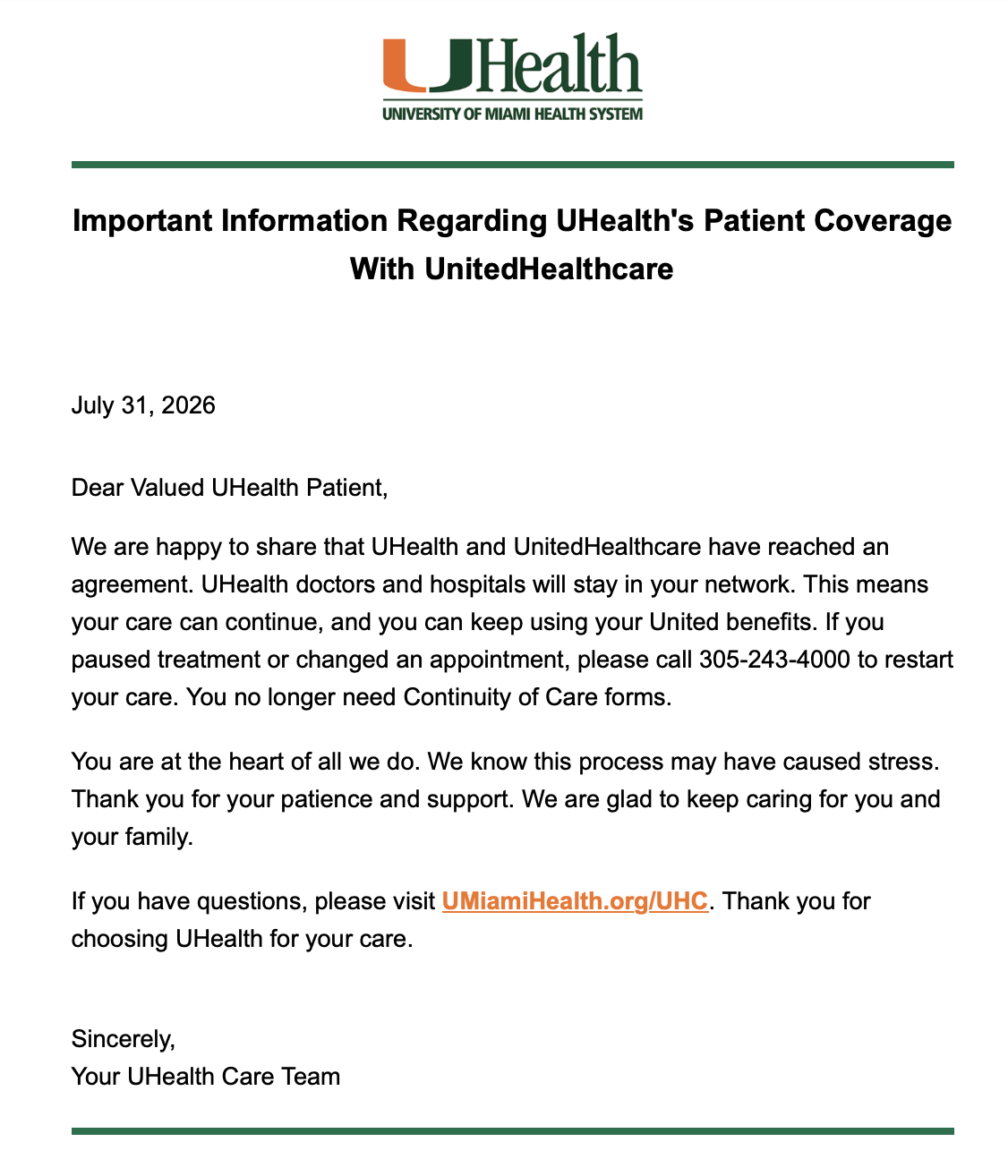
“We are happy to share that UHealth and UnitedHealthcare have reached an agreement. UHealth doctors and hospitals will stay in your network,” UHealth wrote in an email on July 31. “This means your care can continue, and you can keep using your United benefits. You no longer need Continuity of Care forms.”

Still, the parties were unable to reach an agreement for patients using Medicare Advantage Preferred Care Network, who will become out of network under the new agreement.

UHealth and UHC released matching announcements earlier in the week, marking the end of negotiations. Both companies thanked their patients for their patience.

“You are at the heart of all we do,” UHealth’s email continued. “We are glad to keep caring for you and your family.”

Screenshot of the email UHealth sent patients on July 31, 2026. // Screenshot via TMH Staff.

Several plans will keep in-network privileges with UHealth: 

  • Employer-sponsored commercial plans
  • Individual Family Plans
  • Medicare Supplement — which covers the leftover out-of-pockets costs from Medicare plans and the two Medicaid plans making up the UnitedHealthcare Community Plan of Florida
  • Medicaid Managed Medical Assistance — for families and adults who meet income requirements
  • Long-Term Care — for elders at risk of being placed in nursing homes

Members of UHC’s Preferred Care Network Medicare Advantage plans — a Health Maintenance Organization plan with coverage for prescription drugs in Miami-Dade and Broward — are not so lucky.

Members left out-of-network will have to pay out of pocket for all of UHealth’s services, including physicians. Self-pay costs vary depending on the treatment, but for patients undergoing cancer treatment at Sylvester Comprehensive Cancer Center — one of the most prominent institutions within UHealth — the costs could exceed $150,000. 

UHealth services will also only remain in-network for Preferred Care Network patients until Dec. 31, 2026. Prior to renegotiations, UHealth would have been out of network for these patients by Sept. 1, 2026.

According to UHealth, this contract was a unilateral decision. 

“UnitedHealthcare has notified UHealth that it intends to terminate its Preferred Care Network contract,” UHealth announced on its website. 

UHC confirmed there are no ongoing negotiations to reinstate UHealth for PCN plans. 

“We don’t know why PCN wanted to cancel us,” said Joanna Palmer, the executive director of media relations and medical communications for UHealth. “That’s a question for the insurance provider as to their ‘why.’” 

UHC has not yet responded to The Hurricane’s inquiries. 

For patients with a PCN plan facing termination, UHealth still encourages them to keep scheduling appointments with their current care team. 

“Keep your upcoming appointments and continue to schedule new ones,” UHealth said on their website. 

Once these PCN patients become out-of-network, they will only be able to continue their treatment at UHealth with Continuity of Care forms — exceptions that can be granted to patients who are pregnant or have an ongoing treatment for a serious illness. These forms only cover treatment for 30 days, afterward patients would have to switch providers or pay out-of-pocket. 

Applications for Continuity of Care can be submitted up to 30 days after UHealth leaves the network. 

UHC does not disclose how long these applications take to be processed and did not answer questions relating to the topic. 

The Hurricane also reached out to UHealth to understand how it will handle cases that are still being processed after Dec. 31, but did not receive a response. 

For UHC members who would need to request Continuity of Care, it is unclear what the next steps should be. 

UHealth urged PCN members to consider their future lack of in-network access during open enrollment — a period from Oct. 15 to Dec. 7 where people can change, sign-up or drop insurance plans — and offered alternative providers. 

On their website, UHC echoed the benefit of switching providers.

“Current UnitedHealthcare Medicare Advantage members who switch to a new plan for 2027 that has UHealth in its network will have no gap in network access to the health system,” UHC posted. 

For patients who decide to keep their current PNC plan, UHC’s website lists several South Florida health systems that will still be in-network, such as Mount Sinai Medical Center and Memorial Healthcare System.

Miami head football coach Mario Cristobal reportedly agrees to long-term contract extension

Miami head football coach Mario Cristobal has reportedly agreed to a long-term contract extension after leading a recent program resurgence which included a national championship appearance in January.

The extension comes after Cristobal led Miami to one of the most successful and impressive seasons in program history. The Hurricanes finished 10-2 in the regular season in 2025, good enough for a College Football Playoff appearance where the Canes would knock off three top-10 teams before falling to the Indiana Hoosiers in the championship round at Hard Rock Stadium.

Cristobal, 55, is entering the fifth year of the 10-year, $80 million contract he signed after returning to his alma mater in December 2021. The original agreement was set to run through the 2031 season.

Cristobal has steadily improved Miami’s record since taking over the program in 2022. After leading the Hurricanes to a 10-3 campaign in 2024 behind quarterback Cam Ward — who later became the No. 1 overall pick in the NFL Draft — Miami reached new heights last season with its first national championship game appearance in over two decades. 

Cristobal has increased Miami’s win total in each of his four seasons as head coach — five, seven, ten and most recently 13 — and enters the 2026 campaign with a 35-19 overall record at the University.

The Hurricanes are expected to compete again among the nation’s top programs this fall. 

Miami added former Duke quarterback Darian Mensah and wide receiver Cooper Barkate through the transfer portal and returns key offensive contributors, including running back Mark Fletcher Jr. and wide receiver Malachi Toney.

The optimism surrounding the program has been reflected nationally. Last week, Miami was selected as the preseason favorite to win the Atlantic Coast Conference in the ACC preseason media poll, reinforcing expectations that the Hurricanes will again contend for both a conference title and a spot in the expanded College Football Playoff.

Cristobal, a former Hurricanes offensive lineman who played on Miami’s 1989 national championship team, has consistently emphasized recruiting, player development and restoring the program to national prominence since returning to Coral Gables. 

The reported extension signals the university’s continued commitment to that vision after Miami’s resurgence over the past four seasons.

Additional details regarding the terms of Cristobal’s contract extension — such as duration and finances — have not yet been released by the university.

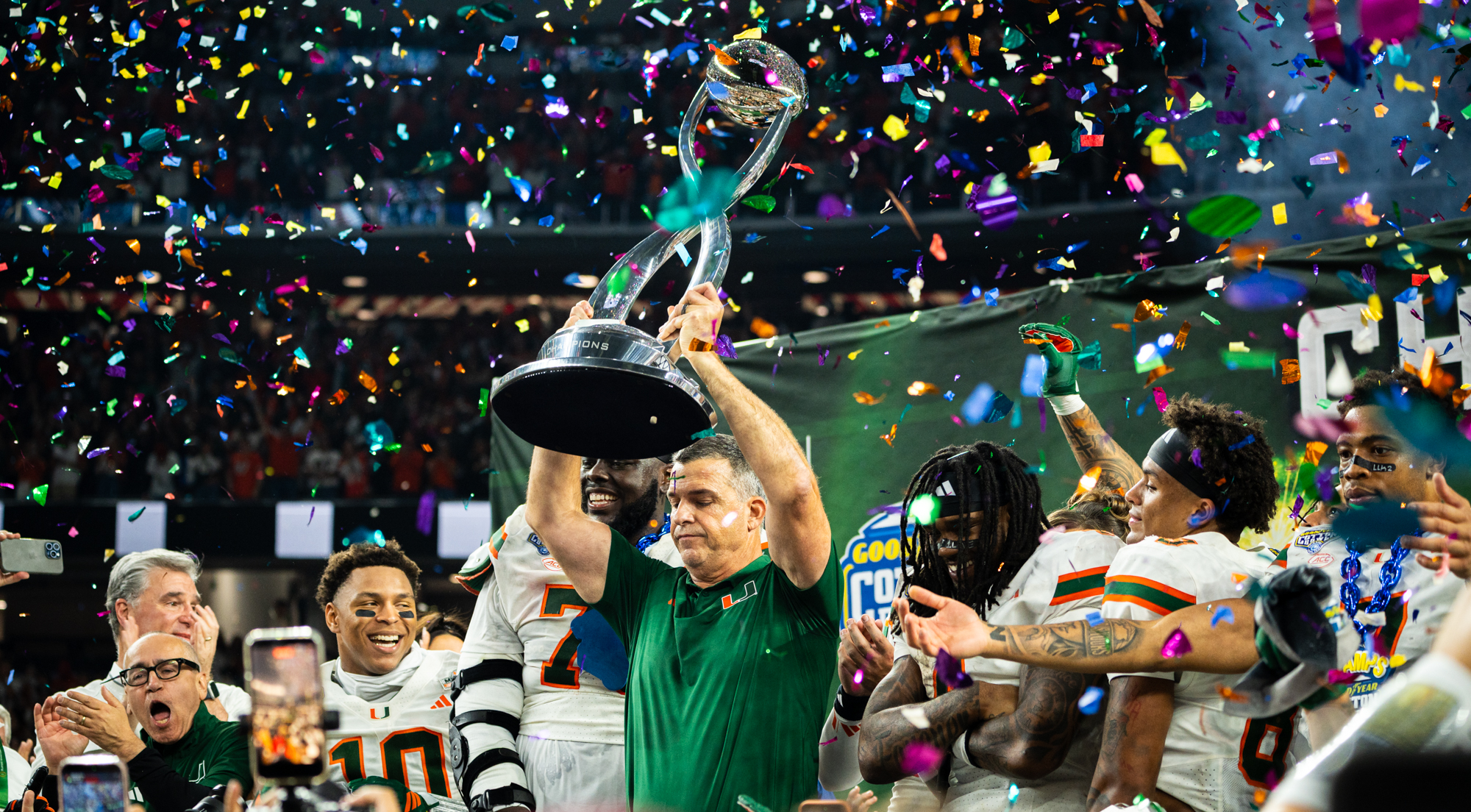
Photo Editor Brian Mulvey // Head Coach Mario Cristobal raises the Cotton Bowl trophy after Miami’s victory against Ohio State University on Wednesday, Dec. 31, 2025.

UHealth recognized in five nationally-ranked specialties for 2026-2027

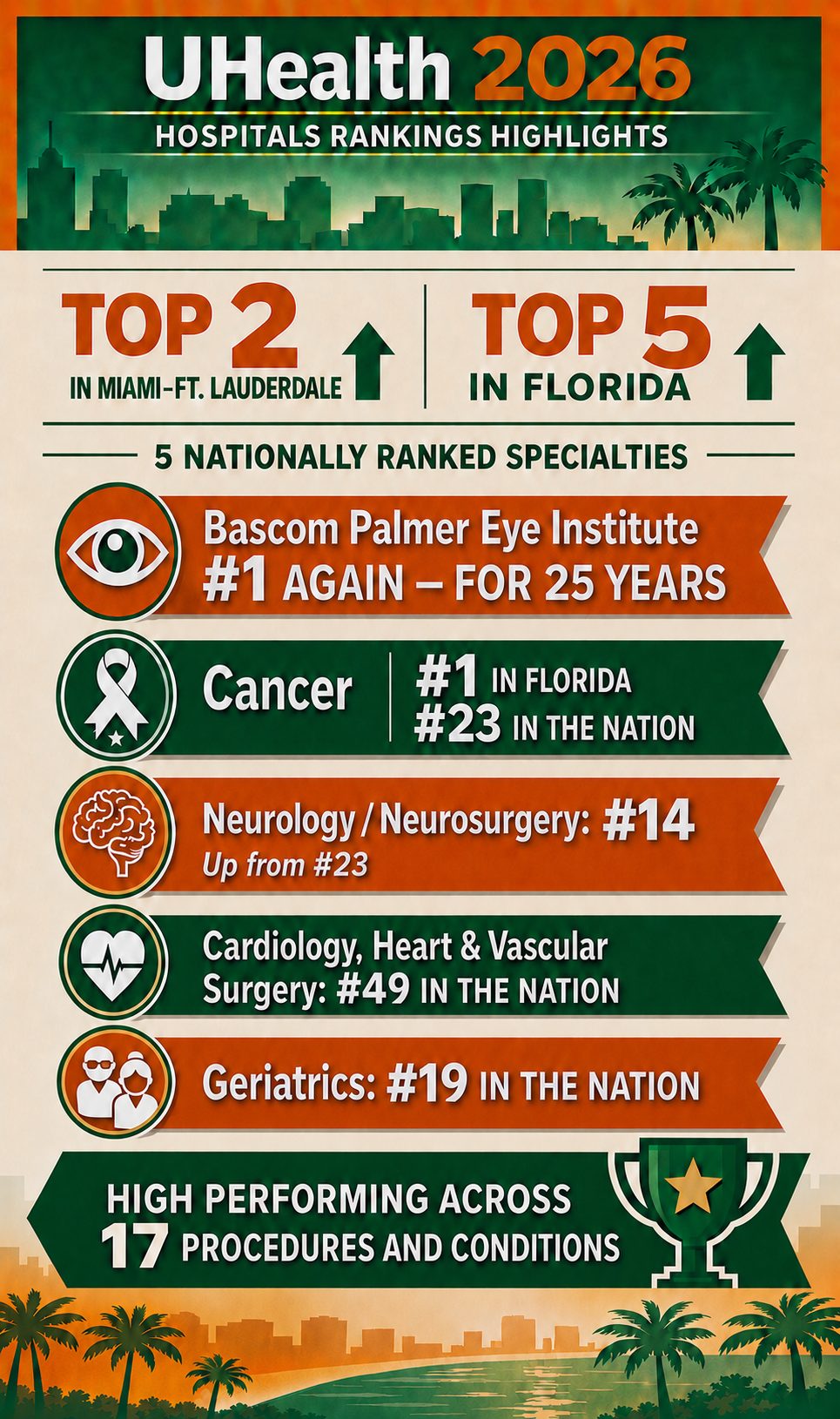
The U.S. News & World Report released its rankings for the 2026-2027 Best Hospitals on the morning of Tuesday, August 4. UHealth — the University of Miami’s Health System — was nationally ranked in five adult specialties, three of which were awarded top 20.

The rankings are as follows:

4,494 hospitals nationwide were ranked for the 2026-2027 year. This was the first year U.S. News recognized statewide specialty rankings in three categories: Cancer, Cardiology & Heart Surgery and Orthopedics. 

Regionally, UHealth ranked No. 2 in the Miami-Fort Lauderdale metropolitan area and No. 5 in Florida.

A data visualization chart of UHealth’s 2026-2027 U.S. News and World Report rankings. // Visual courtesy of the University of Miami.

Dr. Dipen Parekh, the CEO of UHealth, is using these rankings to continue driving the hospital to greater heights. 

“Our physicians, nurses and staff deserve every bit of this recognition, and we will celebrate it today knowing that our work is not done,” said Dr. Parekh. “What is being recognized is a standard of excellence we set long before anyone outside was measuring it. That is what we hold ourselves to, and it is what we will continue to build on.” 

Notably, this was the first time the Neurology & Neurosurgery specialty was ranked in the Top 15. The department was ranked No. 23 last year, and the program has been ranked in the Top 25 for six consecutive years.

Five specialties also earned high performing marks: 

  • Diabetes & Endocrinology
  • Gastroenterology & GI Surgery
  • Orthopedics
  • Pulmonology & Lung Surgery
  • Urology

This places these departments among the top 10% of highest performing hospitals.

Dr. Kymberlee Manni, the CEO of University of Miami Hospital and Clinics, emphasizes that these rankings are a testament to the quality of patient experience UHealth has created.

“It’s about creating a system that consistently delivers excellent outcomes, minimizes complications, prioritizes patient safety and provides a positive experience for every patient,” she said. “That is what we’ve done.”