


After saying “Good Riddance” and revealing “The Secret of Us” on her first two albums, Gracie Abrams returns to music with a third album. “Daughter from Hell” released July 17 with a name of such intensity that deserves to be equaled by the album.
The album is who she is in her entirety – a celebrity adjusting to the blinding spotlight, an anxiously-avoidant person settling herself with a significant other and a daughter trying to be better to her mother.
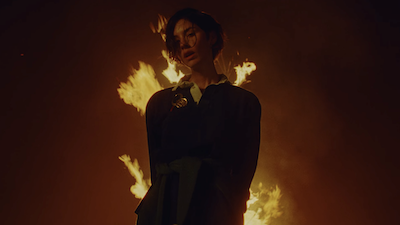
Abrams’ new era commenced with the lead single, “Hit the Wall” released in May. Despite its fiery visuals that signify a stray from her signature soft, bedroom-pop sound, it’s just the same as her previous works.
One of its lyrics, “sooner or later you’ll find out I live in a pattern of breakdowns” could serve as the tagline of this album.
The record may be thematically scattered, but this lyric puts every piece of artwork in one frame. Her feelings don’t follow a linear narrative, but neither is raw human emotion, which she serves to convey in her musical poetry.
From one track to the next she’s delving into current loves then lost loves, from childhood nostalgia to fear of change.
Ahead of its release, Abrams promised to tell a story different from her usual trials and tribulations of romantic love. She revealed the title stems from the difficulty she gave her mother during her teenage years and the strain it put on their now-recovered relationship.
Although this could’ve been a theme to explore throughout the entire project, as she hasn’t delved deeper into it before, she still just barely grazes the surface of it.
The introduction of the titular track maintained the fierce expectation that its name set, with a vibrating electric guitar, but when the verses commence, it’s no different than the rest of her discography – raspy-hushed vocals and acoustic production.
Abrams takes accountability for the hardships she gave her mother when she was a teenager. She expresses her newfound admiration for her, something she wishes she always felt.
It’s sentimental, but it’s missing the potency that the title and the introduction teased.
Songs like “The Knife,” “Good Reason, “Afflictions” and “Minibar” are the most-memorable of the record.
“The Knife” feels like a mashup of “I Love You, I’m Sorry” and “Free Now,” fan-favorites from her sophomore album. It’s familiar, but it’s right. Although it’s a strength of the album, even her strongest work has been done before.
The bridge of “Good Reason” is exactly what you crave from an artist like Gracie Abrams. It utilizes repetition to climactically confess her truest feelings line by line.
Her most exciting songs follow the same format: opening as a crooning ballad, then escalating into a dramatic bridge, but the strength of the punch is minimized by the fact that it’s expected.
Abrams’ songs are inflicted with the habit of sounding the same, and it wasn’t cured with this album.
A love song amid the chaos, “Afflictions” sweetly addresses her boyfriend and actor Paul Mescal. She creatively breaks the fourth wall with the lyric, “I don’t know where to put it all/ I’ll put you in a song” as she attempts to put her love for him into words. She does it the way she knows best: through music.
Abrams sounds most authentic and characterized when she is co-writing with her best friend fellow singer-songwriter Audrey Hobert. Instead of lyrics that feel like a diary that is anticipated to be read by a critical audience, “Minibar” resembles a FaceTime debrief with your best friend after a night out.
For her, that’s just what works. It shines light on the personality that hides in her other songs: Less formalities, more character. Less explanations of her emotions and more expression of them.
Hobert isn’t the only co-writer on “Daughter from Hell.” This album’s collaborators also includes Mescal, who contributed to “Imaginary Friend,” Taylor Swift’s “Folklore” producer Aaron Dessner and Mumford and Sons’ lead singer Marcus Mumford.
All the collaborative input is subtle, but Hobert’s is instantly and undeniably noticeable.
“Daughter from Hell” could have benefited from a connective tissue between each of the themes. Instead, listeners “look at [her] life” through a kaleidoscope of interchangeable music.
As a writer, Abrams has a way with words and emotion that resembles a poet. The lyrics could be read and enjoyed as free-verse poems, but in their full capacity as songs on an album, they prove that her musical talents – from vocals to production – fall short.
Rating: 2.5/5