Fans have plenty of catching up to do before consuming the Marvel Cinematic Universe’s (MCU) next massive crossover. To understand where the universe is heading, we first need to look back at “Avengers: Endgame.”
Following Thanos’s devastating “snap,” the surviving Avengers were left completely hopeless. The Mad Titan had won, erasing half of all life in the universe and turning fan-favorite superheroes like Spider-Man (Tom Holland), Doctor Strange (Benedict Cumberbatch), Black Panther (Chadwick Boseman) and the Scarlet Witch (Elizabeth Olsen) to dust.
The remainder of the team was adrift until Ant-Man (Paul Rudd) suddenly appeared after a 5-year time jump and explained that being safely trapped inside the Quantum Realm protected him from the universal destruction.
Armed with this breakthrough, the heroes approached Tony Stark (Robert Downey Jr.) to do the seemingly impossible: use the Quantum Realm to build a time machine.
Stark succeeded, launching an ambitious “time heist.” The Avengers split up into five different times, New York City (2012), Asgard (2013), Morag (2014), Vormir (2014) and Camp Lehigh, New Jersey (1970). They aimed to retrieve the Infinity Stones, bring them to the present and undo Thanos’s deadly snap.
Everything was going according to plan until a past version of Nebula (Karen Gillan) infiltrated the team and hijacked the machine, pulling Thanos and his massive Chitauri army forward into the present day.
This triggered an epic, massive-scale showdown uniting all of Earth’s greatest heroes against Thanos.
Victory ultimately required the highest cost.
Stark managed to steal the Infinity Stones back, snapping the Mad Titan and his army out of existence, but not without sacrificing his life. Watching the hero who started it all take his final agonizing breaths surrounded by his devastated found family remains a uniquely gut-wrenching farewell to Iron Man.
To bridge the gap and prepare fans for the next phase, Marvel Studios is bringing the blockbuster back to all major theaters on Sept. 25, 2026 as “Avengers: Endgame: Encore.”
This special limited theatrical presentation is designed to tap into the communal magic of the original 2019 release while teeing up the future. The encore features four minutes of unreleased footage that is recommended viewing to understand the transition into the next saga.
Fans who catch the film on premium screens like IMAX or Infinity Vision will be shown an exclusive sneak peek of the upcoming sequel.
In “Avengers: Doomsday,” Victor Von Doom, the absolute monarch and ruler of his birthplace, serves as the main villain. Audiences were first introduced to this iteration of Doom during the post-credits scene of “The Fantastic Four: First Steps”, which established his origins in the alternate universe of Earth-828.
Now, the multiversal conqueror is crossing over into the main MCU timeline.
Robert Downey Jr.’s return serves as an unexpected surprise in the film. He isn’t playing Stark; instead, he is stepping into the cold iron mask of Victor Von Doom. This forces the surviving Avengers to grapple with the psychological toll of fighting a ruthless dictator who wears the exact face of their fallen savior.
Directed by returning heavyweights Joe and Anthony Russo, “Doomsday” promises an unprecedented crossover with a massive roster of established heroes—including Thor, Ant-Man, Shang-Chi, The Fantastic Four and the Wakandan army and Fox’s X-Men.
While “Endgame” was about reversing a singular tragedy, “Doomsday” is about surviving a possible multiversal collapse due to a phenomenon known as an incursion which was shown in the “Doomsday” trailer.
Students walking through the University of Miami’s campus this fall may notice Lake Osceola is a little quieter than normal.
The live music of Hurricane Productions’ Patio Jams is now set to be held every other week, a change that has received mixed reactions among students and performers. The popular music series will still take place, just not every Thursday.
Hurricane Productions, HP, the University’s largest student programming board, recently underwent a restructuring process and now features four programs: HP Collective, HP at the Rat, HP at Nite and HP Live. The restructuring is intended to give each program a more specific focus while allowing HP to offer a wider range of events for students.
HP Live oversees the organization’s musical programming, including Patio Jams, the Homecoming Concert, Battle of the Bands, listening parties and the newly introduced Music @ Mahoney series.
Trinity Vodovoz, this year’s HP Live Lead, says the Fall 2026 Patio Jams lineup has already been released, excluding the headliner. Discussions surrounding additional performance opportunities are ongoing.
HP Live hosted its first Patio Jams of the semester on Aug. 27, drawing more than 250 student attendees, according to HP Live executive board members.
Vodovoz said the new schedule will allow HP to offer additional benefits to students at each event.
“Based on feedback from the student body, we are now able to provide free food or giveaways at each Patio Jams, whereas we were unable to do so for the weekly series,” said Vodovoz.
However, some students involved in the Frost School of Music are concerned that holding the event less frequently could mean fewer opportunities for performers.
Alec Windmiller, a sophomore music business major, said he was disappointed when he heard about the schedule change.
“It’s really nice to hear live music when I’m out walking at least once a week, and now I’ll just kind of have to miss that every Thursday routine,” Windmiller said.
Beyond the experience of attending the events, Windmiller said he worries about what the change could mean for students hoping to perform.
“It’s really hard to get booked for Patio Jams alone because they have a lot of people applying, but this might create even fewer opportunities for our school’s musicians to be shown off the way they would’ve with the previous schedule,” he said.
With fewer events throughout the semester, Windmiller believes the change could limit the variety of performers and music genres.
“Weekly Patio Jams meant there could be a huge variety of performances within the course of just one semester, but with that being halved, I do think that it does place a pretty strong limit on being able to show everything that we have to offer at Frost,” Windmiller said.
Another student performer, Kayla Nguyen, a sophomore at UM in the Frost School of Music, expressed similar concerns.
“I loved seeing my peers perform, and it’s sad that there are fewer opportunities to do that now,” she said.
Nguyen also said the reduced schedule could make performing at the event more competitive.
“I don’t necessarily think the experience of Patio Jams itself will change. I just think it will become more competitive because of the fewer spots available.”
Despite concerns about fewer performance opportunities, both emphasized the importance of Patio Jams to the UM community.
“I think Patio Jams are an excellent way to connect the school music to everybody else on our campus by providing a free space to be able to show off music,” Windmiller said.
Nguyen agreed, describing the events as an opportunity for students to express themselves and experience a wide variety of music.
“I have never seen two Patio Jams that are the same,” she said. “They provide creative outlets for students to perform and to come together as a community.”
Vodovoz said HP continues to value student feedback as the semester progresses.
“Ultimately, we want to create events that students are excited to attend and enjoy,” said Vodovoz.
Regardless of disappointment from the reduced schedule, Patio Jams remains an adamant event on campus that brings together students.
“I’m just glad that we’re still able to offer Patio Jams,” Windmiller said. “I will definitely still be going to every single one.”
For now, students can expect to hear Patio Jams around Lake Osceola every other Thursday, with HP hoping the changes make each event bigger and better for student attendees.
After opening their season with a tournament victory, placing first 1st at the Boilermaker Classic in Kampen-Colser Golf Course in West Lafayette, Ind., the Miami golf team put on another strong showing on Tuesday at the Cougar Classic in Hanahan, S.C.
In a field of 18 teams, the Canes finished 5th while shooting a team score of 856, four over par. In the three rounds, Miami shot scores of 291, 283 and 282. The strong showing on the final day made UM jump two spots in final standings.
Miami’s top performer in the tournament was Anna Behnsen. The junior shot rounds of 73, 70 and 70, with a final score of 213. She finished at even par to tie for 15th on the individual tournament leaderboard.
Sophomore Scarlett Schremmer, who is coming off winning the individual tournament at the Boilermaker Classic, shot a 214 in a similar manner to Behnsen, shooting consecutive rounds of 70 following an opening round of 74. She finished at one over par, placing 22nd on the leaderboard joining Behnsen in the top 25.
Freshman Bella Dovhey and senior Ashleen Kaur finished tied for 30th, both shooting three above par with a final score of 216. Dovhey shot rounds of 73, 72 and 71, while Kaur shot 71, 71 and 74.
Finally, Olivia Grønborg finished a rough tournament outing tied for 81st, shooting rounds of 77, 79 and 71 for a final score of 227, 14 over par.
The Hurricanes will be back in action at the Golfweek Red Sky Classic Sep. 21 to 23.
The felony charges against Miami Hurricanes running back Jordan Lyle were dropped as of Sept. 9.
Lyle was arrested last month on a second-degree felony charge of aggravated fleeing or eluding a law enforcement officer and a second-degree misdemeanor of reckless driving. The alleged incident of reckless driving occurred in Sunrise, Fla. in July.
Only the felony charge was dropped. At the time of publishing, Lyle is still being charged with the misdemeanor.
The Junior running back was unavailable for Miami’s season opener against Stanford last week, but the the Canes still won 45-6. His status remains uncertain heading into Miami’s home opener tomorrow against FAMU at 8 p.m.
For the previous coverage of Lyle’s situation click here.
After a successful spring with nine selections in the 2026 NFL Draft, the 2025 Miami Hurricanes will have their presence felt around the league for the first time this week.
With the NFL season beginning on Wednesday, Sept. 9, in Seattle Wash., let’s take a look at the next generation of the Canes that are ready to make their mark in the pros.
Francisco Mauigoa: OL New York Giants
Aside from some slight injury concerns this summer, Miami’s cornerstone tackle seems to be making the jump up to the NFL pretty smoothly. In the offseason, the Giants have kicked Mauigoa inside to guard and he’s slid perfectly into that spot.
Mauigoa brings the nastiness, physicality and athleticism for the position and with the mentality Miami puts in their offensive line, he should fit perfectly with the Giants. New offensive coordinator Greg Roman is best known for elite running schemes that will allow Mauigoa to bulldoze defenders to create open lanes for running back Cam Skattebo and quarterback Jaxson Dart.
His first test is Sunday night against the Dallas Cowboys at MetLife Stadium with star defensive tackle Quinnen Williams one of his primary matchups.
Reuben Bain Jr.: DE Tampa Bay Buccaneers
It was a surprise to all Hurricanes fans when they saw the program’s best player and defensive anchor Reuben Bain Jr. slide all the way to the middle of the first round at pick 15. Through the preseason, Bain is showing that he could make a bunch of teams regret that decision.
In a preseason game against the Kansas City Chiefs, Bain made a hump move and nearly shoved the opposing offensive lineman away from the play, getting raves from the best in the NFL.
Against the New York Jets during joint practice, Bain totaled three sacks against former first-round pick Armand Membou and a talented New York offensive line.
Even more so, the mentality that had Bain keeping track in a notebook of his motivations still seems to be there.
“His professionalism has been off the chain, and his intelligence to the game, and his work ethic has been outstanding and you forget he’s a rookie because you rarely have to correct him or get on him,” Buccaneers Head Coach Todd Bowles said.
Bain will look for his first NFL sack against Joe Burrow and the Cincinnati Bengals on Sunday afternoon.
Akheem Mesidor: DE Los Angeles Chargers
Mesidor might be in a rotation with veterans Khalil Mack and Tuli Tulipolotu, but he flashed in limited action throughout this preseason. From coaches though the ability to play in rotation might be very beneficial for Mesidor and sounds like he’ll fit right into the Chargers plans.
“Hopefully, he can wreak havoc on the passers as we get into those passing situations and show his toughness, his grit, in the run downs, too,” said Chargers defensive coordinator Chris O’Leary. “It’ll be exciting to see how he develops through the year, too, especially being around ‘K-Mack’ and Tuli. It’s going to be fun to watch his growth.”
With potential double-digit sack guys next to him at all times, Mesidor is surely going to have a go-to running mate just like he did with Bain. And he’s got a chance to feast against the Arizona Cardinals this weekend.
credit: Alexandra Fisher, Co-Photo-Editor // Fifth-year redshirt junior defensive lineman Akheem Mesidor smiles and looks up to the crowd after Miami’s win against Virginia Tech on Sep. 27, 2024 at Hard Rock Stadium.
Carson Beck: QB Arizona Cardinals
It’s been a while since Canes fans have seen Beck since his outstanding performance in the Hall of Fame game. Starting the preseason off on fire, Beck lit up the Carolina Panthers for 188 yards and a touchdown, throwing a few strikes downfield.
A rib injury has limited him since, so throughout the preseason he wasn’t allowed to get an encore to his standout performance. That being said, there’s a high chance Beck will get some time to shine during and get regular season action.
In a division with three playoff teams from last year, the Cardinals are viewed as very far away from the playoffs and by the mid to late point of the year there’s a chance Beck gets his time to shine.
Markel Bell: OT Philadelphia Eagles
Bell is likely a lock to not see meaningful snaps throughout this year, but don’t be surprised if he’s a full-time starter come next year. Bell was praised throughout the offseason for the leaps and bounds he’s taken in the Eagles offensive line room. Particularly drawing praise from a future NFL Hall of Famer he could replace next year.
“He’s one of the best rookies I’ve been around, just as far as in the playbook, you know, no complaining,” LT Lane Johnson said. “Haven’t heard him complaining one time. And just he’s always asking questions. So just a really mature young man.”
So while you might only see Bell in some jumbo packages and helping with the tush push this year, you can almost lock in a big role for him next year.
Jakobe Thomas: S Minnesota Vikings
Thomas unfortunately has dealt with injury all throughout camp limiting him practice snaps. He’ll likely be someone to catch later on in the season as he gets caught up to speed.
If this season does effectively become a redshirt season for Miami’s hard-hitting safety, he has a perfect guy to learn from coming into the fold. Veteran safety Harrison Smith announced just a week before the season that he was returning to the Vikings on a one-year deal. As Thomas works to see the field and make an impact, he’ll have a great opportunity to learn under a Vikings legend.
Keionte Scott: DB Tampa Bay Buccaneers
Another surprise faller in the draft, Scott is continuing to play with his hair on fire with the Buccaneers. Scott flashed everything through his preseason action — sticky coverage, physical tackling, and the ability to make plays flying around the field.
Scott’s only issue seems to be when Tampa will let him off the leash. Right now, he’s in a fight for the starting nickel cornerback spot with Jacob Parrish and Benjamin Morrison. Under Bowles, the Buccaneers always rank on the higher end in blitzing and that lines right up with what Scott does best.
“That’s definitely something I prioritize in my game, especially being a DB,” Scott said. “My goal is to just get back there and cause a mess, just to help those guys back there, too.”
If you’re a Dolphins fan and checked out for the year, I would definitely recommend tuning into Buccaneers games to see Scott and Bain make plays.
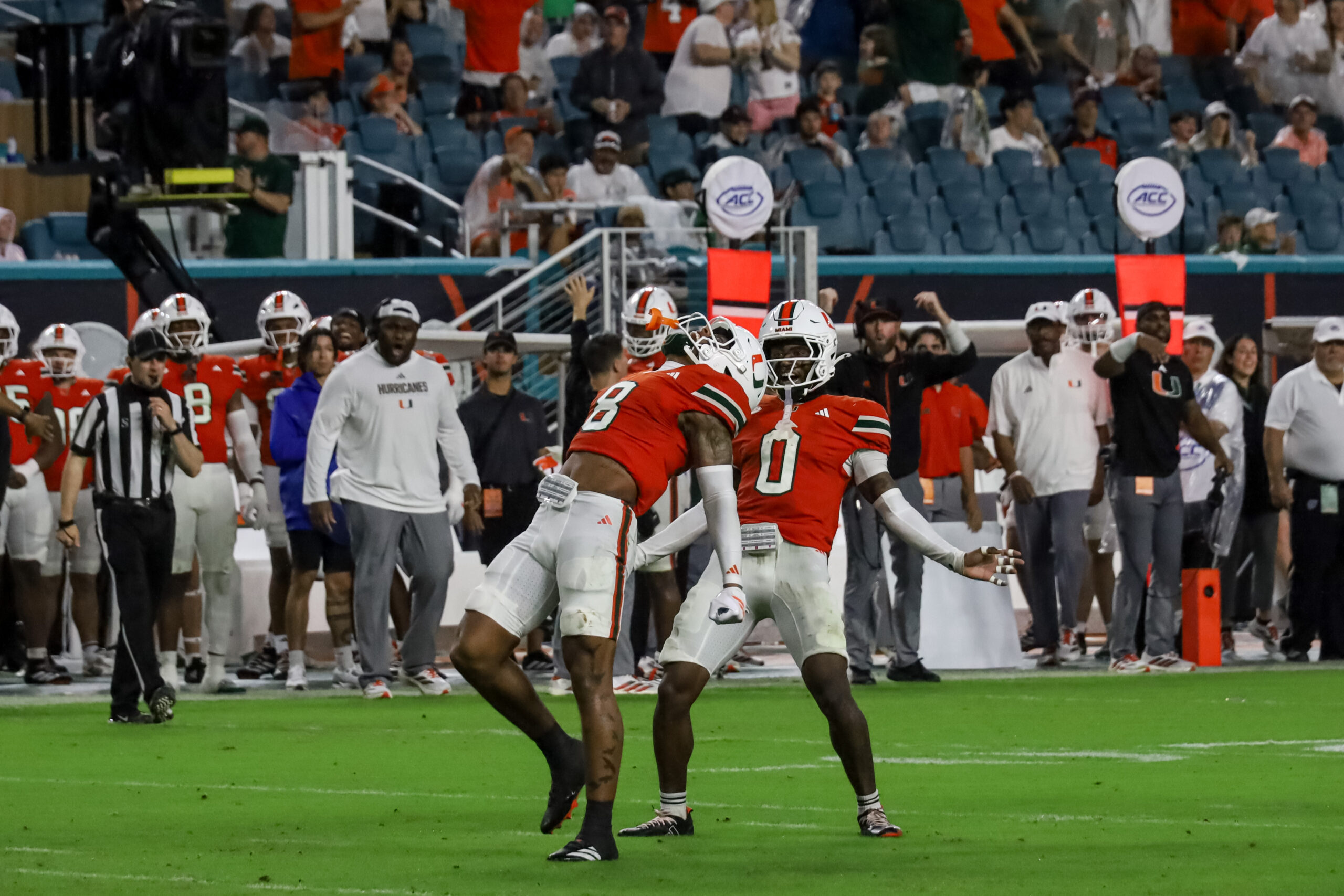
Makena Wong, Photo Editor, Fifth-year senior defensive back Jakobe Thomas (8) and sixth-year redshirt senior defensive back Keionte Scott (0) celebrate after tackling University of Florida player in second quarter on Saturday, Sep. 20, 2025.
Anez Cooper: OG New York Jets
Anez was the rock in Miami’s offensive line for four years, and while he’s currently on the injured reserve, we could see him be the same for this Jets offense. Cooper was spotless in his lone preseason action while posting a 90.9 PFF grade and not allowing a single pressure.
Like Mauigoa, the nastiness and toughness in run blocking stood out and when the time comes this year he could easily rotate in for some significant snaps.
The Jets have some locks at tackles with Membou and Olu Fashanu, but on the interior Cooper could easily find himself with some productive snaps once he’s activated off of IR.
CJ Daniels: WR Los Angeles Rams
Fourth in catches this preseason, Daniels made the most of his opportunities highlighted by a six catch, 68-yard performance.
Daniels is built to a tee to what the Rams want to do: Showcasing good hands, a willingness to block, and a role player’s mindset to give everything you have to the team. Most importantly, Sean McVay noted his maturity, something Canes fans saw all season long as Daniels embraced being the veteran to a group of younger receivers.
The Rams third guy could be a rotation all season long but Daniels can easily find himself playing some big snaps in big games just like last year.
All around the NFL, these guys impressed and showed out to earn their roster spot and a consistent compliment to them all from coaches around the league.
Throughout the offseason, it was a theme that was consistent with every rookie that came from Greentree, a notion that each one of these players shows a readiness for the next level, maturity, humility and an ability to learn.
While their success might vary in the long run, that opinion being held of these Miami’s guys goes a long way to showing what this program has built and is continuing to build as the Hurricanes look to dominate the NFL once again.
Wide receiver CJ Daniels reels in a one-handed touchdown against Notre Dame. Photo credit: Alex Muniz
Walking to class while the sun is still out and leaving in the pitch-black of night has become a reality for University of Miami students stuck with night lectures.
Three-hour classes that meet once a week and run until as late as 9:20 p.m. can take up a huge part of a student’s day, leaving little time or energy for anything beyond the classroom.
While night classes can provide students with flexibility when building their schedules, that flexibility disappears when a required class is offered only at night. UM should not only have one section of a course that meets at night, taking up someone’s entire evening.
The University should rethink how these classes are structured and when they are offered, especially when some three-hour classes begin at 6:35 p.m. and do not end until 9:20 p.m.
Three-hour classes should include a mandatory break, and UM should offer multiple sections instead of only offering one required course that is scheduled to end as late as 9:20 p.m.
Last semester, I had two three-hour classes on Tuesdays: one at 8 a.m. and the other at 2 p.m. Even though I found both of those classes interesting, there came a point when my brain simply started to check out. By the last hour, I found myself fighting to stay focused.
Of course, I understand why three-hour classes exist. Having a class meet once a week rather than multiple times can make the schedule more manageable, and some students prefer to get everything done in one day. Meeting only once can also give students more flexibility throughout the rest of the week.
But sitting in the same classroom for three consecutive hours is a lot to ask of students.
“I chose the shorter classes, so people don’t have to sit as long,” said Professor Anthony Musto, who teaches a class about physical activity and is the executive director of the Wellness Center.
Beyond the health implications for sitting for extended periods of time, another major issue is the quality of learning students receive in these longer classes.
A 2013 study on attention suggests that staying engaged for longer periods is not always easy. The study examined attention and retention among undergraduate students watching a 40-minute lecture. Researchers found that attention and retention of material declined over time.
The study lasted only 40 minutes. Now, multiply that by nearly four times and you have a three-hour lecture.
This is where a break becomes important. I am not arguing that UM needs to eliminate three-hour courses altogether. But, if students are going to spend three consecutive hours in one classroom, there should be an actual opportunity to step away, eat a snack, use the bathroom and reset before returning to the material.
As someone who tries to go to bed somewhat early, I cannot imagine walking out of class at 9:20 p.m. and knowing my night was not over yet. By the time students leave, they may still need to eat dinner, finish homework, study for exams, prepare for the next day and get enough sleep.
An article published by The Miami Hurricane in November 2025 reported that students whose classes end around 9:20 p.m. can have trouble getting dinner before the dining halls close, adding another problem to an already long school day. For students who rely on campus dining, missing dinner may mean going without a meal or spending money on ordering food.
One student quoted in the article said that her Tuesday class ends at 9:20 p.m. and that she does not eat dinner that night because she cannot afford to order food.
There is also research that more directly relates to evening learning. A study of 78 undergraduate students conducted by researchers at Baylor University compared students who learned from a college-level lecture at noon with students who learned at 7:30 p.m.
The researchers did not find that learning in the evening itself significantly hurt test performance. However, they found that shorter sleep and later bedtimes explained 13% of the variation in students’ test performance.
Sleep and later bedtimes can affect how well students perform academically. For a student leaving class at 9:20 p.m., that is worth considering.
College schedules are complicated, and students have different responsibilities outside of academics. For some students, later classes actually are the best option.
“I chose to take afternoon classes since I work multiple jobs that typically occur during the day, so afternoon or night classes allow me to work during the day before my classes,” said Megan Belk, a sophomore studying accounting and finance.
Not every student wants an 8 a.m. class. Some students work during the day. Others have internships, club meetings or other responsibilities that make afternoon and evening classes more convenient.
A 2023 study published in Nature Human Behaviour examined data from tens of thousands of university students and found that attendance was about 10 percentage points lower for 8 a.m. classes compared with later class times.
Clearly, an 8 a.m. class and a 9:20 p.m. class pose two different scenarios. But studies support that class timing matters. But both show why class timing matters
Students’ sleep, attendance and academic experiences can all be impacted based on when they are expected to be in the classroom.
Alyssa Ziccardi, a sophomore studying communication sciences and disorders at Pennsylvania State University, said she does not support requiring night classes.
“I personally do not take any night classes and neither do my friends,” said Ziccardi. “I think that night classes should only be for individuals who need to take them, like adults who work and have kids, not 20-year-old students.”
Students need flexibility. But flexibility should not mean expecting them to spend their entire evening in a classroom.
At some point, three hours becomes too long, and 9:20 p.m. becomes too late.
For a University where students pay very high tuition, you would assume that its on-campus fitness center would be top of the line.
UM’s Herbert Wellness Center has plenty going for it. Its basketball courts, racquetball courts and other recreational spaces are useful and generally well-maintained. However, several minor details — from the towel requirement to cramped lockers and narrow showers — make the facility feel less impressive than it should.
Let’s talk about the towel policy.
To work out, you are required to bring a towel to the gym for “sanitary reasons.”. The Wellness Center policy states you must wipe down equipment when you are done with a workout.
If you don’t have a towel, you have no other choice but to buy a towel at the Pro-Shop, located in front of the racquetball courts. Towel prices range from $1 for daily purchases to upwards of $20 for the entire semester.
The towel policy is ridiculous, considering two things.
For one, there are multiple stations with disinfectant wipes throughout the gym, which would clean equipment far better than a dirty towel would, according to a study conducted by Private University Products and News.
Secondly, the policy that you must enter the gym with a towel or else be forced to pay the University even more money than you have already paid them is absurd in and of itself.
Right next to the Pro-Shop are the locker rooms, which are another issue.
While daily locker rental is free, they are way too small. If you’re a student with a busy day and need a larger locker with extra clothes, shoes and shower necessities, slightly larger lockers are available.
However, despite their larger size, certain duffle bags still need to be shoved inside to fit. I carry a relatively large bag that holds my extra pair of shoes, clothes, towels and other toiletries, and I have had to use excessive force to get it into the locker.
The locker room showers also present a big challenge.
The showers are very narrow and small, meaning you either have to be an average-sized person or, if you’re on the taller side like myself, you are out of luck. You have to angle yourself to get a proper shower, and they aren’t necessarily the cleanest bathrooms on the planet.
Another area for improvement is the room for core exercises. There are not enough mats, the fake grass feels weird and there are only a handful of medicine balls for weight training. This is also not helped by the fact that the room is designed so that sound echoes off the walls, which means that if someone even whispers, everyone working out is privy to a full-on conversation.
The Herbert Wellness Center has the potential to be a great student facility, but its outdated policies and cramped spaces hold it back. For what students pay to attend UM, the Wellness Center deserves a facelift.
They’re green, scaly, peculiar creatures. It’s not uncommon to see these giant, dragon-like lizards roaming around Lake Osceola.
But what students may not realize is that these reptiles aren’t supposed to be here at all.
UM’s iguanas have become an ordinary part of campus life, making it easy to overlook the toll they take on our surrounding community. Iguanas threaten Miami’s native wildlife and infrastructure.
Preventing that damage from escalating starts with changing our own behavior. UM students can help by keeping food away from iguanas and avoiding interactions that encourage their presence on campus.
“I think they are super cool and nice to look at when walking to class. I do not think about their impact on our environment,” said a sophomore psychology major at UM.
With native ranges in Central America, parts of South America and some Caribbean islands, these iguanas are far outside their natural territory.
They’ve been well-established since 1964, when a pet dealer reportedly released more than 300 iguanas around Miami.
Today, iguanas are just one part of a much larger invasive species problem. South Florida is considered the region with the most invasive species in the world — including peacocks and Muscovy ducks — according to a 2023 study by researchers at UM.
Sidney Blumenfeld, the conservation ecology subcommittee chair for Student Government’s ECO Agency, spoke about the local impact of invasive species.
“A couple of on-campus examples would be the instance of green iguanas eating newly planted native firebush in one of our native gardens as well as the time they ate the mangrove propagules that were a part of the mangrove planting initiative,” Blumenfeld said. “My biggest concern about having a large population of green iguanas on UM’s campus is that it would make it even more difficult to maintain our gardens.”
Sharing the walk to class with an iguana or two can feel like a harmless part of the UM experience, but their natural behaviors come at the expense of Florida’s native wildlife.
As iguanas dig and take over burrows, they displace gopher tortoises and prey on their young. This predation compounds existing risks to gopher tortoises, a threatened species whose burrows provide shelter for more than 350 other animals.
Those involved in campus conservation efforts may see this damage firsthand, but it can go unnoticed by the average student.
“I typically never see them eating other animals or plants, so I guess I did not really think about their effect on the environment,” said junior Lauren McDonald.
For people living in Miami, the consequences of the expanding iguana population extend beyond wildlife and into the infrastructure beneath our feet. The burrows female iguanas dig to lay their eggs can weaken the ground beneath sidewalks and other structures students rely on every day.
Even after noticing an unstable sidewalk on the way to class, most people would never think to trace the issue back to the iguana roaming beside it.
“I did not realize they were negatively affecting infrastructure,” McDonald said.
She added that learning about the damage changed the way she saw their role in our environment’s ecosystem.
Iguanas are not inherently bad — they are just reptiles exhibiting their natural behaviors in an unnatural environment. Their introduction is not ours to undo, but its consequences are still ours to face. Students might not have to repair the infrastructure themselves, but surrounding communities pay the price.
Reducing that burden begins with understanding how everyday choices can contribute to their continued presence.
Yet recognizing that burden can depend on a person’s past experiences with the animals.
“There are some people whose experience with green iguanas consists of admiring them basking on rocks in the sun, bobbing their heads. In that situation, those people may not even think about the iguanas’ environmental impact,” Blumenfeld said.
For those who grew up in South Florida, familiarity can make them fade even further into the background.
“I don’t think much when I see them because I’m so used to them,” said senior Nicole Jahangani, who grew up in the area.
Managing iguanas at UM is not a task for students to take on alone, but this does not make them powerless.
They can help by avoiding behaviors that encourage iguanas to remain on campus, such as feeding them or leaving behind food and open snack bags.
These small choices can help students avoid contributing further to an existing problem.
However, the responsibility to prevent invasive species issues from worsening does notjustify cruelty toward animals. Florida’s anti-cruelty laws still apply to iguanas, even though they are invasive and otherwise unprotected.
Feeding an iguana might feel unique to life in Florida, but behaviors like this can encourage their populations to continue spreading. Not only can this threaten our own safety, but it can threaten theirs, too.
At UM, iguanas remind us how serious environmental problems can subtly blend into the scenery. After seeing them bask beside Lake Osceola day after day, it becomes easy to mistake familiarity for belonging.
Iguanas might be here to stay, but we do not have to normalize an environmentally destructive invader.
We cannot reverse their introduction, but we can stop feeding them, attracting them and treating their continued spread as inevitable. The longer we continue to sit back, the closer we inch toward making today’s damage tomorrow’s normal.
With multiple football games scheduled mid-week or conflicting with travel plans, Miami fans are in for a rough ride this season.
To help students support the Canes through these inconvenient dates, the Rathskeller — Miami’s on-campus bar — will stream the games live and host watch parties throughout the 2026 season.
According to the University, the Rat plans to stream at least five of the Hurricanes’ games:
Sept. 10 at home versus FAMU
Sept. 18 at Wake Forest
Sept. 26 at home versus Central Michigan
Oct. 3 at Clemson
Oct. 31 at UNC, only if it’s a day game
Nov. 7 at Notre Dame
ACC Championship, if UM qualifies
Typically, the Rat only stays open until 8 p.m. during the week and is closed on the weekends. But, given the number of games that will run past closing time, UM is making exceptions for the benefit of on-campus Canes fans.
Miami’s home opener against Florida A&M, for example, is scheduled for Thursday, Sept. 10, at 8 p.m. With Hard Rock located more than 45 minutes from UM’s Coral Gables campus, attending could become particularly difficult, especially with traffic.
While the University offers free bus transportation, the hike to Hard Rock could leave students facing a difficult choice: Skip their afternoon classes to make the trip or miss the game. For Canes looking to avoid the hassle of commuting, watching the game at the Rat provides another option — students can grab a bite to eat, settle in after class and cheer on their team alongside their peers.
For the Central Michigan game on Family Weekend, the Rat will host a Pre-Party for Pre-registered Families as part of the Family Weekend Program. General admission will start 15 minutes before kickoff and will remain open throughout the game.
However, plans have not been put in place for other complicated dates.
On either end of Thanksgiving break, Miami is hosting its last regular-season games against Virginia Tech (Nov. 21) and Boston College (Nov. 28). With many students expected to travel for the holiday, support at both games could be low.
However, the Rat plans to open for the ACC Football Championship if Miami is playing.
Opening the Rat for these matchups could offer students a much-needed break from studying for final exams and recreate the home-team atmosphere Canes fans experienced during this past March Madness tournament.
The NCAA’s interim NIL policy took effect on July 1, 2021, starting the process of turning college football from an amateur sport into something resembling a professional league.
Fans never thought they would see the day that football players tried to leave the NFL for a college roster, but, strangely enough, that’s what’s happening.
Hundreds of former collegiate athletes flocked to the court system in search of temporary restraining orders that grant them an extra year of eligibility — including former Hurricanes like Wesley Bissainthe and Alex Bauman.
Arguably, the face of the recent chaos has been former Ole Miss tight end Dae’Quan Wright.
Wright dressed for a preseason game with the Browns on Aug. 22, was cut on Aug. 23, and then committed to and enrolled at LSU on Aug. 24.
In doing so, he became the first player to ever return to college after being on an NFL roster.
Now, Wright can still play football at a high level and could make more through NIL than he would as an NFL rookie.
So, how did the sport get to the point where going back to college can be more financially attractive than playing professional football?
After years of receiving indirect endorsements, on July 1, 2025, following the House v. NCAA antitrust settlement, Division I schools were allowed to provide direct financial benefits to athletes through a new revenue-sharing system, turning student-athlete life into more of a full-time job.
Now, the best college players are getting paid well north of $5 million, while the NFL rookie minimum is $885,000.
David Lebowitz, Photo Editor // Redshirt Junior Quarterback Darian Mensah leaps into the air as he comes onto the field versus Stanford on Sept. 4, 2026 at Stanford Stadium
The transfer portal has become a free agency.
College players rotate from school to school every year based on money, coaching and team fit, factors that used to be the main influence for only pro players. The Hurricanes have arguably embraced this situation better than anyone else, reaching into the transfer portal to pluck their last three quarterbacks, with an estimated roster cost north of $40 million.
Not only can players quickly switch schools, but they can now move from professional football back to college.
College athletes deserve to be paid for their play, but so far the NCAA has handled the situation poorly.
The NCAA’s new five-year eligibility plan has already led to lawsuits, and courts have temporarily allowed certain players from the 2022 recruiting class to regain eligibility.
In opposition to the courts, the SEC and Big Ten have sought to prevent players who have signed professional contracts or declared for the professional draft from returning to college. Judicial courts have pushed back against those restrictions.
If college football conferences can’t control who plays, then who’s in charge?
Thanks to NIL and the changing economics of college football, fans have also seen the death of the Power Five, with more conference realignment seemingly inevitable. The talent pool is becoming increasingly lopsided, leaving many fans worried about the future of a sport once built on school pride and passion.
However, NIL isn’t all bad; it has also allowed these players to capitalize on their value and take more control over their careers.
NIL hasn’t ruined college football; it has simply revealed that college football is operating like a professional business without professional rules.
A few years ago, the path was simple: play college football, get drafted and become a professional. Now, we’ve seen players bounce around from school to school, in some cases for nine years, go from college to the NFL, only to then potentially decide that college is the better financial option and return to it.
The old definition of college football no longer exists. If the NCAA doesn’t get a handle on the sport it governs, football fans could see it spiral further out of control.
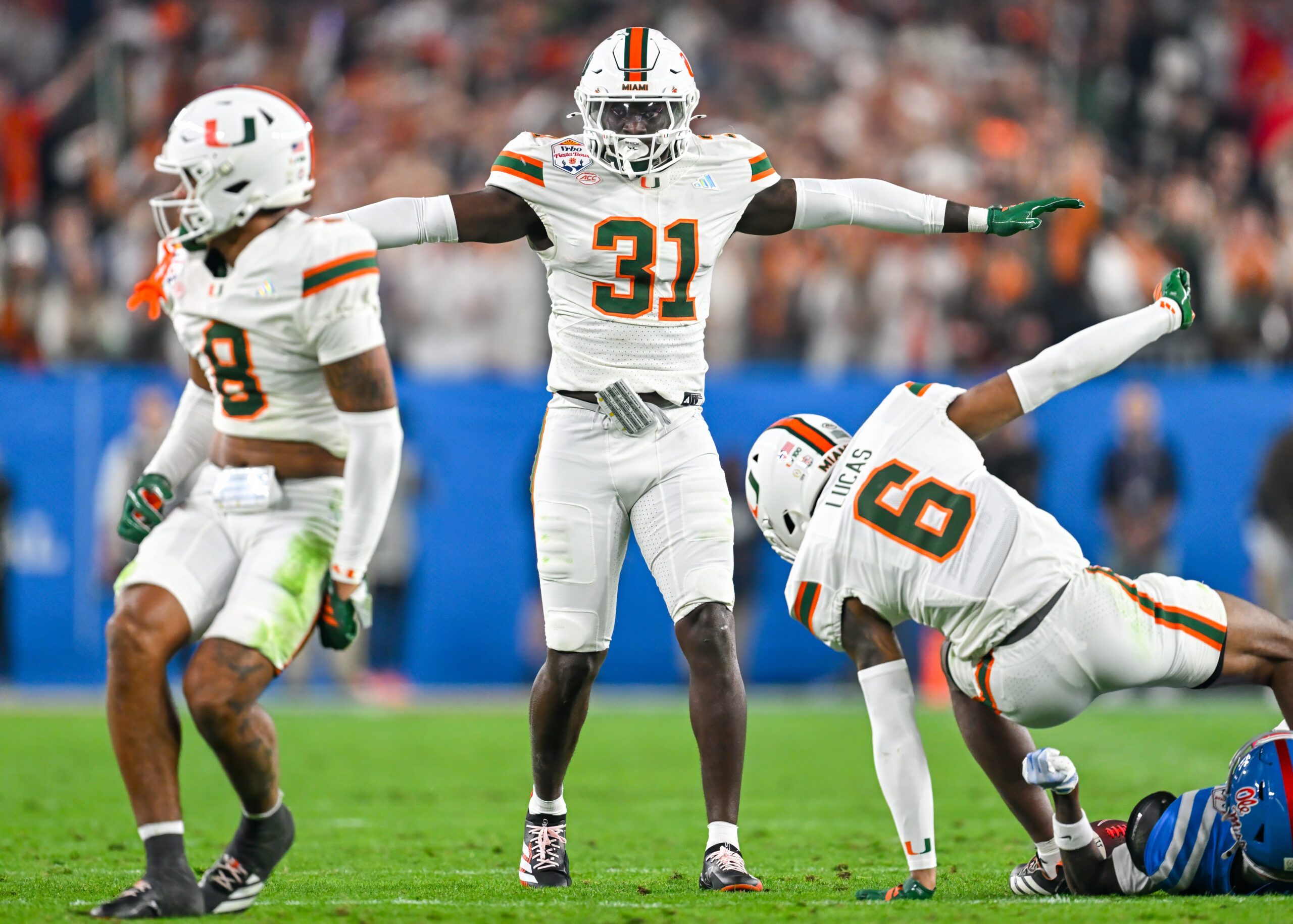
Photo Credit: David Lebowitz, Photo Editor // Miami linebacker Wesley Bissainthe celebrates a pass breakup from cornerback Xavier Lucas in the Fiesta Bowl against Ole Miss on Jan. 8, 2026