


Water laps at Miami’s edges as sea levels continue to swell, and UM alum and eco-artist Xavier Cortada is determined to raise awareness.
Miami’s population is the fourth most vulnerable to sea level rise in the world, according to the World Resources Institute. Predictions from the National Oceanic and Atmospheric Administration indicate that with “high greenhouse gas emissions and rapid ice sheet collapse,” sea levels for the U.S. will rise more than seven feet by 2100.
For areas like Miami Beach, which has an average elevation of 4.4 feet above sea level, this data is staggering.
Cortada was born in New York and moved to Miami at the age of three. After spending the majority of his life in South Florida, he graduated from UM with three degrees: a Bachelor of Arts in 1986, a Master’s in public administration in 1991 and a Juris Doctor from the School of Law in 1991.
He launched “The Underwater,” a series of interactive public art installations, in 2018 to spark community interest and conversations about sea level rise.
“My time at the University of Miami was foundational. That interdisciplinary training shaped how I approach problems — connecting knowledge across fields and applying it in the real world,” Cortada said. “Just as important, being embedded in Miami made the climate crisis tangible.”
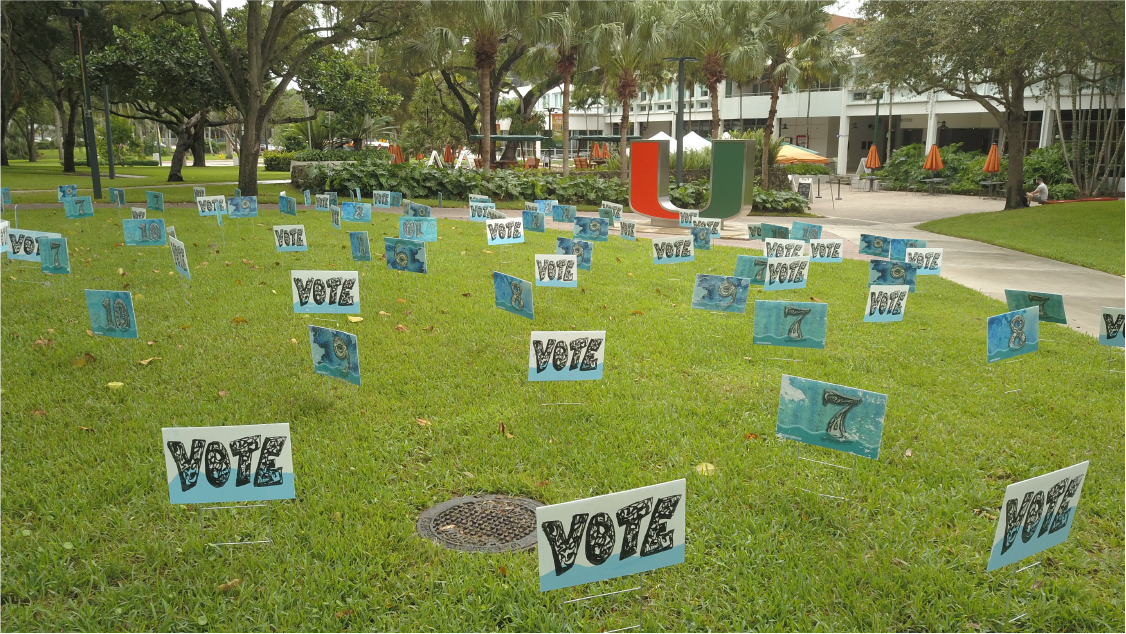
In 2020, Cortada collaborated with UM’s ECO Agency and Climate Reality Project on the “Underwater Vote” installation. Signs reading “vote” and others featuring the number of feet an area was above sea level were placed in three locations across UM’s campus: Lakeside Village, the “U” statue and the Foote Green.
Cortada designed this project to “engage students directly.”
“We installed yard signs across campus marking elevation above sea level to make climate risk visible in a place students experience every day,” he said. “The project encouraged civic participation, asking [students] to consider thinking long-term about the future they are inheriting and shaping when casting their votes in elections.”
The majority of the yard signs were placed at elevations ranging from seven to ten feet. If NOAA’s predictions are accurate, these elevation levels mean that parts of UM’s campus will be underwater by 2100.
“The Underwater” is made up of three more installations: “Underwater HOA,” “Underwater Florida” and “Underwater Gulf.”
“Underwater HOA,” based in the Village of Pinecrest, was created in 2018 and was a precursor to the larger project. The installation similarly uses painted intersections and yard signs to mark the area’s elevation.
Now, Cortada is collaborating with the UM’s College of Engineering’s Structures and Materials Lab to implement sustainable concrete underwater elevation sculptures — part of “The Underwater” installation — across 261 Miami-Dade County parks.
“This collaboration builds on work I began as a faculty member at UM and as Miami-Dade County’s Artist-in-Residence,” said Cortada. “It was launched as part of the socially engaged art classes I taught when I was a full-time faculty at [UM]. Our students helped deploy and document the early iterations of the project.”
After a sculpture has been installed, the Xavier Cortada Foundation hosts a dedication ceremony at the site. Participants pour water from Biscayne Bay onto the sculpture and promise to work to prevent saltwater from ever touching it again.
“UM students remain central to the work. Many of our interns are current students or recent graduates, and all members of our team — including leadership — began as interns,” Cortada said. “They help implement projects, conduct outreach, and lead educational programming in schools.”
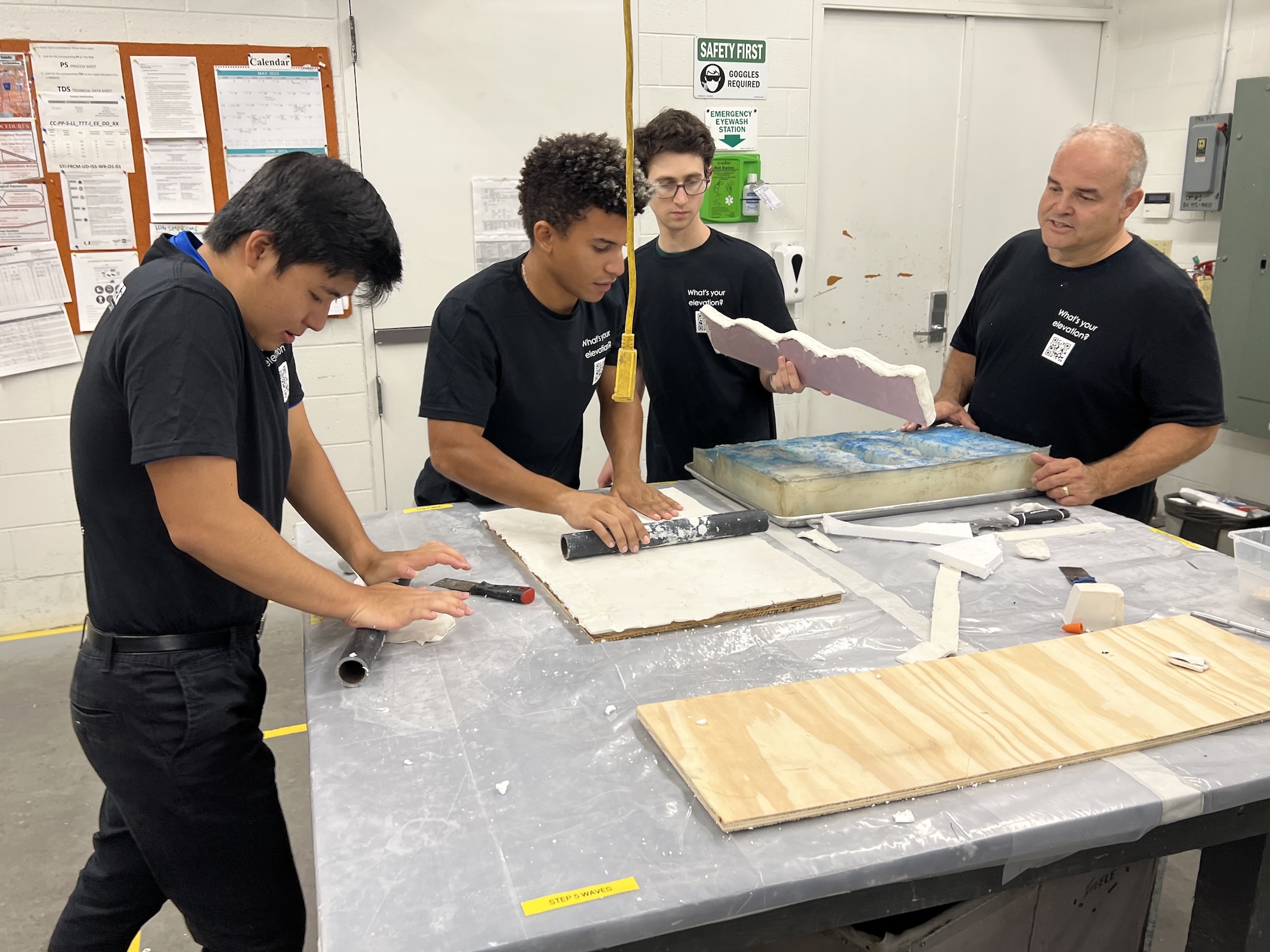
Adam Roberti, executive director of the Cortada Foundation and UM alum, feels that his education at UM shaped how he chooses to communicate about these climate-related issues.
He originally started as a marine biology major, but “decided to shift into ecosystem science and policy and pursue [his] masters, which had a very strong focus on climate communications” after realizing that the biggest threat to the climate was a “lack of political will” to implement available solutions.
Since working at the Cortada Foundation, Roberti and Cortada have made it their mission to keep UM students involved in the cause — including by bringing on students as interns.
For students who want to raise awareness of environmental issues, The Cortada Foundation hosts events to get involved. This semester, interns with the Cortada Foundation are also working to launch the Cortada Climate Collective club at UM.
“Through it, students will be self-directed in organizing art-based projects to engage students and residents in developing creative solutions to our environmental crisis and expanding the reach of Foundation initiatives like ‘The Underwater,’” said Cortada.
To join, Roberti recommends that students email Kiki Lopez Nowotny, the club’s president, and Theresa Pinto, the advisor.
While UM’s course work options are helpful for preparing students for the real world, partnerships like these are also extremely beneficial for students who want to continue being a part of the positive work that the University has done through its alumni.
“UM gave me the academic tools, but it was engaging with the community that made the work urgent and actionable,” said Cortada.