Home Blog Page 18

The Supreme Court’s birthright citizenship decision defends America’s promise

In the week of America’s 250th anniversary, the Supreme Court dealt a necessary blow to President Donald Trump’s agenda with its decision on birthright citizenship. 

In a 6-3 decision, the court upheld the rights outlined in the 14th Amendment, rejecting the executive order Trump signed on the first day of his second term. That order directed federal agencies  not to recognize the citizenship of children born to illegal migrants.  

Writing for the majority, Chief Justice John Roberts wrote: “A child born on American soil and subject to American law was made an American citizen.” 

This sentence alone captures the essence of what the ruling means. Birthright citizenship is not a loophole, but rather one of the clearest promises in the Constitution. 

That promise has deep roots. Roberts added that birthright citizenship can be traced as far back as English common law, where citizenship was based on “right of the soil.” That idea carried across the Atlantic and has become a fundamental part of understanding American citizenship.

The history of birthright citizenship also carries the heavy weight of America’s biggest sin: slavery. In the Dred Scott decision, Black Americans were denied citizenship despite being born in the United States. It was only 11 years later that the injustice of that decision would be undone by the 14th Amendment to the Constitution.

The 14th Amendment was written so that “all persons born or naturalized in the United States” would be granted citizenship. It also added that no state shall “deprive any person of life, liberty, or property, without due process of law; nor deny to any person within its jurisdiction the equal protection of the laws.”

That’s why this ruling matters. While under two very different circumstances, the 14th Amendment was not written for convenience. It was written to make citizenship stronger than politics, prejudice and most importantly, a president’s agenda. 

As an avid Trump supporter and President of College Republicans, I’ll concede on this issue with my friends on the other side of the aisle. The president indeed overstepped his authority by removing the rights of several million Americans, and the court was right to reject it. 

While critics like Justice Clarence Thomas, Vice President JD Vance and Speaker Mike Johnson argue that the ruling “devalues” American citizenship, they forget that the opposite is true. Rewriting the law because of political mood or a parent’s immigration status would devalue citizenship far more than a court ruling. A court ruling that upholds the constitution. 

A nation that celebrates freedom should not spend that same week searching for ways to exclude children born under its laws. The most patriotic decision the court could’ve made this week was as simple as honoring an old promise. 

The court’s ruling reminds us that the country lives up to its ideals not when it narrows citizenship, but when it keeps faith with the people born under its flag.

Miami Athletics partners with Ticketmaster across four sports

Ahead of the 2026-27 athletic season, University of Miami Athletics announced July 1 that Ticketmaster will become the official ticketing partner for Hurricanes Athletics.

Under the partnership, fans will be able to purchase, sell, transfer and access tickets through Ticketmaster.com, MiamiHurricanes.com and the Miami Hurricanes app. The new platform launched Monday, July 6 with a primary focus on football, men’s and women’s basketball and baseball.

The University said the partnership will provide a more seamless purchasing experience and improved fan engagement through Ticketmaster’s digital platform. 

“This partnership strengthens our ability to engage our community, enhance the game-day experience, and build a sustainable foundation for our future growth,” said UM Chief Revenue Officer Jesse Marks. 

Ticketmaster succeeds SeatGeek as Miami Athletics’ official partner. SeatGeek, which began working with the university back in 2023, integrated resale ticketing with Miami’s primary ticketing system.

While Ticketmaster remains the largest ticketing company in the United States, it has faced increasing scrutiny in recent years regarding its dominance of the live entertainment industry.

In 2024, the U.S. Department of Justice and a coalition of states filed an antitrust lawsuit against Ticketmaster’s parent company, Live Nation Entertainment, alleging the company maintains an illegal monopoly over live event ticketing. 

Live Nation has denied these allegations and continued to contest the lawsuit. 

The company has also faced criticism from consumers over service fees and ticket availability, particularly following the highly publicized ticket sales for Taylor Swift’s Eras Tour in 2022, when overwhelming demand caused widespread website failures and prompted congressional hearings.

Despite those controversies, Ticketmaster remains the ticketing provider for thousands of sports and entertainment venues nationwide, including numerous NCAA athletic departments such as Oregon, Penn State and Cincinnati. 

Ticketmaster has stated it will act as a community partner with UM, providing access to Miami’s athletic programs to the youth of underserved communities throughout South Florida.

“Miami Athletics is one of college sports’ most storied programs, and we’re proud to bring our technology, expertise and longstanding presence in South Florida to support Hurricanes fans,” added Ticketmaster’s Executive Vice President and Co-Head of Sports Clay Luter. 

Tickets for the upcoming athletics seasons are available for purchase immediately after the platform’s official launch. 

Miami Athletics’ newest era is underway. And the 2026-27 season doesn’t begin on the field or centercourt, but rather with the fans who fill the stands.  

But whether the new partnership delivers the seamless experience the university is promising will be up to Canes fans to decide as they gear up to purchase tickets to this year’s events. 

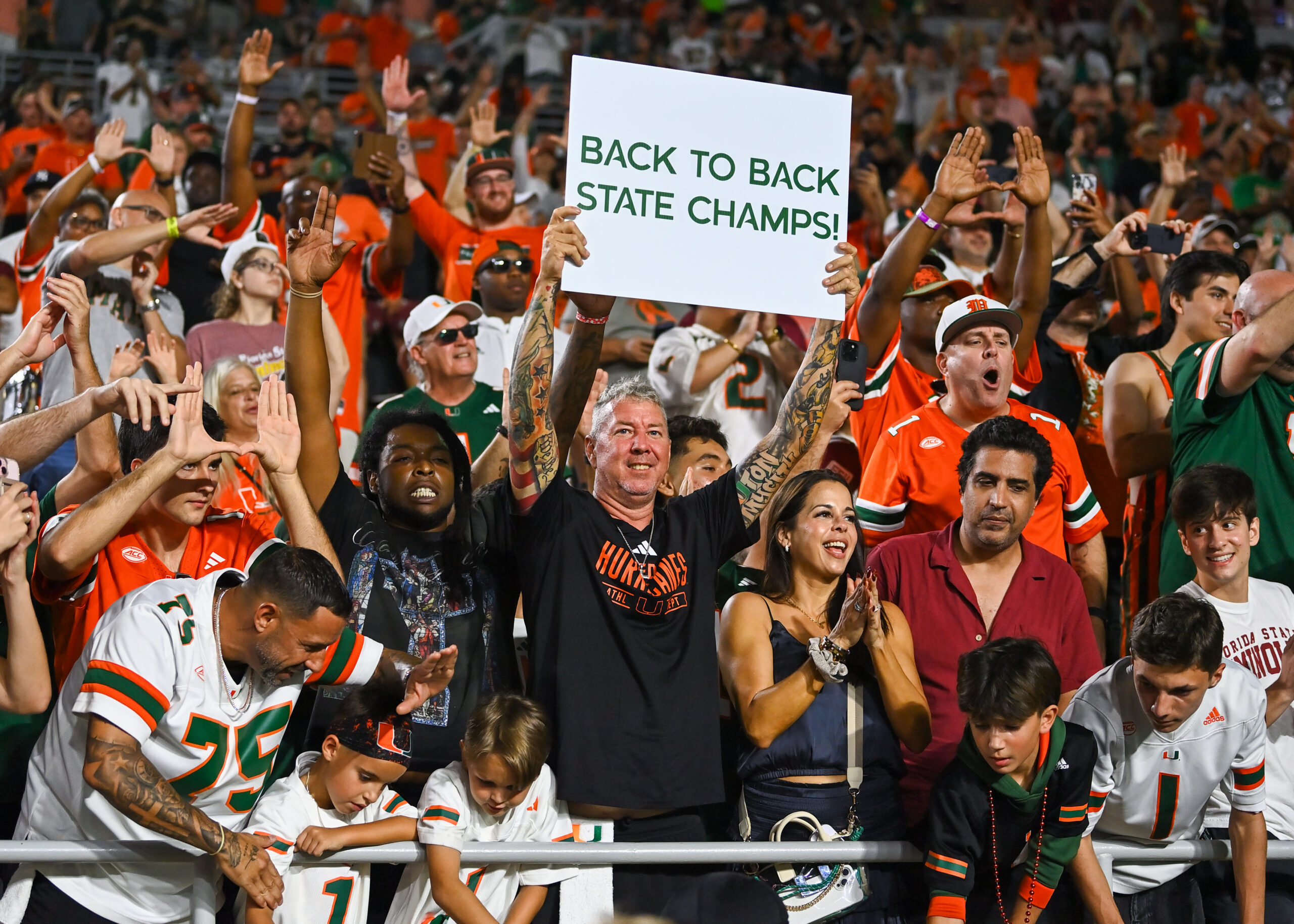
David Lebowitz, Staff Photographer – Fans celebrate a big road win against FSU on October 4, 2025.

UM raises tuition nearly $3,000, but cost of attendance barely rises

Tuition for the 2026-2027 year increased by 4.5%, but the total cost of attendance for on-campus students increased by much less, well under 1%.

This school year’s tuition will cost $66,312, up from last year’s $63,456, consistent with the 4.5% increase UM students have seen over the last two years.

CollegeBoard says that private, four-year institutions increase by 4% a year on average, putting UM’s yearly increase slightly above the trend. 

Despite the tuition jump, the total cost of attendance for on-campus students increased by only $754, from $98,118 to $98,872.

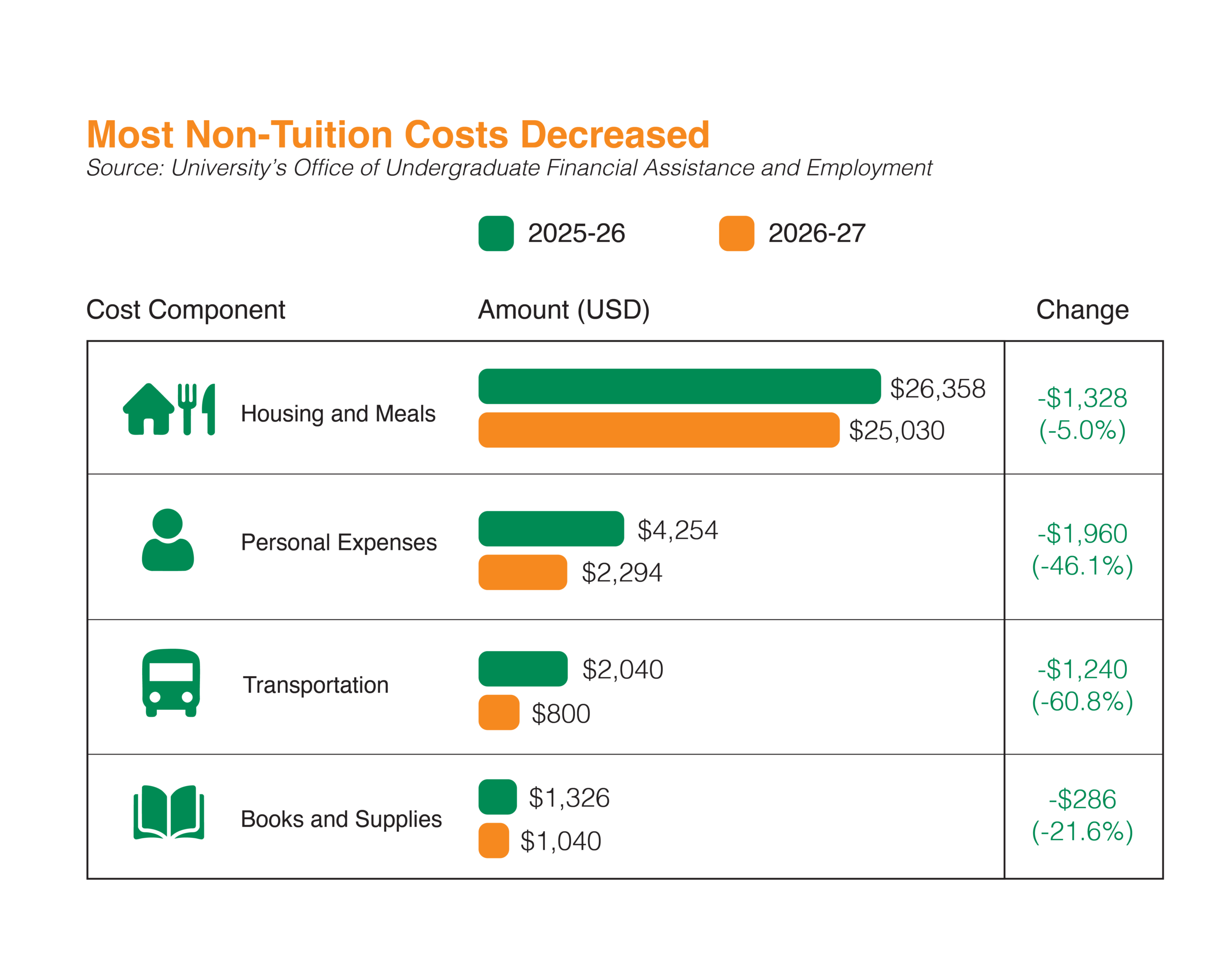
The reason is that nearly everything except tuition has gone down since last year. 

Housing and meals decreased from $26,358 to $25,030; books went from $1,326 to $1,040; “personal” fees took a dive from $4,254 to $2,294; and transportation decreased from $2,040 to $800. 

Graphic credit: Sovannreach Po.

The University has not provided a response to The Hurricane’s questions about why these costs are so much lower than last year.   

According to U.S. News, UM is significantly above the national average tuition cost of  $47,09, but Business Insider does not rank it among the 30 most expensive schools. Those include schools like Georgetown and Boston College that charge in the $70,000 range. 

The tuition reaching such high numbers affects students, no matter how big the increase. In a story posted to The Miami Hurricane’s Instagram on June 25, students were able to share how they felt about the 2026-2027 tuition numbers. 

“Uncertain from year to year, while I don’t feel like the quality of the institution is increasing,” one student replied. 

“I would be fine with it if there was more transparency on why it was needed and to fund what,” Jonas Junquera, a senior studying environmental engineering, said.

The costs for the 2026-2027 school year can be found on the University’s Financial Assistance page, and the breakdown from the last two years can be found on The Miami Hurricane’s website.

The nation worth arguing about

“If there is no struggle, there is no progress.” – Frederick Douglass

As the United States approaches its 250th birthday, Americans will reflect on what the nation has accomplished since 1776. There will be celebrations, ceremonies, speeches and countless attempts to explain why this anniversary matters.

The country we inhabit is not the same America that declared independence in 1776, nor should it be. America’s greatest achievement is not that it has remained unchanged, but that it has remained true to the principles that allowed it to change. For nearly 250 years, America’s story has been one of perpetual improvement. 

Perhaps the most remarkable feature of the American story is not what many people assume.

The United States has survived for nearly two and a half centuries — and not because Americans have agreed with one another. 

The American experiment has survived because generation after generation has done the difficult work of self-government: arguing about what the country should become while remaining committed to the constitutional framework that makes those arguments possible. 

Constitutional republics are far more fragile than we often realize. History is filled with nations that fractured under internal pressures, abandoned self-government or simply failed to endure. The continued existence of the American republic was never inevitable. It has survived because every generation inherited it, argued over it, improved it — and ultimately chose to preserve it. 

The ability to change without abandoning our founding principles is what separates the American experiment from so many others. 

America’s history contains chapters worthy of celebration and chapters demanding reflection. A nation founded on the principle that all men are created equal also tolerated slavery. A republic dedicated to liberty often denied liberty to many of its citizens. Entire generations of Americans fought for rights and opportunities that should have belonged to them from the beginning. 

These are not footnotes in our history. They are part of it. Patriotism asks that we neither ignore them nor that we allow them to define the American story. 

But history should not stop there.

Every nation has failures. Every nation has contradictions. Few possess the freedom to confront them. 

What makes the American story remarkable is not that contradictions existed, but that Americans refused to accept them as permanent. 

Frederick Douglass captured the American story in a single sentence: “If there is no struggle, there is no progress.” America’s story has been defined by both. Americans marched. They petitioned. They persuaded. They voted. They changed laws. And in doing so, they changed the country. 

The nation fought a devastating Civil War over the meaning of its founding principles. Nearly a century later, Americans marched across the Edmund Pettus Bridge demanding that those same principles be applied more fully. Progress did not happen because America was perfect. 

It happened because America possessed something rare: the freedom to recognize its shortcomings and the constitutional institutions necessary to address them. 

The story of the United States is not one of perfection. 

It is a story of perpetual improvement. 

The thread connecting our history is not agreement, but aspiration. Americans have argued about economics, religion, civil rights, immigration, education and foreign policy. They have disagreed passionately — at times bitterly. Yet beneath those disagreements has always endured a shared conviction that the nation itself was worth improving. 

That belief remains one of our greatest strengths.

It is also what makes the freedoms protected by our Constitution so extraordinary. Few ideas have been more distinctly American than this: love of country and criticism of it are not opposites. Throughout our history, reform has come not from abandoning America, but from insisting that it live more fully up to its founding principles. The freedom to make that argument may be one of the greatest gifts the Constitution has given us. 

We often take these freedoms for granted because they are familiar to us. They should never be mistaken for ordinary. 

Nor should we forget the sacrifices that preserved them.

As we commemorate this anniversary, it is worth remembering that the freedoms Americans enjoy today were not guaranteed by history. They were secured and defended by generations of citizens willing to sacrifice for something larger than themselves. From the Revolution that secured our independence to the Civil War that preserved the Union, from the beaches of Normandy to the mountains of Afghanistan, generations of Americans answered the call to defend the republic. 

Many never returned home. Others carried the burdens of war for the rest of their lives. Their sacrifice reminds us that the American experiment has endured not simply because our constitutional institutions are well designed, but because generations of Americans   believed they  were worth preserving.

Today, the United States faces genuine challenges. Trust in public institutions has declined. Political divisions often appear deeper than ever. Public discourse has become increasingly dominated by outrage, suspicion and the assumption that disagreement is evidence of bad faith.

These trends should concern us. They should not discourage us. 

What threatens us most is not disagreement. Americans have always disagreed. The founders disagreed. Lincoln’s America disagreed. Every generation has argued fiercely about the country’s direction. 

The greater danger is forgetting that, despite our disagreements, we remain engaged in that same American project. 

A free society depends upon more than elections and institutions. It depends upon citizens who believe the country is worth preserving. It depends upon people who understand that self-government requires patience, participation and a willingness to see fellow Americans not as enemies, but as partners in a shared national project.

That project remains unfinished.

The United States at 250 is not a completed achievement but an ongoing endeavor. Every generation inherits the responsibility of strengthening the institutions, liberties and civic culture that previous Americans entrusted to them. Every generation is called to confront new challenges while preserving the principles that made reform possible in the first place.

That responsibility belongs to every generation — including ours. 

The country we inhabit is not the same America that declared independence in 1776. 

It is more faithful to its founding ideals than it was then, though still imperfect and still unfinished.

That is not a sign that the American experiment has failed. 

It is proof that it endures.

After 250 years, America remains a nation worth arguing about.

Dylan Long is the Student Director of  the George P. Hanley Democracy Center on campus. He is also the president on the UM Debate Team.

Review: Olivia Rodrigo’s new album is an auditory love story from its first to final page

“you seem pretty sad for a girl so in love,” Olivia Rodrigo’s producer, Dan Nigro said to her while recording new music, unknowing that his remark would become her third studio album’s title. 

Rodrigo opened her career with “SOUR,” an angsty, insecure, pop-punk, ballad-rich record in 2021 at just 17 years old. She followed it up two years later with “GUTS,” an album that felt like SOUR’s older sister.

Rodrigo now returns to music at 23 years old with “you seem pretty sad for a girl so in love,” a much more emotionally-mature, introspective record than her first two. The album debuted on June 12.

Like “SOUR” and “GUTS,” this album features an eclectic mix of genres from piano ballads to pop-punk. But this time, it’s heavier on ‘80s new wave pop-influences and elegant piano ballads, only dipping into rock. 

This album is a story divided into two acts: The “so in love” first half, and the “pretty sad” second half.  

Its 13 tracks are presented in chronological order, from Rodrigo and her then-boyfriend, Louis Partridge’s first meet-up in “drop dead,” to the moment they said goodbye in the third to last track “less.” 

The choice to order the songs this way is a strength of the album, as it feels like you’re watching a rom-com movie — but without the fairytale ending. As fans sit back and listen to the relationship unfold, evolve and eventually unravel, they find themselves growing more invested and connecting more deeply with every track.

In the past, Rodrigo’s songs connected more to her audience by striking relatability in individual songs, specific feelings and scenarios. With this album presented as its own story, she creates a space for fans to be able to empathize without necessarily sympathizing. They are introduced to a couple, then listen to them drift apart.

“drop dead,” the lead single, is a radio-friendly pop song, sonically fitting for its lovestruck lyrics. It’s upbeat, playful and quite frankly the only love song on the album that doesn’t feel “laced with melancholy,” a feeling Rodrigo noted in her newsletter regarding many of her love songs. 

Hearing the first low-octave piano note in track two, “stupid song,” came as a shock, as I was expecting the ballads to be saved in the “pretty sad” latter half of the album. The song quickly picked up into a pop anthem. It’s clever, catchy and satisfying, earning its spot as the third single. 

“honeybee” is where the underlying melancholic tones of the album truly begin to surface — simultaneously hopeful and fearful. With background vocals contributed by Conan Gray, fellow sad-songwriter and longtime friend of Rodrigo’s, the song feels haunted by their harmonies, all the way through the chanted outro — a cohesive quality that can also be attributed to many other songs of the album.  

The lyrics are hopeful, but the production gives the song a sense of dread. It encapsulates the spirit of “you seem pretty sad for a girl in love.”

“maggots for brains” and “u + me = <3” compete with “drop dead” for the title of most lovestruck song. Sonically, they’re similar as upbeat, retro-pop tracks, but lyrically they’re vastly different. 

Vivid imagery is used in “maggots for brains” to describe the empty boredom that is solitude. It wistfully comments on the apparent co-dependency in her relationship, without fully addressing it yet. 

Like “honeybee,” it’s masked as a love song, but the subtle foreshadowing reminds listeners of what they’ll hear more of in just a few songs — in other words, the end is coming. 

Meanwhile, “u + me = <3” maintains a hopeful tone, still afraid of the end, but not anticipating it.

“my way” momentarily pulls away from the narrative Rodrigo builds around just her and her significant other, introducing a third character: an external threat. These lyrics seethe with jealousy, spilling into the arrangement and creating a final product with an angst comparable to “brutal” from “SOUR” and “obsessed” from “GUTS.”

The more subdued sound Rodrigo embraces on this album fits the maturity of her newfound experience of love — from the angle of a committed relationship. But a song like “honeybee,” juxtaposed with “my way,” only makes the toxicity of her anger feel more repugnant. It emphasizes the song’s message, making for a seamless delivery and a piece of pop-punk perfection.

And so we’ve reached a turning point. “purple” is the last of the “so in love” songs. Lyrically and melodically, this track isn’t necessarily a highlight of the album – the metaphor feels elementary, and the melody just isn’t as satisfying as her other work. Narratively, however, this song is crucial. 

For almost the song’s entirety, Rodrigo keeps her rose-colored glasses on, singing about how she and her partner intersect paths and “melt” together and it all sounds lovely, until the glasses come off. “Melt with you ‘til I just feel sad,” she reaches an unfortunate revelation, as the track fades.

As “the cure” begins, the “pretty sad” act 2 commences. Released weeks before the album as its second single, the appeal of “the cure” could have subsided by now, but ensconced in the context of the rest of the album, it takes on a new life. In it, Rodrigo finds herself unraveling as she realizes love doesn’t automatically erase her insecurities.

“begged,” accompanied by harmonies reminiscent of “favorite crime” from “SOUR” and “what’s wrong with me,” featuring The Cure’s Robert Smith, progress the conflict – externally with unmet expectations from her partner, and internally with insecurity, overthinking and doubt.

It’s all built up to “less:” the story of the breakup. The most vulnerable song on the album, “less” is a tearjerking ballad that describes the exact moment when the two decided to call it quits. It’s in this song when it hits you: you’ve just endured an entire relationship, from its highs to its lows, from beginning to end. 

It’s not the kind of song that you can simply move on from when it ends, making the transition into “expectations” feel even more jolting. This returns the album to rock, with Rodrigo’s classic adlibbed, talk-singing verses that are uplifting and perfect for a singalong. 

Like “my way,” “expectations” utilizes the rock genre as a device to express her confidence. It makes it evident that the piano ballads on this album, though often presented as love songs, have melancholic undertones that slip through the cracks. The arrangements on this album feel carefully curated to synthesize with her truest emotions, even the ones she tries to bury in lovesick lyrics. 

Closing with “cigarette smoke,” the final track reflects on the estranged relationship with a newfound resentful lens and a strumming guitar similar to Radiohead’s “Fake Plastic Trees.”

“The memories goes dark” Olivia sings into a whisper, until the song, and the entire album, ends.

“you seem pretty sad for a girl so in love” is Rodrigo’s most cohesive record yet, thematically and instrumentally. Every song feels like a plot point in their overarching love story, but even on their own, each one carries its weight. 

Rodrigo’s sound is so fitting to her that it has yet to feel overdone. She experiments just enough where you never truly know where her music may venture next.  

“you seem pretty sad for a girl so in love” is out now and can be heard on her sold-out arena tour, “The Unraveled Tour” later this year.

Rating: 5/5

ScandyCandy expands to Coconut Grove after Coral Gables success

Last Fall, University of Miami students drove from campus to Coral Gables just to stand in line for bags of Sour Skull gummies and Swedish chocolate. Now, after months of viral TikToks and sold-out candy bins, ScandyCandy is expanding to Coconut Grove.

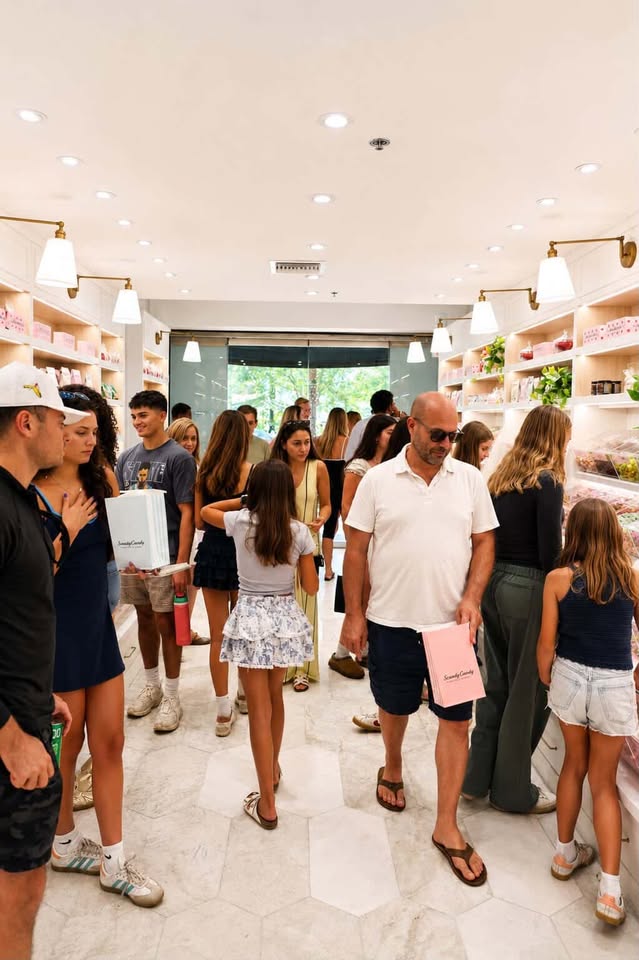
The Swedish candy shop opened its second Miami-area location on Commodore Plaza across from Greenstreet Cafe, bringing its colorful pick-and-mix candy wall to one of Miami’s busiest social neighborhoods. 

The grand opening took place on Saturday, May 9, with giveaways and promotions throughout the day. 

ScandyCandy’s expansion comes less than a year after their debut opening in Coral Gables, where the store sold out its entire inventory within just nine days of opening. 

For many UM students, ScandyCandy has become more than a quick sugar stop. The Miracle Mile location quickly became a weekend destination, as students flocked to the store after discovering Swedish candy through social media trends and viral taste-testing videos.

Like the Coral Gables location, the Coconut Grove store will feature bins of imported candy sold by weight, allowing customers to build their own mix of gummies, chocolates and sour treats.

Contributed by Willie Olsen.

Part of the appeal comes from the ingredients. Unlike many American candy brands, Swedish candy often avoids artificial dyes and high fructose corn syrup, in addition to  offering a larger variety of vegan friendly options. 

The move to Coconut Grove feels natural for the brand. Known for its walkable streets, outdoor cafes and weekend crowds, the Grove attracts many UM students looking for places to eat, shop and spend time off campus. 

With ScandyCandy opening across from the popular Greenstreet Cafe, the new location is likely to become another student hotspot. 

What started as a viral candy trend has quickly become part of Miami student culture, and ScandyCandy’s expansion proves the excitement has not slowed down. 

We are losing the student voice in college applications

0

A prospective student’s GPA can reveal how well they perform academically. A list of extracurriculars can show what they accomplished. But neither answers the most important element in college admissions: who they are.

Universities are tasked with building a community of individuals with unique experiences, values and perspectives. This is why many institutions emphasize a “holistic” admissions process that seeks to understand the person behind the application. 

On June 18 the University of Miami announced it was removing the supplemental essay requirement for students in the 2026-27 application cycle. By removing the supplemental essay, UM loses a critical opportunity to understand students as individuals rather than simply a collection of achievements. 

Before eliminating the requirement, applicants responded to a 250-word prompt where they would describe how their community shaped them, how they contributed to it and how those experiences would impact the way they contribute to the UM community. It gave students a chance to connect their personal experiences and values to UM in a way that transcripts and résumés cannot.

“The University is confident that removing the supplemental essay will not interfere with our ability to enroll high-achieving and qualified students and provide them an excellent education,” the University said in a statement to The Hurricane. 

College counselor Jamie Adelson, who has worked with high school students throughout the admissions process for years, said supplemental essays offer benefits beyond what can be measured elsewhere in an application.  

“Supplemental essays can be a great way for the university to gauge interest levels from students and for students to be able to express their interest in a particular university,” Adelson said. “It can be a great exercise … because they have to actually verbalize and express why they want to go to a university.”

While students can demonstrate competence through their achievements, essays build character and personality. Colleges often state they seek qualities such as curiosity, resilience and leadership, according to PrepScholar. 

These traits are hard to recognize just by looking at a transcript or resume. Students with an average GPA or fewer extracurricular activities can still possess qualities like empathy, perseverance or intellectual curiosity that strengthen the campus community. The supplemental essay gives applicants the chance to demonstrate those traits in their own words.

“The supplemental essay was a chance for me to really display my emotion and personality,”  said UM sophomore Bella Zahirudin. “I was able to tell a story. It was a chance for me to truly speak to the admissions team.”

Critics argue that supplemental essays favor students who can afford private counselors or professional admissions support. While this concern is valid, removing the supplemental essay does not create a more equitable admissions process.

Accomplishments such as leadership positions, internships and extensive extracurricular involvement are also heavily influenced by access to resources. Many public school students have limited access to individualized college counseling. In some states, such as Arizona, a single counselor may be responsible for hundreds of students.

Sophomore Daniel Fakhoury said the essay gave him the opportunity to provide context beyond the rest of his application. 

“It allowed me to share more about myself, like my background, and helped me explain why I deserve to be accepted,” he said.

Other critics argue that supplemental essays favor students who can afford private counselors. However, eliminating them places more weight on extracurricular accomplishments, research opportunities and other achievements that are even greater influenced by a student’s access to resources. 

“Removing the supplemental essay can end up harming students who may be weaker in other aspects, such as grades or test scores,” sophomore Lily Masi said. “Many students had external factors that may have affected their grades, or how many extracurriculars they did, and their writing can help them make up for that.”

As university applications become more streamlined, it becomes easier for students to submit to a larger number of schools. While this can be beneficial, the resulting surge in application volume raises concerns for maintaining individualized review.  

“After reviewing the application process for the last several cycles, the University of Miami determined that the standard parts of the application, including the applicant’s choice of essay from the Common Application, give the admissions counselors detailed information about each applicant and their potential contributions to the University of Miami community,” the University said in the statement to The Hurricane. 

The personal statement on the Common Application undoubtedly provides useful information about the applicant. Nevertheless, it cannot answer the same questions as a university-specific supplemental essay. One explains who a student is, and the other explains why that student belongs to a particular place.

Students feel that the supplemental essays were one of the best opportunities they had to differentiate themselves beyond their grades and extracurriculars. 

“The supplemental essay allowed me to write something more specifically aimed at the University of Miami. It gave me another chance to make my application stand out,” said sophomore Isabella Gannon. 

As holistic review becomes increasingly foundational, it relies on students presenting themselves in a number of different ways. Given that universities continue simplifying applications, they should be careful not to simplify the students behind them. 

While the supplemental essay is not perfect, it allows students to connect their values to a specific university. By taking away this part of the application, UM loses a valuable source of insight into how students see themselves contributing to campus life. 

UM senior Lauren Barnwell has officially been cast in season 2 of ‘Destination X’

NBC’s globetrotting reality TV show “Destination X” revealed the cast of season 2 this week. University of Miami senior Lauren Barnwell was named among the 10 contestants set to compete when the Peacock series returns.

“Destination X” strands contestants on a blacked‑out bus somewhere in Europe. Players then complete challenges, solve puzzles and attempt to guess their location on a map — a hybrid of “Survivor” and “The Amazing Race.”. 

The contestant whose guess lands furthest from the true location is eliminated, and at the end the winner takes home $250,000. 

Barnwell, a rising content creator with more than 500,000 followers across social media platforms, told The Hurricane she is “very excited for viewers to see what’s coming,” but emphasized that she cannot discuss gameplay, filming details or travel destinations due to NBC’s promotional restrictions.

Season 2’s cast includes several familiar reality TV names, including Kaylor Martin and Nic Vansteenberghe of season 6 of “Love Island USA.” 

Their addition ties into UM’s own recent reality TV streak. Sincere Williams, a UM track athlete, currently appears on the newest season of “Love Island USA,” continuing the university’s growing presence in the genre.

Season 1 of “Destination X” drew modest ratings, but viewers took more notice when Jana Craig, a former “season 6 Love Island USA” cast member, appeared in the initial lineup. Craig’s presence helped introduce the series to Peacock’s loyal reality TV audience, and Season 2 appears to be building on that momentum with a more recognizable cast.

This new cast includes stars from “Big Brother,” “Below Deck,” “Survivor,” “The Traitors,” and of course, “Love Island USA.” It’s a noticeable shift from last season’s lineup of mostly non‑influencers and everyday players. 

Barnwell falls into the TikTok star genre with 6 other cast members filling out the remaining spots, making this season more well-known. 

Barnwell said she expects a range of reactions from students once the season airs.

“I’m sure it’ll be a little bit of, ‘oh, another one,’” she said when asked whether she anticipates people commenting on yet another UM student entering the reality TV world. “But I love to entertain. This isn’t a cash grab for me.”

Since the cast reveal, Barnwell said her phone has been flooded with messages — not just from friends, but from people she hasn’t spoken to since high school. 

“Parents of kids I haven’t talked to in forever are texting me,” she said. “Everyone suddenly wants to know everything.” 

Barnwell described the reaction as overwhelming but exciting, a reminder of how quickly visibility spreads once a name appears in a national cast announcement.

The opportunity, she said, has already shaped her sense of what’s possible after graduation, reinforcing her long‑term goals in entertainment and media.

As for what she hopes viewers take away, Barnwell kept it simple — and very on brand.

“Don’t cancel that subscription after Love Island ends,” she said. “Peacock’s coming back at you with another banger — with your girl, represent.”

Season 2 of “Destination X” is expected to premiere in 2027. NBC has not yet announced an exact release date.


The Latest Recruiting Updates for Miami Hurricanes Football

0

Updates on the latest recruiting news in the offseason as the Hurricanes look to put the finishing touches on their top-three class in the country. Breaking down key upcoming visitors for Miami, priority targets until National Signing Day, and a quick look at a potentially legendary group of prospects in the state of Florida for the Class of 2028.

Three UM students starring in Peacock’s new reality show — with campus as the backdrop


University of Miami students Nikki Pindor, Sienna Long and Georgia Gay star in the just-launched reality micro-drama titled “Campus Confidential: Miami,” Peacock announced on Monday, June 15.

The show, divided into two chapters, will follow UM’s social hierarchies and scandals, and it’s now available to stream on the platform’s mobile app. 

The first chapter, titled “The Sorority Dropout,” spans 27 episodes and follows Gay after she decided to leave her sorority — Delta Phi Epsilon — and grappled with the decision of whether to transfer out of UM in the aftermath. 

“When I had my advising appointment to drop out, I remember being so nervous to tell my advisor but she had said ‘Once a Cane, always a Cane,’” Gay said. “I’ll always be so grateful for that. I love the U and all of the incredible experiences the school gave me.”

Georgia Gay poses in her UM merch. // Photo courtesy of Georgia Gay.

Gay is no stranger to reality television. Her mother, Heather Gay, earned her own time in the spotlight through “The Real Housewives of Salt Lake City.”

The second portion, “Influencer Enemies,” explores TikTok influencers Long and Pindor’s viral online feud. Through 23 episodes, the series seeks to determine whether they can reconcile their relationship. 


Long and Pindor’s feud began in response to The Miami Hurricane’s Oct. 22 print edition. Long took to TikTok to describe how upset she was when she was not featured on the front cover of The Hurricane’s edition.

Sienna Long gets ready to film a “get ready with me”, known as GRWM on TikTok.

Pindor then posted a TikTok that allegedly mocked Long. The feud grew increasingly public, with both continuing to post and Pindor writing that she had to meet with the dean. 

Several weeks after the TikToks were posted, a small production company reached out to Long, informing her they were interested in creating a microdrama about UM. 

“I don’t know if I can trust someone who tried to get me kicked out of school,” Pindor said in a clip of the show Long posted to her Instagram.

The clip features both women sitting at a table on campus, raising questions about filming rights and legal implications for UM. Procedure III of UM’s filming guide outlines that a “script/storyboard” must be submitted in advance of filming. The guide also dictates the fees to shoot on campus, ranging from $2,500 to $20,000 for eight hours depending on the type of content being shot. 

The Hurricane reached out to the University for comment but has not yet received a response.  

The series was originally set to star a large group but ended up narrowing its main cast down to three. Filming occurred on campus in late April and throughout May. 

Pindor told The Hurricane that she believes there’s nothing to take away from the series, that the episodes were “scripted as hell” and that she only participated “for the bag.” 

Nikki Pindor poses on a boat. // Photo courtesy of Nikki Pindor.

According to Long, the girls are each being paid a few thousand dollars. 

“I hope it doesn’t have a negative impact on the UM community,” said Long. “The school’s had a very positive impact on me, so I hope it brings positive attention to the school.”

Her segment, Long added, is not so much focused on the school but on the “interior drama and life in Miami.”

Gay echoed similar sentiments about wanting the show to leave a positive impact on UM and the students. 

“I hope the series helps show that no one’s college experience is as seamless as social media makes it seem,” she said. “I had an amazing experience filming the series and I’m so grateful I was given the opportunity to share my story. I think filming a show about your personal life takes a lot of introspection and can be challenging at times, but always worth it in the end.” 

Katie Karlson contributed to the reporting of this article.


This article was updated at 2:29 p.m. CDT to include quotes from Nikki Pindor.

Frost School of Music alumnus Joshua Henry turned Tony Award-winner

University of Miami alum Joshua Henry took home the Tony Award for Best Performance by a Leading Actor in a Musical at the 79th annual ceremony on Sunday, June 7. 

Henry was awarded for his performance as Coalhouse Walker, Jr. in “Ragtime,” which in total won four Tonys, including Best Revival of a Musical. 

“Shiny things don’t run my life, but this … feels really good, and I will allow myself to live in the beauty of this moment as my community has given me this tremendous honor,” said Henry in an Instagram post on the evening of June 8. 

“Ragtime” marked Henry’s fourth Tony nomination across his nearly twenty year-long career across stage and screen. He additionally holds a Grammy Award, a Drama League Award, an ACCA Award, two Drama Desk Awards, two Outer Critics Circle Awards, two Broadway.com Audience Choice Awards and a Dorian Award. 

His performance was met with critical acclaim long before the accolades came in. The New York Times opened their rave review by declaring Henry “blows the roof” off of the Vivian Beaumont Theater at Lincoln Center.

“Ragtime” is a period piece which takes place at the start of the 20th century. The plot diverges to follow three separate storylines before they all intertwine together at the end. Henry plays a Harlem African American musician in pursuit of his love and the American Dream. 

He stars alongside Brandon Uranowitz — a Jewish immigrant striving to forage a better life for his young daughter — and Caissie Levy — an upper-class white woman who is forced to confront inequality. The latter took home Best Performance by a Leading Actress in a Musical. 

Henry earned his Bachelor of Music in Vocal Performance with a concentration in musical theatre from the Frost School of Music in 2006. He routinely returns to UM to conduct masterclasses or perform at special events. 

During his acceptance speech, Henry thanked theatre educators and Black performers, such as Audra McDonald and Brian Stokes Mitchell, for paving the way.  

“It is an honor to play this role, Coalhouse Walker, Jr., a Black musician whose art led him to his love and to his dream,” said Henry. “And even in the face of pain and tragedy, he found a way to be heard. Every artist in this room, every artist at home, fight, fight, fight to be heard.”

“Ragtime” is running on Broadway now through August 2.

6.1 magnitude earthquake in Cuba causes tremors across Florida

Cuba was struck by the strongest earthquake to hit the Gulf of America in 150 years, and its effects were felt as far as Orlando, Florida, where buildings began shaking on Monday, June 8.

The earthquake hit at a shallow depth of 16 miles northwest of Mantua, Cuba, according to the U.S. Geological Survey. It occurred 248 miles from the intersection between the North American and Caribbean tectonic plates. 

Miami-Dade County Hall, the Stephen P. Clark Government Center, was evacuated following reports of the building trembling. Metrorail and Metromover services were also suspended. After inspection, they resumed their activity, bypassing the station.

No injuries, deaths, or major property damage were reported despite calls to emergency services across Miami. 

“The situation remains stable,” City of Miami Fire-Rescue posted. “And the City will continue coordinating with appropriate agencies while monitoring for any additional impacts.”

The Miami Beach Fire social media echoed the statement, assuring residents that “there is no cause for alarm.”

Jochen Braunmiller, a professor at the University of South Florida, told News Channel 8 that he felt the tremors for 15 seconds.

“They are so unusual to have in Florida,” said Braunmiller. “And what I like in this particular case [is that] it’s an earthquake that is large enough to be felt, right, but it didn’t do any damage in Florida.”

Another Florida resident from Hillsborough County told WFLA he thought he was the one shaking.

“I thought maybe it was just someone underneath me causing a ruckus until I realized everything was slightly shaking,” Taylor F said. “I thought it was me for a second until I put my coffee down, and it was also moving.” 

Aftershocks of a 4.3 magnitude were reported just after 9 p.m. on Wednesday, June 10. They were shallow, at 6.2 miles and in the same place as the original earthquake.

There is no tsunami threat, William Barnhart, a geophysicist with the U.S. Geological Survey, told ABC News. These destructive waves are more likely in the Pacific rather than the Atlantic. 

Florida is not likely to feel any further aftershocks.