The brothers built massive online followings by their often polarizing promotions of wealth, masculinity and the “manosphere” — an umbrella term describing online communities associated with “red pill” ideology, anti-feminism and rigid traditional gender roles. They are described as some of the most problematic social media personalities today.
In 2022, the Tate brothers were held in Romania on sex crimes charges — similar to those they currently face — and in 2025, they arrived in the U.S. Since then, they’ve been residing in South Florida.
Holding dual U.S. and U.K. citizenship, the two are being charged with a combined 59 criminal charges. They already face multiple charges of rape, bodily harm, human trafficking and controlling prostitution from 2012 to 2015 in the United Kingdom.
Andrew Tate, 39, is now charged with seven additional counts of rape, three counts of arranging or facilitating human trafficking for sexual exploitation, three counts of assault and 19 charges related to possession of child and extreme pornography.
His brother Tristan Tate, 38, is being charged with one count of sexual assault, two counts of rape and three counts of arranging or facilitating human traccking for sexual expolitation.
Andrew Tate is a self-described misogynist and former professional kickboxer who has accumulated more than 10 million followers on X, most of whom are young men, while being banned on platforms such as YouTube and TikTok for repeatedly violating hate speech guidelines.
Over the years, the Tate brothers have been tied to many influential individuals, including people within President Donald J. Trump’s administration. Paul Ingrassia was part of the Tates’ legal team in a defamation suit they filed in Florida against some of their alleged victims. Ingrassia previously served as the White House liaison to the Department of Homeland Security and currently serves as deputy general counsel to the General Services Administration.In the past, Ingrassia also acted as Andrew Tate’s publicist, even scoring him an appearance on former Fox News host Tucker Carlson’s show.
The brothers appeared before court on Monday, July 20 in Miami., and U.S. Magistrate Lauren Louis has set another hearing for Monday, July 27. The brothers are currently in federal custody until a decision about their extradition status is made.
If passed, a new agreement between UM and the city of Coral Gables would allow a hospital to be built on campus, significantly increase the number of undergraduates and provide more square footage for construction.
The University of Miami filed a 217-page package with the city of Coral Gables on June 11, requesting amendments to four separate documents: the Development Agreement, the campus master plan, the comprehensive plan and the zoning code.
This proposed Development Agreement is a 30-year agreement between the two parties, with both leveraging key negotiating assets.
“The development agreement is designed to look into the future,” the University told The Hurricane in a statement. “It establishes the parameters that will govern future growth and development of the University of Miami’s Coral Gables Campus over the course of the next 30 years.”
What would UM gain?
The proposed deal would adjust the land-use rules so that UM would have permission to build a hospital on campus. Page 11 of the filing suggests that a hospital could be built along the “Ponce de Leon corridor with easy access to public transit.”
No plans for a hospital have been filed with the city yet, and it is unclear if UM would build a full-service hospital or a specialty center.
“The University does not — at present — possess a specific plan to build a hospital on the Coral Gables Campus,” the University said. “As home to the only university-based academic health system in South Florida, the University is planning for the future needs of its community — both on campus and beyond campus — as it continues to deliver on its mission to transform lives through education, research, innovation, and service, while providing high-quality, compassionate patient care and positively impacting the community.”
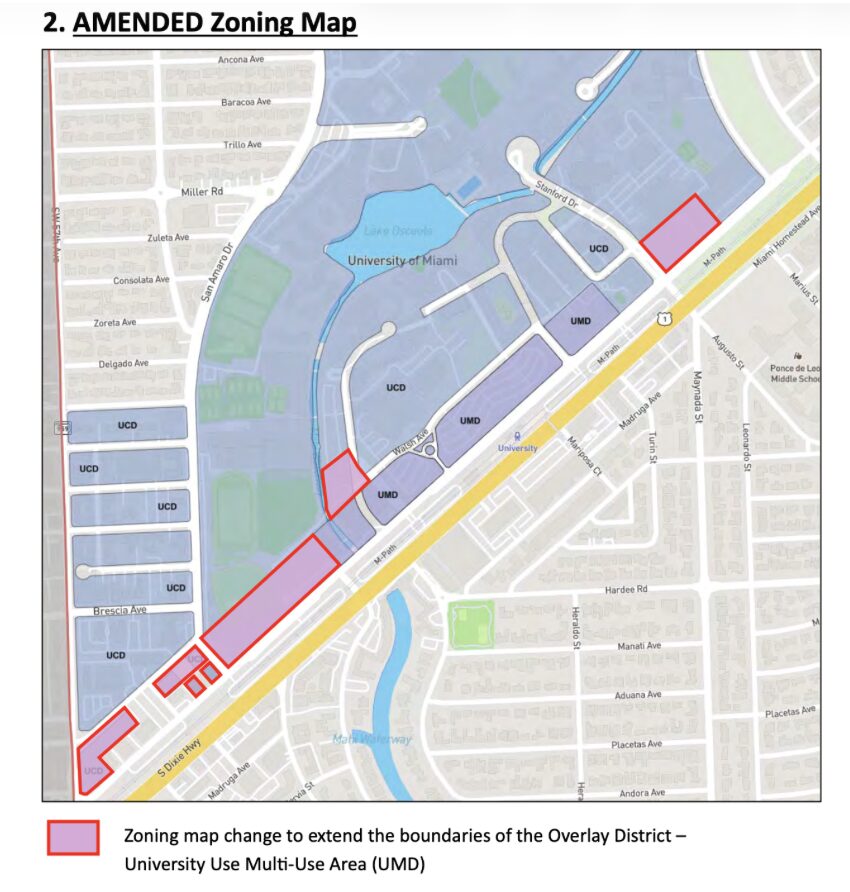
UM is proposing that the area across from the University Metrorail Station along Ponce de Leon Blvd. — essentially the location of the yellow lot — be rezoned to a University Use Multi-Use Area, suggesting that this may be where UM envisions a future hospital.
Screenshot of the Amended Zoning Map from the Coral Gables public records. The highlighted areas indicate where UM is asking for the land to be changed to “University Use Multi-Use Area.” // Screenshot via public records.
Additionally, the new deal would allow for UM to enroll 17,500 undergraduate students, compared to the 13,000 permitted under the old terms.
This is approximately a 35% increase in the undergraduate population.
If the population were to exceed 17,500, UM would need to address traffic, housing and other concerns with the city as per the agreement.
Along with the increased population cap, UM’s campus boundaries would expand.
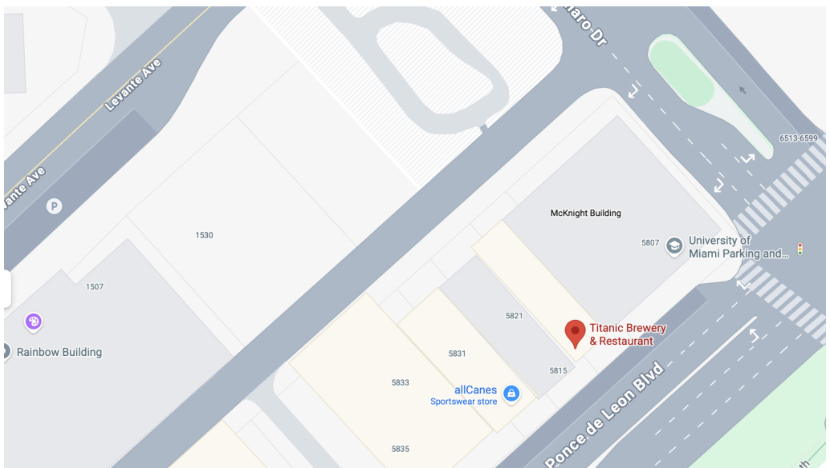
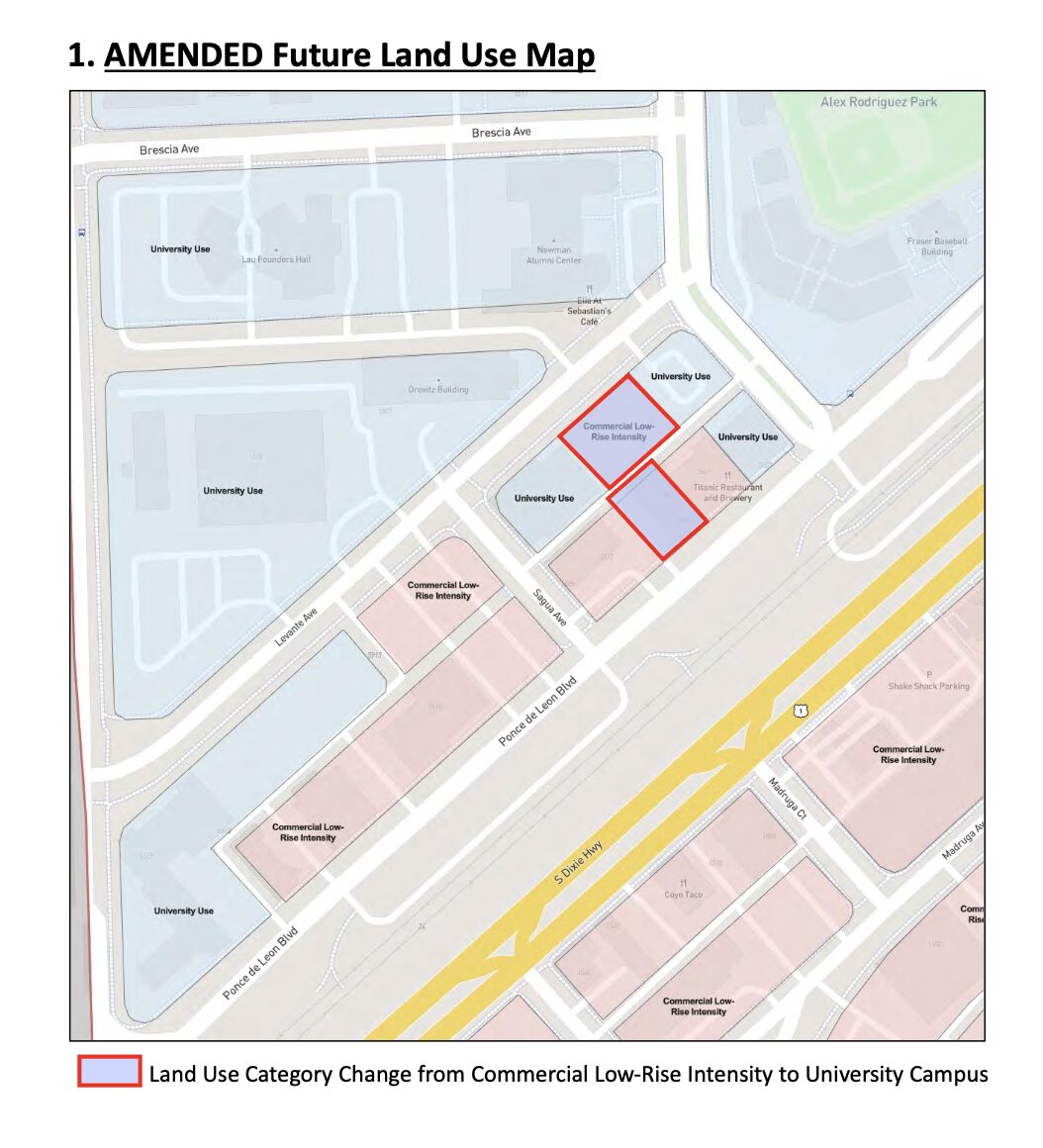
UM requested that three properties — 1530 Levante Avenue, 5827 Ponce de Leon Blvd. and 5855 Ponce de Leon Blvd. — located near Titanic Brewery and Restaurant be rezoned from the “Commercial Low-Rise Intensity category to the University Campus category.”
Screenshot of Google Maps showing the three property locations that UM is proposing be rezoned. // Screenshot via Google Maps.
Screenshot of the Amended Future Land Use Map from the public records. The highlighted areas indicate properties that UM is proposing be rezoned to “University Campus.” // Screenshot via public records.
Within the land that the University already owns, the proposed deal would change the “fixed development cap” of 6.8 million acres to a Floor Area Ratio (FAR) structure. Areas with higher FAR values can be more densely built, making the land more efficient.
The proposal allows for an FAR of 1.0.
For example, if UM owned a 10,000-square-foot lot, the University would be allowed to build 10,000 square feet of total floor space. The floor space could be one 10,000-square-foot story, two 5,000-square-foot stories, and so on. The total just cannot exceed 10,000 square feet.
Stairwells, trash chutes, electrical rooms and other similar spaces have been excluded from the FAR.
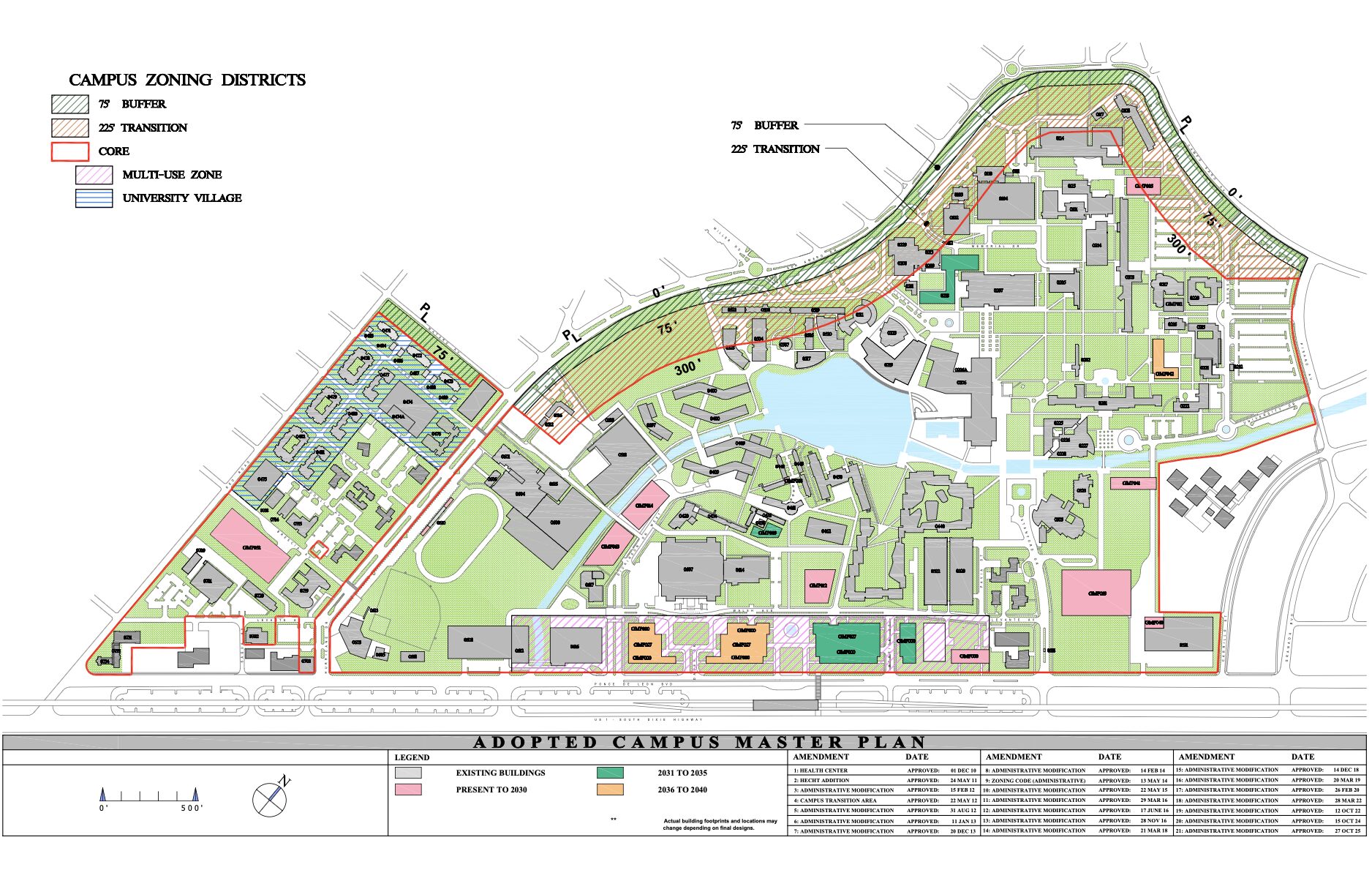
Screenshot of the Adopted Campus Master Plan from the public records. // Screenshot via public records.
What would the University give?
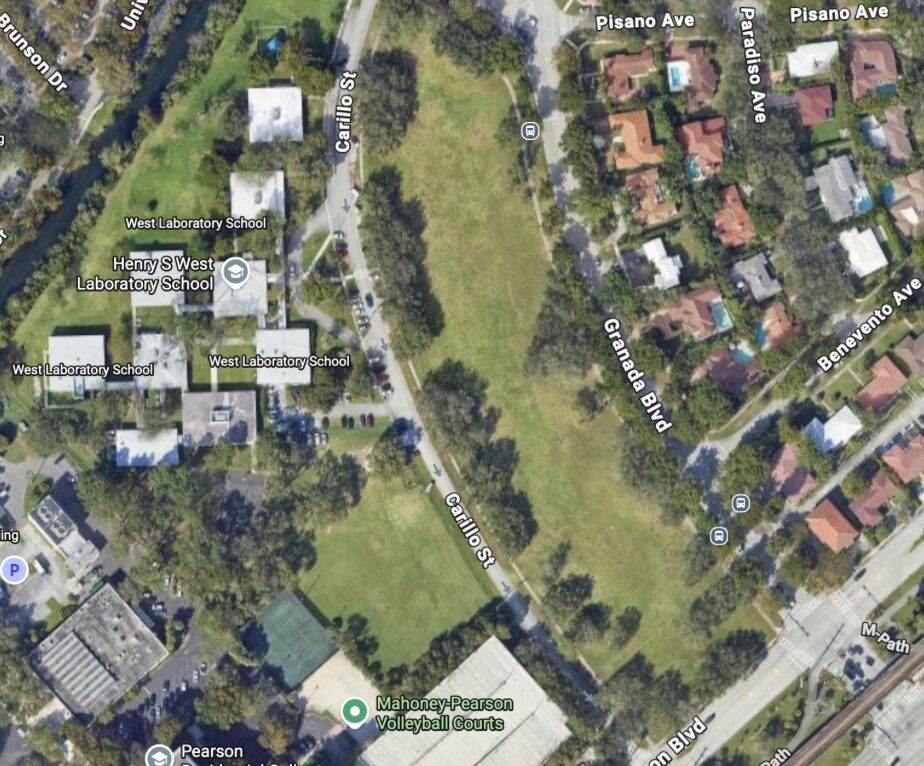
In return, UM will transfer the 5.52 acres of land known as the Lee Lincoln Site — worth an estimated $50 million — to the city. The site sits between Granada Blvd. and Ponce de Leon, behind the Mahoney-Person parking garage and East of campus.
The park will be renamed “Centennial Park” in honor of the city and UM’s 100th year and will be restricted to “ancillary recreational purposes,” making it the largest green space owned by Coral Gables.
Screenshot of Google Maps image showing where the Lee Lincoln site is in relation to campus and nearby roads. // Screenshot via Google Maps.
The Hurricane reached out to Mayor Lago for comment and has not yet received a response.
UM will also pay the city $1 million annually, with a 4% annual increase, and will continue its partnership with athletics. Specifically, the University will continue to offer “Coral Gables Day,” where football tickets are “Buy One, Get Two Free” for one agreed-upon home game, and continue giving out 1,000 free tickets for men’s and women’s basketball and baseball.
Many of UM’s existing partnerships with the city would continue as well. The Gables Fellow Program, an internship program for students committed to public service; UM’s lecture series; the UM Concert Series; and more will remain in place.
What else is UM planning?
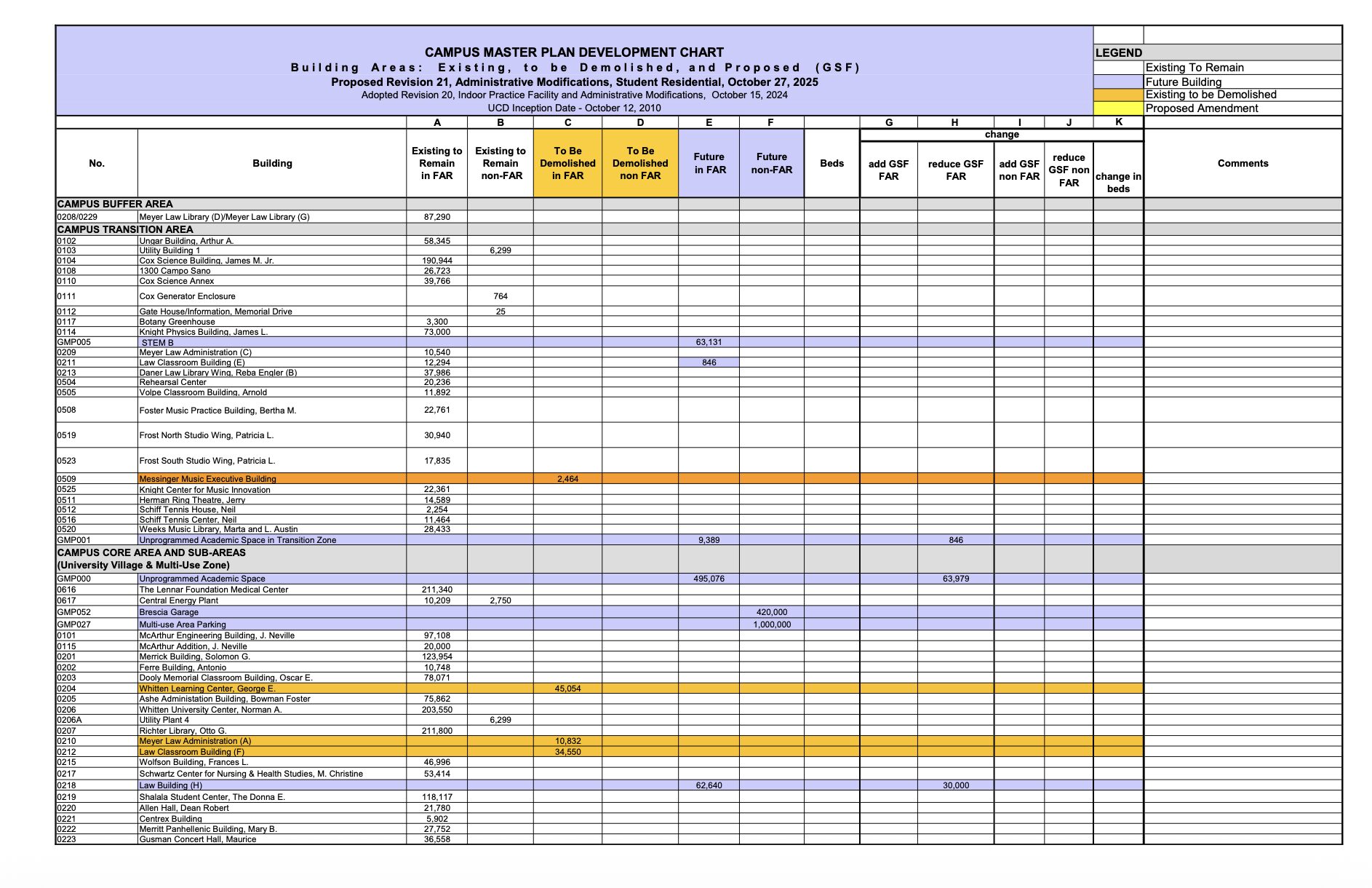
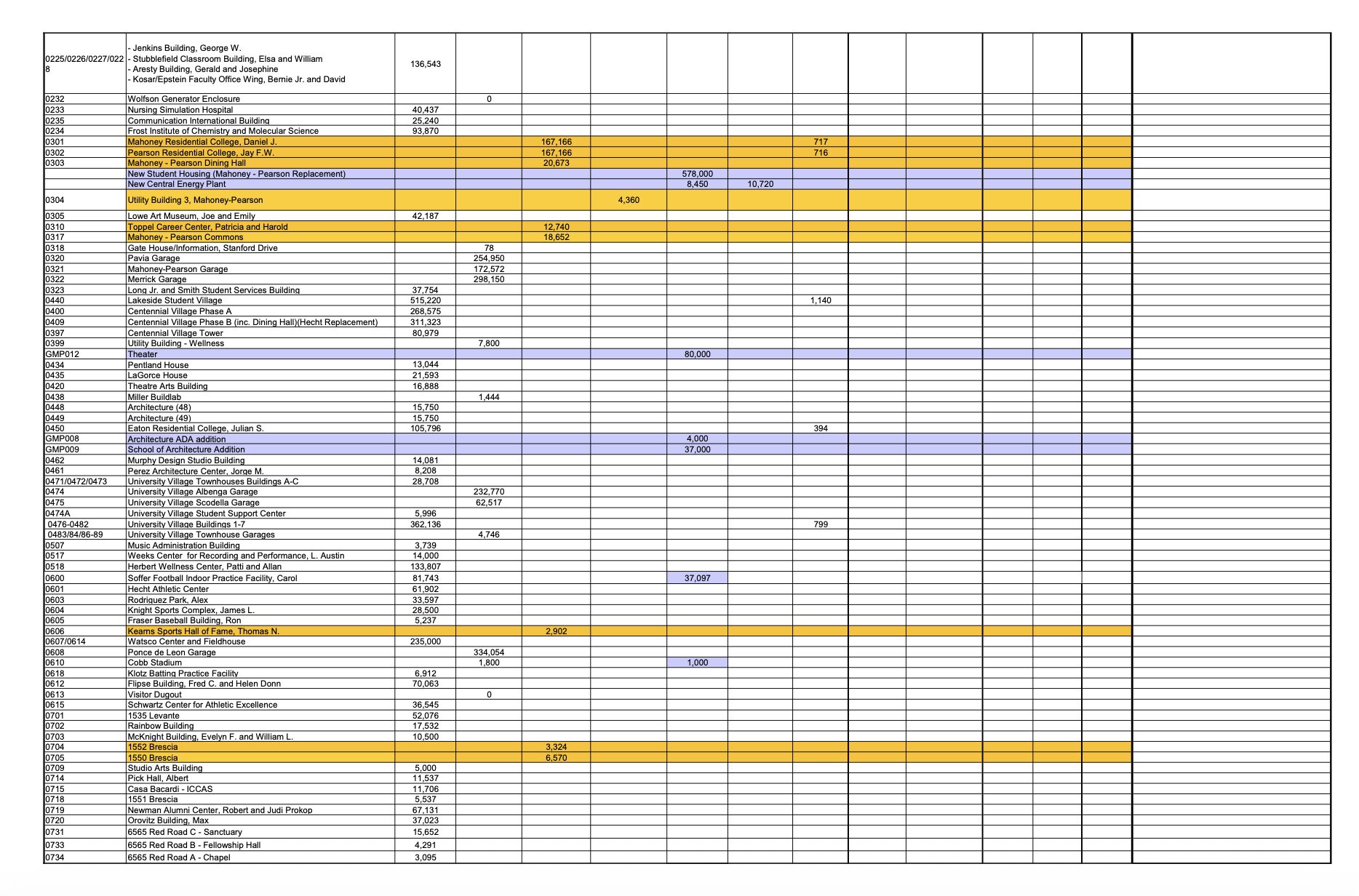
Also in the filings, the University listed the buildings it plans to demolish. Notably, the list includes Mahoney and Pearson Residential Colleges, the Toppel Career Center, the Whitten Learning Center and Meyer Law Administration (A).
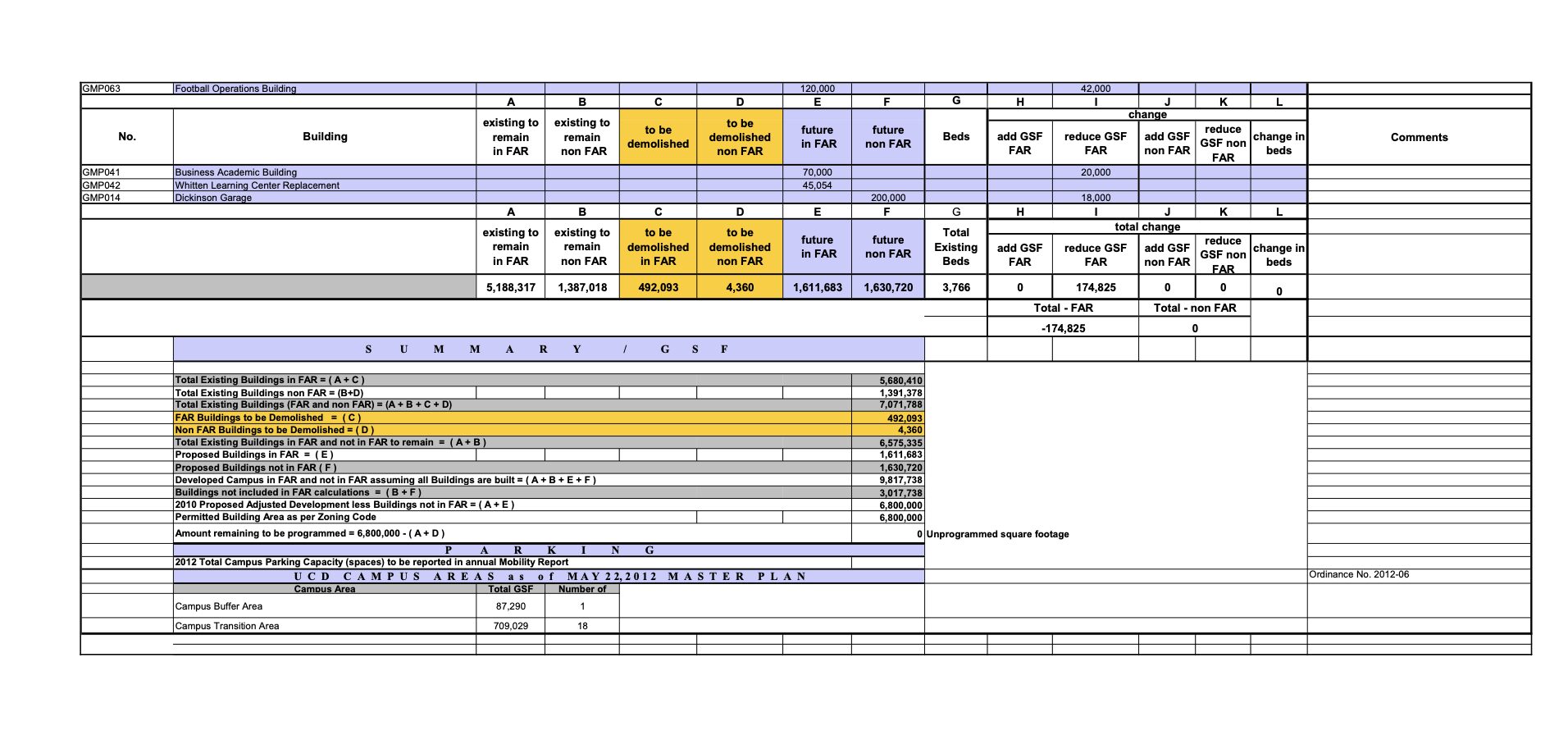
The proposed deal also highlights “Future Building,” including a Football Operations Building, a School of Architecture Addition, a theatre and a building titled “STEM B.”
Screenshot of the first page of the Campus Master Development Chart. The orange highlight indicates “Existing to be Demolished” as per the key in the top left corner. // Screenshot via the public records.
Screenshot of the second page of the Campus Master Development Chart. The orange highlight indicates “Existing to be Demolished” as per the key in the top left corner. // Screenshot via the public records.
Screenshot of the first page of the Campus Master Development Chart. The orange highlight indicates “Existing to be Demolished” as per the key in the top left corner. // Screenshot via the public records.
What is the status of this deal?
The proposal was submitted to Coral Gables’ Development Review Committee on June 26 and now requires approval from the Planning & Zoning Board. If approved, the city commissioners will make a final vote.
Because the pieces of this proposed deal are connected, if one piece fails, the others may not be implemented as intended.
The Hurricane is in contact with UM and working to schedule an interview with the administration.
A new bipartisan housing law could impact University of Miami students and recent graduates.
The 21st Century ROAD to Housing Act became law on July 11 after President Trump allowed it to take effect without his signature. It seeks to increase housing supply, update federal programs and reduce regulatory barriers.
“We can only speculate what the effects of this legislation will be on South Florida’s housing affordability,” Chelsea Lafrance, the Research and Data Program Manager for UM’s Office of Civic and Community Engagement, said. “The extent to which this bill will affect housing affordability in South Florida will largely depend on how it is implemented locally.”
The Hurricane reviewed the bill’s details to break down what matters most for you. If you want more background, check out the Bipartisan Policy Center’s issue brief.
This law will likely not lower rent immediately. The law could support more housing over time, but it does not impose rent caps, provide general rental assistance to students or require housing to be built near UM.
Its effect will depend on whether Congress funds the programs and whether South Florida governments and developers use them.
“Counties, municipalities, public housing agencies, nonprofit organizations, and banks might experience an increase in financial investment for affordable housing if they successfully pursue and leverage the bill’s new tools and funding opportunities,” Lafrance said.
In terms of change in South Florida, some federally supported housing projects could get faster environmental reviews.
“Streamlining the environmental review timeline may lead to lower housing development costs by shortening the development timeline,” Lafrance said. “Typically, the longer it takes to develop a housing project, the more expensive it will be for the developer.”
Whether this change affects new housing near UM depends on each project’s funding, location and eligibility. The law does not override local zoning or permits, so its impact near UM will depend on whether specific projects get qualifying federal help.
Section 210 allows the Department of Housing and Urban Development, if funding is available, to establish a pilot program from 2027 to 2031. This program would turn qualifying empty commercial buildings into housing, focusing on struggling areas and “Opportunity Zones” — neighborhoods the federal government says need more investment to grow. Empty office parks and old strip malls near campus could become new housing, but the buildings must first meet the law’s definition of “vacant and abandoned.”
For now, students should watch whether Congress funds the new programs and whether Miami-Dade County or nearby municipalities apply to use them. Those decisions will determine whether the law produces housing accessible to UM students.
If you have scrolled through socials, turned on your TV or even taken a peek at billboards or restaurants in your neighborhood, then you are probably no stranger to the World Cup and all it entails.
Fans of all nations have traveled to one or more of the 16 cities — including Miami — across three countries to see their team play and make their country proud.
With all the excitement comes changes that affect the surrounding communities of each of the major cities these games are being played in.
More traffic, larger airport crowds and thousands of soccer-themed advertisements driving the economy are all markers of a World Cup season.
One of the most vital aspects of the community affected by the World Cup is the economy, and while most would believe that cities are greatly benefited by its presence, evidence shows that some cities are actually losing money.
In Miami, the city expects to spend about $12.5 million on preparations for the world cup such as security measures, permitting and celebrations. Total visitor spending is expected to be approximately $650 million, but FIFA will collect most of the revenue because of its contract terms.
According to an article from NC State University, FIFA’s contracts with host cities allows them to capture financial gains through media rights and sponsorships. The cities themselves will only see indirect revenue from lodging and tourism.
“FIFA will collect an estimated $8.9 billion from the 2026 World Cup while the 11 U.S. cities hosting it could face a collective shortfall of upwards of $250 million,” said an article in Fortune magazine.
The author credits this loss to the restructuring of how FIFA is going to be running the World Cup moving forward.
For the first time in the tournament’s history, FIFA itself will be dealing directly with host cities, rather than going through national federations that split the profit. So, the company receives almost all the profits made from advertisements, sponsorships, tickets, merchandise,sales and more.
This is also the first time FIFA is using dynamic pricing for tickets, where ticket prices change as demand for tickets fluctuate. The results of this are the nearly $6,000 price tag seen on quarterfinal match tickets, with prices only expected to increase through the remaining rounds as the final game approaches.
Forbes contradicts the conclusions brought up in Fortune, stating that host cities are “generating a significant [economic] boost” thanks to the World Cup.
“Bank of America’s latest consumer spending analysis, which tracked card-based purchases in the tournament’s 16 host cities, found that overall spending has increased 6.3%” compared to this time last year, said Forbes.
Consumer spending by non-locals has increased by nearly 17% in the major host cities as well, as fans travel to support their competing home countries.
According to Forbes, as fans travel and follow their nation’s games, they also explore the surrounding cities and drive revenue for local businesses including transportation, hospitality, and dining.
Taking a broader view, various news and research outlets state that the economic results vary for each World Cup.
The 1994 World Cup, hosted by the United States, is credited with having generated massive revenue for its host cities as it saw almost 69,000 fans per match.
However, in 2014, the World Cup hosted in Brazil was a failed public investment.
The efforts displaced local residents to make way for infrastructure and stadium developments, and cost approximately $11.5 million to cover the costs brought on by the tournament.
“Any potential benefits, sustained or short-lived, come at a steep price, as World Cup events are often exceedingly expensive to host. And in many cases, a city’s financial gains — a mere fraction of FIFA’s — can result in a breakeven scenario or a loss,” said Britannica.
With the World Cup and the Winter Olympics all being held this year, 2026 has seen an unprecedented travel boom.
According to Good Morning America, survey results found that 81% of travelers are influenced by major sporting events when choosing where and when to go.
“What Expedia data shows clearly is that fans booked earlier, are traveling farther, and spending more to be part of the tournament -— so the demand is there — it’s just not showing up evenly in every city,” said Melanie Fish of Expedia Group, a global travel technology company.
Cities like Dallas and Seattle have reported an increase in visitors, and therefore an increase in local revenue. On the other hand, travel bans and visa denials have resulted in lower percentages of travelers than anticipated in certain areas.
“Fans from more than a quarter of the countries taking part in the World Cup are facing travel bans, tighter restrictions or high visa rejection rates,” reported the BBC.
Unlike Mexico and Canada, the U.S. has travel bans on certain countries such as Haiti, Senegal and Ivory Coast, making them ineligible for the type of visa recommended by U.S. officials.
“Analysis of the U.S. State Department data found that the visa rejection rate for citizens of 11 of the 48 countries that have qualified for the World Cup was higher than 40%,” they said.
When I booked my three-week trip to Japan, I knew I would be thousands of miles from home, setting my clock 13 hours ahead and immersing myself in a foreign culture.
What I did not know was that I would be adapting to an entirely new way of life.
I was there as a part of the University of Miami’s Mind-Body Health, Healing, and Performance course, which explores the remarkable ways our state of mind can influence our health and well-being. The lectures gave me new ways to think about the mind-body connection, but it was the ordinary moments outside the classroom that stayed with me most.
Stepping into Japan was like turning down the volume on a world that had always been too loud.
Each morning, people made their way across the Kamo River on a series of broad stepping stones. One mother was walking with her daughter, pausing mid-river so the little girl could take her shoes off and splash in the wet stones.
I found myself here each day, unable to sleep much later than 4:45 a.m. when the daylight would break through.
By 6 a.m., one woman was almost always there. She looked to be in her eighties, and arrived each morning with a pink floral tote bag neatly tucked under her arm. When she wasn’t reading from what appeared to be a religious text, she would chant for nearly an hour with her willowy arms stretched toward the rising sun.
People of all ages would effortlessly sleep on public buses and trains, with most conversations kept to a minimum. Quiet was never strictly enforced, but simply respected.
It made me realize that the biggest difference wasn’t how busy people were, but how differently they treated the moments in between. After living in Kyoto for three weeks, I realized just how much constant stimulation had become my default.
Getting used to Japan’s culture as someone from Miami was definitely an adjustment. I was used to a city where loud phone calls, music in public parks, or aggressive honking in traffic was a part of daily life.
Back on campus, my days were always busy. I’d rush from class to work, squeeze in a workout, meet my friends for dinner and end the night scrolling through social media before falling asleep, just to wake up and do it all over again.
I spent so much time moving from one thing to the next and rarely gave myself the space to process what I was actually feeling and doing.It wasn’t until I experienced a culture that made space for quiet that I realized how uncomfortable silence had come into my own life.
The more I reflected after returning home, the more I realized I wasn’t the only one experiencing this. Constant stimulation and the pressure to always be doing something have become deeply ingrained in our culture.
In a city that never seems to slow down, it isn’t unusual to see someone squeezing in lunch between meetings, answering emails by the pool, or even studying Quizlet while walking on the treadmill.
Somewhere along the way, simply doing one thing was no longer enough. We’ve become experts at “multi-task maxxing,” squeezing entertainment, productivity or self improvement into every spare second.
We’ve gotten so accustomed to constant stimulation that we’ve forgotten how to simply exist. In the long-winded pursuit of self improvement, every empty moment becomes a moment to self-optimize.
Read another book. Listen to the latest podcast. Learn another language. Dodge the guilt trips of the Duolingo owl every time you skip a lesson. Eventually, even rest starts feeling like something we must perfect. The irony is that the pressure to “take care of ourselves” can end up becoming yet another source of stress.
When we’re never still, we deny our brains the space to wander, process emotions and connect ideas in ways that constant stimulation often interrupts. Research suggests that when our attention isn’t focused on the outside world, the brain shifts into the Default Mode Network. When we’re in this state, we’re more likely to reflect on our experiences, process emotions and make creative connections between ideas.
In Japan, the soundtrack of everyday life was different. You could hear bicycle wheels rolling over the pavement, the hum of passing cars and soft conversations filling the streets. Despite the movement, there was an ease to it all. I couldn’t explain why I felt so much more refreshed, even after days spent walking for miles and sightseeing. It taught me that feeling restored isn’t always about adding another wellness habit. Sometimes, it’s as simple as making space for quiet.
Self-care doesn’t have to be expensive, aesthetic or even productive. There is no “right” or “wrong” way to do it. In fact, it is adaptive and may look different for everybody. For one person, it might be a face mask and a spa day. For another, it might be turning off their phone, watching their favorite movie, going for a walk, or simply going to bed early. There’s no universal formula for rest, and trying to make it one may defeat the purpose.
So while it’s fun to post in a fluffy bathrobe and face mask on Instagram, making time for simple stillness may be one of the most underrated forms of self-care we have. In fact, some of the world’s most successful people intentionally make time for this quietness. Bill Gates, for example, has long scheduled “Think Weeks,” taking a break from the demands of everyday life to read, reflect and simply think.
I’m not saying phones are entirely at fault. Music can make long car drives enjoyable and podcasts are a great way to learn something new. Modern day technology has given rise to platforms that let us express ourselves, get inspired from others, and connect with like minded people.
The problem isn’t the stimulation itself, it’s forgetting that silence can have value too.
Japan didn’t teach me how to meditate. It didn’t make me think I needed incense, special pillows, or crystals to do so — even though I may have bought some.
It simply reminded me that silence isn’t empty.
Maybe all it takes is one quiet shower, one walk without headphones or one uninterrupted moment to remember that some of our best thoughts don’t arrive when we’re searching for them. They arrive when we finally give them room to.
UFC fighter Conor McGregor was found civilly liable in 2024 for sexually assaulting a woman so violently that she needed to have her tampon surgically removed.
After a five-year-long hiatus from fighting, McGregor returned to the UFC on July 11, performing for an arena of more than 20,000 screaming fans. He lost less than two minutes into the fight.
On June 16, Jimmy Fallon brought him on to “The Tonight Show” to promote the aforementioned fight, laughing and talking with McGregor in a fluff interview that completely ignored the sexual assault.
McGregor sexually assaulted Nikita Hand in her Dublin hotel room in 2018. In 2024, an Irish court jury found him legally responsible for “assault by rape” as detailed by Hand’s barrister. He later appealed the verdict, but his appeal was dismissed in 2025. He was never charged criminally due to “insufficient evidence” failing to meet Ireland’s legal burden of proof.
When I was sexually assaulted at 16, my name was withheld from the media because I was a minor. That didn’t stop thousands of online hecklers from accusing me of lying for money or attention.
“Little girls like this are trained and queued to lie by the Me Too Movement and liberal media and ruin men’s lives” was one of the many comments that has stayed with me nearly four years later.
My assailant was a prominent chiropractor in my community, and what I learned from my experience is that the general public will most often choose to first believe a man in power over a vulnerable young woman.
Cases like McGregor’s continue to prove this worldview accurate.
I will never understand how someone can morally side with a potential rapist. Of course, there are false allegations, but false allegations make up a meager minority of sexual assault cases.
I can tell you firsthand that you have so much more to lose than to gain when coming forward about a sexual assault. There isn’t enough money or sympathy in the world that can make the re-traumatization worth it. I didn’t come forward about what happened to me because I wanted money or attention — I came forward because I didn’t want it to happen to anyone else.
I’ve utilized my minor TikTok platform to speak about topics that are important to me, one of which being the importance of believing and supporting survivors of sexual assault. I recently posted a video calling Fallon out for hosting McGregor. The video gained some traction, with many commenters agreeing McGregor should never have been brought on.
Because McGregor was technically never charged criminally, others argued that McGregor was never convicted and thus isn’t guilty. Seeing as McGregor was required to pay his victim roughly $250K in damages and that his claims were “unanimously” denied on appeal by both the appeals court and the Irish Supreme Court, it’s apparent the courts disagree with the notion that he was innocent.
Moreover, McGregor’s criminal record precedes him. The rape aside, McGregor has had multiple run-ins with the law, such as his 2019 arrest for stomping on a fan’s phone in Miami Beach. He also pleaded guilty to one misdemeanor count of disorderly conduct in a Brooklyn court after he threw a metal dolly at a bus of UFC fighters in 2018. The rape of Nikita Hand was neither the first nor the last chapter in a long history of violence.
One comment on my video argued that McGregor should be allowed to move on with his life, while admitting McGregor was obviously guilty.
“Why would the producers of this show not air him?” wrote @gebeen89 on TikTok. “Do you think he should be banished for life?”
It’s fair to argue that people change — that minor mistakes made can be repented for. But sexual assault is not a minor mistake. Sexual assault is an unforgivable crime that warrants a lifetime spent in prison, not a lifetime spent in the public eye.
Survivors are told rape allegations ruin assailants’ lives, but that isn’t true. Rape ruins lives. Rapists, more often than not, walk away free and unscathed.
Even though our legal system is unbelievably skewed against sexual assault survivors, critics of the #MeToo movement will argue that the community pushes a “guilty until proven innocent” narrative.
But that idea is unfounded, because clearly, it hardly matters when rapists are guilty, either.
More often than not, even those proven guilty receive little more than a slap on the wrist — if anything — before being tossed back into society where many of them will do it all again.
By allowing McGregor to continue his life in the limelight, society is placing him on a pedestal. By broadcasting McGregor’s supposed redemption arc to Fallon’s massive viewership, society is teaching young men watching that they can rape and get away with it, and society is teaching survivors that there’s no point in coming forward.
McGregor is a monster and should not be treated as a celebrity. Fallon is complicit in allowing him continued prominence in society. Fallon is complicit in bolstering rape culture and quieting survivors. Fallon is no better than the corrupt system that let McGregor walk free.
Rising University of Miami sophomore Connor Gooding was arrested on June 29, 2026, for traveling with the intention to meet a minor for sexual intercourse.
According to the official Columbia County police report released on Facebook, Gooding was communicating with someone he believed was a child over social media. In reality, the account was run by an undercover Columbia County, Fla., detective.
Gooding sent messages describing explicit actions he would like to do and sent inappropriate pictures to the undercover account despite knowing the presumed child’s age. He also asked the “child” about their parent’s schedule so that he could coordinate a time for them to meet.
Columbia County detectives eventually arrested Gooding and found condoms in his possession.
During a digital investigation detectives discovered over 25 pictures of bestiality on his devices.
Gooding was processed at the Columbia County Detention Facility and released on a $430,000 bond the next day.
While at the detention facility he was charged with the following: traveling to meet a minor for sex, attempted sexual battery, using computer to lure, seduce and solicit a child, using a two-way communication device to facilitate a felony, distributing, transmitting, and showing obscene material to a minor on three accounts, “film, possess image video animal sex activity” on 25 accounts, possession of fictitious identification and tampering with evidence in a criminal proceeding.
According to his LinkedIn profile, Gooding also worked at KidStrong, a kid’s development center, as a youth fitness coach. Kids from 0-11 are able to attend the program.
Gooding was also a member of the Lambda Chi Alpha fraternity. According to the chapter president, Logan Hone, the Epsilon-Omega chapter became aware of Gooding’s arrest shortly after it occurred and took immediate action to expel him from membership in accordance with the Fraternity’s governing policies.
The chapter additionally shared this official statement.
“The allegations described are deeply troubling and are wholly inconsistent with the values and standards of Lambda Chi Alpha. The safety and well-being of others, along with the expectation that our members conduct themselves with integrity and respect for the law, are fundamental to our Fraternity. Because this is an active criminal matter, it would not be appropriate for us to comment further on the specific allegations or the ongoing legal proceedings.”
The Columbia County sheriff’s office is still working on the case and expects more charges to follow.
Gov. Ron DeSantis announced the closure of Florida’s immigration detention center in the Everglades, known as “Alligator Alcatraz” on June 25, 2026. DeSantis announced this closure eight days after detainees had been removed from the temporary facility, with the final detainees transferred June 17.
The site of the facility is located approximately 55 miles west from the University of Miami main campus. UM students question the impacts this facility has left on the state budget, environmental impacts on the Everglades, and what tipping point led to this.
“It was unsettling to know that a facility connected to such serious human rights concerns was so close to campus.” Said Isabella Smith, Vice president of the United Human Rights Foundation at UM. It made the issue feel much more real and reminded me that these situations are not always far away, they can be happening within our own community.”
Officials said the temporary facility is no longer necessary because the federal capacity increased and hurricane season is fast approaching, drawing concerns about the facility’s ability to withstand weather. Beyond those reasons, “Alligator Alcatraz” came with legal challenges, opposition from environmental groups and allegations of mistreatment.
Questions remain about the relocation of detainees, payment of vendors and the protections of the Everglades land.
By August 2025, Florida signed about $405 million in vendor contracts to construct and operate the site. Officials sought $608.4 million in federal funding; but Florida had not received the full reimbursement by the time facilities closed, leaving taxpayers responsible for the cost.
DeSantis added more than 20 acres of pavement and installed fencing, industrial lighting and hundreds of diesel generators at a site surrounded by Big Cypress National Preserve. The Big Cypress helps support the Everglades water system, filters water, and protects habitats for species.
The assessment concluded the facility is unlikely to cause a major change to the overall landscape because much of it was mainly occupied by an already developed airport site, but it still identified air pollution concerns.
The complete effects of the construction on the soil, water and wildlife in the Everglades are unclear. Conservation groups protested the facility as it disturbed wetlands and habitat used by protected species, including the endangered Florida panther. In response, the Miccosukee Tribe demanded an independent assessment and restoration plan.
“I think universities and students have a responsibility to speak out when people’s basic rights and dignity are at risk.”
When a student enrolls and is accepted at a school like the University of Miami, they expect all the perks that come with it: the football games, the influencers filming, the Saturday pool parties.
What they don’t expect is to pay, on average, $50,000 in tuition and still not receive on-campus housing.
During my freshman year at UM, I received housing in Mahoney-Pearson with almost no hassle. I enrolled, was accepted, confirmed my decision, and by about late May I already knew where I was living and who I’d be living with.
I assumed that securing housing for my sophomore year would be just as simple, if not easier. Boy was I wrong.
The problems first began when I, along with roughly 2,500 other rising sophomores, enrolled in the lottery system for housing for the 2026-27 school year in late February.
Once students expressed interest in on-campus housing through their housing portal, they were able to select up to three preferences for rooms, choosing among a quad, triple, double or single, all with variations of dimensions and building placements.
Students could select any combination of preferences, and were then emailed with a specific date and time when they could select their room based on what they selected.
In my case, and in the case of many others, by the time I logged into the housing website to select my room for next year, the rooms were completely sold out.
However, I believed I was still safe, because I had made my top choice a double and chosen a single as my backup choice. But when I went to select a single room, I soon realized that I was actually limited to only my top choice, a double room.
I quickly got on the phone with housing and explained how the University hadn’t explained that only their top preference was relevant, and that the other two options were pointless. They told me there was nothing they could do, and I would have to just wait to get back on a waitlist in Marchl.
I placed myself on the waitlist, and was told by several employees of Housing and Residential Life that I would receive housing by the end of May.
On May 27, I received an email explaining how to remain on the waitlist to continue the housing process.
On June 10, I received an email telling me that I would need to express my “continued interest in on-campus housing” and opt in to remain on the waitlist. It explained that I would receive my assignment no later than July 15 — five months after my original housing selection date.
At this point, I was in too deep and I decided to place myself on the waitlist again. Worst case scenario, I would find something off campus with friends.
On June 24, I finally received an email telling me that I had been assigned to a building and room. After multiple calls with Housing and Residential Life throughout this entire process, I remained confident that I would at least get something on campus, as this is what the employees on the phone had told me numerous times.
When I opened my email, however, I was extremely disappointed to see that I had been placed in the THesis Hotel, across the US 1 highway in front of campus.
The hotel is where all “overflow” students get placed, waiting throughout the fall semester to be told if they can move onto campus in one of the residential colleges.
So now, approximately four months later, I am still in limbo and could be given a new housing placement at any point in the fall semester.
I am not the only student who has experienced the same frustratingly long journey only to be placed off campus.
According to a statement from the University, 191 students were assigned THesis, and another 34 students who did not opt into the original waitlist are still waiting for a housing assignment after emailing the school.
“My son has been on the housing list where he was guaranteed a spot. He has not gotten an email but he went into the housing portal today and it has him listed with a roommate and for the room it lists ‘overflow,’” said another user. “We were hoping he wouldn’t get THesis and I am a bit confused as he has not gotten an email.”
“My son just received an email saying he has been assigned to THesis. Odd as I called yesterday and they said they had no plans to put anyone in THesis. This process is so frustrating,” said a third anonymous Facebook user.
After almost 80 years of students and housing assignments, the housing process should not bring stress and confusion to residents. Students should be allowed to enjoy their time off for the summer, not worried about where they are going to live in the fall, and whether there will even be a spot for them on campus.
Dr. Jill Biden, former First Lady and educator, visited The Hub at Temple Beth Am on June 6 for a conversation about her new memoir, “View from the East Wing.” The evening’s conversation was with political commentator and television host Ana Navarro. Navarro was accompanied by her puppy, Cha Cha. Each ticket which was $40 included a bookplate-signed copy ofthe memoir from Books & Books The memoir, released on June 2, 2026, offers Dr. Biden’s personal perspective on life in the White House during her husband Joe Biden’s presidency.
Dr. Biden and her dog, Cha Cha, contributed by The Hub at Temple Beth Am.
To begin the evening, Dr. Biden stood in front of the podium and read the opening pages of her memoir. She began with a story of a woman who came up to her and her husband while they were on the beach.
“The woman put both her hands on Joe’s chair, leaned into him, and said “ I’m a doctor. How did your doctor not pick up on this cancer diagnosis earlier?”
Dr. Biden explained that former President Joe Biden has stage four prostate cancer that has metastasized to his bones. Many people could not believe that with a group of doctors constantly monitoring the former President’s condition had gotten to stage four.
The reading set the tone for an evening centered on reflection, public service, family, and life behind the scenes in the White House.
Throughout the discussion, Navarro guided the conversation with questions, prompting Biden to share stories from her years as First Lady and discuss the inspiration behind writing the memoir. One of Navarro’s more notable questions centered on the 2024 presidential debate and the intense public scrutiny that followed.
“I didn’t know what was going on … And I wrote in my book that I thought he was having a stroke. I mean, I didn’t know. And I can still say to this moment, I still don’t know what happened,” she said.
Biden reflected on the experience and reiterated that “View from the East Wing” was written not to revisit, but to move on and share her personal experiences and reflections from her years in public life.
“The book is my reflections on my life as a teacher, what life was like in the White House, what it was like to plant state dinners, what it was like to go to NATO conferences, my relationships with other first ladies and on and on.”
During her time as First Lady, she made history by continuing to work as an educator while serving in the White House, becoming the first First Lady to maintain a full-time career outside of her official duties.
Navarro and Biden shared an easy chemistry throughout the evening. Navarro’s direct questions helped create an engaging discussion that balanced humor with thoughtful reflection.
Although she did not speak candidly about the current political administration, making only slight comments, her book is said to focus purely on her own perspective and experiences.
The event is one of many hosted by The Hub in partnership with Books & Books, a collaboration that regularly brings authors, public figures and cultural leaders to South Florida audiences.
The Hub serves as a gathering place for conversations that connect the community through literature, arts, and civic engagement. Its programming includes author talks, book launches, comedy showcases, culinary experiences, musical theater productions and wellness events.
Through events like this, The Hub continues to foster meaningful conversations and cultural experiences for the South Florida community, bringing notable voices and perspectives to audiences across the region. The evening with Jill Biden is one of the opportunities presented to South Florida Residents.
Eager high school students transformed into “Pre-College Canes,” stepping on campus to preview college life this summer, because the fun doesn’t stop just because the semester ended.
With more than 31 unique programs ranging from cancer biology studies to international relations to sports administration, these students dive into intensive coursework, develop vital life skills and meet individuals from diverse backgrounds. Students can choose between two immersive tracks: the noncredit two-week UM Academies and the credit-bearing three-week Summer Scholars Program.
Notable faculty from UM’s renowned departments have been dedicating a portion of their summers to mentoring and inspiring the next generation of scholars since 1991.
Manuel Sicre, a respected accounting professor at the Miami Herbert Business School, has been teaching at UM for 28 years. Throughout his journey as a professor, Sicre emphasizes how much he enjoys the campus environment. This summer, he is teaching BUS 201: Money, a course that features in-depth discussions of how to earn, save and borrow money.
“This is my dream school to teach,” Sicre said.
The dynamic change from teaching undergraduate students in the fall to hosting the summer pre-college program brings an exciting shift in energy.
“I love working with young kids,” Sicre said. “I’m impressed by the kids we have in the Summer Scholars program. Every student in the program is an overachiever.”
Sicre encourages Pre-College canes to “ask questions, learn, and be curious.”
“Curiosity is a great thing,” he said. “That goes for anything in life.”
Professors across all departments notice a recurring wave of excitement among the pre-college students. As they learn to navigate the 293-acre Coral Gables campus, they find a sense of relaxation.
Myla Lyn, a rising junior at NSU University School, is participating in the Sports Medicine: Athletic Performance and Energy Management course. In addition to learning sports science, she has enjoyed the mellow campus vibe.
“This program has really shown me how beautiful the Miami campus is and how nice the energy is here and how nice the people are here. It is really showing me how much I love to learn and how much I love Miami,” Myla said.
Marketing professor Carlos Erban watches this eagerness translate directly into students’ classroom engagement.
This is Erban’s third year teaching MKT 101: Marketing in the 21st Century, which offers his students a tangible sneak peek into University life. Erban believes UM’s summer programs thoroughly prepare high school students for the college environment.
“One of my pre-college students went on to become one of my Marketing 201 students last year, so for him the actual course was a breeze,” Erban said.
That classroom enthusiasm is exemplified throughout all schools and departments. Across campus, in the College of Arts and Sciences, Professor June Dreyer witnesses that same drive firsthand in her summer classes.
“Pre-college students are typically extremely enthusiastic,” said Dreyer, who teaches the Introduction to International Relations course. “Less motivated students will probably be spending their summers lying on the beach; these kids really seem to want to learn. Which makes them fun to teach.”
Distinguished professors leave students with a profound understanding of their field of interest. In addition to these enriching classes, Pre-College Canes are offered opportunities to attend financial aid workshops, admissions information sessions, and college essay workshops.
Addison Madden is a Pre-College Summer Scholars student with a passion for journalism, advocacy and service. She enjoys writing about sports, culture and topics that inspire meaningful conversations.
In the week of America’s 250th anniversary, the Supreme Court dealt a necessary blow to President Donald Trump’s agenda with its decision on birthright citizenship.
Writing for the majority, Chief Justice John Roberts wrote: “A child born on American soil and subject to American law was made an American citizen.”
This sentence alone captures the essence of what the ruling means. Birthright citizenship is not a loophole, but rather one of the clearest promises in the Constitution.
That promise has deep roots. Roberts added that birthright citizenship can be traced as far back as English common law, where citizenship was based on “right of the soil.” That idea carried across the Atlantic and has become a fundamental part of understanding American citizenship.
The history of birthright citizenship also carries the heavy weight of America’s biggest sin: slavery. In the Dred Scott decision, Black Americans were denied citizenship despite being born in the United States. It was only 11 years later that the injustice of that decision would be undone by the 14th Amendment to the Constitution.
The 14th Amendment was written so that “all persons born or naturalized in the United States” would be granted citizenship. It also added that no state shall “deprive any person of life, liberty, or property, without due process of law; nor deny to any person within its jurisdiction the equal protection of the laws.”
That’s why this ruling matters. While under two very different circumstances, the 14th Amendment was not written for convenience. It was written to make citizenship stronger than politics, prejudice and most importantly, a president’s agenda.
As an avid Trump supporter and President of College Republicans, I’ll concede on this issue with my friends on the other side of the aisle. The president indeed overstepped his authority by removing the rights of several million Americans, and the court was right to reject it.
While critics like Justice Clarence Thomas, Vice President JD Vance and Speaker Mike Johnson argue that the ruling “devalues” American citizenship, they forget that the opposite is true. Rewriting the law because of political mood or a parent’s immigration status would devalue citizenship far more than a court ruling. A court ruling that upholds the constitution.
A nation that celebrates freedom should not spend that same week searching for ways to exclude children born under its laws. The most patriotic decision the court could’ve made this week was as simple as honoring an old promise.
The court’s ruling reminds us that the country lives up to its ideals not when it narrows citizenship, but when it keeps faith with the people born under its flag.