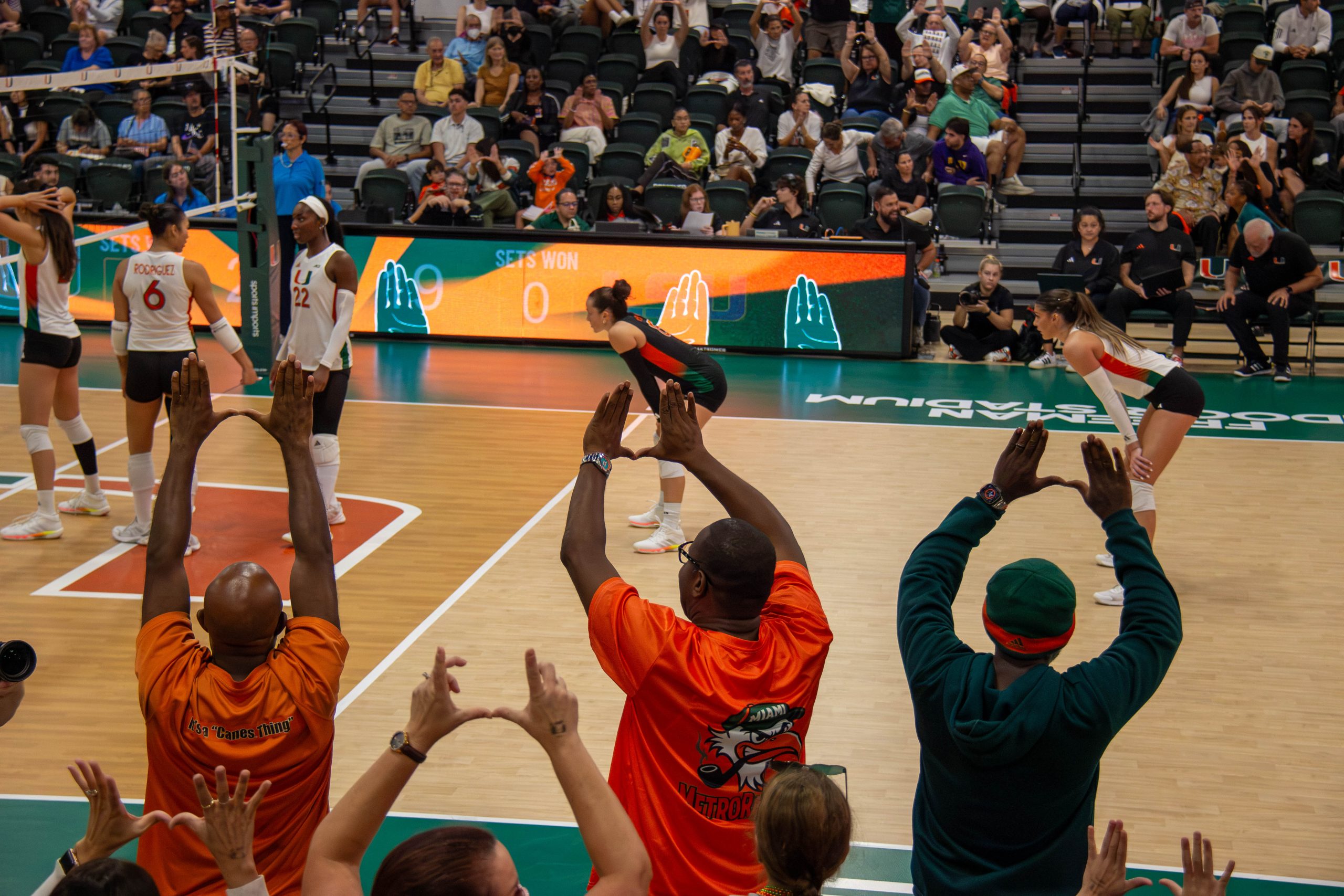
The Miami Hurricanes broke their seven game losing streak with a win over the LSU Tigers Thursday night, winning in four sets at the Freeman Indoor Stadium in Coral Gables.
Miami was in the midst of a horrid 0-7 start to the season, which included six straight sweeps, and were looking to make their first win of the season.
LSU also came into the match off a slow start, only recording one Power Four win through seven games.
As both sides aimed to turn around their season, the first set started off competitive.
Asia Harvey had a block in the first few moments, followed by Logan Wiley and Ariana Rodriguez.
The fans were cheering from the sidelines as the score remained level at 14-14 within the first seven minutes of the game, but the Canes pulled away and won the first set 25-20.
The second set started off with the Canes’ first kill by Ruth Martinez and an assist from Ariana Rodriguez.
Martinez had an impressive night, shining with 26 kills and six blocks throughout the game.
Miami was leading at the beginning, until LSU scored two points with a kill by Jessica Jones, followed by a block from Lauren Brooker.
UM took a timeout before the end of the second set, followed by a kill by Harvey as the Canes won the second set 25-19.
The third set didn’t start well for the Canes, and they were struggling to stop the Tigers’ defense.
Martinez and Wiley had kills back-to-back, but the Tigers took over most of the third set.
LSU hitter Sanaa Donaie had a kill assisted by Lauren Brooker and gave the Tigers the lead at 15-11. LSU maintained control of the ball for most of the 3rd set, and there was a timeout taken by both teams. Miami challenged the play before the end of the 3rd set, but LSU was granted the score and won the third set 25-12. This was the Canes’ worst performance of the night.
The 4th set started great for the Canes, with Martinez again getting a kill, followed by Rodriguez, and the crowd went wild. The energy from the Canes fans was at its highest.
The Canes were leading 11-5 within the first few moments of the 4th set, making it UM’s’ best lead gap in this game. LSU challenged the play, but after the review, Miami was granted the last kill.
There was an attack error by LSU middle blocker Jessica Jones, where Miami challenged the play, and Miami got an extra point. LSU took a timeout, but Miami continued to crush the Tigers and won the 4th set 25-20 to claim its first win of the season.
The Canes will remain at home, hosting Tulsa on Saturday, Sept. 19.
Bella Ochoa – Senior Photographer // The Hurricanes prepare for the second set win versus LSU on Thursday, Sept. 17, 2026 at Freeman Indoor Stadium
Miami soccer falls to No. 13 Virginia in Charlottesville
The Miami Hurricanes fell 3-0 to No. 13 Virginia on Thursday night in Charlottesville, ending Miami’s one-month unbeaten streak.
The Cavaliers, under 27th-year head coach Steve Swanson, controlled the game from the opening kickoff. Virginia recorded 19 shots and nine shots on target compared to the Hurricanes three shots and two shots on target. The Cavaliers also recorded six corner kicks to Miami’s one.
The Hurricanes held their own throughout the first half with solid, disciplined defense while Atlee Olofson recorded four saves within the first 25 minutes to keep the game scoreless.
Miami generated two shots on goal in the 28th and 35th minute of the game, with both Kambryl Armstrong and Carolina Hood forcing saves from Virginia’s goalkeeper Victoria Safradin.
Virginia eventually broke through in the 41st minute when Sarah Flammia played a pass up the middle for Aniyah Collier, who took a touch with her right foot before firing a powerful shot from just inside the 18-yard box to open the scoring.
Virginia took a 1-0 lead into halftime.
In the 62nd minute, Addison Halpern cut inside and doubled Virginia’s lead with a goal from 25 yards out, assisted by Faith Broering.
Any hopes of a comeback for the Hurricanes ended in the 67th minute when Armstrong received a red card following a challenge on Virginia defender Kathryn Kelly.
In the 81st minute, Halpern scored her second goal to give Virginia a 3-0 lead. Sophia Bradley found Halpern in space before placing her shot into the left side of the goal to put the game out of reach and secure the home victory for the Cavaliers.
Olofson finished with six saves on the night for the Hurricanes.
With the loss, Miami (6-2-1, 1-0-1 ACC) ends its three-game winning streak and drops its first game in conference play as Virginia (5-1-2, 1-0-1 ACC) claims its first conference victory.
Miami will look to bounce back Sunday, Sept. 20, when the Canes travel to Raleigh, N.C. to face NC State in their third ACC match of the season. Kickoff is scheduled for 1 p.m. The game will be aired on ACCNX.
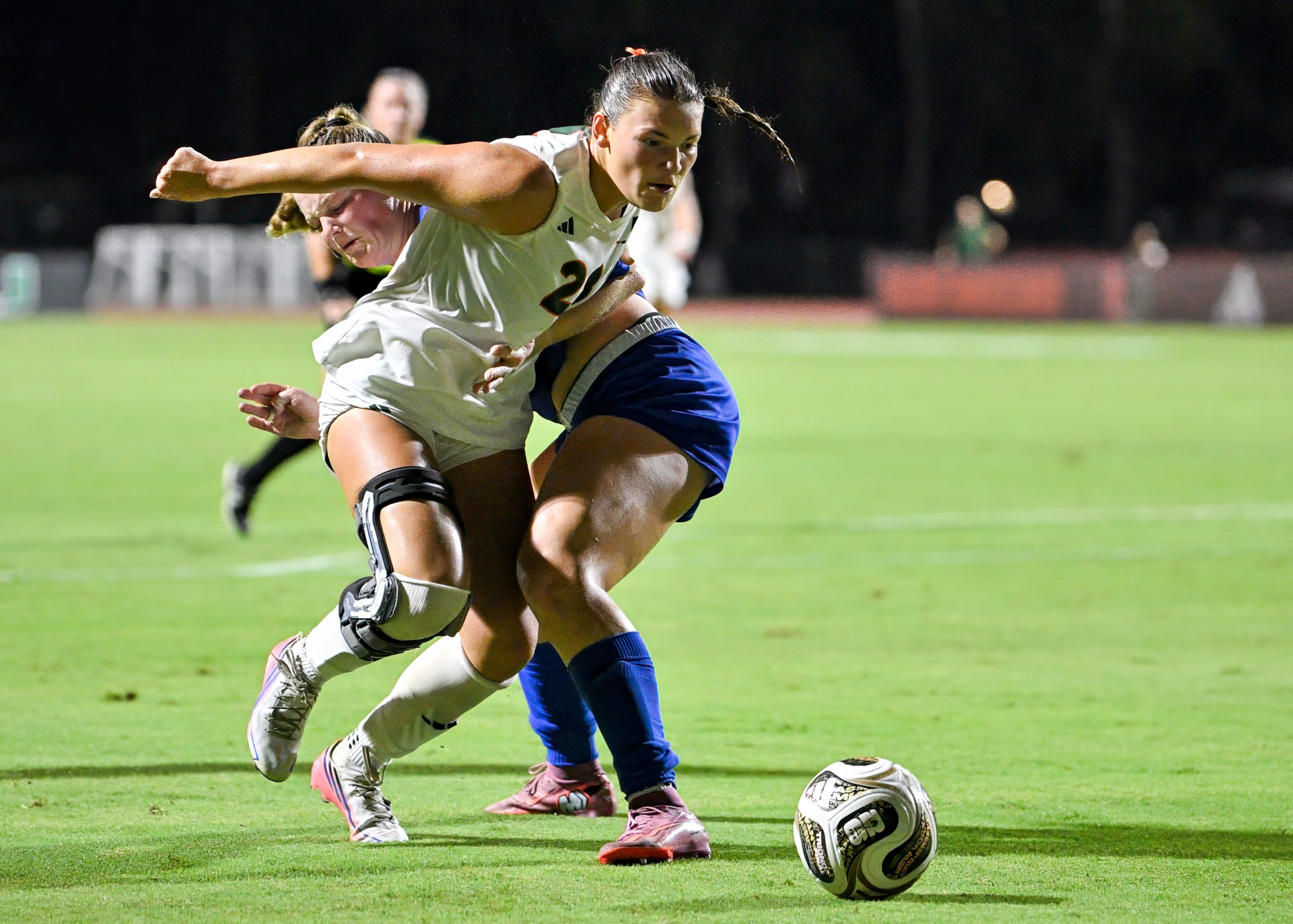
David Lebowitz, Photo Editor // Freshman Midfielder Maddie Sadusky maneuvers past an SMU defender on September 11, 2026 at Cobb Stadium.
From 70-point wins in football to consecutive losses in volleyball, Hurricane athletics experienced both the highs and lows of early season competition this past week.
Here’s the latest edition of the Hurricane Huddle (9/9 – 9/16):
Sept. 9 – Hurricanes Volleyball Falls Short to the Gators
Miami Volleyball traveled to Gainesville, Fla., to take on the Gators in the ACC-SEC Challenge “Showdown at the Net” at the Stephen C. O’Connell Center.
Despite the added intensity for a rivalry matchup, the Hurricanes dropped all three sets to the Gators.
Asia Harvey led Miami offensively with 11 kills. Denitsa Angelova and Adrianna Bridges both recorded three blocks.
Sept 10. – Hurricanes Dominate FAMU 77-7
Miami’s first home appearance since falling short in the CFP championship game did not disappoint, as they rolled past FAMU 77-7.
The Hurricanes set a new school record with 856 total yards and an ACC record with 42 first downs. The victory marked Miami’s 20th straight home-opening win.
Darian Mensah completed 14 of 15 passes for 252 yards and three touchdowns. Malachi Toney led offensively with a team-high with four catches for 96 yards and a touchdown. Mark Fletcher Jr. had seven carries for 105 yards and two touchdowns.
Sept. 11 – Hurricanes Volleyball Faces Defeat by the Gophers
Miami Volleyball continued its road trip, heading up north for the Diet Coke Classic in Minneapolis, Minn. at the Maturi Pavilion.
But UM’s struggles continued as they dropped all three sets to the Gophers.
Freshman Ruth Martinez led Miami offensively with 10 kills. Ariana Rodriguez recorded 21 assists. Gabby Arroyo led the Canes with 12 digs.
Miami started ACC play off strong with a 2-1 over SMU at Cobb Stadium in Coral Gables, Fla.
Freshman Vivien Muchuruza scored both goals in the second half for the Hurricanes. Goalkeeper Atlee Olofson played all 90 minutes, recording one save and an assist.
Miami improved to 6-1-1 overall and 1-0 in ACC play. The Canes will hit the road to take on Virginia on Thursday, Sept. 17 looking to continue their strong start.
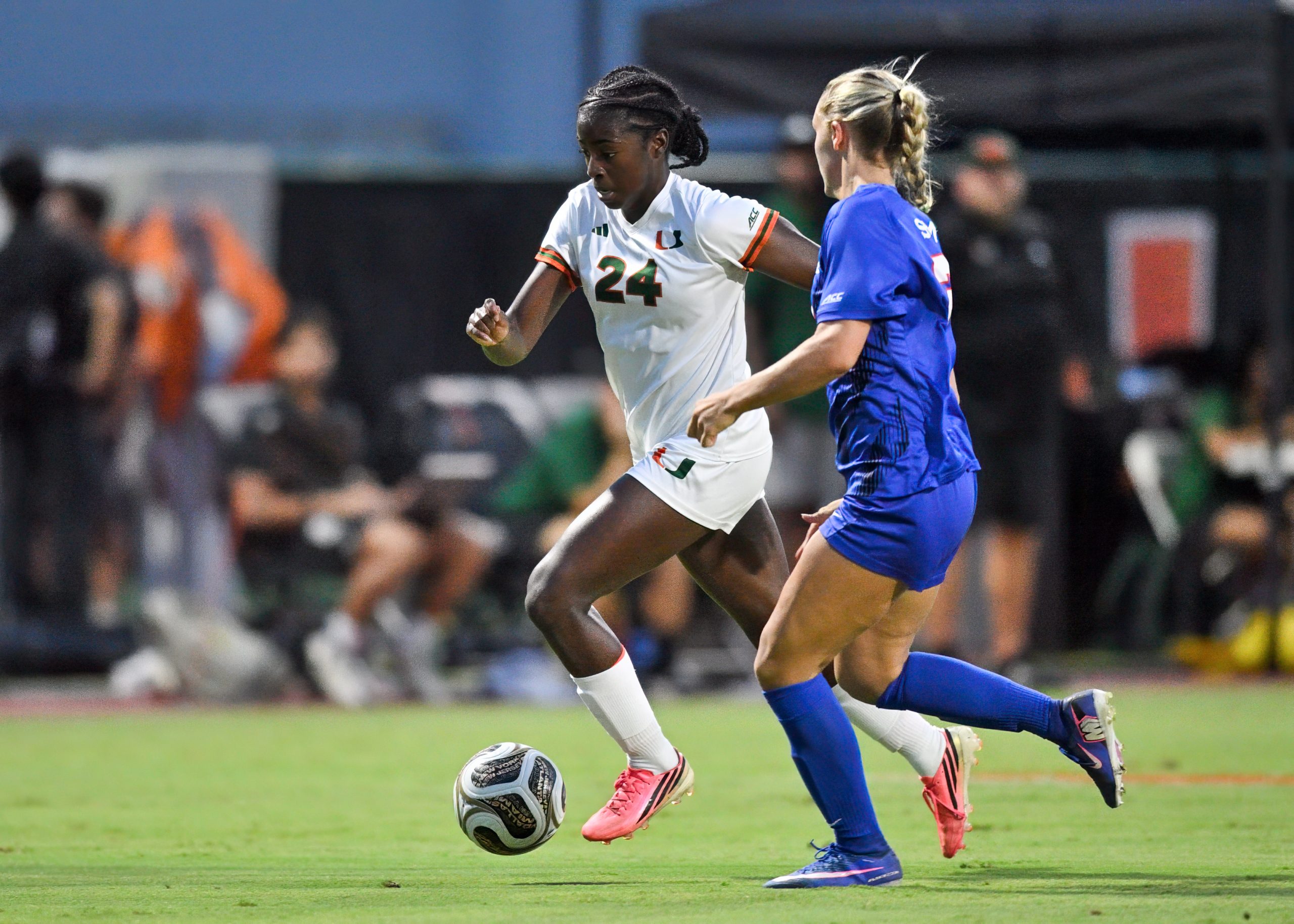
David Lebowitz, Photo Editor // Junior Forward Alyssa Stephenson drives past an SMU defender on September 11, 2026 at Cobb Stadium.
Sept. 12 – Hurricanes Volleyball Falls to St. Thomas in Three Sets
Miami took its seventh loss in seven games, falling to St. Thomas in three sets in the final game of the Diet Coke Classic.
While the Hurricanes held a lead in the first two sets, their defense could not stop the Tommies, who
Harvey led Miami offensively with nine kills. Rodriguez recorded 14 assists, while Billie Reiter added five more. Arroyo finished with 14 digs. Sonja Danilovic led the team with four blocks.
Miami ends its three-game road trip and looks for their first win against LSU in the Canes Classic on Sept. 17.
UPCOMING:
Sept. 17 – Hurricanes Volleyball Host LSU in Canes Classic
Miami returns home to host the Canes Classic, where it will face LSU on Sept. 17.
The Tigers enter the matchup with a 4-3 record after back-to-back sweeps against Charlotte and Southeastern Louisiana. LSU libero Kiley Brooks was recently named SEC Freshman of the Week on Sept. 14.
The Hurricanes enter this matchup 0-7 looking for its first win of the season with first serve scheduled for 6:30 p.m. EST.
Sept. 17 – Hurricanes Soccer Heads to Virginia For Ranked ACC Matchup
Miami looks to continue its strong start facing No. 10 Virginia. The Hurricanes are coming into Charlottesville with a 6-1-1 record and a 2-1 ACC win over SMU.
The Cavaliers are 4-1-2 and are coming off their first loss of the season against No. 3 Wake Forest.
Kickoff is set for 7 p.m. EST.
Sept. 18 – Hurricanes Take Momentum on the Road Against Wake Forest
Miami travels to Winston-Salem, N.C., to take on Wake Forest on Sept. 18.
The No. 5 Hurricanes are coming off a dominant 77-7 win over FAMU and have outscored their first two opponents by 109 points.
Miami’s defense will face a challenge without both starting cornerbacks, OJ Frederique and Xavier Lucas.
Wake Forest enters this matchup 2-0 after a 38-36 double-overtime win over Purdue.
Both teams feature transfer quarterbacks: Miami is led by Darian Mensah, who previously played at Duke, while Wake Forest is led by Gio Lopez, who previously played at North Carolina.
Kickoff is set for 7:30 p.m. EST.
Sept. 18 – Hurricanes Cross Country Heads to Tallahassee for FSU Pre-Regional
Miami’s men’s and women’s cross-country teams travel to Tallahassee, Florida on Sept. 18 to compete in the FSU Pre-Regional.
Both teams recently placed fifth overall at the Florida Intercollegiate Invitational.
Senior Maddie Scheier led the women, placing second in the 5K. Freshman John Templeton led the men placing ninth.
The FSU Pre-Regional will help Miami prepare for its return to Tallahassee for the NCAA South Region Championship on Nov. 13.
The first race is set for 7:40 a.m. EST.
Credit: Jason Hill – Co-Photo Editor \ Senior quarterback Cam Ward gets ready to take the next snap against Wake Forest at Hard Rock Stadium on Nov. 23, 2024.
It feels like someone invents a new term used to define or describe a romantic relationship every day. Words like “situationship” and “talking stage” were invented within the last decade, and they’re only making dating more stressful and confusing than it already is.
Although these terms aren’t unique to Miami, definitions like these often discourage people looking for a serious relationship.
And finding love at the U is already almost impossible.
According to College Weekly, an Instagram account that ranks colleges on various criteria, the University of Miami ranks second for “toughest dating scene” after Arizona State University.
The caption stated, “finding love at these schools is an extreme sport,” and, to some extent, this rings true.
Among the schools listed in the Instagram post, almost all were also known as “party schools,” showing a possible correlation between party culture and finding long-term romance.
“For many young people, the way they experience nightlife, or the morning after, directly impacts their romantic relationships,” NSS magazine wrote in an article on what is called the “party gap.”
The party gap suggests that people who enjoy going out to clubs or bars often clash with those who prefer staying in and reading a good book.
While this is an obvious assumption, what isn’t obvious is how greatly this gap is impacting the Gen Z population.
A study by Family Studies found that Gen Z is in a “relationship recession.” The study focused on unmarried young adults aged 22-35 who expect to marry.
They found that only 1 in 3 young adults, both male and female, is in a serious relationship or dating, and only half expressed interest in getting in a relationship at all.
“I don’t think it’s impossible to find love here, but I definitely think it has a lot to do with the individual person,” said another female sophomore at UM. “A lot of the time, people get too into the party culture at schools like this, and tell themselves they won’t find anything serious, so they never treat the relationship seriously even if they do eventually get in one.”
One possible cause of the relationship epidemic is oversaturation: too many fish in the sea.
There are approximately 19,850 students who attend UM’s undergraduate and graduate programs, but more students don’t always mean better options.
According to a study published in PubMed Central, having a larger dating pool actually decreases someone’s chances of finding a potential partner due to an overload of selections, leading you to stay single rather than form an intimate relationship.
“I think there’s hope for finding someone or something serious at this school, it’s just a matter of looking for someone who has similar interests as you,” said a different female student who wishes to remain unnamed. “If you’re into going to the gym, then join a club for runners or working out. If you’re into movies or music, go to places where you’ll find people of those interests. It’s not completely hopeless, just a lot of work.”
So, while finding love isn’t necessarily impossible at UM, it may be time to branch out if you’re looking to find “the one.”
Following back-to-back blowout wins to start the year, Miami travels to Winston-Salem to open up conference play against Wake Forest.
Like UM, the Demon Deacons (2-0) are undefeated, riding high following their double overtime thriller defeat of Purdue.
The No. 5 Hurricanes are still heavily favored in this one, with ESPN Analytics giving them a 91.7% chance of victory and most predicting Miami to win by three scores.
However, mid-season conference games have served as the Canes’ kryptonite in recent years, so it isn’t a game they should take lightly
Miami’s ex-factors will be the stars that have already shined bright to start the year. The dynamic duo of quarterback Darian Mensah and wide out Malachi Toney are among the leaders in the country for the Heisman Trophy early in the year. Through two games, Mensah has thrown just four incompletions, totaling 653 passing yards and eight touchdown passes.
Toney has been exceptional to begin the season, having 330 receiving yards and four touchdowns in less than five total quarters of action, as the starters were pulled midway through the 3rd quarter against Stanford and at halftime in the season opener against FAMU.
Miami’s running backs are also expected to make their presence felt on Friday. With the Hurricanes outscoring their opponents 122-13 to open the season, starters Mark Fletcher Jr. and Marty Brown haven’t had much work to start the year.
These blowouts have allowed true freshman Javian Mallory to make his mark, totaling 173 yards in two games and sitting at fourth in the ACC in rushing yards.
While the Canes offense has gone off to a historic start, it will be Miami’s defense that will need to step up against a Wake Forest team that totaled 411 yards in its win over Purdue.
Wake Forest was led by the rushing attack, with three players garnering double-digit carries on the day.
Expect running back Ty Clark to demand the rock early and often against the Hurricanes, with quarterback Gio Lopez contributing to the rushing attack. The UNC transfer led the team in carries against Purdue, with 13, and scored two touchdowns with his legs.
In the air, Lopez has been very efficient this year as well, throwing for 575 yards, 4 tds, no picks, and a 62.7% completion.
Lopez’s number one target against the Canes will likely be Washington State transfer Carlos Hernandez. The deep threat is averaging 23.0 yards per catch on the season, and with Miami dealing with some injuries in their cornerback room, this will be an area the Demon Deacons will undoubtedly attempt to exploit.
The season is still young, and the Canes will be looking to add another dominant win to their resume early, while the Demon Deacons are looking to shock the college football world, with Friday night’s game expected to be a sell-out crowd in Winston-Salem.
Kickoff is set for 7:30 p.m. at Allegacy Federal Credit Union Stadium, with the game airing on ESPN.
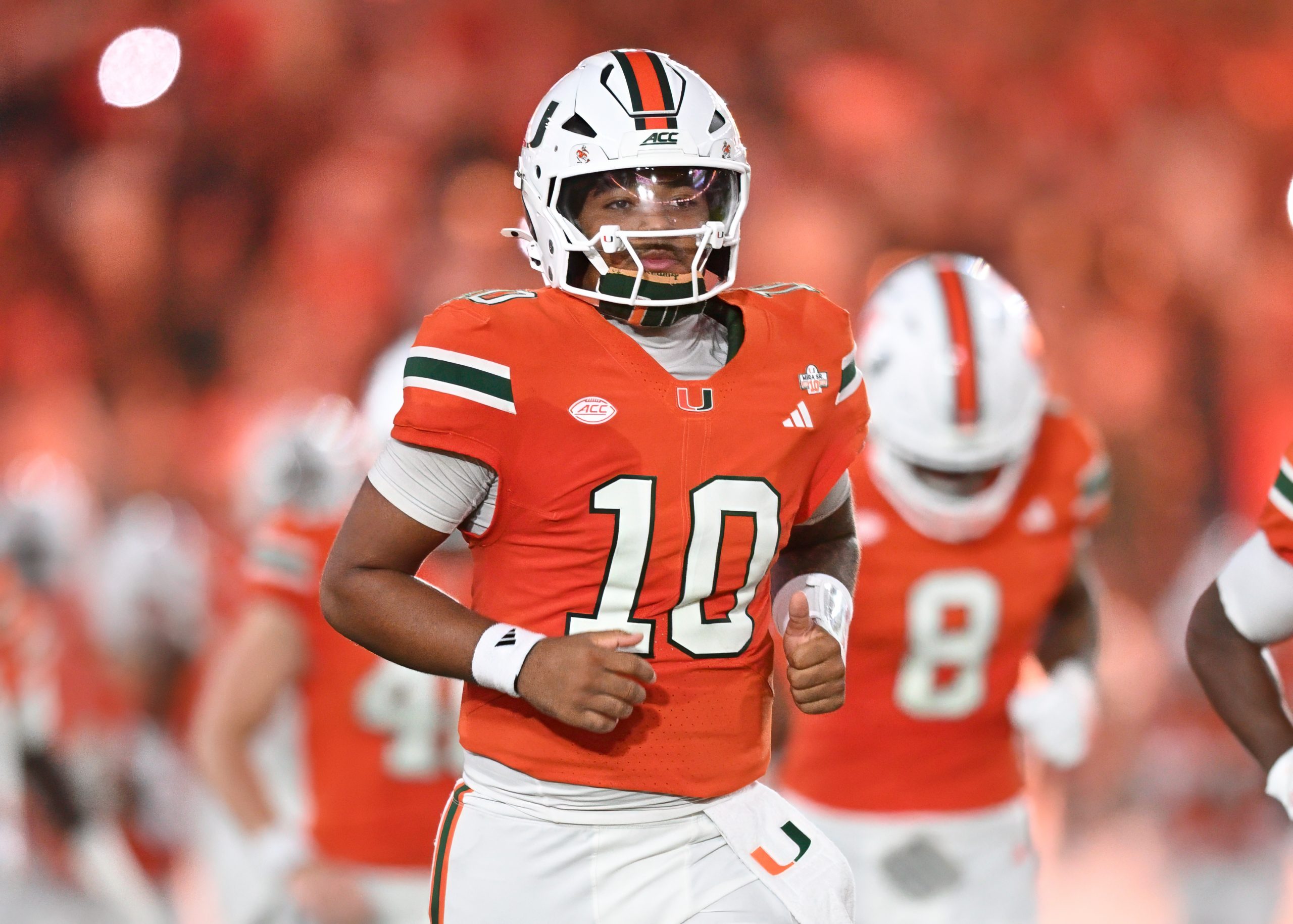
David Lebowitz, Photo Editor // Redshirt Junior Quarterback Darian Mensah runs out onto the field on September 10, 2026, at Hard Rock Stadium.
Miami athletics has returned to Nike as the program’s apparel sponsor, agreeing to a lucrative 10-year contract worth more than $200 million.
Nike was the apparel sponsor of the Hurricanes from 1987-2015, before the University made an unprecedented decision to sign with Adidas.
Now, Miami is back wearing the iconic swoosh.
Miami found themselves in a strong negotiating position following its national championship appearance, also coming off the footsteps of other premier programs signing apparel deals.
Adidas put pen to paper with Penn State on July 1, in a 10-year, $300 million dollar deal, and agreed to a 10-year, $100 million deal with the University of Tennessee the next day.
With the bar set high, UM went into negotiations with the upper hand and found that Adidas was unwilling to match Nike’s offer according to reports.
The deal marks a role reversal from when Miami was last in apparel negotiations 12 years ago. Nike was unwilling to match Adidas’ offer in 2015, leading to the longstanding Adidas partnership the University had until now.
The offer reportedly puts Miami as the second-highest collegiate investment from Nike, just behind Oregon, where the apparel giant was founded.
UM was in the midst of a 12-year deal partnership with Adidas, set to expire in 2027. The agreement was the longest-standing collegiate partnership in Adidas history — also the first all-sport apparel partnership the company had with a top program.
Makena Wong, Photo Editor, Junior Defensive End Rueben Bain Jr. celebrates after interception on Sunday, Aug. 31st, 2025.
Adidas had spent the last decade investing in South Florida sports, from high school all the way to Universities.
South Florida talents such as Malachi Toney, Ohio State’s Jeremiah Smith and Miami recruits A’mir Sears and Nick Lennear all signed with the three stripes within the last year.
In 2025, Adidas signed a five-year, $13.5 million deal to outfit all 41 of Miami-Dade County High Schools’ athletics uniforms, cementing itself as the leading athletic apparel company in the greater Miami area.
But while UM and Adidas have been great partners for more than a decade, UM and Nike have historic ties.
Miami’s original partnership with Nike marked the first all-sports apparel contract in collegiate history, and continued for four of UM’s national titles in football (1987, 1989, 1999, 2001) and two in baseball (1999, 2001).
The Hurricanes join South Carolina as Power Four programs to sign with Nike in the past year, with the decision set to take effect when Adidas’ deal expires next July ahead of the 2027 athletic season.
The Miami Hurricane reached out to the University for comment and is awaiting a response
As Week One kicked off in the NFL, former Miami Hurricanes all around the league began their seasons. Through it all, there was a fair share of ups, downs, surprises, and big plays from Miami’s alumni. With the excitement and fanfare surrounding Week One, it’s best to remember that there are still 17 more weeks of NFL football to go, regardless of the good or bad.
Francis Mauigoa: Rookie of the Week and Offensive Player of the Week
Starting off with one of the stars of last season, Francis Mauigoa had one of the most impressive debuts for a rookie offensive lineman in nearly a decade. Against a renewed Dallas Cowboys interior defensive line featuring stars like Quinnen Williams and Kenny Clark, Mauigoa was the exact player ‘Canes fans saw in Miami. Bullying nose tackles trying to push him back in the run game, his contributions helped New York run for 165 yards and win the time-of-possession battle, 36 minutes to 24, as the Giants came away with a 28-20 victory on Sunday Night.
Mauigoa wasn’t just a factor in the run game, and his pass protection wasn’t just amazing it was a historical feat. In 36 pass-protecting snaps, Mauigoa allowed zero pressures and zero hits on Jaxson Dart, a feat no rookie offensive lineman has reached in Week One since 2018. Tasked with handling Kenny Clark, Mauigoa was also the first offensive lineman to hold him without a pressure through 19 or more matchups since 2023.
It was truly a special debut for the former tackle, as he showcased that it doesn’t matter where he plays on the offensive line he’s going to continue to bring that same physicality and nastiness to his game.
Gregory Rousseau: MVP and Defensive Player of the Week
You do not typically expect a 36-31 game to be decided by plays from the defense. Rather, it’s usually a “who can score last” competition. In Sunday’s 1 p.m. shootout between the Buffalo Bills and the Houston Texans, Gregory Rousseau potentially made the biggest plays of the game.
After going up 36-31 with a late connection from Josh Allen to Joshua Palmer, Houston still had plenty of time to march back down the field, and they were well on their way to doing that. Starting from their own 29-yard line with just over a minute and a half left in the game, Houston was down in the red zone with 20 seconds to go when Rousseau sealed the game.
As Stroud tried to step up in the pocket, Rousseau beat his man around the edge, wrapped up Stroud, and poked the ball free to be recovered by the Bills. This was Rousseau’s second strip-sack of the game, and along with two sacks and forced fumbles, Rousseau had five QB hits, two other tackles for loss, and a pass deflection.
He was a game-changing and game-wrecking force all day long for Buffalo, and Week One was a big-time start to what could be a breakout season for the former Cane.
Biggest Surprise: Rough Start for Cam Ward and the Titans
A loss to the Jets any week can be rough, but Ward and the Titans looked outclassed by the Jets in every way possible in their 23-10 loss. Ward went 19/32 for 140 yards and a touchdown, which he scored while down 20 points in the fourth quarter, and Tennessee’s offense couldn’t get much of anything going throughout the game.
This may sound light, but I’m not sure how much of this is on Ward. Throughout the game, Ward had pressure in his face immediately plenty of times and was flushed out of the pocket on crucial third downs. In addition, Ward was set up a few times around midfield in a manageable fourth-and-short situation, and as the game slipped away, it seemed like head coach Robert Saleh was unwilling to take risks.
On a positive note, unlike last year, Ward did show improvement in his willingness to throw the ball away or take off and run for a small gain. Still, Ward took three rough sacks, including on this play, a creative end-around fake that Ward panicked on before stepping up into a sack. His other two
This Tennessee team is still clearly far away from a talent standpoint, but Ward’s performances need to include more substance than the flashes he has shown.
Other Notes: Bain and Scott Instant Starters, Mixed Results
Reuben Bain was only able to record a single tackle throughout the game and really wasn’t a presence in the Buccaneers’ 33-27 loss to the Bengals. It was promising to see Bain receive a starting opportunity this early for the Buccaneers. Playing 64% of the snaps, he clearly seems to be a guy that Tampa trusts to make an impact.
Plays like this, with Bain unable to get off a block in the run game, aren’t what we’re used to seeing from the game-wrecking defensive end, and they need to be cleaned up to maintain that starting role.
In the back end of Tampa’s defense, Keionte Scott showed up in a premier role for the Tampa Bay secondary. Scott played 47 snaps, the sixth-most for Tampa Bay, and notched four tackles throughout the afternoon. In coverage, Scott played effectively in his limited matchups against superstar wide receiver Ja’Marr Chase, allowing only a single catch when Chase lined up in the slot on his way to finishing with two receptions for 12 yards.
This is a Tampa team that is going to be very reliant on its rookies, as noticed with Bain and Scott, but also Jeremiah Trotter Jr., who exploded in Week One with a sack and a pick-six. That reliance on this rookie class means Scott and Bain are going to have plenty of opportunities to bounce back from the ups and downs of their debuts.
Along with them, veteran Al-Quadin Muhammad, coming off a 10-sack season with Detroit, started off his time in Tampa slowly but did notch a couple of QB hits.
As the season continues, it’s clear there’s plenty of growth that these young ‘Canes need to make as they enter the action of the NFL. That being said, it’s only Week One, and anything can happen in the coming weeks.
So, as these ‘Canes take flight through their NFL journeys, keep an eye all around the league for someone to make a big play. With a large rookie class across the board playing tons of snaps and taking on big roles, there are plenty of ways to catch a Cane making a play on Sundays.
As week one kicked off in the NFL, former Miami Hurricanes all around the league began their seasons. Through it all a fair share of ups, downs, surprises, and big plays from Miami’s alumni. With the excitement and fanfare around week one, it’s best to remember that there’s still 17 more weeks of NFL football to go and regardless of the good or bad.
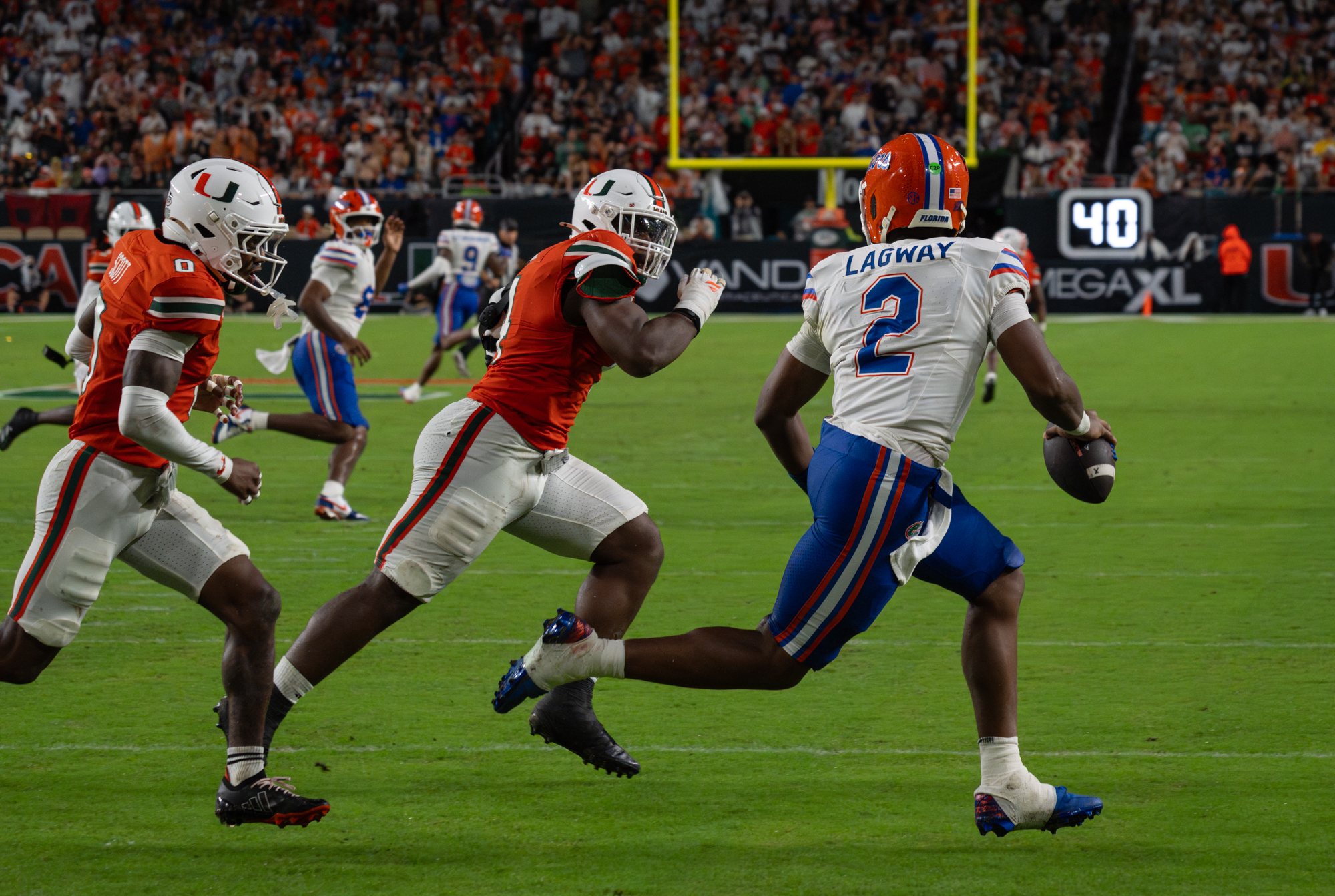
Assistant Photo Editor Brian Mulvey // Junior defensive back Rueben Bain Jr. (4) and sixth-year redshirt senior defensive back Keionte Scott (0) chase Florida’s DJ Lagway on Sept. 20, 2025
Friday, Sept. 11, 2026, marked 25 years since the terrorist attacks on New York City’s World Trade Center, where nearly 3,000 people were killed.
The city of Miami honors the victims, first responders and public servants who sacrificed their lives that day.
Here is a look at events happening on campus and around Miami-Dade County:
Campus Events
On Friday, the University of Miami unveiled a 25th Anniversary 9/11 Remembrance Display, located behind the “U” statue. The display, brought by the Political Science Association and the Veteran Students Organization, features an abundance of mini United States flags.
On Saturday, Sept. 12, from 6 a.m. to 8 a.m., the Veteran Canes Society and University of Miami Army ROTC hosted the 7th annual 9/11 Ruck to Remember, a 9.11-mile-long ruck march through Coral Gables.
On Tuesday, Sept. 15, from 5:30 p.m. to 7:30 p.m., the Newman Alumni Center is screening the documentary, “9/11: Reclaiming Ground Zero.” The event will be followed by a discussion with movie producer Robbie Shinder and Dr. Gregory Kroger, Director of the George P. Hanley Democracy Center.
Miami-Dade County Events
The Coral Gables Police and Fire Departments hosted a joint ceremony to honor not only the lives lost on 9/11 but also the public who helped with the aftermath.
In Miami Beach, first responders from the fire and police departments held a ceremony honoring the victims of 9/11.
“September 11 reminds us of both the devastating loss of innocent lives and the extraordinary courage of our nation’s first responders,” said Miami Beach Mayor Steven Meiner. “We honor the firefighters and police officers who ran toward danger to save others, and whose sacrifice is a powerful example of the strength, duty, and patriotism that define America as we stand with our own Miami Beach Fire and Police Departments who carry that legacy forward every day.”
Coconut Grove held a ceremony at Miami City Hall, followed by a graduation ceremony for 44 new firefighters.
Miami Dade College’s North Campus hosted “We Promise to Never Forget,” a remembrance ceremony honoring the lives lost and the heroes who emerged on 9/11. The event will be open to students, faculty, law enforcement and the public as an act of unity and resilience.
“On this 25th anniversary of Sept. 11, we pause to honor the innocent lives lost, recognize the extraordinary bravery of first responders and reflect on the resilience that emerged from one of our nation’s darkest days,” said MDC North Campus President Fermin Vazquez.
At Key Biscayne Civic Center’s Monaco Fountain, events included a reflection from former New York Fire Department captain Robert Senator, a moment of silence and prayer.
The North Miami Police Department honored those lost on 9/11 at its headquarters, including a moment of silence along with a 21-gun salute by the officers at 9:11 a.m.
The Miami Hurricanes dominated Florida A&M 77-7 on Thursday night at Hard Rock Stadium, but the 70-point blowout only tells part of the story.
Miami didn’t just dominate FAMU; it rewrote school and ACC record books in the process.
The Hurricanes piled up 856 total yards, equaling the second-most all-time (FBS) and shattering the previous program record of 750.
Miami also made ACC history with 42 first downs, setting a new conference record and the most by an FBS team since 2019.
Miami’s 77 points tied the program’s single-game record, while nine different Hurricanes scored a touchdown from scrimmage, tying the most by an ACC team in the last 30 years.
The production was perfectly balanced. Miami finished with 430 rushing yards and 426 through the air.
The Hurricanes scored touchdowns on each of their first 11 drives and became the first FBS team since 2021 to go an entire half without facing a third down.
Quarterback Darian Mensah was nearly perfect, completing 14 of 15 passes for 252 yards and three touchdowns. Backup Luke Nickel took over in the second half and completed all eight of his attempts for 144 yards and three scores.
Mensah and Nickel became the first power-conference quarterback teammates since 2016 to each throw three touchdowns in the same game. It also marked the first time the Hurricanes had two quarterbacks with multiple touchdown passes since Kyle Wright and Kirby Freeman combined for five touchdowns in 2005.
The Hurricanes’ dominance extended to the other side of the ball as Miami held FAMU to just 107 total yards and a 1-for-14 mark on third down.
The game became so lopsided that both teams agreed to shorten the fourth quarter from 15 minutes to 10.
With the outcome decided early, head coach Mario Cristobal rested his starters for the entire second half while giving Miami’s backups valuable playing time.
Miami returns to action Friday, Sept. 18, on the road against Wake Forest at 7:30 p.m.
David Lebowitz, Photo Editor // Redshirt Junior Quarterback Darian Mensah runs out onto the field on September 10, 2026, at Hard Rock Stadium.