


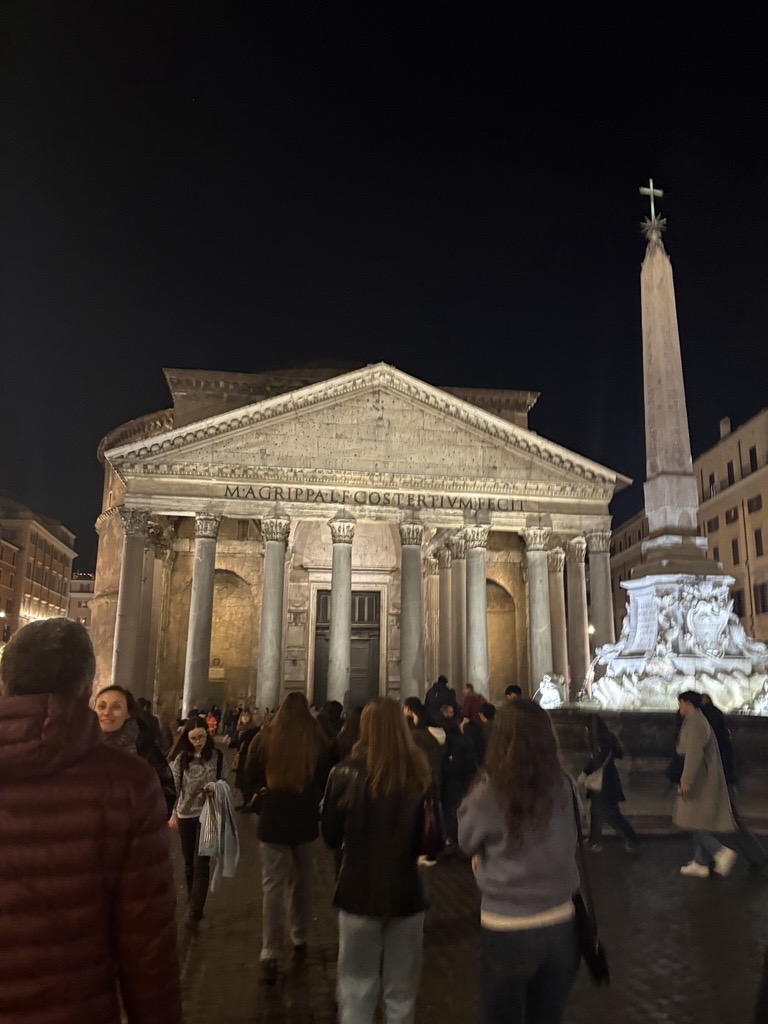
I arrived in Rome a couple months ago believing I would be fully immersed in a new culture. This expectation has proven to be partially true.
By exploring the city, I’ve experienced a different language and different customs. But it turns out that certain moments in my day-to-day life feel very similar.
At universities across the United States, study abroad opportunities are most commonly offered through a U.S.-run program, rather than an academic institution of the host country.
As a study abroad student at the American University of Rome, I live and study alongside fellow Americans. On my walk from my apartment to class, I’ve noticed it’s about as common to hear people speaking English as it is to hear people speaking Italian.
In the Journal of Comparative and International Higher Education, Professor Mary K. MacKenty writes that “US programs inherently increase peer group contact, which can detract from the development of local relationships and tend to shelter students from the foreign environment, creating ‘American bubbles.’”
According to a 2024 presentation by the Association of American College and University Programs in Italy, only 15% of American students studying abroad in Italy interact continuously with Italians, and the majority never or only occasionally interact with Italians. This number is astonishingly low. But it’s hard to break out of the bubble.
A student at Syracuse University told the San Diego Union-Tribune that she “loved her semester in London,” but admits parts of the experience didn’t feel all that different from being back on campus at Syracuse University. She lived with four Syracuse classmates, took classes with fellow Syracuse students in a Syracuse-owned building from Syracuse-affiliated faculty.
“Our social circle was pretty much other people in the program,” she added.
Being surrounded by Americans is certainly comforting, but I can’t help but feel like my experience living in Italy is inauthentic. During my time abroad, I’ve come to the conclusion that I don’t want to be comfortable.
In fact, some of my favorite travel memories have come out of moments of discomfort. I’ve gotten on the wrong bus and ended up two hours away from Paris, and I’ve gotten on the wrong ferry to an island in Greece. Each time, after the initial shock wore off, I was grateful to have the opportunity to see something different than what I initially expected.
I recently started attending a language exchange in Rome where individuals learning Italian can meet for a conversation guided by a native speaker. The first time I went, the man leading the conversation found my attempts to speak Italian hilarious. Yet I kept coming back, and my Italian has gotten better.
I know that I won’t become a local, at least not in the short time I’m here. But pursuing total immersion is worthwhile in and of itself. There’s so much learning and personal growth that comes out of feeling completely out of place.