Fresh off a summer of travels, festivals, and fearless growth, Miami-based singer-songwriter Maeve McMahon (formerly MAEVE) is stepping into a new season with unstoppable momentum. With her full band in tow, Maeve is set to light up stages across South Florida this fall—bringing fans both the heartfelt folk-pop they know and love, and a taste of bold, brand-new originals.
Maeve’s live shows are something you can’t miss. Whether it’s a festival crowd singing along to her original anthems, or an intimate brewery set filled with covers that keep the energy flowing, Maeve thrives on making audiences move.
“I was a performer before I was a songwriter,” Maeve said., “So seeing the music come alive on stage is everything. I can’t sit still when I’m performing—and I don’t want the audience to either.”
This season, fans can expect something only Maeve can deliver. She is debuting unreleased songs that lean into an edgier pop-rock-folk sound with a country twang, showing off new layers of her artistry and vocal range.
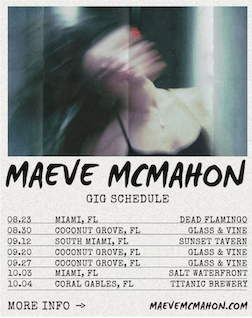
Maeve McMahon upcoming show schedule. Photo Courtesy of Maeve McMahon.
These tracks will serve as the foundation of her upcoming album, set to drop next summer. “I want people dancing, feeling free, and seeing a new side of me,” Maeve said.
For those who haven’t seen Maeve live, this is the moment. Her debut EP Traffic Lights—an emotional journey through heartbreak, change, and growth—has already introduced her fearless voice to the world. But on stage, Maeve’s fire burns brighter. Her energy, movementand raw presence transform her songs into something unforgettable.
Between her slew of recent and upcoming gigs and her adventurous songwriting, Maeve is setting out to prove she’s not an artist who can be boxed in. She’s limitless—and she’s inviting her fans to grow, groove and go with her.
Stream Maeve’s EP “Traffic Lights” now on all platforms. Don’t miss her upcoming shows in Miami and watch her new music video. Expect covers, fan favorites and fresh originals that will leave you buzzing for what’s next.
Over the weekend, hundreds of students waited for the Hurricanes’ season opener versus Notre Dame tickets to drop at noon. Those who didn’t join the waitlist right away were disappointed to see tickets had sold out less than 24 hours later.
This Sunday, the Hurricanes are facing the Notre Dame Fighting Irish for the 28th time, a rivalry that was once a yearly spectacle in the 1980s. The last time these two teams faced each other was in 2017, when Miami won 41-8 in dominant fashion. This is the first time student tickets have sold out since last year’s FSU versus UM game in October, due to the teams’ long-standing rivalry.
With a history filled with decades of drama and hatred, it’s no wonder Hard Rock Stadium is expected to be at full capacity Sunday night after selling 42,000 season tickets, the second most they’ve ever sold, according to Miami Hurricanes Athletic Director Dan Radakovich.
Several students were also upset when they realized they could not purchase guest tickets. This could be due to the University preparing for the frenzy of the first game day of the year.
Sophomore Daniella Vega was about to score a ticket for the game but did not. She was also relying on a guest ticket for her long distance boyfriend, who she planned to attend the game with. With the restrictions, the only way she’ll be attending the game is if she finds stadium tickets to purchase for the both of them.
“The problem is now the tickets are so expensive if you’re not getting one from the student section, so I don’t know if I’ll be able to go anymore,” said Vega.
The first game of the season is one of the biggest and most important events of the year, not just for the players and cheerleaders but for the students as well. With the historic “Catholics versus Convicts” match up, UM fans are excited to see how this game will set the tone for the remainder of this year’s season.
“I can’t wait to see the stadium filled with UM spirit at the first home game,” shared one freshman student from New York City.
UM officers arrested an unidentified man at the University of Miami Police Department on Aug. 25 at 7:15 p.m. after reports were filed about duck abuse on campus. The man was charged with one count of animal cruelty.
According to Sergeant Michelle Christensen, the public information office for the City of Coral Gables, the man was not placed into handcuffs or taken directly to jail and was instead given a promise to appear in court. Failure to show up in court will result in a warrant for his arrest.
The documented abuse, which occurred on Aug. 22 at approximately 4 p.m., went viral on social media nearly an hour later. A video showed a man cursing at and kicking a beloved campus duck named “Ivan.” A separate photo showed a different man holding the duck by its wings while its head dangled down. This man in the photo appeared to be wearing ABM attire.
“I am happy and grateful that consequences were given out and that this situation was handled seriously,” said Alexa Wood, the student from UM who reported the original incident via the University Hotline. “It is important that we treat our wildlife just as we would treat humans in this scenario.”
Sergeant Christensen also confirmed that the man arrested was not a UM student but his affiliation to UM is still unknown.
American alt-metal band, Deftones, released their long-awaited tenth studio album, “private music,” on Aug. 22. After a five-year wait, fans finally got to hear Deftones’ most psychedelic, modern sound yet.
With sounds mirroring those of their four 2010s albums — “Diamond Eyes,” “Koi No Yokan,” “Gore,” and “Ohms” — “private music” is the final evolution of Deftones’ journey as a modern metal band.
In the build-up to the album’s release, Deftones released two singles, “my mind is a mountain” and “milk of the madonna.” Together, the two singles have amassed over 4.3 million views on YouTube and 27 million plays on Spotify.
The success of “my mind is a mountain” overshadows the other amazing songs that are on the album. While good on its own, songs like “infinite source” and “i think about you all the time” easily outmatch the single with their melodic vocals and creative riffs. “I think about you all the time,” especially, gives off the feeling of floating peacefully through space.
“Milk of the madonna,” however, stands extremely well on its own. With spiritual metaphors in its lyrics and a similarly holy melody and sound, it takes you to another dimension of listening. While “my mind is a mountain” may be overhyped, “milk of the madonna” definitely isn’t.
As the album hit the ears of fans worldwide, Deftones lead singer Chino Moreno reflected on how their music continues to attract young people even after an active period of almost 40 years.
“Having this whole new generation of eyes on us and more attention now than we’ve had in decades. So why not embrace it?” Moreno told the LA Times.
In fact, many people were surprised when Deftones announced more music. “I was very surprised the album came out,” Sebastian Quesada, a sophomore at Florida International University, said. “I didn’t think Deftones would release anything else after ‘Gore’ and ‘Ohms’ since they’ve been active for so long.”
For young Deftones fans, the announcement of “private music” was also a great opportunity to experience parts of music that aren’t so common anymore today: purchasing a record of the album.
“As a frequent listener of Deftones, Spotify gave me early access to purchase ‘private music’ as a record, which I did,” Jake Williams, a freshman at the University of Miami, said. “At first, I didn’t know what to expect and I wasn’t sure how it would hold up to their past music.”
But some eager fans were disappointed.
“This album was kinda mid,”Quesada said. “It felt too repetitive, too slow, and too boring. I needed more energy, everything sounded like a whole lot of nothing to me.”
However, other students felt the album was right up their alley. “I wasn’t sure how it would hold up to their past music,”Williams said. “Then I heard ‘my mind is a mountain’ and in that moment I felt like this band would never go out of style. The album was basically perfect.”
Many other fans which were eagerly awaiting the release of “private music” were satisfied with what they got. “Just, overall, I was very impressed,” Andres Robles, a sophomore at Rice University, said. “Deftones has been really consistent for so many years now. Every new album is an enjoyable experience.”
The most commercially successful songs so far are “my mind is a mountain” and “milk of the madonna”, which were released as singles prior to the album’s release. Other great, successful, and unique songs on the album include “i think about you all the time,” “infinite source” and “ecdysis.”
“‘Private music’ gave a nice mix of heavy and soft rock,” Williams said. “It also gave me eleven new songs to listen to, which honestly couldn’t have made me happier.”
Other songs, like “cut hands,” gave fans of the heavier Deftones music a taste of nostalgia. “I really like their aggressive songs,” Robles said. “So I liked songs like ‘cut hands’ because of its power and aggression, and it’s reminiscent of earlier Deftones and I thought that was cool.”
Now, post-release, fans don’t expect much more out of Deftones. “Unless they make another album like their first three, then I don’t want more,” Quesada said. “It just felt like a drag to listen to, they shouldn’t release more.”
Still, some of Deftones’ fans are still waiting for the finishing touches of their career, including a shelved album called “Eros,” which was some of their last work with late bassist Chi Cheng — though it’s likely to stay shelved, according to Moreno.
“I still want them to release a song called ‘Smile,’ off of that album,” Williams said. “I think if that was officially released it would be my number one listened to song. All around, I thought “private music” was amazing and I found something to like about every song.”
For now, though, “private music” will keep fans listening to Deftones for a long time. “I’ll probably change my opinion on my favorite song after a couple listens,” Robles said. “But even after the first time, it was very good, and very consistent with Deftones’ brand, and I’m happy with what we got.”
As kick-off approaches, Miami Hurricanes Athletic Director Dan Radakovich and UM football coaches gave updates on the state of the football program and college athletics at their weekly Monday press conference.
Coming off the Hurricanes’ best statistical season since 2017, the energy is in the air, and the fans feel it.
“[Miami Athletics] sold 42,000 season tickets, which is the second most we’ve ever sold,” Radakovich said.
Radakovich emphasized how the marketing team worked hard on improving in-game operations and hopes to see a sea of orange at Hard Rock Stadium on Sunday.
UM will start the season with four home games, and even in front of the Miami faithful, it will be a challenge.
“The program has continued to rise over Mario’s last four years here,” Radakovich said; however, “These four home games in a row will be a test,” he later added.
Despite facing a team that went to the National Championship last season, the staff is confident they’ve prepared the players well.
“We’re turned up pretty good here, we’re trying to make every day like game day as close as possible,” coach Cristobal said.
Radakovich also praised the team.
“I feel really good, I do. The coaches have put a lot of work in, you can look at what [Cristobal] did for our football program step by step back up into a nationally relevant team. We’re ranked in the top 10 in the country, that’s pretty good.”
This team is set up to succeed on both sides of the ball. One point of emphasis was getting the defense stronger, under new Defensive Coordinator Corey Hetherman.
“Excited for our guys to get out there and play fast,” coach Hetherman said. “Got to get a stop and try to make the quarterback uncomfortable.”
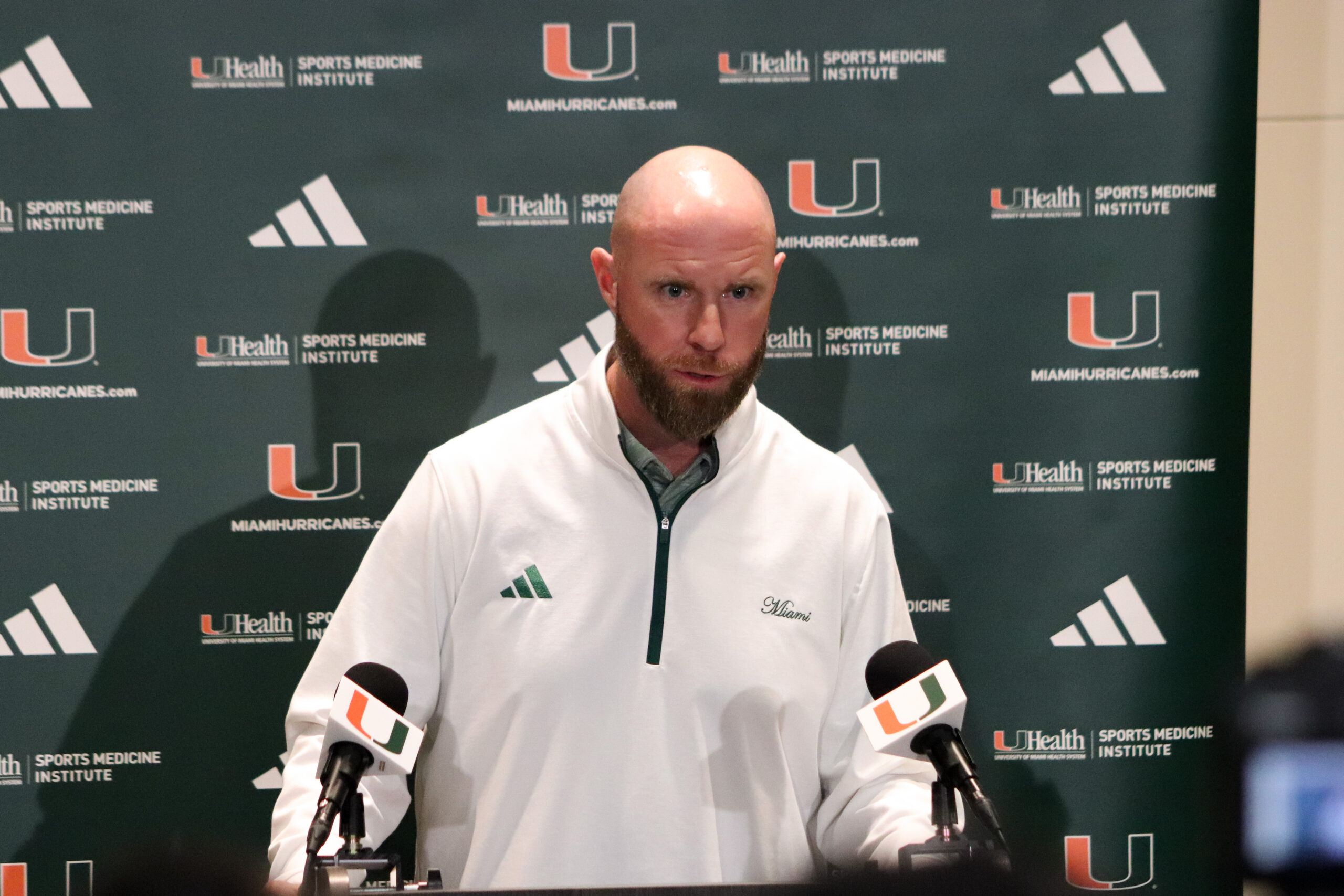
Makena Wong, Photo Editor, Defensive Coordinator Corey Hetherman answers questions during a press conference ahead of the University of Miami vs. Notre Dame football game on Monday, Aug. 25, 2025.
There is no doubt that last year’s offensive was impressive last season under the helm of Cam Ward. But now its time for Georgia transfer Carson Beck to be a leader. Offensive Coordinator Shannon Dawson talked about what his offense needs to do in order to be successful.
“We need efficient good offensive football … [the quarterback] has 10 guys around you that are pretty good, depend on those guys,” coach Dawson said. Dawson also hinted that a lot of true freshman will play.
Outside of what to expect on the field this season, Radakovich discussed the timeline for upgrades and expansion to the football facilities. According to him everything is on schedule and should be done sometime in the spring.
Also, NCAA playoff expansion will be discussed in meetings coming soon.
It should be a rowdy crowd at Hard Rock Stadium as Miami is set to take on Notre Dame.
“Should be as maniacal as a Miami game should be,” coach Cristobal said.
“Expect it to be as loud, and as wild as possible.”
Miami Hurricanes football is back after an offseason of movement, excitement, and speculation. Their first challenge of the season is No. 6 Notre Dame, last season’s CFP runner-up. Though a tough opponent on paper, Miami has more than a fighting chance to take down the Fighting Irish.
Miami’s marquee offseason acquisition, former Georgia quarterback Carson Beck, will make his Hurricanes debut after recovering from UCL surgery. Beck was active during fall camp and, by all reports, looked healthy and ready. Beck, when healthy, is a great fit for offensive coordinator Shannon Dawson’s offense. With a strong arm and solid accuracy, he suits an offense built on timing and precision.
The passing game will feature plenty of new faces. Miami lost its top five targets, including Xavier Restrepo, and is still sorting out who will emerge. Dawson said the depth at receiver is better than in years past.
“What I think you can look forward to is a lot more people playing in games,” Dawson said about the receiver room on Sunday. “We’re deeper there than we’ve been, deep in a way where I feel very comfortable with looking out there and seeing a whole lot of different people out there.”
Miami’s receivers remain largely unproved. LSU transfer CJ Daniels has the most experience, having a 1,000-yard season at Liberty in 2023. However, in his lone season at LSU, Daniels had 480 yards in 11 games. This year, Miami will have to rely on a mix of younger players and transfers, including freshman Malachi Toney and Joshua Moore, sophomores Ray Ray Joseph and Joshisa Trader, and transfers Tony Johnson and Keelan Marrion. Trader is viewed as a breakout candidate, though he still has to prove it.
When looking at the Notre Dame roster, the Fighting Irish excel against the pass with an elite secondary, even with the loss of safety Xavier Watts. Preseason All-American Leonard Moore leads the defensive back group as an elite shutdown cornerback who frequently travels with a team’s top receiver.
Across from Moore is Christian Gray, a big-time playmaker who most notably had the game-winning interception on Drew Allar in the Orange Bowl. In the back end, Adon Shuler, who played alongside Watts, didn’t allow a single touchdown in coverage and accounted for 23 run stops.
More than anything, Miami will rely on the ground game this season. The Hurricanes have an impressive offensive line that is slated to be one of the best in the nation. Preseason All-American Francis Mauigoa leads that group, but between Anez Cooper, Markel Bell, and Matthew McCoy, Miami is bringing back a very similar group.
The only change at offensive line is James Brockermeyer, a TCU transfer who will be the starting center. Not only will they give Carson Beck the time he needs, but more importantly, they will open the lanes for Miami’s strong running back room. Mark Fletcher is expected to lead this group and take a big leap.
“He is 226, 228 pounds. Lean. He’s as fast as he’s ever been, stronger than he’s ever been, and healthy. Really excited to see him,” Miami head coach Mario Cristobal said.
Sophomore runningback Mark Fletcher Jr. celebrates his touchdown in Miami’s win against FSU on Saturday, Oct. 26, 2024 at Hard Rock Stadium. – Photo Credit via Emily Rice
Alongside Fletcher is sophomore running back Jordan Lyle, who averaged 7.4 yards on his 54 carries and will bring a complement of speed to the UM backfield. Behind them, North Dakota State transfer Charmar “Marty” Brown and freshman Girard Pringle Jr. are also expected to work in.
The trenches are where Miami could get an edge on this Notre Dame team. The Irish allowed just under 140 yards per game on the ground on 3.8 yards per attempt last season. Entering 2025, Notre Dame lost its top two defensive linemen with Rylie Mills and Howard Cross entering the NFL Draft. They will now have to rely on a mix of guys to make plays. They do have a solid linebacker room led by Nagurski Trophy preseason watch list honoree Drayk Bowen with Jaylen Sneed and Jaiden Ausberry behind him.
If Miami wants to win on Sunday, making the quarterback uncomfortable will be new defensive coordinator Corey Hetherman’s main goal. Last week, Notre Dame announced redshirt freshman CJ Carr as the week 1 quarterback. Between the nerves, an expected sell-out Hard Rock Stadium crowd, and a refreshed defense led by Hetherman, the Hurricanes should be able to make things rough for the first-time starter.
UM’s defense was nothing short of a disappointment a season ago, and this year it has the potential to be a strength. At Minnesota, Hetherman led the Golden Gophers as one of the best defenses in college football in a Big 10 conference filled with offensive talent. The new defensive coordinator faces a tough challenge in attempting to stop a fierce Notre Dame rushing attack.
Led by Heisman Award candidate Jeremiyah Love and backfield mate Jadarian Price, Miami is going to have some problems against the Notre Dame run. The pair both averaged over six yards per carry and combined for 24 touchdowns on the ground. With the Fighting Irish boasting a potentially equally stout offensive line and a similar desire to run the ball, the game will likely be won in the trenches. But, unlike Notre Dame, Miami’s front seven might be more complete.
Reuben Bain is back, healthy, and when asked at the start of fall camp, he is ready to get back to playing at his highest level.
“It feels amazing,” Bain said. “I’m going out, playing a caliber [of] football I like to play, to my standard.”
Now healthy, Bain is going to lead a group with a lot of depth. Akheem Mesidor, going into his sixth year, has been a mainstay for Miami and has taken up a leadership role. Versatile five-star sophomore Justin Scott, 300-pound defensive tackle Ahmad Moten, and Louisiana Tech transfer David Blay can hold down the middle of the line. On the outside is five-star edge rusher Hayden Lowe, who has reportedly turned heads in fall camp and could play into the rotation.
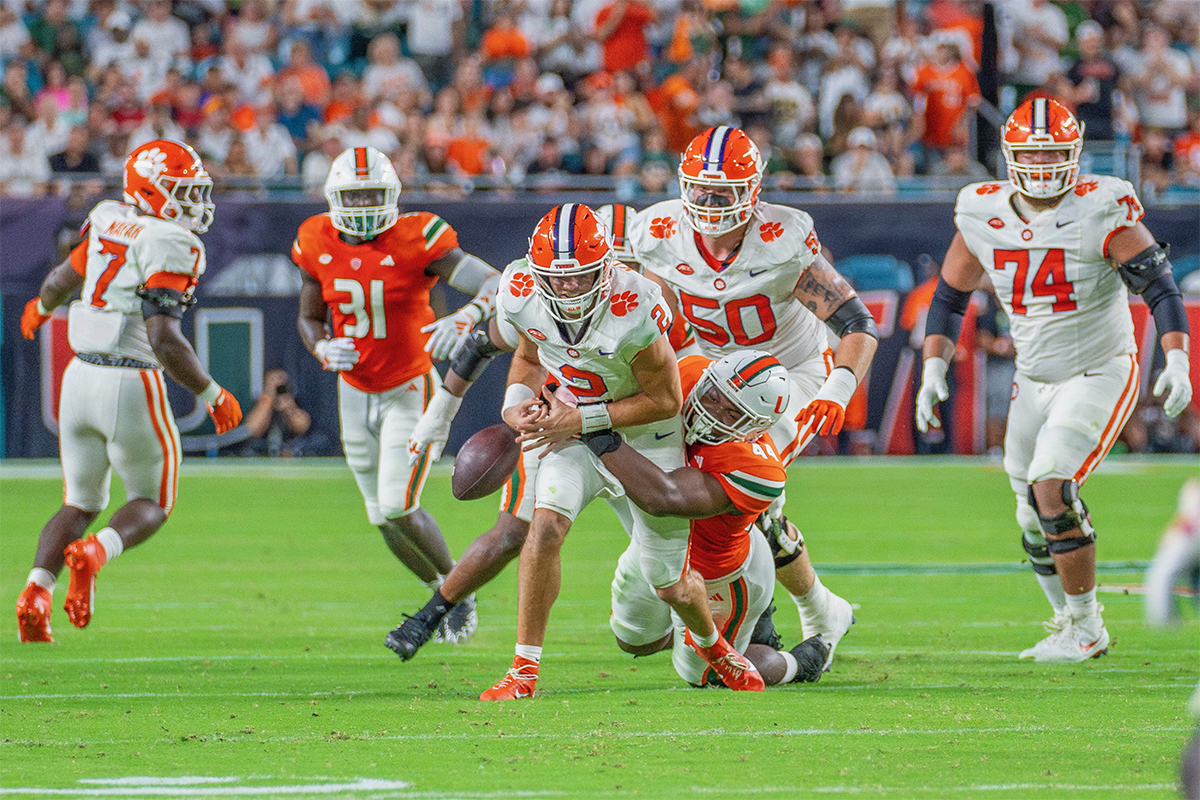
Freshman defensive lineman Rueben Bain, Jr. strips the ball from Clemson sophomore quarterback Cade Klubnik in the second quarter of Miami’s game versus Clemson at Hard Rock Stadium on Oct. 21, 2023. Photo credit: Jared Lennon
Linebacker Wesley Bissainthe will continue to be a leader for Miami’s defense, but the ’Canes might have landed the gem of the transfer portal in Mohamed Toure from Rutgers. Coming off his second torn ACL in college, Toure has reunited with Hetherman, who coached him at Rutgers. In his two healthy seasons with the Scarlet Knights, he averaged 72 tackles and 9 tackles for loss. Toure’s excited to get back into the system.
“We haven’t missed a beat, so I just love it; I love being back with him.” Toure said. “And his defense, it’s exciting, honestly. It’s exciting. It’s explosive.”
That front seven will have to hold things down for Miami, especially given the rebuilt secondary. While OJ Frederique had an impressive true freshman campaign, Miami’s defensive struggles were so blatant that Cristobal had to rebuild with fresh talent. Transfers Xavier Lucas, Charles Brantley, and Zachariah Poyser are some of the most notable talents to come from the portal.
The 28th iteration of the Miami Hurricanes and the Notre Dame Fighting Irish starts at 7:30 p.m. and will air on ABC.
“Omg!,” every Swiftie said yesterday at noon. If you are a Swiftie, the announcement was one you have been waiting for and will not forget. Travis Kelce, the Super-Bowl winning Kansas City Chiefs tight end, and Taylor Swift, enough said, got engaged.
Let’s take it back to the start. Travis attended one of Taylor’s concerts on The Eras Tour at The ArrowHead Stadium with a friendship bracelet with his phone number two years ago.
He couldn’t give it to her, so he spoke about it on his podcast, New Heights, that he shares with his brother, Jason Kelce, instead. Through mutual friends, Taylor and Travis got to talking. Sparks flew.
Taylor has been seen at many Kansas City Chiefs games to support Travis, and he has done the same by attending her concerts. They traveled to places like Italy and Florida during their time off. Taylor is known for being a private person when it comes to relationships, so the fact she was so open with it made everyone suspect Travis was the one for her.
For months people have been speculating that they were engaged or planning on it, especially because of Taylor’s most recent album, “The Tortured Poets Department.” This album includes songs like “But Daddy I Love Him” and “So High School,” which truly showcase the love she feels for Travis.
After months of speculation, the Kelce brothers podcast was teased for what people could only assume to be Taylor.
Along with the podcast came the announcement of a new album, but the 2 hour long video had one main takeaway: their love for each other. People were obsessed with how they looked at and spoke to each other.
Thanks to Swifties, that podcast was the most live and concurrent podcast video ever viewed according to Guinness World Records.
Less than two weeks later, Taylor and Travis announced their engagement through Instagram with a photoshoot of them surrounded by beautiful flowers. It is speculated that these photos are not from the actual engagement, but yet a play on the Lover Era photoshoot showing her Lover wish has been fulfilled.
She also showed off her beautiful ring that caught the eye of millions. It is thought to be between 8-10 carats, an estimated $550k. Like Taylor said in her Instagram post, “Your English teacher and your gym teacher are getting married.”
A small kitchen fire broke out in the Phase II VOX Miami Apartment building around 4:30 p.m., forcing all residents to evacuate and leaving some displaced.
An email from VOX Miami, which primarily houses UM students, said, “At this time, we are addressing water damage on the 10th floor caused by the activated sprinkler, as well as some water that trickled down the stairwell. Our team is working to clean up and resolve this as quickly as possible.”
Residents said that when they returned to their apartments on the top floors, their area was flooded and water was leaking from light sources and vents.
“[Water was ] not just in the hallways but all of our bathrooms are soaked too,” said Kelly McDermott, a sophomore who lives on floor 8 of VOX. “The power and water are out and Vox hasn’t given us any information and briefly mentioned that we might need a place to stay tonight but that’s all we’ve heard. No one has come to check on our damage yet or clean up the water leaking.”
In today’s Eye of the Hurricane episode, hosts Sophia and Jamison go into why you don’t have to be a stereotypical “UMiami girl” to fit in at UM. Those same students at UM are often among the most successful on campus, and fitting in at UM is not about conforming to any stereotype.
Original article by Keira Faddis for The Miami Hurricane’s Opinion section:
On Saturday, August 23, Miami’s Kaseya Center was transformed into a dystopian, candy-colored battlefield for Katy Perry’s Lifetimes Tour. With a narrative that blended pop fantasy, sci-fi futurism, and Perry’s catalog of career-defining hits, the show proved why, even at 40, she remains one of the most enduring entertainers in the industry.
The concert started at 7:45 p.m. with pop-disrupting queer artist Rebecca Black, the Mexican-American singer-songwriter and internet favorite, who delivered a sharp medley of songs from her project “SALVATION”, including “American Doll,” “TRUST!,” and “Sugar Water Cyanide.”
By the time Perry was set to take the stage, the arena was buzzing — families with kids as young as seven, groups of thirty-somethings reliving their teen years, and even parents in their forties and fifties tagging along for the ride. The energy was so high fans were doing the wave long before the main act appeared.
Then she arrived. In Perry’s world, a powerful AI known as Mainframe has harnessed butterflies to fuel its existence. Only one force can stand against it: Katy Perry, portrayed as a hybrid of human and machine. This narrative wove itself throughout the night, amplified by an arsenal of stagecraft — futuristic set pieces, dystopian projections, prop-laden choreography and, yes, even moments where Perry took flight across the stage.
Recurring motifs appeared along the way: a white heart and a pink heart flickered in and out of songs, representing Perry’s dual sides. It wasn’t until the show’s latter half — after an interactive audience vote unlocked “Not Like the Movies” and “The One That Got Away” — that the two hearts finally converged during “All the Love,” Perry’s dedication to her daughter. Embracing the symbols onstage, she embodied the merging of her human and AI selves.
But the story soon escalated into a full-blown battle. Perry fought robotic henchmen with a dual red lightsaber, then strapped a cannon-like blaster to her arm to obliterate the Mainframe in a fiery climax. It was spectacle in its purest form — a reminder that Perry has long thrived on mixing theatrical excess with pop accessibility.
The setlist was carefully structured, too. Perry delivered the catalog that made her a global icon: “Dark Horse,” “California Gurls,” “Teenage Dream,” “Hot N Cold,” “Last Friday Night,” and, of course, “I Kissed a Girl.” That stretch sent the arena into a euphoric, neon-soaked singalong, the kind of collective release only a veteran pop star can orchestrate.
Later tracks like “Wide Awake,” “E.T.,” and “Part of Me” built momentum toward a finale of her two defining anthems: “Roar” and “Firework.”
By the end, it truly felt like a teenage dream brought to life — a balance of nostalgia and reinvention. Perry may not be in her prime chart-dominating years anymore, but on this night she proved she still embodies the same “showgirl candy-licious attitude” that defined her rise. The Lifetimes Tour isn’t just a concert; it’s a pop opera staged by an artist who knows exactly how to turn spectacle into storytelling.
On Friday, August 22, Spotify took over Regatta for an exclusive event that transformed the venue into a celebration of summer’s hottest Latin sounds. Known as Verano Forever, the night marked the end of syllabus week at the University of Miami with a star-studded lineup and a vibrant energy that pushed Regatta beyond its usual college crowd.
The private event featured performances from Hamilton, Elena Rose, Rawayana, Beele, and headliner Myke Towers — all artists who dominated playlists this summer. With curated cocktails, free food, VIP lounge, touch-up stations, and more, Spotify made sure attendees got more than just music.
From the start, the atmosphere felt less like a typical Regatta night and more like a Latin festival. The crowd — filled with students, locals and a strong Venezuelan presence — immediately connected with the artists. Elena Rose’s performance of “Caracas en el 2000” had the audience singing in unison, while Rawayana and Beele delivered groovy, sun-soaked sets that embodied the carefree vibe of summer.
But the evening belonged to Myke Towers. Closing out the show, the Puerto Rican star ran through hits like “LALA,” “LA FALDA” and fan favorites like “Si Se Da”and“La Playa.” His set brought the energy full circle, sending the crowd into the night with the kind of high only a medley of summer anthems can deliver.
Beyond the music, what stood out was the ambiance. Golden hour light flooded the outdoor venue, lightning danced in the background sky. Fans lined up for Spotify’s interactive content stations, where they answered questions like “What was your Latin song of the summer?” or “Which artist are you most excited to see tonight?”
The answer for many, including me, was Rawayana — and they didn’t disappoint. Still, Myke Towers’ finale left no doubt why he was the headliner.
For UM students who didn’t quite mesh with Regatta’s temporary transformation into a Latin hotspot, the night may have been a miss or “Holy sell” as Instagram user @mike67mcn describes it. But for those lucky enough to be inside, Verano Forever wasn’t just a party — it was an extravagant kickoff to the semester that proved Regatta Fridays can go far beyond the usual UM crowd.