The Penn Relays, the oldest, largest and arguably most iconic track and field meet in the United States, celebrated its 130th anniversary this year at Franklin Field on the campus of the University of Pennsylvania.
Drawing athletes from high school to college and beyond, the three-day event, held Thursday through Saturday, brings in more than 100,000 spectators and 20,000 competitors each year.
Senior Sanaa Hebron stole the show for the Canes, taking first in the women’s 400-meter hurdles Thursday night with a time of 55.30. The mark ranks her fifth in the NCAA this season and broke the meet record of 55.36 set in 2024 by Savannah Sutherland.
The victory marks just the third time a Hurricane has won the event at the Penn Relays, joining Dominique Darden (2006) and Tameka Jameson (2010).
Hebron’s time sits just shy of her personal best of 55.21, where she currently ranks second in program history.
The reigning ACC champion returned on Saturday to compete in the women’s 4×400-meter relay alongside Iyonna Codd, Nandy Kihuyu and Gabriella Grissom. The quartet placed fourth in the Championship of America race, finishing in 3:34.27, just two seconds behind Texas A&M, which won in 3:32.31.
Miami entered the weekend with strong momentum after several standout performances earlier in April, including a school record in the 3000-meter steeplechase and multiple top-five program marks across sprint and field events. The results at the Penn Relays continue to reflect a team building toward peak form at the right time in the season.
The Hurricanes have one meet remaining before championship season begins. Miami will travel to Jacksonville next weekend for the UNF East Coast Relays starting Friday.
In this special edition of Catch Up Canes, we sit down with award-winning journalist Antonio Mora, Frances L. Wolfson Chair at the University of Miami Department of Journalism and Media Management. With a career spanning decades, Mora has anchored for Good Morning America and Al Jazeera, earning numerous honors including multiple Emmy Awards, Peabody Awards, and a national Edward R. Murrow Award.
In this interview, Mora reflects on his unconventional path from corporate finance law to broadcast journalism, the challenges he faced as a Cuban-American in a competitive industry, and the evolving landscape of Latino representation in media. He also shares personal insights on identity, storytelling, and what it means to build a lasting legacy both on and off the screen.
Whether you’re an aspiring journalist or simply interested in the intersection of media and culture, this conversation offers a compelling look into the life and career of one of the industry’s most accomplished voices.
The best football prospects in the world gathered together in Pittsburgh, Pa. for the annual NFL draft from April 23-25. After an incredibly successful season for the Hurricanes, they had nine players drafted to the league — tied for the fourth-most of any college this year and tied for the third-most in program history (modern era).
With the 10th overall pick in the draft, the New York Giants selected offensive tackle Francis Mauigoa. The American Samoa native was the cornerstone of Miami’s offensive line for the past three seasons, and was regarded as one of the best offensive lineman in the nation. Mauigoa was the 2025 ACC Jacobs Blocking Trophy Winner, given to the most outstanding lineman in the ACC each year. Expect him to start from day one for New York as he protects second-year quarterback Jaxon Dart.
Just five picks later, the Tampa Bay Buccaneers selected defensive end Ruben Bain Jr. — arguably the best defender in all of college football this past season. With 15.5 tackles for loss and 9.5 sacks, Bain won the Ted Hendricks award for the nation’s best DE and ACC defensive player of the year.
Later in the first round, the Los Angeles Chargers selected Bain’s edge rushing duo Akheem Meseidor. Finishing last season as first team All-ACC and second team All-American, Mesidor was a dominant force on Miami’s defensive line the last two seasons. He will look to help the Chargers compete for a title with veteran defensive end Khalil Mack on the opposite side of him.
In the third round three more Hurricanes were selected.
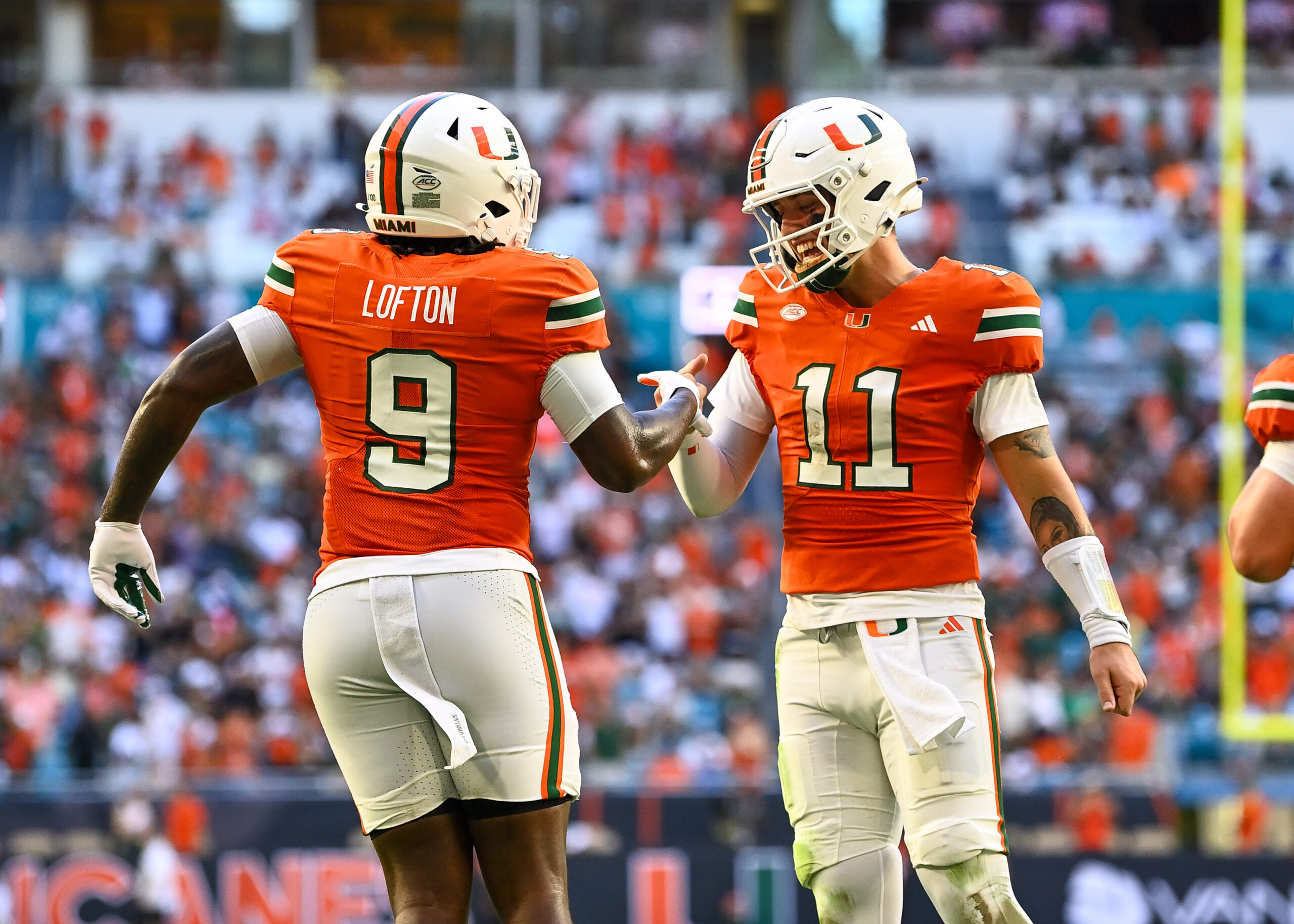
David Lebowitz, Staff Photographer/ Sixth-Year Redshirt Senior quarterback Carson Beck and Sophomore tight end Elija Lofton celebrate after a touchdown on November 8, 2025.
The Arizona Cardinals took quarterback Carson Beck with the 65th overall pick. After six seasons and two different schools, Beck turned his attention to the NFL following a season in which he helped the Canes reach the CFP National Championship. The Jacksonville native has a chance to start from day one in Arizona, but only time will tell if he’s the Cardinals’ future star at the helm of the offense.
OT Markel Bell was selected by the Philadelphia Eagles three picks later. Already boasting one of the best lines in the NFL, Philly adds 6-foot-9, 346-pound Bell to bolster the edge of the offensive line. Bell started all 16 games for the Hurricanes, allowing no sacks last season.
Later in the third, the Minnesota Vikings took safety Jakobe Thomas. With 3.5 sacks, five interceptions, and two forced fumbles last season, Thomas was a weapon on the Hurricanes defense, embodying the physicality and violence the team played with. In Minnesota, he will look to be the same swiss army knife he was for the Canes in 2025.
The Buccaneers paired Bain with safety Keionte Scott in the fourth round. The nickel corner was another hard-hitting ball hawk with the ability to change the game on his own, making one of the greatest plays in Hurricane history with his pick-six in the Cotton Bowl against Ohio State. With five sacks and two defensive touchdowns he will bring some explosiveness to Tampa Bay’s defense.
In round six, the New York Jets took guard Anez Cooper. Cooper was the third offensive lineman taken for the Hurricanes, as he earned all ACC honors his final three seasons at the ‘U’. Cooper is expected to add depth to the interior offensive line in New York.
Nine picks later, the Rams selected wide receiver C.J. Daniels, who impressed with spectacular catches and reached pay-dirt seven times last season.
The nine Hurricanes drafted over the weekend are tied for the most since 2017 and the first time the Canes had players drafted in the top-10 in consecutive years since 2004 and 2005.
Four Hurricanes were signed as undrafted free agents, including James Brockermeyer (Falcons), Wesley Bissainthe (Chiefs), Keelan Marion (Falcons) and David Blay (Patriots).
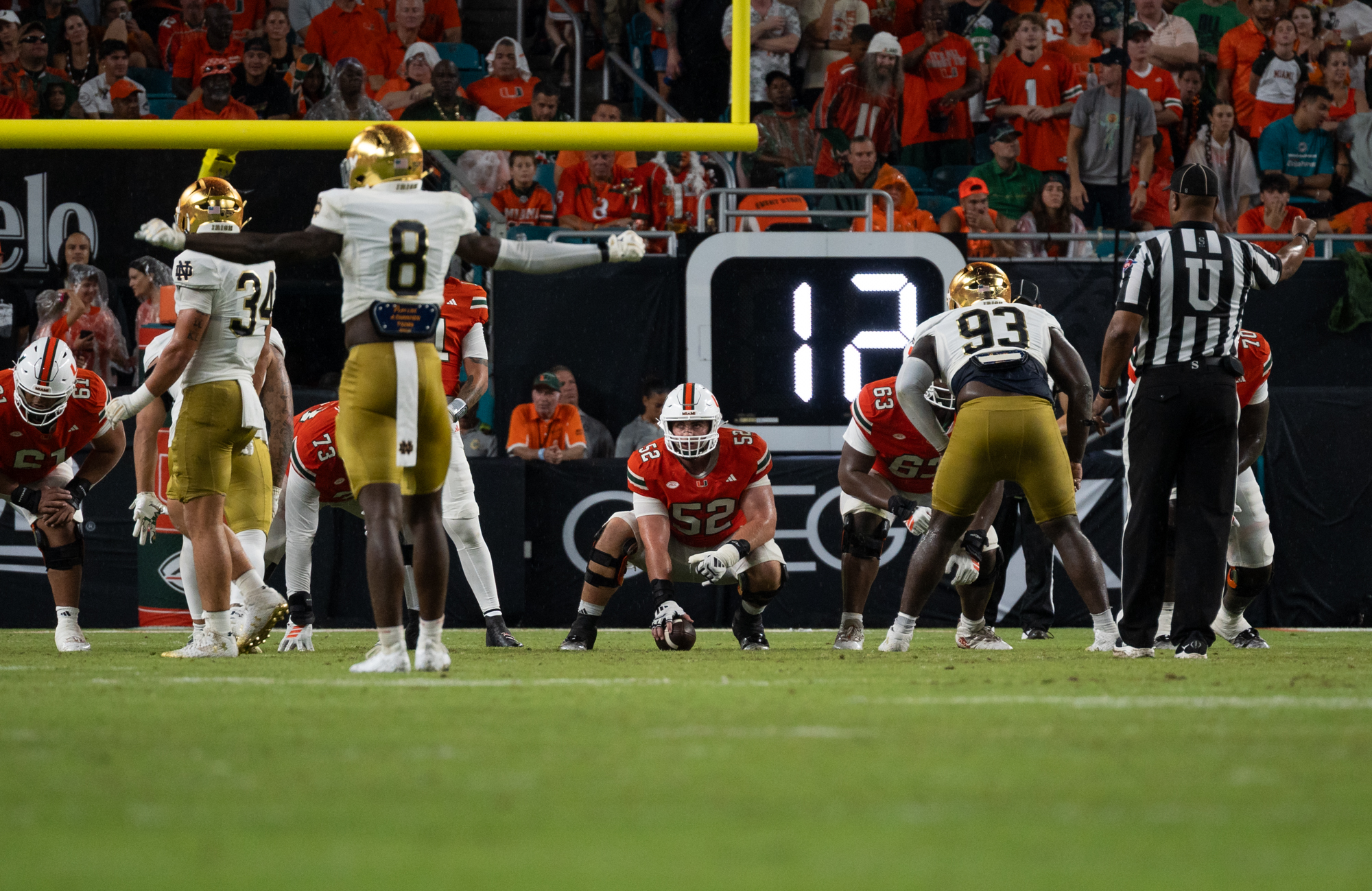
Brian Mulvey – Assistant Photo Editor // Redshirt senior James Brockermeyer waits to snap the football against Notre Dame on Aug. 31, 2025
The No. 14 Miami Hurricanes rowing closed out the regular season at Lake Wheeler with a dominant performance that included only first or second finishes in 11 races across the two-day regatta, highlighted by a 1V8 victory in 6:18.81 and multiple program-record performances.
The Canes rowed with the kind of speed, depth and confidence that turns a good regatta into something that feels a lot like a warning.
Because this wasn’t just about winning races. It was about setting the tone.
It was about rewriting what this team is capable of — in real time.
Friday cracked the door wide open.
The 2V4 got things started the way great crews do: by setting the tone and then immediately raising it. A program record fell — 7:16.75 — only to be broken again less than 24 hours later. Not a one-off. Not a perfect race they’ll spend weeks trying to replicate.
Just the team’s new standard.
The 3V8 followed, carving out its own piece of history with a record-breaking performance that didn’t just showcase speed, but depth — the kind of depth that separates solid programs from dangerous ones.
And by the time the 1V8 and 2V8 took the water, it was clear that Miami wasn’t chasing results.
They were setting them.
Then Saturday happened — and everything sharpened.
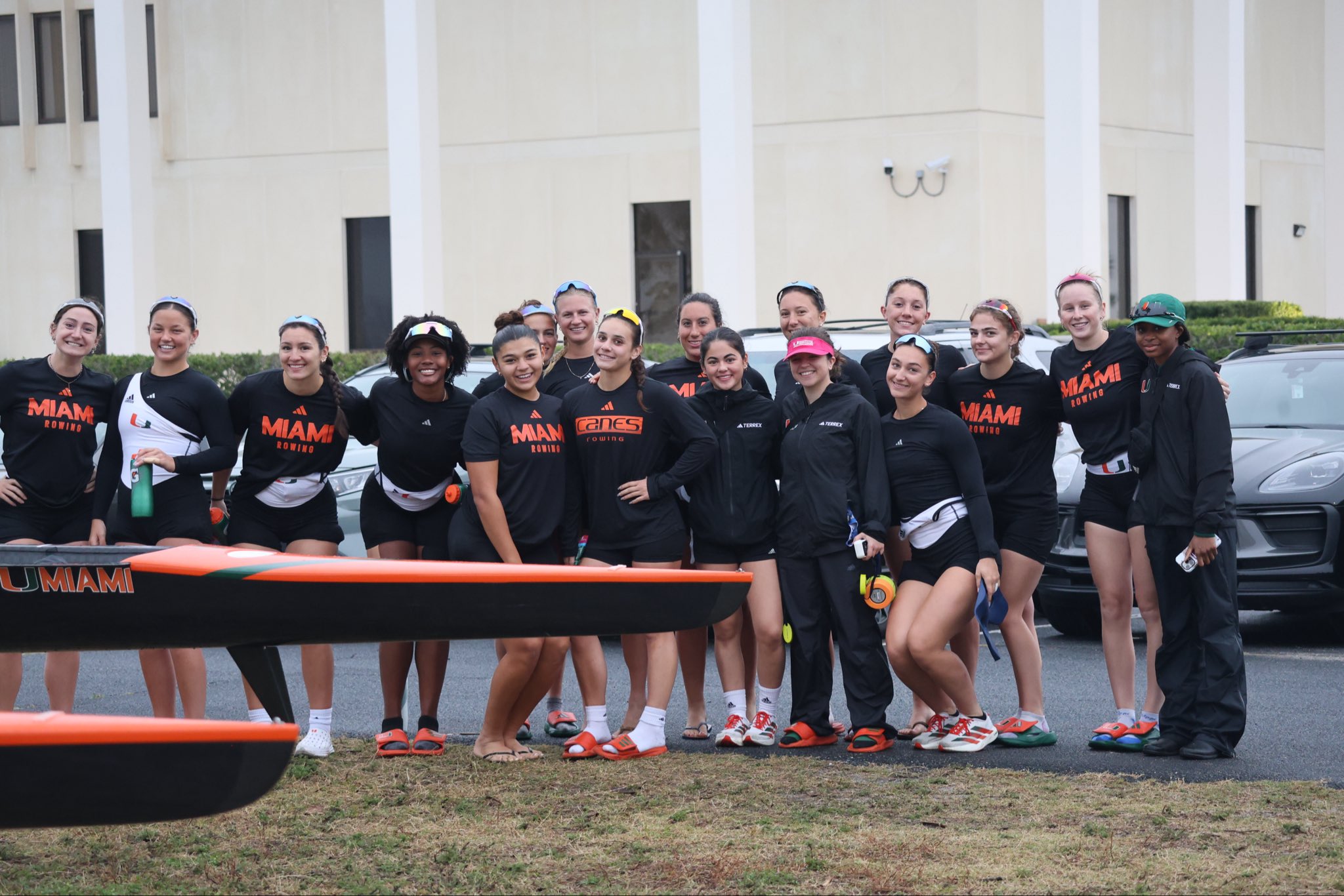
Photo credit: @CanesRowing via X // Members of the Miami Rowing team prepare for Day 1 of the Sarasota 2k Invitational in Sarasota, Fla. on March 26, 2026.
The 1V8 delivered the kind of race you build a postseason run on. Clean. Controlled. Unbothered by the moment.
Their 6:18.81 wasn’t just a win over ranked competition — it was another program record, breaking the one they had set just a week prior.
That’s the part that stands out most.
The Hurricanes are not just getting faster. They’re getting faster quickly.
Right behind them, the 2V8 matched that energy with a record of its own, clocking in at 6:26.01. Another razor-thin margin, another reminder that Miami’s speed doesn’t stop with one boat.
It stacks across the lineup.
And that’s where this weekend really separates itself.
Because even beyond the wins and records, the consistency is what lingers. Miami finished first or second in 11 races — a number that says just as much about the team’s identity as it does about its performance.
Head coach James Mulcahy called it “incredible racing,” but what it really looked like was a team settling into itself at exactly the right time. The confidence was unmistakable.
And still, something feels unfinished.
Watching this group, there’s a sense that they’re not satisfied with these results — they’re building something with them. With the ACC Rowing Championships taking place soon, it’s paramount that this team keeps this momentum going.
But if Lake Wheeler was any indication, Miami isn’t showing up hoping to compete.
They’re showing up ready to win.
The Hurricanes will take to the water again May 15 for the ACC Rowing Championships.
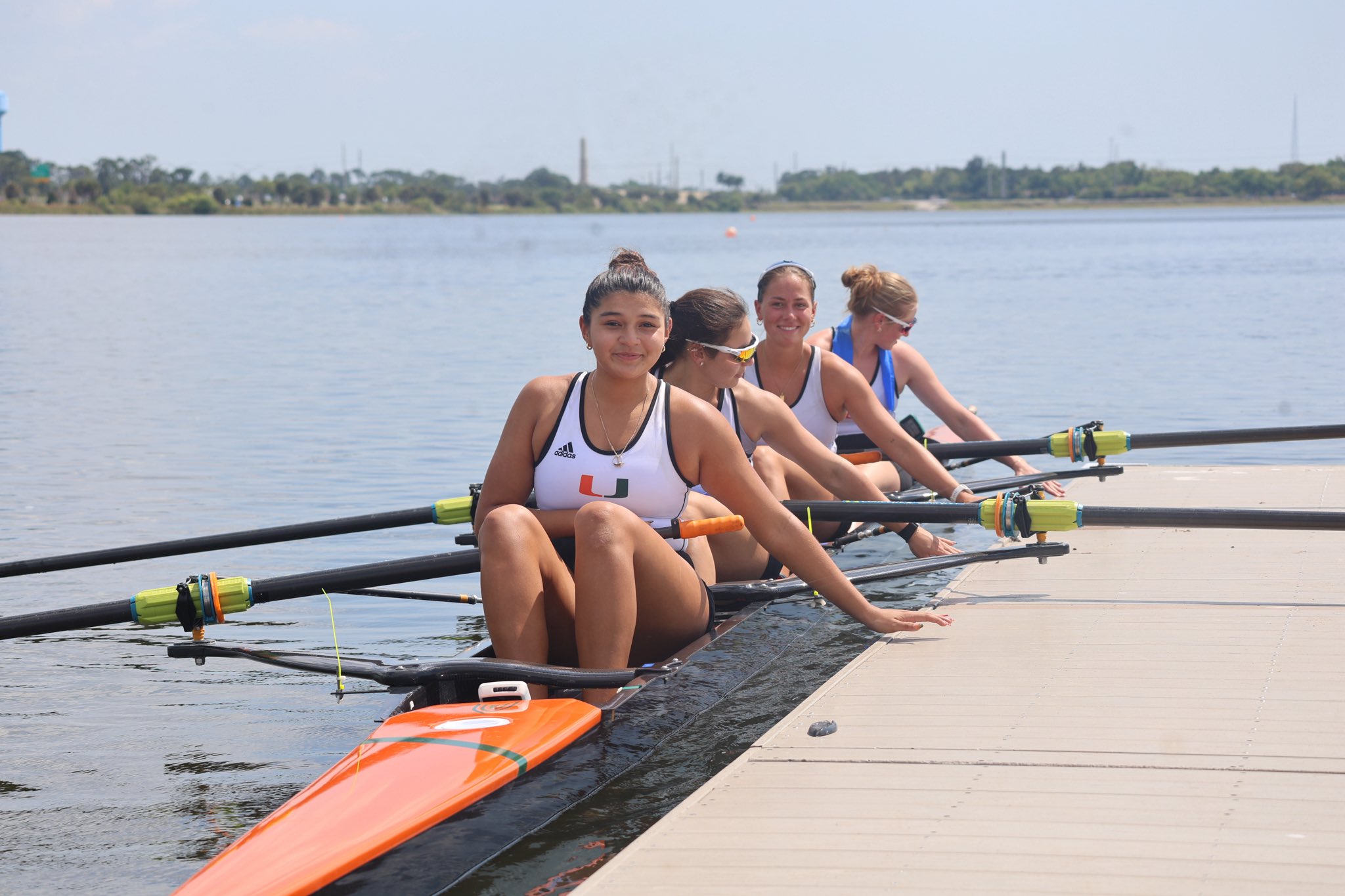
Photo credit: @CanesRowing via X // Miami Hurricanes rowing races against Riddle Aeronautical University in Dayton Beach, Fla. in a scrimmage on Feb. 28, 2026.
Behind a stellar start from AJ Ciscar, the Miami Hurricanes (32-12, 12-9 ACC) defeated the California Golden Bears (22-20, 7-14 ACC) 4-1 on Sunday to clinch the series after dropping Friday’s opener.
For a Miami team that has built its recent surge on pitching and timely offense, Sunday was another example of the formula working.
The Hurricanes bounced back from Friday’s loss to take the final two games from Cal, securing their sixth straight series win for the first time since 2014 — five straight in ACC play.
Miami handed the ball to former Friday night starter AJ Ciscar for his tenth start of the season.
Ciscar entered with a 4.18 ERA over 51.2 innings and looked to rebound after allowing six runs on six hits in an uncharacteristic 1.2 innings against Stanford last weekend.
The righty looked more like his early-season self Sunday afternoon, throwing 80 strikes on 106 pitches over 7.2 innings, allowing one earned run before being taken out to a standing ovation.
Miami made its first mark in the bottom of the second after Vance Sheahan and Brylan West opened the inning with back-to-back hits to put runners on second and third. Freshman Gabriel Milano followed with an infield single, giving the Hurricanes a 1-0 lead.
The third and fourth innings turned into a pitcher’s duel between Ciscar and Otto Espinoza, as both teams combined for two hits during that stretch, both by the Golden Bears in the third.
Cal went to the bullpen in the fifth while trailing 1-0, calling on senior right-hander Ethan Foley to face the top of Miami’s order. It was a move coach Mike Neu probably wanted back almost immediately.
Jake Ogden and Max Galvin opened the inning with back-to-back bloop singles before catcher Alex Sosa followed with a single to right field, scoring both runners and extending Miami’s lead to 3-0.
With Sosa on second, Brylan West nearly added to Miami’s lead with a deep fly ball to right field. Cal right fielder Gannon Snyder tracked it down near the wall, crashing violently into the padding while taking away an extra-base hit, leaving the Light shocked he was able to run back to the dugout.
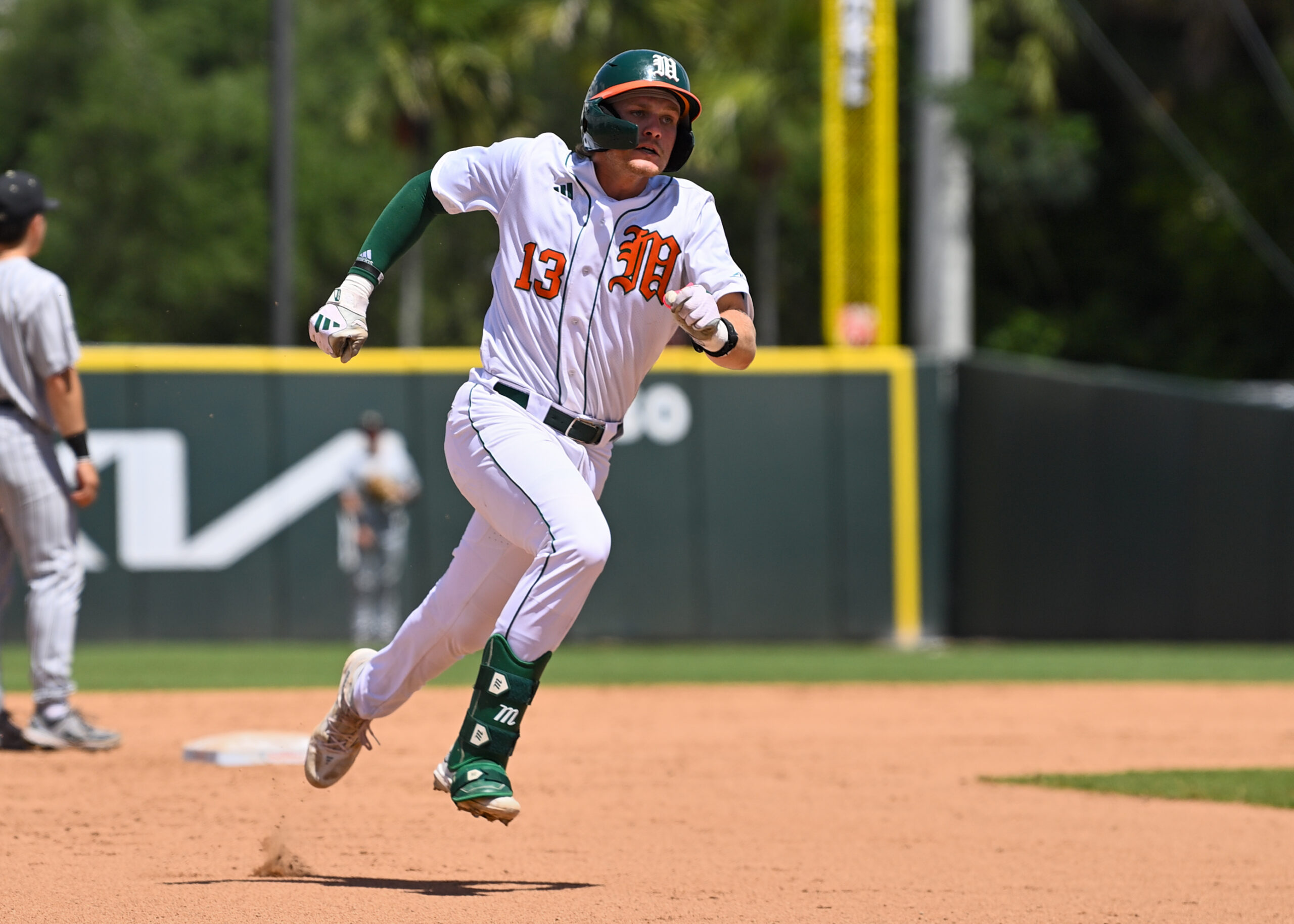
David Lebowitz, Photo Editor/ Junior Catcher Alex Sosa sprints toward third base on April 12, 2026.
Ciscar ran into trouble in the top of the sixth, allowing three consecutive singles to load the bases with no outs. After a mound visit from pitching coach Laz Gutierrez, Ciscar limited the damage by inducing a double play that scored one run and a lineout to shortstop to end the inning with Miami still ahead 3-1.
In the sixth, Sheahan and Milano struck again.
Sheahan laced his second double of the game as Milano followed with an RBI single for his second multi-RBI game of his young career.
Despite loading the bases and Miami’s top hitter, Derek Williams, at the plate, the Canes could not break the game open. Williams flew out to deep center, allowing the Golden Bears to escape the inning.
Ciscar’s day ended in the eighth after he struck out back-to-back batters. Miami coach J.D. Arteaga then called on senior Lyndon Glidewell for a right-on-right matchup, and Glidewell ended the inning by striking out left fielder Carl Schmidt.
The Canes stuck with Glidewell to wrap things up in the ninth. With two outs and the Light on their feet, Glidewell struck out Hideki Prather to clinch another ACC series for Miami.
Sheahan, Milano, and Ogden each recorded multi-hit games, while Milano and Sosa drove in multiple runs, helping secure the victory.
The win gave Miami a 5-2 record in ACC weekend series this season after dropping the opening series to Boston College and Duke in March.
Miami opens its next ACC series on the road against NC State on Friday at 6 p.m. on ACCNX.
Nine Miami Hurricanes were selected in the 2026 NFL Draft, further cementing Miami’s reputation as one of college football’s premier pipelines to the professional ranks. Breaking down each selection, evaluating their landing spots, and explaining what the huge draft haul means for the future of the program.
Rumors of a shakeup at UM’s Athletic Director position have circulated, as reports say current AD Dan Radakovich is expected to retire, with ROC Nation Sports International President and CEO Michael Yormark emerging as Miami’s top target to fill the role.
Head Baseball Coach J.D. Arteaga provided an update on ace starting pitcher Rob Evans, who suffered a lower leg injury during Friday night’s loss to California.
Canes Men’s Basketball landed Horizon League Player of the Year DeSean Goode through the transfer portal. A look at Goode’s play style and how he slots into Miami’s starting five for next year.
The University of Miami welcomed 10 new members to its Sports Hall of Fame Thursday night, as roughly 300 family members, friends, teammates and supporters gathered at the Watsco Center to celebrate some of the most accomplished athletes and coaches in program history.
This event marked the 56th UM Sports Hall of Fame induction banquet. The Hall of Fame, a nonprofit organization founded in 1966, now includes 382 members.
This year’s induction class featured representatives from a variety of sports: Sam Dorman (diving), the late Wendy Foote (basketball), Bryan Garcia (baseball), Duke Johnson (football), Savanah Leaf (volleyball), Mike Rumph (football), Duane Starks (football), Phallon Tullis-Joyce (soccer), Shakima Wimbley (track and field) and Mark Richt (football coach).
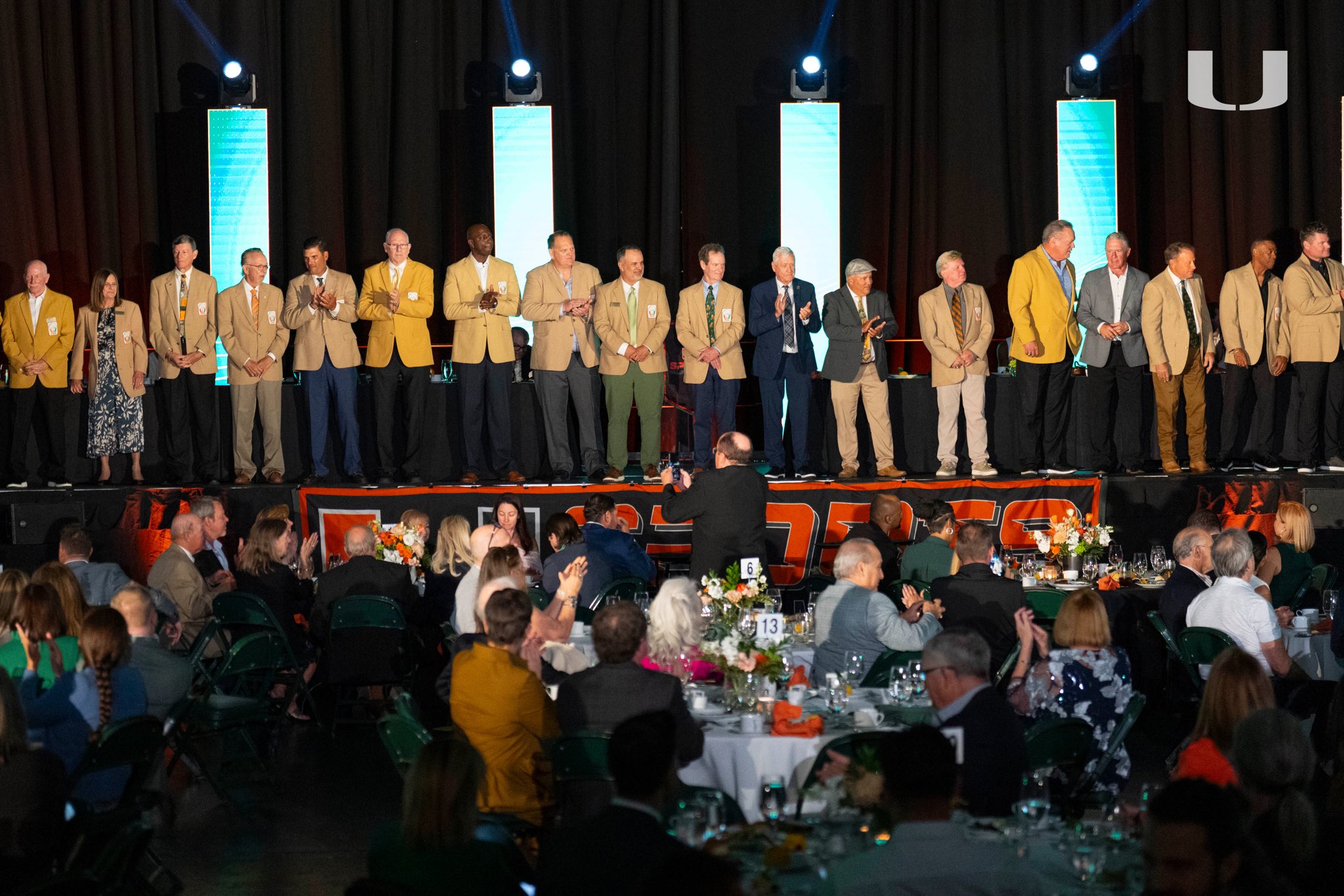
The event began with a cocktail reception at 6 p.m., followed by dinner and an introduction led by former Miami football player Don Bailey Jr. Current Hall of Fame members, including former quarterback Gino Torretta and former men’s basketball coach Jim Larrańaga, filled the 30 tables, wearing their signature gold jackets as they welcomed the new class. Members presented each inductee with a gold jacket, with Richt receiving a standing ovation as he took the stage.
Each inductee was introduced with a video highlighting their most notable accomplishments before delivering a speech.
One theme echoed throughout the night: gratitude. Inductees used their time at the podium to recognize the people who helped shape their journeys.
Photo Credit: @MiamiHurricanes via X // The University of Miami Sports Hall of Fame & Museum welcomes its Class of 2026 on Thursday, April 23, 2026.
Starks thanked former teammate and friend Fred Taylor for taking him in.
“Look at me now. That’s because of you,” Starks said.
Dorman reflected on his time at Miami, saying, “UM gave me a foundation, a family and memories that will last forever.”
Garcia shared a similar sentiment. “This is my home, and Mark Light Field is my sanctuary,” he said.
As Johnson approached the podium, chants of “Duuuuuke” rang out across the room. He challenged his fellow inductees to “be there and show up for your people.”
Beyond gratitude, many inductees reflected on the personal growth that defined their careers. While countless athletes dream of one day being enshrined in the university’s prestigious honor, only a select few achieve it.
“Growing up, I didn’t know where or how, I just knew I wanted to be somebody,” Wimbley said.
A decorated sprinter, Wimbley earned a world championship in the 4×400-meter relay and multiple NCAA titles, cementing her place among Miami’s all-time greats.
Leaf described a more personal journey, recalling how she passed the Hall of Fame daily on her way to practice.
“I’ve always dreamed of being in there and this legacy, so it’s crazy to be standing here right now,” she said.
Tullis-Joyce was unable to attend, as her professional team is currently competing in the European playoffs, but she accepted her honor through a recorded video message.
Foote, a standout in Miami women’s basketball history, was inducted posthumously, with her legacy honored during the ceremony.
For Rumph, the moment represented a full-circle journey. A former Hurricane standout, he now serves as a coach, helping develop the next generation of players.
That future was on display during the banquet, when offensive tackle Francis Mauigoa was selected No. 10 overall in the NFL Draft by the New York Giants, with the announcement made live during the event.
As one group cements its legacy in Miami history, the next generation continues to chase the same dreams, one step at a time.
The Miami Hurricanes took on the Cal Golden Bears on Saturday evening, eventually coming out on top 4-3 with a walk-off walk.
Lyndon Glidewell earned the win on the mound for Miami after coming into a bases loaded jam and striking his way out of it in the eighth, before pitching a scoreless ninth.
Offensively, Alex Sosa led the way for the Hurricanes, with 2 hits and 3 RBIs, courtesy of a three run homer in the first inning.
The Golden Bears started the game off strong, jumping on Miami starter Lazaro Collera with some explosive hitting as Jett Kenady continued to torment the Hurricanes with an RBI double in the first.
Miami responded with some strong offense of its own.
Leadoff hitter Jake Ogden sliced a double down the left field line to get things started for Miami, and then hustled over to third base on an infield single. Then, with men on the corners, catcher Sosa mashed a ball deep to right, leaving the yard for a three-run shot.
However Cal starter Gavin Eddy completely regained his poise, shutting the Hurricane offense down for the remainder of his outing — a 120-pitch, eight inning performance.
After the shaky first inning, Miami’s defense got on track, retiring 8 batters in a row, including an eight-pitch third inning for Collera.
Both offenses couldn’t seem to get the ball away from either defense for a stint, until Cal found its way back onto the base paths in the fifth inning thanks to a pair of walks by Collera.
Hideki Prather made his way up for the Golden Bears and smashed a pitch to deep center, scoring two and tying the game with a double — his second of the evening.
The top of the sixth saw Cal try to keep their momentum, and they almost did with a huge swing to center by Daniel Murillo.
However, Miami center fielder Michael Torres put on the jets, sprinting to the wall before scaling it for an electric home run robbery, keeping the score knotted up at 3-3.
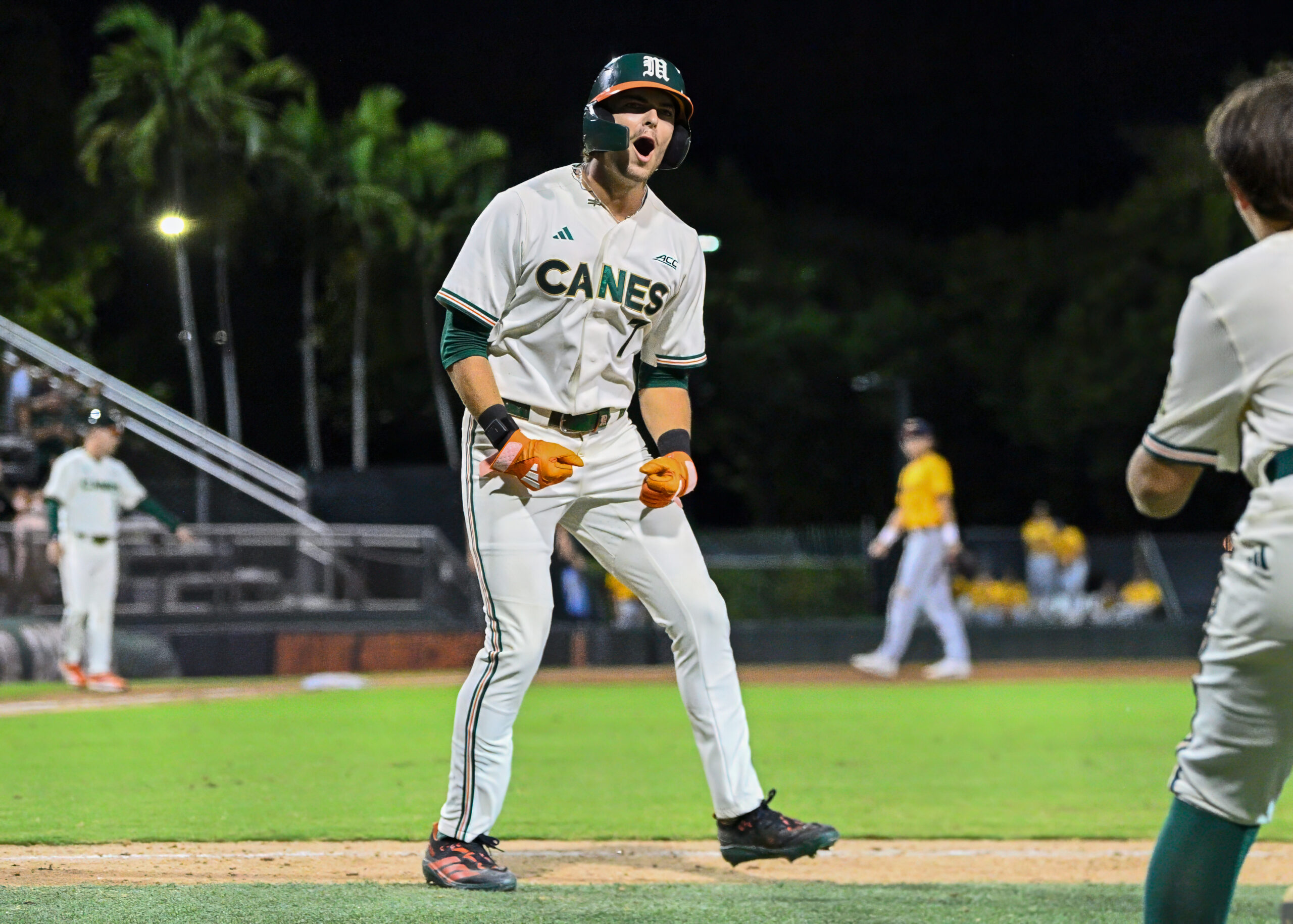
David Lebowitz, Photo Editor/ Outfielder Max Galvin celebrates after his game winning walk against California on April 25, 2026.
Torres made another highlight reel grab the following inning, sprinting in to make an incredible diving grab to save another run.
Miami opted to enter the closer, Ryan Bilka at the end of the seventh, sensing Cal knocking on the door of the lead. Bilka got out of the inning, giving the Canes a chance to get the lead back.
However, they couldn’t do much with the opportunity as they had three straight Ks to end the seventh.
That made it the second night in a row the Hurricanes failed to record a baserunner from the fifth to seventh inning,
With the pressure building, Cal loaded the bases in the eight with a single and two walks. So off went Bilka and in came Glidewell with the bases loaded and two outs. After falling behind 2-0, Glidewell pumped in three straight strikes to get the Hurricanes out of the bases loaded jam.
With an eruption from the crowd, the Canes got momentum back on their side
Glidewell handled things in the ninth, keeping the Hurricanes energized with another big strikeout to end the inning,
With Eddy out of the game, Dylan Dubovik started the inning with a six-pitch walk to get a man on base for the Canes, but he was followed by a failed bunt attempt by Vance Sheahan which popped out. Next, a line drive single to center from Gabriel Milano put a runner in scoring position.
The Golden Bears opted to walk the bases loaded, which brought up Max Galvin with the game on the line.
The crowd roared as three straight pitches were thrown for balls. With the crowd on their feet, the final pitch landed just outside, and Miami walked it off with a walk.
Miami (31-12, 11-9 ACC) will face Cal (22-19, 7-13 ACC) in a rubber match tomorrow at 1 p.m. at Mark Light Field.
Despite Miami taking the opening game of its last five series, the Hurricanes were unable to stifle the red-hot California Golden Bears, falling 9-2 Friday night.
After being swept by No.3 Georgia Tech, Cal rattled off back-to-back series wins against Pitt and Louisville, the former being an emphatic road sweep.
And making the cross-country trip to South Florida, the Golden Bears showed no signs of jet lag for the Golden Bears, coming out firing against Hurricanes starter Rob Evans.
Cal feasted on early count pitches, launching two homers from Jett Kenady and Lawson Olmstead to take an early 3-0 lead.
While Miami would claw a run back in the bottom of the inning thanks to a Jake Ogden double and subsequent sac fly from Derek Williams, Cal would regain the three-run cushion as Cade Campbell came around to score following a leadoff single.
However, the focus shifted away from the game in the third inning, when Evans hit the ground hard after trying to reach a ground ball up the middle. The Harlem native suffered an apparent left leg injury, and was carried off the field in visible pain.
Evans came into the matchup with a .191 OBA and 1.05 WHIP, both on pace to be the best by a Hurricanes starting pitcher since 2018. The lefty was one of the best starters in the country, in the top-five for most pitching statistics. If he’s set to miss significant time, the Hurricanes will be left with a hole in their rotation that’s already dealt with struggles this season.
After a delay in play which saw Tate DeRias enter the game, Miami escaped the inning with the three run deficit intact.
Visibly shaken, the Hurricanes were unable to rally back into the game, surrendering back-to-back two run innings in the sixth and seventh — which included Kenady’s second homer of the game.
The Golden Bear shortstop finished his evening 2-for-5 with three RBIs and two runs scored.
Cal starter Oliver De La Torre carved through the Hurricanes lineup, consistently generating weak contact by keeping Miami hitters off balance.
The 6-foot-4 junior only allowed two runs across eight innings of work, only allowing five hits on 110 pitches. De La Torre retired 15 straight Hurricane hitters from the third to eighth innings.
With the series opening win, Cal (22-18, 7-12 ACC) will have the opportunity to win its third straight ACC series with one more win against the Canes this weekend.
Miami (30-12, 10-9 ACC), will return back to the Light tomorrow evening, hoping to avoid its first series loss since early March against Duke.
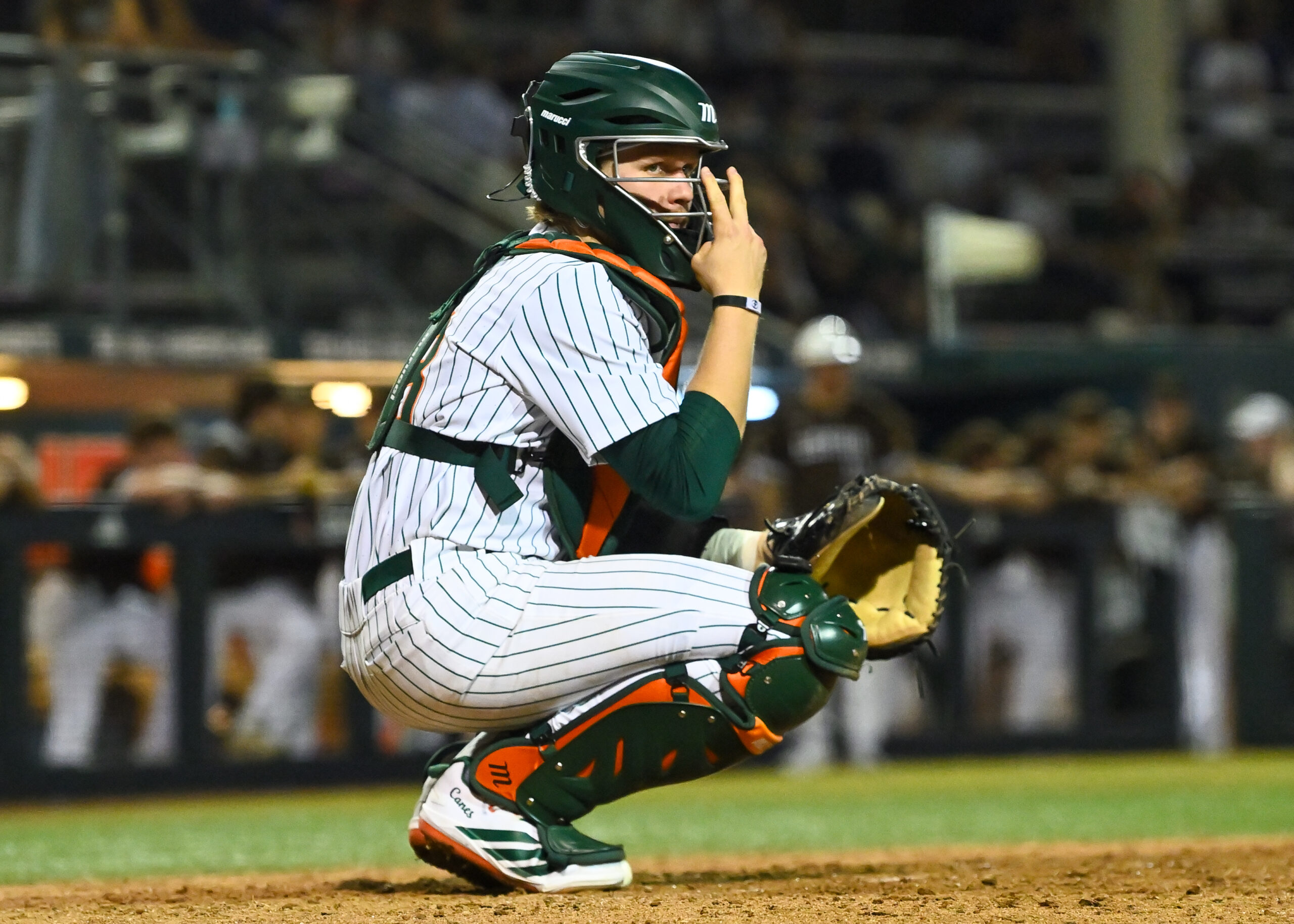
David Lebowitz, Photo Editor/ Junior Catcher Alex Sosa signals back to the dugout on Friday, February 13, 2026.
Dan Radakovich, the University of Miami’s athletic director, is preparing to step down, according to Yahoo Sports.
67-year-old Radakovich, who was recently named NACDA director of the year, has served as the University’s athletic director since 2021.
During his time as AD, Radakovich has led the program back to national prominence, including last season’s College Football Playoff run, men’s basketball’s Final Four in 2023 and the Elite Eight in 2022.
Despite rumors surfacing as early as last December, Radakovich personally assured the media he would not be stepping down.
Before becoming the 15th AD in program history, Radakovich served as Clemson’s athletic director from 2012 to 2021 and Georgia Tech’s from 2006 to 2012.
A Miami alumnus who began his administrative career with the University in 1983, the Pennsylvania native oversaw multiple infrastructure projects including the expansion of the Carl Soffer Indoor Practice Facility.
According to ESPN’s Pete Thamel, Miami is allegedly targeting Michael Yormark, the president and CEO of ROC Nation Sports International. Yormark is the brother of Big 12 Commissioner Brett Yormark and has multiple ties to the South Florida native area, holding the position of the President and CEO of the Florida Panthers from 2003-2013.