

[vc_custom_heading text=”Latest Stories” font_container=”tag:h1|font_size:25px|text_align:center|line_height:25px” use_theme_fonts=”yes” css_animation=”none” link=”|||”][alaya_recent_posts number=”7″]
[vc_cta h2=”” h4=”Sign up for TMH Newsletter” txt_align=”center” color=”white” add_button=”bottom” btn_title=”Click Here to Sign Up” btn_color=”default” btn_align=”center” btn_link=”url:https%3A%2F%2Fthemiamihurricane.us3.list-manage.com%2Fsubscribe%3Fu%3Dfb38a546bffbd53fef179909f%26id%3D33b978bef5|title:SubscribeHere|target:%20_blank|” css=”.vc_custom_1613695310409{padding-top: 20px !important;padding-bottom: 20px !important;background-color: #2b4f00 !important;}”][/vc_cta]
[vc_custom_heading text=”News” font_container=”tag:h2|font_size:30px|text_align:center” google_fonts=”font_family:Roboto%20Slab%3A100%2C300%2Cregular%2C700|font_style:700%20bold%20regular%3A700%3Anormal” link=”url:http%3A%2F%2Fwww.themiamihurricane.com%2Fsection%2Fnews%2F|||”][alaya_post_loop posts_per_page=”3″ template=”list” columns=”2″ category_name=”news”]
[vc_custom_heading text=”Sports” font_container=”tag:h2|font_size:30px|text_align:center” google_fonts=”font_family:Roboto%20Slab%3A100%2C300%2Cregular%2C700|font_style:700%20bold%20regular%3A700%3Anormal” link=”url:http%3A%2F%2Fwww.themiamihurricane.com%2Fsection%2Fsports%2F|||”][alaya_post_loop posts_per_page=”3″ template=”list” category_name=”sports”]
[vc_custom_heading text=”Culture” font_container=”tag:h2|font_size:30px|text_align:center” google_fonts=”font_family:Roboto%20Slab%3A100%2C300%2Cregular%2C700|font_style:700%20bold%20regular%3A700%3Anormal” link=”url:https%3A%2F%2Fthemiamihurricane.com%2Fsection%2Fculture%2F|||”][alaya_post_loop posts_per_page=”3″ template=”list” category_name=”culture”]
[vc_custom_heading text=”Opinion” font_container=”tag:h2|font_size:30px|text_align:center” google_fonts=”font_family:Roboto%20Slab%3A100%2C300%2Cregular%2C700|font_style:700%20bold%20regular%3A700%3Anormal” link=”url:http%3A%2F%2Fwww.themiamihurricane.com%2Fsection%2Fopinion%2F|||”][alaya_post_loop posts_per_page=”3″ template=”list” category_name=”opinion”]
LATEST ARTICLES
Today is National Unplugging Day—Here’s why you should join in

National Day of Unplugging, a holiday created to bring awareness to the hold that technology has on the everyday person, is next Friday, March 5. A holiday you may not have heard of, participants in this annual tradition bathe in a digital detox for 24 hours– no cell phones, no laptops…just mindfulness.
The holiday originates from a Jewish nonprofit called ‘Reboot,’ an organization that started in New York City but is rapidly growing in cities across the country. If you’re thinking, “I’m not Jewish,” don’t worry. The holiday is for everyone, regardless of religious affiliation.
In recent years, the event has had hundreds of thousands of participants nationwide, and it is looking to be a major hit again this year. According to the celebration’s website, it aims to help participants “start living a different life: connect with the people in your street, neighborhood and city, have an uninterrupted meal or read a book to your child.”
Audrey Cleary, a University of Miami licensed clinical psychologist, spoke with The Miami Hurricane about why putting your phone down for a bit to focus on the world around you might not sound as bad as you think.
“Mindfulness can be as simple as becoming aware of what is around you– experiencing the sounds, sensations and your senses as a whole,” she explained. “You can deliberately become mindful in the moment with effort, but in general, focusing on one thing helps. Also, focus on gratitude and appreciation. Take time to focus on what you’re appreciative for. It can improve your happiness and overall well being.”
Cleary also spoke about the negative side effects of cell phone overuse, often seen in college students across the nation.
“Cell phone usage can be too much when it starts causing problems in your life. The distraction from academics it brings, and conflict in relationships. Not being present with the people around you can be a sign,” she said. “Social media can also bring on negative comparisons to other people. You don’t want to compare yourself to the negative, edited versions of someone else.”
According to Cleary, the benefits of unplugging can be monumental. Breaking the habit of always having to check your cell phone over and over again for notifications can be a positive experience. Yes, technology has provided many benefits into everyday life, but no one should want to feel locked down by their cell phone.
“It can be healthful to not have to focus on your cell phone and other technology. Kicking away that demand on your attention can help a person get reconnected with their natural environment. Getting aware of your emotional experiences can make the urge of your cell phone less powerful. Even just being present and aware of the negative emotions in your mind like sadness or anxiety can help you feel better about them since you know they are there.”
She continued to list the specific benefits of unplugging, saying that the awareness and physical contact with other people around you to be especially powerful. She says that when you are face to face with a person, your communication can often feel way more authentic. According to Cleary, an improved sleep schedule is another benefit worth mentioning.
Psychologists and researchers have begun identifying disorders that exist when individuals are unable to go lengths of time without their cell phone. One such disorder, known as ‘phone separation anxiety,’ is a struggle that many students deal with every day.
This disorder may sound funny or peculiar, but according to Cleary, it is not a joke. It is defined as “a sense of fear and panic when separated from a mobile phone and the overwhelming fear of anxiety coming from the inability to immediately respond to a notification or have your device in your hand.”
“If having immediate contact with your cell phone is something you’ve learned to depend on, it’s definitely real,” she explained. “If students are feeling anxious about not having their cell phone, it’s important to really think about why. Identify what the fear is, and challenge your fears associated with the phone.”
She listed several questions that students who think they may have this disorder might want to consider in order to try and cure their separation anxiety.
“What do you think you’re missing out on? Do you feel like you’ll really miss out on those things? Are the consequences really as bad as you think they are?”
Whatever the case is, she assured that phone separation anxiety does not have to be permanent. It can be overcome with a little cognitive work.
So, whether you unplug or plug in, make sure to think again about your technology habits. While 24 hours away from a cell phone may not immediately cure problems, everyone has to start somewhere.
Featured image from flickr.com.
Miami advances to ACC Semifinals in dominant 8-2 win over Boston College

With the downtown Charlotte skyline towering beyond Truist Field, No. 5 Miami launched its way past No. 4 Boston College 8-2 in the ACC Baseball Championship quarterfinals.
Down 2-0 after the first inning, a four-run second inning set the tone for the Hurricanes.
Dylan Dubovik scored on a groundout by Vance Sheahan before sophomore Fabio Peralta dug into the left-handed batter’s box and belted a two-run home run to the opposite field for his first homer of the season.
Peralta’s home run was his first of three hits on the day. He not only got the job done with the bat but with the glove as well.
Boston College’s Gunnar Johnson sent a ball to deep straightaway center, where Peralta made a running grab while slamming into the wall in the bottom of the inning.
The fourth run of the inning came on a wild pitch as senior Jake Ogden aggressively ran home
Up 4-2, Miami never looked back.
Miami continued its success against Boston College southpaw AJ Colarusso. In March at Mark Light Field, Colarusso only lasted three innings, giving up eight hits and six runs.
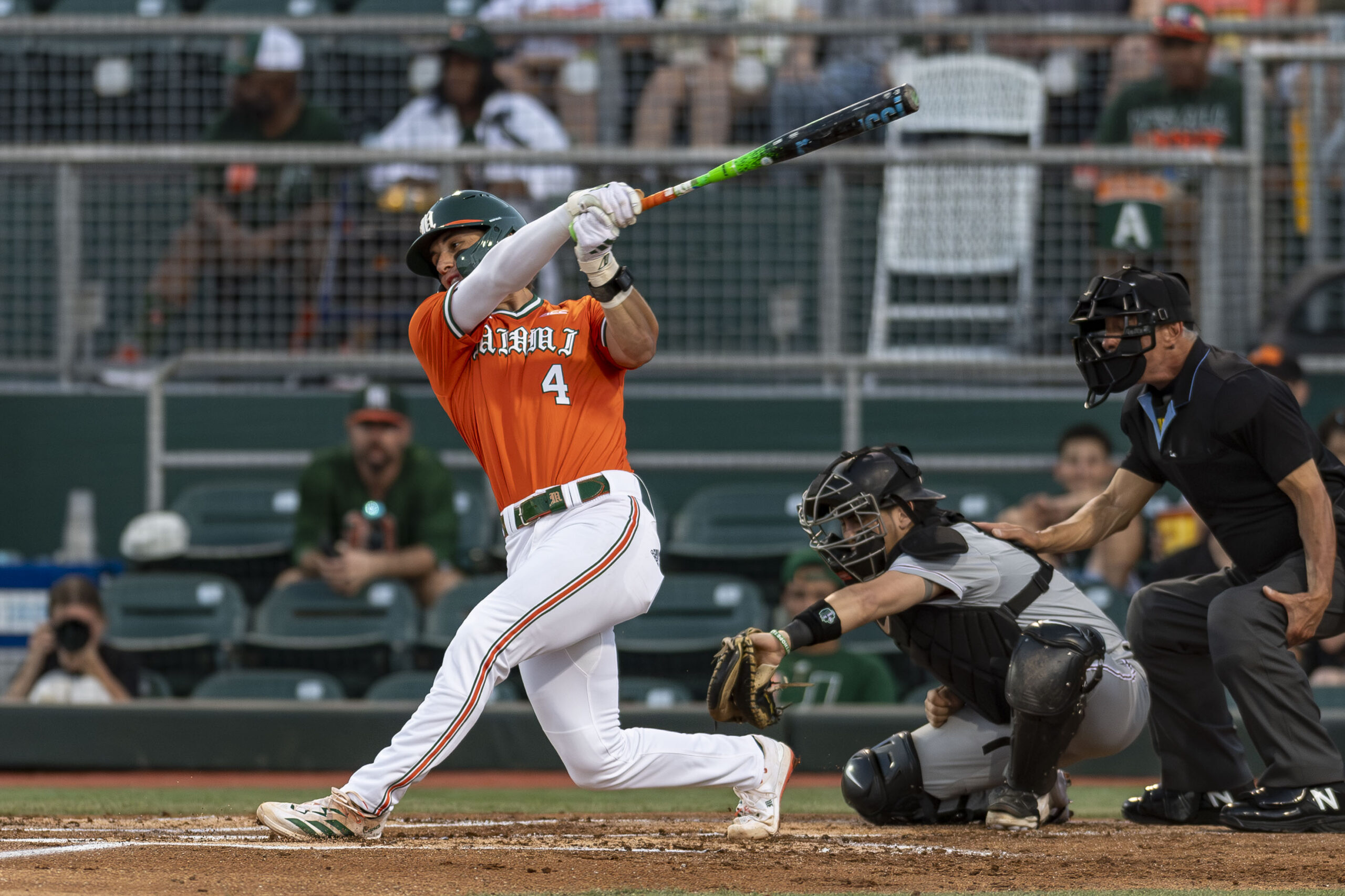
On Thursday afternoon, Colarusso did not fare much better. In five innings pitched, he gave up 10 hits and six runs, managing to strike out five Hurricane batters.
The ball continued to carry out to left field as first baseman Alex Sosa hit a 394-foot two-run shot, his 17th of the year.
After the two run first inning, Boston College’s bats were stagnant for the rest of the game.
Sophomore right-hander Lazaro Collera gave just what his team needed out of him through five innings of work. He struck out four batters while allowing two runs on three hits.
Between the quality at bats and the great pitching it seemed as if this was one of the Hurricanes most complete wins of the season.
Nick Robert came in to relieve Collera, allowing two hits in the sixth inning. The Miami bullpen shutdown the Eagles in the back third of the ballgame as Jack Durso, Packy Bradley-Cooney and Lyndon Glidewell each threw one inning allowing no hits.
Boston College’s bullpen was mostly able to tame the Hurricanes bats in the back half of the game. Five of its relievers combined to allow five hits and two runs.
With one out in the top of the seventh and Dubovik standing on first, third baseman Gabriel Milano hit an RBI double down the right field line, extending the Canes lead to five.
Milano has been impressive offensively over the past few weeks as he went 3-for-4 against the Eagles. Dubovik also picked up a pair of hits in five at-bats.
The Hurricanes put together the finishing touches offensively in the eighth as Derek Williams scored on a fielder’s choice to move the score to 8-2.
With the win over the Eagles, Miami advances to the semifinals for the first time since 2024. They are set to face No. 1 seed Georgia Tech at 1 p.m. on Saturday. The game will air on ACC Network/ESPN and can be listened to on WVUM 90.5 FM.
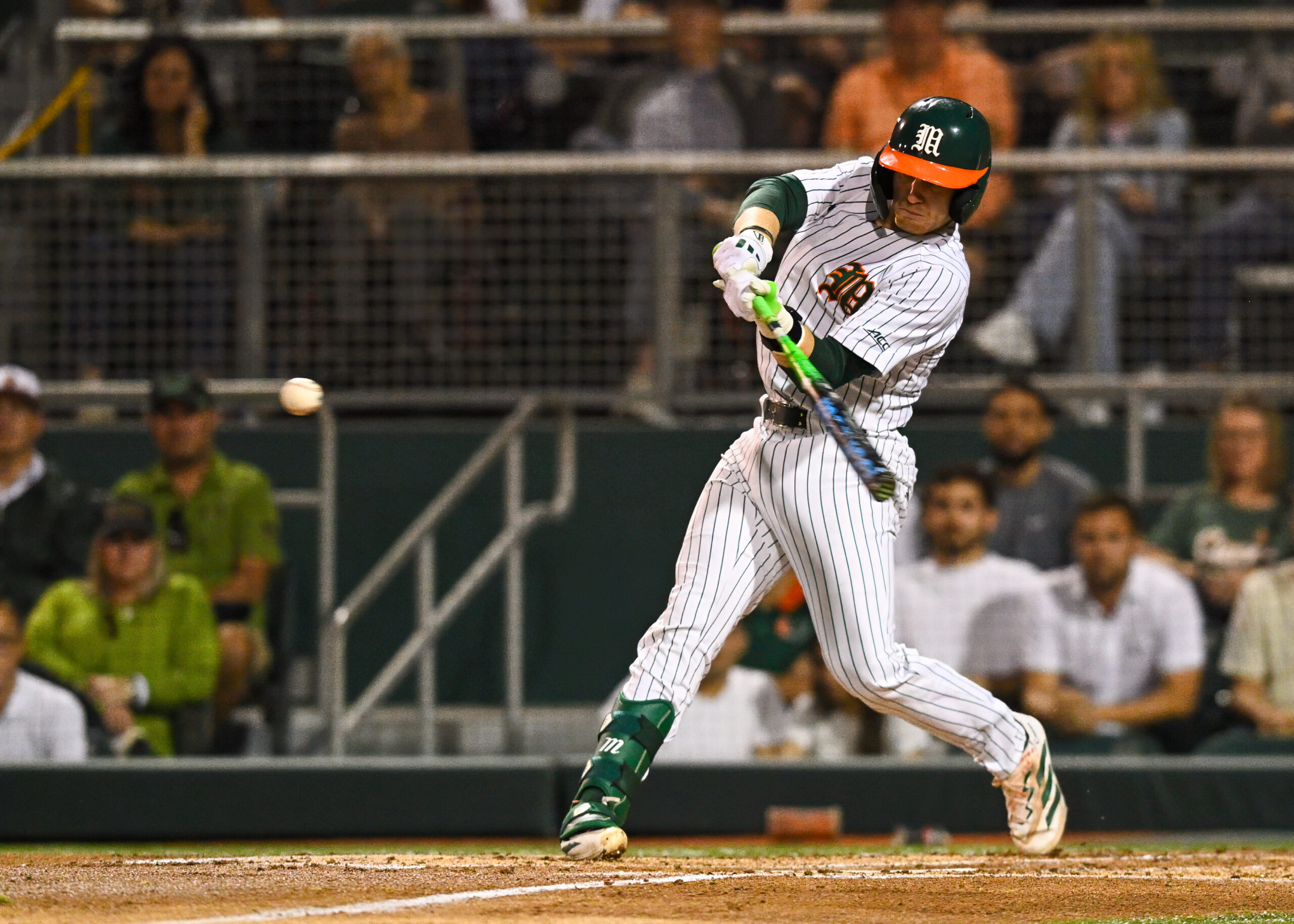
Miami baseball surges past Stanford in round two of the ACC Tournament, winning 11-2

Clear skies and a beautiful summer day in Charlotte, North Carolina is what the Miami Hurricanes baseball team was greeted with in the second round of the ACC Tournament.
The Canes defeated the Stanford Cardinal in a blowout win, 11-2.
“They did everything we didn’t,” Stanford head coach David Esquer said after the loss.
Miami has showcased mound dominance with star left-handed pitcher, Rob Evans, throughout the season, which was prevalent from the start of Wednesday’s game when Evans retired the side in order in the top of the first inning.
Stanford returned the favor in the bottom of the inning, retiring Miami’s first three batters. The Cardinal’s Charlie Bates scored in the second inning, putting the team on the board off of a one-run double.
It was no problem for Miami, as it quickly responded in the bottom of the second with a homerun from ACC All-Freshman Alonso Alvarez.
The Hurricanes faced the No. 11 ranked Florida State Seminoles over the weekend, falling 2-1 in the series, but managed to take the series finale to avoid the sweep, proving their ability to stay competitive with the nation’s top talent.
Last year, the Hurricanes dropped the opening game of the ACC tournament to the California Golden Bears, but fought their way to a super regional, ultimately falling short of an Omaha appearance by one run.
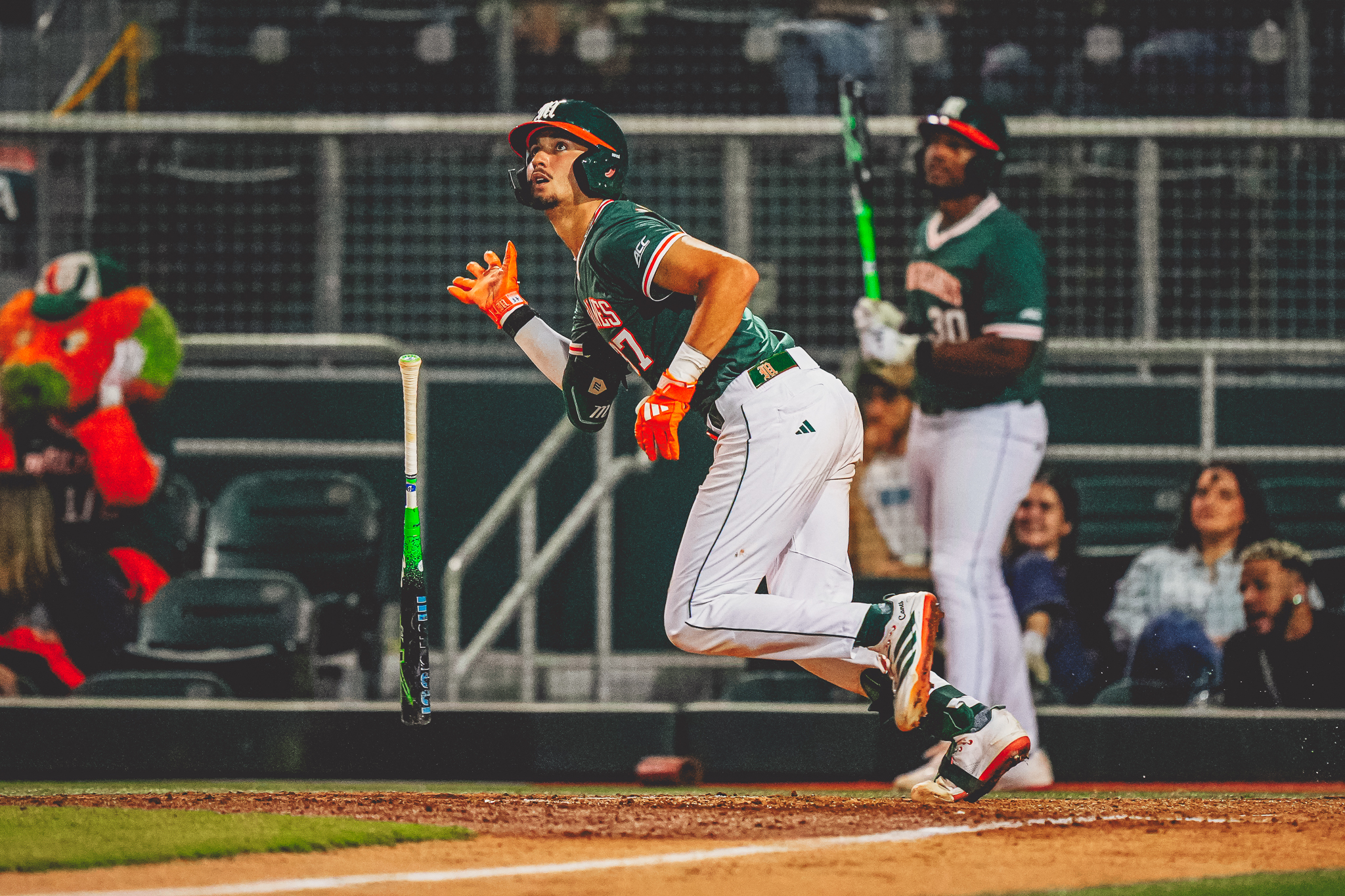
This year, they secured a bye in the ACC tournament as the fifth seed and the Cardinal are a familiar face for the Canes who made the cross-country trip to Palo Alto back in April, taking the first two games of the series and falling in the last.
Going into the bottom of the fourth inning, the Hurricanes led 3-2, and Max Galvin contributed a two-run single, padding the lead 5-2 going into the fifth.
Alvarez extended the lead once again with another homerun, this time a two-run homer to extend the Hurricane lead to seven.
“They all contributed some way or another,” Miami head coach J.D. Arteaga said about the team’s young talent. “It’s just great signs of what our future looks like and how this team is coming together.”
Miami continued their dominance as Evans captured three strikeouts in the top of the fifth inning alone and Miami’s offense added an extra two runs off of Vance Sheahan’s RBI single and a wild pitch in the bottom of the inning.
Evans pitched for a total of seven innings, with 90 pitches and six strikeouts before Arteaga looked to the bullpen for the left-hander, Jake Dorn who took over in the eighth.
“He leads the charge by all means,” Arteaga said about Evans. “His competitiveness and finding ways to win. Sometimes it’s a slider, sometimes it’s a changeup, today it was a fast ball, whatever it is, he just competes his tail off and just finds a way to win all the time.”
The Canes will face Boston College Thursday in the quarterfinals of the ACC tournament at 3:00 p.m. at Truist Field in Charlotte, N.C.
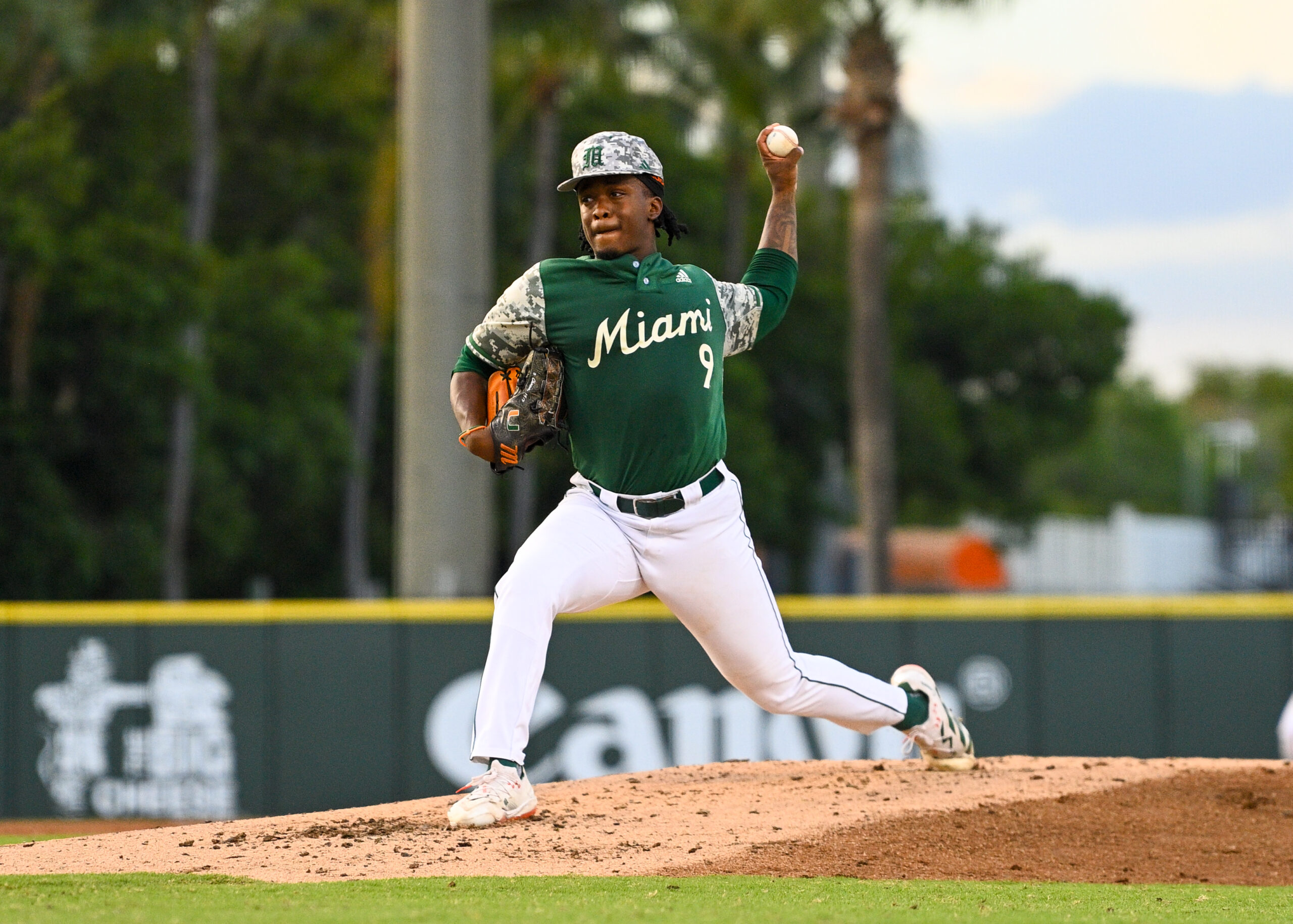
EXCLUSIVE INTERVIEW with 5-Star CB Recruit + Baseball’s Devastating Rivalry Loss to Florida State

5-Star CB recruit Donte ‘Tae’ Wright talks with TMH Sports editor Sebastian Font to break down his commitment to Miami and recruitment process after flipping from the University of Georgia. Miami announced significant changes to its 2026-27 football schedule while remaining active on the recruiting trail, following the loss of major target Mark Matthews and awaiting decisions from several other coveted prospects. Canes Baseball suffered a devastating rivalry loss to Florida State in the final series of the regular season. Recapping why Miami struggled and looking ahead at where UM stands ahead of the upcoming ACC Tournament this week.
Hurricanes rowing places fifth at ACC Championships, eyes historic NCAA bid

After qualifying three boats for Saturday’s Grand Finals, the No. 14 Hurricanes capped off a historic weekend on Lake Wheeler with a fifth-place finish in the conference standings — a massive jump from last year’s 11th-place result.
That momentum has been building all season, and finally came to a head in Raleigh, N.C. at what could be the Canes’ final showing of the season.
Miami’s first varsity eight continued its record-breaking campaign Friday, posting a 6:17.64 in qualifying heats to punch its ticket to the Grand Final while beating Clemson, Louisville and Notre Dame. The time shattered the previous program record — which the same crew had set just weeks earlier at the Lake Wheeler Invitational.
The 1V8 crew of Scarlett Pringle, Naroa Zubimendi Varela, Jovana Stanivuk, Samantha Premerl, Mallory Sullivan, Esther Fuerte Chacón, Candela Martínez Pernas, Maria Sole Perugino and Beatrice Ravini Perelli has become one of the defining stories of Miami’s season — and they backed it up again Saturday with a fifth-place finish in the Grand Final against one of the deepest fields in the country.
The Hurricanes’ second varsity eight also delivered a standout performance, qualifying for the Grand Final Friday before finishing fifth Saturday with a time of 6:32.99 — ahead of Duke and just behind a stacked lineup featuring Stanford, Virginia, Syracuse and Cal.
Miami’s third varsity eight rounded out the trio of Grand Final qualifiers after opening racing Friday by beating Louisville, Duke and SMU. The boat returned Saturday to compete in the conference final against multiple nationally ranked programs.
The results capped off what has arguably been the most impressive season in program history.
The Hurricanes have set multiple program records across all five boats this year while collecting eight wins over ranked opponents — including four top-15 victories.
Head coach James Mulcahy emphasized just how much the team has evolved throughout the season, pointing to Miami’s ability to improve week after week against elite competition.
And the numbers back it up.
In arguably one of the toughest rowing conferences in the nation, Miami finished fifth overall behind only Stanford, Virginia, California and Syracuse — all top-10 programs nationally.
For senior Naroa Zubimendi Varela, who earned second-team All-ACC honors Saturday, the turnaround says everything about the work this team has put in.
“I think we’ve shown how much we’ve improved from last year,” Zubimendi Varela said. “Going from 11th [last year] to fifth [this year], that shows how much work we’ve put in all year.”
Now, the Hurricanes head back to Coral Gables waiting to learn whether their historic season will continue at the NCAA Championships — something that would mark the program’s first-ever NCAA bid.
Three gold medals highlight Miami track and field’s ACC Championship performance

The University of Miami track and field team delivered a strong showing at the ACC Outdoor Championships from Thursday through Saturday at Owsley B. Frazier Cardinal Park at the University of Louisville.
The Hurricanes left the meet with three gold medals, multiple podium finishes and two school-record performances. Both the men’s and women’s teams finished seventh in the 17-team field, with the women scoring 55 points and the men tallying 53.
George Franks led Miami with an ACC title in the men’s 400m, posting a season-best time of 45.27 and winning the race by nearly eight-tenths of a second.
Franks also made history in the 200m preliminaries, breaking a 29-year-old school record with a time of 20.55. He later placed fourth in the event final in 20.86.
Sanaa Hebron continued her standout senior season by winning the women’s 400m hurdles for the second consecutive year. Hebron crossed the line in 55.19, the second-fastest time in program history.
Miami’s third gold medal came in the men’s decathlon, where Edgar Campre captured the ACC title with 7,749 points. Campre won the shot put, 110m hurdles and discus en route to his second ACC decathlon championship after previously winning the event in 2024. He also placed second in the pole vault and third in both the 100m and long jump.
Campre’s performance gave Miami one of its biggest scoring boosts of the meet, while teammate Dominique Hall finished seventh in the event with 7,048 points.
Several other Hurricanes added podium finishes and key team points throughout the weekend.
Kennedy Sauder earned silver in the men’s high jump after clearing 2.12m, while Magdaline Campo took bronze in the women’s high jump with a mark of 1.77m.
Serena Tate captured bronze in the women’s 400m with a season-best time of 52.69, and Nandy Kihuyu finished fourth in 54.15.
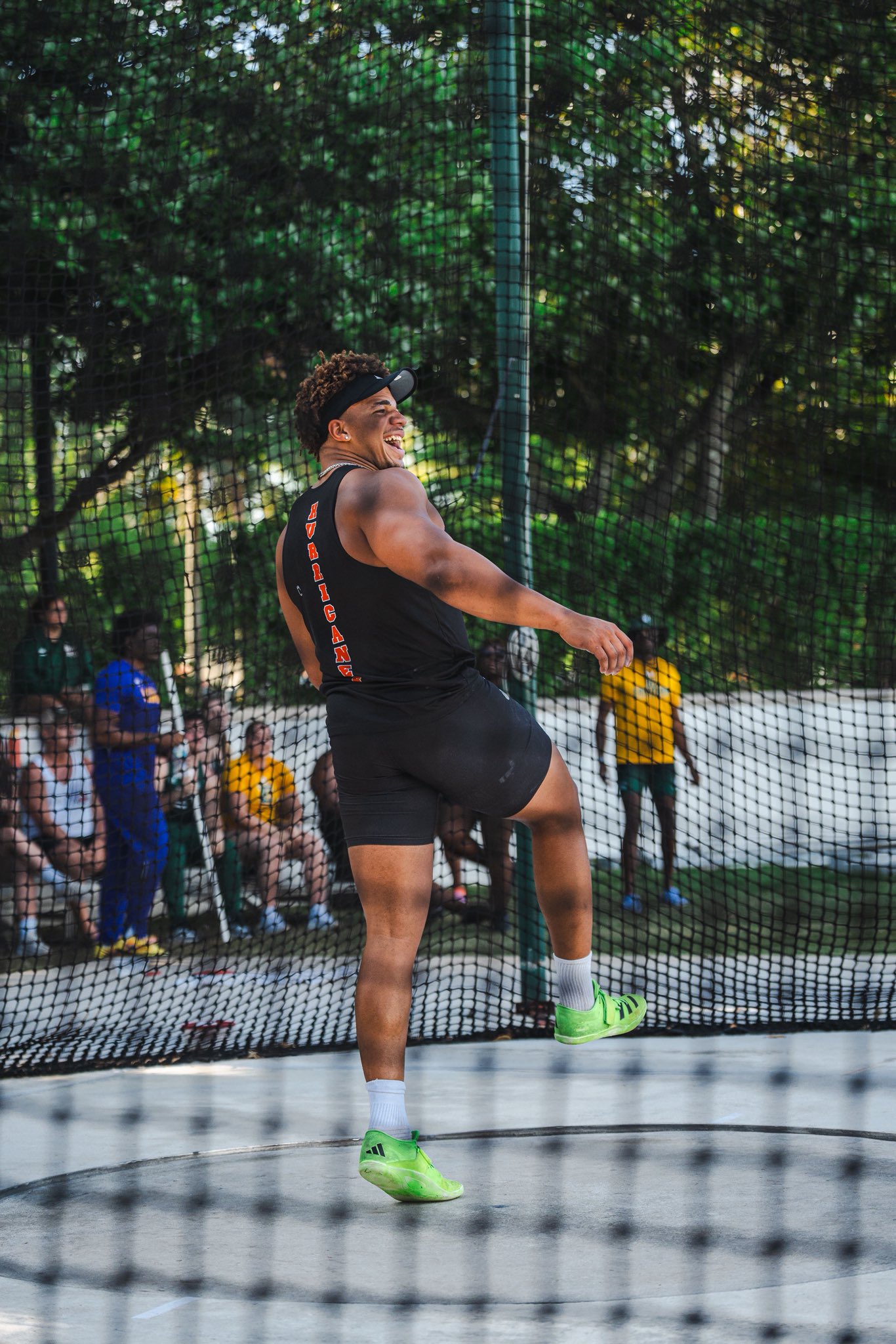
Senior Desmond Coleman placed third in the men’s discus with a throw of 58.00m.
Maddie Scheier broke her own school record in the women’s 3000m steeplechase, finishing in 10:16.69.
The women also excelled in the throwing events. Jocelyn Pringle recorded the second-longest hammer throw in program history at 65.03m to place fourth. In the women’s javelin, Alva Back finished fourth with a throw of 48.38m, while Deisiane Teixeira placed seventh with a mark of 47.62m.
Gabriella Grissom added a fifth-place finish in the women’s 800m with a time of 2:03.90, and Adriana Kruzmane placed fifth in the women’s triple jump at 12.98m.
The Hurricanes also showed depth in the relay events.
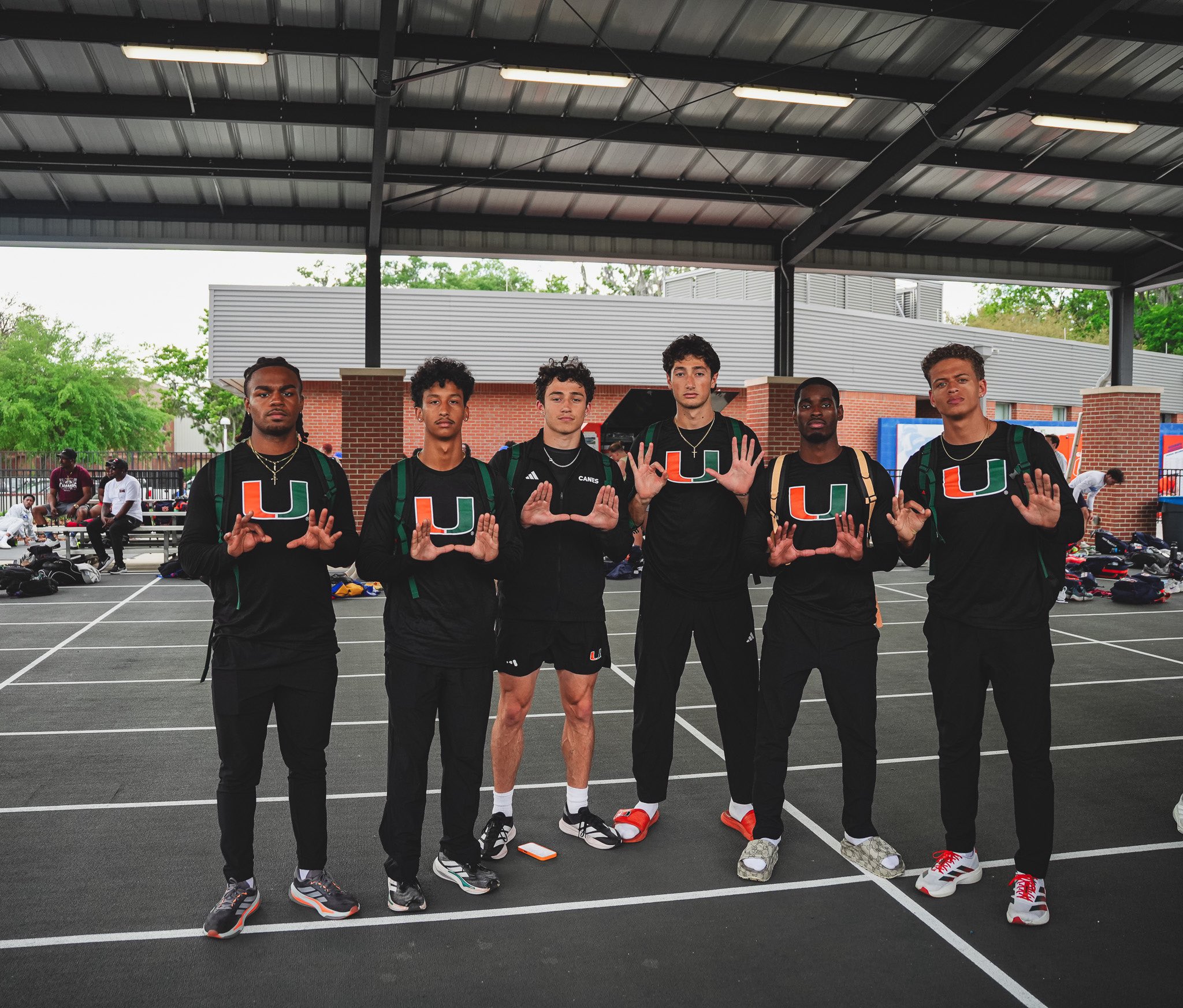
Miami’s men’s 4x100m relay team of Ashton Torns, Tristen Washington, Carter Cukerstein and Dylan Woodruffe placed fourth with the second-fastest time in school history at 39.52.
The women’s 4x100m relay team of Janay Moorer, Kihuyu, Aniyah Brown and Iyonna Codd also finished fourth, recording a season-best time of 43.88.
The Hurricanes will look to carry their momentum into the NCAA postseason, beginning with the NCAA East Preliminaries from May 27-30 in Lexington, Kentucky. Miami will aim to qualify multiple athletes for the NCAA Outdoor Championships, scheduled for June 10-13 in Eugene, Oregon.
Hurricanes avoid sweep against No. 11 Florida State, win 7-4

Down 1-0 in the top of the seventh inning, the Hurricanes were searching for life, sitting just eight outs away from being swept by FSU in Tallahassee, Fla.
On an 0-1 pitch from FSU starting pitcher Bryson Moore, freshman third baseman Gabriel Milano pulled his hands back and unleashed a powerful two-run home run to deep right field, traveling 382 feet from home plate.
Leading 2-1, Miami never looked back and won the game by a score of 7-4.
Miami’s bats continued to display fireworks in the eighth and ninth inning.
In a great display of two-out hitting, Derek Williams and Alex Sosa hit back-to-back home runs to give the team much needed insurance runs.
Williams went 3-for-4 at the plate, leading Miami in hits on the day.
FSU made it interesting in the bottom of the eighth, scoring two runs on Miami reliever Nick Robert who could only manage to get one out.
Up 4-3, going into the ninth Miami put up a three spot. Vance Sheahan singled up the middle that brought home Dylan Dubovik from second. Fabio Peralta followed that off with a single of his own.
Sheahan went on to score via a throwing error from Nathan Cmeyla and Jake Ogden hit an RBI single down the right field line.
Lyndon Glidewell recorded the final four outs despite a bump in the road in the bottom of the ninth inning, when Noah Sheffield took him deep for a solo home run.
The Hurricanes are not put in a position to win without a stellar performance from Sophomore AJ Ciscar.
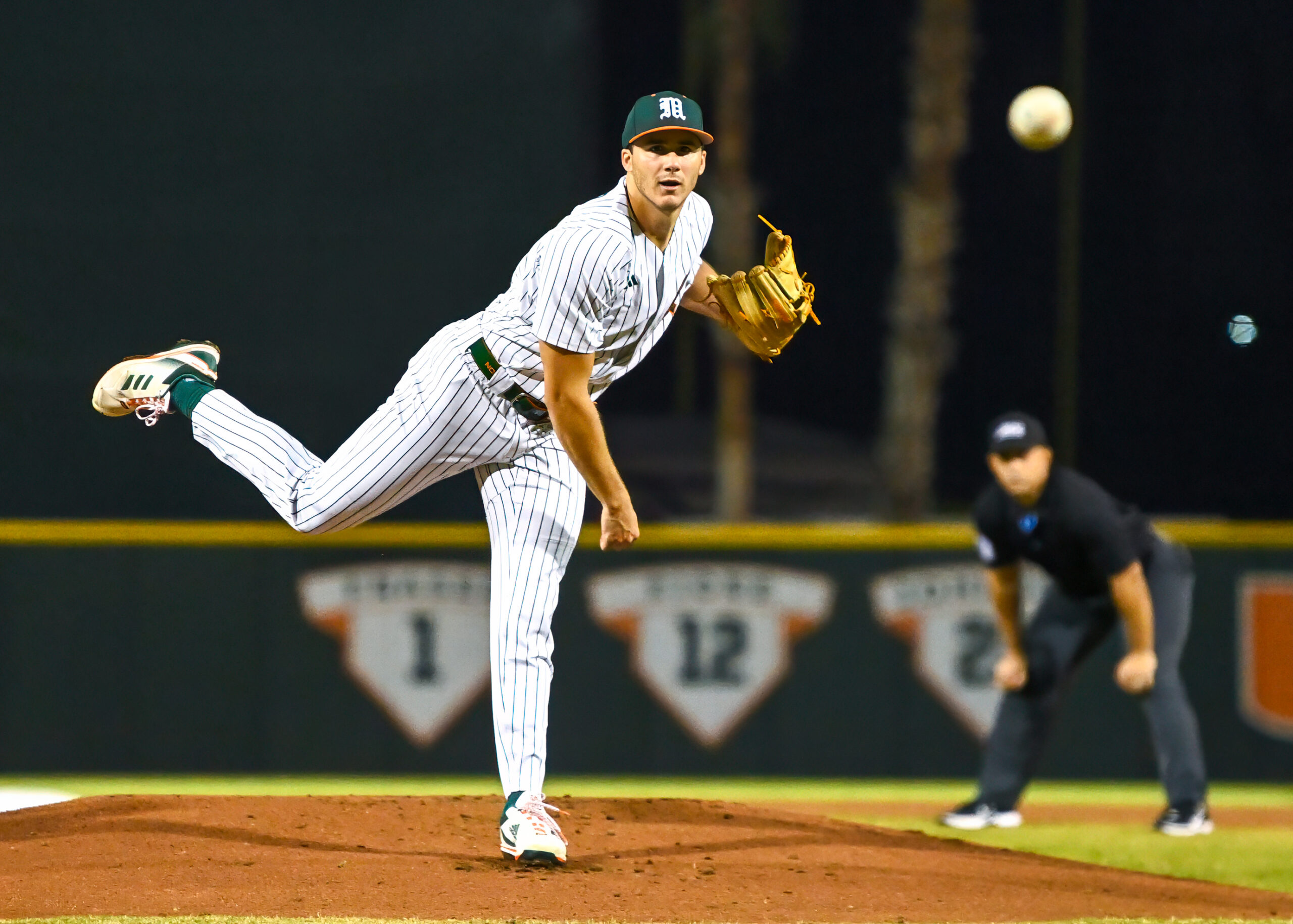
He finished his last regular season start of the year throwing seven innings, striking out four, while allowing six hits and one run. His only dent came in the second inning when allowing a home run to Cmeyla.
Two out of the four strikeouts from Ciscar came back-to-back in the third inning.
FSU’s Bryson Moore put up similar stats in what was a pitchers duel up until the seventh inning. He threw seven innings, striking out two, giving up six hits and two runs.
The Seminoles used three relievers in the losing effort, as each pitcher lasted less than an inning
Both squads consistently put the ball in play, but Miami’s defense stood out with a clean performance in the field, an area that had troubled the Hurricanes throughout the season, as they committed no errors Saturday afternoon.
Particularly in the third inning, Miami converted a 4-6-3 double play right before FSU’s Gabe Fraser could step on first base.
Miami (36-17, 16-14 ACC) out hit the Seminoles (38-16, 19-11 ACC), 12-to-9 as they left one less runner on base.
The Hurricanes will head north to Charlotte, N.C. for the 2026 ACC Baseball Tournament, starting on Tuesday, May 19.
From UM student to social media star, Alix Earle returns to campus

At the Watsco Center, Alix Earle returned to a familiar setting, one she knew well from her time on campus.
Before her videos reached a global audience, she was a University of Miami student trying to figure things out like everyone else in the room.
“I felt such an immense pressure to either fit in or act like I knew what was going on,” Earle said.
She returned to campus last Thursday, April 30, as part of the Windows Campus Creators Tour.
During the event, Earle answered questions from students about balancing authenticity with vulnerability online, turning social media into a career and navigating life after college.
By her sophomore year at UM, Earle had built a following of around 40,000, posting lifestyle content as a student. The summer before her senior year, her videos began reaching millions of views online.
She said a turning point came when she started posting about struggling with her skin.
“I didn’t really have so much confidence in myself at the time,” Earle said.
Since then, being candid has become a big part of how people connect with her content, even when sharing personal moments feels uncomfortable.
“There’s a little bit of embarrassment or hit to the ego,” Earle said. “Everyone’s seeing me crying online, but it’s real and it’s happening.”
As her platform grew, so did the business behind it. Earle said she has become more intentional about the brands and products she promotes online, especially because of the influence creators can have on consumer behavior.
She said she tests products for months before agreeing to partnerships to make sure she genuinely uses them.
After graduating in 2023, Earle also began developing her own skincare brand, Reale Actives. The project was built behind the scenes over nearly two years.
Building a business had been a goal of hers since college, but choosing the right idea took time.
Earle said she wanted to create something she would enjoy working on every day, regardless of success.
“It was really important to build a brand that was authentic to me and my story,” Earle said.
Reale Actives entered a market where Earle’s recommendations already carried enough weight to sell products out online, a trend commonly referred to as the “Alix Earle Effect.”
The same happened with the skincare brand, which sold out shortly after its launch.
She said her marketing classes at the Herbert Business School helped prepare her for the career she has today, from understanding analytics behind social media to developing confidence in public speaking and presentations.
Her connection to UM has also continued beyond graduation.
A month after earning her degree, Earle launched a scholarship program supporting juniors and seniors at the university, especially those with financial need and an interest in business.
“I wanted to be a source of inspiration,” Earle said. “You know, be a phone call away.”
At the center of the initiative was a desire to give back after receiving support from the school throughout her college career.
Earle said she also hopes to stay connected with the scholarship recipients and support them beyond the financial aspect.
Speaking to students at the Watsco Center, Earle encouraged them to not put too much pressure on having everything figured out.
She added that students should make the most of their college experience and take opportunities even when they feel uncertain.
“Say yes to everything,” Earle said. “Reach out to the people in your class that you always wanted to make friends with but haven’t yet. Go out on the nights that you’re tired and maybe don’t want to, because it’s going to end soon.”
Miami blows five-run lead, drops series opener to FSU in 11 innings

After building a five-run lead, the Miami Hurricanes (35-16, 15-13 ACC) collapsed late in a 7-6, 11-inning loss to the No. 11 ranked Florida State Seminoles (37-15, 18-10 ACC) on Thursday night in the opening game of their final ACC series of the year.
For a Miami team trying to finish the regular season strong, Thursday’s loss was one of its most painful of the year. The Hurricanes had the rivalry opener in their hands, but FSU stormed back with three late home runs before walking it off in the 11th, turning Rob Evans’ gem into a crushing defeat.
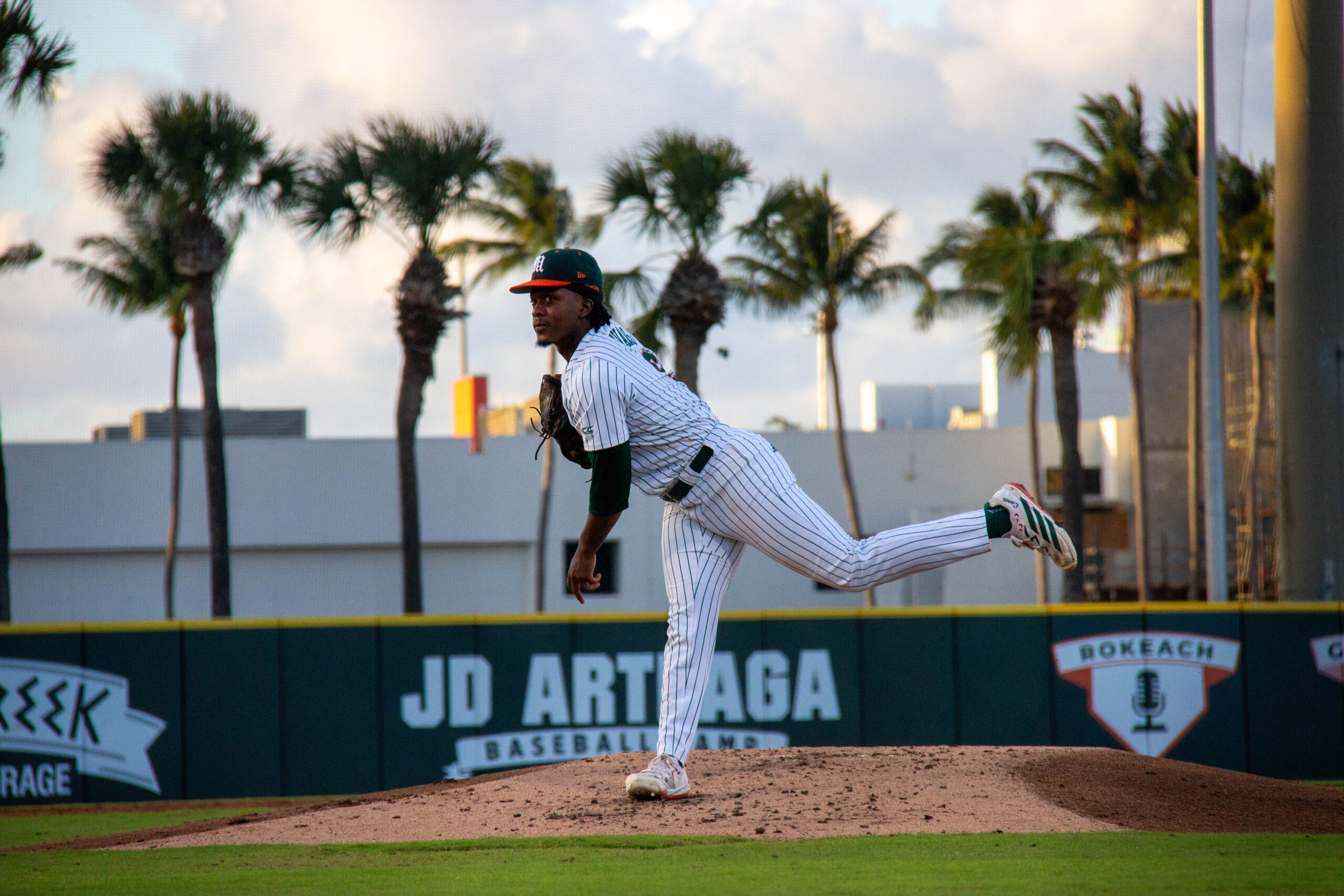
On the bump for the Canes was the senior Evans in his final regular-season collegiate start, pitching one of his best starts of the year. He allowed one earned run in seven innings pitched, striking out seven.
Unfortunately for Miami, Evans’ stellar night was overshadowed by a rough relief outing from senior Lyndon Glidewell. Glidewell entered on a heater, riding a streak of 12-straight scoreless appearances, but collapsed in the eighth and ninth, allowing five earned runs as the Seminoles forced extra innings.
FSU went with its ace, Wes Mendes, who entered with a 2.42 ERA across 78 innings and 103 strikeouts. He lasted six innings, allowing four earned runs.
The Seminoles’ bullpen stepped up from there.
After Cade O’Leary allowed two earned runs, Kevin Mebil and Chris Knier combined for five scoreless innings, with Knier earning the win.
The scoring opened with designated hitter Hunter Carnes, who launched a towering solo home run to right field beneath the College World Series banner displaying Florida State’s 24 appearances, and still, no championships.
The Canes put runners on second and third after Gabriel Milano and Jake Ogden delivered back-to-back hits in the third inning. Max Galvin then stepped to the plate and lined a shot directly into Mendes’s glove, allowing him to escape the jam with a clutch play.
In the fourth, Miami was able to get on the scoreboard when freshman Alonzo Alvarez launched a 394-foot three-run shot into deep center, continuing his red-hot year and putting the Canes ahead 3-1.
Dylan Dubovik followed with a double to center field and was eventually driven home by Milano on a fielder’s choice, giving the Canes a three-run cushion.
After Miami’s busy fourth inning, the game went scoreless in the fifth and sixth.
In the seventh, the Seminoles decided to yank Mendes and bring in O’Leary. He opened the inning by hitting Fabio Peralta, allowing a single to Ogden, and walking Galvin, all with no outs.
FSU manager Link Jarrett went back to the bullpen and called on Kevin Mebil. He induced a double play from Derek Williams that brought in a run, and Alex Sosa later added an RBI single to extend the Canes’ lead to 6–1. The hit marked Sosa’s fourth straight multi-hit game, and he has now recorded at least one RBI in eight of his last nine games.
Miami turned to Glidewell in the eighth, but FSU wasted no time making noise. Leadoff hitter John Stuetzer launched a no-doubter off the scoreboard in left for his ninth homer of the season. One batter later, Brayden Dowd followed with a deep drive to right, giving the Seminoles back-to-back home runs and cutting Miami’s lead to 6-3.
J.D. Arteaga stuck with Glidewell in the ninth inning, protecting a three-run lead, but the Seminoles quickly applied pressure with a walk and a single that put runners on the corners. FSU then brought home a run on a sacrifice fly to cut the deficit to two while still keeping a man aboard.
Moments later, pinch hitter and redshirt senior Eli Putnam delivered the knockout punch, crushing a moonshot deep over the left field wall to tie the game and send it to extras. Putnam slammed his bat to the ground as the stadium lights flashed across the park, a moment that encapsulates the stakes of the Miami-FSU rivalry.
In the eleventh, the Seminoles got the bases loaded on two outs on two singles and a hit by pitch. The Canes brought in freshman Jack Durso to get the final out, but he walked Brayden Dowd to force in the winning run and end the game.
The Canes face the Seminoles in game two of the last ACC series Friday night, with live coverage on ACCNX and WVUM 90.5 FM.
Baseball is more than a game for J.D. Arteaga

From the outside, University of Miami baseball coach J.D. Arteaga seems to have the life every aspiring coach dreams of.
He played Division I baseball, six years of professional baseball and now coaches a four-time national champion program.
But, his life has been far from perfect; yet his faith anchors him.
When he was 16, he lost his father. Then, early in his coaching career, he lost his teenage son.
His father, Juan Diego Arteaga, Sr., passed away from a heart attack during his sophomore year at Westminster Christian.
As a teenager, navigating life and baseball without a father was incredibly difficult.
“I think we all grow up and our parents are our heroes, and then we get to the age where they don’t know what they’re talking about, and then maybe later, in our 20s, they might be right,” Arteaga said. “And then when they’re gone, they’re absolutely right. I learned that they’re absolutely right at an early age of 16.”
In 2018, Arteaga’s son, Ari, died in a car accident. The loss deeply affected his family and the Miami community deeply.
A man who has felt the pain of tragedy and experienced the unthinkable refuses to let his legacy be defined by tragedy, even after Ari’s death.
Faith is central to Arteaga’s family and personal life.
“Without faith, it’s impossible to get through this day called life,” Arteaga said. “Without that, we’re kind of lost and wandering, and everything that I know and accomplished has been through Jesus.”
After his son’s death, he and his wife started the Ari Arteaga Foundation with the mission “to provide scholarships to students who shine Ari’s unique light and characteristics.”
“Life is complicated, life gets difficult, we forget that other people are out there in need,” said Ysha Arteaga, Arteaga’s wife. “It’s a simple act of kindness, go do one nice thing that day.”
According to his wife, Arteaga is a “no bull—t” type of coach. The goal is always to win, make it to the College World Series in Omaha, Neb. each year and bring home another national championship.
Aside from winning, Arteaga wants to leave a lasting impact on each of the men who come through the Miami baseball program.
Dorian Gonzalez Jr., a four-year infielder for UM who graduated in 2025, grew closer to Arteaga during his time as a player.

“Off the field, it’s almost like he’s an older brother that will mess around with me,” Gonzalez said. “He genuinely cares, and he’ll ask me how work is going. He goes the extra mile to establish that relationship with his players.”
Arteaga strives to mentor his players as he would his own son.
“Obviously, my job depends on winning and losing, but I get just as much pleasure as when a former player brings his son by and says, ‘This guy made me the man I am,’” Arteaga said. “As good a program as we are, I’d say 90% of our guys are not going to play in the big leagues. They’re going to be fathers, they’re going to be husbands, they’re going to be a lot of things. And to me, it’s making them the best men possible.”
With faith at the center of it all, Arteaga was raised Catholic and continues to lead in a way that reflects Jesus.
“Last year was the first time that the team was very faith-oriented, and I think it had something to do with JD,” Gonzalez said. “On Sundays, a good group of the guys would go to mass before or after games, and JD and his wife were always there, and I think that says a lot about his leadership.”
“He’s got 35 to 40 sons, that’s how he is with them,” Ysha said. “He’s raising them the same way [as Ari], there’s absolutely no difference.”
Arteaga could’ve chosen a different path. After playing for the Miami Hurricanes from 1994 to 1997 and leading them to four-straight College World Series appearances, he went on to play professionally.
He was a 26th-round draft pick by the New York Mets and spent six seasons in the Mets, Astros and Rangers minor league organizations.
In 2003, Arteaga left his aspirations to play in MLB behind and returned back to Coral Gables as the program’s pitching coach.
“I was in spring training in ’03,” he said. “I think they were nine games into the season down there, and they called and offered me the job, and I went into the general manager’s office of the Rangers and retired to go coach college, and his response was, ‘You have a chance to get to the big leagues this year.’”
It didn’t matter that Arteaga was at the cusp of fulfilling every young player’s dream. He always knew he wanted to end up with the Miami Hurricanes.
“It was always his dream to be the head coach at the University of Miami,” Ysha said. “That was always the main goal.”
“I think J.D. embodies Miami,” Gonzalez said. “Anyone in the baseball community in Miami knows J.D. Arteaga.”
Although he is only in his third year as head coach, Miami baseball is nothing new to him. He’s a Cane who bleeds orange and green.
After leaving professional baseball behind, Arteaga joined Miami’s staff as a pitching coach on March 4, 2003, under head coach Jim Morris. He’s been with the Hurricanes ever since, and some may argue he never truly left.
Last season, the Hurricanes advanced to a super regional, where they lost to the Louisville Cardinals by one run.
Arteaga hopes to build off that momentum.
“I remember, as a player, we would leave Omaha and make reservations at the hotel for the following year because we knew we were coming back,” Arteaga said. “I want to be a program that every year we’re in contention to get to Omaha.”

Play it again or I might “Drop Dead”

On April 17, pop star Olivia Rodrigo graced us once again with her musical intelligence through the release of her new song “drop dead.” This is the first in a series of 13 songs from her third album “you seem pretty sad for a girl so in love” set to be released later this year on June 12.
Rodrigo has not put out a single since 2023 which may be why the song was quick to gain popularity with her music video reaching nearly 6 million views within the first 24 hours. This is the largest debut so far in Rodrigo’s career.
As opposed to speculation that this would follow the heartbreak theme expressed throughout her previous albums,“drop dead” can be added to her short list of love songs. An article from The New York Times describes it as the “most visceral evocation of dreamy romance that Rodrigo has released yet.”
The single combines rock tones with a familiar pop feel that Rodrigo’s fans are more than familiar with. The ethereal soft tone and catchy tune express her yearning and pure infatuation for her newest crush.
“drop dead” showcases a whole new sound for Livies to enjoy, leaving them something to listen to while they impatiently await her new project.