Three graduating seniors in the Rosenstiel School of Marine, Atmospheric and Earth Science analyzed a new way to measure coral growth and decay without setting foot in the water.
The passion for the one-year-long project began when Jakob Brown, Isaiah Wang and Nayonika Choudhury were presented with data and tasked with analyzing a new method of coral quantification.
Brown and Choudhury are majoring in marine affairs and Wang is majoring in marine science and computer science, making this type of work very important to them.
The two goals of the study were to monitor how the coral was changing and to figure out if the method was reasonable.
“Science is slow and all results are good results. At this point, we’re not looking for good results or bad results, we’re looking for a result of whether this method is viable,” said Choudhury.
Over the past year, the team has been analyzing data collected by drones equipped with Fluid Lensing technology — which enables us to see objects beneath the water that wouldn’t otherwise be visible.
The study took place at the Piti Bomb Holes Marine Preserve, which is located in a popular snorkeling spot in Piti Bay, Guam. The area is known for its natural, coral-filled holes that stretch several dozen feet deep and resemble bomb craters.
The images of the reef site in Guam were captured every 10-15 days by the Micronesian Area Geospatial Information Center, a lab partnered with NASA. UM’s ACES lab trains scientists to deploy these drones for research.
Brown, Wang and Choudhury took these images and analyzed them with a variety of tools designed specifically for coral.
One tool used for the study is the PICOGRAM, an AI-based image analysis software that processes drone images at the exact pixels that the coral corresponds to.
This way, the team can measure how the surface area of the corals are changing.
Not only is the project the first-ever long-term Fluid Lensing campaign, but it’s also one of the first-ever centimeter-scale coral quantifications using remote sensing.
“To me, this project highlighted the rapid pace of scientific and technological advancement. We demonstrate how emerging tools can already enhance the way we study coral ecosystems, with even greater potential as these methods continue to evolve and improve,” said Wang.
Although this exact technology is patented by NASA and the ACES lab, they hope to partner with labs all over the world to continue this research with coral reefs.
“The scalability of these new methods has global implications – helping us better understand the effects of climate change,” said Brown.
After graduation, all three students plan to continue their education.
Brown will be pursuing a masters of environment and international affairs at Georgetown. Choudhury is staying at RSMAS to earn her masters of climate and society through the professional science program. Wang is entering a PhD program for ocean engineering at the University of Rhode Island.
They express the necessity to continue this kind of work.
“We want results back quicker because in the face of anthropogenic climate change, we’re running out of time for sustainable solutions,” said Choudhury.
The three presented at the Research, Creativity, and Innovation Forum Symposium on Monday, April 27, to report their findings and further publicize their study.
UM Student Body President Ivana Liberatore made sure that every minute of her college career mattered. Now, on her way to Harvard University, she doesn’t intend to slow down.
Liberatore, a senior majoring in finance, business analytics and legal studies, has spent the last four years developing her relationships on campus and listening to students.
“I had to advocate and make decisions that impacted thousands of students, often in situations where there wasn’t a perfect answer,” Liberatore said. “It taught me to balance different perspectives while thinking a few steps ahead.”
As she prepares to attend Harvard Law School with the goal of becoming a mergers and acquisitions lawyer, Liberatore says she will miss the campus’ vibrant energy and sense of community the most.
She recalls her freshman year Homecoming as her favorite memory.
“It was one of the first times I really felt the full energy of UM. Being surrounded by all my friends, whom I still cherish to this day, put into perspective the life-long community I had just entered,” Liberatore said. “I remember thinking how lucky I was to be part of something like that.”
As her time at UM comes to a close, Liberatore reflected on how well her courses prepared her for her next chapter.
She credited her private equity class with Professor Jason Wright and her law of risk class with Professor Mark Shapiro for giving her a real-world understanding of private equity deals and insight into legal thinking that she “will carry with [her] as [she steps] into law school.”
Liberatore knows she still has room to grow, and views the future as an opportunity to learn.
“It will challenge me in ways I haven’t experienced before and I’m looking forward to growing both academically and personally,” she said.
Liberatore thanked her friends, mentors and professors for supporting her over the past four years. She also emphasized how grateful she is for her parents and brother believing in her unwaveringly, even when she was doubtful.
As the saying goes, no one is an island. Liberatore’s close connections to her friends, her organizations and her fellow students highlight just how important community is at the U.
When Sienna Sacco arrived at UM, she had no idea where social media would take her. She posted content primarily just for fun until a couple of unexpected videos changed her life overnight.
“I started creating content in high school as just a complete joke,” Sacco said. “I didn’t take it seriously.”
That perspective changed when a few of her videos gained thousands of views. As her platform began to shift, so did her ideas for the future.
But, behind her curated content and expanding audience is a busy schedule. Sacco, a nursing and health science major, balances tedious coursework with her online presence.
“It’s definitely super hard,” she said. “You just have to find a schedule and plan everything out.”
Her path in the science industry requires acute focus. Beyond academics and social media, Sacco is also pursuing modeling, adding an additional layer to her demanding schedule.
Her transition into college highlighted a turning point. In an environment like UM, where influencer culture was on the rise, Sacco began to approach content creation more intentionally.
Now, with more than 500,000 followers on TikTok, Sacco expresses her success as “out of the blue.” Growing up to be very shy and quiet, she said putting herself online felt surreal.
“Me doing that was just kind of like, ‘Oh my God,’” she said.
As she reflects on her college journey, Sacco said personal challenges — including a difficult breakup — helped shape her into the person she is now. “That made me who I am today,” she said.
As graduation approaches, Sacco plans to continue her studies and potentially pursue acting.
Despite her success, Sacco remains self-aware of the impact she has on her followers. She recalls meaningful moments when followers have approached her.
“They’ll be like, ‘You’re my inspiration,’” she said. “That just makes me so happy.”
For underclassmen, her advice is straightforward: “Be friendly and go out. Don’t say no to anything. It goes by in the blink of an eye.”
If she could speak to her freshman self, Sacco said she would offer reassurance.
“Everything will work out the way it’s supposed to,” she said.
As her chapter at UM comes to a close, Sacco leaves behind more than just a digital footprint — she leaves an empowering message about growth, balance and embracing the moment.
For the last edition of V this semester, I know you all are dying to hear from some older, wiser voices about their time at UM. Here’s what our class of 2026 had to say:
Just say yes
When an opportunity comes knocking, you need to be ready to answer the door. You truly have no idea what waits on the other side — just be sure to lead with love and excitement.
This senior says her best moments at UM have come through unexpected opportunities and activities she was not originally enthusiastic about. But, as she embraced the moment, she found herself enjoying these opportunities and connecting with new people on campus.
Form a village, be a villager
As this senior likes to say, “If you want a village supporting you, you need to be a villager.”
Sometimes, when you’re missing your parents and the comfort of the house you grew up in, all it takes is one person to pull you out of your funk and brighten your day.
Remember the people who go the extra step to make you smile and support them when they seem like they need a pick-me-up. College can be hard.
It’s never too late to make friends, so always be open to joining a new organization and becoming part of that community. College gives you the chance to choose your friends, so choose wisely and foster those relationships.
Not every day will be perfect, but you’ll look back and feel grateful for all of it. While it may be difficult to appreciate in the moment, your hardest days are when you grow the most.
Lean into being a student
The biggest piece of advice from our third, and final, senior: Ask what you don’t know and don’t be afraid to go after what you want.
The word “student” is powerful because it means you are still learning and you are allowed to make mistakes. If you never fail or have a less-than-perfect moment, did you truly learn anything?
Lean into the idea that you are still learning and growing — as a person and a student — and ask for help when you need it. You’ll be surprised how many people are just waiting for you to ask.
While some see political polarization as a challenge to democracy, Boris Johnson, the former UK prime minister, sees an opportunity.
Democracy cannot thrive without disagreement, as long as it is civil — this openness to different viewpoints was a trait he praised about the University of Miami campus.
“I’d rather have a country that is capable of polarization than a unipole,” Johnson said.
Johnson was the Provost’s visiting lecturer at UM this semester, and on Wednesday, April 22, he held a roundtable discussion with UM’s media, including The Miami Hurricane. He discussed democracy, international intervention and the fragile state of the world order.
His message was simple: “You have to fight for [democracy].”
Johnson’s view of democracy shapes his support for the recent U.S. foreign intervention, which is strong but not unconditional. He backs the U.S. involvement against Iran’s “nightmare government,” yet is critical of the go-it-alone approach.
“America would be stronger if America’s allies were on its corner,” Johnson said. Without a coordinated coalition, he argued, Iran found room to exploit the situation. “England’s vast knowledge of the area would have proven useful to the U.S., and maybe even could have prevented the current blockade in the Strait of Hormuz.”
Venezuela is a conflict that Johnson knows more personally. He was once sent to negotiate with Nicolas Maduro, an experience he recounted with characteristic self-deprecation.
“I was sent to try to talk to Maduro and to persuade him to be a democrat,” he said. “Pretty hopeless venture.” When he urged Maduro to put opposition leader Maria Corina Machado on the ballot, Maduro refused. “He said, ‘No, no, she is a traitor.”
When the U.S. moved to remove Maduro in January, Johnson was not surprised. In fact, he largely approved. Democracy, though, was not the only motivation.
“Venezuela, as everybody knows, has got among the world’s largest reserves of oil,” he said, “And the US has massive refining facilities which are, purely by coincidence, for just that type of oil.”
Still, he hoped “something good will come out of this for the people of Venezuela.”
So far, President Delcy Rodríguez, who took power after Maduro’s capture, has released 51 political prisoners. “It’s not a total transformation,” Johnson said. “Yet.”
Critics like Brazil’s President Luiz Inácio Lula da Silva called the intervention a “regrettable chapter in the continuous erosion of international law.” Johnson is unmoved.
“International law is very important,” he said. “But even the most liberal-minded people are not consistent with it.”
His closing thought returned to democracy itself: imperfect, often contested and essential.
In a world where there are more autocracies than democracies, Johnson makes the case for the latter. The benefits outweigh the cons. Economic growth, peace of mind and “fun” are things worth fighting for. He does not view political polarization as an enemy to any of this.
“Political polarization is a feature of freedom to dissent,” Johnson said. The ability to disagree is more valuable than a country without plurality.
Despite UM football being in the thick of athletic probation in the mid 90’s — a dark period between the Canes’ title winning sides of the late 80’s and early 2000’s — Rod Mack still committed to playing football for the Miami Hurricanes.
Now, nearly three decades later, Mack continues to embody South Florida, this time in his hometown of Miami Gardens, Fla. where he’s running for City Hall’s Seat 4.
“I wanted to give back to the community that gave so much to me,” Mack said. “ I want to make sure every resident feels safe and secure … help families and local businesses.”
The Miami Gardens native qualified for the running earlier this month as incumbent Councilwoman Katrina Wilson reaches her term limit this August. Like Wilson, Mack’s campaign is centered around local investment, expanding economic opportunity for his constituents.
Mack aims to develop his hometown from the ground up, focusing on improving quality of life for young families and homeowners by creating feasible avenues to thrive locally.
A double finance major at the ‘U’, he plans to use his finance background to invest within the Miami Gardens area, supplying local entrepreneurs with grants to kickstart their ideas and provide financial literacy seminars to ensure the growth can last for generations.
One of his main initiatives is to create paid internship programs and vocational training to show that “success doesn’t mean leaving the community.”
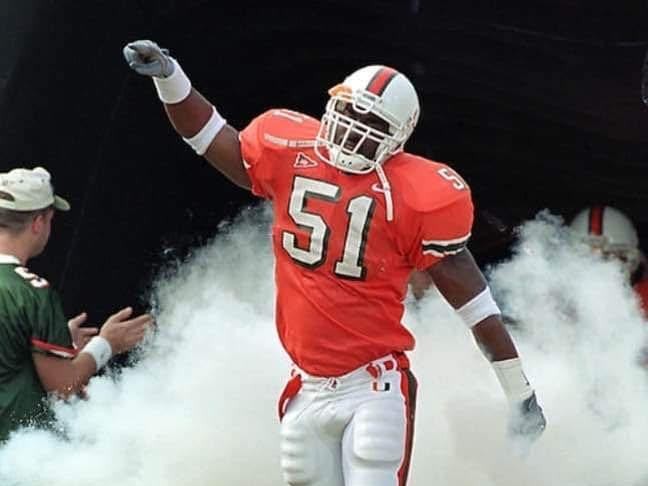
Former UM linebacker Rod Mack running through Miami’s iconic “smoke” entrance // Photo Courtesy of Gabrielle Charles PR
A former top-50 player in Florida for his 1995 class, the linebacker lived and breathed old-school Hurricane football culture — earning his way up the depth chart during his five years in the orange in green.
Mack takes lessons from his time at UM as a student-athlete during the University’s athletic probation period and applies them to his new path in life.
“My freshman year we lost a lot of scholarships, we knew then that we were building something great that we probably would not reap the benefits from, like after I graduated the team played for the national championship,” Mack said. “I can draw from those experiences in building for the future, planting trees for fruit that I might not be a part of.”
While this journey marks Mack’s first venture into politics following his career as a wealth manager for NFL players, it doesn’t mark his first impacts in the Miami Gardens community.
Mack co-founded the Miami Gardens Ravens Youth Football Academy in 2010, an ultra-successful youth football program. Eight players on the teams competing in last season’s national championship game could trace their roots back to Mack’s program. While he takes pride in this number, his ultimate focus scopes beyond the field.
“When you’re dealing with a youth football program, you’re not just dealing with the kid, but you’re also dealing with the parents and grandparents,” Mack said. “So just seeing those perspectives sparked an interest in me.”
One of those players he coached just so happens to have more than a player-coach dynamic — his son Ryan Mack.
Ryan, a former top-100 player in Florida’s 2024 class, followed his father’s footsteps by committing to Miami.
However, the defensive back suffered back-to-back injuries that forced him to take a redshirt year in 2024.
Ryan, now healthy, is battling his way up the Miami depth chart in a similar manner his father did nearly three decades ago.
“I’m just really proud to watch him go through that process and deal with that adversity,” Mack said. “He could have packed it in and been one of those people to pout, but he didn’t.”
From his own playing days at the ‘U’ to his family ties with the University to his roots in Miami Gardens, all these full-circle moments make up who Mack is — a South Florida leader.
With the Miami Grand Prix days away, Formula 1 energy has already made its way onto the University of Miami’s campus.
The Pen to Pitlane event at the Watsco Center brought Red Bull Racing into Miami’s orange and green spotlight, giving attendees a rare, up-close look at some of the personalities behind one of the most legendary teams in the paddock — including reserve and test driver Yuki Tsunoda, who raced in Formula 1 for five seasons.
Along with Tsunoda, Red Bull brand ambassador and former chief mechanic Calum Nicholas and Red Bull Group Lead of our Technical Partnerships team Jack Harrington took to the stage.
Tsunoda, who’s known for his quips, unfiltered radio messages and fiery personality, delivered exactly what you’d expect: speed, honesty, and just a little bit of trouble with the filter.
About ten minutes into speaking, Tsunoda swore.
He paused, eyes wide.
“Oh, I’m so sorry,” he said quickly, as the room erupted into laughter.
It was a small, unscripted moment — but one that captured the tone of the morning, and the personality of a driver navigating the balance between authenticity and expectation within the highest level of motorsport.
Throughout his career, Tsunoda’s candor has stood out in a setting that, by design, leans polished.
“I was just literally shouting at the radio,” Tsunoda said, referencing his radio messages that have since become legend in the mythological landscape of motorsport. “I was swearing a lot.”
“Swear words are beautiful,” he laughed. “They’re an amazing thing.”
That honesty is part of what has made him one of Formula 1’s more compelling young drivers — but it’s also something he confessed that he’s had to rein in.
“You get hammered by [the] media, and you have to be professional,” he said. “There are a lot of things you want to say, even if you can’t.”
At this particular event — one centered around fan access and brand visibility — Tsunoda’s ability to toe that line between media-trained and completely unfiltered was on full display.
Even in a room built for engagement and outreach, his instinct to speak candidly never fully disappeared. It just arrived a second faster than a so-called media-friendly filter.
The event itself served as a preview of what’s to come this weekend in Miami, as the Formula 1 weekend kicks off Friday, May 1. As this sport continues to rapidly expand its presence in the U.S., this upcoming weekend promises high energy and high stakes.
While content creators and media personalities have helped to expand the brand globally — something both Nicholas and Harrington addressed to the audience in Watsco Center — it’s the drivers who still stand as the main draw.
And for Tsunoda, the conversation quickly turned back to what happens on track.
“The power I felt through my body when I started the throttle was completely different,” Tsunoda explained, answering a question about making the jump from F1 driver to reserve/test driver. “Formula 1 is a special beast.”
That “beast” is something he’s been preparing for most of his life.
“I’ve been racing since I was four years old,” he said. “That experience helps.”
Off the track, though, the challenges look different.
“Hanging out with big guys — sponsors — you have to force yourself to step out, [to] grow,” he said.
Events like the Pen to the Pitlane [highlight that growth in real time, where drivers are expected to represent not just themselves and their personal brand, but the teams and sponsorship partners that come with the sport.
With the Miami Grand Prix approaching, moments like these — on a college campus, in front of a room full of students — offer a glimpse into the personalities behind the scenes and under the helmets.
Tsunoda, for his part, didn’t try to be anything other than himself.
That means answering honestly. Reacting in real time. And, occasionally, swearing before catching it a second too late.
He’ll have to keep that in check once the cameras — and the stakes — turn fully back to the track this weekend.
But for a morning at Watsco Center, just days before one of Formula 1’s biggest American races, Tsunoda reminded everyone that even in a sport built on precision, a little unpredictability goes a long way.
Hundreds of posters were arranged in rows, each bearing a name, a face and a date.
Together, they lined the walls of the Shalala Grand Ballroom at the University of Miami — each representing a life in Miami-Dade County who was lost to a fentanyl overdose.
The Black Poster Project, organized on Aug. 29, 2025 by a local harm reduction organization in Miami-Dade, F*** Fentanyl — along with many on-campus organizations such as URecovery, the Sandler Center and UM Student Health — designed what spreadsheets and public health reports cannot express: to honor an individual life that was failed by the system.
“Walking through the exhibit and seeing rows of posters, each representing a life lost to overdose was powerful in a way that statistics alone can never convey,” described Alan Benoit, program director for Coalicíon Esperanza at Hope for Miami. “The posters reflected people of different ages, backgrounds and communities — young adults, parents, students — making it clear that this crisis does not discriminate.”
The crisis extends beyond the conversation between statistics and record numbers. Every poster is a story that Miami-Dade is learning to tell. Researchers, clinicians and community outreach organizations at the forefront uncover a more humane narrative that most fail to realize.
What are the numbers saying?
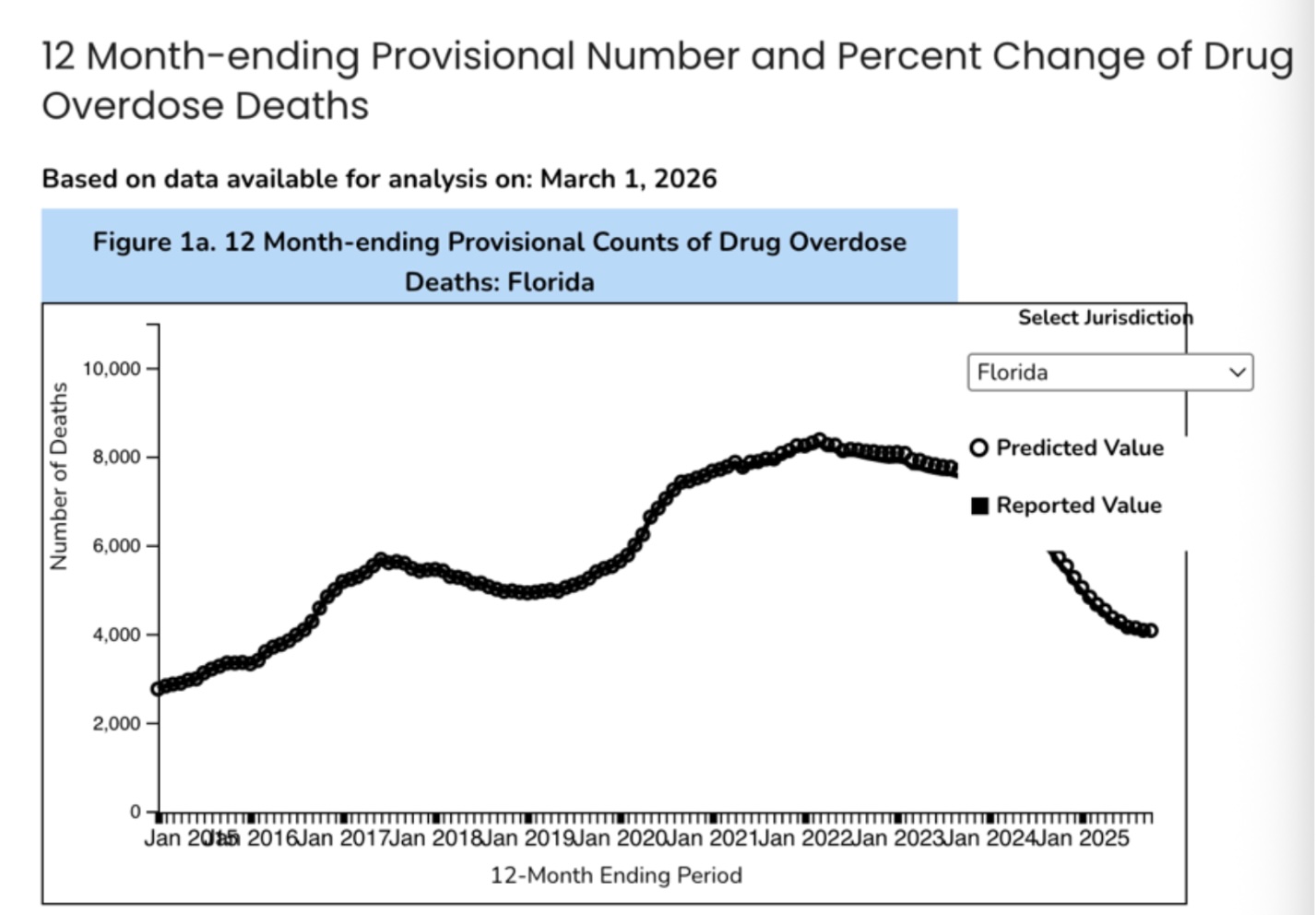
Data available on the CDC’s National Vital Statistics System displaying the predicted and reported values on a 12 month-ending provisional number and percent change of drug overdose deaths as of March 1, 2026. Credit // Centers for Disease Control and Prevention, CDC.
Despite the decline, experts caution that the crisis is far from resolved. They reason that issues like social stigma, economic disparities and accessibility to resources are conducive to the ongoing effects of fentanyl abuse among varying socioeconomic groups.
Fentanyl is a synthetic opioid that is up to 50 times more potent than drugs like heroin that are organic or derived from an actual plant. Because fentanyl can be produced and compressed in small batches, it has become more accessible and easily distributed by supply chains for profit.
Cyrus Owens, supervisor and senior research associate at the IDEA Exchange — Florida’s first and only syringe services program, housed at the UM’s Miller School of Medicine — is also a professor who teaches a course called Drugs and Culture at UM.
He explains fentanyl has acted as an outsider throughout the history of illicit narcotics.
“For 100 years, all of our knowledge, drugs were created in tropical places where you could grow a lot of crops — the Golden Triangle in Myanmar, Colombia, Peru. Synthetic drugs like fentanyl changed that,” Owens explained.
“You do not need a farm; you do not need infrastructure. Instead, it’s a decentralized approach…lots of small-scale operations.”
Fentanyl is now found mixed with other drugs and substances, leading to unpredictable side effects.
Owens describes this as the “chocolate chip dynamic”: similar to how chocolate chips survive while baking them in the oven, concentrated pockets of fentanyl survive the large drug batches they are mixed into — creating lethal spots that the supply chain cannot detect.
Appearing mixed with cocaine, fake prescription pills and in some cases, marijuana, the drug can reach people with no opioid tolerance and who have no idea what they are taking — highlighting how imperative awareness and education surrounding these drugs are.
This issue developed further with the discovery of xylazine — a non-opioid sedative or animal tranquilizer not reversible by naloxone — that flooded Miami’s drug supply about two years ago.
The IDEA exchange documented cases of the contaminant and its qualities, highlighting that it is not approved for use in people as it can slow down breathing, lower blood pressure and make the heart beat slower.
“It was up to a certain point. 60% of all of the folks who were doing urine screenings at our place were testing positive for [xylazine],” Owens explained. “And this was from our perspective an economic decision made on behalf of the drug cartels.”
The combination of xylazine with fentanyl can create hazardous effects on the body where the skin may produce wounds with abnormal redness, rashes, bumps and the further development of ulcers.
The supply chain continued moving, but the drug remained an emerging threat.
“One of the biggest misconceptions is, ‘This could never happen to my family,’” Thomas Guerra urged, the founder and CEO of F*** Fentanyl — where the organization aims to provide support to those who use drugs to ultimately prevent overdose deaths. “Overdose remains the leading cause of death for American ages 18 to 44, and fentanyl is involved in most of those deaths.”
Beyond the statistics, overdose crosses socioeconomic lines
The IDEA Exchange sits in Overtown, a historically Black neighborhood intersected by a highway built about six decades ago. This left behind a plethora of liquor stores and pawn shops.
Owens explained that this location is not a coincidence, but rather an instructive issue.
“What we could characterize as a fentanyl problem, I would characterize as a poverty problem … as an economic opportunity problem. The areas that are in the most need are also the areas where people are the least educated about resources.”
The people most affected by fentanyl are typically not recreational users. They are people who manage chronic pain or addiction that started through medicated prescriptions — a pipeline well-known in Florida as a hub of the prescription opioid epidemic about 20 years ago.
However, the crisis has expanded beyond those communities.
In the past, higher rates of overdose were concentrated in urban, lower-income communities such as parts of Little Havana and Allapattah. These areas already have challenges including access to healthcare, housing instability and economic disparities which makes prevention, treatment and recovery more difficult.
Alan Benoit oversees Coalicíon Esperanza, a youth prevention program under the Hope for Miami umbrella that focuses on substance use and promoting healthy lifestyles by working with schools, law enforcement and healthcare providers to implement more awareness and engagement.
He says the geography of risk has shifted.
“We are now seeing fentanyl affect suburban communities, young people and individuals from middle and higher-income backgrounds at increasing rates,” Benoit described. “Fentanyl is being mixed into other substances … meaning people may be exposed unknowingly, regardless of their background or intent.”
For young people, this drug poses significant risks in settings like nightlife, music festivals and college campuses with the purchase of pills like Adderall that may be counterfeit or contaminated with fentanyl.
The bottom line is anyone could be affected.
Though, the lack of resources to survive the use or exposure of drugs like fentanyl can be more fatal.
Users who come from higher backgrounds with more economic stability have greater access to private rehabilitation than uninsured users who often do not have access.
In shelter programs, residents who test positive for substances create a quicksand effect where many cannot access the stability sought to get off the drug keeping them out of stability.
That stability, however, is surrounded by social stigma.
At the IDEA Exchange, Owens regularly sees people who relapse over short periods of recovery and leave rather than seek help, oftentimes due to shame.
“When you are in recovery, your self-esteem is already very low. That is not going to encourage you to seek care. It is going to encourage you to go underground.”
Luke Bell, UM senior and founder of the Substance Awareness Club on campus, built that organization following his own struggles with substance use. His experiences forced him to take time from school for a year.
He found that campus resources were not enough and wanted to layout a different approach when he returned — a space that met students where they were, not where institutions wanted them to be.
“I talked to someone and I didn’t feel helped at all,” Bell explained. “No one should have to go. There should be something.”
Call to action: what is being done?
Change is happening.
Since 2016, the IDEA Exchange has conducted more than 50,000 needle exchange in the past decade and has distributed more than 16,000 doses of naloxone (or Narcan). The program has singlehandedly recorded more than 4,000 overdose reversals since its birth.
F*** Fentanyl prides itself on harm reduction tactics to meet people wherever they are in their journey, holding on to the fact that not everyone is ready or capable to stop their substance use.
The organization offers free naloxone, fentanyl test strips when available and overdose education — where Guerra gives out resources at public events and gatherings such as Ultra Music Festival, distributing thousands of doses of Narcan.
“Harm reduction is not one single service. It is a mindset of compassion, safety and meeting people where they are,” said Guerra.
Fentanyl strips were legalized in Florida in 2023. Naloxone, or doses of Narcan, are now available without the need of a prescription at most pharmacies.
Coalicíon Esperanza narrows in on young people in underserved communities like Flagami and Little Havana by collaborating with schools, resource fairs and coalitions funded through the CDC.
The crisis remains an environmental and economic issue rooted in the greater management of wealthy and connected communities than in impoverished ones.
With this, Bell’s message to students and every resident in Miami-Dade is simple.
“Take a second to learn about [fentanyl] because it only takes a second to overdose and die,” Bell urged. “If you can take a second, you can save a life.”
In this special edition of Catch Up Canes, we sit down with University of Miami senior Ximena Hidalgo, an aspiring broadcast journalist whose journey spans from Venezuela to the U.S. media landscape.
Hidalgo shares her story of moving to the United States at a young age, discovering her passion for journalism early, and building her career through hands-on experience at UMTV, where she has served as Executive Producer for both UniMiami and NewsVision. As founder and president of the university’s student chapter of the National Association of Hispanic Journalists, she has also worked to uplift and connect Latino voices on campus.
In this interview, she reflects on her internship experiences with Telemundo, the challenges and advantages of navigating the industry as a Venezuelan woman, and the evolving role of Latino journalists in a predominantly English-language media space. She also offers advice for students just starting out and shares what she hopes her future in broadcast journalism will look like.
This conversation is a thoughtful look at identity, ambition, and what it means to pursue your voice in today’s media world.