Home Blog Page 31

Factory Town bent time during Miami Music Week and that was the point

The best way to describe Factory Town during Miami Music Week is that you cannot do it all.

You stand in one room listening to some of the best music of your life, dancing the night away, and yet somewhere two stages over another set is peaking without you. You feel it in the back of your mind the entire time. 

Not as regret exactly, but as pressure — the good kind. The kind that tells you the programming is working. Over five nights from March 25 through March 29, Factory Town was the gravitational center of Miami Music Week. It’s a place so stacked, so spacious, and so constantly alive that it made missing out feel like part of the experience.

For me, the week really did begin and end there. I did all five days at Factory Town, which meant my sleep schedule eventually stopped making any real sense. My entire week started revolving around how and when I could make it back to town and stay there until the early morning. I basically became nocturnal. 

And once you are inside, that starts to feel normal. Time behaves differently there. One quick stop at the Chain Room turns into an hour. A plan to catch only half a set in Infinity Room becomes a full sunrise mission. You leave one stage with the intention of going somewhere specific and get swallowed by something else entirely. 

Factory Town has a way of compressing time because there is always one more room, one more sound pulling you, one more reason to stay.

That is what made this year’s programming so strong. The lineup did not feel top-heavy or easy to game out in advance. It felt balanced in a way that made every decision feel costly. And that is a compliment. 

There were epic sets happening all over the venue every night, and the range across the five-day run was as wide as I have seen at Factory Town yet. Minimal and tech house were obviously there in force, but so were acid house, drum and bass, hard techno, melodic crossover moments and stranger, more difficult sounds that still found a crowd. 

You knew the curation was good because even while you were having a transcendent time, you were still hearing from everyone around you about what you had missed. That is not bad scheduling. That is abundance.

Factory Town’s physical design is what allows that abundance to actually work. Five stages is one thing on paper, but five stages with enough room to breathe, walk, reset and re-enter is something else entirely. 

No other venue in Miami really offers that combination at this scale. You can spend a whole night in one room or drift between multiple worlds without ever feeling trapped inside one traffic pattern. 

The art installations in the middle of the grounds help with that too, giving the venue real pockets of pause between intensity. Then there was the open-deck section at the Engine Shed, which added one of the week’s more genuine little surprises. 

It had that improvised intimate energy where people could step up with their usb and shape the atmosphere themselves. The result was messy in the best way — immediate, unpredictable, human. The kind of connection that could only really happen in the heat of the moment.

Production stepped up again this year too, but what mattered most was how different each space felt from night to night. Factory Town was not static across the week. It kept changing identities. 

The Infinity Room featured those wire-like illuminated cables wrapping around the main posts on the dance floor, which made the room feel like it was constantly pulsing from the inside. Chain Room had upgraded lighting and new CO2 cannons that gave the space a sharper, more aggressive edge. 

The Park featured a massive cube suspended in the middle of the ceiling that kept lighting up into a rotating F and T, branding the entire room without feeling tacky. 

The Warehouse had new lights stretching across the posts and overhead, creating tunnel-like patterns that made the room feel colder, more industrial and somehow even larger than before.

Some of the best transformations came through the label and brand takeovers. Planet X made its room feel like a fully formed environment, with a stage that looked like a flying saucer dropped into the middle of the party. 

At Infinity Room, elrow closed the final night by bringing a carnival of confetti, dancers and pure overstimulation. Even the rain made sense there. It did not ruin the illusion. It intensified it.

The crowd was part of the architecture too. Factory Town during Music Week felt like one of the clearest examples of how dance music collapses social boundaries when it is working at its best. 

There were locals, travelers, veterans, younger ravers, people in full fashion-week mode and people dressed like they had wandered in from a warehouse in another decade. There was visible international crossover everywhere. 

You could hear different languages around you all night. There were older ravers still moving like they knew exactly what the room demanded. 

There were younger crowds chasing their first real sunrise. That mix mattered. Factory Town did not feel like one scene occupying a venue. It felt like multiple scenes agreeing to share the same week.

That showed up most clearly in the sets themselves. Justice’s Factory Town debut carried the kind of prestige that automatically made it feel like an event before a single note played. 

Seeing them take over the Infinity Room gave the venue a certain legitimacy that only a few acts can bring. It was not just one of the week’s biggest bookings. It was one of those performances that shifts the perceived ceiling of what a venue can hold.

Josh Baker, b2b Prospa and b2b Kettama felt a generational pulse of the week. Three artists with different energies converging at sunrise with loose, modern and chaotic energy. A great sunrise set can reorder your body. 

They dropped a mix of “Sweet Disposition” as the sun came over the horizon. It was one of the best ways I have ever watched the sun come up. It just felt alive.

Then there was Ben Sterling, b2b Beltran and b2b Tiga at The Park during Planet X, which brought a totally different kind of satisfaction. The set was groovy in a way that felt effortless, the kind of dancefloor energy that does not need to overpower you to keep you locked in. 

At one point they dropped a mix of “Heads Will Roll” that instantly changed the room and got the crowd really bumping. After so much running around between stages all week, that set felt like a reminder of how good it can be when a room finds its groove and just stays there. 

“I HATE MODELS” brought one of the week’s most intense sets, but what made it work was that he did not just go hard for the sake of going hard. There were stretches where he eased the room in just enough before completely flipping the energy on its head. 

That contrast is what kept the set unpredictable and alive. He’ll pull from places you do not expect — like dropping “Paleta” into the mix — and somehow make it all feel coherent. It was a reminder that the harsher side of Factory Town’s programming works best when it still leaves room for surprise.

Max Styler and b2b CamelPhat delivered a different kind of emotion. If any set belongs as the final image of the week, it is that one. By then it was pouring rain at Factory Town and people were still out there dancing all the way through it, not caring at all about wet socks. 

This set reminds you how beautiful humanity can be when we let go together. This one had that feeling. That is maybe the simplest way to say what Factory Town did over those five days. 

It made every path through it feel both complete and incomplete at the same time. You could have a perfect night there and still know you left something extraordinary unseen. But that was never a flaw. 

That was the whole design. Factory Town succeeded because it gave everyone a different Music Week experience. By the end of the week, that was the real takeaway. Factory Town did not just host five nights of music. It distorted time, demanded choices and turned abundance into atmosphere. 

The age of leisure: Pajamas and loungewear are taking over fashion

Nights in Brickell, out to dinner or meeting up with friends warrants a put-together outfit.  Running errands, going to an 8 a.m. class and getting some work done is all about being comfortable. 

What once was blouses, polos, jeans and sneakers, is fading into hoodies, sweatpants, flannel pants and Uggs. 

“Cute-Comfy” is the trend of this decade. It dates back to 2020, the start of the Covid-19 

pandemic. In an era when leaving the house was limited, pajamas became an all-day outfit. 

The University of Miami isn’t exempt from this trend. Seven out of eleven interviewed students believe this is part of the reason daytime loungewear is ideal. Instead of waking up earlier to pick out a nice outfit, a hoodie and sweatpants is the perfect solution for saving time and energy for plans later that night.

Helena Lopez, the president of University of Miami’s Luxury and Fashion Club, says, “brands started to respond more and more to this by releasing sets, pajamas and loungewear that met consumer’s wants, and it became a feedback loop.”

Brands like Skims and Comfrt establish their identities as loungewear brands, creating a new market for their audiences. Skims, founded in 2019 by Kim Kardashian, Emma Grede and Jens Grede, sells a wide range in a small niche. 

The umbrella of pajamas and loungewear is large, though. It’s not just matching sets and nightgowns. 

Almost exclusively just shapewear, underwear, loungewear and pajamas, this brand has been a catalyst for the cute-comfy trend, especially given that it’s founded by a Kardashian, an instant trendsetter.

Comfrt is another growing loungewear clothing brand, targeting a different audience within the same niche. This company, founded in 2022, offers a selection of hoodies, loungewear and athleisure for both men and women. 

Both brands were created within the past decade, a testament to the timeline of the trend. 

Out of the11 UM students, nine of them reported that they have worn pajamas in public spaces and plan on continuing to do so. 

Many of them come to the same consensus, including sophomore Alex Serrano, who says he wears loungewear “half the time because it’s easy to put on and is comfier than a polo.” 

Lopez also notes that “this trend goes hand in hand with the trends of wearing silk and embroidery, where shorts, tops and dresses can be confused with house dresses or night gowns.” 

This implies that the trend may only be a passing fad, given that preferable looks and materials swap every few years with the influx of newly-desired aesthetics. 

However, in terms of comfort, convenience and expense, the more realistic component of fashions, loungewear may be here to stay. 

A study conducted this year by Industry Research found that 65 percent of global consumers prioritize comfort in their outfits while only 18 percent of consumers prefer traditional daywear.

“I see it as something permanent, at least in the US, because it’s been normalized through the years that people dress down in sweatpants and comfortable clothing for everyday errands, airports, school, etcetera.,” Lopez said. 

Although it appears people would much rather wear comfortable clothes as much as possible, there are still limits – just different than the previous limits of wearing them exclusively to bed. 

Eight out of the 11 interviewed UM students don’t think it’s appropriate to wear pajamas to class, and all of them agree it’s inappropriate to wear them to work. 

Where it gets hazy is in the classroom and running errands. Eight out of eleven students wouldn’t wear pajamas to class, but they would wear them to run errands or travel.

The U.S. Secretary of Transportation, Sean Duffy, even got involved in the debate, saying “dress up to go to the airport, help a stranger out, and be in a good mood” in an interview with Fox Business. 

He includes this in his Civility Campaign, which introduces the idea that dressing nice equates to a demonstration of respect.

“I think your personal presentation says a lot about your demeanor and work ethic,” Lopez said. “Dressing well and put together can sometimes make a difference in other people’s perceptions of you.”

DragOUT celebrates its 13th year at UM

The Shalala Ballroom transformed into a runway, complete with stagelights, screens and costumed audience members to showcase SpectrUM’s annual DragOUT celebration.

Proceeds directly benefitted The McKenzie Project, a Miami based organization dedicated to uplifting Black transgender and nonbinary individuals, particularly by addressing the challenges of homelessness and HIV/AIDS. 

A large portion of the proceeds will also go toward “House of the South,” South Florida’s first and only housing program run by and for transgender individuals.

“Drag is an art form that we support and build our programs around knowing that our staff and board of directors are also all drag entertainers,” said House of the South CEO Jasmine McKenzie. “We agreed [to partner with SpectrUM] because we know firsthand how hard it is to raise funds as a Black trans-led organization in the state of Florida.”

Professional drag artists and students alike came together to perform for an audience of approximately 200. 

Hosted by South Beach’s Palace drag performer Tiffany Fantasia, the Friday evening spectacular offered audience members an up-and-close experience with several professional drag artists, including CC Glitzer, Ground Zero, A’Zaria Lavish and special guest LaLa Ri, a Rupaul’s Drag Race Season 13 competitor. 

Students performed for a panel of four judges, including Dr. Barbara Hoffman, professor of writing studies, Dr. Mark Lomanno, professor of musicology and freshman Olivia Bueno. 

This year, DragOUT began a new tradition of inviting back an alum to judge, starting with Michael Robinson Jr., a member of UM’s centennial class and DragOUT 2025 runner-up.

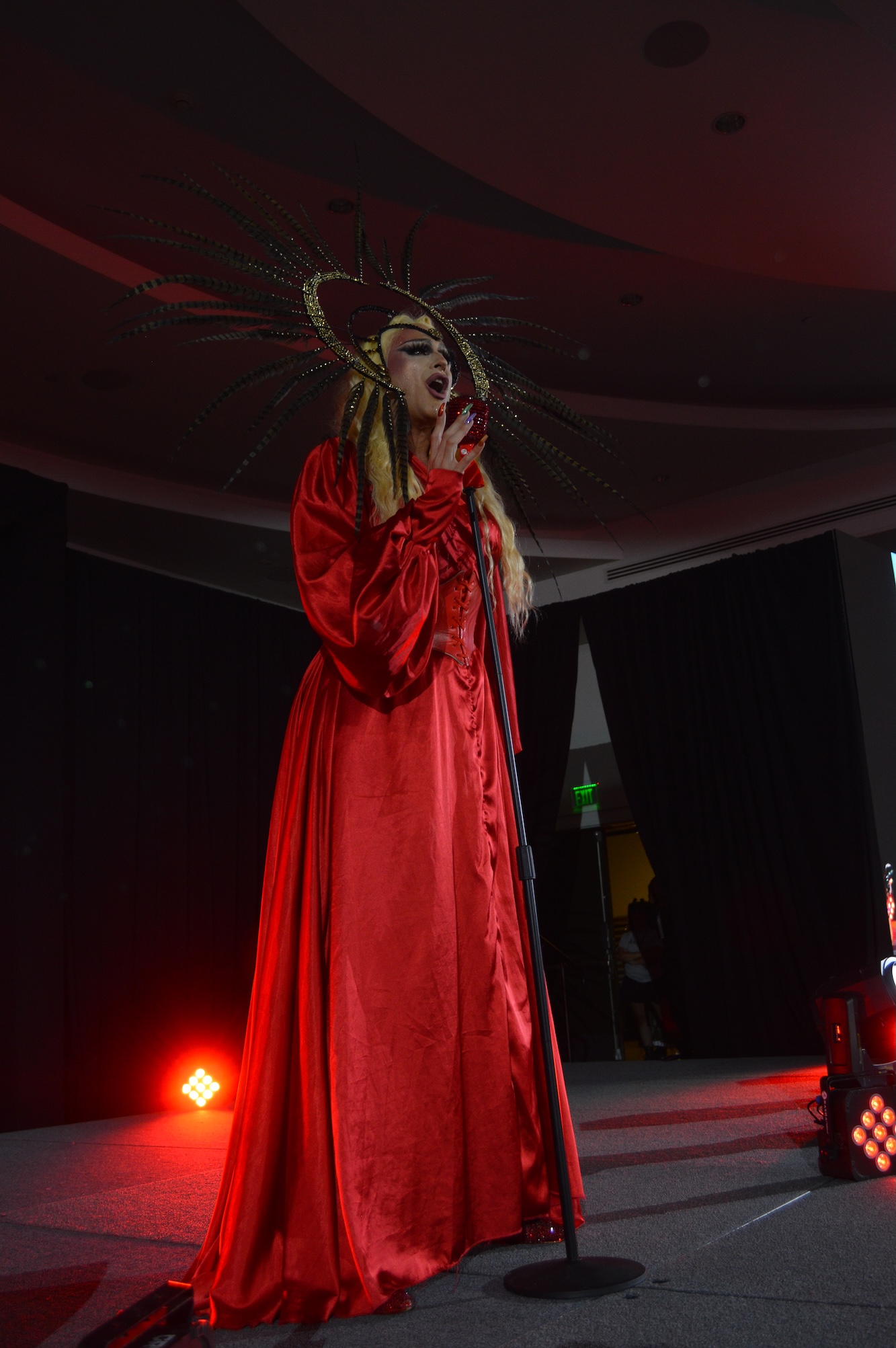
Drag artist CC Glitzer performing at SpectrUM’s DragOUT in the Shalala Ballrooms on April 3, 2026. Photo Credit // Ariana Glaser.

Any UM student can sign up to perform at DragOUT, and each student performer is granted full creative control. Though SpectrUM provides access to their suite’s wigs and costume pieces, most students bring their own makeup and costumes to fully execute their vision. 

Each of the three student performers took home a title: Ellie Gibson (“Annie PC”) took home first place, Sam O’Connor (“Miss Stake”) was named runner-up and Courtney Hartung (“Dallas Demyze”) was crowned the fan-favorite by an audience vote.

Outside of her drag persona, Hartung serves as president of SpectrUM. In preparing for DragOUT, Hartung led the E-Board through reserving the space, contacting and coordinating with the production company, assembling a budget and ordering necessary materials. 

“DragOUT was exhilarating; to see so many talented performers get to exhibit their art during one joyous night meant so much to me,” said Hartung. “Overall, DragOUT is a night to celebrate art and queer joy. It unifies people from many different backgrounds to celebrate drag and how diverse the artform itself can be.”

SpectrUM is the University of Miami’s oldest undergraduate LGBTQ+ organization. Though DragOUT is SpectrUM’s biggest event, other highlights include Winter Formal, drag workshops and open performance nights.

To celebrate DragOUT’s 13th year at UM, this year’s theme was “spooky.” Some performers went all out. Ground Zero, for example, appeared to swallow knives and staple his skin. 

Tiffany Fantasia, on the other hand, poked fun in her black corset, quipping, “What’s scarier than a man in a dress?”

DragOUT is one of several UM LGBTQ+ events to celebrate College Pride Month. Celebrations continue on April 11 with L.O.V.E. Symposium and April 12 with the Miami Beach Pride Parade. 

No. 28 Miami women’s tennis defeats Boston College, 4-1

0

The No. 28 University of Miami women’s tennis team defeated the Boston College Eagles 4-1 on Sunday afternoon at the Neil Schiff Tennis Center. 

With the win, the Hurricanes (13-4, 8-2 ACC) matched last season’s number of home victories.

To start off the day, UM took care of the doubles point with two wins on the top courts. 

Raquel Gonzalez and Sebastianna Scilipoti took the opening match victory over Seren Agar and Olivia Benton, easily winning 6-1. Dominika Podhajecka and Daria Volosova won the doubles clincher, 6-4, on court two over Bella Camacho and Tola Glowacka.

When play was stopped, Aely Arai and Jaquelyn Ogunwale were leading Boston College’s (8-12, 0-10 ACC) Olivia Cutone and Leyden Games 5-4.

The Eagles notched their only win of the day at the start of singles play when Games bested Scilipoti in two quick sets, 6-3, 6-0. From there, the Canes took care of business, winning the next three matches to finish the day. 

The matches finished in the order that follows: Volosova bested Nadia Barteck 6-3, 6-2, No. 107 Podhajecka took care of Camacho, winning 6-4, 6-1 and Ogunwale notched the final win over Agar with a score of 6-2, 6-3.

When singles play was halted, No. 96 Sofia Rocchetti was leading Benton 6-4, 2-4 and Arai was up against Glowacka after a close first set, with a final, unfinished score of 7-6 (7-4), 3-1.

The Hurricanes will be back at home on Friday at 12 p.m. when they face the North Carolina Tar Heels (21-2, 9-1 ACC) at the Neil Schiff Tennis Center.

Awareness feels good, but action feels better

0

Scrolling through TikTok, Instagram or Twitter often feels like the easiest way to stay updated on global conflicts or crises. Friends, influencers, and advocacy accounts flood social media fees with proclaiming solidarity and support. It seems like a call to action. Where reposting feels like the expected response. But does this form of advocacy truly lead to meaningful change?

But, resharing a post on Instagram is not going to save the world. It can help people learn about the topic, but you aren’t an activist just because you repost a story. 

Social media gives users a platform to discuss topics they are passionate about. A post can start off the conversation and introduce people to a cause. Meaningful activism involves taking initiative to challenge systems and cooperate with people to create change for the greater good. This kind of work requires time, consistency and real sacrifice. Currently, online activism allows people to confuse minimal effort with change and initiative.

When people’s Instagram posts do not accurately reflect their behavior and real-life decisions, it’s just a performance. Posting a story about a political crisis and refusing to have an open discussion or donating to the cause people advocate for is hypocritical. 

True change comes from hands-on action. It can come in many forms. At UM, clubs and organizations host fundraising events and informative workshops. There are sororities raising funds for philanthropy causes and student volunteers with campus nonprofits.

Despite this, people can still take different forms of action. Educating family and friends, boycotting companies, writing letters or calling representatives are all meaningful forms of activism. Reposting content should be a supplement to these activities, not a replacement for them.

“A specific example of our chapter’s impact is through our Anchor Splash Philanthropy week, where we raised over $25,000 in support of Service for Sight,” said Claudia Fonseca, philanthropy chair of Delta Gamma. “A portion of those funds directly benefit the Miami Lighthouse for the Blind and Visually Impaired, helping expand access to vision rehabilitation services, educational programs and assistive technology for individuals with visual impairments in our local community.”

Public advocacy efforts from organizations like Greek life bring attention to important causes.  Public advocacy is not equally accessible to everyone. 

Not everyone is able to support a movement publicly or even make a post because it can risk people’s safety. This is especially true as ICE continues to  target individuals and collect information in different ways. 

Activism on social media can expose undocumented immigrants or activists to surveillance, making it dangerous for them to publicly support or engage in movements. 

Social media can add a lot of significance to social movements, as was seen in the 2020 Black Lives Matter Protest. But the blackout Tuesday screen on everyone’s feed was not a major factor of change. Rather, it was the protest, donations, awareness and education that came with action. 

Now, political movements feel like a trend where people give attention for a brief moment and forget all about it for the next big issue. Celebrities wore pins at the Grammys and some gave speeches showing support for a cause, leaving people questioning whether this was activist or merely a performance. Many of our favorite celebrities engage in performative activism and leave it there. 

Without action such as donating, volunteering or using their influence to create systemic change, their involvement becomes little more than a publicity stunt. This leaves a cycle where the issue becomes fashionable for a short time, only to be replaced by the next trending cause.

Every so often an “all eyes on ” will be circulating Instagram stories with an AI-generated image that has millions of reposts. The trendy repost story is pushed higher, and the educational post explaining the situation is pushed down. 

The media works with algorithms. If a political issue is a trend, those algorithms often magnify the performance tendency. The more interaction a post has, the more it will be pushed by social media platforms. The algorithm keeps individuals in a chamber of limited exposure to perspectives, creating polarization and posing a direct threat to successful organization.

A few years ago, movements like Black Lives Matter and the Ukraine-Russia war were everywhere on our timelines. But now, they’ve been pushed aside to make room for the next big crisis or movement, quickly forgotten as new issues take over. 

How long before people stop discussing Gaza and Israel or ICE?

Social media is a vessel to export information to the masses, but it should not be the sole tool used to drive change, as it will just lead to a false sense of accomplishment. Discussion of social movements can lead to real action and education like lobbying or donations, but it will never be successful if it’s solely kept online. 

As stated earlier, activism without change beyond social media is performative. Reposting a graphic or slogan, then doing nothing else is performative. Changing a profile picture for a cause just because it is trending, is performative. Giving the illusion of activism without meaningful action.

It’s time to get off your phone and advocate for what you believe, stand by your values and create change in your community.

Student represents University of Miami at National Environmental Advocacy Day in Washington, D.C.

University of Miami student Sasha Thorne recently traveled to Washington, D.C., as one of 90 students selected nationwide to participate in the Rachel Carson Council’s (RCC) 2026 Advocacy Day. 

The event was hosted on Capitol Hill from March 25 to March 27 and offered college students a hands-on opportunity to engage directly with the federal policymaking process.

“It was much more of a conversation [with the policy makers],” Thorne explained. “All the staffers we spoke with were very welcoming and eager to talk about these issues.”

During the three-day intensive program, participants attended policy briefings and advocacy workshops before traveling to Capitol Hill to meet with congressional offices and discuss key environmental issues.

“I believe we can make environmental issues a priority for the government and general public, and eventually pass federal legislation to undo harm already done and prevent further damage,” Thorne said.

Thorne focused her advocacy on emphasizing the negative effects of the wood pellet industry, highlighting its environmental consequences and the way it affects vulnerable populations.

In those conversations, she explained that the industry contributes to large-scale deforestation and pollution, while many of its factories are located near low-income, Black and Indigenous communities that bear the health and environmental costs.

“I took the lead on talking about this issue because of my interest in environmental justice, since the industry unfairly impacts the aforementioned communities.” Thorne said. “No one should have to live in an environmentally disadvantaged area because of their culture, race, or class.” 

Thorne also advocated for specific policy solutions, including the Polluter Pays Climate Superfund Act, which would require major polluters to fund climate resilience efforts, and the Opportunities in Organics Act, which supports farmers transitioning to organic agriculture through federal funding and United States Department of Agriculture assistance.

She believes the issues she advocated for in Washington resonate strongly with students at the University of Miami, because of the campus’s growing focus on environmental awareness and justice. 

Thorne noted that many students are already engaged with student organizations such as ECO Agency and other conservation-based clubs and classes. “I felt proud to represent the University of Miami because of its commitment to environmental awareness and advocacy’,” Thorne said. “It was important that UM is part of the conversation of environmental policies and action.”

Hurricanes stumble on Easter Sunday, lose 6-3 to Virginia Tech

0

On Easter Sunday, Virginia Tech spoiled Miami’s hopes of its first ACC sweep of the season, falling 6-3.

AJ Ciscar took the bump after a brief injury stint that sidelined him from a start in the series last weekend against Clemson.

It took Ciscar a few innings to get in rhythm as he allowed a combined four runs in the second and third innings.

The sophomore was able to settle down in the back half of his appearance, going nine up nine down from innings three through six.

Ciscar finished his outing surrendering four runs (three earned) on six hits while striking out eight batters in six innings of work.

Costly base running happened to be a game changer in favor of Virginia Tech. 

With two runners in scoring position, Max Galvin lined a ball to Virginia Tech right fielder Sam Grube who made an athletic diving grab. Derek Williams, standing on second base, did not get a good read and was unable to get back to the bag in time, resulting in a double play.

Despite seven hits through six innings for the Hurricanes, they could only score two runs. 

On a 2-2 pitch, Daniel Cuvet hit a screamer down the left field line that scored the red-hot Jake Ogden from first base.

In the sixth inning, Galvin picked up his third hit in as many games and Brylan West rounded third base to score. 

The Hurricanes left eight runners on base, while the Hokies only left two runners stranded. Over the first two games of the series, Miami scored 19 and eight runs with a large part due to scoring with runners on base. That trend did not continue on Sunday.

Virginia Tech starting pitcher Griffin Steig gave the Hokies much needed length and grinded out six innings of two-run ball. Steig gave up seven hits and struck out three, but got the outs when it mattered most.

Virginia Tech (15-15, 6-9)  tacked on two insurance runs in the ninth inning off senior Ryan Bilka, who gave up a three-run home run the night prior.

The Hurricanes (24-8, 6-6 ACC) will look to get back in the win column as they will stay home to face cross-town rival FIU on Tuesday at 6 p.m.

Phot Credit: Ava Stroshane // Senior infielder Jake Ogden swings at a pitch against Lafayette on Feb. 21, 2026 at Mark Light Field.

Miami track and field delivers another successful weekend at Florida Relays

Miami Hurricanes Track and Field had another successful meet as they headed to Gainesville for the Florida Relays. 

It wasn’t the biggest showing for Miami this year, but throughout the weekend improved marks, new entries into the team’s top fives, and some top-of-the-line finishes were littered through the weekend. 

Sanaa Hebron set a great early-season mark; in her debut for the outdoor season, she flew through the track on the 400m hurdles. At 55.57 seconds, she landed in second place and was just slightly short of her current personal best at 55.21. 

Early in the day, hammer thrower Jocelyn Pringle set a new personal best with a 62.39 meter toss, improving on what is already the second-best mark in Miami history. This landed her at fourth on the day.

On Friday, Miami saw both their 4×100 squads make it to the finals for the weekend. For the men, the group of Ashton Torns, Caine Stanley, Carter Cukerstein and Dylan Woodruffe made their way back to the track and clocked a 39.85 time to qualify for the finals.

As for the women, their squad was made of Sophie Haag, Nandy Kihuyu, Aniyah Brown and Iyonna Codd. Neither squad would post a time in the finals, as the men received a disqualification and the woman did not start. Regardless, impressive times contributed to a solid day for the relay squads. 

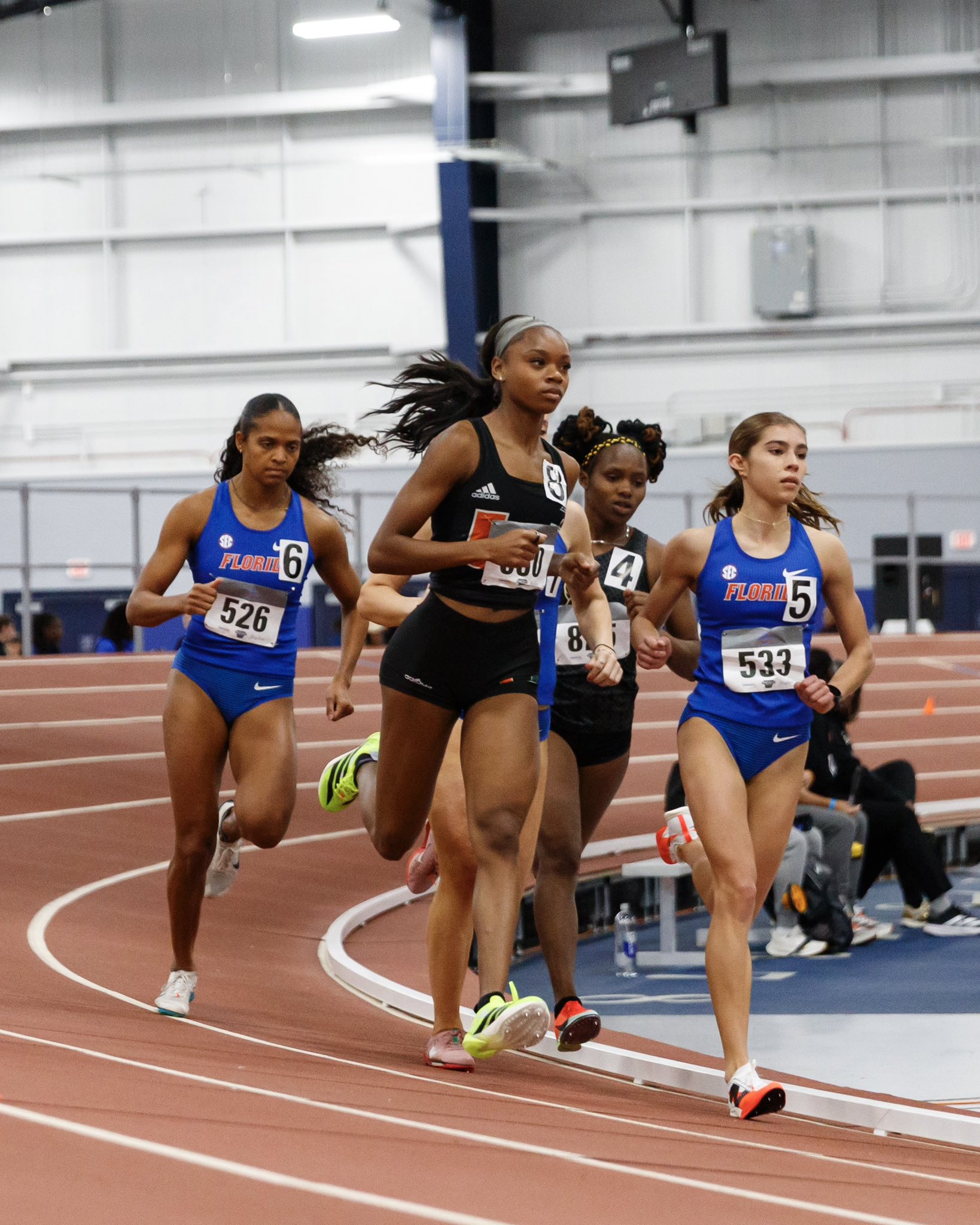
Photo Credit: @CanesTrack via X // Graduate student Gabriella Grissom places third in the women’s 800m with a time of 2.01.87 at the Razorback Invitational in Fayetteville, Ark. on Jan. 31.

Rounding out the day, Enrique Borrego had to wait a long time to get on the track due to a two-hour rain delay. After the starting gun fired at 10:37 p.m., he made the most of his opportunity. 

After entering the top three by the 600m split, he held his spot throughout the entire race and finished in third place with a time of 14:48.68. Not too far behind him was Evan Pena, who climbed from as far back as 11th to finish in fourth, seven seconds behind Borrego at 14:55.60. 

Into Saturday, Miami added one more top five mark as Sean Watkins entered fourth place in school history in the 400m with his time of 46.02. Both Watkins and George Franks (45.97) ended in the top-10 of the field of 49 participants. 

Back to the throwers, Desmond Coleman took a fourth-place finish in the discus with a throw of 57.87 m. 

Closing out the day, the Hurricanes women’s squad with Serena Tate, Gabiralla Grissom, Antonia Sanchez Nunez and Sanaa Hebron was a part of the 4×400 invite section. The group came in fifth at 3:33.05, which, including the open group, would have been good for sixth of the 22 teams that competed on Saturday. 

Hurricanes Track and Field will be back at Cobb Stadium for the Hurricane Alumni Invitational for their final home outdoor meet of the season. The meet will run from April 10-11.

Miami Men’s Tennis delivers statement Easter Sunday 4-1 win against Duke at home 

Under a bright Easter Sunday sun at the Neil Schiff Tennis Center, Miami Men’s Tennis delivered exactly the kind of response teams search for but don’t always find. 

Just two days removed from a gut-wrenching 4-3 loss to the North Carolina Tar Heels men’s tennis — a match that slipped away in the final moments — Miami returned to its home courts with a different edge, channeling that frustration into a composed, convincing 4-1 win over the Duke Blue Devils.

The timing couldn’t have been more fitting. With the buzz of the Miami Open still lingering in the city and a calm, sun-soaked afternoon blanketing Coral Gables, the setting felt almost too peaceful for the kind of battle that unfolded. 

But beneath that warmth was urgency. Miami entered the match knowing exactly how thin the margin had been on Friday — and how important it was to flip the script.

The Hurricanes took control early. In doubles, Antonio Prat and Rafael Segado set the tone with a steady 6-3 win on the top court, playing with both confidence and rhythm. Moments later, the No. 43-ranked pair of Mehdi Sadaoui and Jakub Kroslak backed it up, grinding through a competitive 6-4 victory to clinch the doubles point. 

It wasn’t just a point on the scoreboard, it was a shift in energy — a sign that Miami had come out sharper, more intentional and unwilling to let another match slip.

That momentum carried directly into singles, where Jules Garot extended the lead with a composed 6-3, 6-2 win, controlling the pace from start to finish. Sadaoui followed with a 6-3, 6-4 victory of his own to push Miami comfortably ahead to 3-0. The Hurricanes weren’t just winning. 

Credit: Claudia Campi – Staff Photographer // The University of Miami Men’s Tennis Team huddle up with Assistant Coach Filip Vittek during a match against Colgate at the Neil Schiff Tennis Center on March. 18, 2025.

They were dictating.

Still, Duke pushed back. Alexander Visser put the Blue Devils on the board with a straight-set win over Segado, and suddenly the remaining courts tightened. The top three matches became drawn-out battles filled with full momentum swings, each point carrying a little more weight than the last. It felt familiar — uncomfortably so — for a Miami team that just two days earlier, had experienced how quickly a match can turn.

But this time, the ending belonged to the Hurricanes.

With the pressure building, it was Nacho Serra Sanchez who stepped into the moment. Facing Duke’s No. 47 Cooper Williams, Serra Sanchez stumbled out of the gate, dropping the first set 0-6. For a moment, it looked like Duke might claw its way fully back into the match. Instead, Serra Sanchez recalibrated. He slowed things down, found his rhythm and began to chip away, taking the second set 7-5 before closing out the third 6-3. 

His comeback not only secured the fourth and deciding point for Miami, but also marked the highest-ranked win of his career — a perfectly timed potentially career-defining performance.

In many ways, it was the perfect encapsulation of the afternoon. What began as a calm, almost serene Easter day evolved into a test of resilience, composure and response. And unlike its Friday matchup, Miami didn’t let the moment get away from them.

The 4-1 victory pushes the Hurricanes forward with renewed confidence as they prepare for their regular-season finale against the Florida State Seminoles. More importantly, it reinforces something deeper about this group: they don’t shy away from pressure — they rise to it.

On a day synonymous with light and renewal, Miami didn’t just bounce back.

They answered.

The Hurricanes will take on the Seminoles Saturday April 11. 

Miami men’s tennis drops close one to UNC 4-3

0

The University of Miami men’s tennis team took on the North Carolina Tar Heels on a cloudy Friday afternoon at the Neil Schiff Tennis Center on April 3rd.

After a hard fought affair, Hurricanes lost a 4-3 decision, bringing their record to 12-10, and 4-7 within the ACC.

The Canes started off strong by earning a doubles point. However, the Tar Heels rallied back on court two as Niels Ratiu and Chris Xu took down Antonio Prat and Rafael Segado on court two, 6-2.

Over on court three, Nacho Serra Sanchez and Jules Garot took care of business, winning 6-2 over Ian Mayew and Logan Zapp. Meanwhile, No. 43 Jakub Kroslak and Mehdi Sadaoui were able to handle things as well, winning a closer match at the top court, 6-4, over No. 34 Roan Jones and Anthony Wright.

In singles, Miami got their first win as No. 118 Serra Sanchez handily beat No. 58 Jones, 6-2, 6-0, on court two. However, UNC struck back as they then took three straight for the lead on court one, three and six

Segado was able to tie it back at three on court four, beating Ratiu 7-5, 4-6, 6-3. However, Sadaoui fell 6-2, 3-6, 6-2 to Djakouris on court five.

The Hurricanes are back on Sunday to face Duke at the Neil Schiff Tennis Center.

Miami women’s tennis makes quick work of Syracuse

Coming off a disappointing 4-0 loss to No.20 Clemson last Sunday, the Miami Hurricanes women’s tennis team had a point to prove taking the court against the Syracuse Orange.

And in an impressive display, Miami (11-2, 4-8 ACC) swept Syracuse (6-10, 2-7 ACC) convincingly Friday afternoon at the Neil Schiff Tennis Center in Coral Gables.

The doubles point offered a back and forth battle between the ACC sides, as the Hurricanes fought to secure the opening point.

Sebastianna Scilipoti and Raquel Gonzalez struck first at the top court, 6-2, over Anastasia Sysoeva and Nelly Knezkova. The Syracuse Orange secured their lone win of the afternoon on court three, led by Leena Bennetto and Emma Scaladalai over Maria Vargas and Sofia Rocchetti, 6-4.

Meanwhile, on court two, Daria Volosova and Dominika Podhajecka were able to clinch the doubles point, 7-6 (2), over Serafima Shastova and Monika Wojcik.

Miami dominated in singles, taking three straight matches to secure the sweep.

Volosova had a remarkable match as she started the streak off with a 6-0, 6-1 win, followed by another 6-0, 6-1 win from Jaquelyn Ogunwale on court three.

On the other side, Aely Arai was able to clinch a win on court four with a 6-4, 6-1 victory.

The Hurricanes will be back again at the Neil Schiff Tennis C on Sunday to face Boston College at home.

Ogden and Cuvet lead Canes to fourth-straight win, defeating Virginia Tech 8-6

The bats of the Miami Hurricanes stayed hot on a humid Saturday night at Mark Light Field, as the Canes won their fourth-straight game, defeating the Virginia Tech Hokies 8-6.

Following a 19-1 run rule slugfest the night prior, Miami was looking to break the game open for the second night in a row against the Hokies. Up 4-1 in the bottom of the fourth with a runner on third base, Daniel Cuvet stepped up to the plate.

The junior third baseman took VT’s Brett Renfrow’s offspeed pitch deep into the night for a 385-foot two-run home run in left-center field to give the Canes a 6-1 lead.

Cuvet’s 53rd career home run surpassed Yonder Alonso for third-most home runs by a Miami Hurricane. He trails only Pat Burrel and Phil Lane for the all-time home run lead.

Prior to Cuvet’s long ball, second baseman Jake Ogden crushed Renfrow’s breaking ball off the wall in right-center field, plating two runs as the senior collected his second triple to give Miami a three-run advantage. Ogden finished the night going 4-for-5 with three extra-base hits and three RBIs.

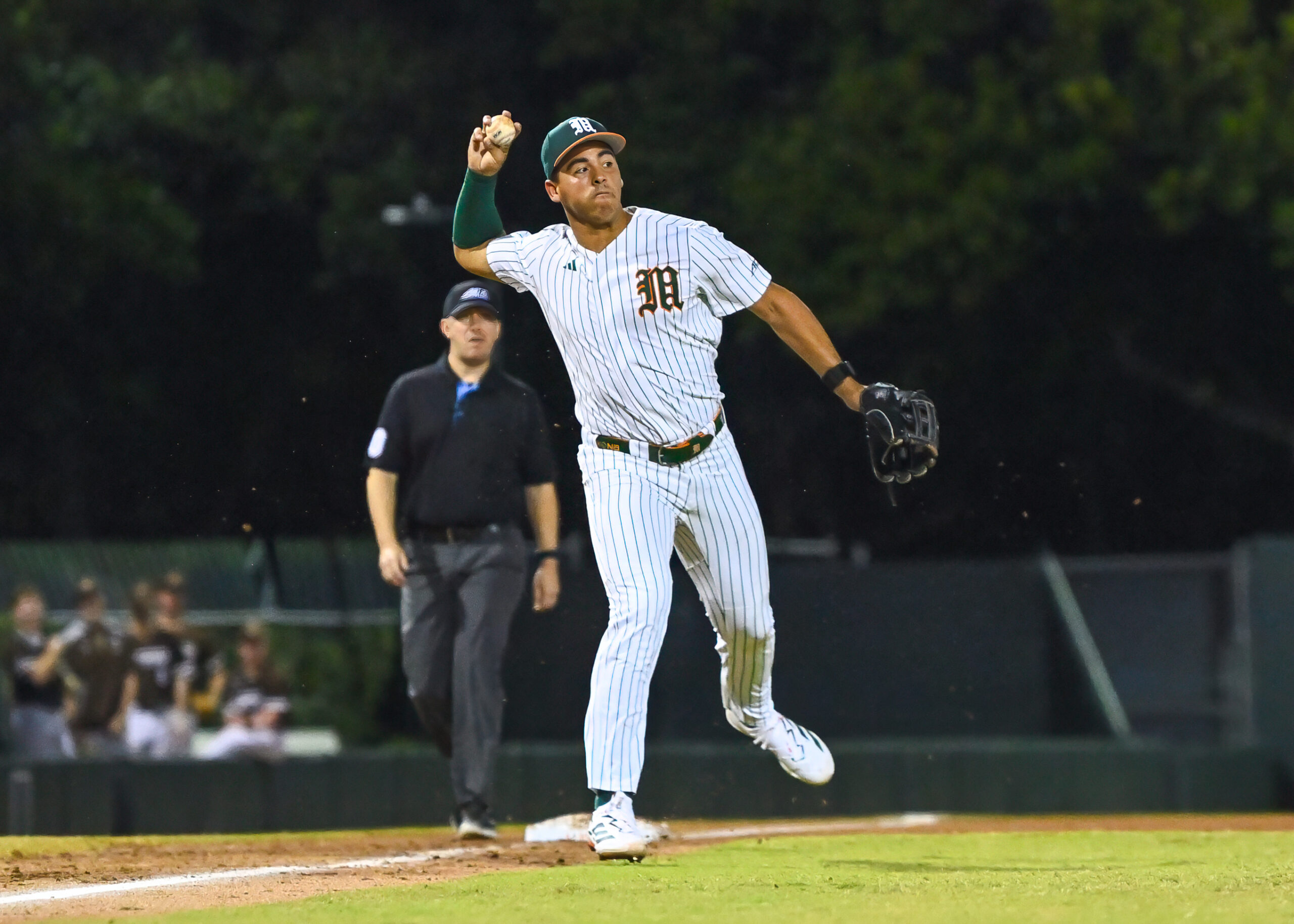
David Lebowitz, Photo Editor/ Junior Third Baseman Daniel Cuvet winds up to throw to first on Friday, February 13, 2026.

Despite the six-run hole, the Hokies fought in the ninth. Following back-to-back walks surrendered by Frank Menendez, Nick Locurto lined an RBI single to center field down to his last out.

Ryan Bilka came in for Menendez and on the first batter he saw, gave up a 420-foot three-run home run to Ethan Ball, who sent his pitch off the parking garage in right field.

Bilka bounced back, striking out Sam Grube and end the late surge from the Hokies.

After putting up 19 runs on Friday, the UM bats continued to stay hot.

Entering Saturday’s game, UM’s bats have put up six or more runs in 12-straight games. The Canes that streak, scoring eight runs on 12 hits. Miami’s top of the order — Ogden, Cuvet and Alex Sosa — went 7-for-14 and tallied six RBIs.

After missing the last 26 games due to an ankle injury, left fielder Max Galvin made his return to the Hurricanes lineup. In his second at-bat, the redshirt senior laced a single up the middle for his first hit 46 days.

Lazaro Collera toed the slab for the Hurricanes and followed up his six scoreless against Clemson with another strong performance against VT. 

Collera gave up just one run on five hits, striking out five and allowing one walk in six innings of work. Over his last three games starting, the Miami native has a 3.22 ERA.

The only trouble Collera had came in the second inning, when Pete Daniel and Sam Gates hit back-to-back doubles to put the Hokies on the board first.

With tonight’s win, the Hurricanes claim back-to-back ACC series victories for the first time this year. After a rough start to conference play with series losses to Boston College and Duke, UM might be back to the form fans expected when the season started.

The Hurricanes will look to sweep the Hokies for the first time since March 17-18, 2023 on Easter Sunday. First pitch at Mark Light Field is set for 1 p.m.

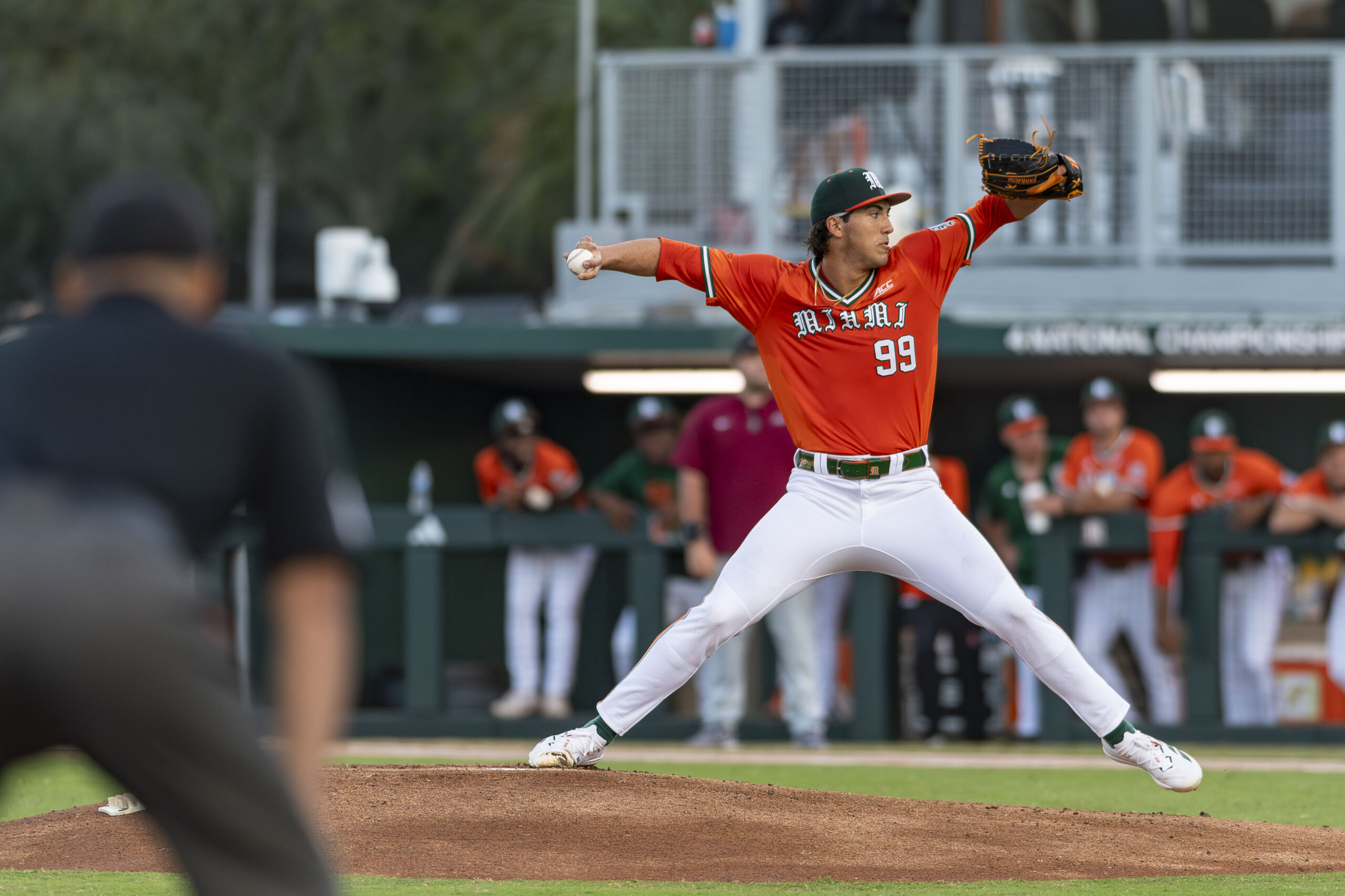
Phot Credit: Ava Stroshane // Sophomore pitcher Lazaro Collera pitches against the Lafayette Leopards on Saturday, Feb. 21 at Mark Light Field.