Home Blog Page 30

Miami picks up fourth straight series win, defeating Wake Forest 8-0

0

In the thick of ACC play, Miami is rolling.

The Hurricanes took their fourth straight series with a shutout 8-0 win over Wake Forest on Sunday, April 12.

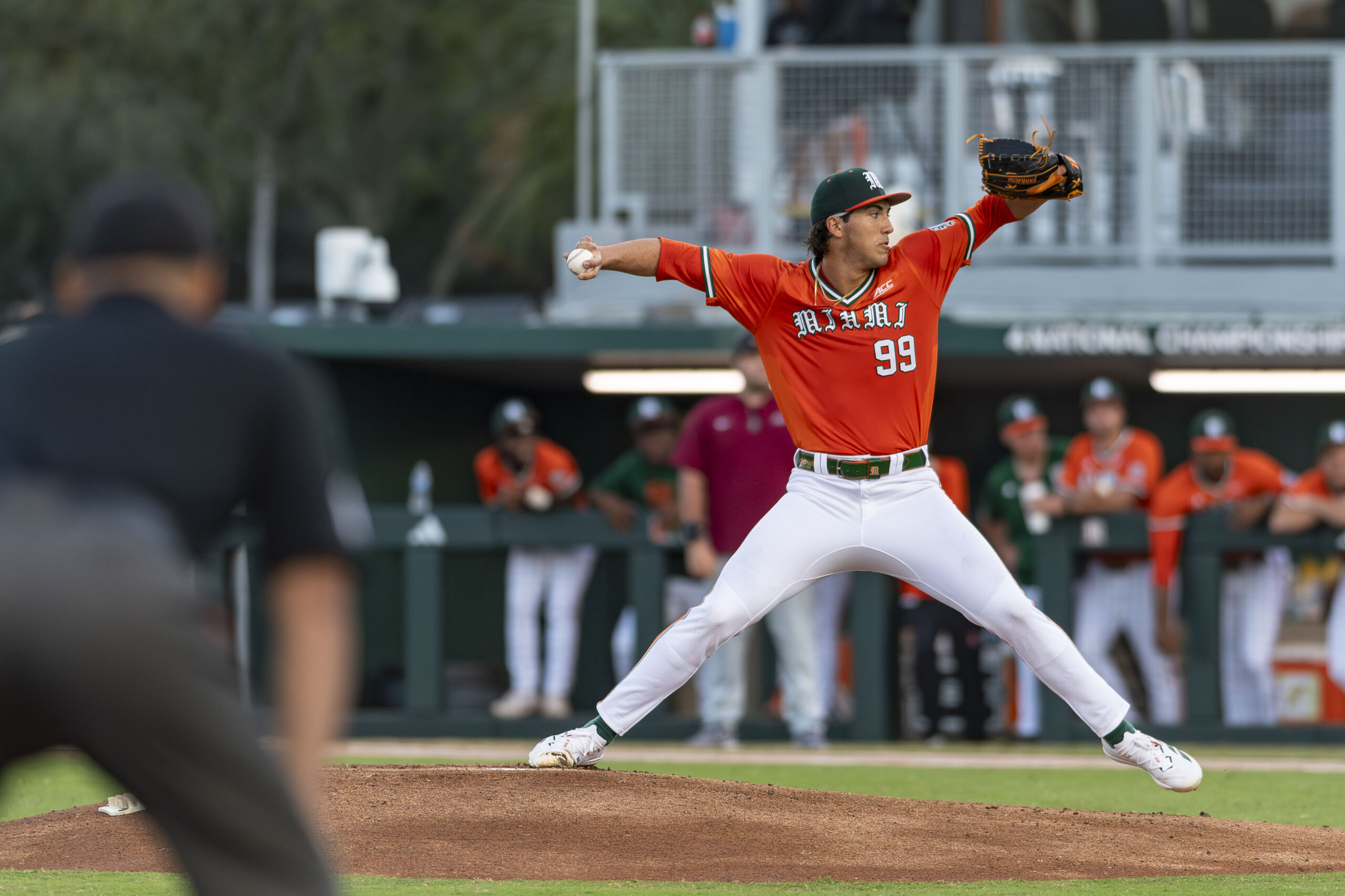
Miami’s bats came to life with 12 hits, but the starting pitching stole the show once again this weekend. Sophomore AJ Ciscar, making his eighth start, threw seven innings of shutout baseball. He struck out five batters while only allowing five hits on 90 pitches. 

Miami put runs on the board in five straight innings — the third through seventh, respectively.

Catcher Alex Sosa continued his stellar season, hitting two extra base hits. 

His first hit broke open the scoring in the third, launching a 2-run homer over the right field wall. 

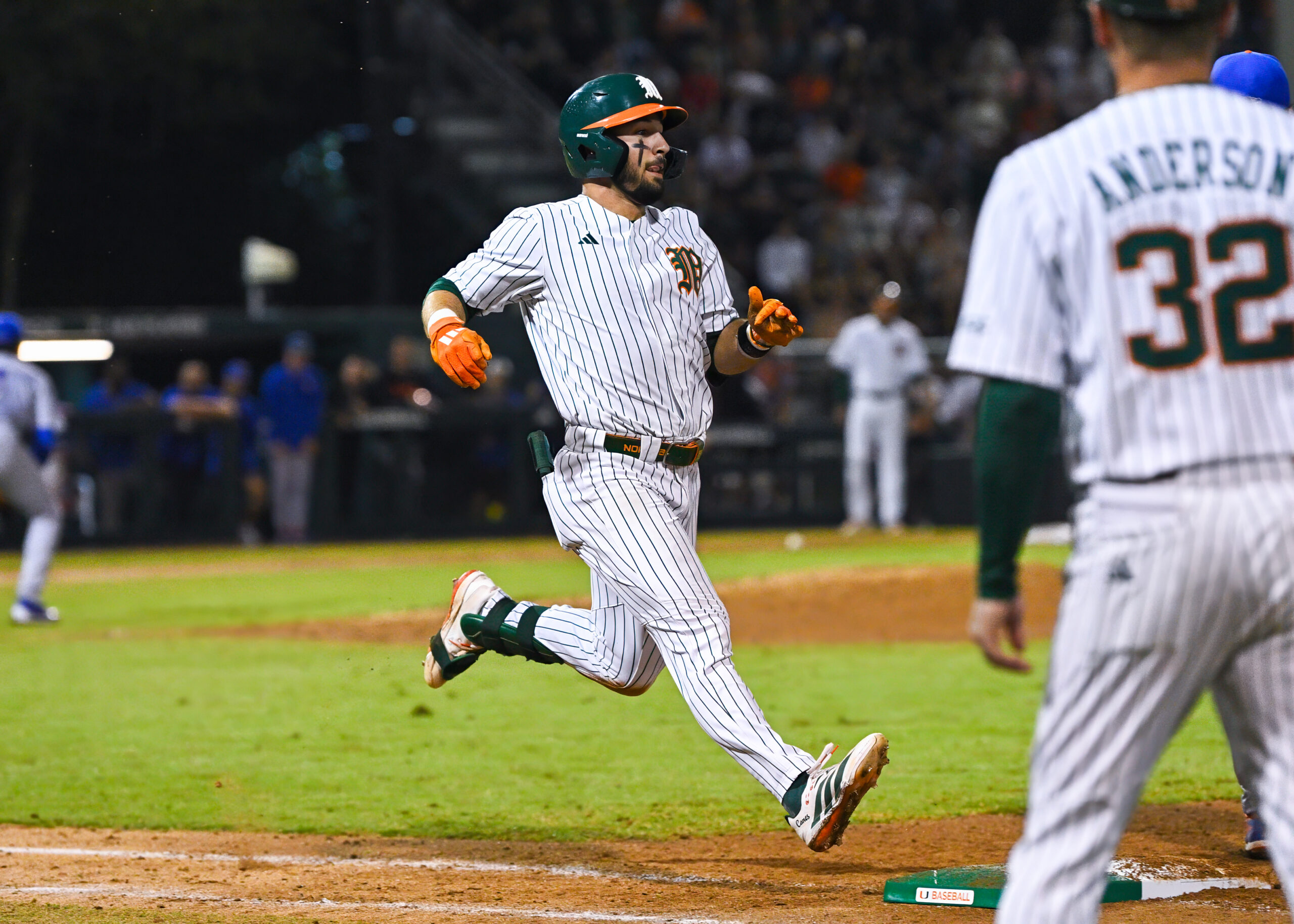
He followed that up hitting a triple down the right field line in the fifth, rounding second as the Wake Forest right fielder Luke Costello fumbled the ball.

Sosa, a Miami-native, extended his on-base streak to 25 games in the process.

Not to be outdone, the biggest blast of them all came off the bat of none other than Derek Williams in the fifth inning. 

The fifth-year senior hit a deep two-run homer to left center field, measured at 401 feet. Williams finished the afternoon with a team-leading three hits. Four of Miami’s hitters had two or more hits on the afternoon.

In the fourth inning, designated hitter Alonzo Alvarez picked up his ninth double of the season, scoring Max Galvin. Two innings later, Alvarez had another extra base hit on an 0-2 count.

Miami set the tone inning by inning, leading off with a hit in four of eight frames to power a dominant showing.

Demon Deacons starting pitcher Cameron Bagwell lasted four and one-thirds of an inning giving up eight hits and five runs.

The crowd of 2,768 got to hear the tunes of “Don’t Stop the Rock” as Wake Forest head coach Tom Walter took the ball out of Bagwell’s hands. 

Wake Forest’s bats were no help to Bagwell, only mustering four hits. Its offense was 1-for-9 with two outs and 1-for-8 with runners on base.

It was the long ball and small ball that got Miami on the board in Sunday’s matinee. Center fielder Fabio Peralta hit a sacrifice bunt that allowed Vance Sheahan to run 90-feet home in the sixth inning. 

Reigning ACC Player of the Week Jake Ogden picked himself up a two hit game, setting the tone for this Hurricanes lineup.

Wake Forest used four relievers in the losing effort. Junior Blake Morningstar allowed three runs in four hits in two innings pitched. Ryan Bosch and Zach Johnston were able to quiet the Hurricanes bats in the later innings.

Miami’s Lyndon Glidewell took care of business in relief of AJ Ciscar. The 6-foot-2 right-hander pitched two innings of no hit baseball

The Hurricanes will finish up its nine game home stand on Wednesday as they welcome USF to town. First pitch is scheduled for 6 p.m.

Miami men’s tennis caps off regular season with thrilling 4-3 win over Florida State

0

The University of Miami men’s tennis team defeated the Florida State Seminoles 4-3 at the Neil Schiff Tennis Center in Coral Gables on Saturday in the final regular season match of the year.

The match started off with a senior day ceremony for the Hurricanes’ Antonio Prat, Mehdi Sadaoui, Saud Alhogbani, and Nacho Serra Sanchez. Miami will miss the four seniors next season and will need to find some good replacements.

The Seminoles started off hot in doubles, with Jan Sebesta and Erik Schiessel dominating court one, beating Sadaoui and Jakub Kroslak 6-2.

UM evened things as No. 2 Prat and Rafael Segado overpowered Justin Lyons and Mohammad Alkotop of FSU 6-2.

Minutes later, Florida State clinched the doubles point on court three as Luis Felipe Miguel and Gabor Hornung earned the 6-3 victory over Serra Sanchez and Jules Garot.

The Seminoles opened up singles with another emphatic win from No. 5 Alkotop 6-3, 6-0 over Sadaoui making it a 2-0 lead.

The Hurricanes were able to bounce back with two close victories. No. 6 Garot earned the first point, beating Lyons 7-6(5), 6-2. No. 3 Kroslak narrowly escaped Schiessel 6-4, 7-5 to tie the match at 2 points each.

Florida State retook the lead as Azariah Rusher took down Segado 6-1, 7-5, on court four.

No. 2 Serra Sanchez tied the match at 3, coming out with a 6-3, 7-6(3) win against Corey Craig of FSU after a commanding performance in the second set tiebreaker.

Everything in the rivalry match came down to the top court. Prat got off to a strong start, winning the first set 6-3. However, he gave up a break early in the second and fell 4-6. 

The third set was close all the way through before Prat was able to break Miguel late and get the 7-5 victory, clinching the regular season finale for the Hurricanes.

UM finished off the season with a 14-10 record, going 5-7 in ACC play. They will be the No. 8 seed in the ACC tournament in Cary, N.C. and will face off against the winner of No. 9 Duke and No. 16 Boston College on April 16 at 10 a.m.

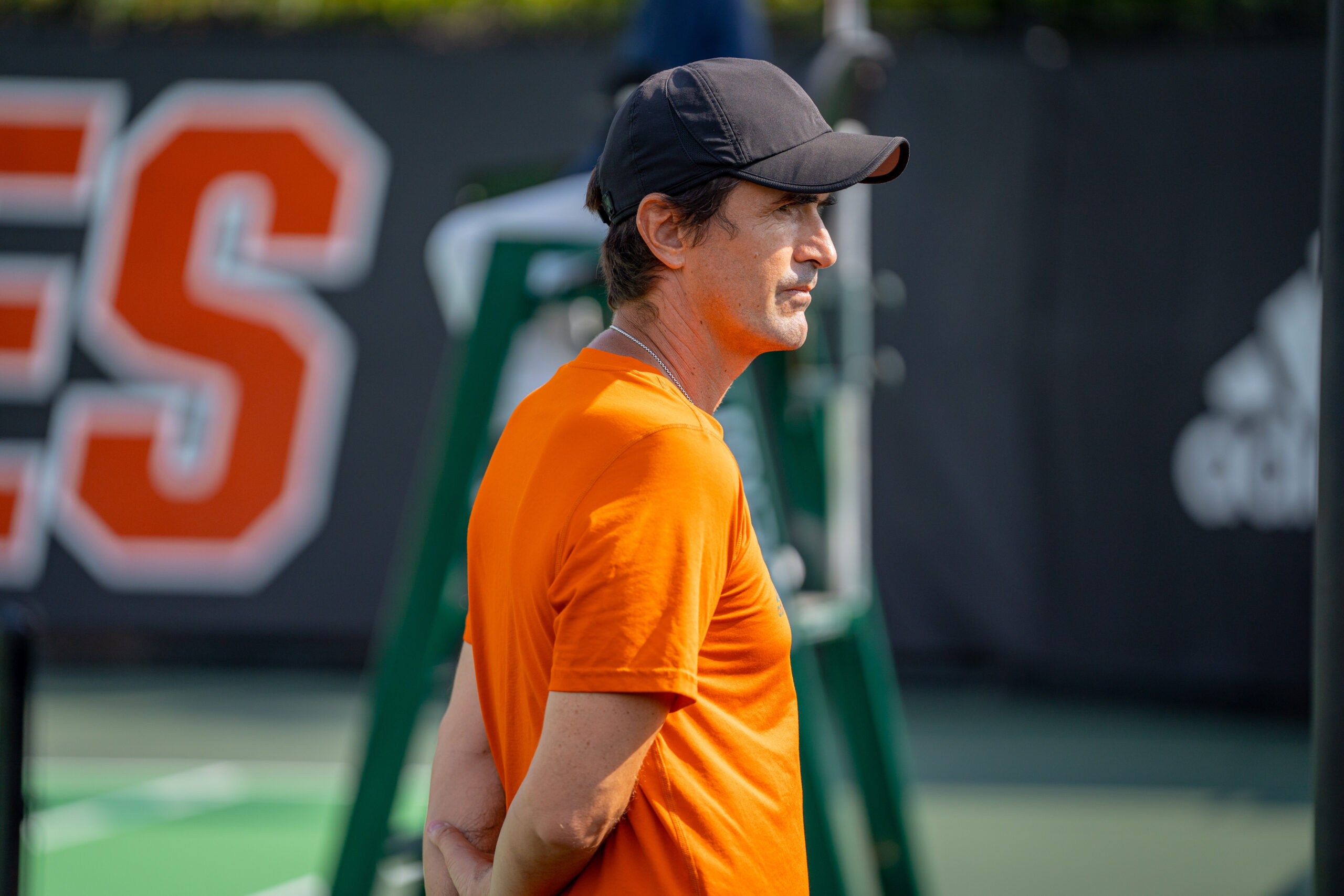
Miami head men’s tennis coach Aljosa Piric, who will be stepping down from his position at the end of this season, pictured above. Photo credit: Miami Athletics

No. 35 Miami women’s tennis falls to No. 5 North Carolina 4-3

0

The No. 35 University of Miami women’s tennis team lost a close one to the No. 5 North Carolina Tar Heels 4-3 on Friday afternoon at the Neil Schiff Tennis Center. 

In a high profile contest between two top programs, a total of five different ranked singles players lost their matches.

To start off the day, the Tar Heels (22-2, 10-1 ACC) won two out of three over the Hurricanes (13-5, 8-3 ACC) to take care of the doubles point.

Canes duo Raquel Gonzalez and Sebastianna Scilipoti had the opening loss with No. 5 Reese Brantmeier and Alanis Hamilton sweeping them, 6-0. UNC then secured the doubles point when Oby Kajuru and Maddy Zampardo bested Jaquelyn Ogunwale and Sofia Rocchetti, 6-4.

Despite already losing the point, the Hurricanes managed to win the final match with Dominika Podhajecka and Daria Volosova defeating Tatum Evans and Anna Frey, 6-3.

Singles play was split between the two squads, with no side claiming victory until the final match.

On court one, No. 2 Brantmeier bested No. 36 Gonzalez 6-2, 6-3 while No. 105 Sofia Rocchetti earned her highest ranked win, defeating No. 11 Kajuru in straight sets, 6-4, 6-3.

Scilipoti took down No. 93 Hamilton, 6-4, 6-2 but Zampardo turned it around versus No. 116 Podhajecka, winning 2-6, 6-1, 6-3.

Similar to Rocchetti, Ogunwale earned her highest ranked win, defeating No. 31 Evans, 6-4, 7-6 (7-3) but not before UNC’s Theadora Rabman won the clinching match over Volosova, 3-6, 6-4, 6-2.

Wake Forest shuts down Miami bats, evens the series

The bats went cold for Miami (26-9, 7-7 ACC) against Wake Forest (24-12, 9-8 ACC), falling 3-1 after managing only three hits and leaving seven on base.

After Friday night’s electric showdown between Rob Evans and Chris Levonas, game two of the series proved to be another pitchers’ duel.

On the mound for the Canes, in his sixth start of the year, was sophomore righty Lazaro Collera. In his previous five starts, he had only allowed a 3.60 ERA across 25 innings. 

For Wake Forest was Troy Dressler, also a sophomore righty with a sub-5 ERA.

Through seven, Collera allowed two earned runs, five hits, and one walk while punching out six Wake Forest batters.

However, Dressler pitched six scoreless innings, claiming the win for the day. 

Collera pitched superbly, retiring the nine straight before allowing a single to leadoff man Javar Williams in the top of the fourth. 

Williams’ single was the catalyst to open the scoring for the Demon Deacons.

Williams was able to advance to second on a groundout before junior first baseman Kade Lewis drove him in on a single to right. The play at the plate went to review, but Williams was ruled safe to give the visitors a 1-0 lead. 

Collera bounced back in the fifth, walking down Wake Forest 1-2-3. 

But the top of the sixth spelled more trouble for Miami. 

On two outs, right fielder Luke Costello drilled a double into center past the chasing Michael Torres. In the clutch, Lewis was once again able to bring in a run, this time on a single to shallow left. 

Phot Credit: Ava Stroshane // Sophomore pitcher Lazaro Collera pitches against the Lafayette Leopards on Saturday, Feb. 21 at Mark Light Field.

For the Canes through six, Dressler seemed to be their Kryptonite. 

Even with a seemingly sold-out Mark Light crowd, Miami couldn’t get anything going. In the first three innings, Dressler allowed two hits, two walks, and no runs. 

In the ensuing fourth, fifth, and sixth innings, Dressler sat down nine straight Miami batters. The sixth was his last inning of dominance before being pulled, throwing an extremely impressive six scoreless. 

The Canes decided to stick with Collera at the top of the seventh. After allowing a no-out single, JD Arteaga’s choice paid off as Collera retired at the bottom of the order to close out his day. 

In the top of the eighth, Miami turned to freshman Sebastian Santos-Olson. In his seven appearances this season, Santos-Olson has allowed in every single outing but one. 

Following a strikeout, Santos-Olson allowed a double that careened off the left field wall and a walk, to give the Demon Deacons two baserunners on first and second. Catcher Matt Conte catapulted a single into right to bring in Costello from second and extend the Wake Forest lead to 3-0. 

In the bottom of the eighth, eight-hole hitter Fabio Peralta secured a two-strike walk. With two outs, Daniel Cuvet blasted a single past the shortstop’s glove to score Peralta for the Canes first run of the day. 

It marked Cuvet’s 200th career RBI, moving him fourth all-time in Miami History.

But even after Alex Sosa was able to get on base with a walk, cleanup man Derek Williams struck out swinging, leaving two Canes baserunners on with a 3-1 deficit. 

It was up to the 5-6-7 batters, Brylan West, Max Galvin, and Vance Sheahan, to get some runners on base to spark a ninth-inning comeback. Even with a Galvin walk, the Canes were unable to advance him as Will Ray slammed the door shut to take the game two win. 

The Canes look to claim the series tomorrow at 1 p.m. at the light, and can be watched on ACCNX and listened to on WVUM 90.5 FM.

Canes cap home slate with six wins at Hurricane Alumni Invitational

The Miami track & field team closed out its home slate in dominant fashion this weekend, delivering a strong showing at the Hurricane Alumni Invitational.  

Facing competition from programs including Ohio State and Wake Forest, the Hurricanes carried momentum throughout the two-day meet at Cobb Stadium, racking up six first-place finishes. 

Miami set the tone early on Friday in the field events. 

Jocelyn Pringle and Calea Jackson led a one-two finish in the women’s hammer throw with marks of 62.31m and 58.65m respectively. Jackson added a personal-best performance in the discus, placing third with a throw of 52.38m.

In the men’s decathlon, Steven Franco (7,231 points) and Dominique Hall (7,066 points) secured another one-two sweep for Miami, recording the fourth and fifth-best marks in program history. 

Desmond Coleman continued his strong season by improving his fifth-best mark in school history in the hammer throw (61.33m) before capturing gold in the discus with a throw of 58.90m.

Deisiane Teixiera added to the Hurricanes’ success, claiming the women’s javelin title with a mark of 50.43m.  

The wins continued in the high jump, where Magdaline Campo cleared 1.83m to take first. That mark ranks seventh nationally and ties for the second-highest clearance in program history. 

Miami also found success in the horizontal jumps, as Pablo Delgado won the triple jump with a distance of 15.23m, while freshman Dominique Johnson placed second in the long jump at 5.92m.

On the track, Nandy Kihuyu and Iyonna Codd finished second and third in the women’s 400m with times of 52.98 and 53.86, respectively. Robert Joseph added a third-place finish in the men’s 400m, crossing in 48.09. 

In the 1500m, Lexi Arambulo (4:36.71) and Alex Severson (4:02.23) each earned third-place finishes for the Hurricanes. 

Freshman Zuzanna Zajac rounded out the top performances with a third-place finish in the 100m hurdles, clocking in at 13.90.  

Miami will return to action next weekend at the Tom Jones Invitational in Gainesville, Fla. set for Friday and Saturday. 

Miami outlasts Wake Forest in stunning pitching duel

Nothing was going to stand in the way of Rob Evans and a win for Miami Friday night at Mark Light Field.

He faced off against Wake Forest and their sophomore ace Chris Levonas, who came into the matchup with only a 2.08 ERA — but Evans couldn’t care less.

Miami’s southpaw gritted through 6.2 innings of one-run baseball, throwing 103 pitches in the process while striking out five, setting the Hurricanes up for a statement 3-1 win over their conference opponent.

Every time the New York native retired the side, a triumphant scream and fist pump echoed through the ballpark — letting everyone in Coral Gables know he wasn’t going to be beat.

That energy was matched by the fans, who were deafeningly loud all night, understanding how crucial this game was for this Hurricanes side.

With former MLB superstar Alex Rodriguez and iconic Mark Light shakes in hand, the tone was set for a beautiful night of baseball — and the fans were treated to just that.

Evans and Levonas flexed their pedigree from the jump, working through opposing hitters at will. What made it interesting was neither ace generating plenty of strikeouts to do so, both let hitters put the ball in play with effective pitch sequencing.

Miami’s hitters in particular struggled to begin the matchup. Despite coming off a 9-7 win over FIU on Tuesday and averaging more than eight runs a game in ACC play, the Canes were held hitless through four innings.

Granted, some solid contact was made with lineouts to the outfield, but overall Miami had no match for Levonas.

And with Evans laboring on the mound to keep the game scoreless, the Hurricane bats finally rewarded his efforts in the fifth inning.

Midseason Golden Spikes Award nominee Derek Williams fittingly got the rally started with a single to right to break up the hitless outing for the Canes. After a walk from Brylan West and consecutive fielders choice plays, Williams came around to score, giving Miami a much-needed one run cushion.

David Lebowitz, Photo Editor/ Fifth-Year Senior Outfielder Derek Williams extends his foot towards foot base against Florida on Febrauary 27, 2026.

But Miami wasn’t done supporting their pitchers’ standout performance.

After a Daniel Cuvet double and Alex Sosa walk in the bottom of the sixth, Wake Forest opted to pull Levonas from the game for Marcelo Harsch with the ever-dangerous Williams at the plate.

Williams couldn’t care less, lacing a double down the left field line to score both Cuvet and Sosa, hyping up the UM dugout and crowd in the process.

With some insurance runs on the board and only three innings remaining, Miami was in arms-length reach of a crucial series opening win.

However, after Evans gave up his first run with two-outs in the sixth and placed two runners on, head coach J.D Arteaga called in Austin Peay transfer Lyndon Glidewell in to put out the fire.

Miami’s bullpen has been its achilles heel all season, but on Friday against Wake, the bullpen was its secret weapon.

Glidewell struck out Dalton Wentz with a beautiful changeup to retire the side, chest-pumping all the way back to the UM dugout.

He would return for the eighth, notching two outs before the ball was turned over to lefty Frank Menendez who recorded the final out of the inning.

The Florida transfer would return to close the game out in the ninth, but after giving up two walks, coach Arteaga made the point to the bullpen for his closer, Ryan Bilka.

A preseason All-American who’s had his ups and downs this season, Bilka blocked out all the noise and slammed the door on a possible Wake Forest comeback, recording all three outs via a popout and a double play.

Miami (26-8, 7-5 ACC) lined up on the mound for postgame celebrations, with a clear message to the rest of the conference sent.

The Hurricanes will return to face Wake Forest at the Light tomorrow night, aiming to secure a third-consecutive ACC series win at 6 p.m.

EXCLUSIVE: ESPN Host Kevin Clark Talks the NFL Draft, Hurricanes Football, & The Change in Modern Journalism

0

ESPN Host of This is Football joins for an exclusive interview on The Miami Hurricane Sportscast with Liam Hickey. A former Miami Hurricane, Clark shares his rise in journalism and the biggest changes he’s noticed in the new sports media landscape. 

With the NFL Draft a couple weeks away, Clark breaks down his projections for when and where the top Canes prospects will fall. The two also look ahead to the 2026 regular season as they give their predictions and evaluate the current roster through three weeks of spring practice. 

PLEASE DONATE to the James C. Clark Memorial Fund to honor the life and legacy of Kevin’s Clark late father, a former history professor at UCF. All proceeds are directed towards a scholarship fund in his name for students majoring in history. 

DONATE HERE: https://www.givecampus.com/campaigns/74750/donations/new

Miami survives ninth-inning FIU push to remain undefeated in midweeks

0

The Miami Hurricanes baseball team continued their strong run of form as of late, taking down the FIU Panthers 9-7 in another offensive eruption. 

The Panthers mounted a furious ninth-inning comeback, but it wasn’t enough to catch up with the Canes after a rocky start. 

TJ Coats earned the win on the mount for Miami, throwing a career-high 6 innings and striking out seven.

On the offensive end, Derek Williams, Brylan West and Jake Ogden carried the load for Miami, tallying 2 hits and 2 RBIs each.

With both defenses on lockdown to start the first inning, West opened up the scoring in the bottom of the second with a two-run blast to left field, his fifth homer of the season.

FIU answered back with a homer of their own in the fourth inning, as Cleveland Cole smoked one to deep right, cutting the lead to one.

The bottom half of the inning was characterized by mistakes for FIU which led to an offensive barrage from the Canes. 

With the bases loaded, a wild pitch skeetered away from the Panthers. Vance Sheahan took his base on the walk and West zoomed home from third to extend the lead. Later on in the inning Alonzo Alvarez got in on the fun, firing an RBI single to right to bring in another run. Fabio Peralta followed it up with a sacrifice fly and then Ogden launched a two-run shot to right field.

David Lebowitz, Contributing Photographer/ Junior Jake Ogden celebrates with his teammate at home plate after hitting a grand slam versus Princeton on Saturday, Febrauary 22, 2025 at Mark Light Field.

By the end of the fourth the score was already 7-1 and it looked like the Hurricanes were ready to run away with it.

Dominant pitching and defense helped the Hurricanes hold FIU to just one more run until the ninth inning, as they bolstered their lead with a Derek Williams 2-run bomb in the seventh.

However, in the ninth inning, the Panthers made a desperate comeback attempt. 

It all started with a Cooper Rasmussen shot to deep right field, which scored two. FIU kept the momentum going, loading the bases and eventually scoring on an RBI walk. 

That was followed by a Mario Trivella 2 RBI single, and all the sudden it was a ball game.

With the game hanging in the balance, Ryan Bilka saved the day for Miami, retiring the last two batters, and helping the Hurricanes eke out the win.

With the win, the Hurricanes improved to 24-8 on the season, and they will return to action this Friday against Wake Forest.

How L-Acoustics shaped the sound of Miami Music Week

You cannot have Miami Music Week without music. More specifically, you cannot have Miami Music Week without sound that actually hits the way it is supposed to. 

During a week built around huge drops, long sets and carefully crafted moments the difference between a good night and a great one often comes down to the sound. Not just what people are hearing but how they are hearing it. 

That is where L-Acoustics comes in. Long known as one of the most influential names in professional audio, the company has quietly become part of the sonic backbone behind many of the spaces and experiences that define Music Week. 

Its systems power major venues like LIV Miami, and, according to the team, are also part of the audio infrastructure audiences hear at places like Factory Town and Ultra. 

LIV’s recent installation was framed by L-Acoustics as an effort to make the venue’s sound match its visual scale, using its L Series system to elevate the room’s clarity and impact.

What makes the company’s latest push especially interesting is not just loudness or fidelity, but flexibility. The team described a process that lets DJs and performers separate stems — vocals, drums, basslines and other elements — in real time, directly from the mixer output rather than relying on tracks that were pre-analyzed in advance. 

That matters because it removes the extra step of cloud processing or preloaded software and turns the performance itself into the workspace. In other words, instead of being locked into a flat stereo image, artists can manipulate track elements live and place them around the room as they play. 

L-Acoustics has been developing its spatial audio ecosystem for years through its L-ISA platform, and more recently introduced L-Acoustics DJ, a tool designed to transform traditional stereo DJ sets into real-time immersive performances. 

The company says the system can turn stereo tracks into 3D spatial audio on the fly, a concept it recently brought to the U.S. festival circuit at III Points in Miami.

That immersive side of it is really what makes this feel different from a normal club setup. With regular stereo sound what you hear can change a lot depending on where you’re standing. If you’re not in the right spot, parts of the track can start to feel thinner or less clear. 

What L-Acoustics is trying to do instead is make the whole room feel consistent so the music stays full and balanced wherever you are. 

That way you’re not searching for the perfect place to stand. You can just stay in the moment and hear it the way it is meant to hit. 

The team said they’ve been developing this kind of spatial technology for years in major productions for artists like Adele and Katy Perry, and the real challenge was figuring out how to bring that same level of movement and control into the DJ world, where everything usually starts from a stereo track.

That makes Miami Music Week a natural proving ground because there are so many events happening at once, with artists, fans, venue teams and industry people all moving through the same city and experiencing the technology in real time. 

It’s the kind of environment where feedback comes quickly and where new ideas can actually be tested under pressure. In that kind of environment, L-Acoustics is not just amplifying the week; it shapes how it is experienced.

Feid’s new era is getting more intimate, more reflective and a little darker

If Feid’s last few years were about proving just how big Ferxxo could become, this new chapter feels more interested in asking what happens when the character turns inward.

That shift has been visible in the music, in the staging and even in the way he has been presenting himself lately. 

At Ultra Music Festival, where he appeared as a surprise guest during John Summit’s closing set to debut their new collaboration “CHICA 305,” Feid did not just feel like another big-name pop-out. He felt like an artist in transition. 

The darker styling, the gold grills, the more shadowy edge of this rollout — all of it points to a version of Feid that feels more introspective and split between identities, even as he remains one of the most visible stars in Latin music.

That duality is now the entire point of his new EP, “FEID VS FERXXO.” In the official release materials, the seven-track project is described as an exploration of “the duality that has defined the artist throughout his career,” balancing “the essence of Ferxxo that first connected with audiences” with Feid’s evolution into one of Latin music’s most influential voices. 

The press release also frames the project as a “sonic journey” connecting those two identities — his roots, his present and the direction his artistry is moving next.

That framing matters because Feid has always contained both sides. There is Ferxxo, the public-facing character fans have embraced for years — playful, neon-lit, swaggering and emotionally direct. 

Then there is Feid, or really Salomón, the more reflective and personal self underneath it all. What this era seems to be doing is making that split explicit instead of keeping it implied. 

The title alone turns the internal contrast into the main event. And if the cover language in the press release is any indication — “EL GREEN PRINT: La Saga (Disc 1)” — this looks less like a standalone EP than the beginning of a longer conceptual run.

That tension between Feid and Ferxxo also comes through in the EP itself. Across the seven tracks — “Que Vuelta Vox,” “El Hexxo,” “La Mejor Música,” “Medellín Takai,” “Trankaito,” “Boleritoxx” and “Se Lo Juro Mor” — the project feels less like a hard reset than a moodier recalibration. 

It moves between beachy, melodic, romantic and reflective textures while still holding onto the core sensitivity that has always made Feid’s music connect. For me, “Boleritoxx” stands out the most — the kind of song that makes this era feel more intimate, more personal and more interested in emotion than pure scale.

That is where some fan speculation has started to grow. Because the project is being framed as Disc 1 of a larger saga, listeners are already reading the rollout as the beginning of a multi-part story. 

One of the titles circulating most heavily in fan conversations is “BABYSITA MOR,” which some suspect could mark a later installment  and possibly even the long-rumored collaborative project with Álvaro Díaz. 

What is confirmed is that Feid is intentionally scaling the live experience down. After years of arenas and stadiums, his newly announced “FEID vs FERXXO: Falxo Tour” is built around smaller theaters and club-size rooms such as The Fillmore Miami Beach, Buckhead Theatre, House of Blues Boston and Brooklyn Paramount. 

That is not the route of an artist who still needs to prove he can sell scale. It feels more like a conscious choice to get closer to the material and to the people hearing it. 

The official press release points to the same instinct by highlighting his sold-out return to Medellín’s Teatro Carlos Vieco, described as an iconic venue that holds special significance in his career.

That smaller-room move makes even more sense when you look at what the EP is actually doing. The release notes describe songs that move between beachy reggae touches, romantic balladry and more melodic urban textures, all while maintaining Feid’s core sensitivity and pushing into newer rhythmic territory. 

One of the tracks even features Japanese rapper Yuki Chiba, extending the project’s global reach while keeping the emotional thread intact. This is not an era that seems designed around excess. It feels designed around contrast.

That is why the phrase Feid vs Ferxxo works. It sounds like a battle, but the deeper point may be that it is not one. They are different versions of the same person. At the end of the day, both still trace back to Salomón, and this era seems interested in letting those layers sit beside each other instead of forcing one to win.

That made his Ultra appearance feel more revealing than it might have at first glance. Yes, it was a flashy guest spot. Yes, it helped push one of the weekend’s most talked-about moments even higher. 

But it also fit neatly into the larger story Feid seems to be telling right now: a superstar coming off giant stages, stepping into a more intimate and reflective frame without losing the magnetism that made him a star in the first place.

This new chapter still has the energy of Ferxxo. It just seems more aware of the person underneath and that may be what makes it compelling.

Beyond Ultra and Factory Town, Miami Music Week still had plenty of life left to give

Conversations about Miami Music Week usually start with the obvious heavyweights: Ultra. Factory Town. The giant stages, packed sunrise sets, photos that make the week look bigger than life. But some of the best parts of Music Week happen in the spaces orbiting those major attractions — in hotel pools, airport lounges, warehouse corners and conference rooms, where the culture keeps stretching into new forms. 

This year, the week felt especially rich in those in-between spaces. Where you could go from a private Carlita set inside an airport terminal to conversations about vinyl at WMC, then end the night at a warehouse rave in Wynwood.

Wednesday started with one of the strangest and most memorable ideas of the entire week. Runway Sessions took over Wait n’ Rest inside a secured terminal at Miami International Airport for a private DJ set from Carlita. This marks the first time an activation like this inside a U.S. airport lounge. 

The setting was intimate and polished– almost surreal, with travel luxury and club culture meeting somewhere in the middle. Wait n’ Rest has built its identity around rethinking what airports can feel like, and this felt like a natural next step — not a gimmick, but a genuine attempt to let music and culture live in a place where they normally do not.

From there, the day shifted into the industry-facing side of the week. Winter Music Conference remained one of the places where Miami Music Week paused for a conversation about the music. It was a  reminder that this week is not only about nightlife, but also the infrastructure and ideas that keep the whole ecosystem moving. 

Later that afternoon, the conversational  feeling carried over into Fun Business Days at Sable in Wynwood, an invite-only conference that brought together venue tech, payments, data, movement-building and culture under one roof. The energy was  less release, more reflection

Then, like so many Miami Music Week days, that more measured pace gave way to the night. A nap later, it was back out to Factory Town for Interplanetary Criminal and Justice, and the week fully tipped into motion.

Thursday was a full Wynwood night, and honestly one of the best reminders that you can build an entire great Music Week experience without ever touching the biggest stages. The night began at Pardon My French, where DJ Snake b2b A-Trak delivered a filthy hip-hop-heavy set that had the room moving almost immediately. 

They  dropped bangers from all over — Snoop, Kid Cudi, Kanye, all the obvious crowd-triggering material. The lighting and sound were on point.  The space had that rare kind of instant good vibe where it  felt like everyone showed up ready to sweat.

That event, like a lot of the week’s more ambitious side programming, was part of the Phase 3 orbit. Based between Chicago and Miami, Phase 3 helped give Music Week a strong middle layer this year: not the giant, obvious anchor events, but the parties and multi-day runs that make the city feel fully activated. 

Their footprint ran from the Sagamore South Beach pool series tied to DJ Mag all the way through Toe Jam XL, which hosted the return of Pardon My French, 10 Years of Black Book, mau5trap, and Steve Angello & Friends. You could feel their hand in the week’s connective tissue.

From Pardon My French, the night jumped to Deadbeats’ 10th anniversary at Mana Wynwood. We made it just in time for the tail end of Zeds Dead b2b Tape B with Levity in the mix. The laser show was insane. The room was dirty and musty in that exact way a dubstep warehouse should be. The bass was punishing. It was one of those environments where nothing about it is clean or elegant, yet that is exactly what made  it hit.

Progressive House Never Died at Midline followed, which ended up being one of the night’s best surprises. The crowd was much smaller than at the other stops, but the energy was incredibly high. Sometimes that is how Music Week works — not every meaningful room is the most packed one. 

Sometimes the smaller crowd is the better crowd because everyone in it has chosen to be there for the same very specific reason. It gave the night a different kind of emotional lift before the route carried on again toward Factory Town for Jamie Jones b2b Loco Dice b2b Seth Troxler and James Hype.

Beyond the events I personally made it to, the rest of the week continued to prove how much depth exists outside the headline attractions. The DJ Mag Sagamore South Beach pool series offered one of the cleanest daytime runs of the week, with labels and artists cycling through a polished hotel setting that has become one of Music Week’s most reliable daytime institutions. 

And then there was Breakaway Beach, which managed to pull one of the more unexpected pairings of the week with a surprise Chris Lake b2b Kettama — the kind of combination that feels so random on paper and yet so perfectly Miami Music Week in practice.

By Friday and Saturday, my route got pulled harder into the gravitational centers of Ultra and Factory Town, where the week naturally reaches its loudest and most obvious scale. But even then, what stuck with me was how much the earlier events had already shaped the mood of the week. The airport set, the industry panels, the Wynwood warehouse hopping, the poolside circuits, the strange and very specific little pockets of dance culture that kept opening up all over the city — all of that mattered.

That is Miami Music Week at its best. Not just the biggest lineups or the most crowded dancefloors, but a city temporarily surrounding  itself around sound. Ultra and Factory Town may be the main attractions, but the whole story lives in how many different versions of music culture can  brush up against each other in the same week.

One minute you are in an airport lounge, the next in a conference room, the next in a pool deck crowd, the next under warehouse lights. That range is what keeps the week alive.

Ultra 2026 felt bigger than a festival

Ultra Music Festival was not always what it is today. Back in 1999, it was a single afternoon on Miami Beach — modest, local, still figuring out what it wanted to be. 

Now it sprawls across three days at Bayfront Park, drawing crowds from nearly every corner of the globe. But the scale of it was not what stuck with me this year. 

It was something harder to name — that feeling of moving through the grounds and noticing, almost by accident, how many entirely different worlds had found a way to exist inside the same weekend.

This year, that feeling was everywhere. Ultra still had the giant drops, oversized visuals and marquee names people expect, but the weekend felt bigger than spectacle. It felt like a crossroads. 

Main stage EDM maximalism sat within walking distance of underground techno, bass chaos, internet-born experimentation and some of the strongest Latino representation the festival has seen in years. Bayfront Park became a place where global dance culture did not just perform itself, it mixed in real time.

That is what made the weekend feel like more than just another edition of Ultra. Right now, a lot of the world feels tense, divided and hard to read, and this festival somehow pushed back against that, if only for a few days. 

Bayfront Park turned into a place where people from everywhere could lock into the same moment, move to the same set and feel some version of the same release. That kind of shared joy can sound a little dramatic on paper, but being there, it felt undeniable.

The programming had a lot to do with it. The Megastructure was delivering some of the sharpest techno of the weekend — precise, relentless, the kind of sets that pull you in and do not let go. 

Walk ten minutes in any direction and the Worldwide Stage was swinging toward full-body bass, the kind you feel more than hear. Drift back toward the Main Stage and the mood shifted again entirely — big, open, built around moments people had been waiting months to experience together. 

Three very different rooms, three very different feelings, all inside the same park. The boundaries between genres, crowds and moods kept bleeding into each other.

That was evident when it came to the Latino presence across the weekend, which felt impossible to ignore. Miami is one of the few cities where a global electronic festival can still sound local, and this year Ultra leaned into that more than usual. 

BZRP’s debut on Friday did not feel like a side experiment or a novelty booking. It felt overdue. His set was one of the clearest examples all weekend of where electronic music and Latin popular music are meeting right now, and of how naturally that intersection belongs on a stage this big. 

Ultra itself highlighted it as one of the weekend’s defining moments, noting that his Friday Main Stage debut featured surprise appearances from Skrillex and Daddy Yankee.

And honestly, that was exactly how it felt in the crowd. BZRP was easily the best set of my first day. He came in with this all-new visual identity, these huge tracks and this sense that the whole thing was designed to announce a new level. 

The Daddy Yankee moment already would have been enough. Then mid-set he brings out Skrillex and the entire thing just erupts. It was one of those Ultra performances where you could feel the scale of the artist changing in real time. 

In a city like Miami, with the kind of Latin American and international crowd Ultra pulls, it just made sense.

That thread kept showing up all weekend. Steve Aoki, who has always had an ear for Latin crossover, leaned into it again on Saturday. DJ Snake took things even further on Sunday when his Main Stage set turned into what honestly felt like a full-on Latino rave. 

J Balvin came out. “Gasolina” dropped. The crowd lost its mind. Later that same night, John Summit brought out Feid and used the festival’s closing stretch to debut a new collaboration. 

Ultra’s own post-festival recap also pointed to that momentum, noting appearances from J Balvin, Ryan Castro and Feid across the weekend.

That mattered. Not because festivals need to check a representation box, but because Ultra is a global festival hosted in Miami. This year, Miami actually sounded like Miami.

The range elsewhere across the lineup only made that feel stronger. One of the things Ultra still does better than most festivals at its scale is give people access to very different kinds of transcendence. 

There was the emotional nostalgia hit of Alan Walker, which was one of my non-negotiables of the whole weekend. I got there day two just in time, and hearing “Faded” live finally felt like some weird little piece of younger me was getting released back into the air. 

It was very real. It was very personal. And it reminded me that festivals are not just about new music or surprise guests. Sometimes they are about finally meeting a song where you needed it.

Then there was the full opposite end of the spectrum. On Saturday, Outlaw b2b Trym at Worldwide was absolute destruction in the best possible sense. Ultra’s official recap described it as an “unexpected mix of heavy sonics,” which is true, but being there it felt even less polite than that. 

Those first 20 minutes were pure release. Hard, fast, punishing and deeply satisfying. It was one of those sets that completely reset your body. The kind where all you can really do is surrender to the pressure and let it rearrange your energy.

That same unpredictability showed up in a completely different way with ¥ØU$UK€ ¥UK1MAT$U. I had been wanting to see him ever since his Boiler Room set blew up, and he absolutely lived up to it. 

The best part was never really knowing where he was about to go next. He would throw in pop bits, trap, strange transitions and combinations that really should not work on paper, but somehow, in his hands, they did. 

He made the Worldwide Stage feel unstable in the best way. Not messy. Not random. Just truly free. Ultra’s recap pointed to him as part of the festival’s expanding global flavor, and that felt right. 

He represented a different kind of dance music future, one less interested in clean genre lines than in what happens when you stop respecting them.Still, the emotional centerpiece of the weekend was Swedish House Mafia.

Ultra had already framed the Saturday closing takeover as a “festival within a festival,” with Eric Prydz joining the trio’s curated Main Stage event after a rare Steve Angello b2b Sebastian Ingrosso opening stretch. 

That sounds huge on paper. In person, it felt even bigger. This was not just a headlining set. It felt like a gathering of lineage. Afrojack, Axwell and Prydz all orbiting the same closing moment gave the whole thing a kind of historical weight that very few festival sets can carry without collapsing under it.

And then there was the run of songs. “Don’t You Worry Child.” “Midnight City.” “Sweet Disposition.” “Wake Me Up.” Four tracks that somehow made the entire field feel suspended between different eras of dance music memory. 

When the Avicii tribute hit, it stopped feeling like just a closing spectacle and started feeling like a reckoning with what this music has meant to so many people over time. 

Ultra itself called it a “new chapter in dance music history.” That might sound grand, but honestly, from where I was standing, it did not feel exaggerated.

And then came John Summit, who had the hardest job of the weekend and somehow made it look easy.

Closing Ultra is not just a booking anymore. It is a test. It asks whether an artist can carry the emotional and physical weight of the entire weekend’s final release. And for me, Summit passed that test. 

More than that, he made a serious case that he can wear that crown for a while. His set was not my single most shocking one of the weekend, but it may have been the most consistent. The energy never really dipped. 

He knew exactly how to hold the field. He brought out Feid. He closed by jumping into the crowd and taking in the fireworks from inside the audience rather than above them. That gesture said a lot. 

For all the discourse around him, there is still something very sincere about the way he approaches this whole thing. Love his music or not, he seems genuinely grateful to be in it.

That is part of why Ultra still works. It is still trying to evolve. One of the clearest examples of that this year was the RESISTANCE Cove, which became the first zero-emission, battery-powered stage at a major U.S. electronic music festival.

 Ultra’s Mission: Home initiative says the battery setup at the Cove prevented nearly 19,000 pounds of carbon emissions from entering the atmosphere, the equivalent of an average car driving more than 22,000 miles. 

That kind of detail matters because a festival of this scale should not only be asking how to get bigger. It should also be asking how to get smarter.

Ultra closed things out with some numbers worth noting — 165,000 attendees, 100 countries represented, a sold-out run, and Miami-Dade County officially putting March 28 on the books as Ultra Music Festival Day. 

Milestones like that are easy to rattle off in a press release. What they cannot tell you is whether the weekend behind them actually had a pulse. This one did.

What I kept coming back to had nothing to do with crowd size or production scale or who showed up unannounced. It was something quieter than that — the sense that Ultra, for one weekend, managed to hold a genuinely mixed room without sanding everything down to the same thing. 

EDM maximalists and techno heads. Bass freaks and Latin music fans. People chasing nostalgia and people who had never been to anything like this before. First-timers who came for one artist and left with a list of five more. 

Getting all of those people to coexist inside the same festival, without any of them feeling like an afterthought, is not easy. This year, it worked. Ultra did it anyway.

And in a moment when so much of life feels fragmented, there was something genuinely meaningful about that. Not because festivals solve anything. They do not. But because for three days in Bayfront Park, a lot of different worlds moved together and that still counts for something.