Just under two weeks away, ‘Canes football is gearing up for the 2025 season.
In what Miami hopes to be a promising year, the Hurricanes will host eight home games this season and will not leave the state of Florida until Nov. 1, when they will take on SMU in Dallas.
The season will kick off against Notre Dame on Sunday, Aug. 31, at Hard Rock Stadium in what should be a thriller. The Fighting Irish are coming off a national championship game appearance, but won’t have that same leadership presence from quarterback Riley Leonard, who entered the NFL Draft. On Tuesday, Notre Dame named redshirt freshman CJ Carr to be the starter. Notre Dame and Miami have played several great games in the past, most recently in 2017, when Miami beat them 41-8.
After two more competitive home games against Bethune-Cookman and South Florida, Miami will host Florida for another electric matchup. Miami beat the Gators on the road in Week 1 of last year, 41-17, when Cam Ward threw for 385 yards and three touchdowns. The Hurricanes look to make it two wins in a row against Florida, this year led by quarterback Carson Beck, the former Georgia Bulldog starter.
The battle of Florida continues as Miami will play its first road game against rival Florida State on Oct. 4. The Hurricanes defeated the Seminoles 36-14 in last year’s meeting at Hard Rock.
The Hurricanes will have a bye week before and after the matchup against FSU, then will face a gauntlet the rest of the way.
After two straight home matchups against Louisville and Stanford, Miami will hit the road to play SMU. The weather should not affect the Hurricanes as the temperature is around 60 to 70 degrees, but the Mustangs will be a challenge coming off a College Football Playoff berth.
Miami then returns home to face off against the Syracuse Orange. The Hurricanes look for revenge from the Orange after an unsettling loss in Week 12 last year, resulting in missing the ACC Championship and the College Football Playoffs.
The Hurricanes will play their final home game against NC State before closing the season with two cold-weather games: at Virginia Tech in Blacksburg and at Pitt. Those final two games could make or break Miami’s hopes of an ACC championship and or make the College Football Playoff.
The Bascom Palmer Eye Institute of the University of Miami Health System was ranked the No. 1 ophthalmology hospital in the U.S. for the 24th year by U.S. News & World Report.
Bascom Palmer, the ophthalmology department of the University of Miami Health system, serves clinics across South Florida and in its flagship eye hospital. From vision correction to advanced eye transplant procedures, the institute prides itself on education through its teaching hospital and flagship research program.
Dr. Eduardo C. Alfonso, director of Bascom Palmer, told UHealth News that Bascom Palmer’s national and international recognition reflect the innovation and high caliber of medicine at the institute.
“From state-of-the-art digital imaging and artificial intelligence tools to the latest medical and surgical treatments, our nationally recognized clinicians work closely with our scientists to provide patients with the best possible vision,” Dr. Alfonso said. “It is due to their efforts that we continue to receive this national recognition.”
In addition to the ophthalmology department’s accolades, UHealth’s neurology and neurosurgery program was ranked No. 23 in the U.S., making it the fourth year the program is in the top 25. The Sylvester Comprehensive Cancer Center rose to No. 45 in the U.S.
Ava Perloff is a junior at UM and works in the Chen Lab at Sylvester Cancer Center. The lab studies esophageal cancer development in hopes of developing possible treatments.
Perloff says that the dedication she sees in the lab every day inspires her to make a difference as a future physician and researcher.
“This experience has enlightened me about the devotion that researchers have towards making a long-lasting impact for the future of our world,” she said. “I believe I am genuinely making an impact on UM’s legacy of medical innovation.”
Chief Executive Officer of UHealth Dr. Dipen J. Parekh says the national recognition speaks to the high caliber of care UHealth provides.
“Our continued high rankings in a wide range of programs reflect our longstanding commitment to excellence in patient care,” said Dr. Dipen J. Parekh. “As an academic medical center, we are dedicated to providing the most advanced treatments and care to our patients and their families. National rankings are just one indicator of that success.”
Two students were hit by a car on South Dixie Highway, a segment of U.S. Route 1, on Saturday, Aug. 16 around 6:30 p.m.
The students are freshmen living in Mahoney Residential College.
“One student was struck by a car making a left turn and was transported to the hospital. That student is expected to be discharged soon,” the University of Miami said in a statement to The Hurricane. “The second student was also struck, but did not require hospitalization.”
Many other students learned about the incident later that same day, expressing concern for their fellow ’Canes.
“Around 9 p.m., one of my friends mentioned that two students who live on Mahoney floor three were hit by a car while returning from CVS on U.S 1 earlier in the evening,” said an anonymous student living in Mahoney-Pearson Residential College. “My friend told me that they saw around 9 ENTs in the area after the accident happened. My hopes and prayers go out to the students affected.”
Multiple other students have been injured or passed away after being hit by cars at this busy intersection. After years of lobbying and UM administration and students pushing for a solution, a pedestrian bridge spanning U.S. 1’s six lanes opened in 2017.
The students hit on Saturday are receiving assistance from UM and should hopefully continue the semester positively.
“Student Affairs and Housing and Residential Life staff has provided support to both students,” said the University.
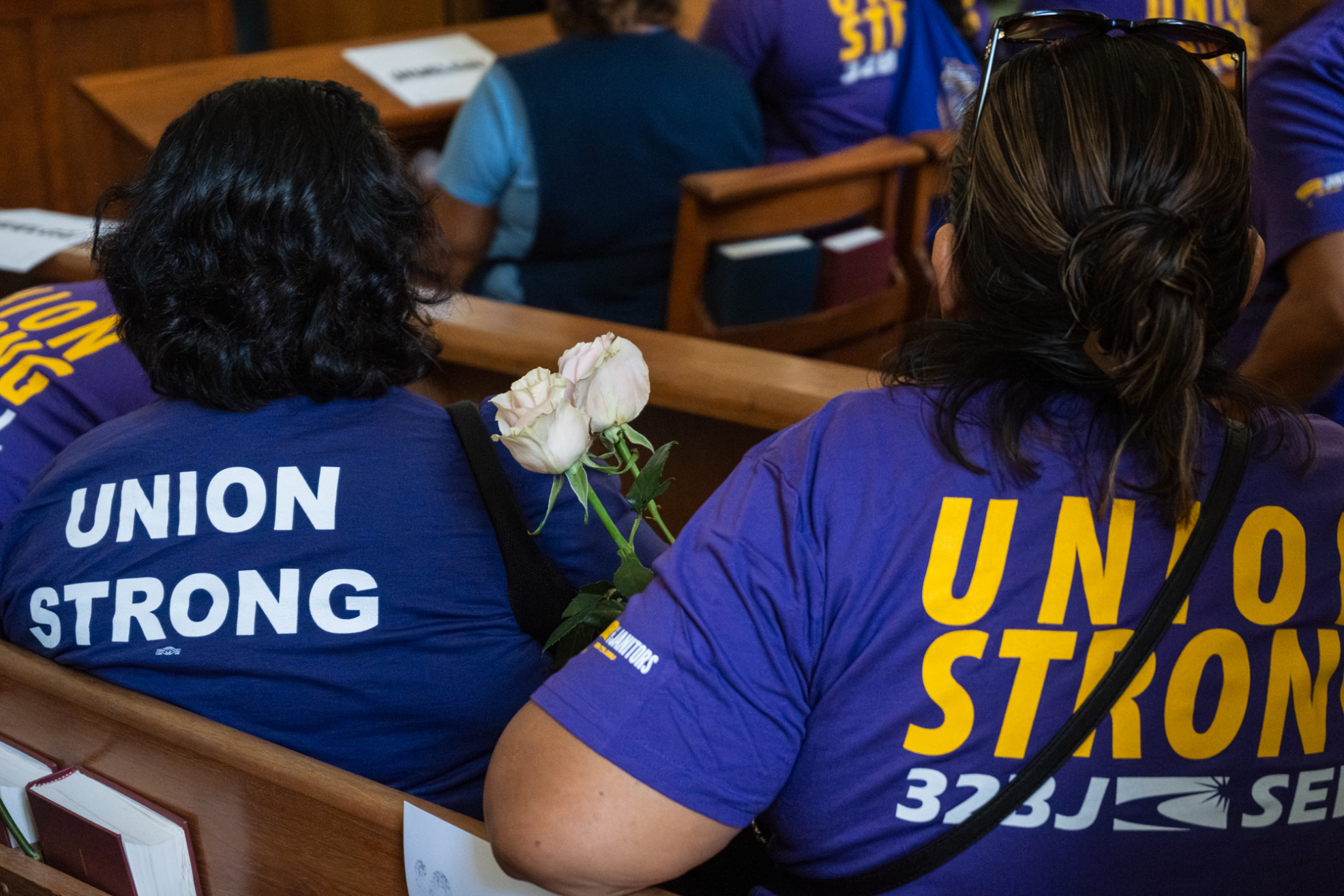
More than 364 janitors, groundskeepers and maintenance workers at the University of Miami voted “yes” to authorize a strike at a rally held at noon on Monday, Aug. 18.
If no agreement is reached between ABM, UM’s cleaning contractor and the employees’ union, the strike will occur after the current contract expires on August. 31, 2025.
The workers employed by ABM are members of Service Employees International Union Local (SEIU) 32BJ. The union represents the staff who clean dorms, classrooms, UHealth medical facilities – including the Lennar Center and Sylvester Comprehensive Medical Center – and many other areas of campus.
“Nosotros somos los empleados que estamos limpiando la universidad … porque nosotros trabajamos para ustedes” [We are the employees who clean the university … we work for you], said Candida, who is a custodian at the Shalala Student Center. She added that janitors need better salaries because life in Miami is extremely expensive, and their wages have not kept up with inflation.
The workers rallied outside of Saint Bede Chapel on UM’s Coral Gables campus, demanding a new contract that reflects Miami’s soaring cost of living and recognizes their role in keeping the university’s facilities safe and clean for students, faculty and patients.
Many more workers gathered on Ponce De Leon Boulevard encouraging student support and handing out flyers reading: “Welcome back. Your janitors are ready to strike.”
“Many [ABM workers] are housing insecure or even skipping meals,” said 32BJ SEIU’s Regional Communications Manager Ana Tinsly. “It’s embarrassing considering that they’re cleaning and maintaining one of the most expensive and luxurious universities in the country. There is no excuse for the workers who keep UM safe and operational to be earning poverty wages.”
Service workers at UM first started a union in 2006 after an initiative that included a 17-day hunger strike drew national attention. This effort led to major improvements at the time, including employer-funded health care, paid sick leaves and stronger workplace protections.
Nearly two decades later, the union argues that those hard-won gains are no longer being honored to keep up with the expenses of living in Miami.
Workers at the rally echoed that frustration, saying that they feel disrespected by the company’s proposals and that history is repeating itself as the union members struggle to make ends meet once again.
“No alcanza salario y no nos quieren aumentar nada y no hay respeto” [Our salary is not enough and they don’t want to give us any raise and there is no respect], said Victoria Carvajal, a cleaner in the Ashe Building.
According to estimates from MIT Living Wage Calculator , a single adult in Miami-Dade County needs to earn about $24.77 an hour, or approximately $4,294 per month, to cover basic expenses, including housing, transportation, food and healthcare. Typical monthly costs in the county are about $1,718 for housing, $670 for transportation and $404 for food.
In contrast, ABM workers at UM start at $14.25 an hour, which is about $2,470 a month before taxes for those who work 40 hours a week. The figure falls nearly $1,800 short of the monthly living-wage estimate.
“We are currently negotiating in good faith with SEIU to reach an agreement that is fair to both our team members and [the University of Miami],” ABM said in a statement to The Hurricane. “We remain hopeful that we will soon find common ground and a shared path forward.”
According to the SEIU, the company has offered an unacceptable 50-cent raise per year and suggested eliminating the training fund, which provides workers with English classes and career-advancing certifications.
In a statement to The Hurricane, the University of Miami said that ABM staff are not employed by the institution, and that the dispute falls beyond the University’s authority.
“The University appreciates its long-term relationship with both ABM and SEIU and is hopeful the two sides reach an amicable agreement,” the University said in its statement.
Union representatives also criticized ABM for refusing proposals for free campus parking, which they say forces workers to spend hundreds of dollars each year just to get to their jobs.
The efforts are supported by local elected officials, including South Miami Mayor Javier Fernandez and Miami Commissioner Christine King. King, who attended the event, emphasized the importance of siding with those who receive low wages.
“We have to stand up for [our janitors] because they are the lowest paid but they do the most important work,” the Commissioner said.
The Union is also looking to students to advocate for their cause. At the rally, organizers handed out posters and encouraged students to attend in solidarity.
Helene O’Brien is the Vice President of 32BJ SEIU, which represents more than 185,000 workers. O’Brien says that these hardworking people not only provide for students, but love them as part of their community, and now, they need students to stand with them in return.
“Students went on a hunger strike with [workers] back in 2006. You may not realize, but they love the students and many of them are here for them,” she said. “The students are essential.”
Daniella Krasney and Emil Salgado Vazquez contributed to this reporting.
As a sophomore who just moved into Lakeside, I passed by the Mahoney-Pearson Residential dorms, reminiscing about my freshman year.
I then started thinking back to my first days here at the U. I was very naive and believed many myths about my new home. I compiled a list of the most annoying assumptions about UM that people ask me about. So frequently, in fact, that I once believed many of these claims.
UM has its own beach
Yes, but it’s way off the main campus. Many assume just because we’re in Miami, that we are right on the beach. UM is located in Coral Gables, about a half hour or more from the beach.
But, you can take a shuttle bus from Miller Circle to University of Miami’s Rosenstiel School of Marine, Atmospheric, and Earth Science campus located in Key Biscayne, where we do, in fact, have a beach. If you were to ask me, the sand on the Lakeside volleyball courts and the Whitten University Pool is just enough for me to get my feet wet and my skin tan. I’d still definitely check out the activities, clubs and amenities that campus has to offer!
Lake Osceola is full of gators
No. Actually, I retract that statement. Not usually.
My entire freshman year I didn’t see one gator, and I was even told on my first campus tour that there are never gators in the lake. But one day, on April Fools Day ironically enough, there was an actual sighting in the lake!
So never say never.
UM is a party school
Everyone has a different answer to this question, but I would say no.
I believe Miami gets the “party school” label because of its location in proximity to the city’s nightlife. But there’s no college town right within an arm’s length of campus with bars and clubs. Campus is a little more removed from the downtown lights of the city of Miami.
While a good amount of students are involved in Greek Life, including myself, it does not dominate the social scene. I think there is so much more to Miami, especially the300 registered student organizations focusing on academics, leadership, volunteering and sports.
EVERYONE owns a goyard
Okay, not true. I don’t own a goyard, isn’t that enough?
But in all seriousness, people have a large variety of bags, purses and backpacks. I find that longchamps are the right size for laptops, books and personal items while looking like a nice designer bag on the cheaper side!
So you may still be unsure about what you’ve heard about UM, but the first few weeks of freshman year is the perfect introduction to how you’ll be living the next 9 months!
Ready to join student organizations that help you find community, enhance your faith and help you feel at home? UM has a wide array of religious centers, from Muslim to Jewish groups to Christian ministries that span multiple denominations. No matter your religious faith, a network of trained individuals are available to provide connection and guidance.
Christian Organizations
Christian organizations at UM range from broad, interdenominational ministries to groups tied to specific denominations. Campus Crusade for Christ, Baptist Collegiate Ministry, University Christian Fellowship, and Intervarsity Graduate and Faculty Ministry provide weekly Bible studies, worship nights and service opportunities open to students of all backgrounds.
Some ministries focus on particular communities. Athletes in Action and Fellowship of Christian Athletes combine faith with sports, creating spaces for student-athletes to share in prayer and community. Denomination-specific groups offer worship services, fellowship dinners and small group gatherings tailored to their traditions. These include the Wesley Methodist Center, St. Bede Episcopal Church Center, the Christian Science Organization and Adventist Christian Fellowship.
Together, these ministries offer spiritual support for Christian students, fostering friendships, encouraging faith-based leadership and connecting students with local churches.
UCatholic
UCatholic Campus Ministry provides a spiritual environment for Catholic students with an on-campus ministry. The organization offers confessions on campus, Sunday services, Bible studies and service projects. They also offer social events such as intramural sports teams and game nights.
UCatholic also partners with local parishes, giving students the opportunity to connect with the greater Miami Catholic community.
Jewish Life
Jewish life at UM centers around two main organizations – Hillel and Chabad. Both offer weekly shabbat dinners and services, holiday celebrations and a variety of cultural and educational programming throughout the week.
Hillel is located on-campus and serves as a hub for social events, Israel engagement and leadership opportunities. Chabad offers a more home-style atmosphere in a house off-campus.
Both organizations emphasize building community, supporting students in their personal and spiritual growth and creating a welcoming space for Jewish students of all backgrounds.
Muslim Student Ministry
Muslim Students at the University of Miami host social events, banquets, and biweekly discussions on religious topics and issues. They also host weekly prayer services on-campus in Shalala or in their Musallah.
MSUM also hosts community service opportunities through Project Downtown, an initiative started by MSUM Alumni to feed the homeless population of downtown Miami.
Finding Faith On-Campus
Freshman year can feel overwhelming with new experiences, but joining faith-based student organizations can bring comfort through familiar traditions and prayers.
No matter your faith, having a sense of community through your religious practice can enhance your college journey and provide a foundation as you navigate college life. At UM, faith is lived through communities that make a big campus feel like home.
Shopaholics anonymous unite. Start your semester off right at Dadeland Mall’s UM ‘Canes Kickoff Event on August 16.
The event will start at 10:30 a.m. and conclude at 2 p.m., but get there early to be one of the first 50 students to get a $20 gift card for Princess Polly, Lush, the Miami Heat Store, Lululemon and more.
Start your day by checking in with your UM student ID at Dick’s House of Sport. There you’ll receive your ‘Canes Kickoff passport, and you’ll get the chance to shop their massive array of UM merchandise. It’s never too early to prepare your gameday ‘fits.
As you complete your passport, you’ll explore the full offerings of Dadeland Mall while receiving exclusive student discounts, uniquely tailored gifts and surprise perks.
Go across the world (or, you know, mall) to complete your passport and get a surprise gift with a ticket to the $200 mall raffle. So I get to shop without getting into more debt? Count me in.
Eager to shop until your drop? Get ahead of the crowds and stop by Dadeland Mall during orientation week. From August 11–15, UM students can stop by the Mall Management Office to claim their limited-edition UMiami x Dadeland Mall tote. (Plus it’s filled to the brim with more move-in must-haves.)
RSVP to the UM Canes Kickoff Event here—because broke college students can always use free swag.
Known for its swagger, history and expectation to win, the University of Miami has built its reputation as one of the premier athletic institutions in the country. In 100 years, “The U” has stacked 21 national team championships across its multiple athletic programs.
If you’re a new Hurricane, there’s no better way to understand this culture of dominance than by looking back at some of Miami’s most legendary title-winning teams.
1987 Miami Hurricanes Football
After a crushing loss to Penn State in the prior season’s Fiesta Bowl that saw Heisman Trophy winner Vinny Testaverde throw five interceptions, head coach Jimmy Johnson entered his fourth season determined to bring Miami back on top. What followed was a perfect blend of talent, attitude, and the trademark “swagger” that made the Hurricanes the most feared and polarizing team in college football.
Quarterback Steve Walsh had no shortage of weapons, most notably future Hall of Famer Michael Irvin. The offense, loaded with 14 future NFL players, averaged over 35 points per game and racked up multiple statement wins. They put 51 on No. 10 Arkansas — leading 41-0 at one point — and pulled off an unforgettable comeback against No. 4 Florida State, erasing a 16-point deficit before Irvin’s 74-yard touchdown sealed a 26-25 victory in Tallahassee.
The ’Canes capped their 12-0 season with a 20-14 win over No. 1 Oklahoma in the Orange Bowl, securing Johnson’s first and only national championship at Miami. Their brash style, blowout wins, and unapologetic celebrations became the program’s calling card, so much so that years later, in 1995, Sports Illustrated ran its infamous “Why Miami Should Drop Football” cover story, urging the school’s president to shut the program down entirely.
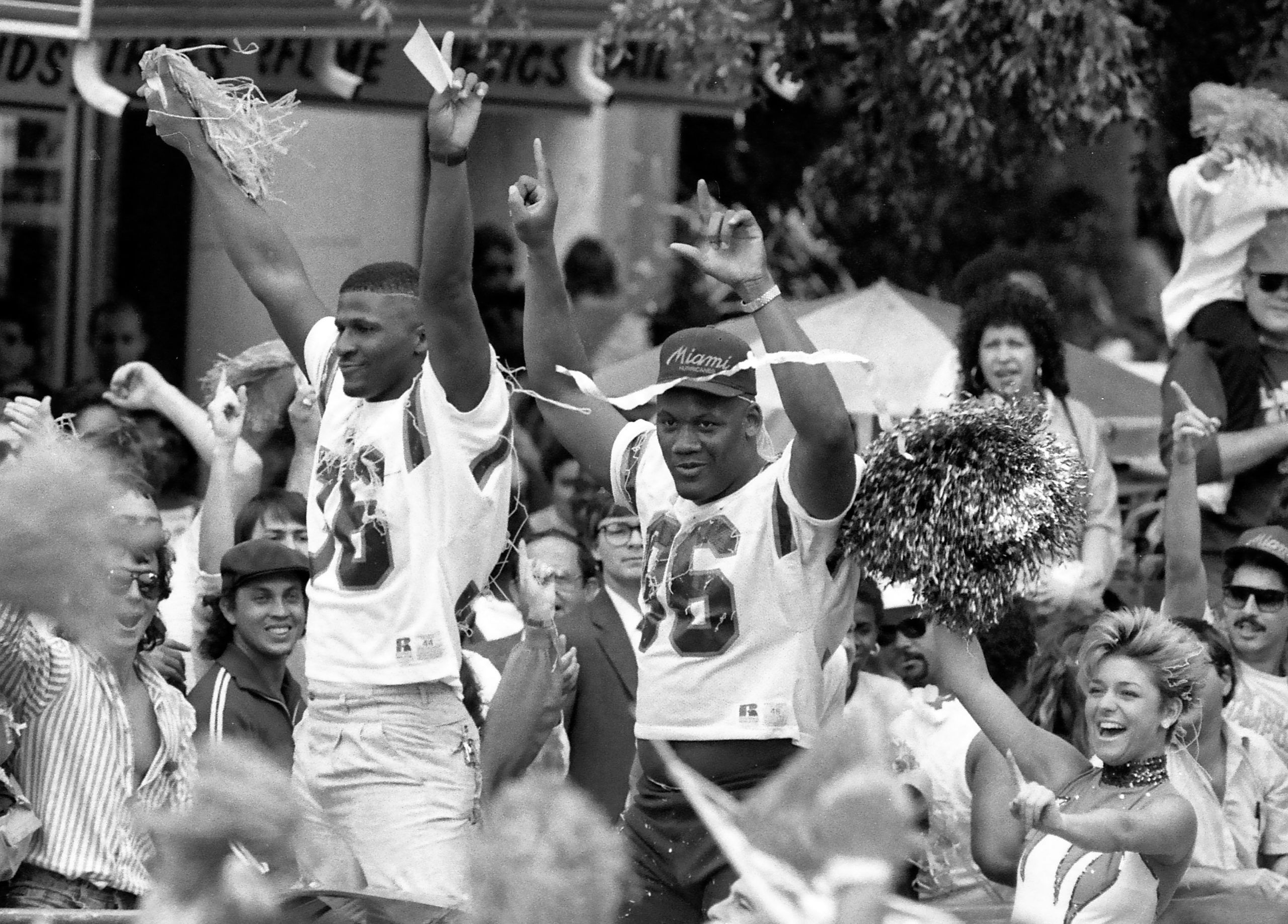
University of Miami defensive back Bennie Blades and defensive end Daniel Stubbs celebrate the National Championship during a ticker tape parade in downtown Miami January 1988. The Hurricanes defeated the Oklahoma Sooners 20-14 for the national title. Photo credit: Rhona Wise
2001 Miami Hurricanes Baseball
Before the 2001 Miami football season, the baseball team put together a season just as dominant. Under veteran head coach Jim Morris, the Hurricanes overcame a midseason sweep by then-No. 1 Cal State Fullerton and caught fire, ripping off a 28-3 stretch to close the season. Their 53 wins were the most by a Miami team since 1992.
Rolling into Omaha as the No. 2 seed, Miami steamrolled through the competition. They slugged past Tennessee in a 21-13 shootout, outdueled No. 3 Southern California, and took down Tennessee again 12-6 to punch their ticket to the College World Series final. Against No. 4 Stanford, a 51-win team that was one year removed from losing in the final, the ’Canes dominated the Cardinals 12-1 in one of the most lopsided CWS championship games ever.
First baseman Kevin Brown, DH Danny Matienzo and pitcher Tom Farmer earned spots on the CWS All-Tournament Team, while outfielder Charlton Jimerson was named Most Outstanding Player. In four games in Omaha, Jimerson batted .333 with two home runs and stellar defense.
Of Miami’s four national baseball titles, the 2001 team just might be the most dominant.
2001 Miami Hurricanes Football
If you ask a college football fan who the best team of all time is, odds are they’ll bring up the 2001 Miami Hurricanes. First-year head coach Larry Coker inherited a roster overflowing with NFL talent — 38 future draft picks, 17 of them first-rounders — and put the world on notice for the rest of the country to watch.
Quarterback Ken Dorsey directed an offense stacked with weapons like Clinton Portis, Andre Johnson, and Jeremy Shockey. They scored 50 touchdowns and averaged more than 42 points per game, often putting opponents away before halftime.
But the defense was just as terrifying. Led by future Hall of Famer Ed Reed, Miami made opponents earn every inch. The unit was so dominant that, even if the offense had never taken the field, the ’Canes still would have had an 8-4 record.
The 12-0 season ended with a 37-14 demolition over No. 4 Nebraska in the Rose Bowl, a game that was all but over by halftime with Miami leading 34-0. It was the program’s fifth national championship — and one that cemented the 2001 Hurricanes as perhaps the most dominant team college football has ever seen.
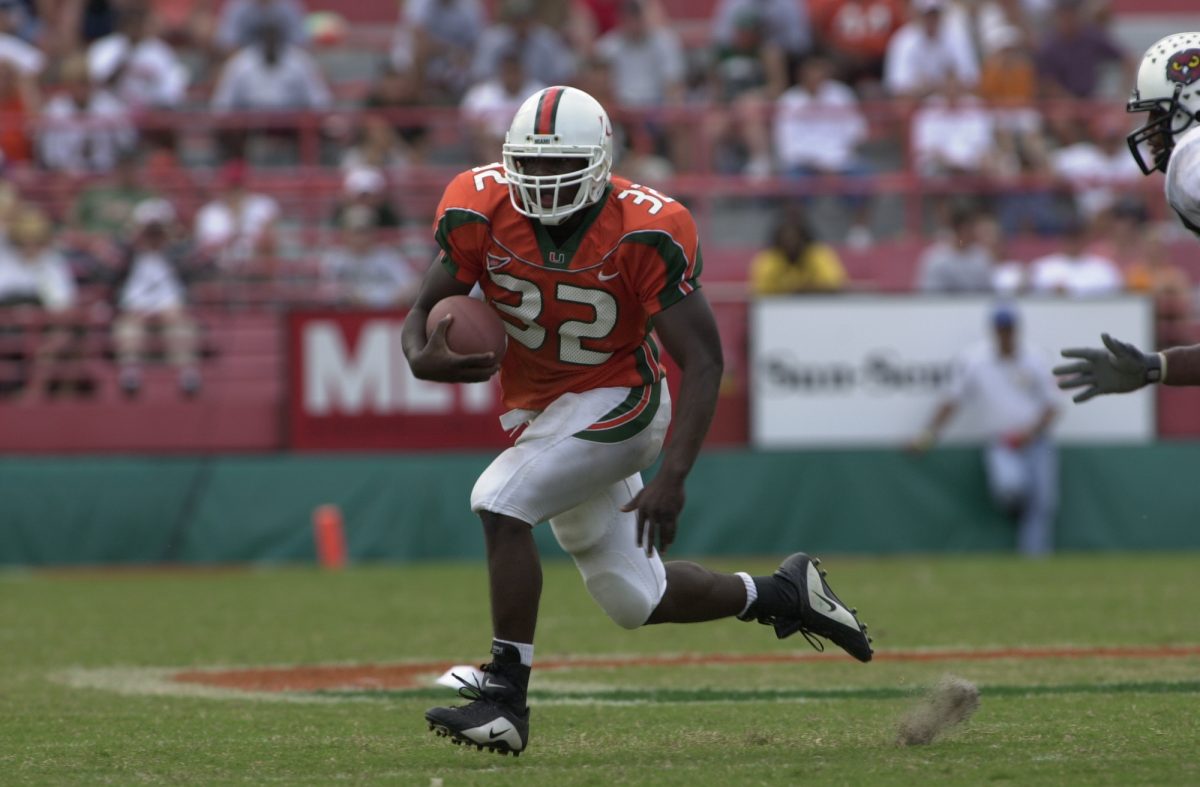
Running back Frank Gore rushing during the 2001 football season. Photo credit: JC Ridley/Caneshooter.com
Like most students here at Miami, I’m an avid coffee drinker. I live for sitting down at a local coffee shop fueling up while I do more work or read a nice book. If you’re new at University of Miami, you’re going to want to know the best coffee shops to sit back, relax and let the caffeine seep into your veins.
Just across the street from campus you’ll find Miami’s Thesis Hotel, which many students have stayed at or have visited.. A few steps from Miami’s team store is one of my favorite places, Crema Gourmet. This sit down espresso bar has a multitude of breakfast items and the best coffee you’ll ever sip on. My personal favorite is their cortados that have a cute foam design on the top of the small drink, similar to a cafe latte. While the closest one to campus is by the Thesis Hotel, you can find another location in Coconut Grove and on Miracle Mile in Coral Gables.
Crema Gourmet is located at the Thesis Hotel, 1350 South Dixie Highway Coral Gables, FL 33146.
One of my favorite things that I did last year was play a morning tennis game at the Mahoney-Pearson tennis courts. After my matches, I usually craved a quick morning bite at Pura Vida. Not far from the freshman dorms and right next to the Hillel Jewish Student Center, Pura Vida offers an eccentric menu of healthy options. You can sit down or take out your order. Their cafe art on their cafe lattes are extraordinary; I’ve gotten designs with hearts, a teddy bear and even a U!
Pura Vida is located at 1100 Stanford Dr, Coral Gables, FL 33146.
I love doing my shopping on the weekends, and I’ll never pass up a visit to the Shops at Merrick Park. There you’ll find Bistro Cafe, with specialty coffees and all types of brunch options. If you’re into sweet drinks and big portions, they offer a variety of specialty mochas, such as chocolate, s’mores, pistachio, peppermint, lavender and more!
Bistro Cafe is located at 4155 Laguna St, Coral Gables, FL 33146
If you’re like me and you pull all-nighters for that 8 a.m. exam, there’s no better way to do it than treating yourself to a Cuban cortadito. Located at the campus food court, Vicky’s Bakery is home to many Cuban favorites, from sandwiches, pastries and especially those Cuban coffee favorites. It is an absolute must-try, especially if you’re new to the Cuban culture here in Miami!
Vicky’s is located at the UM food court, 1350 Miller Dr, Coral Gables, FL 33146
The coffee culture in Miami is to die for. So, in between moving into your new home, take a break and a sip!
No doubt one of the hardest parts of not living at home is having to be responsible for your own meals. Since freshmen can’t have cars and the freshmen dorms don’t have kitchens, grocery shopping can be tricky. Eating out adds up almost as quickly as the dining hall can get boring.
If you need a break from the repetitiveness of dining hall food, here are some alternatives to keep you full while staying on campus.
The Halal Shack
The first spot on this list has students and faculty fighting for the title of “most loyal customer.”
The Halal Shack offers a unique twist on the classic build-your-own bowl or wrap, drawing inspiration from its Middle Eastern and Mediterranean heritage. All of their food is Halal — hence the name — meaning it is sourced and prepared following Islamic dietary guidelines.
Adding mint yogurt or Tajin to your meal goes back to the restaurant’s Middle Eastern roots and provides flavors that other spots on campus lack.
Halal Shack is located in the food court and is open from 11 a.m. to 8 p.m. Monday through Thursday and 11 a.m. to 5 p.m. on Friday.
Half Moon Empanadas
With various locations around the business school, communications school and the Dooly Memorial building, it’s impossible to go an entire day without seeing someone eating an empanada
Empanadas are half-moon-shaped dough with fillings that vary from sweet, like Dulce de Leche, to savory, like their best-selling Spicy Chicken. There truly is something for everyone, so expect to see the line for Half Moon wrapping around buildings during lunchtime.
Alongside empanadas, they also serve coffee, providing a great pick-me-up from 8 a.m. to 4 p.m. every weekday.
Daybreak
Breakfast is often considered the most important meal of the day, so why not make it a staple at every meal?
Daybreak specializes in all-day breakfast foods, from their “handheld” waffles to bowls filled with hash browns and acai bowls for those with a sweet tooth.
If you are a breakfast aficionado, this spot in Lakeside Village opens from 7 am to 6 pm every weekday, meaning even dinner can turn into a breakfast burrito.
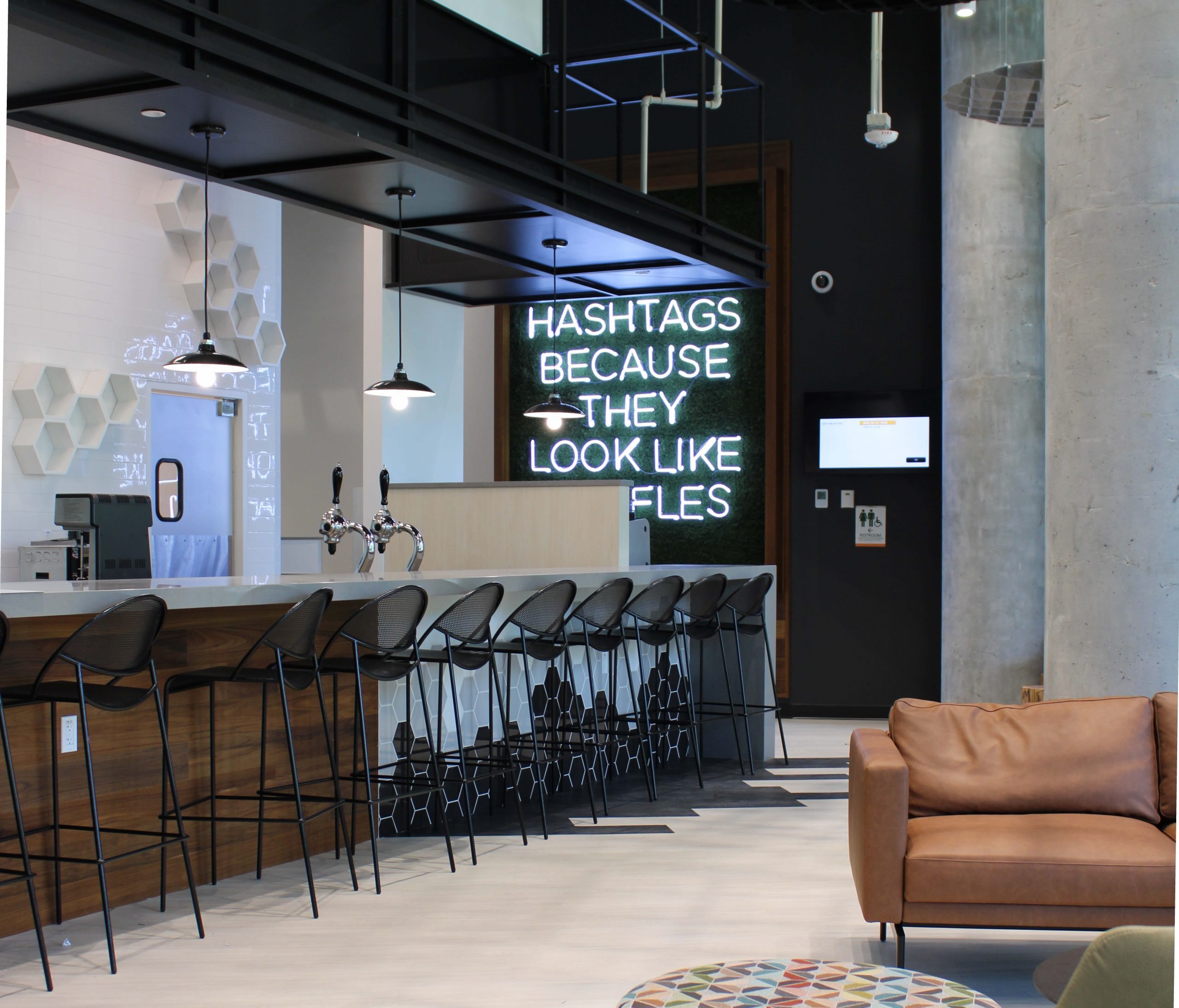
The interior of Daybreak features modern decor. Photo credit: UM Dining Marketing
The Corner Deli
The Corner Deli is the only on-campus location that lets you use meal swipes instead of only accepting dining dollars (or your wallet).
Corner Deli offers a kosher menu, which follows the guidelines of sourcing and preparation held by Jewish law and also accommodates students with dietary restrictions.
You can customize your bowl or wrap, but it also has pre-made meals ready to go if you’re too tired to make a decision.
It is open from 11 a.m. to 7 p.m. every weekday and closes on weekends. It is located next to the Shalala Student Center.
SoCal Taco Co.
Despite its Miami origins, SoCal’s menu is inspired by South Californian flavors. With their “SoCal Classics,” students can try the “Cali-mex” dishes that make it stand out against other on-campus restaurants.
If you would like to experiment, though, “your creations” lets students create their taco, burrito, or bowl.
SoCal is open from 11 a.m. to 10 p.m. on weekdays and 4 p.m. to 10 p.m. on weekends, making it a perfect spot for a late dinner.
Honorable Mentions
Coffee and other caffeinated drinks are essential for the survival of college students. So, here are a few liquid-based honorable mentions:
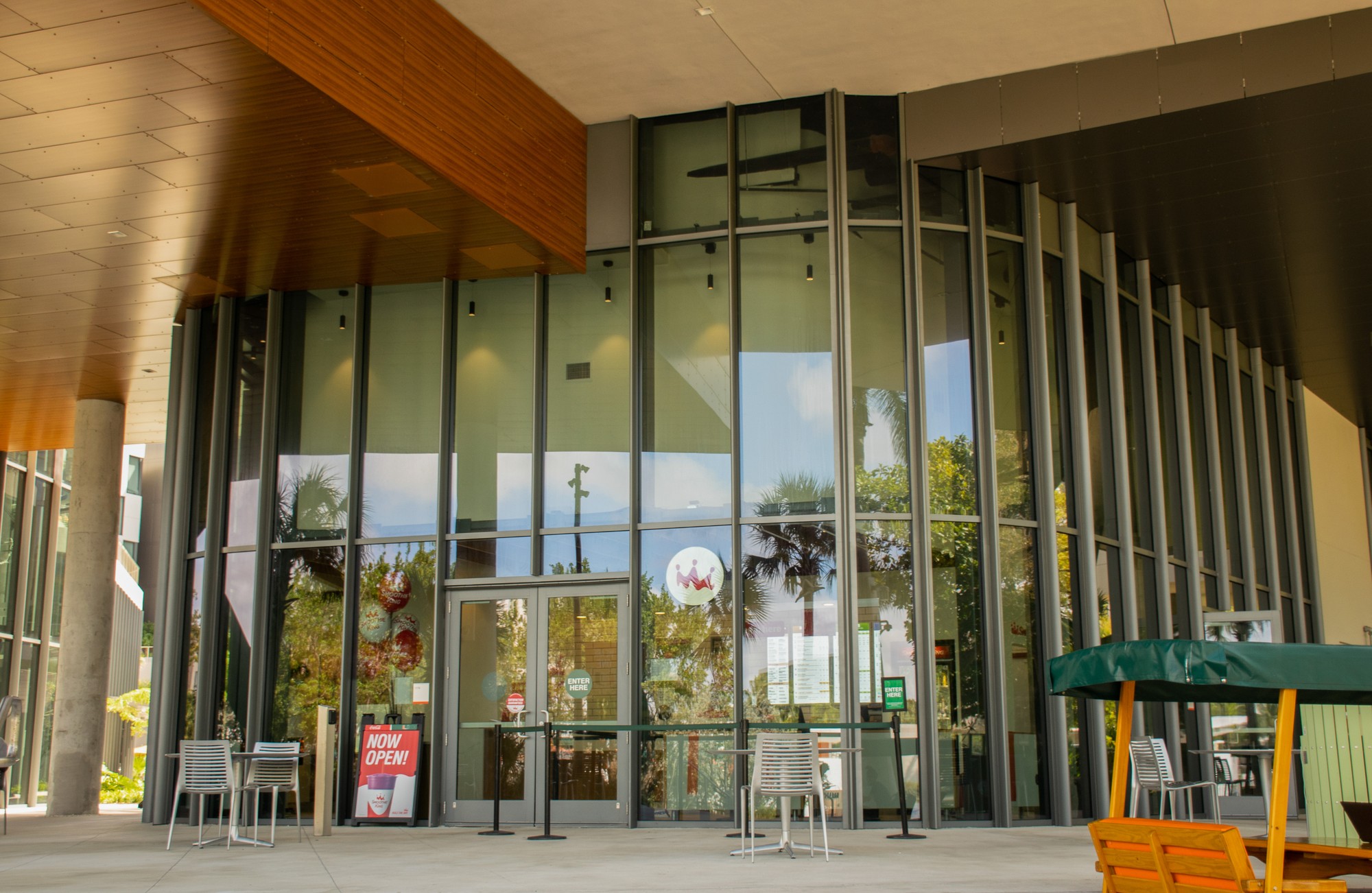
Smoothie King
Cups with the words “Smoothie King” are all over campus and that is because of the large variety of drinks available.
Smoothie King’s menu has more than 100 items, without counting the smoothie bowls, and the option to customize any of them increases the variety. From those looking for a mid-day caffeinated pick-me-up, to those trying to get more protein into their diet with the “Get Fit Blends.”
It is located in Lakeside Village from 9 a.m. to 7 p.m. on weekdays and 10 a.m. to 6 p.m. on weekends.
Smoothie King, located in Lakeside Village, is open until 9:30 p.m. every day of the week. Photo credit: Alex Carnochan
The Archivist
Founded by two UM alumni, The Archivist (also referred to as “Pete’s”) is a great spot for a study snack. It is right next to the Richter Library and might become your best friend during finals season.
If you want to break away from the regular matcha lattes, their spicy coffee selection can offer a nice change of pace.
The Archivist is open from 7 a.m. to 7 p.m. from Monday to Thursday and 7 a.m. to 5 p.m. on Fridays.
The man of steel has seen adaptations that range from good to downright questionable, yet James Gunn’s “Superman” delivers on what fans have been urgingWarner Brothers to do for years – hope.
The last time we saw Big Blue get his own solo movie was the critically divisive Zack Snyder directed “Man of Steel” which took a darker and more grounded approach to the character, inspired by Christopher Nolan’s “Dark Knight” trilogy.
Since then dark and gritty versions of Superman, lacking his signature bright colors and optimistic personality, have graced the silver screen.
Superman returns with David Corenswet’s cheesy, loveable hero that is just as ‘man’ as he is super. “Superman” brings to life the core aspect of the character that makes him truly stand out above other characters within the DC pantheon, hope.
His arc proves he’s the man of steel and symbol of hope.. At first, he uses the Kryptonian message left behind in his pod as his guiding light for becoming a hero, but the message is incomplete.
However, after Lex Luthor (Nicholas Hoult) breaks into the Fortress of Solitude he is able to play the full message to the public. Which reveals that Superman’s parents sent him to Earth to subject the humans and animals he loves to protect to his rule..
This shakes him to his core and makes Superman question who he really is, but still he holds out hoping that not only is the message manipulated (it wasn’t) but he also still fights for Earth. Unlike the last version of Superman, this version of the character fights for humanity through and through, even when he doubts his own.
Another spectacular aspect of the film is the cast, particularly Nicholas Hoult as Lex Luthor, David Corenswet as Clark Kent/Superman, and Rachael Brosnahan as Lois Lane. Hoult absolutely stole the show as Lex Luthor, every scene he is in is either hilarious or intense. He truly feels like the smartest man in the room, even if he is a bit unhinged.
Corenswet’s Superman is very different from Henry Cavill’s acclaimed turn. This version of Clark is defined by his optimism and humanity, the scene that seals the deal is when Lex calls him an alien. Despite the insult, Superman reminds Lex that being human is his super power and that Lex could also use it for good.
Brosnahan’s Lois Lane is a show stealer. Despite not being in much of the film, surprisingly, she is a no-nonsense journalist who gets her story no matter what it takes. She also saves Clark when he gets trapped in Luthor’s pocket dimension alongside Mister Terrific.
This reverses the role we have often seen Lois fall into as the damsel in distress. The chemistry between Brosnahan and Corenswet is beyond words. They’ve only been dating for three months, but it feels like a lifetime.
The film is not without its flaws. Luthor comes off at times as a whimsical hater rather than the calculated man audiences were used to seeing. Yet, Hoult still comes out with the film’s best performance.
The lack of presence from the core cast of the Daily Planet, Wendell Pierce’s Perry White, Skyler Gisondo’s Jimmy Olsen and Mikaela Hoover’s Cat Grant all could’ve added more to the day to day of Clark’s life.
Another gripe with the film are the visual effects. While the flight scenes are pretty good, some fight scenes, powers, and other effects in the film feel like they were hastily put together.
No more evident is this than when Superman unmasks Ultraman revealing it to be a clone of Clark.The effect of two David Corenswets feels out of place. Superman and Ultraman feel like they were copy and pasted into the scene.
Overall, the film repairs much of the damage that Zack Snyder did to Superman. James Gunn restores a faithful version of the character while also setting up the new DC Cinematic Universe with great promise.
After two decades of failed films, both critically and financially, it would seem that Marvel Studios has finally delivered an adaptation worthy of Stan Lee’s iconic catchphrase– “Excelsior!” “The Fantastic Four: First Step”’ delivers justice to Marvel’s first family 60 years in the making.
From the dynamics between the cast to the action and stakes to its world building, this film delivers both the much needed save for the merry quartet but also injects energy into the Marvel Cinematic universe ahead of the highly anticipated “Avengers: Doomsday.”
The film’s opening introduces us to Earth-828, a retro-futuristic ‘60s universe where the F4 are the sole heroes and leading figures across science and politics.
Much like in “The Batman” and “Superman,” rather than rehashing origin stories that audiences know all too well, director Matt Shakman instead builds this world through exposition and an awesome five minute montage. Shakman throws audiences head first into a world F4 creators Jack Kirby and Stan Lee would be proud of.
With moments like Reed fighting Red Ghost’s super ape, Sue giving an impassioned speech at the Future Foundation– with a notably empty chair of the Latveria representative– and the team being the epicenter of culture through the various magazine covers shown.
Shakman also pleases comic fans by name dropping iconic villains like the aforementioned Red Ghost and obscure villains like Paul Walter Hauser’s Moleman–while also not taking up a majority of the movie’s runtime showing the origin and the team getting their powers which could otherwise leave casual audiences bored and confused.
What makes this film stand out are the characters, particularly Vanessa Kirby’s Sue Storm/Invisible Woman, Pedro Pascal’s Reed Richards/Mister Fantastic and Ralph Ineson’s Galactus.
Reed and Sue are treated equally as main characters as are Ebon Moss-Bacharch’s Ben Grimm/The Thing and Joseph Quinn’s Johnny Storm/Human Torch. However, Reed and Sue undeniably are the heart and soul of the film.
Their relationship feels real, and seeing their joy at the prospect of being parents but also Reed’s fear of what Franklin could be is all too relatable. Sue spearheads saving the world contrary to her more sideline role in previous F4 films. Here, she is a political leader and diplomat instead of the attractive damsel in distress.
Ineson’s Galactus is terrifying from the moment we see him. Midway through the film the team goes to his ship and are led to him by the Silver Surfer (Julia Garner), at first we see pitch black but then the celestial’s eyes pierce through the darkness followed by his booming voice; which Ineson says he based off of natural disasters.
Galactus is all the more terrifying when watching in IMAX as the villain takes up all corners of the 59 by 79 feet screen, especially during the final act. The comic accurate appearance also delivers long awaited justice to the character after he was just shown as a space cloud in 2007’s “Fantastic Four: Rise of the Silver Surfer.”
The film also excels in visual effects and action sequences. The most exciting part of the film is the chase scene from Galactus’s ship. After denying Galactus’ offer of sparing Earth in exchange for Franklin, the team run for their lives. Silver Surfer gives chase nearly ripping Franklin from Sue’s womb before they jump to hyperspace.
Sue goes into labor at the start of the sequence and it all ends with the birth of Franklin. The best shot of it all is when Ben passes Franklin to his parents through zero gravity, the young child lit by the sun and the stars.
As for visual effects, everyone’s powers were executed incredibly well. Reed’s stretching abilities didn’t look gross or cartoony but rather looked realistic. Johnny’s fire powers were also well executed showing how much control he has over them without looking like an animated orange man.
Ben’s VFX were the weakest, while looking great, in the scenes where he is just standing still doing nothing he looks very out of place. Galactus was also a mix of practical and CGI effects which created the large and intimating image.
The “Fantastic Four” fun keeps rolling after the credits. It sets up the Fantastic Four’s return in “Avengers: Doomsday” to protect Franklin from the greatest Avengers level threat since Thanos: Doctor Doom; and yes that was RDJ himself under the hood in that scene!
“Fantastic Four: First Steps” is a game-changing adaption of the iconic super-family. From the casts’ chemistry to villains that scare you from a universe far away,, the film excelled at showing that Marvel knows what people have been asking for and can deliver it.