Home Blog Page 112

Elon Musk’s Neuralink implants brain chip at UM hospital

In 2016, Elon Musk and a team of eight scientists and engineers founded the neurotech company Neuralink. Nine years later they implanted a brain chip alongside doctors from the University of Miami Miller School of Medicine, revolutionizing treatment for paralyzed patients.

Neuralink’s brain-computer interface was developed for paralyzed patients who have suffered spine injuries or for those diagnosed with Amyotrophic Lateral Sclerosis. It allows patients to control computers, smart phones and televisions with their mind. 

The Food and Drug Administration-approved PRIME clinical trial is assessing the safety and functionality of the BCI with seven patients. The UM Miller School of Medicine was declared as the second trial site in January 2025

RJ, a paralyzed U.S. military veteran is the first and only patient to date to receive the BCI at a Miami hospital. He suffered a motorcycle accident that left him a quadriplegic, paralyzing him from the waist down. 

According to the Miller School of Medicine, RJ was able to turn on his TV and play video games for the first time in two and a half years.

“They’re giving me my spark back … my drive back. They’ve given me my purpose back. Now, I’m able to turn around and build that fire for the next guys that come through,” RJ said. 

Dr. Jonathan Jagid performed the surgery last April at the UHealth Tower, the flagship hospital of the UM Health System. RJ was discharged the following day. 

While BCIs have existed for decades, the Neuralink trial has gained a lot of national recognition due to Musk’s high-profile involvement in the company and the device’s cutting-edge technology. The Neuralink BCI is more complex than a basic brain chip device, such as the Utah Array which was invented in 1989. Neuralink’s device has 10 times as many electrodes than the Utah Array, meaning more electrical brain activity can be recorded and translated into actions.

Dr. Jagid believes that this technology has the potential to greatly improve the quality of life for many paralyzed patients. In a phone interview with The Miami Herald, Dr. Jagid said that RJ’s involvement will “move the science forward in order to help everybody else who suffers with these types of injuries.”

W. Dalton Dietrich, PhD., the scientific director of  The Miami Project to Cure Paralysis, praised the partnership with Neuralink, noting it complements The Miami Project’s multidisciplinary approach to advance neural interface and neurorehabilitation research. With support from the Miller School of Medicine, UM is positioning itself as a leader in developing treatments for spinal cord injuries and other neurological conditions.

The trial has been predominantly successful aside from a setback with its first patient, 30-year-old Arizona native Noland Arbaugh. About a month after his implant surgery the device suffered a hardware malfunction, causing 85% of its implant threads to retract and lose function. Neuralink repaired the device, but Arbaugh has not yet regained full control over the BCI.

UHealth CEO Dr. Dipen Parekh declared the RJ’s successful implant a major milestone for the institution. The entire team of doctors at The Miller School of Medicine is excited to see how this technology could transform paralyzed patients’ lives and bring the field closer to a lasting solution for paralysis.

Central Texas flood impacts reach UM, raise questions of storm preparedness

Flash flooding in Central Texas over Independence Day weekend has killed more than 120 people, including 27 campers and counselors at a summer camp. It is one of the deadliest flooding events to occur in the last 50 years.

Peaking at more than 22 feet, the Guadalupe River surged through the area and swept away homes, vehicles and infrastructure. The event left behind major debris, road closures and flooded neighborhoods, complicating efforts as first responders work tirelessly to locate 160 missing individuals.

Camp Mystic, a Christian girls’ summer camp along the river, was hit hard by the flooding after cabins were overtaken by rising waters throughout the night. The 27 victims from the camp included eight and nine-year-old girls, the youngest age group whose cabins were closest to the riverbank. Among the lives lost was Chloe Childress, a 19-year-old counselor who was set to begin college this fall. 

The July 4 storm dropped more than 11 inches of rain in less than three hours, well over forecast projections. The heaviest rainfall hit Kerr County around 4 a.m. and caused an emergency alert to be issued at 4:03 a.m. Many people didn’t receive emergency messaging due to poor cell phone coverage in the area. 

Flooding of the Guadalupe River near Kerrville, Texas // Source: Wikimedia Commons

Earlier this week President Trump approved a major disaster declaration for Texas, providing federal assistance for recovery efforts in Kerr County. The assistance includes loans, home repairs and grants for temporary housing. Trump visited the site Friday, describing the flood as “a hundred-year catastrophe.”

With so many Texans impacted by the flood, members of our UM community are feeling the weight of the tragedy. Mercer Peakes is a rising junior at UM from Houston who says the devastation hit close to home.

Two of the little girls were students at my alma mater and one of the older girls was an acquaintance of my sister. Tragically, none of them made it through the storm,” he said. “It has been really hard on everyone here in Houston.”

Peakes said that the intense weather event coupled with the frequency of floods in Texas was a dangerous combination in Kerr County.

“I think it has become a bit normalized. This leads to a lackadaisical attitude instead of being appropriately prepared and cautious of upcoming storms,” the junior said. “I have never seen videos like the ones of the water rising as quickly as it did in Hill County.” 

Radar map of the heavy rainfall in Central Texas over the holiday weekend. // Source: GOES imagery, CSU/CIRA & NOAA

The devastation has left many Texans not only grieving, but questioning how such a catastrophe unfolded so quickly and whether it could have been better anticipated. As storms become more severe, concerns are growing as to how prepared local and national agencies are to respond.

In the wake of the deadly flood, many look to the 600 layoffs at the National Weather Service last month. The Trump administration has forced layoffs and retirements for tens of thousands of government employees, including scientists in agencies like the National Oceanic and Atmospheric Administration which houses the National Weather Service.

A funding lapse and subsequent shutdown of the Austin/San Antonio Weather Service forced all data and services to temporarily shut down last April. The warning coordination meteorologist of the local agency took a buyout from the Trump administration during the lapse, ending his 32-year career.

As weather events continue to become more intense and extreme, experts warn that human-initiated climate change and global warming worsens these patterns. Warm air holds more moisture than cool air, releasing more precipitation from a warmer atmosphere. A report by European scientists found that the heavy rain was worsened by human-driven climate change in Texas.

Florida lies on the Gulf of Mexico, which has experienced “significant warming” according to NOAA. Two major hurricanes last season in Florida left residents wondering just how severe the next storm will be and if global warming played any part in the severity of the events.

With over 20% of staff leaving the Federal Relief Management Agency , experts warn that staff shortages may contribute to a lack of preparation for future storms. Rick Spinrad, an administrator at NOAA until last January, told the Guardian that warnings of future hurricanes may be less reliable. 

“If I were a citizen of Texas, Florida or Georgia, I wouldn’t be sure how well warned I would be of a hurricane,” Spinrad said. “And if a hurricane was heading for a major city, I’m not confident FEMA would be able to respond to the forecasted warnings.”

Texas Senator Ted Cruz said that Trump should not be blamed for a natural disaster, and later reports will show areas of improvement for future weather events.

“Now is not the time for partisan finger pointing and attacks,” Cruz said. “After we come through the process of rebuilding, there will naturally be a period of retrospection.” 

While political leaders debate accountability, Peakes said that the people of Houston are focused on healing, looking to come together as a community during a moment of profound loss.

“I think the people of Houston are just trying to make sense of the whole situation,” he said. “It gives me some hope to see how unified our city has been throughout this tragedy.  I am hoping that this will bring a significant change to prevent this from ever happening again.”

Your guide to clubs and student organizations at the U

Ready to make an impact on campus, meet new people and find your niche? Getting involved in clubs at UM is a great way to meet like-minded students and find your home at the U.

With more than 200 student organizations, it’s easy to get overwhelmed at the club fair during orientation. Here’s your go-to guide to the types of clubs, what they offer and how each can shape your next four years.

Greek Life

Photo credit: Instagram/@UMPanhellenic

UM offers three different types of greek life – social, cultural and pre-professional. 

Social Greek life includes Panhellenic sororities and fraternities. UM uses a delayed rush system, meaning you cannot rush a sorority or fraternity until the spring semester of your freshman year. This allows you to find your footing as a student before immersing yourself in Greek life.

UM has eight sororities yet no sorority houses, instead offering each organization a suite where members can hang out in between classes. So, while sorority life is an amazing way to make new friends, it is also not overwhelming and doesn’t determine your living situation. With 13 fraternities on campus, many have fraternity houses that members can live in after their freshman year. 

Cultural Greek life is a vibrant community on campus. These are fraternities and sororities that focus on specific cultural identities and emphasize cultural awareness, community building and promoting diversity and inclusion.

Pre-professional Greek life includes organizations that focus on specific career paths. UM offers many pre-professional organizations, from pre-med to business to architecture. These organizations provide networking opportunities, professional development and academic support.

It’s important to note that just 25% of the student population is involved in any form of Greek life. You do not need to be in a Greek organization to have a social life, especially in a vibrant city like Miami.

Club Sports and Intermurals 

UM Club Ice Hockey players celebrate a goal. // Photo credit: Ashley Baumgard

Most UM students are not on track to become professional athletes. However, there are still many ways to get involved in athletics and stay active during the school year.

Club sports teams travel across the U.S., sometimes internationally, to compete against other collegiate teams. You should expect most of the 30 teams to have coaches, host tryouts and practice 2-5 days per week. 

Club sports are a great opportunity to stay engaged if you played a sport competitively in high school and want to continue.. Check out if your sport has  an existing club team here.

Intramural sports are a more recreational, less competitive option. Teams compete with other teams in the UM community, offering sports such as soccer, football and pickleball. All you need is a group of five  friends to create  a team. 

Student Media

The team behind UMTV’s SportsDesk has been nominated for the Suncoast Student Production Award // Photo Source: Facebook

Housed in the School of Communications but open to all students, UM offers six award-winning multimedia outlets that are entirely student-run. 

UMTV is UM’s Emmy award-winning television station. UMTV has  eight  different shows ranging from comedy to news and more. There are opportunities for on and off-camera talent and any student can participate. 

The Ibis Yearbook publishes a 400-page, award-winning book every year that captures campus events and student life. Other organizations include WVUM-FM, the student radio station and Distraction magazine, a publication dedicated to the culture of the students at the U. 

And, my personal favorite, The Miami Hurricane. TMH is UM’s student-run and award-winning newspaper with sections for News, Arts and Entertainment, Sports and Opinion. Students can write single pieces as a contributing writer or more frequently as a member of the staff, all while getting paid for their work.

Whether you want to promote student media on social media, work in front of the camera or take photographs, student media offers you a chance to improve your skills.

Service Organizations 

More than 350 South Floridians with special needs visited the University of Miami campus on Feb. 3 for a daylong event full of activities geared toward bridging the gap between students and their buddies. // Photo credit: Lena Mobin

Service organizations encompass a broad variety of clubs dedicated to helping  the community. These range from Habitat for Humanity to Gift of Life, an organization that swabs cheeks on campus so you can be added to the national bone marrow registry.

Student government works to improve campus life through initiatives voted on by bodies of student representatives. Student government also operates four agencies that you can get involved in – Category 5 for school spirit, ECO Agency for sustainability, What Matters to U for events that promote student learning and the Elections Commission.

Service organizations are a great way to make an impact and feel more connected to campus and the greater Miami community. They’re also a fun way to meet students outside your major, volunteer with friends and get involved in causes you care about.

Recreational Clubs

Jacki Coffey keeping an eye on her dive computer during a routine safety stop after diving to three wrecks in 90ft of water off Jupiter, FL. Participating in the UM Scuba Club dive to witness goliath grouper aggregations during their spawning season is a highlight for many divers during the Fall semester. This particular dive they saw roughly 80 Goliath Groupers, ranging from 4-6ft in length, as well as loggerhead turtles and reef sharks // Photo Courtesy Patrick Nichols
Jacki Coffey keeping an eye on her dive computer during a routine safety stop after diving to three wrecks in 90ft of water off Jupiter, FL. Participating in the UM Scuba Club dive to witness goliath grouper aggregations during their spawning season is a highlight for many divers during the Fall semester.  // Photo Courtesy Patrick Nichols

The largest club on campus is the UM Scuba Club, which hosts scuba certification classes and weekly dives off-campus.

From the Pickleball Club to the Video Game club, it’s easy to find organizations that match your specific interests and hobbies. Check out the student organization fair during orientation to find a group that fits your vibe.

Staying Involved Beyond the Classroom

This may sound daunting, but remember that you don’t have to do everything all at once. Throughout the next four years, you’ll get to discover not just what you want to do, but who you want to be. 

Diving into extracurricular activities that you’re passionate about -– not just an activity that looks good on a resume — will make your experience at UM much more meaningful. Getting involved on campus will help you adjust to college, help you build friendships, stay active and feel more at home in your new environment.


Letter from the editor

Fellow ’Canes,

Congratulations on joining the University of Miami community. I am thrilled to welcome you to our campus filled with sunshine, Cuban coffees, empanadas and dozens of opportunities. UM is truly a special place and your next years of college will be challenging and also incredibly rewarding. I have found that the hardest things I have done at UM have also been the most fulfilling and enjoyable.

Two years ago, I was moving into my freshman dorm and nervous, just like I imagine many of you are today. As an only child, I was especially clueless. So clueless, in fact, that I accidentally ordered a patio table umbrella to the UPS store instead of a regular hand-held umbrella. It is normal to have jitters and worry about whether you will like the dining hall, but I encourage you to put those worries aside and embrace the new experiences ahead of you.

Over the next six weeks, The Miami Hurricane, our student-led newspaper, will be sending you “First Impressions” newsletters every Tuesday and Thursday. These newsletters, thoughtfully put together by our staff, aim to familiarize you with some UM basics to help your college experience be the best that it can be. 

In the meantime, I offer you three pieces of advice for your journey at the U:

  1. Don’t be afraid to step off the beaten path. It is impossible to perfectly plan your college years, and you’ll miss out on incredible opportunities if you let yourself fixate on an arbitrary plan. I am pursuing a major in biochemistry and nutrition, yet I can confidently say that joining the newspaper is one of the best choices I have made at UM. No, journalism does not directly connect to my major, but that is okay. It is okay for your path to be non-linear. 
  1. Learn what you like. Miami is rich in food, fashion, music, sports and culture. UM is perfectly positioned near a huge city, the beach, the Everglades, the art district and the F1 track. Yes, you need to hit the books and advance yourself academically and professionally, but you should also spend time learning about yourself. Take the opportunities to discover what you are passionate about. 
  1. All you need is one person. Transitioning to college is hard, and there are times when you may feel alone — far from your family, your hometown friends and the comfort of your bedroom back home. I met three of my close friends on the first day of orientation in the assigned, major-based tour groups. Develop those relationships. Having one great friend who is there for you on a tough day does wonders in making you feel less alone and more connected to the ’Canes community.

College is going to come with a fair share of challenges as well as rainy moments (and yes, we get a lot of those in Miami), but your self-growth and the many sunny moments make the entire experience worth it. 

Be proud of your journey and enjoy the experience. And, if you ever need some encouragement that you are on the right path, pick up a copy of TMH and read about your fellow classmates. One day, it may be you on the cover. 

The Miami Hurricane staff and I are so excited to have you on campus and we can not wait to kick off the year with you.

As always, go ’Canes!

Katie Karlson

Editor-in-Chief

The Miami Hurricane

Top 5 Athletes to look for this fall semester

With barely more than a month before students return to campus for the fall semester, many of the University of Miami’s finest student-athletes are hard at work preparing for their upcoming season. 

UM has a long history of bringing in some of the best young athletes worldwide, so here are five you should look out for across the fall sports next semester:

  1. Carson Beck – Football, Quarterback 

All eyes are on Miami’s new quarterback heading into the 2025-2026 season. A top transfer from the University of Georgia, Beck has some big shoes to fill after Cam Ward’s Heisman finalist campaign last season. The Jacksonville, Fla. native threw for 3,485 yards and 28 touchdowns, alongside an 11-2 record last season where he helped lead the team to an SEC Championship win and a college football playoff berth in his final season as a Bulldog. 

As a part of two national championship-winning teams and finding success as a starter the past two years for Georgia, Beck looks to bring his winning mentality to Coral Gables and win Miami their first ACC championship ever. 

With the Hurricanes playing eight home games at Hard Rock Stadium this year, fans will get plenty of opportunities to watch Beck and his offense, starting with rival Notre Dame on Aug. 31. 

  1. Flormarie Heredia Colon – Volleyball, Outside Hitter

Returning from a brief stint at UF last semester, Heredia Colon is back for another season of Miami Hurricanes Volleyball so the ACC better watch out. 

A fan favorite both with personality and performance, Heredia Colon was named to the All-ACC First Team in her junior  campaign last season. In her 2024 season, she led the ACC in kills (490) and points (562.5) for the majority of the season while maintaining second in points per set (4.93) and kills per set (4.30). 

The Dominican Republic native looks to keep on dominating the court during her senior season.

Sophomore outside hitter Flormarie Heredia Colon spikes the ball during the first set of Miami’s match versus Florida International University in the Knight Sports Complex on Aug. 26, 2023. Photo credit: Jared Lennon
  1. Giovana Canali – Soccer, Forward

The freshman phenom who took the ACC by storm in 2024 is now a leader for Miami women’s soccer this upcoming season. 

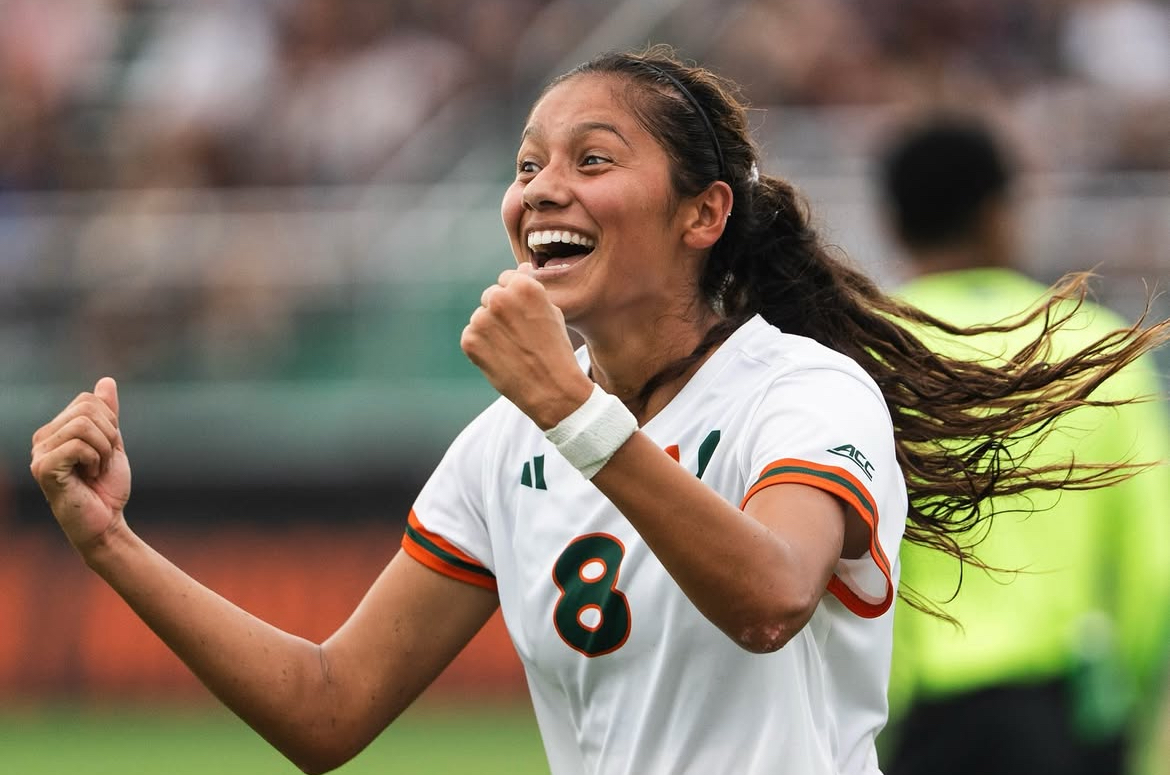
In her first season as a Hurricane, Canali scored a team-high nine goals and finished tied for  ninth in the ACC in goals. The Brazilian native, who has previously suited up for her national team, made the All-ACC Third Team and All-ACC Freshman Team in 2024. 

A deadly forward who shines when the lights are brightest, Canali scored two game-winning goals against FIU on Sept. 1, 2024 and Florida Atlantic University on Oct. 6, 2024 last season. With a year of experience under her belt, Canali hopes to lead the ’Canes and build off of their first year in the Ken Mashur era at Cobb Stadium.

  1. Rueben Bain Jr. – Football, Defensive Lineman

Back to football, the powerful 275-pound Rueben Bain Jr. looks to continue to dominate at the defensive line position. After an impressive freshman campaign where Bain received Freshman All-American honors alongside being named the ACC Defensive Rookie of the Year, he dealt with a lingering injury last season that limited his production. 

Despite missing four games due to a calf injury last season, Bain still finished the season with an impressive 23 tackles, 5½ tackles for loss, and 3½sacks. Now fully healthy and a projected top-10 draft pick, Bain looks primed to have a standout year as the anchor of the Hurricane defense.

Freshman defensive lineman Rueben Bain, Jr. strips the ball from Clemson sophomore quarterback Cade Klubnik in the second quarter of Miami’s game versus Clemson at Hard Rock Stadium on Oct. 21, 2023. Photo credit: Jared Lennon
  1. Ariana Rodriguez – Volleyball, Setter

’Canes volleyball keeps another exceptional player for the 2025 season as setter Ariana Rodriguez returns for her third season down in Coral Gables. From New York, NY, Rodriguez has Olympic experience, playing for the Dominican Republic in the Paris Olympics last summer. 

Last season in Coral Gables, Rodriguez tallied 1,058 assists and averaged 8.74 assists per set and was named ACC Setter of the Week three times for her efforts (Sept. 23, Nov. 4, Nov. 25, 2024). She currently sits in seventh for most career assists in Miami volleyball history, a rank which will only climb with her performances on the court this upcoming season.

Michelle Kaufman celebrates 20 years of teaching Sports Reporting at her alma mater

Michelle Kaufman can predict the best students in her class from the first day. 

On the first day of classes, she walks in confidently to her small classroom in Allen Hall. She plops down on her desk a large pile of media credentials — dating from the 1992 Winter Olympics in Albertville, France to various countries such as the South African or Brazilian World Cup, Wimbledon, and every notable sporting event imaginable — as proof of why she’s qualified to teach the class. 

After 20 years of teaching Sports Reporting at her alma mater, she has grown to recognize greatness in her students instantly. 

Every student in the 15-person class arrives eager to learn. Often it’s difficult to pique the interest of busy and tired college students, but these students show up happily to listen to Kaufman.

While the University of Miami promises hands-on experience to all of its students, no class delivers it like Kaufman’s. She considers her class more of an internship, and herself as more than just a professor. 

“I am a mentor more than a professor, and my goal is that at the end of the semester, the students will have a very, very clear picture of what it is to work in sports media,” Kaufman said. “They will know either I love this and I want more of this, and I can picture myself doing this, or this is not the same as being a sports fan.”

She brings to the classroom 37 years of experience as a sportswriter, having covered 14 Olympics, six World Cups, Wimbledon, the U.S. Open, NCAA basketball tournaments, NBA playoffs and Super Bowls. She has served as the Miami Herald’s soccer writer and University of Miami basketball beat writer for 25 years..

Her students see her knowledge in every words she speaks. David Villavicencio, account supervisor at Chemistry Cultura who took her class in 2009, said her experience speaks for itself.

“I mean Michelle is so impressive with the proof of her success and experience and knowledge jumps out at you just the way that she carries herself and everything that she’s experienced and done,” Villavicencio said.

From sitting in the press conference room with Coco Gauff at the Miami Open to watching the NFL Draft from the Dolphins headquarters,  even shaking hands with talented alumni who once sat in her class, real-life experience and networking become real in this classroom. 

When beginning this class, many challenges stood in her way. When she began teaching, Kaufman was juggling a full-time career and raising a 5-year-old daughter.

“I thought she was a little crazy at first because she was already so busy,” said her husband, Pulitzer Prize-winning writer Dave Barry. “That would be adding another time-consuming thing onto her plate.” 

But what seemed to concern her the most was giving her students the best experience. 

“She was nervous if the students would like her, what would they think and I think that’s what makes her a good teacher is that she does genuinely care about the students,” Barry said. 

And while she did not need to teach, she chose to, out of nothing more than a genuine passion for mentoring students.

“She wants to create all these relationships with all these people and learn as much about them as possible and help them through the rest of their lives, said her daughter, Sophie Barry. “At the end of the year, she invites everybody over to our house and does individualized awards for each specific person based on everything she’s learned about them and everything she knows about them.”

She began calling as many connections in Miami as she could find and through those connections a class was born, one that would manifest some of UM’s most successful alumni in the sports world. Through 20 years of caring for students, many have gone on to have long and notable careers in communications, journalism, and sports. Often they attribute their success to the real world lessons and connections they made through her class.

Her journey began and still remains in Miami. A Hurricane herself, Kaufman was actively involved in sports writing, dating back to her time at UM as a contributor for The Miami Hurricane, the student newspaper. Decades later, her students sit in press boxes, anchor desks, and editing bays across the country carrying with them the lessons she taught and the standard she set.

One of those students is David Furones, Miami Dolphins beat writer for the South Florida Sun Sentinel. He credits Kaufman with giving him his start in 2011.

“She told me ‘David, I actually think you’re one of the better writers in this class, and I would love to set you up with Andre Fernandez just to cover some high school football games for the following fall,’ ” Furones said. “That really got me started.”

Her students witnessed compelling and unforgettable moments in sports history, moments they would carry with them forever. 

Furones remembers covering a game featuring the Miami Heat’s “Big Three” and attending a post game press conference with Dwyane Wade and LeBron James.

“It obviously left a huge impression on me as a college kid,” he said. “That was just an assignment for class.”

Kaufman remembers that night vividly.

“I think LeBron James scored his career-high 61 points, and on the night that my class was there, Kaufman said. “That was very amazing, because he came into the press conference. So he normally probably wouldn’t have spoken at the press conference, but he scored 61 points.”

She recalled other major moments students have experience: interviewing Roger Federer, Rafael Nadal and Serena Williams, or watching Lionel Messi score a goal live.

In a digital age of consuming news, Professor Kaufman could’ve chosen to evolve her class to solely teaching digital news, yet she holds on tight to her values from what she calls “the golden age” of journalism. Through 38 years of working in print journalism, she has watched the industry change before her eyes, and while she still provides modern tools for her students, nothing holds more importance than her core values. 

“I sometimes think, is what I’m teaching becoming obsolete? Is what I’m teaching becoming outdated? Do I need to teach more about social media? Do I need to teach Tik Tok or something like that?” Kaufman said. “And then I think, no, there are people who can teach that, or who want to teach that. I still focus on the foundation of journalism, which is being accurate, being truthful, being fair, being able to sift fact from fiction, being able to cultivate sources, being able to gain people’s trust, learning how to write report and report correctly, the etiquette of all of it. All of those lessons, I think, are still extremely valuable.”

Her students carry her lessons and standards of journalisms into their current careers, such as NBC6 Reporter Briana Nespral who took the class in 2017. 

“Whether I’m chasing a breaking story or or navigating into tough interviews, I kind of still hear her voice in the back of my mind pushing me to be sharper, fair, more focused and not just focus on the everyday questions,” Nespral said. “She would always talk about the golden nuggets. I still try to include those golden nuggets in every story that I can.”

Those golden nuggets are the particular part of a story that requires further focus, and can be used to take an average story into an exceptional one. 

Graduate student Dara Karadsheh took the class this spring semester, and recalled the practical skills she learned in the classroom that she believes will well prepare her for her future career.

“One of the biggest things I learned from her class is how to manage your stress when you’re writing on a strict deadline,” Karadsheh said. “That was something I’ve never had that much experience with.”

As Michelle Kaufman leaves behind a two-decade journey at Miami. She leaves behind more than a syllabi and lecture notes. She leaves a legacy built on integrity, curiosity, and excellence. And after two decades, she shows no signs of slowing down.

Her classroom remains a space for growth, friendship, and a launchpad for the future of sports journalism—one story at a time. 

Move over Everglades, ‘Alligator Alcatraz’ is here

What was once set to be the Everglades Jetport, the largest airport in the world — circa 1968 — is now Alligator Alcatraz, Florida’s new migrant detention facility, lying 55 miles west of Miami and adjacent to Big Cypress National Preserve.

The Miami Dade–Collier Training and Transition Airport has been seized by the state and via a post on X, Florida Attorney General James Uthmeier announced its new use as Alligator Alcatraz. This name is in reference to the infamous maximum security federal prison in San Francisco Bay. The facility is the most recent effort to support the Trump Administration’s mass deportation agenda. 

Alligator Alcatraz is estimated to cost $450 million per year and is set to be funded by the Federal Emergency Management Agency’s Shelter and Services program. The program was created by Congress to support cities and groups receiving migrants and asylum seekers released from federal custody along the U.S.–Mexico border.

In the video on X, Uthmeier commends Alligator Alzatraz’s location for its natural hazards and remoteness.

“You don’t need to invest much in the perimeter. There’s not much waiting for them other than alligators and pythons. Nowhere to go, nowhere to hide,”  said Uthmeier. 

The facility, deep in the wilderness of southwest Florida, has caused protests and calls for the protection of the land, emphasizing the inhumane conditions detainees could face, the importance to indigenous groups, the value to conservation efforts and concerns of expansion. 

Mayor Daniella Levine Cava wrote to the Florida Division of Emergency Management, which had originally offered to purchase the land from Miami-Dade County, but was met with an “unreasonable” counteroffer from the Mayor’s office. Levine Cava sought a slowdown in operations and requested more detailed plans for the center, particularly regarding its environmental impact.

“[It] is also imperative that we fully understand the scope and scale of the proposed use of the site and what will be developed, as the impacts of the Everglades ecosystem could be devastating,” Levine Cava said. 

Despite pushback, there is little evidence of a slowdown. President Trump, Governor Ron DeSantis and Homeland Security Secretary Kristi Noem visited the facility on Tuesday, July 1. During the visit, Trump introduced the concept he called “Farmer Responsibility” or “Owner Responsibility.” With this idea, detained immigrants with experience in agriculture would be assigned to farmers, allowed to stay in the U.S. and pay taxes, but without a path to citizenship.

President Donald Trump participates in a walking tour of the immigration detention center nicknamed “Alligator Alcatraz”, Tuesday, July 1, 2025, in Ochopee, Florida. (Official White House Photo by Daniel Torok)

“Without those people, you’re not going to be able to run the farms,” said Trump. 

On Thursday, July 3, a group of local Democratic lawmakers attempted to visit Alligator Alcatraz after hearing that the first group of immigrants had arrived. Despite giving advance notice and citing a legal right to enter, they were denied access due to safety concerns. The lawmakers criticized their barred entry as hypocritical, considering Trump’s visit two days prior. They questioned how the facility could be safe for residents if it was deemed unsafe for visitors. The lawmakers plan to take legal action.

Uthmeier announced federal approval for constructing multiple holding facilities in Florida with the collective capacity to house up to 5,000 detainees, with more than 1,000 detainees held at Alligator Alcatraz.

Road signs reading “Alligator Alcatraz” have been put up surrounding the facility.

UM sisters build a brand, one cup of matcha at a time

Every Tuesday through Thursday from 9 a.m. to 3 p.m., a sleek white truck parked outside the Cox Science Building drew a steady stream of students. With its signature matchas, lattes and small-batch baked goods that sell out fast, Honey Veil quickly became a go-to destination last semester for matcha lovers on campus.

Founded by Miami-native sisters Ceci and Regina Alcobe, Honey Veil is a mobile café born out of a shared love for matcha and baking. At just 22 and 19 years old, the sisters have transformed a passion project into a popular campus staple, offering thoughtfully crafted drinks, sourdough pastries and a moment of calm amidst college chaos.

While you may not be shocked to hear that the drinks are delicious, you may be surprised to learn that both sisters and their older brother attended UM. This inspired Ceci’s decision to bring Honey Veil to UM. She felt like campus was the perfect place to start the business.

“Ceci did her research, reached out to the right people, and we got confirmation that we could be on campus two days a week,” Regina said. “She took the spring semester off to fully focus on Honey Veil, but she wanted to stay connected to campus — and this was the perfect extension.”

Behind the truck’s success is a story of resilience and inspiration rooted in family. The sisters cite their mom and multicultural background (Mexican, German and Spanish) as their most significant influences. It all started when their mom, Cecilia, shared a photo of her sourdough bread in a group chat and received a flood of orders. That led the sisters to start selling baked goods at farmers markets.

What began as a two-day setup quickly expanded to three. Starting in fall 2025, the truck is expected to operate Monday through Friday.

The name “Honey Veil” originated from an unexpected source: ChatGPT. Regina, known for her love of descriptive writing, struggled to sum up the brand’s vibe in just a word or two. She typed out a long paragraph explaining their vision of something delicate, natural, sweet and intentional. AI suggested words like “honey,” “nectar,” “lace” and “thread.”

After mixing and matching, Regina initially landed on Honeylace, but the Instagram handle was taken. That’s when she found Honey Veil. She felt that the name captured their essence and even included a nod to her love for weddings.

Honey Veil stands out because of the intention and authenticity behind it. While their age might seem like a disadvantage to some, the sisters believe it’s one of their biggest strengths. Being young helps them connect with their audience and to their brand, from recipes and design to service with energy and meaning.

“I think sometimes when you take things too seriously, it’s hard to achieve what you set out to do because everything becomes about the destination — not the process,” Regina said. “We were so focused on enjoying the process and making that as authentic as we possibly could, and great things ended up happening.”

When it comes to their matcha, the sisters are perfectionists. Drinks are refined sugar–free and made with clean, simple ingredients. After conducting numerous tests, they perfected the matcha-to-milk and water-to-matcha ratios, striking a balance between taste and froth in every cup. 

Ceci led many of the matcha experiments. During this time, Regina accidentally invented their now-signature whipped honey, which was initially a failed attempt at a healthy meringue. While Regina keeps their recipes a secret, she’s always transparent about the ingredients.

As someone with a sweet tooth and a performance-driven mindset, Regina also began adjusting her recipes to cut refined sugar, opting for coconut sugar, maple syrup and more natural ingredients.

“I noticed that when I had too much processed food, I would break out, bloat and just not feel my best,” Regina said. “We never wanted [our food] to be about ‘low-calorie’ — it’s about real, whole foods that help your body feel good while still tasting amazing.” 

Honey Veil even offers gluten-free and dairy-free options.

Flavor creation is one of Regina’s favorite parts of the job, even though she doesn’t have as much time for it now.

“I have an endless document of flavors that have popped into my head and I’ve been wanting to test and try out,” Regina said. “A lot of them come to me when I’m working on the truck, or when someone mentions something, or I’ll see a TikTok with a cool dessert recipe and imagine it in a drink with a different twist.”

Right now, she’s still heavily involved in the day-to-day operations and plans to regularly release new and exciting flavors in the near future. One of her biggest inspirations is Hallie Meyer, founder of Caffè Panna in New York, who is known for her creative ice cream combinations.

“Her flavor concepts always blow my mind — I look up to her so much,” Regina said.

The sisters’ dedication goes beyond recipes. One of Regina’s most memorable days on the truck came when she gashed her foot open with a syrup bottle. She had no choice but to bandage herself up, prop her foot on a stool and keep working through the pain.

“It was honestly pretty painful working like that for hours, but the constant flow of matcha and conversation with students kept the pain at bay,” Regina said.

Despite needing crutches for two days, she was back in the truck shortly after.

“One of the girls told me, ‘Thank you for coming back,’ and those words meant the world to me,” Regina said.

Operating a food truck comes with its own set of challenges including permits, logistics, weather and power outages. But the sisters have built a strong system and learned to adapt.

As former competitive tennis players, Ceci and Regina were enrolled in online school to travel for tournaments, training five to six hours daily. The discipline and sacrifice tennis demanded taught them the necessary skills for running a business.

“I think tennis gave me the skills to persevere, adapt and be consistent no matter the circumstances,” Regina said. “You have to master what you can control so you’re always ready for the unknown — whether it’s on the court or the truck.”

Regina was even talking with Division I tennis programs before Honey Veil took off but ultimately chose the café over a collegiate athletic career. She’ll begin at the University of Miami in fall 2025.

UM students have been some of Honey Veil’s most loyal supporters and a major reason the sisters have pushed forward.

“There have been a lot of hard days that made us doubt,” Regina said. “But the students were always there — showing up, talking with us, giving us their energy.”

The sisters never set out to specifically “market” to students, but the connection came naturally.

“I credit them more than I credit us — for taking a chance on us and supporting us every step of the way,” Regina said.

That connection helped cement Regina’s decision to attend UM this fall.

“I think I resonate with our customers because I am our customer — young, curious, a little bit confused about the world, but with a hunger to learn and be so much more.” Regina said.

From a trending sourdough craze to a sleek campus truck, Honey Veil is more than a café. It’s a story of sisterhood, vision and passion sweetened with a little whipped honey on top.

As the truck’s following continues to grow and its menu evolves, Honey Veil is proving that thoughtful ideas, genuine connection and a bit of boldness can go a long way even without formal training or years of experience. 

With every pour, swirl and smile, the Alcobe sisters are building community, one matcha at a time.

BLACK CASHMERE: From childhood friends to musical duo

In this special summer exclusive interview for Catch Up ‘Canes, Sophia interviews BLACK CASHMERE members Devon Sellers and Harry Weil about their recently released song, “In My Head.”

Prefer a different platform? We’ve got you covered.

Transfer Portal troubles: Wisconsin sues Miami for Tampering with Star DB

When Xavier Lucas transferred to Miami in January earlier this year, from the outside it was easy to not bat an eye.

The ‘Canes had closely missed out on the former four-star defensive back during their 2024 recruiting season, narrowly losing out to Wisconsin. And upon the completion of his freshman year, it appeared the South Florida native and former American Heritage star decided to move back home. To most, this was a no-brainer move back home to the sunshine state for the rising star.

But with that being said, the circumstances that surrounded Lucas’ departure from Wisconsin and transfer to Miami have become shrouded in controversy, and now, after much speculation, the Big Ten school announced a lawsuit against the University of Miami on June 21.

Wisconsin alleges that Miami made illegal contact with Lucas prior to his decision to transfer, allegedly days after he signed his NIL agreement with the Badgers.

Wisconsin’s issue stems from Lucas’ 2-year NIL agreement signed on December 2, 2024. Lucas then soon requested to transfer, informing his position coach. According to CBS Sports, it was also reported that his deal was among one of the highest revenue-sharing agreements on the team.

Lucas and his representation originally asked to be put into the transfer portal but claim, as Wisconsin also states, that the team did not allow for him to be officially listed as a transfer.

Wisconsin’s first official statement in response to Lucas’ decision stated, “A request to enter the transfer portal after entering such an agreement is inconsistent with the representations and mutual understanding of the agreement and explains the reason for processing a transfer portal request under these circumstances.” 

Wisconsin alleges that “on multiple occasions after December 2, 2024, and continuing into January 2025, Miami had impermissible contacts with [Xavier Lucas] and his representatives.”

They list out multiple alleged meetings, including visiting a relative’s home with a coach and prominent alumni providing a compensation commitment that “included financial terms more lucrative than those included in the contracts.”

Lucas’ attorney, Darren Heitner, has fought back against these allegations, stating that they are flat-out false. He was hired in January after the team refused to terminate the agreement and allow Lucas to transfer.

When neither side could agree on terms, Lucas withdrew from the university, not officially entering the transfer portal but essentially allowing him the same opportunity to enroll at another institution, which he did with Miami. The NCAA did respond to this, stating that its rules cannot prevent a student-athlete from taking this approach and being able to compete. In the lawsuit, Wisconsin does point out, though, that Lucas was allowed to enroll well after November 1, 2024, Miami’s official deadline for spring transfer enrollment. 

Miami football head coach Mario Cristobal guides players through warm-up drills before their game against Bethune-Cookman at Hard Rock Stadium on Sept. 14, 2023. Photo credit: Alexandra Fisher

What is important to note is that none of the money had been paid out to Lucas, as this was pending the final decision of House V. NCAA, so neither Miami nor Lucas is liable to return any financial compensation to Wisconsin. The Badgers, regardless, have pushed forward with the lawsuit after months of speculation if they would and are backed by the Big Ten.

They officially announced support for Wisconsin, telling Yahoo Sports, “The Big Ten Conference believes that the University of Miami’s actions are irreconcilable with a sustainable college sports framework and is supportive of UW-Madison’s efforts to preserve it.”

The lawsuit states that the Badgers saw Lucas as a cornerstone of their program, leading to their big financial commitment to Lucas. With Miami allegedly swooping in and taking him, not only did that take a big contributor, it disrupted the Badgers’ plans for building their program. 

They allege even more in the lawsuit, claiming that, quote, “in late 2024, Miami continued to recruit a second student-athlete, ‘Student-Athlete B,’ even though Student-Athlete B had made a written commitment to another DI school in late 2024, which commitment had been reflected in the Transfer Portal.” 

The question now is what the potential fallout could be for this case regardless of whether the courts find the allegations against Miami to be true.

For one the NCAA should watch if other student-athletes unenroll and then enroll to avoid the transfer portal. Lucas’ method of getting to Miami could be used in less reasonable circumstances, which would result in chaos between student-athlete and university. Moreover, plenty of student-athletes enter the portal with a “DNC” tag, which means do not contact. In these cases the student-athlete typically already has a school they wish to transfer to, which could lend itself to tampering as the school and athlete often make contact before the athlete enters with a “DNC” tag.

Redshirt sophmore wide receiever Isaiah Horton celebrates after scoring a touchdown in Miami’s game against Virginia Tech at Hard Rock Stadium on Sept. 27, 2024. Photo Credit: Jason Hill – Co-Photo Editor

More importantly, with money officially on the board across the college football landscape, student-athletes are now closer to pros than they have ever been. While they are rightfully earning their share of the pie, the question now is whether these NIL contracts are going to be enforceable and binding. Regardless of whether Miami is at fault, the potential for any team to come in and have similar situations happen is huge for the future of college sports in general. 

As for what this means for Miami, if the allegations are true, Wisconsin is asking for some sort of financial compensation and for the ‘Canes to declare their conduct to be tampering. On the larger scale, it’s uncertain if the NCAA will make an example out of Miami.

When the last situation of this scale happened with the Michigan sign-stealing allegations, the eventual champions faced no repercussions after the NCAA found them to be not guilty. But within the Big Ten, as the investigations continued, both Jim Harbaugh and current head coach Sherrone Moore faced suspensions brought forth by the Big Ten.

With no NCAA investigation currently announced and with this being between conferences, it’s unlikely that Miami, even if found at fault, will face anything more than fines. This could mean more in terms of the team’s reputation, especially at a time when rumored conference realignment or movement could have the ‘Canes looking to places like the Big Ten to get a slice of their lucrative media rights. 

While Miami has yet to officially comment on these allegations, Lucas’ attorney, Heitner, has stated that the intention is still for Lucas to play for the ‘Canes this fall. For the foreseeable future it’s certain to stay that way as the Hurricanes look towards their season starting in just a couple of months. 

Regardless of where this case falls, it will be one of the first big decisions in the post-House v. NCAA landscape, a landmark case in how student-athlete contracts and compensation unfold in the future. 

The Miami Hurricanes take the field at Hard Rock Stadium against the Virginia Tech Hokies on Sept. 28, 2024. // Photo Credit via Emily Rice

Happy birthday, Jeff Baena

Barbara Stern would call her son Jeff Baena, the acclaimed screenwriter who co-wrote “I Heart Huckabees” and “Horse Girl,” at 8:30 p.m. on June 29 every year. It’s the exact minute he was born, a moment she’ll never forget. This year, however, he won’t answer.

Baena, who grew up in Miami, died by suicide in his Los Angeles home on Jan. 3. He was 47. His family and friends were stunned. If you ask his brother, father, mother and childhood friends about their plans to remember Jeff on his birthday, there would be a moment of silence. 

Ever since Jeff moved to Los Angeles in 1999, June 29 was filled with birthday poker nights, chocolate mousse cake and a creepy vintage Cocker Spaniel figurine. 

He made sure all players honored poker rules and that movies were playing so anyone mad about a poker loss could watch.  The dark comedy genius planned for everything. 

Most of Jeff’s family still lives in Miami, yet their grief sent shockwaves to the east coast.

“My parents are still grieving,” Brad Baena, Jeff’s brother, said. “I don’t know what’s going to happen.”

People remembered Jeff as a great host as opposed to the man of the hour at his birthday parties. He shared the spotlight with guests, almost as a grand way of saying ‘thank you.’ 

Clifford Bailey, a lifelong friend, got passed around like a party trick by Jeff. The talented artist would make abstract sketches of guests before getting yanked by Jeff to draw another Oscar nominee. 

“He was saying, ‘Hey Cliff, draw him, draw him, draw her,’” Bailey said. “I got shown around, introduced to a lot of clients. That way, people ended up buying my work.”

He did the same thing at age 16. Jeff would bring friends from Miami Killian High School home unannounced. He’d introduce his troupe to his family as Barbara made impromptu lunch from parmesan, white bread, bologna and American cheese.

She met some of the same friends years later at Los Angeles for Jeff’s celebration of life in April. They reminisced over his endless kindness while climbing the California hills, enjoying one of Jeff’s favorite hobbies: hiking. 

Yet, he never hesitated to kick someone out from the poker table for going too slow during Fern Dells Card Club poker nights. Members would get emails with the date, place and time. Some could bring plus ones, but newbies would have to prove themselves to be invited back.

He gathered high school friends from Miami and Hollywood stars. They would collide and clash over competitive matches. Money was lost. Tears were shed. But the attendance grew. 

“The last person I brought was my wife’s nephew, who just turned 30, and I was scared,” Bailey said. “I told Cameron, ‘Look, just keep the gaming moving. Whatever you do, whatever Jeff says just say, ‘Okay, okay.’” 

Clifford anxiously waited to see if Cameron got the Jeff seal of approval. Was he too slow? Did he cross talk? What if he broke the rules? Wait, what are the rules?

“[Jeff] called me the next week and said, ‘Oh, bring him again.’ Which was rare. He never did that.” Bailey said. “Poor Cameron, he felt so special to be invited back only to have it all end six months later.”

Only, it rarely stopped. The Fern Dells Card Club is as active as ever, minus one seat at the table. Aubrey Plaza, Jeff’s former wife, gave his custom orange chips to the club so they can honor him with every move. 

Jeff’s moves with them were ruthless. It’s better to see Jeff dominate a poker match than win the lottery in Clifford’s book. Yet, both are worth millions.

“I’m just trying to focus on the good times, there were so many of those. I’m not sure what happened there,” Bailey said. “We all thought we had 50 more years of poker ahead of us.”

Jeff would plan games for three nights a week instead of one two weeks leading up to his death. He cracked his jokes and gave members another unforgettable night. Though it became unforgettable for a different reason.

Friends barely saw his pain in those last moments. Not even family.

“My kids love Jeff. He’ll make bras out of napkins. He would do funny stuff and swap faces with them with the phone apps,” Brad said. “I had no idea he was even going through this at that time.”

Looking back, they could see he was in a different headspace. But Jeff was always different. Still, it begs the question: why would he want to make his closest friends lose their last paycheck before his death?

A birthday invitation to a party for Jeff Baena’s 13th birthday made by his mother, Barbara Stern. Photo Courtesy of Barbara Stern.

Despite reaching stardom, Jeff always kept his first friends close. Clifford remembers the prodigy who memorized Steve Martin jokes in his Coral Gables apartment and gifted him a personalized, mixed cassette before leaving to New York University.

Katie Rubin, Jeff’s high school girlfriend, remembers the hot, smart life of the party who, she thought, would never want to date her. She took her shot and hit the bullseye. Annie James, a fellow classmate, planned double dates with the duo. 

“We spent a lot of time in Jeff’s green Jeep driving around Miami to various house parties, beach things and making films,” Rubin said. “He was the guy that pulled everybody together. Everybody was always at Jeff’s house. You wanted to be friends with Jeff.”

Though, Rubin knew there was a different side to him beneath the surface, one that found the backward and forward drives and tense game nights therapeutic. 

“When all the people went away, there was a real kind of sensitivity that was pretty profound that he had,” Rubin said. “Having a lot of people around him helped him keep it light and be less focused on whatever may have been challenging as a sensitive person.”

Passing around a disturbing Cocker Spaniel figurine with freaky eyeballs and real fur with James as a game of tag. Or blushing while his Miami Dade school friends begged him to twerk at his 40th birthday party. 

Playing ping pong. Shooting BB guns. Running away from a mountain lion. Driving to the Keys for Fantasy Fest. The more people, the more smiles Jeff would get to put on peoples’ faces. To Scott Baena, Jeff’s father, that’s all Jeff ever wanted.

“He took great pains at every [movie] preview to meet with the audience for questions and answers, to explain how plots were developed, what didn’t happen in the movie or what did,” Scott said. “He just wanted you to smile.”

June 29, a day usually filled with laughs, now has a bitter sorrow. James stares into her new Cocker Spaniel figurines’, she replaced the old one after not being able to find the original in time for his funeral, creepy, terrifying, spine chilling eyes.

She’s heartbroken that the demon has nowhere else to go, that the game’s over. Now, she can’t sleep at night for a second reason.

“It’s annoying that I can’t speak to him again,” Stern said.

If a magical birthday card could be sent to Jeff to the beyond, it’ll be filled with variations of: I love you, thank you, forgive me and I forgive you. Most of all, “I miss you.”

“I would just hope that he’s having a good celebration,” Brad said. “He’s able to play all the instruments and board games and just be in his element with other people. He’s continuing to do what he loved when he was alive.”

Jeff’s thoughts on the afterlife are debated, yet no one could ignore the paranormal activity at his house. So, Brad doesn’t think he’s seen the last of Jeff.

“If he can just show a sign of himself for his birthday, somehow, through some way, do it.”

Thinking like an engineer

I can’t remember a time when I wasn’t “thinking like an engineer,” even before I had the words to explain it.

I was known for asking a lot of questions – how things worked, why they were built that way and how solutions were interconnected. I was the kind of kid who could spend hours watching videos about how everyday products were made and manufactured. That curiosity only grew with time.

During the COVID-19 pandemic, I came across a story about engineering students designing low-cost ventilators for international communities facing equipment shortages and unreliable electricity. It hit close to home. As someone originally from Caracas, Venezuela, I’ve seen firsthand how power outages and a lack of critical medical equipment can devastate communities. 

That was the moment I realized that engineers were developing the technologies that support billions of lives worldwide. I wanted to be part of that by learning those skills, contributing to that mission and bringing my perspective forward to create meaningful innovation.

In high school, while working part-time at Starbucks, I was drawn to understanding how systems worked behind the scenes. That led me to develop workflows that optimized shift hand-offs and team communication. I didn’t know it yet, but I was already thinking like an engineer.

That curiosity only deepened when I began college. As a student who received a B.S. in Biomedical Engineering and who is pursuing an M.S. in Industrial Engineering at the University of Miami, I started seeing how classroom lessons connected to real-world systems. That same mindset carried into my internships at Medtronic and Stryker, where I worked on cross-functional teams focused on medical device development, optimization and process improvement.

Through research projects, leadership roles and  networking events, I’ve continued to ask questions, challenge assumptions and find  ways to make systems work better.

I’m not alone.

A new report released by the Society of Hispanic Professional Engineers (SHPE) and the Latino Donor Collaborative shows that stories like mine are part of a growing wave. Latino undergraduate engineering enrollment grew by 39% from 2012 to 2022, and engineering degrees awarded to Latinos rose by 57%. Master’s degrees in engineering awarded to Latinos increased by 37% and doctoral engineering enrollment grew by 50%.

As a first-generation college student, I know how overwhelming and confusing navigating college can be without guidance. Getting started early is the key to a student’s success.

To get kids interested in STEM and plant the seeds for higher education, SHPE offers Virtual STEM Labs, which provides K-12 students access to a variety of STEM opportunities and experiences that spark excitement. SHPE’s Equipando Padres program helps families like mine understand how to support their students and access resources they need to succeed in STEM.

Alongside these initiatives, SHPE offers MentorSHPE, that supports personal and professional growth through one-on-one mentorships. InternSHPE, which collaborates with corporate partners to design programming lays a solid foundation for success from the first day of the internship.

These projects have led to SHPE members having a graduation rate of 88%, far above the national average of 50%. As one of those students, I’ve seen how support systems like these make the difference. My journey began with curiosity, but it’s driven by the belief that thoughtful, community-centered engineering can change lives.

Across the country, Hispanic students are ready to lead the next wave of innovation, bringing fresh ideas, cultural perspectives and a commitment to building a better future.

We’re not just entering the workforce. We’re connecting with each other to shape the future.

Andrea Godoy is a fifth-year BS/MS student at the University of Miami, pursuing a B.S. in Biomedical Engineering and M.S. in Industrial Engineering. Born and raised in Caracas, Venezuela, and moving to Miami, FL, at a young age, she is a first-generation college student passionate about engineering solutions that improve lives, especially in underserved communities. Since her freshman year, Andrea has worked as a student assistant in the Office of the Dean at the College of Engineering and has held leadership roles in several student organizations. She has interned at Medtronic and Stryker, contributing to medical device development and process improvement. Andrea also serves as a regional leader for the Society of Hispanic Professional Engineers (SHPE), where she supports chapters across the Southeast and champions access, mentorship, and professional growth for Hispanic students in STEM.