Miami survives ninth-inning FIU push to remain undefeated in midweeks

0

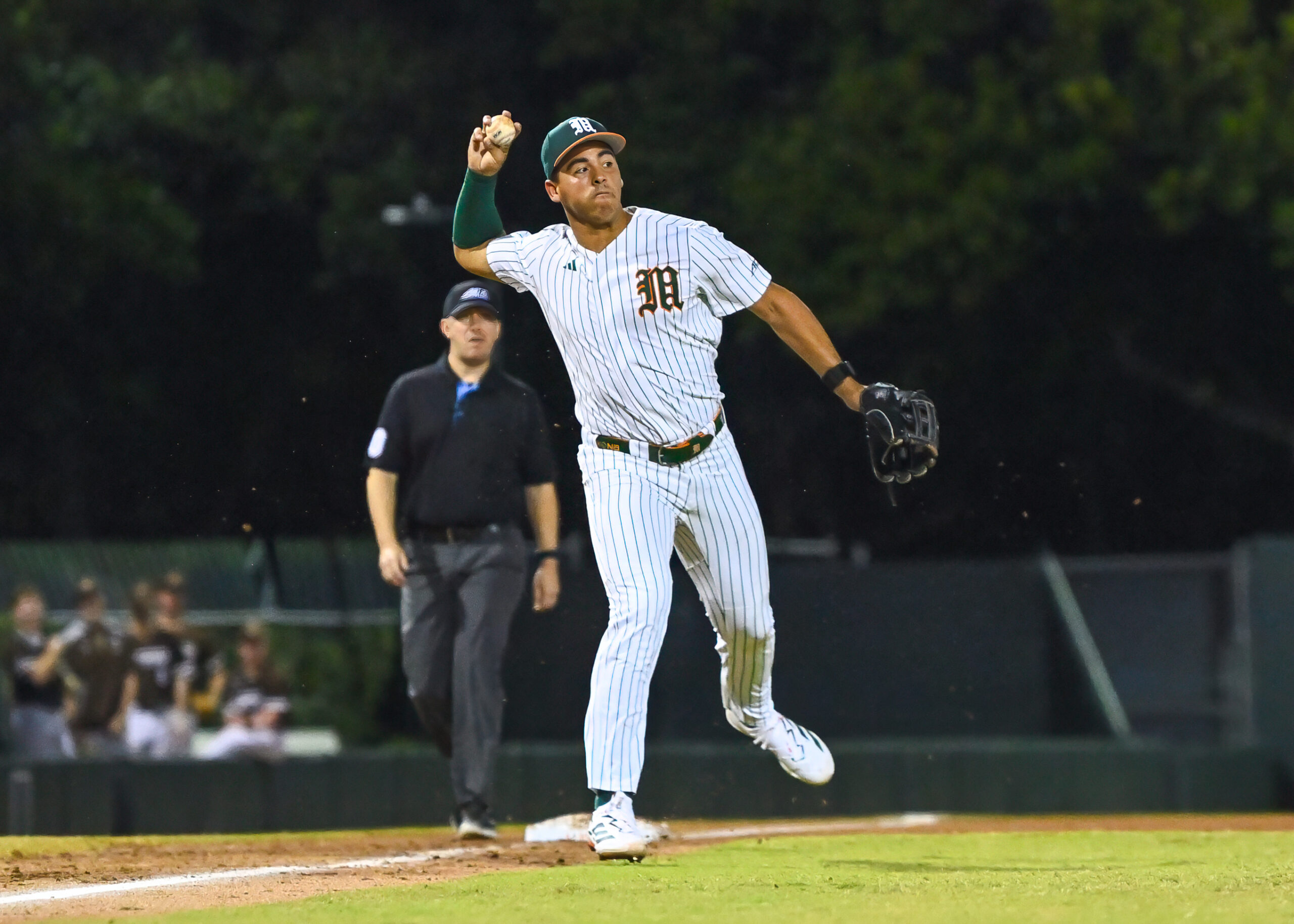
The Miami Hurricanes baseball team continued their strong run of form as of late, taking down the FIU Panthers 9-7 in another offensive eruption. 

The Panthers mounted a furious ninth-inning comeback, but it wasn’t enough to catch up with the Canes after a rocky start. 

TJ Coats earned the win on the mount for Miami, throwing a career-high 6 innings and striking out seven.

On the offensive end, Derek Williams, Brylan West and Jake Ogden carried the load for Miami, tallying 2 hits and 2 RBIs each.

With both defenses on lockdown to start the first inning, West opened up the scoring in the bottom of the second with a two-run blast to left field, his fifth homer of the season.

FIU answered back with a homer of their own in the fourth inning, as Cleveland Cole smoked one to deep right, cutting the lead to one.

The bottom half of the inning was characterized by mistakes for FIU which led to an offensive barrage from the Canes. 

With the bases loaded, a wild pitch skeetered away from the Panthers. Vance Sheahan took his base on the walk and West zoomed home from third to extend the lead. Later on in the inning Alonzo Alvarez got in on the fun, firing an RBI single to right to bring in another run. Fabio Peralta followed it up with a sacrifice fly and then Ogden launched a two-run shot to right field.

David Lebowitz, Contributing Photographer/ Junior Jake Ogden celebrates with his teammate at home plate after hitting a grand slam versus Princeton on Saturday, Febrauary 22, 2025 at Mark Light Field.

By the end of the fourth the score was already 7-1 and it looked like the Hurricanes were ready to run away with it.

Dominant pitching and defense helped the Hurricanes hold FIU to just one more run until the ninth inning, as they bolstered their lead with a Derek Williams 2-run bomb in the seventh.

However, in the ninth inning, the Panthers made a desperate comeback attempt. 

It all started with a Cooper Rasmussen shot to deep right field, which scored two. FIU kept the momentum going, loading the bases and eventually scoring on an RBI walk. 

That was followed by a Mario Trivella 2 RBI single, and all the sudden it was a ball game.

With the game hanging in the balance, Ryan Bilka saved the day for Miami, retiring the last two batters, and helping the Hurricanes eke out the win.

With the win, the Hurricanes improved to 24-8 on the season, and they will return to action this Friday against Wake Forest.

How L-Acoustics shaped the sound of Miami Music Week

You cannot have Miami Music Week without music. More specifically, you cannot have Miami Music Week without sound that actually hits the way it is supposed to. 

During a week built around huge drops, long sets and carefully crafted moments the difference between a good night and a great one often comes down to the sound. Not just what people are hearing but how they are hearing it. 

That is where L-Acoustics comes in. Long known as one of the most influential names in professional audio, the company has quietly become part of the sonic backbone behind many of the spaces and experiences that define Music Week. 

Its systems power major venues like LIV Miami, and, according to the team, are also part of the audio infrastructure audiences hear at places like Factory Town and Ultra. 

LIV’s recent installation was framed by L-Acoustics as an effort to make the venue’s sound match its visual scale, using its L Series system to elevate the room’s clarity and impact.

What makes the company’s latest push especially interesting is not just loudness or fidelity, but flexibility. The team described a process that lets DJs and performers separate stems — vocals, drums, basslines and other elements — in real time, directly from the mixer output rather than relying on tracks that were pre-analyzed in advance. 

That matters because it removes the extra step of cloud processing or preloaded software and turns the performance itself into the workspace. In other words, instead of being locked into a flat stereo image, artists can manipulate track elements live and place them around the room as they play. 

L-Acoustics has been developing its spatial audio ecosystem for years through its L-ISA platform, and more recently introduced L-Acoustics DJ, a tool designed to transform traditional stereo DJ sets into real-time immersive performances. 

The company says the system can turn stereo tracks into 3D spatial audio on the fly, a concept it recently brought to the U.S. festival circuit at III Points in Miami.

That immersive side of it is really what makes this feel different from a normal club setup. With regular stereo sound what you hear can change a lot depending on where you’re standing. If you’re not in the right spot, parts of the track can start to feel thinner or less clear. 

What L-Acoustics is trying to do instead is make the whole room feel consistent so the music stays full and balanced wherever you are. 

That way you’re not searching for the perfect place to stand. You can just stay in the moment and hear it the way it is meant to hit. 

The team said they’ve been developing this kind of spatial technology for years in major productions for artists like Adele and Katy Perry, and the real challenge was figuring out how to bring that same level of movement and control into the DJ world, where everything usually starts from a stereo track.

That makes Miami Music Week a natural proving ground because there are so many events happening at once, with artists, fans, venue teams and industry people all moving through the same city and experiencing the technology in real time. 

It’s the kind of environment where feedback comes quickly and where new ideas can actually be tested under pressure. In that kind of environment, L-Acoustics is not just amplifying the week; it shapes how it is experienced.

Feid’s new era is getting more intimate, more reflective and a little darker

If Feid’s last few years were about proving just how big Ferxxo could become, this new chapter feels more interested in asking what happens when the character turns inward.

That shift has been visible in the music, in the staging and even in the way he has been presenting himself lately. 

At Ultra Music Festival, where he appeared as a surprise guest during John Summit’s closing set to debut their new collaboration “CHICA 305,” Feid did not just feel like another big-name pop-out. He felt like an artist in transition. 

The darker styling, the gold grills, the more shadowy edge of this rollout — all of it points to a version of Feid that feels more introspective and split between identities, even as he remains one of the most visible stars in Latin music.

That duality is now the entire point of his new EP, “FEID VS FERXXO.” In the official release materials, the seven-track project is described as an exploration of “the duality that has defined the artist throughout his career,” balancing “the essence of Ferxxo that first connected with audiences” with Feid’s evolution into one of Latin music’s most influential voices. 

The press release also frames the project as a “sonic journey” connecting those two identities — his roots, his present and the direction his artistry is moving next.

That framing matters because Feid has always contained both sides. There is Ferxxo, the public-facing character fans have embraced for years — playful, neon-lit, swaggering and emotionally direct. 

Then there is Feid, or really Salomón, the more reflective and personal self underneath it all. What this era seems to be doing is making that split explicit instead of keeping it implied. 

The title alone turns the internal contrast into the main event. And if the cover language in the press release is any indication — “EL GREEN PRINT: La Saga (Disc 1)” — this looks less like a standalone EP than the beginning of a longer conceptual run.

That tension between Feid and Ferxxo also comes through in the EP itself. Across the seven tracks — “Que Vuelta Vox,” “El Hexxo,” “La Mejor Música,” “Medellín Takai,” “Trankaito,” “Boleritoxx” and “Se Lo Juro Mor” — the project feels less like a hard reset than a moodier recalibration. 

It moves between beachy, melodic, romantic and reflective textures while still holding onto the core sensitivity that has always made Feid’s music connect. For me, “Boleritoxx” stands out the most — the kind of song that makes this era feel more intimate, more personal and more interested in emotion than pure scale.

That is where some fan speculation has started to grow. Because the project is being framed as Disc 1 of a larger saga, listeners are already reading the rollout as the beginning of a multi-part story. 

One of the titles circulating most heavily in fan conversations is “BABYSITA MOR,” which some suspect could mark a later installment  and possibly even the long-rumored collaborative project with Álvaro Díaz. 

What is confirmed is that Feid is intentionally scaling the live experience down. After years of arenas and stadiums, his newly announced “FEID vs FERXXO: Falxo Tour” is built around smaller theaters and club-size rooms such as The Fillmore Miami Beach, Buckhead Theatre, House of Blues Boston and Brooklyn Paramount. 

That is not the route of an artist who still needs to prove he can sell scale. It feels more like a conscious choice to get closer to the material and to the people hearing it. 

The official press release points to the same instinct by highlighting his sold-out return to Medellín’s Teatro Carlos Vieco, described as an iconic venue that holds special significance in his career.

That smaller-room move makes even more sense when you look at what the EP is actually doing. The release notes describe songs that move between beachy reggae touches, romantic balladry and more melodic urban textures, all while maintaining Feid’s core sensitivity and pushing into newer rhythmic territory. 

One of the tracks even features Japanese rapper Yuki Chiba, extending the project’s global reach while keeping the emotional thread intact. This is not an era that seems designed around excess. It feels designed around contrast.

That is why the phrase Feid vs Ferxxo works. It sounds like a battle, but the deeper point may be that it is not one. They are different versions of the same person. At the end of the day, both still trace back to Salomón, and this era seems interested in letting those layers sit beside each other instead of forcing one to win.

That made his Ultra appearance feel more revealing than it might have at first glance. Yes, it was a flashy guest spot. Yes, it helped push one of the weekend’s most talked-about moments even higher. 

But it also fit neatly into the larger story Feid seems to be telling right now: a superstar coming off giant stages, stepping into a more intimate and reflective frame without losing the magnetism that made him a star in the first place.

This new chapter still has the energy of Ferxxo. It just seems more aware of the person underneath and that may be what makes it compelling.

Beyond Ultra and Factory Town, Miami Music Week still had plenty of life left to give

Conversations about Miami Music Week usually start with the obvious heavyweights: Ultra. Factory Town. The giant stages, packed sunrise sets, photos that make the week look bigger than life. But some of the best parts of Music Week happen in the spaces orbiting those major attractions — in hotel pools, airport lounges, warehouse corners and conference rooms, where the culture keeps stretching into new forms. 

This year, the week felt especially rich in those in-between spaces. Where you could go from a private Carlita set inside an airport terminal to conversations about vinyl at WMC, then end the night at a warehouse rave in Wynwood.

Wednesday started with one of the strangest and most memorable ideas of the entire week. Runway Sessions took over Wait n’ Rest inside a secured terminal at Miami International Airport for a private DJ set from Carlita. This marks the first time an activation like this inside a U.S. airport lounge. 

The setting was intimate and polished– almost surreal, with travel luxury and club culture meeting somewhere in the middle. Wait n’ Rest has built its identity around rethinking what airports can feel like, and this felt like a natural next step — not a gimmick, but a genuine attempt to let music and culture live in a place where they normally do not.

From there, the day shifted into the industry-facing side of the week. Winter Music Conference remained one of the places where Miami Music Week paused for a conversation about the music. It was a  reminder that this week is not only about nightlife, but also the infrastructure and ideas that keep the whole ecosystem moving. 

Later that afternoon, the conversational  feeling carried over into Fun Business Days at Sable in Wynwood, an invite-only conference that brought together venue tech, payments, data, movement-building and culture under one roof. The energy was  less release, more reflection

Then, like so many Miami Music Week days, that more measured pace gave way to the night. A nap later, it was back out to Factory Town for Interplanetary Criminal and Justice, and the week fully tipped into motion.

Thursday was a full Wynwood night, and honestly one of the best reminders that you can build an entire great Music Week experience without ever touching the biggest stages. The night began at Pardon My French, where DJ Snake b2b A-Trak delivered a filthy hip-hop-heavy set that had the room moving almost immediately. 

They  dropped bangers from all over — Snoop, Kid Cudi, Kanye, all the obvious crowd-triggering material. The lighting and sound were on point.  The space had that rare kind of instant good vibe where it  felt like everyone showed up ready to sweat.

That event, like a lot of the week’s more ambitious side programming, was part of the Phase 3 orbit. Based between Chicago and Miami, Phase 3 helped give Music Week a strong middle layer this year: not the giant, obvious anchor events, but the parties and multi-day runs that make the city feel fully activated. 

Their footprint ran from the Sagamore South Beach pool series tied to DJ Mag all the way through Toe Jam XL, which hosted the return of Pardon My French, 10 Years of Black Book, mau5trap, and Steve Angello & Friends. You could feel their hand in the week’s connective tissue.

From Pardon My French, the night jumped to Deadbeats’ 10th anniversary at Mana Wynwood. We made it just in time for the tail end of Zeds Dead b2b Tape B with Levity in the mix. The laser show was insane. The room was dirty and musty in that exact way a dubstep warehouse should be. The bass was punishing. It was one of those environments where nothing about it is clean or elegant, yet that is exactly what made  it hit.

Progressive House Never Died at Midline followed, which ended up being one of the night’s best surprises. The crowd was much smaller than at the other stops, but the energy was incredibly high. Sometimes that is how Music Week works — not every meaningful room is the most packed one. 

Sometimes the smaller crowd is the better crowd because everyone in it has chosen to be there for the same very specific reason. It gave the night a different kind of emotional lift before the route carried on again toward Factory Town for Jamie Jones b2b Loco Dice b2b Seth Troxler and James Hype.

Beyond the events I personally made it to, the rest of the week continued to prove how much depth exists outside the headline attractions. The DJ Mag Sagamore South Beach pool series offered one of the cleanest daytime runs of the week, with labels and artists cycling through a polished hotel setting that has become one of Music Week’s most reliable daytime institutions. 

And then there was Breakaway Beach, which managed to pull one of the more unexpected pairings of the week with a surprise Chris Lake b2b Kettama — the kind of combination that feels so random on paper and yet so perfectly Miami Music Week in practice.

By Friday and Saturday, my route got pulled harder into the gravitational centers of Ultra and Factory Town, where the week naturally reaches its loudest and most obvious scale. But even then, what stuck with me was how much the earlier events had already shaped the mood of the week. The airport set, the industry panels, the Wynwood warehouse hopping, the poolside circuits, the strange and very specific little pockets of dance culture that kept opening up all over the city — all of that mattered.

That is Miami Music Week at its best. Not just the biggest lineups or the most crowded dancefloors, but a city temporarily surrounding  itself around sound. Ultra and Factory Town may be the main attractions, but the whole story lives in how many different versions of music culture can  brush up against each other in the same week.

One minute you are in an airport lounge, the next in a conference room, the next in a pool deck crowd, the next under warehouse lights. That range is what keeps the week alive.

Ultra 2026 felt bigger than a festival

Ultra Music Festival was not always what it is today. Back in 1999, it was a single afternoon on Miami Beach — modest, local, still figuring out what it wanted to be. 

Now it sprawls across three days at Bayfront Park, drawing crowds from nearly every corner of the globe. But the scale of it was not what stuck with me this year. 

It was something harder to name — that feeling of moving through the grounds and noticing, almost by accident, how many entirely different worlds had found a way to exist inside the same weekend.

This year, that feeling was everywhere. Ultra still had the giant drops, oversized visuals and marquee names people expect, but the weekend felt bigger than spectacle. It felt like a crossroads. 

Main stage EDM maximalism sat within walking distance of underground techno, bass chaos, internet-born experimentation and some of the strongest Latino representation the festival has seen in years. Bayfront Park became a place where global dance culture did not just perform itself, it mixed in real time.

That is what made the weekend feel like more than just another edition of Ultra. Right now, a lot of the world feels tense, divided and hard to read, and this festival somehow pushed back against that, if only for a few days. 

Bayfront Park turned into a place where people from everywhere could lock into the same moment, move to the same set and feel some version of the same release. That kind of shared joy can sound a little dramatic on paper, but being there, it felt undeniable.

The programming had a lot to do with it. The Megastructure was delivering some of the sharpest techno of the weekend — precise, relentless, the kind of sets that pull you in and do not let go. 

Walk ten minutes in any direction and the Worldwide Stage was swinging toward full-body bass, the kind you feel more than hear. Drift back toward the Main Stage and the mood shifted again entirely — big, open, built around moments people had been waiting months to experience together. 

Three very different rooms, three very different feelings, all inside the same park. The boundaries between genres, crowds and moods kept bleeding into each other.

That was evident when it came to the Latino presence across the weekend, which felt impossible to ignore. Miami is one of the few cities where a global electronic festival can still sound local, and this year Ultra leaned into that more than usual. 

BZRP’s debut on Friday did not feel like a side experiment or a novelty booking. It felt overdue. His set was one of the clearest examples all weekend of where electronic music and Latin popular music are meeting right now, and of how naturally that intersection belongs on a stage this big. 

Ultra itself highlighted it as one of the weekend’s defining moments, noting that his Friday Main Stage debut featured surprise appearances from Skrillex and Daddy Yankee.

And honestly, that was exactly how it felt in the crowd. BZRP was easily the best set of my first day. He came in with this all-new visual identity, these huge tracks and this sense that the whole thing was designed to announce a new level. 

The Daddy Yankee moment already would have been enough. Then mid-set he brings out Skrillex and the entire thing just erupts. It was one of those Ultra performances where you could feel the scale of the artist changing in real time. 

In a city like Miami, with the kind of Latin American and international crowd Ultra pulls, it just made sense.

That thread kept showing up all weekend. Steve Aoki, who has always had an ear for Latin crossover, leaned into it again on Saturday. DJ Snake took things even further on Sunday when his Main Stage set turned into what honestly felt like a full-on Latino rave. 

J Balvin came out. “Gasolina” dropped. The crowd lost its mind. Later that same night, John Summit brought out Feid and used the festival’s closing stretch to debut a new collaboration. 

Ultra’s own post-festival recap also pointed to that momentum, noting appearances from J Balvin, Ryan Castro and Feid across the weekend.

That mattered. Not because festivals need to check a representation box, but because Ultra is a global festival hosted in Miami. This year, Miami actually sounded like Miami.

The range elsewhere across the lineup only made that feel stronger. One of the things Ultra still does better than most festivals at its scale is give people access to very different kinds of transcendence. 

There was the emotional nostalgia hit of Alan Walker, which was one of my non-negotiables of the whole weekend. I got there day two just in time, and hearing “Faded” live finally felt like some weird little piece of younger me was getting released back into the air. 

It was very real. It was very personal. And it reminded me that festivals are not just about new music or surprise guests. Sometimes they are about finally meeting a song where you needed it.

Then there was the full opposite end of the spectrum. On Saturday, Outlaw b2b Trym at Worldwide was absolute destruction in the best possible sense. Ultra’s official recap described it as an “unexpected mix of heavy sonics,” which is true, but being there it felt even less polite than that. 

Those first 20 minutes were pure release. Hard, fast, punishing and deeply satisfying. It was one of those sets that completely reset your body. The kind where all you can really do is surrender to the pressure and let it rearrange your energy.

That same unpredictability showed up in a completely different way with ¥ØU$UK€ ¥UK1MAT$U. I had been wanting to see him ever since his Boiler Room set blew up, and he absolutely lived up to it. 

The best part was never really knowing where he was about to go next. He would throw in pop bits, trap, strange transitions and combinations that really should not work on paper, but somehow, in his hands, they did. 

He made the Worldwide Stage feel unstable in the best way. Not messy. Not random. Just truly free. Ultra’s recap pointed to him as part of the festival’s expanding global flavor, and that felt right. 

He represented a different kind of dance music future, one less interested in clean genre lines than in what happens when you stop respecting them.Still, the emotional centerpiece of the weekend was Swedish House Mafia.

Ultra had already framed the Saturday closing takeover as a “festival within a festival,” with Eric Prydz joining the trio’s curated Main Stage event after a rare Steve Angello b2b Sebastian Ingrosso opening stretch. 

That sounds huge on paper. In person, it felt even bigger. This was not just a headlining set. It felt like a gathering of lineage. Afrojack, Axwell and Prydz all orbiting the same closing moment gave the whole thing a kind of historical weight that very few festival sets can carry without collapsing under it.

And then there was the run of songs. “Don’t You Worry Child.” “Midnight City.” “Sweet Disposition.” “Wake Me Up.” Four tracks that somehow made the entire field feel suspended between different eras of dance music memory. 

When the Avicii tribute hit, it stopped feeling like just a closing spectacle and started feeling like a reckoning with what this music has meant to so many people over time. 

Ultra itself called it a “new chapter in dance music history.” That might sound grand, but honestly, from where I was standing, it did not feel exaggerated.

And then came John Summit, who had the hardest job of the weekend and somehow made it look easy.

Closing Ultra is not just a booking anymore. It is a test. It asks whether an artist can carry the emotional and physical weight of the entire weekend’s final release. And for me, Summit passed that test. 

More than that, he made a serious case that he can wear that crown for a while. His set was not my single most shocking one of the weekend, but it may have been the most consistent. The energy never really dipped. 

He knew exactly how to hold the field. He brought out Feid. He closed by jumping into the crowd and taking in the fireworks from inside the audience rather than above them. That gesture said a lot. 

For all the discourse around him, there is still something very sincere about the way he approaches this whole thing. Love his music or not, he seems genuinely grateful to be in it.

That is part of why Ultra still works. It is still trying to evolve. One of the clearest examples of that this year was the RESISTANCE Cove, which became the first zero-emission, battery-powered stage at a major U.S. electronic music festival.

 Ultra’s Mission: Home initiative says the battery setup at the Cove prevented nearly 19,000 pounds of carbon emissions from entering the atmosphere, the equivalent of an average car driving more than 22,000 miles. 

That kind of detail matters because a festival of this scale should not only be asking how to get bigger. It should also be asking how to get smarter.

Ultra closed things out with some numbers worth noting — 165,000 attendees, 100 countries represented, a sold-out run, and Miami-Dade County officially putting March 28 on the books as Ultra Music Festival Day. 

Milestones like that are easy to rattle off in a press release. What they cannot tell you is whether the weekend behind them actually had a pulse. This one did.

What I kept coming back to had nothing to do with crowd size or production scale or who showed up unannounced. It was something quieter than that — the sense that Ultra, for one weekend, managed to hold a genuinely mixed room without sanding everything down to the same thing. 

EDM maximalists and techno heads. Bass freaks and Latin music fans. People chasing nostalgia and people who had never been to anything like this before. First-timers who came for one artist and left with a list of five more. 

Getting all of those people to coexist inside the same festival, without any of them feeling like an afterthought, is not easy. This year, it worked. Ultra did it anyway.

And in a moment when so much of life feels fragmented, there was something genuinely meaningful about that. Not because festivals solve anything. They do not. But because for three days in Bayfront Park, a lot of different worlds moved together and that still counts for something.

Factory Town bent time during Miami Music Week and that was the point

The best way to describe Factory Town during Miami Music Week is that you cannot do it all.

You stand in one room listening to some of the best music of your life, dancing the night away, and yet somewhere two stages over another set is peaking without you. You feel it in the back of your mind the entire time. 

Not as regret exactly, but as pressure — the good kind. The kind that tells you the programming is working. Over five nights from March 25 through March 29, Factory Town was the gravitational center of Miami Music Week. It’s a place so stacked, so spacious, and so constantly alive that it made missing out feel like part of the experience.

For me, the week really did begin and end there. I did all five days at Factory Town, which meant my sleep schedule eventually stopped making any real sense. My entire week started revolving around how and when I could make it back to town and stay there until the early morning. I basically became nocturnal. 

And once you are inside, that starts to feel normal. Time behaves differently there. One quick stop at the Chain Room turns into an hour. A plan to catch only half a set in Infinity Room becomes a full sunrise mission. You leave one stage with the intention of going somewhere specific and get swallowed by something else entirely. 

Factory Town has a way of compressing time because there is always one more room, one more sound pulling you, one more reason to stay.

That is what made this year’s programming so strong. The lineup did not feel top-heavy or easy to game out in advance. It felt balanced in a way that made every decision feel costly. And that is a compliment. 

There were epic sets happening all over the venue every night, and the range across the five-day run was as wide as I have seen at Factory Town yet. Minimal and tech house were obviously there in force, but so were acid house, drum and bass, hard techno, melodic crossover moments and stranger, more difficult sounds that still found a crowd. 

You knew the curation was good because even while you were having a transcendent time, you were still hearing from everyone around you about what you had missed. That is not bad scheduling. That is abundance.

Factory Town’s physical design is what allows that abundance to actually work. Five stages is one thing on paper, but five stages with enough room to breathe, walk, reset and re-enter is something else entirely. 

No other venue in Miami really offers that combination at this scale. You can spend a whole night in one room or drift between multiple worlds without ever feeling trapped inside one traffic pattern. 

The art installations in the middle of the grounds help with that too, giving the venue real pockets of pause between intensity. Then there was the open-deck section at the Engine Shed, which added one of the week’s more genuine little surprises. 

It had that improvised intimate energy where people could step up with their usb and shape the atmosphere themselves. The result was messy in the best way — immediate, unpredictable, human. The kind of connection that could only really happen in the heat of the moment.

Production stepped up again this year too, but what mattered most was how different each space felt from night to night. Factory Town was not static across the week. It kept changing identities. 

The Infinity Room featured those wire-like illuminated cables wrapping around the main posts on the dance floor, which made the room feel like it was constantly pulsing from the inside. Chain Room had upgraded lighting and new CO2 cannons that gave the space a sharper, more aggressive edge. 

The Park featured a massive cube suspended in the middle of the ceiling that kept lighting up into a rotating F and T, branding the entire room without feeling tacky. 

The Warehouse had new lights stretching across the posts and overhead, creating tunnel-like patterns that made the room feel colder, more industrial and somehow even larger than before.

Some of the best transformations came through the label and brand takeovers. Planet X made its room feel like a fully formed environment, with a stage that looked like a flying saucer dropped into the middle of the party. 

At Infinity Room, elrow closed the final night by bringing a carnival of confetti, dancers and pure overstimulation. Even the rain made sense there. It did not ruin the illusion. It intensified it.

The crowd was part of the architecture too. Factory Town during Music Week felt like one of the clearest examples of how dance music collapses social boundaries when it is working at its best. 

There were locals, travelers, veterans, younger ravers, people in full fashion-week mode and people dressed like they had wandered in from a warehouse in another decade. There was visible international crossover everywhere. 

You could hear different languages around you all night. There were older ravers still moving like they knew exactly what the room demanded. 

There were younger crowds chasing their first real sunrise. That mix mattered. Factory Town did not feel like one scene occupying a venue. It felt like multiple scenes agreeing to share the same week.

That showed up most clearly in the sets themselves. Justice’s Factory Town debut carried the kind of prestige that automatically made it feel like an event before a single note played. 

Seeing them take over the Infinity Room gave the venue a certain legitimacy that only a few acts can bring. It was not just one of the week’s biggest bookings. It was one of those performances that shifts the perceived ceiling of what a venue can hold.

Josh Baker, b2b Prospa and b2b Kettama felt a generational pulse of the week. Three artists with different energies converging at sunrise with loose, modern and chaotic energy. A great sunrise set can reorder your body. 

They dropped a mix of “Sweet Disposition” as the sun came over the horizon. It was one of the best ways I have ever watched the sun come up. It just felt alive.

Then there was Ben Sterling, b2b Beltran and b2b Tiga at The Park during Planet X, which brought a totally different kind of satisfaction. The set was groovy in a way that felt effortless, the kind of dancefloor energy that does not need to overpower you to keep you locked in. 

At one point they dropped a mix of “Heads Will Roll” that instantly changed the room and got the crowd really bumping. After so much running around between stages all week, that set felt like a reminder of how good it can be when a room finds its groove and just stays there. 

“I HATE MODELS” brought one of the week’s most intense sets, but what made it work was that he did not just go hard for the sake of going hard. There were stretches where he eased the room in just enough before completely flipping the energy on its head. 

That contrast is what kept the set unpredictable and alive. He’ll pull from places you do not expect — like dropping “Paleta” into the mix — and somehow make it all feel coherent. It was a reminder that the harsher side of Factory Town’s programming works best when it still leaves room for surprise.

Max Styler and b2b CamelPhat delivered a different kind of emotion. If any set belongs as the final image of the week, it is that one. By then it was pouring rain at Factory Town and people were still out there dancing all the way through it, not caring at all about wet socks. 

This set reminds you how beautiful humanity can be when we let go together. This one had that feeling. That is maybe the simplest way to say what Factory Town did over those five days. 

It made every path through it feel both complete and incomplete at the same time. You could have a perfect night there and still know you left something extraordinary unseen. But that was never a flaw. 

That was the whole design. Factory Town succeeded because it gave everyone a different Music Week experience. By the end of the week, that was the real takeaway. Factory Town did not just host five nights of music. It distorted time, demanded choices and turned abundance into atmosphere. 

The age of leisure: Pajamas and loungewear are taking over fashion

Nights in Brickell, out to dinner or meeting up with friends warrants a put-together outfit.  Running errands, going to an 8 a.m. class and getting some work done is all about being comfortable. 

What once was blouses, polos, jeans and sneakers, is fading into hoodies, sweatpants, flannel pants and Uggs. 

“Cute-Comfy” is the trend of this decade. It dates back to 2020, the start of the Covid-19 

pandemic. In an era when leaving the house was limited, pajamas became an all-day outfit. 

The University of Miami isn’t exempt from this trend. Seven out of eleven interviewed students believe this is part of the reason daytime loungewear is ideal. Instead of waking up earlier to pick out a nice outfit, a hoodie and sweatpants is the perfect solution for saving time and energy for plans later that night.

Helena Lopez, the president of University of Miami’s Luxury and Fashion Club, says, “brands started to respond more and more to this by releasing sets, pajamas and loungewear that met consumer’s wants, and it became a feedback loop.”

Brands like Skims and Comfrt establish their identities as loungewear brands, creating a new market for their audiences. Skims, founded in 2019 by Kim Kardashian, Emma Grede and Jens Grede, sells a wide range in a small niche. 

The umbrella of pajamas and loungewear is large, though. It’s not just matching sets and nightgowns. 

Almost exclusively just shapewear, underwear, loungewear and pajamas, this brand has been a catalyst for the cute-comfy trend, especially given that it’s founded by a Kardashian, an instant trendsetter.

Comfrt is another growing loungewear clothing brand, targeting a different audience within the same niche. This company, founded in 2022, offers a selection of hoodies, loungewear and athleisure for both men and women. 

Both brands were created within the past decade, a testament to the timeline of the trend. 

Out of the11 UM students, nine of them reported that they have worn pajamas in public spaces and plan on continuing to do so. 

Many of them come to the same consensus, including sophomore Alex Serrano, who says he wears loungewear “half the time because it’s easy to put on and is comfier than a polo.” 

Lopez also notes that “this trend goes hand in hand with the trends of wearing silk and embroidery, where shorts, tops and dresses can be confused with house dresses or night gowns.” 

This implies that the trend may only be a passing fad, given that preferable looks and materials swap every few years with the influx of newly-desired aesthetics. 

However, in terms of comfort, convenience and expense, the more realistic component of fashions, loungewear may be here to stay. 

A study conducted this year by Industry Research found that 65 percent of global consumers prioritize comfort in their outfits while only 18 percent of consumers prefer traditional daywear.

“I see it as something permanent, at least in the US, because it’s been normalized through the years that people dress down in sweatpants and comfortable clothing for everyday errands, airports, school, etcetera.,” Lopez said. 

Although it appears people would much rather wear comfortable clothes as much as possible, there are still limits – just different than the previous limits of wearing them exclusively to bed. 

Eight out of the 11 interviewed UM students don’t think it’s appropriate to wear pajamas to class, and all of them agree it’s inappropriate to wear them to work. 

Where it gets hazy is in the classroom and running errands. Eight out of eleven students wouldn’t wear pajamas to class, but they would wear them to run errands or travel.

The U.S. Secretary of Transportation, Sean Duffy, even got involved in the debate, saying “dress up to go to the airport, help a stranger out, and be in a good mood” in an interview with Fox Business. 

He includes this in his Civility Campaign, which introduces the idea that dressing nice equates to a demonstration of respect.

“I think your personal presentation says a lot about your demeanor and work ethic,” Lopez said. “Dressing well and put together can sometimes make a difference in other people’s perceptions of you.”

DragOUT celebrates its 13th year at UM

The Shalala Ballroom transformed into a runway, complete with stagelights, screens and costumed audience members to showcase SpectrUM’s annual DragOUT celebration.

Proceeds directly benefitted The McKenzie Project, a Miami based organization dedicated to uplifting Black transgender and nonbinary individuals, particularly by addressing the challenges of homelessness and HIV/AIDS. 

A large portion of the proceeds will also go toward “House of the South,” South Florida’s first and only housing program run by and for transgender individuals.

“Drag is an art form that we support and build our programs around knowing that our staff and board of directors are also all drag entertainers,” said House of the South CEO Jasmine McKenzie. “We agreed [to partner with SpectrUM] because we know firsthand how hard it is to raise funds as a Black trans-led organization in the state of Florida.”

Professional drag artists and students alike came together to perform for an audience of approximately 200. 

Hosted by South Beach’s Palace drag performer Tiffany Fantasia, the Friday evening spectacular offered audience members an up-and-close experience with several professional drag artists, including CC Glitzer, Ground Zero, A’Zaria Lavish and special guest LaLa Ri, a Rupaul’s Drag Race Season 13 competitor. 

Students performed for a panel of four judges, including Dr. Barbara Hoffman, professor of writing studies, Dr. Mark Lomanno, professor of musicology and freshman Olivia Bueno. 

This year, DragOUT began a new tradition of inviting back an alum to judge, starting with Michael Robinson Jr., a member of UM’s centennial class and DragOUT 2025 runner-up.

Drag artist CC Glitzer performing at SpectrUM’s DragOUT in the Shalala Ballrooms on April 3, 2026. Photo Credit // Ariana Glaser.

Any UM student can sign up to perform at DragOUT, and each student performer is granted full creative control. Though SpectrUM provides access to their suite’s wigs and costume pieces, most students bring their own makeup and costumes to fully execute their vision. 

Each of the three student performers took home a title: Ellie Gibson (“Annie PC”) took home first place, Sam O’Connor (“Miss Stake”) was named runner-up and Courtney Hartung (“Dallas Demyze”) was crowned the fan-favorite by an audience vote.

Outside of her drag persona, Hartung serves as president of SpectrUM. In preparing for DragOUT, Hartung led the E-Board through reserving the space, contacting and coordinating with the production company, assembling a budget and ordering necessary materials. 

“DragOUT was exhilarating; to see so many talented performers get to exhibit their art during one joyous night meant so much to me,” said Hartung. “Overall, DragOUT is a night to celebrate art and queer joy. It unifies people from many different backgrounds to celebrate drag and how diverse the artform itself can be.”

SpectrUM is the University of Miami’s oldest undergraduate LGBTQ+ organization. Though DragOUT is SpectrUM’s biggest event, other highlights include Winter Formal, drag workshops and open performance nights.

To celebrate DragOUT’s 13th year at UM, this year’s theme was “spooky.” Some performers went all out. Ground Zero, for example, appeared to swallow knives and staple his skin. 

Tiffany Fantasia, on the other hand, poked fun in her black corset, quipping, “What’s scarier than a man in a dress?”

DragOUT is one of several UM LGBTQ+ events to celebrate College Pride Month. Celebrations continue on April 11 with L.O.V.E. Symposium and April 12 with the Miami Beach Pride Parade. 

No. 28 Miami women’s tennis defeats Boston College, 4-1

0

The No. 28 University of Miami women’s tennis team defeated the Boston College Eagles 4-1 on Sunday afternoon at the Neil Schiff Tennis Center. 

With the win, the Hurricanes (13-4, 8-2 ACC) matched last season’s number of home victories.

To start off the day, UM took care of the doubles point with two wins on the top courts. 

Raquel Gonzalez and Sebastianna Scilipoti took the opening match victory over Seren Agar and Olivia Benton, easily winning 6-1. Dominika Podhajecka and Daria Volosova won the doubles clincher, 6-4, on court two over Bella Camacho and Tola Glowacka.

When play was stopped, Aely Arai and Jaquelyn Ogunwale were leading Boston College’s (8-12, 0-10 ACC) Olivia Cutone and Leyden Games 5-4.

The Eagles notched their only win of the day at the start of singles play when Games bested Scilipoti in two quick sets, 6-3, 6-0. From there, the Canes took care of business, winning the next three matches to finish the day. 

The matches finished in the order that follows: Volosova bested Nadia Barteck 6-3, 6-2, No. 107 Podhajecka took care of Camacho, winning 6-4, 6-1 and Ogunwale notched the final win over Agar with a score of 6-2, 6-3.

When singles play was halted, No. 96 Sofia Rocchetti was leading Benton 6-4, 2-4 and Arai was up against Glowacka after a close first set, with a final, unfinished score of 7-6 (7-4), 3-1.

The Hurricanes will be back at home on Friday at 12 p.m. when they face the North Carolina Tar Heels (21-2, 9-1 ACC) at the Neil Schiff Tennis Center.

Awareness feels good, but action feels better

0

Scrolling through TikTok, Instagram or Twitter often feels like the easiest way to stay updated on global conflicts or crises. Friends, influencers, and advocacy accounts flood social media fees with proclaiming solidarity and support. It seems like a call to action. Where reposting feels like the expected response. But does this form of advocacy truly lead to meaningful change?

But, resharing a post on Instagram is not going to save the world. It can help people learn about the topic, but you aren’t an activist just because you repost a story. 

Social media gives users a platform to discuss topics they are passionate about. A post can start off the conversation and introduce people to a cause. Meaningful activism involves taking initiative to challenge systems and cooperate with people to create change for the greater good. This kind of work requires time, consistency and real sacrifice. Currently, online activism allows people to confuse minimal effort with change and initiative.

When people’s Instagram posts do not accurately reflect their behavior and real-life decisions, it’s just a performance. Posting a story about a political crisis and refusing to have an open discussion or donating to the cause people advocate for is hypocritical. 

True change comes from hands-on action. It can come in many forms. At UM, clubs and organizations host fundraising events and informative workshops. There are sororities raising funds for philanthropy causes and student volunteers with campus nonprofits.

Despite this, people can still take different forms of action. Educating family and friends, boycotting companies, writing letters or calling representatives are all meaningful forms of activism. Reposting content should be a supplement to these activities, not a replacement for them.

“A specific example of our chapter’s impact is through our Anchor Splash Philanthropy week, where we raised over $25,000 in support of Service for Sight,” said Claudia Fonseca, philanthropy chair of Delta Gamma. “A portion of those funds directly benefit the Miami Lighthouse for the Blind and Visually Impaired, helping expand access to vision rehabilitation services, educational programs and assistive technology for individuals with visual impairments in our local community.”

Public advocacy efforts from organizations like Greek life bring attention to important causes.  Public advocacy is not equally accessible to everyone. 

Not everyone is able to support a movement publicly or even make a post because it can risk people’s safety. This is especially true as ICE continues to  target individuals and collect information in different ways. 

Activism on social media can expose undocumented immigrants or activists to surveillance, making it dangerous for them to publicly support or engage in movements. 

Social media can add a lot of significance to social movements, as was seen in the 2020 Black Lives Matter Protest. But the blackout Tuesday screen on everyone’s feed was not a major factor of change. Rather, it was the protest, donations, awareness and education that came with action. 

Now, political movements feel like a trend where people give attention for a brief moment and forget all about it for the next big issue. Celebrities wore pins at the Grammys and some gave speeches showing support for a cause, leaving people questioning whether this was activist or merely a performance. Many of our favorite celebrities engage in performative activism and leave it there. 

Without action such as donating, volunteering or using their influence to create systemic change, their involvement becomes little more than a publicity stunt. This leaves a cycle where the issue becomes fashionable for a short time, only to be replaced by the next trending cause.

Every so often an “all eyes on ” will be circulating Instagram stories with an AI-generated image that has millions of reposts. The trendy repost story is pushed higher, and the educational post explaining the situation is pushed down. 

The media works with algorithms. If a political issue is a trend, those algorithms often magnify the performance tendency. The more interaction a post has, the more it will be pushed by social media platforms. The algorithm keeps individuals in a chamber of limited exposure to perspectives, creating polarization and posing a direct threat to successful organization.

A few years ago, movements like Black Lives Matter and the Ukraine-Russia war were everywhere on our timelines. But now, they’ve been pushed aside to make room for the next big crisis or movement, quickly forgotten as new issues take over. 

How long before people stop discussing Gaza and Israel or ICE?

Social media is a vessel to export information to the masses, but it should not be the sole tool used to drive change, as it will just lead to a false sense of accomplishment. Discussion of social movements can lead to real action and education like lobbying or donations, but it will never be successful if it’s solely kept online. 

As stated earlier, activism without change beyond social media is performative. Reposting a graphic or slogan, then doing nothing else is performative. Changing a profile picture for a cause just because it is trending, is performative. Giving the illusion of activism without meaningful action.

It’s time to get off your phone and advocate for what you believe, stand by your values and create change in your community.