Celebrating their seniors at Hard Rock Stadium, the No. 15 Miami Hurricanes pummeled the NC State Wolfpack Saturday afternoon, winning 41-7.
Down 3-0 in the first quarter, NC State sophomore quarterback CJ Bailey dropped back and intended to throw the ball to Justin Joly. Instead, Miami safety Jakobe Thomas flew in front of the NC State tight end and ran behind a “wall of orange” to the endzone for a 60-yard touchdown return.
The defensive score set the tone for the game, and Miami continued to put its foot on the neck of the Wolfpack all game.
Miami’s defense dominated all four quarters, holding NC State to 149 total yards on the night with just 29 of those being rushing yards.
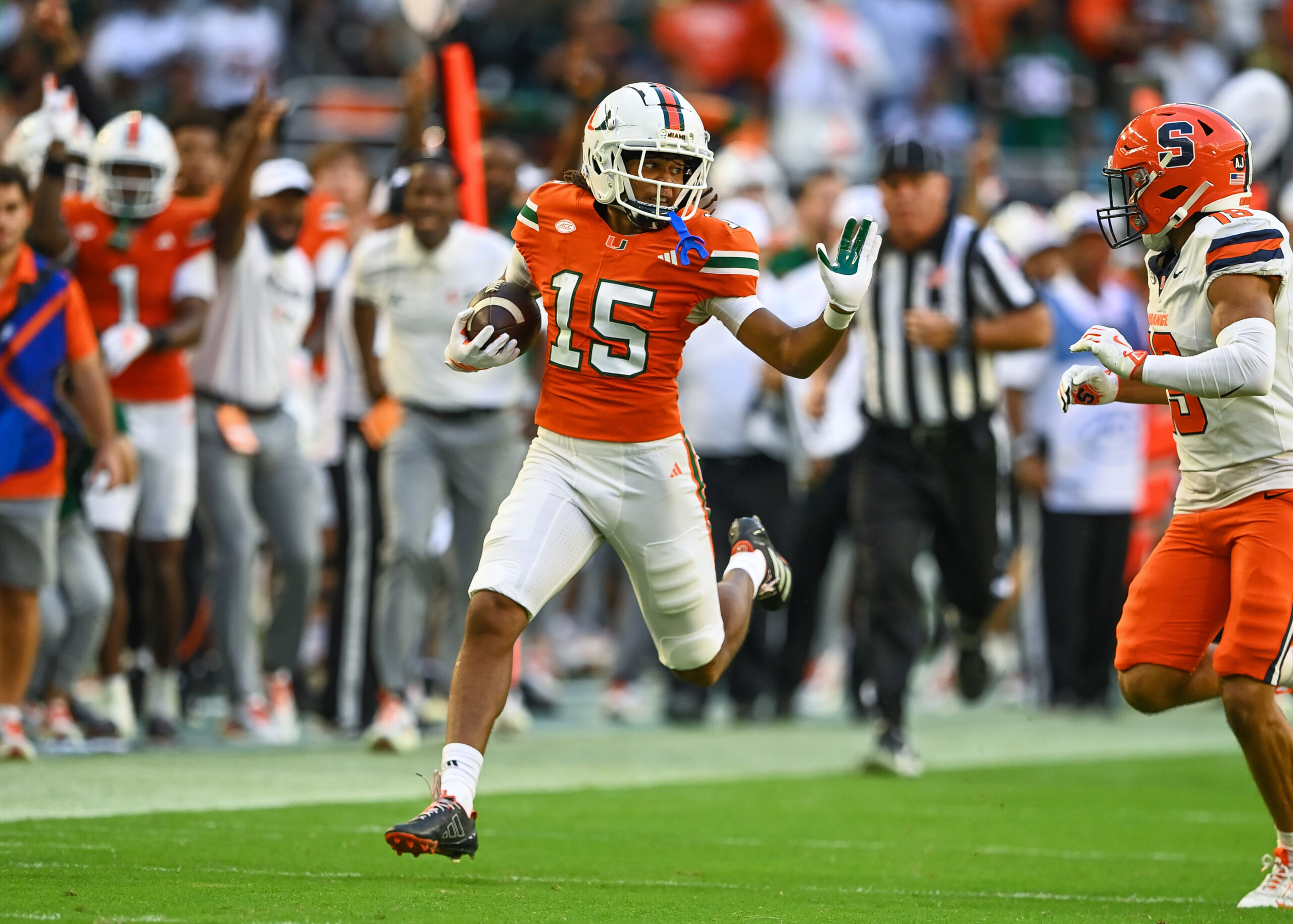
UM (8-2, 4-2 ACC) drove down the field on its opening drive, thanks in part to a Keelan Marion 35-yard grab down the left sideline which resulted in a 31-yard field goal by Carter Davis.
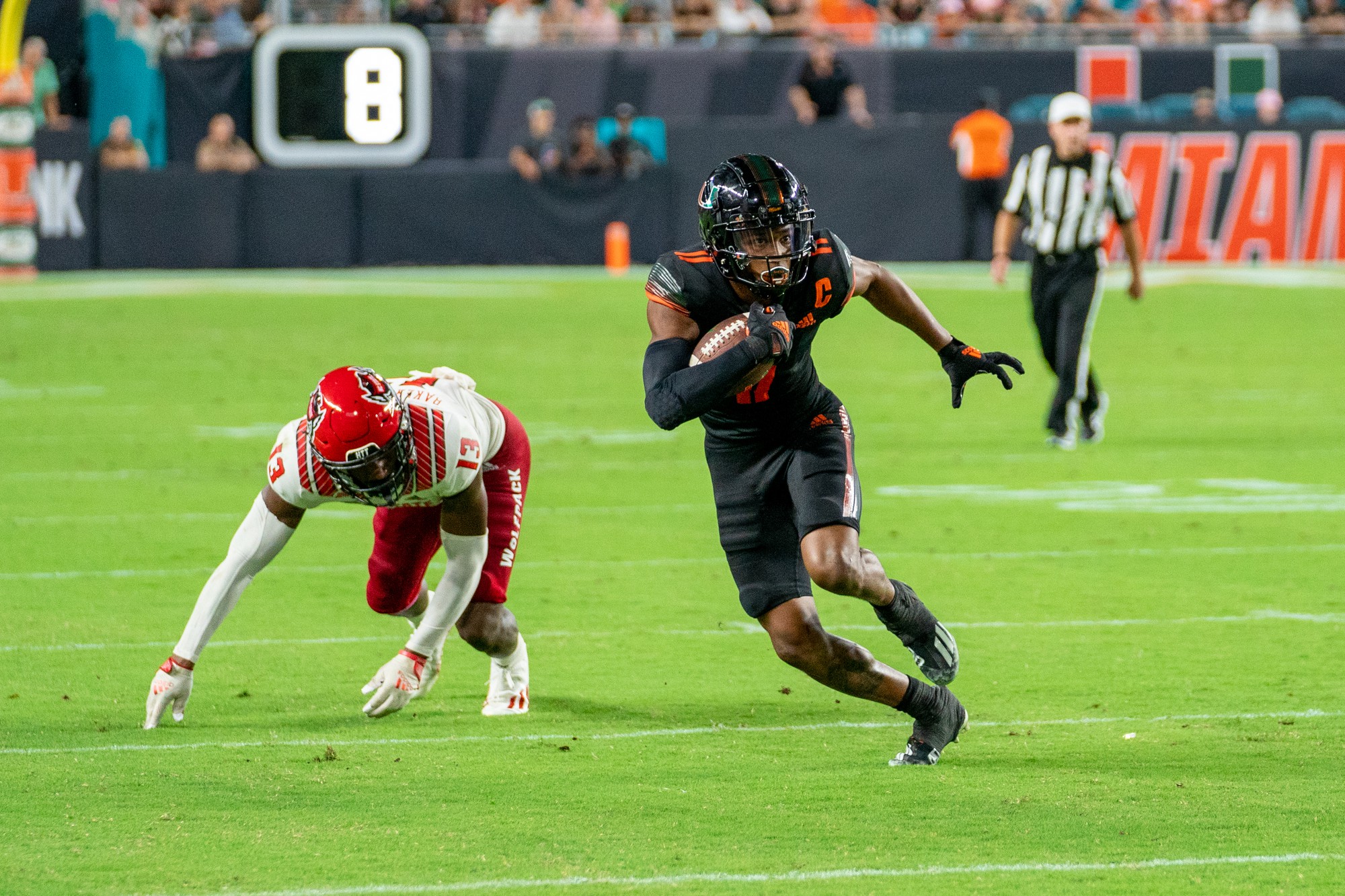
David Lebowitz, Staff Photographer/Fifth-Year Senior Safety Jakobe Thomas returns an interception on November 15, 2025.
Marion had another exceptional performance, leading the team with 96 receiving yards on nine receptions.
On its next offensive possession, NC state senior cornerback Devon Marshall popped the ball out of redshirt sophomore running back Marty Brown’s hands. Wolfpack senior linebacker Caden Fordham came up with the fumble.
That was the only bright spot NC State (5-5, 2-4 ACC) saw all game, from there on it was all ’Canes.
Thomas secured his aforementioned pick-six, and followed it up with his second interception of the night to give Miami the ball back with all the momentum with the orange and gree.
Up 10-0 in the second quarter, Miami offensive coordinator Shannon Dawson opened up the playbook.
On NC State’s 48-yard line, Beck pitched the ball out to freshman wideout Malachi Toney who rolled right and threw a 44-yard bullseye to sophomore wideout Jojo Trader.
A few plays later, Brown ran it in for a one yard score to move the score to 17-0.
With time winding down in the first half, Beck led the offense on a methodical nine play, 66-yard score that was capped off by a 14-yard pass from Beck to Toney in the endzone. Going into halftime, Miami led 24-0.
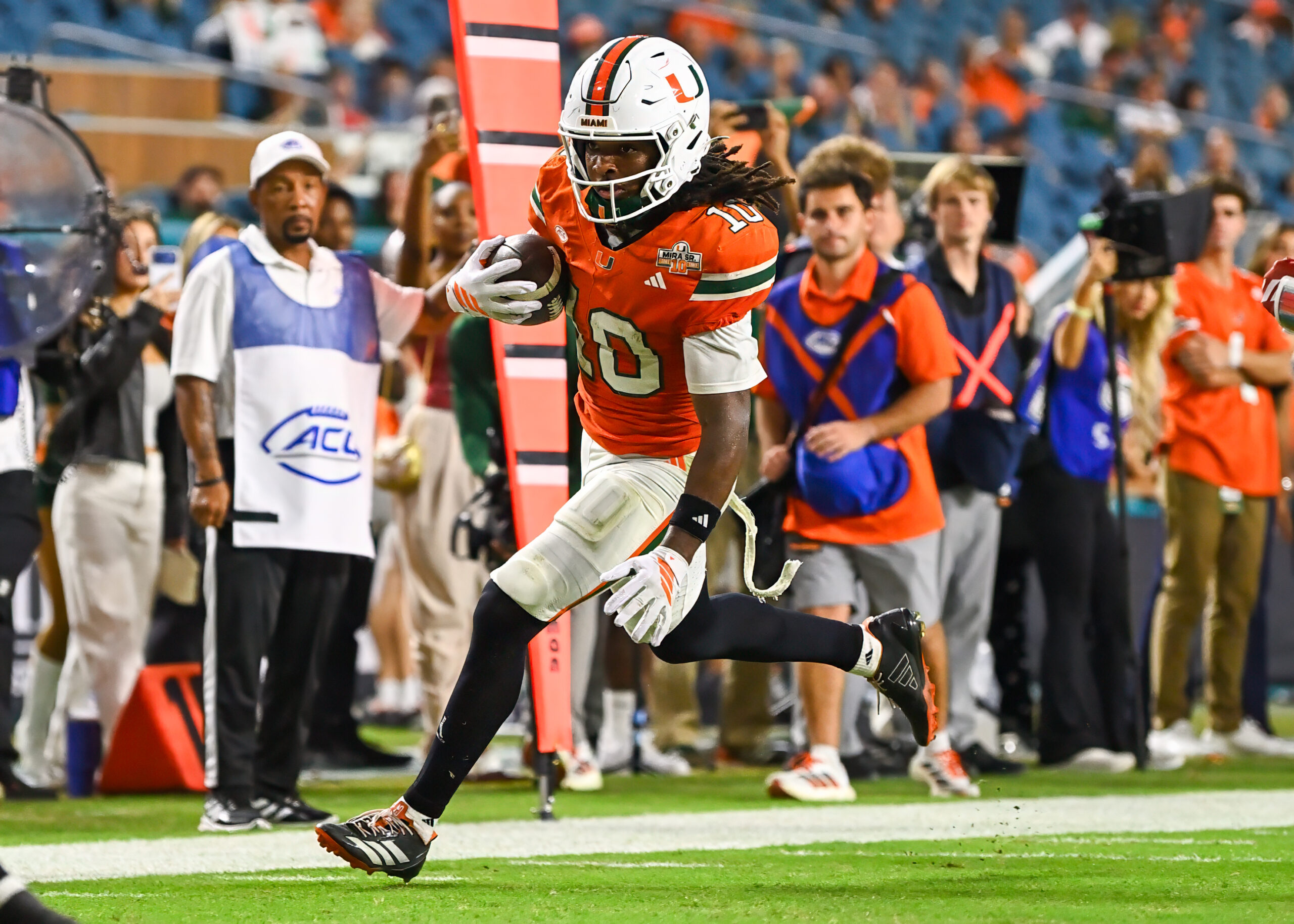
Toney finished the game with five catches for 54 yards and two touchdowns.
David Lebowitz, Staff Photographer/Freshman Reciever Malachi Toney running the ball toward the endzone after a redzone catch on November 15, 2025.
“The best part about this guy [Malachi Toney] is his approach,” Miami head coach Mario Cristobal said. “Everything he wants to do is get better.”
The 24-point lead marked Miami’s largest first-half lead over an ACC opponent this season as the ’Canes have struggled out of the gate against their conference foes this year.
The Hurricanes came back out in the second half carrying their swagger and urgency from the first half.
On NC State’s 29-yard line, Beck hit sophomore Elija Lofton for his first receiving touchdown of the year. Miami firmly took the driver’s seat, going up 31-0.
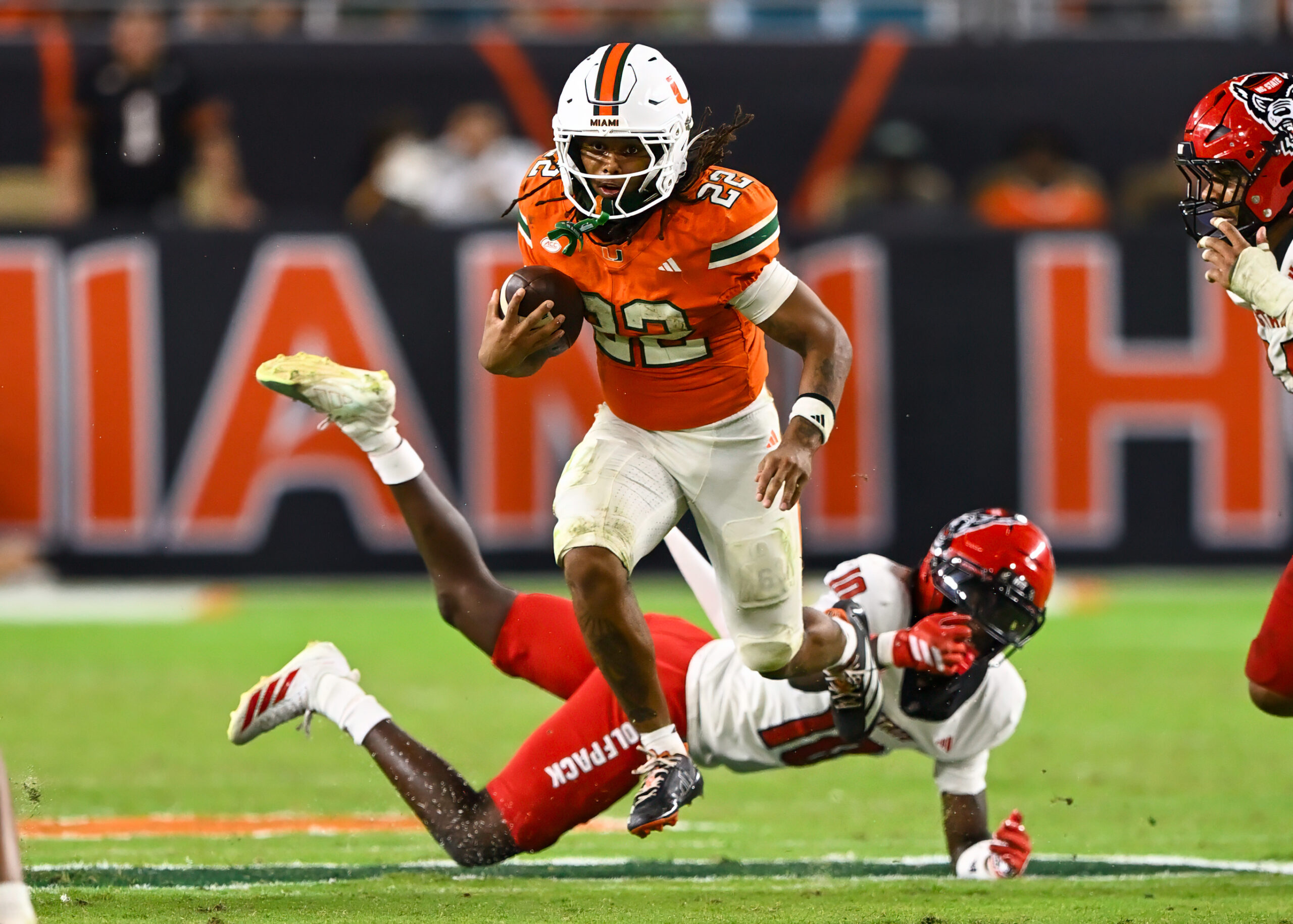
Despite throwing the ball for 367 yards, it was Miami’s rushing attack, led by true freshman Girard Pringle Jr., that opened everything up for the offense. The Tampa native finished the game with 116 yards on 17 carries.
“It feels great. You know, when I got the chance to execute, I executed,” Pringle said postgame.
David Lebowitz, Staff Photographer/Freshman Runnning back Girard Pringle Jr. makes an NC State defender miss on November 15, 2025.
The Beck and Toney connection continued in the fourth. With under 12 minutes of regulation left, Beck threw a short pass to Toney, who ran it into the endzone for a 15-yard score and moved it to 41-0.
Beck threw for an efficient 291 yards on 21-for-27 passing with three touchdowns.
“We’ve been really good and we really, kind of found our rhythm, again, in passing, the run game. Just complementary football on offense which is so important,” Beck said.
As the clock ticked down, UM waved goodbye not only to the Wolfpack but the fans who showed up on Saturday night and all season long. 510,613 fans cheered on the ’Canes this season, a program record.
“It’s all about one game. It’s always worked best for us,” Cristobal said. “We really appreciate the support because these fans made a big difference.”
Every win from here on out is a statement and the motto of “1-0” needs to continue next Saturday at Virginia Tech.
The game will be played at Lane Stadium on Nov. 22 and the game time is to be announced.
The No. 14 Miami Hurricanes volleyball team (22-4, 12-3 ACC) stayed red hot, defeating Notre Dame (9-14, 6-9 ACC) in four sets to extend their winning streak to seven.
The Hurricanes were headlined this week by Flormarie Heredia Colon, who earned AVCA National Player of the Week honors – Miami’s first ever. Heredia Colon broke her own program record with 42 kills in the first of two matchups against FSU, which the ‘Canes won in five sets. Then, in the second game against the Seminoles, Heredia Colon tallied 32 kills as well.
The Hurricanes opened the first set blazing, 7-1. At 13-7 Miami, Ariana Rodriguez’s assist to Dalia Wilson marked her 2,000th career assist. Miami went on several scoring bursts, finishing points with kills from every area of the court. The Hurricanes hit .444 as a team in the 25–14 set win. Miami has only lost two matches this year when winning the first set.
To begin the second set, Wilson and Rodriguez each recorded a service winner. Miami then put together three straight points, with Heredia Colon registering her eighth kill to extend the lead to 11–5. Rodriguez later added two consecutive kills, and Danilovic contributed another. The Hurricanes closed out the set, 25–14.
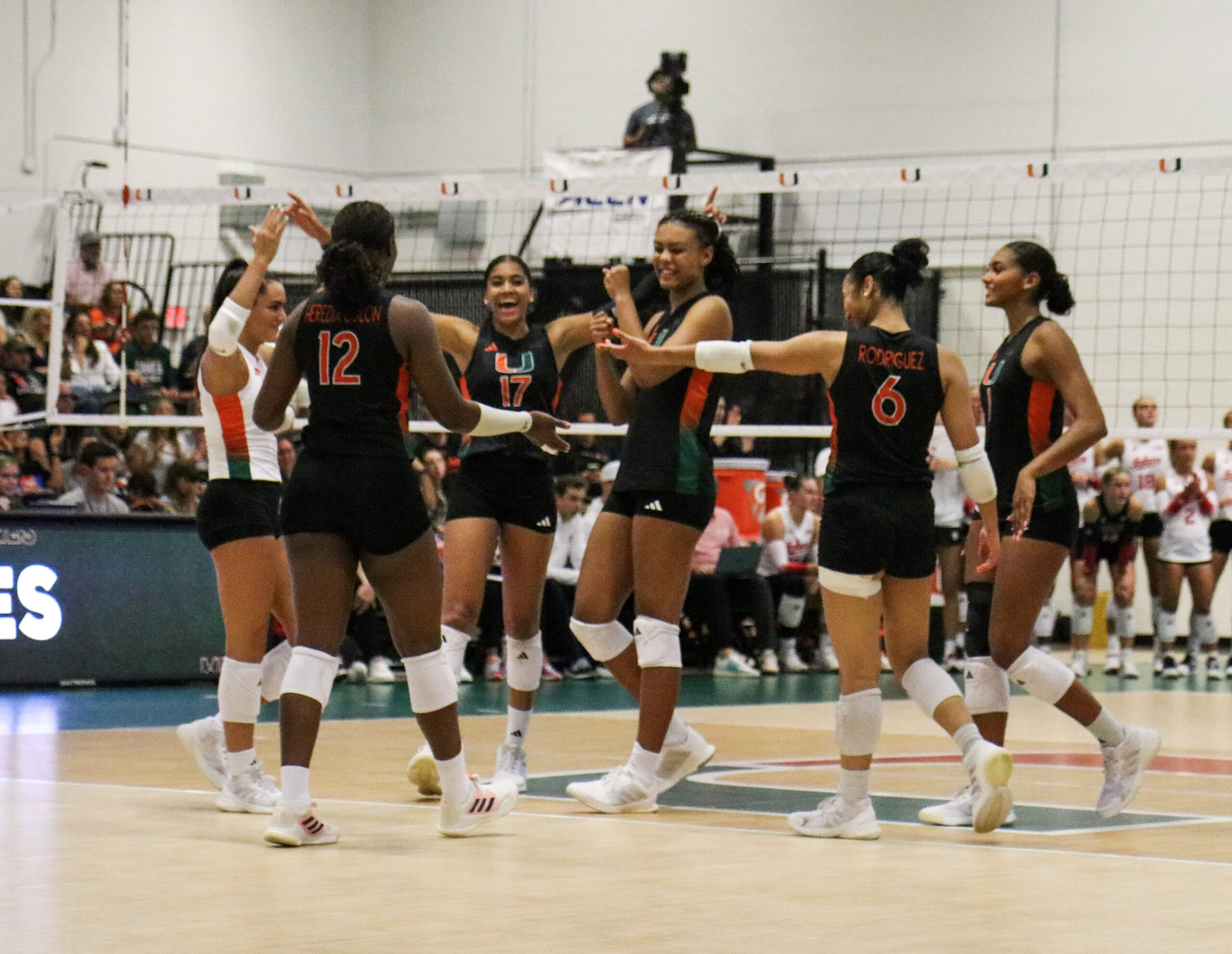
UM’s women’s volleyball team celebrates after a point against Indiana
In the third set, Notre Dame raced out to a 5–2 advantage, but a series of errors by the Fighting Irish and a kill from Amina N’Diaye allowed Miami to pull even at 12–12. The sides continued to exchange points, and Notre Dame eventually held a 20–15 cushion.
Miami answered, with Feliciano extending a crucial rally through three defensive plays before the Hurricanes drew level at 20-20. Heredia Colon then delivered consecutive kills to bring the score to 24–24. A kill from the Fighting Irish’s Chichi Nnaji, followed by an attacking error from Heredia Colon, ended the set for Miami.
Miami built an early 7–4 advantage, highlighted by a kill and a block from Logan Wiley. Notre Dame countered with four unanswered points to move ahead, 10–8. Rodriguez then tallied two straight kills to spark a 7–1 surge and put Miami in front, 17–14. With three total blocks and 15 kills in the frame, the Hurricanes closed out the set, and the match, 25–18.
With only five remaining matches, Miami looks to close out the season on a winning streak as they play five unranked ACC opponents. The first of those is a road match at Louisville on Sunday, Nov. 16.
Miami Hurricanes Cross Country had history made on Friday as they finished 13th over in Tuscaloosa, Alabama for the NCAA South Regional Championships.
That history was made by senior Colten Morris, who in the 10k posted a time of 31:04.92, claiming the fastest 10k time in school history. Morris’ time was 25 seconds faster than Sean Pazzullo, who set the record in 2013.
He wasn’t the only one to add his name to the record books. Sophomore Michael Castillo and grad transfer Evan Pena both set impressive times to move themselves into the top 10. Castillo clocked a time of 31:37.92 the fifth fastest time and Pena ran a 31:45.47 the seventh-fastest time in school history.
Castillo, Pena and senior Enrique Borrego set a new personal best finished in the top 100 at the regional. This helped the Hurricanes place 13th out of the 27 teams in Alabama. Amongst those were three regionally ranked teams with No.11 UT Martin, No.12 Jacksonville State and No.14 Belmont all falling below Miami.
On the women’s side of things, there were still some other impressive performances. Junior Maddie Scheier was the most impressive as she notched the fourth fastest time in the school history in Women’s 6k. Her time of 20:42.37 helped her finish at 48th, the only woman to crack the top 100 on Friday.
This will likely be the last of the Hurricanes for this season in Cross Country. Despite a strong finish to the season the NCAA only selects 32 teams to represent in the Cross Country national championships.
18 of those are selected from placing in the top-two of their respective regional and the rest are chosen at large. That being said, the indoor track and field season is right around the corner and stars like Scheier and Morris can be expected to take to the track.
If the Hurricanes are able to qualify for Nationals, the championships will be held on November 22 in Columbia, Missouri.
The Hurricanes are in “must-win” mode for the remainder of the regular season as they hope to keep their playoff dreams alive, but face a tricky set of opponents to close the year.
To start the three game stretch, Miami will take on the NC State Wolfpack in its final home game of the year.
The Wolfpack boast one of the more explosive offenses in the ACC, led by Florida native CJ Bailey. The 6-foot-7 sophomore quarterback has taken off this season, able to create big plays with both his legs and arm.
Therefore Miami must place an emphasis on containing Bailey, as well as getting an early lead.
UM will look to avoid the slow starts which have plagued the team over the past few weeks and control the game from start to finish.
Despite the two score spread, expect this one to be close — the turnover battle will be crucial in this one.
Final Score: Miami 30, NC State 21
Zach Cohen, Senior Staff Writer
In its last home game of the season, Miami will need to play fast and physical to get the job done.
Every game matters for the Hurricanes as they hope to stay in the race to make the college football playoff.
NC State’s quarterback, CJ Bailey is a dual threat quarterback. Miami will have to stop him from running, something they have done to other quarterbacks in previous games. Bailey will have some extra juice as he returns home to Miami.
Miami has to play poised offense and get down the field against a Wolfpack defense that gives up 30.56 points a game.
In the absence of Mark Fletcher Jr., look for Jordan Lyle and Marty Brown to step up in a big way for this crucial ACC matchup.
Final Score: Miami 33, NC State 30
Olivia Attalla, Contributing Writer
And just like that, the Miami Hurricanes last home game arrived in the blink of an eye.
After a strong performance last Saturday against Syracuse, Miami looks ready to take on NC State to keep its playoff hopes alive.
When speaking with UM running back Jordan Lyle earlier this week, he emphasized the importance of this game.
“We have no other options but to win,” said Lyle.
NC State’s offense is impressive, coming off a 48 point performance over then top-ten Georgia Tech. However, Miami’s defense is equipped with the tools needed to slow them down.
For the Hurricanes, quarterback Carson Beck must stay focused in the red zone and avoid costly interceptions. Miami must score early, and keep the game from drifting into a fourth quarter battle.
With the home-field advantage on their side, ’Canes fans can make a real difference in their last opportunity to cheer their team at home.
Expect a tight matchup that could come down to a field goal or a touchdown.
The Miami Hurricanes women’s basketball team dominated FAU 79-46 on a beautiful Thursday night at the Watsco Center.
Miami started off strong in the first quarter, with all eyes on Amarachi Kimpson, Ahnay Adams, and Ra’Shaya Kyle, who combined for 26 points on the night.
UM jumped to a 24-9 lead, in large part thanks to outrebounding the Owls 14-3 in the opening quarter.
Head coach Tricia Cullop was seen on the sideline pushing the team forward.
“Faster, faster.”
Starting the second quarter, FAU’s Michiyah Simmons and Grace Carstensen were able to step up, scoring 14 points and holding the Hurricanes to only 18.
Miami struggled to close the half, shooting a game-low 35 percent in the quarter, needing to dial back in for the second half.
In the third quarter, the Hurricanes were ready to get back in the action, as Meredith Tippner started the scoring by knocking down two free throws.
FAU wasn’t able to stop the Canes’ defensive efforts and only managed to score 12 points in the quarter.
The ’Canes forced 13 turnovers on the night, able to create fastbreak opportunities at will against the Owls.
Most of the third quarter featured the ’Canes rotation players while the starters rested, and the bench players held more than their own as they extended the lead.
Junior Guard Vittoria Blasigh shoots from three against FAU at Watsco on Thursday, Nov. 13, 2025 // Bella Ochoa – Staff Photographer
Miami carried its momentum in the fourth, extending the lead to over 30 points and coasted to its third win on the year.
In the postgame press conference, Kyle and Kimpson were asked if Miami’s size advantage proved key in its win.
“We used that to our advantage, and we also rebounded the ball really well,” said the ’Cane pair.
Miami outrebounded FAU 48-20 on the night, which allowed for second-chance opportunities and crushed the spirit of the Owls.
When Cullop was asked where she believes the team should be after three straight wins, she believed the team is on the right track.
“I think we are right where we need to be. We have so many new players and are trying to get them used to different situations,” Cullop said.
Next, the ’Canes (3-0) will go on the road to face Davidson and Iowa, hoping to continue their winning streak.
Technician Sports Editor Connor VanDerMark previews NC State football before its Saturday matchup against Miami.
Redshirt junior wide receiver Charleston Rambo runs with the ball after catching a pass in the fourth quarter of Miami’s game versus NC State University at Hard Rock Stadium on Oct. 23, 2021. Photo credit: Jared Lennon
After weeks of uncertainty — four losses in five games — and doubt about the season, NC State football has seemed to right the ship after pulling off one of the largest upsets in program history against previously undefeated then-No. 8 Georgia Tech.
From early on in the season, many analysts and fans have had the Wolfpack’s (5-4, 2-3 ACC) matchup against Miami (7-2, 3-2 ACC) marked as a loss, due in large part to questionable play from the red-and-white, an away matchup at Hard Rock Stadium and Miami’s projections as one of the top teams in college football. But over the last month, it’s become clear that NC State might have more of a chance than anticipated.
Despite its lofty expectations, Miami has dropped two of its last four matchups, falling at home to Louisville and faltering at SMU in an overtime loss. In those losses, transfer quarterback Carson Beck has thrown for just two touchdowns and six interceptions, falling short of his hopes at the Heisman Trophy.
Even still, the Hurricanes have averaged nearly 33 points per game and face a Wolfpack defense that allows nearly 31 points and 425 yards of offense per game. For NC State to come out on top, it will have to score on nearly every possession, similar to its performance against Georgia Tech.
NC State X-Factor of the Week:
Quarterback CJ Bailey
If last game proved anything, it’s that sophomore quarterback CJ Bailey is everything he was advertised to be and more. Facing the highest-ranked opponent of his young collegiate career without his two biggest offensive playmakers — senior tight end Justin Joly and redshirt sophomore running back Hollywood Smothers — Bailey put on his best performance yet, completing 75 percent of his passes for 340 yards and two touchdowns. He also ran for an additional 34 yards and another touchdown.
With Joly and Smothers questionable again, it will be crucial for Bailey to remain calm under pressure in a hostile environment and keep the offense moving down the field. With the way the NC State defense has performed this season, the offense has little room for error and can rarely afford to punt, especially against an ACC-leading Miami defense that allows just 15 points per game.
But its bigger than just being the quarterback. Bailey is a Florida native, and was heavily pursued by Miami during his recruitment before his eventual commitment to the Wolfpack. Returning to the school that vied so hard for him, it’s imperative that Bailey block out the outside noise and focus on the field rather than the drama.
NC State keys to the game:
Get stops early
Miami has proven time and again that once it gets going early, it’s hard, if not impossible, to stop it. But throughout their struggles over the last four weeks, the Hurricanes have scored just 14 total points in the first quarter. If the defense can keep Beck under pressure, the Georgia transfer has shown that he will eventually break.
Establish the run, but don’t rely on it
If Smothers is unavailable, freshman Duke Scott will start for the second straight week, coming off a 196-yard performance. Scott averaged over eight yards per carry, albeit against one of the worst rushing defenses in the ACC. The Wolfpack has shown that it can win with its ground game.
But even with the recent success, NC State can’t force the run. If it isn’t working, put the ball in the hands of Bailey and let him work. Miami allows the second-least rushing yards per game in the ACC and has all the talent needed to keep the red-and-white behind the line of scrimmage, so give your talented quarterback the opportunity to shine.
NC State vs. Miami: A Quick History
NC State is 6-11-1 all-time against Miami, with an away record of 4-6-1.
The Wolfpack won the most recent matchup 20-6 in a home game on Nov. 4, 2023, but lost the previous four games before that.
The average margin of victory in the matchup is 11 points.
These teams are no stranger to odd final scores, with a 0-0 tie in 1957 and a 2-0 Wolfpack win in 1942.
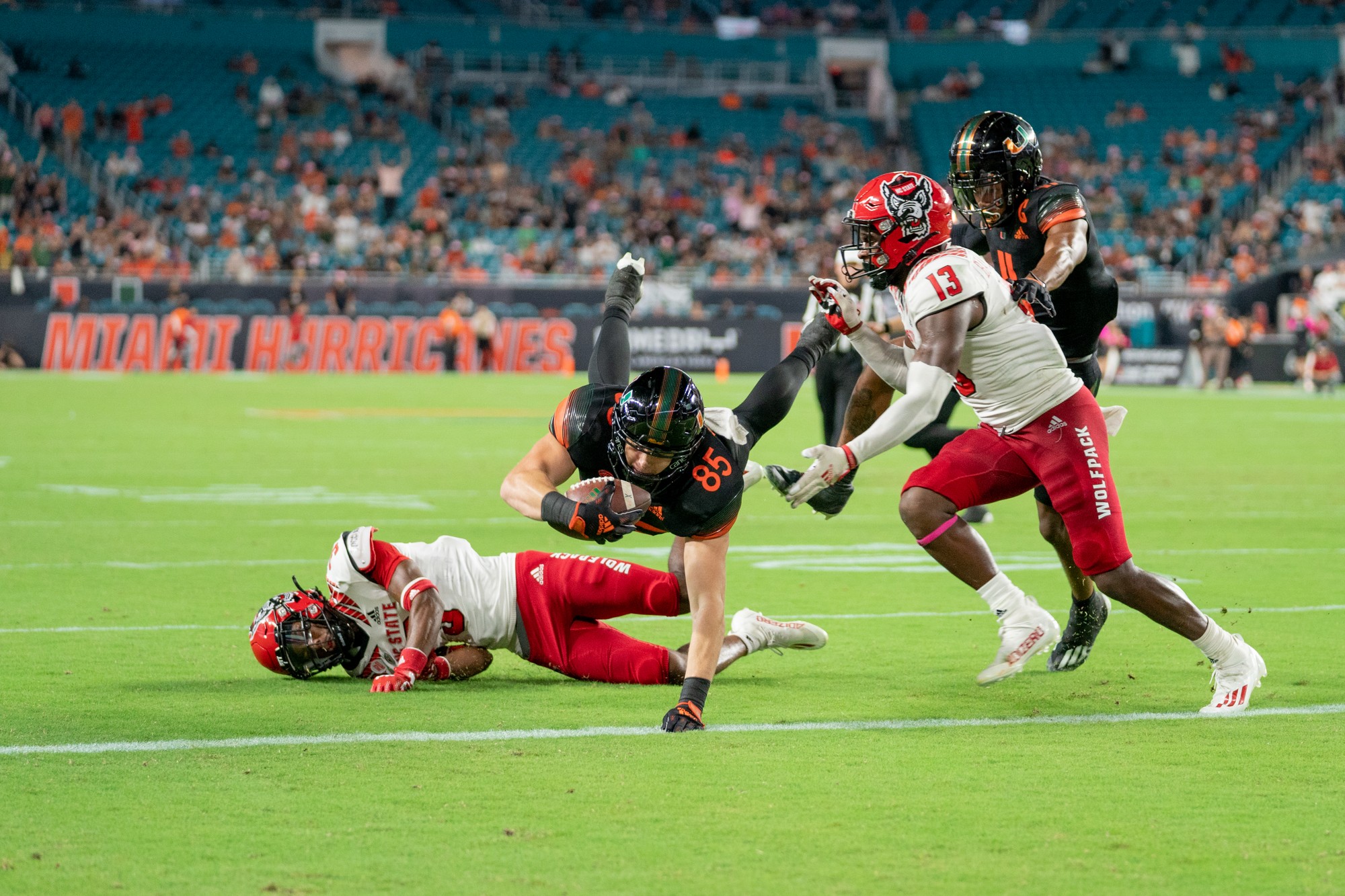
Junior tight end Will Mallory dives into the end zone to score a touchdown in the third quarter of Miami’s game versus NC State at Hard Rock Stadium on Oct. 23, 2021. Photo credit: Jared Lennon
In this week’s episode of TMH Sportscast, Zach and Liam break down Miami’s much-needed win against the Syracuse Orange and talk about college football playoff projections. The two are then joined by Corey Smith from the Pack Pride podcast to set the scene for Miami’s matchup against NC State.
This week’s News Brief breaks down UM’s rising tuition and the soaring cost of living in Coral Gables, the city’s removal of chickens and roosters from University Village, the surprising cultural role of campus cats, and the fireworks mishap that sent students scrambling during a campus show. Stay informed on the issues reshaping daily life for Hurricanes.
Lakeside Village and University Village residents will not be required to pay a fee of $1,700 for the Winter Intersession beginning Fall 2025. This would have been the first time students in UV and Lakeside would be required to pay for intersession housing.
On Tuesday Nov. 11, The Miami Hurricane received a tip from a student who wishes to remain unnamed notifying about the alleged new fee. The student called Housing and Residential Life that same day, and a representative confirmed that the fee would be required.
Multiple TMH reporters called HRL on Wednesday Nov. 12 for more information and received conflicting answers. One reporter who made contact with an HRL representative said she was told that a meeting was held to discuss the fee, and that the fee was not yet confirmed by administration. Another reporter said that she was told there would be no fee.
“At this time, nothing is changing. There will not be a $1,700 surcharge for students living in University Village and Lakeside Village during the winter break,” The University of Miami said in a statement.
Historically, Lakeside and UV residents have been granted free intersession housing during winter break if they submit the application on the housing portal before the Dec. 1 deadline. After the deadline, a fee of $250 would be applied.
The University of Miami runs on a delayed recruitment system. Work Week, a time for members of the sororities to prepare for recruitment, begins in early January. The fee would impact recruiters who lived on-campus.
Mia Garcia, a sophomore and sorority member living in Lakeside, requires intersession housing for Work Week. Garcia said the fee would have placed an unexpected financial burden on her
“Housing on campus is already expensive,” Garcia said. “[A fee] would make me rethink housing on campus in the following years.”
Two cars were vandalized on Walsh Avenue in front of Lakeside Village Lobby C on Saturday, Nov. 8, around 10 p.m.
According to Jaedon Cover, a Lakeside Village resident who witnessed the vandalism, a white car pulled up next to two black cars — which were parked in 15 minute curbside parking spots — and started shooting paintballs at one of the parked cars.
“We ran inside, and once they were done, they drove off into the Murphy Design Studio parking lot area,” Cover said. “When we came out, we saw that two cars were shot with paintballs.”
Cover said that a few minutes after initially shooting paintballs, the white car drove back to the curbside area of Lobby C to shoot more paintballs at the two cars.
“That night, they did it at least one time before I was there,” Cover said.
UMPD arrived at the scene around 10:30 p.m. to address the incident.
According to Sergeant Michelle Christensen, the public information officer for the city of Coral Gables, a report was filed with the Coral Gables Police Department. No comment was provided to The Hurricane as this is an open investigation.
After jumping up to 15th in the most recent College Football Playoff rankings, the Miami Hurricanes (7-2, 3-2 ACC) are going to need to continue to impress the committee down the final stretch.
Their opponent on senior night Saturday, the NC State Wolfpack (5-4, 2-3 ACC), have already upset one top tier ACC team and the Hurricanes need to be on alert to avoid being their second.
In his press conference Monday, Miami head coach Mario Cristobal told reporters how good this Wolfpack team has been as of late.
“They understand that they have a great team coming in here,” Cristobal said. “Maybe the hottest offensive team and maybe one of the most physical defenses that we have faced.”
More than ever, this Miami offense is going to need to be consistent and start fast, something they’ve had trouble with over this recent stretch of games. While Louisville had a top tier pass defense that forced four turnovers from Miami, in its most recent games UM has had trouble exploiting the weaknesses of opposing teams.
In their last three games, the Hurricanes have faced three bottom tier pass defenses and struggled to capitalize on all three. The Mustangs allow an average of 303 passing yards per game and despite a strong start, finished with 274 passing yards and elected not throw downfield.
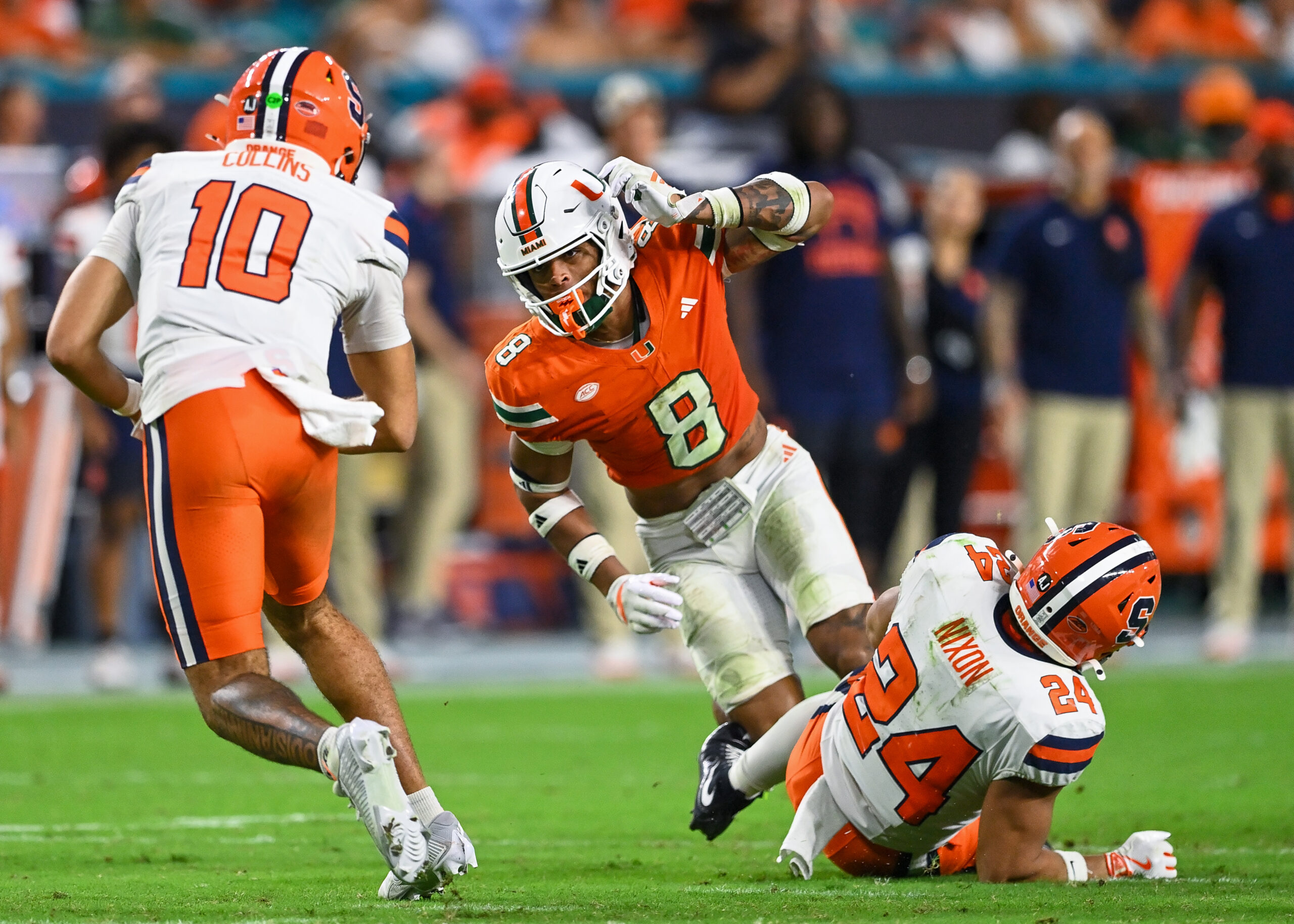
David Lebowitz, Staff Photographer/Redshirt Senior Jakobe Thomas reaches toward the Syracuse quarterback after beating his blocker on November 8, 2025.
Even in its last two blowout matchups, Miami’s offense has started off slow. Despite winning by a combined 60 points against the Cardinal and the Orange, most of those came in the second half. In each game, Miami’s offense scored just seven points in the first half.
The Hurricanes are likely to be without some of their important weapons with wide receiver CJ Daniels and running back Mark Fletcher Jr. potentially out once again. However, against the Orange, the Hurricanes showed that they are confident in their depth in those areas with freshmen stepping into roles to make big plays. True freshmen running back Girard Pringle Jr. and wide receiver Daylyn Upshaw both made big plays and their execution and practice habits both stood out to Cristobal.
“Daylyn Upshaw would take four reps for the scout team,” Cristobal said. “He’d sprint over to the other field and take four reps with the offense, sprint back and do the same. And so did Gerard Pringle. They were really paying attention to detail.”
With the injuries on this offense, Cristobal seems confident in the ability of his younger playmakers to step up when their name is called.
NC State has struggled to stop the run but has struggled against the pass especially in their last two games. Allowing 292 yards through the air this season, opposing quarterbacks have thrown for 400 yards in both of the last two games. Teams are averaging 30 points against this Wolfpack defense and Miami can exploit a secondary that due to injuries has had to move guys around and give younger players increased opportunities.
The Wolfpack especially struggled against crossers and mesh patterns against Georgia Tech (8-1, 5-1 ACC) , something receivers like Malachi Toney and Keelan Marrion can exploit. With teams able to throw with ease against NC State, running backs haven’t had too much individual success.
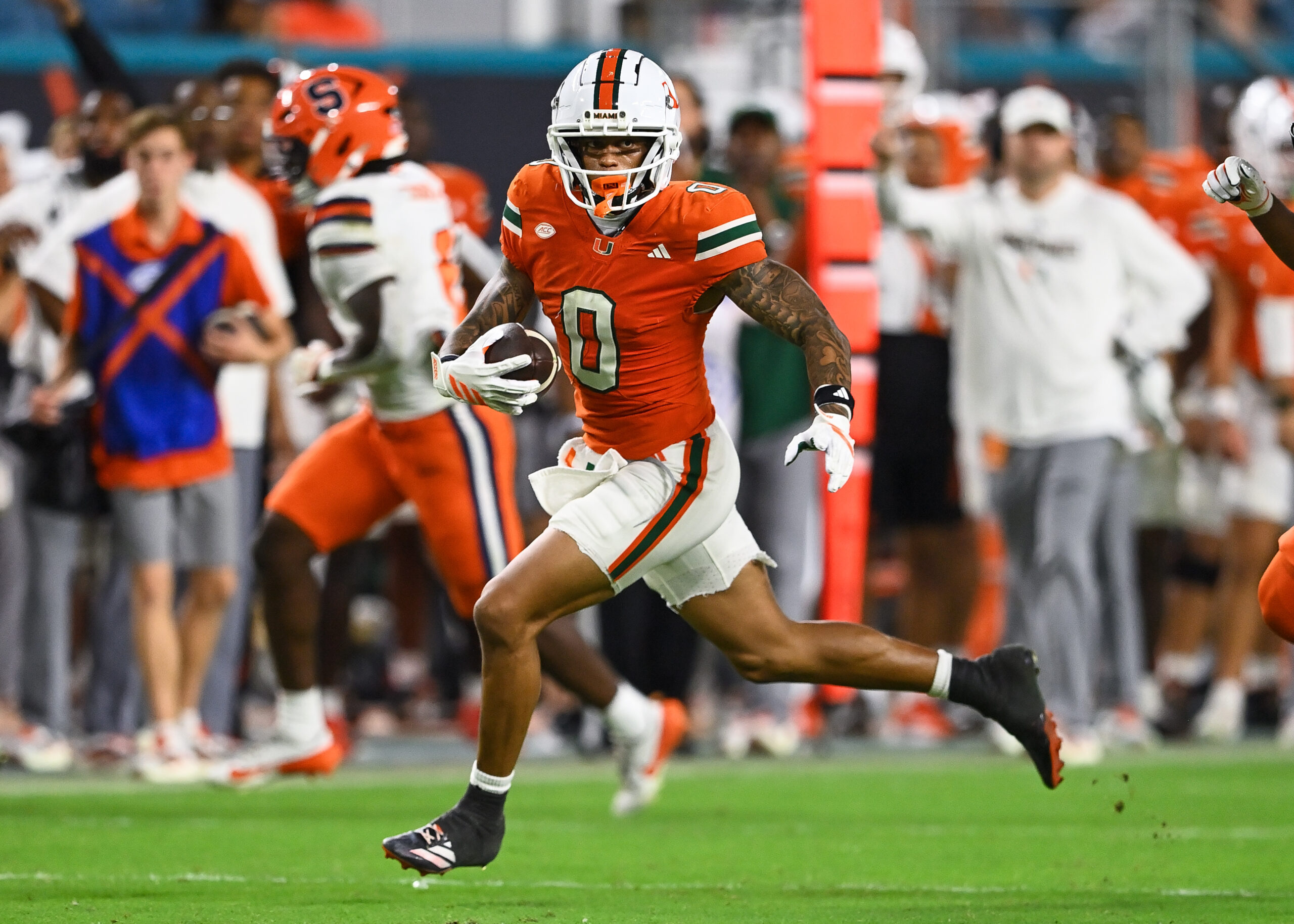
David Lebowitz, Staff Photographer/Redshirt Senior Keelan Marion makes an impressive catch and run to set the Hurricanes offense up in the redzone on November 8, 2025.
Georgia Tech quarterback Haynes King went over 100 yards but aside for that, the Wolfpack hadn’t allowed a 100-yard rusher since Virginia Tech. Teams are averaging just over four yards per carry, an area Miami can exploit.
However, the NC State struggling passing defense is definitely where the Hurricanes should attack. Turnovers also shouldn’t be too much of a worry with the secondary only having six interceptions and eight total turnovers on the year.
The Hurricanes cannot start slow against this Wolfpack offense led by breakout sophomore quarterback CJ Bailey. The 6-foot-6-inch second year starter out of Chaminade High School in Hollywood, Fla. has completed 70% of his passes, thrown for 19 touchdowns to 7 interceptions and rushed for another four touchdowns on the ground.
In their win against Georgia Tech at the beginning of November he dominated, with 374 total yards and three touchdowns. His go-to target has been wide receiver Terrell Anderson, who has been a big play machine. In five of the Wolfpack’s games this year, he’s had a catch of 30 yards or more.
With just 28 receptions on the year, he has gone for 527 yards averaging almost 19 yards per reception. OJ Frederique’s health is still a question mark but this Hurricanes secondary has held together. Keionte Scott has flown around and has stolen the show but, Damari Brown has quietly also been a lockdown corner leading ACC defensive backs with a 33% forced incompletion percentage. This Hurricanes secondary is more than up for the challenge.
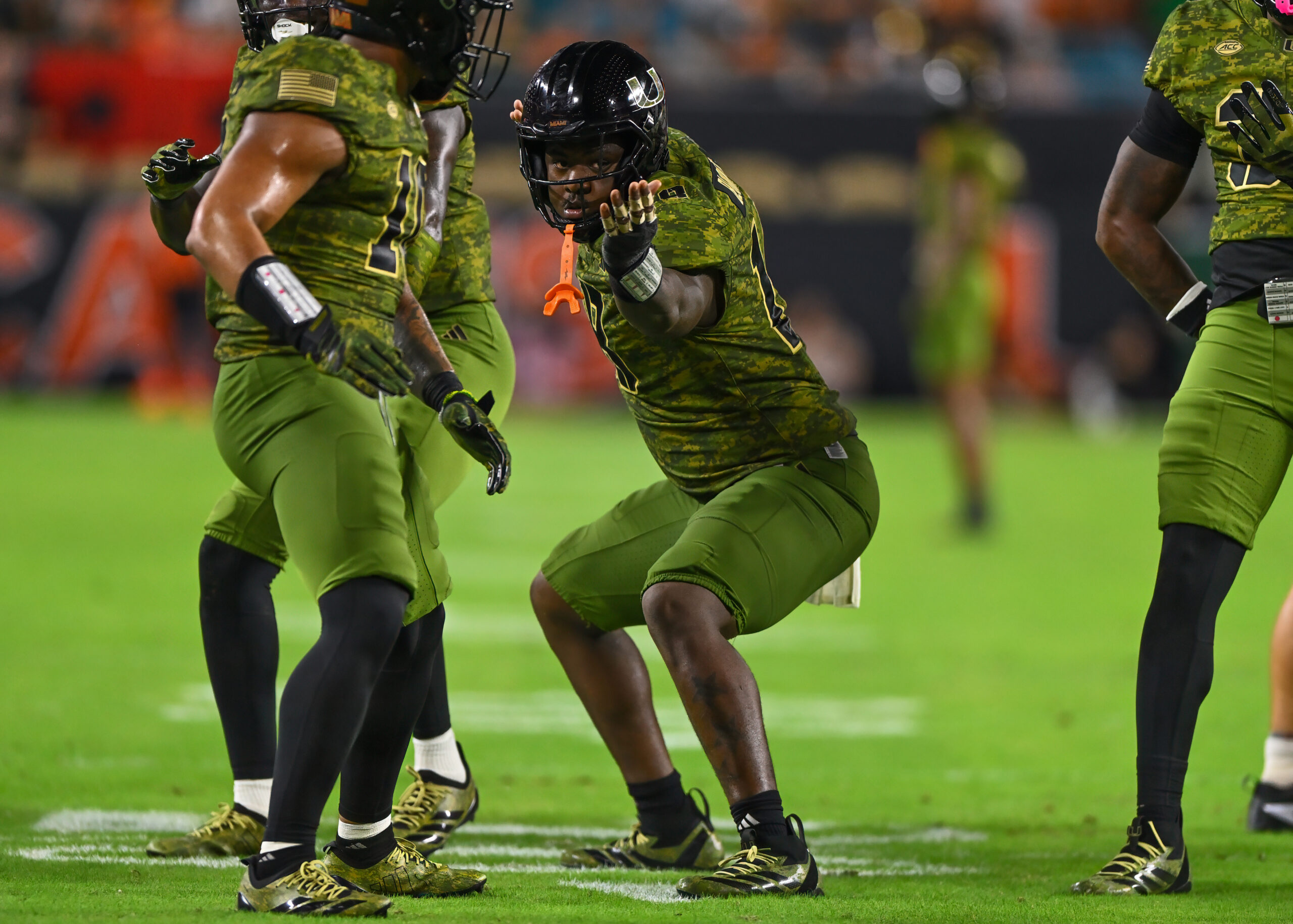
David Lebowitz, Staff Photographer – Sophomore Defensive Lineman celebrates after a sack on October 26, 2025.
The Hurricanes are going to need to minimize the explosive passing plays from this NC State passing offense and keep Bailey contained and that is going to need to be the work of this Hurricanes pass rush. Bailey has 14 touchdowns and zero interceptions when kept clean as he has been on 70% of his drop backs, under pressure Bailey has thrown all of his seven interceptions.
According to PFF, Bailey holds the ball longer than most power four quarterbacks at 45th of 68. This is an area of attack for Miami’s elite pass rush anchored by Rueben Bain Jr. and Ahkeem Mesidor. Miami defensive coordinator Corey Hetherman is well aware of that.
“We got to affect the quarterback. We got to hit him. We got to try to hit him as much as we can early in the game.” Hetherman said in his Monday press conference.
Bailey is a good scrambler but is more likely to go up the middle rather than outside of the pocket. The Hurricanes will need to maintain discipline in their rush lanes and keep Bailey from stepping up and finding guys downfield or taking off.
Miami’s interior defensive lineman such as Justin Scott and David Blay are going to be huge in collapsing the pocket from the inside and putting the pressure on Bailey. If Miami is able to get some early hits onto him, it could rattle and throw off this NC State passing game.
This Wolfpack offense is not only limited to the air, with a strong running game as well. While they don’t run it too often with just 289 rushing attempts on the year (Miami has 324), NC State averages five yards per carry and have some big play threats on the ground as well.
Lead rusher junior Daylan “Hollywood” Smothers averages almost seven yards per carry and has rushed for 825 yards and six touchdowns on the year leading the ACC. He bounces off tacklers with a great combination of speed, vision, and elusiveness.
NC State runs a lot on the inside and Smothers is often able to make one guy miss in the hole and then break off a long run. The Hurricanes linebackers are going to need to fight around pulling guards and rally to tackle and prevent Smothers from taking off. Despite the flash that this team has, coach Cristobal talked about how physical the NC State offense has been as well.
David Lebowitz, Staff Photographer/ Freshman wide reciever Daylyn Upshaw gained 41 yards on an impressive catch and run againt Syracuse on November 8, 2025.
“It was really important for our edge guys to watch today and see how physical they are running the power counter.”
There’s a chance that the Hurricanes don’t see Smothers who missed the Georgia Tech game but, in his stead Duke Scott has filled in more than adequately. Against Georgia Tech, Scott became the first freshman running back to top 100 yards with 196 yards and a touchdown.
Scott is more of a big bruising back but, as he showed against Georgia Tech can make one cut and go as he did with a big 69-yard rush. The Hurricanes regardless are going to need to play fast and physical defensive football and are going to be really tested against this explosive offense and could let up their first 30 point game of the year.
If that happens Miami will need its offense to start out hot and give the defense the leeway to make some mistakes and let up some points. With the slow starts offensive coordinator Shannon Dawson seems to be trying to get the offense to play looser.
“I mean I think that’s been the goal, the recent goal for us,” Dawson said. “I felt good about calling them [trick plays] was because I want our guys to have fun and you know we have to play loose.”
This Miami offense has come out sluggish, playing too tight and restricting themselves. Whether it’s trick plays or taking shots down field Miami needs to come out firing against NC State and get off to a hot start. While hopes for the playoff require a lot of help from outside Cristobal and the ‘Canes need to take everything one step at a time. And according to the leading man the focus is just that.
“It’s all on us and about us and we have some great opportunities coming up and from there everything else does take care of itself,” Cristobal said.
The Hurricanes need to control what they can control but they need it all to come together and more than ever this week.
Saturday’s kickoff at Hard Rock Stadium is set for 3:30 p.m. and will air on ESPN. It will be the Hurricanes last home game of the regular season.
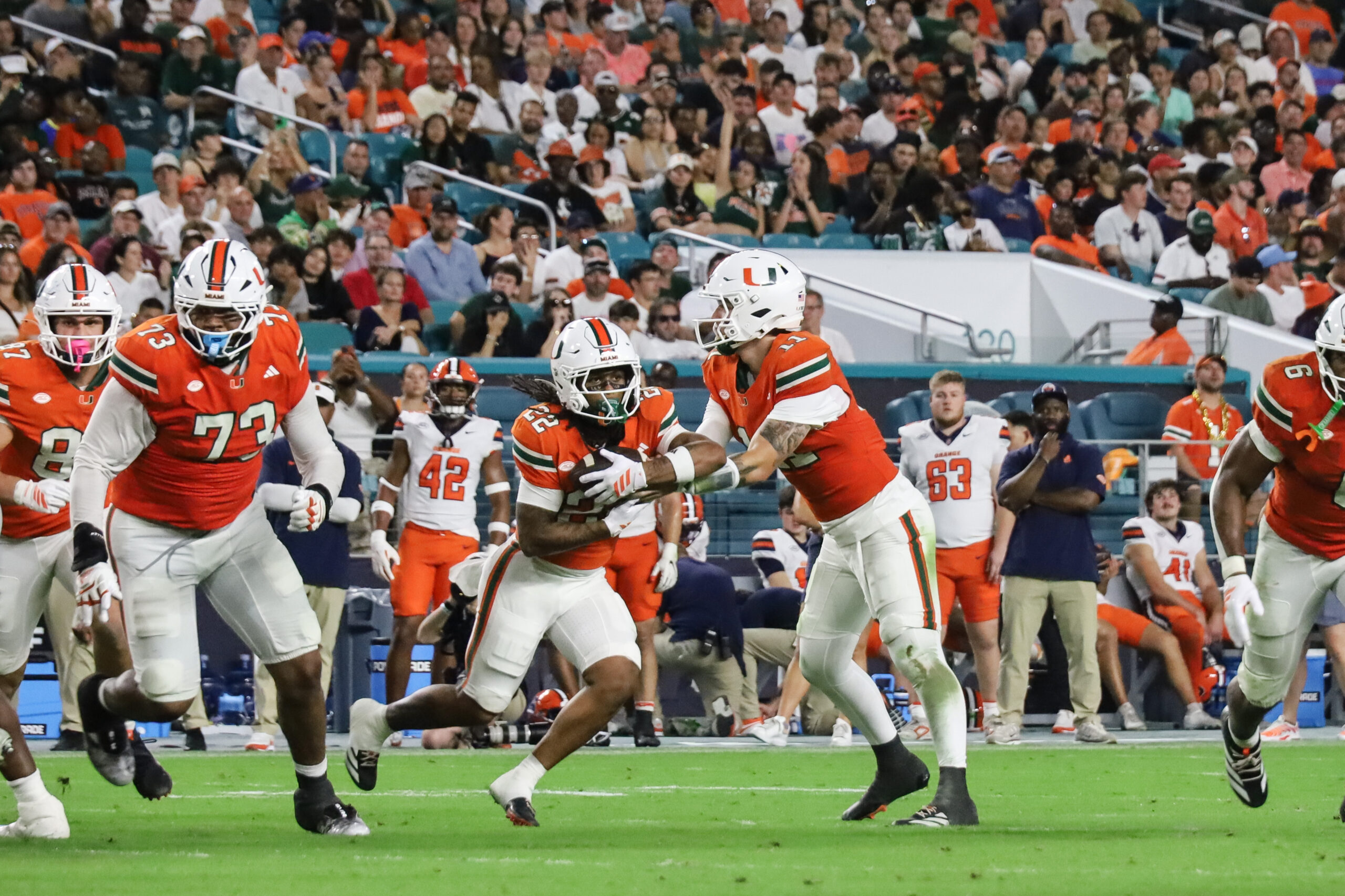
Makena Wong, Photo Editor, Sixth-year redshirt senior quarterback Carson Beck hands off to freshman running back Girard Pringle Jr. for a run play on Saturday, Nov. 8, 2025.