Home Blog Page 79

The state of athletics at UM following the NCAA House Settlement

0

Just like every other school with an NCAA athletic program, UM must sometimes make difficult decisions when choosing which sports to fund becomes increasingly more complex. 

One of the most recent and significant developments to college athletics is the July 2025 House Settlement, which allows schools to pay their athletes directly under a salary cap of 20.5 million dollars across their sponsored sports as they see fit.

This money will be paid out in addition to that already earned by athletes from NIL (name, image, and likeness).

Traditionally, football has warranted the most funding from schools due to its ability to bring in large amounts of revenue, suggesting that many schools may allocate a significant portion of the 20.5 million dollars to the gridiron pastime.

However, success in football doesn’t necessarily correlate with a lack of funding in other sports. 

“It needs to start from football because that’s how the system is structured,” said former UM women’s basketball coach Katie Meier. 

Meier led the Hurricanes for 19 years, which included an AP National Coach of the year in 2011 as well as 13 postseason appearances. Following her retirement in 2024, Meier is currently a special advisor to Dan Radakovich, UM’s athletic director.
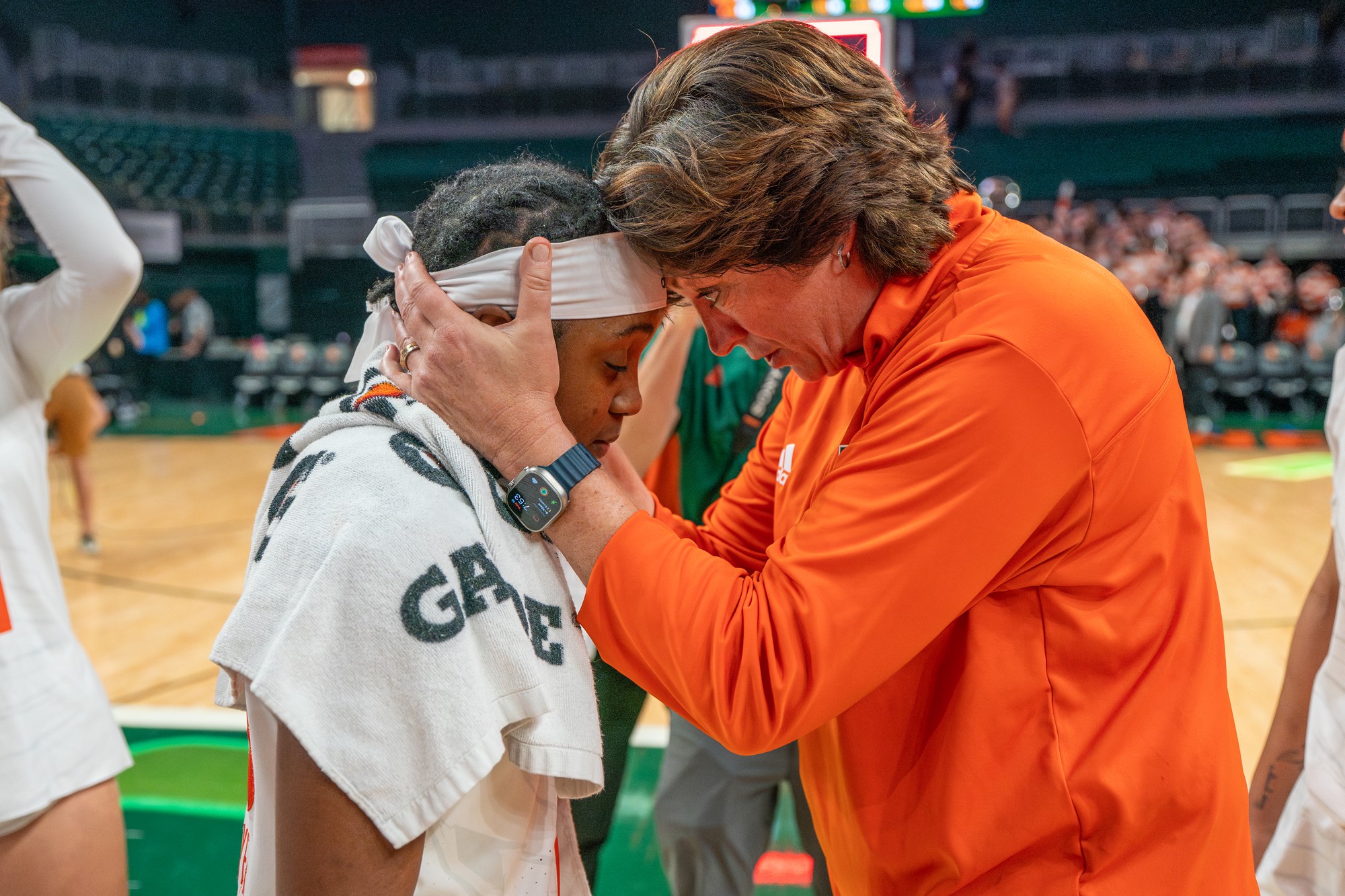
Head coach Katie Meier takes a moment with junior guard Lashae Dwyer after Miami’s 73-59 win over versus NC State in the Watsco Center on Jan. 18, 2023. Photo credit: Jared Lennon

“Bigger investments can get bigger returns and then the returns can trickle down. It’s been a very supportive situation,” said Meier.

Traditionally, the “revenue sports” apply to football, men’s basketball and baseball, with women’s basketball joining the mix across the last decade.

Women’s basketball in particular has expanded massively in recent years with the emergence of superstars like Caitlin Clark and Angel Reese.

Teams competing in Women’s March Madness can now earn units for victories from the First Four through the Elite Eight, with the funds coming from a collective pot of $15 million that will increase to $25 million in the next three years.. 

Clark herself is estimated to have generated $82.5 million in consumer spending in the state of Iowa, where she competed for the Hawkeyes from 2020 to 2024.

Aside from those revenue sports, Miami’s non-revenue sports have been historically accomplished.

“There is a certain culture in Miami where you gotta earn your respect, and I think it’s been earned by our women’s sports,” said Meier.

Unfortunately, not all schools have been as equally invested in their non-revenue sports as UM. 

For example, following the House Settlement, Grand Canyon University cut its successful men’s volleyball program despite the program only having a budget of $300,000.

Many believe that schools like GCU are using the House Settlement as a scapegoat for getting rid of certain athletic programs, especially considering that many of these cuts have little to no impact on the relatively large value of $20.5 million that schools have in revenue share.

Regardless of what may be happening at other schools, Miami’s non-revenue sports have been flourishing in 2025. 
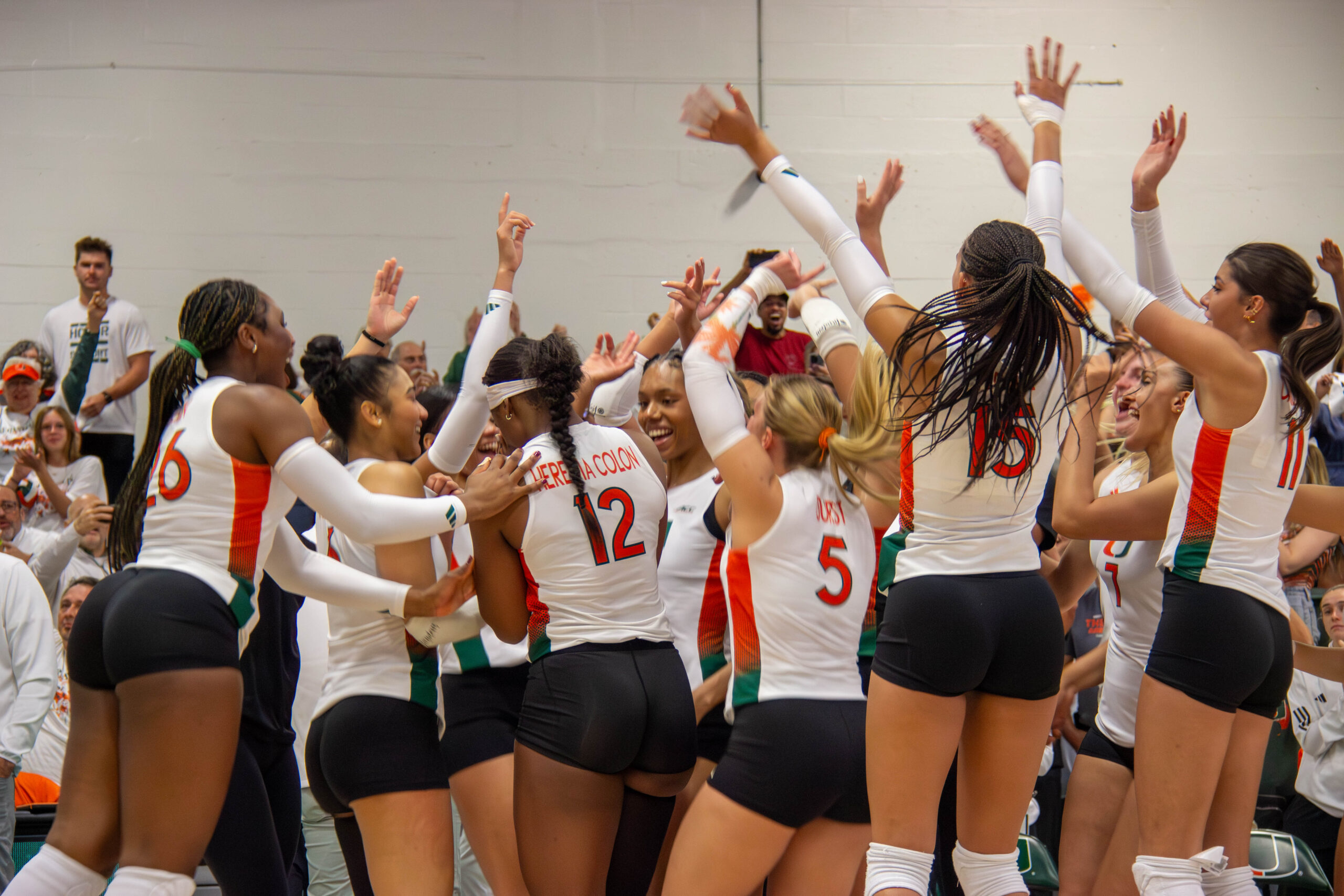
The University of Miami volleyball team celebrating their victory over rivals Florida State University on Nov. 5, 2025 at Knight Sports Complex

Women’s volleyball in particular has been impressive this season, jumping out to a 21-4 start under head coach Jose Gandara. 

“You’re on the edge of your seat the entire match,” said Meier in regards to Miami volleyball.

Another Hurricanes non-revenue sport that has made major headlines as of late is the men’s track and field team, which finished a program record 10th at the NCAA championships in 2024.

Some Olympic sports that have traditionally been labeled as “non-revenue” also have the potential to bring in significant amounts of money for their respective colleges. 

Besides the potential of some Olympic sports to make their schools money, they are also an integral part of the culture of both college athletics and student life.

“It’s a part of your collegiate experience. What an awesome way to make friends and to have a social event- it’s just incredible,” said Meier in regards to the value of college sports.

Despite all of these changes, there is no doubt that Radakovich, president Joe Echevarria, and the rest of the athletic department staff will guide the university towards a fair and equitable path for all student athletes.

Devoux Deysel throwing at the 2025 NCAA Men’s Javelin Championship on June 11, 2025 in Eugene, Ore. Photo credit: Miami Athletics

Hard Rock stadium food: what’s worth it and what’s not

There is one only thing that I love more than food: football. Pair those two together, and you have the perfect combination. 

The only problem? Hard Rock Stadium prices its food like you’re at a Michelin Star restaurant when it usually tastes like something you could buy from the frozen aisle at Publix. 

For years, I’ve missed out on the experience of eating good food during a ball game, and I’m sure many others feel the same way.

But ’Canes fans, fear no more. 

I took it upon myself to test some of the most popular foods at Hard Rock to determine what eats will satiate your game-day appetite and won’t leave your wallet with a dent in it.

Cuban sandwich

I grabbed a Cuban sandwich at a self-service storefront that flows smoothly, allowing you to scan your card at the entrance, grab an entree, fries, drinks and other snacks before walking out and having your card charged automatically.

I didn’t have high hopes for the Cuban sandwich. After looking at 20 of them sitting on the shelves, they did not scream freshly made to me. Luckily, I was wrong.

It tasted surprisingly good, and when paired with the fries, it made for a solid meal. This storefront is an efficient way to grab yourself a sandwich, fries and a drink before getting back to the action.

Considering the $10 price tag, it didn’t break the bank either.

Lobster roll and mac and cheese

I then moved on to the $35 lobster roll along with a  $10 side of mac and cheese. 

For almost $50, I thought this would be some of the best mac and cheese and lobster I’ve ever tasted, so I was prepared for a good meal.

Boy was I wrong.

Do NOT get the Lobster roll. It was cold, flavorless, and started to taste worse the more I thought about the price. The cooks tossed in a lemon on the side as if it would save the meal, but the little slice was nowhere near enough.

The mac and cheese was good, but it tasted like any other mac and cheese my mom used to microwave for me at night when she didn’t want to cook.

Overall, if this food was $10, maybe I would let it slide, but for $45, this was a disgrace.

Chicken shawarma  

My last hope to save my palate from the monstrosity I had previously encountered was the chicken shawarma. For $25, it felt a little pricey, but nowhere near as outrageous as the lobster and mac and cheese. 

Once I saw the food, I got excited. My wrap was built in front of me so it was nice and hot when I got it in my hands. 

From the first bite, it was delicious. It may have benefited from following the disappointing lobster roll, but it was genuinely delicious. It was flavorful, hot and hit the spot at the game.

If you’re ever at Hard Rock and you’re hungry, the chicken shawarma wrap is definitely the way to go.

While my dream of enjoying truly good food while watching my ’Canes once felt out of reach, this mission proved that Hard Rock isn’t completely hopeless. Sure, there are still some overpriced disasters lurking around the concourse, but there are also bright spots that can actually elevate your game-day experience.

The Cuban sandwich and fries offer a quick, reliable option if you’re trying to refuel without missing a single play, and the chicken shawarma is a standout that reminded me it is possible to eat something flavorful, hot and satisfying inside a stadium. It gave me a glimpse of what stadium food should be: convenient, tasty and worth the money you shell out.

My advice? Skip the hype items, stick to the winners and don’t be afraid to explore a little. Somewhere among the overpriced options, there actually are a few gems.

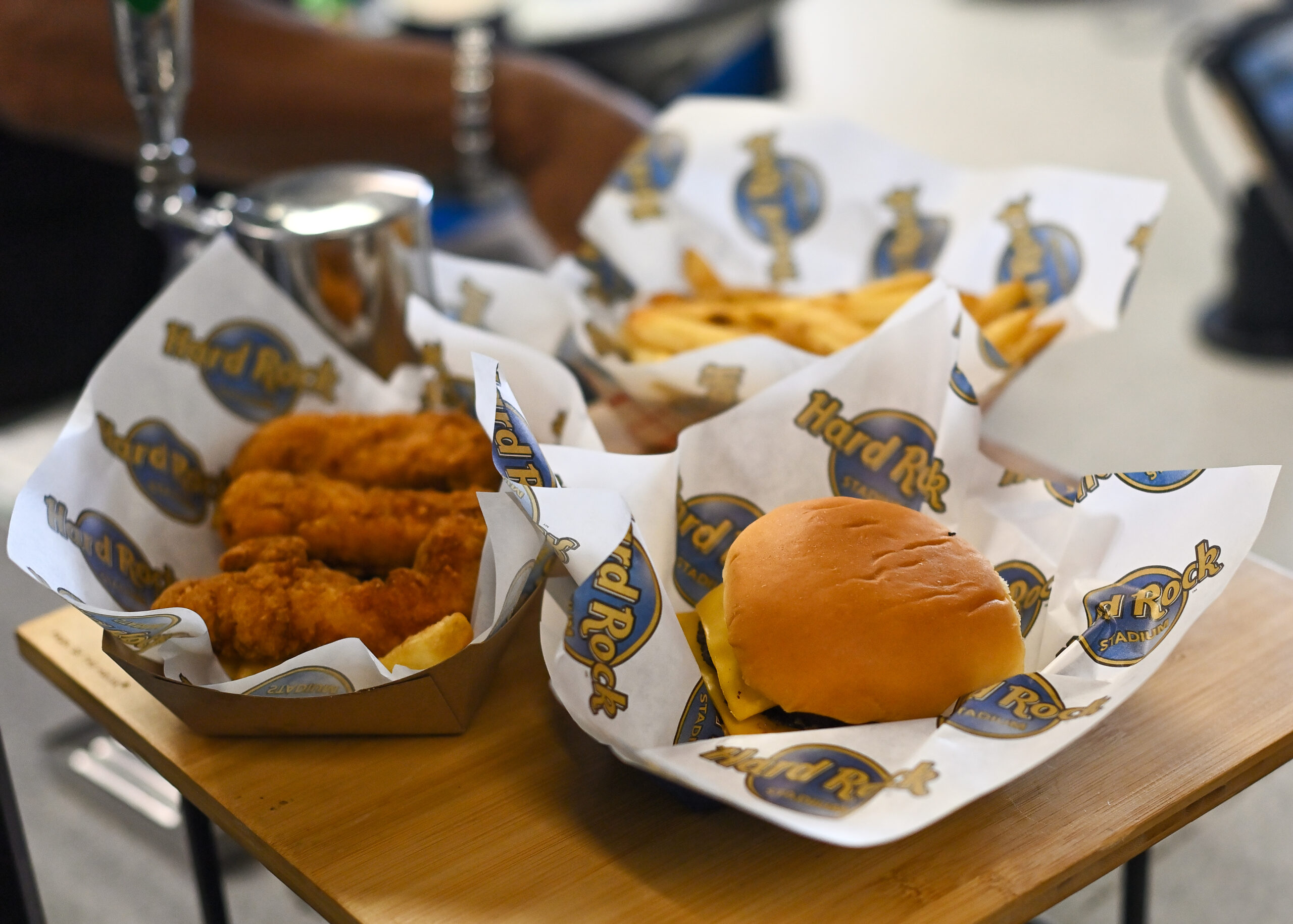
David Lebowitz, Staff Photographer/ A burger, chicken fingers, and fries on display at one of the various concession stands found at Hard Rock Stadium, November 15, 2025.

The dining hall disparities dilemma

0

Although freshman students pay the same price for a required meal plan, there are clear differences in the food options available in the freshman dorms. Freshmen living in Mahoney-Pearson face the same lackluster options day after day, while students in Centennial enjoy breakfast all day, fresh pastries, multiple entrée choices, a huge salad bar and a bread selection large enough to fill a bakery. 

The differences between Centennial and Mahoney-Pearson dining halls are astonishing. Centennial has variety, freshness and customization. Mahoney-Pearson has monotony — limited choices and food that feels like an afterthought. The solution isn’t complicated: either make the dining halls genuinely equal in quality and range, or adjust the meal plan pricing to reflect the difference.

“For us, equity in dining means ensuring every student — regardless of where they live, study or dine — has equal access to nutritious, culturally diverse and enjoyable meals,” said Michael Ross, the vice president of operations for UM Dining Services, in a statement to The Hurricane. 

Between classes, labs, extracurriculars and Miami’s extreme weather conditions, a 10-minute detour each way can mean missing a meal altogether. When your local dining hall consistently disappoints, you’re stuck choosing between convenience and nutrition.

The quality of a freshman’s dining experience, including cleanliness, food quality and available options, is determined by a random housing assignment. 

“Everything is spotless [at the Centennial Dining Hall], all the food is fresh,” said freshman Mahoney-Pearson resident Milena Hiza. “When you go to Mahoney-Pearson, the lettuce is brown. Even the water has a weird taste. My friend had a worm in her chicken one day, and my roommates saw a roach in the cookies.” 

Hiza also noted that the time it would take to go from Mahoney-Pearson to Centennial whenever she wants a quick bite is just unrealistic. 

“Am I really going to have the time to walk all the way to Centennial just to have a quick salad? Everyone’s so busy with clubs and classes, I just don’t see how it’s fair that some people have a great dining hall close by. As freshmen, we have to pay for the dining plan, and I feel like I’m throwing away my money.”

Complaints about Mahoney-Pearson are often dismissed with the explanation that Centennial residents pay more for housing. While this is true, students living in Mahoney-Pearson and Centennial pay the exact same amount for their meal plans.

. Mahoney-Pearson residents with dietary needs and restrictions are penalized with a 10-minute walk when they want food that their body is less likely to reject.

Match the meal plan to the dining experience. Make the food and the system fair. 

Until the food reflects the same standard across campus, students in Mahoney-Pearson are paying premium prices for second-tier meals, and that’s hard to swallow.

How much do we really know about microdosing?

0

In today’s obsession with wellness fueled by influencers, podcasts and self-proclaimed health “gurus” with no scientific training, it seems we have turned to fast media instead of science as a main source of knowledge.

Information is everywhere yet we seem to disregard the importance of questioning its origins. Ironically, science and reason have become the last thing we refer to.

In an attempt to rebrand the fading trends of homeopathy and natural remedies, microdosing has taken center stage, promising transformation through doses too small to prove anything at all. But this new wave of self proclaimed “biohacks” deserves far more skepticism than what is given. Despite their trendy wellness marketing, they remain fueled largely by hype rather than science.

Microdosing refers to taking a small dose — usually a small portion of the standard effective dose — of a classic hallucinogen, a class of psychedelics (distinct from dissociatives), used in microdosing, such as psilocybin, the substance found in “magic mushrooms” or LSD. Anecdotal reports have praised its supposed range of benefits such as cognitive-enhancement and improved mood. 

Yet anecdotal evidence is just that — stories we tell ourselves and others, giving rise to psychology’s fascinating placebo effect. With no empirical proof that these small doses have any significant physiological effect, microdosing has yet to prove itself useful as a mood enhancer, tool for focus and productivity or boosted energy. 

Essentially, it’s the combination of psychedelic research along with manipulated media that’s driving the frenzy around this “revolutionary” way of taking a drug.

Psychedelics have become increasingly popular for their potential to improve long-lasting mental health conditions. Michael Pollan, a pioneer in “psychedelic-assisted psychotherapy,” intentionally targets the use of things like LSD or psilocybin to treat depression, anxiety and addiction. In sufficient doses and in the right environment, psychedelics have shown to significantly improve depression and anxiety in those suffering from multiple mental disorders. 

However, the success of psychedelics at full therapeutic dosage does not necessarily imply success at microdoses. In fact, a study published by University of Chicago Medicine found no evidence supporting claims that taking small amounts of classic hallucinogens at regular intervals improves cognitive performance. 

However, despite this lack of proof, Dr. Harriet de Wit, a Professor of Psychiatry and Behavioral Neuroscience at the University of Chicago, is reluctant to draw any absolute conclusions.

“We can’t say necessarily that microdosing doesn’t work,” de Wit said. “All we can say is that, under these controlled circumstances, with this kind of participant, these doses and these intervals, we didn’t see a robust effect.” 

Interestingly, the purpose of such studies is to generalize findings and expand knowledge in the field of science. Yet, even as microdosing repeatedly proves indistinguishable from placebo, even scientists hesitate to accept the data in absolute terms. In the right dose, even science isn’t immune to a good story.

With so many alleged benefits like increased focus and reduced anxiety, microdosing seems like the perfect antidote for stressed-out college students. A recent study found that a significant portion of students reported microdosing to manage mood or improve cognition. But with multiple studies showing that these ‘benefits’ could just be a placebo effect,  microdosing could very well be the psychological equivalent of manifesting all the intelligence you never knew you had.

At UM, the appeal is already visible. One senior majoring in Marine Science and Biology with a chemistry minor described microdosing to me as “not terrible, just safer than taking a full dose, and honestly, kind of a way to say you’ve done the drug without actually doing it.”

For many students, microdosing becomes less about transformation and more about flirting with the idea of psychedelics while staying within what feels like a controlled, manageable boundary.

The media buzz around microdosing often leaps ahead of the research and in many cases, the story is more compelling than the data. In the end, just as there is not enough evidence to show that microdosing has any significantly positive effects, there isn’t enough to prove its harmful either.

A placebo is unlikely to cause any physical damage, but the fact that we can convince ourselves that something with virtually no measurable effect can elevate our consciousness should make us question how much power we have granted the media to convince us of our own potential. 

Making Thanksgiving vegan and delicious

Turkey, ham, stuffing and gravy are just some of the animal based options you might see this Thanksgiving. But for UM junior and neuroscience major Alexandra Lutcavage, the past two Thanksgivings have not included the animal-based centerpiece. 

“I first became vegetarian about two years ago,” Lutcavage said. “As soon as I moved out and was cooking for myself, I said ‘there’s no better time to start.’” 

Lutcavage now serves as the vice president of UM’s Plant-Based Canes club, a club that welcomes vegans, vegetarians and veggie-curious students to weekly meals prepared by the chef in the Mahoney-Pearson dining hall, and for those looking to try some vegan Thanksgiving classics, look at the ThankFUL dinner. 

“PBC is a great opportunity to expose these students to really well made, healthy plant-based food so that they’re more likely to think positively on the subject and be more likely to try plant-based food in their free time as well,” Lutcavage said. 

According to a study by university polling center College Pulse, one in 10 college students follow a vegetarian or vegan diet. This is significantly higher than the national average, where only up to 4% of Americans are vegetarian and 1% are vegan. 

With more than 80 members in the PBC club, there are numerous students on the UM campus who are also eating meat-free this holiday season.

Dr. Michelina “Mickey” Witte, a lecturer in the Department of Kinesiology and Sport Sciences and faculty advisor for the Plant-Based Canes club, says the holidays can be an opportunity to rethink what’s on the table.

“Animal foods are devoid of fiber, and [fiber] supports good gut health, helps regulate blood sugar and keeps you feeling fuller for longer,” Witte said. “So, fiber is one of the key reasons why one would want to eat in a very plant-forward way.”

According to the Center for Disease Control, the No. 1 cause of death globally is heart disease. Eating a plant-based diet or plant-based foods rich in fiber can help lower cholesterol, which helps lower chances of heart disease. 

Witte has eaten a plant-based diet for 30 years and said that she doesn’t miss anything on Thanksgiving. She believes that the plants are what make the flavors, and that for her the Thanksgiving holiday is not really about the food in the first place. 

“For me, Thanksgiving’s not really about the turkey. It’s about gratitude and connection,” Witte said. “Going plant-based just expands that idea into including caring for our health, the planet and even the animals.” 

She thinks the best part of eating plant-based meals is that it makes the table more inclusive, because everyone can enjoy these dishes, no matter what their dietary preference.

Still, for many students, changing traditional family recipes can feel emotional. Lutcavage admits that transitioning away from the turkey was difficult at first.

“Thanksgiving has always been my favorite holiday,” Lutcavage said. “So, it was initially difficult to give up the turkey, but I just kind of leaned into all of the other sides that I really loved.”

Her favorite part of Thanksgiving dinner is the stuffing, which usually contains a meat-based broth. But with one swap, Lutcavage is able to enjoy a vegetarian stuffing made with vegetable broth. 

Many side dishes are vegetarian on their own, including mac and cheese, mashed potatoes and cornbread, which are all personal favorites of Lutcavage. 

“There’s also amazing recipes that people make with things like tofu and sweet potatoes, ” Lutcavage said. “You just need to put a little bit of time into looking up some recipes.”

Before heading home for the holiday, students can try a variety of vegan and vegetarian foods and sides inspired by classic Thanksgiving dishes at the ThankFUL Dinner, a collaboration with Plant-Based Canes and UM Dining.

“We’re very focused on expanding and enhancing our plant-based program,” said Michael Ross, the vice president of operations for UM dining services. 

“For our ThankFUL Dinner on Nov. 18, we’ll be featuring vegan stuffed peppers, maple-glazed roasted acorn squash and vegan mac and cheese, along with all our regular plant-based selections.”

According to Ross, the UM Dining team is still finalizing menus for Thanksgiving week itself, but he said that students can expect a variety of exciting plant-based dishes. 

Centennial Village Dining Hall will remain open for brunch and dinner throughout the week, with plant-based offerings available daily at the Taste of Home station.

For students who are heading home to have their first vegan or vegetarian Thanksgiving, Witte offered a piece of advice. 

“Be ready and prepared to talk about your decisions around your foods as much as your comfort level allows,” she said.

It is natural for people to ask questions about things they are not familiar with, but approaching the conversation with respect can open the table to insightful conversations. 

The Green Haven Project gives back to Miami

Students at the University of Miami are taking time to give back to their community with The Green Haven Project. Founded in 2019, The Green Haven Project is a nonprofit organization aiming to help those located in food deserts around the Miami area. 

Volunteers are in the Florida heat six days a week working on the gardens and inside the cafeteria, preparing free meals to hand out to those in need. 

Just outside the New Covenant Presbyterian Church in Model City Miami, a line of families, homeless, and those simply in need of a hot meal are patiently waiting for their turn for a free platter. 

“I used to be outside waiting in that line too. One day they needed more volunteers, so I thought I’d come out.” Sheva Dhalia, a Green Haven volunteer, said. “I did such a good job, they wanted me to come back and I’ve been here ever since.” 

Dhalia is a fraction of all the dedicated people who come together to make sure the neighborhood is fed. 

But the volunteers don’t just pick apples and make deli sandwiches. They harvest crops, like papaya, cucumber, eggplant, carrots and pineapple, each week. 

The fresh ingredients ensure the quality of food prepared is just as good as it is at home. Green Haven welcomes volunteers of all ages and backgrounds to get their hands dirty inside and outside the lab, fostering a sense of belonging and shared purpose. 

“Before we began working in the garden, one of the garden keepers gave the group I was in a brief introduction and history lesson about what the entire company was about,” Laliah Richelle, a Green Haven volunteer and UM student, said. “After that, my group, and I transferred mulch that they had made on site to place throughout the garden.”

This flexibility and hospitality is why many students at the University are so willing to lend a hand or even a rock. As a symbol of  gratitude, students who are part of the homecoming committee decorated stones and donated them to Green Haven to help make the community garden even more beautiful.  

Students were encouraged to let their creative juices flow as they paint rocks with vibrant colors, patterns, and even messages of hope and appreciation. A small gesture for an organization with a truly big impact.

Midweek magic at Market Wednesday

Every Wednesday, the roundabout next to the Richter Library transforms into a hub of flavor and community. The Wednesday Farmers Market — often called “Market Wednesday” — comes alive. Students and faculty can smell the amazing aromas from anywhere on campus.

From 9 a.m. to 3 p.m., tents line the pathways by the library ready to serve tropical smoothies, BBQ, tacos, pizza, bacon, egg, and cheese sandwiches and ceviche. Students on their way to class pause to grab lunch and socialize. The usual rush of campus life slows into something calmer.

Market Wednesday began in October of 2010 through a collaboration between the Student Government and the University’s Benefits and Human Resources departments. Its mission was simple: bring fresh, local food options to campus while promoting health, sustainability and connection.

Fifteen years later, the Market Wednesday has evolved into one of UM’s most cherished traditions. What started as a handful of produce stands has grown into a bustling open-air market offering a mix of vendors — many of whom have built loyal student followings.

The lineup of vendors changes slightly each semester, but students can expect a large mix of foods: fresh produce and tropical fruits; international cuisine, including Greek gyros, Indian samosas and poke bowls. There are also several vegan and vegetarian options like açai bowls, smoothies and falafel wraps.

“It’s honestly my favorite part of Wednesdays,” Ava Ferrara, sophomore advertising major said. “It’s a time during the week when I actually slow down and enjoy being outside. Plus, the food is so much better than the dining hall.”

Barnyard Bagels, a student-run business at UM, brings authentic New York-style bagels to campus each week. Its bagels are shipped straight from New York, giving some students a taste of home. 

“The one thing I’ve noticed from working at Barnyard Bagels as a student is the huge sense of community UM has. The customers are all hungry but they’re all sharing an experience of eating your food and being a part of that is really cool,” Andy Schwartz, sophomore sports administration major and Barnyard worker said. “Everybody’s there, the same people come with the same people, and they all say hi to each other.”

Whether you grab a classic everything bagel or one of their loaded creations, Barnyard never disappoints.

Many students also enjoy the açai bowl stand because it offers a break from the heat between classes. Similarly, the fresh fruit stand has been a fan favorite for years.

“The fruit is super fresh, but one thing I want at the market really badly is a coffee stand. They need one,” Mackenzie Bobier, junior advertising and marketing major, said.

While the market is beloved for its food, it also serves a deeper purpose. 

For local vendors, it’s consistent and welcoming with high foot traffic. For the University, it aligns perfectly with sustainability and wellness initiatives. 

By supporting small local businesses and giving the campus community access to fresh, locally sourced food, the market reinforces UM’s broader commitment to health and sustainability goals.

And for students, it’s more than just a weekly food stop — it’s a ritual. The market provides a chance to unwind, socialize and participate in something that feels uniquely “UMiami.”

“It’s like a midweek reset,” Emma Paccione, a sophomore finance major, said. “Everyone’s smiling, the food smells amazing and the weather’s perfect. It’s Miami, you know?”

Market Wednesday isn’t just about food — it’s about community and connection. Whether you’re there for a fresh smoothie, a savory and filling bowl or just a few minutes of peace between classes, the market has something for everyone. 

So next time you’re rushing by the library, slow down. Take in the vibes and aromas and let the market remind you that even in the middle of a busy week, there’s always time to savor the moment.

Plant-Based Canes prove a vegan lifestyle is more than tofu

You don’t have to swear off cheese or force kale into every meal to join Plant-Based Canes. All  you need is an open mind and a taste for sustainability.

PBC is a student club centered around developing a sense of community for vegans and vegetarians. Its goal is to educate students on the benefits of eating more plants for health, the animals and environment through outreach events. 

“I think a lot of people misconstrue us,” Gabriel Izaguirre, president of PBC, said. “It’s not just about veganism, it’s more about incorporating plant based alternatives into our everyday lives and promoting more sustainable eating.”

Switching to a plant-based diet doesn’t have to be all or nothing. If you’re curious, you can start with small switches: try out a plant-based milk such as oat, almond or soy, or opt for tofu over chicken.

Not sure where to start? Want some company for dinner? Stop by PBC’s weekly dinners at the Mahoney-Pearson dining hall. Every Wednesday at 7 p.m. the club gets together to eat at the patio with meals made by Chef Vincent. Whether you’re already on the diet or curious or just hungry, all are welcome.

No Cane Card swipe is necessary to enter the dining hall, just tell the door staff you’re there for the Plant Based Canes weekly club meet-up.

Izaguirre hopes that the biggest thing members take away from being part of this community is that they don’t have to sacrifice quality or flavor in order to be sustainable. 

TikTok vegan content can portray plant-based living as less of a lifestyle and more of a competition. Some creators note that these conversations can shift attention away from broader topics like sustainability.

For many Gen Z students, plant-based living isn’t about perfection. It’s about balance and community. PBC embodies this mindset. 

Rather than forcing strict regulations on its members, the club instead focuses on building a more mindful campus culture around sustainability and wellness.

After their executive board dissolved last semester as most leaders graduated, Izaguirre and secretary Linley Loew found themselves holding the organization together. 

“We’ve slowly built up since then,” he said. Now, with a full board again, PBC has been expanding with events like teaching kitchens and campus tablings.

Izaguirre, Loew and Michelina Witte, PBC’s faculty advisor, met with Mike Ross, the head of UM Dining, and Chef Vincent over the summer. According to Witte, this meeting “enabled us to retain continuity with our partnership w/ UM Dining.”

Plant-Based Canes is proving that plant-based living can be flexible, flavorful and judgment-free. No “vegan police” required. 

UMiami En Pointe Ballet Club presents ‘The Nutcracker’

With the holiday season approaching, UM En Pointe, the University’s emerging and vibrant ballet club, performs “The Nutcracker” after weeks of rehearsals and practice. 

The club’s executive board and members reimagined this beautiful classic inspired by George Balanchine’s choreography and Tchaikovsky’s timeless soundtrack.

They took the stage at Gusman Concert Hall on Friday, Nov. 14 to blend the classical charm of music and choreography with the energy of a fully student-formed cast. 

Founded in 2025 by alumna Sophie Stokes-Wong, current President Molly Radice and current Vice President Ava Byrne, UM En Pointe is an on campus ballet club open to dancers of all levels. 

With years of training behind them, Radice, Byrne and fellow executive board members Maya Armster and Emily Huffman inspire seasoned dancers and beginners to master ballet while building a creative and supportive community.

“It’s been so great to bring together this group of girls. We are getting together because we all love to dance, and to love dance again, and have so much fun with it”  said Huffman, the club’s public relations chair.  

The club meets Sundays from 5 p.m. to 6 p.m. with classes taught by Radice and Armster who are both ballet instructors at the Herbert Wellness Center.

After class, cast members rehearse for their upcoming shows with the four executive board members. The Wellness Center offers additional ballet clauses taught by Radice and Armster to club members on Mondays and Wednesdays. 

Last semester, UM En Pointe presented its inaugural production, “Sleeping Beauty,” with only 12 cast members and was performed in a Wellness Center dance studio. Since then, the club has grown to more than 150 members, with 22 performing in “The Nutcracker” this semester.

Beyond choreography, the executive board also handles costumes, props, sets, budgeting and internal bonding events. 

In October, members attended a field trip to the Miami City Ballet to see “Peck: Miami in Motion,” to continue bonding through their shared appreciation for the art form. 

This fall’s production of the holiday classic tells the story of Clara, whose Christmas Eve gift — a magical nutcracker — transports her into an enchanting world of swirling snowflakes, dancing sweets and the graceful Sugar Plum Fairy. 

Tickets were free for students, faculty and the public. 

There was no better way to welcome the holiday season on campus than by experiencing this enchanting performance and supporting UM’s newest ballet club, En Pointe.

’Cane dad serves sushi and school spirit at Miyako

Everyone is always talking about new restaurants in town, but what about the classic spots that have been Miami staples for decades? Miyako Japanese Restaurant is one of those timeless favorites. 

Miyako is a restaurant that treats its customers like family. Just 10 minutes away from the University of Miami campus, Miyako has been an established spot in South Miami for 30 years and its loyal customers cannot rave enough about it. 

Ivo Perez is a sophomore student at UM and a frequent customer of Miyako. 

“I’ve stayed a little over a week in Japan before, and I can confidently say that Miyako is the most authentic Japanese restaurant I have been to in South Miami,” said Perez. “The food is delicious, and the experience is genuine. Would 100% recommend.”

Sung Kim, the proud owner of the family-owned restaurant and ’Cane dad, prides himself on “making every customer feel like family.” 

His son, Matthew Kim, is a junior at the University of Miami. Matthew shared that he grew up in the restaurant and always loved sitting at the traditional floor seats next to the window watching how people would come together and bond over his family’s food. 

He says that UM students should make the effort to go because “the atmosphere is welcoming making it a perfect place to eat during special occasions and casual eating as well … it’s definitely worth it.” 

Regulars know Sung for his comedic personality as he entertains the table and loads up plates with delicious “hockey puck” sized sushi rolls. 

Miyako is famous for its large portions and delicious food. It offers a wide variety of food, with a lengthy menu of 10 pages. Its wide selection is nut-free and the restaurant also serves vegan and vegetarian dishes. 

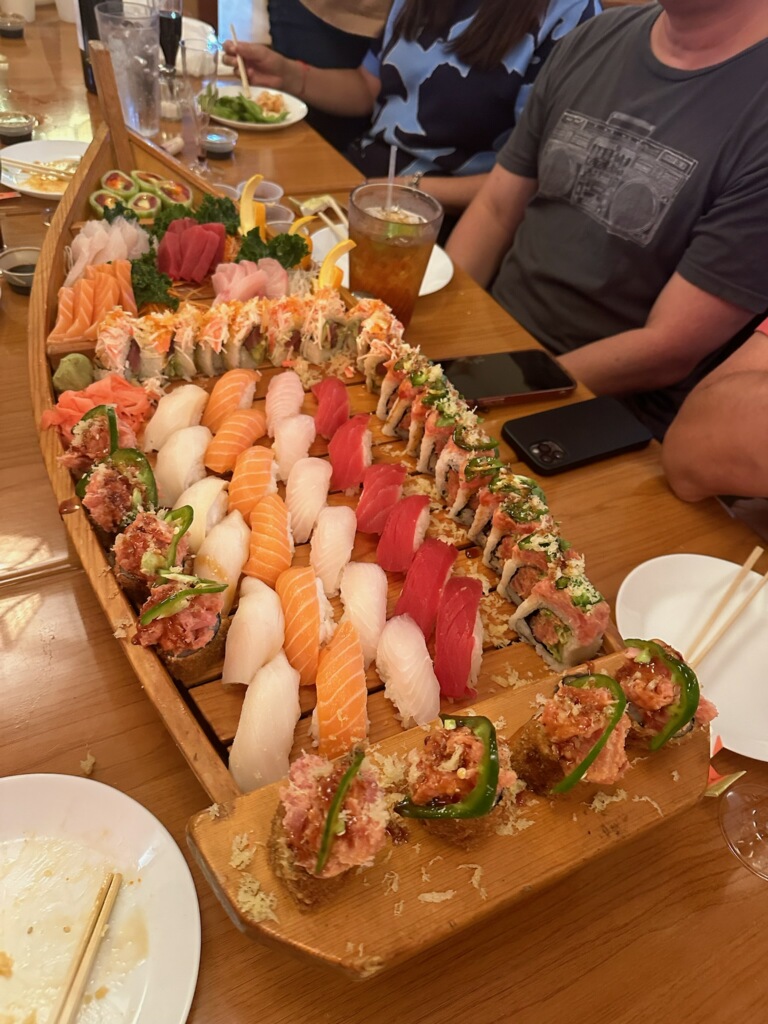
A sushi boat sits in front of diners at Miyako Japanese Restaurant. Photo Courtesy of Vanessa Velasquez.

Kim recommends ordering the “Diana Tower” and the “Miami Hurricane Roll,” which is topped with orange salmon, showing off his UM pride. 

His son shared that his favorite dish is the “volcano roll” a spicy baked roll with imitation crab covered with spicy mayo. 

Although Miyako isn’t a flashy new restaurant, its reputation alone draws in notable guests. Miami Heat’s President Pat Riley, former NBA star Ray Allen, current Heat players and UM faculty who’ve made it their go-to spot, are known to stop by. 

Kim has a somewhat unorthodox approach to advertising, he simply doesn’t spend money on it. He and his team rely on word-of-mouth marketing and a commitment to quality to keep bringing customers into the restaurant. 

Despite the consistent attention, the restaurant has recently faced struggles since the closing of Sunset Place mall, which would bring customers to Miyako after a busy day of shopping. 

Yet, Kim’s focus on flavor, great prices and family has made Miyako a UM favorite. Customers can take pictures of the colorful, delicious sashimi dishes and leave knowing they got their money’s worth.

Miyako is a perfect place to add to your list of local restaurants to try, and could be a refreshing change from dining hall food. 

Don’t forget to bring your ’Cane card when you pass by for a “’Canes Family” discount before you pay. 

One thing’s for sure: you won’t leave Miyako hungry. 

Trader Joe’s is a college students’ heaven

The best feeling after a long day of classes is opening up my fridge and heating up a pre-made Trader Joe’s meal. They are pre-portioned, relatively healthy and, best of all, quick to make.  

Trader Joe’s is a college students’ heaven. It carries staples like eggs, deli meats, fresh vegetables, salad kits and microwavable meals. It has a lot of options to offer, from cultural foods and even simple meals suitable for picky eaters. It has everything. 

In comparison to other supermarkets in the Miami area, Trader Joe’s is very budget friendly for college students. In contrast to top contenders like Milam’s Market, Publix, Target and Whole Foods, Trader Joe’s is significantly cheaper. 

Some of my staple items are the overnight oats, the jalapeno and cream cheese wontons and their tomato labne dip, but almost all of their dips are amazing. And it has the best snack ever: the chili and lime rolled corn tortilla chips, which are the superior Takis dupe.

For example, you can find sourdough bread at Trader Joe’s for $3.49, while at Whole Foods it is $5.49. You can find Trader Joe’s Pita Chips for $2.49, and at Target they are $3.39.  

Trader Joe’s tends to be more cost effective because most of its products are store branded, without sacrificing the taste and quality.

“I prefer Trader Joe’s because it’s cheaper than other supermarkets, but it offers quality products and new fun stuff that you can’t find in other places,” said Paulina Banus, a senior majoring in business technology.

Luckily for UM students, there are two Trader Joe’s locations near campus, and one of them is just a single metro stop away. This location is extremely convenient for students’ busy schedules.

Time is a college student’s biggest enemy. When I was living in the dorms, the amount of ready to eat kits or microwave meals that I had from Trader Joe’s was not only a good alternative to the everyday dining hall, but also a healthy and fast option.

It also saves money compared to the Uber Eats or DoorDash you would typically order late at night. The frozen pastas, butter chicken and tikka masala are some of my favorites that I had on rotation.

If microwave meals aren’t your thing, there are a multitude of recipes online with budget friendly Trader Joe’s ingredients to cook an entire meal in 30 minutes. 

Trader Joe’s is a sanctuary for college students. It offers excellent quality products, variety and budget friendly options that are a good alternative to dining halls, campus food courts or just ordering fast food.

Dining hall hours leave students dinner-less

0

It’s 9:20 p.m. and your three-hour class just ended. As your stomach grumbles one last time for the whole class to hear, the realization hits. The dining hall is closed, leaving only Subway, Starbucks and the Market as options for dinner — all of which cost dining dollars or money.

With the hefty and mandatory $4,490 per-semester meal plan for freshmen, not being able to get dinner from the dining hall after 9:30 p.m. is frustrating. The dining hall should be open late enough for all students to eat, regardless of their class schedules.

From Monday to Thursday, the dining hall has dinner until 9:30 p.m. On Fridays, it is open until 8 p.m. and on Sundays, it is open until 9 p.m. The dining hall also has late-night dining on Thursday to Saturday, reopening the kitchen from 11 p.m. to 2 a.m. 

With the population of students taking classes that end at 9:20 p.m., and the late-night study habits many students at this school have, there remains no time for many students to indulge in their last meal of the day.

Late-night dining is in theory a solution to this issue, but in reality, it is only accessible to half of the freshmen. It is currently only available in the Mahoney-Pearson dining hall, leaving all students in Centennial Village forced to walk across campus to eat. 

Centennial Village resident Sophia Clark said, “I have only been to late-night dining once. It’s just such a hassle that late.”

Additionally, it only being available from Thursday to Sunday leaves students without a meal all other nights of the week. Late-night dining is a great idea in theory, but its limitations prevent it from providing all students access to food.

On nights that the dining hall doesn’t have late hours, there are many students who have classes that end later than the dining hall is open. Freshman Shannon Brickley has a class on Tuesdays that ends at 9:30 p.m. 

“The late time was the only class open by my time to register,” said Brickley, “I literally don’t eat dinner on Tuesdays because I can’t afford to DoorDash that much.”

Like Brickley, many students in late classes aren’t doing it by choice. Instead, these students have been forced to select later times as it is the only time the course they need is offered. 

A study published in the Journal of the Academy of Nutrition and Dietetics showed that food insecurity is negatively associated with GPA, both alone and when considering demographic covariates.

The dining hall hours are not only inconvenient, but are further impacting students’ cognitive ability to maintain the grades required for UM’s rigor.

“We recognize that some students may have additional factors, such as labs, team practices or internships/jobs, that may impact their schedules. Any student with a scheduling conflict or concern is encouraged to reach out to our team so we can ensure they receive the support and nutrition they need,” said Michael Ross, the vice president of operations for UM Dining Services.

But that is not the point. Students shouldn’t have to request accommodations on a schedule that the school establishes. Not to mention, these potential accommodations are not advertised anywhere, leaving students unaware this is an option.

“I DoorDash dinner around four times a week and an energy drink once or twice a week because I have a late class, and always lose track of time when studying. By the time I go to eat, it is closed,” said freshman Sadie Rosenblatt.

Even those students who are willing and able to spend money on DoorDash weekly shouldn’t be forced to. Spending excess money to get a different dinner should be a personal choice, not one that the student is forced to make.

“This spending is draining my bank account, but not eating dinner after classes and the long days I have is ridiculous,” said Rosenblatt.

UM’s dining halls currently have a system that prevents students from eating dinner. These hours must be extended so that all students have access to the food they paid for.

Feed the students who study late. Keep the dining halls open.