Home Blog Page 80

Stanford seeks elusive road win at No. 9 Miami: What to know about the Cardinal before Saturday’s matchup

0

The Stanford Daily’s sport section managing editor Isaac Sullivan previews Stanford football before they take on the Miami Hurricanes this Saturday.

STANFORD, CA – OCTOBER 18: Elijah Brown during a game between Florida State University and Stanford University at Stanford Stadium on October 18, 2025 in Stanford, CA.

Stanford football’s (3-4, 2-2 ACC) most meaningful progress under interim head coach Frank Reich will be measured on the road. The Cardinal are 0-4 away from home and have yet to stack back-to-back wins this season. That makes Saturday night’s first-ever meeting with No. 9 Miami at Hard Rock Stadium a chance to change the trajectory, not just the record, of this season.

The quarterback situation is the biggest question for Stanford heading into the weekend. With redshirt senior Ben Gulbranson’s status uncertain after last week’s leg injury, redshirt freshman quarterback Elijah Brown could make his first start of the season. Brown said he leaned on Gulbranson and the staff to be ready when called, emphasizing a “level head” approach: 

“Just staying the course is the key to the win. And I had a lot of help over the week just picking Ben’s brain on what kind of looks we’re getting and where I should go with the ball,” Brown said.

 Reich echoed that message of letting things come naturally for Brown: “Don’t try to be a hero. Just do what players fall for, let your teammates shine and just stick to the script.”

If Brown gets the nod, he will have the support of a backfield coming off an impressive week. Redshirt freshman running back Cole Tabb is coming off a career night and was named both ACC Running Back and Rookie of the Week after rushing 28 times for 118 yards and a touchdown in the win over Florida State. 

“There were a lot of yards after contact,” Reich said, praising Tabb’s “contact balance” and the line’s improved run blocking. “He showed that power to move the pile, but he also showed speed to get around the edge. And that’s a rare combination.”

Senior tight end Sam Roush has emerged as a steady chain-mover, piling up targets the last two weeks as the passing game found better rhythm. Reich called Roush a big part of their offense but insisted the plan remains to spread the ball. To be successful this weekend, Brown will have to trust his deep shots in an effort to connect with receivers CJ Williams and Caden High. 

Defensively, Stanford’s challenge is compounded by a short-handed unit for the first half. Fifth-year safety Mitch Leigber must sit the opening two quarters following a targeting ejection in the game against the Seminoles; Reich called it “an unfortunate play” and said the staff would adjust personnel until Leigber’s return after halftime.

To make things tougher, Stanford will be facing a team in bounce-back mode. Miami (5-1, 1-1 ACC) just absorbed its first loss, 24-21 to Louisville, but remains a top-10 team with speed across the formation and an experienced front on defense. Reich lauded the Hurricanes’ physicality and variety — plenty of single-high looks and man-match principles — and warned that their corners “can play man coverage the whole game.” The last time Stanford beat a top-10 nationally ranked team was in 2009, when they defeated No. 7 Oregon 51-42.

Although Miami is an unfamiliar foe to Stanford, Reich is no stranger to the Hurricanes. In 1984, Reich orchestrated the “Miracle in Miami,” replacing Maryland’s starting quarterback and leading the Terrapins to a 31-point second-half rally to beat the Hurricanes 42-40 — the largest comeback in college football at the time. Reich smiled off any suggestion of recreating that script for the Cardinal.

“That is not my advice. That’s definitely not my advice, for sure,” Reich said.

To avoid facing an impossible deficit early in the game, the Cardinal have to bring the vibes of Stanford Stadium, where the team is undefeated this season, on the road. Stanford has played cleaner football as of late after a flag-heavy outing two weeks ago; avoiding pre-snap penalties and staying on schedule will be essential against Miami’s front. The Cardinal must also ride the ground game. Tabb’s yards-after-contact can keep Stanford ahead of the chains and set up play-action for Brown, who made it clear that he will be simplifying the script and taking what the defense gives. Brown has faith this road matchup will unfold differently than the others.

“We’re a great team as well,” Brown said. “If we eliminate our mistakes and keep moving forward, we’re going to be great.” 

It’s the right message for a roster that has shown steady growth and is learning how to win tight games. Reich understands that a win in Miami would be huge for the program.

“This is going to be a really good test for us on the road,” Reich said. “If we want to get to where we want to go, we have to be able to show that we can go on the road against a well-coached team, a tough team, and play good football.”

Kick-off is scheduled for 7 p.m. EST on Saturday.

Photo Credit: @MiamiHurricanes via X // The Miami Hurricanes will don these camouflage jerseys for their Military Appreciation Game against Stanford on Oct. 25, 2025.

Orange Umbrella finds its true colors with new logo and rebranding

For nearly a decade, Orange Umbrella, often called “OU,” has been the University of Miami’s hub for student creativity and collaboration. Now, the student-run advertising agency is stepping into a new chapter with a new logo — one that better redefines their mission, vision and values. 

The new logo is sleek and modern, representing a fusion of OU’s initials — an “O” and “U” — cleverly shaped to also resemble the canopy of an umbrella.

“If you look closely, you’ll notice the top of the ‘O’ forms a more modern, contemporary top part of an umbrella,” Ian Mavorah, OU’s managing director said. “It’s italicized to show forward momentum, which is our North Star.”

The new logo intentionally uses two shades of orange to reflect OU’s values. Mavorah feels as though OU “really owns” the color orange as it represents enthusiasm, boldness and creativity — qualities that he feels the whole team embodies.

Wesley Lucas, OU’s creative team lead and senior creative advertising major is responsible for the final logo design.  

OU began in 2017 and is a student-run, professionally-led advertising agency within the School of Communication. The agency turns classroom hustle into real-world muscle, working with approximately 30 student team members to take on clients, deadlines and creative briefs that mirror the professional world. 

OU’s current clients include Know the Glow, Furi Sport, Doritos’ Crash the Super Bowl contest and Matchmaking.com.

When Mavorah joined as managing director last year, one of his first goals was to reshape OU’s internal culture and public image. He explained that while there wasn’t necessarily an issue with the old logo and brand image, he just wanted to evolve as an agency and truly position themselves as an agency for Gen Z.

“There was a misperception on campus that we were a club, that we were a fraternity, a sorority,” Mavorah said. “But at the end of the day, we’re an ad agency. We really needed to kind of redefine who we were and who we wanted to be.”

That transformation began with an internal look at the agency’s culture, mission, vision and values. Once that process was complete, Mavorah and his team realized the agency’s old logo no longer represented its identity.

“The old logo with the upside-down umbrella wasn’t contemporary. It wasn’t future-thinking. It wasn’t innovative or bold,” Mavorah said. “It lacked energy — all the things that now define who we are as an agency.”

The rebrand wasn’t just a change of look — it has become a symbol of unity and creative collaboration across the organization.

“During my first few weeks, I had everyone write a word on the board that they felt exemplified OU,” Mavorah said. “That exercise set the tone for the types of clients we want to attract and the types of students we want to hire.”

This spirit of collaboration carried through the entire rebranding process. Some students worked together over the summer in a smaller team acting as a focus group to test logo concepts and give honest feedback.

“It truly wasn’t just like ‘oh let’s fix a logo,’” Ava Prinzo, OU’s VP of public relations and senior creative advertising major, said. “It was a full revamp of everything, which definitely boosted morale here in the agency.”

Their website and social media pages were adjusted to match the revamp as well.

For Mavorah, the rebrand was as much about internal transformation as it was about external perception. He compared the new logo to the Nike logo. Even though it may not be understood by everyone, it’s incredibly definable.

“This wasn’t about clients. It was about us,” Mavorah said. “It was about cultural transformation because it’s good for team morale, it’s good for business and it’s good for awareness on campus.”

The new identity has also helped increase awareness on campus. Students who previously overlooked OU are now taking notice and Mavorah couldn’t be more grateful.

“People see the new logo and realize things are happening — that it’s an exciting time for us,” Mavorah said. 

With its refreshed logo and renewed purpose, OU’s rebrand marks a new chapter for the agency — one defined by creativity, curiosity and confidence.

The Institute for Individual and Family Counseling returns to UM

0

The Institute for Individual and Family Counseling reopened on Aug. 18 following its closure during COVID-19. The IIFC is a training clinic for graduate students in UM’s Department of Educational and Psychological Studies within the School of Education and Human DevelopmentCounseling sessions are available in English and Spanish, both in person and virtually. The students provide individual, group and couples counseling under the direct supervision of University of Miami faculty. This program provides hands-on learning experience for students, while simultaneously providing affordable mental health services to their local community. 

Many of the graduate students working at the IIFC are second-year master’s students pursuing their license in mental health counseling. They must complete at least 700 hours in a year, 280 of these being direct hours working unpaid with clients.

George Welch is one of these interns working toward becoming a registered mental health counselor intern. 

Welch says that all of the sessions are recorded for educational purposes, then deleted later. They are recorded for liability reasons, and for interns to learn from under the supervision of a psychologist or licensed clinician.

“We go over [the recordings] with our supervisor just to figure out if the right interventions are going to be utilized or [what are the] therapeutic goals,” Welch said. “And then after that, we delete the recordings because of confidentiality purposes.”  

Gabriela Sanchez, an intern at the IIFC, says she found this opportunity through her classes at UM. She explained that the program’s inclusivity was one of her main reasons for joining.

“I like how [the IIFC] includes [counseling for] everyone, like people of different heritages and ethnicities,” said Sanchez. “It isn’t just for the elderly, it’s not just for young people. It’s anyone that needs therapy.” 

The IIFC works hard to include anyone in the Miami area who is in need of counseling despite socioeconomic status. Morgan Reilly, who started working with the IIFC in August, emphasized the accessibility of the counseling service.

“It’s a community-based center, so we also offer services at a lower cost for people so that we make it accessible,” said Reilly. “Our starting [price] is $50, but we do have a sliding scale because we do want to work with families, individuals, and couples.” 

A client may meet with the same counselor continuously from intake until termination. Sanchez says it is important to create a judgment-free place where individuals can receive the care they need. For example, many of her clients appreciate the chance to talk to someone who isn’t a close friend or family member and can listen without judgment.

Julian Maceira, another student working toward his hours at the IIFC, says part of what excited him about joining was the clinic’s strong community reputation before COVID-19.

“It’s nice that it’s on campus and [the IIFC] is integrated with a lot of professors that we already know and that we’ve worked with, but also it just has had a good reputation in the community,” said Maceira. 

Although UM offers counseling services to students, Maceira says the IIFC can be a better long-term option.

“The Counseling Center does really good work, but from what we’ve seen they’re really swamped, and they can only do a few sessions,” said Maceira. “If you’re a student that’s looking for something a little more long term … then the IIFC is a good alternative.” 

Now, the IIFC is working to rebuild its clientele by promoting around campus and in the community to spread awareness about the resources UM offers.


Student Senate looks to increase connection to UM community

The Student Senate is currently working to increase transparency and visibility with the student body. Steps to expedite passing bills and finding new ways to reach constituencies are already in motion.

Senator Issa Romano passed a bill in September to add Americans with Disabilities Act buttons on doors in University Village to open them automatically. No one told her this was a problem, but she realized it and wanted to fix it. She wrote the bill and passed it faster than in previous years.

Previously, bills took months to be implemented. Members of the Senate attribute it to a lack of clear directions on how to work with the administration. Now, the Senate is creating a set of procedures that will incorporate changes to UM more effectively.

With the internal changes, Alexei Darling, Speaker of the Senate, hopes that each senator will be able to pass at least one bill per semester and represent their constituency better.

“Now, it’s more let’s create a system that gives people the structure that they need in order to build those things,” Darling said. “And I think a lot of the time, people in the Senate want to do those things, but there’s just been a difficulty with finding direction.”

With the elections for the 2025-2026 Student Senate complete, Darling hopes the new senators can already benefit from the efforts. 

There is one main area the Senate is targeting with its newest bills.

“Career Services,” Darling said. “Having worked on it last year with administration and seeing what our employment numbers and internship landings were for students at the school, it wasn’t a great picture, especially for how good of an institution the University of Miami is.”

Expanding job opportunities for students and improving academic advising are not changes the Senate can do alone. Even if the administration is responsible for most of the work, Darling thinks the work they are doing is valuable.

“It’s a process that takes time, and sometimes you need some student voice and student input to kind of see how that gets shaped a little bit,” Darling said.

The Lakeside food pantry was empty on Sept. 4. To find a solution, Ate’sia Wallace attended the Student Senate’s open forum on Wednesday, Sept. 10. Now, the student senators are drafting a bill to help prevent food scarcity among students.

Cases of students reaching out like this are not as common as senators would like. To make changes that matter, senators need students to reach out.

Darling and other members of the Student Government blame the difficulty in connecting with students on a lack of transparency and visibility.

“We do a lot of work, and we try and make a big effort to do good things, but we don’t do a great job of advertising [their initiatives], so we’ve been trying to do a better job doing that,” Darling said.

Having more tabling events is one solution. Its most recent event in September, “Food for Thought,” was held to discuss improvements to housing. But most student engagement comes from Student Government’s weekly meetings.

“People are free and allowed to come,” Darling said. “We want our constituents to be more involved.”

Students are invited to talk to senators during Open Forum every Wednesday from 4:30 p.m. to 6:30 p.m. in the Senate Room on the third floor of Shalala. If someone cannot attend, senators are working to connect representatives with their constituencies. 

“I did have an idea for a bill where we would send out emails to our respective constituencies and the advisors or directors for our respective constituencies,” Elizer Rozado, first-generation student senator, said. 

The Senate’s Public Relations Committee is working on Rozado’s proposal.

Another initiative has been Senate Takeovers. Students can get to know representatives from different constituencies by following them for a day and asking questions.

The Speaker for the Senate, Alexei Darling, and his Speaker Pro Tempore, Trinity Vodovoz, can be contacted at speaker@miami.edu. If students want to know more, they can look over their website and Instagram pages.

“I want to emphasize that the senators do a lot of work, and they want to hear from you guys,” Darling said. “Go talk to them. Go give them these ideas. Talk to them about your issues so they can work on them, because they want to improve student life for everyone.”

Survey results reveal that most people know, and ignore, vaping policy

The University of Miami Coral Gables campus became a smoke free campus on August 1, 2013, making smoking prohibited on all campus property. Even with this policy in place, a cloudy haze can still be spotted all around campus as students use their e-cigarette devices.

According to the university handbook, “Those who violate this University policy will be referred to the Dean of Students Office and are subject to disciplinary action.”

The policy includes “inhaling, exhaling, burning, or carrying any lighted cigarette or electronic cigarette, cigar, pipe or other such device which contains tobacco or other smoke producing products.”

Despite these consequences, vaping remains a prevalent issue on campus. 

According to a Google Form survey posted on the @themiamihurricane Instagram on Oct. 13 and filled out by 162 UM students or faculty, the places you are most likely to see a student smoking is in dorm rooms or halls, the dining hall and in buildings like Whitten, Shalala and Dooly. 

When prompted with the question, “Have you ever seen a student vaping on campus? If so, where?” An anonymous student responded to the form, “Yes, everywhere.”

87% of survey takers are aware of the campus rules, but nearly 70% of responders feel that the exact policy and consequences could be communicated more clearly. 

The policy document states, “Smoke-Free Ambassadors, faculty, staff and students are encouraged to directly and politely inform those unaware of the policy or remind those in disregard of it.” 

The document later states that students will face disciplinary action. 

Even if the rules were communicated better, that doesn’t necessarily mean it would stop students from vaping all together. In fact, the results of the survey above show that nearly 44% of responders think that the root cause of this cloudy haze is addiction.

According to an article by Statistica, as of fall of 2024, 24.8% of college students used tobacco or nicotine products daily or almost daily within the past three months.

“They’re either addicted to it or they just don’t feel like following the rules because they know they probably won’t get caught,” said a student who wishes to remain unnamed.

On the student health center website, a variety of resources are offered to help students who want to quit vaping but are struggling. 

On campus, students can visit a medical provider in the student health services. Smoking cessation aids are available free of charge to all students in the university’s student health center.

Students can also attend the University’s award-winning smoking cessation program, Tobacco Free Florida AHEC. This resource is available to UM employees, students, and the community at no charge.

The resources off campus include The State of Florida Quit Line, which offers free counseling and nicotine patches. There are also many websites to visit with programs like My Last Dip, Kill the Can and apps like NCI QuitPal and Smokefree Teen QuitSTART.

When prompted with the question, “What do you think could help reduce vaping on campus?” A response from the form stated, “Maybe more signs saying it’s prohibited around campus, I don’t think I’ve ever seen one.”

Some responses took the stricter approach like more patrol from RA’s, more cameras, and making the punishments more clear and firm. 

One student believes a cultural shift is necessary to reduce the smoking and vaping on campus. 

Others, like UM communications professor Elayna C. Paulk, feel that more education on smoking and overall reduced stigma are a step towards reducing vaping. Also more signs around campus as a preventative measure.

“A policy that’s just like stuck on a wall is not going to really change perceptions on it. At this point, it’s so much of a habit that I think it’s so important for us to really address, ‘How do we make this not a habit,’” said C. Paulk. “We can all benefit from education, whether we use it or not, just so that we understand more.”

‘Porch pirates’ reported stealing packages at The Cloisters Miami apartment complex

0

Several reports were made by residents of The Cloisters Miami, off-campus apartment complex located on SW 57th Ave behind the Wellness Center, that a “porch pirate” had been seen on camera stealing packages from their front doors. 

Tiyana Hartwell, a junior at the University of Miami, shared Ring camera footage with The Hurricane, showing a concealed young man fumbling through a package at their front door and walking away on Sept. 8 at 4:20 a.m. 

Other residents expressed concern for their safety as several similar incidents have occurred within the same complex.

“There have been multiple incidents of a man sneaking into apartments around three in the morning and taking packages,” said a resident who wished to remain unnamed. “Several residents have asked management to address the issue, but their response has been lackadaisical.” 

When asked to comment on the situation, The Cloisters Miami responded that they were “looking into the situation but as of now have no record of any form of theft.” 

In 2023, a WSVN article covered the living conditions of several UM students living at The Cloisters whose bathtub, toilet, and sink were filled with feces and sewage. 

“We currently have feces coming out of our kitchen sink, and we’re trying to get someone on it,” said Gianna, a resident at the Cloisters during the time the article was written, to WSVN. 

The students also mentioned their closet door falling off its hinges, having no window shades or blinds and overall feeling unsafe in their environment. 

An online rating website called ApartmentRatings.com currently has The Cloisters Miami at 2.2 out of 5 stars based on reviews. 

“Absolutely awful establishment that should be shut down,” said one review from Current Resident 724593. 

“The worst part is it isn’t a safe place to live,” wrote Current Resident 321299. 

The response from the Cloisters has generally been that they are “addressing complaints as quickly as possible,” but students are unsatisfied with management’s lack of action.

However, the Cloisters’ response has left some students concerned for their safety, complaining that “their inaction is worrisome” and “students don’t feel their safety concerns are being taken seriously,” as shared by the same unnamed resident of the apartment complex.

This is not the first time the apartment has been under fire for reports of “unsafe conditions.” 

H-1B Visa fee threatens UM employees and student opportunity

0

Universities nationwide may be unable to continue hiring qualified researchers, professors and medical practitioners following the Trump Administration’s new fee for H-1B visa applications.

President Trump issued a presidential proclamation on Sept. 19, placing a $100,000 fee on any new petitions for H-1B visas following Sept. 21, 2025. 

United States employers typically obtain H-1B visas for highly-skilled international employees working in engineering, technology, finance and medical fields. 

According to the Miami Herald, 2,589 university workers have required an H-1B visa in Florida in the past five years. The University of Miami accounts for 13% of that total, or approximately 336 people. 

In the first three quarters of the 2025 fiscal year, UM filed for 137 H-1B visas.

H-1B visas historically cost between $2,000 and $5,000, meaning universities could be spending $10 to $20 million to maintain current hiring levels. However, it is more likely that sharp cutbacks will take place on hiring talented foreign workers for research, clinical care and STEM courses. 

In an interview with the Miami Herald, Bruce Baker, the chair of the department of teaching and learning at UM said, “Universities will most certainly take a hit from this policy change.” 

The majority of H-1B visa workers at UM are among biochemists and biophysicists, followed by health specialities teachers, medical scientists and molecular and cellular biologists. 

Students are concerned that they could be facing a decrease in access to talented professors in the future because of the high concentration of foreign workers employed in these fields.

“The STEM departments at UM could definitely struggle from a loss of international professors,” said Siri Ravi, a sophomore studying microbiology and immunology. “It was interesting to experience [international professors’] teaching styles because they’re different from professors I’ve had before.”

Science students also reported that it is already challenging to acquire research opportunities with the current, full staff of professors.

“A lot of professors are really stingy about using their name to get research opportunities. They are very careful about saying yes to requests for recommendations,” said a chemistry student who wished to remain unnamed.

If UM has to cut back on the number of international professors it hires due to H-1B visa fees, students may have a harder time contributing to research. A smaller staff in the STEM departments would have adverse effects on the student body, seeing as the School of Nursing and Health Studies is home to approximately 1,500 students. Additionally, the College of Arts and Sciences is the largest college at UM with around 35% of undergraduate students, many of whom study biology, chemistry or computer science. 

International professors wanting to work in the U.S are not the only group that could be negatively affected by a high H-1B visa fee. International students looking to stay in the country after graduating from UM may also face challenges.

“Everyone on a student visa will have to apply for a different visa because it expires when you graduate,” said an international student who wishes to remain unnamed.

For instance, graduating international students with job offers in engineering, architecture or medical professions have the option of applying for an H-1B visa. If they can not afford the $100,000 fee, they would have to look into other options.

No. 9 Miami looks bounce back with Saturday night showdown with Stanford

0

Coming off their worst game of the year, the Miami Hurricanes, 5-1 on the season and now ninth in the AP Poll, are set up to bounce back this week against a struggling Stanford team. More than ever, the pressure is on to not only win this week, but to dominate the opposition.

From the defense missing 27 tackles, to the offense for a second straight game being unable to run the football, Miami (5-1, 1-1 ACC) had problems all around the field. And as the ’Canes top coaches talked during media availability, the message was simple: get back to what they do best.

“Collectively as a group, some of it is tweaking and some of it might be changing,” head coach Mario Cristobal said Monday. “But it’s also improving and really doing things that we have done well, doing them well again, and not straying from that.”

So while the team is focused on acknowledging what went wrong Friday, there’s a key balance to not overreact and get in their own heads. Despite the win against Florida State (3-4, 0-4 ACC) last weekend, Stanford has struggled all year against good teams. 

The Cardinal (3-4, 2-2 ACC) is 0-4 against teams that currently have a winning record, all of which came on the road. In its last three games against such teams, Stanford has lost by 24, 28, and 24 points against BYU, Virginia and SMU respectively. Simply, good teams have just blown the Cardinal out of the water and Miami is going to need to do the same. 

For the ’Canes, quarterback Carson Beck needs to not let things spiral for him. Beck has been solid all year long, but played one of his worst games of his career on Friday. 

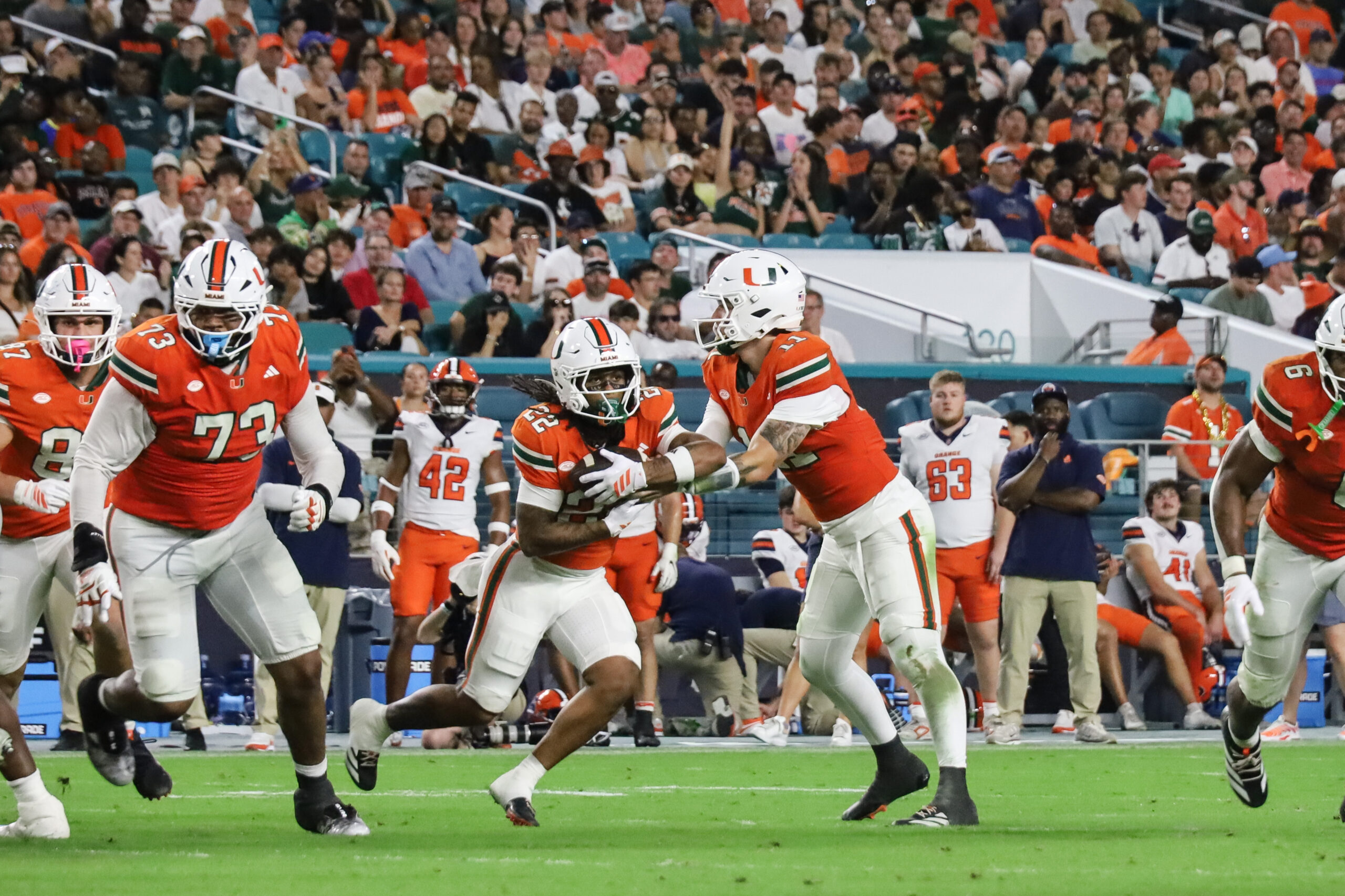
David Lebowitz, Staff Photographer – Sixth Year Redshirt Quarterback Carson Beck hands the ball off to Sophomore running back Jordan Lyle against Louisville on October 17, 2025.

The Georgia transfer threw four interceptions against Louisville, including a costly one in field goal range that sealed the game. Beck looked like he was pressing, attempting to force the big play with his first two interceptions coming on early down, deep throws.

While Beck is going to need to bounce back, there’s a recognition from the rest of the offense to do so as well. Offensive coordinator Shannon Dawson spoke on how the whole offense is looking in the mirror, including himself.

“Ultimately there were some things, you know, there’s specific things that I think in those certain situations that I could do better,” Dawson said. I have to call better, make clearer, in those particular situations, and that’s coaching. I have to coach better in those situations.”

Stanford defensively has been poor and the passing game is no exception. On average, the Cardinal has allowed 304 passing yards per game. To make things worse, the Cardinal’s potentially best defensive player, cornerback Collin Wright, has dealt with injury the past couple of weeks. 

Wright has Stanford’s only interception on the year and the Cardinal has just five turnovers in seven games. Its defense also allows some of the most explosive passing plays in the country, with 34 plays of 20 or more yards allowed. With an injured and struggling Cardinal defense, Beck is poised to get back on track.

Maybe more important for Miami is the run game, or lack thereof over the last two weeks. Since FSU, Mark Fletcher Jr., Marty Brown, and Jordan Lyle have averaged 2.7 yards per carry. 

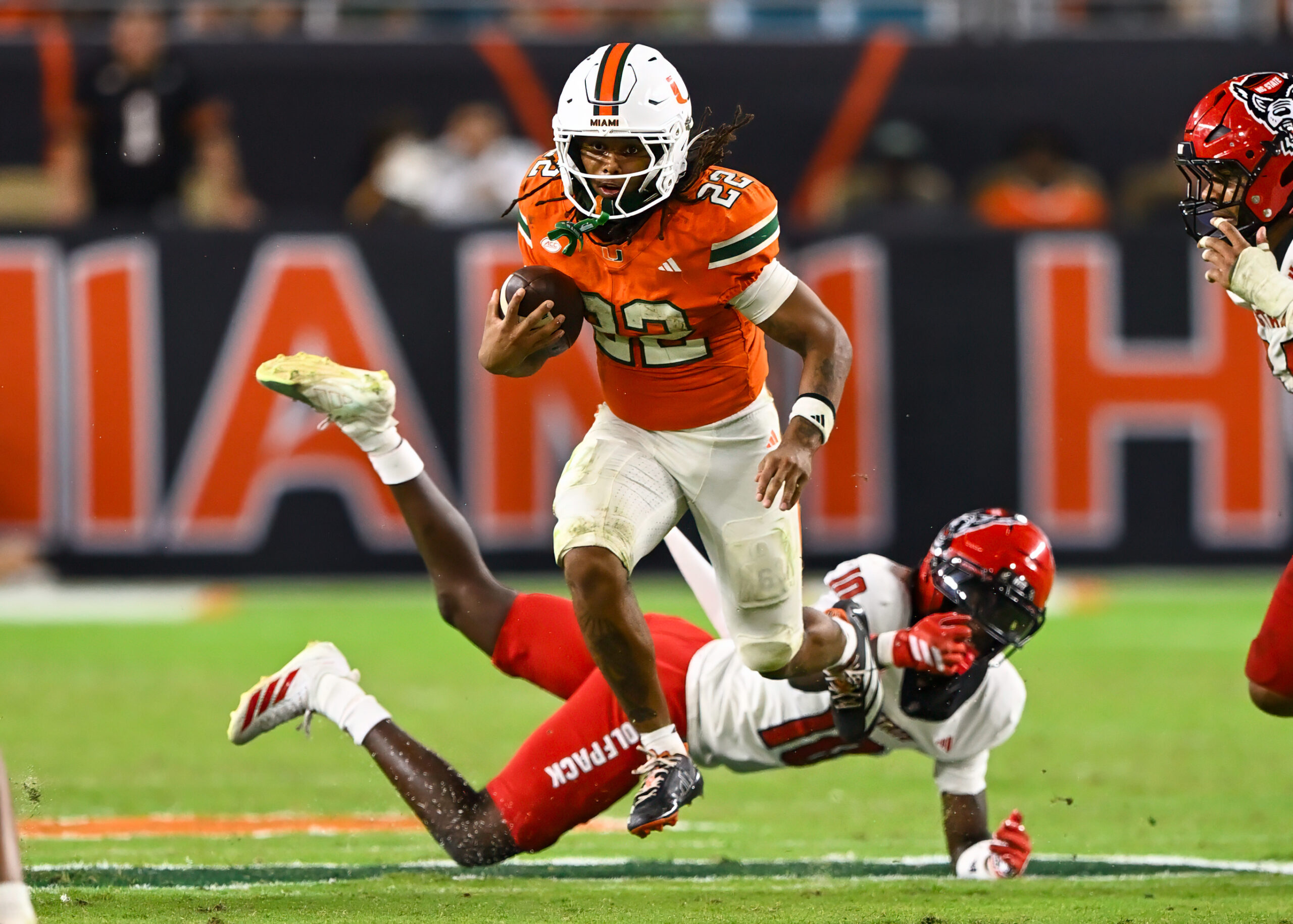
Photo Editor Brian Mulvey // Sophomore running back Jordan Lyle takes a hit against Louisville on Friday Oct. 17, 2025.

The Hurricanes ground game has been predictable at times and even with Lyle returning from injury, the creativity from Dawson has yet to be seen. Not only does Miami need to commit to the run unlike last week, they need to have some variation to keep teams from guessing.

Similarly to their pass defense, Stanford’s run defense equally has holes for Miami to exploit. The Cardinal is coming off back to back games allowing over 100 yards and overall on the season, teams are averaging 117 rushing yards against SU.

While Stanford is definitely not Louisville, it also has a few weapons that could present similar challenges. Miami was burned by Issac Brown and Chris Bell Jr., and Stanford has similar archetypes of players. 

Stanford has a solid running back room between Micah Ford and Cole Tabb. Ford went out with injury during the Florida State game, so it’s unsure if UM will see him. But, as a big 6 ‘0, 220 pound back, if healthy, he can test the Hurricanes physicality. 

In his stead, Cole Tabb had a big finish to the game against the Seminoles, rushing for 118 yards and a touchdown. As a speedy, quick footed runner, he might present similar challenges as Brown did for Miami. Linebacker Wesley Bissainte accounted for five of UM’s missed tackles and he’s going to need to have a bounce back game against this running back duo. 

The most pressing issue for UM is an answer for the quick passing game. Against UL, quarterback Miller Moss was able to get the ball out in an average of 2.3 seconds. This gameplan of getting the ball out quickly entirely neutralized defensive end Reuben Bain and Miami’s elite pass rush.

A week after allowing five sacks, Louisville allowed just one thanks to Moss being quick with the football. As the season moves on, Miami has to expect other teams to take a similar approach. As the game progressed the Hurricanes did seem to adjust. During his press conference, Defensive coordinator Corey Heatherman talked about how the defense mixed up coverages and schemes, and how despite a sluggish start, they came together. 

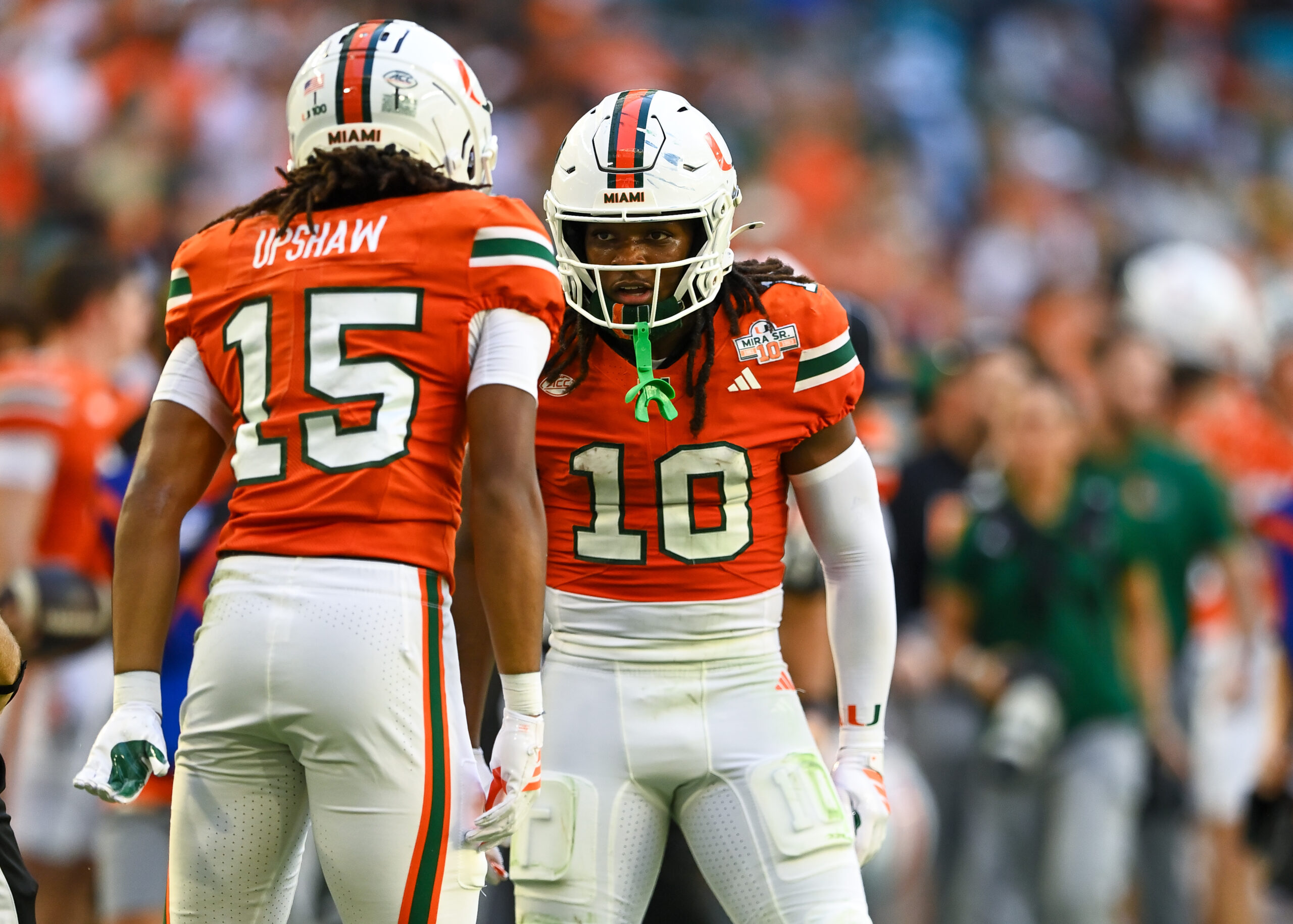
Photo Editor Brian Mulvey // Junior defensive lineman Rueben Bain Jr. rushes the passer against Louisville on Oct. 17, 2025

“I thought we did a really good job after those first two drives of getting to third and off tracks,” Heatherman said. “I think they converted one third in more than four all game and it was third-and-10 in that last touchdown drive.” 

As part of that quick passing game, Miami will have to deal with CJ Williams, the go-to guy for the Cardinal. Williams is averaging eight receptions for 100 yards over the last four games. 

The senior, like Bell, is a big outside receiver with strong hands who works great over the middle of the field and on quick throws. Williams is not the same athlete or vertical threat that Bell is, but he’s more than capable of giving Miami similar problems.

The biggest question for Saturday’s game is the quarterback situation for Stanford. Senior quarterback Ben Gulbranson was knocked out of the game against the Noles because of a lower body injury before halftime. Redshirt freshman Elijah Brown managed the game well enough for the win. With the lack of experience, Stanford’s offense could be dumbed down to the quick game and runs like Louisville did.

But after coach Jeff Brohm and UL’s blazing start, the ’Canes forced seven punts and a turnover, giving Miami’s offense a chance when all seemed lost. While Louisville’s first two drives and the final touchdown showcased concerns, Miami does seem like it can weather the storm even if teams use quick passing to take Bain out of the game.

To put it simply, Miami is much better than this injured and struggling Stanford team and this week needs to be more than a win. Miami needs to dominate this game and play its best four full quarters since USF. 

Stanford has yet to take down a winning team this season and aside from its opener, the Cardinal has been unable to hang with any other team. This has to be a return to form for Miami and needs to be a statement that last week was a fluke.

As the season continues and with UM having no more currently ranked opponents, each week Miami does not play a ranked team or team with a winning record needs to be dominant. With an easy schedule and no control over their own destiny in the ACC, the Hurricanes must treat every game for the rest of the season as if it was a playoff game.

Stanford has lost its last nine road games against ranked teams and Miami needs to make it 10. Kickoff is set for 7:00pm in Hard Rock Stadium Saturday night and will air on ESPN.

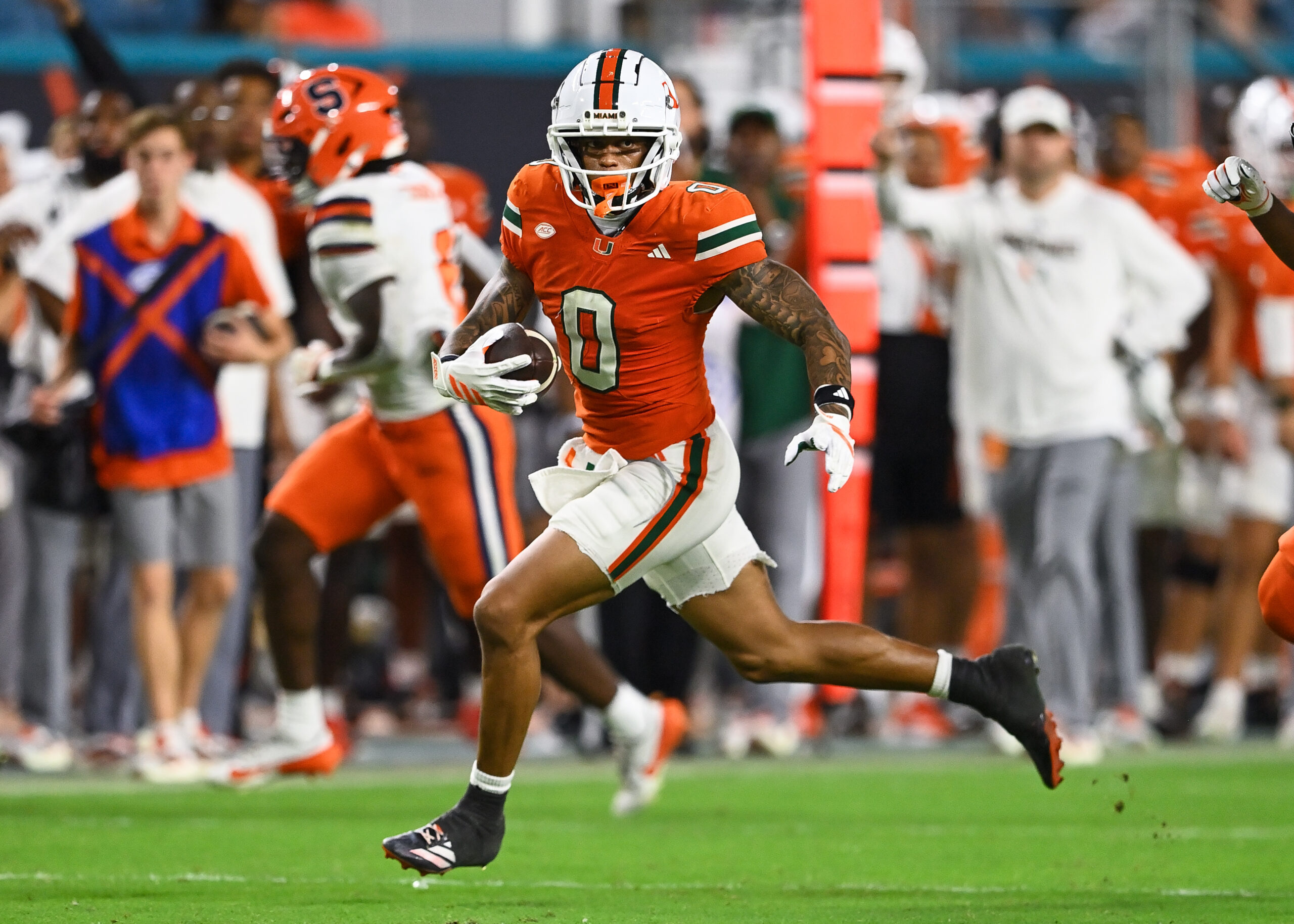
Photo Editor Brian Mulvey // Redshirt senior wide receiver Keelan Marrion (0) is tackled by Louisville defenders on Oct. 17th, 2025

Rock out at Churchill’s Pub in Miami

Miami’s punk and metal scene was stationed in Churchill’s Pub for decades. The dive bar opened in 1979, hosting local bands daily until 3a.m. The bar closed in March 2020 due to complications with the COVID-19 pandemic. After 5 years, they have finally reopened their doors for fans.

On Friday, Sept.5, Churchill’s hosted their reopening night. The lineup consisted of local bands such as Adhesive and Miss Michigan. They followed tradition by staying open late and joking about their infamous bathrooms. The night was free entry for all over 21.

Generations of loyal visitors attended the opening ceremony. Performances spanned through experimental genres across the decades. Visitors found local artists to support, while record companies scouted for talent. 

Upcoming artists include Off Orbit, Lavola, and Pink Foot Goliath.

Spend the night at Churchill’s Pub to support Miami’s local music scene with good drinks and vibes.

Gramps, University of Miami student hot spot, permanently closing

“Gramps”, a local favorite bar and music venue, announced via Instagram that it will be closing Jan. 2026. The spot was a popular hang out spot for UM students to see comedians, DJs, and acclaimed artists for 13 years.

“Thankfully, I’ve been able to make this decision thoughtfully, and leave when it feels right,” Gramps owner Adam Gersten posted on Instagram, “The time to leave Wynwood has come.” 

While the comment brought disappointment to customers all around South Florida, it also brought about speculation about a potential different location opening up elsewhere. 

In honor of their closing, they asked visitors to submit any pictures at the venue through email. Gramps will also be hosting a farewell concert, encouraging past performers to join the lineup. Commemorative shirts are also available on their website. 

UM students were disappointed to hear the news. Students and alumni had attended many shows throughout the years such as HOMESHAKE, Chained Saint, Deadharrie and Basterdane. 

 “Gramps was my favorite spot to visit for music nights.” Richard Rollheiser says. “They had other music related events other than concerts that hold very special memories.”

Before it closes, guests are still welcome to join Gramps for their famous pizza and beer, enjoying events such as “Indie Nights” and “Vinyl Time.” Their other location, Gramps Getaway, will remain open in Key Biscayne. 

Falling in love with III Points

Stepping into Mana Wynwood for III Points felt like walking through a portal — one where music, art and pure energy collided to create a world all its own. 

For two nights on Oct. 17 and 18, Miami’s creative heart pulsed louder than ever, beating to the rhythms of rap, techno, dubstep, house and everything in between. It was my first time at the festival, but by the end, it felt like home.

The first thing that struck me was how perfectly balanced the space felt. The festival featured 150+ globally renowned and powerhouse local talent. The site spanned five city blocks in the heart of Wynwood. 

The site wasn’t massive, but it somehow managed to hold 12 thoughtfully curated stages — each with its own vibe, sound, and identity — without ever feeling chaotic. 

The layout made exploring effortless, every corner alive with something new: glowing art installations, food vendors, and a crowd that looked like Miami itself — eclectic, colorful and ready to dance.

Friday night began at the Mind Melt main stage, where CA7RIEL & Paco Amoroso set the tone early. Their high-octane performance drew a sea of people, all singing, jumping, and losing themselves to tracks like “DUMBAI,” “LA QUE PUEDE, PUEDE,” “BABY GANGSTA” and “#TETAS.” 

It was the kind of set that reminded you why live music matters — the way sound unites strangers into one moving body.

From there, I caught Puerto Rican rapper Villano Antillano, who waved our flag proudly and shouted “¡Viva Puerto Rico libre!” into a roaring crowd. Moments later, Sean Paul took over Sector 3 with an unforgettable wave of Jamaican energy, performing hits like “Cheap Thrills,” “No Lie” and “She Doesn’t Mind.” 

The crowd stretched into the street, everyone dancing, sweating, smiling — a celebration of rhythm and culture.

The night kept unfolding in waves. At Grand Central, Chuwi — the rising Puerto Rican collective fresh off Bad Bunny’s residency — offered a beautiful, intimate set. Their harmonies floated over the crowd like something sacred. 

Everyone was swaying together, arms over shoulders, eyes closed, connected. It was one of those rare festival moments that feels less like a show and more like communion.

Later, the VIP section gave us a brief breather — with pool tables, local eats, and a relaxed, club-like vibe. But before long, we were pulled back to the mainstage for Michael Bibi’s hypnotic set. His transitions were seamless, his energy contagious. It felt impossible to stand still. 

And then came Peggy Gou — the queen herself — closing the night with a magnificent set that featured her iconic tracks “Starry Night” and “(It Goes Like) Nanana.” The crowd erupted. Everyone sang. Everyone danced. For that hour, the world outside didn’t exist.

Saturday hit just as hard. I dove straight into Turnstile’s set, a burst of pure, raw energy that turned the crowd into one big mosh pit. It was chaos, but it was community — people picking each other up, smiling, throwing themselves back into the music. 

Between sets, I wandered through neon tunnels that pulsed like arteries, a heartbeat syncing with the music in the distance. Giant projections washed over warehouse walls, faces and fractals morphing to every rhythm. 

Everywhere I turned, people were taking photos, spinning light toys, or just standing still in awe. It felt like stepping through a dream curated by the city’s most creative minds.

During Beltran b2b Chase West, I’ll be honest — I wasn’t glued to the decks. I was off to the side, talking with a friend who came down from Orlando for the night. The air was thick with dust, and the crowd was moving like one giant wave under the flashing lights. 

Even while we talked, the bassline kept sneaking into our rhythm — it was impossible not to feel it. That’s what I loved about III Points: even when you’re taking a breather, you’re still in it. The music finds you wherever you are.

The night rolled on with Mau P and Seth Troxler taking over the main stage with deep, ecstatic house grooves. Coming out the gate with “Verano en NY” by Toman was the kickstarter to one of the transient sets of the festival. 

Looking out from a higher spot, I could see the whole lot moving together, a living ocean of sound and light.

And then there was Dom Dolla. His late-night set was the perfect exhale to a weekend that had already given me everything. The music pulsed through me — I don’t remember every detail, but I remember how it felt. Euphoric. Free. Like love made tangible through sound.

By the end, I realized III Points isn’t just a festival — it’s a feeling. A city-sized heartbeat. A reminder of why we go to raves in the first place: to lose ourselves and, somehow, find ourselves again among the lights, the strangers, and the music that unites us all.

I came to III Points not knowing what to expect. I left with my body sore, my ears ringing, and my heart full. Somewhere between the flashing lights and the crowd’s collective pulse, I understood what makes this community so special. It’s not just about escaping — it’s about belonging.

Renowned Latin journalists visit the University of Miami’s Cosford Cinema

UM’s National Hispanic Association of Journalists chapter hosted an open panel discussion with Hispanic broadcast legends Jose Diaz-Balart, Louis Aguirre, Jackie Nespral and Antonio Mora about their careers at UM’s Cosford Cinema on Friday, Oct. 17. 

The highly-anticipated event did not disappoint. The star-studded group spent the afternoon sharing stories and insights all which led them to stardom. For Hispanic students in particular, the event left them inspired and empowered to keep working hard towards their dream career. 

“It was an absolute honor to be in the same room as them. These are the same people I grew up watching on my TV,” Ximena Hidalgo, president of the NAHJ UM chapter and co-organizer behind the event said.  “To get this opportunity to learn directly from them was an incredible experience.” 

The career advice did not come at a shortage. Themes like hard work and perseverance generally stood out, but each individual shared their unique perspectives.

“Find the one thing that really interests you and become an expert in that. Hone your essential skills like writing – it’s not just about looking good, wanting to interview famous people or being at big historical events,” Louis Aguirre, Local Channel 10 anchor and former Fox and Friends host, said. 

He also added that students should stay away from using AI to write because “your own heart and soul” is your best asset for this career.

Telemundo and NBC anchor, Jose-Diaz Balart stressed the importance of staying connected to your roots and to yourself in order to stand out in the crowd. 

On reminiscing his difficulties with perfecting his spanish to land a role, he recommended students should be, “binging their study rather than binging shows.”

Each star also shared their experience dealing with hispanic discrimination at the start of their careers, whether that be due to their name, appearance or mannerisms. 

Many took note from the infamous Jackie Nespral on her experience becoming the first Hispanic American network television news anchor as the weekend co-host of NBC’s “Today.” 

Nespral dealt with harsh criticism from executives, however, she leaned into the challenge and persevered by pushing herself to perfect her skills as a journalist. 

In an interview with The Miami Hurricane, president Ximena Hidalgo of NAHJ expressed her deep gratitude for the school of communication and Wolfson Chair Antonio Mora for making this event possible for students and aspiring hispanic-american journalists at UM. 

For Ximena and NAHJ, she plans on working to bring more opportunities for career exposure like this to campus and a strong focus on creating workshops that develop professional skills so that members can increase their competitiveness for a job application. 
Get more information on NAHJ online and check the University’s School of Communication’s calendar to stay up-to-date on future events.