The University of Miami has announced that Patricia Sánchez Abril, J.D., has been appointed as the new dean for the School of Law.
“I am deeply honored to serve as the School of Law’s next dean. This law school is full of promise and opportunity,” Abril said in a statement to The Hurricane.
Abril has served the University of Miami for over 21 years. Throughout her time she served as a professor, vice dean of Graduate Business Education, associate and interim dean of the University of Miami’s Graduate School, and interim dean of the School of Law.
She has served as Interim Dean of the School of Law since April of 2024, and is officially dean effective as of Feb. 18, 2026.
According to the email announcement from UM President Joseph Echevarria, as interim dean, Abril advanced academic priorities and promoted student success. She did this by working closely with faculty, staff, students and alumni, creating a collaborative community.
Considering her time not only at the School of Law, but at the University as a whole, she feels it will be easy to start making an impact.
“Since I have been at the School of Law as interim dean for about two years, I have gotten to know this community well, so we are ready to hit the ground running,” Abril said.
Echeveria also notes that as dean, Abril will lead the School of Law’s academic mission and external engagement and focus on faculty excellence, learning objectives, and enhancing the school’s national profile.
In her statement, Abril echoed just that.
“My focus has always been on the students. I have taught and mentored decades of students at this University and am ready to do that here on a larger scale,” Abril said. “We will ensure that every student that graduates from the School of Law is exceptionally trained, intellectually agile, and ready to succeed in an ever-changing legal market.”
Miami women’s basketball pulled away in the second quarter and held off the California Golden Bears in a 69-60 matchup on Sunday at the Watsco Center, extending their late season surge with three wins in a row.
Cal struck first, with an early 3-pointer from guard Gisella Maul. But the Hurricanes responded back right with a series of layups, but ended the quarter trailing the Golden Bears by one.
Miami then flipped the game in the second quarter. The Canes opened with a strong burst, getting a layup from Ra Shaya Kyle, then back-to-back buckets from Vittoria Blasigh and a jumper from Gal Raviv to build a 23-15 lead.
They kept stretching their lead with second chance points, with Ahnay Adams hitting a late 3-pointer to get the Canes to a 35-27 halftime lead.
After the break, Cal made a big push. They cut Miami’s lead to 35-33 on a three from Aliyahna Morris. Miami answered with a steady run inside, getting baskets from Adams, Kyle, and Natalie Wetzel to push the lead out.
Miami protected their 54-46 lead early in the fourth quarter, and went up by 11 after Kyle converted 3-point-play on a layup inside. Cal trimmed the deficit to 60-55 midway through, but Miami delivered the knockout stretch.
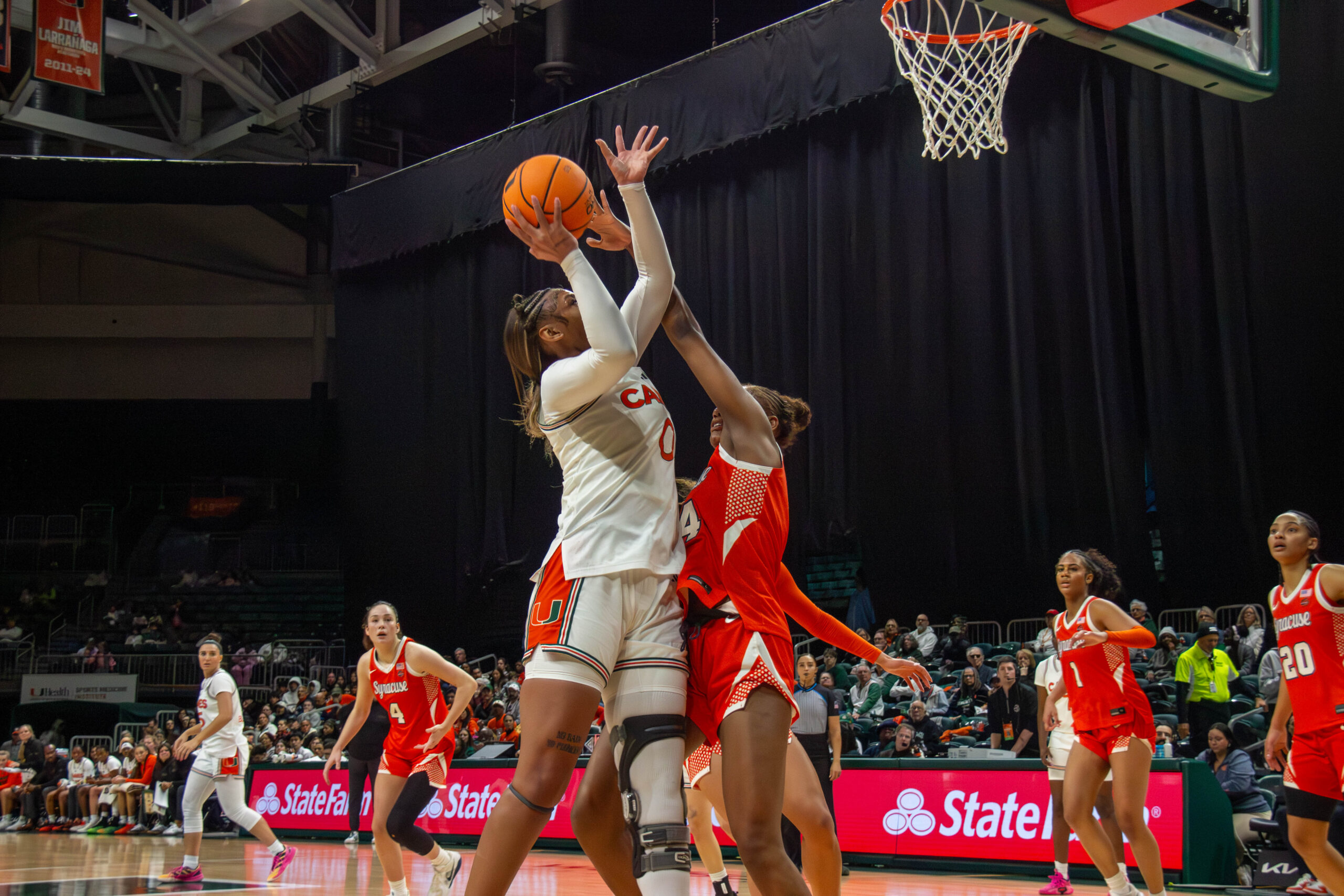
Photographer Bella Ochoa // Graduate student center Ra Shaya Kyle fighting under the basket against Syracuse University on Sunday, Feb. 1, 2026.
Raviv drilled a three, followed by another from Blasigh to push the lead back to 11. Cal got within seven again but the Canes closed it out at the line for the 69-60 win.
Kyle and Adams controlled much of the game for Miami. Adams finished with 10 points and six assists, while Blasigh added 12 and Raviv 14. Miami shot 50% from the field and hit seven out of ten from the 3-point line.
Miami head coach Tricia Cullop noted in the press conference after the game that the team has improved over the course of a year, but it’s still not enough.
“I don’t want us to be happy with that. I’m not happy that we don’t have more than that to this point. “ Cullop said, “But I want us to continue, want to get better, and head into the conference tournament on a really high note, feeling really good about what we were playing, and fixing things still that we’re not doing as well.”
The Canes play their final home game against Pitt on Thursday Feb. 26. Tip off is at 7 p.m.
Tied at 83-83 with 3.6 seconds remaining, Virginia’s Chance Mallory was sent to the free throw line.
The Hurricanes have been no stranger to late game heroics themselves, with their previous two wins coming by one point each.
But Miami wasn’t able to make it three storybook wins in a row, as Mallory hit all three free throws to ice the game 86-83 in favor of the Cavaliers.
No.14 Virginia fell behind initially to the red-hot Canes on Saturday at John Jones Arena in Charlottesville, Va..
The Cavaliers opened the first half with an early 11-7 lead, but the Canes quickly responded with a 17-2 run to take a 24-13 advantage. Miami shot 56.7% from the field and 62.5% from beyond the arc during that stretch. Freshman Shelton Henderson led the surge with an early eight points.
The remainder of the half turned into a back and forth battle between the Hurricanes and Cavaliers. With the game tied at 39-39 and 40 seconds remaining, Tru Washington knocked down his third 3-pointer of the half, and Timo Malovec converted a fast break layup to give Miami a 44-39 lead at halftime.
Virginia set the tone to start the second half with an 11-2 run, but Miami answered, cutting the deficit to 59-57 with 11:53 remaining. The Cavaliers responded once again with another 11-2 run, forcing Miami, down by seven, to call a time out.
Out of the break, Tre Donaldson sparked a 13-2 run, hitting a 3-pointer to give the Hurricanes a 73-70 lead with five minutes remaining. Trailing by four points in the closing minutes, Miami battled back to tie the game at 83-83.
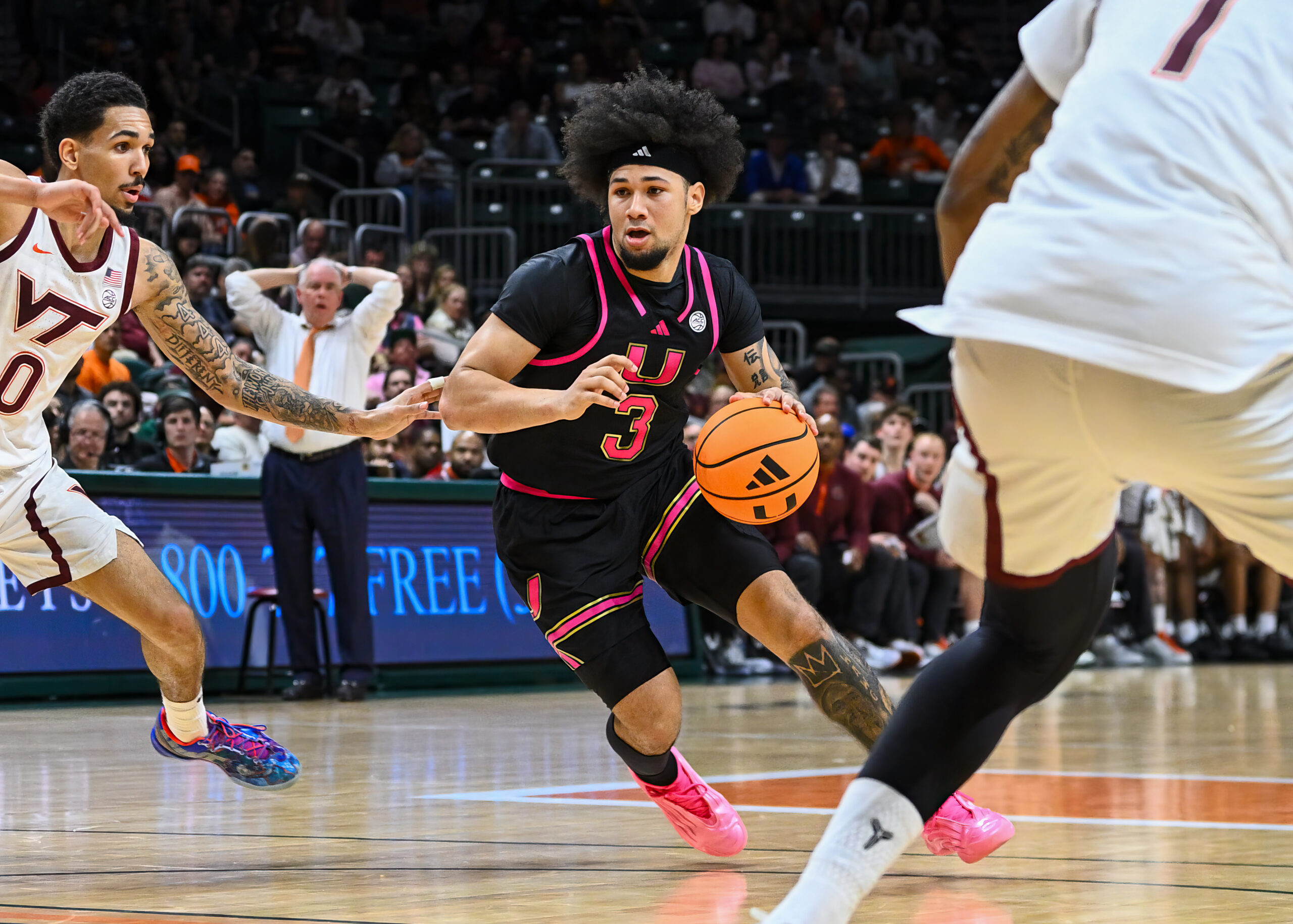
David Lebowitz, Photo Editor/ Senior Guard Tre Donaldson drives toward the paint against Virginia Tech on February 17, 2026.
But with 3.6 seconds left, the Canes committed a foul beyond the arc, sending Virginia’s Mallory to the free throw line.
Mallory calmly drained all three from the line, sealing the win for Virginia, 86-83.
Donaldson and Henderson each led Miami with 18 points, while Malik Reneau added 16. Washington contributed 15 points and seven assists off the bench, and Ernest Udeh Jr. recorded nine rounds and eight points, going 6-for-6 on the free throw line.
In the second half, the Hurricanes shot 12-of-31 from field goal, 4-of-10 from the three point range, and 11-of-11 from the free throw line, finishing the game at a season high of 94.1 percent at the line. Turnovers ultimately made the difference. Miami committed nine turnovers, which Virginia converted into 14 points.
Miami now sits third in ACC conference with a record of 21-6. Under first-year head coach Jai Lucas, The Hurricanes have transformed into a legitimate March contender after entering the season with uncertainty.
Last season (2024-2025), Miami finished last in the ACC with a 3-17 conference record and failed to win a road game. This year, Lucas has reshaped the program’s identity, emphasizing points in the paint, offensive rebounding and efficiency at the free throw line while building a stronger defensive foundation.
Key contributors this season include Reneau, who is averaging 19.5 points per game; Udeh Jr., who averages 9.5 rebounds per game and Donaldson, who leads the team with 5.9 assists per game. The Hurricanes’ renewed culture has positioned themselves with a chance to make it far in March Madness.
Miami will remain on the road and will match up against Florida State on Tuesday in Tallahassee at 9 p.m.
Miami Hurricanes men’s tennis remains undefeated at home taking their last game before conference play with a 4-0 against the FGCU Eagles. In a packed Neil Schiff Tennis center, Miami had another dominant day at home to boost the Hurricanes to 7-2 and give Miami their fourth sweep of the season.
Things got off to a great start in doubles with the senior Antonio Prat and the junior Jakub Kroslak. The two teamed up for the first time and put up a dominant showing winning 6-0 at the top court. This is now Prat’s second straight win in doubles coming back from dropping eight of his last nine when paired up. Over on court three, seniors Nacho Serra Sanchez and Saud Alhogbani wrapped things up with a 6-4 win.
Singles were just as good for Miami and were over as fast as they started. Kroslak continued his strong day as the Slovakian, Middle Tennessee transfer earned a court three win 6-3, 6-3 to extend the lead for Miami. Rafael Segado dominated Stavros Hadjivarnava forcing him to retire after a 6-4 win, and a 3-0 start to give Miami another point.
Finally, No. 100 Prat clinched the win for Miami. His 6-3, 6-4 win ended Miami’s final game before ACC play. It also boosts their home winning streak to 20 games, going back to last season.
At 7-0 this year and 13-0 last year the Neil Schiff Tennis Center has proven to be a massive asset for the Hurricanes who play another eight games at home the rest of the year.
After non-conference play the Hurricanes sit at 61 in the ITA Intercollegiate Rankings. Miami has a match against Delaware on March 25, but from here on out Miami will be taking on ACC opponents the first two of which will be on the road.
Their first ACC matchup will be the No. 67 Louisville Cardinals who sit at 9-4 after dropping a match to Middle Tennessee State. The match is Friday Feb. 27 in Louisville, Kentucky.
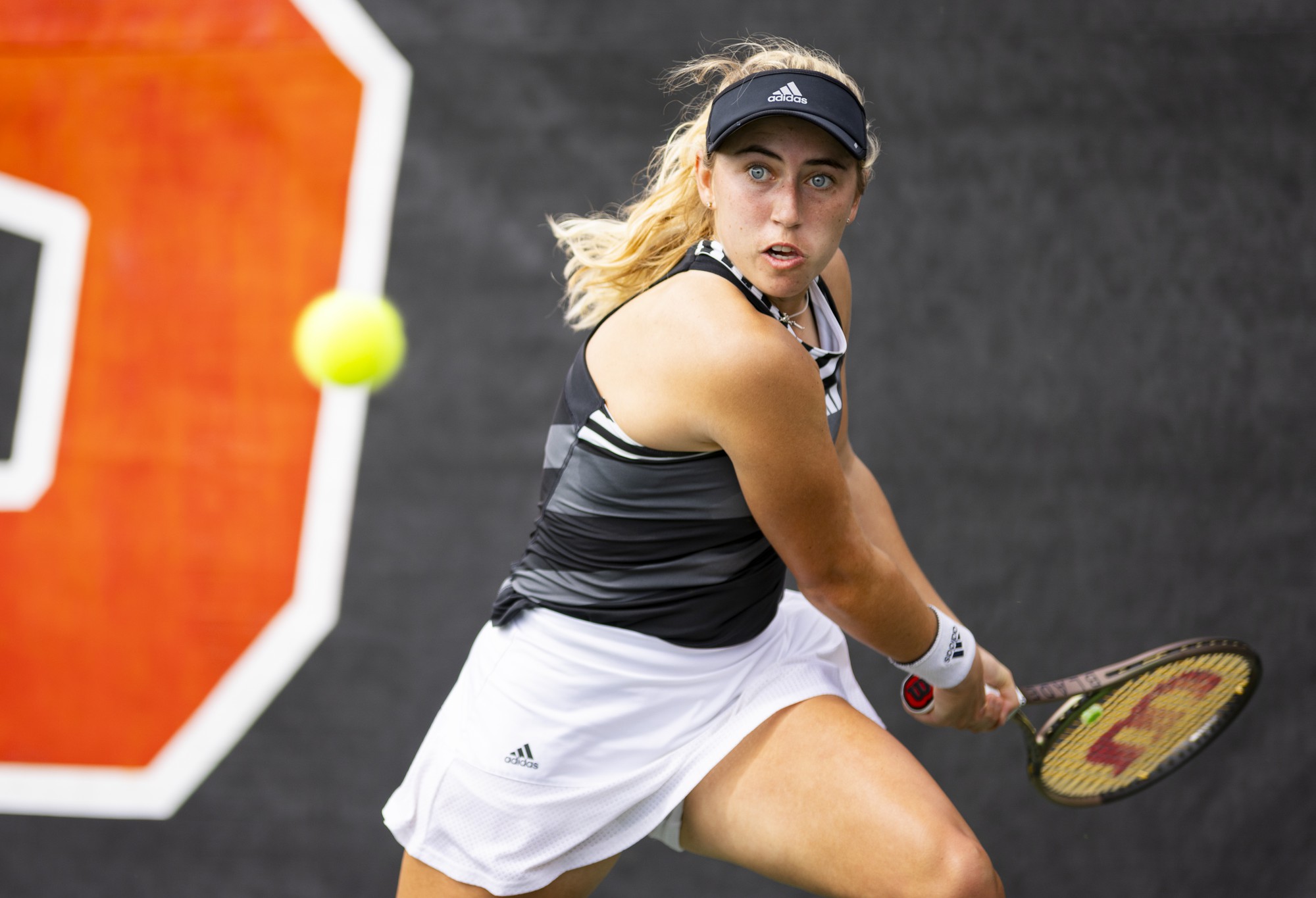
Graduate student Vladislav Melnic hits a backhand to his opponent during his singles match against Virginia Tech’s Michael Shepheard at the Neil Schiff Tennis Center on March 24, 2024. Photo credit: Alexandra Fisher
A beautiful Saturday afternoon in Coral Gables set the stage for a single-admission doubleheader against the Lafayette Leopards. The Patriot League foe appeared to be no match for the home-standing Miami Hurricanes as they won 14-4 in game one.
Miami’s bats got it going early in the bottom of the first inning scoring six runs.
With the bases loaded, one out, and the count full, outfielder Derek Williams belted a ball in the right field gap to score two runners to get the Miami offense going. Miami Dade College transfer Cian Copeland followed up Williams RBI double by blasting a ball 405 feet for a three-run home run.
The sixth run of the first came off a fielder’s choice ground out from Fabio Peralta that allowed FIU transfer Brylan West to score after his double and stolen base.
Lafayette’s head coach A.J. Miller elected to keep his starter junior Trey Deitelbaum in despite the rough inning.
In the second, junior third baseman Daniel Cuvet doubled to left field and the speedy Michael Torres touched home from first for the RBI to extend the lead.
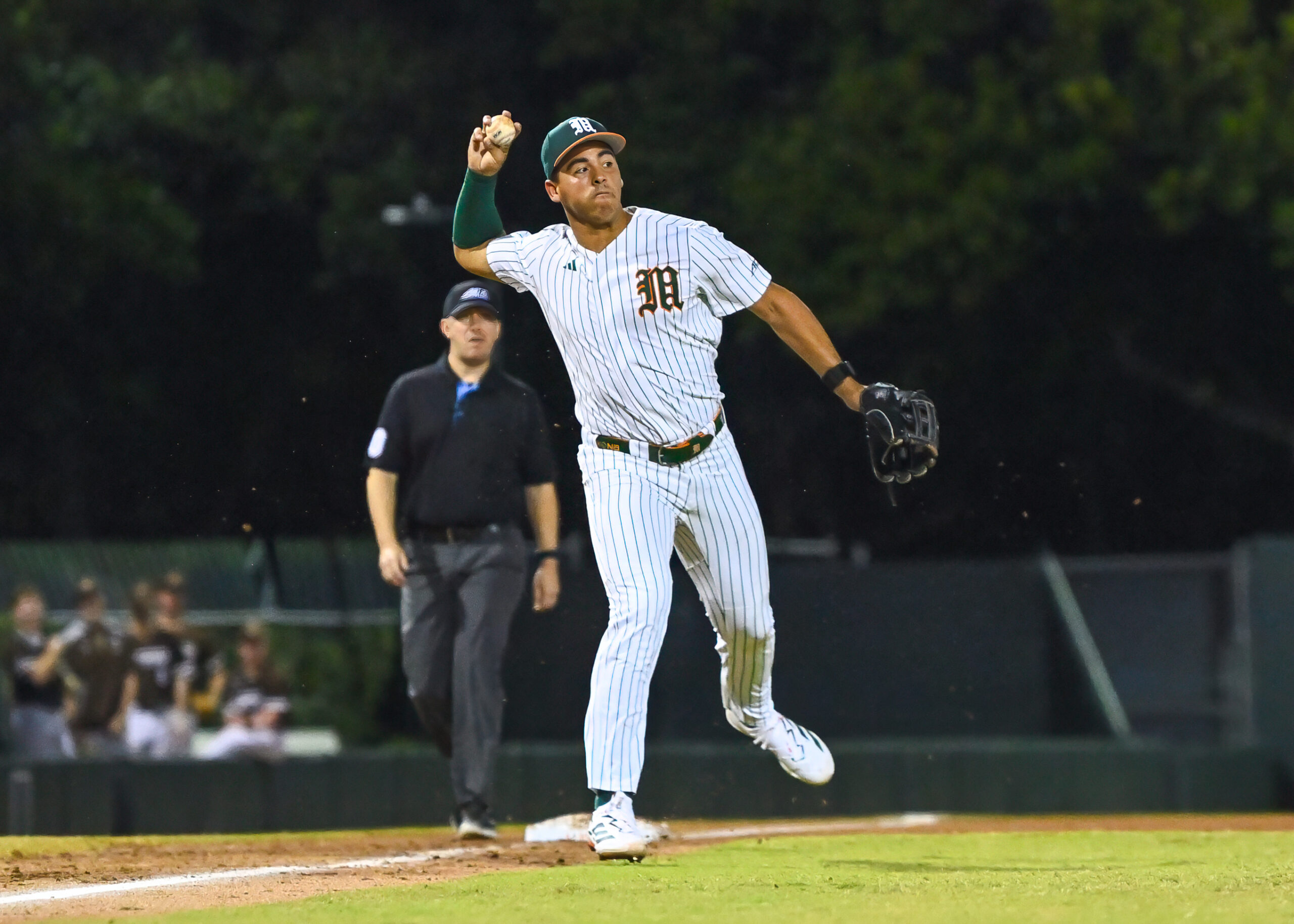
David Lebowitz, Photo Editor/ Junior Third Baseman Daniel Cuvet winds up to throw to first on Friday, February 13, 2026.
Deitelbaum was eventually relieved after just 2.1 innings, surrendering eight earned runs on five hits and five walks. Before getting taken out, he walked three batters and hit a batter, setting up a bases-loaded situation to put the game out of reach. The Leopards turned to Kellen Moore as an attempt to hold it down, but Hurricane bats never slowed.
Torres hit a sac fly and with the bases loaded, Alex Sosa hit a bases-clearing double of the padding in left center field. After three, Miami led 12-4.
The Leopards pitching mistakes were a big factor in this ball game as UM had eight hits but scored 14 runs.
Despite giving up four runs in the third, senior left-hander Rob Evans was solid in his first start of the season. He finished his outing allowing four runs on four hits, striking out 10 batters in five innings of work.
Moore was able to hold down the fort in his 3.2 innings of work as he only gave up two runs on three hits. One of the runs came off the bat of Cuvet who hit a solo home run to left field for the third long ball of the season.
The Hurricanes will look to sweep the doubleheader and take the series at 6 p.m. Saturday night at Mark Light Field.
Bolstered by an eight-run sixth inning, the Miami Hurricanes cruised by the Lafayette Leopards 15-2 to open a four-game series. The 23rd ranked Canes improved to 6-0 with the win and its their best start to a season since 2013.
Miami jumped out to a lead in the second inning following RBI singles from Jake Ogden and Brylan West as well as an RBI fielder’s choice from Fabio Peralta.
Miami tacked on three more in the fourth with another Ogden RBI single and two walks with the bases loaded.
Two innings later, the Canes exploded on offense, blowing the game wide open. With the bases loaded, Alex Sosa barreled a ball deep to left field for a grand slam, bringing the lead to 10-2.
After that, there was no hope for the Leopards. The Canes pitching staff dominated from there on out, and the offense powered in six more runs over the course of the game.
AJ Ciscar earned the win on the bump for the Hurricanes, going six innings, giving up two runs on five hits.
“Left, right, left, right! Sientateee!” rang out from Hurricanes fans all night, as Ciscar struck out nine batters on the night.
The Canes will continue their series against Lehigh this weekend as the games will be broadcast live on ACCNX and WVUM 90.5 FM.
The No. 54 University of Miami women’s tennis team won 4-2 against the No. 36 Notre Dame Fighting Irish on Friday evening in South Bend, Ind.
With the victory, the Hurricanes (4-2) open up conference play on high note against the Fighting Irish (11-2) who have had a great start to their season prior to their matchup with the Canes.
UM fought hard to secure the doubles point. It would be a tough task due to Sebastianna Scilipoti and Aely Arai falling quickly to Notre Dame pair, Rylie Hanford and Gabriella Rawles, 6-1.
The loss would not deter the Canes as they won the other two matches, with Daria Volosova and Maria Vargas defeating Bojana Pozder and Akari Matsuno, 6-4, and Raquel Gonzalez and Dominika Podhajecka getting the clinching double victory over the No. 57 duo, Sophia Holod and Bianca Molnar, winning 7-5.
Heading on to singles, Volosova started things off with a straight-set win, 6-4, 6-3, against Rawles to increase their lead. The Fighting Irish would then take their first point of the day with Pozder winning over Podhajecka, 6-4, 7-5.
No. 77 Gonzalez then put Miami within a point of victory with a ranked win in the top matchup of the day, defeating No. 46 Molnar, 2-6, 6-2, 6-3.
Notre Dame would then delay the eventual Hurricane victory with Hanford getting the win over No. 102 Arai, 6-2, 2-6, 6-4. The final blow would come in the form of a tough Scilipoti victory over Holod, winning 6-3, 3-6, 7-6 (4).
When play was stopped, Matsuno and Miami’s Sofia Rocchetti were in a close one with a score of 6-4, 6-7 (6-8).
Senior Isabella Pfennig winds up for a backhand during her singles match against Duke University’s Shavit Kimchi at the Neil Schiff Tennis Center on Feb. 23, 2024. Photo credit: Alexandra Fisher
A male riding a skateboard was struck by a gray Honda Odyssey near the Watsco Center parking lot around 9:30 a.m. on Thursday, Feb. 19.
A UM student who witnessed the skateboarder get hit, Whitney Shelton, said that she was keeping her distance from the car before the accident because the driver had “cut [her] off turning into the University and almost hit [her] car.” The accident with the skateboarder occurred shortly after.
Shelton said that the driver turned left into the Watsco parking lot and the skateboarder was on the sidewalk. As the car turned into the parking lot, the skateboarder continued straight along the sidewalk — which went through the parking lot entrance — but the driver did not see him and crashed into him.
“I think he was scraped up and startled. I left before I could truly see all the injuries but it looked bad. The car hit the guy and he fell straight onto the ground and I believe rolled,” Shelton said. “He was very close to being run over because they slammed on [the] brakes after hitting him,” said Shelton.
Shelton said she nearly called 911, but she did not end up reporting the incident to UMPD or the police.
The driver and the passenger have not been identified, but the vehicle had a Florida license plate.
In a statement to The Hurricane, the University said that “UMPD has not received a report of this incident.”
Martina Panteleon contributed to the reporting of this article.
This article was updated at 10:37 a.m. on Monday, Feb. 23, to include UM’s statement.
Miami athletics delivered a packed week of highs and hard lessons. Margo O’Meara captured ACC gold on the 1-meter springboard, leading a strong showing for Hurricanes diving. On the hardwood, Tre Donaldson poured in 32 points — including Miami’s final 15 — to lift the Canes to a thrilling 67–66 win over Virginia Tech. Women’s basketball, meanwhile, continues to search for answers amid a four-game skid. And on the diamond, baseball secured a steady 6–2 midweek victory over Indiana State to keep momentum rolling. From championship dives to clutch heroics, it was a statement week across Miami sports.
This week at UM: The Frost Jazz Orchestra earns its first-ever Grammy nomination, Divine Nine members celebrate Black History Month with a halftime performance at a Miami Heat game, and the fashion rental app Tonight’s Dress gains popularity among students. We also cover what UM students should know before studying abroad — from culture shock to personal growth — and spotlight three compelling editorials on LGBTQ+ life in Miami, newsroom layoffs at The Washington Post and student government campaign promises.
The diving stage closed with hardware at the ACC Swim & Dive Championships — and Miami’s swimmers wasted no time stepping onto the championship stage.
On the final day of diving competition at the conference championships inside the McAuley Aquatic Center in Atlanta, veteran Mohamed Farouk delivered a steady performance on platform to pace the Hurricanes. After qualifying second in the morning preliminary round, Farouk advanced to the evening final and placed seventh overall with a score of 329.40, securing valuable conference points for Miami.
The platform final marked the conclusion of the diving portion of the meet for the Hurricanes, who leave Atlanta’s boards with sharp momentum.
Leading that charge was Chiara Pellacani. After defending her ACC title in the 3-meter springboard earlier in the meet, Pellacani was named the conference’s Most Valuable Women’s Diver — a recognition that cements her dominance and consistency on the conference stage.
And as diving wrapped, swimming competition surged forward.
Miami’s top 200-yard medley relay team — Leah Treglia, Zofia Sobczak, Isabelle Videment and Ines Mahmoudi — touched in 1:39.18, opening the swimming slate with a competitive showing.
Later, the Hurricanes’ 800-yard freestyle relay quartet of Savannah Barr, Ashlyn Massey, Sarah Sensenbrenner and Brooke Murphy clocked a 7:12.22, adding depth and veteran presence to Miami’s early-on swim results.
With diving complete and swimming fully underway, the Hurricanes now shift focus to stacking points across the remaining days of competition which continue Wednesday in Atlanta — and Miami has already proven it intends to stay in the mix.
Unity, culture, love — the words striped across the Miami Hurricanes warm-up shirts in honor of Black Awareness Month. A reminder for all the hardship, prejudice and heartache the black community has suffered, but also battled through to succeed.
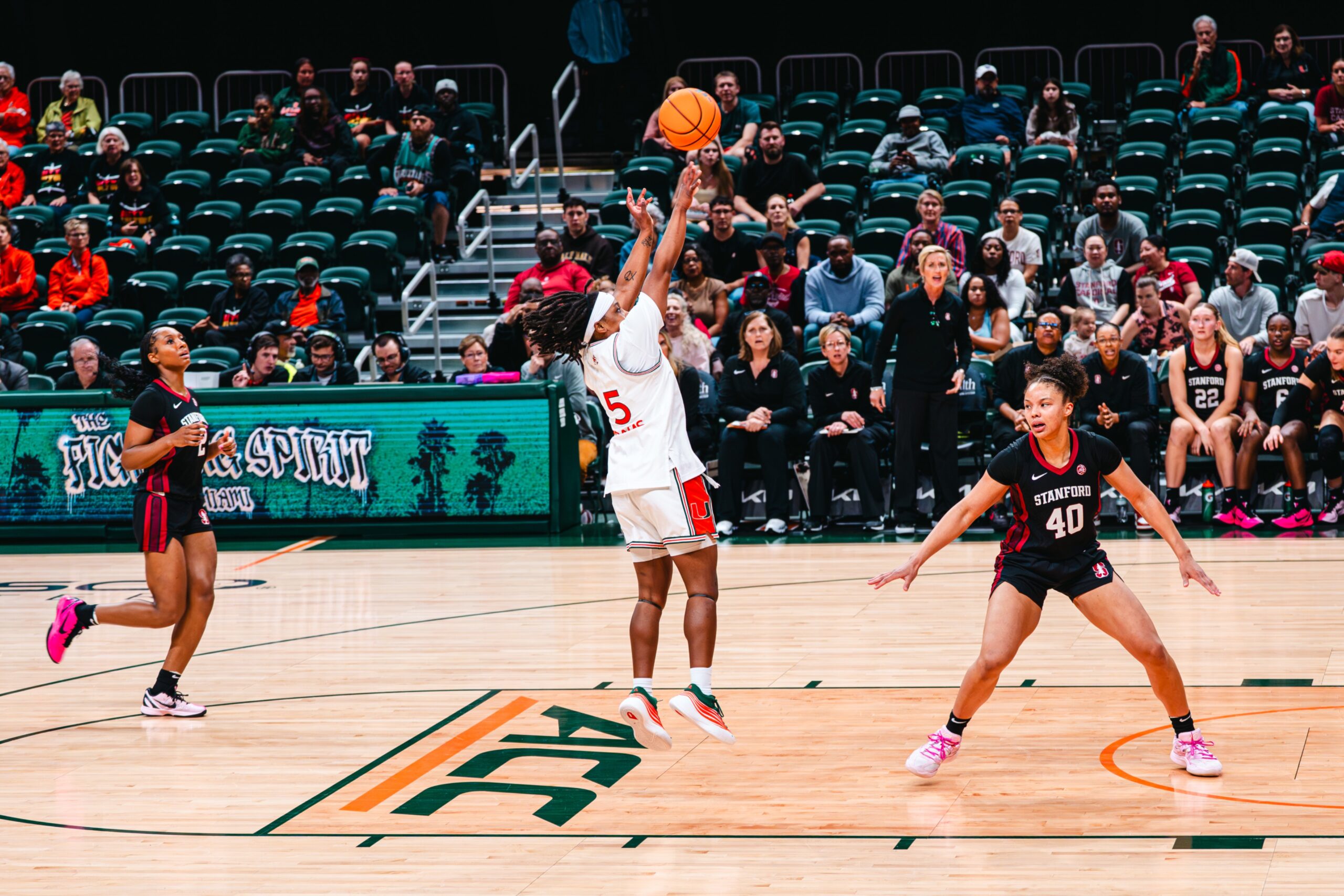
And for a team that has struggled to put together wins all season, the UM Women’s Basketball team took those words to heart, putting together a spirited performance to cut down the Stanford Cardinal 66-51 on Thursday night at the Watsco Center.
“To win games and be connected you need all three (unity, culture, love),” said UM junior Amarachi Kimpson postgame. “Knowing that we’re connected allowed us to come out with a win.”
The triumph marked Miami’s first back-to-back win since Jan. 1, where UM took down Virginia Tech in an eventful overtime showdown.
MIami was in the midst of a torrid rough patch before this pair of wins, losing eight of ten from Jan. 4 to Feb. 8.
And while this win over Stanford might’ve been less dramatic than VT, it could prove as a crucial turning point in UM head coach Tricia Cullop’s second season — one using all three components of the pre-game messaging.
Unified.
Coming off only a seven point performance last weekend against Boston College, Miami guard Gal Raviv got to work early, dropping the game’s opening five points.
Stanford would take an 11-10 lead with 1:38 remaining in the first quarter, but it would mark the last time the Cardinal held the lead as Miami would retake the lead and never look back.
The Canes placed all five starters in double figures, as Raviv led the way with 19 points.
“[Raviv] sees the game better than anyone else on the team,” Cullop said. “She did a tremendous job of getting us into the actions we needed to do … leading us to victory.”
Center Ra Shya Kyle secured her fourth double-double in a row with her 11-point, 14-rebound performance, her 17th on the year.
Kimpson, Natalie Wetzel and Ahnay Adams would put up 14,12 and 10 respectively.
The effort from the starting five proved crucial for Miami, sparing the blunders of a zero-point bench performance.
And when the Canes needed it most, the offense took charge, unleashing a 22-point fourth quarter to ice the game.
Miami guard Ahnay Adams goes up for a jumpshot against Stanford on Feb. 19 2026 // Photo Courtesy University of Miami Athletics
Culture.
Despite being wedged in the bottom half of the ACC standings, this Hurricane team simply doesn’t know when to quit.
It’s a tenacious bunch who battle for loose balls and do everything in their power to disrupt an opposing offense.
The Canes caused havoc on the defensive end with their full court press, forcing 17 turnovers and never letting the Cardinal offense get into a rhythm.
“I’m really proud of our defense tonight,” Cullop said. “They paid attention to detail … made it tough for [Stanford] to get into a flow.”
Stanford struggled from the field, shooting only 31.7% and a 14.3% from beyond the arc.
Guard Hailee Swain was one of only two Cardinal on the night in double figures, her 16 points a lone bright spot for Stanford.
Adams in particular was one of the defenders all over the court for Miami, notching three steals alongside her ten points.
The sophomore guard continues to be a leader for Miami, who looks to her energy to jolt the side from start to finish.
Love.
With only three remaining games in the regular season for UM (14-12, 6-9 ACC), the Canes will look to ride some momentum all the way to the ACC Tournament in March.
“We understood how important this game was,” Cullop said. “Probably the best communicating game that we’ve had … the energy they gave each other made the court tremendous.”
The win launched Miami over Stanford (16-12, 5-10 ACC) into 12th in the ACC standings.
Crucial games loom for Miami against Cal, Pitt and Georgia Tech — as Cal and Georgia Tech rest just above Miami in the ACC standings.
“We want the best seed we can when we get there.”
UM will take on Cal this Sunday at 2 p.m. at the Watsco Center with coverage on ACCNX.