73.6 F
Coral Gables
Thursday, March 5, 2026
March 5 , 2026
Home Blog Page 14

Miami Women’s Tennis sweeps FIU Panthers in dominant victory

0

The University of Miami women’s tennis team swept the FIU Panthers Wednesday afternoon at the Neil Schiff Tennis Center. 

Miami secured a perfect 7-0 victory in their hometown rivalry matchup, beginning with a swift display of dominance in doubles play. 

Ela Plosnik and Aely Arai earned an early win on court two after FIU’s Jelena Vico and Aleksandra Simeva retired due to injury while trailing 2-0. 

Shortly after, Sebastianna Scilipoti and Daria Volosova officially clinched the doubles point for UM with a convincing 6-1 victory over Vittoria Baccino and Maria Araoz-Gosn on court three. 

At the top court, Dominika Podhajecka and Raquel Gonzalez held a 4-3 lead over Katerina Mandelikova and Viktorie Hazmukova when play was halted.

Moving into singles, the Hurricanes extended their lead immediately due to a retirement at the number six position. Podhajecka then kept the momentum rolling on court four, dispatching Araoz-Gosn with a 6-3, 6-1 straight-sets win. 

The match was officially decided on court three, where No. 97 Arai took down Simeva 6-3, 6-3 to clinch the overall team victory. 

Even with the result secured, Miami continued to push for the complete sweep as No. 73 Gonzalez battled to a 7-5, 6-4 win over Mandelikova at the top flight.

The most resilient performance of the day came on courts two and five, where both Plosnik and Volosova overcame first-set deficits to complete the shutout. Plosnik rallied for a 4-6, 6-0, 6-3 win over Baccino, while Volosova finalized the 7-0 scoreline by defeating Hazmukova 4-6, 6-4, 6-2.

Miami closed the day with a perfect record on all courts, demonstrating a level of depth that proved too much for the Panthers to handle. This 7-0 sweep provides a significant momentum boost as the team continues to defend their home turf. 

Looking ahead, the Hurricanes will remain in Coral Gables with back-to-back matches against FAU and UCF on Feb. 14-15.

Miami finishes 15th at Therese Hession Regional Challenge

0

The University of Miami women’s golf team finished the Therese Hession Regional Challenge in the 15th spot on Tuesday. 

The Canes posted a three-round team total of 52-over-par 904. UCLA ultimately claimed the title, finishing as the only team under par at 8-under.

Sophomore Ashleen Kaur led the way for Miami, finishing in a tie for 43rd at 9-over-par. After a difficult opening round, Kaur found her rhythm during the final two days of the tournament. She carded a 2-over-par in the second round before surging in the finale with a 2-under par performance to lead the Hurricanes’ individual standings. 

Cloe Amino Villarino finished shortly behind Kaur, carding an 11-over-par to tie for 53rd. Rebekah Gardner placed 77th, while Barbora Bujakova finished tied for the 83rd spot. Stella Jelinek rounded out the Miami lineup in 85th place. 

The Canes finished three strokes ahead of 16th-place California, but trailed 14th University of Nevada, Las Vegas by 13 strokes. 

Miami will look to rebound later in the month at the Momentum Transportation UNF Collegiate in Jacksonville, Fla. with the two-day event teeing off on Feb. 23. 

UM alum appointed ambassador to Peru

0

Bernardo “Bernie” Navarro, a graduate from the University of Miami Herbert Business School, was sworn in as U.S. Ambassador to Peru on Jan. 15.

Bernando Navarro was confirmed by the Senate with a 53-43 vote on Dec. 18 and credits UM for his opportunities. 

“Years ago, they took a chance on me as a young student,” Navarro said in a LinkedIn post. “And that belief helped shape the path I walk today.”

Before joining the Department of State, Navarro’s childhood dream was to attend the University of Miami.

“There was no way that our family could have afforded the U,” Navarro told News@TheU. “And when I talk to my children, one of the things I tell them is that the biggest thing I ever did, that I achieved, was that someway, somehow, I got to go to the University.”

At age 17, Jim Balter, who was the director of purchasing, gave Navarro the opportunity of a lifetime. Balter offered Navarro a job under him so he would be eligible for tuition remission, a discount for UM employees.

The job fit perfectly with Navarro’s interest in entrepreneurship. It was a family tradition. When it came time to choose his degree, Navarro did not hesitate.

He graduated from the University of Miami Business School in 1994 with a BBA in finance and marketing. Later, Navarro earned a Master’s of Liberal Arts degree in government from Harvard University.

His time at UM left an impact on the rest of his career.

“[The] Honor of a lifetime was being nominated by POTUS to serve as ambassador to Peru,” Navarro said on X on Dec. 31.

Secretary of State Marco Rubio, another UM alumnus, swore him in after meeting almost a decade ago in 2016. Navarro served in the Florida Finance Committee for Rubio’s presidential and senatorial campaigns in 2016. 

Other members of the administration who knew Navarro were quick to voice their support.

President Trump nominated Navarro for the position on June 16, 2025. He was one of the first to congratulate the to-be ambassador after the Senate confirmation.

“Bernie’s expertise in Finance, Trade, Education, and U.S.-Peru Relations will help him be a strong advocate for America’s Interests in Peru,” President Trump wrote on Truth Social.

After graduating from Harvard, he worked for two mortgage businesses, including Citi, before creating his own. 

In 2001, Navarro started his first lending company, HomeMortgage. It earned $140 million by the end of 2005, when Countrywide Home Loans decided to buy it. That same year, they hired Navarro as Vice President.

Navarro created Benworth Capital Partners, a private equity firm specializing in mortgage financing, three years later.

Outside of businesses, he wanted to become a “civic leader.” After Hurricane Andrew hit Florida in 1992, Navarro helped former President Edward “Tad” Foote get the materials and manpower to rebuild UM.

Navarro will move to Peru with his wife, Claudia Navarro, at the end of January. There, he plans to continue his service work.
“I am committed to paying it forward, investing in others, and serving with humility, integrity, and purpose,” Navarro said on LinkedIn.

Commuter Week has crepes, neon lights and fun

Commuter week will take over the University of Miami with sweet treats and exciting activities. Taking place from Feb. 16 – 19 on campus, it starts off with delicious fresh crepes in the Westbrook Walkway.

Then, after a long day of classes, head to Lakeside Village volleyball courts and Outdoor Adventures students can enjoy “Glow with the Flow.” Stop by for glow in the dark activities such as volleyball and rock climbing and some free pizza.

On Tuesday,  enjoy a car show alongside a fry bar and some interactive outdoor activities  at “Neon Nights and Chrome Lights” at Miller Circle.

The next day at noon, stop by the Shalala Student Center for the Association of Commuter Students (ACS) and Orientation and Commuter Student Involvement (OCSI) open houses. 

This is a great opportunity to meet the executive board and members and learn more about the organizations and find a way to be involved all while enjoying snacks and drinks.

If you can’t make these events, don’t worry.  At 8 p.m. at the Wellness Center, there’s Pancakes with Pat. Wind down from the day and enjoy pancakes with students and faculty from across campus.

To close off this exciting week is “Miami Nights” with the Commuter Council. A Miami vice-themed celebration taking place at the Rock Plaza that will feature an array of food, some activities, music and exciting giveaways. 

This is certainly going to be a week to remember. 

The marketing team for ‘Marty Supreme’ already won

“Marty Supreme” has made a huge impact on cinema and people because of its marketing strategy.. From “leaked” Zoom meetings featuring Timothée Chalamet to celebrities wearing “Marty Supreme” windbreakers, “Marty Supreme” has made a statement that shows identity, character and dedication to the source material..

The color orange, a key color in the film’s marketing, is an unusual color in the world of fashion as it is very intense and draws attention.

In the movie, they emphasize the idea of Marty Mauser’s decision to change the color of the ping-pong ball from white to a bright orange, and it’s all based on visibility. Timothée Chalamet, his mom and Kylie Jenner were seen wearing bright orange in different carpets of the movie.

The campaign is mostly attractive to Generation Z audiences. They were doing Zoom calls with Timothée Chalamet sharing crazy ideas for marketing the film, like painting the Statue of Liberty orange, or having orange blimps in the air that said, “Marty Supreme.” 

His blimp one actually happened in the Camp Flog Gnaw music festival. Funny enough, in this Zoom meeting, they mentioned another film that did something very similar with the colors and its marketing: “Barbie.” 

If you think of “Barbie,” you will think of the color pink and Margot Robbie, and the cast and team behind the movie really did push forward on the color. Given the movie’s billion dollar success, it shows how impactful it is to have a staple color that identifies a brand. 

You think of red, and you probably think of Coca-Cola, you think of green and orange, you think The University of Miami. I would say the main point of the campaign’s color is identity.

To keep promoting the film, they hosted events in cities around the world for an underground ping-pong hangout and listening parties for the soundtrack of the film. Timothée Chalamet himself was going to these different events. 

The fact that the lead actor for this film was appearing at many different events makes you feel and see that the actors involved really do care about their project and believe in the product, making you want to see it and be as excited as the team behind the film is. 

More celebrities would wear the “Marty Supreme” merch,  like Kendall Jenner,Bill Nyel,Michael Phelps and Frank Ocean. 

This jacket became a staple for belonging to something big. People everywhere are going insane to try to find one of these jackets just so that they feel some sort of belonging to the Marty Supreme campaign. 

One of the marketing campaign’s biggest stunts was putting Timothée Chalamet on the top of The Sphere in Las Vegas, being the first person to ever do it. 

The Sphere was a large, bright-orange ping-pong ball that read “Marty Supreme Dream Big.”. 

Timothée Chalamet’s and the whole cast’s involvement, along with the additional involvement of many different celebrities from many different fields, created something that is fascinating and impressive. The movie is just as exciting as the marketing campaign.

Get ready for the 2026 Montreux Jazz Festival Miami

The Montreux Jazz Festival is one of a kind. Originally held in Switzerland during the summer, the Montreux Jazz Festival is celebrating its third year in Miami. From Feb. 25 – March 1, it is expanding the horizons of such a long standing tradition and bringing the magic to our backyard.  

This festival is one where you can feel the energy pulsing through your veins with every note. Where you can feel your heartbeat with every smack of the drums. The excitement is palpable and the aura is one that inspires smiles all around. 

Founded in 1967, the aim of this festival was to bring international jazz, blues and rock on to one stage to create a night you will never forget. The creators decided to bring the festival to Miami due to its rich culture, beautiful scenery and prestigious displays of the arts. 

Right next to the remarkable waters of Regatta, a popular hang out spot in Miami, the festival is held at the Hangar. Unlike the 250,000 guest turn out back in Switzerland, the Miami edition only seats around 1,500 guests. This was done intentionally to give the guests a very intimate experience with some of the best names in Jazz. 

Last year, there were stunning performances by artists such as WILLOW, Jon Batiste, Janelle Monae and Chaka Khan. For the 2026 edition some of the artists featured are Jon Batiste and Trombone Shorty, TOTO, Nile Rogers & Chic and more. 

They are all turning up the heat and giving the audience, not just a night, but a feeling they won’t forget. Click here to get your tickets to the ultimate Miami jazz experience. 

See you at The Light: Hurricanes gear up for 2026 baseball season

0

From the blare of “Don’t Stop the Rock” to fans lining up for Mark Light Shakes, the electricity at Mark Light Field will be back in just a few weeks as Miami looks to make a deep postseason run in 2026. 

After starting the 2025 season losing three-straight ACC series, Miami was able to turn the page and dominate in the back half of the schedule. 

With head coach J.D. Arteaga at the helm, UM won the Hattiesburg Regional and advanced to Louisville Super Regional where the team fell one win short of advancing to the program’s first College World Series appearance since 2016. 

Multiple cornerstones from the 2025 team are set to don the team’s iconic “English M” again. 

Junior third baseman Daniel Cuvet posted a team best. He had a 372 batting average last season and was recently announced as a D1 Baseball Preseason All-American. With many major league scouts having eyes on Cuvet, it could be his last collegiate season and you are not going to want to miss it.

On the pitching front, sophomores Tate DeRias and AJ Ciscar are expected to spearhead the starting rotation this year after their freshman success last season which sparked Miami’s turnaround. 

Overall, the 39-man roster bolsters 15 returning players, 11 transfers and 13 freshmen.

Miami’s 55-game regular season schedule will commence at Mark Light Field on Friday, Feb. 13, as the Hurricanes will play a three-game series against the Lehigh Mountain Hawks. 

A week later, another Patriot League team will come to Coral Gables. 

The Lafayette Leopards will also make the trip from Pennsylvania, but will take on the Canes in a four-game set. Both schools finished in the bottom half of the six-team league last season. 

Miami will play 12 mid-week games throughout the year, including three games against FIU and FAU. Other in-state matchups include FGCU, UCF, Bethune-Cookman and USF. The only out-of-state mid-week game is scheduled for Feb. 18 when UM will host Indiana State.

Sophomore third baseman Daniel Cuvet celebrates his first homerun of the year against Princeton on Saturday, Feb 22. 2025. Contributing Photographer – Wes Fleischer

Key ACC Matchups 

The Hurricanes will play 30 of its 55 games against conference opponents. 

Miami’s first ACC test will come against the Boston College Eagles in early March. Last season, UM swept the Eagles, including a 3-2 win at Fenway Park.

After being swept by Wake Forest in Winston-Salem a year ago, Miami’s pitching will look to tame heavy hitters in Dalton Wentz and Kade Lewis, who batted for well over .300 last season. 

There are always firsts in a baseball season. Miami will head to Stanford for its first ACC matchup the weekend of April 17, and Cal will make the trip to UM the weekend after. The Cardinal features star Japanese first baseman Rintaro Sasaki, who slugged .413 in 201 at bats last season. 

Rivalry Weekends 

The Florida Gators come into town from Feb. 27 to  29 for a huge series in the first half of the season. Last year in Gainesville, UF took two out of three games and went back to the 2024 season. Florida also won the series.

The weekend of May 7-9 will be marked in bold on Miami’s calendar. Louisville comes to Coral Gables in which Miami hopes to seek revenge against the team that ended its season less than a year ago.

Miami will end its 2026 regular season in Tallahassee to take on the Florida State Seminoles in what could be a pivotal matchup prior to the ACC tournament.

In just a few weeks, baseball will be back on the corner of Ponce De Leon Blvd and San Amaro Drive, and Hurricanes fans will be ready to cheer every hit, pitch and catch of the 2026 season.

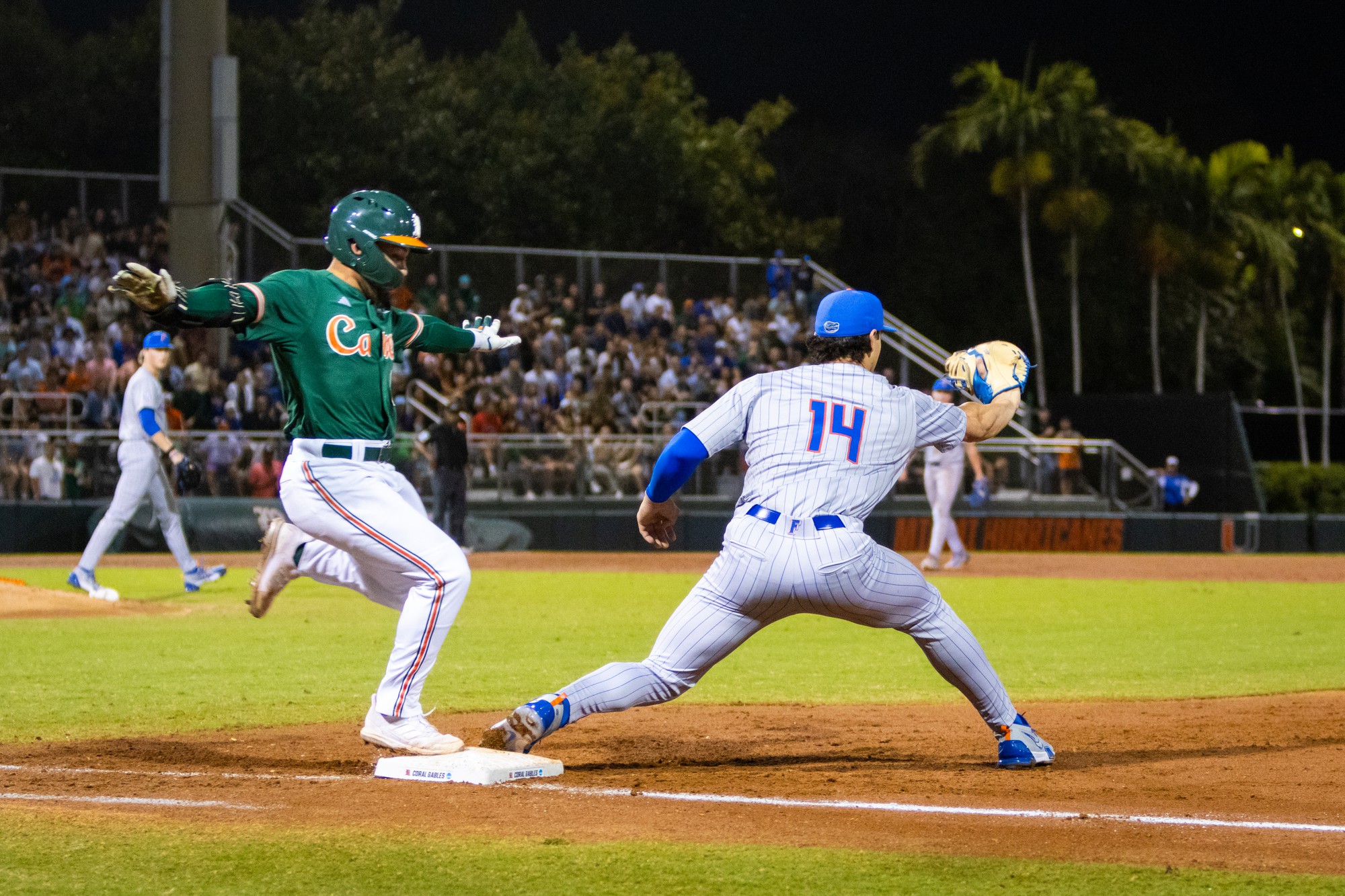
Junior second baseman Dorian Gonzalez, Jr. calls himself safe before getting to first base during the series opener against No. 4 Florida.

College basketball is facing a growing NCAA eligibility crisis

0

College basketball has a problem. 

When it comes to rules and regulations towards eligibility in college basketball, there aren’t real guidelines as to who is or isn’t allowed to play. What was originally a rare exception is quickly becoming a growing trend as an increasing number of “professional” basketball players are attempting to return to college.

Currently, the NCAA eligibility rules require student-athletes to have graduated from high school or a comparable education, never to have signed an NBA or two-way contract, and to compete within a five-year window of their high school graduation. Under these guidelines, any player who has entered the NBA is generally considered ineligible for college competition.

Historically, college basketball has been the point of connection for young athletes looking to transition and develop their games to the professional level. But, athletes who have already competed professionally in basketball are disrupting this system.

This season alone, there have been five “student-athletes” who were granted eligibility despite having previous experience playing professional basketball.

London Johnson from Louisville was granted two years of eligibility, while Abdullah Ahmed from BYU was granted three years — both having experience playing in the G-League. The G-League are the “minor” leagues for the NBA.

James Nnaji from Baylor University was granted four years of eligibility after being drafted 31st overall in the 2023 NBA draft and playing five years overseas in Spain and Turkey.

Charles Bediako played two years in college for Alabama, signed a two-way NBA contract, played in the G-League, and now has returned to Alabama. Despite having a court date to determine whether he will be allowed to finish the year, Bediako is currently playing for the Crimson Tide — something that should not be allowed as he waits for a ruling.

Amari Bailey played one year in college for UCLA, was drafted by the Charlotte Hornets, played 10 games for them, and now he is currently trying to make a return to the Bruins. This decision specifically will have huge ramifications on college basketball.

All of these eligibility decisions are heavily impacting the face of college basketball. Every roster spot matters, and the more former professional players going to college means less opportunities for young aspiring student-athletes looking to develop their skills.

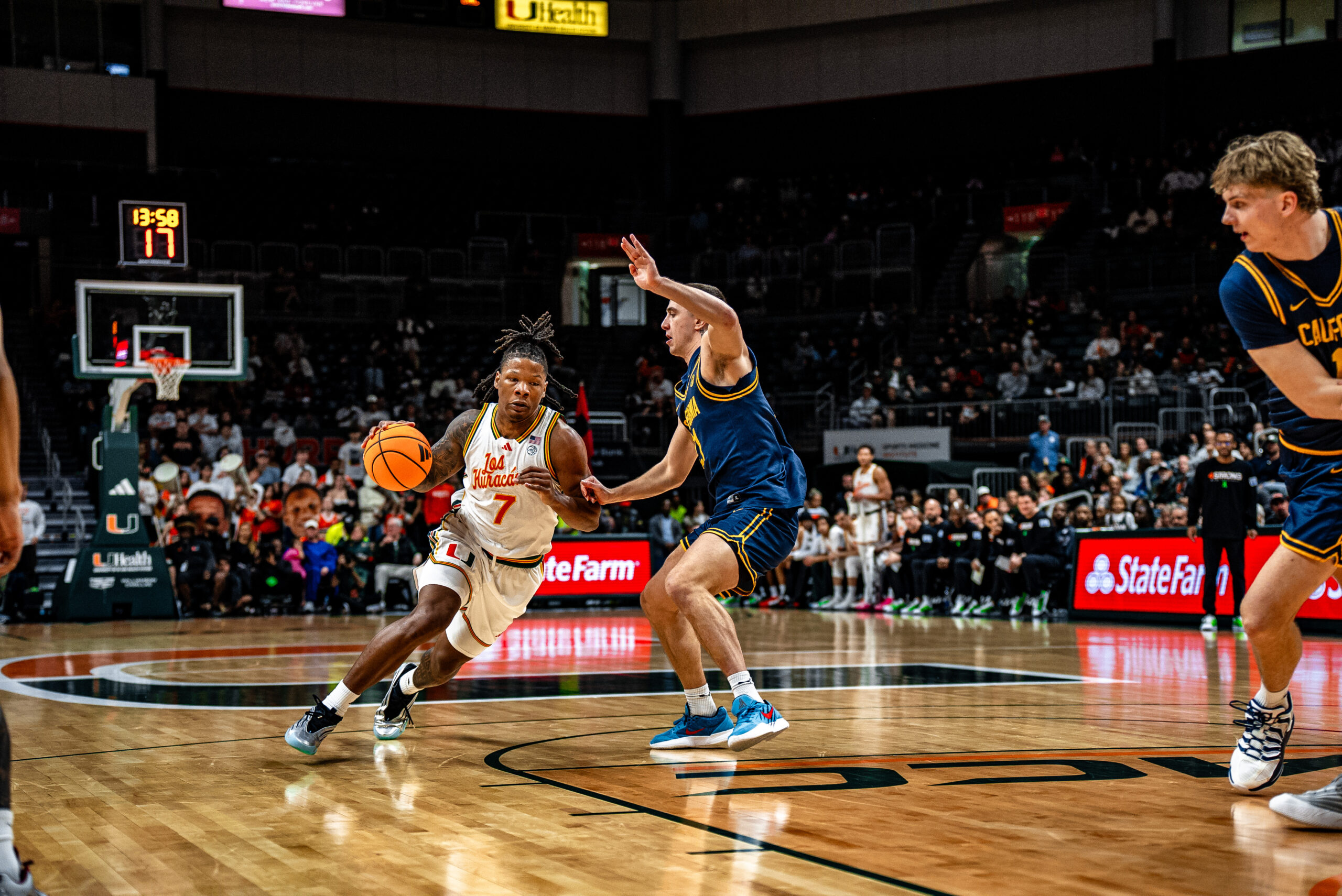
Max Rogers // Freshman Shelton Henderson drives into the pain against UC Berkeley on Saturday, Jan. 31, 2026.

All of the players “returning back to college” are 21 years or older which is not right. The NCAA needs to make more fair rulings on eligibility.

This shift in the priority of recruiting has already been happening in college basketball, driven by the transfer portal and has been reflected by who coaches are deciding to recruit.  

“We went away from high school basketball players, although we have taken one or two to develop, but by and large we’ve gone after older players,”  said St. John’s coach Rick Pitino in an interview with sports personality Colin Cowherd.

While the first two listed athletes are either international or never signed an NBA contract, the other three are in a completely different situation. Nnaji was drafted just one pick outside the first round, Bediako played in college and left to pursue a professional career, and Bailey played professionally in the NBA after leaving college. These cases show how unclear the eligibility standards are, and how they are being stretched past their original intent.

Looking beyond individual cases, this trend will threaten the competitive balance of college basketball as a whole. The top power conference teams will use this to separate themselves from lower-level teams, as smaller schools will have less of a chance at recruiting these more experienced players.

Without any changes, this loophole will continue to grow, eventually forcing the NCAA to draw a line to preserve the opportunity for young players. 

Rather than recruiting and developing high school players, coaches will focus more on these former professional players who already have higher levels of experience, pushing college basketball to become closer to a secondary league to the NBA rather than a place for young athletes to develop their craft.

While players should have the freedom to explore professional opportunities overseas or in the G-League, returning to college afterwards cannot become the standard, as it undermines the point of college athletics.

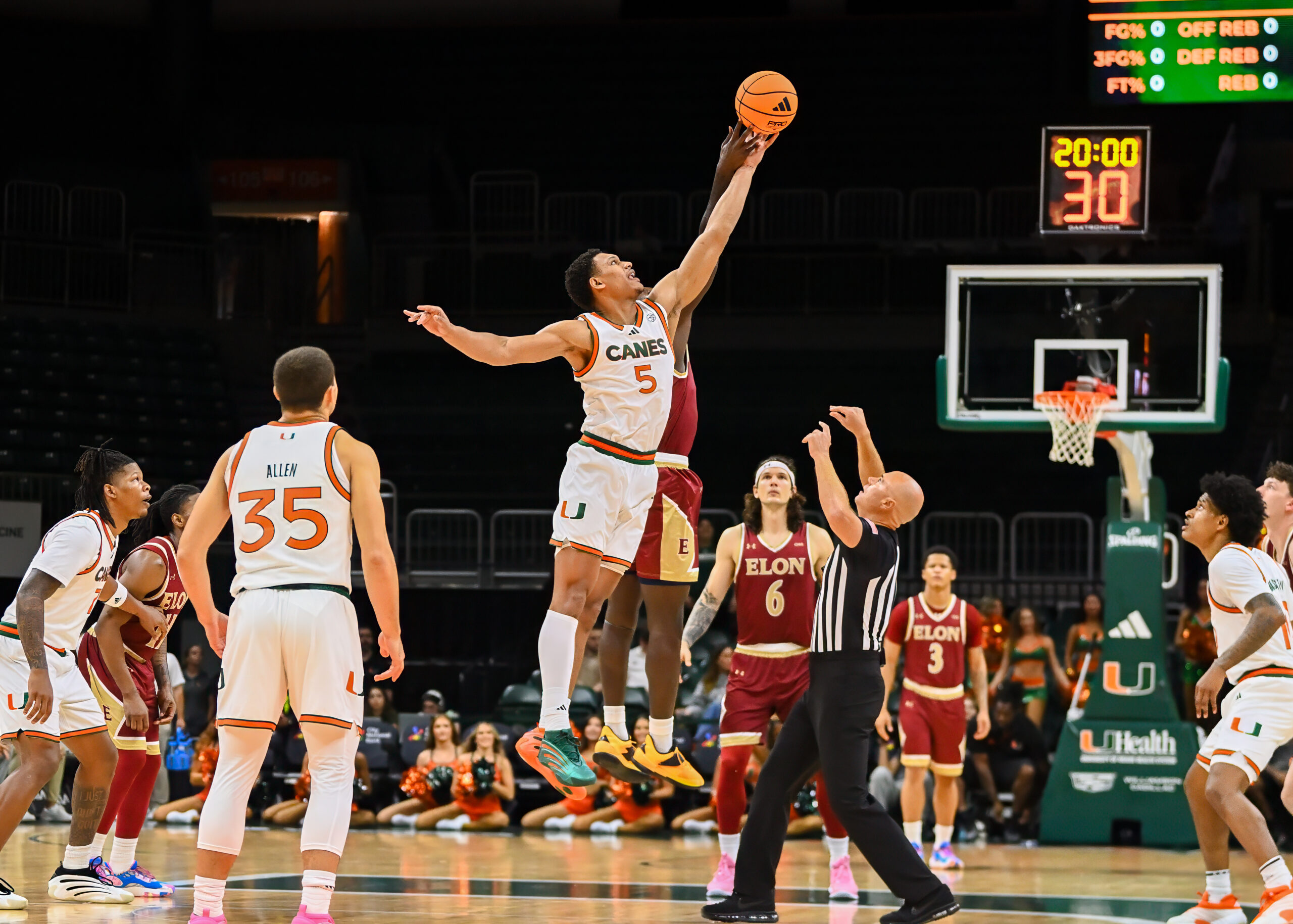
David Lebowitz, Staff Photographer/Senior Forward Malik Reneau takes the tip-off for the Hurricanes against Elon on November 20, 2025.

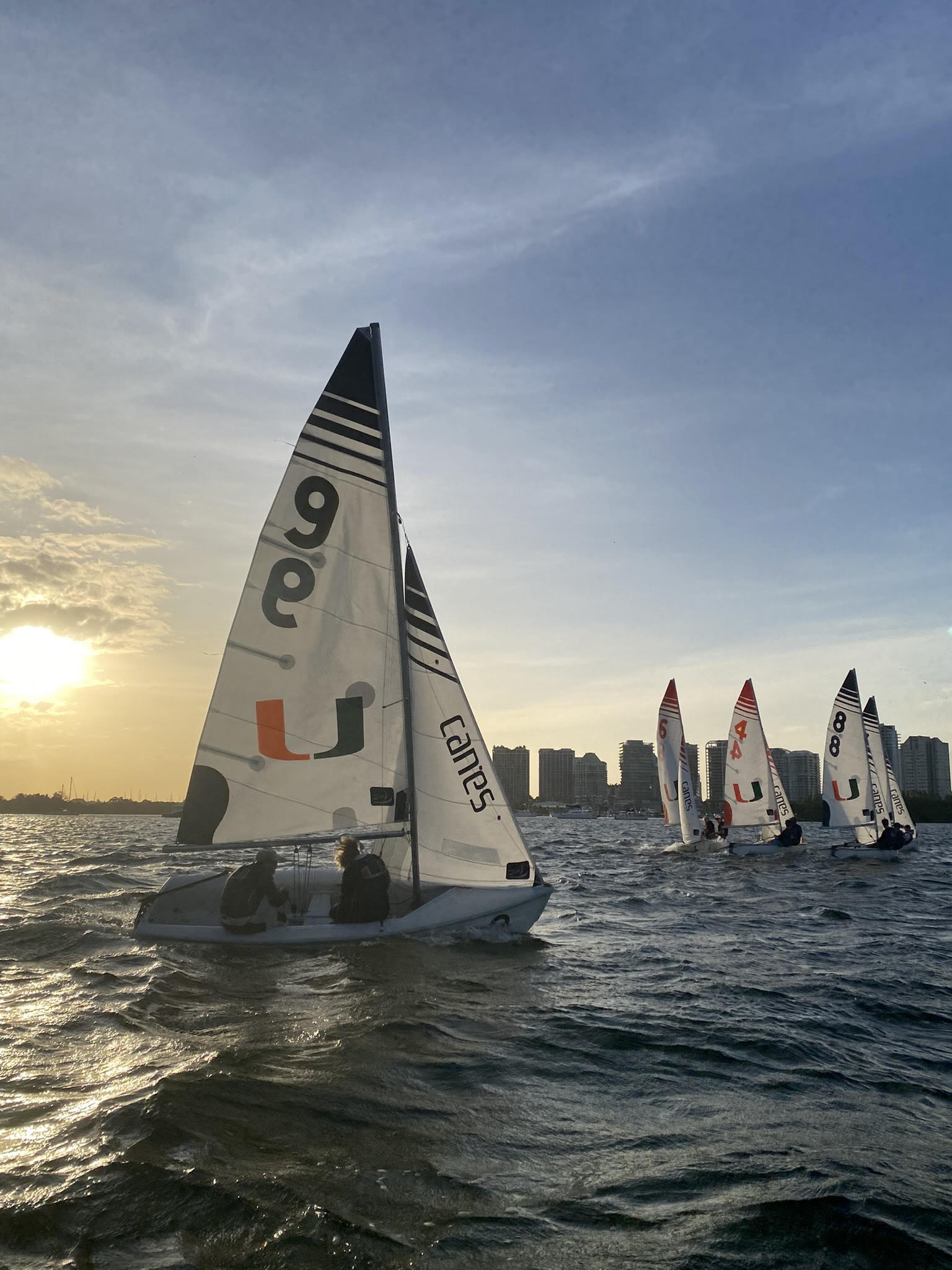
UM Sailing is everything varsity should be, except recognized

On the water, they’re gladiators.

For the University of Miami sailing team, wrestling water, air and sails is as much of a discipline as it is an art form.

Sacrificing comfort to compete against the best programs in the country, the UM Sailing team has long operated at the same level as any varsity program. In 2023, the team asked for that acknowledgement.

When the team made its long-fought bid for NCAA varsity status — a chance to be fully recognized, funded and protected like the athletes they already were — it was denied by UM’s athletic department.

In a 2023 article by The Miami Hurricane, Athletic Director Dan Radakovich dismissed the team’s request, comparing it to “the debate team,” a line as inaccurate as it was insulting.

These athletes don’t argue in air-conditioned rooms, they defy the elements. Each practice on Biscayne Bay is a battle with wind, bruised legs, torn hands and weather that doesn’t permit negotiations — day after day, they break down their bodies and rebuild them again for a sport that demands everything.

Being a club program doesn’t make it any less competitive than the football or basketball teams; it simply restricts the resources available. 

But within those constraints, Miami Sailing has done what so many teams with far more support fail to do: compete, excel and build a formidable national reputation on grit alone.

Last season, the Canes finished 11th in the nation. This year, they’re ranked inside the top 25 — ahead of programs with exponentially more funding, staffing and institutional support.

“No matter how cut short we are, we still come together as a team,” junior Brianna Hummel said. “We’ve continued to do well, despite all the hoops we’ve had to jump through.”

Though the team has seen more financial support in the past few years, it’s still a fraction of what its competitors receive. At the national level, that difference isn’t cosmetic — it’s functional. It shows up in the gear they can’t afford, the travel they patch together and the compromises no varsity program ever has to consider. 

Sophomore Nathan Long even cited a nearby sailing team having a Xbox in its team van, fully-funded by its school’s athletic department.

“We’re in the club sport van that doesn’t have AC half the time,” Long said. “[These other teams] have the advantage.” 

And yet, year after year, Miami Sailing competes at that level, challenging the nation’s top varsity teams. 

“It would be great to get out of this sort-of ‘debate team’ stigma we’ve been locked into,” sophomore Chris McCollum explained. “This isn’t your average club sport practice; it takes time to rig these boats [and] we work over the weekend.” 

They sacrifice several hours each day for their sport, contorting into impossible positions and fighting waves constantly trying to throw them off balance. 

Your hands burn and thighs shake, all while your brain tries to determine wind shifts and right-of-way rules. There is no bench nor breaks. Every second is a tactical calculation made at full speed.

“You have to want it,” McCollum said. 

And while the sport demands individual precision, success depends on collective trust — the people braving the water with you. 

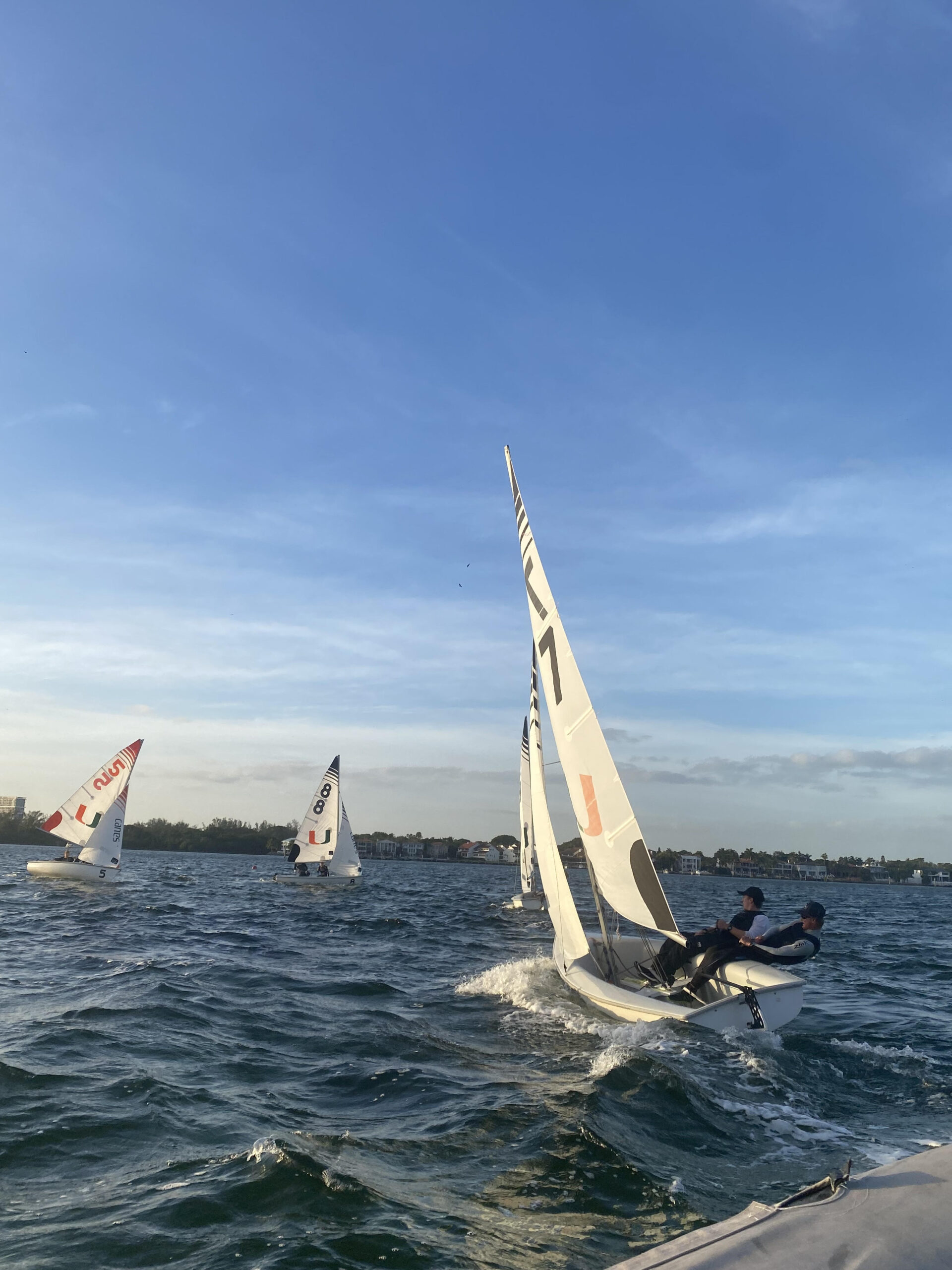
Photo Credit: Bella Armstrong // The UM sailing boats race across the water on Nov. 11, 2025.

“We have to build on each other in order to succeed,” sophomore Jadin Gonzalez said, looking at a teammate rigging a boat. “I think we do a great job of that.”

But this team’s undeniable nerve, tenacity and inspiring optimism doesn’t erase its uphill battle.

Even though Miami Sailing competes against the nation’s best varsity teams, defeating many of them, sophomore Luca Webb explained recruits are still hesitant to come to The U. 

“Kids don’t want to take the risk — even if they think UM is where they want to be,” Webb said.

Captain Steven Hardee has seen this firsthand. 

“If you want to be a top team in sailing, you’re going to need to be varsity,” Hardee said. “As soon as you make this team varsity, it’s going to be a top 10 team — a top five  team.” 

From the U.S. Virgin Island of St. Croix, Hardee competes internationally, having raced at ten World Championships, the Pan American Games and even campaigning for the 2024 Olympics under its banner. With 14 years of competitive sailing experience, Hardee is no stranger to sailing’s physical, mental and emotional toll. 

“The tactics, fleet management — there are a lot of things that go into it,” Webb said. “People don’t understand the dedication we put into this.” 

And that commitment isn’t abstract. It’s tied to the school stitched across their chests, even when that loyalty isn’t returned.

“We love this school,” Gonzalez said. “We want to feel the love we give it.” 

At some point, the question stops being whether Miami’s sailing team have earned recognition and starts being why they’re still waiting for it. 

After watching them in motion, any reason not to take them seriously stops making sense.

You can call them just another club or compare them to the debate team if you’d like. But watch them race. Watch them turn the ocean into an arena — then try saying it again with a straight face.

Because when the wind whips the bay into shape and the boat tries to throw them overboard, they rise anyway — hungry, faithful and unrelenting.

And if that’s not varsity, then the word means nothing.

Photo Credit: Bella Armstrong // The UM Sailing boats in the water of Nov. 11, 2025.

Dos and don’ts of Rome

Traveling to a new country isn’t just a change of scenery — it’s a collision with an entirely different way of living. Different rhythms, different rules and different expectations for how you move through the world and treat the people around you. 

That kind of immersion is a privilege, but it can also be intimidating. The truth is, cultural adjustment takes time. 

When I left to study abroad in Rome, I expected culture shock. I thought my biggest challenge would be the language. What I didn’t anticipate was everything around the language: the unspoken etiquette, the respectful forms of address, the social cues and the norms that are second nature to Italians but completely unfamiliar to Americans.

If you want to avoid embarrassing yourself, a bit of preparation goes a long way. 

So consider this your Rome survival guide: the dos and don’ts that will help you navigate the city with more confidence, more respect and a lot less “American tourist” energy. Because if you’re going to travel, you might as well learn how to live like you belong there. 


Dos: Learn the the language (at least the basics)


You don’t need to be fluent in Italian to travel to Italy. In most tourist areas, you’ll find that many people speak English, and will greet you in English before you even open your mouth. 

But that doesn’t mean you should arrive unprepared. Learn a few key polite phrases like “grazie” (thank you), “per favore” (please) and “buongiorno” (good evening). 

Not only will it make everyday interactions smoother, but it also shows you respect the local culture. It signals that you made an effort, have taken time to prepare and that you don’t assume the world should accommodate you. 

That said, language isn’t just about knowing words. It’s about knowing when and how to use them. 


Don’t: Use “ciao” with strangers


I arrived in Rome with a basic Duolingo understanding of Italian. I knew “ciao” meant hello, but I didn’t realize it’s informal, reserved for friends, family and children. 

In Italy, it’s considered rude to enter a shop without greeting the storekeeper. So I confidently walked into stores saying “ciao” to everyone, until my Italian teacher finally corrected me: when greeting strangers or adults, you should say “buongiorno” (good morning) or “buonasera” (good evening). 

Italians take formality seriously, and respect is built into the language. When in doubt, choose the more formal greeting. It’s the easiest way to avoid coming off too casual — or worse, disrespectful. 


Do: Say “permesso,” not “scusa”


Another phrase I misused early on was “scusa” (excuse me). In English, “excuse me” works for everything: squeezing past someone, getting attention, interrupting. 

In Italy, that’s not the case. 

If you’re trying to move through a crowd or slip by someone on the street, use “permesso,” which essentially means “may I pass?” 

If you say “scusa,” you’re more likely trying to get someone’s attention. I learned this the hard way when I said it while attempting to pass an older man in a store and he just laughed and didn’t move an inch. 


Don’t: Guess labels


This one seems obvious, until you’re tired, in a rush and don’t feel like pulling out Google Translate. 

Don’t guess anyway. 

I learned this the hard way when my roommate once grabbed a random spray bottle from our closet and started spraying it all over the room after spotting a bug. Only after our nostrils started burning did we realize what it was: degreaser — strong, toxic and not something you want to inhale.

A five-second translation check is worth it. Always. 


Do: Pay attention to the cafe ordering system


Now, let’s talk coffee, or as the Italians would say “espresso,” because there may be more rules in bars ( the Italian word for a cafe) than in the language itself. 

Before you order, watch how the place works. In many cafes, the general rule is ‘pay first, drink later.’ You pay at the register, receive a receipt and bring it to the barista at the counter — how most American cafes are. Some people even leave a small tip with the receipt to get the barista’s attention.

In smaller neighborhood spots, though, you may do the opposite: order first, drink your coffee and then tell the cashier what you had on your way out. I noticed this most often in Trastevere, where local routines matter more than rigid systems. 

Bottom line: observe first, then follow. 


Don’t: Ask for coffee to-go


Italians embrace a daily philosophy known as “la vita lenta” (the slow life), prioritizing quality of life, relationships and the enjoyment of the present moment over speed and productivity.

With that mindset, coffee is meant to be enjoyed on-site, not rushed out the door in a paper cup. I learned this the hard way when I asked for a cappuccino to-go and the barista physically recoiled before asking “Are you sure?,” like I had just committed a crime. 

To be fair, “enjoying coffee” in Italy doesn’t always mean sitting for an hour. Many Italians drink their espresso quickly while standing at the counter. It’s a brief social pause — just a few minutes to chat, breathe and move on. 

Lunch and dinner, though? Those are a different story. 


Do: Ask for the check.


In Italy, meals aren’t rushed. Lunch and dinner aren’t just about eating, they’re about savoring. They’re social rituals, often lasting one to three hours, with time built in for conversation, digestion and connection. 

Therefore, it’s considered rude for servers to push you out. So, if you’re waiting for the check to arrive automatically, you may be waiting forever. 

When you’re ready to leave, you need to ask: “Il conto, per favore.”

During my first solo meal in Italy, I sat for thirty minutes with an empty plate, confused, wondering why my waiter kept staring at me. I wasn’t being ignored, I just didn’t know the rule.


Do: Check store hours


The importance of lunch and dinner extends beyond restaurants. Many shops close during ‘riposo,’ a midday break where shopkeepers take time for a proper lunch, or perhaps a nap. 

This pause often happens between 1 p.m. and 4 p.m., so check store hours ahead of time. Otherwise, you’ll find yourself standing outside a closed shop, hungry, frustrated and staring at a sign you can’t translate fast enough. 


Do: Give yourself grace. 


Adjusting to a new culture can be overwhelming, and at times, embarrassing. You’ll use the wrong phrase. You’ll break social rules. You’ll have awkward interactions you replay in your head for days. 

But give yourself grace. 

As long as you’re trying — making an effort, paying attention and showing respect — people notice. And more often than not, they’ll meet you with patience. 

Rome doesn’t expect you to be perfect. It just asks that you show up willing to learn. 

Draft-bound athletes shouldn’t have a get-out-of-class free card

Ahead of the national championship game between the Miami Hurricanes and Indiana Hoosiers, UM quarterback Carson Beck was asked about missing classes for the Jan. 19 matchup.

He laughed.

“No class. I graduated two years ago,” Beck said.

The media room erupted. The internet followed suit. Although many people were outraged at the indifference in Beck’s comment, the moment was seemingly harmless overall — a wink at the reality of modern college football.

But the joke didn’t land as expected. Not because Beck was inherently wrong, but because the moment felt oddly routine. A joke about not attending class shouldn’t register as business as usual. Yet it did.

As a graduate transfer to UM who earned his degree from Georgia in 2024, Beck’s situation is not unusual, nor is it technically controversial. The idea of the “student-athlete” has long rested on the simple idea that education and athletics coexist. But as college sports grow more commercialized, that balance is slipping. And with it, the expectation that athletes — even draft-bound ones — are still students at all.

Allowing draft-bound athletes to opt out of spring academics entirely is more damaging than easing a workload. It signals that education is optional when an athlete becomes “valuable enough.” It says that college is not an institution with standards, but simply a holding space until something better comes along.

This distinction matters, because easing academic pressure is not the same as abandoning it altogether. Until an athlete leaves campus, they are still enrolled students; students who are expected to attend class, even in the spring.

The reaction to Beck’s comment points to a growing debate in college athletics: Should draft-bound athletes who remain enrolled be permitted to forgo spring classes altogether in preparation for professional careers?

In the age of NIL deals and draft projections, elite athletes increasingly occupy a strange in-between space: enrolled in school, branded as professionals all while being treated as something else entirely.

Sure, draft-bound student athletes may be in a league of their own, incomparable to other student athletes, let alone regular students. 

And from a purely professional standpoint, spring classes rarely factor into an athlete’s path to the NFL. 

But here’s the catch: these athletes are not in the NFL yet. 

Yes, draft-bound athletes live in a different reality. They gain national attention, bring donor interest and foster future prestige in their programs. Their schedules are brutal. Their careers can be short. 

“Essentially, for these football players, this is their work study program,” said an anonymous former Miami student athlete. “This is their life.” The athlete went on to cite opportunities high-performance college athletes miss out on, such as study abroad.

Indeed, these athletes’ sacrifices should be viewed as sacred — but not at the expense of academic and institutional integrity. 

NCAA eligibility rules require athletes to maintain academic progress and enroll in a minimum number of 12 credit hours, maintaining progress towards a degree. Those standards don’t just disappear because a mock-draft looks favorable. Online classes, absences excusals, adjusted schedules and academic support already exist to accommodate athletic demands. Expecting participation is not a punishment, but consistency.

It also deepens an existing imbalance. There is no professional draft awaiting swimmers, rowers or track athletes. These athletes’ commitment to academics is non-negotiable. Carving out exceptions for larger sport athletes to cater to their draft-favoribility reinforces the idea that some athletes meeting certain criteria are permitted to be students only when it’s convenient.

“For example, we have athletes [at UM] that are Olympians, and they take time off of school to compete at the Olympic level, but because there isn’t as much coverage, it flies under the radar,” said a former Miami student athlete who asked to remain anonymous. “When you magnify it to the scale of the football team, it really should be considered with that same leniency.”

This isn’t about denying the reality of NIL or pretending college sports aren’t evolving — they are, rapidly. But evolution doesn’t mean we should abandon the core premise that universities still claim to uphold.

When schools market athletes as students, they have to treat that label as more than branding. Selective standards aren’t flexibility — they’re hypocrisy.

If universities want to continue calling their athletes “students,” they must be willing to uphold that label consistently — even when it’s inconvenient for all parties involved. The water gets murky when college sports can claim educational integrity, all while selectively ignoring academic expectations for their athletes with the most monetary and professional appeal. 

Either student status matters, or it doesn’t. Colleges need to start being honest about which it is.