Miami men’s tennis falls to Duke in ACC Tournament second round

0

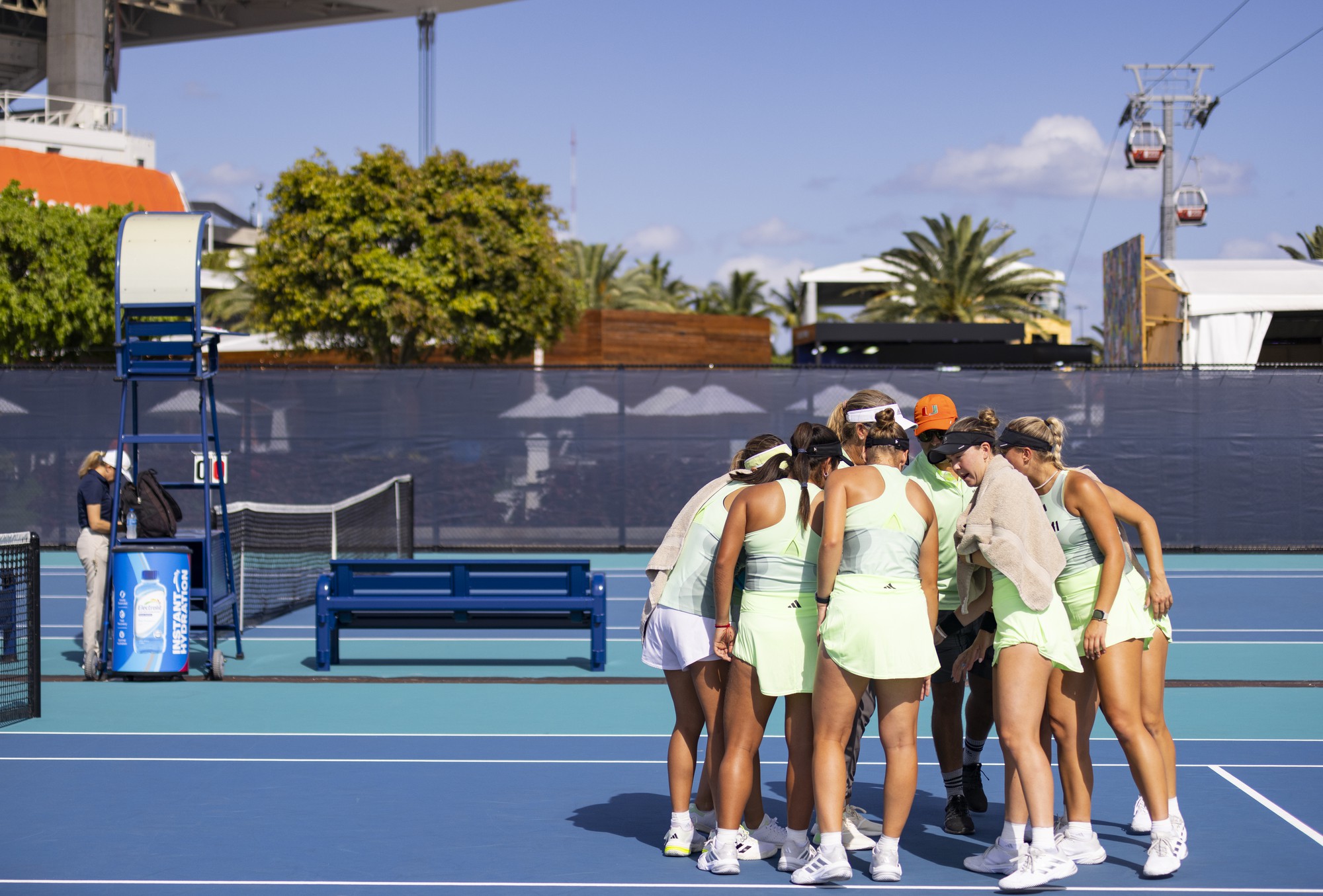
The eighth-seeded University of Miami men’s tennis team fell to the ninth-seeded Duke Blue Devils 4-0 in the second round of the ACC Tournament on Thursday at the Cary Tennis Park in Cary, N.C.

From the jump, the Hurricanes struggled to gain any sort of momentum in doubles. 

On court one, Duke’s Alexander Visser and Gerard Planelles Ripoll overpowered Jules Garot and Nacho Serra Sanchez 6-1. The Blue Devils clinched the doubles point shortly after as No. 3 Pedro Rodenas and Cooper Williams took down Jakub Kroslak and Mehdi Sadoaui 6-3.

Singles started off looking more promising for UM. No. 1 Antonio Prat, No. 4 Rafael Segado, and No. 5 Mehdi Sadaoui all put up strong first set performances.

No. 3 Kroslak and No. 6 Garot both lost their first sets in hard fought battles.

The Blue Devils only needed three singles victories, and that is what they got. Williams put up a dominant performance on court two, beating Serra Sanchez 6-1, 6-3. 

Kroslak and Garot were not able to recover. Kroslak fell 7-5, 6-4 to Ripoll. Garot lost 7-6(3), 6-4 to Saahith Jayaraman of Duke to clinch the match and advance the Devils to the next round. 

This was a disappointing opening round performance from the Hurricanes(14-11, 5-7 ACC), who will await their postseason fate at the NCAA Selection Show on Monday, April 27 in head coach Alex Santos’ last season in Coral Gables.

Nature has a right not to be exploited

0

In the U.S., nature is only protected when humans have something to gain or lose. Rarely because nature itself is harmed. Nature itself has no voice or protection in a court of law.

The growing global movement for legal environmental status for nature is what this country needs. Nature should have the right not to be exploited. Nature deserves protection, not only when humans are being harmed. 

The Rights of Nature is an idea rooted in ancient Indigenous and modern philosophy, holding that nature has its own legal rights without relying on property, human health or human business interests for protection under the law.

If the Rights of Nature framework were ever adopted in the U.S., lawmakers would first have to recognize an ecosystem as having legal rights. Once these rights are established, anyone can take legal action on behalf of an ecosystem that has been damaged or destroyed.

For example, a community member in the U.S. could file a lawsuit against a construction company for destroying a forest recognized as having legal rights. Even if the person doesn’t own the land, they can go to court arguing for the forest’s rights, but only if Rights of Nature were ever adopted. 

The concept is not a utopian theory. Real legal systems around the world are protecting the Earth, but the U.S. is still falling behind them.

Various countries in Latin America have taken the initiative to recognize nature as a legal subject. In 2008, Ecuador led the shift by becoming the first country in the world to include the rights of nature in its Constitution. Bolivia used the “Rights of Mother Earth” framework in its national legislation focused on harmony with nature, and Panama followed. 

In the U.S., pollution is urgent to people when it threatens drinking water, but not when river ecology is being destroyed. This anthropocentric approach has been used for decades and explains why Earth’s health continues to decline. The current system has failed nature, and so have we by staying silent. The root of change requires significant cooperation between lawmakers, courts, local communities and environmental advocates.

Indigenous traditions typically view nature with respect and responsibility, and aim to conserve it. Many communities in these countries have understood that humans belong to nature, not the other way around. The idea of Mother-Earth is one not of ownership but of belonging and interdependence. 

A mother is not something to extract from endlessly. She is someone to respect, protect and remain accountable to. This perspective has driven the expansion of the Rights of Nature movement. It’s not solely political — it’s moral.  

According to the Florida Museum of Natural History, Florida’s nature features more than 80 distinct ecosystems, including the Everglades wetlands, extensive mangrove forests, hundreds of crystal-clear freshwater springs and the ocean. 

Orange County, Fla., residents recognized this, too. In 2020, 89% of voters approved the Right to Clean Water Initiative, recognizing legal rights for local rivers and streams. The following year, advocates filed the first nature-enforcement case in the United States under a rights-of-nature law. These were small wins that were very temporary.  

Florida later restricted local governments from granting legal rights to natural environments unless they are recognized by state law or the state constitution. In a state with such diverse ecosystems, treating nature as unworthy of its own protection is disappointing. 

Critics of the movement argue that ecosystems cannot literally speak or act for themselves. They fear uncertainty about representation and how courts will weigh violations of nature. Other concerns arise from the recognition of legal rights to nature and how that could expand litigation into excessive interpretation. The concerns raised are valid concerns, but they are not unique to the Rights of Nature movement.  

The law already recognizes many entities that cannot speak for themselves. Corporations can hold rights, and representatives regularly act in court on behalf of children or incapacitated adults.

This issue is of utmost importance to every American. Whether it is the oceans they swim in, the mountains they climb or the forest trails they hike, human life depends on these ecosystems. 

The anthropocentric approach has been used for decades and explains why Earth’s health continues to decline. The current system has failed nature, and by staying silent, we have too. The root of change requires significant cooperation. 

As climate pressures intensify and environmental harm becomes harder to ignore, will nature ever have the right to protect itself from exploitation?

Actor and producer Bob Odenkirk talks past roles and new movie, ‘Normal’ at Miami Film Festival

Olympia Theater has stood in the heart of Miami for 100 years. The small red carpet placed in front of the building, however, was a new, temporary addition for the Miami Film Festival. 

Adorned with lights and a blue backdrop, the bustling crowds waited for actor and producer Bob Odenkirk’s arrival on Saturday, April 11. 

Whether a red carpet is laid out for dozens of celebrities to strut across or for just one, the chaos remains the same. Lights, cameras, press, fans who aren’t always supposed to be there. It’s intense, but Odenkirk arrived calm, collected and confident. 

Odenkirk attended the Miami Film Festival to promote the release of his new film, “Normal.”

Odenkirk holding the Precious Gem Award he received.

 The film follows Odenkirk’s character, Sheriff Ulysses.  The story is told through a simultaneously dark and comical lens and has a combination of thrill, horror and comedy. This gives it a “Final Destination” feel, Odenkirk said.

Without giving away too much, Odenkirk revealed Ulysses is a “very smart fellow, but he’s lived a lot of life,” as a man in his early 60s. He finds relatability in his character, noting how Ulysses “is an older guy,” which he appreciates, as he says he is used to playing characters 20 years younger than himself. 

This allowed him to channel his own personality when it came to understanding his character, from the way Ulysses uses his life experiences to guide him, to the way he hesitates to trust his own instincts.

The movie, shot in 35 mm film, was screened for attendees. Director Ben Wheatley made the choice to shoot the film this way instead of a typical digital format, like most movies in this generation are. 

Odenkirk emphasized, “it really is an old style film,” he said. It feels like something “that you would have seen made in the early 1980s or the ’70s, even.”

The graininess, saturated, high-contrast colors and overall retro, rustic feeling the movie deserves— as an ode to older cinematography, can only be produced by a film camera. 

He added, “it really needs to be seen in the theater” for the optimal viewing experience.

After a handful of other interviews he treated with attentiveness, patience and natural charm, Odenkirk finally made his way to my side of the red carpet. 

From playing the title character in the “Breaking Bad” spin-off “Better Call Saul” to having multi-episode cameos as Uncle Lee on “The Bear” to Sheriff Ulysses in “Normal,” Odenkirk’s TV and filmography consists of countless successes. 

When asked which of these characters’ stressful worlds he would rather live in, Odenkirk immediately, undoubtedly chose his character in “Normal.”

“I like the guy I play in this film. He’s actually a nice guy, and he’s funny too,” he said. “‘The Bear’ is too tense. Yeah that guy is out of his mind, and ‘Breaking Bad’ is scary.” 

Before Odenkirk stepped off the red carpet,  I had the chance to ask him one more question: “What are you most excited for fans to see in your new movie?”

”The way that it mixes different genres – it’s got comedy in it, it’s got action, it’s got a little bit of a horror film at times,” Odenkirk said. “I think it’s a tone that I haven’t played yet.”

And with that, Odenkirk shook a few more hands, answered a couple more questions and headed inside Olympia Theater for a conversational Q and A with fans.

Canes’ leather and bats struggle in 4-2 midweek loss to USF

The bats won’t be there every day.

Miami’s defense showed its true colors as their offense lulled in a mid-April midweek matchup against the South Florida Bulls.

The 4-2 loss comes off the heels of an impactful series win against Wake Forest, cementing Miami as sixth in the ACC, shocking both the team, and the 3,446 that bore witness.

Notable contributors, despite the loss, were Jake Ogden, who went 2-4 with a double, Alex Sosa and Max Galvin, who both drove in a run with RBI singles.

The Canes had a rocky start to the game, with the Bulls knocking one in before recording an out —  Two errant throws subsequently led to runs scored, and Miami faced a 2-0 deficit before getting a chance at the plate.

This is not new for the Hurricanes, whose 49 errors coming into their Wednesday matchup rank just below Duke, who leads the ACC with 50. The three of this game only add to concern for the growing total.

After the sloppy frame, Ogden led the charge in return by roping a ball to left for a leadoff double. Sosa continued the rally in a 3-2 count, adding his own extra-base-hit to the stat-sheet when he looped a ball past the Bulls left fielder for an RBI triple.

David Lebowitz, Photo Editor/ Junior Catcher Alex Sosa sprints toward third base on April 12, 2026.

With two outs in the first, and still down one, left fielder Max Galvin stroked a ball back up the middle for an RBI single, tying the game at two-a-piece.

A quiet second brought USF back up to the plate, where first baseman Joey Brenczewski would smoke a 1-1 pitch over the right field wall, giving South Florida back the lead.

Another scoreless inning brought the Canes up to bat in the fifth, still down one. Besides a two-out bunt single from Ogden, Miami could not seem to put it together at the plate.

With two outs in the bottom half of the sixth, USF made their first pitching change, replacing Dominic Pontbriant for Landen Yorek.

Pontbriant kept the Canes at bay after the first, pitching four full scoreless innings of his 5.2 inning total — his day ended at 87 pitches, having tallied five strikeouts and only allowed one walk and four hits.

Following USF’s lead, Miami replaced TJ Coats with lefty reliever Jake Dorn to kick off the seventh.

Coats, after six full innings, was one bright spot on Miami’s day. Despite allowing seven hits, Coats heaved three scoreless to end his day, and only allowed one walk, continually giving the Canes a chance to succeed after some early struggles.

Dorn entered a tough spot, and faltered. Under a close deficit, he plunked two batters, with one ultimately being USF’s fourth run scored, bringing their lead to two.

A single from catcher Alonzo Alvarez rang in another call to the bullpen for USF — which ultimately resulted in a fielder’s choice for the final out of the inning.

Dorn was replaced by Sebastian Santos-Olson in the eighth, who returned to the trend of scoreless innings, giving the Canes another opportunity to come through.

With the Bulls’ fourth pitcher of the game taking the mound, and the top of the lineup due, Miami once again stumbled at the plate, going three-and-out aside for a walk from Alex Sosa.

Despite a walk and a single from first baseman Brylan West and Galvin, respectively, it was too little too late. A lineout to the shifted USF shortstop off the bat of Alvarez led to an easy double play, putting emphasis on Miami’s woes for the evening.

The Canes look to regain their footing in Palo Alto, Calif., as they take on the Stanford Cardinal in a three-game series beginning Friday, April 17 at 9 p.m. EST.

David Lebowitz, Photo Editor/ Junior Catcher Alex Sosa and Senior Lyndon Glidewell celebrate after defeating Wake Forest on April 12, 2026.

Factory Town Keeps the party going after Miami Music Week

Factory Town did not treat Miami Music Week like a finish line. After five straight nights of packed programming across its stages, the venue is moving directly into a spring calendar that continues its momentum. 

From international techno institutions to Race Weekend blowouts and artist-led takeovers, Factory Town is making a strong case for one of Miami’s most essential music spaces long after the Music Week crowds leave.

First up is an event from the team behind III Points on Saturday, April 18 — a more laid-back and  loose spin on a night out. It runs from 4 p.m. to 5 a.m. at Factory Town, which suits the energy: communal, unhurried, with music, games, flowers, a skating rink and a mix of local artists and DJs giving you plenty of reasons to keep moving through the space.

On Saturday, April 25, Time Warp Miami takes over at 9 p.m. and the energy shifts completely. This one’s for the techno heads — Adiel, Hector Oaks, Ben Klock, Marcel Dettmann, SPFDJ, Honey Dijon, Klangkuenstler, Richie Hawtin, Chlär, Boys Noize. 

It’s a heavy, underground lineup and it hits differently on the same grounds that just hosted a skating rink and flower stands. Time Warp has long been one of the most respected names in global techno, so having its Miami edition at Factory Town says a lot about how far the venue’s reputation now reaches.

Then comes Race Weekend, which has quietly become Miami’s next mini-Music Week. As Formula 1 brings another wave of travelers, luxury events and nightlife programming to the city, Factory Town will host a three-night run with Zedd, Cassian, Dreya V at the Infinity Room. 

Mestiza presents Sacro at the Chainroom on Friday, May 1. Rampa, Jaden Thompson and Rimaye on Saturday, May 2 and Martin Garrix and Miss Monique at the Infinity Room and Slugg presents Getbusy at the Charinroom on Sunday, May 3. 

It is a fitting trio for a weekend where sports spectacle, global nightlife and dance music all blur together.

The month continues with two artist-led nights that show the venue can still carry real gravity outside major citywide weekends. Mau P presents Baddest Behaviour comes Friday, May 15, with an open-to-close takeover that should fit perfectly inside Factory Town’s larger rooms. 

The next night, I HATE MODELS presents Disco Inferno brings a harder, darker edge back to the venue on Saturday, May 16. After his standout Music Week set, seeing him return to Factory Town feels like an easy yes.

What makes this run important is not just the names on the calendar, but the range. The III Points-affiliated event shows the venue’s playful local side. Time Warp brings international underground prestige. 

Race Weekend delivers scale. Mau P and I HATE MODELS offer focused artist worlds. Together, they show that Factory Town is not simply a seasonal attraction.

If Music Week proved Factory Town can anchor Miami at its busiest, this spring calendar proves the venue does not need the city’s biggest week to feel essential. Tickets for upcoming events are available through Factory Town and DICE.

Lambda Theta Alpha expands with largest new member class since 2024 revival

Since its revival in spring 2024 with only two founding members, Lambda Theta Alpha Latin Sorority Inc. (LTA) has quickly grown, nearly doubling its size to 15 active sisters at the New Member Presentation on April 3, 2026.

Founded in 1975 as a Latina Academic Sorority, LTA was intended to be one of a kind, a Latin sisterhood rooted in unity, love, respect and community.

While it is Latina by tradition, it is not exclusive by definition. Members come from diverse backgrounds, unified by values of inclusivity, unity and respect. Anyone who aligns with these principles is welcome, regardless of ethnicity or background. 

The recent pledge class, Line 23, presented in Spring 2026, was the largest class since being reinstated, welcoming seven new sisters. This growth represents the sorority’s influence and presence on campus. 

They work towards becoming known as an organization focused beyond social aspects, focusing on education, community service and empowerment for women at UM. 

The new members, many of whom are first-generation college students, reflect LTA’s commitment to empowering Latina women.

“The girls [in Line 23] are very ambitious,” said Perla Hernandez Vasquez, a line 22 member. “They’re all girls that really make us proud because they’ve truly embodied what it means to be a Lambda lady.”

Active members and alumni are committed to help these young women succeed academically, personally and professionally.

The re-establishment of LTA Beta Sigma at UM was led by Deani Sanchez, whose leadership and vision laid the groundwork for the sorority’s revival on campus. Since then, each line has contributed to the strength of their values, sisterhood, and campus engagement. Karolina Morales Sierra, a Line 23 member, was drawn to the sorority for its dedication to philanthropy and community service. 

“I saw how close the girls on campus were,” she said. “Not only are they Latinas, they do community service and their values really aligned with my values.”

Lambda Theta Alpha new member showcase celebration at the Rock Plaza on April 3, 2026. Zulema Zavala // Photo Credit.

What’s next?

With the chapter growing each semester, LTA plans to build on this momentum by developing political advocacy initiatives and deepening community impact, ensuring that growth is sustainable. Focusing on their philanthropy through events like Myeloma Awareness Week and the St Jude Children Hospital. 

With an untraditional recruitment process, LTA seeks women who bring diverse interests and commitments. 

“Figure yourself out first. Do what you’re passionate about and advocate for the things you care about.” Hernandez Vasquez said. “When you’re ready, we’ll be here to support you and help you grow — not to engulf you but to add value to your life.”

Vazquez encourages girls to observe, interact and approach the chapter at tabling events or any member with questions.

UM alumna Jessika Grewe Glover returns home for book launch

Between the shelves of Books & Books at Coral Gables, Jessika Grewe Glover spent much of her teenage years while her mother worked multiple jobs. 

She remembers attending her first book launch and picturing herself in the author’s place. With the release of her gothic fiction “Bromeliad House,” she returns to the same store for her first Miami book launch. 

“It was a place that I found myself,” Glover said. 

A Miami native and University of Miami graduate, Glover said college shaped both her work and her life. 

“Miami was also a huge part of my life,” Glover said. “My mom worked there, my brother was a graduate and my husband and I met there.”

Now in her next book, follows Delphine, an architect working on the renovation of a decaying Florida estate. The main character begins seeing reflections of her loved ones before they die, creating a revulsion to mirrors. 

According to Glover, gothic fiction often works as an allegory to generational trauma and mental health issues. In “Bromeliad House,” the crumbling estate reflects what people carry internally. 

“It’s important to me to remove the taboo of talking about mental illness and disability,” Glover said. “We should bring it to life so that we can find better means of dealing with it.”

She said she wants her fiction to show that people can be productive members of society while still dealing with mental health issues. 

Glover added that people tend to hide these struggles, something she hopes to challenge through her work. Art is another recurring element in Glover’s writing. 

It has been present in her previous books, often through characters connected to creative fields. That influence continues in “Bromeliad House.”.

Glover said the novel is aimed at readers who appreciate art in everyday life, as well as those drawn to gothic fiction. 

 The book came together quickly once she developed the idea, working with music to move through the writing process. She completed the first draft in just a few months in 2024, the fastest she has written. 

“I know these characters inside and out,” Glover said. “The story was easy to write because it felt like they were writing themselves.” She sold the manuscript to a publisher last May. 

Glover said writing has been a constant in her life. She recalled traveling with her mother and writing poetry on anything she could find, including napkins. 

“I don’t think I really chose it. It chose me,” Glover said.

She said she tried to move away from writing at times, but ultimately returned to who she is. Glover is currently working on three new manuscripts, with one ready to be picked up by a publisher.

For young writers, she emphasized the importance of discipline and experimentation. She said her discipline developed over time and encouraged writers to give themselves space to create and explore different approaches. 

“Find out how you like to write and see what inspires you,” Glover said. “There’s a lot of failure in being creative, that’s how we grow and learn.”

Student artist Alivia Clark steps into a bolder new era with ‘Breathless’

After taking some time away from music, Alivia Clark comes back swinging with “Breathless.” The track feels like a late-night rush, pulling from dance-pop, electropop and house while still carrying little traces of R&B and soul that keep it fresh. 

It sounds polished and  confident, but what makes it stick is that there is still a deeper feeling underneath all that shine. 

The production from David Mason, Harry Zelnick and Maxim Laskavy gives it that glossy pulse, but Clark’s voice keeps the song grounded. 

More than a simple return, “Breathless” feels like the start of a new era — one that sounds bolder, more self-assured and very clear about where it wants to go.

There is a sultry edge to the track, but also a real sense of control. It lives in the space between flirtation and vulnerability, which is exactly how Clark herself frames it. In her words, the song captures “that space between vulnerability and power – where emotions hit harder than logic.” 

Clark’s background also makes a lot of sense of why the song comes across this polished while still feeling personal. She is not just stepping into music out of nowhere. She has been performing for years across a bunch of different spaces, from Broadway and Carnegie Hall to film, television and voice acting. 

She has opened for Mariah Carey, performed at major gala events, and built the kind of résumé that stretches across music, stage and screen. That range shows. Even though “Breathless” is clearly built to make people move, it still feels like there is a real storyteller at the center of it.

Clark, who is originally from New Jersey and now based in Miami, describes her sound as emotional, feminine and passionate, drawing from pop, EDM and R&B while letting each song decide what it needs. 

That flexibility comes through here. That flexibility is all over “Breathless.” It feels pop-minded, but not boxed in by pop. It feels danceable, but not disposable. There is a sense that Clark is testing a bigger sound here without letting go of the intimacy that gives her music its shape.

That is what makes “Breathless” feel like more than just a standalone single. It feels like the opening move of something bigger. Clark wrote the song herself, and the fact that it came to her so quickly — while sitting out in the Miami sun — makes sense when you hear it. 

There is something immediate about it. It locks in fast, feels natural and knows exactly how to pull you into its mood.

If “Breathless” really is the beginning of a bigger shift, then Alivia Clark seems to be moving in a pretty exciting direction. 

The song makes this next era feel a little bolder, a little more rhythm-driven and a lot more sure of itself. For someone who has already worked across so many different lanes, there is something especially promising about hearing her lock into a sound that feels this intentional.

Iconic UM spots to snap your graduation glow-up

Graduation is more than closing a chapter; it is the culmination of the late-night study sessions, friendships, and the quiet, unforgettable moments that have shaped your college career. 

When the time comes for your cap and gown photos, these spots become the perfect backdrop to reflect the years of transformation, joy and resilience that made UM your home. 

Whether you prefer lively walkways or peaceful settings, these are some of the best places to take photos and celebrate your Canes journey.

Richter Library walkway

This walkway is more than just a route. It’s where you made your way through finals weeks, greeted sunrises after sleepless nights and pushed through exhausted study sessions. This path stands as proof of your dedication. 

It has seen every version of you, and now it honors your perseverance. Immortalize the moment by standing at the entrance, the library rising behind you and your gown catching the breeze.

Lakeside Patio

If serenity is what you’re after, the Lakeside Patio offers a quiet escape from the campus buzz. Here, time slows, sunlight dances on the water and conversations linger. 

Pose at the patio’s edge with the lake behind you to capture a sense of calm before stepping into what’s next.

‘U’ Statue

This statue was the backdrop of many students’ first campus photos, capturing their excitement and uncertainty for the unknown future. 

Four years later, you return to the same spot, with your cap on and the confidence of knowing that you made it. It’s a true full-circle moment. Capture it with a classic front-facing shot and the glowing “U” behind you, ideally at midday for perfect light.

Loggia at the School of Architecture

Hidden like a treasure within the campus, the ivy-draped Loggia at the School of Architecture is one of those spots that can turn a graduation photo into something truly special. 

Located beside the School of Architecture, the loggia sits in an open green space, surrounded by trees  and soft, natural light.

A black-and-white shot highlights its vintage essence, while a low angle adds drama — perfect for marking the transition from this chapter to the next.

Physics Center Fountain

The fountain directly in front of the Physics Center offers a completely different feeling and emotion — one that is alive, reflective and quietly powerful. The sound of water creates a sense of serenity and peace that contrasts with everything you have done to get to graduation. 

Water has always symbolized balance, change and growth — qualities that feel more personal, especially at these times. That is what makes this place so special. 

It is a reminder that change is often something to move with, not resist. Just as water keeps moving forward, so do you.

The Gliders

These rocking benches capture the everyday magic of UM — moments that once felt routine but later become cherished memories. 

Simple, but so much of life happens there: long conversations with friends, quick snacks between classes, shared homework sessions and quiet moments alone. 

These locations transform graduation photos into unforgettable memories, keeping the true ‘Canes spirit frozen in time. 

Congratulations, class of 2026.

Canes for Canines 5k aims to boost adoptions

The Canes for Canines Wag and Walk 5K offers a unique opportunity for UM students to run or walk alongside an adoptable dog from the Miami-Dade Animal Services shelter.

Led by Amanda Galante, a UM junior, the Canes for Canines organization is inspired by a mix of purpose, community and a real need for change, as overcrowding and limited foster resources continue to impact adoption rates.

“Along with fostering, adoption advocacy, and events like our 5K, we really try to promote responsible ownership so we can help address the root of the overcrowding issue — not just the symptoms,” Galante said. 

After fostering her first dog, King, Galante realized many “amazing dogs” are overlooked in shelters due to limited exposure, prompting her involvement with Canes for Canines to help them find permanent homes.

Pre-registration is open through Friday, April 17, at 11:59 p.m. Participants who choose the Sponsor a Dog option can create a personal fundraising page to collect donations and compete for prizes, sharing their page with friends, family, and on social media. 

The event will be held at Miami-Dade Services and is scheduled for April 25 at 8 a.m.

All funds raised from the event will go directly to Miami-Dade Animal Services to support the shelter’s overall operations and animal care.

Participants who opt in to the “Sponsor a Dog” program during pre-registration are matched with a specific shelter dog and receive information about them via email. 

Amanda Galante poses for a photo during the “Lucky Paws” event in collaboration with Miami-Dade Animal Services at Foote Green on March 20, 2026. Courtesy of Amanda Galante.

In the weeks leading up to the event, participants are encouraged to share their assigned dog’s story on their social media platforms to raise awareness and increase visibility for adoption or fostering. 

While donations support the shelter as a whole, the program offers a more individualized connection between participants and the dogs they are helping.

“I would say student involvement has been so fantastic,” Galante said. 

More than 250 people filled out an interest form during the new student organization process. 

A student who is a professional dog photographer even volunteered to take high-quality photos of dogs for their online profiles, allowing them to improve their presentation compared to initial intake photos taken at the shelters. 

“The 5K is a way to create this, like, real-life moment for the dogs to be out in the community, interact with people, show their personalities, and ultimately increase their chances of being adopted,” Galante said.

Galante also shared that Canes for Canines has been “overflowed with so many organizations reaching out,” such as Greek life volunteering their time for collaboration. 

With strong student support and growing campus-wide cooperation, organizers hope the event will become an annual tradition and continue to make an impact at the Miami-Dade Animal Shelter.