Super-sized conferences are breaking college football

0

The dawn of NIL has forced a realignment of college conferences, putting pressure on the structure of conference championships. When you look at the Power Four football conferences (ACC, Big 10, Big 12, and SEC), each have expanded somewhere between 16 and 18 members. 

The past two seasons have demonstrated that the current conference championship format is not equipped to corral the super-sized power conferences. Deciding the top teams in the country is left to too many qualitative metrics (strength of schedule, head to head, and common opponents).

Something needs to change.

Texas A&M’s path to CFP

Looking at the SEC, Texas A&M had a historic 11-1 regular season, good for one of the best records in the nation. However it featured in-conference wins against seven out of the nine worst teams in the SEC; and every team they beat had a conference win percentage of .500 or worse.

The Aggies season would end in disappointing fashion as they lost twice in a row, against in-state rival the Texas Longhorns 27-17 and in the first round of the College Football Playoff against the Miami Hurricanes 10-3.

A&M arguably only faced three impressive teams all season (Miami, Notre Dame, Texas), and its only win of the three came in the form of a controversial one-point victory over ND in Week 2.

TAMU is one of multiple glaring examples of how massive conferences allow teams to waltz unscathed through their conferences thanks to scheduling issues.
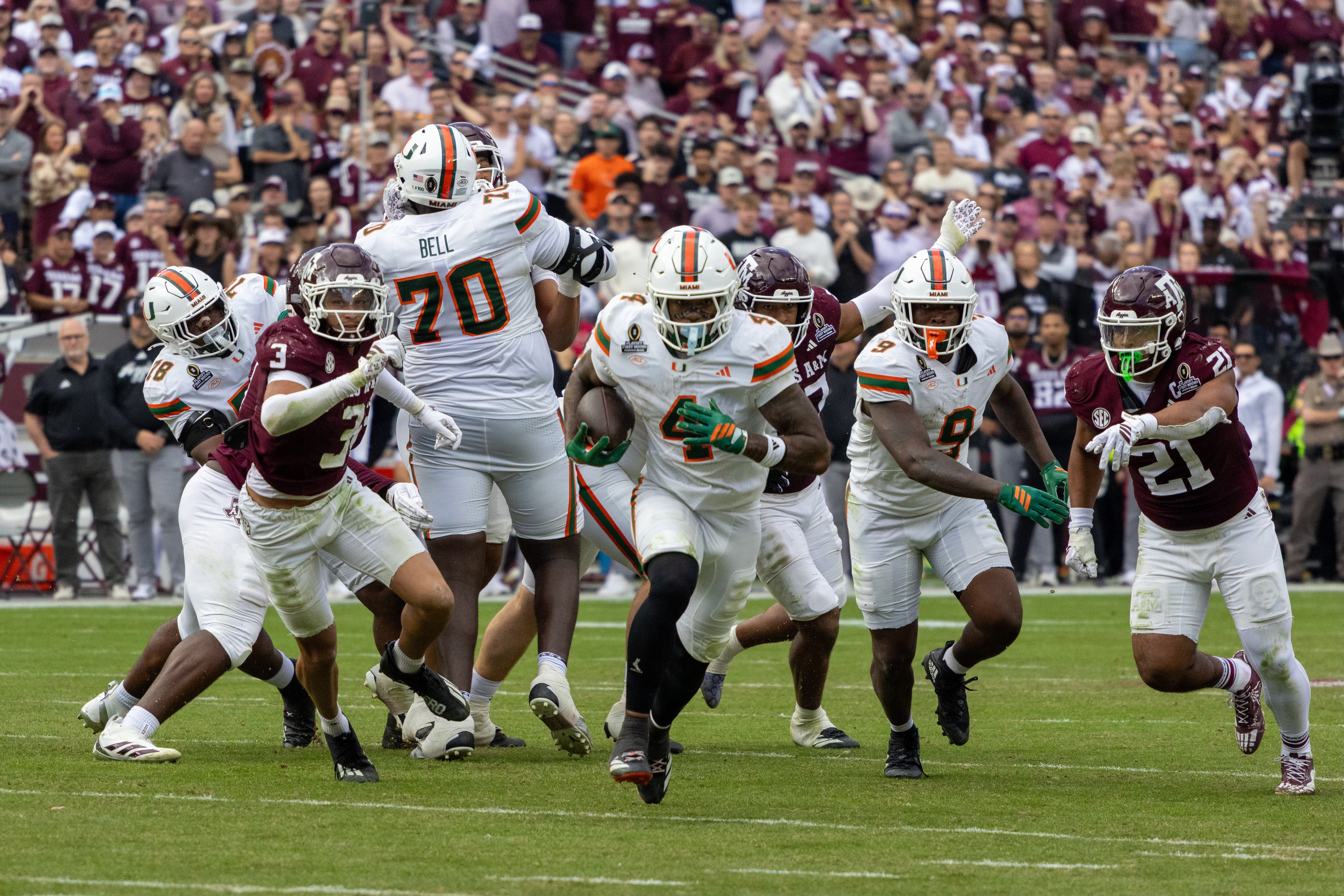
UM Junior Running back Mark Fletcher Jr. breaks through the Texas A&M defense on Dec. 20. // Jake Sperling.

Is a return to Divisions the solution?

It would seem creating divisions within the conferences should be closely considered. This would stoke more fierce rivalries among inter-division opponents, ensuring more even matchups and a clearer cut conference championship.

Looking to the past, all of the Power Four conferences had divisions but were eliminated across  the last decade — a division format made less sense with smaller membership.

In 2024, the Big 12 (with 16 members) had a four-way tie at the top of the conference between Arizona State, Iowa State, BYU, and Colorado, who all finished with a 7-2 record. By the end Arizona State and Iowa State faced off due to tiebreakers, but many thought that BYU was more deserving than Iowa State.

This season in the ACC (with 17 members), Virginia guaranteed their spot after a 7-1 conference record, but there was a 5-way tie for second place between Duke, Miami, Georgia Tech, SMU, and Pitt. As Miami fans well know, the unranked 7-5 Duke Blue Devils were awarded the second spot over a 10-2 Miami team ranked No. 12 in the country at the time.

Applying the Divisions to the ACC

When looking at the ACC, the conference has 17 members, which forces teams to play more or less games than one another. All of this would be solved if another team joined the conference.

But let’s concentrate on how the current structure of the ACC would address this issue. There would be three main things taken into consideration: rivalries, location, and talent. It might look something like this:

ACC North: Syracuse, BC, Pitt, Louisville, VT, Virginia, Clemson and Georgia Tech

ACC South: Miami, FSU, SMU, Cal, Stanford, Duke, UNC, NC State and Wake Forest

For the divisions, it would be fair to re-evaluate every five years whether the two divisions are evenly split. Currently the competition would be tight; each division would be well balanced. 

The proposed system would also allow scheduling and travel to be much simpler; every division team plays one another, the north would have 7 conference games while the south would have 8. At the end of the season, the two representatives from each division would face-off for the championship.

As some guidelines here are the five hypothetical tiebreaker rules: 

1 – Conference Record

Conference records always take importance over every guideline but would have more weight as every team faces each other.

2 – Head to Head

Due to everyone facing off this should solve for tiebreakers except for three (or more) way ties.

3 – Overall Record

In the case of Miami – Duke the tiebreaker was Win Percentage of Conference opponents. In the context of a 7-5 record, the overall record should have more weight.

4 – National Ranking (AP poll / CFP)

Ideally the conference championship should be settled by this point but if it goes this far National Ranking should be considered in ensuring that the best teams compete for the conference championship.

Will realignment fix everything?

Fans want more entertaining matches and teams want ease of scheduling and travel.

The answer is simple — either return to smaller conferences or implement divisions to make conferences matter.

In the end, no matter the solution, it won’t be perfect. Sports fanatics will always say that there will be a better format, but the least we can do is learn from past mistakes.
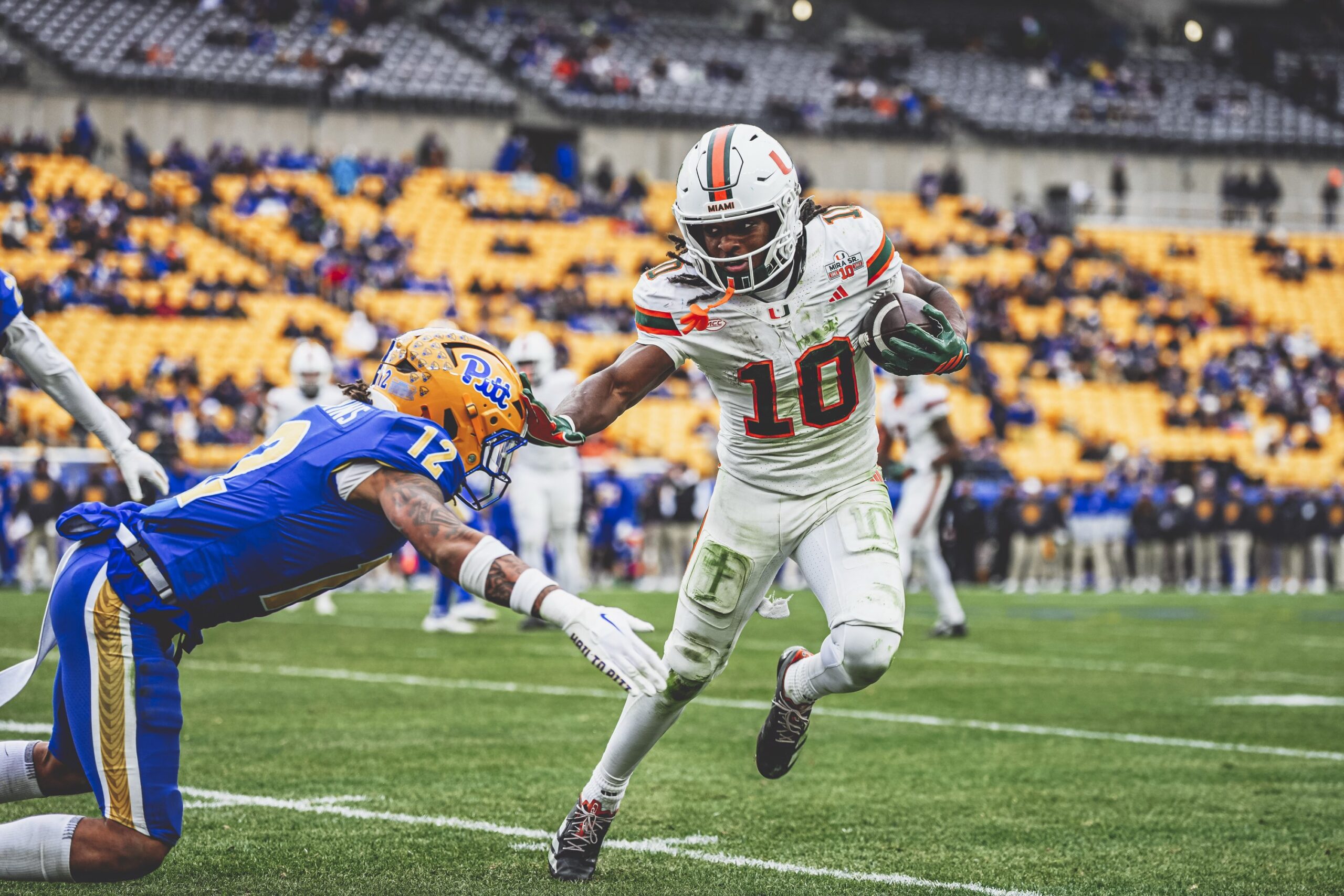
Photo Credit: @CanesFootball via X // Miami Hurricanes true freshman receiver Malachi Toney breaks a tackle against Pitt on Nov. 29, 2025.

Hurricanes running back Mark Fletcher Jr. will return to UM for his senior year

0

UM running back Mark Fletcher Jr. is set to remain a ’Cane for his senior year, deferring his NFL draft plans to 2027 following a career year in both rushing yards and touchdowns.

On Dec. 20 in the CFP opening round against Texas A&M, Fletcher had arguably his best collegiate performance with 172 rushing yards on over ten yards a carry, including a 56 yard gash that led to Miami’s game winning touchdown against the Aggies.

“I love this team. I love this organization. I love this culture. And I just want to spend more time with my brothers while I can,” said Fletcher on his return.

Despite productive seasons in his freshman and sophomore year at the U, the South Florida native was able to truly emerge in 2025 as Miami’s undisputed starting running back, accumulating over 850 yards on the ground and ten total touchdowns. 

Fletcher’s outstanding numbers come despite a midseason injury that sidelined him for two games in November.

The star running back is no stranger to adversity, suffering a Lisfranc injury in the 2023 Pinstripe Bowl against Rutgers and enduring the loss of his father a year later in 2024.

Despite these setbacks, Fletcher has always responded to his struggles with nothing but the highest level of professionalism and maturity. 

Just two days following the tragedy of his father’s death, Fletcher scored against UM rival Florida State and pointed to the sky on one knee in honor of his dad.

Fletcher’s resounding character was on display yet again against TAMU last week, comforting teammate Malachi Toney after the true freshman’s costly third quarter fumble.

“I saw his head going down and immediately had to go to him because in high school together, I remember he had a play just like that,” said Fletcher postgame.

Toney went on to score the only touchdown of the game on a short 11 yard reception from quarterback Carson Beck.

Regardless of whether it’s on or off the field, Fletcher has represented everything it means to be a Hurricane ever since his arrival as a freshman in 2023. Miami players, staff, and fans alike are undoubtedly excited to see their starting running back return for his senior season.

“[Fletcher] is the heart and soul of our football team,” said head coach Mario Cristobal.

UM Junior Running back Mark Fletcher Jr. breaks through the Texas A&M defense on Dec. 20. // Jake Sperling.

How one play shaped hatred for decades: Miami vs. Ohio State

0

The ’Canes and Buckeyes don’t have an extensive past, only going into their fifth matchup all time next week. So, how can there be so much hatred between two fanbases of teams that haven’t played each other in over a decade? 

The answer is a single flashpoint — one play that has lived in infamy for more than 20 years, causing fans of the Miami Hurricanes to have a deep hatred of the Ohio State Buckeyes since 2002. 

Miami was on top of the world during the 2002 season, heading to the 2003 Fiesta Bowl set to fight for their second straight title under head coach Larry Coker. Filled with stars like Willis McGahee, Andre Johnson and Sean Taylor, Miami was 12-0 heading into the championship game and in the middle of a 34-game win streak. 

The Buckeyes, 13-0 going into the game, were respected but had narrowly skated by teams throughout the season with six games won by a touchdown or less. Their lackluster offense was tasked with keeping up with a Miami offensive unit that averaged 40 points per game — not to mention the two Heisman candidates in McGahee and quarterback Ken Dorsey.

Pundits and analysts alike agreed how the Buckeyes seemed outmatched. Miami entered the Fiesta Bowl as 13 point favorites and it seemed like they were lined for an easy path to a repeat.

The game was anything but that for the ’Canes. 

Five UM turnovers including two interceptions from Dorsey led to Miami being down by 10 in the third quarter but Miami was able to claw back into the game. Right before the two minute warning, Roscoe Parrish weaved past defenders and sprinted down the sideline for a 50 yard punt return. This set up kicker Todd Sievers with a 40 yard field goal to tie the game 17-17 as time expired in regulation. 

A quick five-play touchdown drive for Miami put all the pressure on Ohio State to score a touchdown. The Hurricanes had a chance to put it away on a 4th-and-14 but a Craig Krenzel 17-yard conversion to Michael Jenkins gave the Buckeyes hope. 

But soon after, Ohio State faced another fourth down attempt. 

Krenzel looked to the endzone on a fade route to Chris Gamble and in tight coverage cornerback Glenn Sharpe knocked away the pass. Line judge Derrick Bowers signaled incomplete. The game was over. 

The Hurricanes had won their second straight national title, and Miami players rushed the field to celebrate.

But as they celebrated a yellow piece of cloth laid on the field and changed history. 

Seconds after the play was blown dead, Terry Porter, the back judge, threw a flag for pass interference on Sharpe. The championship that lay in Miami’s hands was snatched away and hung in the balance as Ohio State went on to tie up the game and take the lead in second overtime.

Miami’s offense tried desperately to answer back. The ’Canes got to the goal line but were then stuffed three straight plays before a Ken Dorsey pass attempt fell incomplete.

Confetti rained down for the Buckeyes and as Hurricanes football sat shocked — to this day the words “Bad call! Bad call!” from commentator Dan Fouts rings out to ’Canes fans.

It was the last time UM played in a national championship decider, and with the ’Canes sixth title ripped away from them, Hurricanes fans have had a burning hatred for the Buckeyes ever since. 

The teams have played twice since that day, splitting the series 1-1 with Miami taking home the last win in dominant fashion in 2011. Many forget this home-and-home matchup as for Miami fans, nothing will compare to the heartbreak of that infamous title game.

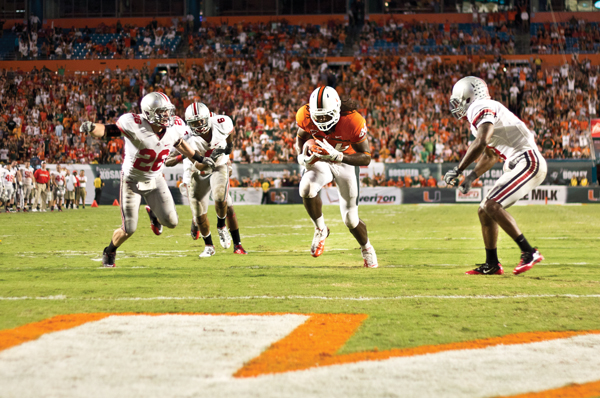
Freshman tight end, Clive Walford, evades Ohio State players to score a touchdown. // Photo credit: Zach Beeker.

Now, more than 20 years later, The Buckeyes are the team looking for the repeat while the Hurricanes are the gritty, defense-led underdog. With an opportunity to avenge the 2002 team, both sides are looking forward to the game rather than looking back to the past. 

“We’re focused on the present,” head coach Mario Cristobal said when asked about the 2002 team.

“This game is the 2025 Hurricanes and Buckeyes going after it, to be determined by the 22 guys on the field one snap at a time,” he said. “That’s going to be the focus. That’s where all our attention will be.”

At this point, players on both teams were too young — or in most cases not even born — to remember this game. But for Ohio State superstar receiver Jeremiah Smith, it’s a story he’s heard more than enough times growing up in South Florida. He’s well aware of the bad blood and he knows how much this means to the Miami faithful and is ready to break their hearts once more. 

“They’re still talking about that 20 years later. They still worry about it. But we’ve got something coming for them on New Year’s Eve,” Smith said. 

More than 20 years after “The Flag,” Miami has a chance to plant its own flag down in Dallas and make another statement this playoff. 

Whether it’s to avenge the past or make a claim for the future it all comes down to New Year’s Eve. Kickoff for the Cotton Bowl is 7:30 p.m. EST on Dec. 31.

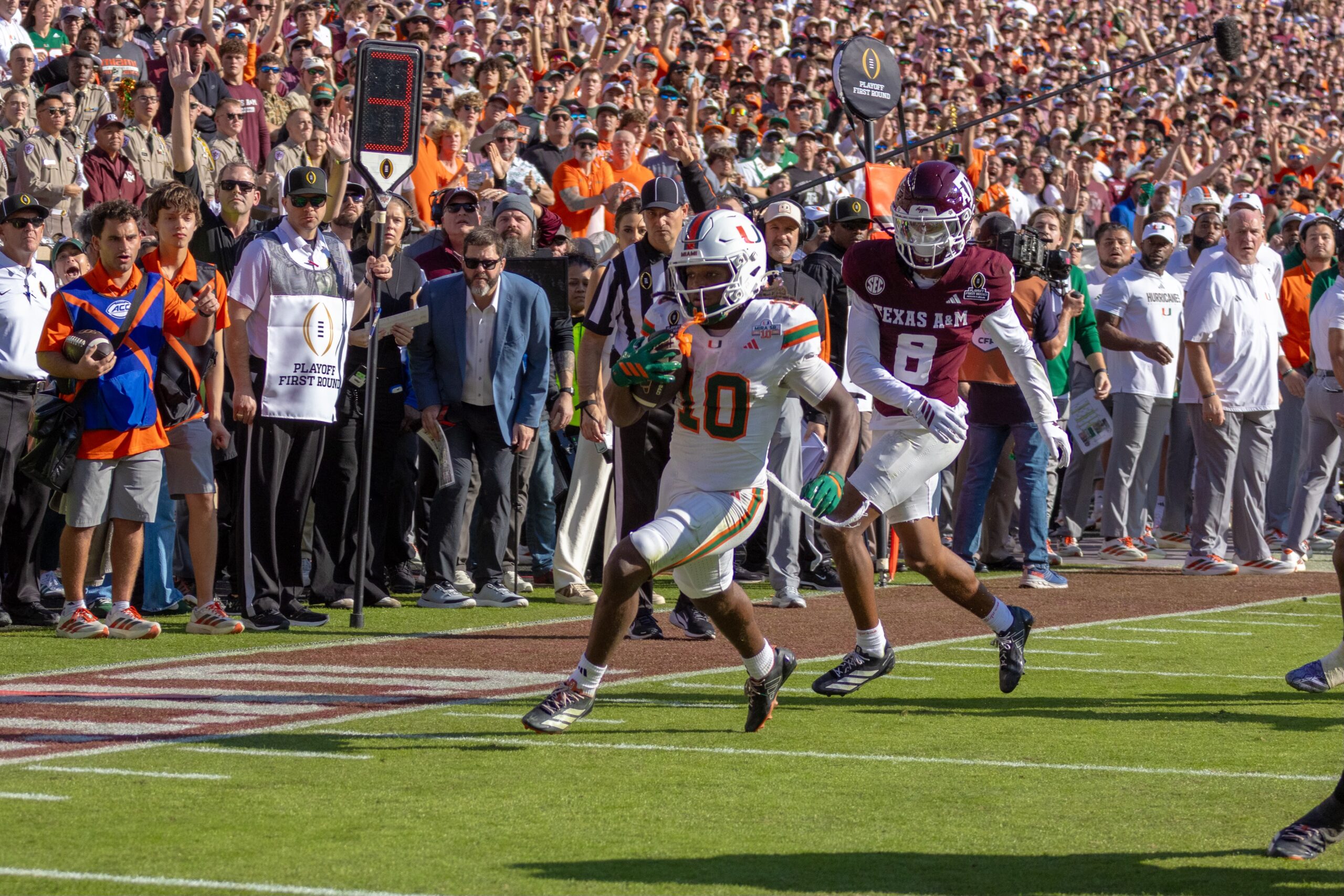
UM Freshman Malachi Toney rushes for the game winning touchdown versus Texas A&M on Dec. 20 // Jake Sperling.

Miami’s Historic Playoff Win + Ohio State Preview with Bucknuts Morning 5 Host Dan Rubin

Miami’s first-ever College Football Playoff win over Texas A&M landed them a spot in the Cotton Bowl. From the game-winning interception by Bryce Fitzgerald to the commanding downhill runs by Mark Fletcher Jr., Liam and Zach give their postgame analysis in the 10-3 win. The Hurricanes now shift their attention to Ohio State, as both programs have history following the 2003 Fiesta Bowl. Dan Rubin from the Bucknuts Morning Five podcast joins the show to preview the Cotton Bowl on December 31.

What Miami must improve heading into the Cotton Bowl

0

The Miami Hurricanes entrance to this year’s College Football Playoff caused a significant amount of controversy. Questions lingered over whether Miami deserved a spot after two losses to unranked opponents, or if Notre Dame had a stronger case and more deserving of a spot. 

Ultimately, the College Football Playoff Committee honored the ’Canes 24-21 win over the Irish in Week 1 as the ultimate tiebreaker, launching UM into the final at-large bid. 

On Saturday, Dec. 20, Miami was tasked with playing in one of the toughest environments in all of sports, Kyle Field, which has a capacity of more than 100,000 fans — UM was pitted against No. 7 Texas A&M, who came into the game with an 11-1 record. 

In a defensive slugfest which featured swirling 30 mph winds and a crowd mostly donning maroon and white, the Hurricanes silenced all the doubters, upsetting the Aggies in a 10-7 thriller, sending The U to the quarterfinals.

For the ’Canes to get their first ever CFP win in a hostile environment over a strong SEC opponent, it shows the committee certainly made the right decision, but Miami shouldn’t be celebrating just yet. UM has an even tougher task awaiting them in the Cotton Bowl — No. 2 Ohio State.

Here’s what the Hurricanes will need to improve on from the first CFP game if they want to notch an even bigger upset.

Kicking concerns

This one goes without saying. Kicker Carter Davis missed three field goals last week from 47, 40, and 35 yards out. Had he made all his kicks, the ’Canes wouldn’t have needed any late-game heroics. Instead, he went 1-for-4 and forced the Miami offense to score a late fourth quarter touchdown to take the lead.

Prior to his game against the Aggies, Davis had been very reliable, going 14-of-16 for field goals on the year. 

His sudden drop in reliability can be attributed to one main factor — the wind. Gusts reached up to 30 mph, and down at the bottom of the massive Kyle Field the swirling winds created unpredictability, which was evident on his first attempt.

At first, Davis’s first kick looked dead on, but then the wind got a hold of it, sending it wide right. His second attempt went wide right again, but it was nowhere close. Even with no wind, it would not have landed. 

His last miss occurred in the second half. After pushing his first two kicks to the right, Davis tried to correct his form but overdid it, pulling his kick to the left just a tad too much, bouncing it off the left upright. 

Luckily for Davis, the Cotton Bowl will be played in a dome at AT&T Stadium, where wind is a non-factor. But in a position where the mental game is so important, the Hurricanes will have to hope that Davis isn’t in his own head following a rough outing.

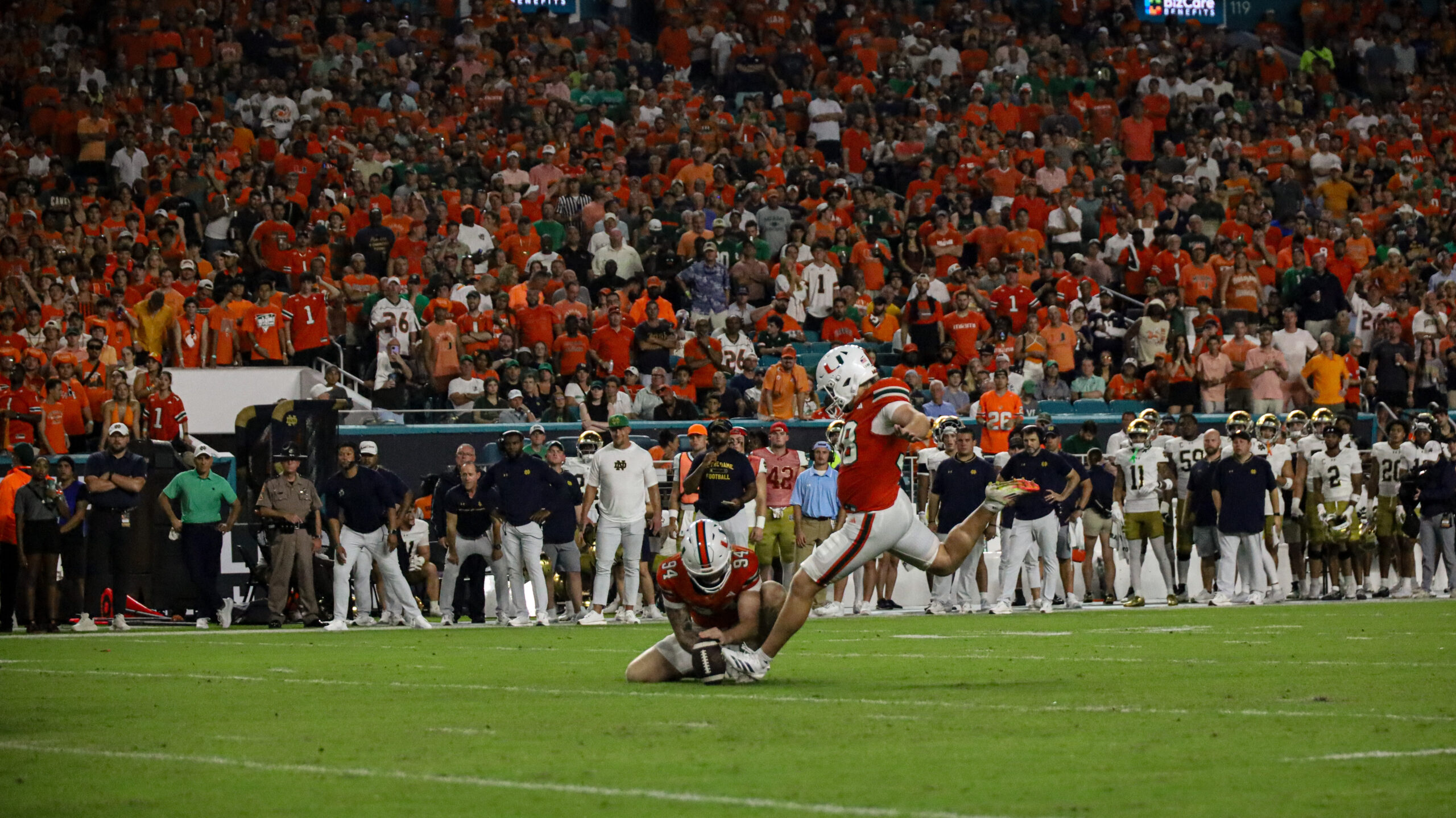
Makena Wong, Photo Editor, Redshirt Senior Place Kicker Carter Davis kicks the ball after Miami touchdown on Aug. 31st, 2025.

Red Zone offense

Miami is lucky its defense played as strong as it did last week, because the offense was not doing the team any favors. The offense was gifted strong starting field position multiple times thanks to a big punt return from Malachi Toney, fumble by TAMU quarterback Marcel Reed, and a big interception return by Bryce Fitzgerald. 

However, the Hurricanes scored on none of these possessions. 

Miami reached the red zone five times, and only managed 10 points. Against the Buckeyes, this won’t hold up. While the Hurricane defense looks like they can stop just about anyone in the country right now, Ohio State has arguably the best offense of all. 

Granted, Indiana proved one can beat the Buckeyes in a low-scoring game, but IU is the No.1 team in the country with the Heisman winner in Fernando Mendoza under center. 

While the blueprint is technically there to win a low-scoring affair, the Buckeyes will likely come out all guns blazing, meaning Heisman finalist quarterback Julian Sayin and star wideout Jeramiah Smith will be a headache to stop. 

The ’Canes can’t afford to leave points on the table next week if they want another upset.

Carson Beck has to step up

Carson Beck started the season off hot — he was a Heisman finalist and looked like the star he was back in 2023 when he won Georgia an SEC championship.

He didn’t look like that last week.

In Miami’s two losses this year, the blame has been mainly pinned on Beck. In those two games, he posted a combined two touchdowns to six interceptions, including picks on both potential game-winning drives. Since then he’s been better, but mostly just beating up on weaker competition.

Against Texas A&M, the game plan was evident: Take care of the football, don’t make any dumb turnovers, and let Toney and Mark Fletcher Jr. carry the load.

Beck did what was asked of him. He had no turnovers, made a few third-down conversions, and Fletcher and Toney ended up lifting the Hurricanes to a win. Fletcher ran for 172 yards on a ridiculous 10.1 yards per carry, while Toney was placed at WR, RB, and even QB, ultimately scoring the game winning touchdown on a tricky jet sweep.

Ohio State won’t let Fletcher get 10 yards per carry, with the Buckeyes gameplan is likely to be making Beck beat them with his arm. Beck has shown at times in his career he is capable of playing like a star, and he’s going to have to do it on the biggest stage against the Buckeyes.

If the defense keeps up its amazing play, and Beck is able to step up, don’t be surprised if the ’Canes surprise the nation again. 

The 90th Cotton Bowl Classic in Arlington, Texas will be played on Dec. 31 at 7:30 p.m. ET, and will air on ESPN.

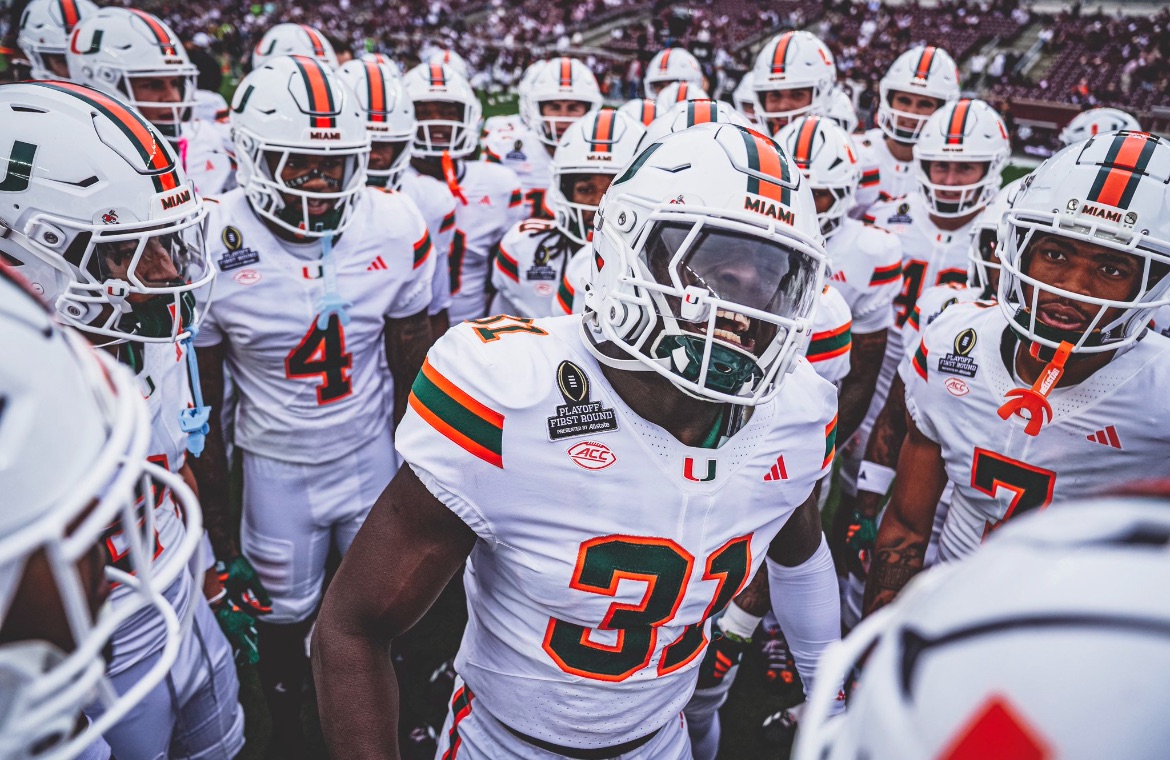
UM Senior Linebacker Wesley Bissainthe leads the huddle pregame before facing Texas A&M on Dec. 20. // @Canesfootball on X

’Canes show promise at Midseason as ACC tests loom

0

The University of Miami women’s basketball team has now reached the midpoint of its season ranked eighth in the ACC with an 8-4 overall record and 1-1 conference record. At the halfway mark of the 2025-26 season, the Hurricanes have established themselves as a consistent, well balanced team with a winning record and room to grow. 

Miami has opened the season stronger than in recent years, performing solidly at the Watsco Center and on the road. 

Averaging 73.9 points per game, and holding opponents to under 61.3 points allowed per game, the Hurricanes have shown their ability to compete away from Coral Gables. Being 1-1 in conference play, the ’Canes are demonstrating that they can secure ACC wins while still needing refinement against league opponents.

The Hurricanes began the season with strong offensive performances in non-conference and conference games, including wins over Florida Atlantic and Wake Forest. Against Florida Atlantic, Miami shot 54% from the field, and espite having a high number of turnovers the Hurricanes controlled the game and built a 42-23 lead. 

Miami followed that performance in a close 64-61 win over Wake Forest, an ACC opponent. 

Although the Hurricanes won by just three points, they shot 49% from the field, keeping the contest close through efficient scoring. 

These wins highlighted Miami’s offensive depth and ability to defend while scoring at a high rate. However, conference play has exposed areas that need improvement. 

Junior Guard Vittoria Blasigh shoots from three against FAU at Watsco on Thursday, Nov. 13, 2025 // Bella Ochoa – Staff Photographer

In an ACC loss to NC State, the Hurricanes struggled offensively, shooting 37% in the paint and 24% beyond the arc. Miami fell by 26 points, showing the difficulty keeping pace defensively and executing under pressure. The loss revealed areas that must improve as the conference schedule intensifies.

Miami’s identity through the first half of the season has been shaped by pace, ball movement, and shared scoring. The Hurricanes rely on transition offense, distribution and effort rather than a single dominant scorer. That approach has paid off in decisive wins, where Miami has executed efficiently across the lineup. 

Still, that collective approach can become challenging in tightly contested games when tempo slows and defense tightens. 

Much of Miami’s early-season progress reflects the development of a roster featuring several new transfers. Ra Shaya Kyle leads the team 15.7 points per game and 10 rebounds per game, while Gal Raviv contributes with 3.7 assists and 1.6 steals. Amarachi Kimpson who averages 10.9 points per game and is 86.2% from the line this season, has proven to be a contributor, adding to the scoring depth. Their production has helped Miami establish clearer roles and build chemistry.

Despite progress, turnovers and uneven shooting remain a concern. Miami averages 11.6 turnovers per game. In the loss to NC State, the Hurricanes committed 12 turnovers, and fluctuating shooting percentages highlight offensive inconsistency against stronger opponents.  

Those issues also present opportunities. 

With the second half of the season underway, Miami has time to sharpen fundamentals ahead of the tougher ACC matchups. By limiting turnovers and defensive execution, it will determine whether Miami’s early season momentum carries into the second half of the ACC play. 

The remainder of the schedule will test the Hurricanes, with games against Florida State, Louisville, Clemson and Virginia Tech. Improved rebounding, sustained defensive, and offensive efficiency will be critical as conference play intensifies. 

At the season’s midpoint, Miami is still defining who it is. The Hurricanes have shown they can compete in the ACC, but the second half of the season will determine whether early wins translate to sustained success.

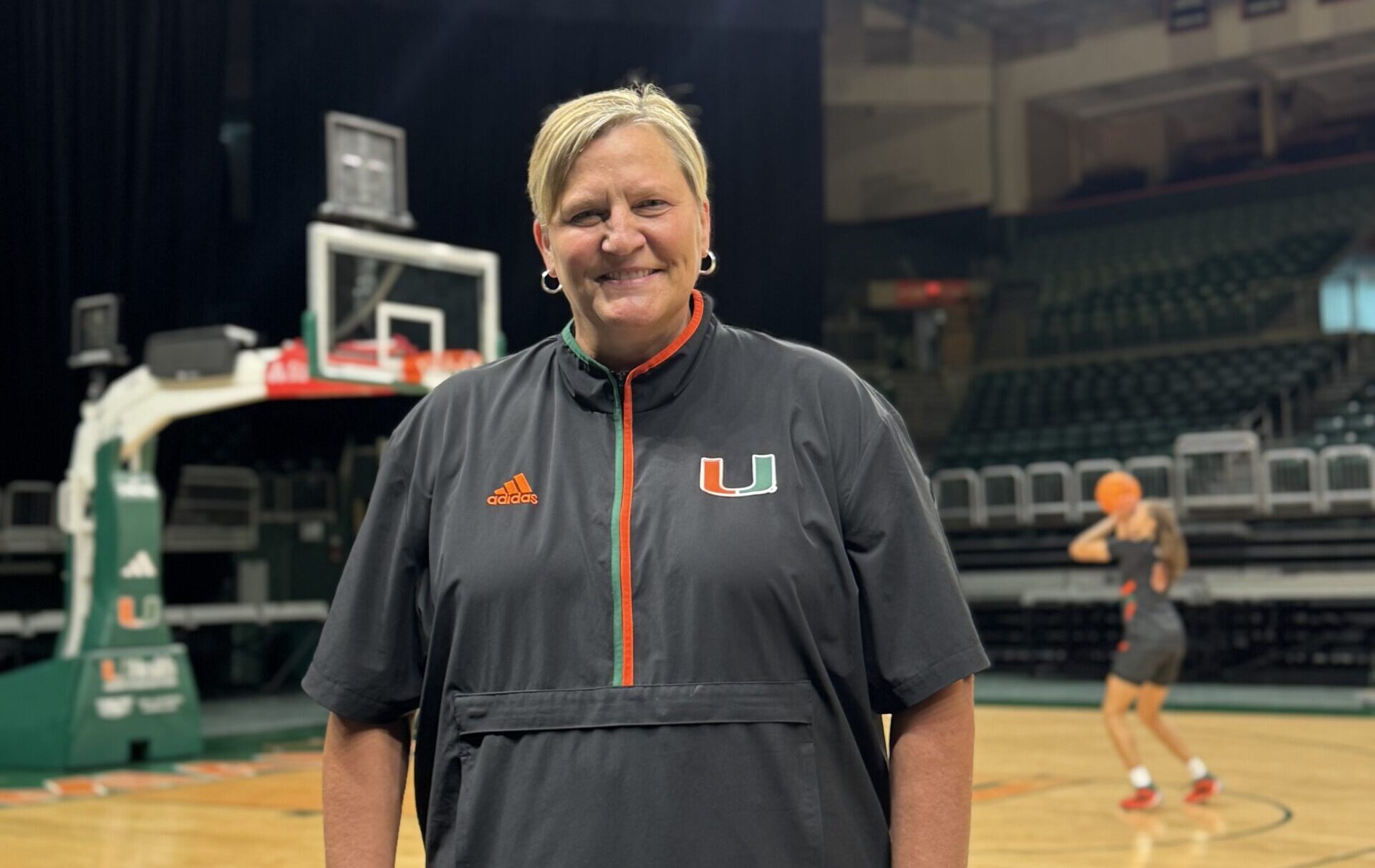
Photo credit: Olivia Attalla // Miami head coach Tricia Collup prepares for her second season at UM on Sept. 22, 2025.

Miami MBB blows out North Florida in 105-67 offensive explosion

0

Miami won its sixth consecutive contest to improve to 11-2 overall and 9-0 at home, dominating UNF on both sides of the floor to sink them to 2-10 this season.

The Hurricanes were led offensively by freshman forward Shelton Henderson, Florida native Tre Donaldson, and Indiana transfer Malik Reneau, all of whom eclipsed 19 points for the night on highly efficient shooting. 

Henderson and Reneau missed a combined three field goals while putting up 39 points as a duo, while three other Hurricanes reached double figures against the Ospreys on route to a season high 105 points for UM.

The first half between the two Florida squads was tightly contested until its latter stages, with UNF guard Kamirn Oriol hitting a three with five minutes to go in the period to narrow their deficit to just five.


However, sparked by a Henderson alley-oop dunk off of a Donaldson assist, the Hurricanes went on an impressive run to end the half to put themselves up 51-35.

Freshman Timotej Malovec capped off the Miami outburst with a 23 foot three point buzzer beater, putting an exclamation point on an imposing half from the ’Canes.

The Hurricanes carried their momentum into the second half, continuing their production on the offensive side of the ball while remaining stout defensively to earn an authoritative 105-67 victory.

Miami was prolific on the offensive end of the ball all game, eclipsing 50 points in both the first and second half while shooting well over 50 percent from the field.

On the defensive side, UM forced 20 turnovers while limiting the Ospreys to an underwhelming 38 percent from the floor overall, although they did make a respectable 11 out of 31 three point attempts largely in part to Oriol.

The UNF senior guard shot seven for ten from behind the arc and left the Hurricanes struggling for answers, finishing with a game high 29 points in 35 minutes played.

However, despite their inability to contain Oriol, Miami was able to lock down the rest of the North Florida attack with no other Osprey reaching double figures.

With this victory, Miami continues their ascension under new head coach Jai Lucas, and turns its attention to interconference hoops following a nine day break from gameplay.

 Miami will begin its ACC stretch at home against rival Pitt on Dec. 30 at the Watsco Center.

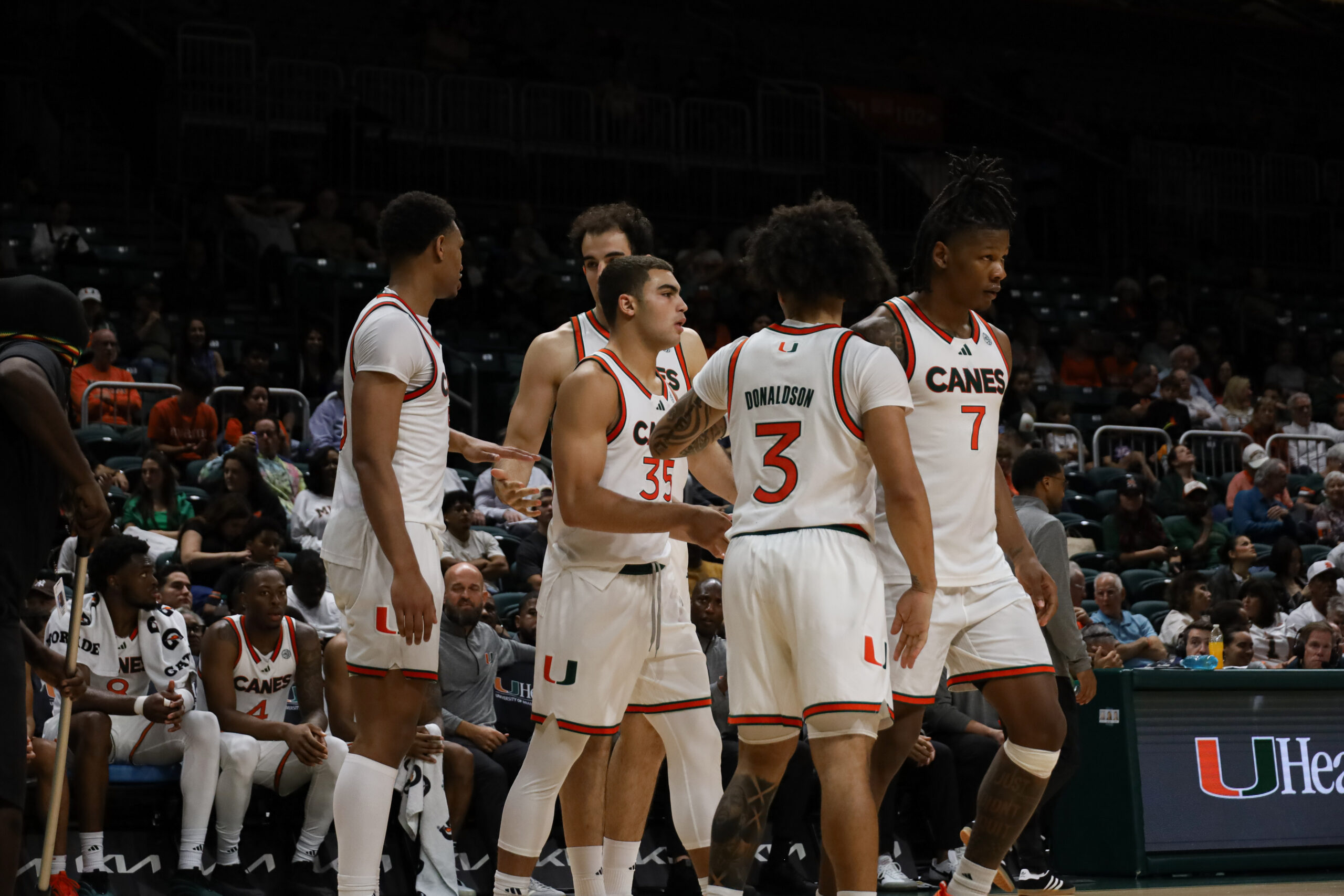
Photo Credit: Makena Wong, Photo Editor // Miami Hurricane basketball players talk following a time out against Jacksonville on Nov. 3, 2025 at the Watsco Center.

Second round of Cotton Bowl student tickets sold out within five minutes 

0

After the Hurricanes’ biggest win in more than two decades against Texas A&M in the first round of the College Football Playoff, UM fans’ excitement immediately shifted to the next round.

On Monday, Dec. 22 at noon EST, Miami Athletics issued a second batch of student tickets for the Cotton Bowl against No. 2 Ohio State. The tickets sold out within five minutes of going on sale.

When the CFP Committee announced that the Hurricanes were selected for the playoffs, UM issued an email to students asking what games they would like to be considered for. UM received 176 requests for tickets to the Cotton Bowl, all of which were fulfilled. 

After the ’Canes beat the Aggies and secured a spot in the quarterfinals, UM issued a second, limited batch of student tickets for the Cotton Bowl.  

Because the Cotton Bowl is at AT&T Stadium — home of the Dallas Cowboys and a neutral site — there are more student tickets available compared to the Texas A&M game which took place at Kyle Field, home of the Aggies. 

“For the Texas A&M game, we rewarded students who requested tickets and had attended at least seven of our eight 2025 home games. That resulted in approximately 40 student tickets distributed,” said the University in a statement to The Hurricane.

UM Junior Running back Mark Fletcher Jr. breaks through the Texas A&M defense on Dec. 20. // Jake Sperling.

As of Tuesday, Dec. 23, tickets on SeatGeek were selling for as low as $80 for standing-room-only admission.

The Cotton Bowl will take place on Dec. 31 at 7:30 p.m. EST as the ’Canes look to defeat Ohio State in their first postseason matchup since the infamous 2003 Fiesta Bowl.

Katie Karlson and Sebastian Font contributed to the reporting of this story.

ESPN GameDay thrills at UM vs. Texas A&M CFP game

0

ESPN’s College GameDay came to College Station, Texas ahead of Miami’s matchup against the Texas A&M Aggies. 

This was the second time Miami has had a GameDay appearance this season. The first was at UM against Florida. 

Former wide receiver and Heisman trophy winner Desmond Howard, as well as the former Alabama head coach Nick Saban both predicted Miami to win. On the contrary, former college football players Kirk Herbstreit and Pat McAfee, as well as former Aggies basketball player Alex Caruso predicted A&M to advance to the next round of the playoffs. 

Miami fans made the trip from around the country to come to the first round of the playoffs. 

Anabelle Rohman, a junior at UM, flew in from Chicago to attend GameDay and watch the ’Canes play. 

“I’ve made it to every home game this season, so I certainly can’t miss the playoffs,” she said. “Miami is on fire right now, and I’m all for it.”

Ashton Weissman, another junior at UM, shared his experience coming from California. 

“I’m from California, but I would fly anywhere to watch my ‘Canes play,” he said. “I’m running on a few hours of sleep and a dream of a national championship.” 

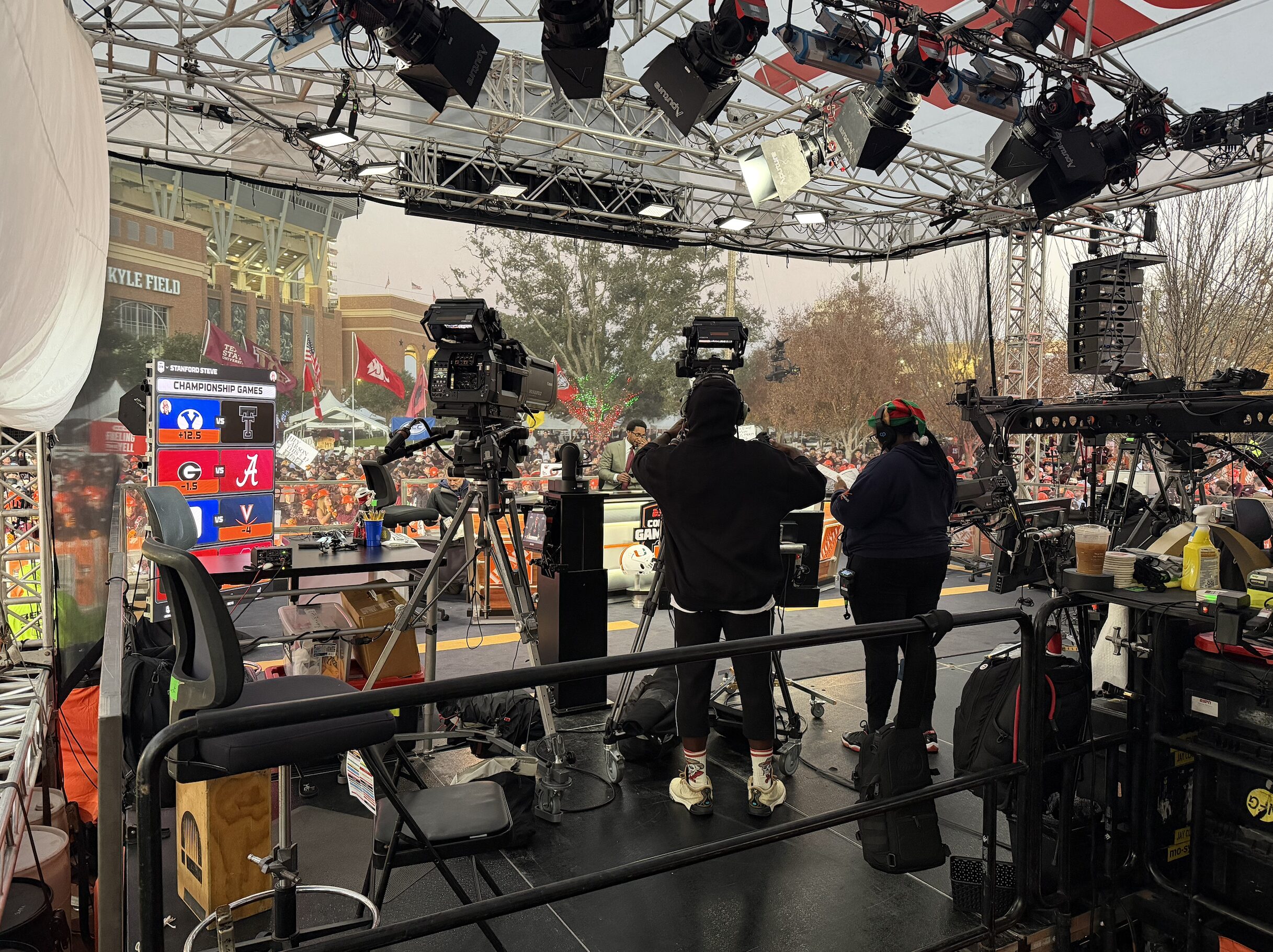
Behind the scenes at ESPN College GameDay at Texas A&M’s Kyle Field on the morning of Saturday, Dec. 20. // Photo Credit: Gianni Echeverria.

GameDay’s attendees attracted more than just students and alums. Robert and Marie Ramos, both Miami natives who did not attend UM, traveled to Kyle Field for GameDay. 

When asked why they came all the way to Texas, they said, “Because we love Mario Cristobal, we love our team, and we need to support them as much as possible.”

Most tickets to the game were available only on secondary markets, with the cheapest option on VividSeats coming in at just more than $400. For comparison, tickets to the JMU vs. Oregon game started at $145 on SeatGeek. 

Former Texas A&M quarterback and Heisman trophy winner Johnny Manziel was scheduled to be the special guest on the show, but was unable to attend due to illness, a representative for Manziel reported to the Daily Mail. 

Manziel apologized to the fans as well as the GameDay hosts for his absence via his social media. 

After a 10-3 victory, Miami advances to the next round of the College Football Playoffs, where they will face the number two seed Ohio State Buckeyes in the Cotton Bowl on New Year’s Eve. 

AGLO: The foundation of UM’s Greek life

UM’s recruitment season is not something you want to miss as a student. While many potential new members (PNMs) focus on which sorority will be their new home or what fraternity brothers they match best with, there is more to Greek Life than the week of recruitment. 

The Association of Greek Letter Organizations oversees all Greek Life councils and chapters on campus, collaborating with The Interfraternity Council, Multicultural Greek Council, National Pan-Hellenic Council and the Panhellenic Association. 

But AGLO is not some behind-the-scenes club that organizes recruitment events. In fact, AGLO is pretty hands-off when it comes to facilitating recruitment, serving as a support system for Greek leaders instead of directly setting up events. 

While AGLO does not lead the recruitment process, it functions as the highest level of Greek leadership bridging connections between each of the 33 chapters at the University of Miami. 

AGLO works day to day with Greek organizations to make Greek Life a rich and positive experience that promotes unity, communication and positive programming — which involves skill-building between members and workshopping ways to improve chapters. 

Involving positive programming within Greek Life contributes to shaping informed perspectives, offering prospective new members a clearer understanding of the community beyond common misconceptions and uncertainties.

AGLO advances its mission by promoting Greek Life through mixers such as Meet the Greeks, an event revived after being dormant since the pandemic hit in 2020. This past semester, AGLO joined Greek Life organizations to connect with students interested in getting involved in Greek Life. 

AGLO Chair Parker Osth knows the importance of Greek Life. As a senior studying architecture and member of Lambda Chi Alpha fraternity, Osth is excited to integrate Greek Life’s presence with student life at a time of rising recruitment numbers

“AGLO has been an underutilized resource for Greek Life,” Osth said. “It really has a unique position to make all people in Greek Life feel like they are part of the same thing.” 

As chair, Osth works with the presidents of all the councils and chapters through roundtable sessions. Osth and other leaders review how each chapter has grown and discuss how they can continue to succeed. 

While leaders represent their respective organization, Greek Life representation starts at AGLO according to Osth. If groups outside of UM want to interact with Greek Life, AGLO serves as the first organization to contact.  

The leaders of Greek Life all aim to represent the heart of any sorority and fraternity: philanthropy. AGLO is currently working to revamp Greek Week, an opportunity for organizations to come together and raise money for their charity service and philanthropy. 

By showcasing events such as Alpha Epsilon Pi’s Rockathon, Alpha Delta Pi’s Ronald McDonald House Charities and other signature Greek Life philanthropy initiatives, AGLO hopes it will draw a large crowd and on-campus support from students. 

“So many aspects of Greek Life are overplayed,” Osth said. “Philanthropy being one of them is good.” We should talk about how impactful [philanthropy] is.

With about 3,800 students participating in Greek life, AGLO plays a crucial role in uniting the Greek community and continuing to expand Greek life on campus.