


On this week’s news brief, Sophia talks about Spring Break complications due to global conflicts, the success of Rockathon and more campus updates.
Kristi Noem: The Secretary of Homeland Security who made us less secure

Kristi Noem’s recent termination as the U.S. Secretary of Homeland Security raises serious questions as to why she was ever trusted with the role in the first place and why she still has authority in our government.
Although Noem’s tenure will end on March 31, students at the University of Miami and universities across the country will continue to feel the lasting effects on their freedoms due to the unprecedented federal pressure she imposed on higher education.
For example, Noem demanded the records of all foreign students at Harvard University, and when Harvard refused, citing violations of the First and Fourth Amendments as well as statutes governing DHS, she terminated 2.7 million dollars in grants.
When institutions are forced to comply with dangerous demands or risk federal retaliation that could jeopardize their existence, students learn that speaking out comes at a cost too.
From 2024 to 2025, UM’s overall student free speech ranking dropped 41 points, and 51% of students reported self-censoring at least once or twice a month, according to FIRE’s 2026 College Free Speech Rankings study.
The University of Miami’s downward trend in student free speech rankings is consistent with that of most universities and is the inevitable result of leadership that has left campuses and their administrators terrified of undemocratic government overreach.
Beyond Noem’s direct impact on college students, the Department of Homeland Security is meant to serve as the nation’s first line of defense, confronting issues such as terrorism, cybercrime, immigration enforcement and disaster response.
Leading such an agency requires integrity, credibility and constitutional literacy — all of which Noem lacks. Appointing Noem as the U.S. Secretary of Homeland Security was a grossly negligent failure of judgment that endangered the lives of every American citizen.
However, Lazaro Chavez, the president of UM’s College Republicans, thinks that she did a “fine job serving at the pleasure of the president.”
“There were areas where she could’ve been a lot better when it came to immigration enforcement and how she communicated policy to the public, but overall she did a decent job,” he said.
Additionally, Chavez believes Oklahoma Senator Markwayne Mullin, whom President Trump has appointed to succeed Noem, will be more effective.
Fortunately for Senator Mullin, it would be difficult to do worse. Noem bears the responsibility for ICE leading with brutality, barbarity, and impunity during her tenure.
The use of unrecognizable masked agents, unmarked vans and secretive raids has fostered a culture of fear among immigrants residing in the U.S., where families face the persistent threat of random arrest or separation.
In the Florida Everglades, Alligator Alcatraz stood as the literal embodiment of the dehumanized, brutalized enforcement that Noem’s leadership kick-started.
Noem praised the cruel detention facility as “absolutely fantastic” and a potential model for other parts of the country. Numerous Trump administration officials boasted that the detention center was surrounded by alligators if detainees dared try to escape its inhumane conditions.
In Texas, eleven-year-old Jocelyn Rojo-Carranza killed herself after classmates reportedly taunted that her parents would be deported. Noem and her leadership initiated the normalization and acceptance of cruelty against immigrants, so much so that children knew how to exploit the permeating fear as a means to bully.
In Minnesota, while trying to protect an innocent woman who was shoved to the ground and pepper-sprayed by ICE agents, Alex Pretti, a nurse for the Department of Veterans Affairs, became another of the many victims of an agency permitted to disregard constitutional limits and employ excessive force.
While Pretti’s family mourned his murder, Noem publicly labeled him a “domestic terrorist.” In reality, Pretti was combating domestic terrorism, dying a hero as a result of 10 gunshot wounds. Members of Congress asked her to retract her statement or apologize to Pretti’s mother, which she refused to do.
By blatantly disregarding her agency’s duty to operate within the Constitution, Noem helped ensure the deaths of immigrants and Americans, perhaps because she does not understand the very document she is sworn to uphold.
Last May, Noem incorrectly defined habeas corpus, the fundamental right to challenge unlawful detention, as authorizing the president to remove anyone from the United States. This is deeply disturbing for someone who is responsible for overseeing federal detention, particularly when, as a result of her direction, citizens have been unlawfully arrested almost every day and often don’t get the due process the Constitution guarantees.
Exchanges such as this, where the factual basis of the policy in question was apparently unknown to the individual responsible for enforcing it, became an alarmingly routine aspect of her public testimony.
President Trump did not consider firing Noem until criticism from within his own party emerged, despite receiving repeated pleas that she was endangering American lives.
That reality illustrates something deeply disturbing about the state of leadership in Washington today: Protecting American lives and constitutional rights is an afterthought, sacrificed for political loyalty and agenda.
The president’s decision to fire Noem as secretary, followed by the creation of an absurd new position for her, couldn’t exemplify this sentiment any more.
UM students struggle to get back to campus amidst flight issues

As students returned to campus after spring break, many found that their flights were delayed or canceled.
The disruptions left students across the country stuck at airports for hours or even days — causing many students to miss lectures, club events and midterm exams.
In a non-scientific poll posted on The Miami Hurricane’s Instagram story, 87.5% of 16 responders said they experienced issues while traveling for spring break. Most respondents indicated the problems occurred while returning to Miami.
While delays can be common while flying, students were stuck at the airport for unusually long wait times. One anonymous survey responder said they had “17 [to] 18 hour delays.”
Freshman Agus Villalba was one of the students who had these delays. Her flights out of South Carolina were rescheduled across multiple days.
“I had a lot of issues on my flight from Charleston to Miami,” she said. “I was supposed to return on Sunday night, but my flight suddenly got canceled and it was moved to Monday night, then that flight was canceled as well and it was moved to Tuesday morning at 6 a.m., then that one was canceled as well and moved to Tuesday night.”
Villalba was not alone in her experience. Third-year Senior Elle Mannion told The Miami Hurricane about her delays out of Salt Lake City, Utah.
After Mannion’s original flight on March 15 got canceled due to the fact that “the crew [was] fatigued,” the airline covered for her hotel and offered $12 food vouchers, as Mannion had to wait until the next night. Unfortunately, more issues arose for her.
“When we checked our airline app, the flight had been canceled again, and no cause for the cancellation was clearly displayed. So not once, but twice, the exact same flight got canceled,” she said.
A majority of the problems were caused by the extreme weather throughout the U.S. The scattered storms in Florida and the massive snowstorm sweeping across the Midwest and East Coast caused over 4,763 cancellations nationally on Monday alone.
According to the Instagram survey, 64% of the students affected by flight issues indicated that weather was the main contributor to their delays.
However, weather was not the only reason for a spike in cancellations and delays.
The partial government shutdown, which started in February of this year, resulted in airport workers not receiving payments, including those at TSA. The shutdown, coupled with higher volumes of travelers due to college students traveling for spring break, caused busier airports with fewer workers, longer security lines and numerous delays.
The partial shutdown also led to excess planes in air traffic. Two of the poll responders said this resulted in “air traffic control limiting the planes allowed to come into Miami” when asked about the reason for their delays.
The mixture of weather, the government shutdown and large number of spring break travelers resulted in the issues that Villalba, Mannion and others faced.
These flight cancellations severely disrupted the plans of students on campus. Both Mannion and Villalba missed important events.
“In total, we were stuck in Salt Lake for about 36 hours. I missed 5 different classes and 2 shifts at my on-campus job,” Mannion said.
Villalba arrived in Miami at 1 a.m. Wednesday morning, meaning she was delayed in Charleston for a total of three days, missing two days of her classes.
Like a lot of students, Villalba was supposed to take a midterm when she got back to campus.
“I had to email all of my professors because obviously I was not able to attend class, and I was really nervous about it, especially since I had a Calculus midterm on Tuesday,” she explained.
Fortunately, her professors were understanding,“flexible and nice,” and her math professor allowed her to reschedule the midterm. Now, students who were delayed coming back from break have to catch up on everything they missed.
31-point fourth quarter powers Hurricanes past Georgia Southern in WBIT Opening Round

The Miami Hurricanes dismantled Georgia Southern 82-56 in the opening night of the Women’s Basketball Invitational Tournament.
UM made its return to postseason basketball after a two-season hiatus, meanwhile Georgia Southern made its fourth postseason appearance in school history
The first quarter started off great for the Canes, driving to the paint at will for consistent layup buckets. Georgia Southern fought to keep it close, but the Canes unleashed a 9-0 run to jump out to a 22-12 lead.
Amarachi Kimpson, Gal Raviv, and Ahnay Adams were taking over for UM as the home crowd roared at the Watsco Center.
Miami head coach Tricia Cullop was fired up, urging her team to break away from the Eagles as the second quarter began.
However, that push didn’t initially come to fruition as the Eagles closed the gap in the second quarter.
The Georgia Southern defense tightened up as the offense slowly chipped away at the Hurricane lead.
After Kimpson’s opening layup to extend the lead to 12, Georgia Southern closed the gap to two to end the half, 30-28.
Kimpson put up 19 points tonight, the Texas native has continued to shine this entire season as she sets new career highs.
Coming out of the half, Miami began to establish its offensive footing.
Adams started off with two free throws, and the Canes kept rolling from there.
The sophomore guard was a game changer, the only returning UM player on the team, using her experience the momentum going throughout the game.
The Canes closed the third quarter ahead by ten, before exploding in the final quarter.
With UM President Joe Echevarria cheering on the sideline, the Canes broke out a 19-7 run to begin the fourth quarter.
And despite Georgia Southern’s best attempts, the Eagles could not find an answer for Miami’s high-powered offense.
The Canes continued to extend the lead, closing the game 82–56.
Postgame, Cullop spoke about how impressed she was with the performance, especially with the roster turnover.
“I am so proud of this team,” Cullop said. “Anytime you get to the postseason, one thing I stress to them, every team is good now, like you can’t take a break and you gotta bring your best effort.”
After this win, the Canes will play on Sunday at the Watsco Center against three-seeded Wisconsin at 12 p.m.
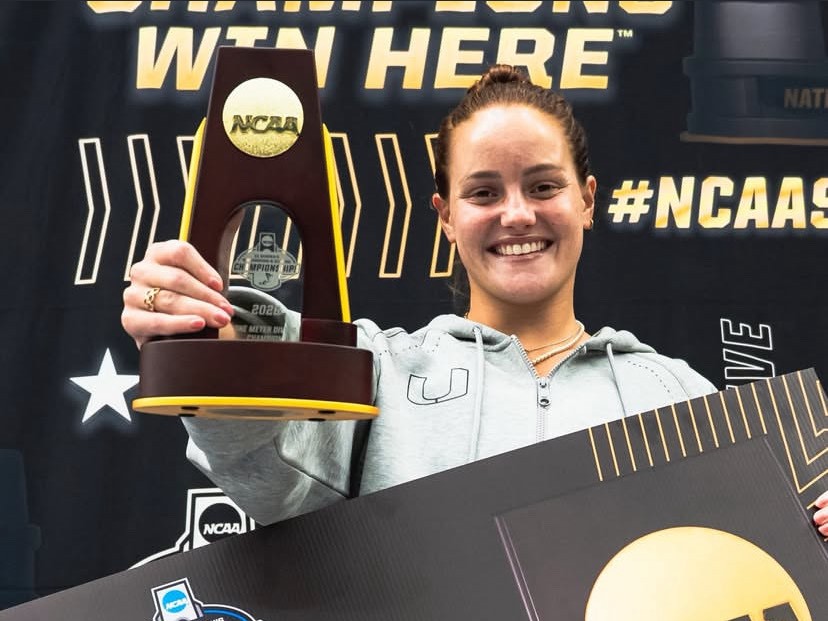
Chiara Pellacani makes history, defends NCAA national title for a second year in a row

History has a way of following Chiara Pellacani.
The two-time Olympian and 2025 NCAA 1-meter champion did it again, defending her national title in a performance that kept everyone at the McAuley Aquatic Center on the edge of their seats.
Every eye was fixed on Pellacani as the senior diver stepped to the edge of the 1-meter board for one of the final dives of her collegiate career.
One last moment to defend a national title — and leave her mark in Miami diving’s history.
Pellacani had been flawless all night.
Six dives, each scoring more than 52 points, a display of precision, control and nerves of steel. Her fifth dive — a reverse 1 ½ somersault with 1 ½ twists — had already stolen the show. But like most things, it all came down to this singular moment: the final rotation, the last splash.
When the scores flashed, the margin was impossibly tight: 345.70 to 345.45, Pellacani over Sophie Verzyl of South Carolina.
A quarter-point difference, a fraction, a heartbeat; the kind of finish that separates great athletes from the legends.
“It’s a little crazy, I also practice for this,” Pellacani said after her victory. “When I’m competing, I just try to enjoy it.”
“We compete against each other, but we’re all friends,” she continued. “It’s always so fun.”
Fun, yes — but every movement had been history in the making. And this win cements Pellacani’s legacy at Miami.
She’s the first diver since Brittany Viola (2008, 2011) to win multiple national titles, the first since Jenny Keim (1999, 2000) to claim back-to-back NCAA championships and the first to defend a title on the same board since Rio Ramirez, a three-time 1-meter champ who now coaches at UM.
“It’s my last year. It’s really important to me and the school,” she said. “[Miami] did a lot for me.”
She wasn’t the only star who shined in Atlanta. Margo O’Meara finished sixth with 311.80 total points, earning her third first-team All-American honor on the 1-meter, while Pellacani collected her second.
Among more than 50 competitors, they proved they belonged in the finals, both having dominated the preliminaries.
And the Hurricanes’ impact extended beyond the boards. Sophomore swimmer Ashlyn Massey clocked 52.07 in the 100-yard butterfly — her second straight NCAA Championships appearance — proving yet again that Miami’s depth of talent goes far beyond diving.
Thursday night wasn’t just a victory, it was a statement. Pellacani thrives under pressure, shines when history is watching and now leaves a legacy that will echo through Miami Hurricanes swimming and diving for years.
As the 2026 NCAA Championships continue Friday in Atlanta, one thing is clear: the Hurricanes are just getting started — and Pellacani’s name will be remembered long after the final splash.
FKA Twigs’ ‘Body High’ turned Factory Town into a living work of art

When FKA Twigs walked onto the Park Stage at Factory Town on March 14, it didn’t really feel like a normal concert was starting. It felt like she was opening up an entire world.
The Miami debut of her Body High tour — and the first show of the whole run — played out less like a setlist and more like one long, shifting performance piece, where the music, movement and visuals were constantly feeding off each other.
Few artists operate with the same level of multidisciplinary control as Twigs. With her “Body High Tour,” that ethos reaches its best form yet — an immersive staging of the ideas introduced on her latest projects “EUSEXUA” and “EUSEXUA Afterglow,” albums that explore intimacy, transformation and the transcendence of the dancefloor.
From the moment the show began, Twigs commanded every dimension of the stage with precision. Lighting shifts mirrored sonic transitions as dancers formed and dissolved into sculptural shapes. The performance operated as a living composition, constantly morphing in tone and texture.
Even if you wouldn’t call yourself a hardcore FKA Twigs fan, the scale of what she was doing was impossible to miss. The way she and the dancers moved together created these moments that almost felt architectural, like their bodies were building and reshaping the emotional tone of the show in real time.
At times, the performance felt ritualistic, at others cinematic but italways intentional. This was performance art operating within the framework of a live music show, blurring the boundaries between disciplines in real time.
The thematic core of the “Body High Tour”draws directly from “EUSEXUA,” a concept twigs has described as a state of heightened focus and emotional clarity — “the moment before an orgasm,” as she articulated in interviews surrounding the album’s release. In a live context, that idea translated into a tension between stillness and release.
Factory Town proved a fitting setting for such an ambitious production. The venue’s industrial openness allowed twigs’ worldbuilding to expand outward rather than remain contained, reinforcing its growing reputation as a space capable of hosting globally significant experimental performances.
Because Miami got the opening night of a tour meant to capture so much of her full artistic identity, Factory Town ended up feeling like more than just another stop on the schedule. For that night, it became part of the story the show was telling.
Throughout the performance, Twigs also stayed aware of what was happening in the crowd, stopping multiple times to make sure people were okay and had water. Those moments shifted the energy in a meaningful way and reinforced how much care and community are built into the experience she’s creating.
If Miami was any sign of what the “Body High Tour” will become, the show probably won’t be remembered for one single standout moment as much as the feeling it created from start to finish. At a time when live performances are so often about size and spectacle, twigs showed how powerful it can be to make something feel intimate even on a big stage. And for one night in Miami, she pulled that off completely.
Rawayana announces Miami date for their ‘¿Donde es el after? World Tour’

Rawayana’s biggest tour yet is coming to Miami, and the city feels like the perfect place for it to end.
The Venezuelan band has announced the second leg of its “¿Dónde Es El After? World Tour”, adding North American and European dates to an already expansive global run, with the tour now set to finish Saturday, Dec. 5 at Kaseya Center.
Tickets to the general public are already on sale as the group prepares to bring its most ambitious live production yet to one of Miami’s biggest stages.
The tour closing date landing in Miami feels especially significant. Rawayana has long stood as one of Venezuela’s most important contemporary acts, blending Caribbean rhythms with funk, reggae, soul, house and rock into a sound that feels playful, sun-soaked and unmistakably their own.
Their new album, “¿Dónde Es El After?,” a 23-track “sensory journey,” has already become the biggest debut of the band’s career, generating more than 80 million streams worldwide.
The album also debuted at No. 2 on Spotify’s Top Albums Debut Global chart and No. 1 on Spotify’s Top Album Debuts USA chart, while the single “Inglés en Miami” reached No. 8 on Spotify’s Top Songs Debut USA chart in its first week.
Miami has always made sense for Rawayana, but right now it feels even more fitting. The city’s Venezuelan influence runs deep across its neighborhoods, nightlife and cultural identity, and that energy feels especially charged after Venezuela captured its first-ever World Baseball Classic title in Miami.
In that context, a Rawayana tour closer in Miami does not just feel like another arena stop — it feels like a celebration with built-in momentum.
And because it is Miami, and because it is the final night of the tour, expectations should be high. Tour-closing shows already come with extra emotion, looseness and payoff.
In Miami, they also tend to come with the possibility of surprise guests, latin energy and the kind of crowd that turns a concert into a full event. For a band whose music already feels like the after, ending the run here practically guarantees a ball.
The 10 best Miami Music Week events besides Ultra and Factory Town

Ultra and Factory Town will dominate most Miami Music Week conversations for obvious reasons, but the week’s real fun is often found in the events around them.
From sunrise grooves and bass-heavy blowouts to intimate underground marathons and open-air house journeys, these 10 parties offer some of the best reasons to leave room in your schedule beyond the biggest names. Here are 10 standout Miami Music Week events worth circling now.
Breakaway Beach
Thursday, March 26 | 12 p.m. – 11 p.m. | The National Hotel
Breakaway Beach has quietly become one of Music Week’s strongest daytime plays, and its third annual return to the National Hotel looks especially tempting. This year’s lineup includes Bob Sinclar, Odd Mobb, Devault and more, but the big hook is a mystery back-to-back closing set by two mystery DJs.
With poolside production, a strong daytime crowd and the kind of curiosity-generating headliner gimmick that actually works, this feels like one of Thursday’s safest bets.
Sagamore Pool Party
If Miami Music Week has a natural habitat, it might just be a pool deck at the Sagamore. DJ Mag Sagamore South Beach residency once again turns the hotel into one of the week’s most reliable daytime anchors, with five straight days of poolside programming that balance house staples, underground names and veteran selectors.
From Cloonee, Sosa and Omar+ on opening day to a week of Defected, Knee Deep, a 50th-anniversary celebration and Glitterbox, Sagamore offers one of MMW’s strongest daytime runs. Sagamore is less one party than a full daytime ecosystem. If your ideal MMW stretch involves sun, house music and a daily reason to stay in South Beach, this one deserves a serious look.
Progressive House Never Died
Thursday, March 26 | 10 p.m. | Midline Miami
This one is pure passion pick territory, and that’s part of the appeal. Progressive house may not dominate the week the way it once did, but this lineup proves the genre still has life: Audien, Lucas & Steve b2b Mike Williams, Justin Mylo, TELYKAST and Sick Individuals all in one place.
For fans of soaring melodies, big emotional builds and that golden-era festival feeling, Midline could be hosting one of Thursday’s most satisfying sleepers.
DEADBEATS 10-Year Anniversary
Thursday, March 26 | 9 p.m. | Mana Wynwood
A 10-year anniversary is already a strong reason to show up, but Zeds Dead b2b Tape B is the kind of booking that can anchor an entire weeknight by itself. Add Peekaboo b2b Lyny, Boogie T b2b Distinct Motive, Kill Safari and more, and DEADBEATS turns into one of the week’s heaviest bass gatherings.
This is less a casual stop and more a full-send commitment for anyone who likes their Music Week loud, dark and overwhelming in the best way.
TOE JAM
March 26–29 | 8 p.m.–late | 150 NW 21st Street
TOE JAM feels like its own little festival tucked inside Miami Music Week. Running across multiple days, it offers the kind of flexibility a lot of pricier marquee events don’t.
It is also a strong value play: multiple nights, a more self-contained feel, and headliners like Chris Lake, DJ Snake, deadmau5 and Steve Angello. Produced by Phase 3, TOE JAM stands out as one of MMW’s more expansive and thoughtfully built experiences.
If you want variety without constantly venue-hopping, TOE JAM is worth the investment.
RAVE at 9AM
Saturday, March 28 | 9 a.m.–3 p.m. | Midline Miami
For anyone looking for a Saturday morning option that doesn’t involve the usual Space chaos, this might be the move. RAVE at 9AM leans into Latin, Afro and tech house, offers an open bar from 9 to 11 a.m., and sits right in the middle of Wynwood for easy access to the rest of the week’s madness.
Coming off a Friday night at Factory Town or elsewhere, this feels like the kind of reset that can easily become a highlight.
Get Cranked!
Saturday, March 28 | Mana Wynwood
Sometimes the name tells you everything you need to know. Get Cranked! is built around CRANKDAT and loaded with high-energy support, including Level Up b2b Kompany, Bella Renee b2b Kade Findley and more.
This is not the event for subtlety. It is for people who want to jump, sweat and lean all the way into the most hyperactive side of the week. If your Music Week needs a dose of pure chaos, this one should be on the shortlist.
Black Coffee at Racetrack
Saturday, March 28 | 8 p.m. | Hialeah Park Casino
Black Coffee at the Hialeah racetrack feels like one of those quintessential Miami Music Week bookings: elegant, expansive and built for an open-air setting. Joined by Carlita and Kaz James, the South African icon will bring his refined Afro-house and deep, soulful pacing to one of the city’s most distinctive venues.
The racetrack setting gives the night an added sense of scale, making this a strong option for anyone looking for something immersive rather than frenetic.
RESISTANCE at M2
March 25–29 | 10 p.m. | M2 Miami
Every year, RESISTANCE quietly puts together one of Music Week’s most consistently stacked runs, and 2026 is no different. Eric Prydz, Amelie Lens, Boys Noize, Boris Brejcha, Miss Monique, Maceo Plex and ¥ØU$UK€ ¥UK1MAT$U all appear across the five-night stretch, but the emotional anchor is Carl Cox closing Sunday’s official MMW party yet again.
For anyone who wants the underground muscle of Ultra’s techno side without actually being at Ultra, RESISTANCE remains one of the smartest plays of the week.
Solid Grooves
Friday, March 27 | 11 p.m. | Club Space
This is the kind of lineup that reads more like a mini-festival than a single party. ANOTR, Michael Bibi, PAWSA, Peggy Gou, Ben Sterling, Dennis Cruz, Chasewest and more all stacked onto the Space terrace is almost absurd on paper, and even stronger in practice.
If you are going to commit to one of the week’s marathon-style house sessions, this is the one that makes the most sense. It is crowded and absolutely loaded.
ColorStack builds its own community at UM

ColorStack, a national nonprofit dedicated to increasing the number of Black, Latinx and Indigenous students in technology-based majors, launched a chapter at the University of Miami this year.
UM offers over 300 registered student organizations, but only a small portion were technology-focused, until the arrival of ColorStack.
The nonprofit was founded in May 2020 by Jerrod Petty, a Cornell University computer science graduate, to support the maintenance and success of Black, Latinx and Indigenous students in technology and computing. As of this year, ColorStack has about 73 official university chapters across the United States, connecting thousands of students pursuing careers in technology.
At UM, since the club’s founding by Messiah Godfrey Majid, ColorStack has been connecting students both academically and personally. The club hosts events designed to provide a welcoming environment where students can meet peers with similar interests and goals.
“Many of our events are skill-building workshops where members can develop technical abilities and prepare for careers in tech,” said Majid. “We host social events and help students travel to conferences so they can connect with industry opportunities, internships, and jobs.”
Beyond academics, ColorStack offers a community where students can find support from peers who share similar backgrounds and experiences, fostering a sense of belonging on campus and in the tech world.
“Representation matters because if you don’t see yourself reflected in a field, it’s harder to imagine yourself succeeding in it,” said Majid. “What connects us is a shared drive to build something meaningful and support each other along the way.”
The club continues to grow at UM, showing that students of all backgrounds are seeking inclusive spaces in technology.
“Being part of ColorStack showed me that there are students across the country who are building skills together and supporting each other along the way,” said Majid. “It made the tech space feel a lot more accessible, and it gave me a lot more confidence that breaking into such a competitive field is actually possible.”
With events that combine academics, mentorship, and community, ColorStack at UM is helping more students of color enter the technology industry and create opportunities for themselves and future generations.
University of Miami Counseling Center provides 24 hour support to students with its crisis line

College gives new students many responsibilities and changes as they transition into a new stage in life. Each student’s experience and journey is unique, but struggling is not uncommon and many people go through the same problems.
UM’s Counseling Center wants to remind students they’re never alone.
The Counseling Center aims to help students through a variety of services, online, on campus, and offsite, to support students’ mental health and well-being. The Counseling Center is located on the third floor in Canes Central.
These services include brief psychological assessments, individual counseling, group counseling, psychiatric services, drop-in consultations, clinical care coordination, and crisis support.
The UMCC’s website also has self-help resources, including advice and information on specific topics relevant and related to mental health and WellTrack, an app that serves as a self-directed tool with structured sessions. The center’s work and impact is driven by a desire and determination to help students and cater to each student’s specific needs.
UMCC Executive Director Dr. Rene Monteagudo shared the Counseling Center’s goal is, “to make sure every University of Miami student knows that support is available whenever they need it — day or night — and that they do not have to navigate difficult moments alone.”
Before his career as a psychologist, UMCC Executive Director Dr. Rene Monteagudo was a telephone crisis counselor. This experience influenced his journey and “shaped my commitment to this work.”
“Being present with someone during a difficult moment and helping them see that there is hope — even when things feel overwhelming — can make a powerful impact,” Monteagudo added.
Since 2015, UMCC has had an after-hours crisis line, available 24 hours a day, 7 days a week. The counseling center is partnered with Protocall, an organization connected with many university counseling centers around the country.
This line connects individuals to an available trained counselor. Counselors are trained in many topics, such as, “ anxiety, depression, academic stress, relationship concerns, transitions, and thoughts of self-harm.”
The service is supervised by a licensed clinician, who is also on the line. Counselors have access to UMCC staff and UMPD contact, who they may reach out to when needed.
After the call, the information discussed is passed to the University’s Counseling Center. The Counseling Center then follows up with the student on next recommended steps.
If you are experiencing a crisis or in need of urgent help, call (305)284-5511, and select option 1 to be connected to a trained counselor.
Mental health is an important area of a person’s life, yet it often goes unnoticed. Since it isn’t visible, people may not prioritize attending to their mental health or know the mental health of others around them.
The Counseling Center and its after-hours crisis line is always there for ’Canes and happy to listen.
“Sometimes the most important step during a difficult moment is simply talking to someone who is trained to listen and help you think through what comes next,” Monteagudo said.