As the Miami skyline hums with late October heat, something special brews in Wynwood. The walls buzz with color, the lights stretch past midnight and for two days — October 17 and 18 — Miami becomes the center of sound.
This is III Points, and for University of Miami students, it’s more than just a festival. It’s a cultural rite of passage.
Every fall, thousands flood Mana Wynwood, weaving between art installations, glowing stages and a lineup that jumps from underground house to Latin experimental. This year, the roster feels especially global: Peggy Gou’s disco grooves, Denzel Curry’s Florida fury, and Sean Paul’s dancehall heat.
But look deeper, and you’ll find the Latin heartbeat that makes III Points feel like home. Acts like CA7RIEL & Paco Amoroso will bring Argentinian trap and funk to the 305. Puerto Rican trailblazer Villano Antillano fuses their explosive performances with perreo and rising Puerto Rican group Chuwi will bring tropical sets that turn the floor into a beachy dream.
For UM students making the trip from Coral Gables, the journey is part of the experience. The fastest route is usually Uber or Lyft, though surge pricing after midnight can sting — split fares with friends or pre-schedule your ride.
Those looking to save can take Metrorail from University Station to Government Center, then grab a Metrobus or short rideshare north into Wynwood. Parking is scarce, and roads around the venue close early, so think twice before driving.
Once you’re inside, the walls melt away. The air smells faintly of paint and street food. Between all the art and energy, remember to stay hydrated.
Miami nights stay humid, and hours of dancing can sneak up on you. Bring a reusable bottle to fill up at the free refill stations. Keep sipping, even when you’re not thirsty. Electrolyte drinks are a smart call, too, especially if you’re drinking.
Comfort beats fashion here. Breathable fits, sneakers and a small bag will take you far. Sunscreen early, poncho later — it’s Miami, after all.
Security is tight, and there’s no re-entry, so double-check your essentials before walking in: ID, phone, charger, wallet and water gear.
Still, the magic of III Points isn’t just in the planning. It’s in those moments you didn’t expect — catching a spontaneous DJ set under neon strobes, running into classmates by a mural or standing shoulder to shoulder with strangers in the crowd.
As the last beats fade and you spill into Wynwood’s painted streets, tired but buzzing, you’ll understand why so many call III Points a Miami tradition. It’s not just another weekend out, it’s the city’s creative soul on full display.
The No. 2 ranked Miami Hurricanes will face a tough test this week as the Louisville Cardinals come to town for a Friday night showdown. The Cardinals are 4-1 on the season and all year have received AP Poll votes, just narrowly staying around the outskirts of the top-25 and present a number of challenges that Miami will have to face.
Friday’s matchup will be a test for Miami’s secondary, most notably its cornerbacks, to slow down Miller Moss and receiver Chris Bell. Moss, Louisville’s transfer quarterback from USC, is a prototypical pocket passer with great touch, accuracy, and more than enough arm strength to make all the throws around the field.
His go-to guy, Chris Bell, has so far been a perfect complement to that style. Bell, at 6’2 220 pounds, is a phenomenal outside receiver with very strong hands, ball tracking skills, and a great combination of size and speed that also makes him great after the catch. Over the last two games, the two have put up big numbers against ACC competition, with Bell averaging 12 catches and 152 yards while posting three touchdowns. On the perimeter, it is going to be a big game for ‘Canes’ cornerbacks OJ Frederique and Xavier Lucas to keep the two from taking over the game.
So far this season, Miami has been able to handle the other team’s number one receiver. Chas Nimrod from South Florida is the only wide receiver to hit over 100 yards against the Hurricanes, and through three quarters, UM held Florida State’s Duce Robinson to just 34 yards, as well as forcing a fumble.
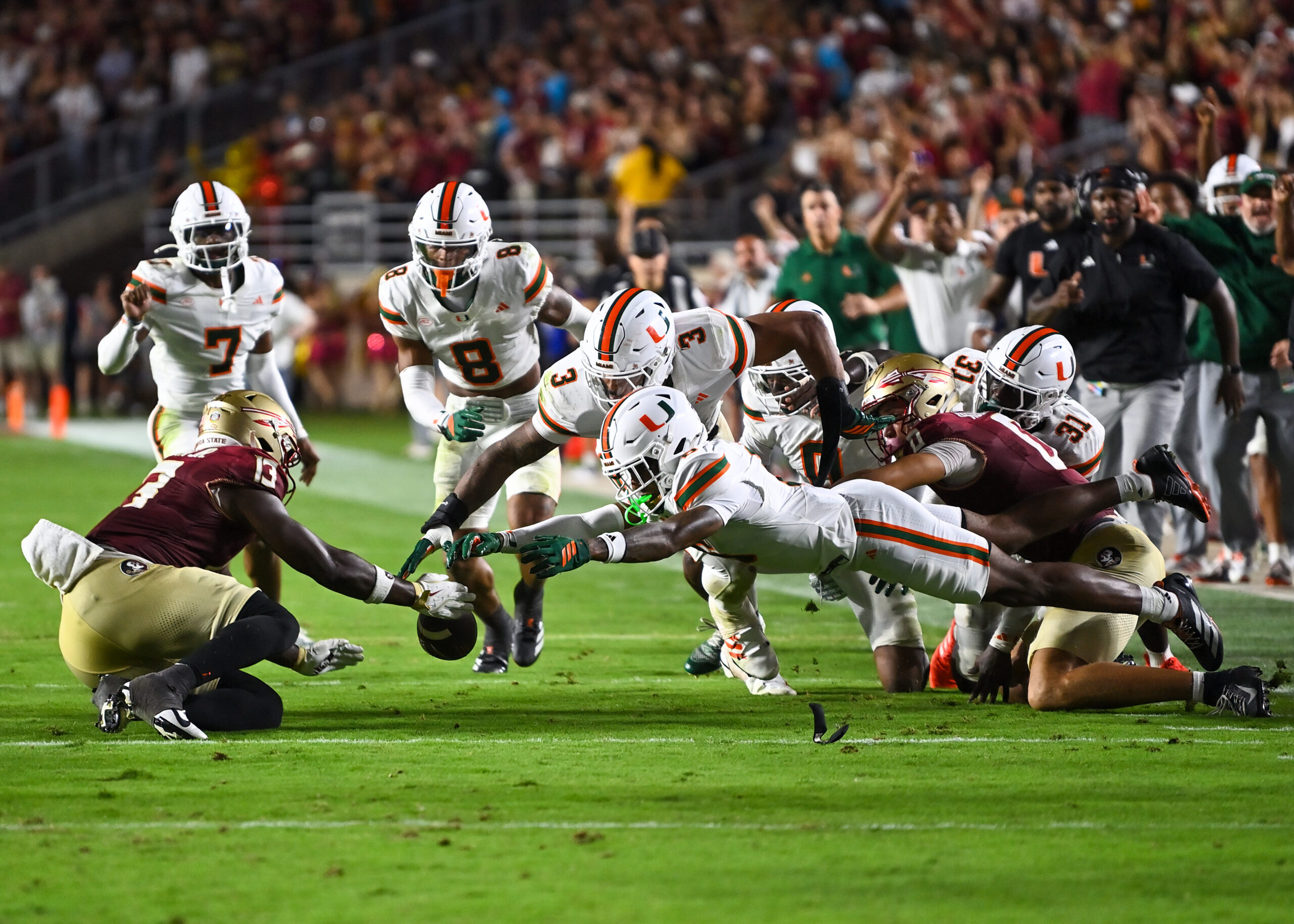
David Lebowitz, Staff Photographer – Multiple defenders dive toward a loose ball against FSU on October 4, 2025.
So far this season, the Hurricanes’ rotation of perimeter corners has done more than a fine job at limiting big plays and stifling the opposition’s best weapon. But Bell is going to be the best receiver they have played all year. That group now once again has to prove it’s up for the challenge.
Miami, as it have every week, will have to rely on its defensive line to wreck havoc. The Hurricanes have a Heisman candidate in Reuben Bain Jr. that could once again take over a game against a struggling Louisville offensive line. So far this season, the Cardinals offensive line has allowed 13 sacks on the year, including five sacks against Virginia. With Moss not being a mobile quarterback, Miami should be able to continue taking the pressure off its secondary by getting to the quarterback quickly.
UM can also take advantage of the gunslinger Moss in the turnover battle, as the UL quarterback sometimes struggles with being too careless with the ball. Since becoming the full-time starter at USC in 2024, Moss has thrown 14 interceptions in 13 games, and more often than not, the turnovers come from defensive pressures. Against UVA, Moss was almost tackled to the ground on a third-down pass. Instead of taking the sack and punting, Moss blindly launched the ball straight to a Cavalier defensive back who returned it for a touchdown.
Hurricanes defensive coordinator Corey Hetherman took advantage of this last year, when he called the defensive plays at Minnesota. In a game against Moss and USC, the Gopher defense brought home two interceptions and held the quarterback to 200 yards and one touchdown. With the Hurricanes’ ability to consistently generate pressure with only four defensive linemen, Moss could be in trouble and could make some mistakes as a result.
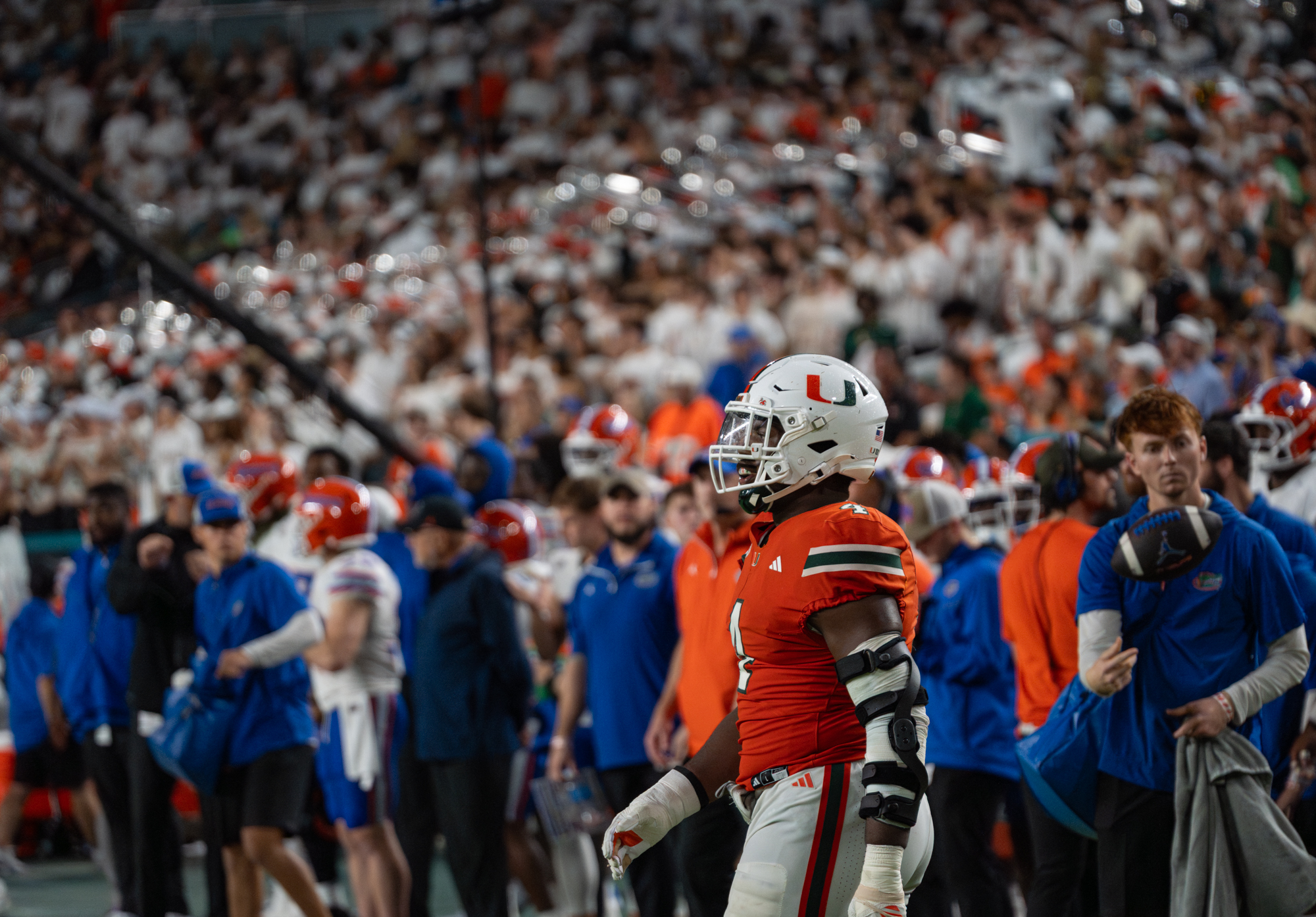
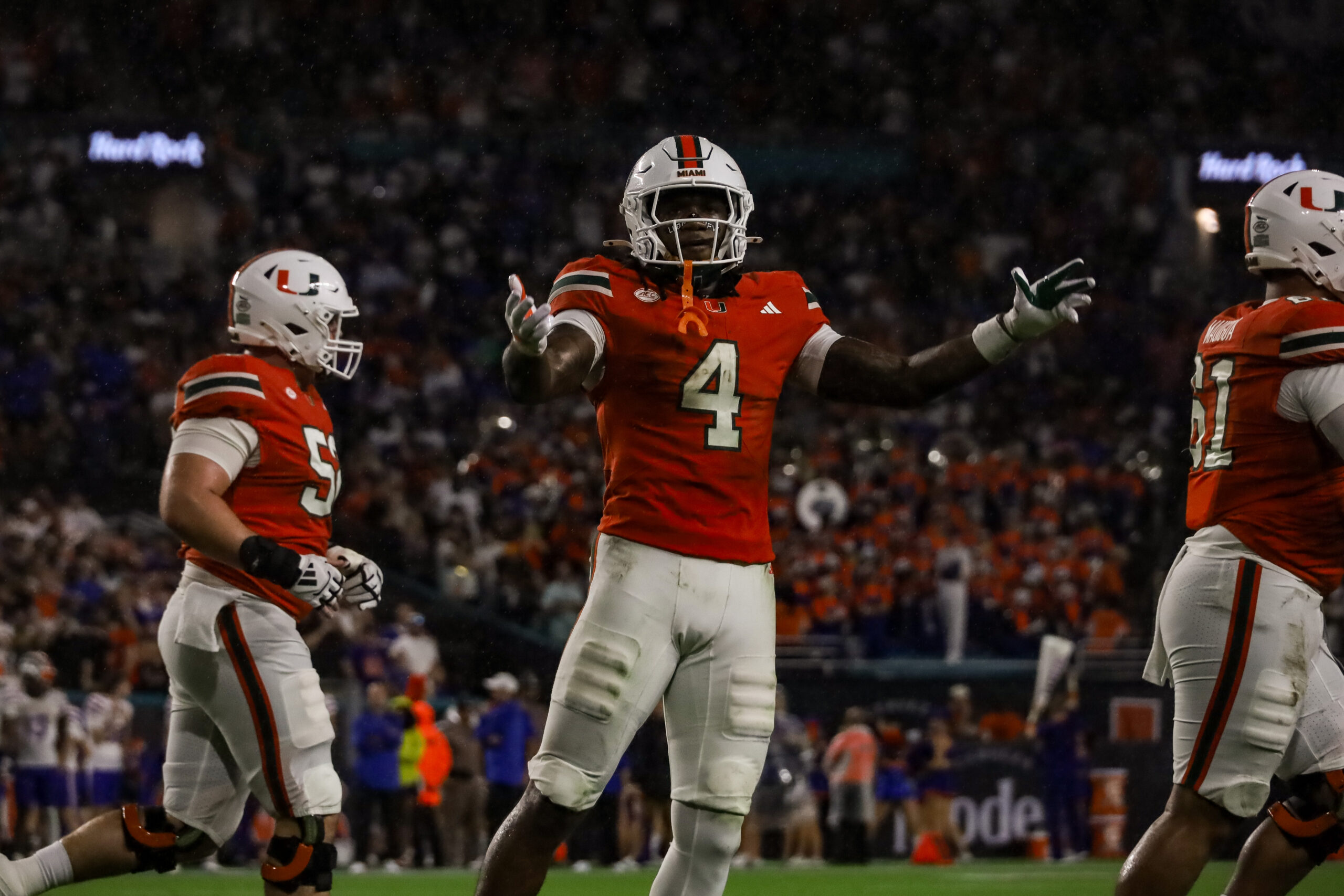
Assistant Photo Editor Brian Mulvey // Junior defensive lineman Rueben Bain Jr. (4) consistently found himself in the backfield versus the Florida Gators on Sept. 20, 2025
So far this season, Miami and Hetherman’s defense have been able to force turnovers consistently. Against FSU and Notre Dame, the Hurricanes defense combined for five total interceptions, making things tough on two solid offenses. True freshman Bryce Fitzgerald and fifth-year safety Jakobe Thomas have led the way in the UM secondary that has produced nine total turnovers on the year and have a chance to add to that against Louisville this weekend.
While the Cardinals do have a talented running back in Issac Brown, who burned UM on a 43-yard scamper last year, they haven’t shown much of a willingness to stick to the run. This season, Louisville sits 13th in the nation in pass attempts per game at 38.4, but over the last two games, the Cardinals threw the ball an average of 49.5 times against their two ACC opponents.
Miami, with a dominant front, has only allowed 2.82 yards per carry and might be able to force Louisville into a passing game if the ‘Canes break open the game early. Without the mobility that Tommy Castellanos brought last game for FSU, the electric edge duo of Bain and Akheem Mesidor should be able to make some trouble for Moss.
Miami’s ability to build the lead is going to rely on the offense continuing to stay hot. Last game, the Hurricanes’ offense was phenomenal through the air as Florida State sold out to prevent the run game from firing on all cylinders. The Seminoles were punished by quarterback Carson Beck airing the ball out to CJ Daniels and Malachi Toney for four total touchdowns and several explosive passing plays.
This week, it could be a return to the ground game for the Hurricanes, as the Cardinals have had an excellent passing defense, limiting opposing offenses to just 150 passing yards per game. On the ground, teams haven’t had much more success, as the Cardinals have allowed 3.28 yards per carry and 111 yards per game. In these last two games for Louisville, that has gone down to just 84 rushing yards per game.
Miami has to watch out for Clev Lubin on the edge, who has totaled four sacks and 24 total pressures. In the interior, defensive tackle Rene Tonga has played well, tallying 14 pressures and three tackles for loss. Louisville’s secondary has some solid pieces on that end as well, led by cornerback Jabari Mack and defensive back Antonio Watts, combining for three interceptions on the year.
UM will need a balanced attack to take down a Louisville team that overall has been solid on the defensive end. With no glaring holes, Miami can’t rely on one facet of offense, whether it be the passing game like they did against FSU or the run game like they did against Florida.
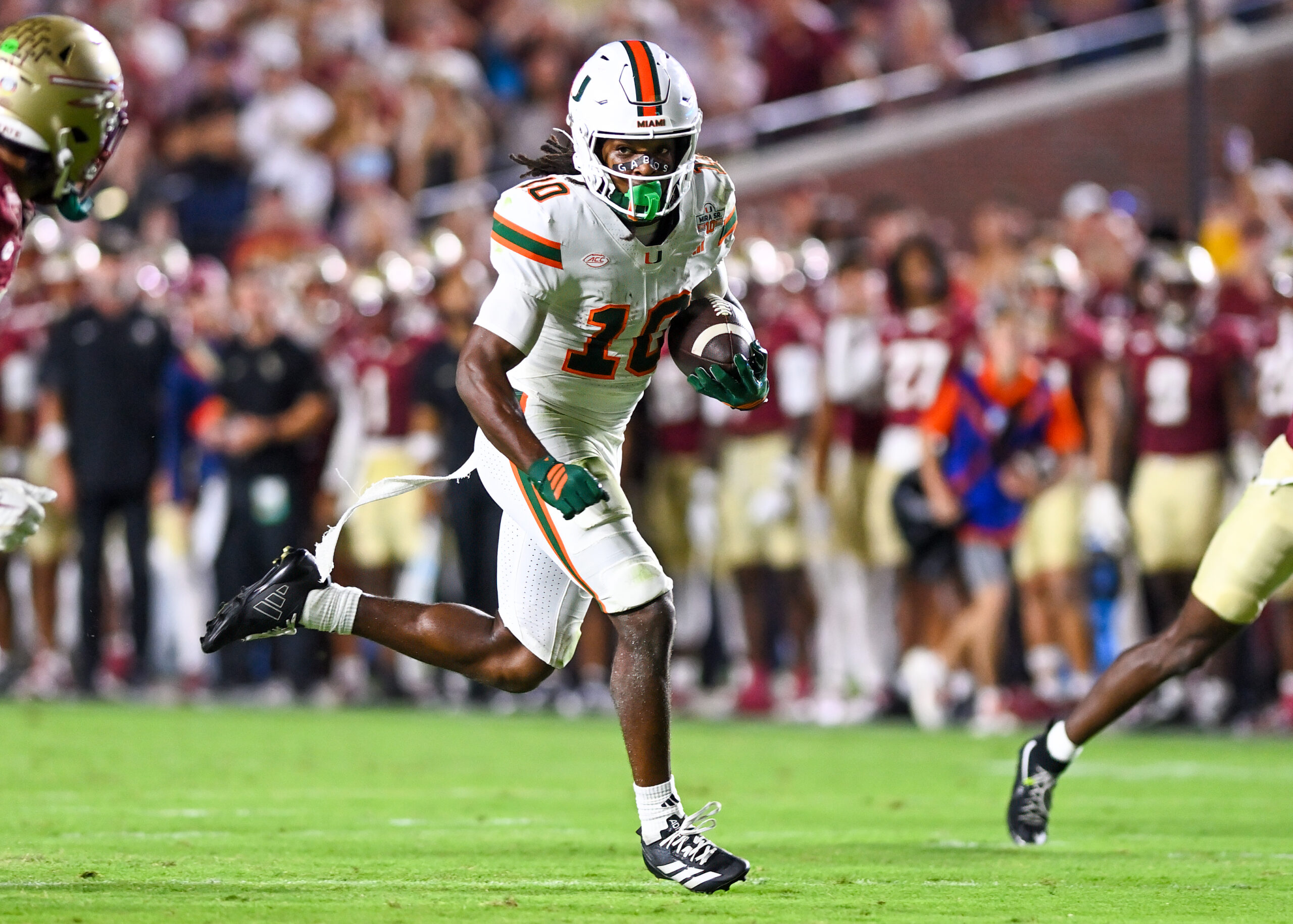
david Lebowitz, Staff Photographer – Freshman Wide Reciever Malachi Toney runs toward the end zone against FSU on October 4, 2025.
On offense, the Hurricanes should see some more Jordan Lyle. While he did play some snaps last week, Lyle, with another week of health, could be an x-factor to watch out for. Lyle’s speed and elusiveness allows for the Miami’s offense to add an outside run game that hasn’t been utilized fully.
The Hurricanes, as they have all season, will likely tailor the game plan to the flow of the game. Whether it’s a big passing day from Beck or a big game on the ground, what Miami does on Friday will be determined by what Louisville decides to stop. Regardless, the Hurricanes have one of the best offensive lines in the country, and have a group that is able to push teams around consistently. No matter what area the Cardinals try to stop, the Hurricanes offense should still be able to flourish.
More important than anything is the need to stomp out the Cardinals when the Hurricanes get the chance. Throughout this season, the ‘Canes have played with fire late in games, allowing teams to stick around despite Miami’s dominant play. Games against Notre Dame and Florida State have shown the offense or defense sputtering for large portions of a game and allowing teams to come back.
Louisville has shown resilience in multiple games this year, facing deficits and making comebacks against JMU, Pittsburgh, and Virginia. The Hurricanes will look to their game against USF, where the ‘Canes put away the Bulls and wouldn’t let them come back at any point. The Cardinals are a pass-heavy team that can make explosive plays happen fast. Miami needs to stay on its toes and prevent this game from once looking like a blowout, then turning into a shootout that goes down to the wire.
The Hurricanes and Cardinals will play for the ‘Schnellenberger Trophy’ on Friday Oct. 17 in Miami Gardens, Fla. Kickoff at Hard Rock Stadium is set for 7 p.m. on ESPN.
The Miami Seaquarium has welcomed visitors for the last time, Sunday, Oct. 12. The decision follows years of federal scrutiny, reports of animal cruelty and public outrage after the death of resident orca Lolitain 2023.
Regulators and animal rights groups repeatedly cited the Seaquarium for poor water quality, unsafe enclosures and neglect of aging marine mammals. The U.S. Department of Agriculture’s inspection reports documented injuries, deaths and violations of the Animal Welfare Act, which led Miami-Dade County to reconsider the facility’s future on Virginia Key.
According to court records, the Seaquarium’s parent company, Leisure Investments Holdings LLC (The Dolphin Company) filed for Chapter 11 bankruptcy in March. A later motion sought to transfer the Seaquarium’s county lease to Miami developer Terra for $22.5 million. Terra outlined a redevelopment plan that includes an aquarium and research center, green public spaces, a public baywalk, retail spaces, restaurants and preservation of the Buckminster Fuller “Dome” as an event venue.
Under Miami-Dade’s Home Rule Charter, the property is restricted to public park purposes, meaning any redevelopment must preserve public access and cannot include private housing. County officials have previously signaled support for a reimagined, non-marine-mammal attraction with public access along the bay, according to the Miami Herald.
In a press release shared with The Miami Hurricane, representing developer David Martin, the Seaquarium’s parent company described the agreement as part of a “responsible plan” to modernize the property and ensure the safe relocation of animals. The statement emphasized that the deal remains contingent on both court and county approval.
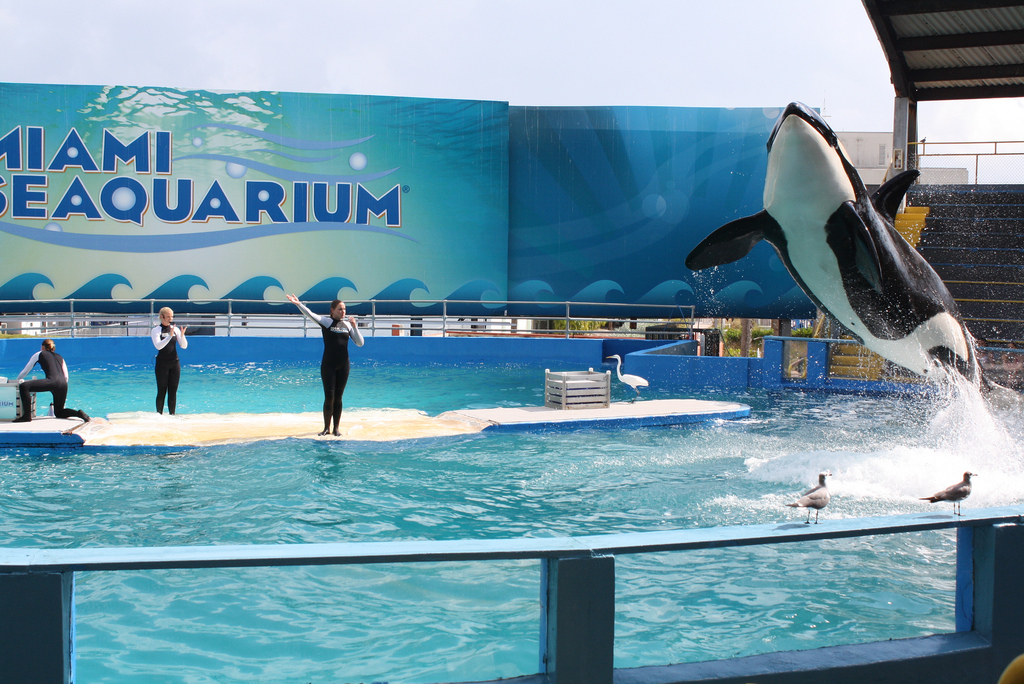
Lolita the Orca performing at the Miami Seaquarium on January 19, 2011. At the time of her death, she was the second-oldest orca in captivity. // Photo credit: Wikimedia commons
PETA, an animal rights group, released a statement shortly after the announcement of the facility’s closure.
“Champagne corks are popping at PETA, following the news that the Miami Seaquarium is finally having to shut its doors after more than 50 long years of imprisoning sick and suffering animals in crumbling concrete tanks, denying them veterinary care, and forcing them to perform tricks,” PETA said in a statement.
Officials have not confirmed exactly where the animals will go or how long the park will remain closed. The company says it has begun developing a Park Transition and Animal Relocation Plan, hiring International Animal Exchange Inc. to coordinate the safe transfer of animals and notifying regulators of its plans.
In this exclusive debate for Catch Up Canes, two University of Miami students discuss whether vaccine mandates should be in place, following the state of Florida’s announcement to drop its vaccine mandates.
Miami volleyball’s impressive 15-game winning streak came to an end on Sunday, as the No. 18 Hurricanes fell 3-1 to No. 10 SMU.
Miami had been on a historic run, sweeping its first four ACC opponents and reverse-sweeping the No. 4 Pittsburgh Panthers last week. But, that grueling test against Pitt seemed to have taken the wind out of the Hurricanes, as SMU were able to take the game by the reigns from the first set to the last.
The ‘Canes kept up with the Mustangs to start the first set, having led 5-4 after the first nine points. Yet, from this point on, SMU controlled the opening set with relative comfortability, eventually winning it 25-12.
The second set saw Miami come back into the game with a sense of renewed energy and fight. Miami was consistently one point behind SMU, but never let the set slip away, repeatedly finding ways to stay in contention. Ultimately, at the 20-20 mark, the ‘Canes dug in deeper than the Mustangs and battled towards a 25-21 set victory, tying the match at one set each.
Miami initially carried this momentum into the third set, taking the first four points consecutively. However, an eight-point streak from the Mustangs saw the scores flipped to 4-8, a lead that SMU refused to drop, as Mustangs took the set 25-14.
A pattern had emerged by the final set, as despite a strong opening by the Hurricanes, their impetus did not persist. SMU clawed themselves back into the set, showing the same edge that they had displayed throughout the contest, winning the set 25-21, and the match, 3-1.
Although any loss is a disappointing one, Miami’s historic run had to end at some point, and given SMU’s higher ranking, the Mustangs were not a lousy opponent by any means.
Senior Flormarie Heredia Cólon continued her solid form, with the outside hitter leading the team with 19 kills. Meanwhile, setter Ariana Rodriguez again displayed her playmaking proficiency, achieving 25 assists this game.
The ‘Canes remain tied for third in the ACC with No. 6 Stanford and No. 4 Pitt, all of whom are 5-1 in conference play.
The Hurricanes will now seek to bounce back against the California Golden Bears, who are on a four-game losing streak. Miami will go back on the road for this fixture in Berkeley, which will take place on Thursday, Oct. 16. First serve is set for 10 p.m. ET.
Coming off the other side of Miami’s final bye week, the first half of the 2025 campaign is officially in the rear view as the Hurricanes get set to gear up for seven nonstop weeks of ACC conference play. Now at the halfway point of the college football regular season, it’s time to dish out the midseason report card for each UM position group.
Standing at 5-0 heading into Friday night’s contest against Louisville, Miami’s start thus far has been an overwhelming success. In less than two months, the Hurricanes have re-established national powerhouse status, ascending to No. 2 on the AP Poll and conquering the state of Florida amid one of the toughest schedules in the country through seven weeks. Statement wins against Notre Dame, USF, Florida, and FSU have echoed nationwide among the college football landscape and catapulted Miami to being legitimate title contenders.
From elite offensive playmaking by the likes of Carson Beck and the legion of skill players at his disposal to the game-wrecking defensive front headlined by Reuben Bain Jr. that has terrorized opponents at the line of scrimmage, standout performances on both sides of the ball have been the sparkplug of the team’s undefeated run.
Let’s take a deeper look into the driving forces behind Miami’s dominance by assessing the various position groups before the Hurricanes enter the final half of the season.
Quarterback: A
Beck arrived at Coral Gables in January under lofty expectations and doubts from critics who failed to see the full picture of his time at Georgia. Within ten months, the sixth-year signal caller has silenced every naysayer, reversing the narrative and asserting himself as the Heisman favorite seven weeks into the season. As the trigger man behind offensive coordinator Shannon Dawson’s high-powered offense, Beck has already exhibited the traits of an NFL-caliber quarterback.
The marquee 2025 transfer currently ranks in the top 10 for completion percentage and grades as one of the best QBs in the country when in a clean pocket. But beyond the statistics, it’s the intangible qualities he possesses that have vaulted him into the spotlight. Beck’s overall leadership, poise, and competitiveness have been the backbone of Miami’s success, proving to be the decisive factors during the Hurricanes’ most crucial moments.
As the season progresses, the Jacksonville native will only continue to improve as he gets more comfortable utilizing his weapons within Dawson’s tailored offensive schemes.
David Lebowitz, Contributing Photographer/ Sixth-Year Redshirt Senior Carson Beck Surveys the defense againt USF on Saturday, September 13.
Wide Receiver: A-
What was once a position of uncertainty heading into the fall has become one of the team’s greatest strengths. Miami’s new wide receivers have arguably exceeded expectations more than any other offensive group.
Commanded by the two-headed monster of sixth-year LSU transfer CJ Daniels and true freshman phenom Malachi Toney, the receiving corps has flourished in season-defining matchups against Notre Dame and Florida State, with the pair of wideouts developing into one of the most formidable duos in the nation.
Toney has emerged as Carson Beck’s favorite downfield target, leading the group with 29 receptions for 375 receiving yards and three touchdowns, while Daniels isn’t far behind, amassing 269 yards from 23 catches and a team-high five scores. BYU transfer Keelan Marion and freshman standout Joshua Moore have also been making waves, and highly-touted pass-catcher Joshisa Trader will hopefully be unleashed in UM’s arsenal soon after suffering an injury in the season opener.
Aside from seeing little involvement in the game script against Florida, Miami’s wide receiver group has been elite when called upon.
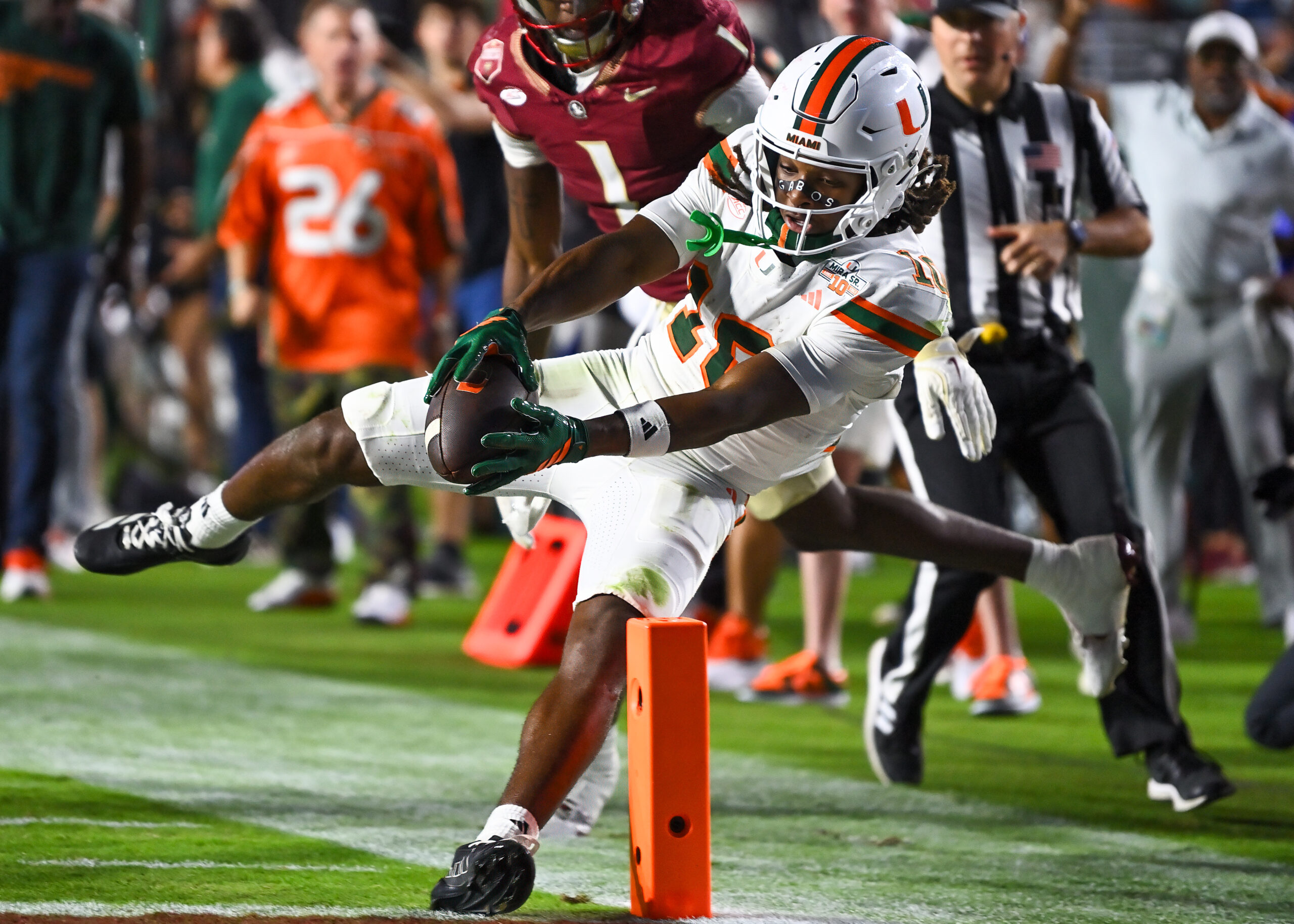
David Lebowitz, Staff Photographer – Freshman Wide Reciever Malachi Toney reaches the ball over the goal line before stepping out of bounds against FSU on October 4, 2025.
Running Back: A-
A remarkable aspect of the Canes’ refurbished offense this year has been that when one skill group has sputtered, the other has picked up the slack.
This was seen most visibly against Florida, when Mark Fletcher Jr. and North Dakota State transfer Marty Brown combined for 196 yards on the ground and three rushing touchdowns when the passing game wasn’t moving the needle. Negating the Florida State contest as the only slight blemish, Fletcher Jr. and Brown have been stellar for Miami, taking over the backfield and moving the chains to alleviate pressure from Carson Beck having to play hero ball.
By establishing the run, they have added to a balanced attack that works in tandem with the receiving unit to beat teams in a multitude of ways. Fletcher Jr. has cemented himself as the feature back, accounting for 5.5 yards per carry on 428 total yards, while Brown has carved out a role at the goal line, seeing his bulk of touches come in the red zone en route to four touchdowns.
Jordan Lyle, who entered the year atop the running back depth chart before sustaining an injury in week one, will also look to provide an impact as he slowly ramps up his snap share.
Makena Wong, Photo Editor, Junior running back Mark Fletcher Jr. celebrates after play on Saturday, Sep. 20, 2025.
Tight End: B-
The tight end unit has drawn mixed but generally lukewarm reviews up to this point. While the group has paid dividends in the blocking game, their lack of receiving production has stood out as a concern.
Elija Lofton, viewed as the successor to UM’s Elijah Arroyo who was taken in the second round of the NFL draft last year, has only generated 100 yards on 11 receptions. The lack of involvement in the passing game has been due to an unfavorable play design, not a lack of talent.
Between Lofton, Alex Bauman, and Brock Schott, this room has untapped potential that could be highly effective in short-yardage situations if their usage is increased. On the flip side, they have been strong contributors in run blocking and pass protection, opening the doors for explosive plays where the receivers and running backs have excelled.
Offensive Line: A
Loaded with depth and immense talent, Miami’s front five has been the foundation of the entire team. Some have even made the case that this group is the best in the country at the position, bar none.
Anchored by standouts Markel Bell, Anez Cooper and superstar Francis Mauigoa, the offensive line has smothered opponents at the line of scrimmage, allowing Carson Beck ample time to work his magic in the pocket. Against Florida State, the QB was pressured only six times in 30 dropbacks, amounting to a meager 20% pressure rate, which was astonishingly the highest rate they had conceded all season.
Head coach Mario Cristobal and offensive line coach Alex Mirabal’s reputation for constructing elite units in the trenches has been exemplified through the Hurricanes’ impregnable brick wall up front, who have set the tone for UM to move the ball at will offensively.
Defensive Line: A+ (Valedictorian)
Through five games, Miami’s defensive line has shown why they are unequivocally the best in the country — just watch the film.
Physically domineering and mentally relentless, this front seven behind the ball has suffocated all players in their path, and no team has found an answer to stopping them so far. Leading their reign of terror is the combo of Akheem Mesidor and Bain, two of the best edge rushers in college football who rank among the top three in the nation in pressure rate.
Mesidor leads the team with 3.5 sacks, while Bain has become the best-graded football player in the country. Already racking up multiple defensive player of the week awards, the edge rusher’s performances have lifted him to the No. 1 spot on many NFL 2026 mock draft boards.
With the competition expected to ease up over the next seven weeks for the ‘Canes, expect Bain and the defensive line to continue brutalizing opposing offensive lines in unimaginable ways.
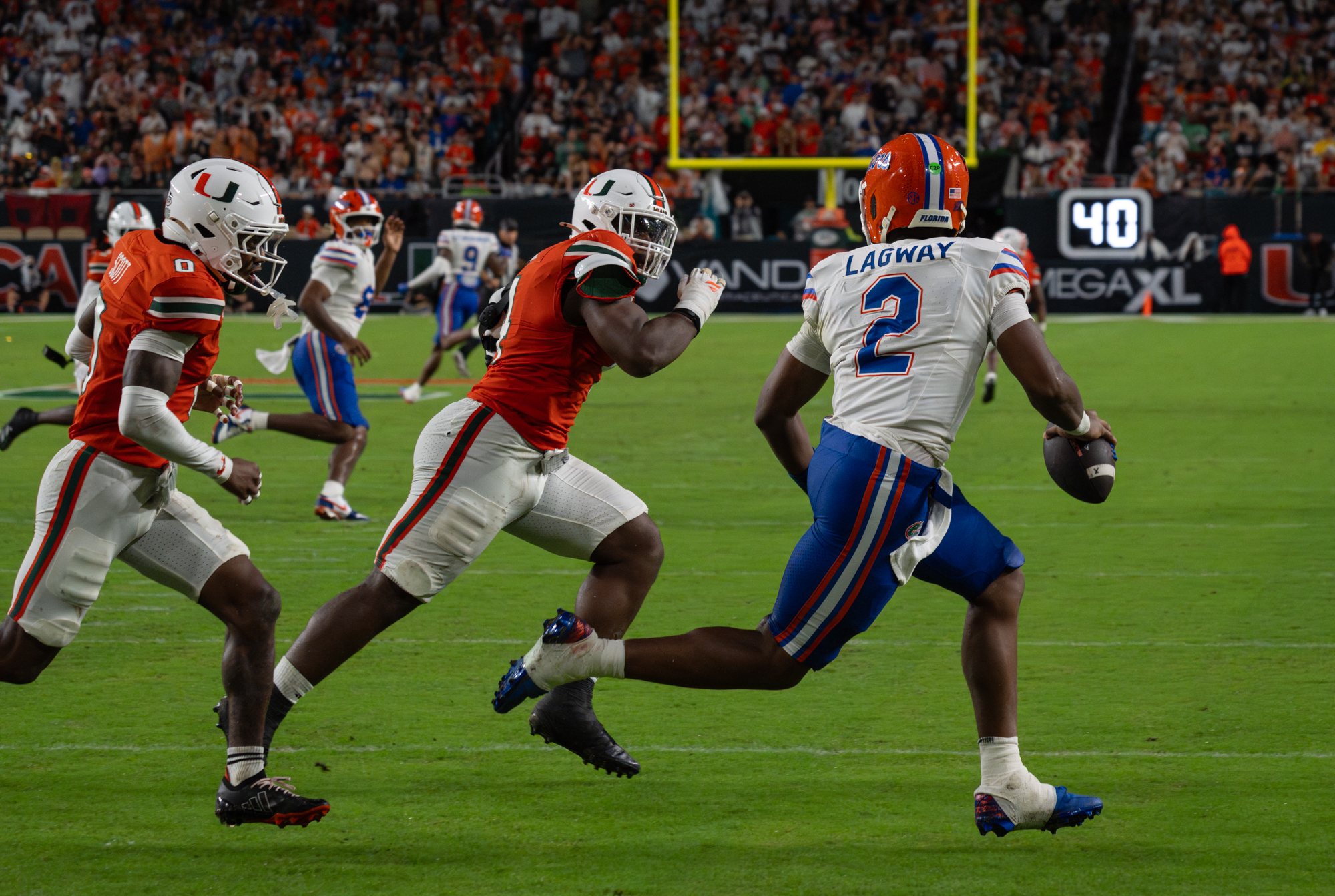
Assistant Photo Editor Brian Mulvey // Junior defensive back Rueban Bain Jr. (4) and sixth-year reddshirt senior defensive back Keionte Scott (0) chase Florida’s DJ Lagway on Sept. 20, 2025
Secondary: B+
While not perfect, the secondary’s grade shows marked improvement from last season’s flunking disaster. Under the coaching of former defensive coordinator Lance Guidry in 2024, the defensive backs and safeties could not contain the explosive play, and they were frequently torched in man coverage as a result.
But under the new management of defensive coordinator Corey Hetherman, this unit has completely transformed from an alarming weakness into a net strength. The group underwent a major overhaul during the offseason, highlighted by the splashy additions of defensive backs Jakobe Thomas, Keionte Scott and Zechariah Poyser via the transfer portal and the recruitment of ballhawking true freshman Bryce Fitzgerald, who has already nabbed three interceptions on his own.
Altogether, the secondary has produced nine turnovers, a strong positive that may help in overlooking their fourth quarter collapse against FSU.
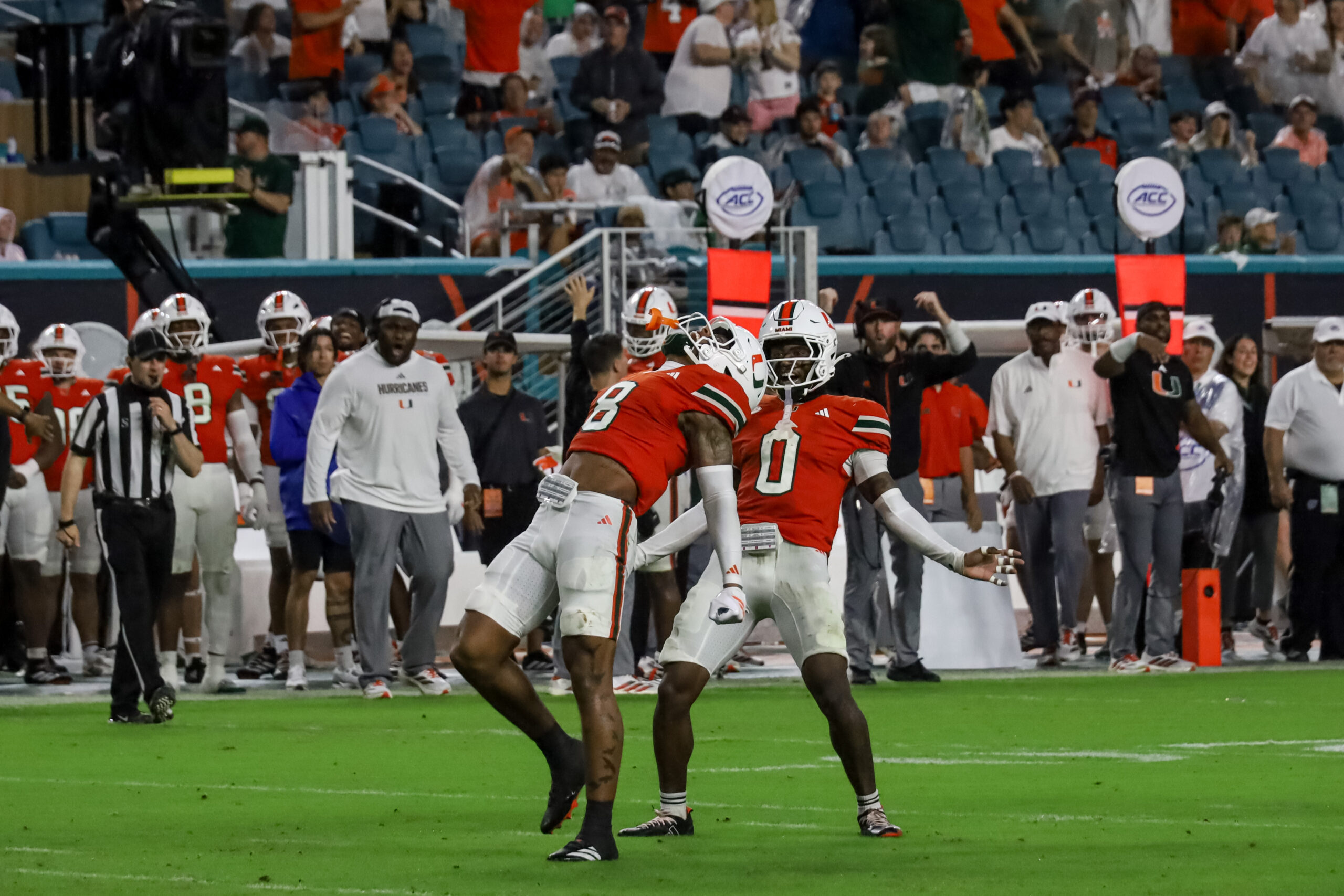
Makena Wong, Photo Editor, Fifth-year senior defensive back Jakobe Thomas (8) and sixth-year redshirt senior defensive back Keionte Scott (0) celebrate after tackling University of Florida player in second quarter on Saturday, Sep. 20, 2025.
Special Teams: A-
Consistency and reliability have been the main takeaways from this year’s special teams unit. FAU transfer kicker Carter Davis has been phenomenal, nailing field goals and PATs with 100% accuracy and drilling pivotal kicks against Notre Dame and Florida. Davis’ turnaround from last season has been extraordinary after entering Miami’s program 4-for-11 on field goals in his career and going 2-for-7 in 2024.
Punter Dylan Joyce has also enjoyed a strong start, shanking a punt at Florida State that tanked his average distance but otherwise remaining steady on the year. In the return game, specialist Keelan Marion along with Malachi Toney have flashed promise. Their best moment came against South Florida, when Toney almost ran a punt back for six had a teammate not fell into him seconds before breaking free of the pile. Overall, Hurricanes fans have yet to see any head-turning or awe-inspiring moments, but there haven’t been any major disasters either.
The University of Miami Women’s soccer team narrowly lost to Syracuse after conceding a late 77th minute goal, spoiling the ’Canes senior night.
Syracuse was able to earn its first conference win of the season (5-6-4, 1-5-1 ACC), while Miami remains winless in the ACC (6-5-3, 0-5-1 ACC).
The game was a defensive chess match, as both teams struggled to generate offense on a soggy field which had been battered by rain all day leading up to the match.
With the game tied up late, the ‘Canes pushed for a late winner in an effort to cap off their senior night on a high note.
However, their aggressive approach backfired, as Syracuse was able to notch a clinical counter attack. After a failed clearance by a Miami defender, Syracuse’s Mia Klammer found herself through on goal, where she calmly slotted a shot into the bottom corner for the game’s lone score.
The Hurricanes were unable to equalize, despite outshooting Syracuse 16 to 13 and earning 12 corner kicks compared to Syracuse’s six.
Miami’s standouts on the day were goalkeeper Emily Bredek, who had two saves and held a clean sheet before being subbed off at the half, and Crosby Nicholson who had four shots on the day.
Miami’s home stand will continue when they host the California Golden Bears on Oct. 16 with kickoff set for 7 p.m. on ACC Network Extra.
It was absolute bedlam at the Knight Sports Complex on Friday night when the No. 18 Miami Hurricanes (15-1, 5-0 ACC) defeated the No. 4 Pitt Panthers (12-3, 4-1 ACC), a night that ended with a ceremonial court-storm.
The Hurricanes’ 15th straight victory came after their opening loss to Indiana and marking the team’s best start since Miami began 15-0 in 2002.
The first set was tight, with the two teams tying the set on 11 separate occasions, along with five lead changes. With the score at 23-23, Dalia Wilson recorded a kill off an Ariana Rodriguez assist to give Miami set point. UM then dropped three straight points to lose the first set, 26-24.
The second set was all Panthers. They started hot, scoring six straight points and extending the lead to 9-3. The margin grew to as many as 11 as Pitt closed out the set, 25-14. This left Miami trailing 2-0 and marked the first time this year the Hurricanes had to fight back from a 2-0 deficit.
Although the third set was again largely even, Miami pulled away late, winning its first set of the night, 25-22. The Hurricanes hit .500 in the set. Flormarie Heredia Colón tallied seven kills, highlighted by scoring four of the final five points of the frame to close it out. Her last kill of the set clinched set point as it resoundingly deflected off the fingers of the Pitt block.
Miami carried the momentum into the fourth set. After the score was tied at 4, the Hurricanes strung together a 7-1 run, prompting a Pitt timeout. The Panthers could not reestablish themselves, as they did not tie or reclaim the lead in the set. This was Miami’s first match that went five sets since Sept. 10, when the Hurricanes defeated Ole Miss.
In the fifth set of contested action, kills from Heredia Colón and Jazmin Vergara gave Miami an early 10-6 lead. Returning the favor, Pitt’s Olivia Babcock tied the score at 11-11. Down the stretch, two Heredia Colón kills, a Rodriguez ace and a final Panthers service error encapsulated a massive upset in Coral Gables.
Miami completed the reverse sweep behind Flormarie Heredia Colón’s 38 kills, a program record, and Ariana Rodriguez’s double-double with 46 assists and 12 digs.
The Hurricanes will have another top-ten matchup when they face No. 10 SMU at home on Sunday at 1:30 p.m., looking to continue their hot streak.
Zach and Liam break down Miami’s 28-22 victory over Florida State University with Luca Mucciardi. The crew gives out mid-season grades, discusses the new schedule format, and more.
Efforts to remove Miami Beach’s iconic rainbow crosswalk from Ocean Drive’s entertainment district began Sunday afternoon, and by Monday morning, the intersection was entirely paved over in asphalt.
Miami Beach officials fought against the state order, but lost their appeal just two days prior to the removal.
The repainting comes two months after a federal directive to remove “political” or “non-uniform” art from Florida’s roads.
The removals began in late August when an Orlando crosswalk, which served to honor the victims of the Pulse shooting, was painted over. Florida’s queer community fought back by recoloring over the charcoal, but the Florida Department of Transportation continued repainting the crosswalk black.
The Ocean Drive crosswalk was a marker of the annual Miami Beach Pride parade — a beloved tradition for many UM LGBTQ Center student assistants and Pride Ambassadors.
Courtney Hartung, president of SpectrUM and a self-identified biromantic-asexual woman, recalled many fond memories of the intersection during the Miami Beach Pride parade. She called the removal of the crosswalk “heartbreaking.”
“It represented the LGBTQ community here in Miami,” Hartung explained. “It showed our contributions to the community. To me, it just meant representation; it meant visibility.”
Growing up in Florida, Hartung shared that she had never felt unwelcome or unsafe due to her queer identity until recently, with legislation such as the Parental Rights in Education Act also known as the Don’t Say Gay Bill and restrictions on gender-affirming care.
“As laws are being passed, it feels very much more unsafe to be a Florida resident,” said Hartung. “It feels like we are not wanted, because that is what the legislation is saying — that our existence does not matter to them. It feels like it’s becoming harder and harder to live here when this has been home for me since birth.”
Miami Beach Commissioner Alex Fernandez and more than a dozen protestors held signs across the street from the repainting. They chanted, “Miami Beach, forever proud.”
To Fernandez and the greater Miami queer community, the walkway represented queer liberation and unrelenting strength.
“This is the story of people’s lives. We’ve suffered decades of injustice, of inequality of discrimination,” said Fernandez. “Then we overcame that. That was the story being told by these bricks. We can’t lose it.”
The commissioner shared that city public works employees collected all of the removed rainbow stones so they could one day be repurposed.
Pablo is back with another packed TMH Sportscast, breaking down a massive week for the Hurricanes.
Miami Volleyball continues its red-hot run as it gears up for huge matchups against Pittsburgh and SMU. Soccer looks to bounce back at home, while both the men’s and women’s basketball teams prepare for nationally televised seasons full of must-watch matchups. And in football, the Canes swept FSU and Florida for the second straight year.
UM Women soccer’s 3-0 loss to Florida State University last Friday saw the Hurricanes left winless in the opening five fixtures of their 2025 ACC Campaign.
However, this Saturday’s game against last-place Syracuse provides a more-than-promising opportunity for the Hurricanes to grab their first ACC win of the season.
The fact that Syracuse and Miami are level in the ACC on one point, with both having tied against SMU, could suggest that they are of the same standard. However, Syracuse has played three home games in contrast to Miami’s one, and currently ride a five-game losing streak. The Hurricanes have shown strong performances against difficult sides in Louisville and Duke, while Syracuse was convincingly beaten by every tough team they have faced.
Most of all, Miami has bright sparks, namely Teegan Melenhorst and Ciara Alarcon, that give the Hurricanes the technical edge needed to win this game.
Syracuse was dominated in all of their last three fixtures, having been outshot 16-5 by California, 36-5 by Stanford, and 31-10 by Clemson.
Meanwhile, Miami was defensively sound against Duke and Louisville, showing the capability to put in industrious performances against highly-rated teams. Still, Miami must improve at defending cutbacks, as in every one of Miami’s competitive fixtures, there has been a lapse in focus in marking second-runners when the opposition squares the ball from out wide. While Syracuse are unlikely to punish Miami to the same extent that the attacking powerhouses of FSU and Wake Forest did, the Hurricanes need to work on this issue if they wish to have a strong second half of the season.
Furthermore, Miami should emphasize funneling attacks through Melenhorst and Alarcon. Prior games against Wake Forest and Duke required structural solidity and quantitative overloads to try and pinch results against these highly organized and technical sides. Conversely, Syracuse lacks the same organization and individual ability as previous opponents, making them less threatening offensively and weaker defensively. Therefore, placing onus on utilizing the qualitative superiority of the Canes’ midfield will be effective in breaking down Syracuse’s 4-5-1 formation.
Most of all, there must be a focus on finding the Hurricanes’ midfielders in the right areas, as Miami’s insufficiency in getting the ball in and around the penalty area has resulted in lower quality chances. The 4-4-2 diamond Masuhr has recently deployed works at getting Melenhorst on the edge of the box, but this narrow formation sometimes restricts Miami’s ability to stretch the opposition’s defense, reducing the faculty for the ’Canes deeper midfielders to play. Therefore, an adaptation to a 4-2-3-1 could potentially solve this issue while keeping Melenhorst in her best role.
With this idea in mind, Miami could set up as follows:
In this setup, Nicholson would be the primary defensive outlet while Alarcon would occupy the more progressive role in the double pivot, aiding movement of the ball up to Melenhorst in the #10 role. Miami’s recent goal drought has produced the belief that some changes in attack should occur, but rolling substitution rules mean that this frontline would be subject to change throughout the game.
Ultimately, this game is firmly in Miami’s hands. The Hurricanes have benefitted from over a week of preparation, and the home advantage of playing at Cobb Stadium will only add to the team’s growing sense of impetus to win on Oct. 11th, at 7:00 p.m.
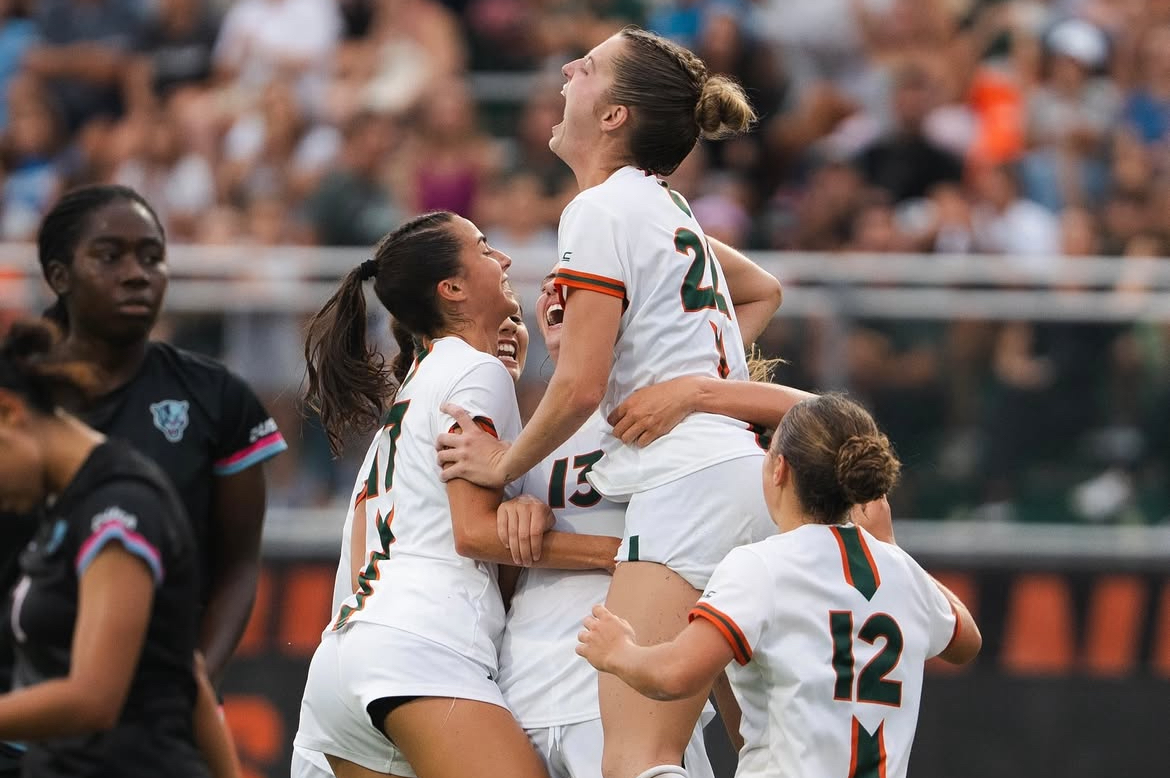
Crosby Nicholson celebrates with her teammates after scoring versus FIU on Sept. 7. Photo credit: University of Miami athletics