75.5 F
Coral Gables
Wednesday, March 4, 2026
March 4 , 2026
Home Blog Page 9

What UM students should know before studying abroad

Every University of Miami student heading abroad expects adventure, new culture and a change of scenery. What many do not anticipate is how different daily life feels once they are away from Miami. Students currently studying abroad say the adjustment itself became one of the most defining parts of their experience, offering lessons they wish they knew before leaving campus. 

Expect culture shock

From language barriers to unfamiliar customs, culture shock often begins the moment students step off the plane. Transitioning from a palm-lined campus and Miami’s fast-paced lifestyle to cities that move at a different rhythm can take time. Later dinner hours, inconsistent transportation and new social norms often require students to rethink their routines. 

“The culture shock when you first get here is so hard and I was super homesick,” said Addie Murphy, a junior abroad in Barcelona. “But once I started meeting new people and exploring the city more I felt much more comfortable.” 

While the initial adjustment can be overwhelming, immersing themselves in their surroundings helps ease the shift of life. 

Homesickness is real, even if not expected 

Homesickness might not set in until students are thousands of miles away from family, friends, and everyday life. Time differences and busy schedules abroad can make staying connected more of a difficulty than expected. 

“Being thousands of miles away from home has been challenging,” said Claire Parrish, a junior abroad in Barcelona. “Especially with the six-hour time difference, and after a long day I just want to talk to a familiar face.

Building new routines and forming connections abroad help the longing feeling to fade away over time, even if it seems it won’t. 

Daily routine abroad is not the same as in Miami 

One of the biggest adjustments is reworking routines. From navigating public transportation to managing time differences and language barriers, familiar habits can change quickly. 

“Getting around here is much different than America,” said Murphy. “The time zone change made me jet lagged for the first week, and I also don’t speak much Spanish, so it was hard to figure out how to communicate with others.” 

According to the Office of Study Abroad, these everyday adjustments play a key role in student growth however.

“Learning in a global setting encourages students to step outside their comfort zones and engage with new perspectives,” the Office said. “The cultural immersion helps students develop adaptability and critical thinking beyond traditional learning on campus.”

Free time looks different abroad  

The academic structure abroad is not the same at the University of Miami. With fewer scheduled classes and a greater emphasis on personal exploration, free time becomes bigger than expected. 

“A challenge has honestly been how weird it feels having so much free time,” said Samantha Gross, a junior studying abroad in Barcelona. “But it’s also great because it gives me so many opportunities to explore Barcelona more, try new things, and really take advantage of being here.”

The flexibility allows students to engage more deeply with their host cities, diving deeper into what the place has to offer. 

The experience is not perfect

While studying abroad offers many unique opportunities, the experience does come with highs and lows. Adapting to a new environment is emotionally demanding. 

“There are definitely ups and downs, and some days feel harder than others,” said Parrish. “Still, time moves really fast abroad, so I am trying to make the most of it.”

Whether abroad for a summer session or full semester, the experience ultimately reshapes how they approach daily life, culture and independence. Lessons that can extend beyond their time overseas and back to campus. 

UM students secure $200,000 for ambitious AI startup

It was a regular day at the Lakeside Village ping pong tables, two UM freshmen were just trying to win a game. They began talking casually about a problem they both saw in storing private information on computers and they began listing off all the ways they could do it better than the current systems.

Alexander Kim and Ethan Tieu had come into the University together through the Stamps Scholarship program. A “serendipitous set of events,” as Kim described it, made them roommates. 

It didn’t take long for them to realize they shared the same frustration: UM had plenty of talented computer science students, but no real structure to connect them with the research problems happening across campus. So, they built a solution to their frustration.

Kim and Tieu co-founded an applied computer science research group, open to interested students, designed to bridge that gap. They decided not to release the name of the organization to keep focus on Textile. 

“You can think of it like a consulting organization,” Tieu said. Professors, labs and local companies bring the group their data or computational ideas. Then, the student-research group organizes student engineers to build the solutions.

Kim said the scale of the group surprised even them.

“So, after all things told, we worked probably throughout the course of the three years of that organization, which we still run, probably like 80 of the top computer science, electrical engineering, computer engineering, mathematics, and ITD students.”

They’ve delivered more than 27 projects, including diagnostic tools for Alzheimer’s and Parkinson’s, collaborations with the medical campus, and work with the business school and astrophysics department. But as the organization grew, so did its chaos.

“We started drowning in our own information,” Kim said. Years of research files, documents and project histories were scattered across drives and folders. Even the most organized students had systems no one else could inherit. They needed a tool — a tool that didn’t exist yet.

Tieu saw the same problem outside the lab. 

“People create systems that only make sense to them,” Tieu said. “And when something happens, no one else knows where anything is.”

So, once again, the team built a solution.

Within the organization, Kim and Tieu began developing a tool that could store important documents in one place and let users retrieve information in plain language without having to remember file names or folder paths. It was meant to help future team leaders understand the group’s history.

That internal tool eventually became Textile. The first prototype came together last March, when the team entered the College of Engineering’s Innovation Challenge. They won first place — a win publicly celebrated by the College of Engineering.

That early funding helped send the team to New York for the summer, where they built out the prototype and pitched to investors. They printed posters and taped them to police barricades around places like Madison Square Park, putting them on when officers turned away.

By then, they had already chosen the name “Textile.” Only later did they realize their office was in Manhattan’s garment district surrounded by textile retailers. 

“We were literally in the textile retail center,” Kim said. “Textile founded in textile.”

Back in Miami, the student organization continued as a research group. Textile became something else entirely: brand new technology.

They began their ambitious journey within the research group, “Textile is what was born out of it.” Kim said.

The problem Textile is trying to solve is universal: digging through 20 years of paperwork in a manila folder and still not finding what you need.

Michael Mastando, a senior computer science major, joined the team after hearing about the idea from a mutual friend. Today, Textile has 10 student team members and an advisory board of seven senior industry figures. The student run- research group, has more than 40 members and runs 10 projects at a time.

Tieu leads the machine learning and AI. Other students focus on software development, design, debugging, marketing and outreach. Mastando leads business development, reaching out to firms and companies to secure early partnerships.

“It’s really helped me build a lot of real‑world skills,” Mastando said. “Sales, talking to people, cold calling.”

The team didn’t name the investors, but they emphasized that the overall $200,000 investment came from “the local Miami community,” senior advisors in California and academic networks on the East Coast.

The product itself is in public beta and free to try. The major release is coming in the near future, and Textile already has pilot agreements with prominent wealth managers and law firms — partnerships the team expects to turn into full contracts.

For all the technical work, the team talks just as much about values as they do about code. They want Textile to feel “friendly” and “un‑frustrating.” They want answers to be “correct, authoritative and totally intuitive.”

Textile also believes in signing its work — literally — a nod to the original 1984 Macintosh, which hid its design team’s signatures inside the case.

If you say a certain phrase to the system, it reveals a “signature page” of the team and the story of how the name came to be.

After graduation, Kim and Tieu plan to move to New York City to keep building Textile. 

“Everybody who we can afford on the team we’ll bring over,” Kim said. Three of the ten are confirmed to be working from New York, while others will stay involved part-time or remotely.

Tieu describes their journey with a phrase Kim repeats often: “Increase the surface area of your luck.” 

Say yes to strange meetings. Show up to competitions. Talk to people you don’t expect to meet.

“The universe works together in special ways to make that stuff happen,” Tieu said. “I want to work on this until the problem is solved.”

Divine Nine showcases cultural history at Miami Heat game

Members of the National Pan-Hellenic Council, also known as the Divine Nine, showcased their step skills during a Black History Month celebration during halftime at a Miami Heat game on Monday, Feb. 9.

The University of Miami is home to active chapters of all nine National Pan-Hellenic Council of Black fraternities and sororities, which advocate for social justice and elevate the voices of Black college students and graduates at universities across the nation. 

Alongside UM’s Divine Nine members, students from other South Florida universities practiced with a professional choreographer and came together to perform in front of thousands of fans Saturday night. 

“This is a beautiful experience for me as I represent my sorority, Alpha Kappa Alpha Sorority, Incorporated, the first Black female sorority founded in 1908 at Howard University,” said Aria Harrell, a junior and member of Alpha Kappa Alpha. “I am honored to stand alongside my Divine Nine brothers and sisters as we highlight and celebrate Black culture and history.” 

The National Pan-Hellenic Council was founded between 1906 and 1963 by Black college students to combat racial segregation, discrimination and lack of representation in universities nationwide. 

From this broader movement emerged Alpha Phi Alpha, which became the first Black Greek Letter Organizations chartered University of Miami in 1970, nine years after the university’s desegregation. 

The halftime performance was more than entertainment to Jayvaun Hill, a senior member of Phi Beta Sigma. It was an opportunity to celebrate and represent their organizations, universities and generations of black history before a national audience. 

“For Divine Nine to have the honor to perform during a game like this is truly a testament to how far people of color have come in this country,” said Jayvaun Hill. “To have the ability to showcase who we are on television will definitely teach people who we are and just one thing that we do is stroll.” 

Frost Jazz Orchestra celebrates its first Grammy nomination

Former students from the Frost School of Music earned national recognition after their album “Some Days Are Better: The Lost Scores” received a nomination for Best Large Jazz Ensemble at the 2026 Grammys. 

The album was created through the Kenny Wheeler Project, a collaboration between John Daversa, Frost’s chair of studio music and jazz, and Nick Smart, head of jazz programmes at the Royal Academy of Music. 

They selected eight students from each jazz orchestra to record lost scores by Kenny Wheeler, an influential musician in the British jazz scene. While his music has been performed in concerts and broadcast on radio, many of these works had never been brought together on an album.

University of Miami students met the Royal Academy ensemble in London, recording the album at the historic Abbey Road Studios. Saxophonist and UM master’s student Izzi Guzman said being in one of the most iconic recording spaces in music history pushed the group to approach the project as professional musicians rather than students.

“This project meant so much more than myself,” Guzman said. “We were all coming together as a unit and placing our egos aside to perform music that’s a part of jazz’s history.”

The ensemble recorded alongside saxophonist Evan Parker and vocalist Norma Winstone, musicians who had worked directly with Wheeler. Both helped create his legacy and continue to keep it alive.

The main challenge was the physical constraint of having only three days to record an album. Guzman said the group got tired after a few hours, especially when having to record multiple takes of the same tune.

“I remember we were there from probably like 9 a.m. to 6 p.m. one day,” Guzman said.

Despite the pressure, the group also spent time together outside the studio, exploring London and building connections beyond the music.

“I truly believe that connecting with people outside of the music contributes greatly to the music itself as well,” Guzman said.

When selecting students for the project, Daversa focused on bringing together musicians whose personalities mashed together to bring out the best in the music.

The project was originally planned to begin in 2020, but the COVID-19 pandemic delayed the recording until 2024. Many participants are now professional musicians, touring in Europe or building careers in New York. 

Guzman said learning about the Grammy nomination while still on campus allowed her to get support from her peers and professors.

It marked the first time in the school’s history that a student ensemble was nominated for a Grammy. 

“I hope that through this album people can see it doesn’t matter how young or experienced they are,” Guzman said. “We can all contribute something. If we put our minds and our hearts together, we can make something beautiful happen.”

Our campus must vote UNITED

0

At a time when the University of Miami ranks at an “F” for free speech, who we elect to lead our student body has never been more crucial. Students deserve leaders who will listen, communicate transparently and turn student voices into concrete, achievable action. That’s why the best path for our Student Government is the UNITED campaign.

Running for president, Jaell-Ann Auguste is not new to leadership. She has already taken charge as Student Government Director of Outreach and founder of the Belonging in Business Program. 

As a Miami Herbert student ambassador and orientation fellow on the First-year Leadership Council, August engages in genuine conversation with students across campus on the campaign trail and her ideas align with students’ wants and needs.  

Auguste’s position serves as a powerful reminder that women’s voices belong at the forefront of leadership. Cora McKittrick, a freshman on the pre-law track described the UNITED campaign as “inspiring and necessary.” 

The UNITED ticket is made up of students from various academic backgrounds and identities, offering diverse perspectives. Auguste leads with diversity, involved in the Caribbean Student Association, UMTV The Culture and United black Students. In a system where students often feel detached from the decision-making process, her approach ensures that student voices are leveraged and empowered. 

UNITED’s diverse leadership is one of the strongest points of their campaign. Auguste is a business student, while her vice president running mate, Alex Barrowclough, is on the pre-law track, and her treasurer candidate, Grace Wheeling, is pursuing a degree in nursing.

Barrowclough offers the institutional experience needed for a successful vice presidency. Barrowclough serves on the President 100 Advisory Board and in leadership councils of Student Government.  

Wheeling has managed and allocated resources sustainably in effort of and maintaining long-term projects as founding president of Global Dental Brigades. Much like her work in the health sciences, Wheeling understands and embodies the responsibility associated with UNITED’s path to victory.

The campaign’s initiatives have already been proved realistic through conservations Auguste’s team has tirelessly engaged in. At a visit to the Debate Team on Wednesday, Auguste assured students that they shouldn’t have to deal with vague promises that are forgotten about after an election. UNITED has done the work to ensure the student body gets what they voted for.

“We have worked with our advisors and the school to ensure that these initiatives are attainable and realistic,” Auguste said. 

UNITED has done the work to ensure the student body gets what they voted for. 

One initiative they are pushing for is adding a Panera Bread to the food court. An addition of a Panera Bread would expand choice with additional gluten-free and vegan offerings, especially after Tossed left the food court last year, leaving students with fewer gluten-free food options

The student government should function as a bridge — not a barrier. In an environment where students often feel kept on the periphery, UNITED’s promise and commitment to provide transparency offers a potential way forward. 

“We are committed to always being a voice for the student body, and an outlet where every perspective is valued and heard,” UNITED said on their instagram. “We are dedicated to working for YOU, ensuring that the changes you want to see are acted upon.” 

This election is the chance to elect a representative that is truly committed to student voices. UNITED offers exactly that. 

Vote UNITED for student government from Feb. 16-18.

The perfect candidate FOR U

0

Student government only matters when the people are invested in changing student life. The candidates “For U” have proven their abilities, not through their words, but through their actions and more than qualified skills.

Built on three core pillars of academic, student life and community goals, the For U ticket is ready to make some much-needed practical changes to the University of Miami. 

Leading the group is presidential candidate Fernando Sepulveda Sagaseta, whose involvement in this school is impressive, to say the least. His on-campus portfolio includes Chief of Staff of Student Government and project manager of a consulting group TAMID, both organizations of which he has been involved in since his Freshman year. 

Sepulveda Sagaseta’s second in command, Aaron Gonzales, has also packed a hefty punch for this campus. As the Director of University Affairs for Student Government, he has been able to “Lead projects and provide problem-solving support on initiatives like expanding rideshare access, improving dining options, improving gym facilities, and more.” 

Gonzales keeps a full schedule, with an active business operations internship for F1 Miami, a job at the school gym and earning his education in legal studies. Gonzales is a motivated individual who gets things done. 

Both students have already been able to enact change. Bringing Half Moon to other locations on campus and expanding Freebee’s services, Sepulveda Sagaseta and Gonzales know how to help the student body in various ways. Giving them a larger platform would amplify their ability to better this campus even further. 

Supporting the three candidates is potential treasurer Dylan Hall. Hall is treasurer of UM’s Women in Business, coordinator for University of Miami Student Activity Fee Allocation Committee and an on-campus SASO Finance Intern. Hall is not new to treasurer responsibilities; she has hands-on experience that shows how well she could disperse UM’s finances.

Three students with demanding schedules campaigning for a significant student body position understand more than anyone the nuisance that our library is not 24 hours. With student’s demanding workloads, For U is ready to address the injustice that we are not being provided with the proper hours to study.

When asked why she is choosing For U, UM student Ami Bouzaglo said, “With my biology major, I am in the library till late hours, and it’s ridiculous when they kick me out. Extending hours would make a huge difference for me.”

Continuing, their agenda lobbies for Mobile CaneCards, more registered parties, increasing our schools’ student section for sports, and increasing the hours of food places on campus. Rather than broad ideals, the platform highlights measurable goals aimed at improving routine aspects of student life.

Every member brings their own unique experience to the table, which combined makes them the perfectly suited trio to win this election. Their initiatives aren’t out of reach — they are a necessity. With their past and current involvement on campus, the candidates understand their responsibilities and how to be transparent with students. 

Vote For U in this upcoming student election, because they are the best choice FOR U.

Why being gay sucks in Miami

0

I am everywhere on campus and somehow nowhere at all.

I go to class, have multiple leadership positions on campus, attend events, create content and smile when people recognize me. On paper, I am the kind of student the University of Miami celebrates: involved, motivated, polished and busy. 

But beneath the calendar invites is a quiet isolation that feels harder to admit the more socially put together I appear.

Most nights, my loneliness has a dress code.

Many of my closest friends are in Greek life. Their weekends revolve around mixers, pool parties and fraternity events that shape UM’s social scene. As an openly gay guy, I never felt comfortable rushing a fraternity. Greek life — for all its prominence — was not built with people like me in mind and I understood that early on.

That reality is the most obvious on weekends. While my friends pregame for Greek life events, I am left figuring out where I fit. As a guy, going out in Miami often means paying absurd cover fees just to enter a crowded room. Women are waved in, while men end up paying $20, $50 and sometimes even more. 

Simply existing in the nightlife scene and a reminder of who is valued and who is not. As a gay guy, entry often comes with conditions. You are really only allowed in if you arrive flanked by multiple girls, your presence justified by proximity to femininity rather than accepted on its own.

Fraternity parties reflect the same dynamic. I am too masculine to be let in as one of the girls, yet at the same time, I am not masculine enough to be welcomed as one of the guys. I hover in an in-between space, visible but never fully claimed, present yet never quite belonging. 

I am still perceived as competition — another man in the room — even though I am not looking to compete against them. I exist in an in-between space that feels invisible and isolating. I watch my closest friends post stories from events I cannot attend, not because I was not invited, but because I do not fit neatly into the boxes those spaces demand.

UM seniors Taveion Neasman, a Pride Ambassador for the LGBTQ+ Center, and William Harless said fraternity and party culture at the University of Miami often make being openly gay feel conditional rather than truly welcoming.

“The nightlife scene and Greek life are definitely points of tension for many gay students,” Neasman said. “Fraternities are incredibly heteronormative. You either have to be hypermasculine or quiet about who you are.”

Harless said that dynamic extends beyond campus and into Miami’s nightlife, where gay men are often treated as disposable.

“You’re seen as a guy who ‘throws off the ratio,’ even when you’re gay,” Harless said. “More masculine-presenting gay men have it easier if they conform or stay in the closet.”

Neither student said exclusion always looks overt, but both described environments that feel unwelcoming by design.

“I’ve never felt directly discriminated against,” Neasman said. “But I’ve overheard gay students being turned into jokes. Homophobia exists, even when it’s subtle.”

Harless said those systems quietly decide who belongs.

“Not everyone is homophobic,” he said. “But the social norms are, and they determine who gets let in and who gets left out.”

Neasman said support on campus often feels limited to the LGBTQ+ Center rather than woven into everyday student life.

“Integration is being invited to the party,” he said. “Inclusion is being asked to dance.”

During the week, I am everywhere. I contribute to campus life in ways that are publicly celebrated. To many, it looks like I have it all together socially. Yet even in a room full of people, I still feel alone.

There is an unspoken pressure at UM to always be thriving. Being surrounded by people does not guarantee connection, and being involved does not mean being seen. I move from meeting to meeting with a full schedule and a familiar face, but behind the constant motion, few people ever ask how I am actually doing. Loneliness does not always look like eating alone on a campus glider. Sometimes, it looks like showing up to everything and still feeling invisible.

This campus often talks about community and less about the emotional distance that exists in it. Students who appear the most connected can and do still feel isolated. 

Loneliness isn’t cured by a strong resume, leadership titles or a packed social calendar. Sometimes it comes not from having no friends at all, but from having friends whose worlds you’re never fully allowed to step into.

UM is a place filled with ambition, energy and pride. But belonging cannot be measured by involvement alone. Even the people who appear the most socially put together can still feel isolated, unsure of where they truly fit. If Miami truly wants to foster belonging, it must make space for honesty, especially from those who seem like they already have it all figured out.

Why you should care about the layoffs at the Washington Post

0

“Democracy dies in darkness.” Under Jeff Bezos, one newsroom’s light is flickering. 

The Washington Post was acquired by Bezos in 2013 for roughly $250 million. Acclaimed for breaking news like the Watergate Scandal and publishing the Pentagon Papers, the paper is regarded as a pillar of accountability journalism. 

The Post’s recent “financially motivated” decision to lay off roughly one-third of its staff, including entire sections like the International desk — Lizzie Johnson was fired while on the ground, reporting on war in Ukraine — reflects a troubling shift away from journalism that undermines informed civic life.

Change at The Washington Post began with eliminating the editors’ chance to endorse presidential candidates before the 2024 election and moving away from left-leaning opinion pieces. That same year, Bezos sat in the front row of President Trump’s inauguration, alongside Mark Zuckerberg, Elon Musk and Former Prime Minister Boris Johnson. 

More recently, Amazon has acquired the rights to the Melania Trump documentary for $40 million, which was $28 million more than the next highest bidder. Multiple anonymous sources from the company’s entertainment division see this as a bribe. 

The Washington Post’s leadership has framed the layoffs as a necessary business decision, but journalism should not be framed as an optimizable product when it exists to serve the public.

Thirteen years ago, Bezos pledged that he would not view The Post as a source of income. He framed himself as a protector of the institution. This raises an important question: who is responsible for preserving the information systems democracy relies on? Journalists and press advocates warn that treating news purely as a business risks hollowing out its democratic purpose. 

Freedom of the press is an enumerated right, and the free circulation of publications like the Federalist and Anti-federalist papers catalysed the ratification of the U.S. constitution, after circulars and pamphlets rallied the colonies behind the Articles of Confederation.

Much like these historic documents, The Washington Post is a national agenda-setter whose reporting shapes political discourse across the country. When an institution of this scale contracts, the effects ripple outward. This signals to smaller outlets that deep, resource-intensive reporting is increasingly unsustainable. 

This moment reflects a broader crisis in democratic information. More than 50 million Americans live in “news deserts,” or areas with one or less local news sources. Research shows that when news coverage declines, civic participation declines with it. These deserts are disproportionately in rural and low-income areas, creating information gaps and a class divide in the ability to engage with our democracy, starting at the local and municipal levels.

At the annual dinner for reporters covering Congress, former Democratic Speaker of the House Nancy Pelosi spoke out against the layoffs, which she believes infringe on the people’s first amendment rights. 

“A free press cannot fulfill its mission if it is starved of the resources it needs to survive,” Pelosi said. “When newsrooms are weakened, our republic is weakened with them.” 

Choking these institutions financially serves the same purpose as censorship.

So, why does this really matter? As newsroom layoffs accelerate the growth of news deserts, civic participation increasingly becomes a privilege of those with access to quality information, deepening class and geographic divides in democratic engagement. Communities become less informed, civic participation declines, polarization increases and fewer people vote, organize or hold leaders accountable.

Supporting journalism through subscriptions, public pressure and policy conversations is not charity, but a civic act. Use your student accounts and read the local news for your town.

The Washington Post layoffs force readers to confront a difficult truth: Democracy cannot function without strong institutions dedicated to informing the public. 

An engaged and truly representative democracy depends on more than access to information, it depends on institutions capable of producing it.

Student government candidates campaign on the unattainable

0

Student government election season has arrived, and with it a wave of ambitious promises. Candidates are vowing to improve pre-professional advising, expand campus food options and increase security measures, among dozens of other proposals.

These are not small promises. They require funding, administrative approval and coordination with departments that operate independently of student government. The problem is not the ambition behind these proposals, it is the absence of any honest accounting of what student government can realistically deliver.

Yet campaign messaging rarely explains the mechanics.

Instead, initiatives are presented as outcomes rather than advocacy goals. While student government can lobby administrators, allocate portions of student fees and bring attention to student concerns, it cannot independently open national food chains, alter curriculum requirements, extend library hours without administrative approval or install new physical infrastructure – especially off campus.

To better understand how realistic these promises may be, The Hurricane contacted the current executive board of student government. They declined to comment on the feasibility of the current candidates’ proposals.

That leaves students to evaluate campaign platforms without insight into the likelihood of their execution.

Holding candidates to a higher standard is not a rejection of their ambition. It is a recognition of it. Many proposals reflect genuine student concerns, and some build on past accomplishments: further expansion of the campus ride share map and new shuttle stop covers, for instance, are cited as a foundation for this cycle’s larger proposals. But vision alone is not enough. Clarity about how these goals would actually be achieved and what obstacles stand in the way is missing. 

If a candidate proposes expanding food vendors, what existing contracts are in place? If they promise technology upgrades, where would that funding come from? If they guarantee faster reimbursements or clearer budgeting timelines, what structural changes are required?

These questions are not cynical. They are practical.

Student government functions within institutional constraints. Understanding those constraints does not weaken leadership, it strengthens credibility.

The most responsible campaigns are not those with the longest initiative list. They are the ones that distinguish between what they can execute directly, what requires partnership, and what demands long-term advocacy. 

Ambition draws attention. Transparency builds trust. As voters, we should expect both.

Major development postpones opening statements in former Miami Hurricane Byran Pata’s murder trial

Opening statements in the murder trial involving former University of Miami football player Rashaun Jones were scheduled to begin Tuesday morning but were postponed after defense attorneys revealed new information they say could reshape the case.

Jones, now 40, is accused of killing his former teammate Bryan Pata, a defensive lineman for the Miami Hurricanes in November of 2006.

According to defense attorney Christian Maroni, new information that the defense received late on Friday, Feb. 13 includes a Homeland Security Investigation document in which a confidential informant identified a man named Wilner Yacinth as being involved in Pata’s killing. The defense also claims that police did not thoroughly investigate an alleged confession from Yacinth. 

The confession includes the language, “‘I just killed that kid from the University of Miami,’” Maroni said. “So now we have a specific statement linking that confession to the murder of Bryan Pata.”

Maroni also argued that investigators did not fully look into gang involvement and other possible suspects, saying police reports show detectives did not interview individuals allegedly connected to a gang.

Judge Cristina Miranda delayed the start of the trial, saying the court must resolve outstanding questions before opening statements are presented to a jury.

“I do think we want answers to these types of things to be able to put some puzzle pieces together for the ethical obligation that we all have,” Miranda said.

Prosecutors acknowledged receiving the same materials but argued the defense is attempting to introduce unsubstantiated hearsay, characterizing the information is inadmissible.

State attorney Cristina Diamond argued that the court has no supporting records or witnesses who can verify the information referenced in the reports.

Miranda did not immediately rule on whether jurors will be allowed to hear about the alleged confession or the HSI report, noting that similar references to alleged confessions had previously been excluded over validity concerns. After a long hearing Tuesday, the judge gave both sides until Wednesday morning to provide any additional information before making a final determination.

This delay to opening statements came as nearly 17 of Pata’s family members arrived at the courthouse expecting opening statements to begin. Among them was Pata’s mother, Jeanette, who is now wheelchair-bound but attended court.

The opening statements and trial are expected to move forward Wednesday morning, once the court resolves the issues surrounding the newly presented information. 

This article was originally published on Tuesday, Feb. 17 at 8:51 p.m. and was updated on Wednesday, Feb. 18 at 12:35 a.m.

Margo O’Meara captures ACC title as Miami stacks three more medals

The Hurricanes handled business Monday at the ACC Swim & Dive Championships, stacking three more medals at the McAuley Aquatic Center and continuing what has been a dominant showing on the boards.

A day after trading places on the podium in the 3-meter, Margo O’Meara and Chiara Pellacani flipped the script again in the Women’s 1-meter final. In her first season at Miami, O’Meara captured ACC gold with a winning score of 333.45, edging Pellacani by less than two points.

O’Meara’s most electric moment came on her reverse 1½ somersault in pike, which earned 58.80 points. She never dipped below 53 points across six finals dives — the consistency that ultimately secured her the conference title.

Pellacani, this year’s ACC champion on the 3-meter, added another medal to her growing collection with a 332.20 silver-medal finish. Her reverse 1½ somersault with 1½ twists scored 58.50, keeping the duel razor-thin until the final round.

Veteran Emma Gullstrand just missed the podium, placing fourth with 298.15, finishing behind North Carolina’s Sofia Knight (300.25).

On the men’s side, freshman Matteo Santoro continued his breakout championship debut. After earning bronze on the 1-meter Sunday, Santoro claimed silver on the 3-meter with a score of 422.80, finishing behind Georgia Tech’s Max Fowler (459.75). His reverse 3½ somersault tuck scored an impressive 84 points, while his opening forward 2½ with two twists from pike earned 81.60. Although he’s only a freshman, Santoro brings a wealth of experience to the springboard, including winning gold under the Italian banner at the World Aquatics Championship last summer.

Jake Passmore also qualified for finals and finished fourth (373.15), capping another medal-heavy day for Miami.

With six divers feeding off each other’s strengths, the Hurricanes have left much of the conference in the deep end.

Tuesday marks the final day of diving competition — and riding this momentum, Miami looks poised to somersault straight back onto the podium.

RSMAS shuttle driver arrested for DUI while operating shuttle

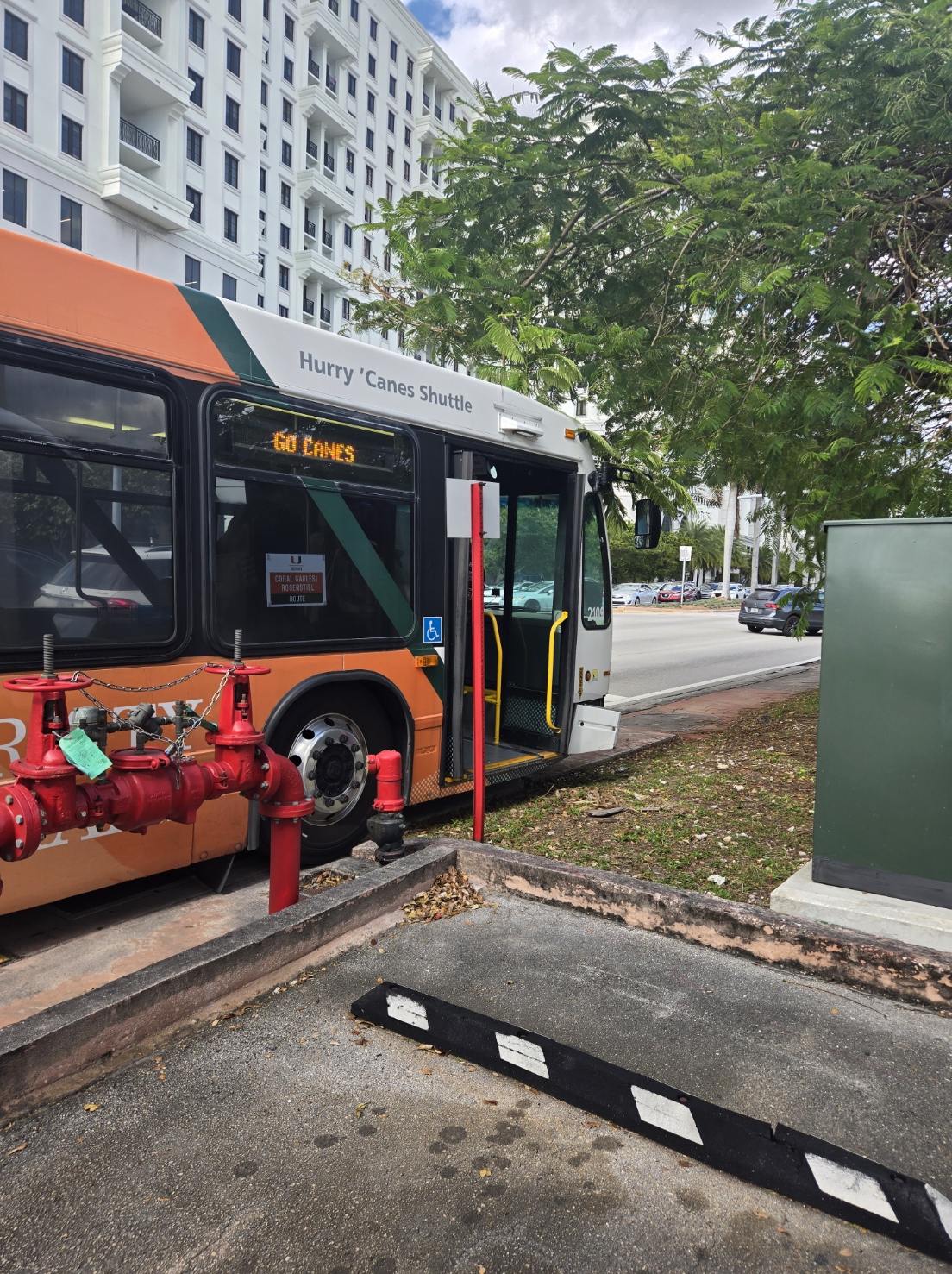
A shuttle driver for Rosenstiel School of Marine, Atmospheric and Earth Science was arrested for driving the UM shuttle with about 15 students on board while allegedly under the influence on Monday, Feb. 16, at approximately 3:27 p.m.

Timothy Kowalewski, the shuttle driver, is facing one charge driving under the influence, two charges of DUI with damage to property or person — one for hitting a tree and one for damage to the vehicle — and one charge of refusal to submit a breath test after license suspension. 

Maya Dejean, a freshman majoring in marine biology and ecology, takes the shuttle to Virginia Key, driven by Kowalewski, every Monday. Dejean said that Kowalewski is normally very punctual, but he was late picking up the students from the Coral Gables campus and picking them back up from the Key, which was the first indication that something was wrong.

“Once he picked us up to drop us back off at the main campus, his driving was very erratic. It wasn’t, you know, it just wasn’t safe,” Dejean said. “I would say he was swerving a lot. He ended up making a U-turn in the middle of [South Dixie Highway], stopping traffic on both sides of the highway, crashing into trees, poles, just very much risking the lives of all of us and everyone around us.”

After Kowalewski made the U-turn, students on the shuttle began asking if he was all right and in the right state to drive. The students talked to him and encouraged him to pull over near the Trader Joe’s on South Dixie Hwy., engaging in a back-and-forth with the driver about putting the shuttle into park. 

“He was trying to first say that he was okay to drive, and at the same time he was driving into the sidewalk,” Dejean said. “So, we kind of just forced him to hit the break and stop. For a good amount of time, he didn’t really put the vehicle in park. He just had his foot on the break.”

Video of the students on the shuttle asking Timothy Kowalewski if he is alright on Monday, Feb. 16. // Video via Maya Dejean.

Dejean also said that the back window of the shuttle was cracked for the ride back to the Coral Gables campus but that it had not been cracked on the trip to Virginia Key. During the drive, the glass from the shattered window blew into the shuttle.  

Students on the shuttle called UMPD and were referred to 911, since the area where the shuttle was stopped was outside of UMPD’s range. Dejean said that police arrived within about 10 minutes and took Kowalewski in an ambulance. 

Coral Gables Police Officer Pena was the first to arrive on the scene and described the defendant as “sweating profusely.” Another officer noted the smell of alcohol on his breath and that he was slurring his words. 

According to the police report, an officer asked the driver if he had had anything to drink, to which he answered “yes.” When asked when his last drink was, he answered, “This morning, since the store opened.” 

Kowalewski declined to participate in any field sobriety exercises and refused to provide a breath sample. 

The RSMAS shuttle parked partially on the sidewalk after students asked the driver to pull over due to his erratic driving on Monday, Feb. 16. // Photo via Sebastian Bernhard.

UM sent another shuttle to retrieve the students and bring them back to the Coral Gables campus. Dejean said that about half of the students had already called their friends or Ubers to take them back, and the other half were “scared and hesitant” to get back on a shuttle. 

“The incident involving a University of Miami campus shuttle is under further investigation by the Coral Gables Police Department. The safety of our students, faculty and staff members, and the greater University community remains our top priority,” the University said in a statement to The Hurricane.

Dejean said that she feels UM dismissed the severity of the situation. She said that nobody from UM was there to talk to the students when they arrived back on campus and they didn’t receive any communication from the University. 

“It felt very dismissed by the school,” she said. “Like, we get alerts on our phone if there’s a car crash or police chase, sometimes not even involving students, and this was very University of Miami involved, like directly involved, and it just felt really pushed to the side.”

The students on the shuttle have been trying to schedule a meeting with the dean of student life since the incident. 


The article was updated at 3:06 p.m. on Tuesday, Feb. 17, to include the statement from the University.