Home Blog Page 67

POLITICS: Why Zohran Mamdani won in New York City and what it means for 2026

Emil and Lazaro argue different sides of the debate and explain why they believe Zohran Mamdani won the mayorship of New York City and what that victory means for U.S. politics and the 2026 midterm elections.

These opinions do not reflect the stance of The Miami Hurricane.

Caffeine culture: healthy or harmful?

0

It’s not unusual to see students walking around campus with an iced latte or a Red Bull, especially during finals season. A Google Survey shared with students via The Miami Hurricane’s Instagram found that almost 90% of students consume caffeine, with more than 50% drinking it at least once a day. 

Researchers say caffeine is the most commonly used drug in the world. The World Health Organization states that the stimulant leaves you with symptoms similar to withdrawal when you do not regularly consume it. This leads coffee drinkers to continue to consume it, even if they know the effects it may have. 

This feeling of needing to consume caffeine can also be known as “caffeine dependency,” characterized by a persistent, compulsive need to consume caffeine even when you know it can  harm you or lead to negative consequences. 

An article published in 2025 by the Journal of Health found that almost half of the college-aged participants they studied exceeded safe levels of caffeine consumption. These levels were also associated with greater anxiety, depression and stress scores.

“I would have two cans of Celsius a day, sometimes three, because I was so exhausted with school and practice,” said sophomore and former dancer Neil Fernandez. “I had really bad crashes, I couldn’t perform without it because I would get jittery and shaky. It wasn’t a good practice if I didn’t have my usual amount of caffeine.” 

The Hurricane’s survey results also found that 31.7% of students get their caffeine from energy drinks such as Celsius, Alani Nu and RedBull. While different brands advertise a “healthier formula” or “more natural ingredients,” the brands have all received criticism from medical professionals. 

Researchers at UT Austin found that energy consumption is directly linked with unhealthy dietary behaviors among college students. Those who consumed greater amounts of energy drinks were more likely to eat frozen meals, sodas and sugary snacks that lack proper nutrients. 

“While energy drinks may be effective in providing a quick jolt of energy and alertness, the excessive added sugar can be a problem,” stated an article by University Hospitals. “Consuming too much added sugar is linked to diabetes, heart disease, weight gain and a number of other health problems.”

The dangers of consuming too much caffeine is not a foreign concept to many students. Having one or more caffeinated drinks throughout the day, especially during stressful or long weeks, has become a part of the “college culture.”

The Hurricane’s survey found that 50.7% of students drink more coffee during exam season, a busy homework week and the night before studying for an exam or project presentation. 

One student even stated that they “drink an obscene amount [of caffeine] during finals week.” 

Another student said they “need it to focus and get work done.” 

While caffeine might help students stay awake, it can disrupt sleep patterns in the long-term, causing fatigue. 

“I probably drink about 100mg of caffeine a day, maybe 200 if I’m super busy,” said freshman Riley Kai Richards. “Since I’m so used to drinking it, I get really bad brain fog or migraines whenever I don’t.”

A study from the Nature Communications Biology journal found that when an individual consumes more coffee, their brain is still more active during sleep, leading to a less restorative and effective sleep than those who do not consume caffeine. This is because caffeine increases beta brain waves, which affects mental engagement and wakefulness. 

This same study also found that the effects were worse in individuals aged 20 to 27. Younger adults have more adenosine receptors, a chemical in your brain that builds up throughout the day to make you feel sleepy, meaning the stimulant has a more pronounced effect. 

“I really didn’t start having coffee until this semester. Most of my days start at 5 a.m. and go until 8 or 9 p.m. I don’t take naps, so coffee helps me stay awake,” said senior Madison Lundy Hawkins. “I’m very sensitive to coffee, so I can’t have it after 1 p.m. or I’ll be up until like 3 am.” 

So, before you pick up your next Red Bull from The Market or order that Sugar Cookie Iced Latte from Starbucks, take a second to consider the long-term effects it may have on your health.

Former UM neurologist explains post that led to resignation

Dr. Michelle Bravo, a doctor who resigned from the University of Miami’s Miller Center, sees what other neurologists might miss. That’s how she saved a 21-year-old’s life during her first years as an assistant professor.

When a young man was about to be sent home after the primary medical team found nothing wrong with him, Bravo and her student resident asked for more tests. One CT scan later, they discovered he actually had lymphoma, a cancer that attacks brain nerves.

Bravo thought she’d have more moments like this at UM. Then, on Sept. 11, 2025, while she was in Brazil for the 22nd International Headache Congress, she was informed that an Instagram repost concerning Charlie Kirk that she had made on her public account had gone viral. 

She resigned from UM two days later.

“My whole life was turned upside down after that post,” Bravo said in an interview with The Hurricane. Yet, the post also introduced her to a world of supporters, whose kind messages helped her get a new job.

Her Sept. 11 repost showed an X tweet from @zei_squirrel made on Sept. 10, the day Kirk died after being shot while addressing an audience at Utah Valley University.

It read, “What was done to Charlie Kirk has been done to countless Palestinian babies, children, girls, boys, women and men not just over the past two years of the ongoing genocide, but decades. And whenever it happened, and it’s on camera and we all saw it, Charlie Kirk came out to say: I love this, I want more of this. The people who did this are great and I love them and they should keep doing it forever. As Malcolm said, the chickens have come home to roost.” 

But then, Stop Antisemitism, a nonprofit group, found her story. The organization advocates for people they claim are antisemitic to be fired from their jobs, including YouTuber and preschool teacher Ms. Rachel and New York City mayor-elect Zohran Mandami.

Stop Antisemitism condemned the post to its 593,000 followers on its social media pages with a picture of Bravo, her Instagram account and the caption, “How can this woman be entrusted with patients?” 

As of the time of this reporting, its Instagram post has 10,700 likes and X tweet has more than a million views. The posts have a combined total of more than four thousand comments.

@flgovrondesantis please make sure @umiamimedicine doesn’t allow Dr. Michelle Bravo to practice medicine,” Instagram user @mamalaz33 said under Stop Antisemitism’s post. “She promotes political assassination. No patient should be left in her “care”.”

Most commenters asked for Bravo to be fired and say they’re waiting to see how the University will respond.

Hey @UMiamiHealth and @umiamimedicine,” X user @geraldpostner said under Stop Antisemitism’s tweet. “for those of us who live in South Florida, you are going to lose the trust of a LOT of patients if you make us feel unsafe because one of your physicians hates Israelis, Jews, Zionists, and admirers of Charlie Kirk. Take some action!”

Bravo and her husband dealt with death threats, doxing and cruel messages the next day. When they returned from Brazil, they decided to move away from South Florida for their safety. 

Michelle was blindsided, and it was clear she felt an enormous weight of fear, loss and confusion,” Bravo’s husband, who wished to remain unnamed, said. 

Bravo doesn’t regret reposting the X tweet, she only regrets seeing how it was misunderstood.

“I’m apologetic that people interpreted it negatively,” Bravo said. “It was never my intent to endorse or condone violence.”

Despite the fallout, Bravo still sympathizes with the tweet. She sees her advocacy as another part of being a physician. 

“I took a hippocratic oath to never do harm, to take care of people’s lives. That’s my role as a physician,” Bravo said. “But as physicians, we still have to stand up for social inequities and injustices that happen.”

Bravo is a vocal supporter of Palestinians as bombings in Gaza continue to take more than 69,000 lives according to Gaza health officials.

She knew Kirk had claimed “Palestine doesn’t exist” when discussing its independence from Israel. Still, wanting to be well-informed across politics, Bravo would tune into his debates. 

“The idea of having discourse that he promoted is actually a good thing,” Bravo said.

Bravo was shocked and upset when the news about his death broke. But another headline also grabbed her attention. 

On Sept. 10 in Colorado around the same time Kirk was shot, a 16-year-old armed with a revolver walked into Evergreen High School during lunchtime and shot and killed two students. Bravo found it harder to find updates about the Evergreen shooting as the Kirk situation kept developing.

“Why aren’t we also talking about other people that have also died because of gun violence recently?” Bravo said. “I started to see the selective empathy in people.”

Bravo wanted to be part of a change that connects Kirk’s assassination to a bigger picture about the overall growth of gun violence in the world, from Israel to Colorado. @zei_squirrel’s X tweet gave her that opportunity. 

“[The tweet] made me think about the kids in Colorado,” Bravo said. “It made me think about all these horrific images that I’ve seen of Palestinian children being shot and burned alive.”  

Bravo shared it with her Instagram followers, which were mostly family and friends, to “promote more humanity” and “open people’s eyes.” Her post reached far more eyes than expected.

“Other people found out about [the viral repost] before I found out about it,” Bravo said. “I was horrified to learn that what was intended to be a private story was just shared among the masses.”

She feared for her reputation, livelihood and career as she talked through her anxiety with her husband and therapists while she was still in Brazil. 

Bravo went to sleep that night not knowing what would come next. There was nothing to do but wait to see how the University would respond. To protect her career, Bravo ultimately chose to resign.

@zei_squirrel never thought their words could be the reason someone gets harassed online or fear for their life.

“I feel terrible that my words were used against Mrs. Bravo,”  @zei_squirrel said. “I hope she will challenge this act of blatant censorship that violates core free-speech principles.”

Bravo left Brazil on Saturday night wondering if she was part of a database filled with people who criticized Kirk after his death.

“I don’t know if my address was online and someone’s going to be waiting to kill me,” Bravo said. “Those were all the thoughts I had, I was terrified.”

Bravo and her husband came home just to leave. They said goodbye to their time in South Florida, a time that’s now marked by fear, trauma and tears.

“This was one of the most traumatic experiences of my life,” Bravo said. “And for people to have those thoughts of me as being a violent person or anti semitic, it’s just not true.”

An outpouring of love from friends, patients and strangers she got hours later helped her remember she’s the same exceptional physician her husband tells her she is.

“There was a grieving process,” Bravo’s husband said. “But with time, support, and distance from the online hostility, she began to reconnect with her confidence, joy and sense of self.”

Former patients, like Teresa Liberatore, left supportive comments on the same platform many used to leave hateful words for Bravo.

“My initial assessment with an ER doctor was insufficient and laughably mediocre, and he deemed my medical episode evidence of Bell’s Palsy,” Liberatore said. “After Dr. Bravo’s medical examination, she accurately pre-diagnosed me with an MS pseudo exacerbation. Her sharp and exemplary talent and patient care during my experience cannot be understated.”

Bravo’s sharp instincts and care for her patients was noticed by a large medical institution when she was applying for a new job. When she was interviewed, she explained what had happened and left feeling uncertain. Days later, she was hired for the clinic’s headache division. 

“There’s a renewed sense of purpose and excitement to return to doing what she loves most: taking care of patients,” Bravo’s husband said. “She’s stronger, more centered and ready to move forward without letting this experience define her.”

Bravo wanted to open her followers’ eyes to humanity with her repost. In the end, she saw some of the best and worst of humanity. 

“What [some people online] wanted didn’t happen, I got another job, I’m successful, I’m happy,” Bravo said. “We have to continue to be successful. We need to continue to advocate for the things that we know are right.”


Seasonal depression struggles to exist at UM

0

The University of Miami’s tropical climate and top-tier student life is proving successful in keeping “seasonal depression” at bay for many students.

Seasonal Affective Disorder, commonly known as seasonal depression, disproportionally affects those aged 18 to 30. Common symptoms include feelings of sadness and low energy, a loss of interest in activities, oversleeping, trouble concentrating and anxiety. Seasonal depression is diagnosed in 5% of U.S. adults and there are several treatments available, including light therapy and antidepressants. 

Scientific research has attributed the disorder to changes in a person’s biological clock, a brain chemical imbalance and a vitamin D deficiency. Less sunlight during the winter months decreases the amount of vitamin D produced in the body, creating lower serotonin levels that can negatively impact one’s mood.

Sophomore Anya Beniwal, a Boston native, experienced downturns in her mood during the winter months before coming to UM.

“Boston in January is pretty bad because you wake up early for school, it’s so dark, and just sitting inside all day didn’t help,” Beniwal said. “The darkness is the worst part.”

As the winter months approach, college students across the country may begin to feel sad, tired or experience a decrease in their energy levels. But the year-round warm temperatures and sunny days in Miami tend to uplift students’ moods at UM. 

Weather appears to be a driving factor in students choosing UM considering that the school draws a large crowd from the northeast regions of the country.

“Aside from my scholarship, the weather is definitely part of why I chose this school,” Beniwal said. 

In addition to Miami weather, UM’s inviting campus and exceptional campus life, ranked at #8 in America by Niche, make students less of a target for seasonal depression. 

“I genuinely love the University of Miami. From the moment I first visited, I felt at home,” a sophomore said in a UM review on Niche. “The campus in Coral Gables is beautiful with palm trees, Lake Osceola, and constant Miami sunshine that creates a perfect mix of peaceful and energetic.”

Many students have described UM as an exemplary college environment. 

“The campus is the best. I love studying at different spots, and because of the nice weather, this is possible year round,” a freshman said in a UM review on Niche.

On the other hand, Miami’s weather is not a magical fix for all students. Ananya Uttamchandani, a sophomore from Nigeria, still experiences slight symptoms of seasonal depression during the winter months.

“I get tired earlier just because the sun sets so early and I’m not used to that,” Uttamchandani said. “So I try to go to bed earlier which helps, and I wake up earlier since the sun is up.”

A study supported by the National Library of Medicine used surveys to evaluate students’ moods in the fall and the winter months. The study found that students from non-seasonal hometowns are more likely to develop symptoms of seasonal depression than students from seasonal hometowns. 

Because Nigeria is closer to the equator than Miami, its climate is less seasonal than Miami’s. Therefore, Uttamchandani’s tiredness during winter months corresponds to the results of the study.

The study also determined that seasonal depression has a stronger correlation with climatic variables than with latitudinal position. It found that seasonal depression accounts for 9.7% of recurring depressive symptoms in New Hampshire, but only 1.4% of recurring symptoms in Florida. 

With daily temperatures reaching 90 degrees Fahrenheit approximately 130 times a year in Miami, a lack of warm weather is certainly not a problem for UM students.

“The biggest reason for my improved mood in Miami is the weather,” Beniwal said.

UM students like Beniwal have found comfort in Miami’s never-ending warm temperatures and sunshine.

Smoking air conditioner in Mahoney dorm causes safety concerns

On Oct. 18, a freshman who would like to remain unnamed and her roommate began smelling smoke before they went to sleep in their Mahoney dorm room. The next morning, they woke up in a smoke-filled room. 

The girls said that the smoke was pouring out of the HVAC system, the vents for the air conditioner.  

“We thought [the HVAC] was going to fully catch our room on fire. So we freaked out, called maintenance, and then they weren’t answering,” she said.

After maintenance came to repair the vent, they resolved the issue and left the doors open to allow smoke to dissipate out of the room. Housing suggested that they move back into their dorm room that night. 

After declining to move back into their room that still had smoke, she and her roommate were offered emergency housing in Centennial Village. They said they stayed in a hotel for two nights before moving into a room in Centennial for another two nights. 

 “The motor was replaced and the air conditioning unit was thoroughly cleaned and tested,” the University of Miami said in a statement to The Hurricane. “The smoke detector was also tested by maintenance staff and found to be in working condition. The students in the room were temporarily relocated to another room at their request.”

She said that when the HVAC was smoking all night the smoke detector never went off. 

“People’s [smoke] alarms have gone off for burning popcorn and blow-drying their hair. Our parents were contacting [housing] about [the smoke], and they were saying there just wasn’t enough smoke. We were [thinking], ‘we have videos of the room full of smoke,’” she said.

Prior to the incident, she noticed that the smoke detector’s light was not turned on. After the incident she alerted maintenance that she thought the battery was dead but they said that it was functioning properly. When the girls returned on Monday to grab their belongings for the hotel, the light on the detector was suddenly on.

“We think they changed the battery without us knowing,” she said. 

She says that since it was a Sunday, and University Housing office is not available on the weekends, the responses were slow. But the Director of Housing Operations and Facilities, James Johnson, handled the situation once he was alerted.

Once housing had figured out what was going on, they worked with the student  and her roommate to mitigate the situation. They did so using fans, cleaning the smoky laundry and room, fixing the HVAC and offering them alternate housing for the time being.

This isn’t the first time that Mahoney has had smoke issues. There have been multiple fires in the laundry rooms because students don’t remove the lint from the dryers. There have been no reported incidents of fires in student rooms. 

Students have reported repeated mold exposure in Mahoney-Pearson dorms in the past,  and now other safety concerns like smoking air conditioners are increasing.

After many complaints from freshmen, housing authorities have made no major call to action regarding the housing situation for freshmen.

What Happens to All the Food Waste in UM’s Dining Halls?

0

Large amounts of uneaten food are cleared from the University of Miami’s dining halls each day including student leftovers, trays of food that were never served and ingredients that expire before they can be used.

According to Micheal Ross, resident district manager for Chartwells, UM dining hall staff follow food-safety rules set by Chartwells Higher Education, the university’s dining provider. 

Once food has been on the service line beyond approved time or temperature limits, it must be discarded. Items that remain within safe ranges can be stored for later use, but cannot be donated because of handling and storage restrictions. 

“UM Dining takes a proactive approach to minimizing food waste,” Ross said. “We focus on limited overproduction through batch cooking, and we donate safe, unused food when possible through our partnership with Miami Rescue Mission.” 

Ross said the dining program has donated more than 184,000 pounds of food through the  partnership over the past 14 years.

Mahoney-Pearson and Centennial Village, UM’s two main dining halls, serve thousands of students daily. Both are open to all students with meal plans, though most of the regular traffic comes from first-year students, who are required to have unlimited meal plans.

“There’s always trays with half-eaten meals rolling through that dishwashing machine,” freshman Cawthra Burns said. “It’s kind of gross, and it makes you wonder what happens to all that food.”

Food waste on college campuses is a national issue. Colleges and universities across the United States discard an estimated 22 million pounds of food each year, according to data from ReFED and the U.S. Department of Agriculture.

At UM, most waste reduction efforts focus on recycling and composting materials from campus kitchens. Cardboard, cans and bottles are sent for single stream recycling, and used cooking oil is collected by a vendor for processing. 

Vegetable scraps and other organic material are diverted through Compost for Life, a University program that converts food waste into compost used in landscaping. According to waste diversion totals provided by UM Sustainability Director Teddy Lhoutellier, the program has diverted more than 243,000 pounds of organic matter from landfills. 

“We track the waste that comes out of dining, Ross said. “We get reports from Compost for Life on how much we’re pulling out of the waste stream.”

The compost program has expanded as the vendor’s capacity has grown.

“We started with just the scraps as the chefs were putting meals together,” said Ana Alvarez, assistant vice president of Auxiliary Services. “Now they’re able to take proteins too. As they expand what they can accept, what we compost will expand.”

Alvarez said Centennial Village was designed to support composting from the start. 

“At Centennial Village we designed the dining hall so the compost bins stay refrigerated and cold,” she said. “When we design the next dining hall, the goal is to build that in from the start and do more of that.”

UM’s Green U office also oversees a Food Recovery Program that donates safe, unused food from certain campus locations to local partners. Lhoutellier said the University is evaluating whether the dining halls could join in the future. 

Sophomore Peter Coleman, a frequent dining hall user, said the amount of food waste is noticeable even if students are focused on reducing waste. 

“You don’t really think about it while you’re eating,” Coleman said. “But when you see how much food they toss, it sticks with you.”

Chartwells and UM officials said dining operations are regularly reviewed for potential sustainability improvements. They said any future changes will depend on operational and regulatory factors, but no concrete plans have been finalized.

In memory of Cam Moore, forever in the physical

0

It is with great sadness that we share about the passing of UM graduate student, Cameron “Cam” Moore. 

Moore first graduated from UM in 2019 with a degree in Geological Science and Ecosystem Science and Policy. He then returned for his Master of Business Administration in 2024 and also served as vice president of the Graduate Student Business Association. 

During his time as a ‘Cane, Moore shared his love for the physical world, while living in a digital age. As an undergraduate, he helped to map out the arboretum and enjoyed spending time in nature.

His love for the physical world influenced others. Moore and his best friend, Ronald Manning, collected editions of The Miami Hurricane with eye-catching and “frame-worthy” covers.

“He inspired this in me, dealing with more physical things, so wanting to read a physical newspaper rather than an article online or something like that,” Manning said. “We were both trying to get each other off Instagram and trying to get in touch with nature.” 

One of Moore’s favorite editions featured Cam Ward after his season opening victory over the gators on the cover. 

“A year later, he brought it to this year’s game against UF so that he could show it off and was taking a bunch of pictures with it,” Manning said. 

In a letter shared to the GBSA, Manning wrote, “Go outside. Take your shoes off and scrunch your toes in the grass. Lean in and smell the roses … Hug your friend instead of shaking their hand. Embrace any weirdness you have inside you and let it out. Don’t be afraid to be yourself. And never forget to put as much good out into the world as you can, Cam would love you to do so.”

Battle in Blacksburg: No. 13 Miami heads north to face Virginia Tech

0

After a dominating Senior Day victory over NC State, the No. 13 Miami Hurricanes (8-2, 4-2 ACC) hope to keep their playoff hopes alive as they head up to Blacksburg, Va. to face the Virginia Tech Hokies (3-7, 2-4 ACC).

Virginia Tech’s season was over almost as soon as it started. The Hokies started their 2025 campaign by going 0-3 and firing head coach Brent Pry. Since then, interim head coach Philip Montgomery has been at helm and not much has changed. 

With a 3-7 record, the Hokies are bowl-ineligible and do not have much to play for this season. The school has already moved on and is thinking about the future. On Nov. 17, Virginia Tech announced the hiring of former Penn State coach James Franklin as the Hokies’ new head coach.

Although Virginia Tech’s mind is halfway through the door to next season, it still has two games left on schedule with Miami up next.

Going into their match-up with the ’Canes, the Hokies have dropped four of their last five games, with the only win in that frame coming from a 2OT slugfest against California. The Virginia Tech passing game has been ineffective in the frame, with quarterback Kyron Drones only throwing from a combined 612 yards.

Drones’ speciality is more so on the ground rather than in the air. With nine rushing touchdowns, Drones has been the team’s best passer and runner as the rest of the team has a combined two rushing touchdowns. Drones is second in rushing touchdowns among ACC quarterbacks, trailing Georgia Tech’s Haynes King with 14.

Miami will be looking for a much more comfortable margin of victory this season as last year’s matchup with Virginia Tech ended in controversy. Though the Hurricanes were ranked in the top-10 at the time and Virginia Tech were 2-2, the Hokies made it close and originally won the game on a Hail Mary before being controversially ruled incomplete after extensive review. Due to the call, Miami got the win, 38-34.

Senior quarterback Cam Ward and fifth-year senior Xavier Restrepo celebrate Ward’s rushing touchdown at Hard Rock Stadium against the Virginia Tech Hokies on Sept. 28, 2024. // Photo credit via Emily Rice

UM needs to stomp the Hokies, not only to avoid any debateful final play or because Virginia Tech’s record is terrible. Miami also needs “style points” with the CFP committee. It is unlikely Miami will make the ACC championship (there are currently four one loss teams ahead of UM, one of which is SMU who has a tiebreaker as well), so barring a chain of miraculous upsets, its only shot is an at-large bid. 

Teams that they are competing with for an at-large bid include Oregon, BYU, Utah, Oklahoma, Notre Dame and Alabama. The latter three are the most important as Oklahoma and Alabama are projected to miss the SEC championship and Notre Dame does not have an automatic bid as an independent.

As of right now the committee considers Miami (CFP No. 13) to be less worthy compared to the aforementioned teams (CFP No. 7-12). 

Routing its final opponents will help get Miami in favor of the committee. The ’Canes have already done so against their last two opponents: Syracuse, 38-10, and NC State, 41-7. Next on the list is Virginia Tech.

Injuries could be a factor for UM heading into Blacksburg with star cornerback Keionte Scott expected to miss the rest of the season with a foot injury. Miami hopes to return from injury running back Mark Fletcher, wide receiver CJ Daniels and cornerback OJ Frederique Jr. this Saturday.

Besides injury factors, some x-factors for UM will be wide receiver Malachi Toney, who has been down in yardage the past two games and the cornerback room, which will need to step up with the loss of Scott.

Saturday’s kickoff at Lane Stadium is set for 12:00 p.m. and will air on ESPN.

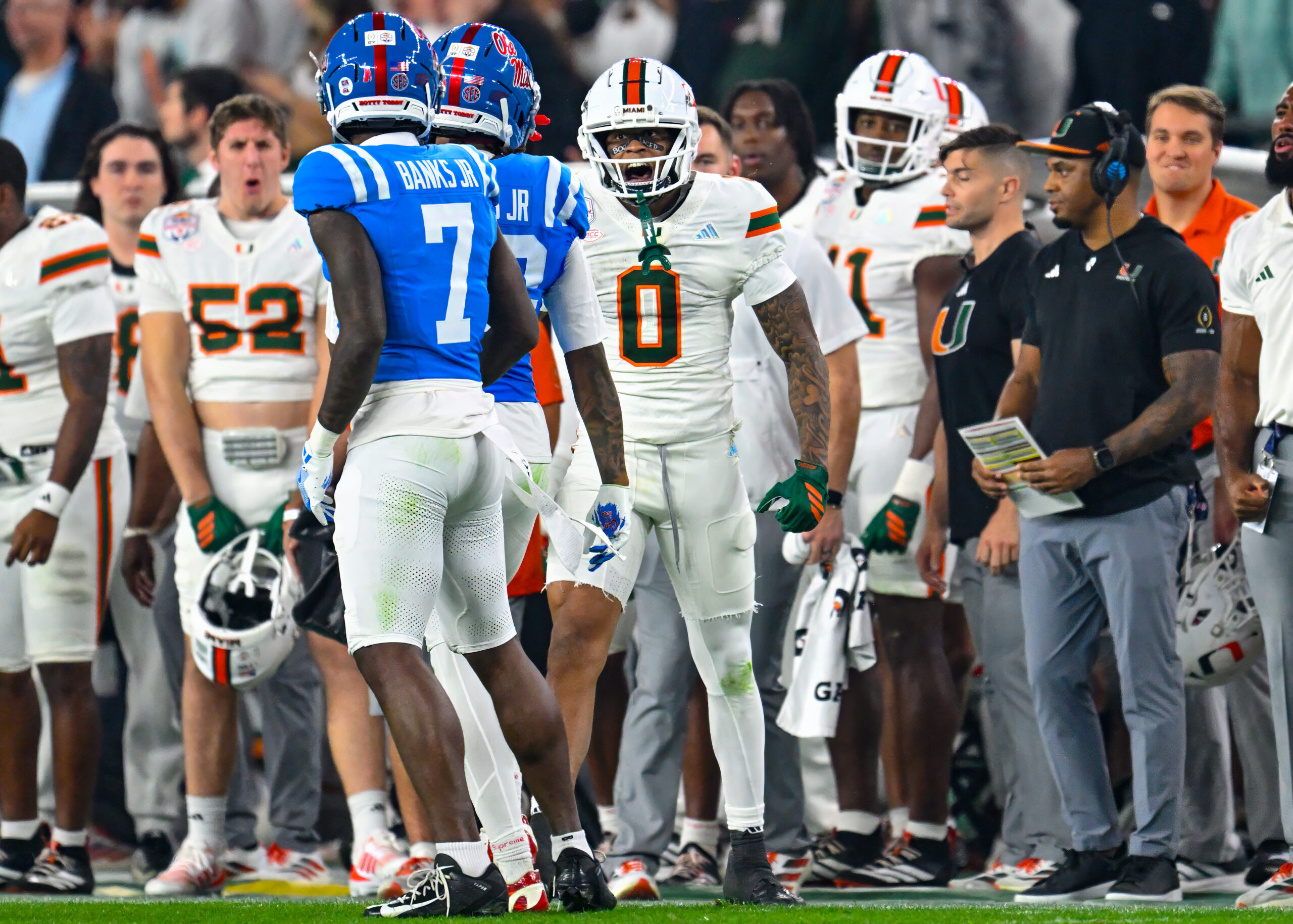
David Lebowitz, Staff Photographer – Freshman Wide Reciever Malachi Toney is fired up after a big punt return on October 26, 2025.

Miami welcomes back Art Basel for a colorful week

Every December for Art Basel, Miami turns into a temporary museum. But the works that pull me in most aren’t the canvases on the wall. It’s the installations that will line Miami Beach from Dec. 5 to Dec. 7 for Art Basel Miami 2025.

Coming from a live music and concert lover, I’m used to thinking about sound, light and bodies in motion, so when I walk into an installation, I can’t help but see it like a stage. 

The way a piece controls brightness, color, silence and noise feels similar to how a great show builds tension across a setlist: there’s an opening moment that sets the tone, a central emotional peak and a kind of visual “outro” that lingers even after you’ve stepped back into the hallway. 

At Art Basel and its satellite fairs, the installations that interest me most are the ones that understand this rhythm and treat viewers less like passive observers and more like an audience moving through a living artistic ecosystem.

That relationship between space and time is what makes installation work feel so alive. A painting waits for you. It assumes you’ll enter from a certain angle, maybe with your phone already in your hand. 

I’m fascinated by artists who lean into that chaos and design environments that choreograph how people move and interact. Ones that use soundscapes that pull you deeper into a room, lighting that slows down your pace, or architectural elements that force you to double back. 

In those moments, the work behaves like a venue, with built-in crowd control and intentional sightlines.

Part of why I’m drawn to this kind of art is that it feels like a way back to something I left behind. As a kid, I was always drawing, coloring and taking art classes, obsessed with filling sketchbooks and color-by-number pages. 

Visual art was the first language I learned to express myself in, long before I ever stepped into a club or a concert pit. But somewhere along the way — between school, work and the pull of music — I stopped picking up brushes and markers. 

I haven’t sat down with a coloring kit in years. Covering installations at Art Basel is, in a way, my way of reconnecting with that younger version of myself: the one who loved colors and shapes for their own sake.

Now, instead of creating the images myself, I’m interested in translating them,writing about how these immersive works feel from the inside. It’s beautiful to see how artists are using space, sound and movement as core materials. 

In a week often overshadowed by celebrity cameos and party lineups, I invite you to take a moment to appreciate the installations that quietly reshape how we move, feel and remember Basel. 

The state of athletics at UM following the NCAA House Settlement

0

Just like every other school with an NCAA athletic program, UM must sometimes make difficult decisions when choosing which sports to fund becomes increasingly more complex. 

One of the most recent and significant developments to college athletics is the July 2025 House Settlement, which allows schools to pay their athletes directly under a salary cap of 20.5 million dollars across their sponsored sports as they see fit.

This money will be paid out in addition to that already earned by athletes from NIL (name, image, and likeness).

Traditionally, football has warranted the most funding from schools due to its ability to bring in large amounts of revenue, suggesting that many schools may allocate a significant portion of the 20.5 million dollars to the gridiron pastime.

However, success in football doesn’t necessarily correlate with a lack of funding in other sports. 

“It needs to start from football because that’s how the system is structured,” said former UM women’s basketball coach Katie Meier. 

Meier led the Hurricanes for 19 years, which included an AP National Coach of the year in 2011 as well as 13 postseason appearances. Following her retirement in 2024, Meier is currently a special advisor to Dan Radakovich, UM’s athletic director.

Head coach Katie Meier takes a moment with junior guard Lashae Dwyer after Miami’s 73-59 win over versus NC State in the Watsco Center on Jan. 18, 2023. Photo credit: Jared Lennon

“Bigger investments can get bigger returns and then the returns can trickle down. It’s been a very supportive situation,” said Meier.

Traditionally, the “revenue sports” apply to football, men’s basketball and baseball, with women’s basketball joining the mix across the last decade.

Women’s basketball in particular has expanded massively in recent years with the emergence of superstars like Caitlin Clark and Angel Reese.

Teams competing in Women’s March Madness can now earn units for victories from the First Four through the Elite Eight, with the funds coming from a collective pot of $15 million that will increase to $25 million in the next three years.. 

Clark herself is estimated to have generated $82.5 million in consumer spending in the state of Iowa, where she competed for the Hawkeyes from 2020 to 2024.

Aside from those revenue sports, Miami’s non-revenue sports have been historically accomplished.

“There is a certain culture in Miami where you gotta earn your respect, and I think it’s been earned by our women’s sports,” said Meier.

Unfortunately, not all schools have been as equally invested in their non-revenue sports as UM. 

For example, following the House Settlement, Grand Canyon University cut its successful men’s volleyball program despite the program only having a budget of $300,000.

Many believe that schools like GCU are using the House Settlement as a scapegoat for getting rid of certain athletic programs, especially considering that many of these cuts have little to no impact on the relatively large value of $20.5 million that schools have in revenue share.

Regardless of what may be happening at other schools, Miami’s non-revenue sports have been flourishing in 2025. 

The University of Miami volleyball team celebrating their victory over rivals Florida State University on Nov. 5, 2025 at Knight Sports Complex

Women’s volleyball in particular has been impressive this season, jumping out to a 21-4 start under head coach Jose Gandara. 

“You’re on the edge of your seat the entire match,” said Meier in regards to Miami volleyball.

Another Hurricanes non-revenue sport that has made major headlines as of late is the men’s track and field team, which finished a program record 10th at the NCAA championships in 2024.

Some Olympic sports that have traditionally been labeled as “non-revenue” also have the potential to bring in significant amounts of money for their respective colleges. 

Besides the potential of some Olympic sports to make their schools money, they are also an integral part of the culture of both college athletics and student life.

“It’s a part of your collegiate experience. What an awesome way to make friends and to have a social event- it’s just incredible,” said Meier in regards to the value of college sports.

Despite all of these changes, there is no doubt that Radakovich, president Joe Echevarria, and the rest of the athletic department staff will guide the university towards a fair and equitable path for all student athletes.

Devoux Deysel throwing at the 2025 NCAA Men’s Javelin Championship on June 11, 2025 in Eugene, Ore. Photo credit: Miami Athletics

Hard Rock stadium food: what’s worth it and what’s not

There is one only thing that I love more than food: football. Pair those two together, and you have the perfect combination. 

The only problem? Hard Rock Stadium prices its food like you’re at a Michelin Star restaurant when it usually tastes like something you could buy from the frozen aisle at Publix. 

For years, I’ve missed out on the experience of eating good food during a ball game, and I’m sure many others feel the same way.

But ’Canes fans, fear no more. 

I took it upon myself to test some of the most popular foods at Hard Rock to determine what eats will satiate your game-day appetite and won’t leave your wallet with a dent in it.

Cuban sandwich

I grabbed a Cuban sandwich at a self-service storefront that flows smoothly, allowing you to scan your card at the entrance, grab an entree, fries, drinks and other snacks before walking out and having your card charged automatically.

I didn’t have high hopes for the Cuban sandwich. After looking at 20 of them sitting on the shelves, they did not scream freshly made to me. Luckily, I was wrong.

It tasted surprisingly good, and when paired with the fries, it made for a solid meal. This storefront is an efficient way to grab yourself a sandwich, fries and a drink before getting back to the action.

Considering the $10 price tag, it didn’t break the bank either.

Lobster roll and mac and cheese

I then moved on to the $35 lobster roll along with a  $10 side of mac and cheese. 

For almost $50, I thought this would be some of the best mac and cheese and lobster I’ve ever tasted, so I was prepared for a good meal.

Boy was I wrong.

Do NOT get the Lobster roll. It was cold, flavorless, and started to taste worse the more I thought about the price. The cooks tossed in a lemon on the side as if it would save the meal, but the little slice was nowhere near enough.

The mac and cheese was good, but it tasted like any other mac and cheese my mom used to microwave for me at night when she didn’t want to cook.

Overall, if this food was $10, maybe I would let it slide, but for $45, this was a disgrace.

Chicken shawarma  

My last hope to save my palate from the monstrosity I had previously encountered was the chicken shawarma. For $25, it felt a little pricey, but nowhere near as outrageous as the lobster and mac and cheese. 

Once I saw the food, I got excited. My wrap was built in front of me so it was nice and hot when I got it in my hands. 

From the first bite, it was delicious. It may have benefited from following the disappointing lobster roll, but it was genuinely delicious. It was flavorful, hot and hit the spot at the game.

If you’re ever at Hard Rock and you’re hungry, the chicken shawarma wrap is definitely the way to go.

While my dream of enjoying truly good food while watching my ’Canes once felt out of reach, this mission proved that Hard Rock isn’t completely hopeless. Sure, there are still some overpriced disasters lurking around the concourse, but there are also bright spots that can actually elevate your game-day experience.

The Cuban sandwich and fries offer a quick, reliable option if you’re trying to refuel without missing a single play, and the chicken shawarma is a standout that reminded me it is possible to eat something flavorful, hot and satisfying inside a stadium. It gave me a glimpse of what stadium food should be: convenient, tasty and worth the money you shell out.

My advice? Skip the hype items, stick to the winners and don’t be afraid to explore a little. Somewhere among the overpriced options, there actually are a few gems.

David Lebowitz, Staff Photographer/ A burger, chicken fingers, and fries on display at one of the various concession stands found at Hard Rock Stadium, November 15, 2025.

The dining hall disparities dilemma

0

Although freshman students pay the same price for a required meal plan, there are clear differences in the food options available in the freshman dorms. Freshmen living in Mahoney-Pearson face the same lackluster options day after day, while students in Centennial enjoy breakfast all day, fresh pastries, multiple entrée choices, a huge salad bar and a bread selection large enough to fill a bakery. 

The differences between Centennial and Mahoney-Pearson dining halls are astonishing. Centennial has variety, freshness and customization. Mahoney-Pearson has monotony — limited choices and food that feels like an afterthought. The solution isn’t complicated: either make the dining halls genuinely equal in quality and range, or adjust the meal plan pricing to reflect the difference.

“For us, equity in dining means ensuring every student — regardless of where they live, study or dine — has equal access to nutritious, culturally diverse and enjoyable meals,” said Michael Ross, the vice president of operations for UM Dining Services, in a statement to The Hurricane. 

Between classes, labs, extracurriculars and Miami’s extreme weather conditions, a 10-minute detour each way can mean missing a meal altogether. When your local dining hall consistently disappoints, you’re stuck choosing between convenience and nutrition.

The quality of a freshman’s dining experience, including cleanliness, food quality and available options, is determined by a random housing assignment. 

“Everything is spotless [at the Centennial Dining Hall], all the food is fresh,” said freshman Mahoney-Pearson resident Milena Hiza. “When you go to Mahoney-Pearson, the lettuce is brown. Even the water has a weird taste. My friend had a worm in her chicken one day, and my roommates saw a roach in the cookies.” 

Hiza also noted that the time it would take to go from Mahoney-Pearson to Centennial whenever she wants a quick bite is just unrealistic. 

“Am I really going to have the time to walk all the way to Centennial just to have a quick salad? Everyone’s so busy with clubs and classes, I just don’t see how it’s fair that some people have a great dining hall close by. As freshmen, we have to pay for the dining plan, and I feel like I’m throwing away my money.”

Complaints about Mahoney-Pearson are often dismissed with the explanation that Centennial residents pay more for housing. While this is true, students living in Mahoney-Pearson and Centennial pay the exact same amount for their meal plans.

. Mahoney-Pearson residents with dietary needs and restrictions are penalized with a 10-minute walk when they want food that their body is less likely to reject.

Match the meal plan to the dining experience. Make the food and the system fair. 

Until the food reflects the same standard across campus, students in Mahoney-Pearson are paying premium prices for second-tier meals, and that’s hard to swallow.