Home Blog Page 218

Canvas of diversity: Exploring the Black art experience at Art Basel Miami

Art Basel is an international art fair held in Basel, Switzerland and has expanded to Hong Kong, Paris and Miami Beach. From visual arts to concerts and panels, there are numerous events to attend during Art Basel weekend that’s sure to strike everyone’s interest.

I decided to investigate and display the Black art. It isn’t just a trend — it displays Black culture, history and celebrates the Black experience.

Hosted by the Wolfsonian-FIU Advisory Board, Tamara L. Harris and the Frankel family, the “Silhouettes: Image and Word in the Harlem Renaissance” exhibit marked the beginning of my Art Basel journey.

Transported to the Harlem Renaissance, an era in the 1920’s when African-American art flourished, “Silhouettes” captured the essence of collaborations between artists and writers at the time. Art was a safe space for them to express themselves.

This experience weighed heavily on my heart as the effects that slavery had on Black people spoke through every piece in the exhibit.

“The Negro Mother and Other Dramatic Recitations” by Langston Hughes and “Banjo” by Claude McKay stood out to me the most as they are two heartfelt books holding a mic to Black perspectives that were silenced at the time.

I gained a new level of respect for them — not because of their struggle, but because of their resilience and determination despite an overwhelming amount of constant hardship.

Gorgeous sculptures and portraits of Black people decorated the gallery.
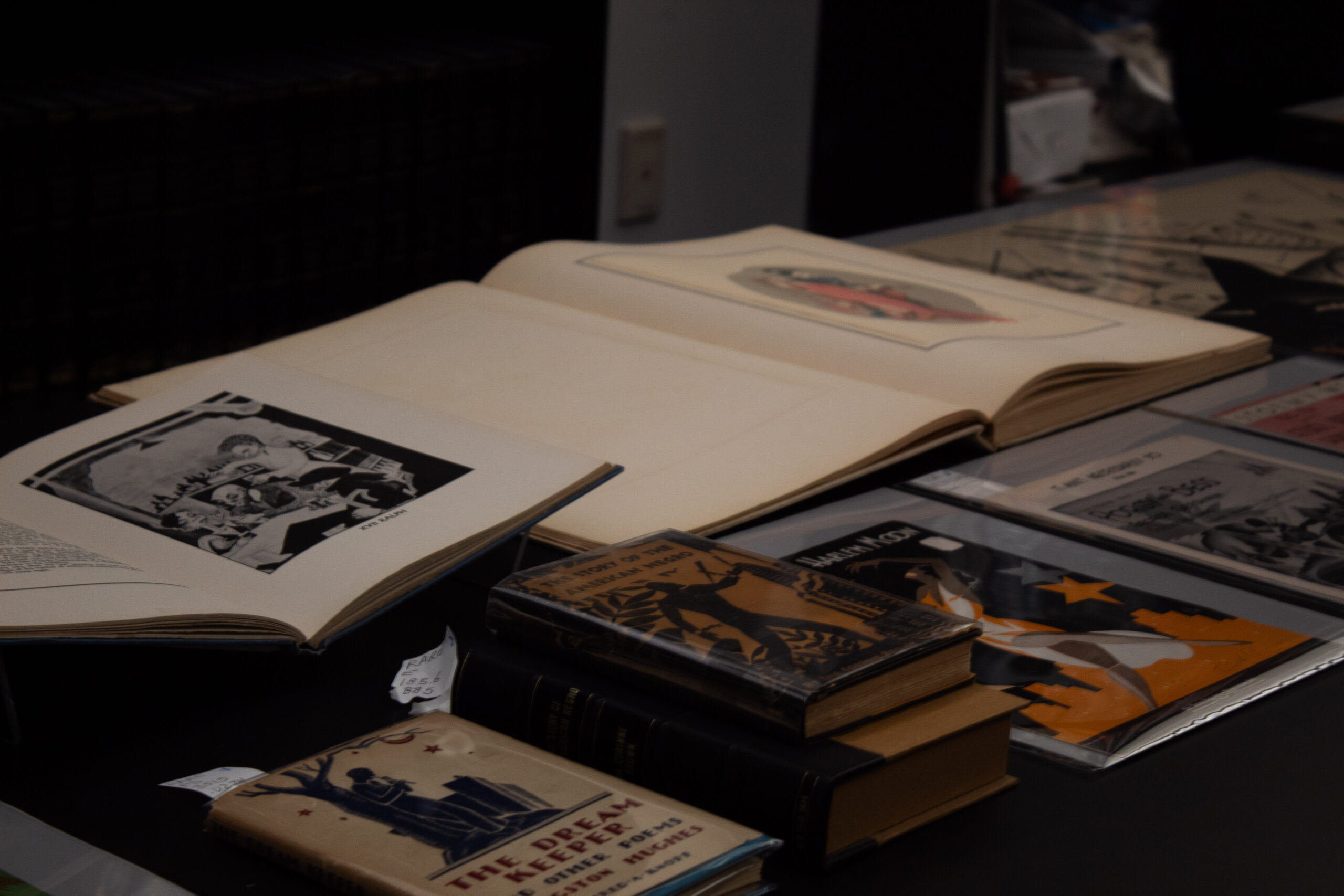
Art and music come together for Miami Art Week’s jazziest affair! The 1920s get a 2020s spin as Art Basel celebrates their newest exhibition, Silhouettes: Image and Word in the Harlem Renaissance, a century after the movement’s start and at the climax of Miami’s biggest cultural moment of the year, on a Friday night in Miami Beach.
The 1920s get a 2020s spin at the Wolfsonian-FIU exhibit, "Silhouettes: Image and Word in the Harlem Renaissance." Photo credit: Nicole Daitschman

Religious Christian books illustrated all figures with dark skin and dressed in common clothes instead of pale skin and wealthy garments. This enhanced the connection of religion in the Black community by making it more relatable.

I advise anyone interested in the “Silhouettes” exhibit to go in with an open heart and prepare to receive a newfound admiration for Black Art.

My evening ended with the “Basel Black Art Experience (B.A.E)” presented by Paramount and SocialXChange at The Urban, an event space located in Overtown. The event combined the display of contemporary Black art with interactive experiences like Karaoke with Jack Daniel’s and fun Insta-worthy photo-ops.

Paintings by Haitian artist Dorviller Olivier and Adonte Clark stood out to me. Both artists’ displays offered lenses of admiration for Black culture by emphasizing beauty and strategically leaving room for thought provoking conversations.

The comforting fusion of soul, R&B, Afrobeats, gospel, hip-hop, soca, reggae and dancehall music filled the dance floor in celebration of Black art.

The following day, I took on Wynwood — the artsy, hipster area known for its alluring nightlife. Between the celebrity appearances, big brand events and funky outfits pedestrians sported, it became abundantly clear to me why people travel from far and wide for this event.

Taking me right back to my hometown of Queens, New York, the Hip-Hop Museum Tour gave me all the nostalgic feels. The exhibit paid a huge homage to Hip-Hop pioneers like Run DMC, Roxanne Shante, and DJ Kool Herc. Fun keepsakes like Tupac’s original handwritten apology letter to his highschool sweetheart, Cosima Knez and Slick Rick’s Nitro Tour Throne decorated the halls of the museum.

Connecting us back to Miami, the 2 Live Crew display included a vintage Miami Hurricanes green satin bomber jacket accompanied with a thick gold chain, original records, concert tickets and newspaper clippings of court days. Before leaving, I got an airbrushed tattoo from Jazzy Faba, a special effects makeup artist who also did nail art for those interested.
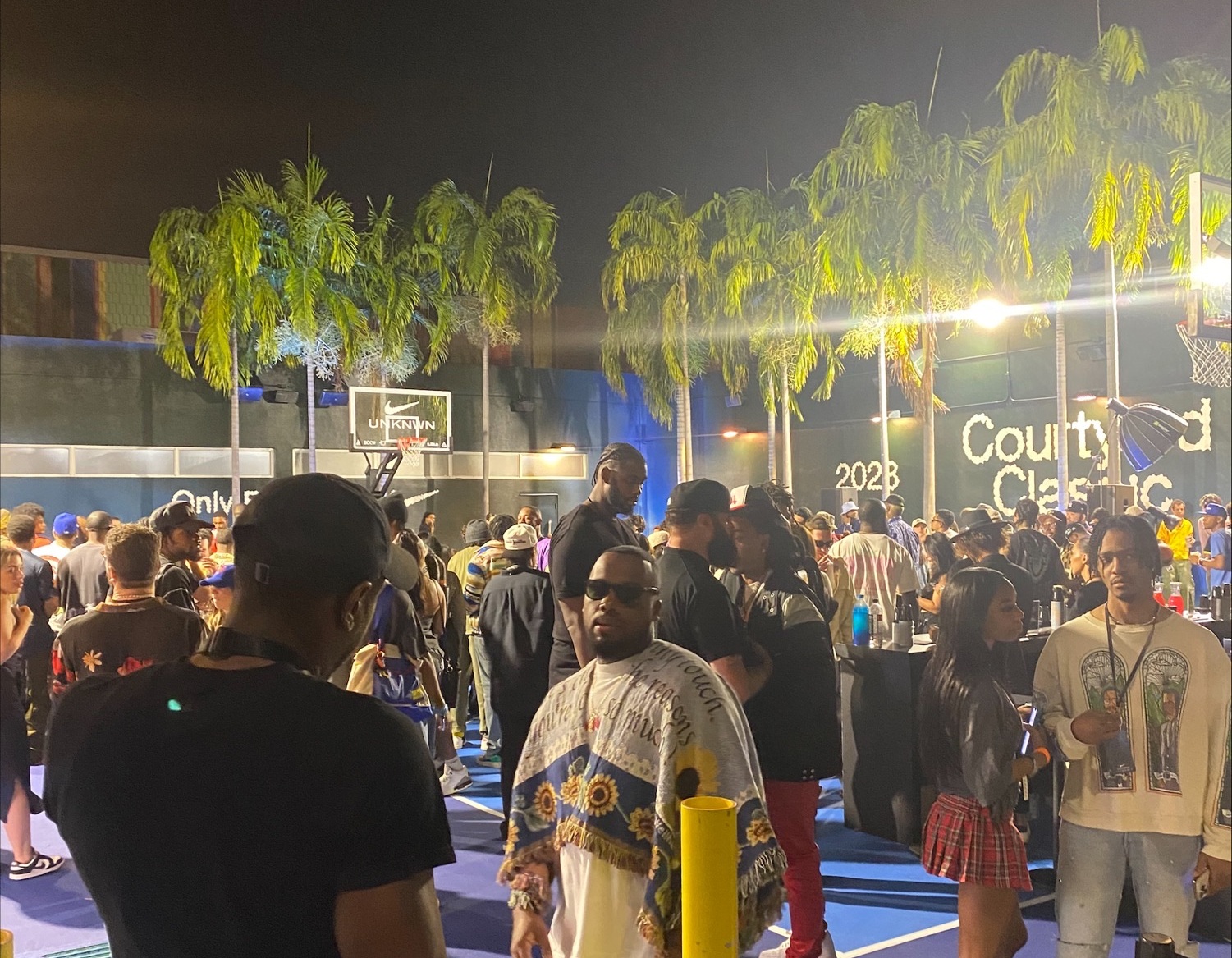
Visitors gather in the backyard basketball court at Unknwn, LeBron James’ clothing brand store, for the Courtyard Classic basketball tournament sponsored by D'usse.
Visitors gather in the backyard basketball court at Unknwn, LeBron James’ clothing brand store, for the Courtyard Classic basketball tournament sponsored by D'usse. Photo credit: Laralyn Jackson

In between stops, I caught a glance of a Courtyard Classic, a basketball tournament sponsored by D’usse in the backyard court at Unknwn, LeBron James’ clothing brand store. Players engaged in street ball while prospects gathered to celebrate.

I also spotted the Museum of Graffiti and the Hip-Hop Museum — not to be confused with the Hip-Hop Museum Tour pop-up — which both had amazing Art Basel events like breakdancing presentations and appearances from Rick Ross, Will Smith and DJ Khaled.

My final stop was Everyday People, an internationally-known live music event experience that celebrates diversity. Hosted at Oasis, a cultural hub down the street from the museum, people from different backgrounds gathered, danced and sang until the sun came up.

Chance the Rapper and influencers Denzel Dion and Ricky Thompson were all spotted at the venue soaking up the thrilling atmosphere. I’ll never forget the fashionable trio of Joe aka “ThatTrendGuy,” Cordell Allen and Jahar Armani serving stylish, fashion forward looks with pride embodying the essence of Art Basel — celebrating artistic expression.

As a first-timer, I did not know what to expect from Art Basel Miami. Nothing could’ve prepared me for this sensational experience that I’ll remember forever. Black art should be celebrated every day, and I hope to see more representation in the years to come.

Last-minute flips highlight Miami’s ACC-leading recruiting class

0

Christmas may fall on Dec. 25, but for Miami Hurricanes fans, the holiday came five days early as the ‘Canes put together a second consecutive top-10 recruiting class on Early National Signing Day. With big names abound and plenty of last-minute drama, let’s look at how head coach Mario Cristobal has continued to shape Miami’s roster through this year’s recruiting class.

Continued dominance on the defensive line

Miami relentlessly pursued its top two recruits, five-star defensive linemen Justin Scott and Armondo Blount, despite the highly coveted players initially committing to Ohio State and Florida State, respectively. The team’s efforts paid off, as Scott flipped in late November, and Blount chose the ‘Canes over the rival Seminoles on Wednesday evening.

“Justin is a massive, massive man,” Cristobal proclaimed. “About as explosive as you can be for a big man.”

The defensive duo, who weigh 560 pounds, are joined in the trenches by DL Artavius Jones and edge rushers Marquise Lightfoot, Booker Pickett Jr., and Elias Rudolph. All four players are considered four-star recruits by 247Sports.

“All these guys are relentless. All these guys play with a high motor,” Cristobal raved. “They’re really good technically.”

Miami’s defensive line was stout this past season, highlighted by Leonard Taylor III and ACC Defensive Rookie of the Year Rueben Bain Jr. But with Taylor departing the program in pursuit of the NFL Draft, the ‘Canes brought in more than enough high-end talent to remain dominant in the trenches.

Replenishing the offense

Though the most prominent names of Miami’s recruiting class were in the trenches, the ‘Canes also made waves at the offensive skill positions, bringing in four-star players at running back, wide receiver, and tight end.

Jordan Lyle, a six-foot runningback out of Fort Lauderdale, followed in the footsteps of future teammate Mark Fletcher Jr., committing to Ohio State but ultimately flipping to Miami precisely one year after Fletcher did the same. Lyle amassed 2391 rushing yards and 34 total touchdowns in his past two high school seasons, averaging over 10 yards per carry.

“Two guys that just amassed a massive amount of yardage this year,” Cristobal said of Lyle and three-star back Chris Wheatley-Humphrey. “Really talented, really intelligent, high IQ guys both on and off the field.”

Lyle and Wheatley-Humphrey join a crowded Miami backfield that features Fletcher, Henry Parrish Jr., and Ajay Allen, who combined for 1441 yards last season. Donald Chaney Jr., who was third on the team in rushing yards this past season, officially transferred to Louisville on Dec. 16.

The ‘Canes hoped to flip wide receiver Jeremiah Smith, the nation’s top recruit according to 247Sports, from Ohio State. However, the Hollywood, FL native signed a letter of intent with the Buckeyes on Wednesday. Since the effort will not come to fruition, Miami still bolstered its receiving corps by bringing in three four-star receivers: Ny Carr, Joshisa Trader, and Chance Robinson.

“They’re human highlight films,” Cristobal gushed. “That room just took a monstrous step in the right direction.”

Miami’s receiver room is set to take a hit with junior Colbie Young, who was third on the team in receiving yards, entering the transfer portal. Furthermore, Xavier Restrepo’s future is still in the air; the sure-handed slot receiver, who paced the Hurricanes in both receiving yards and receptions this past season, could enter the transfer portal or declare for the NFL Draft. But no matter Restrepo’s fate, Miami took a significant step toward restocking its receiving corps.

Miami added six-foot-two tight end Elija Lofton to cap off the offensive haul. “As versatile a football player as I have ever seen,” Cristobal said, praising the four-star pass-catcher out of Las Vegas.

Unlike its receiver group, Miami’s tight end room was largely underwhelming this past season—four players combined for 141 yards on 17 receptions. Last year’s starter, Cam McCormick, was granted a ninth year of eligibility but has yet to commit to another season. Whether or not McCormick, about a month older than six-year NFL starter Tremaine Edmunds, returns, the hope is that Lofton and former four-star recruit Riley Williams can bring more excellent production to a position synonymous with Miami football.

The quarterback remains up in the air

The quarterback position was arguably Miami’s most significant weakness this past season, with longtime starter Tyler Van Dyke struggling after a hot start to the year. Van Dyke was ultimately benched in favor of freshman Emory Williams, who showed flashes before suffering a season-ending injury against Florida State.

Van Dyke is transferring to Wisconsin, and Williams’ timeline is still unclear. Thus, many eyes have turned to the transfer portal, where the Hurricanes have been linked to several high-profile targets.

The team’s convoluted quarterback situation has many names to follow, which means the signing of three-star signal-caller Judd Anderson may have gone under the radar. Anderson, who stands at a colossal six-foot-six, put up gaudy numbers this past season. In 13 games for Warner Robins, he completed nearly 74 percent of his passes for 2917 yards and 30 touchdowns.

“Judd Anderson impresses from day one with a couple of different things,” Cristobal remarked. “It’s hard to do that: that many yards, that type of completion percentage, that many touchdowns, natural leadership skills and just flat-out tough.”

However, Anderson is a raw prospect: the prior season, he completed only 56 percent of his passes while throwing 13 interceptions and only 15 touchdowns. The Hurricanes will likely add a more experienced passer in the next few weeks.

“Obviously, the transfer portal is something that we’re going to be very active in,” Cristobal stated. “We’re not done yet.”

Miami flips top defensive lineman back home

0

He’s back.

Armondo Blount, a composite five-star prospect and the 40th overall prospect in the class of 2024, according to 247Sports, has flipped his commitment from Florida State to head coach Mario Cristobal and the Miami Hurricanes on Wednesday evening.

Blount was originally committed to the ‘Canes before flipping his commitment to the Seminoles. Blount also reclassified to the class of 2024 after being in the class of 2025.

Hailing from Miami Central (Fla.) High School, Blount totaled 30 tackles for loss and 16 sacks last year at Dillard (Fla.) and helped lead the Panthers to a second-round appearance in Florida’s 3M playoffs.

Blount played varsity football as an eighth grader. The Miami native earned MaxPreps Freshman and Sophomore All-American honors. Blount is known for his speed and plethora of pass-rushing moves. While Blount may need to add some weight, he has the potential to be an impact player as a freshman for the ‘Canes.

Blount joins another five-star defensive lineman in Justin Scott, who recently flipped his commitment from Ohio State to Miami. Two of the top four defensive linemen in the class of 2024 are now committed to the ‘Canes.

Those two join an elite group of defensive linemen that includes the likes of four-star prospects Marquise Lightfoot, Artavius Jones and Booker Pickett Jr. This group of commits is among the best in the nation. With Rueben Bain, Jr., the ‘Canes have the makings of one of the best defensive lines in the country.

Blount is the cherry on top of the best recruiting class in recent UM history. Cristobal may not be done either, as the ‘Canes are working to flip a few more high-profile recruits ahead of the early signing period, which begins on Dec. 20.

UM breaks the trend as antisemitism rises on college campuses

October 7, 2023, was supposed to be a day of celebration for the Jewish people. Instead, one of the most sacred Jewish holidays became a day of indescribable horror as Hamas terrorists launched a surprise attack on Israel massacring children, raping women and kidnapping innocent civilians.

Even before the Israeli military invaded Gaza, the deadliest day for the Jews since the Holocaust triggered an outbreak of antisemitism, notably at many colleges throughout the U.S.

A new study from the Anti-Defamation League and Hillel International found that 73% of Jewish college students have experienced or witnessed antisemitism on campus since the start of the 2023-2024 school year. That’s more than double what a study of prior years showed.

The consequence, according to the ADL study, is a sharp decline in the number of Jewish students who feel safe, physically and emotionally, on campus. Before Oct. 7, 67% of Jewish students felt safe physically, and 66% emotionally. Those percentages have plunged to 46% and 33%, respectively.

In testimony before Congress on Dec. 5, 2023, FBI Director Christopher Wray confirmed that hate crimes have soared by 60% across the U.S. since the Hamas massacre, with “the biggest chunk of those” being antisemitic. In October, Wray told lawmakers that antisemitism was reaching “historic levels” as “the Jewish community is uniquely targeted” by terrorists. He added that Jews, who account for only 2.4% of the U.S. population, account for about 60% of all religious-based hate crimes.

The University of Miami has proven to be a notable exception among college campuses with Jewish students feeling comfortable walking to class as their University administration spoke out against the Hamas attack and antisemitism. On Oct. 9, two days after the attack, Hillel arranged a vigil in support of Israel.

“It had over 600 people. I felt extremely safe. I felt unity within the Jewish community and the greater Miami community,” said Sofia Bronstein, a freshman majoring in legal studies and finance.

In the months following the attack, student organizations such as Chabad, Hillel, and Students Supporting Israel have held multiple pro-Israel events.

Joia Intrator, a sophomore majoring in computer science, spoke on her experience as a board member of SSI. “I’m proud to be part of SSI. We have done so many amazing things as an organization since October 7th.”

In addition to the student-led groups being quick to respond, UM’s leaders showed support for Israel early on.

“I think the University has responded amazingly, a few days after Julio Frenk sent out such a supportive email that condemned Hamas and supported Israel and made it clear that he was there for his Jewish students,” Intrator said.

President Frenk and his administration went even further. In late November at an event at UM Hillel, he addressed antisemitism on campuses today.

“The attack and targeting of innocent civilians by a terrorist organization violated a foundational value of universities everywhere: to promote knowledge and understanding as a way of resolving complex issues,” Frenk said.

The immediate and absolute condemnation that Frenk displayed is in stark contrast with many leaders at elite universities who were slow to denounce Hamas and antisemitism forcefully.

Two weeks ago, at a congressional hearing, the presidents of Harvard University, the University of Pennsylvania and the Massachusetts Institute of Technology refused to give straightforward answers to questions when asked if they would discipline students who called on campus for the genocide of the Jews. The commotion that followed has already led to the resignation of Penn’s president.

“The Brown [University] administration has been better than the other elite universities we have seen in the news,” Gabriel Burstyn, a freshman at Brown University, told The Miami Hurricane. “However, this is not a high bar and Brown could do better. The university has done nothing to stem the growth of anti-semitic rhetoric on campus.”

Brown has faced a series of antisemitic incidents in recent years, including swastikas carved into desks and a note at the Brown Hillel calling for the gassing of Jews and praising Hitler.

Columbia University has faced a series of antisemitic incidents since the start of the Gaza war. Manhattan’s district attorney has charged a suspect in the assault of an Israeli student on campus, a swastika was found on a bathroom wall, and students say they’ve been subjected to antisemitic slurs. Columbia is among a half dozen colleges now under investigation by the federal government. In response, the university has created a task force on antisemitism and suspended some anti-Israel groups.

“Directly following the horrific terrorist attacks on Israel on October 7th, prior to any IDF retaliation, many groups at Columbia posted statements that blamed Israel for October 7th,” said Shmuel, a Columbia Law student who prefers to be identified solely by his first name. “An event last week took place in the School of Social Work that was titled ‘Significance of the October 7th Palestinian Counteroffensive,’ with a gun on the flyer.”

While the FBI has indicated that antisemitic incidents are greater in number, Islamaphobic incidents are also on the rise, with students who are Muslim and Palestinian reporting increased harassment.

“We at the Department of Education, like the nation, see the fear students and school communities experience as hate proliferates in schools,” Catherine E. Lhamon, assistant secretary of civil rights for the department, told the Associated Press.

The department says it is taking “aggressive action” against discrimination and that schools that have violated civil rights laws could face penalties.

Miami lands its new center in Indiana’s Zach Carpenter

0

As Matt Lee did before him, Zach Carpenter commits to the Miami Hurricanes to fill the void at center.

Carpenter comes from the University of Indiana, where he played four seasons for the Hoosiers. The Cincinnati, Ohio native picked Miami over offers from North Carolina and Maryland. The redshirt junior will have one year of eligibility remaining. Head coach Mario Cristobal had contact with Carpenter very early on and was in constant contact with him throughout the transfer process.

Last season, Carpenter earned a 71.8 pass-blocking grade and a 61.0 run-blocking grade from Pro Football Focus (PFF). Carpenter also allowed eight pressures and three sacks as a fifth-year redshirt junior in the Big Ten.

At 6-foot-5 and 295 pounds, Carpenter is considered a high three-star transfer by 247Sports. Carpenter is the third transfer this cycle. Cristobal and the ‘Canes have also added N.C. State defensive lineman C.J. Clark and Vanderbilt safety Savion Riley in the past week.

With Miami left tackle Jalen Rivers announcing that he will return for another year, there are fewer question marks with the ‘Canes offensive line. Miami will have the right side of the offensive line back in guard Anez Cooper and tackle Francis Mauigoa. Now, with Carpenter in the fold, only the left guard spot remains void. Expect freshman Matthew McCoy to get an extended look in that spot during the bowl game.

The New “Tomorrowland”: School of Architecture to develop Silica City in Guyana

The idea of “Tomorrowland” has traditionally been one of sci-fi novels – a futuristic city that serves as a hub of technology, commerce and sustainability. This era of smart cities may now finally take place, and the University of Miami’s School of Architecture is already charting the course in Guyana.

The roots of Silica City, the name of this soon-to-be village, were planted over nine months ago through a dialogue with the government of Guyana and UM’s administration. The plan aims to prioritize the integration of industrial, digital, biomedical and AI sectors within its urban fabric, all within an 11,000-acre area near the Guyana International Airport.

As recently as Nov. 22, President Julio Frenk met with President of Guyana Irfaan Ali alongside other UM colleagues and officials to refine the goals of the project ahead and sign an agreement for the collaboration.

School of Architecture Dean Rodolphe el-Khoury, one of the main leaders behind this endeavor who also attended this meeting, shared insights into the origins and unique opportunities presented by the avant-garde project.

“Cities around the world are being transformed by the introduction of new technology. They are becoming more responsive and resilient, with a capacity to respond to data collected in real time,” said el-Khoury. “The difference here is the potential for integrating new technology and best practices in sustainable and resilient design into the plan of the city from the outset. So we are not retrofitting, but rather building in this new functionality and capacity into the very foundations of the city.”

Professor Jose Gelabert-Navia, leading an exploratory design studio course, also played a pivotal role in initiating this vision. His specialties in Latin American architecture as well as architectural history, world art, and globalization each aligned with the project’s overall niche.

“When the dean asked me to help lead the effort, I thought it was an extraordinary opportunity because this project has allowed us to introduce ourselves to the government of Guyana,” said Gelabert-Navia. “If all goes well, there is an opportunity for really developing long-term relationships and collaborating on more meaningful projects.”

The Guyana Innovation Group acted as the catalyst for this collaboration, with one of its members, Rodrigo Arboleda, on the Dean’s Advisory Committee of the School of Architecture. The partnership reflects the University’s commitment to pushing the boundaries of architectural exploration and fostering sustainable development on a global scale.

Guyana is also home to the fastest-growing economy globally according to the BBC, with over 11 billion barrels of oil being found within the region in the past decade. It has also gained the attention of many Fortune 500 companies with the development of another, smaller smart neighborhood, Innovation Village.

However, there are some concerns that pose obstacles ahead as Guyana continues to develop its newfound wealth. The country’s oil-rich neighbor, Venezuela, has begun initiatives attempting to exploit Essequibo, the Guyana region where its oil and gas mines are located.

The global trend to turn away from fossil fuels and achieve “net zero” greenhouse gas emissions by 2050, in accordance with the Paris Agreement, is also a concern for the Guyana government hoping to capitalize on this newly discovered resource.

But despite these concerns, UM and the government of Guyana are excited for what the development of Silica City means in terms of being one of the first hubs in the world to prioritize the industrialization of AI and sustainability, both of which are rapidly-advancing sectors in the global economy.

“What is interesting to us is, like a lot of the oil rich countries in the Middle East, they already have realized that eventually these fossil fuels are not exactly the best things,” said Gelabert-Navia.

“And the fact that they have the riches, but they also have the danger of actually doing more damage to the planet is an interesting line to walk. So they want to do this city as a model city, and that’s where we come in. There’s no equivalent to this anywhere else, and we have a unique opportunity to help them with this initial effort.”

According to el-Khoury, UM aspires to go beyond simple innovation, instead becoming a leading contributor to global advancements. By building a city designed for the future, the University positions itself at the forefront of urban development at a level usually reserved for other national governments.

Within the ambitious framework of Silica City, the School of Architecture has several ideas aimed at reshaping fundamental aspects of urban living, extending into housing, education and healthcare.

“Silica City allows us to rethink healthcare on a vast scale, optimizing the built environment for sustaining health and well-being,” el-Khoury said. “You can sense the swelling wave and it’s a pleasure to be part of it, especially given the attention of the government to issues of social and environmental justice. There is a great deal to be done during this period of growth, and it’s important that we do it right.”

As Silica City’s design process begins, the interdisciplinary team is being assembled, featuring students, faculty, research staff, and external consultants. Dean el-Khoury anticipates the involvement of various UM units, drawing on expertise from civil engineering to public health.

Professor Gelabert-Navia argues that as the dream of Silica City begins to materialize, it symbolizes not only architectural innovation, but a testament to the fusion of academia, sustainability and global cooperation.

“The unique opportunity we have is coming in as a mindful collaborator,” said Gelabert-Navia. “Because we’re an educational institution, we’re not there to make money off of them. We’re offering them what they want, which is ultimately a collaboration where they can move forward. I’m hoping it’s a win-win for everyone involved.”

“Land is Medicine”: How indigenous practices shape modern healing

Society continues to emerge at the end of various global health crises with improved approaches to medicine that have revolutionized our health and well-being. Yet, the Native American influence on the origins of modern medicine is often overlooked.

Indigenous culture traditionally holds a deep respect for nature, and the use of medicinal plants has a centuries-long history within many indigenous communities.

Dr. John C. Burnett, an associate professor of microbiology and immunology at the Miller School of Medicine and a citizen of the Muscogee Nation, discusses how deeply ingrained this natural approach to medicine is within indigenous roots like his own.

“In our tribe, medicines are considered sacred and should only be shared with fellow citizens — in some cases, exclusively with citizens from the same tribal towns or clans,” Burnett said. “I have a Muscogee friend who is a PhD ecologist, and she says, ‘Land is medicine.’ I think this is a common attitude of Native people, especially those who grew up on reservations or in rural areas.”

The natural world and its resources have been the foundation for various life-saving medical advancements. Medicinal plants, which contain natural therapeutic properties when properly harvested, have been used as remedies all over the planet.

According to Frontiers in Pharmacology, over 80% of people around the world rely on an aspect of medicinal plants within primary care, and roughly 40% of pharmaceutical drugs found in Western medicine derive from these plants.

For instance, salicin, most often found as salicylic-acid in face wash or Aspirins, is one of the most common ingredients used today that originates from a medicinal plant. Salicin has traditionally been extracted using the Native practice of chewing on willow bark for pain relief.

The development of baby formula, which serves as a replacement for breast milk for mothers, can be attributed to the Iroquois tribe. This ancient formula used the crushed natural ingredients of corn, water and nuts to feed infants.

Perhaps the most critical medical creation by Native Americans is the syringe, which was originally constructed with hollow bird bones and animal bladders for the injection of natural remedies.

Indigenous practices also place a large emphasis on achieving balance in life through a harmonious relationship between the body and mind. The belief that healing physically can be done by way of spiritual healing is a pioneering factor of mental health.

Various Native tribes around America take part in traditional healing ceremonies, which promote this sentiment and reinforce the unified approach of healing in a community setting.

Dr. Raymond I. Orr is a professor of political science at UM and the co-director of the Native American and Global Indigenous Studies Program (NAGIS). He is also a citizen of the Potawatomi Nation, and reflected upon the Native belief of community healing as opposed to isolation.

“A body of compelling research shows that meaningful and regular social ties are protective factors against many of our widespread maladies and early death,” Orr said. “These connections will likely generate a richer existence.”

Without actively searching for where modern medicine originated, Native assistance in Western medical development falls unseen.

“Native peoples are rarely acknowledged as contributing to our contemporary world,” Orr said.

The overshadowing of their ancestral contributions, paired with a systemic undervaluing of Native peoples within the U.S. healthcare system, reflects a failure to uphold the obligation that the federal government has for the Native American population and its descendants.

“This is called ‘the trust responsibility’ and goes back nearly two hundred years when Native lands were taken without equal compensation,” said Orr. “Health is a key part of this.”

A 2022 data release by the National Center for Health Diseases stated the life expectancy of American Indian and Alaska Native people is over 10 years shorter than the national average. Alcohol-induced deaths remain among the most frequent, and indigenous communities experienced the largest uptick in suicide rates from 1999 to 2017.

These rates can be attributed to a history of lost community ties and land as a result of European colonization, as prior to their forced removal from their land, alcohol was primarily used in a ceremonial and sacred context. Suicide rates have increased due to social detriments, such as pressure to assimilate and grow further from their heritage.

Accessible health clinics remain underfunded within Native communities as well, and they are often hard to find in proximity to reservations, pushing Native residents to move to urban areas in order to find support.

“It’s no surprise that physicians aren’t lining up to work on reservations, but there is also a failure to get tribal citizens into the healthcare workforce,” Burnett said. “The only way to reach Native communities is to improve the numbers of Native students in the biosciences and healthcare.”

Despite the COVID-19 pandemic having a disproportionate and heighented impact on Native communities, their sense of community allowed for a strong response to the virus.

“My parents were able to get the vaccine at a Muscogee Tribal clinic before they could have elsewhere in Oklahoma, simply because the tribes acted quickly and efficiently to distribute their inventories, while the same states, particularly with COVID-denying governors, dragged their feet,” said Burnett.

Barriers to health and medical resources – such as underfunding and scarce access to health clinics in tribal communities – prevent Native citizens from experiencing their ancestral contributions to modern medicine.

Recent pushes for improved care of Native Americans have been made, with national advocacy reflected in the Biden-Harris Administration’s efforts for better overall resources in these communities. Although there is still work to be done, these recent strides are paving the way for a more accessible future for Native communities to reclaim their place in the medical field.

Skin to Skin: Getting to know UM’s new dermatology club

Despite the allure of year-long summers and poolside views, ‘Canes often overlook the harmful effects of the damaging rays they soak up. Even more concerning, late-night junk food and unremoved makeup after a long night out contribute to the skin damage that comes with a typical college lifestyle.

Yet Skin to Skin, one of the newest clubs at the University of Miami, focuses on creating a space for students to gain a deeper understanding of their skins’ needs.

Through speaker events and workshops, the organization focuses on educating its members on the importance of daily rituals and updated skin care practices, as well as educating the future generation of dermatologists on how to develop a successful career path.

Julia Sarama, the president of Skin to Skin, started the club as early as January of this year as a result of her own skin concerns as a college student.

“My journey with my skin has been one of the largest influences on the person I’ve become,” said Sarama. “Growing up I was really insecure, and now it’s what has given me purpose to create Skin to Skin.”

Sarama also emphasized the importance of bringing attention to skin care, especially living in Florida, where sun exposure is constant.

“Experiencing a year-round summer at the University of Miami is easily one of the most loved aspects of being a student here,” Sarama said. “And while every person experiences UV rays regardless of the season or their location on the map, living in Florida does put you at an increased risk for developing skin cancer. Florida’s low latitude contributes to us getting more UV radiation than the rest of the US, and therefore, without proper protection, it is easy to put yourself in harm’s way.”

Many students are known for focusing on aesthetics and beauty standards, whether online or in their daily habits, and tanning is a particularly important part of this culture.

However, according to the City of Hope Cancer Center, about one in five Americans will develop skin cancer in their lifetime. The increased melanin produced by the skin when tanning is often the body’s protective response to UVA radiation, and too much exposure to these UV rays put many at a greater risk of the deadly disease.

“From my understanding, there are two major reasons why skin cancer is an issue: lack of education and societal beauty standards,” Sarama said. “And some refuse to take it seriously because they feel more confident with a tan. I have felt the latter before and once I became more educated on the matter, I understood that serious health concerns outweighed any sort of aesthetic pressures I felt.”

In order to bring awareness to topics such as skin cancer prevention and overall skin health, local dermatologists are often invited by the new student organization to speak on these issues.

For instance, during a club meeting on Nov. 6, board-certified dermatologist Dr. Barry Resnik spoke with Skin to Skin members and debunked common skin care myths, specifically in regards to sunscreen, skin cancer and aging. Having completed his residency at UM and serving as the medical director for the Resnik Skin Institute in Aventura, Resnik also gave some general advice to prospective dermatology students as to how to proceed in their career.

“My dad was a dermatologist and I would go around and do his rounds with him. I learned how to take warts off of him in high school and I read lots of articles about dermatology. Dermatology is a wonderful profession, I get to deal with very sick people and I get to help people and make a difference. But, if you’re gonna be a physician you are gonna have to work for a really long time and have to work even more to get into residency, the idea of work-life balance isn’t realistic if you want to be a doctor,” said Resnik.

Skin to Skin also hopes to get the UM community at large more involved in the practice of protecting their skin. According to Sarama, one of the ways the new club hopes to promote better skin care practices among students is with their latest fundraiser to implement sunscreen dispensers on campus.

“On campus would be the place to start in order for more students to gain awareness of the daily exposure we face,” said Sarama. “It may not seem like you are affected now, but skin damage sneaks up on us and shows with time.”

With successful fundraising, this new program will target a major point for most dermatologists: reapplying sunscreen. Not only would the implementation of these dispensers put skin care at the forefront of most students’ minds, according to Sarama, but it would also begin to help students start thinking about how to better take care of their skin in additional ways.

Skin to Skin is especially dedicated to disproving other common myths and harmful stereotypes that sometimes come with certain skin concerns and practices. For instance, according to a study published in the National Library of Medicine, the lack of skin cancer education has disproportionately impacted many people of color, with the estimated five-year melanoma survival rate being 70% for Black patients and 94% for white patients.

“There is a misconception that exists that people of color are immune to skin cancer,” said Sarama. “Because of a lack of skin cancer education, more minorities die of skin cancer than white people as a result of the delays in detection. Stigma and lack of education kills people and it’s our responsibility to make sure people are aware of this.”

As seen with Skin to Skin’s mission, students like Sarama hope to go far beyond the superficial allure of skincare trends and aesthetically-pleasing products. It’s a dedicated pursuit of a greater cause—one that confronts harmful stigmas, educates others on cancer-preventing practices and prioritizes holistic skin health for the student community.

Poplar scores career-high 25 to lead Miami past La Salle

0

Guard Wooga Poplar scored a career-high 25 points as No. 24 Miami stopped a late La Salle comeback for an 84-77 win on Saturday afternoon at the Watsco Center.

The Hurricanes went up 18 points in the second half and led for all but 23 seconds of the game, but the Explorers clawed their way back. With less than five minutes remaining, Miami’s lead had evaporated to four.

The ‘Canes relied on free throws, making 11 down the stretch, to secure the win. Poplar also hit a crucial three-pointer at the 6:27 mark after La Salle had cut it to six.

“[La Salle] got up by 18, and not only didn’t they put their heads down, they kept fighting and coming back … and then we showed some resilience,” Miami head coach Jim Larrañaga said. “And Wooga’s 3 was the dagger.”

Poplar, originally from Philadelphia, went 9 of 16 from the field against his hometown school, and forward Norchad Omier added 23 points. Guard Matthew Cleveland contributed a team-high nine rebounds. The ‘Canes shot 57.1% from the field as a whole and outrebounded the Explorers 39-25.

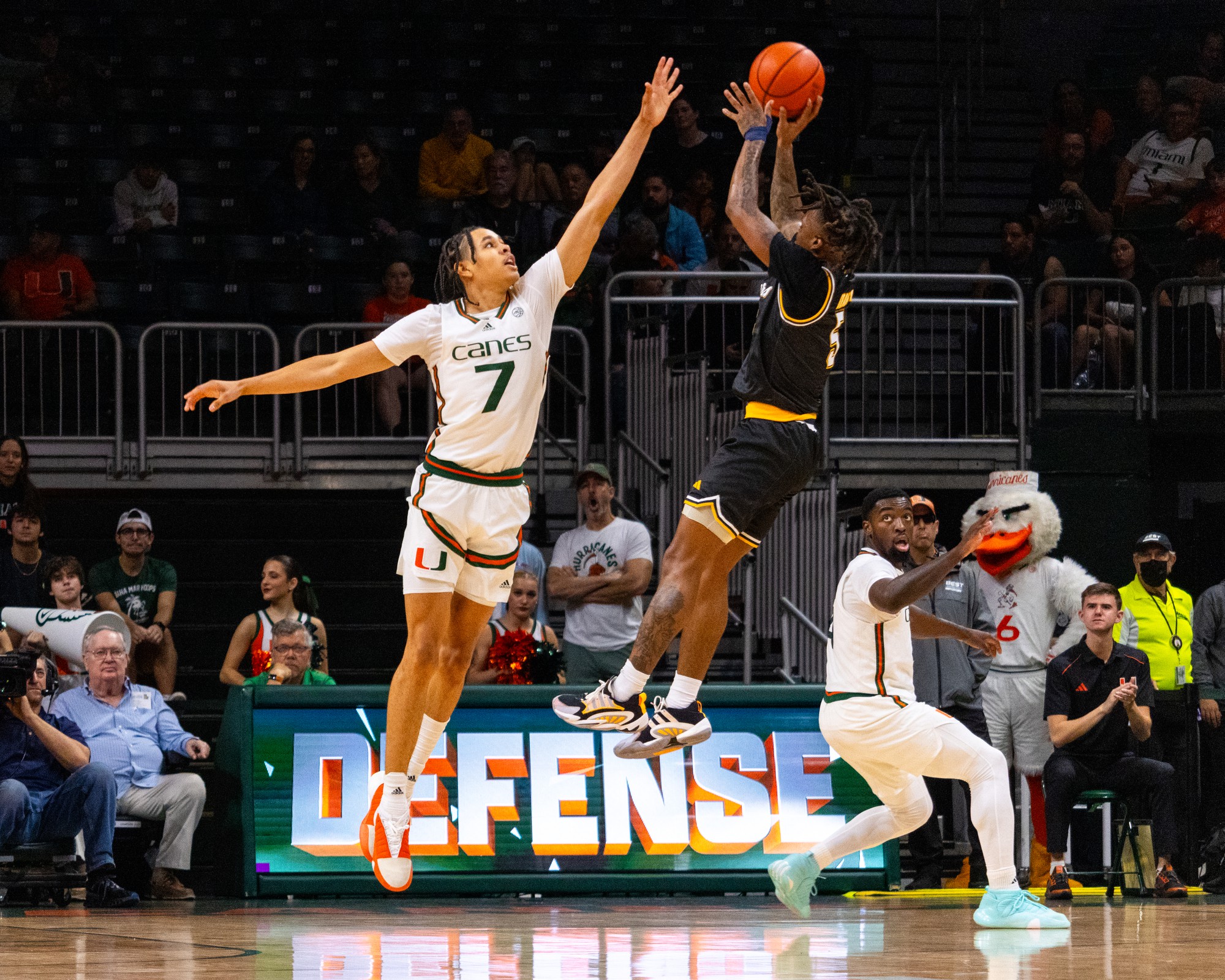
During the winter break game against La Salle, freshman Kyshawn George contests a shot by guard Khalil Brantley in the first half of the 84-77 win at the Watsco Center.
During the winter break game against La Salle, freshman Kyshawn George contests a shot by guard Khalil Brantley in the first half of the 84-77 win at the Watsco Center. Photo credit: Charisma Jones

But most importantly, Miami had only 10 turnovers.

“From a practical standpoint, we need to continue to build on this,” Larrañaga said. “Do a better job of rebounding, do a better job of taking care of the basketball and certainly do a better job defensively.”

Miami played a complete first half with only four turnovers, and the Hurricanes took an early double-digit lead as a result. Cleveland led the charge with tough fadeaway jumpers and exceptional rebounding. He had 10 points and six rebounds by halftime.

However, La Salle fought back and used two three-pointers in 39 seconds to cut the deficit to four.

Poplar responded with a spectacular transition alley-oop from Pack to jumpstart another offensive run, and Miami took a 45-33 lead into halftime thanks to just four turnovers and 57.6% shooting from the field.

That lead ballooned to 18 after Poplar’s layup at 16:57, but then the Hurricanes went cold. A three-minute scoring drought — part of a stretch where Miami made 2 of 12 shots — helped the Explorers storm back.

La Salle shot 55.2% after halftime, more than 15 percentage points better than the first half. Larrañaga attributed that to Miami’s inconsistent defense.

In the middle of the second half of the win against La Salle, junior Bensley Joseph keeps an eye on the court while being tightly defended during the 84–77 win.
In the middle of the second half of the win against La Salle, junior Bensley Joseph keeps an eye on the court while being tightly defended during the 84–77 win. Photo credit: Charisma Jones

“They started making 3’s,” Larrañaga said. “And when they do that, our defense gets extended and then they can drive. We had a period where they drove to the basket, and they scored and got fouled or just got fouled and went to the free throw line.”

The Explorers eventually cut the deficit to four with a 3-pointer, but a 6-0 Miami run ended any hopes of a comeback. Guard Khalil Brantley led La Salle with 23 points, and guard Daeshon Shepherd added 15.

Miami returns to the Watsco Center on Thursday, Dec. 21, at 8 p.m. against Stonehill, which has only one win on the season.

Miami lands first transfer portal addition in defensive lineman C.J. Clark

0

Miami football received its first addition via the transfer portal on Friday night with defensive lineman C.J. Clark from North Carolina State. The redshirt junior will have one year of eligibility remaining with the ‘Canes.

Clark, a North Carolina native, recorded 42 career pressures and generated 7.5 tackles for loss and four sacks over the past two seasons for the Wolfpack. The 6-foot-3, 305-pounder is considered the No. 13 defensive lineman in the transfer portal, according to 247Sports. Clark is a former four-star, top-200 prospect.

A plug-and-play starter for defensive coordinator Lance Guidry and the ‘Canes defense, Clark will be incredibly useful on early downs and in obvious running situations. Clark will help to supplement the loss of Branson Deen and Leonard Taylor II on the interior for the ‘Canes.

Clark is another one of the trench players that head coach Mario Cristobal has made such a focal point of this recruiting cycle.

‘Canes disappoint in Brooklyn as they fall to Colorado

0

When it rains, it pours for the Miami Hurricanes. But not in a good way.

After playing a tightly contested first half of basketball, the ‘Canes were outscored 53-27 in the second half to drop their second game of the season, 90-63, to the Colorado Buffaloes.

Miami was able to keep it close in the first, only trailing by one to Colorado at halftime. Junior guard Matthew Cleveland led the ‘Canes with 13 points in the first half, en route to leading the team with 17. Outside of Cleveland, no Miami starter played particularly well. Colorado held the rebounding advantage, 22-9, after the first half and was dominating in the paint on both ends of the floor.

A 10-3 scoring run at the end of the first provided some optimism heading into the second half for Miami, but that was quickly squashed by the Buffs. Colorado went on a 9-0 run to start the second frame and never looked back.

Colorado pushed the pace against Miami and forced 14 of Miami’s 20 turnovers in the second half. The Buffs were led by senior forward Tristan da Silva, who was one assist away from a triple-double with 22 points, 10 rebounds and nine assists. The veteran leader was aided by junior guard KJ Simpson, who added 20 points on 8-of-13 shooting.

Colorado was also without one of its leading scorers in freshman forward Cody Williams, which makes their win over a top-15 team more impressive. The Buffs had six players score in double figures and shot a stellar 59% from the field.

Miami, on the other hand, put forth a disappointing effort in almost every single statistical category. Norchad Omier fouled out in a game where Miami played a much bigger opponent. With just over seven minutes to play, Omier picked up his fifth foul and exited the game with 12 points and five rebounds.

The ‘Canes displayed many of the same things that plagued them in their loss to Kentucky. They failed to shoot the ball well when faced with perimeter pressure, as Wooga Poplar had another off night shooting the basketball. The team struggled with cuts and ball movement from its opponent, as Colorado capitalized on its open looks.

Miami also failed to punch back. When Colorado came out swinging after the second half started, Miami had no answer to the Buffs’ attack. Instead, just like in the game against Kentucky,

Miami returns home to play the La Salle Explorers at the Watsco Center next Saturday. The tip-off for this game is scheduled for noon. and will be cast on the CW network. This will provide the ‘Canes with a good chance to reset and fine-tune before ACC play gets underway in a few short weeks.

Frat Flu: The 0.1% of bacteria that Clorox can’t kill

0

The frats on campus are known for many things, one of them being the germs inside. No, we’re not talking about the brothers (for once), but the place they live in. Taking a page from Sue Sylvester, they’ve created an environment so toxic that it created its own disease. The infamous frat flu.

The sickness has afflicted students all over since the dawn of frats. Nothing good happens at a frat house, and apparently that extends to a chemical level. It just seems that it’s a law of nature that if the letters are Greek, you’ll be sick for a week.

The mere air in a frat house is laced with so many scents it is nauseating. The cloud of AXE body spray and every possible vape flavor creates an atmosphere unlivable to man, and especially to women. Mixed with the humidity of Florida weather, it is a breeding ground of sickness. It doesn’t help that each pledge class brings in their own new strain of bacteria, adding to the already chaotic microbiome.

Whether it was from a tailgate, tent party or after you “just went over to study” there is no escape. The virus thrives on a potent cocktail of crappy beer, half-eaten pizza and Zynns. It seems just breathing in a frat’s air exposes you to the disease.

Everyone’s experience with frat flu is a little different, but it always starts the same, with nausea. Oh nausea, the most confusing symptom a woman can feel. Is it morning sickness? A sign of the time of the month? Or was it what you drank from a pong cup shared with 150 other people?

The confusion gives the frat flu time to spread, and before you know it, your immune system is overcome by foreign bacteria.

Its basic symptoms are as follows: chills that make you shiver even in the Miami heat, a nose running like a leaky faucet and a cough that sounds like a chainsmokers’.

It’s not a “two days of rest” ordeal. You get it and you’re out for a week – minimum. (If only the brothers were that committed). Soup and a sweet treat can minimize the struggle, but at the end of the day you have to let it run its course.

The thing about the frat flu is that it cannot be cured while on campus. It is not until you crawl home at the end of the semester that you will feel any relief.

Snuggle up in bed, play some Tinder and rewatch the same show you’ve cycled through since high-school. Let’s be honest, you weren’t going to those classes anyway.