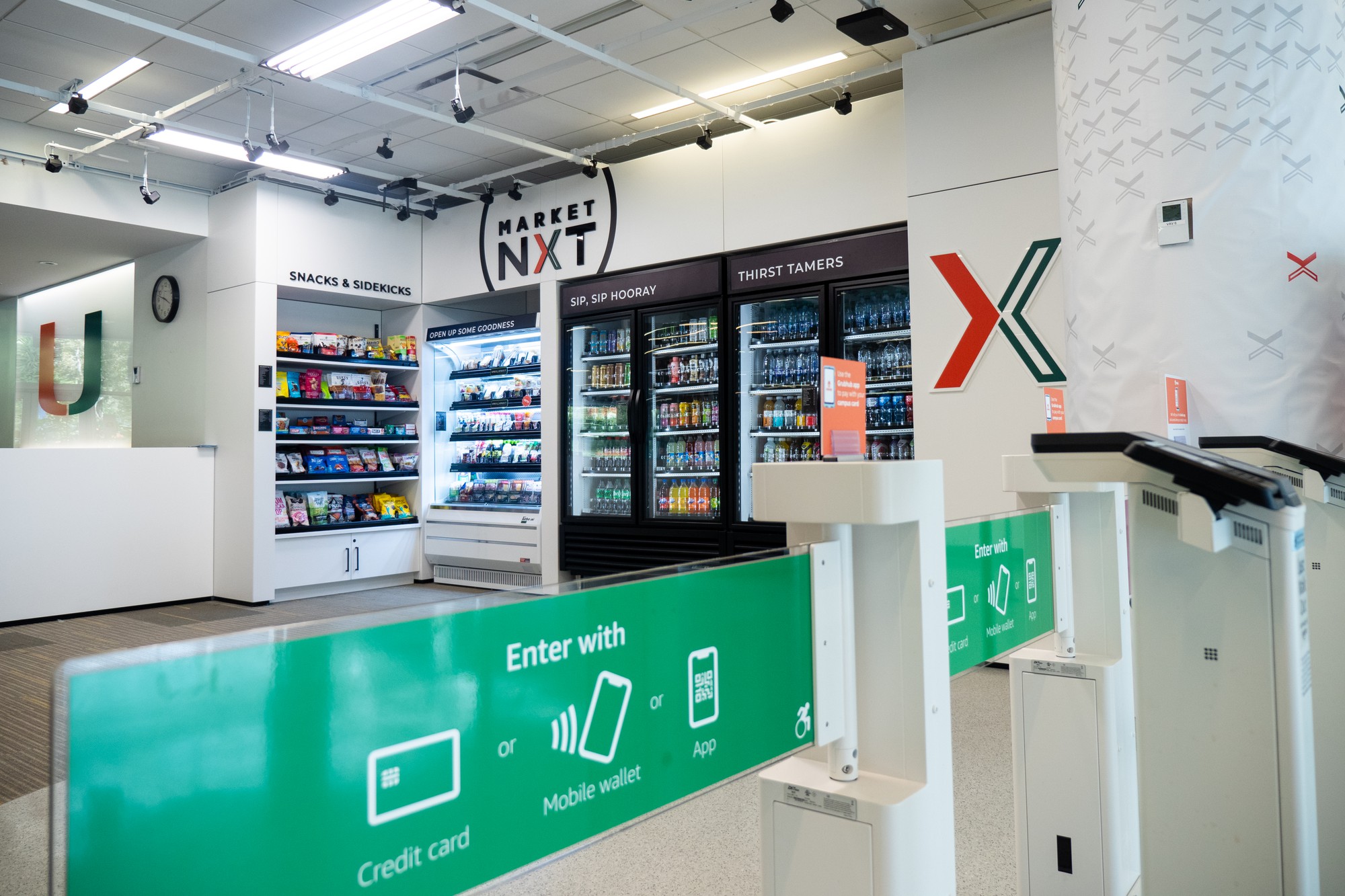
The new Market NXT in Whitten UC at the University of Miami in Coral Gables, Florida, uses artificial intelligence to eliminate checkout lines. Photo credit: Emily Rice
The first floor of Whitten University Center recently received a new makeover, thanks to the addition of UM’s latest convenience store, Market NXT.
Opened on March 18, Market NXT carries a variety of grab-and-go items including freshly-packaged sandwiches, bottled beverages, bagged snacks and more. This newest venture brings cutting-edge artificial intelligence to campus for a checkout-free experience.
“As the first university in Florida, and one of the first in the United States to bring Amazon’s Just Walk out technology to campus, the University of Miami is taking higher education to new heights with Market NXT,” said Michael Ross, Resident District Manager at UM Dining.
Open daily from 8-12 a.m., visitors can grab their Market staples without waiting in the typical long lines. Shoppers simply enter with the Grubhub app or mobile pay, gather their items and exit through the turn gates. After completing the purchase, they receive an itemized receipt via email.
Originally created by Amazon, Just Walk Out technology utilizes generative AI like computer vision, object recognition, advanced sensors and deep machine learning models to accurately determine what products shoppers grab.
This seamless shopping experience increases service speed and takes on-the-go dining to a new level. Some students, however, are wary of what this tech means for the future of campus employment.
“Although having a checkout-free market seems modern and ‘better,’ it does make me worried that our campus will lean more towards this and reduce or cut back on money for employing employees,” said Paris René, a fourth-year architecture student.
“I hope they don’t because a lot of the employees on campus, both students and non-students, are crucial and have helped to make campus life what it is,” René said.
Faye Marcus, director of marketing and guest experience at UM Dining, shared how Market NXT meets the demands of an increasingly-digital world.
“Our students are experts in this new era of technology. They are constantly seeking ways to digitize their experience and simplify the process,” Marcus said.
Born out of a partnership with Grubhub Campus Partners and Amazon, Market NXT demonstrates Chartwells Higher Education’s commitment to innovative dining services on UM.
“Our commitment to elevating the student experience is unwavering, and Market NXT is leading the mission,” Ross said.
Though novel to Florida college campuses, several colleges and universities around the country have also adopted Just Walk Out Technology, with the first opening at Loyola University Maryland in Baltimore.
This latest addition follows other major changes to on-campus dining this school year, like the return of Pura Vida and the opening of Halal Shack in the Hurricanes Food Court.
In a meet that featured schools across the nation, the Chinese national team, and Olympian Nia Ali, Miami track and field took home some impressive feats in the Hurricane Collegiate Invitational.
The highlights of Miami’s Saturday came in the field from its transfer students. Angelo State transfer Devoux Deysel and UNLV transfer Diesiane Teixeira in the javelin shattered school records. For the women, Teixeira came in first with a distance of 53.98m, breaking Erikka Hill’s record of 47.01m from two years ago.
For the men, Deysel, with a distance of 76.58m, came in first and broke the record of 66.32m set by Ed Reed in 1999. As of Saturday, he was ranked first in the ACC and fourth in the nation. Milton Ingraham II, formerly of Florida State, earned his first outdoor win with the ‘Canes with a discus throw of 59.17 m, good for second all-time in outdoor history.
Staying on the field, Arizona State transfer Jeremy Cody cracked into the school’s top-five in the high jump. With a height of 2.11, he finished both third on the day and tied for third all-time with John-Patrick Friday. Freshman Brianna Isa is now tied for third all-time in the pole vault after reaching a height of 3.5m to tie her with Alyssa Rice.
Moving onto the track, there were several other impressive feats.
Starting with the 400m, senior Kennedy Brace, with a time of 53.91 seconds, came in second place on the women’s side. On the men’s side, senior Solomon Strader came in second, and fresh off his ACC Rookie of the Week nod, Ace Malone came in third.
In the 1500m, sophomore Lexi Arambulo took first for the women. On the men’s side, junior Austen Cannon, sophomore Enrique Borrego, and junior Cormac O’Brien went 2-3-4 in the event.
The meet also saw a former UM alum make her return to Cobb Stadium. Michelle Atherley, the 2019 indoor NCAA national champion for the pentathlon, ran in the 100m hurdles and finished second to Olympian Nia Ali. Atherley is continuing her journey as she works to qualify for the Olympics.
Miami track and field will stay in Florida next weekend and travel to Gainesville to take part in the Florida Relays on March 29 and 30. The team will return to Coral Gables for its last home meet, the Hurricane Alumni Invitational, on April 5 and 6.
Down in the series 1-0 to the rival Florida Gators, Miami was in need of a stellar start. Head coach J.D. Arteaga turned to his junior pitcher, Rafe Schlesinger, to deliver in the biggest game of the season.
Schlesinger delivered.
The southpaw came out and delivered 6.1 innings, holding Florida’s potent offense to only three runs and striking out nine batters in a huge win for the Hurricanes.
“I’m very proud of our team, but especially Rafe,” Arteaga said. “Starting the game with a leadoff double and a walk, he could’ve easily imploded and gotten them off to a really good start. He showed a ton of maturity getting some big strikeouts early and the double play ball. Then, he really settled in after that. It was a great job of setting the tone.”
The junior from Holbrook, New York, has been dominant for the Hurricanes so far this year. Schlesinger is first among Miami starters in earned run average and opponent batting average and second in innings pitched, wins and strikeouts.
This is Schlesinger’s first season as a full-time starter for the ’Canes. In his first two seasons, the 6-foot-3-inch pitcher was working out of the bullpen. Schlesinger has established himself as a reliable arm in Miami’s weekend rotation along with juniors Gage Ziehl and Herick Hernandez.
“I think physically I was ready for it,” Schlesinger said. “But mentally, going from pitching like a third of an inning, and now you have to go out here and get seven, eight, nine. When you go in the dugout, you are not done for the game, you have to lock in. That’s kind of a big change but I feel like I’ve made the adjustment smoothly.”
Schlesinger arrived on Miami’s campus as a highly touted prospect. Miami was his dream school and he could not wait to pitch for the orange and green, but Schlesinger did not pitch all that much over his first two years in Coral Gables.
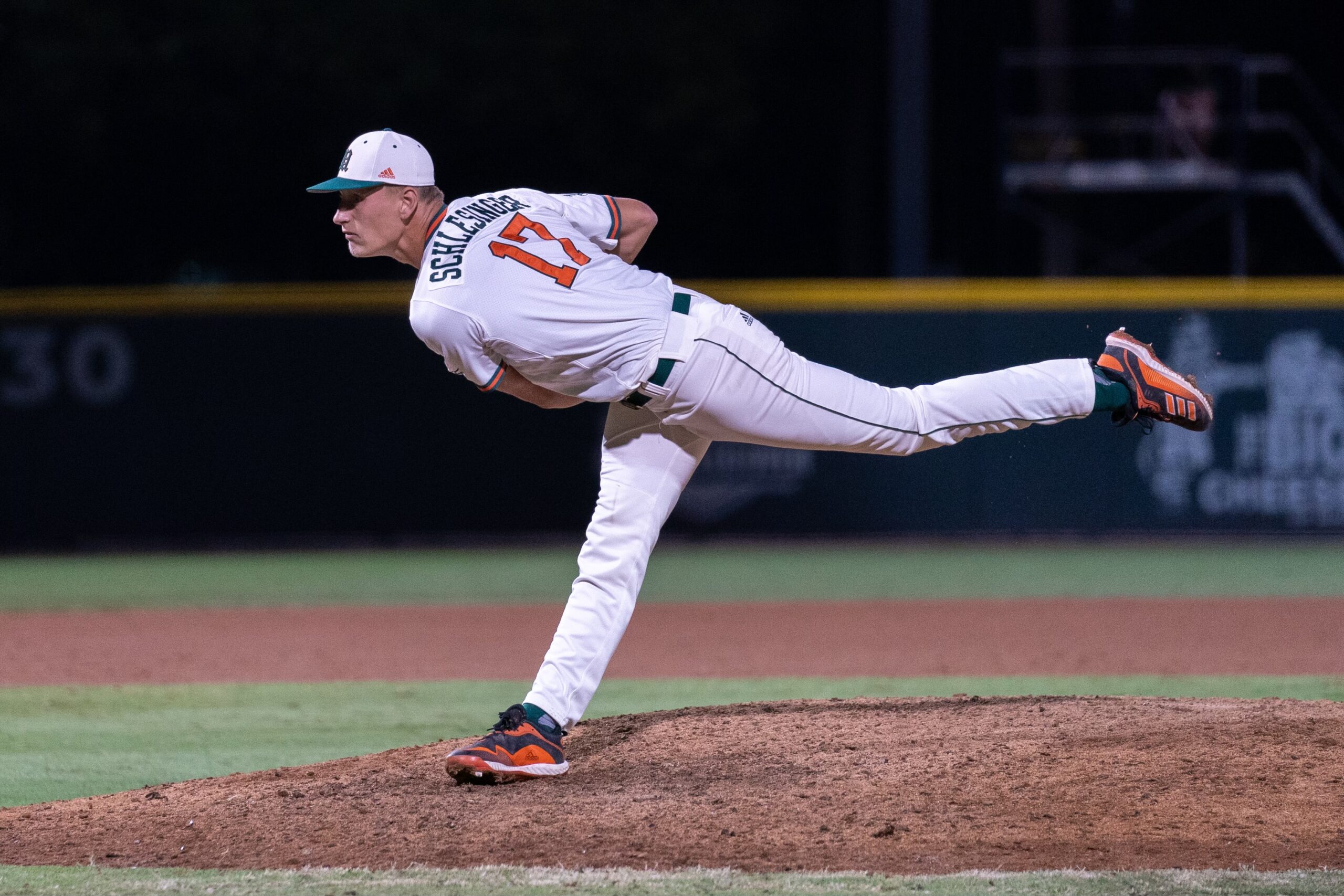
Freshman pitcher Rate Schlesinger pitches in the top of the eighth inning of Miami’s game versus the University of North Carolina at Chapel Hill at Mark Light Field on March. 25, 2022. Photo credit: Jared Lennon
“The first two years were rather upsetting for myself,” Schlesinger said. “I expected to have 50 innings each year but I had 10 my freshman year. So now I’m kind of picking up the slack right now, so I’ll be out there as much as you need. I told Laz, I’ll close the mid-week game if you need. He does not allow that but that is what I want. I jipped myself in those first two years, I let myself down. Now that I’m confident enough to go out there I want every single inning I can get. If I’m leading the country in innings, and it’s by 30, I want that because I feel like I got slacked out of my first two years.”
Not being able to pitch was a blessing in disguise for him. This time allowed Schlesinger to develop the mental side of the game, as well as improve his physical tools.
“I started living with him in the dorms freshman year and have really seen him mature,” Ziehl said. “He hasn’t had the easiest road to where he is now, but I couldn’t be prouder to watch him start every week. He’s a stud and his potential is through the roof. I consider him a best friend and a tremendous leader.”
That development and that potential came from Schlesinger flipping a switch and getting back to what made him a successful pitcher before coming to Miami.
“When I got the confidence that I do belong here, that’s when I started getting angry again,” Schlesinger said. “I never pitched good as a finesse guy. I was straight up throwing it as hard as you can with the intent of hitting a spot. When I got back to that point of pitching angry which came with confidence, came with success, that’s when I started seeing even more consistent success.”
Freshman pitcher Rafe Schlesinger pitches at the top of the eighth inning of Miami’s game versus the University of Virginia at Mark Light Field on April 10, 2022. Photo credit: Jared Lennon
This anger did not come out of nowhere. Schlesinger has always had a chip on his shoulder, even from when he was a little kid playing baseball.
“On the back of the mound every day, I write the initials ‘PD’. That is the initials of the coach that cut me when I was nine years old,” Schlesinger said. “How I view it is like that kid is my son. I’m protecting that kid, you cut that kid, you piss me off, whenever I’m in a tough position I think about that and look down at that PD and think someone doubted me and I run with that and prove them wrong.”
Now, Schlesinger has found coaches and teammates who support him, not just as a baseball player, but as a person, and that has led to success on the field.
“When it came to believing in myself that guy instilled that in me,” Schlesinger said. “From day one he told me that he believed in me. It wasn’t just him telling me that, every day at practice he makes me believe that I’m the best I’ve ever been. If I get shelled, if I get hit around and my stuff is terrible that day, he’ll come back and say next week they are not touching it. When he tells me that stuff, I run with that and that is something I needed. I needed someone to believe in me and he came around at the perfect time.”
While the Miami Hurricanes have lost a plethora of players to the transfer portal, they added a transfer to their roster on Wednesday.
The Hurricanes and head coach Jim Larrañaga received a commitment from Virginia Tech forward Lynn Kidd. The 6-foot-10, 235-pound center comes to Miami after three years at Virginia Tech.
“We are extremely happy to have Lynn join us because he is an incredibly gifted offensive scorer around the basket and who I considered the most improved player in the ACC this past season,” Larrañaga said in a Miami Athletics release. “He has put in the work to take his game to the next level. His work ethic is unmatched and he will bring maturity and four years of ACC experience to our team.”
Last season for the Hokies, Kidd averaged 13.2 points and 6.5 rebounds per game while shooting 66.8% from the field. The Gainesville, Fla. native played in 33 games for the Hokies while playing an average of 23.2 minutes per contest. The big man secured five double-doubles, five 20-point games and 24 double-digit scoring outputs.
The addition of Kidd helps to make up for the losses of Michael Nwoko and AJ Casey. It is still unknown whether Norchad Omier will return, but Kidd helps to soften the blow regardless.
Kidd fits the style of basketball the ‘Canes want to play. The ability to move in transition and push the pace is something Miami wants to do, and Kidd slides into that scheme seamlessly.
Kidd has never attempted a three-pointer in his four years of college basketball. He spent his freshman year at Clemson before transferring to Virginia Tech, and he’ll stick in the ACC for his final season.
Kidd is likely the first of several Miami additions through the transfer portal. Miami is targeting size, and Kidd certainly brings that.
Nijel Pack has announced that he is returning to Miami for his final year of college basketball.
“I am back!” Pack said on social media. “Going into my final season, my focus is on getting healthy and leading our team to compete at the highest level in every aspect of the game, every day. Glory to God.”
In 24 games this past season, Pack averaged 13.1 points, 3.6 assists and 2.5 rebounds per contest. Pack was the team’s third-leading scorer and its top assist guy. Pack’s season-high came against his former team when he scored 28 points in the Baha Mar Classic versus Kansas State.
The Indianapolis native dealt with a plethora of nagging injuries throughout the season that kept him out of key games. Pack’s absence is a big reason the Hurricanes saw such a fall from grace.
Pack’s decision is a big one for the outlook of the team. Miami is still awaiting decisions from Matthew Cleveland, Norchad Omier, Wooga Poplar and Kyshawn George.
With Pack in the fold and the stellar recruiting class coming in, the ‘Canes could be forming one of the most dangerous backcourts in college basketball.
With all the uncertainty about the players in the portal, getting a commitment to return from Pack is huge for the program.
The Week of Cuban Culture is an annual week of festivities hosted by the Federación de Estudiantes Cubanos. This week is meant to keep the Cuban culture alive and present at the University of Miami.
From March 18 to 22, FEC hosted their Week of Cuban Culture, this year themed “Vibra Cubana,” a fun play on the popular reggaeton festival “Vibra Urbana” which recently preceded the Cuban spirit week.
“We host WOCC annually to educate on the Cuban culture, and spread awareness to what’s going on in Cuba today. FEC wants to give every Cuban student at the University of Miami a home and a place to feel welcomed,” said Daniel Fernandez, FEC President.
Along with sharing the Cuban culture with the University of Miami community, the week of events is also meant to bond the members of FEC, creating ties that will continue to develop in semesters to come.
“This week in particular is always a great bonding experience for all the members and our current and future executive boards. I truly enjoy getting to spend time with my friends as well as meet new people who come to our events,” Ryan Cameron, a junior majoring in economics and the secretary of FEC, said.
Monday evening also brought many Cubans and ’Canes together to play in its traditional domino tournament at the Rathskeller. A favorite pastime of the Cuban and greater Latino community, the competition positioned teams of two to battle for the chance to win gift cards for the on-campus sports bar.
Students gather at The Rathskeller to play in the annual FEC Week of Cuban Culture Domino Tournament. Photo Courtesy of FEC.
As a midday pick-me-up on Tuesday, March 19, FEC served cafecito and Cuban pastries at The Rock Plaza during the day.
“One of our favorite WOCC traditions is Cafecito on the Rock where we get to give students “Honorary Cuban Certificates” while we have them answer Cuban trivia and enjoy Cuban pastries,” said Fernandez.
In partnership with Category 5, the student spirit group, FEC also gave away unique sweatshirts at the University of Miami vs. Florida International University baseball game that took place that same evening at the Mark Light Stadium. Though the Miami universities battled it out in a close game, the ’Canes ultimately ended up taking home the win with a score of 4-3.
The rest of the week featured much more educational programming, as seen with FEC’s collaboration with the Lowe Art Museum for a Cuban artist panel on Wednesday, March 20 and the organization’s “Cafecito Talks” event in Lakeside Auditorium featuring several guest speakers.
Students pose at "Cafecito Talks 2024" with Dr. Michael Bustamante and Dr. Daniel Pedreira. Photo Courtesy of FEC.
On Thursday, March 21, FEC hosted a tour of the Cuban Heritage Collection, which is located on the second floor of the Richter Library and is home to the largest collection of Cuban archives located outside of Cuba.
Aylin Xenes, the cultural chair of FEC, has spent hours working on this event with the rest of the executive board and was more than excited to bring the week to fruition, calling it more than just a celebration.
“The purpose behind this week is not only to celebrate the culture of the island, but also to further educate the UM campus and community,” said Xenes. “FEC plays a big role on campus as one of the oldest organizations at UM, and we view this week as our opportunity to share a more in-depth look into the various Cuban customs and traditions that have shaped our org into what it is today.”
FEC later joined student events group Hurricane Productions and their Cinematic Arts Commission, the division of the student programming board that brings movies to campus, to show “Before Night Falls” in the Cosford Cinema.
The film is based on the true story of a Cuban author who faced much legal trouble for being gay in Cuba before moving to New York City, giving a unique glimpse into a complex Cuban immigration story.
After a location change due to inclement weather, FEC finished out the Week of Cuban Culture with their Closing Ceremonies in the Shalala Ballrooms, where they served more Cuban food as well as cotton candy.
Salsa band “Luna Y Sus Rumberos” performed at the ceremony and Camp Kesem, an organization that raises money for and hosts a summer camp for children affected by a parent’s cancer, also took part in the event with a service initiative.
In terms of the week’s importance to FEC and the greater Miami community, Xenes notes that it is impossible to ignore the Cuban influence in the 305, making UM the perfect place to educate others about the country’s complex history and culture.
“Coming to UM and joining FEC, I was quickly surrounded by people that thought being Cuban wasn’t anything to be ashamed of, and should be celebrated instead,” said Xenes. “Being in FEC has further fostered my appreciation for the culture and my identity, as I’ve been able to celebrate it alongside my peers, who may not all share the same roots but share the same love for Cuba and its many traditions and customs.”
Follow FEC at @fecyeah on Instagram or visit their office (210F) in the Shalala Student Center to learn about FEC and their events.
Protesters took to the streets in Santiago de Cuba to speak out against the Cuban government due to ongoing food shortages and power outages. This comes as a result of the economic crisis in Cuba, the worst since the end of the Cold War.
Extreme power outages last up to 18-24 hours of the day on the island. Limited access to food and medicine have also left Cubans in dire straits as a result of the government’s increasing economic instability.
These protests come from a larger issue left unresolved from the impact of the COVID-19 pandemic on the Cuban economy. The President of Cuba, Miguel Diaz-Canel, blamed the U.S. for inciting the unrest, labeling it as “interventionist” and accusing the embargo as being a root cause for the uprisings.
The protests are the latest to break out on the island since July 2021, when demonstrators were protesting similar issues in response to the COVID-19 pandemic with the popular slogan “S.O.S Cuba.”
Diaz-Canel took to social media in response to the protests, blaming the uprisings on influence from Cuban exiles in South Florida rather than the lack of the nation’s resources.
Cuba is economically and politically isolated as an island nation, largely because of the embargo placed upon by the United States and other nations prohibiting trade relations and limiting their international resources. This contributes to much of the lack of supplies that Cuba offers its people.
However, former dean of international studies and co-founder of the Institute for Cuban and Cuban-American Studies at UM, Andy Gomez, argues that some practices allowed under the U.S. embargo with Cuba still do not explain the island’s severe economic limitations.
“Even those that have American dollars have a hard time finding things like bottled water in Havana, the capital. Electricity was out for 24 hours the other day, the entire island was shut down,” said Gomez.
“Is it the economic embargo? No, not necessarily. Cuba just bought millions of dollars of food from the United States, which is allowed under the embargo. So the question is, where’s that food going?”
Cuba’s economic crisis has worsened with inflation, devaluing its currency and leaving wages at an all-time low. Cubans have been fleeing the nation due to the economic struggles in recent years, even leading to the largest mass exodus of migrants from the island to the US since the Mariel boatlift exodus in the 1980s.
Students on campus have also been aware of the protests and their impact on the UM and the greater Miami-Dade community, where thousands of Cuban exiles reside.
“Seeing the protests in Cuba over the dire situation on the island gives me further pride in my people,” said Aylin Xenes, a member of FEC’s executive board. “I worry about the current condition due to the lack of recent info, but I know my people will prevail.”
In Jan. 2024, Cuba opened up its nation to small private enterprises, known as pymes in Spanish, to stimulate its economy – an unprecedented action from Cuba’s strict state-controlled economy.
Diaz-Canel also paid a visit to the United Nations late last year to plead for countries to invest in the nation while criticizing the U.S.’s economic sanctions on the island.
This action counteracts their socialist ideology and practice for the last 60 years in efforts to resume economic efficiency, especially since the pandemic. Yet, these recent protests show that private enterprises have not been successful in their efforts to aid the Cuban people, much less the economy.
According to Gomez, while many Cuban exiles argue that democratic change should be implemented in the nation, he argues that Cuba’s long history with totalitarian governments even in the pre-Castro era leaves little room for democratic reform to take place on the island in the short-term.
“Cuba, like many other countries in Latin America, is not so prepared for democracy. What we’re seeing on the island is a frustration of the failure of a government not being able to meet the primary needs of its people,” Gomez said.
“This is not about patría y vida,” he continued, referring to the popular anti-communist phrase most Cuban refugees say in protest which means “patriotism and life.”
Country folk used to settle their disputes at the downtown saloon, but today they battle it out on the Billboard charts.
During the Verizon 2024 Super Bowl commercial, Beyoncé broke the internet with the release of two new songs as a promotion for her upcoming country album Renaissance: Act II.
Beyoncé’s “Texas Hold ‘Em,” debuted at No. 2 on the Billboard Hot 100 Songs and topped the Hot Country Songs chart. Her other release, “16 Carriages,” appeared as No. 9 on the Hot Country Songs and No. 38 on the all-genre Billboard Hot 100. Most fans were ecstatic about the new songs and their success, but for some, the songs’ high rankings on country charts are a point of contention.
As a fellow Houstonian, I would totally line dance to Beyoncé’s new songs and consider them to be country. However, Beyoncé is not traditionally a country artist and doesn’t have an established fan base in the genre.
Her songs should be eligible for the Hot Country Songs chart, as they incorporate many traditional elements of the genre, but shouldn’t have debuted as high as they did. Billboard’s method for ranking country songs is a large reason her songs charted so high.
Billboard remodeled its genre-charts methodology in 2012, and now the Hot R&B/Hip-Hop Songs and Hot Country Songs charts take their data solely from the all-genre Hot 100. Any song on the all-genre Hot 100 that’s classified as country is automatically placed on the Hot Country Songs chart and the songs remain in the order seen on the all-genre chart.
The problem with this change is that the Hot Country Songs chart no longer accurately represents what country radios and country fans are actually playing. Instead, the country chart now reflects what the general population is listening to.
Artists like Beyoncé who have an already-established fan base are automatically going to receive a larger amount of streams than a niche, lesser-known country artist.
While Beyoncé’s songs deserve to chart the all-genre Hot 100, she worked for her streams after all, “Texas Hold ‘Em” shouldn’t have topped the Hot Country chart.
Billboard needs to reevaluate its selection process. None of the genre-specific charts should be based solely on the all-genre charts. Naturally, there will be overlap, but Billboard should source their data from radio stations and statistics from streaming apps.
Just because a Beyoncé fan listens to her country songs doesn’t mean that country listeners are streaming Beyoncé’s country songs more than Morgan Wallen or Zach Bryan.
It was later revealed that he was unaware of her new songs. I didn’t know she had released country songs until a few days later either, and I’m an avid country listener.
Beyoncé’s songs may not have the prominent acoustic guitar people are used to when they think of country music, but her releases still deserve to be considered country.
Country music has roots in Black culture and “Texas Hold ‘Em” features elements of traditional country music. For instance, Rhiannon Giddens, a Black folk music artist, was featured playing the banjo. The banjo was brought to America from West Africa via the transatlantic slave trade and holds deep ties to Black culture.
Due to these references, fans theorize that Beyoncé’s three-part Renaissance album centers around going back to where historically Black genres began and reassociating them with Black culture. Renaissance: Act I was inspired by 1970s house music and disco, both of which were popular styles in Black queer communities. Act II focused on country music.
Beyoncé also incorporated modern country charm into her songs with her cowboy hat and Texas twang. Beyoncé and her recent songs are country through and through, there ain’t no doubt about it.
The University of Miami first warned Sophia Plancich that she was in violation of the University’s financial aid policies on the morning of March 6. Plancich, who is a first semester senior double majoring in international studies and ecosystem sciences, was told five of her ECS classes are not in her program of study.
She was one of many to receive such an email, sent out by UM to students who could have been impacted by “FACA,” which stands for Financial Aid Course Audit.
“As part of our commitment to your success, we regularly review student academic records and financial aid packages to ensure alignment with degree requirements and institutional policies,” the email read. “In keeping with our policies and the terms under which financial aid is awarded, it is crucial that students enroll in courses directly contributing to their degree completion,” it continued.
Plancich was confused. She thought she was within the University’s requirements because she had never received an email claiming otherwise. Since last spring, she had pursued her second major of ECS and met the GPA and credit minimums mandated in the University’s federal aid requirements.
“This must be a mistake. Like, those are degree requirements for me,” she replied to the email.
In a separate email, not sent to Plancich, but instead students in the Marine & Atmospheric Science Program, the department indicated that “UM will be launching a new program called Financial Aid Course Audit” and that “students will have to fulfill certain requirements to remain eligible for financial assistance.”
The email Plancich received made no mention of a new FACA program aside from using “Financial Aid Course Audit” as the subject line. Instead, the email alludes that she should have known students must “enroll in courses directly contributing to their degree completion” to receive financial assistance.
“For this semester, we are issuing a warning only,” it reads in bolded text. “Starting with the next academic term, financial aid adjustments will be implemented for enrollment in courses not required by your degree program.”
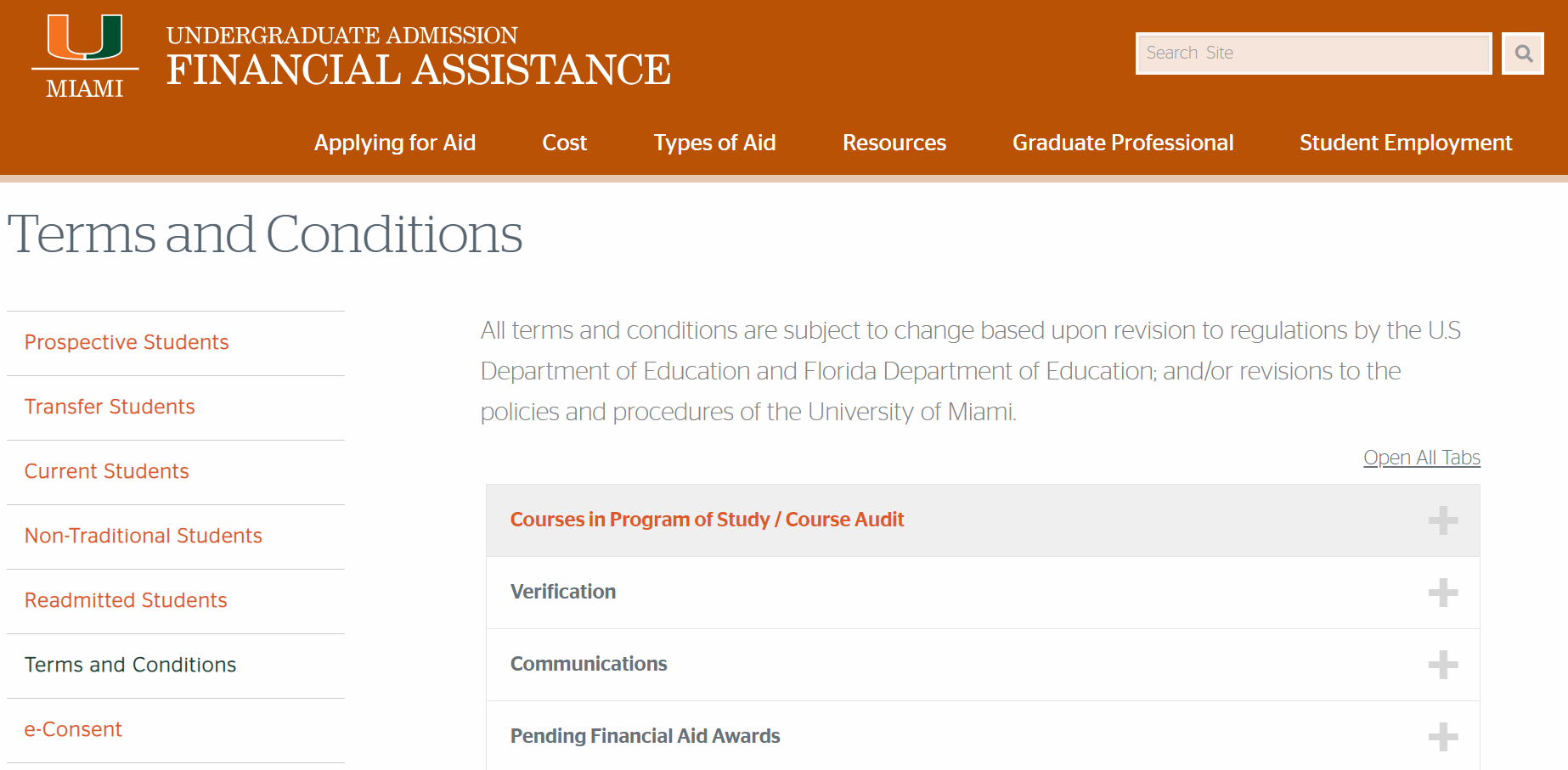
The policy in question can be found on UM’s online “Terms and Conditions” of financial assistance page. Near the top, there is a tab titled “Courses in Program of Study / Course Audit,” which now reports that students who pursue minors or second majors may not receive federal or state aid for the courses that are not needed for their primary degree. That is a rule set by the federal government that UM must comply with.
Discrepancies in the policy
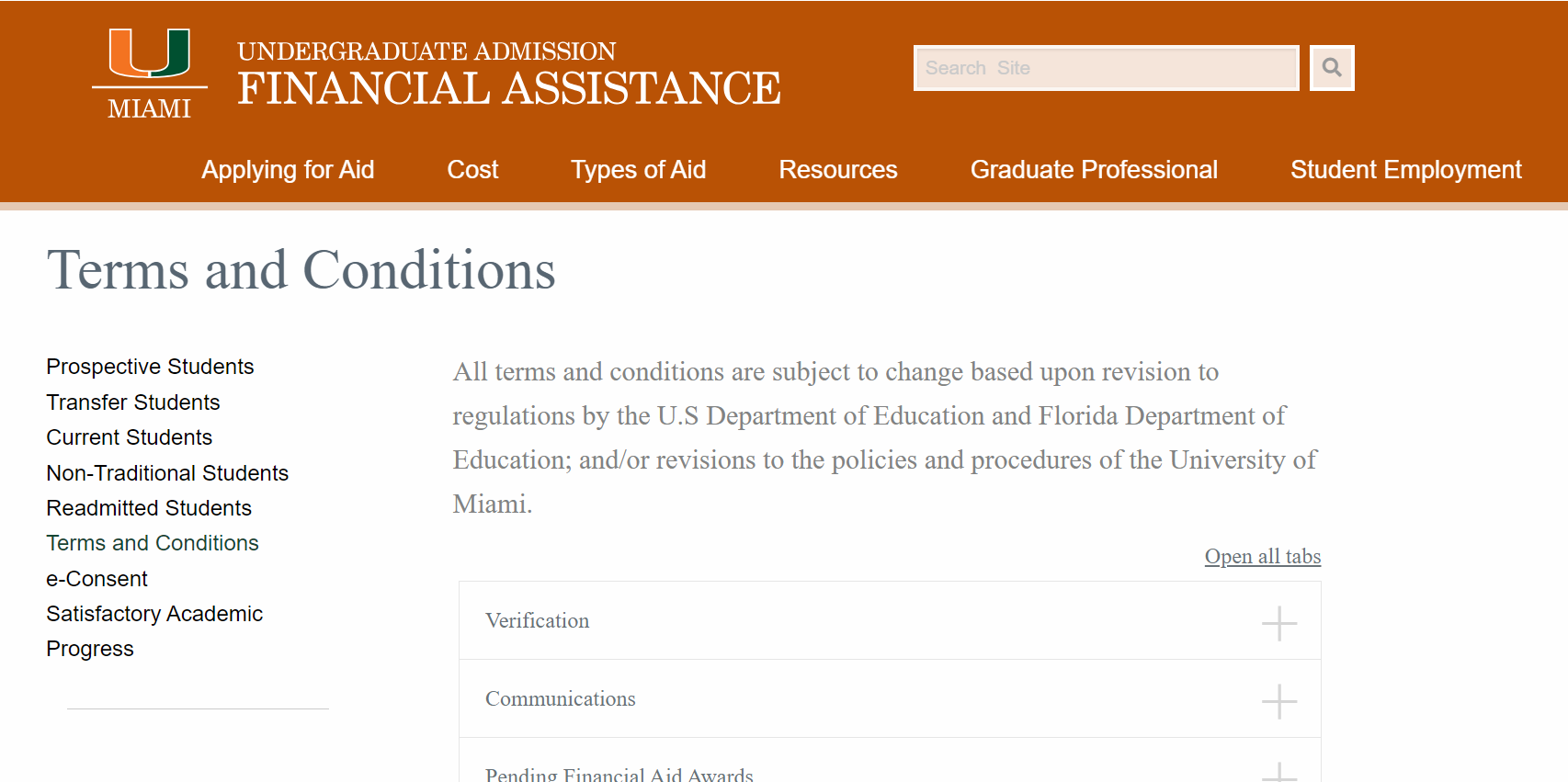
Yet, as recently as March 3, three days before she received her warning, UM’s published “Terms and Conditions” of financial assistance made zero mentions of this policy.
UM's Terms and Conditions of financial assistance on March 3, 2024, three days before sending an email to select students saying they were not in compliance with the terms and conditions. The page lacks a tab about "Courses in Program of Study," which describes the second major policy. Photo credit: Patrick MccaslinScreenshot of the Terms and Conditions of financial assistance taken on March 26, 2024, which now includes the "Courses in Program of Study" tab, describing the federal and state aid policy. This tab did not exist before March 3, 2024. Photo credit: Patrick Mccaslin
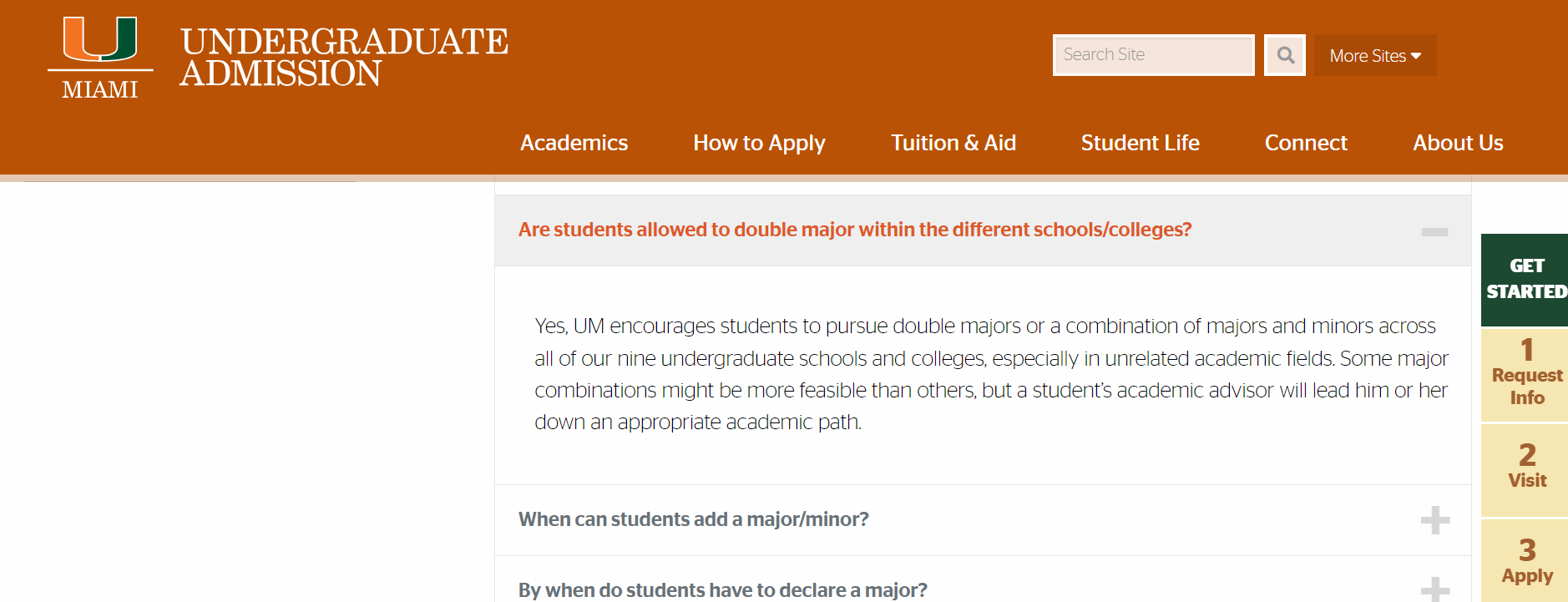
In fact, on another UM page, the University encourages prospective students to “pursue double majors or a combination of majors and minors across all of our nine undergraduate schools and colleges, especially in unrelated academic fields,” with no reference to this federal aid policy.
As of March 26, 2024, UM was still encouraging prospective students to pursue a double major without indicating that federal and state aid might not fund the second major. Photo credit: Patrick Mccaslin
Plancich, who has now pursued her ECS major for a year, should have received a notification from the school that she was not in compliance with federal policy a year ago, when she began taking courses outside of her primary international studies major.
She could still pursue the remainder of her second major, but would not be able to use federal or state aid to help pay for it.
Conflicting messages
The situation became even more confusing for Plancich when she reached out to the school for clarification. In a reply following the initial warning, Daniel Barkowitz, the assistant VP of Financial Assistance and Employment, informed her that “financial aid” would not cover courses outside of her first degree of international studies.
When she contacted ‘Canes Central, UM’s student services provider, they told her this policy would not affect her because it only applies to “double degrees” not “double majors.” Another of her advisors shared that they had heard a variety of conclusions from different students.
The Miami Hurricane contacted Barkowitz three times over the course of a week regarding the University’s financial assistance policy but received no response.
Plancich shared that she was still unsure whether she could continue taking her ECS major.
“I think that it is so incredibly unfair, especially just the timeline of it, the inconsistency in communication and having young people make decisions that would impact their ultimate careers and future because of an institutional change that they can’t do anything about,” Plancich said.
UM provided a statement to The Miami Hurricane indicating that their published policy, which now complies with U.S. federal policy, only applies to students receiving state or federal aid.
“Courses taken outside of the degree requirements will not count for establishing a student’s enrollment status for federal or state financial aid, and will not be considered in payment of federal or state financial aid, including scholarships, grants, loans, and work study,” UM said. “Students who pursue minors or second majors should be aware that this restriction applies to courses not needed for their primary degree and therefore may impact their federal or state aid as well.”
An old policy only enforced now
Based on a definition of “Undergraduate student” put forth by the Department of Education in 2007 and buried in title 34, section 668.2 of the Code of Federal Regulations, the student must be “enrolled in an undergraduate course of study that usually does not exceed four academic years,” or “enrolled in a longer program designed to lead to a first degree at the baccalaureate level.”
At UM, the “course of study” part of the definition refers to the schedule outlined in UM’s academic bulletin. When a student fulfills all of the 120 credits allotted in their degree’s academic bulletin program, their courses are no longer eligible for federal or state aid.
A typical UM student takes 15 credits, usually equivalent to five classes, per semester, for eight semesters. If the student starts at zero credits and follows that schedule, they will exactly fulfill their degree’s requirements. But, not all students follow that mold. A student may take more than five classes per semester, complete credits during the summer term or receive college credits in high school.
For Daniel, a junior majoring in microbiology and immunology who preferred to only go by his middle name, he was able to complete the 103 credits required by his major in three years, instead of four. Daniel plans to graduate early, but he could have pursued a second major in his fourth year. If he had, he would have discovered from UM on March 6 that federal aid will no longer cover his studies.
“I’m not allowed to explore or enrich my knowledge outside my major, or, if I choose to, I’ll be fined with a very massive bill that UM expects me to pay,” Daniel said.
Using data provided by the Department of Education and by a study conducted at UM in 2020, the Hurricane estimates that about 10% of UM students receive federal aid and are pursuing two majors. The Hurricane can not verify this estimate, but hopes the estimate provides more context to readers. Read more below.
“If a student has questions about their particular circumstance, they should start by reaching out to their academic advisor,” UM said in their statement to the Hurricane.
Statistical reasoning: In 2020, a group of researchers concluded that about 32% of UM undergraduates are pursuing a double major. They were working on a paper regarding the digital humanities and surveyed 301 UM undergraduates. We then used the Department of Education’s report that 33% of UM students received federal aid in 2020. With the assumption that receiving federal aid is independent from the decision to pursue a double major, we can estimate that 10.6% of students in 2020 were double majors who received federal aid. Unfortunately, this estimate does not recognize the undergraduates that receive state aid.
The University Metrorail station near campus was flooded with UM students covered in glitter, studs, hair decor, bead bracelets and rain ponchos on Friday, the first day of Ultra Music Festival.
As early as 3 p.m., stations from Dadeland South to Government Center were crawling with students as they made the pilgrimage to Bayfront Park. Friday’s weather forecast called for heavy rain, but there was no stopping students from experiencing the biggest festival in Miami.
“It felt like a community,” said Sharron Lou, a senior advertising major. “The metro security was so helpful in helping guide everyone, and they gave out free Redbull at the station.”
In its 24th year, Ultra was set to feature the return of renowned DJ Calvin Harris to the festival for the first time in 11 years, as well as the introduction of the Chris Lake and Fisher collaboration, Under Construction.
Calvin Harris performing during Ultra Music Festival on March 24, 2024. photo coutesy of Rudgr.com
Peggy Gou, the hottest DJ in techno, was set to headline Ultra’s RESISTANCE stage along with acts like Eric Prydz and Camelphat. Martin Garrix, Excision, Hardwell, Afrojack, Steve Aoki and more were set to take over the main stage.
By the time many made it to the main stage on day one, the rain had made a muddy mess all over the area, causing people to slide around and end up covered in mud in the early hours of the festival’s opening.
Issues like rain and mud didn’t stop acts like Nostalgix from playing in unfavorable conditions to a crowd of headbanging ravers at the Live Stage. Headbanging and dancing in the rain was certainly the vibe as the crowd only continued to grow.
Tiësto, one of the all-time great dance and EDM DJs, was bumped to an earlier-than-usual set that was supposed to take place amidst a typical Miami sunset, but the gray sky and dark clouds had other plans.
As he played some fun tracks like his latest Karol G collaboration, “Contigo” and “The Business,” the downpour began. This didn’t seem to bother the DJ — instead, he responded with “Set Fire to the Rain” by Adele, one of the last songs he played before the rain got too heavy and disrupted the equipment.
Around 8:30 p.m., the rain became too heavy and the entire festival was evacuated. Mass chaos ensued as people frantically tried to get out. Wet, distraught attendees were still trying to leave the downtown area around 11 p.m.
“I was devastated when it ended early on Friday,” said Aris Montero, a junior creative advertising major. “I feel like the crowd was energetic, especially with people that aren’t particularly big fans of EDM.”
Nevertheless, Ultra announced on its social media platforms that they would delay the festival’s opening on day two to ensure a safe reopening. Online users were dissatisfied as they realized that a lot of great acts would have their sets cut short or completely removed.
Fans refused to let this happen to Dutch producer Hardwell, an Ultra favorite playing a special 10th-anniversary set. After outcry his set was rescheduled to the slot before Excision, creating a series of all-star-level performances Ultra fans had not expected because of the last-minute changes.
Montero was glad that Hardwell was rescheduled for Saturday.
“I was a big fan of the fireworks and pyro that he had on display for his show. It was worth it to change him out for other main stage acts,” Montero said.
At this point, the soggy dancefloor had become a part of the festival experience. The mulch thrown around festival grounds did little to help the drying with rain carrying on through most of Saturday. Still, the remainder of day two proceeded as planned, with Ultra even extending its closing time to 1 a.m. in order to fit as many day one and day two acts into the evening.
One of these acts was Martin Garrix, who had one of the weekend’s best sets, playing his classics “Tremor” and “Animals,” as well as international hits like “In the Name of Love” and “Scared to Be Lonely.”
He accompanied his set with one of the more unique stage designs, including an LED cross behind him and an elevated stage. It was clear to see why Garrix was looked to as the coheadliner of the festival.
Sable Valley boss, RL Grime, and signee Knock2 are a popular duo among EDM fanatics at UM. Together, the two put together an hour and a half of some of the hardest bumping bass, trap and dubstep.
“Knock2 doing a back-to-back with RL Grime is easily one of the biggest highlights of the festival for me,” said Asha Shah, a senior studying creative advertising. “It was crazy and chaotic, but I think that’s a good thing for fans of harder EDM.”
The last day of Ultra went mostly as planned, apart from some minor schedule changes. The mud was halfway dry by the time that most of the crowd began to appear at around 4 p.m., and the festival began to look like its usual self.
Amazing sets from Andy C, Camelphat, Eric Prydz, Eli Brown and more kicked off Sunday, but the excitement for those sets paled in comparison to Calvin Harris.
Harris has not played Ultra Miami since 2013, before albums like “Motion,” “Funky Wav Bounce Vol 1” and singles like “This Is What You Came For” were released. Meaning, he had plenty of hits to share on Miami’s biggest stage this past Sunday.
Harris came onstage at 9 p.m. and broke the 10 p.m. curfew to give the people what they wanted. An hour and fifteen minutes of all-time classic hits combined with a bit of pyro, fireworks and trippy visuals had the crowd bouncing.
Opening with “This Is What You Came For” — complete with an LED projection of Rihanna — Harris was on the nose for the crowd who had long been anticipating his return after an 11-year wait. Spinning hits like “Summer,” “Blame” and “We Found Love,”, Harris teased the crowd with classic favorites and groovy… whatever you said. The crowd was enamored for the entire set.
For the last song — his collaboration with Elle Goulding, “Miracle,” he started with the track’s studio version before switching to the Hardwell remix.
The beat dropped one final time as the last pyro show began and fireworks rained all over Bayfront Park.
Ultra left festival goers with a final message: “Thanks for coming and we hope to see you next year for the 25th anniversary of Ultra!”
Frost a capella group BisCaydence is headed to the International Competition of Collegiate A Cappella finals after placing first in the semifinal round.
The award-winning a cappella group beat 450 other groups in the semifinal round to advance to the international competition. Due to the generous support of the University of Miami community, SAFAC and Frost School of Music, BisCaydence will perform in NYC on April 27. With this win, BisCaydence becomes one of the top 10 groups in the entire world advancing to finals.
“It’s almost been a full week at this point, but it still hasn’t fully set in,” said Logan Sandefur, a Modern Artist Development and Entrepreneurship major in the Frost School of Music. Sandefur has been the Music Director for BisCaydence since last May.
After being accepted into the ICCA, BisCaydence placed at quarterfinals and won two special awards. Members Josh Mims and Amanda Bencomo received the “Outstanding Soloist” for their duet of “Apologize” by OneRepublic, and Logan Sandefur won “Outstanding VP” for the whole set.
The ICCA is an international competition run by Varsity Vocals dedicated to showing the art of student a cappella and providing feedback through highly qualified judges. From its beginning to now, it has grown to include 450 groups in nine different regions of the world, including the U.S. and Europe. Groups must participate in quarterfinals and semifinals to get the chance to go to finals.
At the South Semifinals on March 16, where the group took first place, several BisCaydence members also received awards for their performances. Angelina Corbin received the South’s Best Soloist award for “Snow Angel” by Reneé Rapp, and Logan Sandefur, Julia Barrist and Jason Fieler shared the award for Best Arrangement for their set, which they named “Frostbite.”
This is the second time the team has made it to the finals, the first time being in 2019 when the group placed second.
“BisCaydence took its first trip to finals back in 2019, but the group is completely different now,” Sandefur said.
Sandefur joined BisCaydence as a freshman in the fall of 2021.
“That year’s seniors were the last remaining members of the 2019 Finals group, and they gave us a lot of insight into what it takes to do well in ICCAs,” Sandefur said.
BisCaydence, which focuses on co-ed pop music, is one of the three acapella groups on campus. It is joined by Tufaan, which focuses on Hindi-American fusion, and Phoenyx, the most recent acapella group that sings a variety of genres.
Phoenyx and BisCaydence both competed in the ICCA quarterfinals in Orlando on Feb. 17. Though both groups excelled, BisCaydence took home second place and advanced to semifinals.
The group is excited to represent UM at the international level.
“The fact that we get to represent ourselves and the U on the highest stage is absolutely insane to me,” Sandefur said. “It also has been such an incredible opportunity for us to network with some of the country’s top a cappella writers, producers, and choreographers.”
The University of Miami is entering its Swiftie era with the new elective course, STC 290: The Mastermind of the Taylor Swift Brand, coming to campus in the fall of 2024.
The strategic communications class, which will take place on Tuesdays and Thursdays from 11 a.m. to 12:15 p.m., is open to all majors.
Taught by Dr. Alyse Renee Lancaster, STC 290 will focus on the pivotal role that social media has played in crafting and amplifying Taylor Swift’s billion-dollar brand. Throughout the course, students will unravel the strategies Swift employed to captivate her global audience and foster strong brand loyalty for generations to come.
The idea for the class came to Lancaster while she was listening to a playlist of Swift’s songs while exercising. Now, she says she’s “never been more excited” to teach a course in her career.
“Every time I hear one of her songs, listen to one of her interviews or see a photo of her and Travis Kelce, more ideas for the class come to me, and the syllabus continues to evolve,” Lancaster said.
Junior Emma Craig, a biomedical engineering major and diehard Swiftie, plans to register for the course.
“It’s going to be a “Cruel Summer” waiting until fall for the new Taylor Swift class coming to UM,” Craig said. “I’ll be keeping my eyes open on the seats available.”
The class will explore Swift’s powerful storytelling ability, highlighting how her lyrics connect fans through relatable experiences and emotions.
Delving into Swift’s personal experiences, class discussions will cover key concepts such as freedom of speech, the right to privacy for public figures and the proliferation of fake news.
Students will get to analyze Taylor’s life experiences, Easter eggs and playful interactions that have allowed her to deepen her connection with fans over the years.
Charlotte Steffian, a sophomore English major, recognizes Swift as an exceptional storyteller.
“She captures specific moments and feelings,” Steffian said. “Take the whole love triangle thing with “Cardigan,” “August” and “Betty.” I want to watch that movie.”
The class, however, is not limited to Swifties. Even students who aren’t fans of the artist recognize her ability to sell her brand.
“I respect her as a businesswoman,” said Ariella Green, a freshman public relations major. “I appreciate what she’s done and have a lot of respect for her breaking grounds and going from country to pop and then her own style.”
Some students in the School of Communication look forward to taking the class and applying Swift’s successful tactics to their own careers.
“I think the topic of this class heavily aligns with what I have learned so far at UM, and I am interested in closely analyzing Taylor’s communication strategies and how they have gotten her to where she is now,” said Ava Prinzo, a sophomore majoring in creative advertising.
Though Lancaster recognizes some may see a class on Swift as a waste of time or “dumbing down education,” she believes studying the artist will show the power of brand-building and bring joy to the students in her class.
“It’s impossible to talk about Taylor Swift and not have fun, because spreading joy is, in essence, what Taylor Swift’s brand is all about,” Lancaster said. “And given all of the worrisome things happening in the world today, what’s wrong with spreading a little joy and happiness among stressed-out college students?”
Be ‘Swift’ about enrolling for STC 290, as limited seats are available. Students can add the class to their CaneLink shopping cart now, as registration begins on Monday, April 1.