


On today’s episode of Eye of the Hurricane, Lazaro and Emil look ahead to the coming Marvel Studios movie, “Avengers: Doomsday,” discussing their theories and thoughts based on previous movies and trailers.
Miami WBB falls to Florida State 87-70, dropping to last place in ACC standings

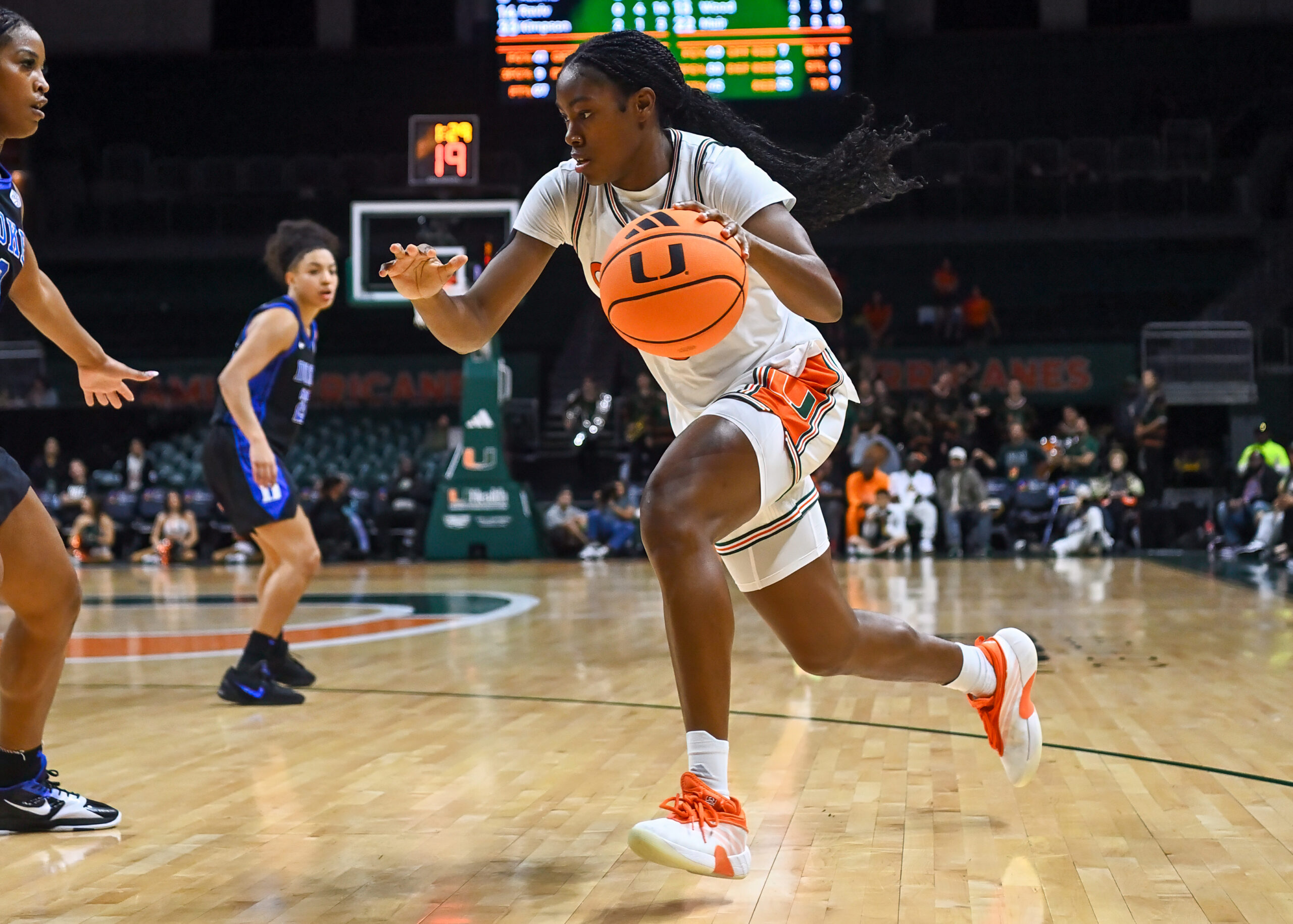
Miami Hurricanes women’s basketball lost to in-state rival Florida State 87-70 on Sunday afternoon in Tallahassee, extending their losing streak and dropping to last place in ACC standings.
The Hurricanes fell to 12-12 overall and 4-9 in conference play, marking their fourth consecutive loss, despite Florida State entering the matchup 8-16 overall and 3-9 in ACC play.
The Seminoles set the tone early, holding Miami scoreless for the first four minutes, while opening on a 6-0 run. Candance Keptikou scored Miami’s first points in the paint, followed by a basket from Gal Raviv, to cut the score to 6-5.
Miami briefly took its first lead with 2:50 remaining in the quarter, but Florida State regained control to end the period 13-12. The Canes in the opening quarter shot 20% from field goal and were 1-of-8 in three pointers.
Miami opened the second quarter with a 14-13 lead, but Florida State converted Miami’s fouls and forced five turnovers to swing momentum. The Hurricanes offensively struggled, shooting 2-of-7 from the free throw line and 7-of-6 in field goals. By halftime the Seminoles led 42-31.
Florida State came out strong in the third quarter, opening the half with three straight baskets, extending the lead 48-31. The Seminoles continued the run, scoring 21 points and pushing the lead to 68-46 by the end of the quarter. Miami continued to show offensive issues, scoring 33% from field goal and 14% from beyond the arc.
Although the Hurricanes opened the fourth quarter on a 6-0 run, gradually closing the scoring gap to 12 points, the Seminoles secured the win 87-70.
Despite the Canes’ having three players in double digits, Ra Shaya Kyle with 23 points, Raviv with 17, and Ahnay Adams with 13 points, Miami’s inconsistencies proved costly. The Canes’ finished 26-of-72 in field goals, 5-for-26 in three pointers, and committed 13 turnovers.
To snap the losing streak, the Hurricanes need to address turnovers and inconsistency offensively.
The Canes will return to Miami for a bye week before traveling to play Boston College on Sunday, Feb. 15. Tip-off is scheduled for noon.
The complicated link between social media and adolescent mental health

Why does social media seem to both endanger and protect young people’s mental health?
Growing research links excessive online use to addiction, cyberbullying and suicide risk among adolescents. However, those same digital platforms simultaneously provide connection, understanding and community support to many.
As researchers continue to uncover these conflicting effects, it is clear that the relationship between social media use and suicide risk is not a simple one. Emerging research shows that the relationship between social media use and suicide ideation is correlational not causational.
People need to stop blaming social media for teen’s poor mental health, as it is not directly correlated to suicidal thoughts; however, many patterns of use do coincide with higher risk. The issue is complex and evolving that demands our attention, exploration and evidence based reasoning.
TMH posted an anonymous survey to its Instagram story on Jan. 20, which received 60 responses. A junior survey respondent explains their experience with comparing themself with others on social media.
“Just watching people’s stories and posts sometimes contributes to a feeling of loneliness and that I’m not experiencing college ‘the right way.’”
As a result of the digital age, young people often feel pressured to participate online in order to maintain friendships, express themselves or stay relevant within their peer networks. This pressure is often intensified by fear of missing out (FOMO), where the expectation to stay constantly updated and visible online highlights anxiety and reinforces feelings of exclusion. The constant connectivity can blur the line between genuine connection and performance, often leaving teenagers empowered, but more importantly, exposed and isolated.
Marcia Gomez, professor of social media messaging and coordinator of social media internships at the University of Miami offers her thoughts on FOMO.
“FOMO can be understood as a psychological response to constant exposure to curated online lives rather than a superficial social trend,” Gomez said. “The concern is less about social media itself and more about the intensity and comparison-driven nature of exposure, which can subtly shape emotional well-being over time.”
Many studies suggest that the way adolescents engage with social media matters more than the platforms themselves. They highlight how excessive engagement can foster addiction-like behaviors, expose young people to cyberbullying and intensify feelings of isolation, inadequacy and social comparison. In the most extreme cases, these online experiences correlate with self harm and suicide ideation.
The data collected by TMH’s anonymous survey further reinforces the distinction between social media itself and how it is used. A majority of respondents reported spending several hours a day on social media platforms, with many acknowledging compulsive checking behaviors, pressure to post and concern over likes and comments.
While many participants also reported positive outcomes such as staying connected with friends or finding community, negative experiences were just as prevalent.
Feelings of comparison, insecurity, loneliness and exposure to cyber bullying appeared repeatedly across responses, particularly among those with higher daily usage. Notably, approximately 70% of respondents out of 60 selected “strongly disagree” for the statement “social media is good for my mental health”. This indicates a clear majority perceived social media as having a negative impact on their mental well-being.
An article published by Leonido Mendes and Marta Morgado found that “addiction to social media was a statistically significant predictor of suicidal ideation, after controlling for gender and physical activity.”
While the study captures data from a single point in time, it reveals that it isn’t simply the time spent on social platforms that correlates with suicidal thoughts, but rather the addictive behaviors surrounding social media use. These addictive behaviors include compulsive checking of social media, interference with everyday tasks and dissociation from relationships and social encounters.
One respondent from the survey, who identified herself as Elena, emphasized a negative experience with ‘doom scrolling’.
“I spend hours scrolling and it messes with my attention span, consumes a lot of time and isn’t productive at all,” Elena said.
Additional warning signs linked to online activity include cyberbullying and digital self harm. Most probably already know what cyberbullying is, but digital self harm refers to individuals posting or sharing negative content about oneself. Overall, the CDC’s national‐scale data supports the conclusion that frequent social media engagement is associated with increased risk of suicidality among adolescents and helps researchers identify particularly vulnerable sub‑populations.
Despite these findings, social media is not solely harmful, it has the ability to both harm and heal ultimately mirroring adolescents itself. It’s a developmental stage marked by both vulnerability, growth, and the formation of identity and belonging.
To understand social media’s true relationship to adolescent mental health, it is crucial to examine not only its risks, but also its potential to serve as a lifeline.
Researchers and mental health organizations increasingly emphasize that these digital spaces can be used as a tool to combat depression and suicide ideation. A 2023 psychological autopsy study by Elias Balt and colleagues in Child and Adolescent Psychiatry and Mental Health underscores this dual nature of online engagement.
The researchers examined the digital histories of teens who died by suicide, analyzing their social media activity, communication patterns and online communities. These findings revealed a complex dynamic of both harmful and protective factors.
For many victims, cyberbullying, exposure to self-harm content and imitation behaviours were present. These are all clear indicators that social media amplifies vulnerability and contagion effects.
However, other adolescent victims had participated in online support groups, expressed empathy for others and used their platforms to reach out for help. In several cases, peers within these digital spaces had even encouraged the individuals to seek counselling or talk to trusted adults.
This highlights the fact that adolescents’ digital footprint encompasses both risks and protective influences, and cannot be attributed to just one cause. Researchers argue online behaviour often mirrors the complexities of offline life, reflecting both suffering, resilience, risk and recovery.
After properly understanding the complex and sometimes contradictory relationship between social media and youth mental health, it is important to focus on the work that can be done to make digital engagement safer.
UM Professor David Berry teaches a course on social media messaging and strategies. He argues that the evidence linking social media to negative mental health outcomes is now strong enough to warrant meaningful safeguards for young users.
“I feel that the research is statistically significant enough; the impact is clear,” said Berry. “And we are at a point where social media should be treated with consideration as getting a driver’s license to drive a car, having a legal drinking age limit, and so on.”
The APP’s framing of social media as a protective factor challenges the public opinion that frames these platforms as purely detrimental. Rather than telling teens to stay off of social media, the organization calls for digital education on its intentional use.
They encourage parents, educators and health professionals to guide adolescents in appropriate online habits and foster healthy online connections. This shift is known as restriction to regulation as we must acknowledge that social media is an inseparable part of our modern society. Eliminating these platforms is not realistic or productive as we have seen several different platforms come and go over the years.
Instead, the goal should be to teach young users how to interact with digital platforms in ways that nurture self-expression, empathy and safety. Unfortunately, it is also vital to acknowledge that many children, particularly those who are neglected or lack attentive caregivers, can fall through the cracks, missing these protective interventions and remaining at heightened risk. This gap underscores the importance of community, education and mental health systems in providing the guidance and oversight that may be absent at home.
When looked at together, these findings position social media as both a potential risk factor and site of opportunity. This underscores the need for balanced approaches that acknowledge its dangers while harnessing its capacity to support youth well-being.
Washington Post’s layoffs mark the end of ‘old-school’ sports journalism

The final blow to traditional sports journalism as we know it came on Wednesday, Feb. 4.
The Washington Post eliminated its sports department as part of sweeping layoffs that cut more than 300 jobs between sports and international reporting. For years, the Post was deemed the “gold standard” of sports journalism coverage.
Now, it’s gone.
“This ranks among the darkest days in the history of one of the world’s greatest news organizations,” former Washington Post executive editor Marty Baron said in a statement to The Athletic.
The loss of the Post’s sports section is the last nail in the coffin in an industry that has been slowly dying since the rise of social media.
Sports journalists used to be the medium between players and fans.
Any news about a team or player and the most popular sports opinions were found in the local paper. Relationships between players and writers were built over the course of the season, which allowed for some of the best storytelling to be curated under around-the-clock deadlines.
“You used to be able to walk into the locker room and talk to anyone,” said Steven Goff, a longtime reporter for the Post. “Traveling with a team like D.C. United, you’d be the only reporter there and build a strong rapport with players and coaches.”
Goff was a pioneer in American soccer coverage during his 40 years at the Post. He reported on 14 World Cups — eight men’s and six women’s — while also covering the U.S. men’s and women’s national teams and MLS’s D.C. United since the team’s inaugural season in 1996.
This player-journalist relationship gave rise to some of the best sportswriters in the business, with ESPN’s “Pardon the Interruption” hosts Michael Wilbon and Tony Kornheiser being key columnists to the Post in the 1980s.
But now, it has never been harder to do your job as a sports journalist.
“In the forest of sports journalism, the Post was a massive tree — and its fall will knock others down,” said Xander Tilock, senior writer and former sports editor of The Cavalier Daily.
“The days of a writer having a publication as security are gone,” he said.
Many newspapers, such as The Miami Herald, have also cut their travel budgets significantly, preventing some writers from covering their beat effectively.
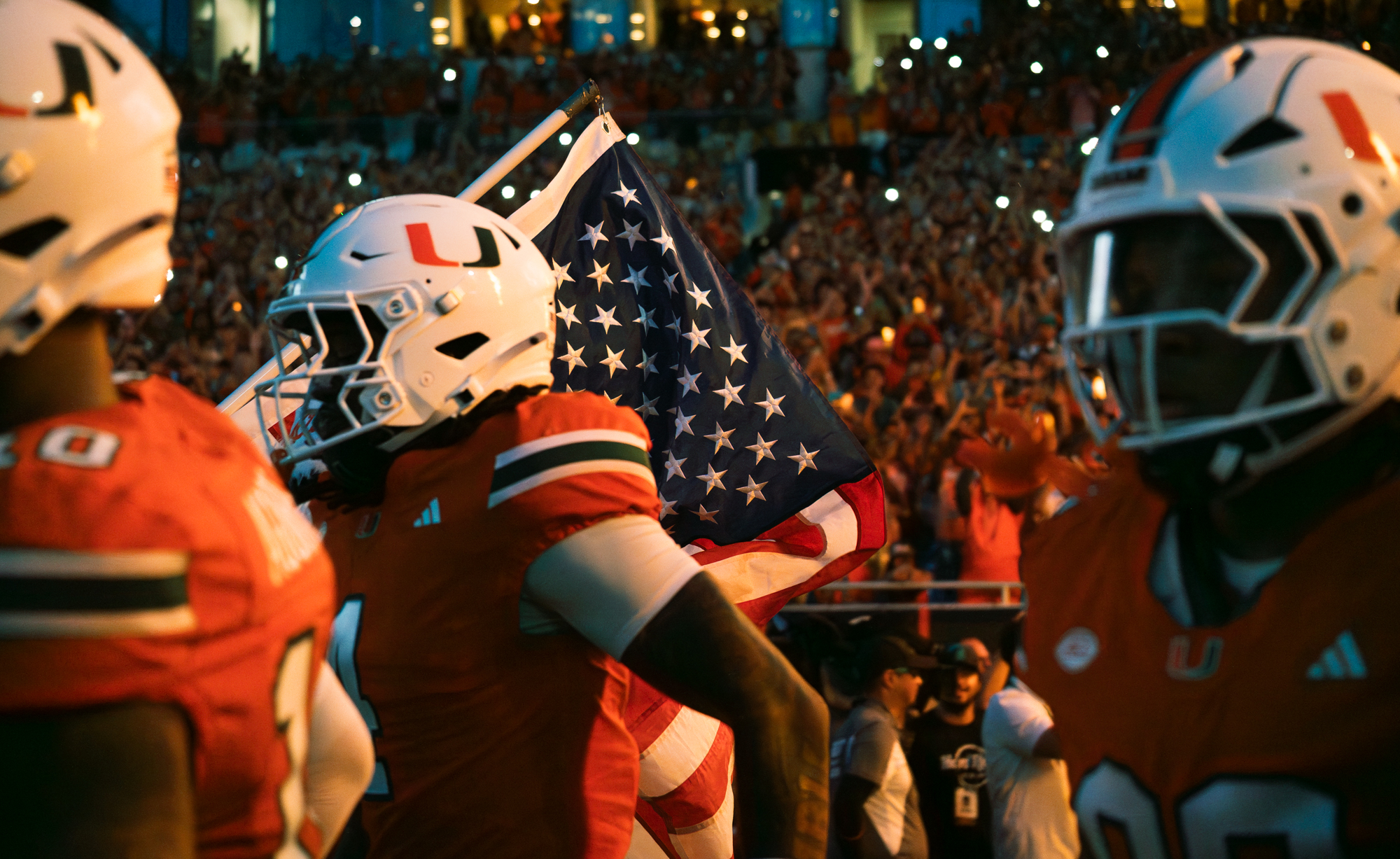
The budget cuts coincide with players and teams increasingly relying on their own platforms to control messaging and communicate without reporters. The result is a form of “state media” in sports, where access is restricted and the hardest questions often go unasked.
“Teams operate their own media now, which helps them generate revenue and control the message, but it also limits critical questions,” said Goff. “I’ve had PR people say I could talk to someone only if I adjusted the tone of my questions or sent them in advance. I’d say no, we don’t do that, and they’d say fine, then you don’t get access.”
Goff took a buyout over the summer from the Post and signed a contract with Yahoo Sports as a contributing writer in October. In his four decades of experience in the industry, he believes it’s the hardest it has ever been to be a journalist.
The Post was responsible for uncovering one of the biggest sports scandals in recent memory, something that may have never been unearthed had its sports section been depleted in 2020.
Post reporters Liz Clarke and Will Hobson spent years investigating Washington Commanders owner Dan Snyder for allowing a culture of sexual harassment among executives. The Post’s reporting led to NFL investigations, congressional hearings and the eventual forced sale of the team. Without the Post, Snyder may have still been running Washington D.C.’s football team.
And alongside the “owned media” model teams are employing, print journalists are experiencing another thorn in their side — content creators.
A notepad and press pass no longer define a sports journalist. In fact, anyone with a phone and a social media account can now “cosplay” as a journalist online.
From aggregation accounts to parody usernames and AI-generated material, the sports media space is flooded with content pieced together from rumor mills and alleged sources.
There’s often no journalistic integrity to these accounts, it’s simply a regurgitation of headlines constantly in an arms race to post first, no matter how inaccurate the report is.
Rather than consumers getting their news via specific journalists, final scores or recaps, interviews are now at the fingertips of billions across the world through social media.
“I just worry if all the news is coming from unvetted sources,” said Michelle Kaufman, a Miami Herald sports reporter and adjunct professor at the University of Miami.
A sports reporter for nearly 40 years, Kaufman has seen it all in the industry and watched the dynamic shift right before her eyes.
“People used to trust newspapers because we were representing an entity … it’s the wild, wild west now,” Kaufman said.
The humble print sports reporter is no longer a necessity, forcing some journalists to embark on a new path or get left behind.
“The people in the sports department really wanted to adapt and change, but we kept waiting for a plan and direction, and it never came,” said Goff. “There were some ideas that never took hold, so we were stuck doing what we always did. That appealed to some readers, but not enough”
Sports journalists who wish to enter the industry are being told to be a “personality,” something that was rebuked in the old version of reporting.
Previously,the model was centered around results and the players themselves, and journalists took a back seat to let the events speak for themselves.
“I went from writing for print to creating videos and podcasts and answering mailbags and responding to threads to keep my followers engaged,” said Manny Navarro, college sports beat writer for The Athletic. “As a journalist, you have to be your own brand 24/7 or you’ll get left behind.”
While a select few like Navarro can pull it off, for most there’s no nuance or depth. The industry has become trend chasing for viral moments rather than storytelling — what the occupation was built on.
“This generation of journalists has the hardest job in the last hundred years,” said Navarro. “Not just because of the work, but the fact you’re the last hope in protecting the truth.”
The field is still there for those who want it, but to the average person, the bad outweighs the good tenfold.
“You can do it, but it takes major sacrifices,” Goff said. “Your social life and mental health take a hit, and unless you’re a TV star, you’re not going to make much money.”
There may not be a happy ending in sports journalism, and the future looks more bleak than it already is.
How far the industry continues to fall is yet to be seen, but one thing is for certain — the truth must find a way to survive.
Because without the truth, the essence of sport itself is lost too.
Miami Men’s Tennis gets swept by No.9 UCF

The University of Miami Men’s tennis team fell 4-0 against the No.9 ranked UCF Knights in Orlando on Friday evening.
UM struggled from the very beginning, failing to gain momentum in doubles. The talented Knights squad came out strong, dominating their service games and controlling the net.
Antonio Prat and Nacho Serra Sanchez were the first to lose for Miami as they fell 3-6 to UCF’s Wissam Abderrahman and Mehdi Benchakroun at court two.
At court three, Luca Hotze and Nicolas Oliveira clinched the doubles point for the Knights, taking down Rafael Segado and Jules Garot.
The Hurricanes’ Saud Alhogbani and Jakub Kroslak were winning 5-4 at court one when the point was decided.
Singles play did not go any better for Miami.
The Knights came out on fire, as Pedro Rodrigues defeated Mehdi Sadaoui 6-0, 6-2. Court 5 was a similar result with Segado falling 6-3, 6-1 to UCF’s Paul Colin.
UCF clinched the sweep at court 3 with Benchakroun taking down Kroslak 6-1, 6-4.
Despite the scoreboard, the Hurricanes were able to put up a decent fight on the other courts.
No. 95 Prat was down 6-2, 5-4 with his serve on deck when the match finished, while Serra Sanchez was in a tight battle on court two, holding a 5-1 lead in the second set after losing 6-4 in the first. Finally, Garot held a 7-6(3), 2-1 advantage in his matchup.
Miami fought hard, but was unable to build any sort of traction early against the top-10 Knights, which proved too much to overcome.
The Hurricanes (5-3) will return home to the Neil Schiff Tennis Center on Tuesday, Feb. 10 to take on USF (1-5).
Miami women’s basketball drop third straight, lose 67-56 to UVA

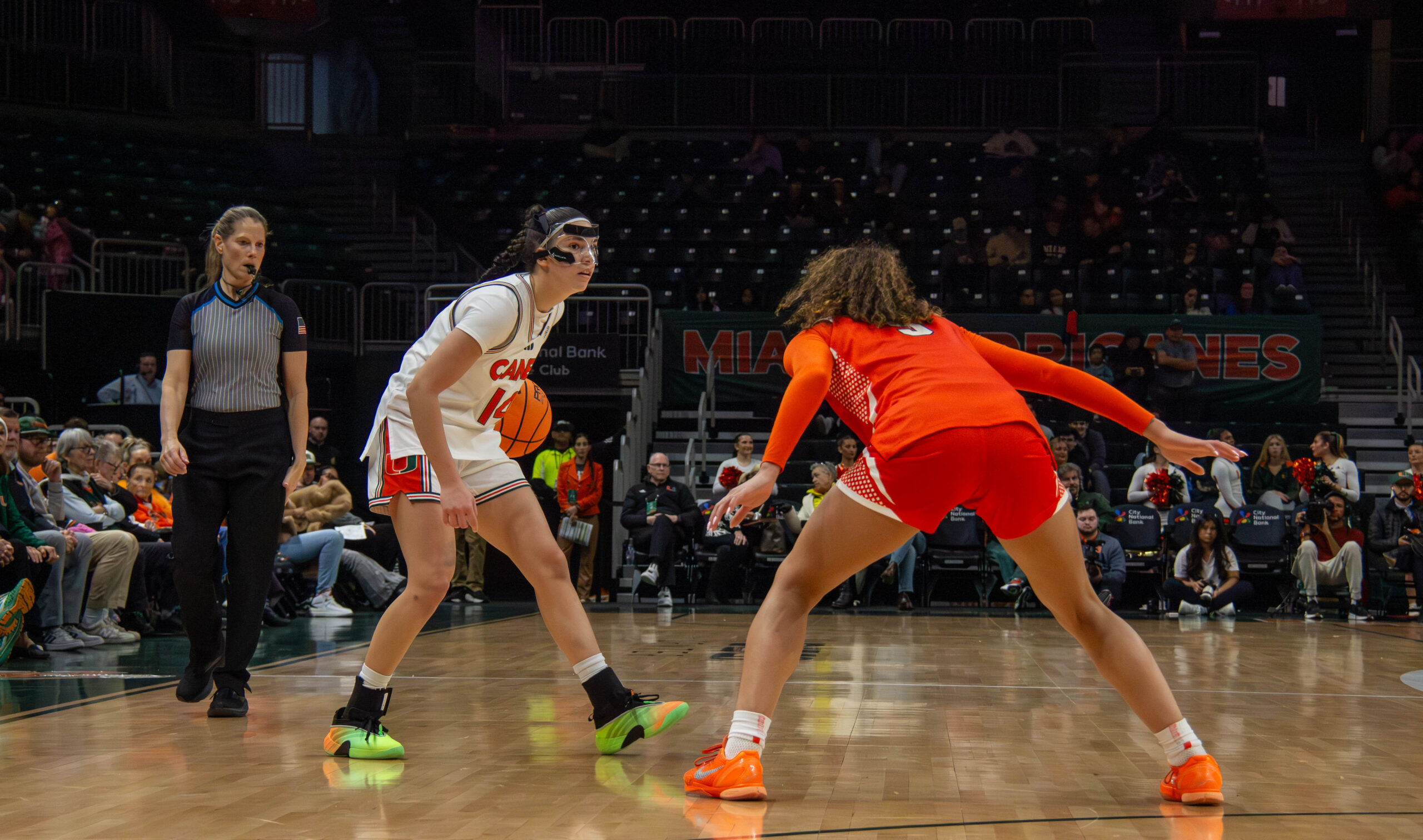
The Miami Hurricanes women’s basketball team fell short to the Virginia Cavaliers in an epic ACC matchup on Thursday evening. Losing 67-56, Miami is now 12-11 while Virginia sits at 16-7 overall.
Despite the loss, there were several stand out performances with Ra Shaya Kyle, Gal Raviv, Vittoria Blasigh and Amarachi Kimpson all scoring in the double digits.
The Canes started off strong with the first score of the game following a spin move from freshman forward Soma Okolo. However, on the other side, Virginia answered with four straight points.
The Cavaliers held the lead for more than five minutes of the first quarter. Miami was able to tighten the game, ending the period 14-10 after a three pointer from Blasigh.
The Canes started to fight back after the deficit, tying the game at 14-14 following back-to-back jumpers from Raviv and freshman forward Natalie Wetzel. The two teams went back and forth in scoring, but Miami finally widened the gap with two free-throws from Kyle and a pull-jumper from Kimpson.
UVA had the final basket of the half, making the score 26-25 Miami.
Although the Hurricanes were going strong the entire first half, they slowly lost their momentum going into the third, and the Cavaliers were able to secure a 13-1 scoring run forcing the Canes to respond.
And Okolo did just that, working on both sides of the ball with a tip in lay-up, six points in the game and three of Miami’s eight rebounds in the third quarter.
The Hurricanes shot a game low of 28.6 percent from the field in the third, and it showed from the score with Virginia leading 47-38.
The final ten minutes consisted of similar play to the last ten, with Miami lagging behind. They were only able to put up six points in the first five minutes, all coming from free throws. In the end, the Cavaliers outscored the Canes 20-18 in the final quarter.
Miami will have a chance for redemption on Sunday afternoon at 2 p.m. against in-state rival, FSU.
The call is coming from inside the HOUSE

Bee Gee’s said it best, “Ah, ha, ha, ha stayin’ alive, stayin’ alive.” Today that popular disco lyric feels less like a throwback and more like a musical prophecy: not only is disco stayin’ alive, but its descendant, house music, might help you too.
In the city of Miami, UM students are surrounded by live music events and popular DJs. A night out here basically requires house music. However nights at SPACE, Factory Town or even your house music gym playlist are more than a good time. They’re a reenactment of the past and an enjoyable benefit to your mental health.
Disco took the 1970s by a sequin storm and, as fast as it became popular, it fizzled out. Lasting less than a decade, disco balls, flared jump suits and platform boots became symbolic tombstones of an iconic time. The genre was pioneered in underground New York City dance venues by African American, Latino and queer communities. The combination of jazz music and turntables birthed a nightlife movement that emphasized dance culture, flashy outfits and made DJs as popular as they are today.
However, after being criticized for growing repetitive and in increasing competition with hip-hop and punk music, disco had its last dance.
Thankfully we have DJ Frankie Knuckles to thank for igniting its revival. Known as the “Godfather of House”, he is responsible for keeping SPACE as lively as it is and getting our generation back in boots and on the dance floor.
He knocked the dust off old disco records and, with a reel-to-tape machine, he mixed in funk, electro-punk and R&B. However, he didn’t stop there. He began including musical build ups full of anticipation, beat drops, percussion breakdowns and catchy samples. From there, house music was born from the ashes of disco.
“House music isn’t black or white. It feels good and it feels right,” DJ Frankie Knuckles said. “The music is everything to me.”
Along with inheriting its energy, house music also kept the catchy 4/4 beat commonly used in disco. Don’t believe it? Try playing a popular house tune for a parent or grandparent and see if they bust out the electric slide, the funky chicken or even a disco finger point. Now they can enjoy their familiar tunes with the house addition of deeper bass, heavier synthesized sounds, vocal loops and massive buildups.
So while the 70s had Chic, Gloria Gaynor, Donna Summer and many others, we have John Summit, Disco Lines, Mau P and Dom Dolla. From viral house audios on TikTok to packed DJ sets, the energy is the same. It’s important to take a moment to appreciate the communities that made this music relevant and to appreciate this unique connection to the past.
With the craze of house music comes not only many dancing-the-night-away moments and hype workouts, but also a new method to fight college and work stress. House music remains within the golden range of 120 to 130 beats per minute. This tempo synchronizes with the body’s rhythm to encourage even breathing patterns, nervous system balance and a steady heartbeat. For the gym goers, these effects strengthen endurance and lead to a better — and more fun — performance. In addition, for all the late night homework sessions, the repetitive 4/4 beat improves concentration, reduces mental fatigue and increases overall productivity.
“I find house music helps me study,” UM sophomore Sophia Ives said. “It’s good background noise that keeps me both focused and in a positive mood so I can get things done.”
One of the components that makes house music what it is, is the cycle of a huge build-up followed by the expectation of an equally epic beat drop. This pattern activates the brain’s dopamine reward system. That process is explained through David Huron’s ITPRA theory which describes five response stages: imagination, tension, prediction, reaction and appraisal.
When listeners hear the music begin to build-up, they use their imagination, feel the growing tension and anticipation to predict the arrival of the beat drop or rhythm change. When the drop finally happens, the bass kicks in, the song does a one-eighty, their reaction and appraisal sees the drop as satisfying and releases dopamine. This pattern reduces cortisol levels, decreases anxiety, generates excitement and encourages a positive mood.
In addition to the mechanisms and science of house music, it benefits listeners in a simple yet important way by encouraging both community and movement. House music is best enjoyed with others, where shared anticipation and enjoyment of a beat drop create a sense of unity among the crowd. Whether at a live set or out in a social setting, people gather around the DJ with a common purpose: to be entertained and engage with the music. It brings people together through shared movement and sound while acting like an echo of the past and a tool for mental health.
“I’ve made so many friends over house music,” UM senior Parker Osth said. “It’s such a diverse genre, you can find your own niche and connect with people over that.”
What was one generation’s disco has become our generation’s house music. A genre that unites, encourages, forms communities and even boosts mental health. To dive into the world of house music, check out Spotify, SoundCloud, Apple Music or even join EQ the UM DJ club. To experience a live house set, get a ticket to SPACE or look into upcoming events at Factory Town. The house music possibilities both digitally and physically in Miami are endless.
The call is coming from inside the house, and it’s asking you to dance.
Florida license plate frame law is confusing and redundant

Florida Lawmakers are currently embroiled in a debate over a few square inches of aluminum and plastic. As of Oct. 1 2025, any license plate frame or object that covers any part of your plate including the words “Florida,” will lead to drivers being fined up to $500 dollars and even 60 days in jail.
The law was meant to help officers see license plates better. However, since the law was passed, it has done nothing but leave residents confused, and has since forced lawmakers to reconsider how they “framed” the wording of the law.
While obvious infringements such as tinted license frame plates that blur your tag are banned, decorative frames have also been thrown in as part of the law. This means repping your favorite sports team, alma mater or movie could put you at risk of being jailed. Which is just outright ridiculous.
I’m not the only one who thinks this. Some commuter students shared their opinion on the matter.
“I understand why certain kinds of frames should be banned, some like the tinted ones can bypass tolls,” said Briana Castillo, a sophomore political science major. “But the pretty pink ones being put in with that is just ridiculous,” she added.
Others expressed concerns of privacy over reach, such as sophomore member of the Association of Commuter Students James Goldrup. “Police already have no issues scanning plates, it is to simplify training for AI-driven traffic cameras to study human movement patterns,” Goldrup said.
Some say the law isn’t confusing once you read the changes. “Given the changes in the Florida statutes, it’s important to review the recent FLHSMV memorandum providing guidance on the legislation – that the numeric plate numbers and decal in top right can’t be obstructed for further clarification for Floridians who commute on a daily basis,” commuter and UM graduate student Angel Aguilar noted that the law clearly outlines what can and can’t be blocked.
Regardless, in late Jan. of 2026, State Representatives requested a clearer definition of the law in a bill package that included several other transportation regulations.
State Representative Michele Rayner of St. Petersburg stated that residents bombarded her office with emails and calls to voice their concerns about the law. State Rep. Berny Jacques of Seminole added the law to the package.
As Florida law looks to correct a ridiculous law, I would put down the screwdriver and frame for now.
Bad Bunny’s ‘DeBÍ TiRAR MáS FOToS’ Album of the Year win means more than music

When Bad Bunny won Album of the Year at the 68th Annual Grammy Awards with ‘DeBÍ TiRAR MáS FOToS’, the room stood up before he could even fully process what had just happened.
Tears hit immediately. Applause didn’t feel polite — it felt earned, communal and necessary. For the first time in Grammy history, an all-Spanish album took home the Academy’s highest honor. That alone is historic — but winning now makes it something heavier, something iconic.
DTMF is not just an album born in Puerto Rico — it is born out of Puerto Rico’s history. A history shaped by colonialism, displacement and a constant fight to be recognized as fully human, fully deserving.
Bad Bunny has never hidden that.
The album lives in memory and resistance: perreo as protest, nostalgia as survival, joy as defiance. It speaks to Puerto Ricans specifically, but its weight stretches far beyond the island. Every Latino who has ever been told to assimilate, to stay quiet, to be grateful for crumbs, hears themselves in it.
“I wanna dedicate this award to all the people that had to leave their home land or country to follow their dreams,” He said in his acceptance speech.
That’s why this win hits so hard right now. After months of backlash for his upcoming performance at the Superbowl Halftime Show. Here is Benito Martinez Ocasio, a week before, standing on the biggest stage in music, winning Album of the Year without translating himself, without softening his roots, without asking permission.
His Grammy speech was powerful, emotional and heartfelt. It felt like he was hugging the entire Latino world and claiming our spot on the world stage. There was room for something sharper, something more cutthroat. But the statement existed regardless.
The album itself said everything. DTMF doesn’t beg to be understood. It exists as proof. Proof that Spanish doesn’t need an English co-sign. Proof that Caribbean music doesn’t need to dilute itself to be “universal.” Proof that stories about Puerto Rico — about struggle, joy, survival — are not niche.
The image of Bad Bunny on that stage mattered. Seeing him be celebrated by American artists in the audience mattered. Watching the entire arena rise for him mattered. This isn’t just a personal victory — it is a cultural one. A win for people whose identities are constantly questioned. A win for anyone told their culture is too loud, too foreign, too much.
Yes, the Academy benefits from this optics. That truth can coexist with the impact. History still happened. The first all-Spanish Album of the Year is now real. Permanent. Unerasable.
Bad Bunny didn’t just win a Grammy. He cracked a door that was never meant to open this wide. And for Puerto Ricans, for Latinos everywhere, that moment felt like breathing — even if just for a second — in a world that keeps trying to take the air away.
Mahoney-Pearson Residential College demolition preparations begin

The University of Miami began construction around Mahoney-Pearson Residential College, marking the start of the building’s transformation into Gables Village. The University announced its plans to demolish Mahoney-Pearson in November, which has housed first-year students since 1958.
An email sent to residents on Friday, Jan. 30 warned about increased construction activity, temporary route changes, and increased signage in and around affected areas.
The email clarified that during construction, pedestrians should expect temporary route adjustments near residential buildings and dining facilities, signage, possible noise and dust disruptions during the day and short-term access limitations in specific areas.
“Our priority is your safety,” HRL told residents in the email. “Steps are being taken to clearly communicate changes, maintain safe pathways, and reduce inconvenience as much as possible.”
“Housing & Residential Life sent out an email notice so it wasn’t too surprising,” Cooper Caldwell, a Mahoney resident, said. “I’m currently unbothered but maybe it’ll get more bothersome.”
Residents have been advised to follow posted signage and detour instructions, allow extra time when walking near construction zones and stay alert around active work areas.
“I thought that seeing the digger was really exciting so close to campus,” Parker Caldwell, a Mahoney resident, said. “I don’t [find] it to be too annoying because I don’t have a car.”
The activity around Mahoney-Pearson will impact students’ access to White Lot, the parking around the outside of Mahoney-Pearson, and Teal Lot, also known as the Mahoney-Pearson garage.
Commuters like Victoria Marciniak, who park in the lots surrounding Mahoney-Pearson are frustrated by the construction.
“The construction has led to congestion in parking spaces and traffic,” Victoria Marciniak, a commuter student, said. “Teal Lot has become the spillover garage for White Lot parking users and we have been limited to access via Ponce de Leon Blvd, which causes unexpected delays in trying to get to class.”
It is unknown how long the preparatory construction will take. The University of Miami has not yet responded to the Hurricane’s request for comment.
UM physics professor sought funding from Epstein for Bahamas physics center

This article was originally published on Thursday, Feb. 5 at 11:13 a.m. and updated on Feb. 5 at 6:13 p.m.
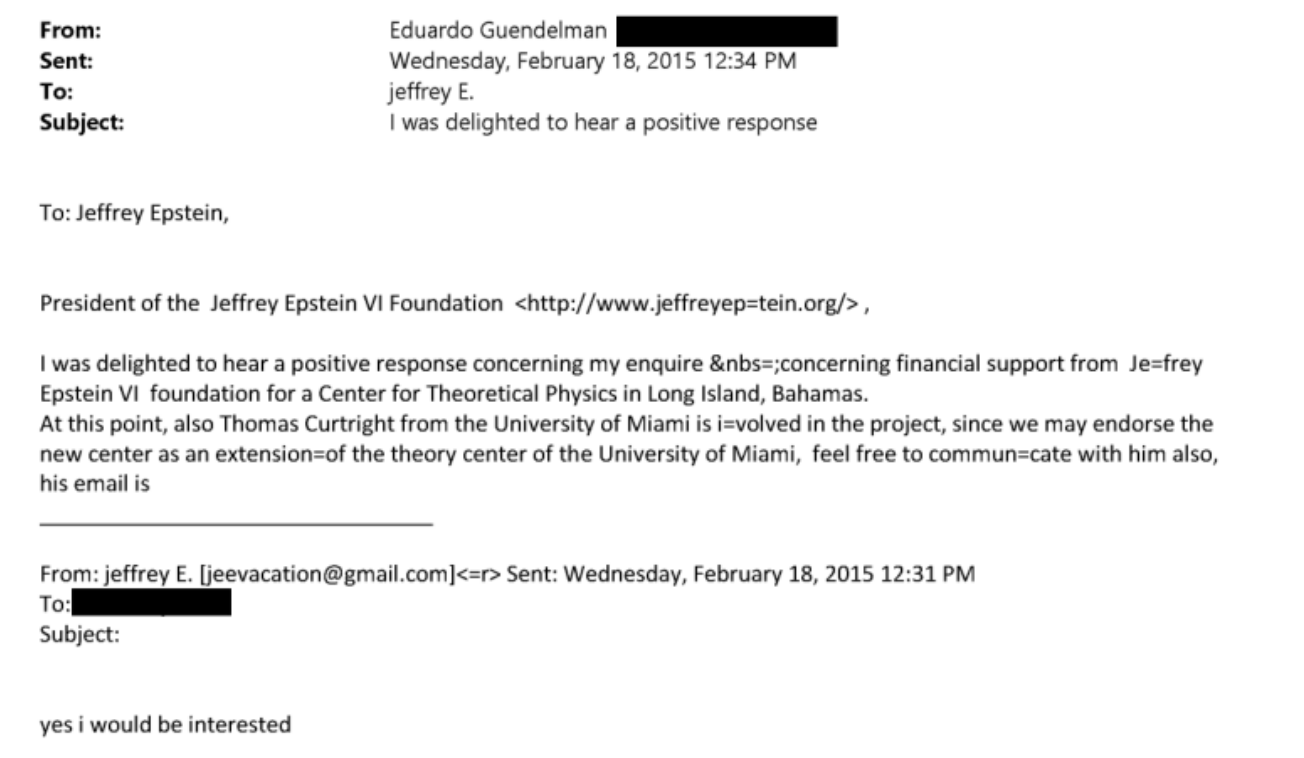
This Current University of Miami physics professor, Thomas Curtright, was involved in discussions with American financier and sex offender Jeffrey Epstein about funding a physics center in the Bahamas, according to documents contained in the most recent Epstein files release.
Their plan was for the center to be “an extension of the [physics] theory center of the University of Miami.”
The Department of Justice recently released millions of pages titled the “Epstein files,” including documents that show correspondence between UM Professor Curtright, Israeli physicist Eduardo Leon Guendelman and Epstein.
Guendelman, who worked alongside Curtright in creating the new physics center, works in the physics department at Ben-Gurion University of the Negev, located in Beersheba, Israel.
One document shows Guendelman and Curtright expressing their gratitude to Epstein for his initial interest in potentially funding the new physics center associated with UM. However, the center was never built.
“No, [the physics center] did not open as a physical place, only virtual. We operate with very little money for the organization of conferences, and we have publications in scientific journals,” said Guendelman in a statement to The Hurricane.
Epstein was first investigated for allegations of abusing a minor in 2005. In 2008, he was sentenced to 18 months in jail and registered as a sex offender.
In the decade that followed Epstein’s first investigation in 2005, multiple women accused him of being a serial rapist and human trafficker. He was arrested on federal sex trafficking charges in July of 2019, and, a month later, he was found dead in his cell. An investigation concluded that he had committed suicide.
Since then, his victims have demanded justice and the release of all court records and documents compiled in the many Epstein investigations.
In a statement to The Hurricane, Curtright said that he became involved in discussions with Epstein after Guendelman suggested he could be a good source of funding for the new physics center in the Bahamas.
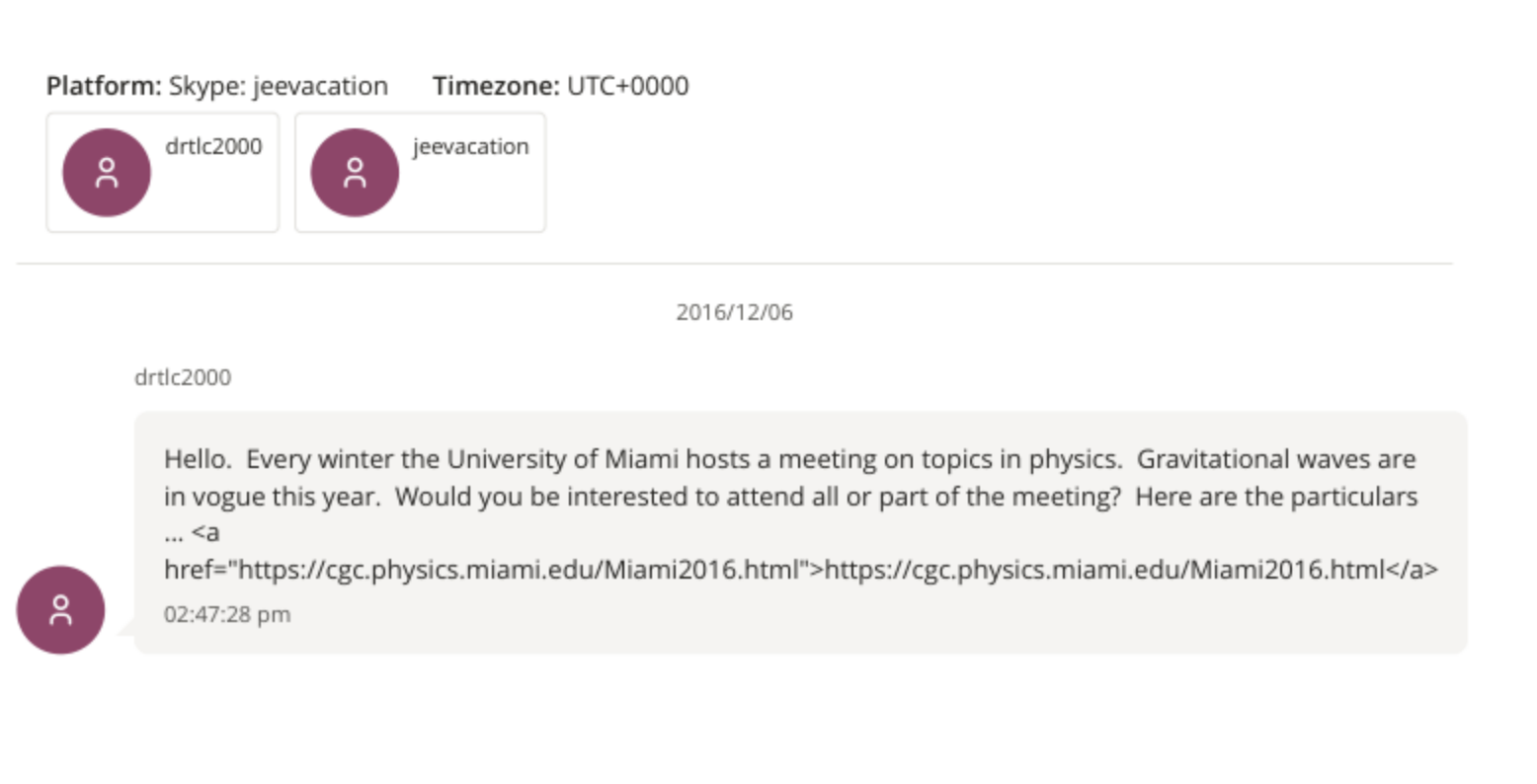
In a text via Skype to Epstein on Dec. 6, 2016, Curtright said, “Hello. Every winter the University of Miami hosts a meeting on topics in physics. Gravitational waves are in vogue this year. Would you be interested to attend all or part of the meeting? Here are the particulars …”
Curtright and Geundelman both admitted to not being aware of Epstein’s past when participating in exchanges with him.
“I did not become aware of his sordid past until his indictment in 2019, after which neither Professor Guendelman nor I had anything to do with him,” Curtright said. “Professor Guendelman identified Epstein as a possible philanthropic source of funding, based on Epstein’s having provided money for previous academic activities.”
Guendelman also spearheaded a physics conference that UM has been named an academic sponsor of, although it is unclear whether or not the University is aware of Curtright and Guendelaman’s communication with Epstein.
The conference, titled Bahamas Advanced Study Institute and Conferences (BASIC), was intended to be a symposium for other physicists or scientists interested in multi-disciplinary physics.
The beginnings of the BASIC conference were outlined in emails between Epstein and Guendelman. Guendelman stated he and Curtright wanted to use space on either Long Island or Stella Maris for both the UM-affiliated physics center and BASIC.
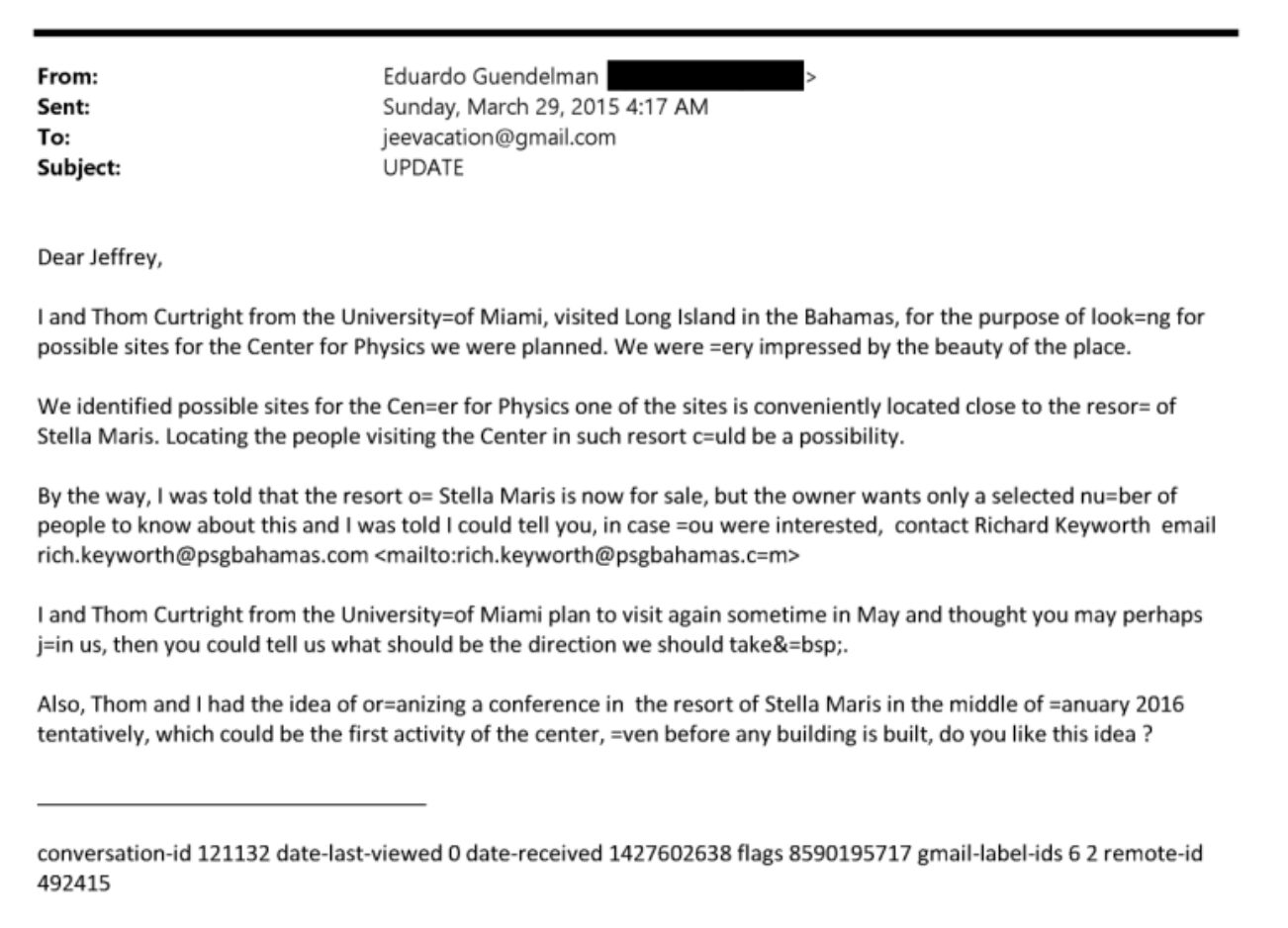
“It was never ascertained by either me or Guendelman that funding from Epstein was a real possibility,” said Curtright. “I did not become aware of his sordid past until his indictment in 2019, after which neither Professor Guendelman nor I had anything to do with him.”
Epstein never went through with the funding.
According to the University of Miami’s College of Arts and Sciences webpage, BASIC was hosted by Curtright, Guendelman and Kings College’s theoretical physicist Peter West in 2024, 2025 and 2026 in the Bahamas. It is unclear how long the University of Miami has been funding BASIC.
West has not yet responded to The Hurricane’s request for comment. The Hurricane also reached out to the University of Miami for comment and has not yet received a response.
TikTok creator “Miami Nate” gets candid about life as a club promoter

Some people joke about quitting their jobs to focus on their social lives. Well, Nate Samuels actually did it. Trading private equity for private parties, Samuels established himself as a prominent figure in Miami nightlife.
Across the city, general admission tickets to nightclubs remain widely available. Many people, however, complain about this form of entry, citing long lines, sweaty crowds and overpriced cocktails.
To elevate the experience, some patrons (and University of Miami students) hire a club promoter: an independent contractor who expedites your entry and grants you access to exclusive areas and complimentary drinks.
Nightclubs rely on promoters like Samuels to attract guests, generate revenue and increase brand awareness.
Born and raised on Long Island, Samuels described an underprivileged upbringing and a complex relationship with his family.
Today, he reports occasional contact with his father, but he does not speak with his mother.
“My parents have had zero influence on anything I’ve ever done in my life,” Samuels said. “They didn’t care if I went into finance … they didn’t care if I was a drug dealer.”
Samuels graduated from Queens College in 2021. He spent three years as a strategy associate at KPMG before eventually joining a portfolio company backed by Blackstone, the world’s largest private equity firm.
He was one of the few people at the company who had not studied at a typical feeder school for private equity, such as the Chicago Booth School of Business or Harvard Business School.
“I didn’t have the luxury of doing that,” Samuels said. “I grew up poor. I was smart, but I wasn’t that smart.”
Samuels suggested that because his undergraduate degree from Queens had less “prestige,” he was a prime target for mistreatment.
“If I f—d up, everything was on me,” Samuels said. “If I did well, someone else took the credit.”
Still, he remained committed to the job, providing for himself and his girlfriend of five years.
He later found out that his girlfriend had slept with a club promoter.
“Now, what most people would do is lie down and be sad about it. But I was like, ‘f—k that,’” Samuels said. “‘If there’s money to be made in this industry, then I’m gonna make it.’”
So, he packed his bags and went to Miami.
Samuels entered the industry by working for free under an established club promoter. When the promoter eventually offered to compensate him, Samuels refused, insisting on “proving himself” before negotiating a salary with Miami clubs.
“You’re gonna want me. Just wait until I blow up on social media,” he told club owners.
In only three months, his TikTok account @miamipromoter_nate reached more than 139,000 followers. He’s turning heads everywhere for his big personality and what many people call his “out of pocket” statements.
He’s gone viral with controversial videos listing requirements for his guest lists, recommending that “unattractive” women not contact him.
Samuels stood by his statements, insisting that bouncers have strict expectations and that he does not want his clients to be rejected at the door.
For anyone who messages him via Instagram, an automated response will appear, reading, “Ladies: send pics of you and your friends if you’re traveling with any, as well as the dates you are coming. Gents: if you need to book a table, yacht, luxury car, private jet, or accommodations, please be clear on the dates and what you are looking for so I can help you.”
His posts often receive mixed reviews: many find his comments offensive, while others find them hilarious. Popular creators have even made satirical videos impersonating him, mimicking his distinct, raspy voice and blunt statements.
Samuels appeared unbothered by criticism or imitations, claiming that his message of exclusivity has led to his success.
He argued that by creating a group of women with shared personalities, a safer environment exists.
“You always want to be in a situation where you’re around other girls with a similar vibe, because those are the ones who are going to protect you if something goes wrong,” Samuels said. “A lot of promoters will try to isolate you.”
Samuels typically avoids drinking alcohol when he works, explaining that he wants to be alert.
The TikTok influencer believes his accomplishments are beyond the reach of rival promoters who lack his social media status. He emphasized that while he enjoys his career, it remains highly challenging and more demanding than most people would expect.
“Try and do it for three nights in a row, Thursday, Friday, Saturday, the easiest nights, and tell me how easy it is,” Samuels said. “Because it’s impossible. It’s really, really, really hard.”
His online presence serves as a form of self-advertising, enabling him to bring 40, 50, or even 60 women to the club each night. On a recent night out, one of his male clients spent $15,000.
Samuels plans to create a social network among his top clients, positioning himself as an intermediary in major business deals.
In January alone, he generated $534,414 in booking revenue across several venues, with LIV Nightclub and Vendôme as his top performers.
But for every dollar he brings in the door, Samuels takes a cut, and the club receives the residual. As an independent contractor, he receives no salary or employee benefits.
He plans to begin running his own events within the next six months, allowing him to keep more of that money in his pocket.