Progressive Insurance is now the presenting sponsor of the Miami-Florida State rivalry matchup.
Miami Athletics announced the multi-year deal on Thursday, marking an innovative partnership between the in-state rivals
The insurance company will focus on activating and generating engagement in South Florida ahead of this season’s game which will take place at Hard Rock Stadium.
However, this partnership isn’t solely limited to when the sides square off in week 7 on Oct. 17.
Starting this season, Progressive logos will be displayed on the field during every home game at both the Hurricanes’ Hard Rock Stadium and the Seminoles’ Doak S. Campbell Stadium.
“Few rivalries in college sports carry the passion, history and statewide significance of Miami vs. Florida State,” UM Chief Revenue Officer Jesse Marks said. “Progressive’s partnership allows us to build on that tradition while creating an innovative model for how brands can engage with our fans.”
In a college football landscape that’s routinely becoming business oriented, Miami is selling from a position of strength.
The Canes played for a national title in January, beating Texas A&M, Ohio State and Ole Miss on their path in the College Football Playoff before losing to Indiana 27-21 at Hard Rock Stadium.
Miami participated in five of the 17 most-watched college football games last season, with its national championship and quarterfinal games ranking as the first and third most watched games respectively.
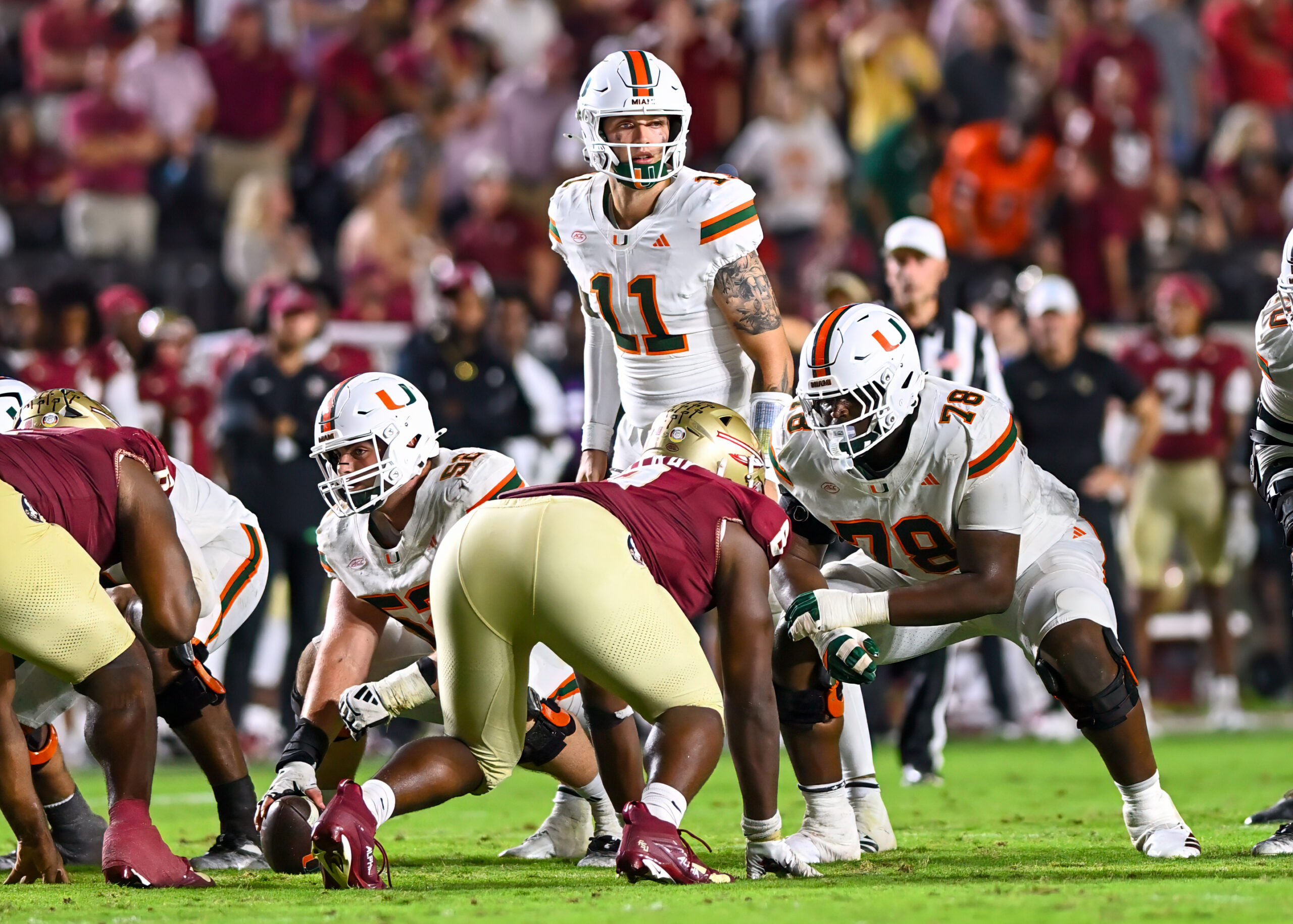
David Lebowitz, Staff Photographer – Quarterback Carson Beck leads the Hurricanes to a 28-22 win over FSU on Oct. 4 2025
There is a reason behind the move to add more sponsorships.
On July 1, 2025, schools began to pay their athletes directly as a result of the House settlement, with a cap around $20.5 million per school this year and projections to rise to $33 million by 2035.
The cap is determined based on what schools’ average in media, ticket, and sponsorship revenue — prompting schools to find new ways to generate revenue to compete.
Field sponsorship itself is new territory.
The NCAA only recently approved sponsor logos on the playing surface for regular-season games. Each school gets three spots: one at midfield and two smaller ones wherever the program chooses.
This month alone, Progressive has purchased logos for 13 other programs, most of which are for one school at a time.
Legends Global brokered the deal alongside both schools, which has become a pattern with the University of Miami.
The first few weeks of the semester are not just about finding your classes or struggling to learn Canvas; they are also the best opportunity to find communities, make connections and explore opportunities outside of the classroom. Getting involved and finding your place at UM can be as simple as showing up. Sometimes, going to the event you almost skipped is how you meet your closest friends or find your favorite organization.
From student organizations to volunteer opportunities, these events give students a chance to explore and find their passions outside of the classroom.
Here are a few events worth adding to your calendar:
Green U Tour
For those hoping to grow more familiar with campus, you can take part in theGreen U Tour on Sept. 9 from noon to 1 p.m.
The tour, hosted by the Office of Sustainability, will take students beyond the classrooms to explore some of UM’s environmental initiatives, including its mangrove restoration site, butterfly gardens and sustainability buildings. The tour gives participants a closer look at how these initiatives contribute to UM’s overall sustainability efforts.
Meet in the Admission Office lobby at Stanford Circle to explore the greener side of the U.
Business School Coastal Cleanup
Students looking to meaningfully spend more time off campus to help the greater Miami community can check out theUniversity of Miami Business School Coastal Cleanup on Sept. 19 from 8 a.m. to noon. The event allows students to spend time outdoors and help keep South Florida’s coastline clean.
The bus will depart from Cesarano Plaza at the Miami Herbert Business School at 8:15 a.m. Check-in begins at 8 a.m.
BreakThru Career Mixer & Fall Job and Internship Expo
For students thinking about their long-term goals or future after graduation, theFall 2026 BreakThru Career Mixer will take place Sept. 22 at the Toppel Career Center. Here, you can network with companies brought in by UM and begin making professional connections.
While these career events may sound daunting to incoming freshmen, they help boost self-confidence and allow students to become more comfortable introducing themselves, asking questions and getting themselves out there professionally.
Family Weekend
Later that week isFamily Weekend. From Sept. 24 through Sept. 27, the University offers various events that give students the chance to show their family members around the campus they call home. One of the main events is the Miami vs. Central Michigan football game at 6:30 p.m. at Hard Rock Stadium.
Engineering Career Day
Engineering Career Day 2026 wraps up the month on Sept. 30, from noon to 3 p.m. at the Lakeside Village Expo Center & Pavilion. Although this event is geared toward students interested in engineering-related fields, it is another reminder that career exploration can start long before junior or senior year.
While the first few weeks of college can feel like a race to get settled, your entire college career does not need to be all figured out right at once. Sometimes finding your place starts with showing up to an event or just introducing yourself to someone new.
At a campus with as many clubs and events as UM, the hardest part may not be finding something to do; it may just be deciding what to join first.
Audiences coming together to the movie theatre is seemingly becoming obsolete. That was, until this summer, when box office releases were so intriguing that no one could resist the trip.
Every big release was carefully crafted — visually, with intentional use or absence of CGI; editorially, with meta-metaphorical scripts; and sonically, with unforgettably immersive soundtracks.
According to The Washington Times and Reuters, the box office earned $4.2 billion this summer, a 10 to 15% increase from last summer.
There was something for everyone, but below are a few fan favorites that you want to see if you haven’t already.
For the horror fans
Indie films are on the rise — especially in the horror genre. This summer, “Obsession” and “Backrooms” had back-to-back releases and found success. Both directed by young filmmakers, they each possess an originality and newness that horror needs right now.
University of Miami junior Pearl Amromin said the success of Obsession and Backrooms “shows that people are ready to transition away from remakes of things and they’re ready to transition into watching smaller indie films.”
She believes “it could encourage indie filmmakers to make more films because that’s what people really want.”
Their psychologically grounded elements don’t let you move from your seat even when the credits roll, placing greater emphasis on sustained unease than on short-lived jump scares.
IMDb reports that “Obsession” led box office sales between the two movies, earning $400 million. “Backrooms” wasn’t far behind, however, grossing $350 million.
For the film buffs
Christopher Nolan is a household name for anyone who loves film, and his new movie “The Odyssey” adds itself to his list of box office hits.
For those who know and love the original story, the movie is a modernized adaptation that offers new perspectives and themes. For those less familiar with the Greek epic poem, it’s still a captivating story. Through practical shots and an IMAX camera, Matt Damon, Anne Hathaway and Tom Holland star in the three-hour blockbuster.
Deadline names “The Odyssey” the “highest-grossing R-rated movie of all time, amassing $1.352 billion worldwide.”
For the Marvel enthusiasts
The Marvel Cinematic Universe hasn’t gripped its audience as it did in the Infinity Saga. The story of Peter Parker and Spider-Man gives you no choice but to tune in. It’s a classic superhero story with the kind of heart everyone craves.
Spider-Man has the power to re-captivate an audience that was growing detached.
“The Fantastic Four: First Steps” preceded “Spider-Man: Brand New Day” in the MCU’s filmography. Its opening weekend earned $218 million, as opposed to “Brand New Day’s” impressive $360 million cited on Box Office Mojo.
“I think people did start to lose interest, but Spider-Man definitely brings back the audience,” said UM junior Sajida Simrin.
For the nostalgics
If you grew up in the past two decades, you know there’s nothing like bright yellow, goggle-eyed, gibberish-speaking minions. Although it’s a children’s movie, the new “Minions & Monsters” movie targets the same audience it always has — even if they’re grown up now. Minions are timeless.
“Toy Story 5” also debuted this summer and appealed to the same audience.
The two family-friendly films went head-to-head at the box office, with Rotten Tomatoes reporting earnings of $36 million for the latest “Minions” installment and $31 million for “Toy Story 5” in their opening weekends.
Although many of this season’s releases are completing their theatrical runs, they’re all still worth a watch when they make their way to streaming services.
A major network isn’t producing the next big reality series coming out of Miami — it’s being built by a University of Miami sophomore who wants fellow Canes at the center of it.
Christian Yeagley, founder of Miami Influence Magazine, is launching a new competition-based reality show, “Miami Influence: The Reality Series.” The show will follow 10 young creators through the fast‑moving, high‑glamour world of Miami’s influencer scene. More than 500 creators have already applied, including over 100 UM students eager to represent the University on screen.
“One day I was making a magazine for old people, and the next I was doing a yacht shoot with influencers looking over the Miami skyline,” Yeagley said.
Yeagley is producing the series through his magazine, which has highlighted Miami’s creator community for the past five years. He’s now expanding that mission into a full-blown reality competition.
Yeagley said he plans to outsource filming to Miami production companies, using multiple camera crews to follow contestants rather than building a traditional set. He’s funding the project through revenue from his magazine, self-funding and additional support from UM students, whose involvement will help offset production costs while giving them hands-on experience.
The series is designed to showcase personality, ambition and the real lives of emerging influencers. Contestants will be selected later this year, with Yeagley emphasizing that UM students are not just welcome but actively encouraged to apply.
While Yeagley is keeping many details under wraps, he describes the show’s vibe as “‘Entourage,’ but make it Miami influencers.” Viewers can expect a mix of high-energy events, brand collaborations, influencer cameos and the kind of spontaneous, chaotic moments that reflect Miami’s social scene.
Instead of manufactured drama, the series will follow contestants through their day‑to‑day lives — the friendships, the hustle, the nightlife and the work behind content creation. Multiple camera crews will capture each storyline as it unfolds, highlighting the authenticity of Miami’s influencer world.
Yeagley emphasized that the show won’t rely on scripted conflict or exaggerated tropes.
“These people are living lives that are already so crazy,” he said. “I don’t have to fabricate anything.”
Yeagley launched Miami Influence Magazine at just 19, despite never having read a magazine from cover to cover. What started as a publication aimed at Miami’s luxury market quickly evolved into a platform for the city’s booming influencer scene.
As he began collaborating with creators, hosting shoots on yachts and private jets, and partnering with Miami businesses, Yeagley realized he wasn’t just documenting a lifestyle — he was embedded in it.
“Miami’s the influencer capital of the world right now,” he said. “There’s more influencers per capita in Miami than LA or in any other big city.”
That pivot from traditional luxury media to creator‑driven storytelling sparked the idea for the reality series. If the magazine could capture Miami’s influencer culture in print, why not bring it to life on screen?
His entrepreneurial path is unusually accelerated for a college student. While most sophomores are building résumés, Yeagley is building franchises. He recently launched a second publication, Naples Influence, and is now raising funding, securing production partners and planning a multi‑season reality competition — all while taking classes.
Yeagley’s decision to center the show on UM students isn’t just sentimental; it’s strategic. In the past few years, UM has not-so-quietly become a hotspot for breakout creators across TikTok, Instagram and YouTube.
Bigger social media stars like Alix Earle and dozens of micro‑creators that focus on fashion, wellness and campus humor have built loyal audiences that extend far beyond Coral Gables.
UM’s student body is uniquely positioned to make an impact: diverse, entrepreneurial, plugged into Miami’s culture and fluent in digital storytelling. Many students treat content creation as a legitimate career path, balancing brand deals and managing schedules alongside coursework.
Yeagley has already collaborated with several UM creators through the magazine, which is why so many students recognized his casting call immediately.
“Our actual audience is UM,” he said. “We’ve worked with so many UM influencers already.”
The result? A flood of applications, over 100 from UM alone, making the University one of the most represented groups in the casting pool.
For UM creators, the series represents something rare: a platform built by one of their own. Yeagley isn’t an outside producer parachuting into campus culture; he’s a student who understands the rhythms, personalities and chaos of UM life. And he believes those stories deserve a bigger stage.
“We’re looking for personality,” he emphasized. “We want people with interesting lives … not just a bunch of followers.”
The show promises visibility, collaboration and a chance to break into Miami’s creator ecosystem — a space that can be notoriously hard to enter without connections.
The winner will be flown out on a private jet to the Bahamas for a magazine cover shoot, but Yeagley insists the real prize is the chance to be seen.
UM students can apply at influencemia.com/show; the form takes less than two minutes to complete. Casting closes at the end of the year, and contestants will be announced on the magazine’s Instagram. Filming begins in 2027, and the series is expected to release in 2028, just in time for Yeagley’s senior year.
If the early buzz is any indication, UM students won’t just appear in the show — they might define it.
The best UM experience stretches far beyond the boundaries of campus.
You do not need a perfectly planned Miami itinerary or an expensive dinner reservation to start exploring. Sometimes, you just need to know a few popular places to meet other college students.
Sunset Place
For the easiest first outing, start close to campus.
Sunset Place is only about a 15-minute walk from UM and, while it might not be the first place you hear about as a freshman, it is seriously underrated. You can catch a movie at the AMC, stop by Honey Veil, take a class at Fuze House Yoga or just walk around when you want to get off campus without making an entire day out of it.
Coconut Grove
A little farther away is Coconut Grove, just a 10-minute drive from campus and home to some of the most iconic student spots. Grab a sweet treat from Go Greek, try the must-have pizza at Mister O1 or walk around CocoWalk for a more relaxed afternoon.
The Grove is perfect for almost anything, whether it is a Sunday coffee run, shopping with friends, showing your parents around when they come to visit or a weekend night out.
For sophomore Lucy Sanford, getting off campus helped her feel like Miami was really her home.
“Exploring everything around UM was honestly one of the things that made me love the school so much,” Sanford said. “There’s so much to do right outside of campus, and once you start exploring, Miami starts to feel a lot more like home.”
Beach trip
Of course, exploring Miami would not be complete without a beach trip. Sophomore Nina Wagner, a member of UM’s scuba club, recommends one that freshmen might not even realize they have access to.
The Rosenstiel School of Marine, Atmospheric and Earth Science sits right on the water on nearby Virginia Key, giving UM students a waterfront escape away from the more crowded Miami beaches.
“Rosenstiel is probably one of the most underrated places for UM students,” Wagner said. “It feels like having our own little beach away from everything, and so many students don’t even know about it.”
Getting there is easy, too. UM offers a free Rosenstiel Shuttle that picks up students at Miller Circle on the Coral Gables campus and takes them directly to the Rosenstiel School on Virginia Key, making the trip easy without a car or an Uber.
Key Biscayne is one of the easiest beach escapes from Coral Gables and a good option when you want something beyond sitting at the campus pool.
That being said, do not underestimate the pool. On a sunny weekend, the UC Pool can look like half the student body independently had the same idea. If you want a chair, get there early. Consider this your warning.
Brickell
Your first semester should also include at least one trip to Brickell, about a 20-minute Metrorail ride from campus.
With skyscrapers, waterfront views, restaurants, shopping and nightlife, it feels like the center of modern Miami. Walk around Brickell City Centre, grab lunch or dinner, explore the shops or come back for a night out.
And getting there is easy: take the Miami Metrorail for a cheap and convenient way to explore beyond Coral Gables without constantly paying for Ubers.
Little Havana
For a different side of Miami, Professor Nicole Hospital-Medina, a UM alumna and writing professor, recommends heading to Little Havana.
“Little Havana is such a vibrant place to explore,” Hospital-Medina said, pointing freshmen toward its small shops, restaurants and Domino Park.
Her advice is to work your way outward rather than trying to see the entire city at once. Start with walkable South Miami, she said, then branch out to Coconut Grove and Brickell before exploring farther from campus.
Game day
During football season, there is one freshman experience that should be nonnegotiable: go to the games.
Yes, Hard Rock Stadium is far. Yes, Miami will probably be unbearably hot. Go anyway. Get on the student bus, wear orange and green and experience a football Saturday at least once.
But making Miami feel like home is not just about how many places you can check off a list. Professor Hospital-Medina said one of the most important things freshmen can do is establish a routine of their own.
“You no longer have that rigid schedule laid out for you in college,” Hospital-Medina said. “It’s easy to get off track or feel homesick, so you need to make your own routine. Step outside the campus a little bit here and there slowly so you don’t feel overwhelmed.”
The biggest mistake freshmen can make is treating Miami like somewhere they will explore “eventually.” Four years sounds like a long time until it isn’t.
So go to Key Biscayne. Spend an afternoon in the Grove. Get to the pool before all the chairs are taken. Take public transit somewhere you have never been. Go to Hard Rock.
Get off campus, explore and take advantage of the city you get to call home for the next four years.
It’s impossible to miss the cranes and piles of rubble that trample over where our beloved Mahoney-Pearson residential halls used to stand.
We may not live there anymore, but we will never forget all the things that really made it feel like home.
I mean, seriously, what would we have done without the water dripping from the vents above our heads while we slept? Or the occasional hospital visit from mold poisoning?
And nothing screamed “you look great” quite like the green or fleshy pink bathroom tile. No matter how good you thought you looked before walking in, one glance in that mirror was enough to make you question whether you were coming down with something … again.
Maybe MP’s greatest gift of all was the sense of community that came from knowing we were all in it together. Centennial Village may have shiny new rooms and no mold, but we had each other and superiority complexes built entirely around being “more social.”
But it was true. Doors were always open, music was always playing and people were always around to lend you a going-out top or some snacks.
Then there were the gliders.
During the day, they were the perfect place to sit outside and pretend to do homework. At night, they became the spot to recap everything that happened while eating Taco Bell you definitely did not need.
And who can forget the time the outdoor ceiling collapsed right where many of those gliders used to be?
On the weekends, there was nothing better than making the trek to late-night dining in pajamas and slippers with your friends. It wasn’t glamorous, but neither was MP — and that was kind of the point.
Mahoney-Pearson may officially be rubble now, but for everyone who called it home, it will always be the place where some of our best college memories began.
So, goodbye MP. You were outdated, questionable and occasionally hazardous to our health, but you were ours.
It’s impossible to miss the cranes and piles of rubble that trample over where our beloved Mahoney-Pearson residential halls used to stand.
We may not live there anymore, but we will never forget all the things that really made it feel like home.
I mean, seriously, what would we have done without the water dripping from the vents above our heads while we slept? Or the occasional hospital visit from mold poisoning?
And nothing screamed “you look great” quite like the green or fleshy pink bathroom tile. No matter how good you thought you looked before walking in, one glance in that mirror was enough to make you question whether you were coming down with something … again.
Maybe MP’s greatest gift of all was the sense of community that came from knowing we were all in it together. Centennial Village may have shiny new rooms and no mold, but we had each other and superiority complexes built entirely around being “more social.”
But it was true. Doors were always open, music was always playing and people were always around to lend you a going-out top or some snacks.
Then there were the gliders.
During the day, they were the perfect place to sit outside and pretend to do homework. At night, they became the spot to recap everything that happened while eating Taco Bell you definitely did not need.
And who can forget the time the outdoor ceiling collapsed right where many of those gliders used to be?
On the weekends, there was nothing better than making the trek to late-night dining in pajamas and slippers with your friends. It wasn’t glamorous, but neither was MP — and that was kind of the point.
Mahoney-Pearson may officially be rubble now, but for everyone who called it home, it will always be the place where some of our best college memories began.
So, goodbye MP. You were outdated, questionable and occasionally hazardous to our health, but you were ours.
UM’s volleyball team dominated the courts last season, playing one of the best seasons in program history, going 27-6 (ACC 16-4) while also winning three ranked matches against Pittsburgh and North Carolina twice in last year’s campaign.
Their regular-season success earned them a bid to the NCAA tournament for a fifth consecutive year. In the postseason, UM won their first-round matchup against Tulsa, but fell to Kansas in the next round.
Last season will not be forgotten, but the Hurricanes, along with head coach Jose “Keno” Gandara, who is heading into his 14th year at Miami, are ready for this year — seeking a sixth straight NCAA tournament appearance.
With the season around the corner, here is how the team is shaping up.
Replacing a program legend
Perhaps the toughest challenge the Canes had during the offseason was finding a replacement for outside hitter Flormarie Heredia Colon.
Heredia Colon was selected No. 10 overall in the 2025 Major League Volleyball (MLV) draft, and the legacy she left behind at the “U” is immense.
In her four years as a Hurricane, Heredia Colon littered her name all across the program record book — holding nearly every program record for kills.
To put her historic kill count into perspective, nine of the top-ten performances in program history came from her during the 2025 season.
In short, the 2025 All-American and All-ACC First Team recipient was a dominant one-woman scoring machine.
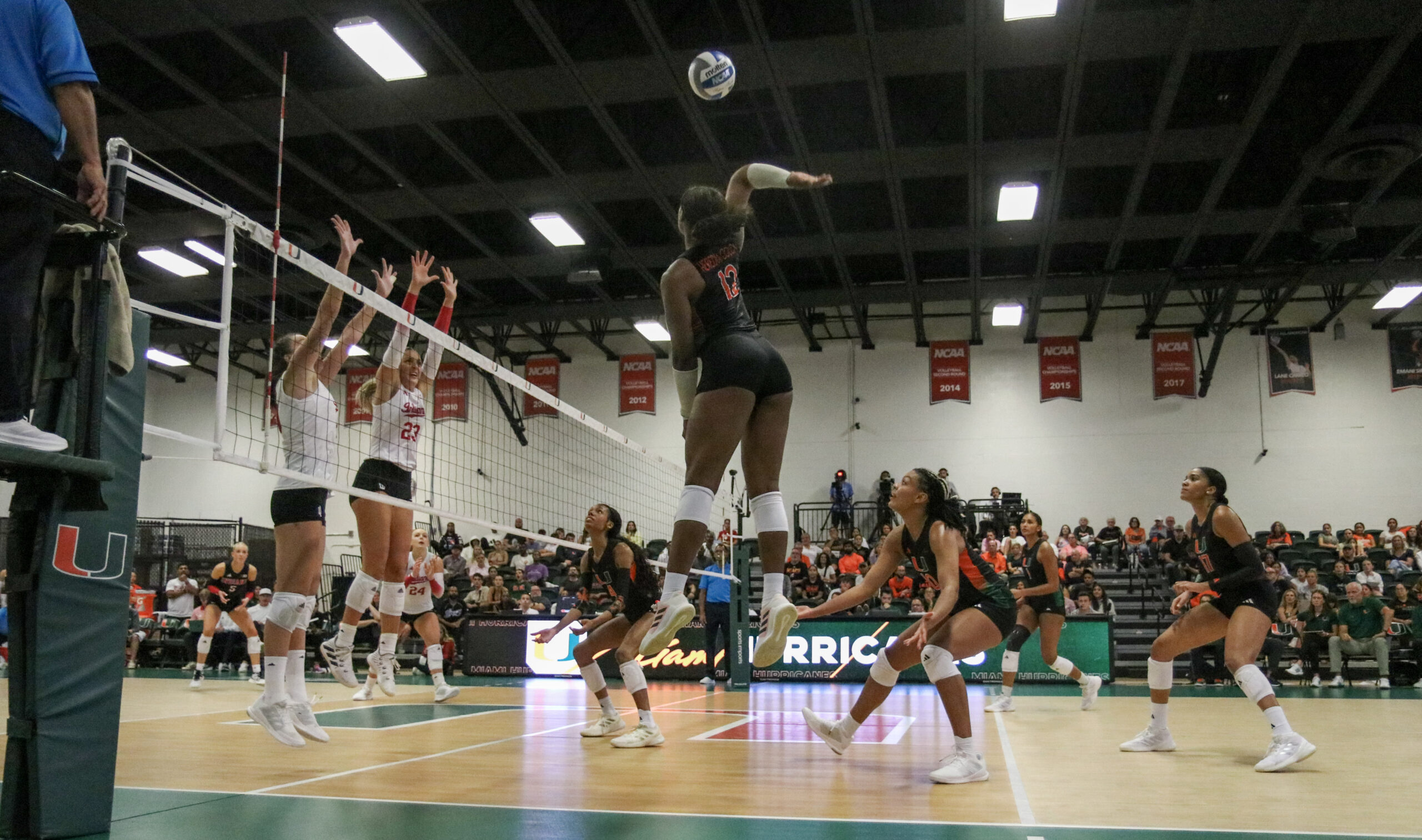
Sophia Metzner, Staff Photographer, senior Flomarie Colon jumps for a spike versus Indiana Aug. 29 2025
Senior outside hitter Flormarie Heredia Colon goes up for a spike in the 2nd set of Miami’s 2-3 loss to Indiana at the Knight Sports Complex on Friday, Aug. 29th.
Many new faces join
The question remains as to who will take Heredia Colon’s role for the 2026-27 Hurricanes, especially with Miami’s next three kill leaders last season no longer with the program.
In total, UM lost nine players, including the majority of their core six.
The Hurricanes have filled that void in the roster with five transfers: sophomores Asia Harvey and Jovana Zelenovic, seniors Avery Bain and Lal Akin, junior Adrianna Bridges and four freshmen.
All nine will be battling for a spot in the starting lineup that has been left wide open after last season.
Who will the starters be?
The only guaranteed pick for a spot in the starting six will be setter Ariana Rodriguez.
The redshirt junior is returning from a career season in which she tallied the second-most assists in a season for Miami (1265) and was named to the All-ACC First Team.
Besides Rodriguez, the rest of the lineup is seemingly up for grabs.
A top pick for one of the two outside hitters is Zelenovic. Standing at a towering 6-foot-7, the Serbian brings power to Coral Gables as she led Kansas last year in both kills and service aces, along with being named First Team All-Big 12 as a freshman.
As for the other outside hitter, Bain brings the most experience as a senior, but one of the younger players could still secure the spot.
Three players could get significant playing time next to the net in a middle blocker position.
Junior Logan Wiley played major minutes last season for Miami, while transfers Akin and Bridges bring both experience and proven success.
Finally, sophomore Olivia Durst is the likely pick at libero, as she is the only libero on the roster who played any sets last season.
A quick overview of the schedule
Miami landed just outside the preseason top 25, receiving the most votes for a team not in the poll.
As the Hurricanes hope to prove they not only belong in the rankings but also near the top, they have many tough challenges this season to showcase their skills.
In total, seven of Miami’s opponents were listed in the AVCA preseason poll: No. 17 Florida (Sept. 9), No. 14 Minnesota (Sept. 11), No. 11 SMU (Oct. 16), No. 4 Pitt (Oct. 18), No. 7 Louisville (Oct. 25), No. 5 Stanford (Nov. 6) and No. 19 North Carolina (Nov. 20; Nov. 27).
With a schedule as tough as theirs, a successful season could potentially bring a tournament regional to Coral Gables.
The season officially begins on Friday, Aug. 28, as UM heads up to East Lansing to face the Michigan State Spartans.
Head coach Jose “Keno” Gandara gives directions to his team on Saturday, April 20 at the Knight Sports Complex. Photo Credit: Jason Hill
Last season brought the most success the Miami Hurricanes football program has seen in more than two decades.
The shine and intimidation the “U” logo held on the field during its dominant periods in the 80s and early 2000s felt like it had returned as Miami took the nation by storm with its College Football Playoff performance.
The Canes soared to a program-record thirteen wins on the year, including their first bowl win since 2016 and their first-ever CFP appearance, but fell just shy of their sixth national championship in a 27-21 loss to Indiana.
Miami’s playoff run highlighted the renewed culture around the program.
UM entered arguably the most hostile environment in college football, Kyle Field, to upset the Texas A&M Aggies 10-3 in round one, followed by dramatic wins over Ohio State and Ole Miss in the Cotton Bowl and Fiesta Bowl.
Despite a heartbreaking loss to Indiana in the final game, the Hurricanes had finally brought themselves back into the national spotlight after more than twenty years in hibernation.
Following their historic season, it’s time to look at what’s to come as the Canes have sky-high expectations for their 2026 campaign.
QB Darian Mensah
Mensah takes the reins as quarterback for the Hurricanes following a stellar season for the Duke Blue Devils in which he threw for 3,973 yards and 34 touchdowns — both good for second in the nation. He also led the Blue Devils to an ACC Championship victory, a title which has eluded the Hurricanes during its 22-year stay in the conference.
Miami is placing a lot of trust in its new signal caller, with On3 valuing his NIL compensation at $6.5 million, marking the highest valuation among college athletes entering the 2026 season.
When asked about his new star quarterback, head coach Mario Cristobal called Mensah “a complete professional,” praising his “great command” of the offense, “arm talent,” “pocket presence” and “great energy.”
With lots of hype surrounding the transfer, many believe Mensah is the last piece of the puzzle to get the Canes over the hump this year.
WR Malachi Toney
The 18-year-old receiver took the country by storm last year as a freshman, being the Canes’ most dangerous weapon on offense all season.
Toney hauled in 109 catches for 1,211 yards and 10 touchdowns alongside contributions as a running back and quarterback in Miami’s trademark “Malicat” formation.
The Freshman All-American paced the entire country in receptions and led all freshmen in receiving yards and touchdowns.
When asked about his thoughts on the season, Toney voiced his confidence.
“This year I feel more prepared because I know what I’m going into,” he said. “Last year, I was a freshman … I didn’t know what I was getting myself into going into the season, but now I know because I have experience from the past season.”
Entering his sophomore year, Toney is expected to maintain his crucial role in the offense as a potential Heisman candidate.
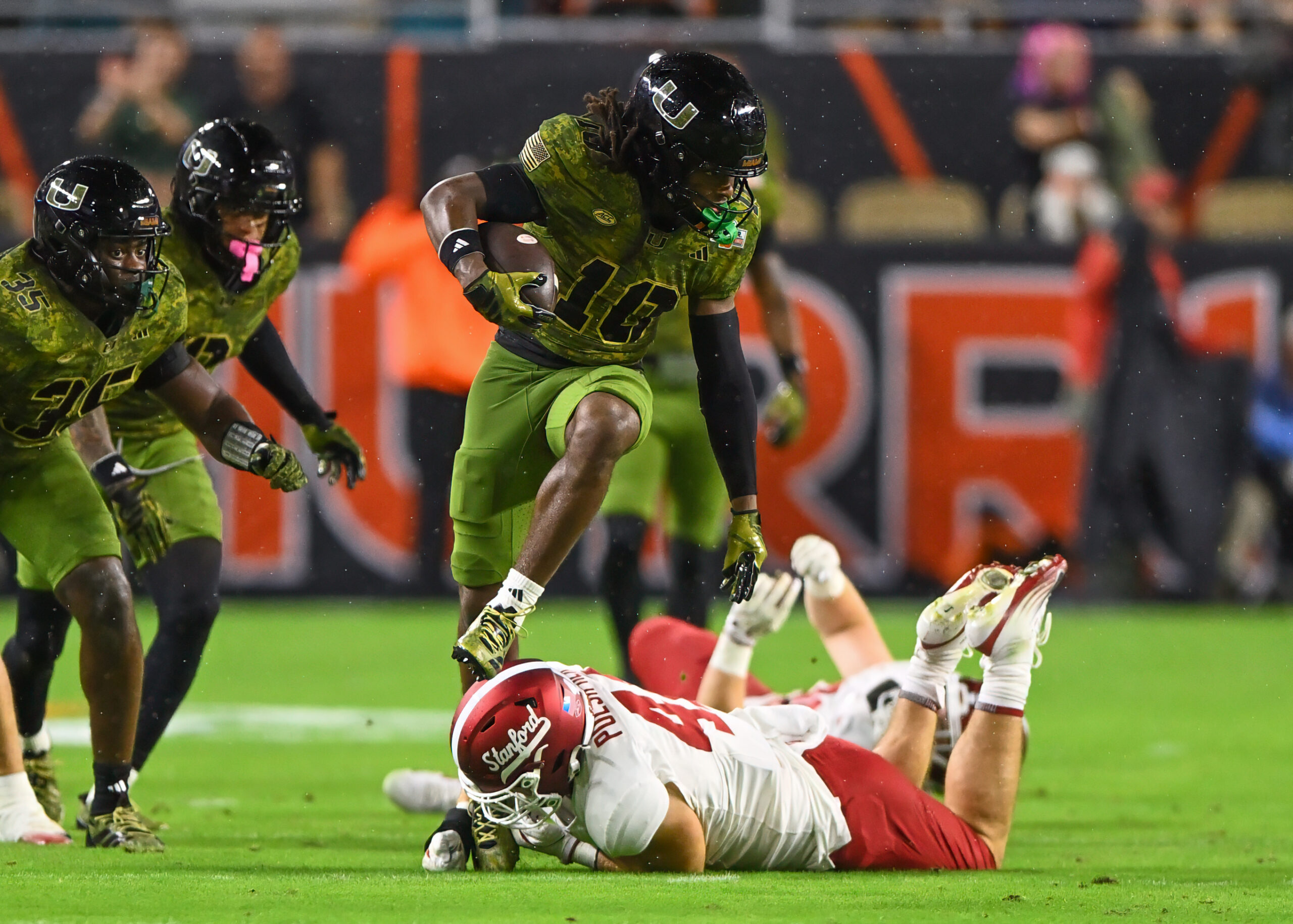
David Lebowitz, Staff Photographer – Freshman Wide Reciever Malachi Toney leaps over a Stanford Defender on October 26, 2025.
RB Mark Fletcher:
Without bruising running back Mark Fletcher, the Canes would not have had a chance in the CFP.
His 172 yards against Texas A&M were the main reason the Hurricanes pulled off the upset in round one, but his production didn’t end there. Fletcher would run for 90, 133 and 112 yards over the next three games, breaking off crucial runs to swing momentum in Miami’s favor.
Many expected Fletcher to head to the league in the 2026 NFL Draft, but opted to return for his senior season.
Still, his decision to return for another year demonstrates the culture established at UM by head coach Mario Cristobal — this team wants to win the title.
S Bryce Fitzgerald
As a true freshman in 2025, Fitzgerald broke onto the scene with six interceptions — tied for second-most in FBS — including the game-winner against Texas A&M in the first round of the playoffs. Fitzgerald only started four games, but still found a way to become one of the Hurricanes’ most important defensive backs with his knack for takeaways.
Fitzgerald knows that he needs to take the next step as a defensive leader this season, noting his new responsibilities.
“Really just got to stop being a kid. [You’ve] got to change your mindset,” he said. “You’re a grown man now, so really just got to do grown-man things on and off the field.”
This season poses an opportunity for him to transition from a young ballhawk to a superstar safety.
DT Ahmad Moten Sr.
After losing star edge rushers Ruben Bain Jr. and Akheem Mesidor, who combined for 22 sacks last season, Moten is being looked at as the new leader of the D-line.
Moten garnered 4.5 sacks, 9 TFLs and 20 quarterback pressures last season, earning him second-team All-ACC honors.
While Miami’s edge rush talent is still immense, the Canes defensive line might thrive more on the interior.
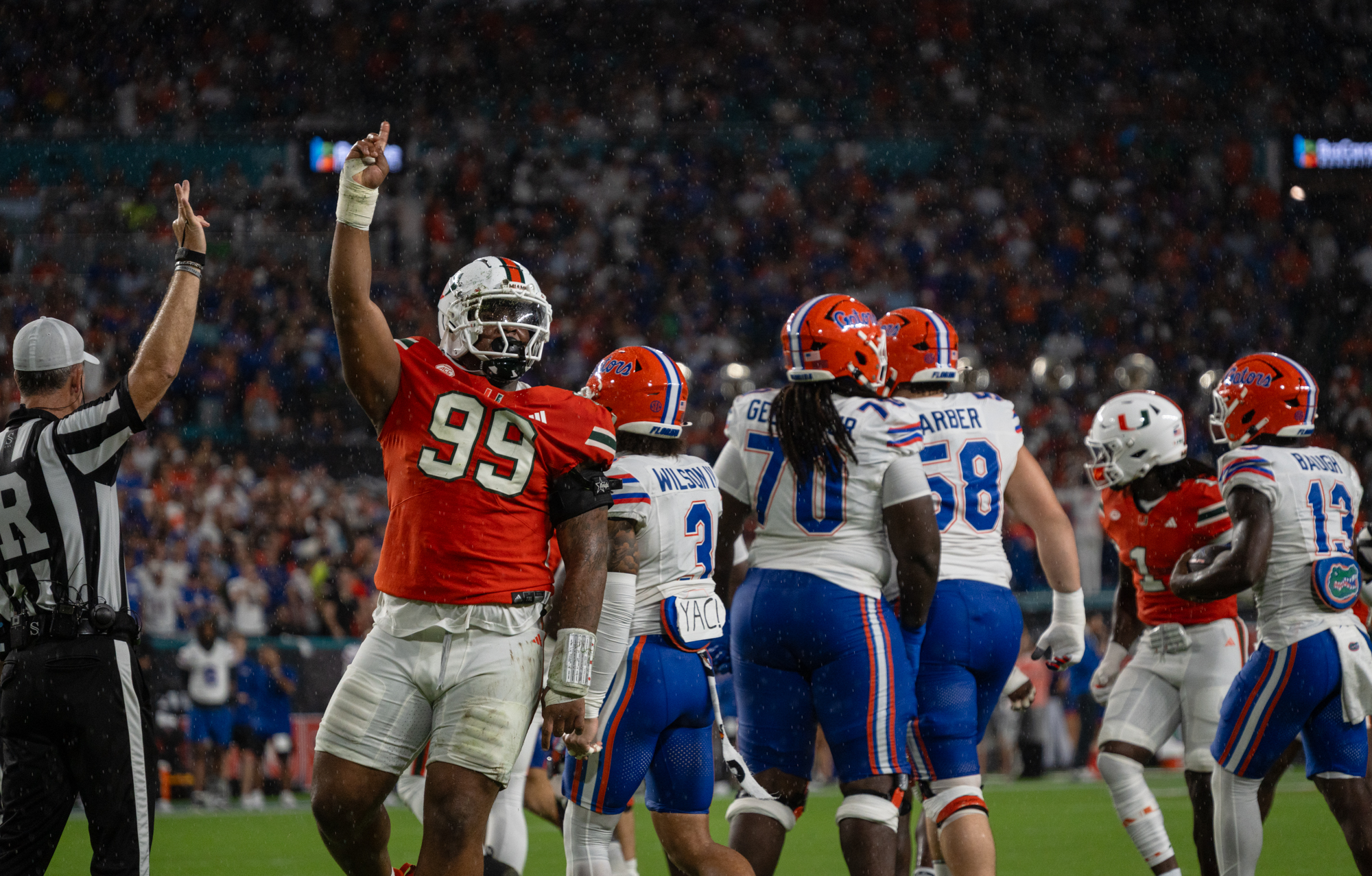
Assistant Photo Editor Brian Mulvey // Redshirt junior defensive Ahmad Moten Sr. celebrates after getting a tackle against the Florida Gators on Sept. 20, 2025
Key Games:
At Clemson (10/3)
This is where the season starts to get real.
Miami takes on Clemson in Death Valley in a matchup already being predicted to be the location of College Gameday Week 5. While the Tigers will have home-field advantage, Miami’s defense should stifle a Clemson offense that sputtered in big games last season.
V.S. Florida State (10/17)
Their next game sees the Hurricanes host the Seminoles in their annual rivalry matchup.
This will be another test for Miami, but once again the Canes are favored and should get the win at home.
At Notre Dame (11/7)
After kicking off their season last year by playing one of the most impactful games of the campaign, many expect this year’s edition to carry the same weight. Now scheduled in the heart of the season, if Miami is to lose a game this year, it would be this one.
Playing away in a hostile environment against a top-5 ranked Fighting Irish team isn’t an easy task, but if Miami plays up to standard, it will be a matchup for the ages.
This season is crucial for Miami in maintaining the program’s trajectory. They have the coach, the quarterback and the talent across the field to compete for a National Championship. Week one away against Stanford on Sept. 4 will begin to tell the story of the 2026 Miami Hurricanes.
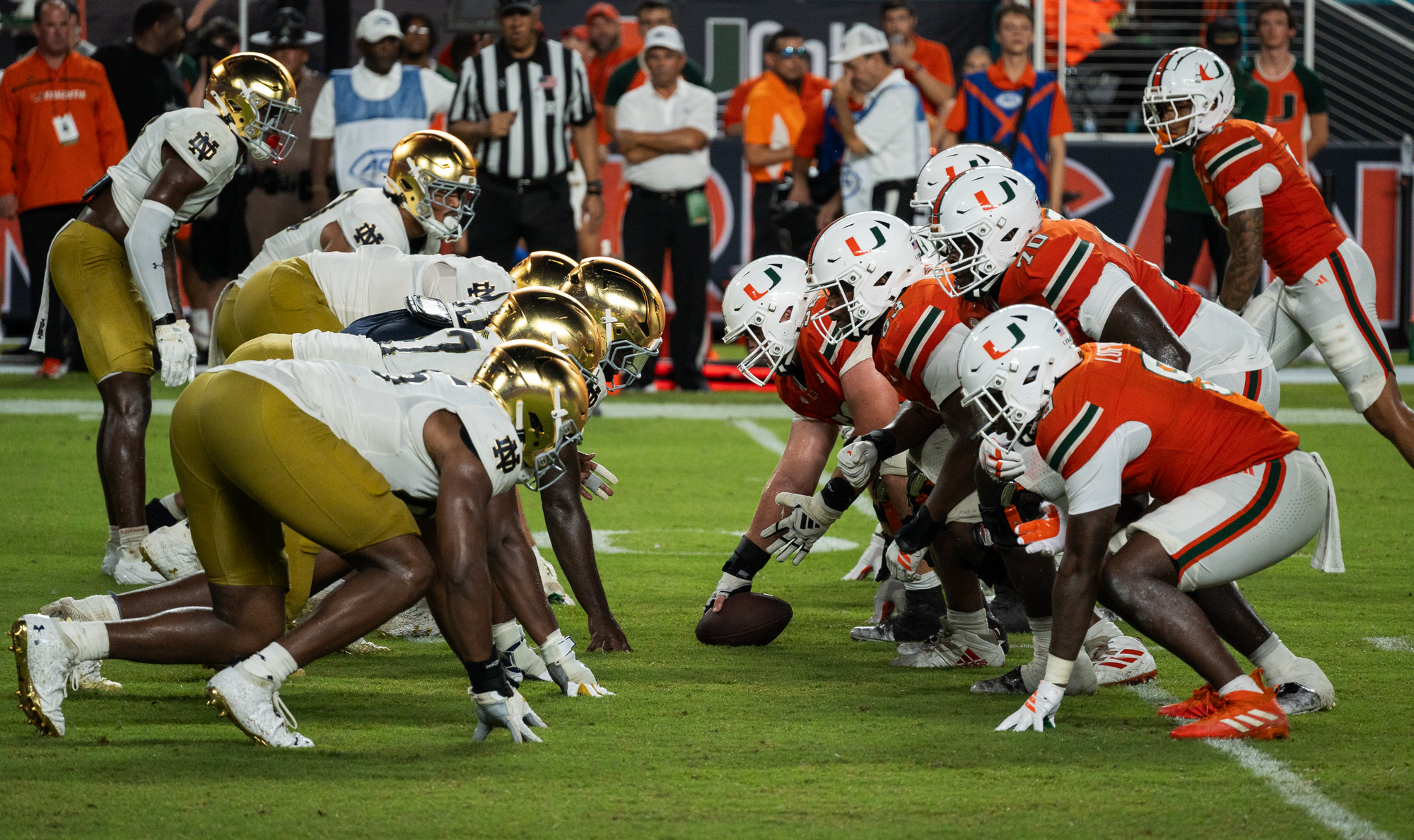
The Hurricanes ready again to face the Fighting Irish during the first game of Miami’s season on Aug. 31. // Photo Credit: Brian Mulvey.
Florida accounts for almost half of all executions carried out nationwide, solidifying its place as a death chamber in the country next to Texas and Oklahoma.
But at the same time, Florida also champions “protecting human life” by passing strict anti-abortion laws under the moral banner of sanctity, fundamental human rights and the defense of the vulnerable.
These laws are contradictory and hypocritical. How can the state support death one way and not the other? It doesn’t make sense from a “for life” movement standpoint.
When signing into law the state’s six-week Heartbeat Protection Act — which prohibits abortions once the unborn child has a detectable heartbeat – Governor Ron DeSantis said supporting life is an absolute moral imperative, saying, “We are proud to support life and family in the state of Florida.”
Yet in the same breath, DeSantis maintained a strict view in defending Florida’s record-setting pace of capital punishment. The Florida Governor offered a different view of Florida’s power over life, calling the death penalty an “appropriate punishment for the worst offenders.”
One cannot claim moral authority on the “sanctity of human life” while operating the nation’s busiest execution site. The state’s stance is fundamentally contradictory.
The criminal justice system is inherently flawed, capable of irrevocable errors and unfortunate racial bias. In fact, Florida holds the alarming record for the most death row exonerations in the entire nation, with 30 individuals on death row cleared of all charges before death since 1973.
This is partly due to Florida’s lenient sentencing requirement, only needing 8 out of 12 jurors to vote for the death penalty while all other states (besides Alabama) require unanimity from jurors.
If life is sacred to its full extent — from conception to natural death — then its value cannot be conditional upon crime, convenience or political power. To argue that the government lacks the authority to terminate a pregnancy but holds the absolute authority to kill someone is a severely hypocritical double standard.
This political question is not new and has existed in the Republican Party for some time now. After Roe v. Wade was decided in 1976, the Republican Party split on its values on life. The GOP adjusted its anti-abortion platform, explicitly invoking the Declaration of Independence to assert the “inherent dignity and sanctity of all human life.”
Therefore, those contradicting GOP values rely on a distinction between innocence and guilt: abortion destroys an “innocent” life, while capital punishment executes a “guilty” life that has no rights through its severe violence.
Florida cannot have it both ways. If it truly wants to stand for a culture of life, it must apply that moral standard consistently across the board, which means abolishing the death penalty.
Until then, the Sunshine State’s actions remain deeply contradictory. Florida, it’s time we live up to the meaning of the movement for life.