Home Blog Page 85

Top 5 sets at EDC Orlando 2025

From headliners to headbangers, EDC Orlando has it all.  Check out these 5 must-see sets you won’t want to miss at EDC Orlando 2025.

5. Porter Robinson (Sunset DJ Set)

Friday, Nov. 7 from 5:26p.m. – 6:41p.m. at Kinetic Field stage

While Porter Robinson is far from an underground name, his sunset DJ set might end up being one of EDC Orlando’s most overlooked gems. 

Known for his emotional, story-driven live shows, this rare festival DJ set offers a different side of Porter — less scripted, more fluid and deeply personal. Expect an ethereal mix of his own classics, nostalgic edits, and melodic cuts that perfectly match the fading light over Tinker Field.

It’s a moment of collective pause before the chaos of night.

4. DJ Snake  

Saturday, Nov. 8 from 9:05p.m. – 10:20p.m. at Circuit Grounds stage

Few artists command a festival crowd like DJ Snake. With hits that span from “Turn Down for What” to “Taki Taki,” his sets bridge trap, house, reggaeton and everything in between. His mainstage performance promises controlled chaos — lasers, flames and global anthems that turn EDC into one massive party. Whether you’re a diehard fan or just there for the drops, this one’s built for everyone.

3. Cloonee 

Saturday, Nov. 8 from 10:30p.m. – 12:00a.m. at Neon Garden stage

Cloonee has quietly built a cult following for his cheeky tech house sound and infectious stage presence. Mixing humor, groove and dance floor swagger, his sets balance underground credibility with mainstream appeal. 

He’s the kind of DJ who can make a small stage feel like the main event.

2. Indira Paganotto

Sunday, Nov. 9 from 7:30p.m. – 9:00p.m. at Neon Garden stage

Indira Paganotto’s sound lives at the intersection of psychedelic trance and driving techno — fast, colorful and unpredictable. 

The Spanish DJ has been building global buzz for her hypnotic performances, and her EDC debut promises to be one of the most immersive dance floor journeys of the weekend.

1. Dom Dolla 

Sunday, Nov. 9 from 10:23p.m. – 11:48p.m. at Kinetic stage

Dom Dolla has become one of dance music’s most magnetic headliners — blending underground house grooves with the mass appeal of a mainstage act. Known for infectious tracks like “Saving Up” and “girl$,” his sets are high-energy, percussive, and impossible not to dance to. 

Expect a finale filled with thick basslines, flashing strobes and that signature Dom Dolla grin as he closes out EDC in pure groove fashion.

EDC Orlando is known for its massive headliners and jaw-dropping production, the kind of moments that define a weekend under the Electric Sky. 

But just beyond the mainstage lights lies the real magic: the artists pushing boundaries, experimenting with sound and creating memories for the fans who wander off the beaten path. 

Whether it’s a sunrise techno marathon or a surprise drop from a rising local, these underrated sets remind us what makes EDC special. It’s not just about who you see, but the moments you stumble into along the way.

Difficult decisions: Homecoming versus EDC weekend

EDC Orlando returns this Nov. 7 through the 9 with three days of lights, bass, fireworks and pure energy at Tinker Field. For University of Miami students, it’s one of the most anticipated road trips of the semester. 

Known for its massive stages, carnival rides and unmatched production, EDC transforms Orlando into a neon wonderland for ravers and dance music fans alike.

This year’s lineup brings some of the biggest names in electronic music, from global headliners to underground fan favorites. Expect sets from artists like Zedd, Tiësto, Knock2, Dom Dolla and Sara Landry, plus plenty of genre-blending moments. 

For first-timers, EDC isn’t just about the music, it’s about the community, the costumes and the feeling of unity that defines the Electric Sky only at EDC.

But this year, the excitement comes with a catch — EDC Orlando overlaps directly with the University of Miami’s Homecoming weekend. The festival kicks off on Friday, Nov. 7, the same night as UM’s annual Hurricane Howl fireworks and boat burning, one of the school’s most cherished traditions. 

The following day, Saturday, Nov. 8, marks the Homecoming football game at Hard Rock Stadium, creating a tough choice for students torn between two major celebrations.

Many students have already noticed the clash, sparking debate over what truly defines the UM experience — school spirit or shared musical escape. For some, the decision is simple: EDC offers a once-a-year immersion into music and creativity that’s worth the road trip to Orlando. 

For others, Homecoming represents something more sentimental — a week rooted in pride, tradition, and community on campus. Either way, the overlap highlights just how full and vibrant Miami’s cultural calendar has become.

If you’re heading up to EDC, plan early. The Brightline and carpooling are the easiest ways to travel, and hotel prices rise fast the closer you get to the festival. 

Pack light, hydrate often, and download the Insomniac app to keep track of set times. Whether it’s your first rave or your twenty fifth, EDC Orlando 2025 promises a weekend of color, sound and memories that will last long after the lights fade.

UM alum Alec Griffen Roth on ‘Billy Knight,’ Al Pacino and building a grassroots film release

When filmmaker Alec Griffen Roth graduated from the University of Miami with a degree in history and a film minor, he dreamed of making movies that felt both grand and deeply personal. Now that dream has become a reality.

Roth’s debut feature, “Billy Knight,” a magically realist drama starring Al Pacino, Charlie Heaton and Diana Silvers, marks his leap from film student to director of a Hollywood production. 

Returning to campus this month, Roth sat down with me to discuss the film’s inspiration, his experience working with Pacino and the unconventional marketing strategy that may refine how indie films reach audiences. 

A personal story with magical seems

“I always wanted to make something bigger that costs more money,” he told me at lunch. Even early scripts were ambitious, often budgeted at several million dollars. 

The turning point came when two Texas financiers responded to a story that could be made on a smaller scale and when Roth’s dream casting idea remained at the top of his list: Al Pacino.

“Pacino was always up there,” he said. “De Niro would have been fascinating. Robin Williams, if he were still with us, would’ve done something wild. But for this Al was perfect. He can greenlight this kind of project.”

Billy Knight follows Alex (Charlie Heaton) and a mysterious mentor figure played by Pacino. The film moves between the everyday and the ethereal.  

“I wanted to make something very personal,” Roth said. “Imagination and magic, but still real. It’s where I am in my life, that combination of a magical sensibility and a grounded reality.”

He cites Italian filmmaker Paolo Sorrentino and his 2013 film “The Great Beauty” as a key inspiration. 

Older movies weren’t afraid to leave you with questions,” Roth said. “If you tighten everything up with a bow, you might lose what lingers on the drive home.”

Everyone in the dream

Roth insists that his voice is present in every character. He points out a brief vignette delivered by Alleah Rogers, who plays Billy’s assistant. 

“She talks about feeling the pressure to ‘figure it out’ but at a certain age,” Roth said. “That’s me talking through her. It’s personal, even in the smallest moments.”

The same goes for the romance between Heaton’s character and Diana Silvers. 

“Being in love with someone who’s distant, off in their own world, I’ve felt that,” Roth added. 

Pacino, up close

Working with an icon came naturally after months of conversation. 

“Al and I talked for six or seven months before shooting,” Roth said. “At a certain point, he isn’t Al Pacino, he’s your collaborator, your friend. That comfort shows up in the work.”

Pacino’s limited hours forced efficiency. “He could start at 10 a.m. and wrap around 8 p.m., so we had to be precise,” Roth added. “Those days are some of the film’s best work.”

The contrast between the Pacino sequences and the indie ensembles remains striking. 

“The Pacino material is on a different level,” Roth said. “Performance, experience, everything. Without him, it’s an indie debut, with all its charms and flaws. With him, the ceiling lifts.” 

From UM to the wider map

Roth studied U.S history and communications at Miami, double minoring in film and political science. 

“History made me a better filmmaker,” Roth said. “It teaches you how people think, how they move through time. I wish I’d taken business earlier; it’s its own language in this industry.”

He credits UM’s community for shaping his worldview. “You could go to a frat, a football game and a film screening in the same week,” Roth added. “That mix of culture and collaborations sticks with you.”

Now, Roth’s production company, Firebrand Media Group, has completed three films, including a docuseries on Hurricanes quarterback Cam Ward. 

“It’s surreal,” he said. “If you’d told me ten years ago I’d be interviewing Coach Cristobal, I wouldn’t have believed it.”

The distribution experiment 

Roth and his partners, Josh Clayton and Kirk Martin are experimenting with distribution instead of relying on studios. “We may never get an offer that makes sense,” Roth said. “So, we’re booking theaters ourselves while still talking to distributors. We want control.”

They’re using geofencing to reach audiences by location. 

“If you were in Miami last week, you might’ve seen “Billy Knight” pop up on your phone,” Roth said. “We literally targeted this area.”

Their philosophy? A million small voices are louder than one big one. “Give 1,500 people five assets and a reason to post,” Roth said. “That grassroots feeling, ‘I’m part of this’ is powerful.” 

On nepo baby labels and persistence

Roth doesn’t shy away from discussing his lineage. His father is a celebrated screenwriter, but he’s clear eyed about the double edge. 

“It can open a door, sure, but you start a step behind. People assume things,” Roth said. 

He recalls sending scripts and emails that went unanswered, or worse, mocked. 

“One exec accidentally sent me an email calling me ‘so [expletive] annoying,” Roth said. “You can fold or fuel yourself with that. I chose to fuel it.”

Roth keeps a Bill Hader quote in mind when he edits: “If people agree something isn’t working, they’re probably right. When they tell you how to fix it, they’re probably wrong.”

“The movie has to be yours,” Roth said. “Process feedback, but solve it your way.”

What changed his cinematic brain

When asked what film transformed his view on cinema, Roth rattled off a list: “Amadeus,” “Lawrence of Arabia,” “2001: A Space Odyssey,” and more. 

“Scope and soul,” Roth said. “Movies that dare to be big and intimate at the same time.”

Ultimately, Roth hopes “Billy Knight” restores a sense of mystery in the audience long after the curtains close. 

“I want you to think on the drive home,” he said. “Not because I was lazy, but because not everything in life ties up with a bow.”

48 hours in South-Central São Paulo, Brazil

During the first semester of 2025, Brazil welcomed more international visitors than ever before in history and nearly all of them had to land in São Paulo. The city is the nation’s main gateway and home to Guarulhos International Airport, the largest in South America. It sets the tone before travelers head to beaches and rainforests. 

However, São Paulo is a destination on its own. 

The city’s South Zone is comparable to a maquette of the rest of São Paulo: favelas next to skyscrapers and culinary experiences that reveal the city’s soul more than any museum. If you’re planning to go to Brazil, São Paulo is worth more than just a layover. Plan to stay the weekend and get to know the city.

Friday Afternoon

A taxi from Guarulhos will take you to the South Zone in about 45 minutes. There, Ibirapuera Park is a nice getaway from the streets of the city. Roberto Burle Marx designed the park, which has Oscar Niemeyer’s famous white pavilions. It is both a playground and a cultural center.

Families ride rental bikes around the lake, joggers lap the lake and art lovers go into the Afro-Brazil Museum. The park is open every day from 5 a.m. to 11 p.m., but parking fills up rapidly on weekends. Check their website for events.

Friday Evening

In São Paulo, weekends mean pizza. By Friday night, the smell of wood-fired dough drifts across the city and Primo Basílico stands out among the 20 best pizzerias in the city. There are two locations in the zone: Jardim Paulistano and Itaim Bibi. Begin with corniccione or burrata (around R$70), then try the signature Violetta pizza topped with turkey breast, catupiry (a creamy Brazilian cheese) and red onion sautéed in buffalo butter. 

A full pizza is about R$131 or R$85 for an individual portion. With rustic interiors and a lively crowd, it’s a place where people gather for late night dinner since it is open until 12:30 a.m. on Fridays. Reservations are strongly recommended.

Saturday Morning 

Breakfast in São Paulo can be as stylish as the city itself and nowhere shows that better than Le Jardin at the Rosewood Hotel. It feels like a garden inside a glasshouse with big windows, plants hanging from the ceiling and a low murmur of people who look like they just left a fashion shoot. 

The 24-hour breakfast is only for hotel guests, although anybody can make a reservation for a table starting at 6:30 a.m. every day. Expect baskets of pão de queijo, seasonal fruits and coffee as strong as the energy outside.

After a peaceful breakfast at Rosewood, explore Paraisópolis in São Paulo. Over 100,000 people live in the favela 20 minutes away from Morumbi’s luxurious skyscrapers. With helipads overhead and brick dwellings below, the difference is dramatic but the atmosphere is welcoming.

Kids kick soccer balls in tiny alleys, colorful murals cover walls and every morning bakeries produce fresh pão francês, the crusty rolls Brazilians like. Most guided tours ($150-$300 per person) are in the morning so visitors can safely observe music schools, dancing projects and small businesses. Uber is the easiest and safest way there.

Saturday Afternoon

By lunchtime, it’s time for Brazil’s weekend classic dish: feijoada. This black bean stew is more than a simple cuisine at Bolinha; it’s a tradition. Bolinha has been serving the black bean stew since 1946, featuring 10 cuts of pork and sausage with rice, greens and farofa (toasted cassava flour). 

On Saturdays, the all-you-can-eat option (R$233 per person) makes it a feast. There is a live pagode band that plays samba rhythms, which makes the whole place feel like a day party. People from the area come early since tables fill up quickly. From Paraisópolis, it’s about 20 minutes by car and opens daily from 11 a.m.

Saturday Late Afternoon

Once the last bites of feijoada are gone, head about 15 minutes by car to Avenida Paulista. On weekends, the avenue closes to cars and becomes a stage: business suits brushing past skaters, drummers leading samba circles and vendors setting up stands of handmade jewelry and vintage vinyl. Bookstores, small galleries and street art turn sidewalks into open-air museums alongside buildings made of glass. It’s chaotic, creative and irresistibly alive.

Saturday Evening 

Saturday night is showtime at Teatro Santander in the upscale JK Iguatemi district of Itaim Bibi. The theater is sleek and modern and the shows are just as excellent as those on Broadway in New York. This season’s highlight is “Dreamgirls: In Search of a Dream,”  an accurate Broadway adaptation that follows a young female R&B trio trying to make it big in the 1960s and 1970s. 

Tickets start at R$20 and go up for better seats. It’s best to get them ahead of time because shows often sell out. Cocktail attire is common. For details on ticket prices and the full schedule, check teatrosantander.com.br.

Saturday Late Evening 

When the curtain comes down at Teatro Santander, head to Lellis Trattoria, a São Paulo favorite for late-night dining. Open until 1 a.m. or later, Lellis serves robust Italian dishes: pastas and risottos for about R$80, steaks near R$150 and wines perfect for lingering over conversation.

Sunday Morning

Spend your last morning in São Paulo at the Mercado Municipal (“Mercadão”), a 1933 market hall known for its stained-glass windows and numerous food vendors. When doors open at 6 a.m., customers rush in to enjoy exotic fruits, spices and codfish pastel. Spend an hour wandering the aisles before walking about 10 minutes to the Monastery of São Bento, founded in 1598. At 10 a.m., monks sing Gregorian chants in the neo-Romanesque church during Mass. This centuries-old practice ends the weekend peacefully.

Transportation

São Paulo’s subway serves parts of the South Zone, although Uber is the most convenient and secure option for travelers. The best option is Guarulhos Airport vehicle rental. Valet parking is offered in restaurants and malls.

Accommodation

Treat yourself to a stay at the Rosewood Sao Paulo, where style and comfort come together. There are nice hotels like Pullman and Hilton in Moema and Vila Olimpia. There are good mid-range hotels and Airbnbs in Brooklin and near Congonhas Airport for people on a budget.

Restaurants

Casa Mathilde: city bakery known for Portuguese sweets, especially pastel de nata, which goes well with quick cappuccinos.

Manarillo: cozy Itaim Bibi bistrô providing unique Italian dishes like shrimp bisque pasta and coconut risotto.

Aoyama: a local favorite for all-you-can-eat sushi in a relaxed setting with unlimited fresh rolls.

Family Tips

Ibirapuera Park, Teatro Santander and Mercadão are family friendly. Children get highchairs and smaller portions at restaurants.

Events

Check cidadedesaopaulo.com for museum exhibits, concerts and festivals.

Caregivers in Brazil offer steady love where families cannot

Confused by Alzheimer’s, the old man mistook the caregiver for a stranger and tried to hit her with a determined hand. His daughter rushed into the room, panicked. But, the caregiver didn’t flinch. 

It wasn’t Maria da Silva’s first time in such a situation — and it likely wouldn’t be her last.

For caregiver Maria da Silva, such challenging moments like these are part of the job description in long-term care.

Unlike hospital staff, caregivers providing long-term care at home often stay in contact with patients for months or even years. They become a steady part of someone’s life. 

Sometimes, this means giving medicine or helping with treatments. Other times, it means dealing with fear or confusion from not only the patient but also from family members.

“And that’s why before coming into this profession, you have to first learn how to truly love another human being. Otherwise, how can you ever do this job well?”  da Silva said. 

Da Silva learned the emotional burden of the profession from her first patient. 

She endured the long hours of medication, weakness and pain while the old woman battled cancer. When da Silva had to leave at night, the woman would object and threaten to throw herself out the window. While the caregiver understood the danger of the situation, the family didn’t take it seriously.

“That completely destroyed my mental well-being,” da Silva said. “Every day I would go home praying that she would be alive the next morning.”

The bond between the two was so strong that da Silva almost quit the profession when the woman passed away. However, da Silva found the strength to continue after realizing the significance of her role. 

“If we, as society, continue to pursue a job only for the money, how will the people in this situation survive?” da Silva said. “One time, a patient with Alzheimer’s held my hand and whispered, ‘thank you.’ He couldn’t recall my name, but he knew I was there for him. That is what keeps me going, not my paycheck.”

In another part of São Paulo, Brazil, Sueli Vizioli, another dedicated caregiver, was sitting at a hospital bed for 28 days and nights, watching a woman slowly lose her battle with cancer. 

She was there when the woman took her final breath, holding her hand while whispering a prayer.

According to Vizioli, dealing with grief is a common part of the job, but in this case, dealing with the daughter’s response was the most difficult part. When she delivered the news, the reaction was cold: buy the cheapest coffin, buy the cheapest flowers and tell the hospital that she was out of the country. 

“I couldn’t believe it,” Vizioli said. “She told me, ‘It took her long enough to go.’ I remember feeling sick to my stomach.” She refused to do what the daughter asked. “I told her, ‘No, that is not my role. I won’t do it.’”

Unfortunately, Vizioli stated that these situations happen more often than she would like to admit. Families often distance themselves, leaving caregivers to bear all the emotional burden.

“You feel anger and disbelief,” Vizioli said. “But I have to pray and ask God to take those feelings from me. The next morning, I still have another patient waiting for me. If you hold onto the anger, you can’t keep going.”

As an alternative, Vizioli went to work in clinics seeking to share the emotional weight of the profession with colleagues, but she soon realized it wasn’t much better.

“In clinics, people are forgotten,” she said. “When the family comes to visit, everything looks perfect. But during the week, they don’t even put underwear on the patients.”

Vizioli kept her experiences from the clinics with her. The neglect she had observed drove her determination to approach caregiving differently. Over time, she grew to adapt and find meaning in daily situations, maintaining her commitment to be in touch with her patients even when she wasn’t working. 

“You have to love what you do. If you think you didn’t connect with a certain patient, don’t stay. If you stay, you have to give all of yourself,” she said. 

That’s something Maria da Silva understood, too. At the end of one of her shifts, the same man who had once tried to hit her because of his Alzheimer’s reached out again, this time just to hold her hand. For her, it showed the power of a consistent and steady love.

Vizioli has seen the same thing. Whether it’s being there when someone takes their last breath or keeping an Alzheimer’s patient calm for just a few minutes, she knows that what matters most is showing up with love.

The two women admitted that long-term care is emotionally challenging, physically demanding and often overlooked by others. But, they also acknowledged their work is more than a job — it is a mission to provide dignity, affection and presence where families sometimes cannot.

How to dress for a rainy day from head to toe

In a matter of minutes, Miami’s weather can change from sunny skies to darker clouds, leaving University of Miami students stuck in flooded sidewalks on the way to class. And even though the rain has eased up, hurricane season is keeping students alert.

For many freshmen, the semester’s soggy start has been a surprise. They’ve shared videos on TikTok showing deep puddles across campus, with the drainage system struggling to keep up. Daily walks across the UM bridge now often end with soaked clothes and a ruined mood. 

“I always have to leave earlier for class because the walk from Mahoney can turn into a disaster if it’s pouring,” said UM freshman, Fiorella Manfio.”Sometimes I just end up stuck inside waiting for the rain to stop before I move”. She explained that now she checks the weather app every morning.

The weather’s unpredictability makes smart outfit planning a necessary part of students’ routines. Without thoughtful gear, even the most carefully chosen look can get ruined the second you step outside. 

Here’s a guide on how to rethink how to balance comfort, function and personal style before a rainy day starts. 

Get some rain boots

The biggest upgrade begins at ground level. We do not want stinky wet sneakers around dorms so it’s best toinvest in a good pair of rain boots. Rain boots come in all types of colors, like wine red and baby yellow, with designs that’ll help you stand out, like stripes or polka dots. Knowing your style will help you get the right pair and be ready to walk the rainy runway. 

 “I got mine on Amazon, they are pink, cheap and very cute,” UM student Camila Ayala said. “I get lots of compliments every time I go out with them.” You can pair them with skirts, sundresses or oversized sweaters to get indoor comfort and outdoor protection. 

Another option is wearing nostalgic ‘90s jelly sandals. ttThey’re making a comeback for their playful look and quick-dry practicality.

 “I haven’t worn my jeans since I got here” shared Gabriella Vazquez, a freshman Architecture student from Puerto Rico.“ The weather is similar to home, so my style didn’t change much – just my shoes.”

A rain jacket for the best protection

Cropped trench coats, pastel ponchos and translucent rain jackets are appearing more often, proving that outerwear can be functional and fun at the same time. For some international students, the weather has been a surprising welcoming to Miami. “I was surprised when I revived – I expected full sun,” said Sol Montefiore , a freshman Industrial Engineering student from Argentina.

“The weather at home is different, but since it’s warm here I dress like I do in summer back home.” For others, the rainy season has felt almost familiar. “Honestly, the weather here has helped with my homesickness,” added Gabriella coming to the US directly from Puerto Rico. 

Tuck-away umbrellas & accessories

Rain showers in Miami can come out of nowhere, often catching students halfway between Mahoney and the Shalala Student Center. On stormy afternoons, it’s common to see a crowd of umbrellas popping open across campus as students try to pass across puddles without ruining their outfits. For many, a sturdy umbrella is more than just protection – it’s part of their daily strategy.

”I always carry my big black umbrella,” Fiorella said. “It’s the only thing that actually saved my outfits when it started raining out of nowhere. Honestly, I would be lost without it.”

Umbrella choices have become a mini fashion statement on their own. Bubble umbrellas, in particular, have gained popularity for their stylish look and extra coverage. Unlike flimsy foldable umbrellas that flip inside out with the first gust, bubble and big umbrellas shield students from both wind and sideways rain while still showing off their outfits. 

But umbrellas alone don’t solve everything. Campus pathways flood quickly, leaving students with soaked shoes and drenched bags if they are unprepared. “One day after class, the rain felt like a hurricane,” Sol recalled. “Even with an umbrella, all my notes were completely soaked by the time I got to my dorm.”

That’s why accessories go hand in hand with umbrellas. Waterproof totes keep laptops and books dry, while smaller pouches protect phones, charges and an extra pair of dry socks– as Fiorella recommends. Shoe covers are also starting to appear in students’ backpacks. “They’re my hack,” Sol explained. “You can wear your usual shoes, and when it pours, you just pull the covers on. It saved me more than once.”

UM students have learned to read the skies like locals. Quick check for that familiar gray haze over the Gables have become part of the routine between classes. And for reaffirmation, many rely on the weather app before leaving the dorms, treating it as the final accessory to any outfit. 

Planning goes digital 

Preparing for Miami’s unpredictable storms isn’t just happening in closets – it’s going digital. Laurie Lewis, a sophomore majoring in Marketing and Business Analytics, interned for Alta, an AI styling app that builds looks from photos of your own wardrobe. “You upload your clothes and the AI generates outfits based on your location, plans and the weather,” she said.

Alta pulls live data from The Weather Channel to personalize recommendations; it thinks of a cardigan or light rain jacket on days when the forecast turns stormy, which makes it a go-to fit for a UM rain-soaked semester. 

Rainy days may be unpredictable, but UM students are showing that being prepared is also chic. For students who plan their looks as carefully as their schedules, these strategies aren’t just about staying dry. These stylistic choices are acts of self-expression and proof of how quickly students adapt to Miami’s radical weather and to life away from home. 

20sUnfiltered: Halloween

Your favorite ghouls are back for frightening advice on this week’s episode of 20’s Unfiltered…

Argentina dominates in Miami: Messi leads 6-0 win over Puerto Rico after beating Venezuela

Ian reviews the recent pair of games played by the Argentine national soccer team in Miami against Venezuela and Puerto Rico, featuring well-known stars and up-and-coming youngsters.

The storm around student journalism won’t stop The Hurricane

College newspapers across the U.S. have faced retaliation from all angles — from administrators, students and even the very schools that should be their biggest defenders. 

The message to student journalists over the past few years has been loud and clear: stay quiet, or face the consequences. But journalism was never meant to whisper in the face of power.

The Miami Hurricane’s 2025-2026 editorial board has poured immense amounts of effort and time into our coverage. We’ve worked tirelessly to dig deeper, ask harder questions and report stories that truly matter to our campus community.

That work has not gone unnoticed. Students, professors and alumni regularly stop us around campus to share how much they appreciate our reporting. We have even heard from people in other states and countries who are following UM’s news because of The Hurricane’s coverage. 

The numbers speak for themselves — our social media following has nearly doubled since April, and our print editions have been flying off the stands within days of distribution. In October, our Instagram reached an all-time record of 1.73 million views over a 30-day period.

This increased level of relevance and visibility reinforced our responsibility to remain fair, accurate and unbiased in our reporting. Our goal has never been to please everyone. Even with the overwhelming positive feedback, not everyone will agree with, or like, everything we publish. But our mission has always been the same: to inform, to hold those in power accountable and to make sure our community has access to the truth.

The more relevant and visible we become, the less the university seems willing to engage with us. 

Despite multiple meetings and calls with University Communications since the beginning of the school year, our repeated requests for comment are often met with silence or responses delayed well past our deadlines.

Under standard procedure, The Hurricane works through University Communications to get quotes from our sources, which range from departments and administrators to faculty and doctors. 

However, our reporters frequently have to submit multiple media requests and follow up repeatedly — often without acknowledgment. In several cases, this lack of response has forced us to bypass our standard procedure involving the University and contact our sources directly to complete our reporting.

Administration’s reaction

Just a few weeks ago, The Hurricane published an article about the opening of SoLé Mia, UHealth’s new ambulatory center. This article was a simple, non-controversial news story about the opening and details of the center, but the University barely helped us. 

The Hurricane attempted to have UM facilitate interviews with leadership and doctors, but aside from a phone call that The Hurricane was asked not to quote, the only material the University provided was a press release that was eventually distributed after our print deadline.

After days of reaching out to UM, The Hurricane made the decision to go around the standard procedures and contacted doctors on our own for the article. After this, members from the University emailed the editor-in-chief asking how we got quotes from these doctors. 

Part of the email read, “we are particularly interested in why Dr. Lopes, an oncologist, is quoted giving revenue information on behalf of the health system which may or may not be accurate as that information was not provided by our chief financial officer.” 

As previously stated, the University offered no help in connecting us with anyone, let alone a CFO.

How are we expected to report on news affecting our campus if the institution we cover often refuses to engage with us and then criticizes us for finding information elsewhere?

If student journalists only repeated the information contained in press releases, which are obviously curated to cast the university in a positive light, we would be failing our community. Our role is not to echo, but to investigate. 

When the university we cover refuses to engage, it limits our ability to serve our readers — but it will not stop us. 

Student backlash

Students who write critical stories have faced backlash from their own peers in the past. The Hurricane has covered multiple incidents of fraternity misconduct in recent years. Frequently, these articles that report the facts about sensitive topics are the ones that cause the most backlash from students, especially from fraternity members. 

“[Greek life], I think, [is] a very close-knit community and people are very protective of their fraternity for understandable reasons,” said Jenny Jacoby, former editor-in-chief of The Hurricane. 

Most of the time, articles about fraternity misconduct report on issues that are already public. This includes Jacoby’s article that received a lot of backlash, particularly on social media, in 2024.

“I just think that they didn’t like that I was the one to push it to that legitimate level as opposed to just hearsay,” Jacoby said.

Fraternity brother backlash was not the only negative thing Jacoby experienced in her two-year tenure, but she said it was very eye opening and, at times, made her reconsider her career choice. 

“[My experiences] made me really, really scared of what a career in journalism would look like and made me question whether or not I could actually handle that for a career,” said Jacoby.

The message the backlash sends is scary: Silence is safer than honesty. 

When reporting on student news like possible hazing allegations, we are not whistleblowers or tattletales — we are journalists reporting the news to the student body. We are doing our job.

When we publish articles about student organizations, leaders of those groups frequently ask to pre-approve quotes, visuals or the entire article prior to publication. 

UM’s Black in Business was instructed by the university to rename itself “Belonging in Business” in compliance with Department of Justice guidance issued under the Trump administration, which restricted “discriminatory language” and DEI programs. 

Students involved in the article later told editors they were unhappy with the illustration and how their quotes were represented — even though the interview was recorded and they had full control over what they chose to say. 

As journalists, we can’t play this back-and-forth game of approvals and letting sources review quotes or drafts only for them to object after publication. We operate under two-party consent; we ask permission to record and our sources know they’re being recorded. They are responsible for their words at that moment. We can’t rewrite stories to ease regret after the fact.

At the end of the day, student journalism isn’t about making everyone comfortable, it’s about telling the truth, even when that truth challenges large groups or popular opinions. Backlash will come and go, but credibility lasts. Our job isn’t to protect feelings, it’s to report facts. 

Financial pressures

The Hurricane has also been struggling with funding, as our budget has not been reevaluated in years, even as Florida’s minimum wage increased. But this issue isn’t just affecting us at The Hurricane. 

At the annual MediaFest25 convention in Washington, D.C., our reporters spoke with Jim Rodenbush, the former Director of Student Media at Indiana University, who oversaw the Indiana Daily Student newspaper. IU’s paper is currently facing major funding challenges after Rodenbush’s termination, which led to its complete defunding after 158 years of being printed. Since then, Rodenbush has sued Indiana University over his termination.

The Indiana Daily Student is currently facing major issues with IU’s administration, especially after Rodenbush was fired. His termination came after Rodenbush resisted prior instruction from IU administration officials to stop publishing any hard news coverage. This decision has since been overturned, and the IDS has been permitted to use its 2025-2026 budget “as the editors see fit,” according to the IDS.  

“In September, we ran a story about the provost’s office and administrative bonuses that had not been made public,” Rodenbush said in a phone call with The Hurricane. “After that story ran, I was called into a meeting with university communications officials who expressed ‘concern’ about the paper’s tone.”

IDS is just one of many papers facing these issues. Now more than ever, students need a platform that empowers them to speak up and be able to form opinions on what’s happening in the world. 

There is no indication that the University of Miami would take similar action, but witnessing these cases across the country remains extremely troubling. We appreciate that UM has upheld its commitment to protecting the voice of its student media in this political climate.

Looking into the future

Despite these pressures, The Hurricane remains committed to serving the UM community with integrity, fairness and rigor. 

Through every unanswered email, every piece of criticism and every challenge, we’ve learned that journalism’s value isn’t measured by how easy it is — but by how necessary it remains. 

We will continue reporting the stories others avoid, asking the questions others won’t and holding our university to the same standard of transparency it expects from us. When students hold power accountable, they strengthen not just their campus, but the principles of accountability and trust that sustain it.

The Hurricane will keep doing what it has done for nearly a century: reporting the truth, even when it’s inconvenient. We report for our readers, for our university and for the future of student journalism.

Three paths, one team: Miami’s transfer trio finds its rhythm

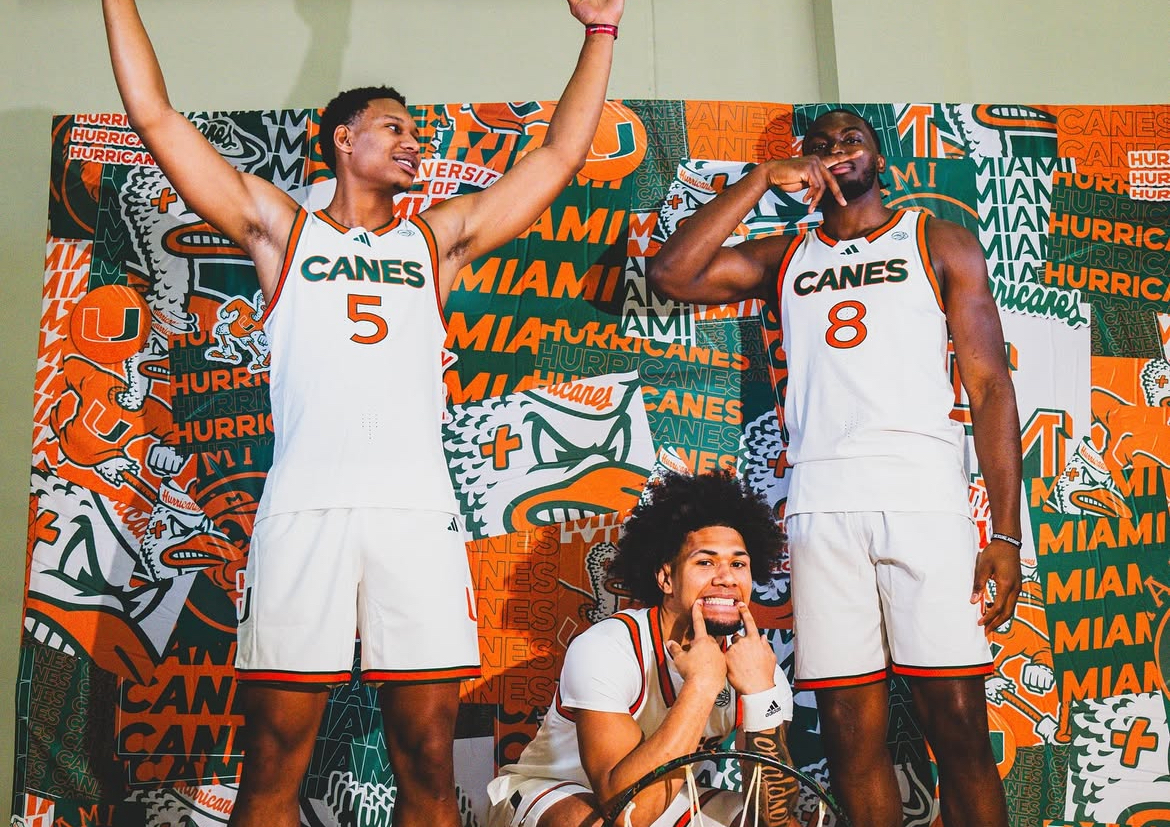
Guard Tre Donaldson, center Ernest Udeh Jr. and forward Malik Reneau make up the core of the University of Miami men’s basketball team for the 2025-2026 season. 

Beyond their love for the game and desire to win, all three athletes share one defining trait — they are all transfer athletes. 

Donaldson played at Auburn and Michigan, Udeh at Kansas and TCU and Reneau at Indiana. 

Since its debut in October 2018, the transfer portal has completely reshaped college basketball. By allowing players to join a different team without sitting out for a season, the portal opens a world of opportunities for college athletes. 

“It gives us an opportunity to make the best decision for ourselves and our families,” Udeh said. 

More than 2,300 men’s college basketball players have entered the transfer portal in 2025. That number reflects a growing trend — one that’s shuffling rosters and redefining team identity across the NCAA. 

Behind each of those athletes is a unique story that motivated their decision to transfer to UM. 

“None of my coaching staff returned from last year, and that played a huge role in getting in the portal because I didn’t know the staff that was coming into the next year’s team,” Reneau said.

Their status as transfer players isn’t the only thing these three have in common. They all grew up in the state of Florida. 

“We take a lot of pride in the state of Florida,” Donaldson said. 

Udeh, who attended Dr. Phillips High School in Orlando, understood how important the Florida ties are for him and his new teammates.

“Being from Orlando, I wanted to come as close to home as possible,” Udeh said. “And after hearing about the recruitment of Tre [Donaldson] and Malik [Reneau], I thought it was pretty much a no-brainer.”

Udeh, Donaldson and Reneau aren’t the only ones on the team with Florida roots. In fact, seven of 13 players on the ’Canes roster are from Florida. That shared geography isn’t just a fun fact — it’s a foundation for chemistry. 

“We can all relate to everything being from the same state and playing around in the same tournaments and AAU programs,” Udeh said. “When you’re able to gel with a group of guys off the court, it helps and translates to everything you do on the court.”

That bond – built through shared roots and experiences – is what keeps the trio grounded as they navigate the pressures of college basketball. For Reneau, keeping the game simple and true to himself is the key.

“I don’t worry about all the media or the NIL,” Reneau said. “I play the game like I was 11 years old playing basketball with my friends on the court.”

But even with familiar faces and hometown pride, the transition isn’t always seamless. 

Transferring does not come without challenges. Players must figure out how they fit into a new group of teammates and staff. 

“Getting to know a new team and a new staff [and] figuring out what type of team we were going to be and how we’re going to interact as a team [were two of the biggest adjustments],” Donaldson said. 

Transfer players must also learn to integrate into a completely new culture, applying what they learned from previous programs while adapting to a new environment.

“No matter what program you came from, no matter where you’re headed, you’re always learning,” Udeh said. 

Beyond the locker room, transfer athletes face scrutiny from fans and media alike. There is often more to the story than people are quick to assume. 

“People see the NIL nowadays and they think that’s what everybody is transferring for,” Reneau said. “In my case, it was super important to find the right play style, find the right guys around me, and the right coaching staff to ultimately develop me to get to my next step.”

As the noise surrounding college basketball grows louder, Miami’s new core is learning to block it all out. For them, success starts with trust: in themselves, in their teammates, and in the process.

“You’re the one lacing up your shoes and going out on that court to play the best basketball that you can,” Udeh said. 

“Trust yourself, take your time with it, and don’t listen to the outside noise at all.”

With the men’s basketball season getting underway, the Hurricanes are focused on turning potential into performance. The team’s hopes are set high for the upcoming season, believing they have put in work and are ready to show the world that they are here to play. 

“I think the most important thing when it comes down to playing team sports is that ultimate goal of winning the national championship and fighting with your team throughout the whole year,” Reneau said. 

For Miami’s transfer trio, the journey may have started on different courts, but now, they’re lacing up for the same fight. 

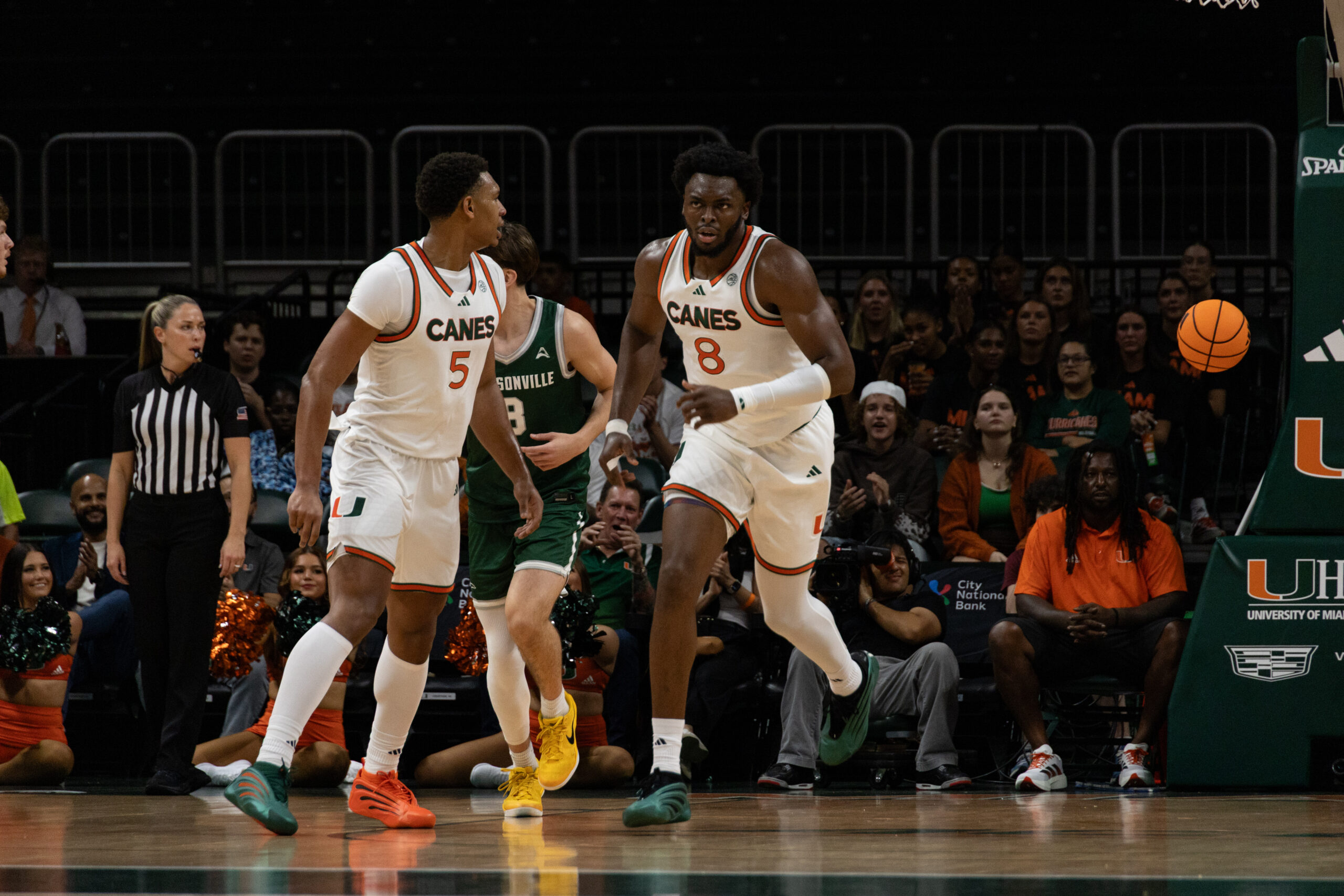
Photo credit: Makena Wong, Photo Editor. // Ernest Udeh Jr. (8) runs back up the court after scoring against Jacksonville on Nov. 3, 2025 at the Watsco Center.

Miami’s Homecoming mythology takes on Syracuse

Just like a cool breeze and changing leaves, Homecoming at the University of Miami arrived like a change in season belonging entirely to the Hurricanes.

The campus glows in orange and green hues. The Band of the Hour echoes through the palms. Alumni return to campus and reminisce about “the good old days” — back when they were 20, sunburnt and believed in everything. 

That same spirit has burned bright dating back decades.

In 1956, Student Union Director Norman A. Whitten sought a unique way to commemorate the 30th anniversary of Homecoming at the U. New to campus, the Theta Chi fraternity took up the challenge and started the tradition of boat burning on Lake Osceola.

Legend had it, if the boat’s mast fell into the water before the boat sank, Miami would win the game. Thousands gathered every year to witness the blazing ritual. 

Though environmental concerns eventually extinguished the annual flames, that same passion and pride continue to define Homecoming today.

It’s a week where time stands still — and Hurricanes of the past and present orbit around one shared heartbeat: Miami football.

At UM, Homecoming isn’t just another game. It’s a sacred spectacle tying together tradition, community and the unbreakable spirit of the U. Though football is at the center, Homecoming is more than a matchup. It’s a celebration of community and belonging — a reminder of how sport connects people to something bigger than themselves. 

In recent years, Homecoming has brought both drama and defining moments, including a double-overtime victory in 2023 and a rivalry win in 2022 that sparked a late-season surge in performance. Last season, Miami crushed in-state rival Florida State 36–14 demonstrating dominance and marking their first win over the Seminoles since 2020.

Sophomore runningback Mark Fletcher Jr. celebrates his touchdown in Miami’s win against FSU on Saturday, Oct. 26, 2024 at Hard Rock Stadium. – Photo Credit via Emily Rice

On Nov. 5, Miami will host the Syracuse Orange at Hard Rock Stadium for one of the most anticipated games of the season. 

Syracuse handed Miami one of its most frustrating losses of the 2024 season, overcoming a 21-point deficit to stun the Hurricanes 42–38. That collapse derailed what had been a promising campaign. This year, Miami has the chance to rewrite that story, and there is no better time to do it than Homecoming.

Kickoff is set for 3:30 p.m., and the stakes are high regardless of revenge hopes. 

Although the Hurricanes won their first five games, three of which against ranked opponents, their recent loss against Louisville sent them tumbling down the rankings from No. 2 to No. 10 in the nation.

For Miami, the matchup is about more than just maintaining its winning record. A win over Syracuse would keep Miami atop the ACC and sustain its national momentum heading into the final stretch of the regular season. 

The Orange play fast, capitalize on errors and have proven they can come back from behind. If Miami wants to avoid another untimely collapse, consistency will be key — finishing drives, limiting penalties and keeping composure through the middle quarters.

Beyond tactics and stats, Homecoming at the U is about atmosphere. It’s about alumni filling the stands, the band echoing through Hard Rock, the flash of orange pom-poms and the electric hum of UM’s illustrious history. 

The Hurricanes have the talent and the track record to keep their impressive run alive. But as Miami knows, records don’t win games — execution does.

Still, there’s something about Homecoming that feels different. It’s pageantry defending the school’s honor. The lights are brighter. The noise is louder. 

The moment is bigger.

Because Homecoming at the U isn’t just about coming home — it’s about standing tall once you’ve arrived.

The Burning of the Boat Ceremony takes place at Lake Osceola, as part of the Homecoming Hurricane Howl evening events on Nov. 4, 2022. Photo credit: Jared Lennon

How to thrive, not survive, as an international student

Most mornings of her first semester at the University of Miami, Mika K. ate maple-soaked blueberry waffles and a huge Dunkin’ coffee. It was simple and didn’t involve cooking. But the diet caused her to gain 10 pounds in only four months. Many international students share the same experience. 

I remember my freshman year. The thought of going back home to Brazil would cross my mind every single night. Translating every word you speak throughout the day is a different kind of mental exhaustion — it challenges someone to unimaginable levels. On top of that, I had never done laundry or cooked a meal in my life. 

So, the issue wasn’t a single issue but a combination of challenges. Culture shock, a full class schedule and learning a new language made learning to cook seem impossible for both me and Mila K.

The 2024 Open Doors Report, an annual survey by the Institute of International Education and the U.S. Department of State, found that more than one million international students attended U.S. colleges and universities in 2023-24, a record high.

Figuring out how to get by on your own in a strange culture can be daunting and scary, and while homesickness is almost unavoidable, how students manage it can make all the difference. 

Expand beyond your country

It’s important to explore beyond people from your country for a community. Getting too comfortable in your bubble can make it harder to adapt since you won’t practice English outside of class or see how other students experience college. Foreign friends can help you learn a language, gain confidence and feel like you belong.

“Simple conversation starters like ‘Hey, I liked your jacket’ can be enough,” Mila K. said. “You have to be bold, ask someone you clicked with in class to grab coffee or send a message to the person you met at orientation.”

Ask your family for help

Another way to cope is to involve your parents in your chores as they teach you how to navigate the new season. Facetime suddenly becomes a place where you can learn how to cook, do laundry, handle paperwork and plan your calendar. 

“During her first semester, my daughter would call me at least three times a day to ask me questions about things I had been trying to teach her for years,” said Renata Alves, mother of a 20-year-old Brazilian studying at Everett Community College.

Once you’re more confident in your native cooking skills, you can plan a potluck with friends, with each person bringing a dish from their home country. That will give you a chance to bond with people from all over the world while you proudly represent your  home.

“The best way to learn is to interact with people from different cultures. Push yourself outside of your comfort zone,” said Valentina Gomez, a junior from Colombia majoring in creative advertising at the University of Miami.

And don’t forget to decorate. Make your place as comfy and homelike as you want. Flags, photographs and colors can transform your space into a piece of home that goes beyond borders.

Learn how to manage money

Being an international student also means being financially supported by your parents, since F-1 visas don’t allow work off campus. For many, it is the first time they are living on a budget.

Shopping and cooking at home is cheaper than eating out or eating on campus, and meal planning can save time and money during busy weeks. Pick a day and meal prep for the week. That will help you in the midst of busy schedules. 

Another overlooked area is discounts. If you ask, many restaurants, movie theaters, shops and transit systems offer student discounts. And don’t forget to track expenses to see how everyday coffee or late-night snacks can add up.

At the end of the day, it is easy to start thinking about going back home, doubting your choices, but wait! The overwhelming emotions wear off. After embracing your new life, that feeling fades and you begin to enjoy your new reality.

Utilize your resources

It’s also easier to get used to a new country if you know where to go for help. Most schools offer an International Student and Scholar Services office that may help students with visas, work requirements and getting used to a new culture. 

“We’re pretty much the first people international students meet. From orientation to welcome events, we try to make sure no one feels alone on that first day,” said Claudia Anderson, associate director of International Student & Scholar Services at the University of Miami.

She emphasized that even a small step, like spending a few minutes exploring the ISSS website, can help students discover resources they might not realize are available. 

No matter where you come from, remember that every international student around you is also learning, adapting and growing. Step out of your comfort zone! Start a conversation, attend a campus event or share a piece of your culture with others. You might be surprised by how quickly a foreign place can start to feel like home when you build connections with people who are on the same journey.