‘We:’ How the loss of a teammate becomes a rallying cry

Bryan Pata bought a beige suit months before he was projected to enter the NFL Draft. 

An expected mid-round pick who was named to the Ted Hendricks Award Watchlist, an award given to the nation’s top defensive end, Pata was the Miami Hurricanes starting edge rusher during the 2006 season.

Despite all his draft promise, he never had the opportunity to wear that suit to Radio City Music Hall for the NFL Draft. 

Instead, Pata was buried in that suit at a cemetery in Kendall after being murdered on Nov. 6, 2006.

Pata was shot outside his off-campus Kendall apartment following a football practice, but with no camera surveillance footage, investigators were forced to rely on eyewitness accounts.

The murder case remained unsolved for 15 years, with multiple leads going cold. 

That was until 2021, when Miami-Dade police arrested Rashaun Jones, Pata’s former UM teammate, on a second-degree murder charge. Jones’ trial began last week and is currently ongoing. 

Pata’s story serves as a reminder on how the community can rally together behind the loss of a promising athlete.

While most collegiate athletes have the internal belief they will “make it to the league,” only 1.6% of NCAA football student-athletes ever make it to the professional level

These statistics make the loss of young men like Pata even more saddening — one of the few with a true expectation of taking that next step in his career.

Family members and teammates were left wondering “what could’ve been” for Pata, who was taken away just before the final step of achieving his dreams.

A step that could have changed the lives of his family for generations.

Amid the heartache and frustration of losing a loved one, something beautiful arises — a motivation that rallies both a fanbase and young group of student-athletes.

In the immediate aftermath of Pata’s death, the entire UM community came together to honor him, inspired by his name.

“I’m going to play the beautiful game of football for myself and for Bryan,” teammate Dave Howell said at a memorial for Pata in 2006. 

Pata should have been with them, alongside them in his final collegiate season, but that opportunity was taken from him — something his teammates recognized and took to heart.

And it wasn’t a fleeting moment of unity either. Teammates still carried his legacy every step they took in their professional careers.

“What’s up my boy almost there man, we did it … almost there; this is tough without you man but this weekend (NFL Draft) is what we wanted all our lives,” former teammate Tavares Gooden posted to Pata’s social media profile in 2008. “I know you are still with me every time I take the field.” 

Pata’s story isn’t a tragedy limited to UM, but one that continually gets repeated across the country — draftable talent being taken before they can change the lives of their families forever.

The late Kyren Lacy, an LSU receiver who tallied 866 yards and nine touchdowns during his final season for the Tigers, tragically took his own life in 2025 while set to face a grand jury for negligent homicide. Like Pata, Lacy was projected to be a mid-round pick.

Even though both deaths took place nearly two decades apart, the support behind each was the same in their respective communities.

One of the main voices supporting Lacy was Miami Hurricanes receiver CJ Daniels, Lacy’s teammate at LSU in 2024. Daniels carried his legacy each game with his “LLK2” eye black he wore across the season, standing for “Long live K2.” Lacy’s collegiate number was two. 

“All you wanted to do was get to the league to take care of the [family], and you were so close,” Daniels wrote in an instagram post honoring Lacy ahead of the 2025 season. “I will carry your legacy 2, and finish what we started.”

Daniels himself is preparing for that next step, invited to the NFL combine with the opportunity to be drafted come this April.

And when one looks at these tragic losses, the word “we” rings loudly from the communities they were a part of. Their loss devastated their community, but also sparked a rally behind their name.

Their stories extend beyond the game, reminding onlookers how humanity is at the core of sport.

It’s not the actions on the field that captivate billions across the world, it’s the emotional aspect players have in doing so — the raw feelings sport brings out both on the field and off it.

Pata won’t be forgotten, not because of the case itself, but because his legacy was carried by his teammates and the community he took the field for every week.

Miami Women’s Tennis sweeps Louisville 4-0

0

The University of Miami women’s tennis team defeated the Louisville Cardinals 4-0 at the Bass-Rudd Tennis Center in Louisville on Sunday afternoon.

Like Friday against Notre Dame, the doubles point once again came down to the wire for the Hurricanes. 

Doubles play started with a loss at court three as Maria Vargas and Daria Volosova fell 6-2 to Louisville’s Germany Davis and Lucia Gallegos.

Miami evened the score after Sofia Rochetti and Sebastianna Scilipoti defeated the Cardinals’ Berta Miret and Elena Noguero 6-3 at court two.

The doubles point was in the hands of Raquel Gonzalez and Dominika Podhajecka at court one. They started the match down 5-2 to Alice Olis and Lika Peresypkina, but were able to rally and clinch the doubles point in a thrilling tiebreaker, winning 7-6(5).

Gonzalez was the first to win singles, dominating against Olis 6-3, 6-1. Podhajecka finished soon after at court two, beating Perespypkina 6-2 6-2.

The Hurricanes clinched the sweep at court six, where Volosova defeated the Cardinals’ Rebekkah Gaines 7-5, 6-1.

Miami (5-2, 2-0 ACC) will head to North Carolina next weekend to take on Wake Forest and NC State.

What UM can learn from Boris Johnson’s leadership style

Former UK Prime Minister Boris Johnson did not deliver a conventional policy lecture on the evening of Thursday, Feb. 19, at the University of Miami. Instead, he offered something closer to a political memoir in real time. 

Mixing humor, self-reflection and unapologetic opinion, Johnson kept a packed room, laughing one moment and leaning in the next. 

The event, “A Conversation with Boris Johnson,” was hosted by the Hanley Democracy Center and led by Provost Joel Samuels. Johnson’s event was open to a crowd of students, faculty, administrators and trustees. This semester, Johnson is on campus serving as a guest lecturer for POL 393, a British politics course. 

His time at the university, he said, is funded almost entirely by Ken Griffin, founder and CEO of Citadel, whose philanthropy supports educational programming. The former prime minister has gained national attention as he brings his unique perspective on governance to students in South Florida.

Rather than ticking through the milestones of his premiership, Provost Samuels framed the evening around the forces that shaped Johnson; family, rivalry and education, as well as how those influences carried into his politics. 

He credited his sister, journalist and author Rachel Johnson, with sharpening his views on feminism from an early age. Growing up in a competitive household, he said, watching her intellect and ambition left a lasting impression. That experience later informed his belief that educating girls should be treated as a national priority, both at home and abroad.

“Most development aid is wasted unless the country is teaching their daughters as they are their sons,” Johnson said, arguing that access to schooling is as fundamental as food or water. Drawing on his own experience teaching his nine children to read, he sees the issue as a practical one. Societies, he suggests, cannot thrive if half their population is left behind.

He spoke with equal candor about his mother’s struggles with mental health and her eventual recovery and career as a painter, describing her resilience as formative. Childhood competition also featured prominently in his recollections. At one point, he joked about sibling rivalry — including being shot with an airgun by his brother — before adding, “The reason I am who I am is because I have to retain the vestiges of superiority,” drawing laughter from the audience.

Personal anecdotes bled into political reflection, as Johnson defended the difficulty of governing during moments of uncertainty in times like the COVID-19 pandemic and Brexit. Standing by pharmaceutical advances but questioning other aspects of pandemic-era policy, he believes future generations will feel responses went too far.

Turning to the United States, Johnson urged European allies to “stand on their dignity” and assessed that the U.S. has become more assertive in recent years. 

“There’s hope and a prospect of change, ” Johnson said. “We have a leader. It’s you, it’s the United States of America.”

Throughout the evening, Johnson leaned into his reputation for theatrical timing, mixing in off-the-cuff humor. One student in attendance, Marizú Weller Rios, a sophomore from Guatemala City, said that beyond his already animated class lectures, Johnson delivered “a very humorous talk,” using stories from his leadership positions and commentary on current events to “delight the audience with some hilarious quotes and anecdotes that go beyond his appearances on TV and news articles.”

“I can definitely say that no matter if you agree with his politics or not, you would find his way of presenting incredibly entertaining,” Weller Rios added, praising the university for planning events that make his presence accessible to the broader UM community.

As the Hanley Democracy Center continues to host influential global figures, Johnson’s appearance fostered open discussion and exposed students to diverse perspectives on global governance.

Trial continues for former UM football player accused of killing teammate

0

Opening statements began in the trial for 40-year-old Rashuan Jones, the former UM football player accused of murdering teammate Bryan Pata in 2006 on Wednesday, Feb. 18 at the Richard E. Gerstein Justice Building.

Jones is accused of shooting 22-year-old Pata outside of his Kendall home in November of 2006 and was arrested 15 years later. He has pleaded not guilty and maintains his innocence.

Pata was a defensive lineman who was expected to be a top NFL draft pick before his death.

Opening statements were supposed to begin on Tuesday, Feb. 17, but were delayed by new developments that emerged after a confidential source informed the defense of a possible hitman on Pata and Haitian gang involvement, though the prosecution called it hearsay.

This was later confirmed to be triple hearsay by Miami-Dade County Circuit Judge Cristina Miranda, meaning the statement has passed through three different people, therefore becoming too unreliable to be used as evidence.

Prosecutors allege Pata was killed by his teammate in a “long-running dispute” fueled by jealousy and on-going issues between the pair, including when Pata reportedly punched and beat Jones during an altercation inside a dorm room in 2004.

“You will hear that regardless of where this investigation took detectives, it kept coming back to one person — Rashuan Jones,” said the prosecution to the jury.

Former Hurricanes teammates who knew both players testified that Jones and Pata had been involved in fights, and recounted that the team was ordered to meet at the Hecht Athletic Center after learning of the shooting.

Former player Bruce Johnson told jurors he called Jones to inform him of the shooting and to tell him to report to the athletic facility.

But, prosecutors say Jones never showed up to the emergency meeting, and instead contacted a friend to ask for money. 

Former UM student Michael Sanders testified that Jones called him but did not explain why he needed the money. Sanders did not provide it.

According to testimony from Pata’s former teammate Dave Howell, Jones later threatened Pata to “clip up,” which Howell said he understood to mean “get your guns.”

The defense claims investigators rushed to make an arrest after the case went cold, suggesting prosecutors have targeted Jones without sufficient evidence.

“Two things can be true at the same time,” said Sara Alvarez, Jones’ defense attorney. “Bryan Pata’s death was an absolute tragedy. But Rashuan Jones is innocent.” 

The trial will continue this week.

Canes baseball extends win streak to nine, clobbers Lafayette 30-5

Sunday seems to be the favorite day of the week for Canes Baseball. 

After obliterating Lehigh 27-3 last Sunday, Miami demolished Lehigh’s cross-town rival Lafayette 30-5 this Sunday behind a five home-run fourth inning, the most for the Canes in one inning in program history.

Hot off three consecutive wins against Lafayette by a combined score 43-7, Miami looked to complete the series sweep Sunday afternoon.

And with Lafayette’s flight being canceled due to bad weather in the northeast the typical getaway game mercy rule was not in effect — something UM put to its advantage.

The Hurricanes tallied 25 hits, including nine homers — four of which came from freshmen.

From the start UM kept their red-hot momentum going, putting up five runs in the first inning.

Sophomore righty Tate DeRias would get the start once again on Sunday, but only went 3 ⅓ innings while punching out five. 

An additional two runs were tacked on in the third, one coming from a Jake Ogden groundout which drove in freshman Dylan Dubovik.

Dubovik himself continued his tear this weekend going 5-6 on Sunday, taking his season total to an .818 AVG with three homers.

In relief for DeRias, Lyndon Glidewell finished off the last two batters in the fourth before things got crazy for Miami.

The Canes would blow the game wide open by scoring 12 runs in the fifth inning. 

Daniel Cuvet recorded a solo shot and a grand slam, his fourth and fifth home runs of the year and 13th RBI. Derek Williams, Alex Sosa, and Brylan West launched homers as well. For West, this was his first home run as a Cane driving in three runs. Jalen Watkins added two more from an RBI double bringing the score to a wide 19-1. 

David Lebowitz, Photo Editor/ Junior Catcher Alex Sosa runs the bases after hitting a homerun against Lafayette on February 22, 2026.

Freshman and Long Island native Jack Durso pitched in the sixth, striking out the side. In the bottom, Alonzo Alavrez and Jeffrey Donavan walked, before Dubovik and Watkins drove in both subsequently to expand the lead to 22-1. 

In the seventh with a man on second and third, Lofgren punched out Cashman to bring it to the bottom. The Canes would lay it on with back-to-back-to-back home runs from Gabriel Milano, Bennett Gary, and Alvarez, all freshmen. This was also Miami native Bennett Gary’s first hit and home-run for the Canes. A Peralta single would drive in another to extend the lead to 26-1. 

Michael Fernandez struck out three in the eight, shutting out Lafayette. The only score from Miami in the bottom was a grand slam into deep right field from Watkins, his first home run as a Cane. 

After Lafayette scored four runs in the top of the ninth to make it 30-5, Peralta struck out Charlie Chropuvka to bring a weekend the Leopards would want to forget about to an end. 

The Canes move on for their first away game of the year, this Wednesday Feb. 25 against FAU. First pitch is at 6:30 and you can listen live on WVUM 90.5 FM. 

Team USA hockey celebrates historic Olympic victory with unexpected stop in South Florida

0

On the heels of its historic gold-medal victory over Canada, the U.S. Olympic Men’s Ice Hockey team unexpectedly landed in Miami Monday afternoon after severe winter weather prevented travel to New York.

The win ended a nearly half-century drought, coming 46 years to the day after the United States stunned the Soviet Union, 4-3, in the famed “Miracle on Ice” at the 1980 Winter Olympics in Lake Placid, N.Y. Team USA went on to clinch gold two days later with a 4-2 victory over Finland on Feb. 24, 1980.

Instead of a traditional championship return to the Northeast, the team arrived at Miami International Airport to a heroes’ welcome, complete with a ceremonial water-cannon salute as fans gathered inside the terminal to greet players and catch a glimpse of their medals.

The detour quickly turned into a celebration.

Miami nightclub E11even Miami announced it would host the team on Monday, Feb. 23. By Monday evening, tickets had sold out, with the get-in price reaching over $500 — underscoring the buzz surrounding one of the program’s biggest wins in decades.

The gold-medal game — played Feb. 22 in Milan during the 2026 Winter Olympics — delivered the kind of drama expected from the sport’s fiercest rivalry.

The United States defeated Canada 2–1 in overtime. Forward Jack Hughes scored the game-winning goal just over a minute into 3-on-3 overtime, finishing a play created by defenseman Zach Werenski.

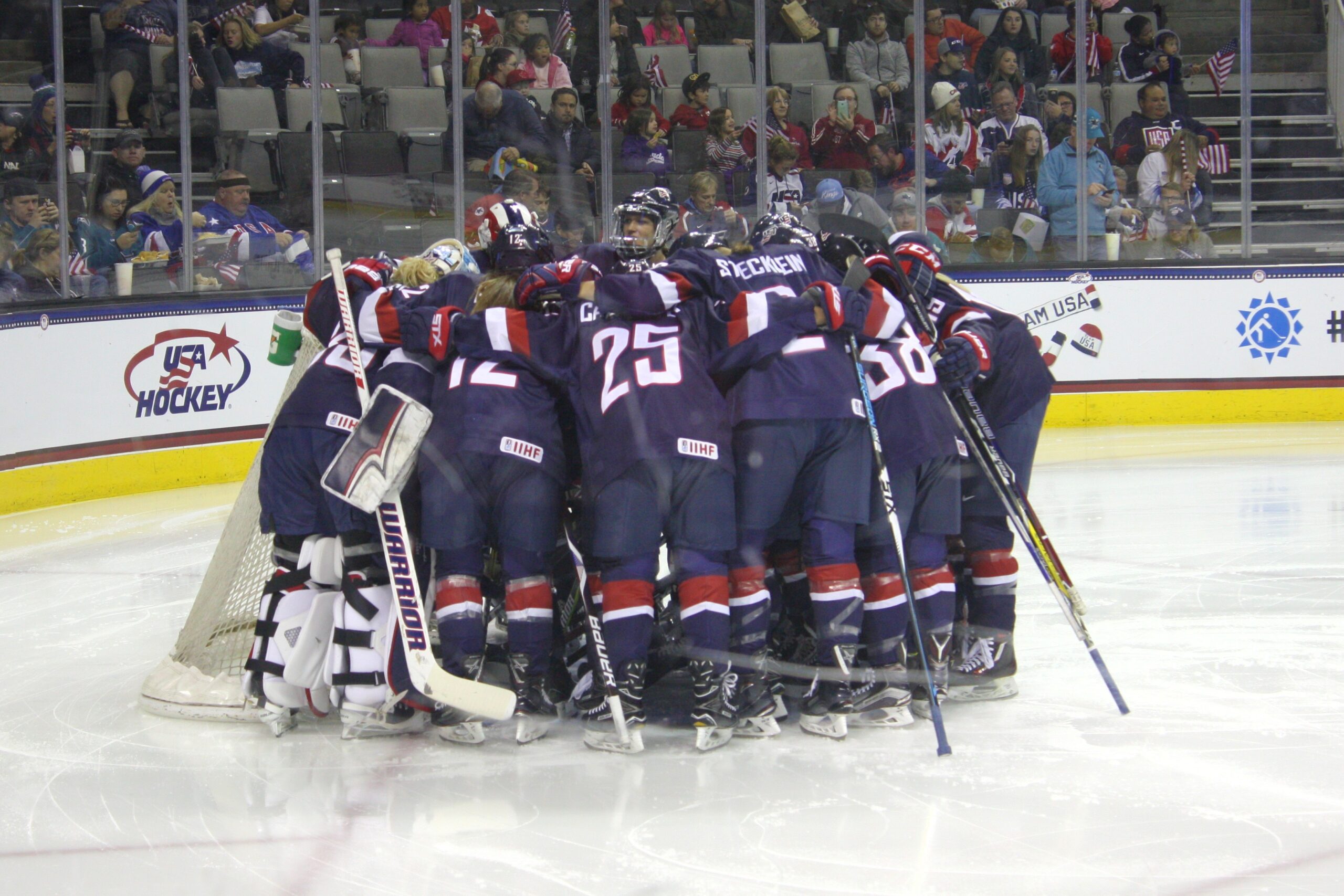
Photo Credit: Kunal Mehta via Wikimedia Commons // Team USA huddles at their goal before starting a exhibition match against Team Canada on Dec. 15, 2017

Canada outshot the United States throughout the game, but goaltender Connor Hellebuyck delivered a standout performance with an astonishing 41 saves — a defining factor in the win and a performance that anchored the tournament for Team USA.

The Miami stop, driven entirely by weather, transformed into a spontaneous championship celebration that blended Olympic history with the city’s vibrant nightlife culture.

For a program that had waited almost 50 years for another gold medal in its trophy case, the victory was already historic. But the unexpected Miami arrival simply added another chapter — one where a defining moment in U.S. hockey belonged to South Florida.

The team is expected to travel to Washington D.C. to attend President Donald Trump’s State of the Union Address, followed by a White House ceremony honoring the players Wednesday. 

CramBetter Modernizes College Tutoring with Innovative 24/7 Study Platform

It’s a canon event for incoming freshmen to enter college a little overconfident after excelling at challenging AP courses in high school.

While it’s normal to take five to eight different classes at once in high school, in college, taking too many credits, loading up on difficult coursework and trying to stay on top of a demanding schedule quickly shatters that confidence and can leave freshmen and sophomore students spiraling, in need of a lifeline.

That all-too-common experience is exactly what led Steven Keys and Marty Parks to create CramBetter, a new kind of tutoring service to meet students where they are and lead them to academic success.

“CramBetter gives college students a game plan for each class that helps them stay on top of what’s happening in lecture and prepares them for exams,” said Keys. “And it’s available 24/7, so no matter when you need help, you can get it.”

Whether you need to recap what went on in class or you’re in the middle of an all-nighter, CramBetter provides students with a study guide for each topic in their course, paired with concise videos that simplify chemistry, physics, and math courses from College Algebra and Precalculus all the way to Calculus 3.

“Our goal is to save students time,” said Keys. “CramBetter covers about a week’s worth of lectures in around an hour by focusing only on the most relevant material likely to show up on tests.”

In addition to its weekly study guides and video lessons, CramBetter’s practice exam questions help students test their understanding of the most common problems. If students get any of these questions wrong, they can watch detailed solution videos that explain how to solve each practice exam question, step-by-step.

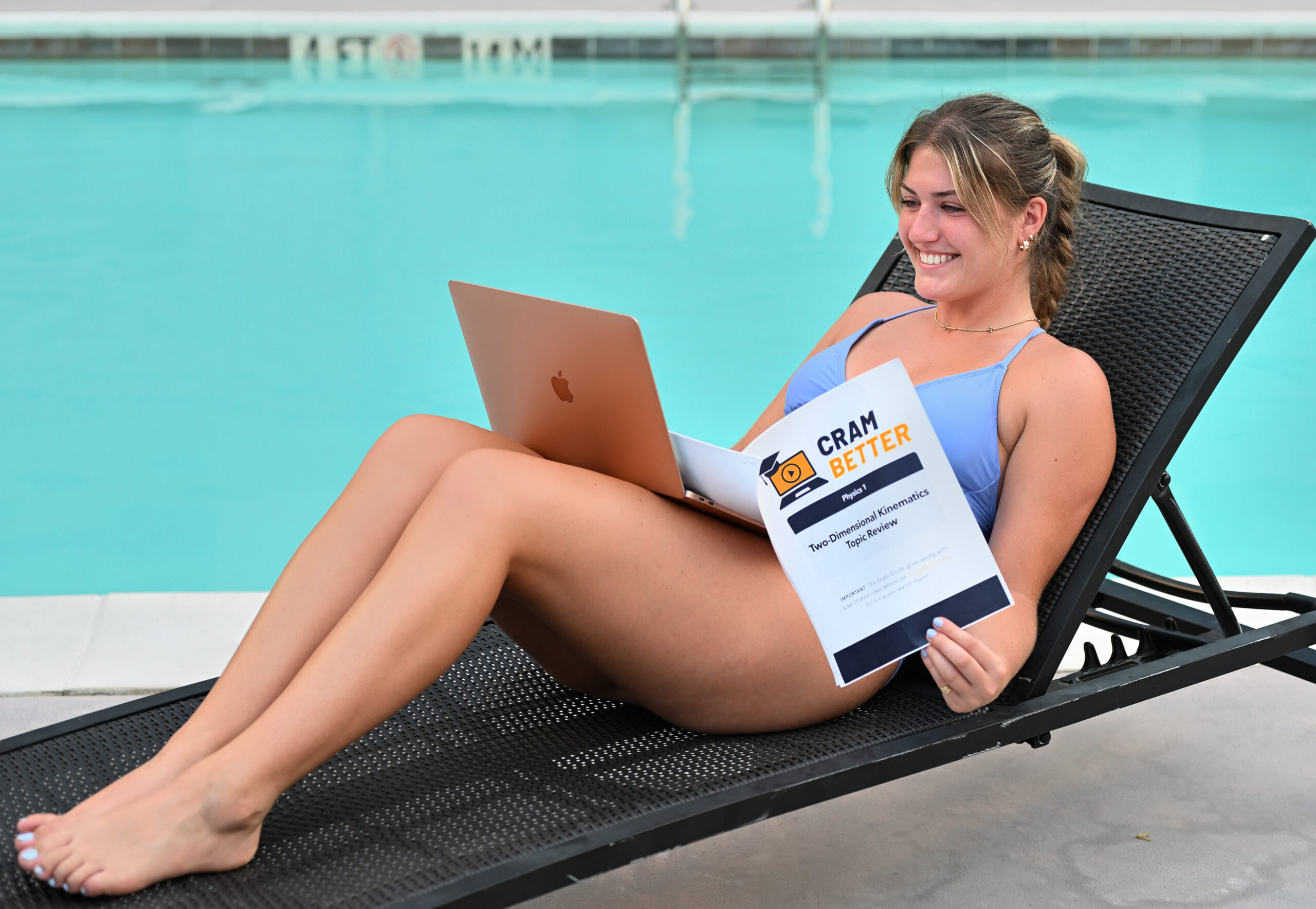
CramBetter’s iconic Study Guides pair with its short videos to create a streamlined, self-paced college tutoring experience that’s available anywhere, any time.

While many schools offer their own forms of academic support, most students find they need more help than those resources provide. Typically, on-campus tutoring is provided by fellow students who previously performed well in a class, which might be helpful to clear up a homework question here or there, but it isn’t the same as seeing a professional educator on a regular basis.

“Every tutor at CramBetter holds a master’s degree or higher and has at least eight years of professional teaching experience,” said Keys. “Studying with your friends and classmates is good, but when you come to CramBetter, you’re getting help from a true expert.”

Since its launch in 2023, CramBetter has grown across universities primarily in the southeastern US, helping thousands of students across more than 100 campuses better understand their classes and get better grades in the process — all while skipping out on that stressful first-year experience of absolute overwhelm.

Want to learn more? Visit CramBetter.com to see how it works and explore their courses offered at your college or university.

Weekend Update: ACC swim honors, baseball victory, and basketball updates

Happy Monday, Canes! Here’s your weekend recap.

Women’s basketball earned its third straight win with a 69–60 victory over California, led by Ra Shaya Kyle’s double-double and Ahnay Adams’ all-around performance. The team wraps up its home schedule on Thursday against Pitt.

Men’s tennis stayed undefeated at home with a 4–0 sweep over Florida Gulf Coast, extending its home winning streak to 20 matches and improving to 7–2 overall.

At the ACC Swim and Dive Championships, Mohamed Farouk placed seventh in platform diving, while Chiara Pellacani was named the conference’s Most Valuable Women’s Diver. Multiple relay teams also posted strong finishes as competition continues on Wednesday.

Men’s basketball fell just short against No. 14 Virginia, 86–83, despite strong scoring performances from Tre Donaldson and Shelton Henderson. Miami sits third in the ACC at 21–6 and faces Florida State next.

In baseball, the Hurricanes defeated Lafayette 14–4 behind a 10-strikeout performance from Rob Evans in his first start of the season.

That’s your weekend in Miami athletics!

Patricia Sánchez Abril appointed new Dean of School of Law

0

The University of Miami has announced that Patricia Sánchez Abril, J.D., has been appointed as the new dean for the School of Law. 

“I am deeply honored to serve as the School of Law’s next dean. This law school is full of promise and opportunity,” Abril said in a statement to The Hurricane.

Abril has served the University of Miami for over 21 years. Throughout her time she served as a professor, vice dean of Graduate Business Education, associate and interim dean of the University of Miami’s Graduate School, and interim dean of the School of Law.

She has served as Interim Dean of the School of Law since April of 2024, and is officially dean effective as of Feb. 18, 2026.

According to the email announcement from UM President Joseph Echevarria, as interim dean, Abril advanced academic priorities and promoted student success. She did this by working closely with faculty, staff, students and alumni, creating a collaborative community. 

Considering her time not only at the School of Law, but at the University as a whole, she feels it will be easy to start making an impact.

“Since I have been at the School of Law as interim dean for about two years, I have gotten to know this community well, so we are ready to hit the ground running,” Abril said.

Echeveria also notes that as dean, Abril will lead the School of Law’s academic mission and external engagement and focus on faculty excellence, learning objectives, and enhancing the school’s national profile. 

In her statement, Abril echoed just that.

“My focus has always been on the students. I have taught and mentored decades of students at this University and am ready to do that here on a larger scale,” Abril said. “We will ensure that every student that graduates from the School of Law is exceptionally trained, intellectually agile, and ready to succeed in an ever-changing legal market.”

Canes WBB beats Cal 69-60, boost ACC tournament position with third-straight win

0

Miami women’s basketball pulled away in the second quarter and held off the California Golden Bears in a 69-60 matchup on Sunday at the Watsco Center, extending their late season surge with three wins in a row. 

Cal struck first, with an early 3-pointer from guard Gisella Maul. But the Hurricanes responded back right with a series of layups, but ended the quarter trailing the Golden Bears by one. 

Miami then flipped the game in the second quarter. The Canes opened with a strong burst, getting a layup from Ra Shaya Kyle, then back-to-back buckets from Vittoria Blasigh and a jumper from Gal Raviv to build a 23-15 lead.

They kept stretching their lead with second chance points, with Ahnay Adams hitting a late 3-pointer to get the Canes to a 35-27 halftime lead. 

After the break, Cal made a big push. They cut Miami’s lead to 35-33 on a three from Aliyahna Morris. Miami answered with a steady run inside, getting baskets from Adams, Kyle, and Natalie Wetzel to push the lead out. 

Miami protected their 54-46 lead early in the fourth quarter, and went up by 11 after Kyle converted 3-point-play on a layup inside. Cal trimmed the deficit to 60-55 midway through, but Miami delivered the knockout stretch. 

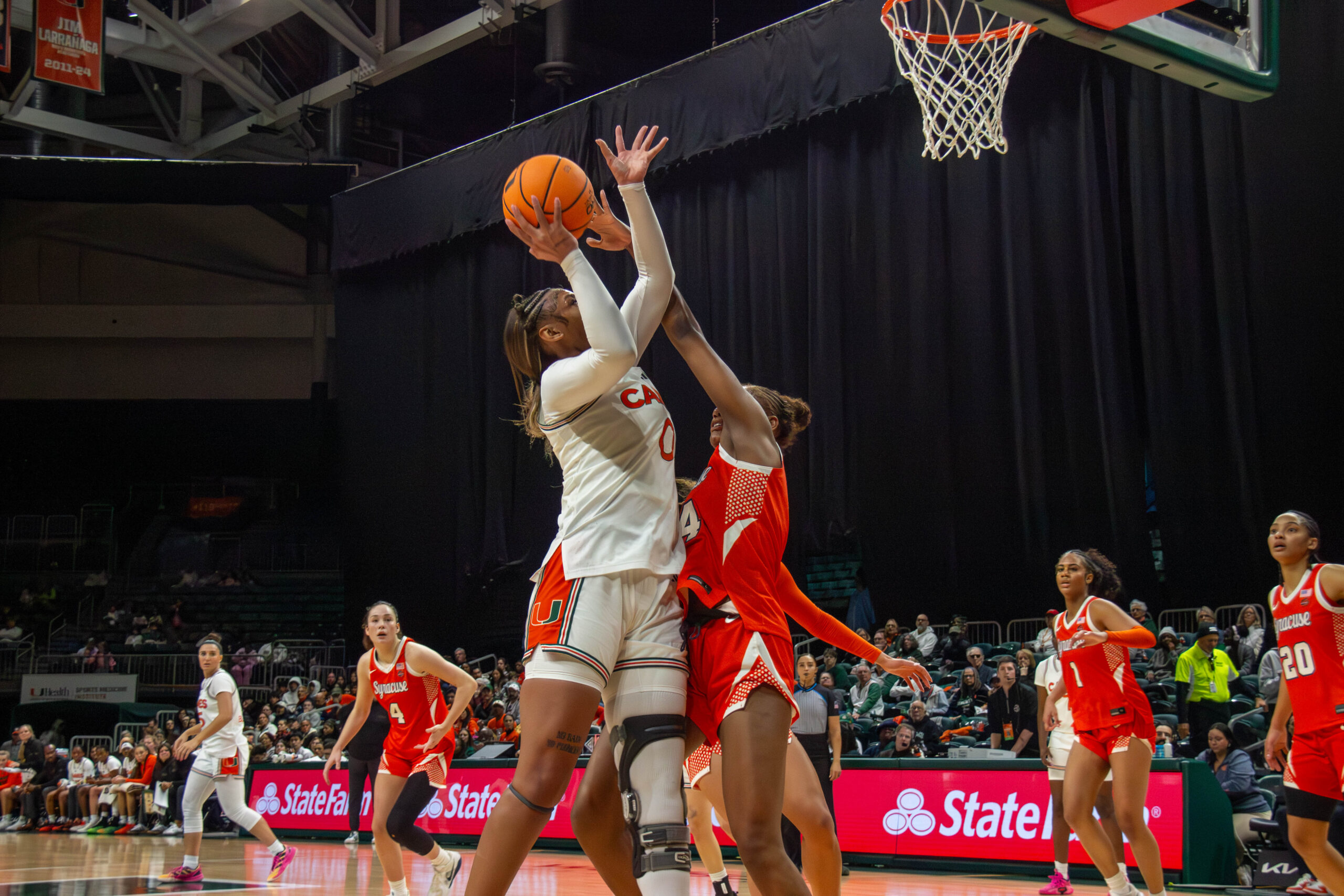
Photographer Bella Ochoa // Graduate student center Ra Shaya Kyle fighting under the basket against Syracuse University on Sunday, Feb. 1, 2026.

Raviv drilled a three, followed by another from Blasigh to push the lead back to 11. Cal got within seven again but the Canes closed it out at the line for the 69-60 win. 

Kyle and Adams controlled much of the game for Miami. Adams finished with 10 points and six assists, while Blasigh added 12 and Raviv 14. Miami shot 50% from the field and hit seven out of ten from the 3-point line. 

Miami head coach Tricia Cullop noted in the press conference after the game that the team has improved over the course of a year, but it’s still not enough. 

“I don’t want us to be happy with that. I’m not happy that we don’t have more than that to this point. “ Cullop said, “But I want us to continue, want to get better, and head into the conference tournament on a really high note, feeling really good about what we were playing, and fixing things still that we’re not doing as well.”

The Canes play their final home game against Pitt on Thursday Feb. 26. Tip off is at 7 p.m.