The No. 62 University of Miami men’s tennis team lost 4-0 against the No. 4 Wake Forest Demon Deacons on Friday afternoon at the Neil Schiff Tennis Center.
The loss is the first at home for the Canes since falling to the Florida State Seminoles on April 13, 2024, ending a 20 match unbeaten streak at home.
In addition to ending the winning streak, the Hurricanes (7-6, 0-3 ACC) have increased their ongoing losing streak to three in a row and stay winless in conference play.
The day started with the Demon Deacons (16-2, 3-0 ACC) securing the doubles point with two quick wins with Mees Rottgering and Kacper Szymkowiak defeating Rafael Segado and Jules Garot 6-1, while Luca Pow and Aryan Shah got the best of Nacho Serra Sanchez and Mehdi Sadaoui, winning 6-2.
When play was stopped, UM pair Antonio Prat and Jakub Kroslak were losing a close one on court one versus No. 4 DK Suresh Ekambaram and Andrew Delgado 3-4.
Singles play went the same way as doubles, Wake Forest domination.
The squad from Winston-Salem got the sweep victory in three two set wins.
In order of finish: Szymkowiak defeated Segado 6-4, 6-1, Dominick Mosejczuk bested Saud Alhogbani 7-6 (7-2), 6-3 and Joaquin Guilleme delivered the finishing blow with a 6-2, 7-5 win over Sadaoui.
When play was halted, No. 98 Prat led No. 18 Ekambaram 3-6, 6-4, 5-3 in a close court one battle. In addition, Serra Sanchez was losing a close one versus No. 51 Rottgering with an unfinished score of 6-4, 4-6, 2-3 and Kroslak versus No. 17 Pow was tied 6-2, 6-7 (4-7).
The Miami Hurricanes opened up ACC play against a veteran-filled Boston College side at home Friday night.
And in the face of such experience, it was Miami freshman left fielder Dylan Dubovik who pushed Miami to an early 5-0 lead over the Eagles. Everything looked perfect for the Canes heading into the ninth with a 7-5 lead, but all the momentum flipped.
Miami closer Ryan Bilka came into the game to close out the night but was unable to record the save, allowing two runs which allowed the Eagles to claw back at 7-7. And in the eleventh, a communication mix-up between Lazaro Collera and catcher Alex Sosa resulted in a dropped strike three with the bases loaded, allowing Boston College to take an 8-7 lead they would hold onto to secure their first ACC win.
The Friday night showdown saw Miami ace AJ Ciscar square off against BC southpaw AJ Colarusso. Through 13.2 innings prior to tonight’s matchup, Colarusso boasted a perfect 3-0 record alongside a sub-two ERA. In his start against the Canes last year, he pitched eight innings, allowing two earned in a 2-1 loss.
However those stats wouldn’t look as pretty after facing the potent Miami bats, as the Canes jumped to an early 5-0 lead.
Standout UM third-baseman Daniel Cuvet started the scoring early with a two-run single in the first. The Fort Lauderdale native racked up his 18th and 19th RBI’s.
The second inning spelled just as much trouble for Colarusso.
Miami’s Brylan West and Vance Sheahan recorded consecutive singles into right field before the red-hot Dubovik blasted a three-run shot into dead center to extend the lead to 5-0.
With the early five spot, it looked like Miami would coast to its first ACC win of the season, but in the third, the Eagles struck back.
After a strikeout swinging, BC’s Owen Deshazo and Julio Solier hit back-to-back singles to get two men on. Second-baseman Ty Mainolfi drove in the first run for Boston College with a double down the third base line.
And with two runs in scoring position, first baseman Nick Wang went yard off Ciscar, rocketing a 406 foot homer into deep center to cut the Miami lead 5-4.
In the bottom of the frame Miami would get one of those runs back thanks to some help from BC.
With one out and Alonzo Alvarez on first, West grounded into what should’ve been a double play ball. But Luke Gallo’s throw dragged Malofini wide, keeping the inning alive as both runners reached safely. Sheahan would capitalize with his second single of the night, driving home Alvarez to increase the Hurricane lead to two.
The top of the fourth was Ciscar’s bounce back inning – three up, three down, two groundouts and a strikeout. He would ride the momentum for the next five innings which included retiring 12 straight batters.
BC elected to replace Colarusso with Venezuelan righty Cesar Gonzalez for his fourth appearance of the year in the bottom of the inning. Despite giving up doubles to Cuvet and Williams in two of his three innings pitched, Gonzalez would work around those setbacks to put up three scoreless innings in relief thanks to six strikeouts.
David Lebowitz, Photo Editor/ Fifth-Year Senior Outfielder Derek Williams extends his foot towards foot base against Florida on Febrauary 27, 2026.
In the bottom of the seventh, Gonzalez was replaced by freshman righty Chase Hartsell. Immediately, West doubled to center. Shehan walked, then Dubovik drilled a single to center for a key insurance run as West scored. After Ogden popped out, John Kwiatkowski relieved Hartsell to close out the inning, immediately getting a double play for the last two outs
Despite the insurance, BC just kept fighting back.
Solier started the eighth off with a double to center off of Ciscar, brought home by Wang’s fourth RBI of the night on a sac fly. Ciscar maintained his composure, wrapping up his eighth and final inning of action with a fly-out to right, holding the lead at 7-5.
To close the game for Miami was Ryan Bilka, was unable to record the save. He allowed two earned which allowed the Eagles to claw back at 7-7.
The Canes could not respond as Cuvet, with the winning run on first, struck out to send the game to extras.
The tenth was scoreless from both sides as BC pitcher Sean Hard recorded a crucial double play and strikeout to walk down the side in order.
In the eleventh, relief pitcher Lazaro Collera was brought in for the Canes but allowed a walk, hit, and a walk to load the bases. In a game changing-play Collera struck out Solier, but Sosa got crossed up, allowing the ball to roll to the backstop, scoring the runner from third.
Down to their last out with the tying run on third, Jake Ogden with three hits on the night grounded out to second to end the game 8-7.
Miami (11-3, 0-1 ACC) will return to the light tomorrow night, aiming for their first win in conference play over Boston College (8-5, 1-0 ACC).
At 19 years old, Jacob Chandler, known artistically as CHXNDLR, already understands something many musicians spend years trying to figure out: authenticity will outlast a trend time and time again.
Chandler is a sophomore at the University of Miami, where he’s pursuing a Bachelor of Music in Music Industry with a minor in Marketing. Chandler didn’t stumble into music. He’s been building toward it since he was six years old.
The result is “REVENGE,” Chandler’s new single releasing March 7. Entirely written, produced and performed by him, the track is a Y2K-inspired hip-hop with elements of R&B and hyperpop
Piano quickly became a constant throughout his life. Jazz piano followed and with it came improvisation, instinct and the freedom to create.
Since being based in Miami, that same freedom has influenced his production work.
Chandler’s relationship with music evolved the most during the pandemic. What simply started as a hobby and something he says he was “really bad at,”, slowly became an obsession.
Music production wasn’t just another skill to learn, it became a passion. What pulled him in most was the limitless nature of production. With production, he realized, you can build anything from nothing.
In January, Chandler attended the National Association of Music Merchants convention in Los Angeles. There, he spoke on how being around industry professionals and emerging artists led to the idea that success meant picking a lane and staying there.
For a moment, he considered the idea. Chandler had already experimented before, even releasing a house track he later admitted didn’t feel authentic.
“It didn’t matter what the genre was,” Chandler said. “It was the idea that I was trying to pick a niche. I felt like I was being kept in a box.”
That realization was pivotal. Instead of narrowing himself, he decided to expand. “REVENGE,” his upcoming single, shows his ability to experiment but keep the same energetic beats that makes CHXNDLR.
“You might have gotten me good, but I’m going to make sure what happens to me happens to nobody else. That’s my revenge,” Chandler said.
Part of him admits he imagines an audience and what they might expect. But he’s learning not to let that expectation dictate the work. As he puts it: create what feels good.
“Your art can be you being yourself and not you being forced to be someone you’re not,” Chandler said.
His minor in marketing isn’t a backup plan — it’s part of his long-term vision. He wants to exist on both sides of the industry as an artist who creates and and helps other artists bring their visions to life.
For now, “REVENGE” represents something simple but powerful: a 19-year-old artist choosing freedom over formula. And that may be his most defining move yet.Listen to “REVENGE” on Spotify when it comes out on Saturday, March 7.
Inside the Gas South Arena on Thursday afternoon, No. 12 seeded Miami came up short against No. 5 seeded Notre Dame, 69-54, in the second round of the ACC Tournament.
Miami opened strong offensively shooting 75% from the field early with contributions from Ahnay Adams and Amarachi Kimpson. The Hurricanes jumped out to a 7-4 lead and extended it to 14-9, before Notre Dame’s Hannah Hidalgo sparked the Fighting Irish offense.
Notre Dame pulled ahead 17-16 and closed the first quarter with a 23-19 advantage.
Both teams went scoreless in the opening minutes of the second quarter. Notre Dame eventually broke through with key points, including a three-point play, while Miami did not record its first basket until three minutes remained in the period.
The Canes trimmed the deficit to nine, 30-21, but Notre Dame closed the half on a 7-0 run, to take a 37-23 lead into halftime.
The Hurricanes in the second quarter shot 2-for-11 from the field and missed both three point attempts, going 0-for-2 beyond the arc.
With back and forth scoring from both teams early in the third quarter, Miami kept the scoring margin to single digits. Adams and Ra Shaya Kyle helped lead the effort, combining for several key baskets as the Hurricanes scored 17 points in the period.
Despite shooting 58% from the field and 40% from the 3-point line, Hidalgo continued to pace the Fighting Irish, who carried a 58-40 lead into the final quarter.
The Canes opened the fourth quarter on a 10-0 run, sparked by back-to-back baskets from Gal Raviv.
With the deficit cut to eight, 58-50, Notre Dame remained scoreless for more than five minutes before ending the scoring slump and pushing the lead back to double digits. Notre Dame continued to control the game and secured a 69-54 victory.
Miami had three players finish in double figures. Raviv led with 15 points and three rebounds. Kyle added 11 points and 15 rebounds for her 21st double-double of the 2025-2026 season, while Adams contributed 13 points and four assists.
As a team, the Hurricanes shot 45% from the field, 31% from beyond the arc and 41% from the free throw line. Miami scored 26 points in the paint, 16 points off turnovers and received seven points from the bench.
Miami finishes the season 17-14 overall and 9-11 in ACC play. The Hurricanes will return to Coral Gables and await a possible postseason tournament bid.
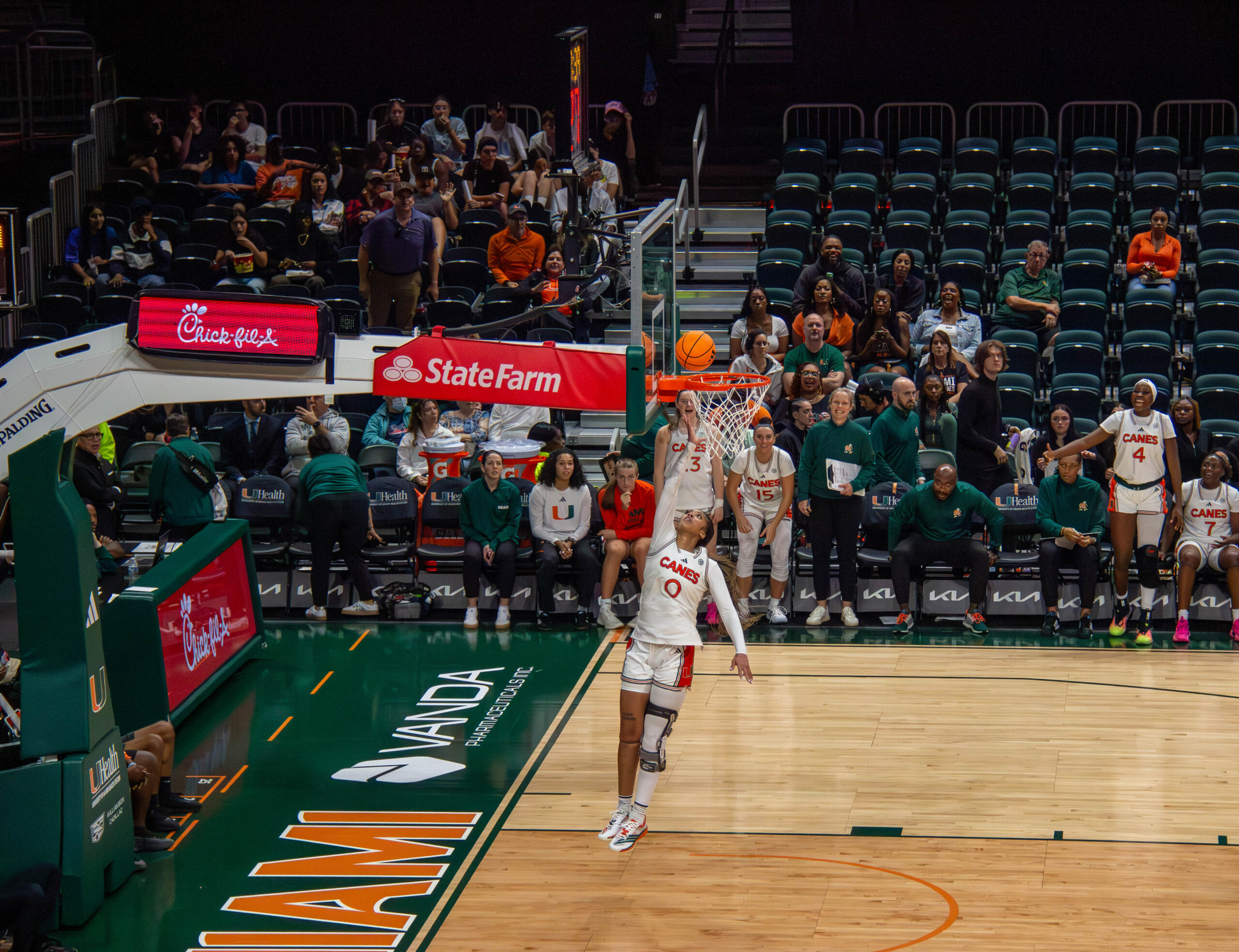
Photographer Bella Ochoa // Graduate student center Ra Shaya Kyle takes it to the basket against Pittsburgh on Feb. 26, 2026 at Watsco
Students walking past the Merrick Building may have noticed something towering above the lawn.
A seven-meter steel sculpture titled “Chaos Herrirako Atea” by American sculptor Jedd Novatt has quietly appeared behind Merrick, becoming the newest addition to the University of Miami’s public art collection.
Novatt is an American sculptor whose sculptures have been exhibited around the world. His sculptures, which often explore geometric forms and spatial tension, create structures that appear both balanced and precarious.
According to a representative from Novatt’s studio, Novatt does not explain the meaning behind his titles or attempt to verbalize the interpretation of his work. Instead, he believes that the artwork should be experienced directly by viewers.
The representative said Novatt feels “the work speaks for itself” and encourages viewers to spend time with the sculpture, observing it at different times of day and in different lighting conditions to gain new perspectives.
The sculpture was gifted to the University by a private foundation and installed as part of the University’s broader public art initiative.
The University of Miami formalized its Public Sculpture Collection in 2001 to expand artwork beyond the grounds of the Lowe Art Museum. The collection now includes more than 30 sculptures by local, national and international artists placed throughout the Coral Gables campus.
Tola Porter, director of the Lowe Art Museum, said public art plays an important role in campus life.
“The University of Miami and the Lowe Art Museum are proud to host a vibrant sculpture park comprising works by leading sculptors from around the world,” Porter said. “Public art democratizes artistic creativity by bringing art outside for all to enjoy and supports student learning, research and wellbeing.”
Alice Corral, director of Campus Development Regulations, says the sculptures are meant to capture interest, stimulate imagination and enrich the daily experience of students and visitors. The works are installed in public locations which make them accessible to the community.
Corral also said the collection “meets the requirements of the City’s Art in Public Places ordinance and exempts the University from ongoing costs related to the construction of new buildings.”
The Coral Gables Art in Public Places program requires certain development projects valued at $1 million or more to dedicate at least 1 percent of their costs toward public art installations that enhance the city’s cultural landscape.
For students passing behind Merrick, “Chaos Herrirako Atea” may appear sudden and imposing. But as the newest addition to the campus landscape, the sculpture invites viewers to pause, observe and interpret it in their own way.
Every March, Miami is taken over by Miami Music Week and Ultra Music Festival is the grand finale.
Returning to Bayfront Park from Friday, March 27 through Sunday, March 29, Ultra 2026 is shaping up to be one of the most stacked and ambitious editions in the festival’s history. For University of Miami students, this isn’t just another weekend—it’s six days where the entire city revolves around music and movement.
The sets
Ultra has always built its reputation on incredible performances and their 2026 set leans heavily into that identity. The festival will host several historic joint sets, including a rare reunion set from two-thirds of Swedish House Mafia: Sebastian Ingrosso b2b Steve Angello, and a special b2b between Alesso and Martin Garrix.
The weekend already feels historic before a single stage opens.That Alesso b2b Martin Garrix pairing in particular is already being whispered about online as a potential all-time Ultra moment.
Both artists are coming off massive individual years and recently collaborated on “Inside Our Hearts,” so seeing them share a stage at Ultra feels less like a novelty and more like a culmination.
Ultra 2026 also leans heavily into global firsts and long-awaited debuts. Argentine hitmaker Bizarrap — better known as BZRP — will make his Ultra debut, bringing together hip-hop, reggaetón, and electronic sound waves in what feels like a genuine cultural milestone for the festival.
Another must-see debut comes from Japanese DJ phenomenon ¥ØU$UK€ ¥UK1MAT$U, whose chaotic, genre-breaking Boiler Room set turned him into a viral legend almost overnight.
The headliners
Veteran headliners returning this year carry just as much weight. DJ Snake returns after four years away and will also bring his darker techno alias “Outlaw” to b2b with Trym at the Worldwide stage.
John Summit arrives amid the rollout of his new album “CTRL ESCAPE” and the announcement of a major residency at the new mega-club [UNVRS], making this one of his most anticipated Ultra appearances yet.
Meanwhile, main-stage giants Afrojack, Hardwell, Armin van Buuren and Major Lazer ensure that the festival still delivers the kind of massive moments Ultra built its reputation on.
Where Ultra really separates itself, though, is depth. The Martinez Brothers return for their first Ultra appearance in seven years while also debuting their “Cuttin’ Headz” stage takeover.
RESISTANCE continues to anchor the festival’s underground side with heavyweights like Carl Cox, Eric Prydz, Boris Brejcha, Adriatique and underground icons Sasha & John Digweed.
Bass music also gets its moment. ISOxo, Excision and Illenium will bring heavier sounds, while the debut of Wooli b2b Crankdat under their WANKDAT alias promises something particularly chaotic in the best possible way.
But as the festival recently revealed its running stage order, another reality has set in: set conflicts. Ultra’s depth is a gift, but it forces difficult decisions.
Sunday night in particular has already sparked debates online. At the same time John Summit closes the Main Stage, the world-exclusive Sara Landry b2b Amelie Lens will be closing the RESISTANCE MegaStructure.
Meanwhile WANKDAT will shut down the Worldwide Stage, and The Martinez Brothers will close RESISTANCE’s Cove stage. In other words, four completely different festival finales will be happening simultaneously — and festival-goers will have to decide where they want to end their weekend.
How to Ultra
Ultra is incredible, but it’s intense. Tickets should only be purchased through Ultra’s official website or authorized partners — avoid resale DMs and unofficial links, especially close to the festival.
Getting downtown is easiest via Metromover, Metrorail, or rideshare, but expect traffic bottlenecks and surge pricing after headliners end. Arriving earlier in the day saves stress and gives you time to explore stages before the biggest crowds arrive.
Hydration, pacing and awareness matter more than anything. Bayfront Park gets hot, packed, and loud — eat beforehand, drink water constantly and set meetup points with friends in case cell service drops.
If a crowd starts feeling unsafe, move early rather than pushing through. Ultra rewards those who know when to go hard and when to step back.
For UM students, Ultra isn’t just a festival — it’s one of those weekends you’ll remember long after graduation. Plan smart, stay safe and let the city do what it does best: turn sound into memory.
For a city often defined by towering LED screens, late-night warehouse marathons and bass-heavy headliners, GroundUP Music Festival has spent the last decade offering something entirely different.
From March 13 – 15, 2026, the festival returns to the Miami Beach Bandshell for its 10th anniversary, marking ten years of collaboration, community and genre-defying programming.
GroundUP has carved out a distinct identity within Miami’s festival landscape. Rather than centering itself around a single genre or spectacle-driven production, the festival builds its experience around artistry, diversity, and connection.
Jazz, soul, funk, R&B, rock, electronic, world music, and singer-songwriter traditions all coexist on one thoughtfully curated stage — without overlapping sets and without forcing audiences to sprint between performances.
At the heart of the festival is Snarky Puppy, the five-time Grammy Award-winning collective co-founded by bassist and producer Michael League alongside arts leader Paul Lehr.
Snarky Puppy will host nightly “Family Dinner” sessions — live iterations of the band’s celebrated Grammy-winning collaborative albums — bringing guest artists onstage for musical exchanges.
This year’s featured performers include boundary-pushing electronic visionary Flying Lotus, genre-blending icon Rickie Lee Jones, R&B standout Bilal, acclaimed guitarist Julian Lage, soul legend Patrice Rushen, globally celebrated vocalist Arooj Aftab, innovative guitarist Isaiah Sharkey, Cuban multi-instrumentalist Alain Perez and Carnatic flautist and vocalist Varijashree Venugopal..
Snarky Puppy will also perform full sets each night, including music from their latest album, “Somni.”
Unlike most Miami festivals that rely on massive crowds and simultaneous stages, GroundUP maintains an intimate daily capacity of approximately 1,500 attendees. The acoustics of the open-air Bandshell allow every seat a clear view and sound experience.
The result is a relaxed, immersive atmosphere where audiences can fully settle into performances rather than chase them.
That intimacy extends beyond the stage. Each day includes four hours of interactive workshops, masterclasses, and panels, where attendees can engage directly with the artists. The festival’s mission — rooted in the GroundUP Music Foundation — emphasizes breaking down barriers between performers and audiences, fostering meaningful musical exchange rather than passive consumption.
The weekend begins with the GroundUP Music Foundation Benefit, an all-day nonprofit event limited to just 150 guests. Attendees gain behind-the-scenes access to rehearsals, intimate dinners with artists and exclusive performances, reinforcing the festival’s commitment to music education and creative development.
Over the past ten years, GroundUP has evolved into more than just a festival. It functions as part of a larger ecosystem that includes the GroundUP Music label and foundation, supporting artist independence, collaboration and community engagement.
With nearly 70% of attendees traveling from outside Florida — representing all 50 states and more than 55 countries — the festival has built a global audience while maintaining a distinctly local, welcoming feel.
In a city known for excess, GroundUP thrives on intention. It is family-friendly without feeling tame, sophisticated without being exclusive and musically adventurous without losing accessibility. As Miami Music Week and festival season approach, GroundUP’s 10th anniversary stands as a reminder that some of the most powerful live experiences happen not in the biggest spaces but in the most connected ones.
The landmark fifth edition of We Belong Here Miami took over Virginia Key Beach Park from Feb. 27 to March 1 and turned it into something that felt less like a festival and more like a temporary beach civilization built on music.
From the moment you walk through the gates, the shift is immediate. You smell the salt water before you see the stages. The sand works its way into your shoes. The melodies drift through the ocean air instead of punching through concrete. It doesn’t feel industrial. It feels coastal and alive.
Friday carried the signature We Belong Here tone — melodic, warm, polished. Artists Bakermat, Lost Frequencies and Elderbrook built the main stage steadily as the sun dipped lower, before Kaskade closed with his Redux sound.
There’s something about hearing them by the water that makes it hit differently—less like a club set, more like a shared exhale.
What separates this festival from most is the freedom to choose how you experience it. You can dance hard at the 360 main stage, wander to the smaller stages, or dip your toes into the Atlantic mid-set. It’s amazing to feel like you’re at a rave and on vacation at the same time.
The Beach Stage, positioned maybe fifteen feet from the shoreline, leaned more vocal-heavy and pop-adjacent when I stopped by. I caught Benjamin Lloyd dropping edits of “Where Have You Been” and “The Less I Know The Better,” and the energy felt light, singable and euphoric.
In contrast, the Lost Village felt like a side quest — wooden structures framing a tucked-away dance floor with a slightly darker, more mysterious tone. It was the kind of place you wander into and end up staying for half an hour.
The decor across the grounds struck a careful balance — not overdone, not bare. Just enough to feel like its own secluded beach world without competing with the ocean itself.
Lane 8 delivered one of the weekend’s most transportive sets, stretching time the way he always does, letting melodies breathe into the sunset. RØZ might have been the most electric surprise of the weekend. He warmed up with Latin-infused edits — “Sexy Movimiento,” Young Miko flips — before dropping Bad Bunny’s “NuevaYol.”
Expected? Sure. But then he dove straight into a speed-house edit of “Salgo Pa La Calle,” keeping the iconic intro intact and sending the Latino crowd into a frenzy. Following that immediately with “MONACO” should be illegal. It was energetic and it flowed.
Sunday’s weather delay tested everyone’s patience. Gates were pushed from 3 p.m. to 4 p.m., and a long line formed across the Key as puddles collected and barriers shifted. But once the skies cleared, everything snapped back into place in time for Nimino and then Tiësto’s set. If anything, the delay added tension to the release.
Tiësto was exactly what you’d expect — polished, commanding, consistent. You know what you’re getting, and he delivers it. Chris Lake, on the other hand, felt long and repetitive. There was visible frustration in the crowd when he teased but didn’t fully commit to his remix of “Opalite” by Taylor Swift, cutting key vocal sections that give the track its lift.
For a headlining slot, it lacked the spark the moment demanded but he did close out with a great remix of Tame Impala’s “Dracula.” Sunday closer Gorgon City was solid andclean.
Logistically, the festival ran smoothly overall. There were plenty of food stands and beverage options — Beatbox seemed to be everywhere — and the layout made navigation easy. One water station felt sufficient for the crowd size, though adding another near the back of the main stage would’ve been appreciated during peak hours.
VIP had solid bar access and clean bathrooms, though adding food options within that area would elevate the experience. If there’s one creative tweak for the future, bringing back the fourth stage from 2024 would deepen the exploration factor.
After hours rotating between two smaller stages and one large main stage, the rhythm can feel slightly repetitive. Another lane would keep discovery alive.
We Belong Here is the kind of beach festival Miami should be doubling down on. For a city so defined by its coastline — we should have more than one significant waterfront gathering each year.
Right now, We Belong Here holds that crown. It’s well put together, immersive without being overwhelming, functional and fun. But Miami crowds evolve quickly, and to keep growing, innovation will matter.
Not just bigger DJs, but new concepts, fresh staging ideas and unexpected collaborations — something that pushes the format forward rather than simply refreshing it.
Still, for three days on Virginia Key, the music met the ocean, and the ocean answered back. And for a moment, it felt like nowhere else in Miami existed.
With “The Romantic,” Bruno Mars’ first album in nearly ten years, he steps into what feels like his most mature era yet. This is his fourth solo studio album, and the title is perfectly chosen.
Instead of centering on longing, heartbreak, or the chaos of chasing love, this project lives in the blissful, intimate harmony you find when you’ve grown up and found something real. It’s passionate without being dramatic, sensual without being performative. There’s a calm confidence throughout the album — like someone who no longer questions love but understands it.
One of the most striking elements is how deeply Bruno leans into his Latin roots. You can hear it immediately. From the bolero textures on “Risk It All,” where his melody floats effortlessly over the rhythm, to the groovy, rhythmic pulse of “Cha Cha Cha,” he sounds fully immersed in these influences.
The bossa nova moment especially caught me off guard — I didn’t expect it, but it works beautifully. His voice carries such emotional weight over it that you can feel both yearning and peace at the same time. “Cha Cha Cha” feels like a confident cultural embrace, almost reminiscent of how artists like Bad Bunny have re-centered their roots in modern music.
And when the outro tempo lifts? That shift elevates the entire song and shows Bruno’s mastery of dynamics.
As the album unfolds, it becomes clear that “The Romantic” is intentionally slower than much of his previous work. Songs like “God Was Showing Off” and “Why You Wanna Fight?” lean into vulnerability and reflection.
The Spanish intro on “God Was Showing Off” had me expecting a full Spanish verse, but even without it, the track feels grand and emotionally heavy. The longing and devotion are strong themes throughout this middle stretch of the album.
While I do miss some of the high-energy Bruno we’re used to, there’s something admirable about how committed he is to this slower, more intimate pace.
That said, he doesn’t abandon groove entirely. “I Just Might” is still a standout for me — effortlessly catchy, danceable, and reminiscent of vintage Bruno but with a modern polish.
It proves that he can make even a relatively simple structure feel elite through vocal control and smart production. Then “On My Soul” delivers the energy I’d been waiting for: bongos, a deep bassline, disco influence, and a saxophone that adds richness and movement.
It’s sensual, playful, and rhythm-driven in a way that reminds you Bruno can still command a dance floor whenever he wants.
By the time we reach “Something Serious” and “Nothing Left,” the emotional depth of the album feels fully cemented. There’s jazz influence woven in, subtle modulation choices, and stronger, more pronounced vocal deliveries that add gravity.
The instrumentation across these tracks feels intentional and layered, never overwhelming but always supportive of the emotional core. It feels rawer here — like the stakes of the love story are clearer.
Closing with “Dance With Me” feels cinematic. The opening notes strangely reminded me of “Yellow” by Coldplay, but the song quickly becomes its own emotional moment — a culmination of the entire journey.
It sounds like the final scene of a love story, asking for one more dance. The choir behind him elevates it beautifully, giving the ending a grand, almost timeless feel.
Overall, “The Romantic” is Bruno Mars fully in control of his artistry. It’s slower, more reflective, and deeply rooted in culture and emotional maturity. While part of me still craves a couple more explosive, uptempo moments, this album proves that he doesn’t need to rely on flashy hits.
He can lean into passion, heritage, and musical exploration — and still make it feel effortless.This isn’t Bruno chasing love. This is Bruno living in it.
Thirty years ago, Nintendo published the very first Pokémon games — “Pokémon Red” and “Pokémon Green” — in Japan. For Pokémon Day 2026 on Feb. 27, the annual celebration of the beloved pocket monster franchise, Nintendo had some special announcements for fans.
The tenth generation of Pokémon
Nintendo officially revealed the next mainline generation of Pokémon games: “Pokémon Winds” and “Pokémon Waves.” These are the first titles in the tenth generation and will be released on the Nintendo Switch 2 console in 2027.
Looking at the trailers, the setting for these games appears to be a tropical, island-rich region with underwater areas. Fans will see some similarities to the seventh generation of the Pokémon franchise, “Pokémon Sun” and “Pokémon Moon,” which were set in the Alola region, inspired by Hawaii.
Nintendo also showed first looks at the new starter Pokémon for Wind and Waves, the first three Pokémon you have to choose between at the start of every game. This time around, it seems that Nintendo chose to go all-in on making the starters as adorable as humanly possible.
Brow, the bean chick Pokémon and grass-type starter, is a cute green bird with leaves on its brow and a clumsy personality. Pombon, the puppy pokémon and fire-type starter, is an innocent and friendly orange dog.
Finally, Gecqua, the water gecko Pokémon and water-type starter, is an intelligent, shrewd blue gecko with a wide head and large eyes.
More information about the new games is likely to come out in the coming months in preparation for the 2027 release window.
Relaunch of classics and upcoming launch of a new game
In honor of its 30th anniversary, “Pokémon FireRed” and “Pokémon LeafGreen,” the 2004 remakes of the original 1996 games, are now released digitally on Nintendo Switch and Nintendo Switch 2. These are enhanced versions of the originals with modern features.
With “Pokémon Pokopia” releasing on Mar. 5, Nintendo also gave fans another look at the upcoming game. Pokopia is a life-simulation and sandbox game from developers Game Freak and Omega Force. The game was first announced in last year’s Nintendo Direct and will likely cost around $70 at launch.
In Pokopia, you play as the shape-shifting Pokémon Ditto that has transformed into a human-like character. The world you find yourself in starts empty and abandoned, and your goal is to build it up into a thriving home to attract Pokémon and maybe even humans.
The game combines elements of other beloved sandbox games like “Animal Crossing,” “Stardew Valley” and “Minecraft,” but with Pokémon twists. You can build and craft like in those games, but you can also befriend other Pokémon and learn from them to interact with the environment.
The game runs in real time, with a day-night cycle and changing weather that affect gameplay and your surroundings.
Pokémon naturally come into the world you’re building as you progress. The focus is more on community, creativity and peaceful exploration than on traditional Pokémon battling, making it ideal for players who enjoy creative sandbox games.