75.5 F
Coral Gables
Wednesday, March 4, 2026
March 4 , 2026
Home Blog Page 8

UM will not purchase land across U.S. Route 1

0

The University Shopping Center across from the University of Miami campus is set to be demolished following the closure of the longstanding Bagel Emporium in late 2025. The property was available for UM to purchase, however, the University said it is unlikely that would happen.

“When you start expanding that boundary line across major roadways, it gets harder to navigate and manage,” said Jessica Brumley, the Vice President of Facilities Operations & Planning, during a roundtable discussion with The Hurricane. “The likelihood of UM purchasing land across the street and building towers is probably not anything that would happen in the near future.” 

Instead, a student housing developer, Landmark Properties, bought the property in 2023 with plans to build a new apartment complex. 

Leading up to Landmark Properties’ purchase, there was speculation that UM would buy the land for campus expansion. Seeing that the UM Strategic Housing Plan will not be completed until 2032, a new housing development could have been a good option for students while construction continues on campus.

An expansion across U.S. Route 1 would have to be approved by the City of Coral Gables. 

“We have agreements that we’ve made with the City of Coral Gables on how we’re going to operate and where we’re going to operate,” said Brumley.

The University is required to submit an annual report to the city on or before June 1, detailing any proposed changes to the Campus Master Plan. 

This system was put in place by the passage of Ordinance No. 2010-34 in 2010. It states that the Campus Master Plan covers all land included in the University Campus District (UCD). If a proposed building or development is not submitted and approved in the annual report, construction cannot move forward.

Section 4-202(E)(4) in Article 4 of the Ordinance states that all modifications “shall be approved after the following findings have been prepared by planning staff, recommended for approval by the Planning and Zoning Board and approved by City Commission.”

There are three main regulations that modifications must meet for approval: The submitted proposal must be consistent with the intended purpose, it must make adequate provisions for public services and traffic control and it must be compatible with adjacent properties and the neighborhood.

In addition to the three regulations, new buildings have to follow the Ordinance’s general height and setback restrictions. The UCD states that no building shall exceed 150 feet or 13 stories. Additionally, no building can stand within 25 feet of its front property line.

While there is no explicit limit on the number of students that can be on campus, the City’s extensive zoning laws in Ordinance No. 2010-34 make it difficult for potential new housing projects to get approved. Instead, UM housing hopes to form a relationship with Landmark Properties, as they’ve done with The Residences and Hotel at THesis.

“Pat [Whitely] and I work very closely together to ensure that we have strategic partnerships with THesis and perhaps this company that is going to build across the street. That’s important,” said Brumley. “We will continue to do that to ensure the best amenities are made available to our students if they choose not to live on campus.”

CAS to create new student lounge

The College of Arts and Sciences is moving forward with plans to transform Ashe room 112 into a student lounge.  

The project has been in the works for about two years, according to Emily Long, the assistant dean of the College of Arts and Sciences. The project was temporarily paused while Cane Navigator offices were moved  into the Ashe Administrative Building in Ashe 140 and the University Center in UC 2275. 

According to Long, Ashe room 140 functions as a Cane Navigator office and a student lounge. Designed with student input and the university design team, it hosts regularly scheduled events and casual student gatherings.

Despite the intention of having Ashe room 140 serve as a student space, some CAS students said they were unaware Ashe 140 was intended for anything beyond advising purposes, or that it existed at all. 

“It doesn’t feel like a student lounge to me because it’s far from Merrick and Dooly, which is where most of [my CAS] classes are,” freshman and political science major Mia Vargas said. “I thought it was a classroom.” 

Long said student feedback has played a role in shaping plans for the Ashe 112 renovation. Details about the final design and construction timeline will be shared by central University Communications. 

Students expressed positive reactions to the idea of a new CAS student space and that it could encourage them to spend more time in CAS buildings between classes. 

“I would go there if it’s a good place to study or get resources for contacting tutors,” Vargas said.

Madison McDonald, a sophomore majoring in Neuroscience and Biochemistry and Nutrition, says most of her classes are in the Cox Science Building and Whitten Learning Center, where there is typically unavailable seating. She looks forward to the development of a new student lounge.

“I think the seating in the bottom area of Cox is nice, but if you go to the second or third floor there’s usually no seating,” McDonald said. “I do think there need to be more student spaces on that side of campus.”

Workout classes in Miami are not affordable for UM students

0

Miami is known for its lively workout culture and it’s considered one of the best cities in the U.S. to live a healthy life, according to NBC Miami.

Students at the University of Miami are often seen carrying a yoga mat back from the metro or with headphones on their way to the gym. However, many students feel like the workout culture in Miami is unaffordable.

 Miami is 20th on the list of healthiest cities according to MindBody that  includes a variety of factors like water intake, alcohol intake, time spent outdoors, hours of sleep and amount of exercise per week.

Carlee Beck, a senior who has tried classes at many workout businesses, said “In general, I don’t feel like workout classes are affordable in Miami.”

The cheapest single-class prices are Fuze House, SoulCycle, Core Power and PureBarre start at  $35. From there, prices go up to $38 at JETSET and $39 at [solidcore]. 

In comparison, Florida’s minimum wage is $14 per hour, meaning it would take over two hours of work to afford a single class. 

Many of these workout spots are located within a 1 to 2 mile radius of the center of campus meaning students have to commute, adding to the cost of the experience. The average rideshare price to these locations is around $13 depending on the time of day.

Beck said that she has gotten her money’s worth. 

“I’ve purchased many class packs from SoulCycle, and I signed up for the free week at CorePower,” she said. “Both options, I thought, were very much worth it.”

Beck said that while discounts are helpful, class costs add up, leaving her looking for ways to spend less. 

There are a variety of options to save money, like student discounts, class packs, intro class rates and even a free week of classes for first-timers.

Beck said, “I generally use ClassPass to book my classes … I find myself gravitating towards studios with a student discount.”

Classpass is a site that allows users to pay a monthly fee which in turn gives them a certain amount of credits to use at local fitness studios and wellness and beauty centers. 

Users can select as little as eight credits for $19 per month or as many as 150 credits for $299 per month. Students can try out different studios or workouts to see what works best. Almost all of the popular workout spots are available on Classpass.

Many of these workout businesses also offer student discounts and promotions for new customers. 

SoulCycle is one location that offers student discounts. Students can take one class for $26 or purchase a five class pack for $125. 

At Fuze House, five class packs for students are priced at $160. 

Places like [solidcore], Purebarre and Core Power offer discounts or even free classes for first timers.

The Herbert Wellness Center also offers a variety of classes like yoga classes, including sunrise and flow, cardio and strength classes, like HIIT, cycling, and both reformer and mat pilates.

Full time undergraduate, graduate and law students are required to pay a $171 Herbert Wellness Center fee per semester. This membership includes all standard group fitness classes, the use of one small towel, sauna and steamroom privilege and more. 

Sophomore Zoe Campos, who has tried all of the classes at the wellness center. From cycling to HIIT to pilates, she thinks they are convenient to fit in between classes since they are covered by the gym fee. 

“I’d rather take a class here since it’s more easily accessible. Most studios off campus are so expensive that it doesn’t seem worth it to drive or get an uber to another workout class,” said Campos.

Students like Beck are required to pay the Wellness Center fee, even if they do not take classes there or use the gym.

This leaves students making a decision between what’s best for their emotional and physical health and what’s best for their financial needs.

Vance Sheahan’s walk-off homer propels Canes to 13th inning comeback win over UCF

0

“Mark Light Magic” was well and truly in the air Tuesday night as the No.23 Miami Hurricanes secured a 13-inning 8-7 walk off victory over the UCF Knights.

It looked bleak for UM, no-hit through six innings and down 5-0 with most of the fans exiting the stadium for the concurrent basketball game at the Watsco Center.

But this team had no quit, chipping away to send it into extras as those same fans returned to fill the stadium and watched from the parking garage in right field.

And with a 3-1 count, and the Mark Light faithful on their feet late into the night, Vance Sheahan would have his moment. 

A 406-foot walk off 2-run homer, to give the Canes an improbable comeback victory. 

“It was an out of body experience,” Sheahan said postgame. “With the fans in the crowd…the people lined up in the parking lot… you could feel it.”

The Canes were coming off a historic opening weekend against Lehigh, scoring a program record opening series 57 runs against the Mountain Hawks. On the other side, UCF had an incredible weekend of their own, outscoring Siena 44-1 over their three game set. 

Lyndon Glidewell got the nod for the Canes, but his outing would last under four innings, as the Knights would tee off for six hits and four runs off the Austin Peay transfer, capped off by an Andrew Williamson 2-run shot in the fourth. 

Meanwhile, the Canes bats had no answer for Knights hurler Matt Sauser, who sat down the first nine Hurricanes in order. Sauser would toss six innings of no hit ball, allowing just one base runner while on the bump.

But despite only being on 69 pitches, UCF head coach Rich Wallace opted to pull Sauser and look to the bullpen — a fatal move.

Down 5-0 entering the seventh, JD Arteaga’s side was kept in the game through a fantastic performance from the bullpen. The combo southpaws, freshman Jack Durso and redshirt junior Jake Dorn, would allow just one hit through four innings, giving Miami’s bats a second life.

On a full count pitch with two outs in the bottom of the eighth, Jake Ogden would break the Canes into the ballgame with a 2-run blast and put some life into the Miami dugout.

The bats would come back up in the ninth, where the Knights would turn to Chandler Dorsey for the save. However, the only thing saved was Miami’s hopes, as Dorsey would hit four out of the first six batters he faced, bringing the Canes within two runs. 

With the bases loaded and two outs, Mikey Torres represented the last gasp of hope for the Hurricanes, and the young sophomore would deliver, ripping a 2-RBI single into left-center, sending the game to extras. 

Preseason All-American Ryan Bilka would take the hill for Miami in the 10th, giving UCF the lead once again thanks to a DeAmez Ross sac-fly. 

But when the Canes needed it most, “Danny Dingers” delivered. 

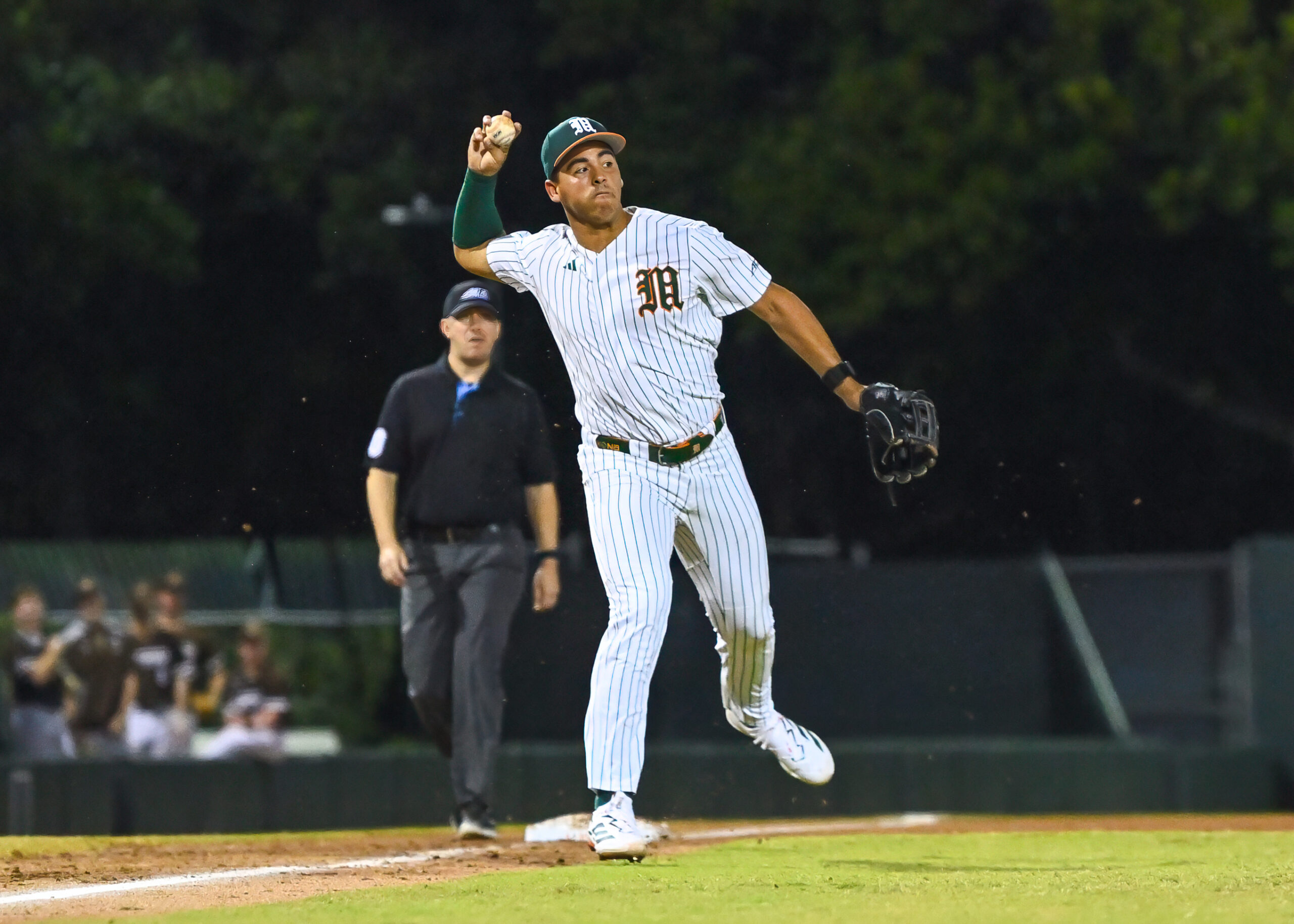
David Lebowitz, Photo Editor/ Junior Third Baseman Daniel Cuvet winds up to throw to first on Friday, February 13, 2026.

Daniel Cuvet would blast a 435 foot shot over the wall in left-center, knotting it up at 6-6. 

As Jai Lucas and the Hurricanes secured their victory at the Watsco Center, the fans flooded to the Light as the game went into its fourth hour, watching from wherever they could get an eye on the game, lining the outfield fences, student sections, and the parking garage beyond the wall in right.

The game would go into a 13th inning where UCF would again regain a one run advantage. 

With the game on the line, freshman backstop Alonzo Alvarez would lead off the frame with a double. After a strikeout from Brendan DeGoti, up stepped USC Upstate transfer Sheahan, who sent the Canes faithful into madness.

His walkoff homer propelled Miami to a 4-0 record, while UCF was handed their first loss of the season. 

The Canes will be back in action Wednesday night as they host the Sycamores of Indiana State.

New book-banning proposal sparks discussion at UM

0

Florida lawmakers have proposed a new bill that would expand the state’s laws on removing books from public schools libraries.

House Bill 1119 (HB 1119) passed its final committee stop on Jan. 27 with a 16-5 vote and is set to be heard on the House floor on Feb. 11, 2026. The bill has sparked discussion among University of Miami librarians about how the legislation could affect students, educators and libraries across Florida. 

The bill aims to restrict reading material deemed harmful to minors, specifically books that contain or depict “nudity, sexual conduct or sexual excitement.” 

Before 2021, challenges to books were largely handled at the local level by individual school districts. However, that changed as debates over race, gender and LGBTQ+ themes intensified statewide. 

“If the book is removed from the school library entirely, it lessens one parent’s ability to help educate their child because someone else thought the book was inappropriate,” said Lauren Fralinger, head of Richter Library’s Learning and Research Services and member of UM’s Banned Book Week committee. 

“This restricts the professional judgement of librarians in terms of what to include in a book collection,” Fralinger said. [It also affects] university students by potentially restricting their access to literature or information when attending K-12 schools and arriving in college less prepared.” 

Florida ranks No. 1 in the country for most books banned at the state level. Although the University of Miami is a private university — giving it broader autonomy of policy — public institutions will be directly affected by this proposed bill. 

As of now, these efforts only are affecting public schools, but the outcome of the bill can have further effects. 

“There have already been attempts made to attack public libraries and even bookstores,” said Terri J. Robar, UM Communication, Media, Geography and Maps Librarian. “If they aren’t stopped, they will eventually get around to harassing university libraries as well.”

The main piece of legislation that explains the reasoning and expansion of HB 1119, is House Bill 1069. In 2023, HB 1069 was made a law, allowing for any person to challenge books in school libraries. 

PEN America, a non-profit organization that advocates free expression for writers and readers, heavily tracks and reports book bans all across the country. 

Sophia Brown, program coordinator at PEN America’s Florida office, said that HB 1119  “[changes] the process by which school districts may review a book once it has been challenged. HB 1119 does this by attempting to do away with the third prong of something called the Miller Test.” 

The Miller test, established by a U.S. Supreme Court ruling, is a three-prong standard used to determine whether material is legally obscene and therefore unprotected by the First Amendment.

For material to be considered obscene, it has to meet three criterias: it is meant to sexually excite people in an inappropriate way, clearly go beyond what people think is socially acceptable and have no serious value in education, art, politics, or science. 

The third rule, lack of value, is judged by what a reasonable person would think, not by what a specific town or community thinks. 

“HB 1119 wants to get rid of that prong,” Brown said. “[That] would mean that once a book has been challenged and a school district is considering whether to retain it or not, they cannot consider the book’s literary value as a reason to keep it. They cannot consider the value of the entire book.” 

This would mean that if a book is challenged, the school district would not be allowed to keep it just because it has important literary, educational or artistic value. They would not be allowed to look at the book as a whole, but only the specific section that was targeted. 

“[Lawmakers] claim that they are trying to fight “the indoctrination of our children,” said Robar. “The truth is that they are the ones trying to indoctrinate the next generation. They are the ones who want to control what children can read and be taught so that they can control what they will think.”

As debates continue over book restrictions, statewide efforts to restrict books may influence how public and private institutions like UM approach curriculum decisions and library collections. The impact will depend on how private institutions balance institutional independence with public pressure.  

UM to boot cars with repeat violations amid frustrations with parking

0

The University of Miami announced the launch of a new vehicle immobilization protocol as of Friday, Feb. 6. 

According to the email sent to students, vehicles with repeat parking violations may be subject to immobilization, or “booting,” for parking without a valid permit accumulating multiple unpaid citations or blocking unauthorized areas. 

“When a vehicle is immobilized, a PayLock SmartBoot is securely attached to the wheel,” the email read. “This system allows vehicle owners to self-release the boot after resolving outstanding violations, without waiting for on-site personnel to arrive.”

To avoid getting booted, every student who parks in a lot on campus should either have a parking permit or pay by phone.

Parking permits are available for purchase in multiple different tiers, ranging from $312 for nights and weekends to $685 for resident students who are not first years.

“It’s just ridiculous to be charged $650 for a parking permit and only be able to park in one area,” a UM student said in an anonymous survey posted on The Hurricane’s Instagram on Feb. 11. 

There are approximately 7,800 parking spaces across all campus garages and surface lots, which includes parking for students, faculty, staff, visitors, ADA access, service vehicles, special-use parking and reserved spots. 

Despite that figure, students say finding an open space can feel impossible. In response to a question asking students to describe parking issues, one law student wrote, “No spots!!!!!!!!! I can never park!!!!!!”

When a student’s preferred zone reaches capacity, students may purchase a permit in an alternate zone and may join waitlists for any zones that are full.

In another response to the survey posted by The Hurricane, a student who identified herself as Cassidy, a junior math and computer science major, claims she has trouble finding parking because, “they oversold red lot because The University is a money grabber.”

UM did not disclose how many parking permits were sold to students for the 2025-2026 academic year. 

“Commuting from dorms to specific buildings for on-campus jobs means I have to park outside of my zone and I get TICKETED even though I have a permit? Ridiculous,” said William Harless, a senior studying international studies and public administration.

According to the University, permit sales follow an annual schedule for students, with release periods going in a prioritized order and beginning with residential students, returning commuter students and then new commuters.

Students can get a parking permit through UM’s online parking portal using their CaneID. After selecting the permit type, registering their vehicle and submitting payment, permits activate immediately through the University’s license‑plate recognition system. 

 “All students who applied for a parking permit have been issued one,” the University said in a statement to The Hurricane. “Permits are sold on a first‑come, first‑served basis, and availability within preferred zones is not guaranteed.” 

For students without a parking permit, The University offers several alternatives. UM offers a free shuttle system, a discounted Metrorail program, Pay-by-Phone parking, the UBike program, Freebee for after hours and Zipcar rentals.

However, Pay-by-Phone parking has caused a headache for some students. 

Red lot parking sign located at the entrance for the lot on University Drive.

For example, in the Red lot by the School of Communication, Pay-by-Phone is not offered during peak class times from 8 a.m. to 4 p.m. This means students with classes in the Communication School who do not have a permit to park in the Red lot must find a spot elsewhere. 

“They sell out of red lot passes so fast and I’m a junior, I’m not about to park across campus. Why can’t there just be a one-size-fits-all type of parking pass?” said an anonymous junior in marketing. 

The issues with parking do not end with availability. Multiple survey responders noted parking space size in their complaints, with one student claiming their car was damaged due to this. 

“There is a lack of spots, and the spots are way too tiny. One time I came back from class to find scratches all over my car from someone door dinging me. Sadly, this is expected with the parking crisis at UM,” Luke Baumstark a sophomore finance and business analytics major.

Tre Donaldson takes over, leads Miami to 67-66 win over Virginia Tech in instant classic

0

In the end, one team had Tre Donaldson, and the other did not.

And that was the difference. 

On a night filled with obstacles for Miami men’s basketball, Donaldson’s late-game takeover and career-high 32 points dragged the Hurricanes through a gauntlet of adversity and into a gritty 67-66 win over Virginia Tech.

Leading scorer Malik Reneau was out for a large portion of the game with a migraine and hardly contributed. Three out of five of Miami’s starters were banged up prior to tip-off. The team shot a meager 44% from the field and were only 25% from beyond the arc. 

But none of that mattered when UM’s point guard was on the court.

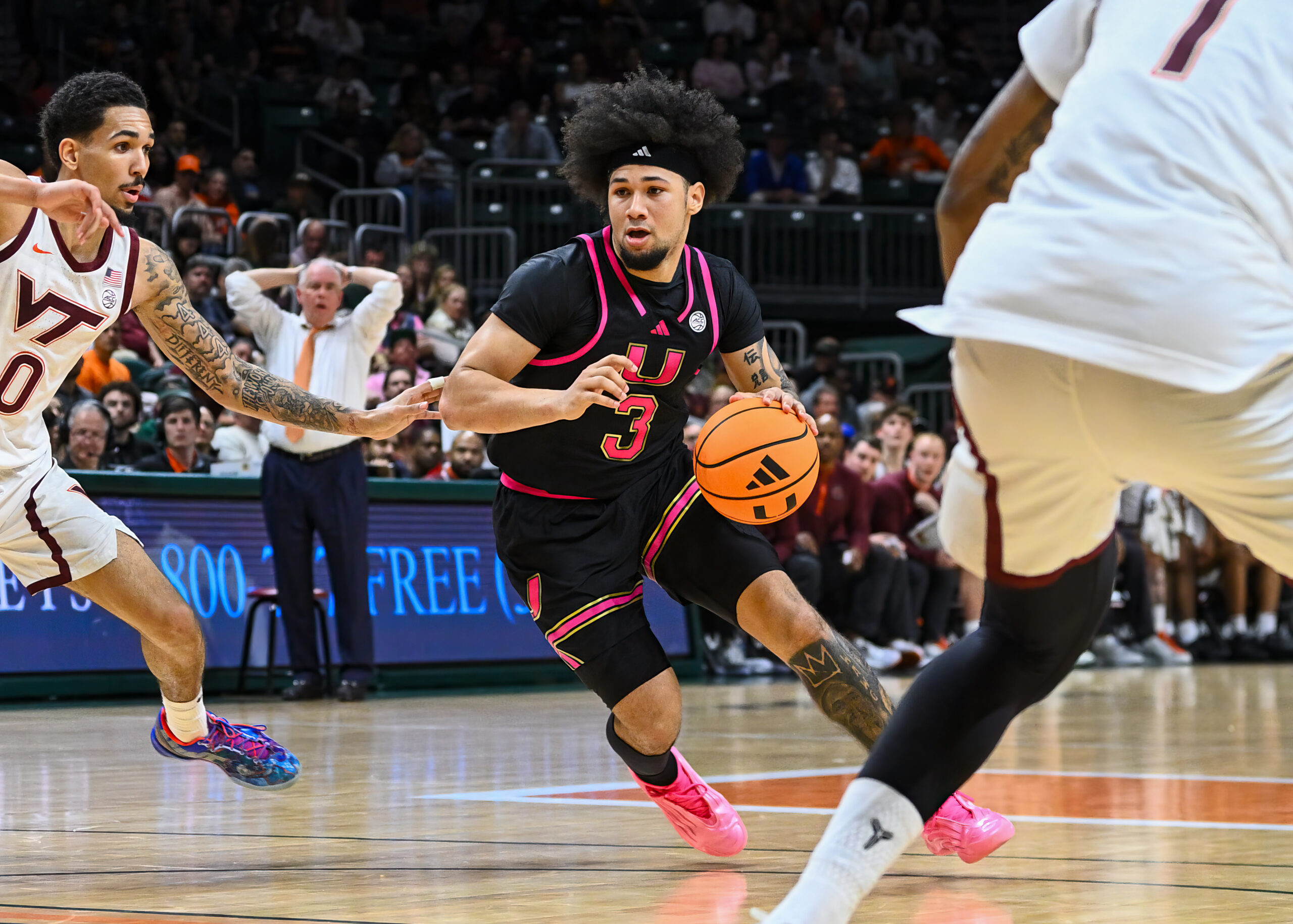
With the squad struggling on offense, the veteran senior guard with NCAA Tournament pedigree stepped up when he was needed most, scoring all of Miami’s final 15 points down the stretch. 

In total, Donaldson finished with 24 of the Canes’ 36 second-half points. No other player scored more than four after halftime. 

David Lebowitz, Photo Editor/ Senior Guard Tre Donaldson drives toward the paint against Virginia Tech on February 17, 2026.

The Hurricanes (21-5, 10-3 ACC) jumped out to a 12-5 lead through dominating in the paint early on, once again creating success on the offensive glass and on the transition after forcing turnovers. 

However, the Hokies (17-10, 6-8 ACC) battled back, launching a 7-0 run to even the score after a few key substitutions made by the Canes led to defensive vulnerabilities near the rim. 

The teams traded blows back-and-forth before Virginia Tech grabbed a 34-31 advantage entering the break behind 46% shooting from deep.

It remained wire-to-wire throughout the last 20 minutes. 

Without Reneau for much of the second half, UM was forced to rely on several of its other key contributors in Ernest Udeh Jr., Dante Allen, and Shelton Henderson, who each logged extended minutes.

Allen closed out with double figures, notching 10 points on the night while Udeh added a game-high nine rebounds. Both provided a significant impact in the extra action they saw. 

But in the final seven and a half minutes, it was all Donaldson.

Trailing 66-63 with 1:18 remaining, the Tallahassee native nailed a pull-up jumper from the top of the key to bring the Canes level.

Excluding the captain, the Canes shot a combined 1-for-9 from three-point range as a team. Donaldson went 3-for-7 alone from the same distance.

Then, in the chaotic minute that followed, both teams missed crucial opportunities to go back in front, highlighted by Tru Washington failing to convert a driving layup on a fast break opportunity.

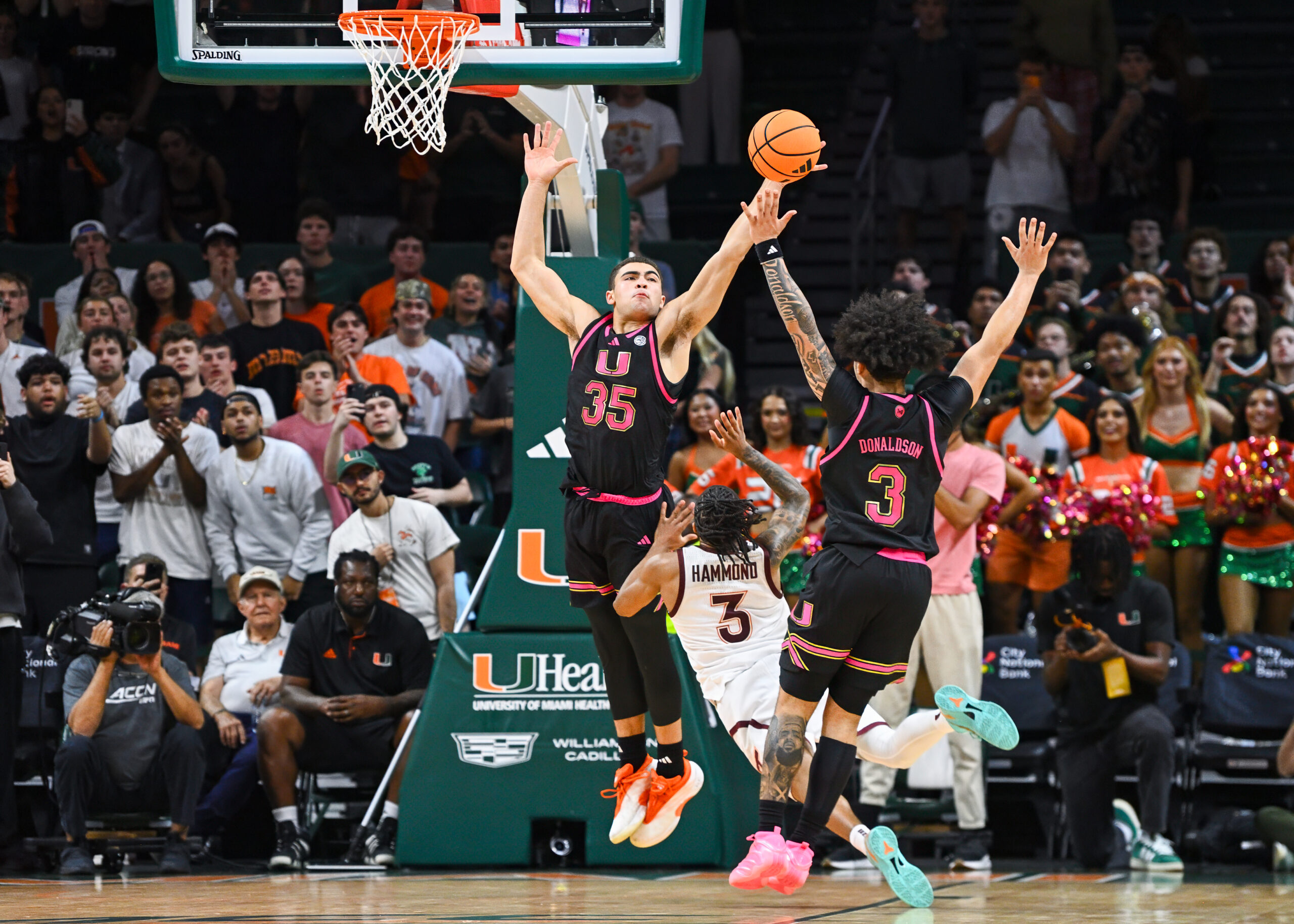
David Lebowitz, Photo Editor/ Freshman Guard Dante Allen goes up for a block on a would-be game winning shot against Virginia Tech on February 17, 2026.


Fortunately for Miami, Donaldson once again took command, rising to the occasion in the most decisive moment of the evening.

The former Big Ten and SEC guard drew a defensive foul with 12 seconds left and then drilled the go-ahead bucket from the free throw line to seal the win for the Hurricanes. 

With the victory, Jai Lucas now has the most wins ever for a Miami men’s basketball first-year head coach.

The ACC Coach of the Year frontrunner was effusive with praise for Donaldson’s experience and composure on the big stage. 

“He willed us to it,” Lucas said after the game. “And that’s what senior guards who have been in big moments, and why you bet on guys’ pedigree, of guys who won state championships, conference championships, and played in big games for moments like this.”

Udeh, on the other hand, was not as surprised with the guard’s career-high performance as others.

“He was unconscious,” Udeh said. “I’m sitting there in the dunker, I’m seeing the shots go in. From my standpoint, it’s not like, ‘Oh wow.’ It’s Tre. I know what he’s capable of.

“I’m blessed to be able to call him my point guard night in and night out,” he said. “He’s always in the gym, first one there, last one out, extra reps all the time. So him making that shot — it’s Tre.”

Miami will aim to extend their four-game win streak on Saturday afternoon in a road clash at No. 14 Virginia (22-3, 10-2 ACC). Tip-off in Charlottesville is set for 2 p.m on ESPN2.

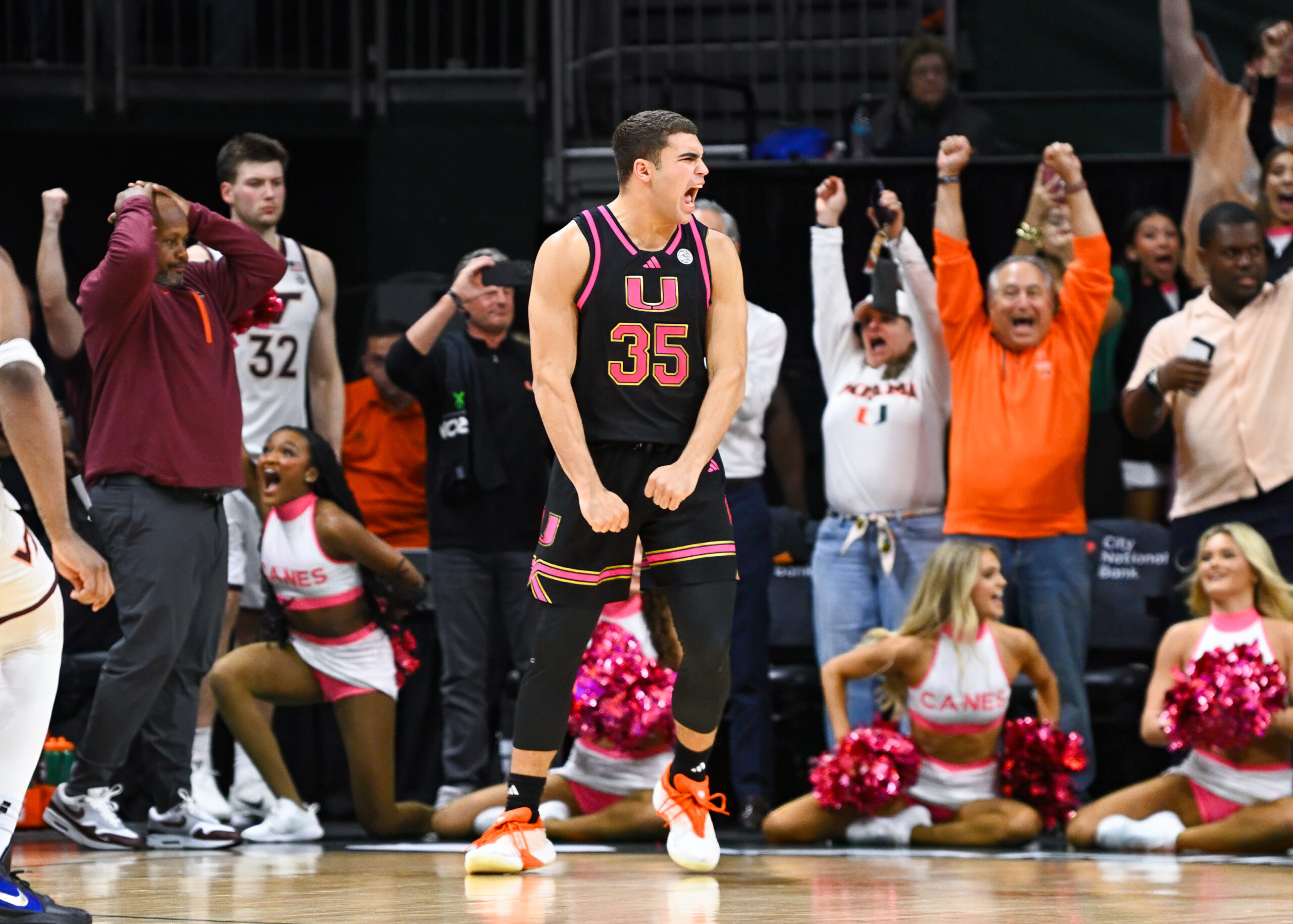
David Lebowitz, Photo Editor/ Freshman Guard Dante Allen celebrates after beating Virginia Tech on February 17, 2026.


Former Hurricanes pitcher John Siegler earns degree after 60-year hiatus

John Siegler lives in a yellow house on the water — the kind you notice from afar and slow down for without realizing it. His car is parked halfway into the garage, the back bumper catching the sun, its custom license plate, JOHN8, is legible if you know to look for it. 

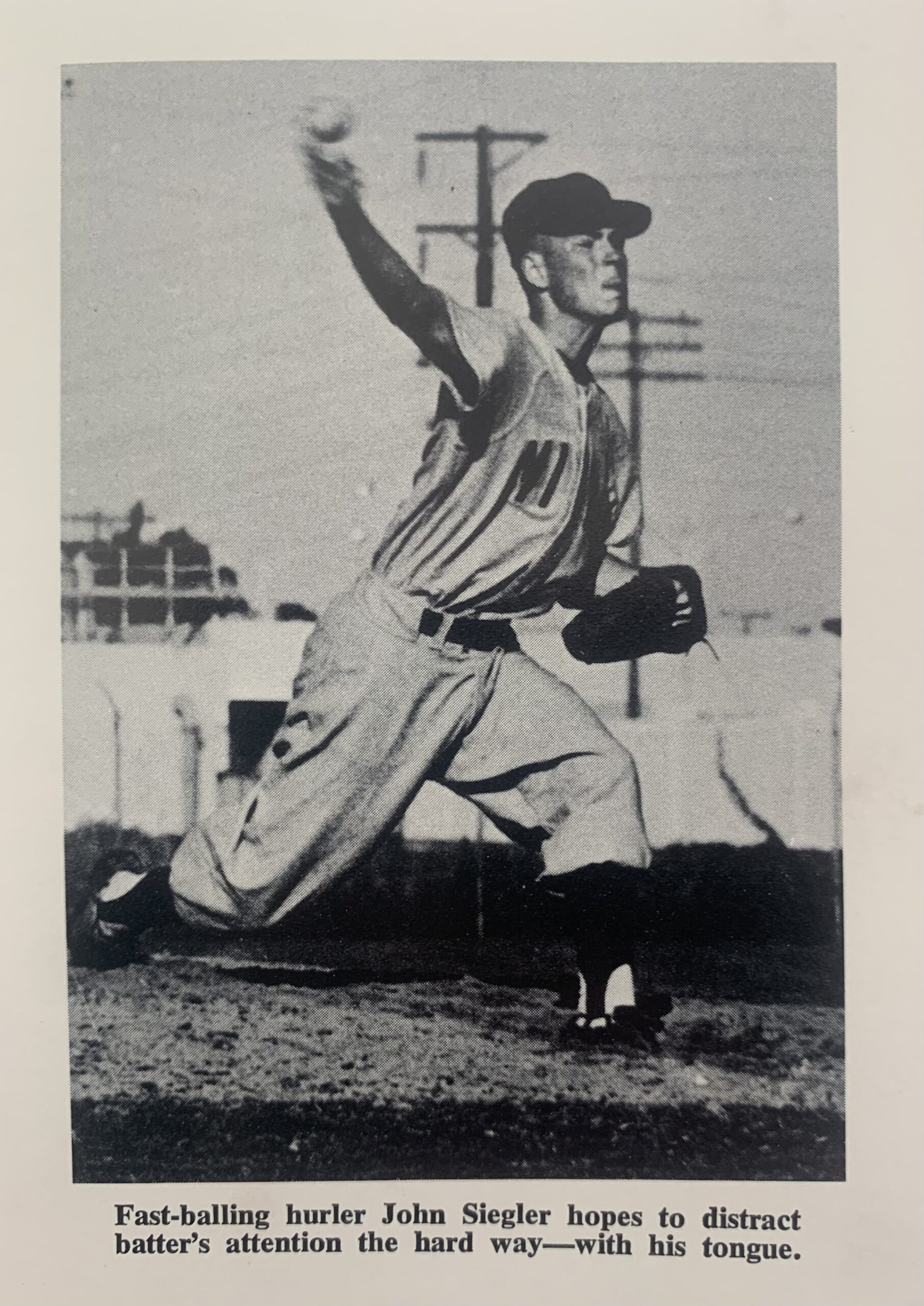
It’s a nod to his days on the mound for the University of Miami baseball team, though he never says it that way. He doesn’t talk about “his days.” He talks about people. About moments.

On his leg, the orange-and-green U is still there, too. The ink has softened with time, the edges no longer sharp, but the meaning hasn’t faded at all.

The last few months have been full of people calling him a living embodiment of the Hurricane spirit. But when you ask Siegler about it, he shakes his head.

“I hadn’t planned to go back and finish my degree,” he said, walking me into his living room and gesturing toward a chair facing a bookshelf and a wall crowded with a lifetime of achievements. “I was sitting there, looking at that shelf, and I thought it would be a good place for my diploma.”

No one except his parents knew that he hadn’t graduated.

“That’s when I turned to my wife, Brenda,” he said. “It was time.”

For most people, graduation is a four-year sprint that ends in a ten-second walk across a stage. For John Siegler, that walk took sixty years.

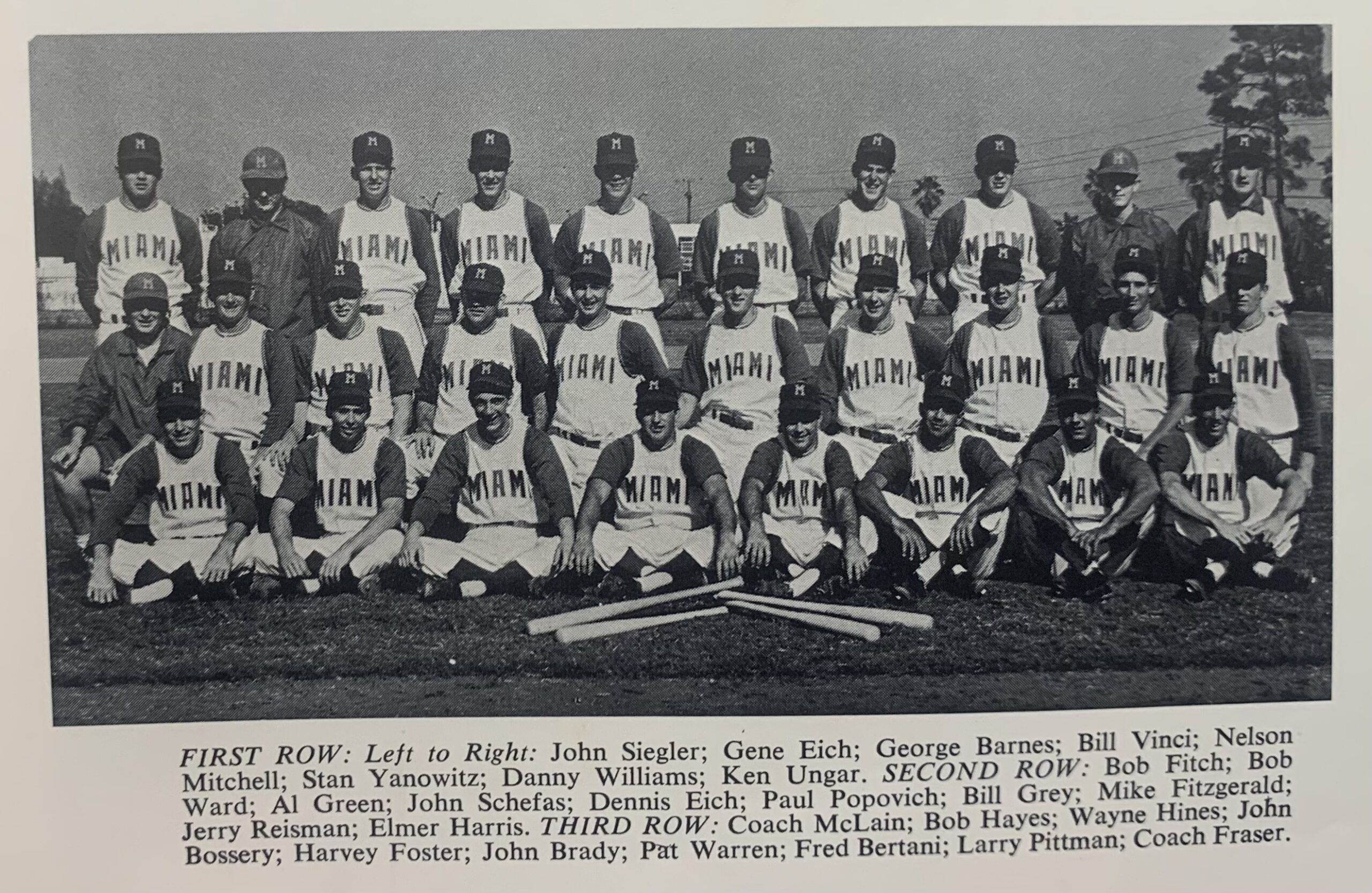
Siegler pitched for Miami from 1961 to 1965, leaving the University just a few credits shy of completing his business degree. Then life arrived — the U.S. Army,  marriage, children, long workdays and the slow accumulation of responsibility that doesn’t wait for unfinished dreams to catch up.

Photo courtesy of UM Athletics // John Siegler, first to the left on the first row, takes team photo with the Miami Hurricanes baseball team in the 1960s.

But at one point, college and baseball were integral pieces in his life.

“I miss it every day,” Siegler said. 

His world was once defined by practices and dugouts, by the easy camaraderie of teammates. He knew he was good — a pitcher who learned how to grind through bad days, to compete when his arm was tired and his legs were heavier than they should’ve been. That feeling followed him like a shadow he didn’t want to shake.

He spoke of the homesickness, too. About coping with it through long stretches of fishing, alone, away from the noise of campus.

“My dad used to take me,” he shrugged. “Maybe that’s why I did it.”

In spite of that homesickness, he built a life. One that, in a quiet way, had been waiting for him to return.

But these days, his competitive spirit has traded box scores for crossword grids. Still racing the clock, still keen to win — even if no one is watching.

These small rituals have kept him tethered to something he wasn’t ready to lose.

Because the potential for his degree never disappeared, it just paused.

This past fall, at 82 years old, Siegler logged onto Zoom for the first time. With encouragement from his family and the support of Miami Herbert’s undergraduate advising team and UM Athletics, he enrolled in two online classes. 

He learned how to mute himself on Zoom. He learned how to share a screen. And, more importantly, he learned that the door he thought had closed decades ago had been waiting for him the whole time.

On Thursday, Dec. 11, 2025, inside the Watsco Center, Siegler finally walked across the stage — forever a Hurricane, but this time, with a diploma in hand, surrounded by a class young enough to be his grandchildren.

Photo courtesy of UM Athletics // John Siegler, an 82-year old former University of Miami Hurricanes baseball pitcher, graduated with the Class of 2025 from UM

But when you talk to him, it isn’t the ceremony he lingers on. It’s the feeling of returning to a place that never stopped belonging to him.

“I’m just grateful,” he said. “But mostly, proud.”

And he should be. John Siegler is not a comeback story. He is a continuation.

His life holds many chapters — pitcher, soldier, husband, businessman, father of four, grandfather of eleven — and now, college graduate. The Miami diploma will sit at the top of them all, not because it defines the rest, but because it completes something tender that couldn’t be rushed.

After 60 years, he finally stepped onto the stage he once thought he’d never reach. Except, he didn’t walk onto that stage like a ceremony. He walked like someone who had been waiting in the bullpen for nearly a lifetime.

Perhaps this is the ninth inning he’s been waiting for his entire life.

And what a shutout it is. 

Miami WBB suffers four-game skid

0

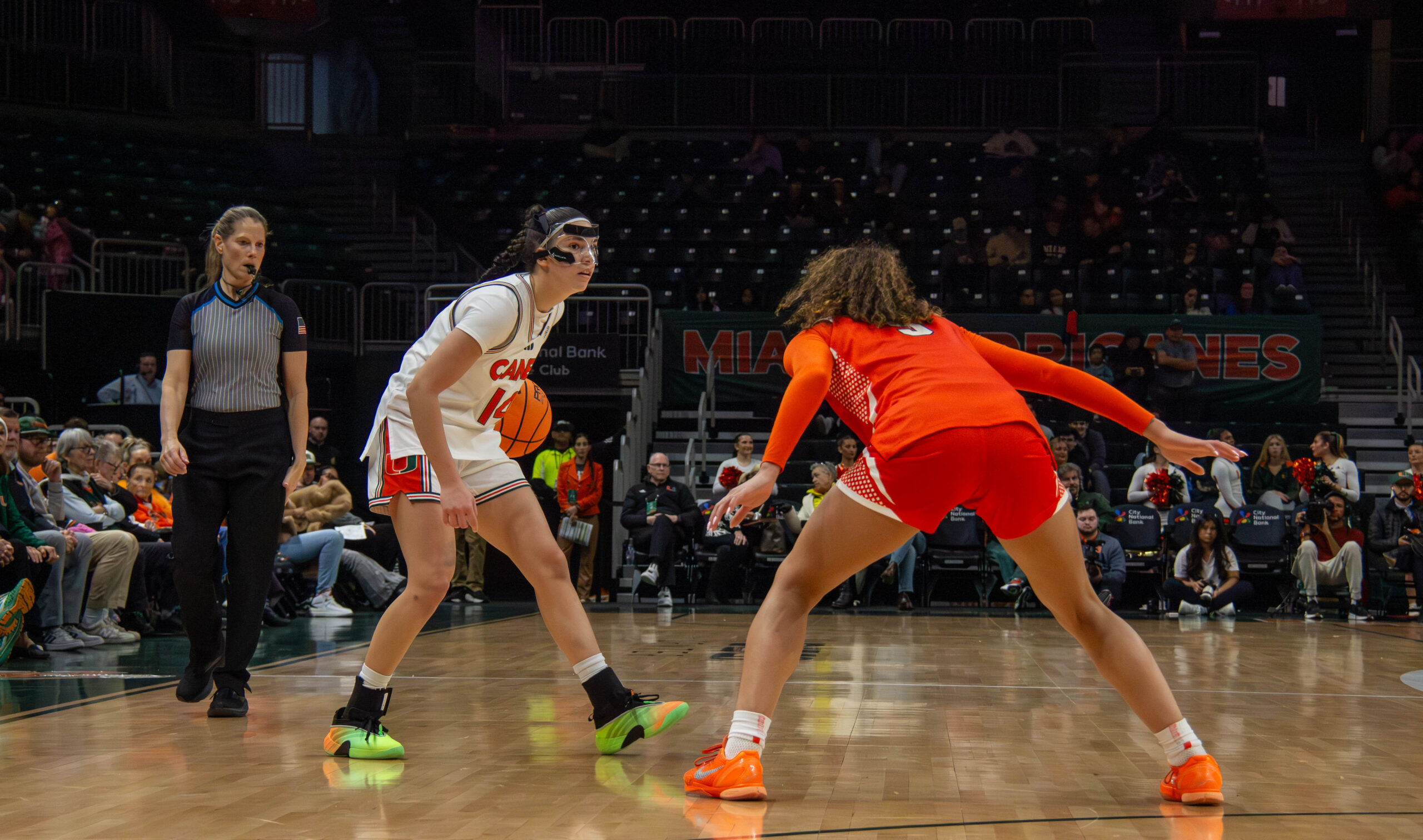
The Miami Hurricanes women’s basketball team is working to find consistency as four back-to-back losses against No. 20 Duke, Syracuse, UVA and Florida State have exposed recurring issues on both ends of the court.

Miami dropped its fifth straight conference game on Feb. 8, falling 87-70 against the Seminoles in Tallahassee, just days after their 67-56 defeat against UVA. With losses to Syracuse and Duke added to the mix, the Hurricanes showed grit and determination in each game, but prolonged scoring droughts and struggles at the free-throw line ultimately led to their downfall.

Miami was scoreless for the first four minutes of the Florida State game, proving to be a common theme in their recent matches. Syracuse also held them to a 9-0 lead in the early minutes of the game, setting the tone for what was to come.

Ra Shaya Kyle has remained the Hurricanes main offensive player, scoring in the double digits for each of the past four losses. Gal Raviv provided consistency in the backcourt for Miami as she scored 16 points against the Blue Devils and delivered seven assists against the Orange. But even with strong individual performances, Miami struggled to sustain momentum over each game. 

Despite strong stretches from several players, including Kyle fueling a 9–0 run on her own against the Orange, the team’s inconsistencies ultimately proved costly. Both the Cavaliers and Syracuse’s defense stifled Miami’s rhythm and forced the Hurricanes into uncomfortable possessions. 

Now sitting at 13–12 overall and 5–9 in ACC play, Miami faces a critical stretch ahead. The Hurricanes will look to prove themselves with a three-game homestand against Stanford, California and Pittsburgh and then regular season out in Atlanta against Georgia Tech on March 1.

The recent losses have highlighted ongoing struggles for Miami, including inconsistent shooting, turnovers at key moments, and difficulties sustaining defensive pressure. Despite the recent setbacks, Miami head coach Tricia Cullop has emphasized patience and growth with a roster still finding its identity.

For Miami, the challenge now is turning flashes of competitiveness into consistency. As conference play intensifies, the Hurricanes will need cleaner execution, stronger starts and more discipline to stop the slide and reestablish themselves in the ACC race.

Photographer Bella Ochoa // Sophomore guard Gal Raviv drives the ball up against Syracuse University on Sunday, Feb. 1, 2026.

UM Greek life revives Greek Week tradition through music, competition and service

Greek Week is set to return to the University of Miami, bringing back one of the most spirited and anticipated traditions. From Feb. 19 to 28, Greek life chapters will come together for a week-long series of events designed to promote teamwork and philanthropy among sororities and fraternities across campus. 

For most students, this will be their first time participating in Greek Week, introducing them to the spirit that defines the tradition. Organizers emphasize that the events are designed not only for members of Greek organizations, but also welcome the entire university community. 

Greek Week is a well-established tradition at UM, but it was temporarily paused in 2020 due to COVID-19. The week itself was one of the year’s most anticipated events, bringing chapters together through friendly competition while reinforcing a shared dedication to philanthropy.

Association of Greek Letter Organizations Chair Parker Osth describes Greek Week as an opportunity “to showcase to the rest of campus the excitement and spirit behind our diverse chapters and the philanthropic and service efforts we can build together.” 

The Greek Week E-Board, which is made up of student leaders across the Greek community, has been organizing and planning events for each day of the week.

This year’s theme draws inspiration from popular American music festivals, with all 33 chapters divided into nine teams to represent events such as EDC, Ultra, Lollapalooza and III Points. 

“With 2026 being the reintroduction of Greek Week, we want to bring the same kind of excitement and energy our student body has for music festivals to our events,” Osth said. 

Throughout the week, teams will compete in a range of on-campus challenges and large-scale events designed to promote engagement with Greek Life in new and exciting ways that extend beyond individual chapters. 

The first event, “Greeks Got Talent,” will take place Tuesday, Feb. 24, at Lakeside Stage and feature performances from selected members of each team.

Greek Field Day will take place at the Foote Green on Wednesday, Feb. 25, blending friendly competition with fundraising and reviving a special campus tradition. Barnyard Bagels will also be sold with proceeds benefiting the Dolphins Cancer Challenge (DCC).

Ultra Music Festival tickets will be awarded as prizes throughout the week, building anticipation for the final on-campus event, “Battle of the DJs,” on Friday, Feb. 27. The event will feature a large-scale competition among DJs within Greek Life, with attendees encouraged to represent their assigned festival in themed attire.

While Greek Week may be known for its high-energy environment and friendly competition, philanthropy remains at the heart of the event. 

Greek Week’s philanthropic initiative supports the DCC, a local Miami-based organization created after a Miami Dolphins team member was diagnosed with cancer. The challenge has since grown into an annual tradition held in his honor. For many students, participating in DCC fundraising efforts is personal, often driven by a desire to honor loved ones and support cancer research.

Greek Week Philanthropy Chair Hallie Sussner, a sophomore and member of Delta Phi Epsilon, shares her experience and personal connection to the cause. 

“I turned my pain into purpose by fundraising,” Sussner said.

Sussner has been working closely with the DCC to increase student involvement across the University of Miami and plans to participate in the 5K herself. The organization encourages UM students to take part in the week’s final and most anticipated event, DCC XVI, on Feb. 28 at Hard Rock Stadium.

To participate, students must raise a minimum of $250 and can choose from a variety of events, including a 5K run, cycling routes and other activities. Students who are unable to participate in the event can still get involved by donating or fundraising through Team Hurricanes.

Greek Week serves as a reminder of the important role Greek life plays in promoting service and unity across campus. The mix of philanthropy and friendly competition allows students to use their voices and platforms to make a positive impact in the community.

“Expect to see campus charged with the energy of Greek Life’s pride and community as we work together to contribute to the great cause behind the DCC,” Osth said.

Working together, Greek chapters will continue to make a meaningful impact both on campus and in the broader community. Greek Week reflects the values at the core of the University of Miami community: collaboration, service and a shared commitment to making a difference. 

Get your next party outfit with Tonight’s Dress

Fashion is part of student’s everyday routines at UM. Students constantly plan outfits for game days, formals and nights out. They quickly adopt a cycle of getting dressed, posing for the cameras and starting to plan their next outfit.

But behind this lifestyle are closets stuffed with old clothes that were only worn once. 

Tonight’s Dress, a fashion app run by two Villanova University students, wants to open those closets to more students. The app turns students’ fashion archives into a collective resource. 

This local, community-driven model is one reason the founders see the University of Miami as the perfect audience. 

“Schools like the University of Miami are ideal because there are so many occasions where students need outfits they may only wear a handful of times,” O’Hara said.

Originally developed in 2022, the app was later acquired by current co-owners Nashla Estefan and Caitlin O’Hara, who stepped in to continue growing the platform after the founder graduated. The two now manage the company as a joint venture that expands across campuses. 

“When we saw over 300 active users, that’s when we realized this wasn’t just another idea — students were actually using it,” Estefan said. 

The platform operates as a peer-to-peer marketplace where students can rent clothing directly from each other. After signing up with a University email, users can browse items within their campus radius, message other students and arrange same-day exchanges.

The concept grew from a pattern familiar to many college students: spending significant amounts on clothing for a single occasion. 

“Students might spend around $80 on an outfit that they will only wear once or twice, and then it just sits in their closet,” O’Hara said. “Being able to reuse those pieces — or make some of that money back — really changes the way students think about their wardrobe and spending habits.”

The app has evolved beyond its original start on night gowns to include daylight outfits, accessories and other statement pieces. Recent updates, including in-app payments, messaging features and expanded filters, have also made the platform more seamless for students. 

Still, what Tonight’s Dress stands out from other rental services is its immediacy and social connection. 

“You can message someone and meet up the same day,” Estefan said. “Now, you have a new outfit and made a new friend on campus.”

“it would not only play into sustainable fashion and overconsumption but could also connect the students within UM that are passionate about fashion and really strengthen that niche community.” said the UM LUX club’s president Helena Lopez, a junior styling business management. 

This method is trending as it eliminates shipping costs and delays, and keeps the interaction experience local. Unlike traditional rental services, Tonight’s Dress doesn’t maintain its own inventory. Its collection is built entirely by students, for students.

“I would 100% use this app and participate as well,” said Yara Bhaloo, an UM advertising sophomore student and member of Pi Phi sorority. 

”I think by just being involved in a sorority and having to go to a lot of events with dresses I’ve definitely accumulated a quite formal wardrobe,” Bhaloo said. “ I would love for it to go to more use.”

The platform has already gained popularity at Penn State, but its growth strategy remains intentionally organic. Each campus develops its own marketplace as students post items and invite friends to join. 

Founders describes this app as a “fashion ecosystem that is shaped by the community itself.” 

From its affordability and efficacy, the founders say the platform reflects a new trend in how Gen Z invests in fashion.

“You can both save money and make money in the long term” both CEO’s said. “And you’re doing it with a community you already know and trust.”

Tonight’s Dress app shows the campus fashion isn’t about spending more but about making your personal style using local resources. 

UM alum Elizabeth Scherer takes her studies to the stand

University of Miami alumna, former circuit court judge and current civil litigator Elizabeth Scherer spent most of her life navigating the justice system — first as a prosecutor, then as a judge. Her resilience, dedication, and inspiring role models have guided her throughout her journey and impressive career in law.

Scherer graduated from the Florida State University with a degree in English with a writing emphasis, reflecting her passion for storytelling and communication. 

At this time in her life, she did not envision herself on the bench. However, after enrolling in the UM Litigation Skills Program, everything changed. The program places students in mock courtrooms that closely resemble real trials, pushing them to perform in fast-paced, high-pressure situations. 

She described feeling “adrenaline rush beyond anything [she] had ever felt” during the mock trials. That moment confirmed her growing passion and led her to never look back. 

One professor who stood out to her in particular was Stan Blake, a practicing judge and her litigation-skills professor at the UM. She always remembers his constant words of encouragement, “You were born to do this.”

“That program teaches students how to actually be lawyers,” Scherer said. “It prepares you for the realities of court.”

Long before her legal career began, Scherer found herself in high-pressure situations through athletics. Throughout her childhood, she played a variety of sports and won multiple state championships in volleyball. 

Her coach, Louise Crocco, the National High School Coach of the Year in 1988, was extremely hardcore, but she is grateful for the resilience and discipline she learned at this stage in her life.

“You can be losing,” Scherer said, “but you need to shake it off and keep going.”

She carries that same mindset into the courtroom. 

“I’m probably best under pressure,” Scherer said. “I would never jeopardize the fairness of a trial by letting emotions take over.”

Before becoming a judge, Scherer spent more than a decade as a prosecutor, primarily in the career criminal unit. She handled cases involving robbery, burglary, carjacking, murder, and attempted murder, frequently working with victims of violent crimes.

“As a prosecutor, I loved being an advocate,” Scherer said.

Her role shifted when she transitioned to the bench. As a judge, Scherer was no longer arguing a side. She had to decide who was right.

“Sometimes, as a lawyer, you have to advocate for your client, and you may not necessarily agree with your client’s position,” Scherer said. “But as a judge, you pick who you think is right.”

This contrast defines much of her professional career. Scherer served as a prosecutor for more than a decade before becoming a judge, strongly advocating for the state and victims of serious crimes. 

And she later became one of the youngest judges appointed to the circuit court, a notable achievement in her remarkable career. 

One case in particular, however, tested her on a national level. Scherer gained national recognition as the presiding judge in the 2022 sentencing trial of the Marjory Stoneman Douglas High School shooter. 

The emotionally charged proceedings placed her at the center of a moment that deeply impacted both the South Florida community and the nation. The weight surrounding the trial became a defining chapter in her career and contributed to her decision to step away from the bench in 2023.

Scherer’s career, spanning prosecution, judicial service, and community advocacy, reveals a broader perspective on the legal profession: justice involves not only enforcing the law but also understanding the lives of those affected. 

In the courtroom, she always carried a strong sense of empathy, a quality that both strengthened her work and, at times, made it more challenging. Some of the most difficult moments of Scherer’s career occurred in dependency court, where she presided over cases involving abused and neglected children.

“I could not serve in dependency longer than two years,” Scherer said, “It just ripped my heart out.” 

These experiences inspired Scherer to pursue advocacy outside the courtroom. 

She served on the Board of Directors of Voices For Children, a nonprofit organization that supports the Guardian ad Litem Program and the Saint Anthony School Foundation for Education, ensuring that students and teachers have the necessary resources. 

After retiring from the bench in 2023, Scherer has reflected on a career marked by high-pressure decision-making, emotionally charged cases, and a lifelong commitment to public service. Stepping away from the courtroom has ultimately welcomed a new perspective in her life.

Now, she works as a complex civil litigator for Conrad & Scherer, her father’s law firm, with her brother Bill Scherer III, who is also a UM law grad, and John Scherer.

For students considering careers in law or public service, Scherer emphasized the importance of consistency and self-reflection for personal growth. 

“The most successful people aren’t always the smartest,” Scherer said. “They’re the ones who put heart into their work.”

She encourages UM students to pursue careers that are both intellectually and socially challenging, emphasizing the importance of learning from mistakes.

“You can accomplish whatever you set your mind to,” Scherer said. “Nothing is too big or too good for you.”