Home Blog Page 41

Crisis in Cuba: How UM students are feeling the impact

Cuba, an island 90 miles off the coast of Miami, is experiencing a worsening economic and energy crisis. Prolonged power outages, fuel shortages and rising food prices, tied in part to policies from Donald Trump’s administration, are affecting families on the island and students in Miami who remain closely linked to relatives there. 

The island has faced economic and energy challenges for decades. After the Cuban Revolution, the island adopted a state-controlled economy and became heavily dependent on support from the Soviet Union. When the Soviet Union collapsed in 1991, Cuba entered a severe economic crisis known as the “Special Period,” marked by widespread shortages of food, fuel and electricity. 

Conditions improved slightly in the 2000s with oil support from Venezuela. But as of mid March, U.S intervention in Venezuela has exacerbated issues for Cuba. With efforts to remove Venezuelan President Nicolas Maduro, a blockade of Venezuelan oil and threats of tariffs on Mexico, the Trump administration effectively shut off oil flow to Cuba — aiming to push the communist-run island toward political and economic reforms. 

With few allies to turn to, Cuba is running out of resources. As the crisis drags on, life in Cuba is slowly coming to a halt as schools are being shut down and businesses having to stop operating. 

“There has been a perfect storm,” said Michael J. Bustamante, director of Cuban Studies and of the Cuban Heritage Collection at UM. “More and more Cuban citizens do not accept the argument that their problems can be laid at the feet of U.S. sanctions alone. Cubans [are] speaking out openly about their desire for not just economic improvement, but political change.”

As possible governmental changes loom over Cuba, students and faculty at the University of Miami, many with family on the island are closely following the unfolding crisis that, for them, is far from distant news. 

“Some of us may see reason for great hope that positive change is finally on the horizon,” said Bustamante. “Others may worry rumors of negotiations between the current U.S. administration and the Cuban government will have unsatisfying results. Either way, the situation impacts all of us personally.” 

For students with relatives still living in Cuba, that sense of hope is tied to the possibility of reconnecting with relatives and seeing an island they have only heard about.

“I have a higher chance of meeting family members that I have never met before, said Lazaro Chavez, a senior at the University of Miami. “My father’s mother still lives on the island and her business has been struggling for decades but the situation has worsened things along with her aligning health.”

The developments mark a potential turning point after years of economic hardship and political uncertainty on the island. For students with family ties to Cuba, even a small sign of change can spark optimism. 

“Now more than ever it feels like there might be a light at the end of the tunnel,” said Jessica Valdes, a senior at UM. 

Those aspirations, however, also raises concerns for relatives and the communities currently on the island having to navigate daily shortages and instability. 

“Based on what we’re hearing from family and friends in Cuba, there’s no power and no running water,” said Valdes. “It’s like being homeless here, except you just have four walls around you — and even those walls are rotting.”

Beyond the impact the unrest has on  individuals, the unfolding events on the island can have broader implications to Florida and the U.S. Changes in Cuba can influence migration patterns, economic opportunity and relations with the Cuban diaspora in South Florida. 

“What happens in Cuba will have significant ripple effects in the United States, and especially in South Florida, whether in terms of renewed migration or potential opportunities for greater economic integration and trade,” said Bustamante. “The Cuban diaspora in South Florida represents a significant resource of capital and Cuba’s future.”

Miami offers a unique perspective on Cuba’s history and ongoing struggles. The city’s large Cuban community means that residents, whether they are of Cuban descent or not, 

feel the impact. 

“Miami almost feels like its own part of the country, said Chavez. “Things that fly here certainly wouldn’t fly in the Midwest or LA or NY, and when everyone around you has experienced or someone they know has experienced oppression at the hands of the regime so it is a very different experience than someone would have if they’re from Kansas for example. It’s a much deeper history.” 

For UM students, the crisis is more than just news, it is personal, intertwined with family, heritage and identity. Despite the uncertainty and challenges on the island, many hold onto hope for a brighter future. 

“We hope and pray for the people of Cuba and for their long awaited freedom and end to their suffering,” said Emma Balleste, a junior at UM.  

“My hope is that one day Cuba will change and I’ll be able to visit the island of my family, my culture, and my identity,” Valdes added. 

As Cuba continues to navigate these uncertain times and affect the daily lives of families on and off the island, many hold onto hope that political or economic changes could bring new opportunities for the country’s future.


AEPi’s 56-hour Rockathon raises more than $43K in the first ten hours

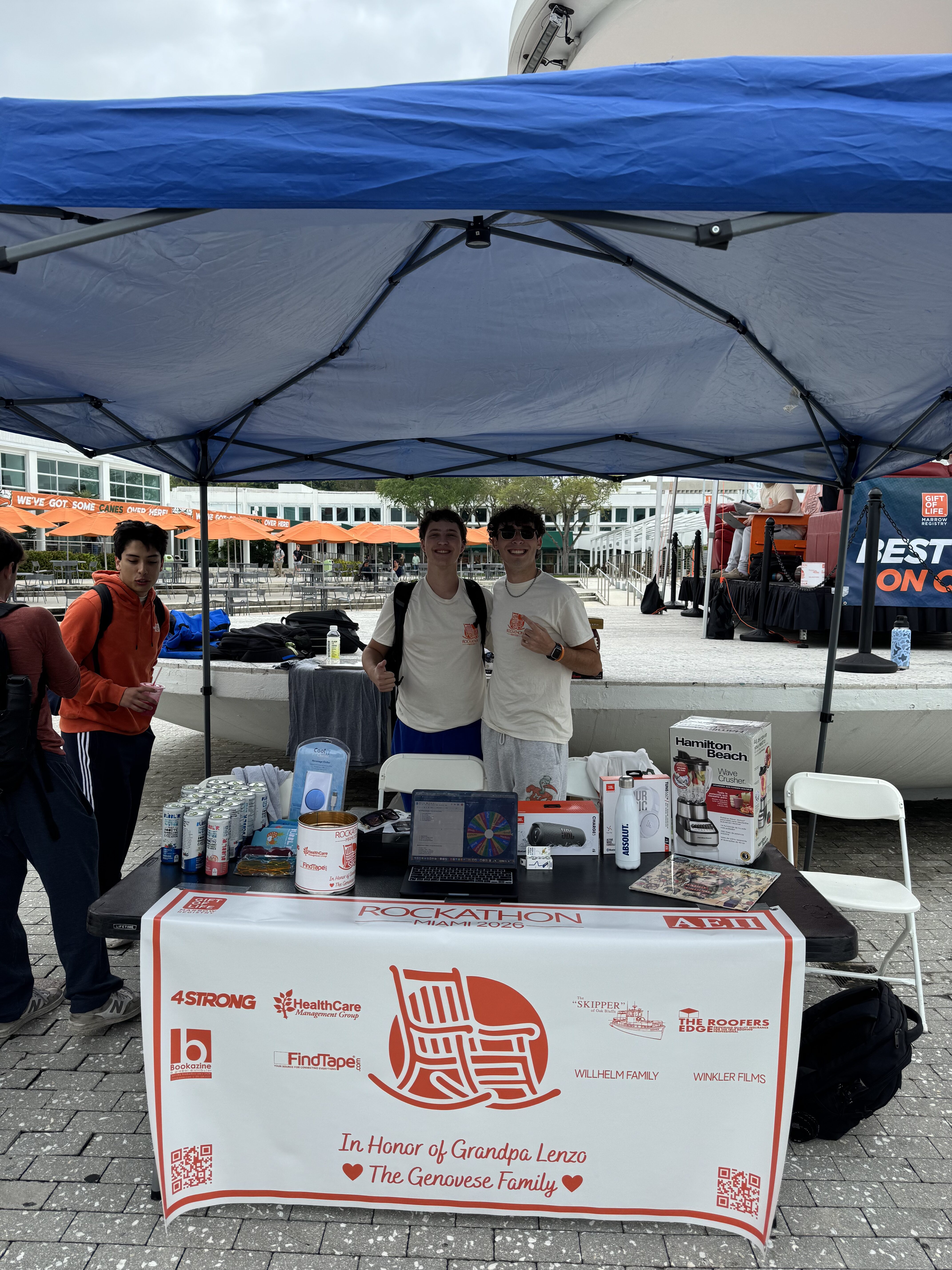
Lorenzo Cavallino sat in a rocking chair at 10:30 a.m. on Lakeside Patio on Wednesday, March 18. He’s not planning on standing up until Friday at 6:30 p.m., by which time he will have rocked in the chair for 56 hours.

Cavallino, a sophomore studying industrial engineering, is a member of the Alpha Epsilon Pi fraternity and this year’s “rocker” for AEPi’s Rockathon fundraiser benefitting the Gift of Life Marrow Registry.

Gift of Life is a non-profit organization that aims to cure blood cancer by facilitating bone marrow and peripheral blood stem cell transplants. Through the organization, someone can have their cheek swabbed and join the registry of donors. Then, they have the possibility of matching with a patient in need.  

Video of Lorenzo Cavallino sitting down for the first time at the Alpha Epsilon Pi Rockathon on Lakeside Patio at 10:30 a.m. on Wednesday, March 18. // Photo via Jimmy Koch.

Jimmy Koch, a senior studying biology and last year’s co-philanthropy chair for AEPi, said that a lot of thought went into which organization they wanted to support, but as soon as he saw that Gift of Life is one of AEPi’s national affiliates, he was “hooked.” 

“The reason I’m passionate about blood cancer is because my mom had it twice now. Once when I was a baby and once when I was in sixth grade,” Koch said. “She required STEM cell transplants both times. Because of those transplants she was able to get healthy again and is still with us today.”

Every $60 raised at the Rockathon funds the processing of one of the swab kits. Last year, the event resulted in about 8,000 processes and three matches. 

“It’s the best notification I’ve ever received on my phone, truly, is that ‘you have a match’ notification,” Koch said.

At the time of publishing, AEPi has raised more than $43K, about 73% of their $60K goal. 

This event is only the second time UM’s chapter of AEPi hosted a Rockathon. Last year, the fraternity had 129 people swab their cheeks to join the registry and raised more than $53,000 over the 55 hours that Christopher Genovese — a senior at the Herbert Business School — spent rocking. 

“I would do it again, but I would like to pass it onto a younger guy. A younger fella,” Genovese told The Hurricane at last year’s Rockathon.

Cavallino, as Genovese’s fraternity little, was the natural choice to rock this year. 

Christopher Genovese (back) and Lorenzo Cavallino (front) on the Lakeside Patio after Cavallino sat down for the first time at 10:30 a.m. on Wednesday, March 18. // Photo via Jimmy Koch.

“I was with [Genovese] probably 30 of the 55 hours last year, so I had a feeling I was going to want to do it,” Cavallino said. “And I’m more than happy.”

The idea for a Rockathon came from the University of Missouri’s AEPi chapter, which had been hosting a Rockathon fundraiser every other year for the last 55 years. 

UM’s chapter worked closely with Missouri AEPi as they coordinated last year’s event and learned “what it means to actually have a Rockathon and have a guy on a chair for three days straight.”

The development community engagement coordinator for Gift of Life, Alexander Gonzalez, has also worked closely with UM’s AEPi since the fraternity first presented the idea. 

Gonzalez got involved with Gift of Life in 2021 when he was matched with a patient in need.

“I was called as a match to somebody who was battling ALM, which is acute myeloid leukemia, and I ended up donating STEM cells and saved his life,” Gonzalez said. “He is five years post-transplant now, which is a really amazing, amazing feat.” 

Gonzalez volunteered with the organization before turning it into his full-time job. When members of AEPi reached out to Gift of Life and suggested a Rockathon, Gonzalez said he thought they were “crazy” at first. 

But, the more he spoke with the fraternity, he could see how organized they were and how clear of a goal they had.

“This chapter specifically at the University of Miami really took it to the next level,” Gonzalez said. “They’re out here getting people to swab and join the registry, but you know, they’re also fundraising to help put those kids into the registry.”

The Rockathon not only benefits the community, but it brings the fraternity together and gives all of the brothers a collective mission. 

Beckham Boymel, a freshman studying business management and a new member of AEPI, highlighted that he was getting to enjoy time with his fraternity brothers all while working to save lives. 

“It was raining, we were still all here having a good time, just supporting Lorenzo, making sure that he knows we’re all here and we’re all part of this together, ” Boymel said. “And then, obviously, trying to raise money for a good cause. Not only that, they’re swabbing people and you have a chance to save a life, so it’s very very important.”

Members of Alpha Epsilon Pi fraternity stand behind the swabbing table at the Rockaton at Lakeside Patio on Wednesday, March 18. // Photo via Jimmy Koch.

AEPi also involved other campus organizations in the Rockathon and created student incentives in hopes of further uniting UM’s community and raising more money for a good cause.

For instance, Patio Jams moved some of the Rockathon’s couches out of the way and played music to attract more students, and members of Koch’s pre-health organization helped swab cheeks. The fraternity is also hosting a field goal raffle at 2:30 p.m. tomorrow, March 19.

The first student to make the kick wins $1,000 and up to five students may receive the opportunity, since each student selected from the raffle only has one chance before the ball is passed to the next person. 

Other members of Greek Life are also incentivized to participate in Rockathon. Each sorority is a team competing to see who can raise the most money, and they are also competing against AEPi itself. The fraternity is divided into six groups — each with a fundraising captain — to see which team could raise the most money. 

So far, the money raised this year has totaled to more than 731 swab kits processed. Click here to make a donation to AEPi’s Rockathon. 

New York style, Miami address: H&H Bagels arrives

When you grow up in New Jersey, you don’t take bagels lightly. Bagels aren’t just breakfast — they’re a standard. A point of pride. You grow up with strong opinions about things like crust texture, chewiness, and whether a bagel actually deserves to be called “New York style.” 

So when I heard that H&H Bagels, a New York staple founded in 1972, was opening in Miami, I was skeptical but hopeful.

Located in Pinecrest’s Suniland Shopping Center, the bagel shop is only a 16 minute drive from campus, making it an easy weekend breakfast run. The brand has been featured in shows like Sex and the City and Seinfeld. 

For decades it’s represented what a real New York bagel should taste like: crispy on the outside and soft on the inside. In a city where good bagels can be surprisingly hard to find, expectations were high.

I kept my order simple: one sweet, one savory. A blueberry bagel with cream cheese, and a spicy sausage, egg, and cheese on an everything bagel. It felt like the easiest way to judge whether the basics were done right.

A spicy sausage, egg and cheese bagel from H&H Bagels in Miami on Feb. 22, 2026. Photo Credit // Arianna Philip.

The sausage sandwich stood out immediately.  When I opened the wrapper, the cheese pull alone already looked promising. But what made it work was how balanced everything felt. 

The sausage had a little spice, the jalapeños added extra heat, and the sauce tied everything together without overpowering the bagel itself. The everything bagel held its texture the whole time, slightly crisp outside, soft inside, which is exactly what you want.

The blueberry bagel was more straightforward, but that’s part of what made it so good. A good bagel shouldn’t need excessive toppings to carry it. This one had a mild sweetness, and paired with cream cheese, it was simple and well done. 

It wasn’t overly sugary or cake-like, which is often where flavored bagels go wrong. Instead, it still tasted like a bagel first.

What stands out most about H&H’s arrival is that it doesn’t try too hard. Miami’s food scene can lean heavily into trends, but this spot sticks to the basics that built its reputation in the first place: consistency, texture, and quality food. 

The shop itself also keeps things simple, with a classic deli-style feel that focuses more on the food than on aesthetics.

For students from the Northeast, or anyone who takes breakfast seriously,  the opening feels like a small but meaningful addition to Miami’s breakfast scene. It may not fully replace the corner bagel shops back home, but H&H has proven itself to be a strong contender. 

‘Kiss all the Time, Disco Occasionally’ and cry sometimes too

Harry Styles returned to music on March 6, with his fourth solo-studio album. His first record release in four years, “Kiss all the Time, Disco Occasionally” is a 12-track album with a 42 minute runtime. 

My place as a Harry Styles fan differs on a song-to-song basis. I don’t automatically love or hate any of his songs. Songs like “Keep Driving,” “Two Ghosts” and “Adore You” have been on repeat for years, but some songs I never listen to again.

This personal trend continued with this album. Although it’s sonically cohesive, only a few truly scratch the same itch in my brain that those previous favorites do. 

I understand his artistry from an outside perspective, but when I listen to his music, I don’t entirely get it. You either do or you don’t. 

The slow songs in this album feel like truth slipping underneath his mask of hyper beats, bass and catchy melodies. Behind the electro-pop elements is vulnerability, fear of being alone and inevitable heartbreak that poisons a relationship’s stability. 

In January, Styles commenced his new era with teasers reading, “We belong together.” These words found themselves in the lyrics of lead single, “Aperture,” released shortly after. 

The intro vibrates like an echo from a loud room next door, preceding a rhythmic, repetitive hook and catchy chorus, all suitable sounds for the entire album’s club-soundtrack-esque. 

 “Aperture lets the light in” encapsulates the album’s theme – shedding a little light on the darkness of life. Togetherness, discos and music are the rays that come together to cast his light. 

Track two, “American Girls” threw me for a loop, leaving me questioning if I accidentally pressed play on a One Direction song. At that moment, I knew this album wasn’t going to have just one sound. 

This song plays with listeners’ nostalgia by resurrecting the chanty vocals of boyband Harry and intertwining them with the production of his solo work and a dance break to remind fans of the occasional disco that the title promised. 

“Ready, Steady, Go!” feels like the “Music for a Sushi Restaurant” of this album, with a kick drum, acoustic guitar and grainy vocals in addition to a groovy keyboard. It’s very funky and very Harry Styles. 

He returns to his first album’s roots with the next song, “Are You Listening Yet?” If you like Olivia Rodrigo’s music, you’ll like this one, as it follows the format of her pop-punk songs, with conversational verses that often carry the song.

Track five, “Taste Back” was an instant favorite for me, the first song of the album I immediately added to my playlist. Styles repeats “you just need a little love” with adlibs to perfectly complete the melody. It draws similarities to The Neighborhood’s “Softcore.”

“The Waiting Game” follows right after, another first-listen love. This song is the first of the album to feel reliant on the lyrics instead of the production. By amplifying the lyrical message, it’s a window into his thoughts that makes you want to listen to the rest of the songs again to hear what you missed in the melodies. 

Another introspective song follows with “Season 2 Weight Loss.” As a superstar, Styles’ perspective on life and love varies from the average person. While many of his songs ask a question to an estranged love interest, this song asks the question, “do you love me now?” to the listener.

He wonders if after four years out of the spotlight, will his return be everything and more or will he disappoint? This captivatingly breaks the fourth wall in his artistry and shifts fans from listeners to respondents. 

Although the past few songs adapted a more contemplative tone, the music firmly remained upbeat. That is until “Coming Up Roses.” An orchestral intro unexpectedly shifted the album, leading to a string instrument quietly plucking in the shadows and vulnerable lyrics portraying the end of a relationship. 

It feels like a haunting foreshadowing of knowing the end is near. Despite the lyrics that assure him all is well, it feels like something is about to go wrong like the score in a movie right before the big betrayal scene. 

It offers the relationship one last dance to the tune of the orchestra’s interlude.The heaviest song on the album transitions into an immediate pick up of pace with “Pop.” 

It’s a revival to the ear, with a noticeable bass and electric guitar. Unfortunately, I can’t get past the fact that it reminds me of Ylvis’ 2010s hit, “The Fox (What Does the Fox Say?)”

Thematically, “Dance No More” makes perfect sense within this album and sits well in Styles’s discography. I like it, but what comes after is one of my favorites.

“Paint By Numbers” delivers everything a fan of his first album craves – a soft drum, blues-feel and a pace you could close your eyes to, but it asks the questions that only an older, wiser Styles would ponder. Personally, I think this could have been the album’s closing track. 

Ending with the lyric, “It’s a lifetime of learnin’ to paint by numbers/ Watchin’ the colours run,” would have been just the right amount of closure and ambiguity to leave listeners in Styles’ most-current state of mind. 

However, “Carla’s Song,” a dedication to his friend, holds the spot as the album’s closer. Thematically, this one makes sense, as it takes you through the tales of “Kiss All the Time, Disco Occasionally” in with allusions to light, the concept of waiting and music as a language.

Catchy melodies, repetitive hooks and funky instrumentals carry this album. It’s cohesive, and it fits in, almost a little too well, with his other previous works, particularly “Harry’s House.” 

He’s always been experimental, but it feels like he got comfortable in the realm of experimentation that he has already explored. There isn’t a lot of newness brought to his artistry, other than the very unique “Coming Up Roses” that deserves its recognition (its flowers if you will). 

In relation to its title, the album feels mostly disco, heartbreak occasionally. Groovy reverbs and infectious beats are the default sound while emotional ballads wait to strike at any given moment. 

Although the entire album isn’t for everyone, if you like any of his music, at least a few of these songs will be playlist-worthy, if not on repeat.

My Rating: 4/5

The 10 sets that will define Ultra 2026

At Ultra Music Festival, the hardest part isn’t getting a ticket — it’s choosing which moment you’re willing to miss. In a weekend built on spectacle, history and sonic chaos, Ultra 2026 might be one of the most overwhelming editions yet. 

From legendary back-to-backs to viral breakout stars and underground icons, this year’s lineup isn’t just deep — it’s defining.

Alesso B2B Martin Garrix

Two EDM heavyweights sharing the Ultra Main Stage is already historic — but this particular pairing carries generational significance. Both artists have individually delivered iconic Ultra sets, and while they’ve shared stages before, this marks their first official Ultra back-to-back. 

With years of melodic festival anthems between them and recent collaborative momentum, this set has the potential to become one of the defining moments in Ultra history.

Sebastian Ingrosso B2B Steve Angello

Representing two-thirds of Swedish House Mafia, Ingrosso and Angello bring a chemistry that has shaped modern festival culture. Their shared history guarantees emotional builds, euphoric drops, and a sense of nostalgia for longtime fans. 

In a festival defined by spectacle, this set feels more like a reunion of eras.

¥ØU$UK€ ¥UK1MAT$U

From viral Boiler Room legend to global festival debutant, ¥ØU$UK€ ¥UK1MAT$U represents the internet-driven evolution of DJ culture. His genre-fluid sets blur the lines between chaos and precision, seamlessly weaving unexpected tracks with heavy basslines. 

Combined with his inspiring personal story, his Ultra debut feels like a cultural moment, not just another booking.

John Summit

Few artists define the current EDM landscape more than John Summit. Arriving at Ultra amid an album rollout and fresh off a Hi Ibiza residency announcement, his closing set feels poised to be a career-peak moment. 

Known for testing unreleased music live, Summit’s performance could preview the next phase of his sound while delivering the high-energy chaos that has made him a festival mainstay.

BZRP

Argentine producer BZRP’s Ultra debut signals a broader cultural shift. Known for his globally successful “sessions” with artists like Shakira, Nicky Nicole and Eladio Carrión, he bridges Latin music and electronic performance in a way few DJs have achieved on Ultra’s scale. 

With Miami’s international and Latin audiences, his set feels long overdue — and primed to be explosive.

WANKDAT (Crankdat B2B Wooli)

Bass music finds its most chaotic expression in this debut superduo. Both artists bring relentless energy individually, but their playful rivalry and online chemistry suggest a performance that will feel as entertaining as it is intense. 

Expect heavy drops, mosh-pit momentum and one of the most physically demanding sets of the weekend.

ISOxo

A rising force in trap-leaning bass music, ISOxo has cultivated a reputation for sets that feel more like controlled riots than traditional performances. His shows attract some of the most energetic crowds in the scene, where aggressive dancing coexists with a strong sense of community. For fans seeking catharsis through sound, this set promises to deliver.

Amelie Lens B2B Sara Landry

Two of hard techno’s most influential figures sharing a stage represents a landmark moment for the genre’s global rise. Both artists have shaped the modern techno aesthetic, and their collaboration reflects the increasing prominence of female leadership in a historically male-dominated scene. 

Their closing set at the RESISTANCE MegaStructure could be one of the most intense sonic experiences Ultra has ever hosted.

The Martinez Brothers

Underground icons with decades of credibility, The Martinez Brothers return to Ultra after years of shaping house and techno culture worldwide. Their ability to blend genres while maintaining deep roots in underground club music makes them a vital presence on the lineup. 

For many, their set represents the festival’s connection to its more authentic origins.

Alan Walker

Sometimes festival moments are about personal nostalgia as much as spectacle. For a generation raised on tracks like “Faded” and “Alone,” seeing Alan Walker live at Ultra feels like a full-circle experience. 

His organic rise from viral producer to global headliner mirrors the digital pathways that now define modern music discovery.

Ultra 2026’s strength lies not just in its headliners, but in the diversity of experiences it offers. From euphoric main-stage collaborations to underground techno marathons and bass-driven chaos, this year’s lineup reflects a festival that continues to evolve with the culture it helped build. 

Choosing where to be at any given moment may be difficult but that’s exactly what makes Ultra unforgettable.

Maggie Gyllenhaal’s ‘The Bride!’ is a feminist take on Frankenstein that falls short of the mark

Mary Shelley’s seminal work “Frankenstein: Or, the Modern Prometheus” is often hailed as the first science-fiction novel, and since its publication over 200 years ago, it has inspired countless adaptations.

Maggie Gyllenhaal’s “The Bride!” is the latest. Starring Jessie Buckley and Christian Bale, “The Bride!” attempts to tell the Bride’s story with a feminist edge, but it doesn’t quite pull together.

The movie opens with Mary Shelley, played by Jessie Buckley, telling the audience that her life was cut short before she could finish the story of Frankenstein. To continue her story, Mary possesses the character Ida — a young woman living in 1930s Chicago tangled up with mob boss Lupino (Zlatko Burić).

Mary and Ida initially struggle for control of Ida’s body. When Mary’s in control, she rants in rhymes about the mob’s crimes. When under Ida’s control, she’s begging to understand what is happening to her. 

Ida’s strange behavior as she and Mary struggle for control of her body makes the mobsters around her antsy. Fearing Ida will get them in trouble, two mobsters separate her from the group and kill her and dispose of her body.

Meanwhile, Christian Bale’s character Frankenstein— Frank for short— finds the mad scientist Dr. Euphronius (Annette Bening) and begs her to create for him a mate to end his loneliness.

Dr. Euphronius agrees, and the two dig up Ida’s body. The dreamlike, swirling visuals of her “reinvigoration” are similar to those of her death, emphasizing the transformation the Bride goes through.

When she revives, she remembers nothing of her life before. She doesn’t even remember her own name. All she knows is what Frank tells her: she was his bride, and her memory loss is due to a mysterious “accident.”

Frank takes her around the town. They see the Ronnie Reed (Jake Gyllenhaal) movies that Frank is obsessed with; Reed’s characters live the life Frank longs for. 

After killing men who attempt to assault the Bride at a club, she and Frank become fugitives. They are pursued by Detective Jake Wiles (Peter Saarsgard) and his ambitious secretary Myrna Malloy (Penélope Cruz).

In the film’s last act, the monstrous couple has a series of close calls with the authorities until Detective Wiles finally catches up with them, and all hell breaks loose.

Frank reveals his deception to the Bride, and while initially angry she remains sympathetic to the selfish loneliness that led to her painful existence. “I am a monster,” is his apology. “Yeah, so am I,” responds the Bride. Buckley’s delivery of the simple line is a heartbreaking admission to the Bride’s resignation.

Simultaneously, Detective Wiles reveals to Malloy that while Ida was alive, he coerced her to sleep with him in exchange for reopening the Lupino case that the corrupt police department closed. He tearfully tells Malloy that he has resigned on the condition that she is promoted to detective.

Though both are clearly angry at their partners, the Bride’s and Malloy’s quick forgiveness of the men subjugating them is confusing at best from a film that positions itself as presenting “radical social change.”

Both women do eventually become independent— Malloy as detective, the Bride finally giving herself a name and rejecting Frank’s marriage proposal— but they find it through the patriarchal system. Malloy only gets her position because a man gave it to her, and the Bride only exists because Frank insisted on her creation.

Regardless, the women are still powerful characters in their own right, and their intellects shine. Malloy does all the heavy lifting in the investigation, and the Bride’s dialogue is peppered with references to great authors such as Milton and Melville.

Another highlight of the film is a dazzling dance sequence at a high-profile party set to composer Hildur Guðnadóttir’s big band arrangement of “Puttin’ on the Ritz” in a clever reference to Mel Brooks’ “Young Frankenstein” (1974).

It is not the only reference to the icons of Frankenstein media in the film; Jessie Buckley’s dual role as Mary and the Bride is an homage to James Whale’s “Bride of Frankenstein” (1935) in which Elsa Lanchester played both characters. 

In Whale’s film, Mary also says she has more of the story of Frankenstein to tell. The difference between Whales’s version and Gyllenhaal’s is that “Bride of Frankenstein” focuses on Frankenstein and his monster, while “The Bride!” keeps the titular character center stage.

Feminist imagery is front and center in “The Bride!” The camera lingers on young women’s wistful expressions as they watch the monsters run away after punishing abusive men. Details like these can make the audience think something will change — perhaps the heroines will free themselves from their oppressors.

The plot deceives and disappoints. Violence towards men is evident throughout the film: the copy-cat murders of women inspired by the Bride, the Bride herself killing a police officer and finally biting a man’s tongue out of his mouth. 

However, the itch of the two male characters with the largest roles getting retribution for their wrongs against their female counterparts is never scratched.

Gyllenhaal’s film is visually rich, the dialogue is sharp and the performances are stellar. Buckley’s dual role as Mary Shelley and the Bride is masterful, a balancing act between Shelley’s quick-wit and Ida/the Bride’s fear and disorientation. Goðnadóttir’s score is spellbinding— even Jake Gyllenhaal’s 1930s singing and dancing impresses.

“The dead have got something to say,” says the Bride. Dead women have something to say to the men who killed and abused them. Unfortunately, the voices of the women get watered down by the monstrous yet hopeful love story at the same time.While undeniably entertaining and creepy, “The Bride!” is something of a Frankenstein’s monster itself— promising though disjointed pieces which create a sort of misshapen and disappointing whole for those looking for a movie with something to say.

The 2026 Montreux Jazz Festival Miami brings iconic artists to the 305

Another year, another amazing run for the Montreux Jazz music festival. Celebrating its third year in Miami from Feb. 25 to March 1, the festival’s beautiful blend of culture and arts blew everyone, including myself, away once again.  

At the show on Feb. 28 at The Hangar in Regatta Harbor, you could see the frantic bustle of traffic as everyone was trying to make their way in at a timely manner. Just beyond the entrance, the patio was lined up on either side as local vendors were selling their specialties from smash burgers to raw seafood. 

There was a beautiful view of the harbor that captured the essence of a beautiful night in Miami. Memories were being made in real time as everyone was chatting the night away waiting for the next artist to perform. 

The creators of the festival chose a smaller venue for the big artists to perform in so that the experience feels that much more intimate.  The excitement was palpable. 

At 8:45p.m., TOTO took the stage by storm. All around me all kinds of people couldn’t help but have wide smiles on their faces as the band played their songs. They played their classic hits such as “Hold The Line” and of course, “Africa”.  

You can tell they love what they do because the amount of heart and soul put into this performance was reflected in each note that was sung and played. Each member of the band contributed an immense amount of talent. 

“Africa” was the final song of their set and everyone went wild. There was a sea of smiles and dancing throughout the crowd. Next to me were two older women who appeared to be friends for a long time, singing their hearts out to a song that seemed familiar to them. It was a heart warming sight to see such wonderful experiences being created through this festival. 

Nile Rodgers & Chic. performing at the 2026 Montreux Jazz Festival Miami at The Hangar in Regatta Harbor on Feb. 28, 2026. Valerie Chaparro // Contributed Photo.

The next artist I had the pleasure of seeing was Nile Rodgers & Chic. opening with the song “Le Freak”, the atmosphere turned into a disco frenzy.  During this performance, Nile Rodgers talked briefly about his time not only being an artist but also a producer for big artists such as Madonna and Beyonce amongst many more. 

As a way to include everyone in the fun, he performed some of their songs he produced such as “Material Girl” and “Like A Virgin” by Madonna as well as “Cuff It” by Beyonce, which also won him a Grammy. 

The female vocalists accompanying the band were outrageously talented. This performance had something for everyone and was very dear to Nile Rodger’s heart as he also paid tribute to a long time friend and collaborator of his who passed with the song “I’ll Be There”.

As the night wound down, it was quite evident that the Montreux Jazz Music Festival put on yet another year of undeniable talent, soul and culture which encompasses the beauty of Miami.

Student Senate elects new Speaker, Trinity Vodovoz

Following passionate speeches from two nominees, the University of Miami’s Student Senate elected Trinity Vodovoz as Speaker for the 2026-2027 academic year during its weekly general body meeting on March 18 in the Storm Surge Room next to the food court.

Vodovoz and Grady Knox ran for Speaker, each delivering a speech and answering questions from the Senate.

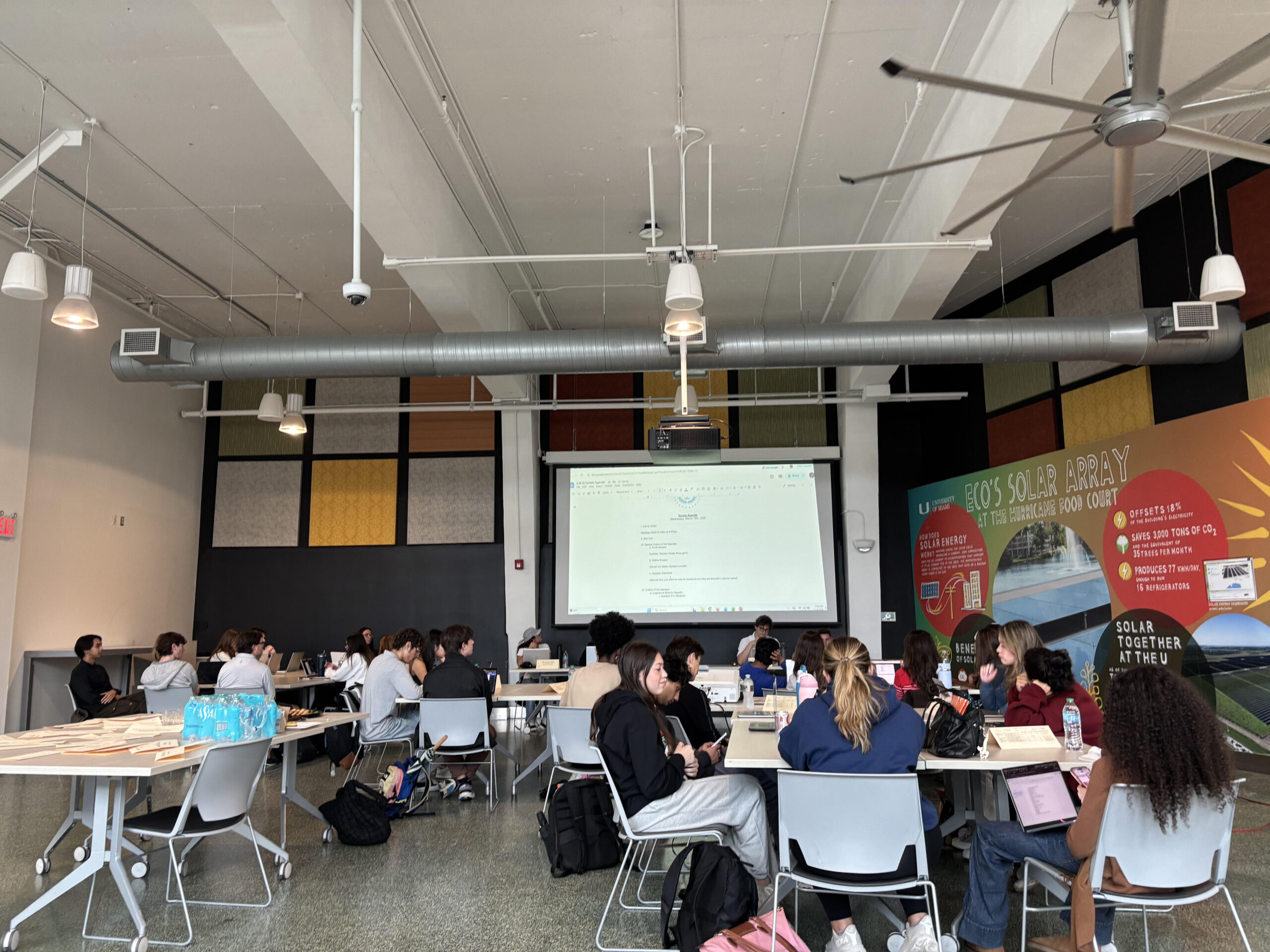
The Student Senate meets in the Storm Surge Room on March 18, 2026. // Photo credit: Emil Salgado Vazquez.

Knox, representing Lakeside Village and chairing University Affairs, emphasized the Senate’s impact on campus and noted her experience organizing several campus initiatives. Vodovoz, the current Junior Class Senator and Speaker Pro Tempore — the second-in-command of the Senate — was the highest-ranking member of the Senate running for Speaker. 

She highlighted her long tenure in the Senate in different positions. 

“I’ve been in the Senate for three years now,” Vodovoz said. “I’ve really enjoyed serving the school and hope to serve you as Speaker.”

She also recognized the lack of connection between the Senate and the Executive Branch.

Vodovoz proposed a Student Government-wide retreat to build bridges between the Senate and Executive branches for more efficient, thorough legislation.

She suggested inviting guest speakers from local government and business organizations and organizing more informal SG events.

Knox discussed helping others improve legislation through editing and clarified his proposed Senate initiatives.

“I think the process for pushing legislation through is limiting,” Knox said. “If I were to win, my focus would be to improve this process and the way we implement legislation on campus.”

In addition to his earlier points, Knox spoke about the need for Senators to interact more with the Executive Branch, suggesting scheduling informal time before committee meetings or around GBMs to build relationships and improve legislation and processes.

There was support for both nominees; Vodovoz’s experience and Knox’s strong leadership of the UA Committee were the main points raised during the discussion portion of the election process.

Ultimately, Vodovoz won the election and her term as Speaker will begin in the Fall 2026 semester.

The Miami Hurricane requested the vote count, but was told it could not be disclosed

“I’m excited to see what the Senate holds for the future,” Vodovoz said after the meeting. “It feels so rewarding to win the election because I’ve been in the Senate since my freshman year, and this will be a great way to celebrate my senior year.”

Stop rebooting my childhood

0

Before the trailer even drops, most of us already know the whole plot and premise.

Another beloved animated classic reimagined in live action. Another superhero resurrected for a “new adventure.” Another sequel to a franchise that supposedly ended years ago.

Contrary to popular opinion, Hollywood is not suffering from a lack of ideas. It is suffering from a fear of risk. 

Hollywood’s growing dependence on rebooting movies and television shows prioritizes safe nostalgia over creative risk, weakening originality in the industry.

From theaters to streaming platforms, entertainment executives have made one thing clear: if audiences loved it once, they would love it again.

That logic explains the flood of recent reboots and revivals on mainstream media. On the film side, Disney has doubled down on live-action remakes like The Little Mermaid in 2023 and The Lion King in 2019, banking on nostalgia-driven ticket sales. Marvel’s Spiderman has also been recycled, with the latest movie, Spider-Man: Brand New Day, set to be released this July.

But the rebooting trend is even more obvious in television — especially when it comes to millennial and Gen Z childhood classics.

Nickelodeon revived iCarly for Paramount+ and Disney reimagined That’s So Raven with a sequel series, Raven’s Home. HBO Max rebooted Gossip Girl with a darker, Gen Z twist. Even Victorious, a beloved 2010’s sitcom, just released a plan for a revival via Netflix.

None of these shows were forgotten. They are now just being repackaged, or rather reworked.

“I feel like completely new shows with new plots are so rare nowadays,” said University of Miami freshman, Navya Maheshwari. “That’s why I feel like shows like Stranger Things did so well.”

To be fair, not every reboot lacks artistic merit. The new iCarly leaned into the characters’ adult lives while Raven’s Home featured new family dynamics. Many of these recent reboots have attempted to evolve with their audience. 

“I do like that the Disney and Nickelodeon reboots are more centered towards my age demographic,” said Tallulah Staeger, a freshman at the University of Miami. “Like I grew up with a show and now the characters are now in my same stage of life.”

Studios aren’t choosing reboots because writers have run out of ideas, rather they are choosing them because familiarity lowers financial risk. An established title comes with built-in recognition, social media buzz, and a cult-like fan base. Today attention is currency, and security matters more than originality.

However, when reboots dominate development slates, they crowd out fresh voices and new project ideas. Many original works struggle to secure the same marketing budget and focus as some of these household TV and movie names.

“I feel like the film and television field is very hard to begin with,” said Staeger. “I can only imagine trying to break into that field as a newcomer with a new or like unheard of concept or idea.”

Nostalgia also comes into play. Reboots often connect audiences to earlier versions of themselves — from family movie nights to afterschool hangouts with friends. Streaming platforms understand this emotional pull and try to monetize it.

Ironically, the franchises being revived today were once risks themselves. For example, That’s So Raven centered a Black teen girl with psychic powers at a time where that kind of representation was few and far between on Disney Channel. iCarly experimented with early internet culture and blogging before the influencer market was more than a billion-dollar industry. These shows were innovative in their time.

Now, the industry treats innovation as something to revisit and reminisce about rather than create again.

Streaming economics also amplifies this cycle. A study in 2023 found that 64% of gamers and 69% of entertainment fans prefer franchised content over something completely new. Data-driven decision-making reinforces what has worked before. In that environment, producing a new project isn’t just risky — it’s harder to justify on a spreadsheet.

“Breakout original series and films still do exist,” said UM freshman Kayla Jensen. “It is just harder for them to find visibility and get the true recognition they deserve.”

Overall, reboots don’t inherently “suck.” Many remain successful, especially in newer generations. However, an industry that relies too heavily on its past begins to fear its future.

Nostalgia can spark interest among viewers; however, it can’t replace imagination. If the film and television industry continues to prioritize safety over originality, audiences will eventually get tired of being sold the updated versions of the same stories.

And when nostalgia stops selling, Hollywood will have to remember how to create again.

Miami native Phil Lord and Chris Miller direct a rock in ‘Project Hail Mary’

The Oscar-winning directors prove you can find the same infectious chemistry they have with each other with the unlikeliest of people, or alien rock things, in their new film “Project Hail Mary.”

Teaming up with Ryan Gosling, Lord and Miller adapted Andy Weir’s novel of the same name into a heart-warming adventure.  In the film, Ryland Grace, a middle school science teacher played by Gosling, wakes up from a coma in outer space forgetting who he is and why he is there. 

When he remembers he’s humanity’s last resort against an intergalactic threat that could kill the sun, he teams up with an alien that looks like a rock, Rocky, to save the universe.

“This movie is a Hail Mary in the story, but it’s also a Hail Mary on the set,” Lord said. “You’re like, ‘We know this is so hard, we’re pretty sure it’s impossible to pull off.’” 

Working with Gosling and the stunt crew to perfectly time a throw in the film was a literal hail mary they pulled off. Lord and Miller plan to do the impossible knowing their past teachers would want them to.

“We had an animation professor in college and he really believed in us,” Miller said. “He was hard on us because he believed that we could do great things, and he made us believe it.”

That professor, David Ehrlich, is from Dartmouth College, where he now works as a visiting professor and still wears purple, his signature color.

“If I get a call before 6a.m. and it wakes me up, I always think it’s him,” Lord said. “He used to call and say, ‘You didn’t turn your assignment in? Where is it?’”

That love for the people who inspired them to be great can be seen in Gosling’s performance. Using tape and inflatable planets, he explains how the sun is dying to his middle schoolers, which helps us understand the stakes and learn he is absolutely the most qualified man to fix it.

“Project Hail Mary” teaches us to find hope in the smallest of miracles and work for, not just believe in, a better tomorrow. Picking yourself back up can show you new ways to tackle a problem and, in Lord and Miller’s case, help make a good scene into an unforgettable one.

“One thing we’ve done more and more as filmmakers is make sure that we’re very prepared for what we need to get but then make sure that we’re flexible and open and ready to pivot if a new idea comes along,” Miller said. “I think that has led to some of the most memorable parts of this movie and other things that we’ve done.”

Miami men’s tennis secures first ACC win over Clemson

0

The University of Miami men’s tennis team secured its first conference win with a 4-0 sweep over the Clemson Tigers (6-10, 2-4 ACC) on Sunday afternoon.

To start off the day, the Canes (8-8, 1-5 ACC) took the doubles point despite Jakub Kroslak and Mehdi Sadaoui losing in the top doubles match, 6-3. 

UM was able to secure the point thanks to wins from Antonio Prat and Rafael Segado, who had a 6-4 win over Henrik Bladelius and Marko Mesarovic, and Nacho Serra Sanchez and Jules Garot, who had the a close opening win, 7-6 (4), against Matisse Farzam and Yannic Nittmann.

Onto singles play, No. 98 Prat earned a commanding 6-3, 6-1 win over Noa Vukadin in the court one matchup, while Kroslak kept the hot start rolling with a 6-2, 7-6 (2) victory over Farzam to extend their lead.

Finally, Serra Sanchez notched his highest ranked win of his career after defeating No. 48 Markov, 1-6, 6-3, 6-0, in a match-clinching win for Miami.

 Next up, the Hurricanes will head west to Dallas, Texas, to face SMU on Friday.

Miami rowing dominates season opener with statement weekend in Oak Ridge 

The first race of a season always carries a certain tension. Months of winter training finally meet open water, and the answers arrive in six-minute bursts.

For Miami rowing, those answers came quickly.

By the end of the Oak Ridge Cardinal Invitational weekend on Melton Lake, the Hurricanes had not only found speed — they had made a statement.

Miami opened Saturday’s racing with a series of tight battles against ranked competition. The third varsity eight got the Hurricanes started with a second-place finish in 6:58.8, edging No. 19 Duke and Wisconsin, setting the tone for the morning.

Then came the first varsity eight.

In the final race of the morning session, Miami’s top boat delivered one of the day’s most dramatic finishes, battling Duke stroke-for-stroke before crossing just behind the Blue Devils in a surgically thin margin. Duke finished in 6:32.0, and Miami followed just six-tenths of a second later.

If that race announced Miami’s speed, the afternoon confirmed it.

The crew of Scarlett Pringle, Naroa Zubimendi Varela, Jovana Stanivuk, Samantha Premerl, Mallory Sullivan, Esther Fuerte Chacón, Candela Martinez Pernas, Maria Sole Perugino and Beatrice Ravini Perelli closed Saturday’s racing with authority, powering to a 6:27.9 victory over Alabama, North Carolina and Navy — the fastest time of the entire afternoon session.

“That was a positive start to our 2026 campaign against some tough competition,” head coach James Mulcahy said. “There were some ups and downs, but we’re very pleased with how the crews stayed focused and intent on their own performances.”

On Sunday, all three varsity eight crews captured victories to close the regatta.

The third varsity eight opened the morning with a win in 6:56.1 over Notre Dame, Wisconsin and No. 25 Oklahoma. The second varsity eight followed with a commanding performance, finishing in 6:41.2 to secure its first victory of the season.

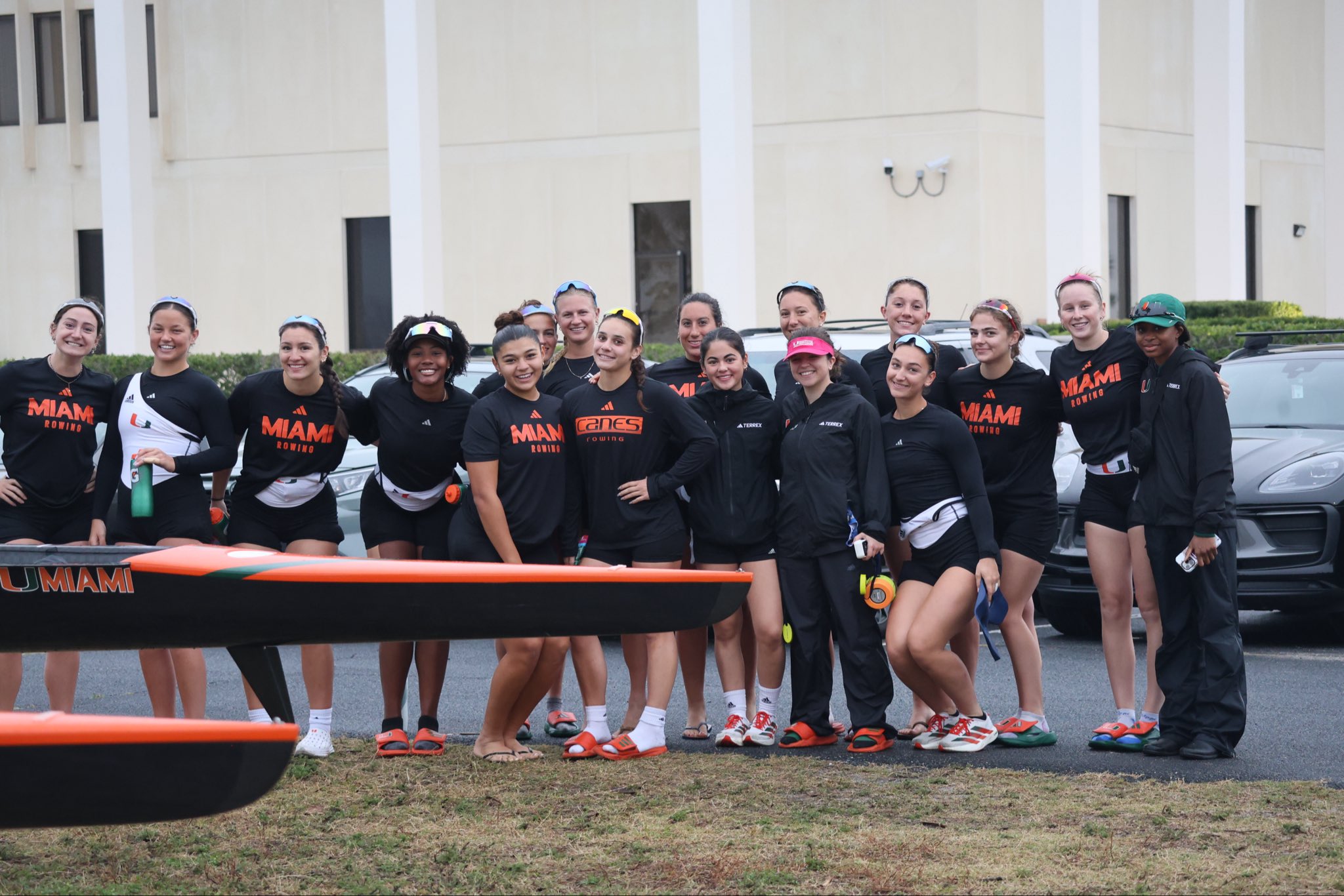
Photo credit: @CanesRowing via X // Miami Hurricanes rowing races against Riddle Aeronautical University in Dayton Beach, Fla. in a scrimmage on Feb. 28, 2026.

Then the first varsity eight returned to the water — and delivered again.

Miami’s top crew crossed the line in 6:30.0 to defeat No. 25 Oklahoma, Notre Dame and Wisconsin, marking its second victory of the weekend and the second time the Hurricanes posted the fastest overall time of the day.

Meanwhile, Miami’s varsity fours stayed firmly in contention. The 2V4 finished just inches shy of victory clocking 7:32.5 behind Oklahoma’s 7:32.1, while the 1V4 added another runner-up result in 7:31.3.

For Mulcahy, the weekend’s results were encouraging not only for the wins, but for the growth across a roster filled with newcomers.

“We’re proud of the way the team handled their first regatta of the year,” Mulcahy said. “Crews improved over the course of their three races and did a great job controlling what they could control and not getting distracted.”

Three varsity eight wins. Two fastest times of the day. And a season opener that left little doubt about Miami’s speed.

At the beginning of a season, that’s exactly the kind of message a team wants to send.

Miami returns to action next Saturday in Fellsmere, Fla., where the Hurricanes will face Columbia.