Home Blog Page 37

Lakeside residents can move into UV now and be guaranteed housing

A new initiative in an effort to manage the demand for on-campus housing allows residents of Lakeside Village to move into University Village before the end of the school year, which guarantees housing in UV for the upcoming school year. 

“While Lakeside and Eaton residents had an opportunity recently to move into UV now and be guaranteed UV housing next year, a total of 140 students in Eaton and Lakeside took the offer to move,” the University said in a statement to The Hurricane. 

The effort comes at a time when housing availability has tightened compared to previous years. The University is operating with 239 fewer beds this year compared to the last, further increasing the demand for housing. As a result, students are facing waitlist placements or looking for off-campus housing. 

For the 2026-2027 school year, approximately 3,100 students completed the housing application. Out of those, about 2,000 received a housing assignment, leaving around 1,100 students without immediate placement. On the third day of the waitlist, 612 people were still without housing, demonstrating the demand. 

Last academic year, everyone on the waitlist was assigned housing by June, according to the University of Miami. 

“I explored off campus housing, but it was honestly very expensive and time consuming,” said Aaron Joe, a junior who lived in Eaton last year. “We lived in Eaton and then didn’t wind up getting UV next year, which was also extremely disappointing.”

THesis Hotel, which is across the street from the University, will continue to be used to temporarily house students while other accommodations are made. The goal is not to assign students to THesis for the whole year, but students currently living there will not be required to move back to campus mid-semester. 

The Department of Student Affairs has emphasized its commitment to helping students who rely on campus housing, whether it be for financial reasons or a schedule that makes commuting difficult. Student Affairs is working to evaluate ways to prioritize these students while also balancing general demand. 

Centennial Village, residential colleges three, four and five are scheduled to open at the beginning of August 2026 and will add approximately 1,150 new beds. 
Mahoney-Pearson Residential Colleges are both scheduled to close at the end of the spring 2026 semester. It is set to be replaced with a new complex called Gables Village with construction starting in the summer of 2026. The demolition of Mahoney-Pearson will result in a loss of around 1,400 beds.

Nobody’s perfect — except in Miami, where you have to be

0

Miami sells a dream. It is a city built on sunlight, nightlife and an image of effortless perfection.
But in a place so deeply defined by appearance, that dream comes with pressure.

Unrealistic beauty standards in Miami are shaping a generation of young people who feel that changing their appearance is not just a choice, but a necessity. Scroll through social media or spend a day in Brickell or South Beach and you will quickly notice a pattern: sculpted bodies, flawless skin, designer outfits and faces that all seem just a little too symmetrical to be a coincidence.

Looking “good” no longer means being healthy or confident. It means fitting into a very specific aesthetic. Defined jawlines, plump lips, tiny waists and perfectly contoured features have become the norm rather than the exception. The rise of cosmetic procedures like lip fillers, Botox and body sculpting has made these features more accessible, but also more expected.

Miami’s image driven culture pushes unrealistic beauty standards that pressure young people to change their appearance, making cosmetic procedures feel less like a choice and more like a requirement.

For many college students, this pressure begins the moment they arrive. 

Freshman influencer Julia Thomas said she immediately felt the shift when she moved from Texas to Miami. “When I first got here from Texas, I was overwhelmed by all the other girls around me,” she said. “I even ended up getting lip filler myself my first semester. It felt like something that everyone was doing, and of course I wanted to fit in.”

Young people, especially college students and recent graduates, are absorbing this pressure at an alarming rate. Appearance often feels tied to social status, career opportunities and even dating prospects, and the idea of “keeping up” can feel overwhelming.

Thomas said that expectation to constantly maintain a polished image can be mentally draining. “I think feeling like you have to be perfect all the time is exhausting,” she said. “We should all be accepting of everyone.”

It is not uncommon to hear conversations about saving money not for travel or experiences, but for procedures. The normalization of cosmetic work has shifted the mindset from “I want this” to “I need this to fit in.”

Social media only intensifies the issue. Platforms like Instagram and TikTok amplify a curated version of Miami life where everyone appears perfect all the time. Filters blur reality, editing apps reshape bodies and algorithms push the most visually striking content to the top.

What viewers often forget is that much of what they are comparing themselves to is not entirely real. Yet the emotional impact is real.

This constant comparison can take a toll on mental health. Feelings of inadequacy, low self-esteem, and body dysmorphia are becoming more common, according to SOURCE. When the standard is perfection, anything less can feel like failure. For young people still forming their identities, this environment can be especially damaging. Instead of discovering who they are, they are trying to become who they think they are supposed to be.

Still, some students say stepping away from those expectations can lead to a healthier mindset. “As I accept myself more and care less about what people think, I’m realizing that I’m the happiest I’ve ever been,” Thomas said.

It is important to acknowledge that there is nothing inherently wrong with cosmetic procedures. People have the right to make choices about their own bodies. The issue lies in the pressure and expectation behind those choices. When individuals feel obligated rather than empowered, it becomes less about self-expression and more about conformity.

Miami’s culture does not have to be defined by unrealistic standards. There is space for a broader definition of beauty, one that includes authenticity, diversity and individuality. Real confidence does not come from fitting into a mold, but from embracing what makes someone different.

Changing this culture will not happen overnight. It requires a shift in what we celebrate and what we promote. It means being more mindful of the content we consume and share. It means having honest conversations about the pressures we face. Most importantly, it means reminding ourselves and others that we are more than how we look.

Miami will always be a city full of beauty. But beauty should not come at the cost of self-worth.

A Rock Symphonic retrospective: the past, present and future of Frost’s student-led  interdisciplinary concert

Colorful, flashing lights and epic guitar solos aren’t really what you’d expect to hear in a concert hall, but students at the Frost School of Music are no strangers to mixing genres. After all, they’re the ones making it happen. 

Rock Symphonic is a student-run concert that combines talent from across Frost’s three departments: classical, contemporary and jazz. Five Frost artists are selected to play their songs live in Gusman Hall backed by a full symphony orchestra. 

Last week’s performance marked the third time the Rock Symphonic Orchestra took the stage.

Brought to life by Frost students Winston Thayer and Dawson Fuss in the Spring 2024 semester, the project has far exceeded its creators’ expectations. Thayer is a senior and Fuss graduated in 2025 with a Bachelor of Music in Modern Artist Development and Entrepreneurship.

Thayer and Fuss were inspired by R&B artist Raye’s 2023 concert in the Royal Albert Hall in London with the Heritage Orchestra. Given Frost’s musically diverse student body, the two had no doubt they could pull off something similar at UM.

They originally wanted to have the concert in Victor E. Clarke Recital Hall, a 147-seat venue intended for intimate performances. The artists would’ve been accompanied by a small orchestra, with only one or two people per instrument.

That all changed after Fuss pitched the concert to Dean Shelly Berg after running into him at Frost’s special screening of “Mean Girls” in 2024. The dean loved their idea so much that he gave Thayer and Fuss permission to use the 600-seat Maurice Gusman Concert Hall instead.

With full faculty approval and a much larger space than they originally anticipated, the whole thing went from zero to 60 . “We were like, well, I guess we have to start getting together an orchestra to fill the hall,” said Thayer. 

Rock Symphonic’s first year was easily its most chaotic. Thayer and Fuss initially split the work evenly as co-directors. Thayer took on the responsibilities of composing the arrangements of the artists’ songs and dealing with the orchestra and Fuss managed the artists and marketing.

Thayer quickly realized there was no way one person could compose 17 arrangements, so he brought in Jennifer Phan, also a senior at Frost. Together, the two developed a standardized system to keep the parts in order: making templates for the sheet music, booklets for each orchestral musician and numbering each song.

Featuring then-Frost students Brayton, Nep and Fuss himself, RS 2024 was a roaring success. Pulling it off was a lot of work, and the executive team was spread thin.

In its next year, Rock Symphonic became far more organized. Thayer and Fuss remained as co-directors, with Phan assistant directing. The three developed a formal application process for the artists, choosing bands based on feedback from faculty across Frost’s three departments.

Thayer and Phan also expanded the composing team, bringing in student composers from the Media Scoring and Production program.

The event’s second year also saw the expansion of its musical scope; it wasn’t only rock music anymore. The lineup included singer-songwriter Maeve, indie band rug, funk/soul/R&B band Puddley, girl rock band Skyrise and the indefinable Che AM.

This year Rock Symphonic came back stronger than ever. It was co-directed by Thayer, Phan and junior Mallory Gravitt, who will be taking over next year. Juniors Quinn Olson and Annakeesta Ironwood were assistant directors.

Singer-songwriter Nicole Emelie was one of this year’s artists. She has never performed with a symphony orchestra before, and after just the first rehearsal, she was amazed.

“I just felt so happy,” Emelie said. “I had a moment when I was listening to it that I was like, these are songs that I just wrote by myself in my bedroom, and now an orchestra is playing them.”

The 2026 concert also featured indie rock band Lawn, jazz singer-songwriter Lena Joy, newgrass band The Wire Jays and indie jazz rock band Nuclear Monkey.

“I think this should happen more often,” Emelie said. “The fact that this is student led and student created is very important. I think it shows that the students want this community and this connection.”

It is typical for the co-directors to engage with the audience throughout the show, introducing themselves, the artists and the orchestral musicians. This year was a little different, though.

Phan and Thayer delivered an extended and heartfelt thank-you to everyone who has made Rock Symphonic possible for the past three years. From the arrangers to the artists to the marketing team to the light and sound crew in the hall to the faculty mentors, no person involved left without a staggering round of applause.

Bending the traditions of orchestral etiquette, conductor Walker Klauda even had every individual section of the orchestra stand to receive their applause.

The concert ended with an epic instrumental medley of songs from each year of Rock Symphonic as a send off to its creators.

A live album with the songs from last week’s performance will be released sometime this summer.

Preparations for next year’s concert will begin in the Fall 2026 semester, and the incoming director has lots of ideas. One of the most important is to expand the team even more. Even as it has grown, the workload remains heavy.

“Being friends with Jen and Winston and Mallory has shown me how much work this thing is,” said assistant director Olson. “The amount of all-nighters that are pulled among that team is insane.

Born from two friends who just wanted to put on a cool show at their school, Rock Symphonic has since grown wings and soared. It is becoming a tradition among students, helping to strengthen the culture of connection, collaboration and just plain fun at Frost.

‘Little Shop of Horrors’ production brings music, comedy and puppetry to campus

CaneStage is bringing the sci-fi horror musical “Little Shop of Horrors” to UM’s stage this month in a student-led production.

The show will run at 7 p.m. on March 20, 22, 27 and 29 at the Cosford Cinema. Performances are free and open to the public. 

Freshman and director Erika Kato described the production as one that appeals to a wide audience.

“‘Little Shop of Horrors’ is a musical for everyone,” Kato said. “It has comedy, sci-fi and thrilling scenes and deaths, romance, dancing, puppetry and so much more.”

The cult-classic musical tells the story of Seymour, a shy florist who discovers a mysterious plant that promises him fame and fortune — but at a dangerous cost.

Producing the show with University students presented unique challenges. According to Kato, coordinating rehearsals among busy college students was one of the most difficult aspects of directing the production.

“We all have so many things going on at UM,” Kato said. “There will be some days where actors would not be here, so rehearsals for vocals and blocking was an issue, but at the end of the day they all took their own time to review and learn.”

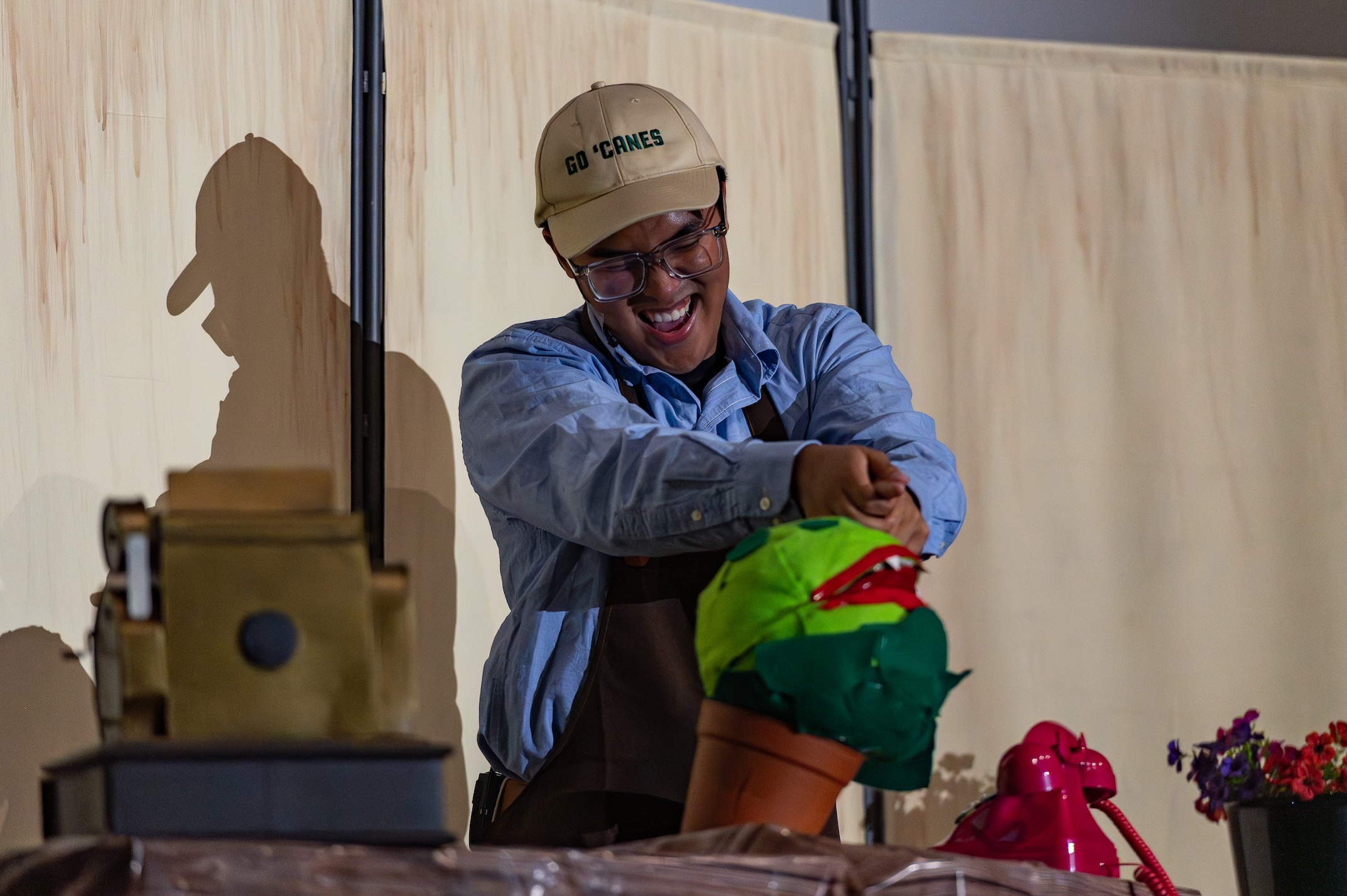
Ava Stroshane Contributing Photographer // Elijah Corpuz plays the role of Seymour in Canestage’s production of Little Shop of Horrors at the Cosford Cinema on March 22, 2026.

As a first year student directing her first production at UM, Kato initially worried about leading performers who were often older and more experienced than she was.That concern quickly faded after the first table read.

“They all believed in me and supported me,”Kato said. 

Throughout rehearsals, Kato said she has watched the cast grow significantly, particularly Valentina Carbonell, the actor playing Audrey — Seymour’s love interest. 

“She has truly built her confidence in this role.” Kato said. “As an audience member, you cannot tell this is her first production.”

The show also features one of the musical’s most iconic elements: the talking plant,  Audrey II, which is shown as a puppet. CaneStage’s production incorporates both a handheld and a large puppet while also featuring a performer providing the plant’s voice.

“We have our actress and voice of Audrey II walking around the puppet and interacting with the actors,” Kato said. “She has such strong stage presence that we wanted her visible and interacting with everyone.”

Despite balancing academics and rehearsals, Kato said the most surprising part of the process has been the sense of community among the cast and crew.

“We are all college students managing school and rehearsals, but everyone is here for each other,” Kato said. “Actors help each other with lines, dances and cues. It’s truly a strong community.”

Get matcha on wheels at The Matcha Bike

A green bicycle near the Merrick building is UM students’ newest caffeine obsession. The Matcha Bike, the newest matcha shop on campus, offers vibrant, colorful matcha lattes with an assortment of flavors. 

The student-founded business brings delicious matcha directly to the UM community with its unique flavors tailored to students’ interest making each purchase personable. 

The Matcha Bike was created when the founders, who wished to remain unnamed, had trouble finding a sweeter version of matcha on campus. They then started experimenting with recipes and created their own drinks they thought students would enjoy.

Matcha, a powdered green tea traditionally used in Japanese tea ceremonies, has a reputation of tasting bitter and earthy. The Matcha Bike wanted to change that stigma by creating a version of the drink that’s sweet and something even fans of the traditional matcha flavor would like. 

“Matcha has a negative preconception among so many for tasting like grass,” an owner said to The Miami Hurricane.

To fix that, the founders spent more than two years developing a signature drink they call the “Green Velvet.”

It blends traditional matcha ingredients with a custom oat milk mixture designed to create a rich and creamier taste. The Matcha Bike designed custom cans for each drink — giving a personalized experience for each drink.

The decision to serve the drinks from a bike came from a desire to make the concept more mobile and interactive.

“From there, the bike concept was born: A mobile, personal way to bring that experience directly to our community,” an owner said.

The entrepreneurial culture at UM also played a significant role in shaping the business. According to the founders, many students at UM have their own businesses, which helped inspire them to pursue their idea.

“UM is hands down the best university in the country for entrepreneurship,” an owner said. “Not only are a large percentage of the student population business owners, but the administration is so supportive of small businesses.”

Balancing academics and starting a small business presented its challenges, including the demands of operating a growing venture, which requires long hours and careful time management.

In spite of the workload, the founders say seeing customers enjoy their drinks makes the challenges worthwhile.

For the founders, The Matcha Bike is about more than just selling a product. They hope each interaction with customers helps build a sense of community.

“What sets us apart is the care we’ve put into crafting our recipes,” an owner said. “Whether you’re a purist or someone still warming up to the flavor, there’s something here for you.”

Café LoCoh combines matcha and Latin America

Lines at any University of Miami coffee shop are guaranteed to be long on almost any morning. But lately, it’s not just coffee students are lining up for. 

Matcha has quickly become a campus obsession. Students can pick up ice matcha lattes and espresso shots between lectures in almost every part of campus.

 One stand has become a daily ritual for many students: Café LoCoh. The coffee and matcha shop is the University’s school of law and is open from Tuesday to Friday mornings.

The story behind Café LoCoh is surprisingly romantic. According to co-founder Daniela Correa, the idea for the café began during a first date — which was at a coffee shop, of course. 

“Oscar and I started talking about how both of our dreams were to open a coffee shop one day,” Correa said.

For Correa, coffee shops were always more than caffeine. That shared appreciation eventually turned into a vision: a café that felt personal and meaningful.

That vision shows up in every cup served at the café’s mobile cart. Unlike many quick campus stops, Café LoCoh roasts its own coffee beans and serves high-grade, stone-milled matcha, bringing what Correa calls the “full café experience” directly to campus.

Students have definitely noticed. One drink in particular has become a campus favorite: the Caramel Cubano. Inspired by the founders’ ethnicities, Oscar is Cuban and Correa is Venezuelan, the drink captures what they describe as the bold and vibrant spirit of Latin culture.

“The Caramel Cubano is so good. It’s sweet but still really strong, which I love,” said Ilkim Sarsilmaz, a sophomore at the University of Miami. “It has this caramel flavor but also a really bold coffee taste, so it’s not too sugary. I get it every time.”

Café LoCoh’s appeal goes beyond creative drinks. The brand itself leans into a vibe Correa describes as “modern, playful and elevated,” blending imaginative menu items with a commitment to high-quality ingredients and a welcoming atmosphere.

That sense of community may be part of why coffee and matcha culture feels so strong at UM. For many students, it’s not just about caffeine, it’s about routine.

“I think coffee and matcha has become something more,” Correa said. “It has become  something that unites the UM community.”

If you’re new to Café LoCoh, Correa recommends starting with the Baklava Matcha or Baklava Latte: a sweet, nutty drink made with the café’s house-made syrup that perfectly balances flavor and comfort.

The best part of the day isn’t just the coffee, it’s the moment you take to enjoy it.

Get coffee, matcha and and connections at Barista Babes

Marcela Galvez and Allegra Wynne-Kaplan turned their shared love for coffee and women’s empowerment into Barista Babes Coffee & Matcha, a mobile business serving University of Miami students weekly. 

The female-owned coffee and matcha cart and trailer regularly sets up at several campus locations, near the School of Communication, the Jorge M. Pérez Architecture Center and the Cox Science Building.

“I have always wanted a coffee business and love the community that coffee brings to people,” said Wynne-Kaplan. “We just put our minds together and this is what came of it.”

Wynne-Kaplan said the idea developed naturally from their shared interests, close proximity and growing friendship, which led them to realize that starting a business together aligned with their goals and passions.  

Before launching Barista Babes, Wynne-Kaplan had long envisioned owning a coffee business, while Galvez expressed interest in starting a female-owned business of her own. 

Galvez, a former school teacher, and Wynne-Kaplan, who owns a clothing business, drew on their customer service experience and people skills to expand the simple coffee shop into something more engaging.  

They noticed the rising popularity of matcha and decided to add it to their menu. Since then, their customer base has grown, with many returning regularly for their matcha. 

The woman chose to cater to UM for several reasons: both are Miami residents, they understand the college student’s need for caffeine, and they enjoy the opportunity to connect with students. 

“I like going to Barista Babes because I am a communications student so it is convenient to have a truck there since there are no other spots on that side of campus,” said Kiki Ferreira, a senior at UM. “I honestly find the coffee super good and the women in the truck are so nice. 

But, Barista Babe doesn’t only serve matcha at UM. Through collaborations with local Miami businesses and events, the two women bring their coffee cart and truck on the go, providing for a wider community. 

The business tailors its offerings to its audience, whether catering events, collaborating with other businesses or serving students on campus. 

“UM students know what they like and they are looking for that specifically,” said Wynne-Kaplan  “And when they come back, it means we did a good job with providing them.” 

In addition to coffee and matcha drinks, Barista Babes sells a variety of baked goods sourced from two other female-owned startups. The company, which will celebrate its first anniversary in April, has continued to grow while emphasizing health-conscience options. 

“It is aimed towards giving students and people healthy choices,” said Galvez. “We are so happy talking to people and getting personal interactions. That’s why we love working and our customers every day.”

With steady success both on and off of campus, Barista Babes continues to expand, offering students and Miami residents a place to grab a drink and make a new friend along the way. 

The campus Wizard brings confidence and self expression to UM

Chances are, over the past few months, you have seen a wizard walking around campus. Whether he’s by the lake, heading to his next class or even sitting in one, the self-described “wizard” is hard to miss. 

“I feel like some people are really excited to see someone that looks unique on this campus,”  the Wizard, who wished to keep his name unpublished, said. “People always ask me if I play D&D, or what I’m dressing up as, and I always say ‘myself.’”

Most of the time, you’ll find the Wizard wearing a green, flowy outfit accompanied by a pointy green hat.

The Wizard, a freshman at UM, didn’t always get to dress so creatively. Before arriving on campus, most of his schools had strict uniform policies. Because of that, he looked forward to any chance to dress up. 

“I’ve always loved doing costumes and dressing up for Halloween,” the Wizard said. “Even during school spirit days, I would wear the most complex costume I could.”

He started at UM with a newfound freedom over his clothing choices. The Wizard decided to fully embrace it. After buying the iconic hat at the start of this spring semester, it quickly became a daily staple.

“I really [wanted] to wear this hat as much as possible, so I just started wearing it,” he said. “I don’t think since I got it there’s been a day that I haven’t worn it to campus.”

Since then, he has had many positive interactions with students and said he has not experienced negative reactions.

His outfit has largely become his identity on campus. Many students who recognize him — and even some of his close friends — don’t know his name at all.

“A lot of people will walk by me and say, ‘Hey, campus wizard,’” he said. “I don’t think a lot of people that I’m friends with know my name. They just call me ‘the Wizard,’ which is funny.” 

For the Wizard, wearing his daily outfits is not just about standing out, it’s a conscious decision to be an example for anyone else who is hesitant to dress differently. 

He describes this as “a fight against anti-individuality.”

“I really hope that people understand that I’m trying to normalize this,” the Wizard said. “I hope that people see me and think, ‘Okay, I can do that, too,’ because I think anyone can do it.”

His inspiration often comes from creative spaces like video games and cosplay, where character design plays a major role in how characters are presented. 

When deciding what to wear each day, the Wizard approaches the process more like designing a character than choosing an outfit.

“I just try to think about it in a character design frame, because I like video games a lot,” he said. 

Instead of following fashion trends, he focuses on wearing pieces that feel expressive and unique. 

“I don’t know anything about fashion,” he said. “I just went shopping and picked things that I liked, and that’s what I wear.”

That perspective leads him to choose pieces that create a specific silhouette, such as flowing layers that resemble cloaks or capes. He said he often thinks about the overall shape of the outfit rather than individual items when getting dressed.

Ultimately, the Wizard hopes that students who see him around campus feel encouraged to express themselves however they want — even if that means wearing something unconventional.

Things at UM that would send other students into a coma

This may come as a shock to University of Miami students, but Goyard bags, graduation raves and frat yacht parties are not a part of the typical college experience. 

A quick TikTok search will reveal that UM’s students have certain trends and customs that are extremely uncommon at almost every other university in the country. 

Videos of college students naming things at their college or university that would send other students “into a coma” have circulated on TikTok for a few years now. 

So, let’s get into a few UM-specific experiences that might do just that — starting with something that is familiar to most students: partying.

Party culture

The main point that users participating in the trend seem to mention about UM is its prominent party culture. 

This might have something to do with the fact that the University is just an Uber ride away from Brickell, Wynwood and Downtown Miami, all hubs for rave culture and late-night to early-morning to, well, afternoon, clubbing. 

Seeing students shuffle back in from their college-town equivalents of Club Space, LIV and E11EVEN between 5 a.m. and 7 a.m. would be uncommon at other universities. 

Miami also hosts events like Hocus Pocus and iii Points in Wynwood, Ultra in Bayfront Park and student’s favorite DJs at Factory Town. This strong festival presence has led to a thriving rave culture among students, who cycle through their favorite mesh Shein tops and Amazon pashminas to post on Instagram. 

At schools like the University of Florida and Florida State University, the nightlife scene is limited to backyard frat parties and a small row of local bars for entertainment. 

“There’s really only one main bar and you always see the same people, it’s gotten kind of played out by now so it’s not as appealing,” said University of Florida student Andres Delgado. 

It’s no wonder that the University of Miami’s party scene is somewhat of a culture shock for students, and has led to UM being named one of the top party schools in the country. 

Influencer central

“Influencer U” is one of UM’s many nicknames thanks to the massive number of both small and large influencers who attend UM or just walk around the campus. 

Sienna Sacco, Ximena Ponce and Collete Couillard — to name a few — are all influencers with well more than 500,000 followers on their platforms. It’s not unusual to see them and other aspiring influencers walking around campus documenting their day or filming brand-affiliated content. 

Thanks to Alix Earle, it seems like every student is trying to get their start as an influencer at UM by receiving PR and filming TikToks of their lavish lifestyles. 

Living in sunny South Florida also has its benefits and has shaped student culture in its own ways. 

Seeing people go to class in bikinis or swim trunks isn’t a rare sight, and girls wearing just their bikinis and dirt-covered Air Forces to the frat houses is something even Earle has pointed out as shocking for visitors. 

Wet campus

I’m not talking about the bipolar weather of the Sunshine state, I’m talking about our day drinkers over at The Rat. 

The Rathskeller is the University of Miami’s student-run restaurant that serves alcohol on campus to those over 21.

According to a Reddit post, most colleges with pubs or bars are only open to graduate students. At UM, though, students of age can stop by at 2 p.m. for a beer or a seltzer as long as they show I.D. 

Though, not every student is gathering to drink. The Rat has also become a place for sports enthusiasts to gather and watch major games, such as the CFP Finals or March Madness. They also host trivia, karaoke and DJ nights. 

So, although there is a bit of a culture shock that comes with being a student at UM, most students seem to enjoy the weather, the diverse nightlife and social media opportunities that come with enrolling. 

Florida is stifling citizen initiatives. Here’s how.

Florida voters will not have any citizen-led amendments on the 2026 ballot for the first time in years, a clear departure from the state’s tradition of direct democracy. 

After lawmakers made initiative rules stricter in 2025, it has become too costly and legally risky to get measures like raising the minimum wage, restoring voting rights and legalizing medical marijuana on the ballot. These new rules make it virtually impossible for voters to have a say in Florida’s government through ballot initiatives.

Citizen initiatives have allowed Floridians to bypass the legislature and enact sweeping policy changes. Voter-approved measures often succeed where elected officials stall. The process has functioned as a crucial check on political power, and a way for us Floridians to have a direct impact on the laws of our own state.

Now, with the harsh regulations put in place last year, zero amendments have made it to the ballot out of 22. The new restrictions are now being challenged in federal court, for good reason: these rules place unconstitutional barriers between voters and the ballot.

Lawmakers fundamentally reshaped the initiative process in 2025 with new petition rules, tighter deadlines, and higher compliance risks. Organizers now face increased legal liability and costs, making ballot access impossible for now. 

Supporters of the harsher restrictions say the changes protect election integrity, but in practice, these laws are barriers set by Florida Republicans to limit voters’ power.

Remember, this is not the only barrier for Florida voters. In 2006, the GOP-controlled legislature managed to push the 60% requirement for amendments into Florida’s constitution. However, that measure failed to reach the 60% threshold: Only 58% of Floridians voted in the affirmative to pass the law, yet we all still suffer the repercussions all these years later.

Since then, Floridians have attempted to pass many initiatives: recreational marijuana legalization, abortion rights protections, homestead tax exemptions, property tax assessment charges and even consumers’ choice on solar energy. Many of these exceeded 55% in the affirmative yet were barred by the 2006 amendment. 

But, Florida Republicans weren’t satisfied with just preventing voters from passing amendments on the ballot.

What happens next will largely depend on the courts, lawmakers, and future election cycles. 

The judicial system may work in our favor and shut down these harsh restrictions. Lawmakers could revisit the rules in future sessions, though no changes are currently guaranteed, especially with a Republican supermajority in our state legislature. Some advocacy groups have already postponed major campaigns until 2028, widely seen as the next realistic opportunity to place citizen initiatives before voters.

This battle over citizen initiatives is about power. If the path to the ballot continues to narrow, Floridians may lose one of their most direct tools for shaping public policy. 

To protect direct democracy, stay informed, support advocacy groups fighting these restrictions and urge lawmakers to reconsider these barriers. Participate in upcoming elections and make your voice heard on this critical issue. 

The future of our state’s direct democracy depends on our collective action.

Hurricanes win fifth-straight, defeat FAU 10-6 in midweek affair

0

The Miami Hurricanes took down the FAU Owls in a high-scoring affair Tuesday night, winning 10 – 6.  

Jake Dorn got the start on the mound for the Canes, one of seven pitchers sent out by Miami throughout the game, none throwing for more than two innings. TJ Coats would be the lucky win recipient after his two innings pitched across the fourth and fifth innings.

Alonzo Alvarez delivered on the offensive end with two hits and two RBIs, along with drawing two walks. As a team, the Hurricanes drew seven walks on the night. 

The Owls were shut down in the first inning thanks to strong defense by the Hurricanes, and the Canes continued the momentum on offense. 

Jake Ogden worked a walk and then advanced to second on a groundout, bringing up Alex Sosa. Sosa hit a routine grounder to second, but with a lucky Hurricane bounce, it skeetered off the defender’s glove and over his head, bringing home Ogden to open up the scoring with an error.

Some more strong defense kept the Owls down in the second inning, and then the floodgates opened up for Miami. 

Ryan Buckler jumped on the mound to replace FAU starter Dalton Robinson after just one inning, but things didn’t go well for him either. 

Vance Sheahan started the inning by working a walk, then stealing second and third on back to back pitches. He was quickly brought home by a Dylan Dubovik single, which was followed by a Jake Ogden deep sacrifice fly to score Dubovik. 

Next up was Alex Sosa, who scored two with a hard hit double ripped to right field, making the score 5-0.

To start the third, Tate DeRias replaced Jake Dorn on the mound, and the Owls took advantage. 

With the bases loaded, Michael Perazza fired a hard single to left field that brought in a run. Left fielder Dubovik failed to cleanly collect the ball, and the error allowed another run in. 

Luckily, the Canes were able to get out of the inning soon after thanks to a heads up play by Ogden, who caught a line drive and flipped it over to second for a double play

David Lebowitz, Photo Editor/ Fifth-Year Senior Outfielder Derek Williams extends his foot towards foot base against Florida on Febrauary 27, 2026.

Another pitching change to start the third saw Cameron Horner come in to pitch for the Owls. After three straight walks Horner was taken out for Brayden Gilsom who limited the damage, allowing just one run on a Dubovik RBI ground out.

The fourth inning saw the Owls battle back once again. First baseman Patrick Ward seized a hold of a pitch inside, blasting it to deep left center. The ball disappeared over the fence, bringing the score to 6-4 putting FAU right back into the game.

The Canes quickly answered back with some runs of their own. They loaded the bases with two singles and a walk, leading to a Cuvet score via a wild pitch. Alvarez proceeded to lift a ball just over the shortstop’s head for a two RBI single, giving the Hurricanes a bigger cushion.

Through the next few innings, strong defense from both sides kept both teams off the board until the bottom of the sixth inning. 

Derek Williams hit his ninth double of the season to tie himself for fifth in the ACC, and he proceeded to score thanks to a Sheahan RBI double.

However, some weak defense by the Hurricanes kept FAU in the game, as an Ogden error led to an easy run for the Owls. The Hurricane lead was cut to four after a wild pitch.

With some good defense in the seventh, the Owls found themselves in a good position to inch even closer. 

With two runners on the Owls opted for a double steal, but the lead runner was gunned down by the catcher Alvarez, halting their momentum and preventing them from getting any more runs on the board.

Miami closed the game out with an emphatic ending, as center fielder Fabio Peralta made a catch at full sprint and then shot a runner down back at first to end the game with a double play. Closer Ryan Bilka earned the save on the night with 1.1 innings pitched and one strikeout. 

Miami will travel to Clemson, S.C., to face the Tigers for a three-game set. The series will begin Friday, with first pitch set for 7 p.m.

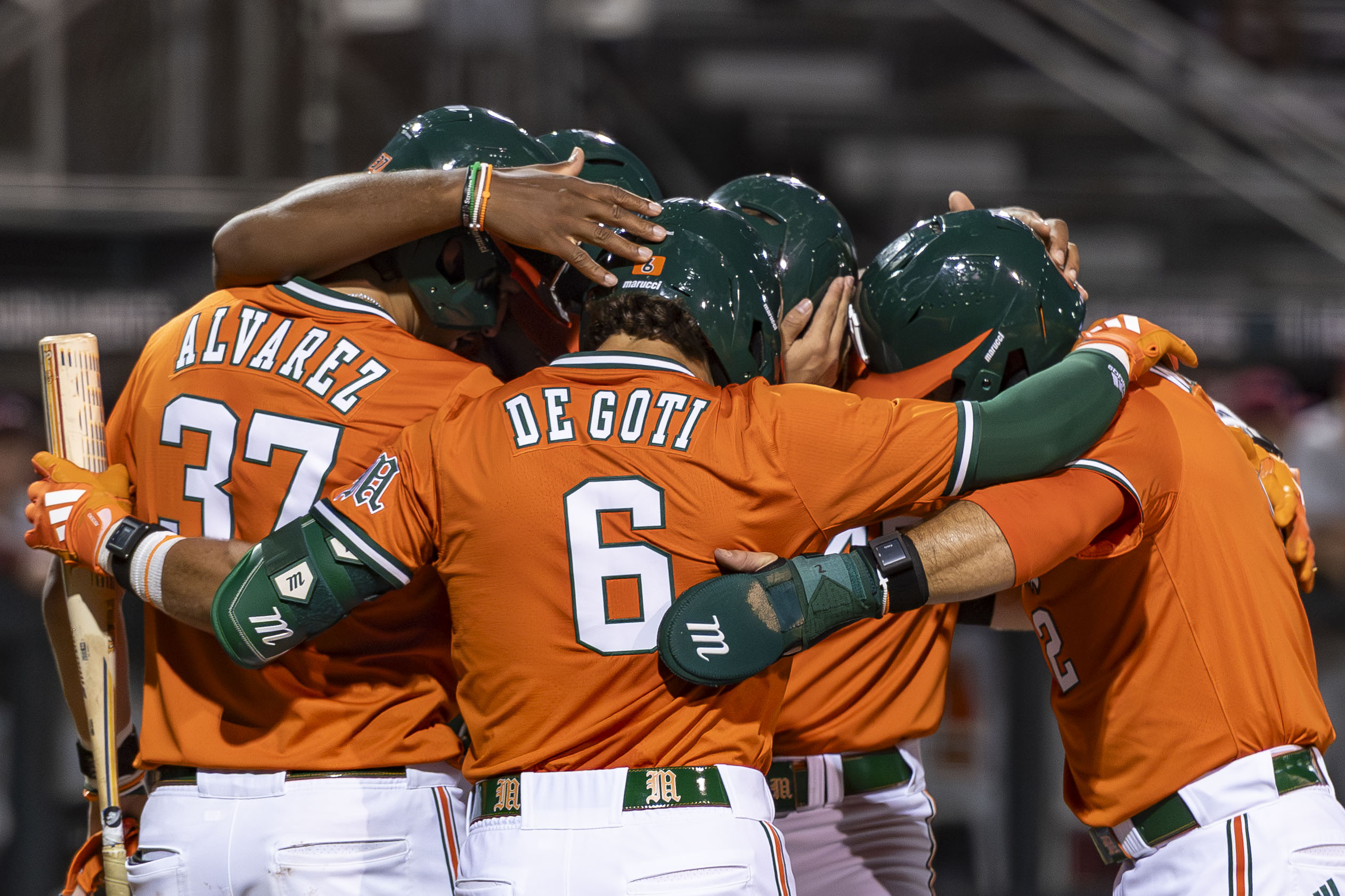
Miami baseball players embrace after each made it to home following a grand slam from freshman outfielder Dylan Dubovik during the Saturday, Feb. 21 game against Lafayette College.

Miami AD Dan Radakovich named NACDA Athletic Director of the Year

When Dan Radakovich stepped up to the podium at his introductory press conference on Dec. 14, 2021 one of his first statements was, “athletics is a part of the greater university community and we need to be a shining example of integrity, innovation and commitment.”


Nearly five years since his induction, Radakovich has demonstrated each, elevating athletics to the point where several of Miami’s programs have reached new heights. 

The result of those efforts, the announcement on March 16 that he will be awarded the Athletic Director of the Year award. 

Among 27 other nominees, Radakovich is being honored for his service regarding football along with three others. 

When Radakovich arrived in Coral Gables, Hurricanes football was at a low point in its history. 

Since 2006, the Hurricanes held just a single bowl win, a single 10-win season, and no significant ACC or post season success. 

As South Florida players flocked to rivals and out of the state, The U was being left behind as the glory days were left in the past with the program criticized for a lack of investment. Radakovich came in with head coach Mario Cristobal, both alumni of the University, hungry to bring the UM back to national prominence. 

In the years since the two have worked hand-in-hand to get Miami football back to the top of the country. 

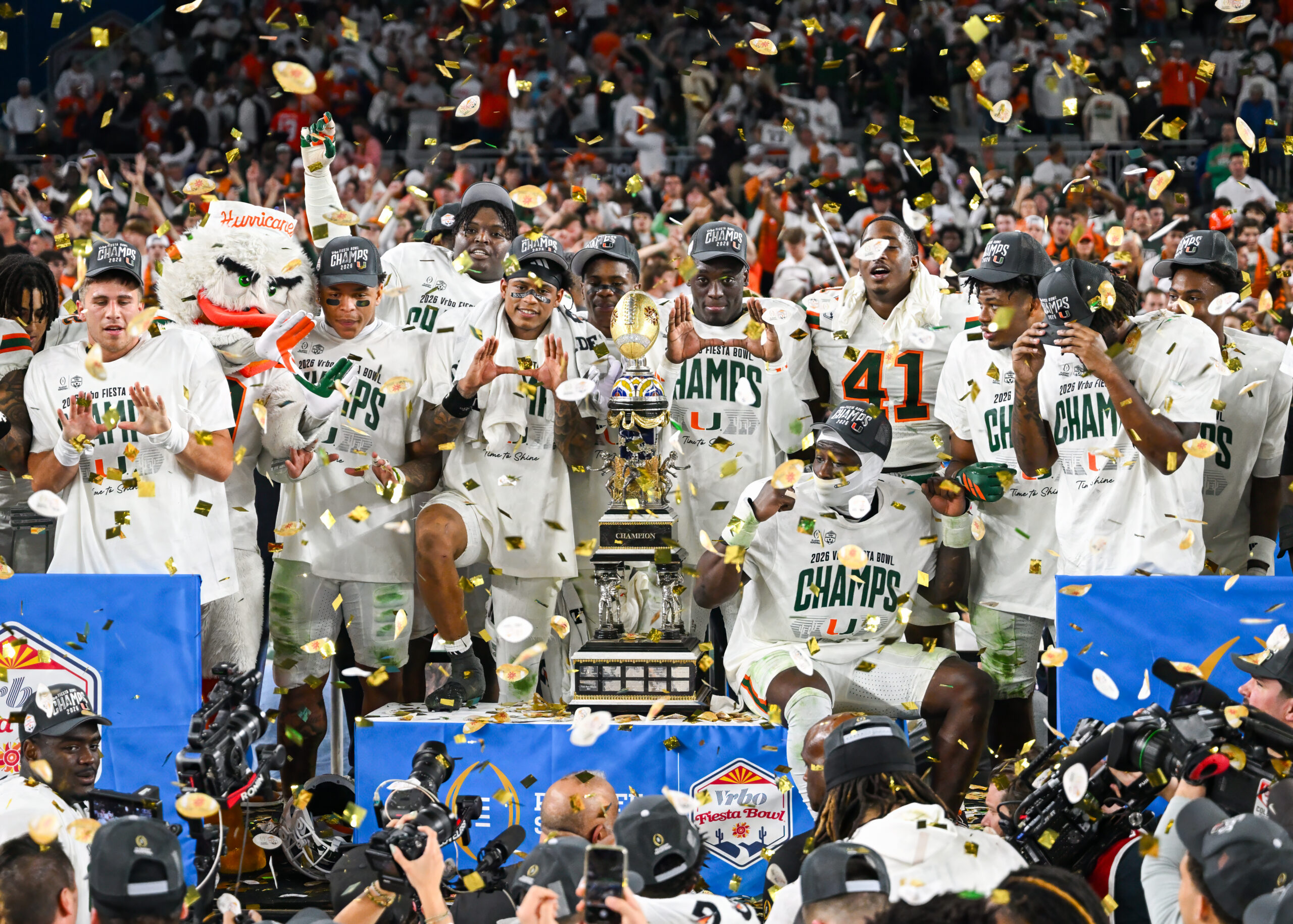
Photo Credit: David Lebowitz, Photo Editor // Members of the Miami Hurricanes celebrate in front of the Fiesta Bowl Trophy on Jan. 8, 2026

Navigating the new world of NIL and paying student-athletes, Radakovich has worked with donors and sponsors to improve facilities and give Hurricanes athletes the best chance to succeed. 

In the 2024-2025 academic year alone, Miami athletics received $36.4 million in gifts and contributions from more than 7,000 donors, the second most in school history. 

In December 2023, the Hurricanes announced a multimedia rights partnership with Legends, a premium experiences company. That deal has resulted in a record single-year revenue growth and improved ticket sales.

Each year, football has improved in record, in recognition and in ability to recruit between keeping guys home or from the transfer portal. 

From five wins in 2022 to national champion runner-ups in 2025, Radakovich has helped reinvigorate sports culture on campus, starting on the gridiron. 

While football is what’s earned him this honor, that’s not to say that Miami hasn’t had other stars shine throughout his tenure. 

In the 2022-2023 season, Hurricanes hoops reached historic new milestones as the men’s program made their first ever Final Four and the women their first Elite Eight berth in school history. 

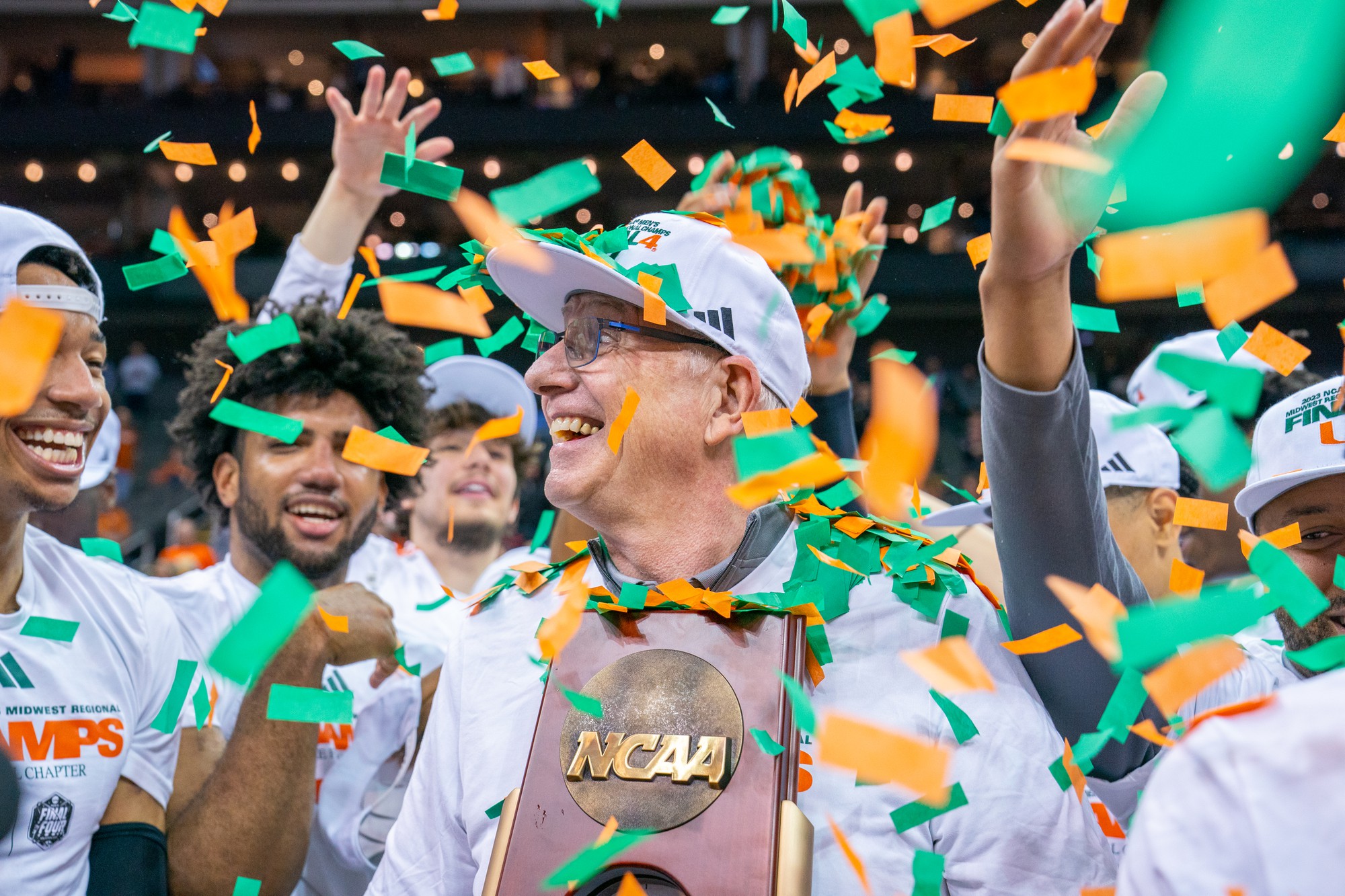
Head coach Jim Larrañaga holds the NCAA Midwest Regional Championship Trophy after Miami’s 88-81 win over the University of Texas in the T-Mobile Center in Kansas City, MO on March 26, 2023. Photo credit: Jared Lennon

Swim and Dive has back-to-back National champion diver Chiara Pellicani, Track and Field has earned a long list of ACC and National honors and Hurricanes baseball was one run away from a trip to Omaha last season.

Off the field, Hurricanes athletics reached a school record 94% graduation success rate and have been at the top of community service winning the annual Community Service competition twice in 2022 and 2024 with levels of 99% student-athlete involvement. 

Radakovich has consistently invested in Hurricanes athletics since his arrival in 2021 with the expansion and improvement of facilities for all its sports. Most recently, Miami has upgraded  women’s basketball and baseball locker rooms as well as the renovation of football’s indoor practice facility.  

As a result, he’ll be honored for the works he’s put in five years in Coral Gables. The ceremony will be at the National Association of Collegiate Directors of Athletics’ 61st Annual Convention on June 9, 2026 in Las Vegas. 

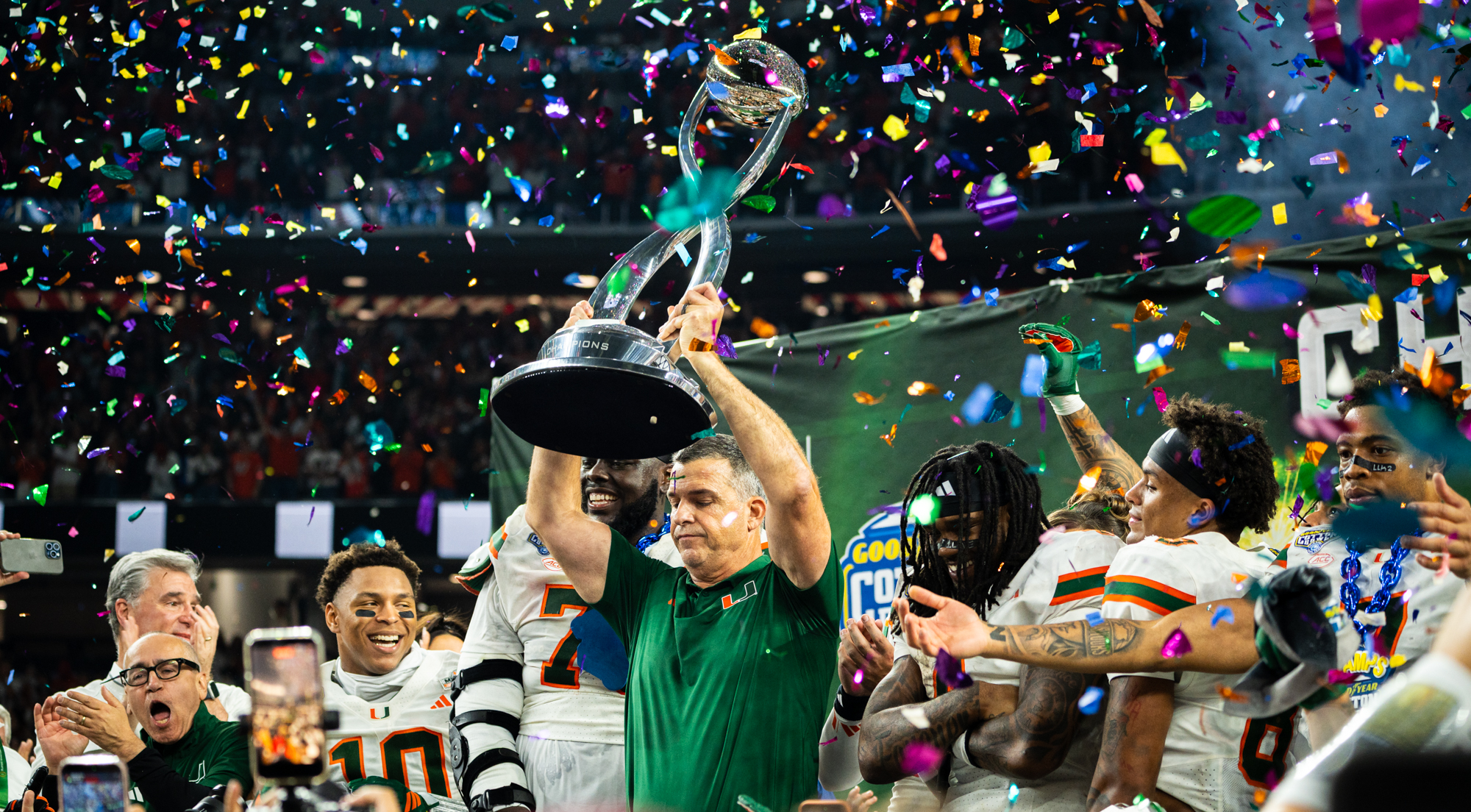
Photo Editor Brian Mulvey // Head Coach Mario Cristobal raises the Cotton Bowl trophy after Miami’s victory against Ohio State University on Wednesday, Dec. 31, 2025.