Home Blog Page 124

UM sisters build a brand, one cup of matcha at a time

Every Tuesday through Thursday from 9 a.m. to 3 p.m., a sleek white truck parked outside the Cox Science Building drew a steady stream of students. With its signature matchas, lattes and small-batch baked goods that sell out fast, Honey Veil quickly became a go-to destination last semester for matcha lovers on campus.

Founded by Miami-native sisters Ceci and Regina Alcobe, Honey Veil is a mobile café born out of a shared love for matcha and baking. At just 22 and 19 years old, the sisters have transformed a passion project into a popular campus staple, offering thoughtfully crafted drinks, sourdough pastries and a moment of calm amidst college chaos.

While you may not be shocked to hear that the drinks are delicious, you may be surprised to learn that both sisters and their older brother attended UM. This inspired Ceci’s decision to bring Honey Veil to UM. She felt like campus was the perfect place to start the business.

“Ceci did her research, reached out to the right people, and we got confirmation that we could be on campus two days a week,” Regina said. “She took the spring semester off to fully focus on Honey Veil, but she wanted to stay connected to campus — and this was the perfect extension.”

Behind the truck’s success is a story of resilience and inspiration rooted in family. The sisters cite their mom and multicultural background (Mexican, German and Spanish) as their most significant influences. It all started when their mom, Cecilia, shared a photo of her sourdough bread in a group chat and received a flood of orders. That led the sisters to start selling baked goods at farmers markets.

What began as a two-day setup quickly expanded to three. Starting in fall 2025, the truck is expected to operate Monday through Friday.

The name “Honey Veil” originated from an unexpected source: ChatGPT. Regina, known for her love of descriptive writing, struggled to sum up the brand’s vibe in just a word or two. She typed out a long paragraph explaining their vision of something delicate, natural, sweet and intentional. AI suggested words like “honey,” “nectar,” “lace” and “thread.”

After mixing and matching, Regina initially landed on Honeylace, but the Instagram handle was taken. That’s when she found Honey Veil. She felt that the name captured their essence and even included a nod to her love for weddings.

Honey Veil stands out because of the intention and authenticity behind it. While their age might seem like a disadvantage to some, the sisters believe it’s one of their biggest strengths. Being young helps them connect with their audience and to their brand, from recipes and design to service with energy and meaning.

“I think sometimes when you take things too seriously, it’s hard to achieve what you set out to do because everything becomes about the destination — not the process,” Regina said. “We were so focused on enjoying the process and making that as authentic as we possibly could, and great things ended up happening.”

When it comes to their matcha, the sisters are perfectionists. Drinks are refined sugar–free and made with clean, simple ingredients. After conducting numerous tests, they perfected the matcha-to-milk and water-to-matcha ratios, striking a balance between taste and froth in every cup. 

Ceci led many of the matcha experiments. During this time, Regina accidentally invented their now-signature whipped honey, which was initially a failed attempt at a healthy meringue. While Regina keeps their recipes a secret, she’s always transparent about the ingredients.

As someone with a sweet tooth and a performance-driven mindset, Regina also began adjusting her recipes to cut refined sugar, opting for coconut sugar, maple syrup and more natural ingredients.

“I noticed that when I had too much processed food, I would break out, bloat and just not feel my best,” Regina said. “We never wanted [our food] to be about ‘low-calorie’ — it’s about real, whole foods that help your body feel good while still tasting amazing.” 

Honey Veil even offers gluten-free and dairy-free options.

Flavor creation is one of Regina’s favorite parts of the job, even though she doesn’t have as much time for it now.

“I have an endless document of flavors that have popped into my head and I’ve been wanting to test and try out,” Regina said. “A lot of them come to me when I’m working on the truck, or when someone mentions something, or I’ll see a TikTok with a cool dessert recipe and imagine it in a drink with a different twist.”

Right now, she’s still heavily involved in the day-to-day operations and plans to regularly release new and exciting flavors in the near future. One of her biggest inspirations is Hallie Meyer, founder of Caffè Panna in New York, who is known for her creative ice cream combinations.

“Her flavor concepts always blow my mind — I look up to her so much,” Regina said.

The sisters’ dedication goes beyond recipes. One of Regina’s most memorable days on the truck came when she gashed her foot open with a syrup bottle. She had no choice but to bandage herself up, prop her foot on a stool and keep working through the pain.

“It was honestly pretty painful working like that for hours, but the constant flow of matcha and conversation with students kept the pain at bay,” Regina said.

Despite needing crutches for two days, she was back in the truck shortly after.

“One of the girls told me, ‘Thank you for coming back,’ and those words meant the world to me,” Regina said.

Operating a food truck comes with its own set of challenges including permits, logistics, weather and power outages. But the sisters have built a strong system and learned to adapt.

As former competitive tennis players, Ceci and Regina were enrolled in online school to travel for tournaments, training five to six hours daily. The discipline and sacrifice tennis demanded taught them the necessary skills for running a business.

“I think tennis gave me the skills to persevere, adapt and be consistent no matter the circumstances,” Regina said. “You have to master what you can control so you’re always ready for the unknown — whether it’s on the court or the truck.”

Regina was even talking with Division I tennis programs before Honey Veil took off but ultimately chose the café over a collegiate athletic career. She’ll begin at the University of Miami in fall 2025.

UM students have been some of Honey Veil’s most loyal supporters and a major reason the sisters have pushed forward.

“There have been a lot of hard days that made us doubt,” Regina said. “But the students were always there — showing up, talking with us, giving us their energy.”

The sisters never set out to specifically “market” to students, but the connection came naturally.

“I credit them more than I credit us — for taking a chance on us and supporting us every step of the way,” Regina said.

That connection helped cement Regina’s decision to attend UM this fall.

“I think I resonate with our customers because I am our customer — young, curious, a little bit confused about the world, but with a hunger to learn and be so much more.” Regina said.

From a trending sourdough craze to a sleek campus truck, Honey Veil is more than a café. It’s a story of sisterhood, vision and passion sweetened with a little whipped honey on top.

As the truck’s following continues to grow and its menu evolves, Honey Veil is proving that thoughtful ideas, genuine connection and a bit of boldness can go a long way even without formal training or years of experience. 

With every pour, swirl and smile, the Alcobe sisters are building community, one matcha at a time.

BLACK CASHMERE: From childhood friends to musical duo

In this special summer exclusive interview for Catch Up ‘Canes, Sophia interviews BLACK CASHMERE members Devon Sellers and Harry Weil about their recently released song, “In My Head.”

Prefer a different platform? We’ve got you covered.

Transfer Portal troubles: Wisconsin sues Miami for Tampering with Star DB

When Xavier Lucas transferred to Miami in January earlier this year, from the outside it was easy to not bat an eye.

The ‘Canes had closely missed out on the former four-star defensive back during their 2024 recruiting season, narrowly losing out to Wisconsin. And upon the completion of his freshman year, it appeared the South Florida native and former American Heritage star decided to move back home. To most, this was a no-brainer move back home to the sunshine state for the rising star.

But with that being said, the circumstances that surrounded Lucas’ departure from Wisconsin and transfer to Miami have become shrouded in controversy, and now, after much speculation, the Big Ten school announced a lawsuit against the University of Miami on June 21.

Wisconsin alleges that Miami made illegal contact with Lucas prior to his decision to transfer, allegedly days after he signed his NIL agreement with the Badgers.

Wisconsin’s issue stems from Lucas’ 2-year NIL agreement signed on December 2, 2024. Lucas then soon requested to transfer, informing his position coach. According to CBS Sports, it was also reported that his deal was among one of the highest revenue-sharing agreements on the team.

Lucas and his representation originally asked to be put into the transfer portal but claim, as Wisconsin also states, that the team did not allow for him to be officially listed as a transfer.

Wisconsin’s first official statement in response to Lucas’ decision stated, “A request to enter the transfer portal after entering such an agreement is inconsistent with the representations and mutual understanding of the agreement and explains the reason for processing a transfer portal request under these circumstances.” 

Wisconsin alleges that “on multiple occasions after December 2, 2024, and continuing into January 2025, Miami had impermissible contacts with [Xavier Lucas] and his representatives.”

They list out multiple alleged meetings, including visiting a relative’s home with a coach and prominent alumni providing a compensation commitment that “included financial terms more lucrative than those included in the contracts.”

Lucas’ attorney, Darren Heitner, has fought back against these allegations, stating that they are flat-out false. He was hired in January after the team refused to terminate the agreement and allow Lucas to transfer.

When neither side could agree on terms, Lucas withdrew from the university, not officially entering the transfer portal but essentially allowing him the same opportunity to enroll at another institution, which he did with Miami. The NCAA did respond to this, stating that its rules cannot prevent a student-athlete from taking this approach and being able to compete. In the lawsuit, Wisconsin does point out, though, that Lucas was allowed to enroll well after November 1, 2024, Miami’s official deadline for spring transfer enrollment. 

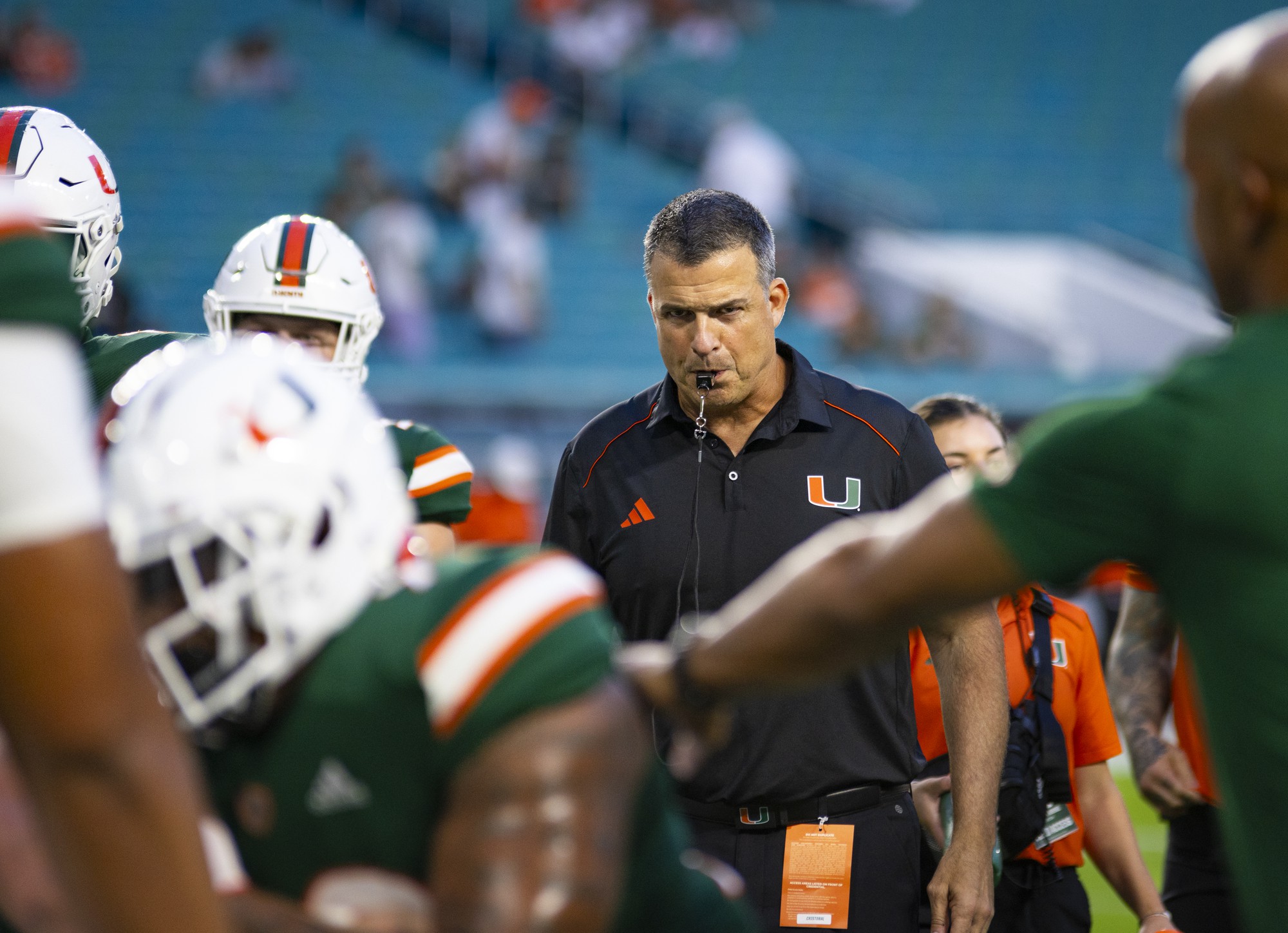
Miami football head coach Mario Cristobal guides players through warm-up drills before their game against Bethune-Cookman at Hard Rock Stadium on Sept. 14, 2023. Photo credit: Alexandra Fisher

What is important to note is that none of the money had been paid out to Lucas, as this was pending the final decision of House V. NCAA, so neither Miami nor Lucas is liable to return any financial compensation to Wisconsin. The Badgers, regardless, have pushed forward with the lawsuit after months of speculation if they would and are backed by the Big Ten.

They officially announced support for Wisconsin, telling Yahoo Sports, “The Big Ten Conference believes that the University of Miami’s actions are irreconcilable with a sustainable college sports framework and is supportive of UW-Madison’s efforts to preserve it.”

The lawsuit states that the Badgers saw Lucas as a cornerstone of their program, leading to their big financial commitment to Lucas. With Miami allegedly swooping in and taking him, not only did that take a big contributor, it disrupted the Badgers’ plans for building their program. 

They allege even more in the lawsuit, claiming that, quote, “in late 2024, Miami continued to recruit a second student-athlete, ‘Student-Athlete B,’ even though Student-Athlete B had made a written commitment to another DI school in late 2024, which commitment had been reflected in the Transfer Portal.” 

The question now is what the potential fallout could be for this case regardless of whether the courts find the allegations against Miami to be true.

For one the NCAA should watch if other student-athletes unenroll and then enroll to avoid the transfer portal. Lucas’ method of getting to Miami could be used in less reasonable circumstances, which would result in chaos between student-athlete and university. Moreover, plenty of student-athletes enter the portal with a “DNC” tag, which means do not contact. In these cases the student-athlete typically already has a school they wish to transfer to, which could lend itself to tampering as the school and athlete often make contact before the athlete enters with a “DNC” tag.

Redshirt sophmore wide receiever Isaiah Horton celebrates after scoring a touchdown in Miami’s game against Virginia Tech at Hard Rock Stadium on Sept. 27, 2024. Photo Credit: Jason Hill – Co-Photo Editor

More importantly, with money officially on the board across the college football landscape, student-athletes are now closer to pros than they have ever been. While they are rightfully earning their share of the pie, the question now is whether these NIL contracts are going to be enforceable and binding. Regardless of whether Miami is at fault, the potential for any team to come in and have similar situations happen is huge for the future of college sports in general. 

As for what this means for Miami, if the allegations are true, Wisconsin is asking for some sort of financial compensation and for the ‘Canes to declare their conduct to be tampering. On the larger scale, it’s uncertain if the NCAA will make an example out of Miami.

When the last situation of this scale happened with the Michigan sign-stealing allegations, the eventual champions faced no repercussions after the NCAA found them to be not guilty. But within the Big Ten, as the investigations continued, both Jim Harbaugh and current head coach Sherrone Moore faced suspensions brought forth by the Big Ten.

With no NCAA investigation currently announced and with this being between conferences, it’s unlikely that Miami, even if found at fault, will face anything more than fines. This could mean more in terms of the team’s reputation, especially at a time when rumored conference realignment or movement could have the ‘Canes looking to places like the Big Ten to get a slice of their lucrative media rights. 

While Miami has yet to officially comment on these allegations, Lucas’ attorney, Heitner, has stated that the intention is still for Lucas to play for the ‘Canes this fall. For the foreseeable future it’s certain to stay that way as the Hurricanes look towards their season starting in just a couple of months. 

Regardless of where this case falls, it will be one of the first big decisions in the post-House v. NCAA landscape, a landmark case in how student-athlete contracts and compensation unfold in the future. 

The Miami Hurricanes take the field at Hard Rock Stadium against the Virginia Tech Hokies on Sept. 28, 2024. // Photo Credit via Emily Rice

Happy birthday, Jeff Baena

Barbara Stern would call her son Jeff Baena, the acclaimed screenwriter who co-wrote “I Heart Huckabees” and “Horse Girl,” at 8:30 p.m. on June 29 every year. It’s the exact minute he was born, a moment she’ll never forget. This year, however, he won’t answer.

Baena, who grew up in Miami, died by suicide in his Los Angeles home on Jan. 3. He was 47. His family and friends were stunned. If you ask his brother, father, mother and childhood friends about their plans to remember Jeff on his birthday, there would be a moment of silence. 

Ever since Jeff moved to Los Angeles in 1999, June 29 was filled with birthday poker nights, chocolate mousse cake and a creepy vintage Cocker Spaniel figurine. 

He made sure all players honored poker rules and that movies were playing so anyone mad about a poker loss could watch.  The dark comedy genius planned for everything. 

Most of Jeff’s family still lives in Miami, yet their grief sent shockwaves to the east coast.

“My parents are still grieving,” Brad Baena, Jeff’s brother, said. “I don’t know what’s going to happen.”

People remembered Jeff as a great host as opposed to the man of the hour at his birthday parties. He shared the spotlight with guests, almost as a grand way of saying ‘thank you.’ 

Clifford Bailey, a lifelong friend, got passed around like a party trick by Jeff. The talented artist would make abstract sketches of guests before getting yanked by Jeff to draw another Oscar nominee. 

“He was saying, ‘Hey Cliff, draw him, draw him, draw her,’” Bailey said. “I got shown around, introduced to a lot of clients. That way, people ended up buying my work.”

He did the same thing at age 16. Jeff would bring friends from Miami Killian High School home unannounced. He’d introduce his troupe to his family as Barbara made impromptu lunch from parmesan, white bread, bologna and American cheese.

She met some of the same friends years later at Los Angeles for Jeff’s celebration of life in April. They reminisced over his endless kindness while climbing the California hills, enjoying one of Jeff’s favorite hobbies: hiking. 

Yet, he never hesitated to kick someone out from the poker table for going too slow during Fern Dells Card Club poker nights. Members would get emails with the date, place and time. Some could bring plus ones, but newbies would have to prove themselves to be invited back.

He gathered high school friends from Miami and Hollywood stars. They would collide and clash over competitive matches. Money was lost. Tears were shed. But the attendance grew. 

“The last person I brought was my wife’s nephew, who just turned 30, and I was scared,” Bailey said. “I told Cameron, ‘Look, just keep the gaming moving. Whatever you do, whatever Jeff says just say, ‘Okay, okay.’” 

Clifford anxiously waited to see if Cameron got the Jeff seal of approval. Was he too slow? Did he cross talk? What if he broke the rules? Wait, what are the rules?

“[Jeff] called me the next week and said, ‘Oh, bring him again.’ Which was rare. He never did that.” Bailey said. “Poor Cameron, he felt so special to be invited back only to have it all end six months later.”

Only, it rarely stopped. The Fern Dells Card Club is as active as ever, minus one seat at the table. Aubrey Plaza, Jeff’s former wife, gave his custom orange chips to the club so they can honor him with every move. 

Jeff’s moves with them were ruthless. It’s better to see Jeff dominate a poker match than win the lottery in Clifford’s book. Yet, both are worth millions.

“I’m just trying to focus on the good times, there were so many of those. I’m not sure what happened there,” Bailey said. “We all thought we had 50 more years of poker ahead of us.”

Jeff would plan games for three nights a week instead of one two weeks leading up to his death. He cracked his jokes and gave members another unforgettable night. Though it became unforgettable for a different reason.

Friends barely saw his pain in those last moments. Not even family.

“My kids love Jeff. He’ll make bras out of napkins. He would do funny stuff and swap faces with them with the phone apps,” Brad said. “I had no idea he was even going through this at that time.”

Looking back, they could see he was in a different headspace. But Jeff was always different. Still, it begs the question: why would he want to make his closest friends lose their last paycheck before his death?

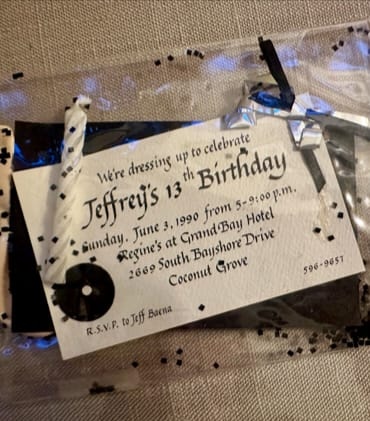
A birthday invitation to a party for Jeff Baena’s 13th birthday made by his mother, Barbara Stern. Photo Courtesy of Barbara Stern.

Despite reaching stardom, Jeff always kept his first friends close. Clifford remembers the prodigy who memorized Steve Martin jokes in his Coral Gables apartment and gifted him a personalized, mixed cassette before leaving to New York University.

Katie Rubin, Jeff’s high school girlfriend, remembers the hot, smart life of the party who, she thought, would never want to date her. She took her shot and hit the bullseye. Annie James, a fellow classmate, planned double dates with the duo. 

“We spent a lot of time in Jeff’s green Jeep driving around Miami to various house parties, beach things and making films,” Rubin said. “He was the guy that pulled everybody together. Everybody was always at Jeff’s house. You wanted to be friends with Jeff.”

Though, Rubin knew there was a different side to him beneath the surface, one that found the backward and forward drives and tense game nights therapeutic. 

“When all the people went away, there was a real kind of sensitivity that was pretty profound that he had,” Rubin said. “Having a lot of people around him helped him keep it light and be less focused on whatever may have been challenging as a sensitive person.”

Passing around a disturbing Cocker Spaniel figurine with freaky eyeballs and real fur with James as a game of tag. Or blushing while his Miami Dade school friends begged him to twerk at his 40th birthday party. 

Playing ping pong. Shooting BB guns. Running away from a mountain lion. Driving to the Keys for Fantasy Fest. The more people, the more smiles Jeff would get to put on peoples’ faces. To Scott Baena, Jeff’s father, that’s all Jeff ever wanted.

“He took great pains at every [movie] preview to meet with the audience for questions and answers, to explain how plots were developed, what didn’t happen in the movie or what did,” Scott said. “He just wanted you to smile.”

June 29, a day usually filled with laughs, now has a bitter sorrow. James stares into her new Cocker Spaniel figurines’, she replaced the old one after not being able to find the original in time for his funeral, creepy, terrifying, spine chilling eyes.

She’s heartbroken that the demon has nowhere else to go, that the game’s over. Now, she can’t sleep at night for a second reason.

“It’s annoying that I can’t speak to him again,” Stern said.

If a magical birthday card could be sent to Jeff to the beyond, it’ll be filled with variations of: I love you, thank you, forgive me and I forgive you. Most of all, “I miss you.”

“I would just hope that he’s having a good celebration,” Brad said. “He’s able to play all the instruments and board games and just be in his element with other people. He’s continuing to do what he loved when he was alive.”

Jeff’s thoughts on the afterlife are debated, yet no one could ignore the paranormal activity at his house. So, Brad doesn’t think he’s seen the last of Jeff.

“If he can just show a sign of himself for his birthday, somehow, through some way, do it.”

Thinking like an engineer

I can’t remember a time when I wasn’t “thinking like an engineer,” even before I had the words to explain it.

I was known for asking a lot of questions – how things worked, why they were built that way and how solutions were interconnected. I was the kind of kid who could spend hours watching videos about how everyday products were made and manufactured. That curiosity only grew with time.

During the COVID-19 pandemic, I came across a story about engineering students designing low-cost ventilators for international communities facing equipment shortages and unreliable electricity. It hit close to home. As someone originally from Caracas, Venezuela, I’ve seen firsthand how power outages and a lack of critical medical equipment can devastate communities. 

That was the moment I realized that engineers were developing the technologies that support billions of lives worldwide. I wanted to be part of that by learning those skills, contributing to that mission and bringing my perspective forward to create meaningful innovation.

In high school, while working part-time at Starbucks, I was drawn to understanding how systems worked behind the scenes. That led me to develop workflows that optimized shift hand-offs and team communication. I didn’t know it yet, but I was already thinking like an engineer.

That curiosity only deepened when I began college. As a student who received a B.S. in Biomedical Engineering and who is pursuing an M.S. in Industrial Engineering at the University of Miami, I started seeing how classroom lessons connected to real-world systems. That same mindset carried into my internships at Medtronic and Stryker, where I worked on cross-functional teams focused on medical device development, optimization and process improvement.

Through research projects, leadership roles and  networking events, I’ve continued to ask questions, challenge assumptions and find  ways to make systems work better.

I’m not alone.

A new report released by the Society of Hispanic Professional Engineers (SHPE) and the Latino Donor Collaborative shows that stories like mine are part of a growing wave. Latino undergraduate engineering enrollment grew by 39% from 2012 to 2022, and engineering degrees awarded to Latinos rose by 57%. Master’s degrees in engineering awarded to Latinos increased by 37% and doctoral engineering enrollment grew by 50%.

As a first-generation college student, I know how overwhelming and confusing navigating college can be without guidance. Getting started early is the key to a student’s success.

To get kids interested in STEM and plant the seeds for higher education, SHPE offers Virtual STEM Labs, which provides K-12 students access to a variety of STEM opportunities and experiences that spark excitement. SHPE’s Equipando Padres program helps families like mine understand how to support their students and access resources they need to succeed in STEM.

Alongside these initiatives, SHPE offers MentorSHPE, that supports personal and professional growth through one-on-one mentorships. InternSHPE, which collaborates with corporate partners to design programming lays a solid foundation for success from the first day of the internship.

These projects have led to SHPE members having a graduation rate of 88%, far above the national average of 50%. As one of those students, I’ve seen how support systems like these make the difference. My journey began with curiosity, but it’s driven by the belief that thoughtful, community-centered engineering can change lives.

Across the country, Hispanic students are ready to lead the next wave of innovation, bringing fresh ideas, cultural perspectives and a commitment to building a better future.

We’re not just entering the workforce. We’re connecting with each other to shape the future.

Andrea Godoy is a fifth-year BS/MS student at the University of Miami, pursuing a B.S. in Biomedical Engineering and M.S. in Industrial Engineering. Born and raised in Caracas, Venezuela, and moving to Miami, FL, at a young age, she is a first-generation college student passionate about engineering solutions that improve lives, especially in underserved communities. Since her freshman year, Andrea has worked as a student assistant in the Office of the Dean at the College of Engineering and has held leadership roles in several student organizations. She has interned at Medtronic and Stryker, contributing to medical device development and process improvement. Andrea also serves as a regional leader for the Society of Hispanic Professional Engineers (SHPE), where she supports chapters across the Southeast and champions access, mentorship, and professional growth for Hispanic students in STEM.


The right move: Donald Trump deserves respect and support for decisive leadership on Middle East

On Saturday, June 21, President Donald Trump announced that the US military coordinated successful airstrikes utilizing B-2 stealth bombers on three of the Iranian regime’s nuclear facilities.

But despite the partisan divides, the nation is grappling with one question – what next? Trump announced a ceasefire just a few days after the strikes, which showed the power of strategic American Diplomacy. However, with both countries seemingly breaking the ceasefire, these next moments should not be about fear, but a call for prudent action.

Various lawmakers have reacted to the strikes, including Senator John Fetterman of Pennsylvania and Senator Rick Scott of Florida, who commended the president’s decision. However, members of both parties have criticized the move, particularly Congresswoman Marjorie Taylor Green who said it was not America’s fight and 2028 presidential hopeful Alexandria Ocasio-Cortez who even called for the impeachment of Trump over the strikes. 

Moving forward, Trump needs to continue applying precise, intelligence-led action against defined targets, such as the remaining nuclear facilities which have already been pointed out, and the eventual ceasefire rather than open ended conflicts.

The president cannot declare war, thanks to Article 1 Section 8 of the U.S. constitution. But he can authorize a military strike on a target as commander in chief. This is the exact power a president should have, despite claims that Trump’s actions violate the constitution. Trump has done nothing illegal nor unconstitutional, and in fact, he has done everything within his power that is granted to him by the constitution. 

For Florida, the repercussions of the conflict are tangible. A B-2 stealth bomber was spotted performing a flyby over the Miami skyline during the Air and Sea show on Memorial Day weekend – reminding citizens and the rest of the world of the formidable might of the American military. While claims that Iran wants to invade the Sunshine State have been debunked, the impact from the conflict is still very real, with UM feeling it in our own backyard.

22 University of Miami students on an internship program in Israel also found themselves caught in the escalating crossfire. With missile sirens in the background, the students were forced to flee their complex in Tel Aviv to the Neveg Desert, where they took a ship to a Cyprus port and were then able to fly home. 

Gov. Ron DeSantis displayed remarkable state leadership when his office arranged for rescue flights to evacuate approximately 1,500 Jewish Americans from Israel back to Florida, including the 22 UM students. The flights were also chartered through Cyprus. This vital operation was executed through the Florida Division of Emergency Management, bringing relief to countless families. The governor also personally greeted evacuees at Tampa International Airport, displaying compassionate and hands on leadership. 

Johan Perez, a resident of Miami Dade County, noted how DeSantis displayed the kind of leadership that this moment calls for. 

“The governor showed the kind of compassion that we want from our leaders,” Perez said, “especially in a time where our politicians try to divide us.”

However, as Israel and Iran continue to fight, the U.S. must also continue to bring peace efforts to the table in order to ensure peace and deter conflict in the middle east. In his part, the president has played it well. Trump took out a major part of Iran’s nuclear armament, which cripples a danger that could put not just Israel or America, but the whole world at risk, and made the effort to bring peace to the region. 

As the nation moves forward, the strategy must be clear: peace through strength and diplomacy. While it may be easy for elected officials in positions of privilege to criticize the hard choice President Trump and his administration made, it is also important to remember that the president would not do this unless it ensures the safety of not only American citizens, but also for citizens around the world.

Let Kai Trump be a student, not a spectacle

0

As UM students headed home for the summer, Kai Trump, one of our future athletes, made headlines for a scary reason. On June 3, a 23-year-old man hopped the gates of President Donald Trump’s Mar-a-Lago estate for a second time, wanting to speak to the president and marry his eldest granddaughter and UM golf commit. 

The UM community must do its part to let Kai Trump be a student, allowing her to attend class and experience a normal college life. The disturbing incident reflects an unfortunate trend in which the families of presidents become targets of public scrutiny, stalking or worse. 

While some of these relatives, like Donald Trump Jr. who even teased a presidential run, ask for the attention– most do not. 

Malia Obama, Barack Obama’s eldest child, faced with a similar situation when she worked as an intern in the Tribeca office in New York. Chelsea Clinton, the only child of Bill Clinton, was called a “dog” at 13 by the late conservative talk show host Rush Limbaugh. The Bush twins, Jenna and Barbara, also faced intense scrutiny during their father George W. Bush’s two terms. The girls were both in college at the time and their activities were heavily documented. 

Kai initially first gained public attention last year when she spoke highly of her grandfather during the Republican National Convention. Despite her debut being political, her content was mostly related to her lifestyle, including golf training, DC trips and other vacations, shying away from the family’s political spotlight. 

It’s important to remember that we are all human. People like Kai, and other political relatives deserve the same respect, privacy and security as everyone else. 

This latest stalking incident is a stark reminder that the university must also be as cooperative as possible with Trump’s security team in order to ensure her safety on campus.

Students should welcome her to the ‘Canes community with open arms, but should also respect her privacy. Doing things like letting her sit with you at lunch or walking with her to class can make her feel right at home

The University of Miami is no stranger to high-profile students, and the school prides itself on being a welcoming and inclusive campus. Let’s rise to that standard by giving Kai Trump the chance to be a member of the Hurricane family, free from the burdens of unwanted attention. We should respect her privacy both on and off campus, as well as supporting the university’s efforts to ensure her safety in light of the alarming breach at Mar-a-Lago. 

If we truly believe in community and respect, let’s show it. Let’s leave Kai Trump alone.

Please please please: is Sabrina Carpenter begging for it?

Sabrina Carpenter’s new album art for ‘Man’s Best Friend’ created the latest social media divide, spurring debate between fans and critics alike. One side argues that the album cover, which features the singer in a short black dress on her knees reaching out to a (presumed) man in a suit while he clutches a fistful of her hair, is degrading to women. People have left comments on her Instagram saying “the image isn’t very empowering to women.” 

Others on X have pointed out the album cover clearly has a satirical tone, playing on the term “bitch” regularly being applied to women. Fans are confused and don’t know which way to sway. 

I do, however, know the following: money talks. 

Carpenter isn’t begging for attention or playing into the patriarchy. Rather, she is carefully crafting a conversation built to generate buzz for her album, and in turn, revenue. 

The 26-year-old American Grammy Award-winning singer, songwriter and actress is known for her big doe eyes and platinum blonde hair. These, along with her short stature give her a certain sense of innocence. Carpenter’s “horny choreography” and figure hugging outfits showcased at her live performances both intrigue audiences and cause us to scratch our heads. 

All of this appeals to America’s guilty pleasure: good girls gone bad. The public focuses on the more sexual aspects of her performance and music. Carpenter is the mirror, showing us our own dirty thoughts and reflection. If controversy is currency, it makes sense that she would use it to her advantage. It is a classic strategy in terms of garnering liquid and social capital. 

I understand some feel that Carpenter’s art sets women back. A large part of the modern feminist movement involves de-centering men and not dressing or acting for the benefit of the male gaze. 

In a New York Times article, Stella Bugbee says Carpenter’s cover art is “very pornographic.” Admittedly, seeing a woman in a position that could be described as degrading doesn’t scream “I am woman, hear me roar.” 

Some of Carpenter’s fans feel differently. 

Ariana Glaser, a UM student and fan of Sabrina’s work for over a decade, feels that “it’s pretty obvious that the album is not catering to men the way people would like to pretend it is … Sabrina has NEVER pandered to men.” 

Sabrina isn’t performing for the male gaze. She is merely capitalizing on what both the public and the algorithms focus on. 

So, if Sabrina isn’t undoing years of feminism, is she catapulting it forward?

Maybe not, but with its general lack of intersectionality and inclusiveness, feminism has more to worry about than the cover art of a traditionally beautiful white woman. 

I believe the cover to be satirical and Sabrina is in on the joke. Men refer to women as “bitches” and dogs as “man’s best friend.” Both revolve around male ownership. Looking at the camera, Sabrina invites the viewer to guess what happens next. Maybe she uses her feminine wiles to get what she wants from the man in the photo. Maybe she is literally taken for a walk. Some fans are speculating that she is the ‘man’ pulling her hair since we can’t see ‘his’ face. Unless she gives us a clear cut answer, we’ll never know. 

The point of the cover art is to start a dialogue, one that translates to likes, views, shares and ultimately dollars. The singer has revamped the discussion of female empowerment while increasing curiosity related to her album “Man’s Best Friend.”

Engagement is the new currency. With over 4.5 million likes on her Instagram post announcing the album, Sabrina likely hears public discourse as background noise while sipping her espresso and counting her coins.

The full story behind UM students caught in Iran-Israel crossfire

It is common for college students to secure summer internships, maybe even one in a different state. What is not common is to have your internship site become a war zone almost overnight. 

For 22 University of Miami students, their summer in Israel has been spent waking up to missile sirens, running to shelters to escape rocket fire and preparing for emergency evacuations.

The young travelers were three weeks into their eight-week Onward Israel internship program when they were caught in the crossfire of a war in the Middle East. Now, they are unable to evacuate the country because of a complete closure of the Israeli and Iranian airspaces. All flights at Tel Aviv’s Ben Gurion International Airport are cancelled indefinitely. 

Israeli Prime Minister Benjamin Netanyahu reported that he believed Tehran was “marching very quickly” towards the development of a nuclear weapon. In response, Israel launched a preemptive strike on Iran last week to prevent further development of uranium-based infrastructure. 

Iran and Israel have since traded repeated strikes, including strikes on the cities of Tehran, Tel Aviv and Haifa.

At the time of publication, at least 24 Israelis and 639 Iranians have been killed, according to NBC News.

The Onward program initially housed participants in Tel Aviv, but relocated them to a more secure location in the Negev Desert after Iranian missiles struck Israel. After the young adults, including the author of this article, were sheltered in place in a hotel there for five nights, they left Israel on a cruise ship to Larnaca, a port on the Mediterranean island of Cyprus. The students will fly back to the U.S. from there.

As of Friday, June 20, Birthright Israel has not given the Onward Miami cohort information about their upcoming flight. 

Ethan Goetz, a junior and chair of programming at UM Hillel, said that it was jarring going from the center of the conflict in Tel Aviv to a more remote location in the Negev. 

“When we got to the [desert hotel] and we didn’t wake up from sirens after the first night, it felt really weird.  In Tel Aviv, we woke up late at night, 1 a.m., 2 a.m. [and] 5 a.m. from sirens,” said Goetz. “Going to the [desert hotel], I felt safer but less connected to the reality of the conflict.”

Before the conflict erupted, the students hoped to further their professional development, build friendships and form a connection with Israel and their Jewish identity.  The Onward program operates under the umbrella of Birthright Israel, a larger nonprofit that brings Jewish people ages 18-26 on a 10-day free trip to the Jewish homeland. 

UM Onward participants have spent more than a month in Israel, initially as a part of UM Hillel’s Birthright trip, then accepting Onward’s internship placements. More than 2,800 students on Birthright Israel programs have been affected by the evacuation. 

The Onward cohort from the Miami-Dade area included 33 participants, composed of students at the University of Miami and Miami residents who attend other Florida schools. 

Miami-Dade Onward cohort gathers before they are unexpectedly forced to evacuate. // Photo credit: Daniella Krasney.

“The University of Miami continues to monitor the situation in Israel and is in constant contact with the facilitators sponsoring the student’s visit to Israel. We are also continuing close communication with state officials to ensure the safe return of the students,” the University of Miami said in a statement.

“The University was notified on June 13 that approximately two dozen University students are currently in Israel, participating in educational programs, including Birthright and Onward Israel, that are not sponsored by or operated by the University. However, the University immediately engaged with campus partners, including Hillel, and state officials to ensure that safe travel for our students back to the United States has been secured.”

University of South Florida junior Noam Benartzy said the program’s cancellation is a massive letdown. 

“I’ve been planning to do Onward this summer since I was a senior in high school,” said the Aventura native. “I’m devastated because the program meant so much to me, and to be in Israel is a feeling that we can never take for granted as Jews.” 

Benartzy’s sister, who currently lives in Tel Aviv, went into labor while the group was in the Dead Sea. 

“My sister gave birth and I had to miss it because the program said it wasn’t safe to be in Tel Aviv anymore. And she gave birth in a hospital basement,” the junior said. “The attacks have already taken so much from me. I feel like everything I had worked for was for nothing.” 

Screenshot of Scanner app shows all missile strike alerts in the last 24 hours as of Friday, June 6 at 6:20 p.m. Israel daylight time. // Photo credit: Daniella Krasney.

Other students faced similar disappointment and fear. 

Ava Perloff, a junior at the University of Miami, was working as a research assistant for the Regenerative Biology and Immunology Department at the Weizmann Institute of Science in Rehovot, a city 12 miles south of Tel Aviv. Perloff said that following drone attacks, she was shocked to learn that the research center was targeted by Iran. 

“I woke up to the news of my work being bombed. The place that became my home for the summer had been destroyed from ballistic missiles,” Perloff said. “What if I was in the building?”

Perloff is a Persian Jew whose family is from Iran. She expressed the dangers of the Iranian regime as echoes of a familiar past.

“The same regime that forced my mother and her family in 1978 to flee from Tehran, Iran has threatened our lives once again,” she said. “Truthfully, my family never fully escaped the dangers of the regime.”

Sydney Bederman is a junior at UM and has been documenting her journey in Israel since the beginning of the program. She says that social media is a strong way to stay connected and educate others. 

“None of my home friends are Jewish, so I hope that my platform informs them and other non-Jews about what’s happening in Israel,” she said. 

From bomb shelter footage to beach days, Bederman’s TikTok page, @sydney_bederman has garnered more than 700,000 views and 500 comments on her travel-style posts. She said that her content attracted pro-Palestinian users, turning her apolitical content into a breeding ground for political engagement. 

“People have been leaving comments like ‘Free Palestine’ even before the conflict with Iran started,” the junior said. “There are so many, and my content is not political at all.”

The Miami Hurricane’s TikTok reporting on the developing crisis drew similar responses.

“Lol why would they even go there… anyways free Palestine,” one user commented on The Hurricane’s TikTok page.

Zander Rappaport, the IACT coordinator at the University of Miami Hillel, says that this political environment is exactly why bringing young Jews to Israel is important.

“People see what’s going on and ask, ‘Why would anyone go to Israel right now?’ But that question misses the point. Students don’t go just for a vacation – they go because Israel is part of who they are,” Rappaport said. “They’re not tourists; they’re young Jews looking to build a real connection to their heritage, their history and their people. That connection doesn’t disappear when things get complicated – if anything, it becomes more real.”

“These programs aren’t just about seeing a place. They’re about helping young Jews understand what it means to be part of something bigger than themselves,” Rappaport said.

Daniella Krasney, author of this article, stands in the lobby of her internship’s building. // Photo credit: Daniella Krasney.

Florida Gov. Ron De Santis has arranged one chartered flight from Cyprus to Tampa, Fla. for Birthright participants that landed Thursday. This comes as U.S. diplomats were already evacuated Wednesday via land routes to Jordan and Egypt. No UM students were on this flight.

The Florida Division of Emergency Management said in a Facebook post that they are “actively coordinating efforts to assist Americans seeking evacuation from the hostile situation in Israel.” 

Birthright Israel has said it will cover all costs associated with accommodations, transportation and travel. 

Despite the uncertainty, the Miami Onward group remains optimistic for the future. Goetz said that he feels closer to his peers than ever. 

“I think this trip has bonded us,” Goetz said. “As American Jews, we don’t really know any of this firsthand. Experiencing it and living it has shown me and the group what Jewish resiliency really means and how strong of a people we are.” 

Birthright CEO Gidi Mark issued a statement when the organization initially sent its first fleet of students on the ship bound for Cyprus. 

“Today we witnessed the true spirit of Birthright Israel – not only as an educational journey, but as a global family committed to the safety and well-being of every participant,” Mark said in the statement. “Our team continues to work around the clock to secure solutions for the remaining participants still in Israel.”

UM students hold up the “U” on Tuesday, June 17. // Photo courtesy of Daniella Krasney.

These students may be facing uncertainty, but Benartzy said these lived experiences aren’t simply setbacks, but a way for students to connect and resonate with their Jewish identity. 

“We’re escaping this country in fear the same way our ancestors have in their homes time and time again,” Benartzy said. “This is a moment in history that won’t be forgotten by me, my family or any Jew.”

Sebastian the Ibis among 5 honored in Mascot Hall of Fame in 2025

Sebastian the Ibis made mascot history on Tuesday morning, joining the Mascot Hall of Fame Class of 2025 on Good Morning America. UM’s iconic ibis is one of five professional and collegiate mascots recognized this year and one of 33 that have been inducted since 2005. 

Sebastian also appeared on the 2020 and 2024 MHOF ballots but did not surpass the 60% of votes required for induction. 

This year, more than 125,000 people voted for their favorite mascot during May’s two-week voting period. The MHOF Executive Committee also casted a vote weighing six times that of the public vote.  

Mercer Peakes, a rising junior studying finance, is surprised that Sebastian was not honored sooner in his career.

“It took them way too long to recognize Sebastian,” Peakes said. “He is one of the most iconic mascots in college athletics. I am happy that he beat out many other big names in the mascot world, such as the Oregon Duck and Big Al for the honor.”  

According to the MHOF website, the initiative aims “to recognize and honor the best of the best mascot characters and programs in existence.”

To qualify for nomination, a mascot must be 10 years old and leave an impact in sports and in their community. 

Caitlyn Freitas, a rising senior studying political science, is excited about Sebastian’s flight to the hall of fame.

“UM has such a unique atmosphere that is hard to encapsulate, but Sebastian represents it perfectly. He commands crowds and always gets us excited about the game,” Freitas said. “It’s incredible that such an important part of our school is being recognized in this way.”

Sebastian’s flair and “C-A-N-E-S” spelling performance have remained constant since his debut in 1956. With his recent engagement to Gigi the Ibis in the Bahamas, Sebastian has been ruffling feathers on the sidelines and on social media, helping secure his spot in the MHOF. 

As Sebastian soars to new levels of fame, fans can continue spotting him at games and around campus, including his regular stops at Lake Osceola for high-fives.

UM students stuck in Israel amid escalating Iran conflict

22 University of Miami students are awaiting evacuation in Israel due to rising tensions between Iran and the Jewish state. 

Participants were three weeks into an Onward Birthright Israel program, an eight-week internship in Tel Aviv. Students were relocated to a more secure location on Saturday, June 14, after escalating strikes between Israeli and Iranian forces. 

“The University of Miami was notified on June 13 that approximately two dozen University students are currently in Israel, participating in educational programs, including Birthright and Onward Israel, that are not sponsored by or operated by the University,” the University of Miami said in a statement. “However, the University immediately engaged with campus partners, including Hillel, and state officials to ensure that safe travel for our students back to the United States has been secured.”

All flights arriving and departing Israel are cancelled indefinitely. Students are scheduled to board a boat from Israel to Cyprus later this week where they will be flown back to the U.S. Participants have not received information regarding their return flights.

“This process could take a number of days, but you will be supported throughout the journey,” Birthright Israel Onward said in an email to participants and families. “What stands foremost in our minds is bringing you home safely — and we’re doing everything possible to ensure that.” 

This is a developing story.

America does not want a king, thousands protest in South Florida

0

Thousands of people across South Florida and Miami-Dade County took to the streets to participate in the “No Kings Day” protest on Saturday. However, Millions more people participated in more than 2,000 protests across the country.

The No Kings protests on Saturday directly followed the protests against the Trump administration’s immigration policies and actions, particularly those in Los Angeles. Organizers planned the mass No Kings protest to fall on President Donald Trump’s birthday parade and the Army’s 250th anniversary. 

The name “No Kings Day” comes from Trump’s Truth Social post celebrating his attempt to end congestion pricing in New York City.

Trump’s post read, “CONGESTION PRICING IS DEAD. Manhattan, and all of New York, is SAVED. LONG LIVE THE KING!”

There were 70 official protests across Florida. Protesters in Miami gathered around the Torch of Friendship on Biscayne Blvd. from 11 a.m. to 2 p.m.. On Miami Beach, protesters gathered at  Pride Park from 11 a.m. to 1 p.m.. 

Approximately 2000 people took part in the protest around the Torch of Friendship.

For rising UM sophomore Ariana Glaser, Trump’s post is one of the many reasons why she decided to join the protest in her home state of New York. 

“I think Donald Trump feeds off of weakness – he feeds off of making civilians feel powerless,” she said. “But by going to these protests and using our voices, we take some of that power back.”

Glaser is not the only one who feels strongly about the Trump administration’s actions. She was joined by about 200 other people in Patchogue, N.Y. despite the rain. Although each sign was different, the message was the same.

“Everyone there was united by love for our country and what we believe it once was, what it still could be,” Glaser said. “It was all just people standing together in the face of fascism.”

While Glaser was joined by people from all walks of life such as teachers, retirees and veterans, there was a notable lack of young people at her protest and many others across the nation. 

“I’d say there were a fair few (young people), even a couple of really young kids,” Glaser said. “There were definitely more older people though.”

Despite this, Glaser is relieved that the older generation is still taking a stand. 

The Patchogue protesters and others across the country protested peacefully. Some organizers even coordinated with law enforcement to ensure a safe and peaceful demonstration.

Before the No Kings protests, multiple police departments across South Florida issued ground rules for what would and would not be tolerated from protesters. Florida Gov. Ron DeSantis also reminded citizens of the state’s law against riots. 

This is an extension of Florida’s “stand your ground” law. This justifies civilians using force, but not deadly force, when they or their property is threatened.

Gov. DeSantis said “If you drive off and you hit one of these people, that’s their fault for impinging on you. You don’t have to sit there and just be a sitting duck and let the mob grab you out of your car and drag you through the streets. You have a right to defend yourself in Florida.”

This intense effort to ensure that the organized protests would be safe and peaceful is in response to the recent anti-ICE riots in Los Angeles. 

Most protests, including those held in South Florida, remained peaceful.

Trump has made no comment regarding the protests other than not feeling like a king in the days leading up to his birthday and the protests. However, he has promised to expand the immigration crackdown in Democratic-led cities since the protests.