Home Blog Page 100

The top five best Miami football jerseys of all time

As football season starts to gain momentum, more and more talk revolves around predictions, and players. 

But one topic that never dies is a team’s fresh fit.

The University of Miami has always been known for cool jerseys, but there is a lot of debate as to which ones are the greatest of all time. 

Whether it’s the older styles that are more “vintage” looking, the modern sharp styles, or rare designs, there are many great Hurricane football jerseys to choose from.

No. 5: “Smoke”

The “Smoke” uniform was released in 2013 for the homecoming game against Virginia Tech.

 It featured a dark gray jersey with matching gray pants. The numbers are in white with an orange outline to match the matte white helmets.

The “Smoke” jerseys symbolized the team “running through the smoke” before a home game. 

Despite the uniform being a one-and-done, fans loved this unique jersey because it contrasted Miami’s usual combos and stood as a symbol of a Hurricanes tradition. 

No. 4 : 1996- 1999 Era

The 1996-1999 jersey style featured a simple design, with basic sleeve striping, a loose cut, and the block number font with a single border. 

The colors featured an orange and white contrast, with orange being the overpowering color. Green served as more of an accent.

These uniforms are often overlooked since they are not associated with a winning streak or any special kind of luck. However, they are still remembered for their classic “retro” style and are often connected to an era of rebuilding for the Hurricanes. 

No. 3: 2000-2003 Era

Many argue the 2000-2003 uniforms are Miami’s greatest jersey. This style has an increased contrast with side panels, a thicker sleeve trim and more visual depth overall.

This style also has a more balanced use of orange, green and white and a more consistent use of the logo with aggressive graphics.

Most fans also appreciate it because of its versatility. It can easily be adapted for more color combos for throwbacks and special designs. 

A jersey from this era is definitely a special part of anyone’s collection.
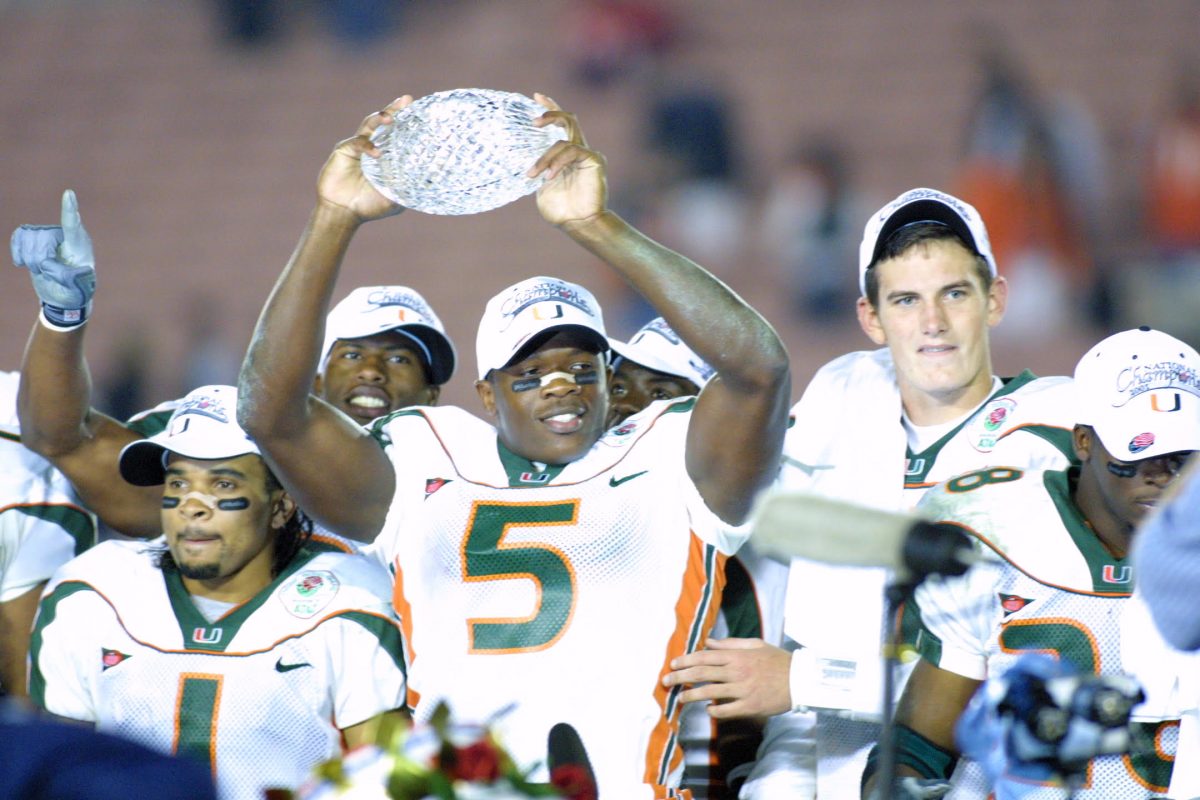
Co-MVP Wide Receiver Andre Johnson hoists the Sears Trophy following the Canes’ 37-14 win over Nebraska in the 2002 Rose Bowl BCS National Championship Game, played on Jan. 3, 2002 in Pasadena, CA. Photo credit: ©JC Ridley/Caneshooter.con

No. 2: “Miami Nights”

A player-favorite, the Hurricanes have rolled out a “Miami Nights” blackout jersey since 2017.

The cohesive green and orange striping down the pants and the helmet makes for a sleek look. 

Also the rare, glow-in-the-dark numbers on this jersey are such a unique feature and one of the reasons why it’s so high on the list. Even the jerseys featuring orange lettering make them stand out.

While the “Miami Nights” are a modern style, they also serve as a symbol of the vibrant city surrounding the University and the culture of many Miami fans.

Junior runningback Damien Martinez runs the football in Miami’s win against FSU on Saturday, Oct. 26, 2024 at Hard Rock Stadium.

No. 1: “Stormtroopers”

The best football jersey in all of UM history is the all white “Stormtrooper” combination.

The clean, modern style is unforgettable and looks sharp on the field. The monochromatic look includes an all white jersey, pants, socks and helmet, with large orange and green striping on both top and bottom, and the helmet. 

It was unveiled in 2014 under Nike as a set, along with other designs called “Juice,” “Surge” and the aforementioned “Smoke.”

The “Stormtrooper” combo has been brought back several times since its release, and is often worn during away games, as white is seen as a “road” color. 

This design easily took the number one spot because people think of it as a good luck combo due to wins against Florida State in 2017 and Louisville in 2020. 

Its sharp, modern look on the field is shown in photos captured from games and the design is easily the most aesthetically pleasing.

Sophomore running back, Mark Fletcher, Jr. smiles after beating the University of Florida Gators at Ben Hill Griffin Stadium on August 31, 2024.

Read this before trying to be the next Alix Earle

0

Ever since former UM student Alix Earle became famous, it seems like the University of Miami has a new influencer on campus every day. With ring lights in dorm rooms and DIMLs (day in my life), influencer culture has become part of campus culture.

For many college students, working a nine-to-five desk job feels outdated and restrictive. It certainly doesn’t help that current job hunts are often long and unsuccessful with limited opportunities according to CBS news.

But, being an influencer is not a sustainable career path for most. Social media should be seen as a tool to complement long-term goals rather than a replacement for them.

The influencer takeover isn’t just a campus trend. A survey by Morning Consult found that 57% of Gen Z say they’d become an influencer if given the chance, a number that has remained consistent since 2019.

Documenting one’s life on TikTok or Instagram offers not just an outlet for creativity, but also the empty promise of flexibility, financial independence and the chance to be your own boss. With overnight stars on platforms like TikTok, it’s easy to see why students believe online fame might offer a faster track to independence than climbing the corporate ladder.

As UM junior Martina Grunwaldt said, “I would [much] rather be able to set my own times and have a job that stimulates my brain in different ways, instead of sitting in front of a computer in an office without any windows.” 

This sentiment has only grown stronger in recent years at UM. The picturesque campus is the perfect backdrop for content creation. In many ways, Miami is the perfect place to live out the influencer dream.

Yet behind the polished filters and carefully curated captions lies a much harsher reality: being an influencer is hard. It demands relentless consistency, creativity under pressure and a willingness to share personal moments with thousands of strangers. 

The supposed freedom often comes at the cost of privacy, mental health and stability. Top creators may earn six-figure incomes, but the rest struggle to make a living. A 2025 report from the Influencer Marketing Hub found that more than half of content creators make less than $15,000 annually.

The influencer economy is extremely overcrowded. For every student who “makes it big,” there are countless others producing content for little return. What may begin as a side hustle can quickly become a source of burnout, as algorithms change and audiences move on.

The hours are not that different from that of a corporate job. TikTokker Hannah Williams described working from 8 a.m. to midnight every day just to maintain her content and brand partnerships, earning around $125,000 a year. She’s not alone. Other creators have expressed similar struggles, pointing out how pressure to stay relevant leaves little room for anything else.

Even students experimenting with influencing on campus acknowledge the strain. “At first it felt exciting, but it turned into pressure,” said one UM senior with more than 15k followers. “I check views constantly, posting when I don’t feel like it. It’s not fun for me anymore.”

There are positives though. Students at UM are developing entrepreneurial skills. They learn to  market themselves, build brands and they can even sometimes earn supplementary income through sponsorships or affiliate partnerships. In many cases, social media has become a platform where students experiment with storytelling, design and digital strategy — skills that carry over into a range of industries.

But this comes at a cost. The emphasis on image can distort priorities, shifting focus from academics and long-term goals to short-term validation. Students may compare themselves to peers who appear effortlessly successful online without recognizing the invisible labor and pressure behind the scenes. Burnout among creators is on the rise. A recent WIRED report highlighted how influencers are increasingly turning to therapy, citing migraines, exhaustion and stress from living “always online.”

While influencer work may lead to a sustainable career for a small percentage, for most it is unlikely to replace the stability of more traditional paths. Instead, it may be more useful to see social media not as an end goal, but as a tool that can complement other professional endeavors, whether building a business, advocating for causes or enhancing a professional profile.

Influencer culture is more than just a trend. It reflects a generational shift in how young people view work, ambition and identity. At UM, students are not just chasing likes, they’re trying to figure out what kind of life they want to build. While social media offers exciting opportunities, it is important to prioritize long-term goals over five seconds of fame.

Bikinis over boots? Tailgates say so

0

Required UM football game attire: girls in bikinis and guys with no shirts. UM game-days look bolder and less traditional than what you’ll see at other schools like FSU or UF. While others dismiss it as immodest or juvenile, they’re not getting the idea — the immodesty is the whole point. 

College is meant to be fun and expressive, and Miami’s heat makes outfits both natural and practical. While SEC and Florida schools may have distinct fashion for game day, we all know UM does it best. 

“Get ready with me for game day” on TikTok is where students find inspiration for their look. Bright orange and green bikinis with glittery mini skirts and sunglasses is the typical outfit. Everyone is in swimwear, yet no one actually gets in the pool at the frat parties. UM signals beach energy without getting their hair wet. It reflects the UM vibe of color and a long day by the sun. 

UM fashion is tailored around the humid Miami climate. When it rains, most just put a poncho over their outfit because it’s never cold. The sun just comes right back and the heat never leaves. 

Flashy and bold prints are part of the game and college lifestyle at UM. Students aren’t afraid of pushing boundaries and setting trends for fun. Green and orange aren’t easy colors to style. UM gets creative with rhinestones, glitter and mismatching basics with statement pieces. It’s artistic and filled with personal style that gives the Miami vibe. 

A city filled with so much art and expression is reflected in the fashion statements even at a college football game. Most find it empowering and practical. Tailgates can be messy and crowded, you don’t want to ruin your good boots or nice dress. 

At other schools, the outfits make it feel more like a fancy event rather than a football game day. No one should be in heels and pearls while watching guys tackle each other. 

Other schools find their outfits to fit their environment which could be more put together like Alabama State or more artsy like Tulane. Every college has different norms and game day fashion, and that’s okay, but it’s clear that no one is doing it like us.

The overrated obsession with Labubus

0

Everywhere you look, Labubus are taking over. On TikTok, unboxing videos rack up millions of views. On campus, it seems every other student has one dangling from a backpack or displayed on a dorm shelf. Even walking through Miami, it is hard to miss people discussing the latest release like it is a cultural milestone.

At the end of the day, Labubus are not “legendary.” They are overhyped.

Retailers have struggled to keep up with the craze. Online drops sell out in minutes, leaving fans scrambling for limited stock. Labubu, created by Hong Kong artist Kasing Lung for Pop Mart’s “The Monsters” series, features the “ugly-cute” aesthetic with oversized ears, wide eyes and a toothy grin. The quirky design is part of the appeal, but critics say it takes more than odd charm to justify the obsession.

Some consumers argue the fascination has less to do with artistry and more with manufactured hype. Limited-edition releases, influencer promotions, and TikTok’s recommendation algorithms push Labubus into the spotlight, creating a cycle where demand is driven more by fear of missing out than genuine appreciation. This reality fuels demand, turning Labubus into not just collectibles, but status symbols among students and young adults.

Jerald Moriarty, a freshman at UM, said he does not buy into the craze. He views Labubus as a passing fad, propped up by social media hype rather than lasting value. While some see the figures’ design as collectible art, Moriarty considers them another example of social media fueling unnecessary obsession.

“I do not think Labubus are actually cool,” he said. “I think it is just a bandwagon that everyone jumps on when trends happen on TikTok.”

Cost is another factor. Labubus are not cheap. According to Pop Mart’s U.S. website, figurines start around $45, with resellers often charging significantly more. For some, the price is justified for a collectible, but for others it raises questions about whether the hype inflates value.

Moriarty also pointed to the environmental impact. The plastic figures and packaging contribute to growing concerns over waste from mass-produced collectibles.

“At first, it made me want to buy a Labubu,” he said. “But then I realized I should not be spending money on a toy that creates so much pollution and excess plastic.”

He added that the figures are “overpriced and overrated” given the minimal cost to produce them. To him, the frenzy feels like a scam, with buyers paying far more than the toys are actually worth.

Critics note that the Labubu craze mirrors other viral materialistic trends, from sneaker drops to collectible clothing. Once reselling dominates the market, the product often becomes more about status than substance.

Much of the craze comes from Pop Mart’s “blind box” model, where customers do not know which character they will get until they open the packaging. The surprise element is exciting, but it is also a strategic marketing tool that keeps consumers buying more to chase the character they want.

This pattern is familiar in pop culture. Collectibles often surge in popularity, drawing young fans into frenzies over the next must-have item, only to fade when something new emerges. Beanie Babies, Webkinz, and Shopkins were once the craze, only to be replaced by the next trendy toy. Labubus appear to be following the same trajectory. The excitement is less about the product itself and more about the hype surrounding it.

Some students see the trend clearly. Kayla Collins, a UM senior, said she does not find Labubus particularly appealing.

“I personally do not find them that cute or cool, but they fall into the ‘so ugly it’s cute’ category,” Collins said. “They are definitely overhyped online, since Pop Mart has many other characters and plushies that are just as appealing, if not more.”

The online component is key. TikTok has fueled the craze by turning Labubus into more than figurines. Videos show users dressing them up in outfits, including the viral 24-karat Labubu clip. Collins said influencer content makes the toys more appealing, but she remains unconvinced.

“The idea of dressing them up is creative and adds appeal, but I do not feel pressured to buy one,” she said. “It is interesting to watch, but not enough to make me participate in the trend.”

Collins also compared the blind box model to gambling. Buyers spend money without guarantees, much like placing a bet.

“Blind boxes are basically a form of gambling,” she said. “The surprise factor triggers a dopamine response if you get the one you wanted. It is fun, but it is also very intentional marketing.”

The hype raises broader concerns about consumerism and social pressure. With resale prices often far above the $45 retail cost, the trend can feel less like a hobby and more like a status game, leaving some students feeling excluded if they cannot keep up.

Still, some genuinely enjoy Labubus for their creativity and design. Collins noted that in Taiwan, where Pop Mart originated, prices are lower and the toys are more accessible. Even so, she admitted much of the hype comes from wanting to be part of the trend.

Labubus are a fad powered by social media, clever marketing, and human desire to belong. They are fun in the moment, but they are not the cultural icons people make them out to be. In a few years, they will likely join Beanie Babies and Shopkins in the nostalgia bin of trends that once seemed inescapable.

Watching the craze unfold can be entertaining, but I will be skipping the next drop. Not because I am out of the loop, but because I would rather invest my money and time into something that genuinely excites me.

At the end of the day, Labubus are not legendary. They are another viral toy dressed up as a must-have collectible.

The plastic surgery pandemic

Have you ever wished you were prettier?

Body dissatisfaction is so common among women that researchers call it “normative discontentment.” 

Right now, more people than ever are seeing cosmetic surgery as the solution. In the U.S., between 2000 and 2009, there was a 69% increase in elective cosmetic surgery procedures performed by the American Society of Plastic Surgeons. Globally, the International Society of Aesthetic Plastic Surgery estimates that the number of cosmetic procedures increased by at least 10.9 million from 2010 to 2019. 

By framing cosmetic surgery as self-improvement, individuals perpetuate the idea that certain natural physical traits are undesirable and need to be fixed. Cosmetic surgery violently upholds the patriarchal beauty standard and normalizes the idea that beauty is synonymous with success. 

In the past, cosmetic surgery has been primarily associated with middle-aged patients. Today, many cosmetic surgery patients are younger. Surveys of college students indicate that between 21 and 43% are interested in getting cosmetic surgery.

Recently, the UM cheer and dance teams partnered on social media with Selfie Aesthetic, an injectable center. While it is not the responsibility of any individual woman or group of women to dismantle toxic beauty culture, to see UM groups promoting cosmetic surgery is disheartening. The UM cheer and dance teams are role models in the community, running a junior cheer program for children. 

Young people are easily influenced by public figures. In 2015, Kylie Jenner’s makeup brand Kylie Cosmetics started selling Lip Kits and collected $420 million in sales in the first 18 months. In that same year, there was a nine percent uptick in lip enhancements among 13 to 19 year olds alone. 

Cosmetic surgery has become so normalized that even children subscribe to the idea that their bodies are in need of “fixing.” This disturbing trend indicates that we are heading towards a society where existing the way that we are born is no longer acceptable.

Dr. Kelly Killeen, a plastic surgeon based in Beverly Hills, Calif., says the trend is growing. 

“I’m seeing so many patients coming in with, like, a Burger King order,” Killeen said. “They’re like, ‘I want the Kylie Jenner.’”

Beauty can result in certain socioeconomic benefits, such as higher income, but endlessly chasing a materialistically “better” life will not result in long-term fulfillment. The consequences of strengthening a system that attempts to reduce our value to our appearance outweigh the potential benefits from being seen as slightly more attractive.

Though the desire to become more attractive is not unique to women, the normalization of cosmetic surgery uniquely impacts women. Several studies show that women are significantly more likely to consider having cosmetic surgery than men, an idea that is supported by the female-to-male patient ratio derived from ASPS data. 

Participants in a research study published by the International Journal of Psychology were asked to rate statements such as “swearing and obscenity are more repulsive in the speech of a woman than a man” and “I have sometimes thought about having cosmetic surgery” on a four-point scale, one for strongly agree and four for strongly disagree. The study found that stronger consideration of cosmetic surgery for oneself and one’s partner is correlated with sexist attitudes. 

Despite earning roughly $15,000 less in median income, women spend about $1,000 more per year on beauty products and services than men. For women, there is a much higher pressure to be beautiful.

Achieving the current beauty standard is impossible. 

Media coverage of celebrities’ procedures promotes the idea that cosmetic surgery is a necessary step in the pursuit of an ideal body. Trendy phrases such as “eyebrow blindness,” “legging legs,” “cortisol face” and “facial harmony” propel individuals towards developing new insecurities. 

Societal norms make women especially susceptible to body insecurity. Objectification theory proposes that women are primarily valued based on their physical appearances, which causes them to look at themselves in the same way. 

The cosmetic surgery industry spills blood to uphold the standard that women need to look a certain way to be accepted. In order to resist this idea, we must reject cosmetic surgery.

Debra Gimlin, a professor of sociology at the University of Aberdeen and the author of ‘Body Work,’ notes that in contemporary society, women view their bodies as projects to be improved by exercise, dieting, make-up, hair styling, cosmetic surgery and other external procedures. 

It can make sense to put plastic surgery in the same category as other transformative, expensive methods of pursuing beauty, such as dying hair or getting acrylic nails. But there is something viscerally sinister about using surgery, which is typically performed to cure medical issues, to “correct” fully functioning features. 

Before you subject yourself to the surgeon’s scalpel, take a moment to listen to the voice inside of you saying, “You are alive. Your body is not a project.”

The ‘Sunshine State’ is not living up to its name

0

Consistent umbrella carrying, rainboots and puddle-avoiding walks to class are not quite the image the “Sunshine State” sells, but it is what University of Miami’s students must endure this hurricane season. 

With students constantly being caught in the rain, UM’s 68% out-of-state student population is easy to spot. They have yet to learn that Florida’s rain will simply appear whenever it wants and it won’t ever stop. Watching students tiptoeing through puddles while attempting but failing to confine themselves to fit under their school bags is almost laughable. 

That’s why learning how to dress, prepare and adapt to Miami’s unpredictable downpours isn’t just useful — it’s essential for surviving hurricane season as a UM student.

Many students haven’t had to be conscious of the weather throughout their life, but in Miami you have to adjust fast. Obliviousness to the weather is not an option here, staying dry means staying aware. One second you could be tanning and in the blink of an eye, the lightning alarm sounds. 

As a California native, to me, rain automatically means I get to wear a hoodie and sweatpants. However, the mix of humidity and rainfall in Florida makes dressing appropriately confusing, and getting ready seems like an impossible balancing act.

Swapping out heavy cottons and polyesters for linens or moisture-wicking athletic clothing is key in this type of rain. Ensure that your clothing is composed of light, breathable fabrics that can get wet and are comfortable in the Miami heat. While these types of clothing may fall out of favor among fashion enthusiasts, accessories can elevate any outfit. Whether it be jewelry, a cute belt, a head scarf or a fun pair of socks, there is no excuse not to let your personal style shine. Accessories allow a fun way to add your personal style to what could be deemed as a previously basic outfit.

UM students must always carry an umbrella and a compact poncho whether the forecast is rainy or not. “U.S. scientists, including NOAA, are forecasting an above-normal 2025 Atlantic hurricane season, with 13-19 named storms, 6-10 hurricanes, and 3-5 major hurricanes.” So while carrying these items around may feel trivial, especially this erratic hurricane season, it is essential to stay dry.

Leathers and suedes are both fabrics that absorb water, so when they get wet, their quality is ruined. While avoiding leather and suedes should be common rain etiquette, that would be naive to the number of leather totes used by students as school bags. 

Purchasing a waterproofing spray to protect luxury items should be the standard. Whether it be Golden Goose’s or Goyard’s, leather and suede goods are an investment and should be treated as such. Simple maintenance tools can be bought for $16.99 on Amazon. So please, skip one trip to Pura Vida and protect your belongings.

Surviving this hurricane season isn’t about luck, it’s about habit. An umbrella, light breathable fabrics and a little waterproofing spray can make the difference between appearing put-together or drenched. With Miami’s unpredictable rainfall, make checking the weather part of your routine before stepping out the door.

The decline of good TV fashion

If you’ve been keeping up with today’s latest shows like “The Summer I Turned Pretty” and “My Life with the Walter Boys,” then you’re no stranger to their recent fashion flops. Belly’s prom-dress-turned-wedding-gown and Jackie’s business formal first day fit show just how far removed we are from the iconic fashions from “Sex and the City” and “Gossip Girl.”

When you look back at characters like Carrie Bradshaw, Rachel Green and Blair Waldorf, it’s clear that modern TV fashion is no longer trend-worthy in comparison to the icons of the early 2000’s.

According to InStyle, Rachel Green’s iconic use of print, slip dresses and baby tees in the show “Friends” are still trendy today, and have shown up in dozens of recent fashion trends. The “Rachel Green Haircut” also circulated social media earlier this year, leaving girls across TikTok running to their local hair salon for a trim. 

Monica and Rachel’s use of baby tees and chic office-style are something I see mixed into almost every college girl’s closet, and never go out of style. 

Another fashion icon of the 2000s we all know and love is Carrie Bradshaw. While most people know her for chasing her situationship Big across Paris, Carrie’s unique fashion choices and extensive shoe collection made her one of the best-dressed women on TV. 

British Vogue said that trends we see today such as name plate necklaces, tube tops and the “little black dress” were all made popular by Carrie herself. 

It’s like she said, “I like my money where I can see it, hanging in my closet.” 

More recent shows seem to have missed the memo on what teens and young adults are actually wearing these days. 

Belly, the star of Amazon Prime’s “The Summer I Turned Pretty,” has rightfully been under some scrutiny for her extremely questionable fashion choices. 

For starters, no matter how much of a broke college student Belly is, a silk, white prom dress is never acceptable for your own wedding. According to TikTok users @silverliningsplaybooks and @teamconniebabyforever1, fans felt that Belly’s outfits were too immature for someone in their early twenties and not representative of what people her age actually wear. 

We also need to address the awful disco party outfit she wore in season 2. I know it might be a controversial take, but come on. If you saw anyone wearing an outfit like that to a costume party, you’d probably also see them getting hated on all over YikYak the next morning. 

Shows like “Never Have I Ever,” “My Life with the Walter Boys” and “Riverdale” also sparked some commentary from viewers who argued that “there are more problems with how [the teens] look” than with their actual portrayal of the character. 

While there are definitely shows that got it right like “Outer Banks” and “Gossip Girl,” I wouldn’t be caught dead in half of the outfits I’ve seen some characters wear, and I’m not the only one who thinks so. 

“The clothes they dress teenagers in is ridiculous. It’s not representative of teenagers at all. Nobody wears that. It’s so annoying, how hard is it to get it right?” said Isa Molliner, a junior here at UM. 

Lets just hope that future costume designers will finally get it right and show what their viewers are actually wearing. I think it’s time they started visiting real school campuses to avoid dressing their characters in an embarrassment of an outfit. 

How UM student Mia Housman is giving you the mic on her podcast ‘By Popular Demand’

Struggling to find something to listen to on the way to class? Want to learn about topics you actually care about? 

Good thing one of your very own ’Canes has decided to bless your ears and fill that awkward silence with her latest endeavor — a brand-new podcast called “By Popular Demand” with Mia Housman.

This isn’t your run-of-the-mill yap-fest podcast. This is a show designed, “for you, by you.”

Meet Housman: 21, from Framingham, Massachusetts. She’s a broadcast journalism major with minors in marketing and sports Administration. In four years, she’s built an impressive résumé at UM.

She’s been a junior reporter, lead reporter, host of Inside Pitch, women’s basketball analyst on Hurricane Hangtime, a package reporter for Pulse and now, co-anchor of UMTV’s Sportsdesk. 

And if her experience isn’t enough, trust me she’s got the voice for it.

The podcast wasn’t something Mia had been planning for months. Instead, it grew out of a chance moment. A friend was heading to a podcast meeting, and Mia tagged along. Sitting there, listening to other students pitch their ideas, she thought about how she could make hers stand out.

What she came up with: an audience-driven podcast where topics are chosen biweekly from a spin wheel. The result is a show that’s unpredictable, interactive and designed to spark conversations. 

“It’s barely started, and I already have people begging to be on the pod,” Housman said. She’s dreamed of making a space where the audience feels welcome to share their own opinions.

At its core, “By Popular Demand” is about community. It’s a passion project for Housman, one she hopes will keep growing and evolving as more students get involved. Every episode brings something new, inspired by the masses.

The next episode? A conversation on “Living in Spain: An Abroad Experience,” featuring two UM seniors as special guests..

Episodes drop biweekly, and you can find “By Popular Demand” streaming on Spotify. She has plans to expand to YouTube soon.

For Housman, this podcast is more than a hobby.  It’s a creative outlet, a way to foster new ideas and, most importantly, a community-building project. 

“Because it’s audience-driven, it matters so much that people are engaged,” Housman said. “It would be so fun to see this continue to grow.”

“By Popular Demand” is just getting started, but Mia’s passion and the podcast’s unique, student-driven concept make it clear that this is one to tune into.

UM alum launches Formatr app to ease citation stress

University of Miami alum Kyle Griffith, class of 2007, launched Formatr, an app designed to simplify academic formatting for students and researchers on July 25.  

Griffith studied architectural engineering at UM and now teaches entrepreneurship at Syracuse University. He said the idea for the app dates back to his own struggles with lost files during late nights in UM’s engineering labs. 

One night, he accidentally deleted an entire project from a flash drive and realized the importance of having a reliable academic workspace proved necessary. 

“After a quick panic attack and some coffee-fueled all nighters, I realized having a single place to store my academic work would be a lifesaver,” Griffith said.

Formatr is designed to be exactly that. The app is a centralized hub where students can store papers, auto generate citations in all major styles and even receive submission reminders. The app runs on an AI model trained specifically for academic use and is currently free for students on the App Store and Google Play.

Griffith hopes that Formatr will give students back what they need most: time.

“We spend so much of our academic lives worrying about how our assignments look, oftentimes forgetting what we have to say is most important,” Griffith said. “Formatr eliminates all that.”

The app isn’t just for students. Griffith noted that researchers often lose valuable hours re-formating manuscripts for different journals. By automating the process, Formatr allows academics to focus on their ideas instead of the fine print.

Griffith also shared advice for current Hurricanes interested in launching products of their own. First, take a hard look at your everyday life and see what’s something you and other people struggle with daily. Then, create a solution and complete the paperwork for the product early. Avoid perfectionism and listen to your customers to make improvements once it’s out.

Griffith is preparing for the next stage of growth and fundraising. He hopes UM students will see his journey as proof that a simple observation can turn into a real venture.

“UM taught me to look at challenges differently,” he said. “That perspective helped me create Formatr, and I hope it inspires others to do the same.”

Inside the rise of the UMiami fashion and luxury club

Without a fashion major to guide them, University of Miami students have created their own pathway into the industry. 

The Fashion and Luxury Club is one of UM’s fastest-growing student organizations, providing a space for those interested in style, design and business to connect with one another and with professionals. 

“The club is a way to create a community of like-minded students who can meet each other, meet industry leaders and get more insight into what it takes to get your foot in the door,” said the club’s president, Helena López, a junior studying business management.The club began as a small group but has since grown significantly alongside student interest in fashion. 

“As the interest of students has grown, the club has gained a lot of traction,” López said. “Now, we’re able to host events that are actually valuable networking points for students.” 

That shift was evident last spring, when alum Marissa Menist, now brand manager for New Yorker Nowhere came back to campus to talk about her career. For members, it was a glimpse of how quickly a UM graduate could transition into a prominent role in the industry.  

This semester, the club is innovating with a partnership with URBN, the parent company of Urban Outfitters, Anthropologie and Free People. 

The collaboration includes a two-day event that features an information  session followed by on-campus interviews. Beyond partnerships, the club emphasizes student engagement. General body meetings and events such as fashion-themed trivia nights provide members with opportunities to discuss industry trends and build community. 

López described the group as “passionate, driven and a combination of creative and analytical,” reflecting the skills necessary to succeed in fashion. 

The club’s growing presence has even drawn the attention of a renowned fashion company, which recently reached out about a  potential collaboration. Since they’re reviewing their collaboration contract, the company is confidential, but López can barely hide her excitement. 

For López, that email was unforgettable. “That was kind of a pinch-me moment,” López said. “I never thought such a huge brand would want to work with us. It made me realize this is a meaningful organization that can have a big impact.” 

The club aims to expand its professional programming. In October, it will welcome fashion entrepreneur Zoila Castro, founder of her own marketing agencies, Nomad Agency, Marketing Besties and Bts Bridal Besties. Her talk will provide students with insight into the challenges of building a career in an industry known for its competitiveness.  

The Fashion and Luxury Club has become more than an extracurricular activity. It is a platform where interests become opportunities and conversations about fashion lead to real connections. 

“We want to be that gateway between the industry and the students,” López said. “Not just a space for conversation, but a place that actually helps people get where they want to go.”

Rained out? Here’s your UM guide to rainy days

If it feels like Miami has been stuck under a never-ending rain cloud recently, you’re not wrong. From buying a new travel size umbrella to getting your sneakers soaked in the flooded sidewalks, the daily downpours in Miami have been hard to escape. But rainy days don’t have to be dreadful when you know how to make the most of them.

Study with a view

When the orange umbrella chairs at the Lakeside Patio are flooded, head to the Shalala Student Center or library for your study sesh. Susan Fleischner Kornspan Study Lounge on the first floor of Shalala is the perfect quiet study place with super comfortable couches. 

Take shelter in the Herbert Wellness Center

When it’s too rainy to go on your usual hot girl walk outside, the Herbert Wellness Center is the perfect alternative. The Wellness Center offers plenty of workout alternatives like cycle classes, yoga sculpt, zumba and more. Check out the fall group fitness schedule at their website. 

Do a café crawl

On rainy days, coffee and pastries in Coral Gables are the perfect combination. 

Start with Panther Coffee in Coconut Grove — known for their strong brews and plenty of tables for studying. Next, head over to Café Demetrio in downtown Coral Gables for some pastries and cozy vibes.

All Day Miami in Brickell is another perfect choice if you love a flat white and want more of a Miami vibe.

Shopping at Brickell City Centre or Design District

Think you can take on the rain? Head over to Brickell City Centre — a half indoor and half outdoor mall with four levels of shops, restaurants and a movie theater. If you want more of a high-end option, head to the Design District to explore. 

If Gucci and Louis Vuitton aren’t in your budget right now, you can still enjoy the art installations, galleries and cafés in the area. 

Have a spa day

Use the rainy day as an excuse to do some self-care. Book that massage, facial, hair or nail appointment that you’ve been putting off. If you don’t feel like venturing too far, GoldenTouch Cuts on campus does both haircuts and nails.

There are countless hair, nails, skincare and spas around Miami to test out. Flawless by Melissa Fox is on the pricier end, but if you’re looking for a relaxing massage, facial or blowout, this is the place to go. 

Explore Miami’s cultural side

If you’re looking for something a little more educational, head over to the Pérez Art Museum where you can explore contemporary art, large scale installations and their newest exhibits. 

There are plenty of indoor exhibits and a café that provide an escape from the gloomy weather. Tickets are only $14 for students who show their school ID. 

Another option is the Vizcaya Museum and Gardens, where you can get a glimpse into Miami’s history through the European inspired architecture and enjoy the variety of art. Even if the gardens are muddy from the rain, there is still plenty of art and architecture to keep you entertained. 

No shame if productivity isn’t in the forecast for you on a rainy day. Feel free to grab some snacks and let Netflix keep you company.

From food truck dream to campus favorite: Ricky’s Cafe at UM

If you haven’t heard already, the University of Miami is now home to Ricky’s Cafe, a food truck serving carefully crafted drinks and baked goods.

The cafe’s story begins on a first date. When Nathalie Moreno asked her future husband Ricky about his dream, he didn’t hesitate. He told her he wanted to share his food with the world. That conversation planted the seed for what would eventually become a labor of love and a campus favorite.

Anniel “Ricky” Chapel immigrated to the United States from Cuba at the age of two. He began working in kitchens at 14, learning from cooks and experimenting out of sheer curiosity. Without any formal culinary training, he developed his style through trial, error and a passion for feeding others.

“We’ve had to adapt constantly,” Moreno said. “It started as just the two of us and now we’ve been able to bring on a barista and a line cook. But it’s still very much a small operation.”

Moreno, a Miami native and daughter of Ecuadorian and Cuban immigrants, became the other half of the dream. With a background in graphic design from Parsons School of Design, she created the truck’s logo, branding and social media presence. Beyond design, she also manages bookkeeping, licensing and paperwork, ensuring the business runs as smoothly on paper as it does behind the counter.

The road to Ricky’s wasn’t always easy. In 2023, the couple poured their savings into a food truck that first served pizza in Hialeah. After settling in Allapattah, they faced an unexpected break-in that led to the realization that the couple had to change their products to something that didn’t require cooking late into the night.

By spring of 2024, Ricky’s had reinvented itself on UM’s campus, shifting from pizza and bagels to specialty coffee, matcha drinks, baked goods and focaccia sandwiches. Listening closely to student feedback, Chapel and Moreno fine-tuned their menu until it reflected what students craved most.

“It feels like we have a little community here on campus,” Moreno said. “My favorite part is getting to know people’s names and orders.”

Part of what makes Ricky’s unique is its dedication to sourcing quality ingredients. For the coffee, Moreno insisted on using beans from Panther Coffee, a locally based roastery she loved during college. It was a choice that honored Miami’s vibrant coffee culture while also keeping the business rooted in the community.

Despite its growth, Ricky’s has never relied on flashy marketing. The owners never paid an influencer for promotion. Instead, they launched a student-friendly “coffee happy hour” to make their drinks more affordable and encourage newcomers to give them a try. Word of mouth has done the rest.

For Chapel and Moreno, Ricky’s is both a dream realized and a stepping stone. Their ambitions are simple yet heartfelt: pay off their loans and one day open a brick-and-mortar cafe. Until then, they’re pouring everything into the truck, building relationships one cup of coffee at a time.

Next time you find yourself rushing between classes, follow the line of students to the truck outside the School of Communication. Whether it’s for a cappuccino, a matcha or a sandwich that tastes like it was made just for you, you’ll discover that Ricky’s isn’t only about coffee, it’s about connection.