Campus valet service starts to aid parking issues

The Office of Parking and Transportation announced a new valet service on campus via email on March 5.

Services paused over spring break and resumed on March 16, when campus reopened.

The two valet stands are located at Cesarano Plaza on University Drive near the Miami Herbert Business School and Gusman Concert Hall on Miller Drive and operate from 8 a.m. to 6 p.m. 

According to the University, the valet service is available to students, faculty,staff and those with and without permits. 

The valet charge depends on length of stay, starting at $8 for under an hour of parking, and up to $32 for three or more hours of parking. These charges do not include tax or tip. 

Permit color zones do not apply when using the valet, because the parking permits and valet service operate independently. 

The exchange is completely contactless from payment to requesting your vehicle. Payment is accepted at pickup by either apple pay or card. Valet guests can also request your vehicle remotely from your phone.

This new campus service is a pilot, meaning it will be tested for the rest of the semester. Its purpose is to reduce traffic congestion and parking delays around campus.

Towne Park is the company that the University is in partnership with to begin this valet service. The company started in Annapolis in 1988 and has been a recognized national leader since then.

Sebastian Garcia, a Towne Park employee and parking attendee, said, “As of right now we have gotten a little bit of movement on both Miller Drive and Cesarano Plaza. It’s looking to be a successful project.” 

Garcia explains that Towne Park is working on adding amenities like monthly valet passes for students and faculty.

The service will conclude in May where it will then be evaluated on its effectiveness through usage data and community feedback in order to decide if it will remain on campus or expand.

‘One Battle After Another’ wins big at the 98th Academy Awards

Hollywood’s biggest night took place on Sunday, March 15 at the Dolby Theatre in Los Angeles, California. Going into the night, Ryan Coogler’s “Sinners” was expected to win big as it broke the record for most nominations with sixteen, breaking the previous record of fourteen.

Paul Thomas Anderson’s “One Battle After Another” won many precursor awards, such as the BAFTA for Best Film, the Golden Globe for Best Motion Picture, and the Critics Choice Award for Best Picture.

Despite these major wins, many still believed “Sinners” had a shot at the elusive Best Picture award, but Anderson’s film ultimately took it home.

There was never much of a discussion when it came to who deserved the Best Actress award. 

While Emma Stone’s performance in “Bugonia” and Rose Byrne’s in “If I Had Legs I’d Kick You” captured audiences, none of them were on the same level as Jessie Buckley’s portrayal of Shakespeare’s wife Agnes in “Hamnet.” 

Her harrowing performance caused her to sweep the precursors, leaving no debate for who deserved the Academy Award. The Irish actress proudly took home her first Oscar, dedicating her award to “the beautiful chaos of a mother’s heart.”

The Best Supporting Actress category wasn’t as predictable. Many believed Teyana Taylor might repeat her Golden Globe win and take home the Oscar for her role in “One Battle After Another” but that didn’t end up being the case. 

Amy Madigan took home the award for her performance in “Weapons” forty years after her first nomination in 1985. 

The Best Actor category was led by frontrunner Timothee Chalamet, who won the Golden Globe and Critics Choice Award for his role as the titular character in “Marty Supreme,” while Michael B. Jordan was the clear runner up. 

Many believed that Jordan showed more range in his performance, as he played identical twins but perfected their individual mannerisms, going far enough as to give one twin a dimple. But others believed Chalamet’s charisma as the ping pong legend would win the voters over.

Jordan won in the end, taking home first win after his first Academy Award nomination while Chalamet lost his fourth nomination.

Best Supporting Actor was a bit more of an interesting award. Before the show Sean Penn was the favorite for his depiction of Lockjaw in Anderson’s film. 

But Penn, who went into the night with two prior wins, is notorious for skipping the awards and mainly resides abroad where he focuses on his humanitarian work. 

When he was ultimately announced the victor, Kieran Culkin, last year’s winner, accepted the award for him, humorously mentioning that Penn “didn’t want to be there.”

“One Battle After Another” ended the night with the most wins with six, followed by “Sinners” with four. 

Rapper Sexyy Red makes an appearance at AEPi registered party

American rapper Janae Nierah Werry, better known by her stage name “Sexyy Red,” performed at the Alpha Epsilon Pi event on Friday, March 21. She took the stage at around 1 a.m. and sang seven songs, including one unreleased single.

The fraternity teased on their Instagram page, @aepimiami, that a “special guest” would be performing at their St. Patrick’s Day party. 

The post uploaded on Wednesday, March 18, featured an outline of what users assumed to be Sexxy Red with the caption “Test your luck, St. Patty’s 2026.”

Sexyy Red became popular around 2023 when she released her single “Pound Town,” which currently has over 42 million streams on Spotify. Her lyrics are known for being particularly head-turning and “risque,” but are still widely used by TikTokers and will appear in trends.

The offer was first posted on YouTuber Nick Nayersina’s Instagram, asking if any University of Miami fraternities would be willing to host a party. 

Fraternity brother Brady Ashker reached out to Nayersina, and was then added to a group chat where the YouTuber pitched the Sexyy Red performance. Nayersina gained popularity through videos where he would bring famous artists to frat parties, his first one being with Sexyy Red.  

“We started this series with her and she really wants to run it back so we want this to be the biggest one yet,” said Nayersina in a text thread with Ashker. 

As seen in photos and videos from the night, the registered party was overflowing with students, as well as content creators who were with Sexyy, and her security team. 

“[There was] an insane amount of people but she put on a great show and it was such a fun vibe,” said sophomore student Jessi Henige who attended the event. 

After her performance, Red played beer pong with several fraternity brothers, two of whom won MacBook laptops. 

Miami Men’s Tennis picks up third-straight ACC win

0

The University of Miami men’s tennis team defeated the Boston College Eagles 4-0 at the Margot Connell Tennis Center in Chestnut Hill, Mass. on Sunday afternoon. 

The Hurricanes struck first in doubles, as Antonio Prat and Rafael Segado won 6-4 over Mathew Overvelde and Aidan Pack on court two. 

UM clinched the doubles point shortly after Nacho Serra Sanchez and Jules Garot outlasted the Eagles’ Luke Levanat and Lukas Rais 6-4 on court three.

Singles started out strong, as Miami got exceptional play on its top courts. Serra Sanchez beat Matthew Carioscia in straight sets 6-4, 6-4. 

Like Serra Sanchez, No. 113 Prat then extended the lead with another straight set victory, 6-4, 6-2 over Mai Gao. 

Segado clinched the sweep for the Hurricanes after a 6-1, 7-5 win on court four. 

After suffering five-straight losses, Miami has gone on a three match win streak with ACC wins over Clemson, SMU and now BC.

Miami moves to 10-8 on the season and 3-5 in ACC play. 

The Canes will return home to face off against Delaware this Wednesday, before Virginia Tech and Virginia come to town for the weekend.

Miami goes cold in the second half, falls to Purdue 79-69 to end season

The Miami Hurricanes’ season came to an end on Sunday, falling 79-69 to the No. 2 seed Purdue Boilermakers at the Enterprise Center in the second round of the NCAA Tournament.

The Hurricanes (26-9) had Purdue (29-8) on the verge of an upset, leading 40-38 at the half, but a rough shooting slump down the stretch ultimately sealed Miami’s demise.

A star was born in UM freshman Shelton Henderson, who took the reins of Miami’s offense. Henderson exploded for 18 points, eight rebounds and four assists to pace the team in every major category.

On the season, he shot 56.7% from the field, which is a freshman program record.

Seniors Malik Reneau and Tre Donaldson both poured in double-digit performances. Reneau finished with 16 points and five rebounds but struggled with ball security, ending his day with seven turnovers. Donaldson added 13 points, four rebounds and three assists.

The Canes set the tone from the jump, opening with Donaldson teeing up Ernest Udeh Jr. for an emphatic alley-oop on the first possession of the game.

Miami trailed by as many as seven points in the first half but remained within striking distance due to offensive miscues from the Boilermakers.

The Hurricanes forced seven takeaways and managed to shut down Purdue guard Braden Smith, the NCAA all-time leader in assists.

Smith, a First Team All-American, had only two points and two assists along with four turnovers through the first 20 minutes of action.

The Canes recaptured the lead after a momentum-shifting sequence from Shelton Henderson, who tied the game on a put-back before flushing in a rim-rattling dunk to go up 31-29. 

Miami entered the break with the 40-38 advantage after Donaldson banked a shot off the glass on a last-second solo drive to the rim.

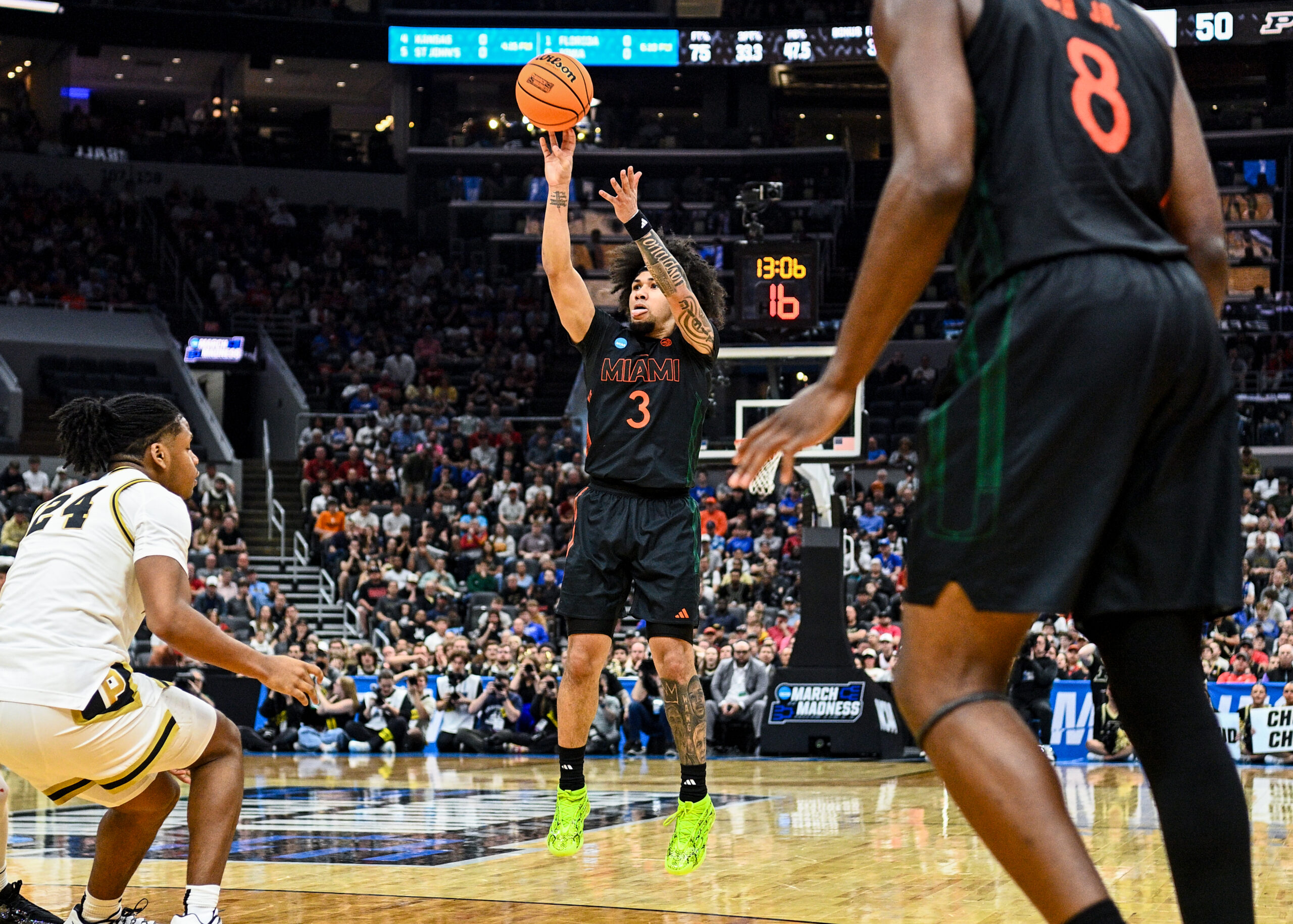
David Lebowitz, Photo Editor/ Senior Guard Tre Donaldson shoots a three point shot against Purdue on March 22, 2026 at the Enterprise Center in St. Louis, Missouri.

Both sides were sizzling from 3-point range in the first half. Purdue was 5-for-9 (56.7%), and the Hurricanes went 4-for-8 (50%) from the perimeter.

However, Miami’s production tapered off in the final frame, and the Boilermakers took advantage, outscoring the Canes 41-29 over the last 20 minutes.

After Malik Reneau’s opening bucket, turnovers and missed field goals triggered a 9-0 run for Purdue. Miami never led again.

The Hurricanes ended going 1-for-11 from beyond the arc in the second half, unable to draw within one possession over the last nine minutes. Overall, Miami shot 26% from three.

In his first year as Miami head coach, Jai Lucas tied the NCAA Division I all-time record in win improvement, taking the program from 7-24 in the 2024-25 season to 26-9 with an NCAA Tournament win.

After the game, Lucas was effusive with praise for the first group of players he’s ever led with the Hurricanes.

“It was an absolute pleasure and joy to coach this team,” Lucas said. “And I thank them for believing in me, believing in a person who has never coached before, and everything they gave me this year, I’m forever in debt to them.”

The love was reciprocated by Udeh Jr., who said this was the greatest coaching staff he’s ever been a part of. He had previously played at Kansas and TCU before transferring to Coral Gables for his final year of eligibility.

“They did a tremendous job throughout the entire year understanding me, Tre and Malik as a person,” Udeh said. “The cohesiveness between all of them to generate one message that we can all comprehend, they did a great job on that front.”

The overwhelming success in year one of the Jai Lucas era was unprecedented to many.

Now firmly seated at the helm for Miami, this success is now just the standard.

Miami blasts past Creighton with three homer surge, completes series sweep

On Sunday afternoon, the Canes offense loomed large over the Creighton Blue Jays in the finale of their three-game series. 

Three-straight homers off the bats of Alex Sosa, Derek Williams, and Brylan West sent Mark Light Field into a frenzy —- part of a much-needed 15-5 rout and series sweep.

Following a two-strikeout first for Miami starter Lazaro Collera, the Hurricanes bats struck immediately in the first. 

Williams hammered a ball to the right field gap to open the scoring with a one-run single. With men on first and third, first baseman West drove a ball to the warning track for a sac-fly, giving the Canes an early 2-0 lead.

After another shutdown inning from Collera, the Canes would bring shortstop Vance Sheahan around in on a passed ball after his single, adding one additional run to their tally.

Collera, making his first start since February against Lafayette, suffered his first setback of the afternoon in the third.

The right-hander would give up a two-run shot to Creighton shortstop Ben North, shrinking the Canes lead to one.

Answering immediately in the bottom half of the inning, however, was the trio of homers from Sosa, Williams and West.

West’s 410 foot homer served as the nail in the coffin for the Bluejays, as the Canes would hold a lead of at least four the remainder of the game.

Second baseman Jake Ogden joined the homer party with a two run shot to left field in the fourth, followed up by another RBI from Williams.

After getting into some trouble in the fifth, Collera was pulled for reliever TJ Coats. 

Through 4.1 innings, Collera tallied six strikeouts with only one walk. The sophomore Miami native has made a great leap from his freshman season, doubling his strikeouts relative to the year prior and halving his ERA.

Collera looks to be a formidable weapon in the Hurricanes’ rotation for the remainder of the season, and beyond.

Creighton jumped on Coats, with two RBI doubles bringing in both of Collera’s runners and one of his own for good measure. But the Nebraska transfer worked his way out of the inning with two strikeouts.

The Blue Jays issued their third pitching change of the day, but he met the same fate as the prior two.

Left fielder Dylan Dubovik was driven in by a flyout from Vance Sheahan after a wild throw-in, before Sheahan was at the center of the action again in the sixth, tallying an RBI single.

Miami’s offense had a rare blip in the seventh, recording their first scoreless inning of the afternoon.

The Canes quickly made up for it in the eighth, racking up five consecutive walks leading to two scored runs and, ultimately, a 10-run mercy rule giving the Hurricanes their first sweep since February.

With 13 RBIs on twelve hits, the Canes’ ability at the plate showcased immensely in this game and as a whole with 35 runs over the three-game series.

Miami plays next against FAU at home on Tuesday, Mar. 24, at 6:00 p.m.

Canes’ comeback falls just short in 72-65 loss to Wisconsin

Miami’s women’s basketball season came to a close Sunday afternoon with a 72-65 loss against the Wisconsin Badgers in the second round of the Women’s Basketball Invitational Tournament.

The Canes battled back from a double-digit deficit early in the third quarter to challenge the Badgers in the fourth quarter.

As usual this season, guard Gal Raviv and center Ra Shaya Kyle led the way for Miami. Raviv racked up 20 points, playing 38 minutes while Kyle closed out her collegiate career with a hard fought performance in the paint, putting up nine points and 12 rebounds. 

Wisconsin’s execution down the stretch proved to be the difference. Gift Uchenna and Destiny Howell delivered timely three-pointers to keep Miami at bay in the fourth quarter — clutch shots that proved to be the dagger in Miami’s postseason hopes.

Despite the loss, UM head coach Tricia Cullop noted the progress the team has made in her second year as head coach. 

“You know last year we were sitting home at this time. We didn’t get to play the post season”, Collup said. “I’m glad we got a taste of it … It’s what we want to be, that’s where this program should be.”

Wisconsin dominated the opening quarter with points from Howell, Lily Krahn and Uchenna, capitalizing on the Canes sluggish start to end the quarter with a commanding eleven point lead. 

In the second, the story was much of the same.

Wisconsin dominated defensively, slowing Miami down while racking up eight defensive rebounds. 

While still trailing, scores from Amarachi Kimpson, Raviv, and Danielle Osho helped make up ground to close Miami’s deficit 23-15 at half-time.  

The game seemingly broke open in the third, where Wisconsin extended their lead to 52-37. Howell led the badgers in this frame, connecting repeatedly from beyond the arc as part of a career high six 3-pointers. Wisconsin’s floor spacing and transition play — spearheaded by Laci Steele and Krahn — consistently overwhelmed Miami’s defense. 

But Miami caught fire in the fourth quarter. 

The Canes leaned heavily on Raviv who led the team in scoring alongside eight assists —  repeatedly attacking the paint and finding shooters on the perimeter. 

Kimpson was the only other Cane to reach double digits, with 11 points. Adams provided some much needed perimeter spark, contributing nine points on 3-of-5 from beyond the arc.


Miami brought the game within two with 45 seconds remaining, but Wisconsin held on to advance to the quarterfinal round of the WBIT.

The Canes will look to improve in Cullop’s third season at the helm in 2026-27.

‘The U’ is in good hands: Takeaways from Miami’s 79-69 season-ending loss to Purdue

The Miami Hurricanes threw everything they could at the Purdue Boilermakers, but it wasn’t enough.

On Sunday afternoon at the Enterprise Center in St. Louis, No. 2 seed Purdue pulled away in the second half behind Fletcher Loyer and Trey Kaufman-Renn to defeat No. 7 seed Miami 79-69, ending the Hurricanes’ season.

Miami led 40-38 at halftime and appeared poised to pull off the upset. But Purdue (29-8) surged after the break, outscoring the Hurricanes 41-29 behind 45 combined points from Kaufman-Renn and Loyer. The Boilermakers shot 8-for-14 from 3-point range and 21-of-22 from the free-throw line.

With less than a minute remaining, Miami (26-8) still had a chance.

Trailing by six, Tre Donaldson and Tru Washington missed back-to-back 3-point attempts that would have cut the deficit to one possession. Kaufman-Renn secured his ninth rebound on Washington’s miss, effectively sealing the game.

Despite the loss, first-year head coach Jai Lucas has Miami trending upward, with this season signaling the program’s return to national relevance.

“It was an absolute pleasure and a joy to coach this team,” Lucas said. “I thank them for believing in me, believing in a person who had never coached before, and everything they gave me this year. I’m forever in debt to them.”

Veteran transfers laid the foundation for Miami’s resurgence

Miami finished its 2024-25 campaign at 7-24 — one of the worst seasons in program history. Lucas, who took over on March 6, 2025 prioritized veteran leadership to reshape the culture.

Senior transfers Malik Reneau, Tre Donaldson and Ernest Udeh Jr. delivered exactly that, establishing a new standard in Lucas’ first season.

Reneau, an Indiana transfer, arrived in Coral Gables seeking a fresh start after an injury-plagued junior year. The Miami native made the most of it.

“I’m blessed that Coach gave me this opportunity to come back home and come to The U and finish my last year here,” Reneau said.

The senior forward earned First-Team All-ACC honors, averaging 19 points and 6.6 rebounds per game. His 662 points tied Don Curnutt for fifth-most in a single season in program history.

“This season has meant the world to me,” Reneau said. “Coach giving me the opportunity to not only be a pivotal player on my team and play 30-plus minutes, but also become a leader and be someone these guys look up to.”

Donaldson provided stability and a clutch factor at point guard, a presence Miami hasn’t seen since Isaiah Wong’s 2022-23 campaign.

After stops at Auburn and Michigan, the senior guard returned to his home state and earned second-team All-ACC honors while averaging 16.5 points and 5.8 assists.

“Coming to Miami, I had to build myself back up coming back off a tough year,” Donaldson said. “Coming into a coaching staff that was going to help me build myself back up and continue to help me get better. I enjoyed every moment of it.”

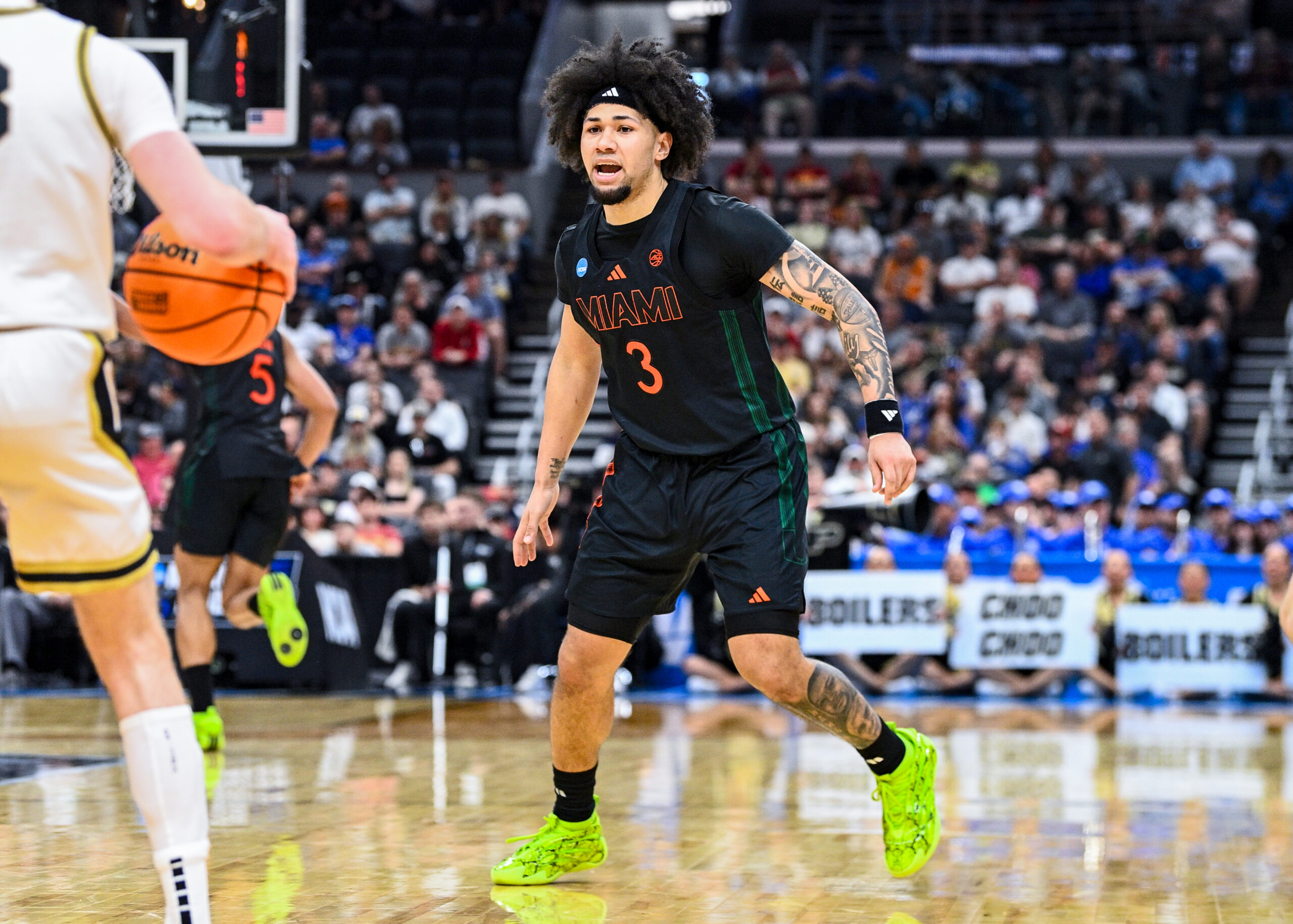
David Lebowitz, Photo Editor/ Senior Guard Tre Donaldson gets back on defense against Purdue on March 22, 2026 at the Enterprise Center in St. Louis, Missouri.

Udeh anchored the defense, impacting the game in ways that didn’t show up in the box score. The Kansas and TCU transfer earned a spot on the All-ACC defensive second team and played a key role in Miami’s interior presence.

The Hurricanes dominated the offensive glass in the NCAA Tournament, outrebounding Missouri and Purdue 30-11 combined on offensive boards. Udeh contributed 12 of those rebounds.

Together, the trio helped revive the program and establish a foundation for sustained success.

“We really have built a great foundation,” Lucas said.

Shelton Henderson has emerged as a centerpiece of Miami’s future.

While the veterans set the tone, freshman Shelton Henderson showed he could be the program’s next star.

The Bellaire, Texas, native stepped up in the NCAA Tournament, producing strong performances against Missouri and Purdue while consistently attacking the paint.

“He’s a stud,” Purdue head coach Matt Painter said after the game. “He could play for the football and the basketball team. He just runs through people.”

In his two tournament games, Henderson averaged 16.5 points and seven rebounds while shooting 61.5%. His postseason showing capped a strong freshman campaign in which he averaged 13.7 points and nearly five rebounds per game on 56% shooting.

“I learned a lot about myself,” Henderson said. “I had to grow up a little bit faster playing with these guys and I think it helped me in the end.”

Henderson is expected to take on a leading role next season as Miami builds on its momentum.

The Hurricanes are also expecting a return of key contributors such as Washington and Dante Allen, while adding five-star recruit Caleb Gaskins, who could make an immediate impact.

Lucas made it clear that this season is only the beginning.

“It’s my job to keep it going and keep it rolling,” Lucas said. “This time next year we’re talking about going to the Sweet 16, not just the season ending. That’s the goal, that’s the plan until you win the National Championship.”

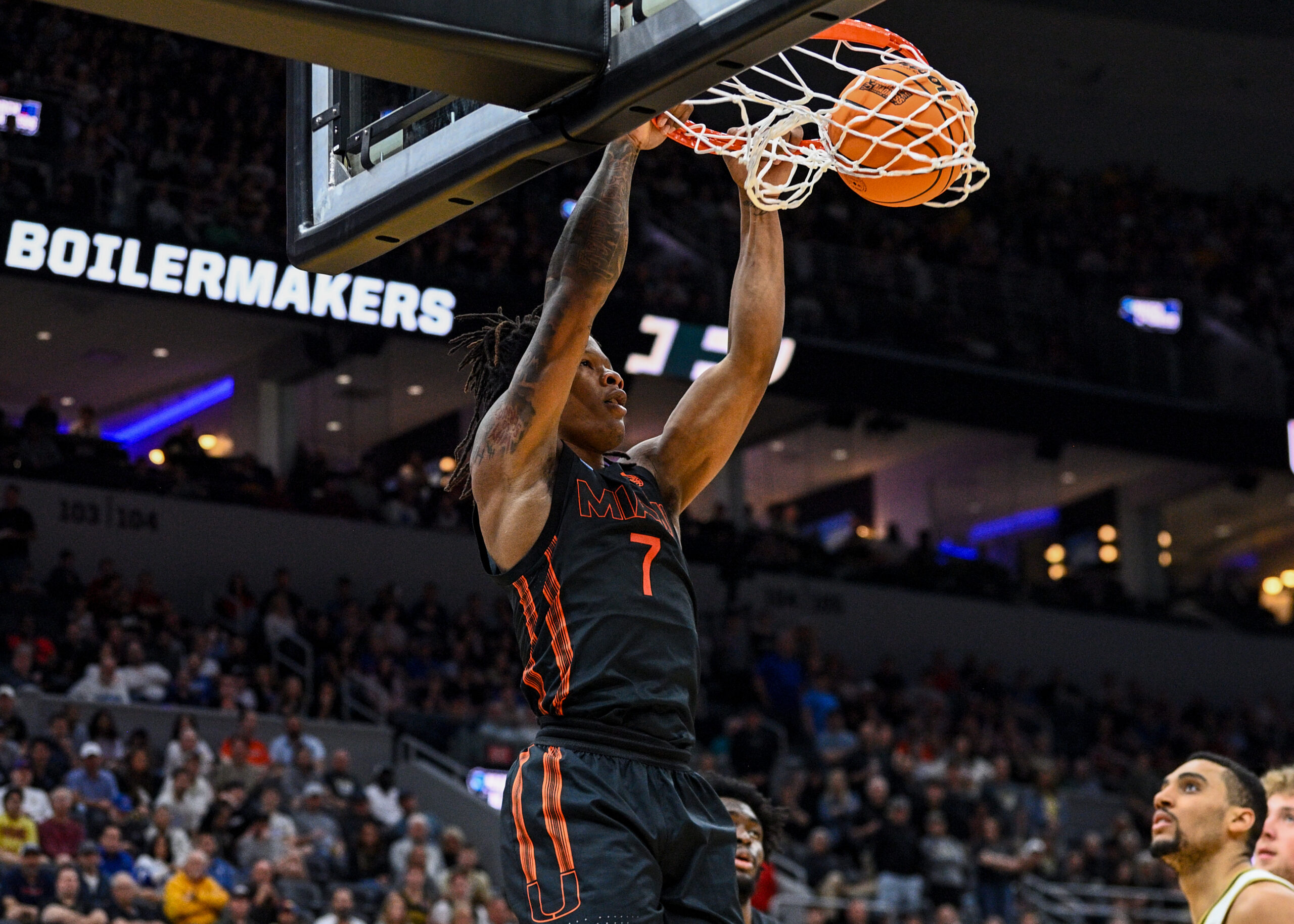
David Lebowitz, Photo Editor/ Freshman Forward Shelton Henderson dunks the ball against Purdue on March 22, 2026 at the Enterprise Center in St. Louis, Missouri.

The cost of a chance: UM’s $100 housing application fee

0

Hidden costs are one of the biggest obstacles students face today, and sometimes they don’t even come with a guarantee. Prior to the Spring 2026 semester, students were charged a $500 deposit which was fully refundable. With a new policy change, students are required to pay a $100 non-refundable application fee

For a school that costs upwards of $100,000 annually, $100 may seem like nothing. However, for the many students who are already stretching their budget to cover housing costs, it becomes something else entirely: the cost of applying for housing without any guarantee of receiving it. 

This charge supports housing operations as a whole, but the University has not specified whether it will be credited to a student’s personal housing balance. Returning students are not guaranteed housing at UM, so if they want to live on campus, they have to find a spot through the lottery system. 

According to the 2025 State of the Student Housing Industry Report by StarRez, 78% of undergraduates live off campus, and 53% of these students chose to live off campus due to a lack of on-campus availability. As a result, many seek off-campus leases at the same time, “just in case” they don’t receive housing.

“I think it’s ridiculous to pay a $100 non-refundable housing fee when they can’t clearly provide housing for every student,” said freshman Gizely Soares. 

However, this problem may not be as prominent as students perceive since last year, the University offered housing to every student on the waitlist by June.

“For the 2026/2027 school year, approximately 3,100 students completed the housing application process,” The University said in a statement to The Hurricane. “Out of those, about 2,000 received a housing assignment, leaving around 1,100 people without immediate placement. If you look at the last school year, everyone was cleared by the end of June with housing assignments.”  

Regardless, the updated requirement holds potential to impact students from low-income families. Research on rental application fees have shown how they can pose a barrier and limit access for lower-income renters.

“The fact that it was non-refundable without a fee waiver available was somewhat concerning,” said freshman Helene Ung.“Personally I’m low income, and have had plenty of fee waivers for school.”

Her experience parallels those of other students who already depend on financial aid to cover basic educational costs. 

This reality suggests that seemingly trivial charges compound into a broader issue. The lack of a fee waiver can exacerbate already limited resources, which shows how crucial it is to consider the various financial situations among students. 

Similar concerns were echoed by freshman Stephanie Embil, who said that the policy change was “especially unfair to students who pay for school without family’s help and low-income families.” 

While some students rely on family support, others must carefully budget every expense. However, some students like sophomore Daniel Joven understood the need for the new fee system.

“I do think that they should somewhat profit from the process, so I can see how the $100 can go toward that,” he said. Even though a number of UM students have found the fee to be controversial, the practice is common. 

In a statement to The Hurricane, the University of Miami said, “This is in alignment with common practice at other institutions to require a modest application fee vs. large pre-payment.” 

Other institutions such as Florida International University, Florida Atlantic University and the University of Florida require similar fees. A majority of the time, these fees are implemented to make sure that applicants are serious before they have access to room selection portals. The money generally helps the process work more efficiently rather than addressing individual room charges. For instance, it might be responsible for the costs of hiring staff, keeping the system running and reviewing applications. 

Freshman Selena Staples pointed out how the policy could affect students from low-income families who rely on on-campus housing. Her concern reflects the same anxious anticipation that many other students sense, the possibility of paying a fee only to receive no housing placement. 

“They would have to be in debt. It’s so unfair for them,” Staples said. 

This uncertainty can make students feel pressured to over-commit financially. Students are asked to pay without guarantee of housing, so many of them are bracing for rejection. With both a non-refundable fee and a push to secure a backup off-campus lease, the burden is doubled. 

Students are required to pay for the chance of receiving housing. While more transparency about the policy would help students understand the process, the larger issue is the uncertainty that comes with the fee. When housing is not guaranteed, even a modest charge becomes something significant: the cost of a chance.

Winter Music Conference looks to reclaim Miami Music Week

In its earliest years, the Miami Music Week wasn’t about massive crowds or viral moments—it was about business. But long before the citywide marathon of parties defined the week, there was a single event that brought the global dance music industry together in one place: Winter Music Conference.

DJs, label executives, radio programmers and journalists traveled to Miami not just to celebrate the culture, but to shape it. 

“WMC in the beginning was all business, and the parties were really label showcases attended mostly by industry, press, artists, radio, etc.,” said conference director David Ireland.

Over time, however, the culture around electronic music exploded beyond the conference walls. As festivals grew and global fan culture took over, Miami Music Week expanded into a decentralized network of events stretching across the city. 

Promoters began throwing larger fan-driven parties, and the industry slowly dispersed across dozens of showcases and activations. In that transformation, the conference that once anchored the entire week gradually faded from the center of the conversation.

Ireland has watched that evolution unfold firsthand. With more than three decades in music media and marketing — including helping relaunch WMC under Ultra Music Festival — he has seen electronic music shift from underground subculture to global industry. 

His return to lead Winter Music Conference’s current chapter reflects an effort to reconnect the event with its original purpose.

But rebuilding the conference isn’t a solo effort. Much of the operational backbone behind WMC 2026 comes from Nick Morgan, CEO of the international event production collective We Group. 

This year’s edition introduces pool parties at the Kimpton EPIC Hotel, adding a new experiential element for attendees—but also a logistical puzzle. 

“We’ve added pool parties on premise which brings its own unique challenges such as permitting and rigging 16 floors up from the lobby,” Morgan said. The reward, he added, is worth it: attendees will experience events overlooking the Miami River and downtown skyline.

Despite logistical pressures, the conference’s leadership sees 2026 as an opportunity to redefine what Winter Music Conference can offer the electronic music ecosystem.

One of the key ideas shaping this year’s programming is accessibility across different levels of the industry. Ireland describes the conference as operating on a “two-track program”—one aimed at creators looking to build careers in electronic music, and another focused on professionals already working within the business. 

For example, the conference is introducing a new A&R Pop-Up Lounge designed to give emerging artists and producers direct access to representatives from labels like Experts Only and Ultra Records. 

For established professionals, panels and discussions tackle some of the most pressing topics shaping the industry today, including artificial intelligence, audience fragmentation, marketing strategies and data management.

“We always try to take the industry’s temperature and see what’s starting to bubble up,” Ireland said. 

The goal is to ensure that attendees leave the conference not just with ideas, but with practical insights they can apply immediately.

The physical environment of the conference also plays an important role in shaping these conversations. Rather than spreading programming across disconnected venues or taking a digital approach, organizers have emphasized creating a central hub where networking, panels and social experiences intersect.

“For me it’s really important that the hub truly feels like the hub,” Morgan said. “People are staying at the hotel, interacting in common areas, attending sessions, and this year we’ve added pool parties as well—meaning there is something happening throughout the venue during the entire event.”

The setting itself is also part of the point. Instead of scattering programming across different venues or relying too heavily on digital access, organizers have focused on building one central hub where panels, networking and social events all happen in the same orbit.

Looking ahead, Ireland said the conference’s future depends on growing carefully without losing what makes it work in the first place. 

Organizers are already thinking through a longer-term plan with the city of Miami, with the goal of expanding in a way that still keeps the event centered, manageable and true to its atmosphere.

“If you grow too much and spread everything out, you lose the magic,” Ireland said.

For him, the benchmark of success remains simple.

“If you don’t leave WMC inspired and more up to speed on things in our industry,” Ireland said, “then we are not doing our job.”

As Miami Music Week gets bigger, louder and more spread out across the city, Winter Music Conference is trying to hold onto something a little more grounded. 

It still wants to be the place where artists, executives and newcomers can actually sit down, talk, exchange ideas and think about where electronic music is heading before all of it plays out onstage later that week.

This year’s conference runs March 24–26 at the Kimpton EPIC Hotel in Downtown Miami. More information on badges, programming and events is available on the official WMC website

With its move downtown and a broader mix of sessions and networking opportunities, the conference is positioning itself once again as a meeting point in the middle of Miami Music Week’s usual chaos.