Takeaways from Miami’s historic College Football Playoff win over Texas A&M

0

“40 days ago we were lower than low, and now we’re still playing for the chance to win a national championship,” said UM head coach Mario Cristobal following Miami’s 10-3 win over Texas A&M in the opening round of the College Football Playoff.

Following their second loss of the season in early November, many had the Hurricanes on the outside looking in when it came to playoff aspirations.

But five games later, the Miami Hurricanes have secured their first playoff win in school history and have their eyes on playing in the College Football Playoff championship at home in South Florida.

The win wasn’t pretty, but good teams grind out wins in big moments — and that’s exactly why the remaining teams should be on high alert about the ’Canes.

Give Corey Hetherman a blank check

Good teams can beat you with a gameplan, great teams can beat you in any way possible — and that’s exactly how the ’Canes won at Kyle Field.

Against an impressive Aggie defense, Miami’s offense stumbled throughout the game, but it always seemed as if the ’Canes had control thanks to their own ferocious defense.

Last season, the Hurricanes defense was a laughing stock, one of the worst defenses in the country whose ineptitude wasted a generational offense.

Out went former defensive coordinator Lance Guidry and in stepped Minnesota defensive coordinator Corey Hetherman to take over in the offseason.

From spring practice the difference was clear, Hetherman instilled confidence in his players by giving them freedom in his defensive schemes.

And against Texas A&M, that freedom led to seven sacks, a forced fumble and two interceptions — one of those which sealed the game in the dying minutes.

The players move freely and with athleticism all over the field, which has made the Hurricanes’ defense one of the most impressive units in the country.

“It’s amazing what Coach Hetherman has done for not only the defense but the program as a whole,” defensive lineman Rueben Bain Jr. said postgame. 

“It’s the mindset he instills in us with ‘ESV’, being excited, swarming and being violent … a coach like that, he’s gonna drive us every play.”

This driven Miami defensive unit might be the best in the country, and it would be wise to keep the mastermind behind it down in Coral Gables as long as possible.
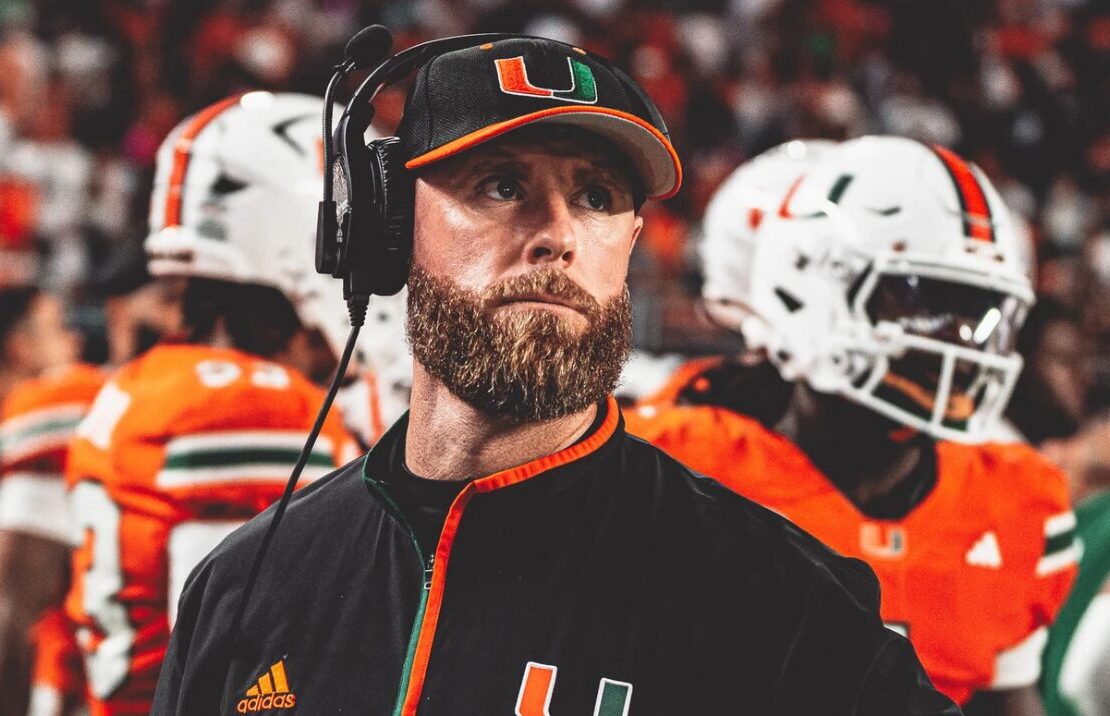
UM defensive coordinator Corey Hetherman was named a Broyles Award Finalist in his first year with the program // University of Miami Athletics

Built to last

In the revolving door NIL/transfer portal era, teams are constantly looking side to side wondering what their future roster will look like. 

Players come and go, but Miami has its future cornerstones locked in place in large part due to its 2025 Freshman class that was on full display Saturday afternoon.

18-year-old superstar wideout Malachi Toney didn’t have the most impressive statline against the Aggies, 31 yards split between rushing and receiving, but his impact cannot be understated.

The freshman phenom provided a threat whether he was lined up out wide, placed as a running back or stood under center with the “Mali-cat” wildcat formation.

And when his name was called to give Miami the lead with under two minutes left in the game, Toney bounced to the outside and waltzed into the endzone for the lone touchdown of the afternoon. 

While Toney gave Miami the lead, the defense needed to hold on and secure the win — and another freshman stepped up to answer the call.

Defensive back Bryce Fitzgerald jumped the route with his second interception on the day, and sent UM to the quarterfinals of the College Football Playoff.

The South Florida ballhawk has racked up six interceptions on the year, putting him tied for the most in the country at the power four level.

Recruiting sites placed the class around the top-15 mark, a down tick from Cristobal’s expected top-10 and even top-5 classes. Because of such rankings, many deemed the class as a non-needle mover.

After Toney and Fitzgerald broke Miami’s Freshman receiving and interception record, the class has not only proven its worth but proven how bright the future is for the ’Canes.
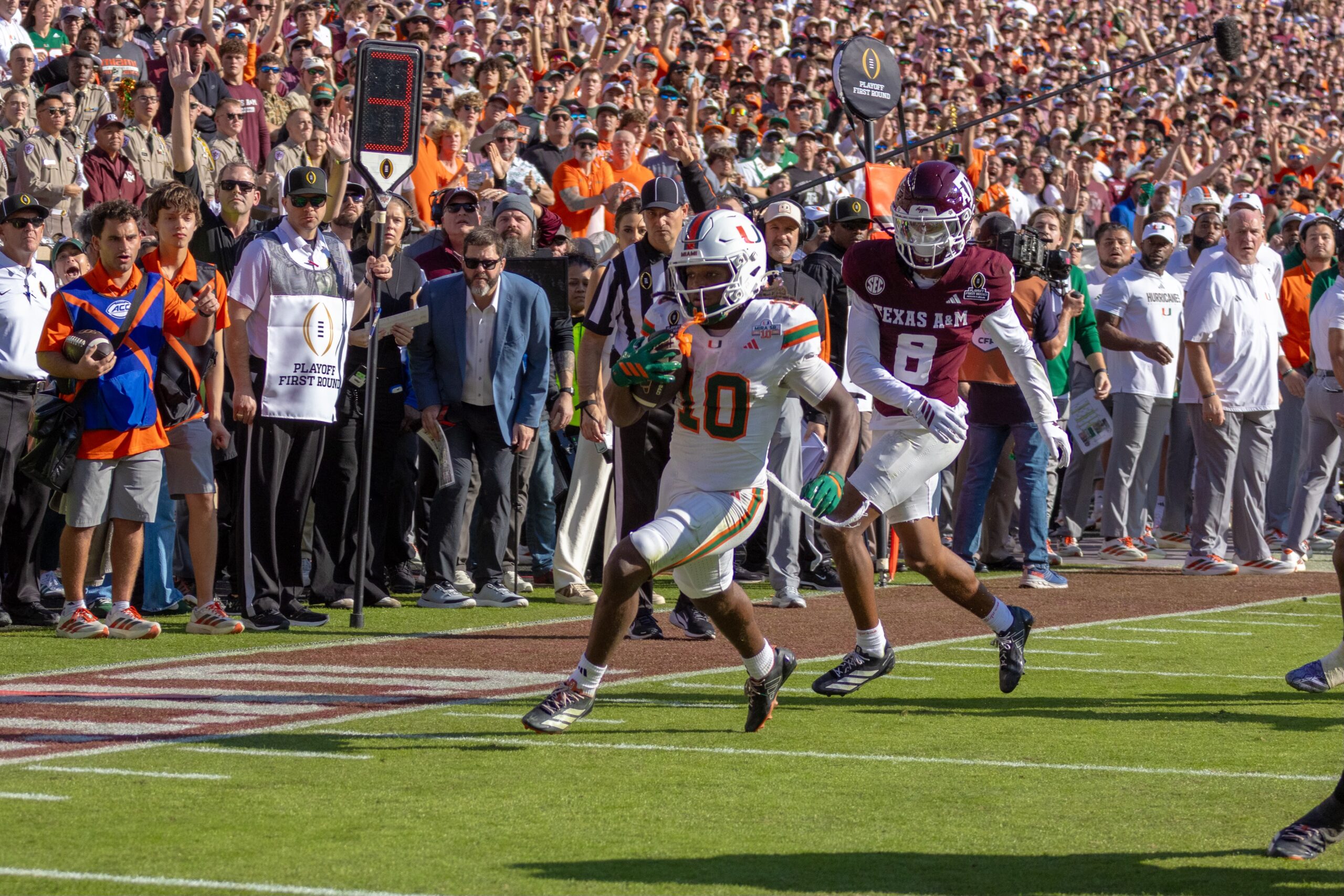
UM Freshman Malachi Toney rushes for the game winning touchdown versus Texas A&M on Dec. 20 // Jake Sperling.

Mentality Monsters

While the Hurricanes’ lack of success over the past two decades could be attributed to a gap in talent to the top teams, that gap was widened by the lack of mentality that Hurricane teams played with. 

From blowouts against bitter rivals to late-season November collapses, UM became a laughing stock in the college football world.

Under Cristobal, Miami has regained that swagger and mental fortitude that made them a national icon decades ago.

In the leadup to the game, multiple Texas A&M players took to the media to talk a bit of smack beforehand. 

“I don’t think [Bain] will be much of a threat,” Aggie offensive lineman Trey Zuhn III said.

Bain didn’t take the bait and let his performance do the talking with three sacks, four TFL’s and a blocked field goal.

“Like I said before, I don’t take kindly to disrespect,” Bain said. “Some guys were in the media saying some things they shouldn’t have said, but they did, so God bless them … Don’t write checks you can’t cash.”

Rather than getting caught up in off-field drama, Cristobal has built a culture on letting the game do the talking and a culture where each player is looking out for one another.

Before Toney’s game-winning touchdown, the wideout coughed up a fumble and was almost inconsolable on the sidelines. But rather than get upset with the young star, nearly every single player on Miami’s roster came to his side to pick his head up.

“I told [Toney] ‘God’s putting you through a little adversity, look how much time is on the clock’,” Fletcher said to the media postgame.

The Hurricane defense stood strong, and when Toney got the ball again there was no question on what he was going to do with it as the Miami sideline erupted when he redeemed himself with a touchdown.

Culture often gets overlooked for talent, but this Miami team has both — a perfect pairing for postseason success.
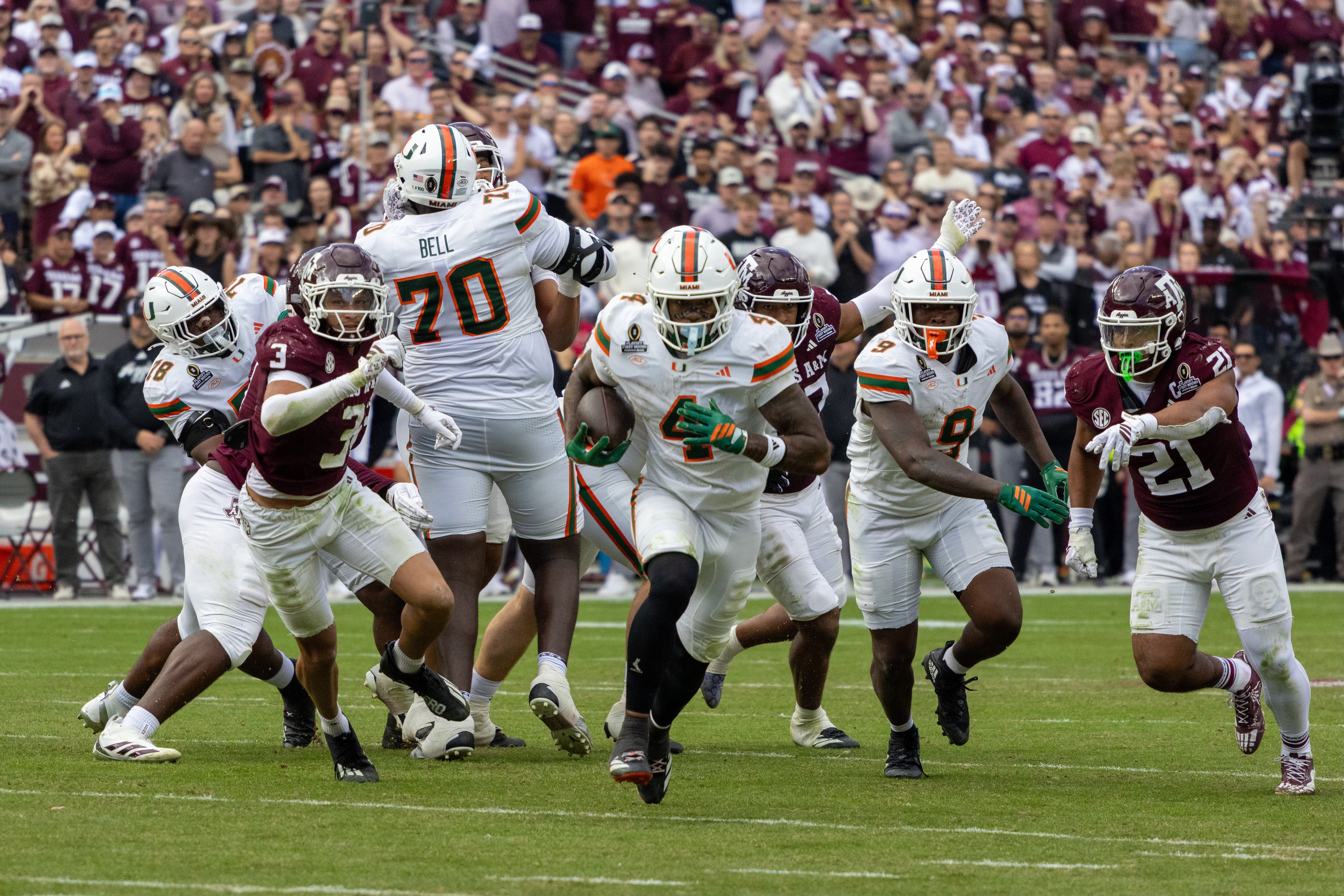
UM Junior Running back Mark Fletcher Jr. breaks through the Texas A&M defense on Dec. 20. // Jake Sperling.

We need to talk

Attending the University of Miami for the past three and a half years as a student, I can honestly say that FIRE’s 2026 College Free Speech ranking was more validating than damning. 

I thought my anxiety about speaking on certain sociopolitical issues was a personal flaw or journey that I needed to address alone. I assumed my thoughts of self-preservation were normal and pragmatic. I thought, if I want to become successful, self-censorship was simply the way that life ought to be navigated. 

However, FIRE’s ranking gave numbers and language to a concept that has a particularly dangerous power to warp communities through silence: the erosion of free speech is an effective tool for alienation.

On a national level, freedom of expression for university faculty is being challenged. On Oct. 1, the White House sent the “Compact for Academic Excellence” to nine academic institutions, detailing a list of demands to be followed to receive preferential treatment in federal funding, with one acutely affecting faculty.

“Signatories shall maintain institutional neutrality at all levels of their administration,” the document said. “This requires policies that all university employees, in their capacity as university representatives, will abstain from actions or speech relating to societal and political events except in cases in which external events have a direct impact upon the university.”

If signed, universities would effectively trade the voices, opinions and perspectives of their faculty and staff for funding, perpetuating an idea that one’s thoughts can be bought. As of now, no university has signed the compact. 

Additionally, there have been numerous instances at universities like Clemson, Texas A&M, Oklahoma and more across the country where faculty members have been fired because of their personal views. 

Even at our own university, we have seen our fair share of speech-related controversy. With a public apology from a professor who wore a “Palestine” sash and a resignation from a doctor for a Charlie Kirk-related repost, university employees have faced intense backlash for their actions. While there is still debate on the actions’ incendiary nature, the reality is that faculty must watch what they do and say to avoid repercussions from either campus administration or wider society.

On a national level, people entering the country from abroad — regardless of visa or citizenship status — have faced immense scrutiny, including visa revocations,  ICE detainments and/or deportation. In the wake of actions as small as co-writing a law-abiding university op-ed like Rümeysa Öztürk or participating in on-campus protests, universities penalize the use of free speech and create fear amongst students from abroad. At UM, it manifests as fear within our international student community. 

A previous Miami Hurricane article quotes a student as acknowledging that they must “become as apolitical as possible in order to ensure I’d be safe.” Additionally, I have had conversations with international students who are scared to speak on any issue for fear of repercussions from either the university or the federal government. This culture of silence robs the university of valuable perspectives that may benefit the campus conscience.

It has also become more recognizable that student protestors face the brunt of federal ire, state regulation and university policy changes, limiting student advocacy for or against certain issues. Both Indiana University and the University of Texas system banned “expressive activity” after 11 p.m. and 10 p.m., respectively, though they were both found likely unconstitutional by federal judges. Rutgers University only allows “expressive activity” in designated areas on campus. 

After updates to the Student Rights and Responsibilities Handbook, the University of Miami requires approval for demonstrations, limits them to two hours max, bans encampments and forces student organizations to pay for police presence. This demonstrates how the suppression of student activism is not limited to any specific state, university or type of university. It affects students across the country.

When people do not feel free to share their opinions with the world, they will only share with whom they feel safe, which is oftentimes only people they agree with. While this provides comfort, it is the antithesis of what higher education is supposed to be about. It is also the cause of the political polarization we all know and hate. 

With the creation of these echo chambers, we will continue to see the growing aversion to listening, empathy, and understanding. Personally, it has felt quite overwhelming to be constantly bombarded with national news and feel helpless to do anything because I, alone, have minimal impact on federal policy. However, UM is essentially our society — government, laws, residents of different backgrounds, issues, etc. — but on a smaller scale, and there is considerable work to be done on the university scale, both from the bottom up and from the top down to allow expression and foster healthy bipartisan and cross-cultural dialogue.

If students, university faculty and staff face challenges in freedom of expression within a university, who does that leave with a voice? Universities around this country, lauded as the “envy of the world” by the White House, would decrescendo from a loud symphony of knowledge and ideas to one, droning note of institutional conformity. If we allow universities to fall silent, the country will follow suit.

Neal Daniel, president of UnlockAI, is a senior majoring in Innovation, Technology, and Design, with minors in Industrial Engineering and Public Administration.

Miami downs the Aggies 10-3 for first College Football Playoff win

Up seven with 27 seconds left, the Miami Hurricanes needed one stop to win their first-ever College Football Playoff game against the Texas A&M Aggies.

On third and goal from the five yard line, Marcel Reed fired the ball into the back of the end zone, looking for Melin Ohrstrom to tie the game.

Instead, true freshman safety Bryce Fitzgerald jumped the route, picking the ball off from Reed and falling to the ground before celebrating with his teammates. 

Quarterback Carson Beck took a knee, let the clock run to zero, and set the Hurricane crowd into a frenzy as the ’Canes took down the Aggies 10-3.

Amid the chaos of 104,122 fans at Kyle Field Saturday afternoon — most wearing maroon and white — the cheer that resounded through the stadium was, “It’s great to be a Miami Hurricane.”

Mark Fletcher Jr. and Malachi Toney stepped up in a big way to set up Fitzgerald’s interception. 

Tied 3-3, with four minutes left at their own 14-yard line, Fletcher found a hole up the middle. The junior running back evaded tackles and carried Dalton Brooks as he ran for 56 yards, setting the ’Canes up in field goal range.

Fletcher led the way for a Miami offense that had just 103 total passing yards. The junior finished the game with a career high 172 yards on 17 carries, averaging 10.8 yards per attempt. 

Five plays later, Beck pitched the ball to Toney, who sprinted to the right sideline and hit the pylon for a touchdown to take the lead.

Toney’s touchdown was redemption for a fumble he committed earlier in the quarter. Not only was Fletcher crucial in the drive itself, the junior running back was the first one to console Toney after the play and gave him the motivation to keep going.

“I told [Toney] ‘God’s putting you through a little adversity, look how much time is on the clock’,” Fletcher said to the media postgame.

But for a game that ended with so much energy and excitement, the first half was anything but.

The two teams combined for seven punts, three failed field goal attempts and no points while the Aggies were the only side to enter the red zone in the first half.

It was sloppy offensive football that was magnified by defensive prowess from both sides.

“The number one thing was to contain [Reed] in the pocket,” Miami defensive coordinator Corey Hetherman said. “And our guys did a great job at handling changing up the picture pre-snap.”

Miami’s defense was dominant against a Texas A&M offense that averaged 32.4 points per game this season, led by the dual-threat ability of Reed.

Reed finished the game completing 64% of his throws for 237 yards and zero touchdowns. He also threw two interceptions, both to Fitzgerald.

Defensive back Keionte Scott, who suffered a lower leg injury against NC State on Nov. 15, played an integral role in his return to the field. 

Against the Aggies, the redshirt senior finished with 10 total tackles, two sacks and three tackles for loss. He also forced a fumble on Reed early on in the first quarter.

Along with Scott, the dynamic duo of Rueben Bain Jr. and Akheem Mesidor played big roles in the victory.

After hearing criticism from media members and players on TAMU in the days entering this game, Bain silenced all the doubters. The junior defensive end finished five tackles, three sacks, four tackles for loss, and one blocked kick in the first quarter.

“Like I said before, I don’t take kindly to disrespect,” Bain said. “Some guys were in the media saying some things they shouldn’t have said, but they did, so God bless them … Don’t write checks you can’t cash.”

Mesidor finished the game with five tackles, 1.5 sacks, and 1.5 tackles for loss — and mentioned how sweet it was to finally win at Kyle Field.

“Last time I was in this building I lost,” said Mesidor. “It was great to come back and get a win.”

Despite the win, the Hurricane passing attack and kicking was a major concern. Carter Davis, who finished the regular season hitting 14 of his 16 field goals, missed three of his kicks this afternoon. 

While the swirling wind in College Station was certainly a factor, Miami cannot afford to leave points on the board because of poor kicking.

Beck was also not up to his standard despite the victory. While efficient, completing 14 out of 20 passes, he threw for 103 yards and one touchdown. His longest completion of the afternoon was a 20-yard pass to Keelan Marrion early in the third quarter.

In addition, while electric, the “Mali-cat” wildcat formation became almost predictable throughout the game. The beauty of the concept is its unpredictability, but when relied on too much the formation almost guaranteed an Aggies stop.

Head coach Mario Cristobal and the staff will look to regroup and get back into the offensive groove for their quarterfinal matchup later this month.

The Hurricanes win against the Aggies is their first win against an AP top-10 opponent on the road since 2005 when No. 5 Miami beat No. 7 Virginia Tech 27-7 in Blacksburg.

Despite winning one of its biggest games in two decades, the Hurricanes are focused on the next step – the Cotton Bowl.

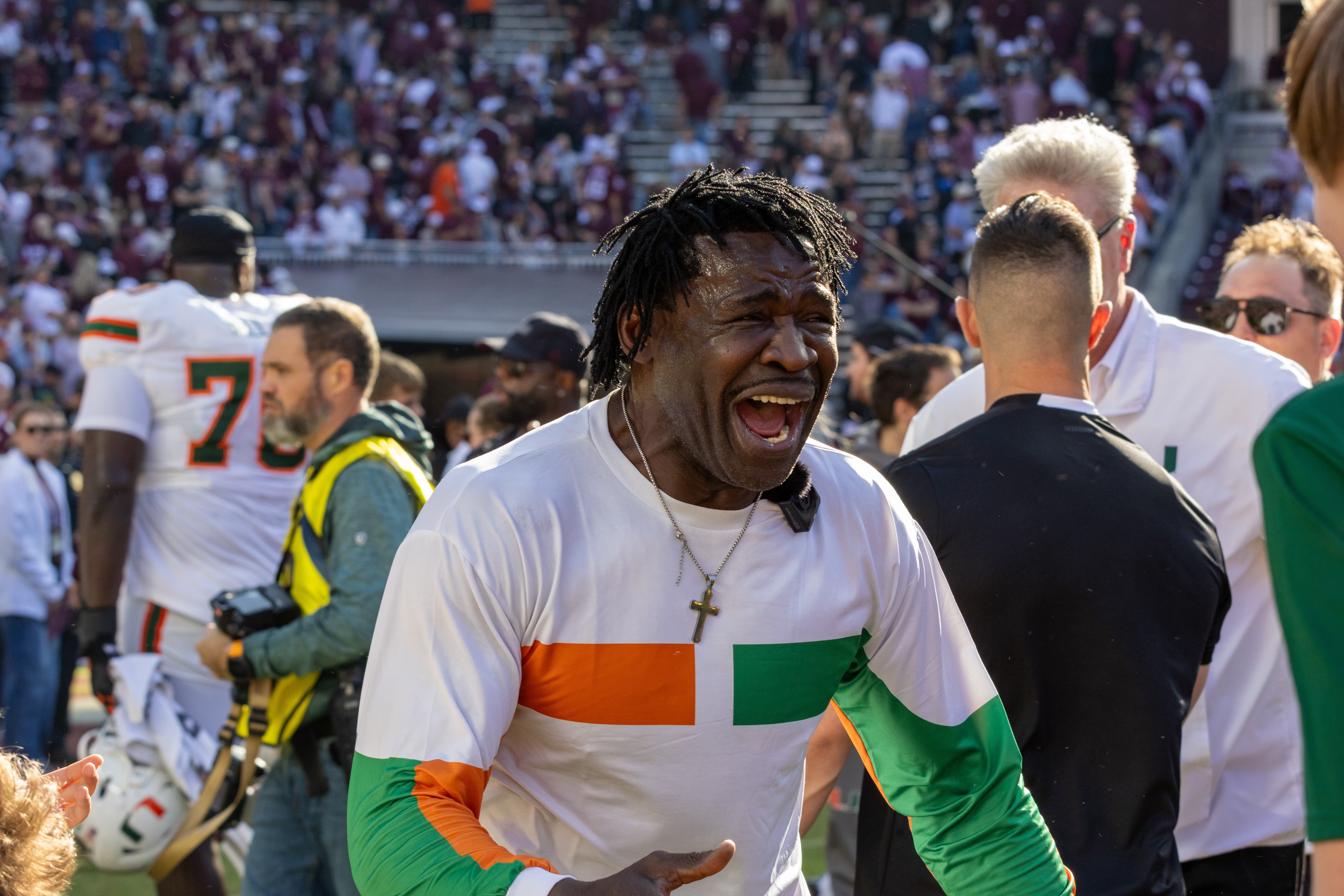
UM alumni Michael Irvin celebrates on the sideline during Miami’s 10-3 win over Texas A&M on Dec. 20 in the first round of the College Football Playoff. // Photo Credit // Jake Sperling.

“It feels great to be able to get our first playoff win, but honestly its onto the next game,” Mesidor said. “You can’t soak in it too much.”

Miami will take on defending National Title champs Ohio State in the 90th Goodyear Cotton Bowl Classic on New Year’s Eve. Kickoff at AT&T Stadium in Arlington, Texas is 7:30 p.m. EST and is set to air on ESPN on Dec. 31.

College Football Playoff 1st Round Preview & 2026 QB Transfer Portal Talk with CBS Sports Insider Gaby Urrutia

Miami is just hours away from its CFP showdown against the Texas A&M Aggies. Liam Hickey and Zach Cohen preview this stellar matchup and end up having similar score predictions for the big game. Gaby Urrutia from 247Sports joins the show to share his thoughts on the game and give some transfer portal analysis.

A beginner’s guide to the Hurricane’s path to a 6th national title 

0

At 12 p.m. EST Saturday, the Miami Hurricanes will take on the Texas A&M Aggies in the first round of the 2025 College Football Playoff at Kyle Field in College Station, Texas.

For Miami, it marks the program’s first appearance in the College Football Playoff. The CFP is currently in its second year of a new 12-team format, meaning that the top 12 teams in college football all have a chance to play for the national title.

The teams are seeded 1-12, and then a bracket is made with the top four teams (seeds 1-4), getting a bye for the first round, while seeds 5-8 play against seeds 9-12, with the higher seed playing their first round game at home.

Miami came into the playoff as the 10 seed, drawing them up against the 7 seeded Aggies, who are coming off a one-loss season in the SEC. If the Hurricanes are able to take home a victory on Saturday, they would advance to the quarterfinals, where the No. 2  Ohio State Buckeyes would be waiting.

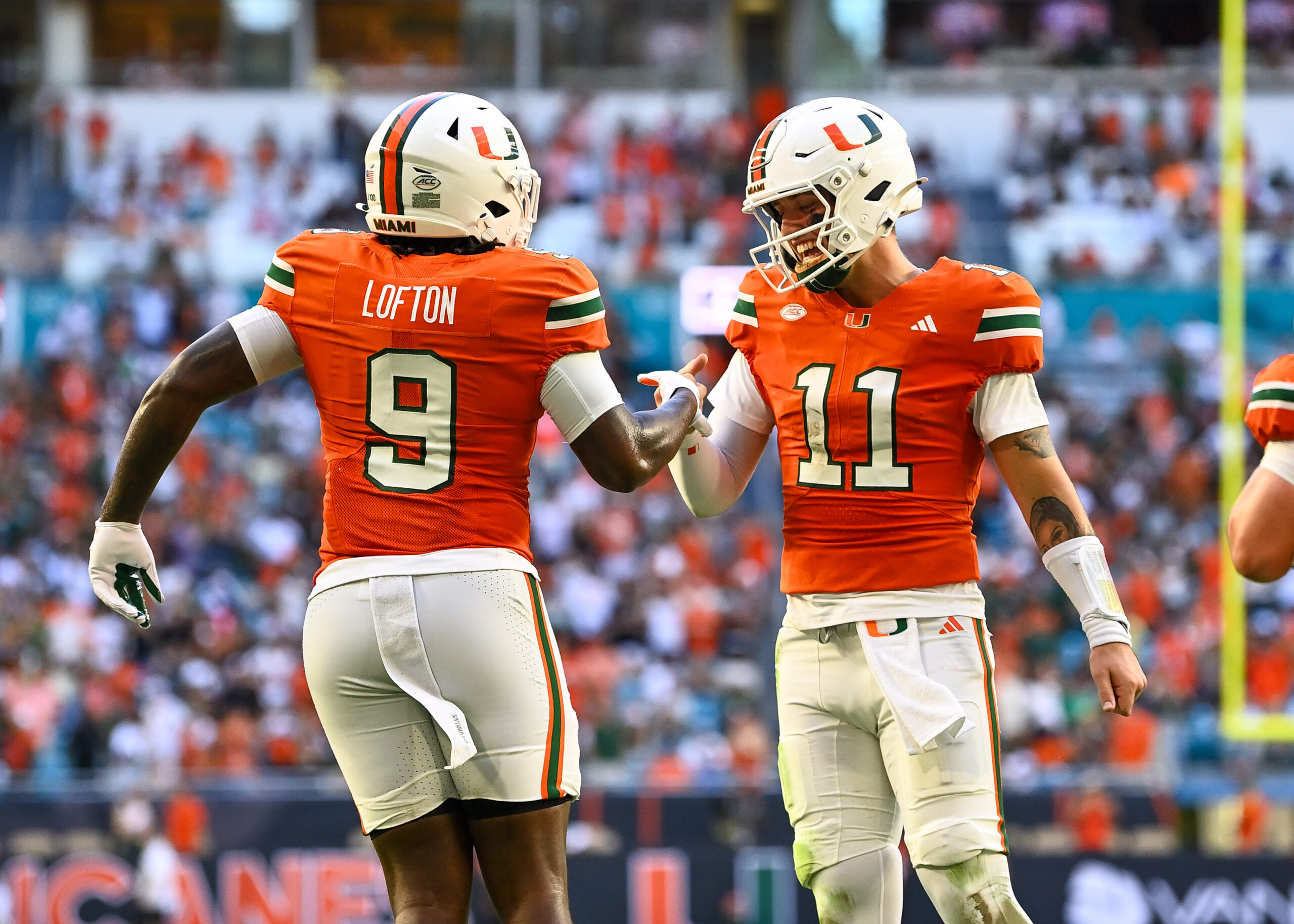
David Lebowitz, Staff Photographer/ Sixth-Year Redshirt Senior quarterback Carson Beck and Sophomore tight end Elija Lofton celebrate after a touchdown on November 8, 2025.

All games after the first round (quarterfinals, semi-finals and final) are held on neutral site fields as “bowl games.” If Miami were to advance to the next round, its matchup against Ohio State would be the Goodyear Cotton Bowl in Dallas, Texas on New Year’s Eve.

Should Miami advance again to the semi-finals, they would then take part in the VRBO Fiesta Bowl taking place in Glendale, Ariz. on Jan. 8. 

Awaiting the ’Canes for this matchup would be either of the following three teams: 11 seeded Tulane, 6 seeded Ole Miss or 3 seed Georgia. Tulane takes on Ole Miss Saturday at 3:30 EST, with the winner facing Georgia in the Allstate Sugar Bowl on New Year’s Day.

If the ’Canes are able to win three consecutive games, that would see the program in their first National Championship game since 2003. And, better yet, the game would be played right here in South Florida, at Hard Rock Stadium on Jan. 19.

For the next four weeks, head coach Mario Cristobal and his men will be looking to keep the winning form going, all with the goal of returning back home to play for that coveted trophy on their own field.

Kickoff for the first round matchup between the Canes and the Aggies is set for 12 p.m. EST, 11:00 a.m. local time.

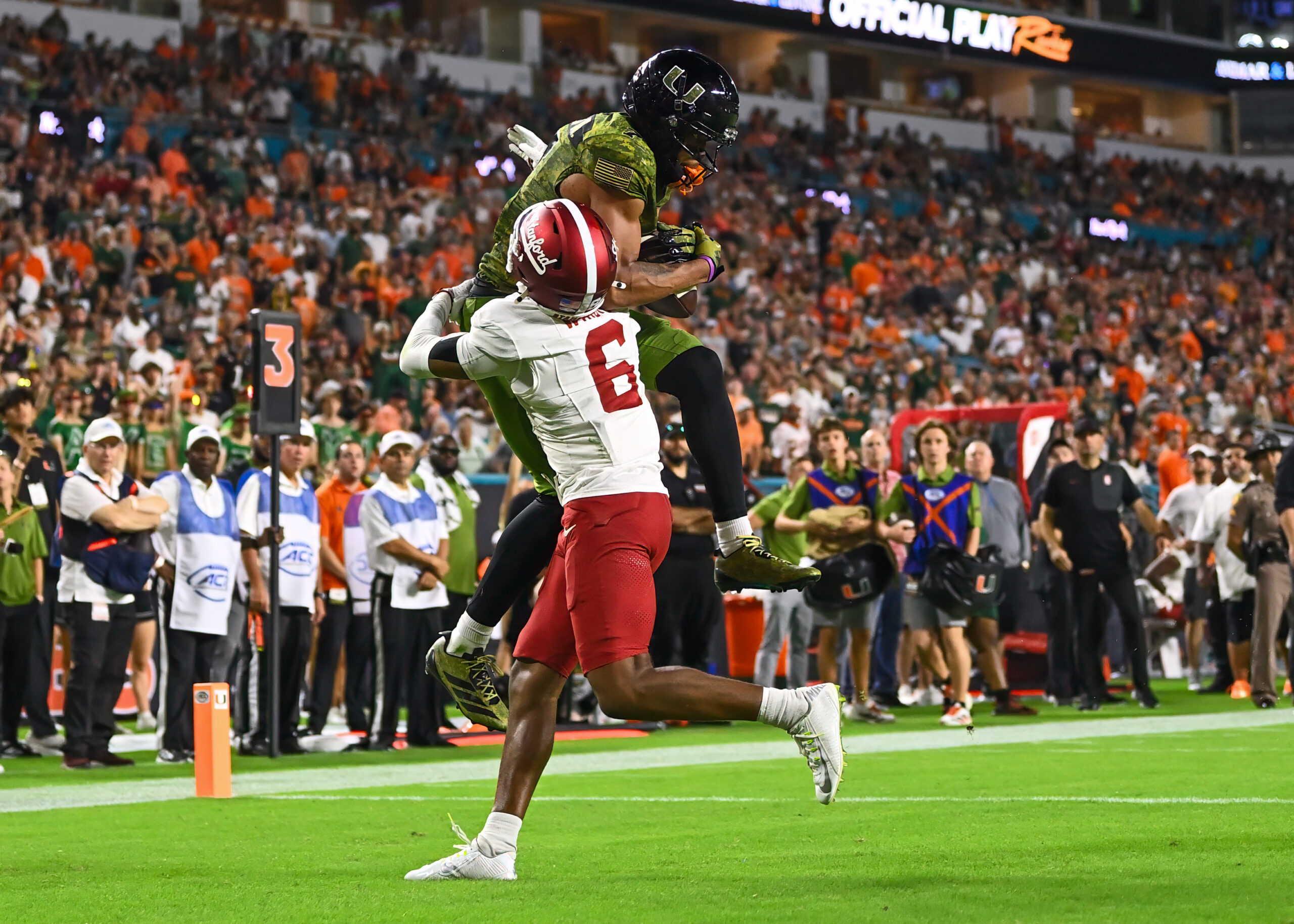
David Lebowitz, Staff Photographer – Sixth Year Redshirt Senior Wide Reciever CJ Daniels makes an incredible catch over a Stanford cornerback on October 26, 2025.

Miami women’s basketball earns first ACC win, tops Wake Forest 64–61

0

Miami women’s basketball hit the road for its second ACC game of the season at Wake Forest, winning 64-61.

After an undesirable loss at home against NC State, the Hurricanes fought hard despite the absence of star international guard Gal Raviv. 

Taking Raviv’s spot in the starting lineup was USF transfer Vittoria Blasigh who put up 11 points on 40% from the field.

It was the freshman guard Meredith Tippner who stole the show, putting up a career high 19 points. 

Junior guard Amarachi Kimpson also put up 17 points, shooting 50% from the field. 

Miami won the opening tip and hit the scoring column first but Wake Forest responded with a 12-4 run led by Opal Bird and Grace Oliver who each had five first quarter points. Miami battled back after the run but ended the first quarter down 20-18.

The Demon Deacons offense remained potent in the second quarter as they extended the lead to 30-22 at the 5:16 mark. Blasigh closed the gap draining back-to-back three pointers moving the score to 30-28 with just over four minutes of play. The Hurricanes kept it close going into the halftime break, trailing 34-32.

Both teams picked up the intensity to start the back half of the ball game. As they continued to drain shots on both sides of the court, UM finally was able to stop Wake Forest holding them scoreless for four minutes. Tippner, the four-star recruit, began to catch fire sinking the go ahead three at the 1:20 mark. Miami ended the third leading 48-47.

Tippner continued to excel early in the fourth quarter, scoring UM’s last 12 of 14 points (7:02). Freshman forward Danielle Osho who scored four of her six points in the last 10 minutes of play. Wake Forest tied the game up at 54-54 but Miami was able to pull away and win the game 64-61 on part from a clutch three-pointer from Blasigh. 

Miami will head back to the Watsco Center on Sunday at noon to take on Kennesaw State. The game will air on ACC Network

Miami guard Marcus Allen diagnosed with non-Hodgkin lymphoma

0

Sophomore Marcus Allen, a guard/forward for the University of Miami men’s basketball team, will miss the remainder of the 2025–26 season after being diagnosed with non-Hodgkin lymphoma, the program announced Friday.

The Allen family released a statement confirming the diagnosis and shared that Allen has begun chemotherapy treatment this week.

“We want to thank everyone for their thoughts and prayers during an extremely difficult time for our family,” the statement read. “We thank God for his continued Grace, Mercy and Favor. We wait in anticipation for the miracle healing to take place. We are standing on FAITH.” 

The Miami native and four-star recruit previously played for the University of Missouri before transferring back home to play for the Hurricanes. In his first season back home, he averaged 18.9 minutes, 5.3 points and 3.1 rebounds per game. 

Beyond his on-court contributions, Allen has been a steady and respected presence within the program since his return home.

“Marcus is an incredible person and teammate, and we will do everything we can to support him and his amazing family during this difficult time,” head coach Jai Lucas said.

“Marcus brings toughness and selflessness to our locker room every day, and those same qualities will help him defeat this disease,” Lucas continued. 

The program confirmed it will continue to support Allen as he focuses on his health. 

A GoFundMe has been created to assist the Allen family. Anyone interested in donating to the Allen family can use the link here.

Meet the two student developers behind Scope

University of Miami seniors Oliver Krok and Nate Reservitz have had their fair share of club experiences. When they were looking for fun after moving to Miami, the parties were nowhere. Now they have a solution.

With their app-in-development, Scope, Krok and Reservitz have answered a question plaguing much of the nation’s student population on weekends, “Where are people going out?”

Reservitz, originally from Massachusetts, dealt with this predicament while working an internship in Chicago.

“I was trying to figure out where to go out and have fun,” Reservitz said. “But I was going out alone, for starters, and two, I didn’t know anyone in Chicago.”

Logically, Reservitz went to the internet and social media to gauge where a good place to go out would be. 

“I looked it up on Google,”Reservitz said, referring to a place known as a local college bar, “and there’s all these Yelp reviews by a 45-year-old mom that’s never come here.” 

The woman thought the bar was a nightmare, but it was just what Reservitz was looking for. 

“There were so many kids there,” Reservitz said. “That woman is not a part of my demographic, and her review of it was very skewed, it would potentially push me away from finding places that I would enjoy.”

Krok experienced this too in Europe.

“I was away with my friends in Europe, and the language barriers were really bad,” Krok said. “This one person told us about a ‘good spot,’ which was really more of a restaurant than anything else.”

Krok and Reservitz began individually brainstorming solutions for this predicament, ultimately leading them to begin their work together.

Enter Scope, their idea for an innovative app that predicts the unpredictable.

Scope will give users bar wait times, customer demographics and price on any given night.

“The idea is to prevent people from having bad nights that could have been great nights simply because they didn’t have the proper information,” Reservitz said. 

Scope works to have users focus more on the party and less on the planning. // Photo Courtesy of Oliver Krok and Nate Reservitz.

The pair’s ideas aligned when Krok approached Reservitz with the basis of an idea for Scope.

Reservitz promoted Scope on TikTok while Krok assembled a team to work on the business side of the app’s development.

“I don’t understand the technical side of developing,” Krok said. “So, when it got to a point where I needed to actually start creating something, I found people that are good at that, and that happens to be some of my friends.”

Working with his closest friends was harder than expected. 

“Creating a business with friends can be challenging,” Krok said. “At some point, you need to separate friendship from business.”

“We’ve had to remove people from the team. So that’s definitely been a big challenge.”

Since finding a balance within the team, however, Krok, Reservitz, and the rest of the group are moving forward despite their busy schedules.

As they work toward releasing a beta version of the app to students at UMiami, the team has already developed a Minimum Viable Product (to demo the basic features of their app and set up a waitlist where they will be able to release the beta to interested students.

The app’s potential motivates the group to keep building their app and market it via social media.

“[The hope is that] you can actually plan your night out with the app and know exactly what you want to do and have almost a guarantee that there’s going to be the same caliber people as you,” Reservitz said, “and your night is ultimately going to have less hiccups, and it’s more likely to be a great night. That’s the goal.”

“I want this [Scope] to be a nightlife ecosystem,” Krok echoed, “my eventual goal for Scope is that it’s synonymous with going out.”

Follow Scope on social media at @downloadscope on Instagram or @buildingscope on TikTok for more updates.

Factory Basel at Factory Town was a glimpse into bliss

After five days at Factory Town, I will never forget the memories I made. It’s less like entering a venue and more like stepping through a portal where time warps, emotions sharpen and dance floors tear open around you. 

With five stages, you can loop the grounds endlessly, and every lap feels like a different universe. With doors opening at 9 p.m. and music going until 7 a.m., I became a nocturnal rave animal, slipping into a world that didn’t sleep until the sun forced us home.

With so much time to wander, I started to wonder where this place came from. Factory Town didn’t just become Miami’s go-to rave playground, it evolved into it. 

Set on the industrial edges of Hialeah, it sits on the remnants of an old mattress factory that once held machinery instead of music. Now those same skeletal frames hold strobe lights, CO₂ cannons and thousands of ravers. It’s an outdoor rave fused with a reclaimed factory yard that’s raw, urban and unmistakably Miami.

What really set Factory Town apart was how each night was produced. The stages they transformed to match the artists. For Beltran Presents Beltools, industrial piping lined the stage and performers in construction jackets blended into the crowd. 

For Cloonee & Friends, massive chains framed the setup and a vintage Mustang hung above the DJ booth. Every night felt designed, not just programmed.

For all its industrial grit, Factory Town is held together by moments that feel stupidly human. Like the night Hugel paused his set to sprint to the bathroom — the crowd laughed and cheered when he came back like nothing happened. Or the Chris Stussy fans who showed up waving a massive AI generated “Christ Stussy” banner.

Some of my favorite moments happened backstage, like watching Tiësto and Kettama throw a sunrise b2b that felt unreal.  Thousands of people were still moving while the sky turned that pale Miami blue.

What surprised me most was how smoothly the entire event ran — except for CircoLoco day, which was its own kind of beautiful disaster. 

The guest list wrapped around forever, backstage was shoulder-to-shoulder with half of Miami’s VIP population and the green room felt like controlled chaos. 

With Travis Scott, Ice Spice, and Olympic champion Sunisa Lee wandering through, you could practically feel the production crew’s stress vibrating through the walls. It was messy, overwhelming and honestly iconic.

Five nights inside Factory Town taught me more about Miami’s rave culture than two years of clubbing. I’ve always known raves are where people let go, dress loud, dance hard and exist as their truest selves. Everyone’s there to have a good time — no pretense, no ego.

But I also learned something I didn’t expect: PLUR is fading. Peace, Love, Unity, Respect, the mantra that built rave culture, is starting to slip. 

At one point I tried to squeeze through a crowd and said, “Excuse me, can I get through please?” Two girls stepped aside immediately, and one called after me, “Thank you for saying excuse me — people don’t do that anymore.” I told her, “Thank you for calling it out. It’s nice to know people still care.”

That moment stayed with me. It reminded me that rave culture only survives if people keep choosing kindness, even in tiny ways. And maybe that’s why the final night hit so hard because it felt like the best version of what raving can be. 

I spent it with some of the most chaotic, fun people I’ve danced with, and come morning we walked out with a new friend who gave us a ride home. When the music stopped, I wanted to go all the way back to Day 1.

Factory Town taught me whyI love raving. This feels like a community I want to be part of, something that scratches a part of my brain nothing else can reach. 

It’s a world where I can disappear from real life, exist purely in the moment, and just have fun. It’s less nightlife and more its own universe — one that only comes alive after midnight, and one I’m already missing.

Best pop-up music events from Miami Art Week

Miami Art Week’s takeover of the city has become increasingly music-centric in recent years. What used to revolve primarily around gallery openings and art fairs now spills deep into parking lots, rooftops and beaches. 

With pop-up events happening every night, many announced last-minute or hidden behind RSVPs,it’s nearly impossible to catch them all. These are the five that stood out most, counting down to the one that defined my week.

5. Diplo — Flaunt Magazine Rooftop Party

Date: Thursday, Dec. 4, 2025
Location: Moxy Wynwood

This private, invite-only rooftop party at Moxy Wynwood felt like stumbling into a secret. Hosted by Flaunt Magazine, the setting alone — a rooftop pool overlooking Wynwood — set the tone. 

Diplo arrived late, but once he stepped behind the DJ deck, it was worth the wait. His set was cool, relaxed and unmistakably Diplo: genre-blurring, unpredictable and effortlessly smooth. At one point, I found myself standing directly behind the DJ booth, perched at the edge of the pool behind him — one of those “only in Miami” moments that makes art week what it is.

4. White Claw Sessions with It’s Murph

Date: Thursday, Dec. 4, 2025; 8 p.m. – 11 p.m.
Location: Wynwood Walls, 2516 NW 2nd Ave

White Claw Sessions at Wynwood Walls felt like one of those effortlessly cool art week moments where everything just clicked. Between free sushi, endless White Claws, and art installations surrounding the space, the event blurred the line between gallery and party. 

DJ It’s Murph took over the crowd with a high-energy set that kept the space buzzing from start to finish, turning the venue into a packed, animated dance floor. 

The mix of music, visual art and an energized crowd made it feel less like a brand activation and more like a genuine art week pop-up done right.


3. Major Lazer — GYALGEBRA Release Party

Location: Coyotaco, 2320 NW 2nd Ave
Time: 6 p.m. – 2 a.m.

Major Lazer’s “GYALGEBRA” release party felt more like a community celebration than a traditional show. With tickets sold at the door benefiting hurricane relief in Jamaica, the event stretched from early evening well into the night. 

Held outside Coyo Taco, the party carried strong block-party energy, complete with Major Lazer classics like “Lean On,” “Light It Up,” and “Cold Water.”

The space never felt uncomfortably packed, allowing room to dance, breathe and connect with the people around you. 

I posted a clip from the night on TikTok that went viral, with countless comments from people wishing they had known about the event — proof that some of art week’s best moments still happen quietly.


2. Skate 95: Mau P (III Points Basel)

Location: 2300 NW 7th Ave, Miami, FL
Date: Wednesday, Dece. 3, 2025; 6 p.m. – 1 a.m.
Mainstage Lineup: Mai Iachetti, Ben Sterling, Mau P

Skate 95 felt like a collision of festival culture, streetwear, and skate energy. The venue combined a warehouse interior with an outdoor parking-lot main stage, with on-site bathrooms and a converted school bus serving as a Von Dutch merch store.

Authorized skaters dropped in throughout the night between DJ sets, keeping the energy moving. Ben Sterling’s groove-heavy set locked the crowd in early, setting the tone perfectly before Mau P closed the night. 

As a fan of III Points, the event felt like a miniature version of the festival filtered through skater culture and raw street aesthetics — chaotic in the best way and refreshingly different from the typical art week setup.


1. Breakaway Beach: Miami Art Week

Location: 38th Street & Collins Ave, Miami Beach
Date: Saturday, Dec. 6, 2025; 7 p.m. – 12 a.m.
Lineup: Daniel Allan, Kaleena Zanders, Night Tales, Chris Lorenzo, Zedd

Breakaway Beach Festival was easily my favorite event of the week and a big reason for that was Zedd, my favorite DJ. The venue was a massive tent on the beach, complete with brand activations like Surfside, multiple bars and an outdoor area where you could step out and catch some ocean breeze. 

Daniel Allan set the tone early with a clean, confident set that eased the crowd into the night, while Night Tales followed with a darker, moodier energy that came alive under the tent’s lighting. 

Chris Lorenzo kept the momentum surging, pushing the crowd deeper into the night before Zedd took over. The heat built quickly, especially as the crowd surged toward the main stage for Zedd’s set. The anticipation built with every drop, and when he debuted an unreleased track, it felt like a genuine art week moment meant just for the people inside that tent.