In Nov. 2025, The University of Miami announced that it would demolish Mahoney-Pearson residential college to build new upper-classman housing–Gables Village. Gables Village will eventually have a new 700-seat dining hall integrated into the complex. With the Mahoney Dining Hall not part of this initial phase of demolition, its future remains uncertain.
A Mahoney-Pearson dining hall employee who wished to remain anonymous shared her thoughts on how the construction has affected the work environment.
“Working inside Mahoney feels different because we used to have so many students coming through. This fall just feels unusually quiet, and honestly makes me worried because the students are such a big part of what makes Mahoney feel alive,” she said. “I sometimes find myself wondering if the lack of students and revenue could eventually affect our jobs.”
The decrease in student traffic could be related to students, like sophomore Patrick Whalen, not realizing that the dining hall is still open.
“To be honest, I wasn’t even sure if Mahoney [Pearson Dining Hall] was still open with all the construction over there,” Whalen said. “Last year, I ate at Mahoney everyday but now I just bring my own food and eat in the food court.”
The University has undergone many changes in the last 100 years. For ‘Canes of all ages, tearing down this part of campus is a tough pill to swallow.
With decades of alumni reminiscing on their time in Mahoney-Pearson, University alumnus Scott Loftus, who lived in Mahoney in the 70s, tweeted on X, “It breaks my heart to see Mahoney being torn down. I remember stepping inside Mahoney for the first time in August of 1974. Guess unlucky new canes will have to live with Eaton for now.”
But for now, Mahoney-Pearson will live on and continue to feed students through the dining hall.
225 days ago, Miami’s season ended on its own field, with red and white confetti shooting into the skies above Hard Rock Stadium.
Now, the Hurricanes are ready to write a new story. Each game and each week represents a new chapter. Chapter One begins Friday, Sept. 4, against Stanford in Palo Alto, as the Hurricanes begin their quest to return to the mountaintop of college football.
“This game has had our attention since January,”Miami Head Coach Mario Cristobal said at his press conference on Monday.
At the center of Miami’s next chapter is Duke transfer quarterback Darian Mensah. He comes into the season having high expectations after throwing for 3,973 yards and 34 touchdowns while leading the Blue Devils to an ACC Championship.
Mensah comes into the season sporting numerous accolades including ACC Preseason Player of the Year, Davey O’Brien Award Watch List, and Manning Award Watch List.
“He’s [Mensah] proactive in making sure he’s ahead on the game plan,” Cristobal said. “He’s got a ton of energy, and I think he appreciates the intensity with which we come at him to prepare him.”
Offensive coordinator Shannon Dawson will look to get the most out of his redshirt junior quarterback by distributing the ball among Miami’s long list of explosive receivers.
Malachi Toney returns for his sophomore season, having put on 10-15 pounds of more muscle. Paired with the Freshman All-American wideout is Duke transfer Cooper Barkate, sophomore Joshua Moore, and South Carolina transfer Vandrevious Jacobs in the mix.
One of the bigger questions surrounding Miami’s offense is its new-look offensive line. The Hurricanes lost four of their starting offensive line last year and will rely on veterans Matthew McCoy and Samson Okunlola to fill the roles of Markell Bell and Francis Mauioga.
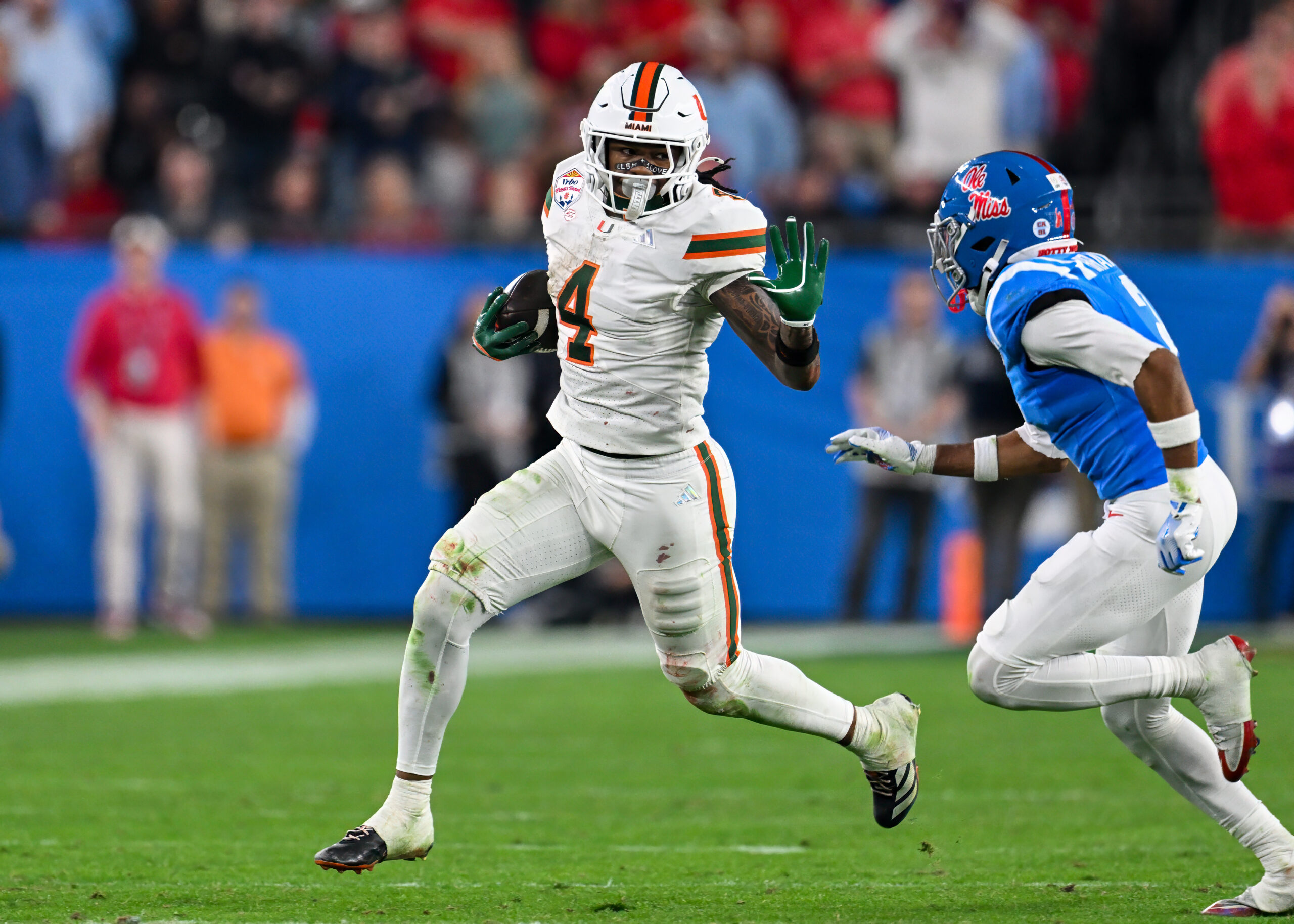
Junior running back Mark Fletcher Jr. attempts to stiff arm an Ole Miss defender in the Fiesta Bowl on Jan. 8, 2026
Miami offensive line coach Alex Mirabal is also expected to have true freshmen Jackson Cantwell and Ben Congdon slot into the starting offensive line. Cantwell is the reigning Gatorade National Player of the Year and was ranked among the top recruits in the country.
Mirabal has done a great job developing the trenches in years past, and it will be intriguing to see how his group fairs on Friday.
The Hurricanes’ offense will look to exploit a Stanford defense that struggled in its 37-27 Week Zero win over Hawai‘i.
Leading 23-7 entering the fourth quarter, Stanford allowed Hawai‘i to mount a late comeback attempt, as the Rainbow Warriors scored 20 points in the final quarter. Hawai‘i’s comeback bid ultimately fell short when quarterback Micah Alejado fumbled in the final minutes.
Miami last played Stanford in Hard Rock Stadium during the 2025 season where the Hurricanes scored 42-straight points to soundly defeat the Cardinal 42-7.
Stanford only had 144 yards of total offense compared to Miami’s 404. It was a big night for running back Mark Fletcher as he rushed 108 yards and three touchdowns.
The 2025 matchup marked the first ever game between the two programs.
The Cardinal is led by Michigan transfer quarterback Davis Warren. Warren is coming off a career-high 310-yard passing performance, completing 22 of 34 attempts with one touchdown. It was also the first time he eclipsed the 300 yard mark in his career.
Stanford totaled 483 yards of offense, led primarily by tight end Benji Blackburn, who recorded five receptions for 49 yards. The 6-foot-6 junior is a Miami, native who attended Christopher Columbus High School.
The Cardinal ran a fast tempo offense that kept Hawai‘i on its toes most of the night, led by junior running back Micah Ford.
Ford rushed for 99 yards on 25 attempts and had three touchdowns. The lead back for the Cardinal missed the 2025 matchup against the Canes because of injury but will be ready for Friday’s contest.
Miami’s defense will look to be ready for Stanford, led by a veteran group of players. The Hurricanes will enter the season without defensive standouts Rueben Bain Jr. and Akheem Mesidor, who both were selected in the first round of the 2026 NFL Draft.
“We want to try to make teams one-dimensional,” Miami defensive coordinator Corey Hetherman said. “We want to get behind the sticks. We want to get advantages to get the pass rush to them, to get them off track on third and long. We got to play hard and we got to make sure we’re stopping the run.”
A cross-country road trip is never easy, but Miami will have to be prepared for the challenge as it gets its longest trip of the season in Week 1.
The chase for title No. 6 begins Friday night against Stanford in Palo Alto, Calif. Kickoff is set for 9 p.m. ET and will air on ESPN.
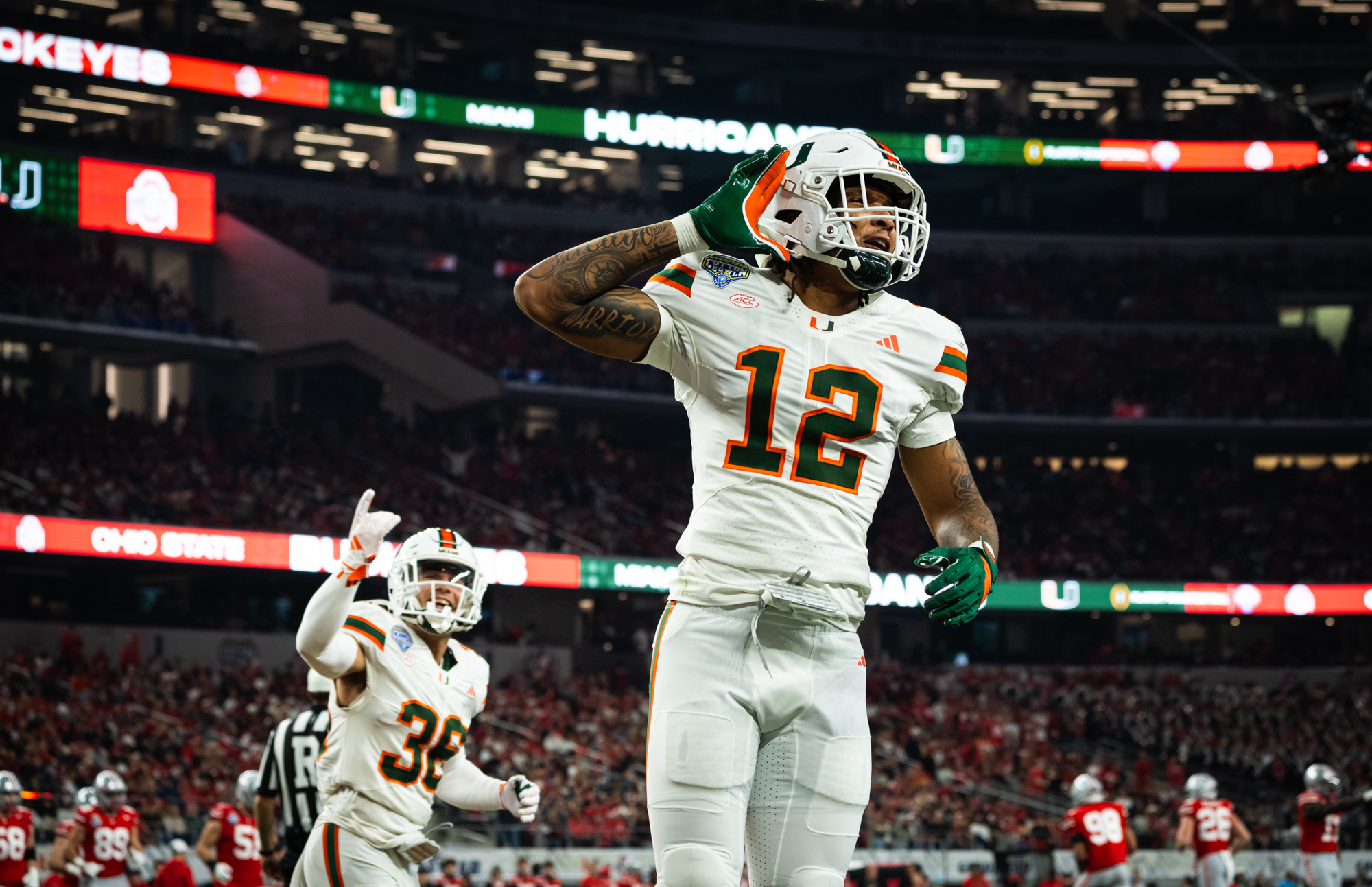
Photo Editor Brian Mulvey // Sophomore defensive end Marquise Lightfoot celebrates against Ohio State University on Wednesday, Dec. 31, 2025.
The iconic University of Miami tradition, Pancakes with Pat, is celebrating its 10-year anniversary this spring. Pancakes with Pat started in 2017 after Senior Vice President of Student Affairs and Alumni Engagement, Dr. Patricia Whitely, was inspired by the school slogan “Canes care for Canes.”
Committed to boosting student engagement and fostering community, Dr. Whitely began serving late-night pancakes to students. Almost 10 years later, the tradition is still going strong.
On Aug.17, students concluded the first day of class and lined up outside Lakeside Village, where the first Pancakes with Pat of the semester was held. Dr. Pat Whitely, sporting her bright orange visor and white apron, handed out pancakes to students, alongside members of the university’s housing and residential life and dining.
Upon receiving their pancakes, students were met with a dessert bar filled with a plethora of toppings. From sprinkles to chocolate to whipped cream, there wasn’t a topping missing.
“I love coming to Pancakes with Pat for the pancakes, the t-shirt, of course, and the vibes. My pancakes were so good, I put whipped cream, chocolate chips and oreos on them,” said Maddie Weinberg, a UM sophomore.
Students received a newly-designed Pancakes with Pat t-shirt in addition to their pancakes. In commemoration of its 10-year anniversary, the Student Affairs and Marketing team worked to redesign the Pancakes with Pat brand. Their new design is fresh and modern, but still reflects the Pancakes with Pat’s commitment to strengthening student connection and campus community.
“Pancakes with Pat is a good social hub, especially with the fact that school can get very busy at times. The shirt is nice and makes the event even more memorable,” said Curtis Maeri, a sophomore majoring in mechanical engineering.
New Pancakes with Pat merchandise via the UMiami Student Affairs & Alumni Engagement Instagram page.
“I heard there were free pancakes, so I went. The merchandise is cool, and the event brings everyone together,” said freshman Cyrus Stanton.
Although the pancakes are a bonus, many students go simply because they love Dr. Whitely.
“I went to Pancakes with Pat because Dr. Whitely is the G.O.A.T.,” said sophomore Irfan Navsariwala.
The next Pancakes with Pat event is on Sept. 23 at Centennial Village. Information about future events is provided by the University of Miami’s Student Affairs and Alumni Engagement Instagram page.
After a five-set grudge match the day prior, the Hurricanes fell flat against the Michigan Wolverines, suffering a straight set defeat (25-15, 25-15, 25-19) on Saturday. The loss in Ann Arbor dropped the Hurricanes to an 0-2 start to 2026 season.
Michigan’s block was the story of the afternoon. The Wolverines finished with 13 block assists to Miami’s two, turning back Hurricane swings all match and hitting .329 as a team compared to Miami’s .011.
The afternoon started back and forth between the sides as the teams’ traded points through a 5-5 tie before the Wolverine’s had a run that Miami couldn’t recover from.
Michigan repeatedly scored in bursts which left the Canes chasing in the first set, despite strong performances from Adriann Bridges and Ella Thompson, who kept Miami at a shouting distance in the middle of the set.
Michigan kept up its momentum and took the opening game 25-15.
Set two began eerily similar to the opening frame, with another even start to the set.
Miami had a quick 5-4 edge before Ece Senyapici and Cymarah Gordon took control for Michigan as they broke away.
Sydney Schnichels’ kill closed out the set for Michigan and put the Wolverines in position to win the match.
The Hurricanes put up a more complete set in the final frame, but still fell short.
A kill from Asia Harvey put Miami in striking distance at 17-18 in the third set, but a string of Michigan points capped off by Lydia Johnson’s back-to-back kills pushed the Wolverine lead to five — eventually clinching the match with a 25-19 win.
Harvey led the Miami attack, following her 17-kill game against Michigan State with seven kills and two aces against Michigan. Thompson added eight kills and nine points, and Billie Reiter ran the offense with 17 assists.
Denitsa Angelova made the most of a limited look, hitting .400 on three kills, while Sonja Danilovic and Adrianna Bridges each chipped in a pair of kills. Reiter and Danilovic had four and three digs, but Miami’s back row was stretched thin against Michigan’s attack that produced 40 kills.
Miami will look to gain some momentum as the Canes return home to Coral Gables for their home opener against UCLA on Friday, Sept. 4, at 6:30pm.
Miami volleyball discusses game plan during a timeout against Notre Dame at Knight Sports Complex on Friday, Oct. 11, 2024. Photo Credit: @loreleis_lens, Contributing Photographer
For just the third time in program history, the Miami women’s volleyball team traveled to East Lansing to take on the Michigan State Spartans.
After a hard-fought affair which marked the season-opener for Miami, the Canes ultimately fell to the Spartans in five sets.
The match was a back-and-forth affair throughout, but Michigan State rode the momentum from its fourth set win into the fifth set to clinch.
To start, the Spartans took an early lead with a 25-19 first set win. But the Hurricanes quickly struck back.
Filled with new faces, Miami evened up the match with a 26-24 victory in the second set thanks to a 5-0 run, and took the lead in the third set with another narrow 25-23 set win.
Offensively, Asia Harvey led the charge for the Canes, racking up 17 kills for a .263 hitting percentage and a .447 hitting percentage in her debut with the Hurricanes. Sonja Danilovic also recorded double-digit kills with 11 and Billie Reiter dropped 38 assists.
Reiter also led the team with 11 blocks on the night, followed by Danilovic with nine.
The remaining two sets of the match were all Spartans as Michigan State rallied with their backs against the wall in a commanding 25-19 set win. Their momentum continued, demonstrated in a 9-0 run which essentially put the game in their hands in the fifth set, winning 15-6.
Miami will continue their road trip with a test against the Michigan Wolverines Saturday, Aug. 29.
Coming off a National Championship appearance, expectations are sky-high for Canes football as the program pushes for its first title in more than 20 years.
With another transfer quarterback at the helm in the form of Darian Mensah and superstars littered around the roster for Miami, the mix of fresh faces and returning talent sparks plenty of national debate on where the Canes stand.
As buzz around the Hurricanes continues to mount with UM’s season-opener one week away against Stanford on Sept. 4, read some “hot takes” from the TMH Sports Staff on what this season will hold for the Canes.
Sebastian Font, Co-Sports Editor – Miami will boast more first-rounders than last season
In the 2026 NFL Draft, the Hurricanes had three of its biggest stars walk across the stage and shake commissioner Roger Goodell’s hand in the first round.
The trio of OT Francis Mauigoa (Pick 10), DE Reuben Bain Jr. (Pick 15) and DE Akheem Mesidor (Pick 22) marked the most Hurricanes selected in the first round since 2004 — a draft where UM set the record for first-rounders with six (for those keeping score at home).
And while their talent will be missed, the Canes reloaded in the portal and retained homegrown talent.
I wouldn’t be surprised to see four or more Hurricanes selected in the first round of the 2027 Draft, including the likes of: QB Darian Mensah, DT Ahmad Moten Sr., DT Justin Scott, CB O.J Frederique and DE Damon Wilson II.
There’s premier talent scattered across the field for this Hurricane side, which has come a long way since Jonathan Ford was the Miami’s only draftee in the 2022 NFL Draft.
From begging for a single pro talent to overflowing with it — proof of Mario Cristobal’s concept.
Jayden Gonzalez, Co-Sports Editor –Miami’s defensive line will be better than last year’s group
It’s hard to imagine the Hurricanes pass rush somehow getting better while losing two of the best defensive lineman in the country to the NFL Draft, but the 2026 iteration of the Canes have a chance to do that in the aggregate.
Missouri transfer Damon Wilson is coming off his best year — hoisting 10 sacks against SEC talent. His style of play is what Miami needs to replace the sack production of Mesidor, who led the Canes with 12.5 sacks last season.
Junior defensive ends Marquise Lightfoot and Armando Blount are also poised for strong seasons after being rotational pieces behind Bain and Mesidor.
On the interior, Ahmad Moten and Justin Scott are two of the best nose tackles in the nation, both having chances to become first round picks in the 2027 NFL Draft.
Entering his fifth season and slowly working his way up the ranks, Moten made his presence felt in 2025, tallying 4.5 sacks and 31 tackles and making his biggest impact in the postseason.
While Scott hasn’t put up the flashiest numbers — with just 26 tackles and one sack in 2025— he has incredible speed and twitchiness for a 303-pound defensive lineman, he just needs the production to put it all together.
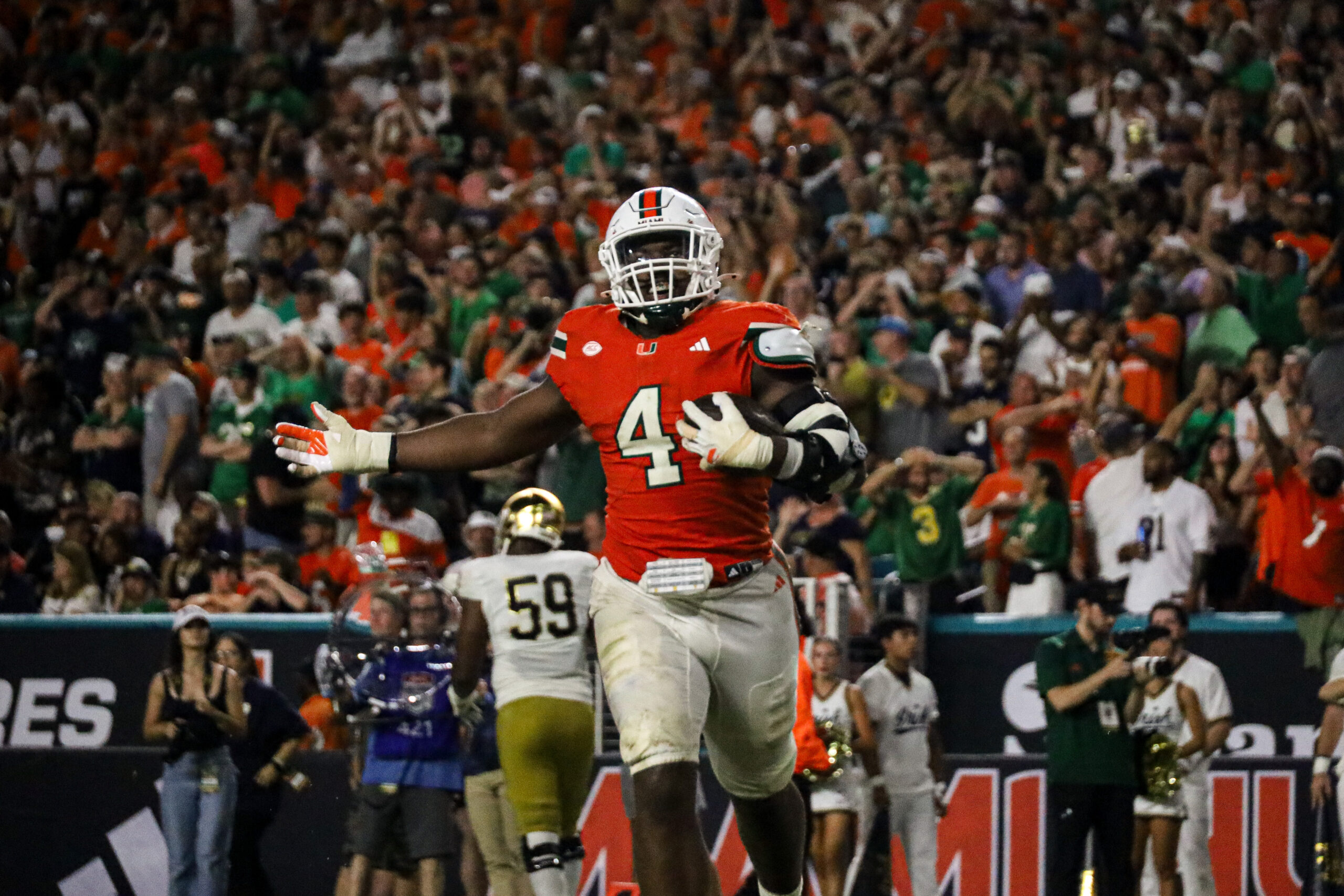
Makena Wong, Photo Editor, Junior Defensive End Rueben Bain Jr. celebrates after interception on Sunday, Aug. 31st, 2025.
Bella Armstrong, Senior Staff Writer – Malachi Toney will win the Heisman.
Call it Miami bias if you want, but Toney has everything necessary to turn a breakout season into a Heisman campaign.
He’s explosive, versatile and ultimately the kind of player who can completely change a game every time the ball touches his hands. More importantly, Miami’s offense gives him the opportunity to produce the highlight-reel moments Heisman voters remember.
The award has become increasingly quarterback-dominated, but that makes Toney an even more interesting — almost dark horse — candidate. If the Canes remain nationally relevant like they’re expected to and Toney becomes the centerpiece of its offense (and we all know he will), don’t be surprised when he ends up in New York.
Come December, I’ll call it proper foresight.
Luca Mucciardi, Staff Writer –“Mali-cat” returns in a bigger role
One of the staples of last year’s Miami Hurricanes offense was Shannon Dawson’s self-proclaimed “Mali-Cat” offense.
Malachi Toney, a high school quarterback for a time at American Heritage High School in Plantation, Fla., was often utilized in this wildcat scheme last season for the Hurricanes. He attempted seven passes, completing four of them for a total of 82 yards and two touchdowns.
With the effectiveness/threat of Toney with both his legs and his underappreciated arm, the “Mali-Cat” has all the possibility of being an integral part of this Hurricanes offensive scheme, leading me to believe that Malachi Toney will throw for over 250 yards and 5 touchdowns this season through the air.
Who needs Air-Jordan, Miami’s got Air-Mali.
Brendan Cafferty, Staff Writer –Cooper Barkate leads team in receiving yards
Cooper Barkate will outshine Malachi Toney … in one general stat.
Malachi Toney’s versatility will not go unnoticed on the playing field, but when it comes to receiving yards, Barkate will prevail as Darian Mensah’s favorite. The two former Blue Devils showed a deep connection in 2025, with Barkate tallying 1,106 of Mensah’s 3,973 passing yards. In comparison, Beck threw for 3,813 yards last year, with Toney being responsible for 1,211 in the air.
With similar statlines in the 2025 regular seasons, there is reason to believe both will have outstanding seasons with Mensah at the helm, but Barkate will break past Toney in receiving for a couple of reasons. One, the previously mentioned connection with Mensah, even being referred to by the quarterback as his “best friend.” Two, Toney’s ACC Rookie of the Year season will make him a target for defenses, often leaving Barkate isolated on the deep route.
Contingent on the offense run by OC Shannon Dawson, and the accuracy of Mensah’s deep ball (which has proven efficient in the past), it seems Barkate could be in for a large downfield presence this season.
With all that said, it’s still impossible to contain Mali, so his YAC could exceed the already high expectations set for this season.
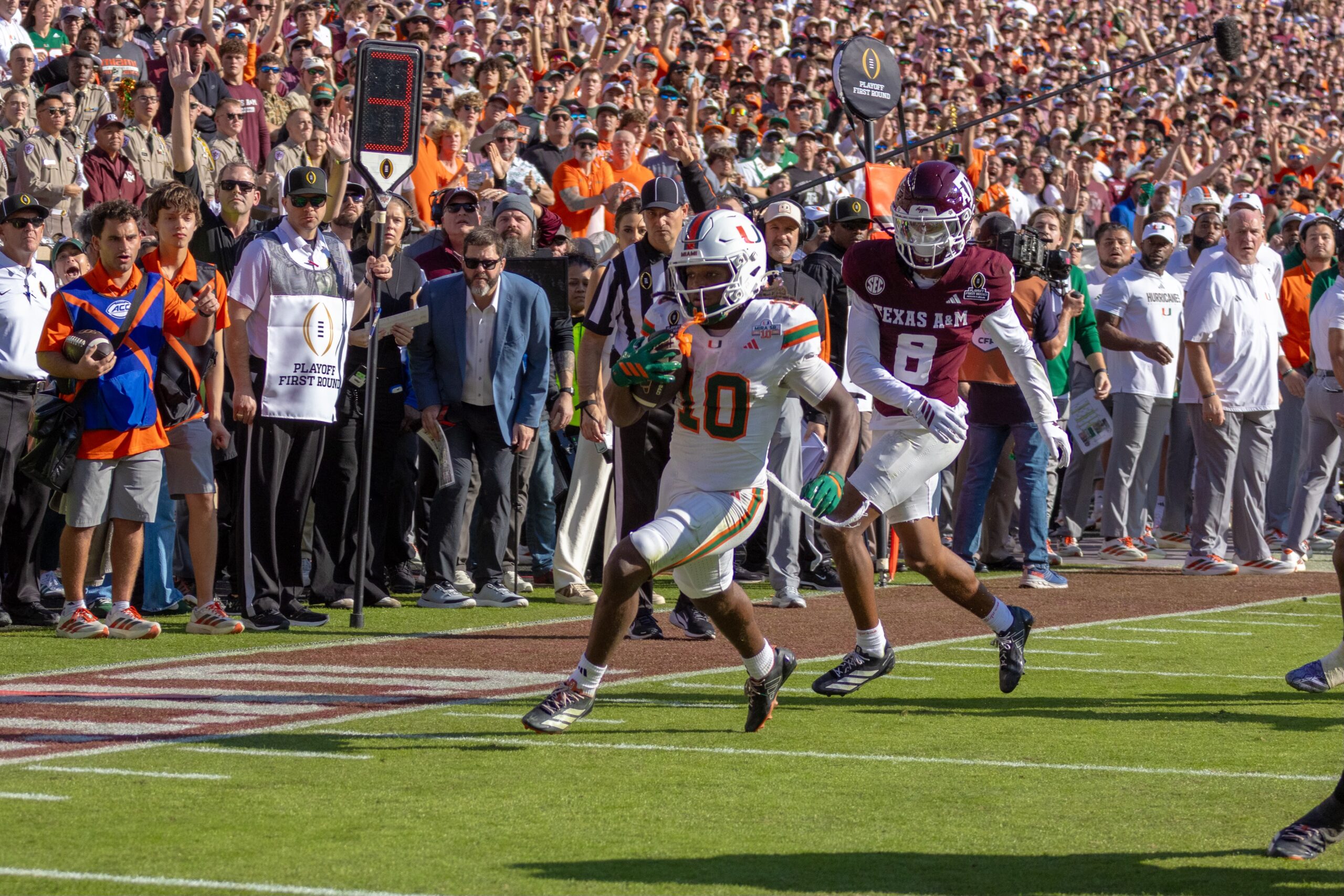
UM Freshman Malachi Toney rushes for the game winning touchdown versus Texas A&M on Dec. 20 // Jake Sperling.
Olivia Attalla, Staff Writer –Miami will win the National Championship
The Miami Hurricanes were only a few seconds away from clinching the College Football Championship against the Indiana Hoosiers until Carson Beck threw a costly interception at the end of the game.
Now, the Canes are back and fully loaded, led by Quarterback Darian Mensah, who had 3,973 passing yards in 2025, leading the ACC, and good for second-most in the country.
Mensah also finished with 34 touchdowns, and set a Duke single-season record. Now, all eyes are on him to see if he can deliver when the pressure is at its highest.
Can the Hurricanes quarterback carry that same high energy and bring the Canes back to the Natty?
I think he will.
Riley Donner, Contributing Writer –Bain and Mesidor Are Gone. So is Miami’s Margin for Error
While The ‘U’ may have more overall talent on paper in 2026, the loss of first round draft picks Rueben Bain Jr. and Akheem Mesidor means losing two players each capable of wrecking a game by themselves. Bain and Mesidor totaled 22 sacks on the season, with 10.5 coming during the Hurricanes’ College Football Playoff run, along with 40 combined pressures.
When Miami needs a big defensive play late in the game, who is the guy now? Last season, blown coverage or a missed assignment could be erased by one of the two elite-level pass rushers.
Replacing the production of two First Team All-ACC pass rushers is difficult; replacing their ability to take over a game is even harder
Talia Eckles, Contributing Writer – Darian Mensah will raise the standard set by Carson Beck
After Carson Beck led the Miami Hurricanes to the National Championship, it may seem bold to say his replacement will be even better. But Darian Mensah has already shown his immense talent at the ACC level, throwing for 3,973 yards and 34 touchdowns with only six interceptions at Duke last season.
Beck finished his Miami season with 3,813 yards, 30 touchdowns and 12 interceptions. Double the amount of interceptions as Mensah last season.
However, Mensah will have to do it without the same key defensive players Beck had with him last season. Miami’s loss of Rueben Bain Jr. and Akheem Mesidor to the NFL gives Mensah a disadvantage over Beck.
Regardless, I think Mensah will not only succeed, but outperform Beck. By the end of the season, I would not be surprised if Canes fans look back at Beck’s numbers and realize Mensah is an upgrade.
Ricky Browne, Contributing Writer – Miami will average the most PPG in its history
In 2024 with Cam Ward under center, the Hurricanes set a program record with 43.9 points per game.
While this prediction marks a big leap from the 30.9 points per game the Hurricanes averaged last year, I truly believe the 2026 Hurricanes have a chance to do it.
Malachi Toney returns after an historical freshman year in which he recorded 109 receptions for 1,211 yards and 10 touchdowns and lining up on the other side from him will be senior transfer Cooper Barkarte who had 72 receptions for 1,106 yards and seven touchdowns last year.
Darian Mesnah also joins from Duke who himself had an incredible year, and now has the best supporting cast of his career.
The Hurricanes also bring back their entire running back room including Mark Fletcher Jr.
If everything falls in place, the Miami Hurricanes could look at an historical scoring offense this season.
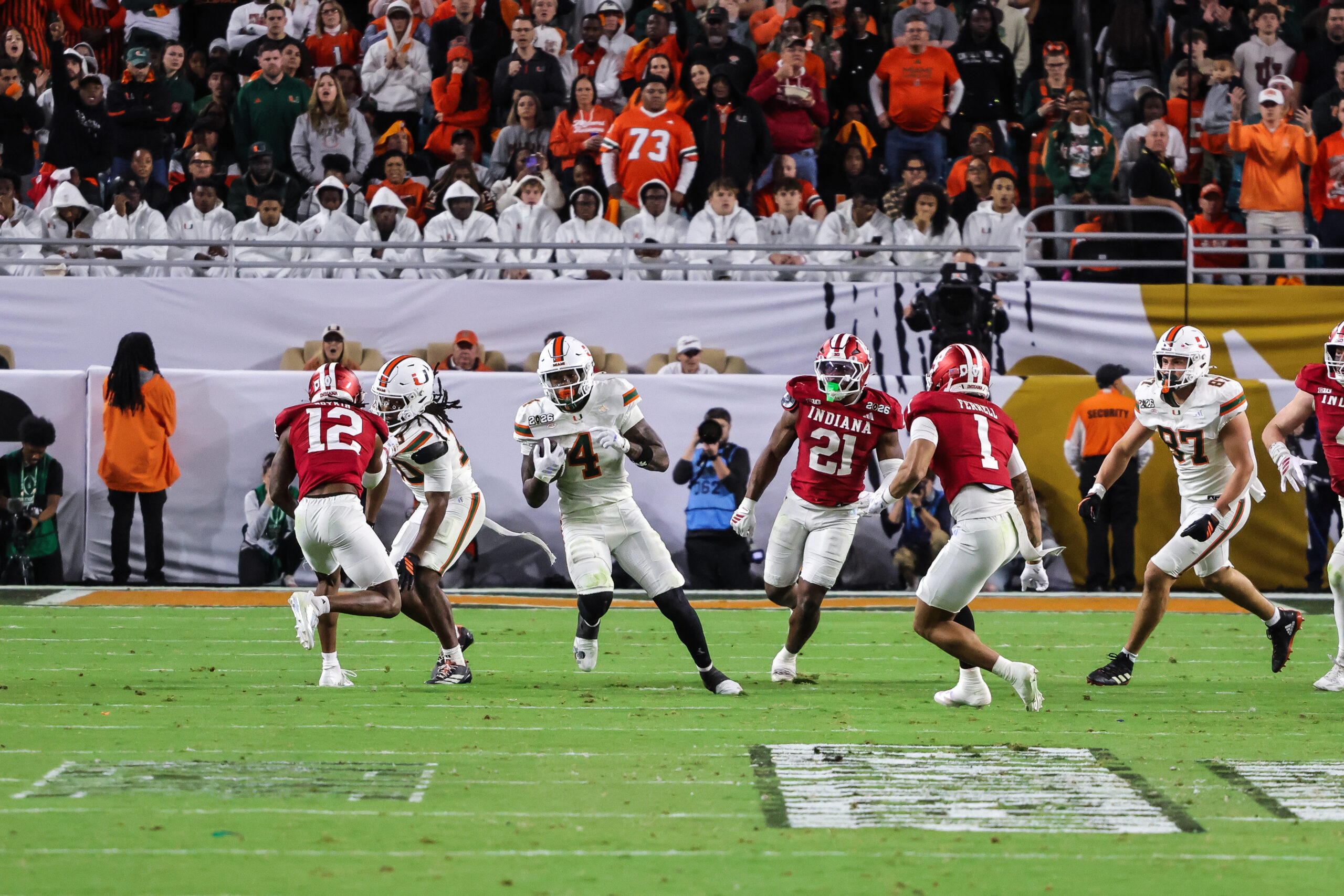
Mark Fletcher Jr. carries the ball as Miami’s offense pushes forward against the Indiana Hoosiers during the College Football Playoff National Championship on Jan. 19, 2026. // Photo credit: Jake Sperling, Ibis Yearbook
Former Miami Hurricanes wideout Cam Vaughn has officially dropped his lawsuit against the University according to On3.
The move comes after the University’s submission of a relief request to allow his entrance into the transfer portal — with such a waiver being at the core of the original suit filed earlier this week.
Vaughn’s original lawsuit alleged the Hurricanes “refused to submit the waiver request the NCAA requires so that he can enter the transfer portal,” following his dismissal from the program earlier this August.
Other claims included “promises of a multi-year scholarship and revenue-sharing and NIL compensation” that were not met.
The West Virginia transfer’s dismissal was announced by head coach Mario Cristobal on Aug. 17, who did not give a direct reason for his departure.
“Cam Vaughn has been dismissed from the team,” Cristobal said. “We wish him the best … the Canes will press on.”
The Miami Hurricane has reached out repeatedly for comment on the situation, but has not received a response.
Vaughn came to the program as a highly-touted transfer from WV, but his place in the depth chart slid following additional transfers such as Cooper Barkate and the rise of emerging homegrown talents.
Miami will kick off its 2026 season in a week’s time on the road against Stanford on Sept. 4.
Click here for more on Vaughn’s original lawsuit, and here for further information on his dismissal from the program.
When UM senior Destyn Storm Zarate ran the Madrid Marathon while studying abroad, he initially saw the race as a personal challenge. He spent his semester preparing for what he expected to be the greatest challenge he had faced, working training into his busy class schedule.
“I thought to myself, it’s good to run a marathon for yourself. But how good would it be if you did it for other people at the same time?” Zarate said.
Zarate gave himself just seven days to raise $10,000 and reached his goal the day before he was set to run 26.2 miles.
“It was the greatest accomplishment in the world, and I didn’t even run the marathon yet,” he said.
After completing the race, Zarate began thinking about scaling up his fundraising. He knew about the Miami Marathon, which attracts University of Miami students.
He also knew he wanted to raise much more than $10,000 this go-around.
And so, Run For The U was created.
UM students can join the organization and run the Miami Marathon, half marathon or 5K while raising enough money to fund a full scholarship to the University.
Zarate estimates that the group will need to raise $400,000 to cover four years of tuition and fees. The team plans to raise money by encouraging donations through a GoFundMe link and by securing local community sponsors.
With that goal in mind, Zarate began looking for members for his founding team and recruited senior Lauren Margerison as his director of marketing.
“He ran the Madrid Marathon and said, ‘Look, a lot of people raise money for the New York Marathon. A lot of people raise money for the Boston Marathon, but nobody raises money for the Miami Marathon to that extent,’” Margerison said.
Interest in the organization has grown quickly, with about 200 students already involved.
The organization is not limited to experienced runners. Members of the founding team come from different levels of experience, and one of the group’s major goals is to have group training sessions, recovery days and dinners together to cultivate a close community.
“We really are just a mixture,” Margerison said. “The point is not just to run. It is to raise money and to have a good time.”
Students are also encouraged to participate without running in the official marathon. Margerison said the race’s lottery system created an unexpected challenge for the organization. She said more than 150 students expressed interest in running the race, but only about 40 have received a spot so far.
Run For The U is considering having non-runners volunteer to help with a water station, a table at events, promoting the fundraiser and supporting the team.
The founding team already includes students involved in Greek life, student government, ROTC and club sports. Margerison said those connections could help the organization reach students who may not consider themselves runners but still want to be involved.
“The more people we have, the more fun and the more energy there is to raise the money,” Margerison said.
The scholarship selection process remains a work in progress, but one thing is clear.
Both Zarate and Margerison said the group wants the eventual recipient to demonstrate financial need and be passionate about UM.
As Run For The U prepares for its first Miami Marathon on January 31, 2027, the organization is continuing to recruit members and build its fundraising network.
Whether students run 26.2 miles, participate in a group training session or share the fundraising link, Zarate hopes the effort can eventually help another student attend UM.
“When you know you’re a part of an organization whose goal is to fund a UM student’s tuition. [It’s] unheard of. It’s never been done before here,” Zarate said.
In this episode, we break down the latest developments at the University of Miami, including housing changes, hazing allegations involving Phi Delta Theta, and the arrest of Jordan Lyle. We cover what happened, the key details, and what students need to know.
Miami Hurricanes Soccer (4-0-1) secured its fourth consecutive victory Thursday night in a 2-1 win over Incarnate Word (3-0-2).
The Hurricanes were back at home at Cobb Stadium for the first time this season after starting their first four matches on the road, and they gave the home crowd much to cheer about.
The game started with a scoreless first half with both teams trading chances, the best of which was a strike from outside the box from Incarnate Word, forcing Hurricanes keeper Atlee Olofson to stretch across the net to keep the game level.
Her heroics were short-lived, as the Cardinals struck first 10 minutes into the second half.
Winger Kianna Villa was able to whip a cross into the box from the right wing, where striker Taylor Kish waited to flick a header past the outstretched Olofson to give Incarnate Word a 1-0 lead.
Less than six minutes later, Miami would level the tie with a moment of brilliance from Cissel Akguel, who took on her defender one-on-one before curling a shot over the head of the Cardinals keeper and into the back of the net.
With five minutes remaining in the match, Abigail Casey would be dragged down in the box, winning the Hurricanes a penalty. Incarnate Word would challenge the call on the field, and after video review the call would stand, giving Miami a chance to find a winner in the dying moments.
With a win on the line, the goalkeeper Olofson stepped up for the Hurricanes from the spot, and after 85 minutes of brilliant play in front of the Miami net, she buried a rocket into the top of the Incarnate Word net to put Miami up 2-1.
The Hurricanes would see the game out and go on to win their fourth consecutive game, and their first of the year at Cobb Stadium.
Miami controlled the game on the stat sheet, outshooting the Cardinals, 16-2, and took 13 corners compared to Incarnate Word’s one.
Canes Soccer returns to action Thursday, Sept. 3 at Cobb Stadium to host App State.