Home Blog Page 107

Hurricanes vs. Gators student tickets sold out amid website glitches

Student tickets for Saturday’s rivalry game between UM and the Florida Gators sold out in just three hours, setting a new standard for demand. The Hurricanes continue to draw larger crowds amid its football program’s resurgence. 

Many students reported problems with the student tickets website, including error messages and persistent loading screens. Kali’a Victorino-Smith, a freshman at UM, shared how she could not claim tickets.

“I waited on the student ticket app for 45 minutes waiting for it to reload and did not know the whole game was sold out until a friend texted me, we both did not get tickets,” Victorino-Smith said.

Students immediately shared their excitement — and, in some cases, frustration with the ticket website — across social media. One TikTok user, @ddanirose posted a video of the ticket site saying, “pov my 98k tuition goes to a student ticket site that doesn’t work.” One user commented they didn’t get tickets until 1:30 p.m., an hour and a half after tickets were released. Another told UM Athletics “they need to do better.”

Danielle Hills, a sophomore at UM, said that her experience of claiming tickets was no less chaotic.

“It was honestly so frustrating because there was no progress and everyone was frantically trying to figure out what was happening,” Hills said. “It was just an hour of straight frustration and confusion.” 

Student tickets also sold out for the Hurricane’s season opener against Notre Dame. With two sold out games only four weeks into the season, UM fans support and participation is consistently continuing as the Canes climb up in national rankings. 

Even if students could not score tickets, their enthusiasm for the matchup is still high. 

“The game is going to be insane,”  said David Kuper, president of Category 5. “We saw earlier in the season how great it is to have a long-time rival come to town when we went up against Notre Dame, and this one means a little bit more since it is our state rival.”

ESPN’s College GameDay pregame show is coming to Coral Gables for Saturday’s match up versus the Gators, marking the second time that the show has been on UM’s campus since 2017. The announcement sent waves of excitement through the Hurricanes’ fan base. 

The University of Miami has won five national championships during its “decade of dominance” in 1983,1987,1989, 1991 and 2001. The program thrived, winning consistently and developing future NFL players. Miami was gradually building a football empire. with challenges in location, recruitment, and coaching, losses began to pile up, extending a streak of disappointing results. Things turned around with Mario Cristobal, a former UM football player who has been coaching the Hurricanes since 2021, created a turning point in the football program’s revival. 

The Hurricanes are now ranked fourth in the AP Top-25 Poll with a 3-0 record. Miami will face Florida in a highly anticipated match-up on Saturday at 7:30pm.  


Miami Vs. Florida: A rivalry recharged

0

The Miami–Florida football rivalry is one of the most historic — and overlooked — in college football. The Hurricanes and Gators have only played a handful of times in the last 40 years, but their rivalry is rich in history and bad blood, with hatred for each other running deep. To understand the true magnitude of this historic hatred, we need to peek into the past.

The ’Canes and Gators first faced off back in 1938, before Florida State football existed, with the game ending in a 19-17 Miami victory. With the Seminoles non-existent, these were the two biggest schools in the state. Naturally, the rivalry soon became a staple in South Florida football culture, with annual matchups alternating between Gainesville and Miami.

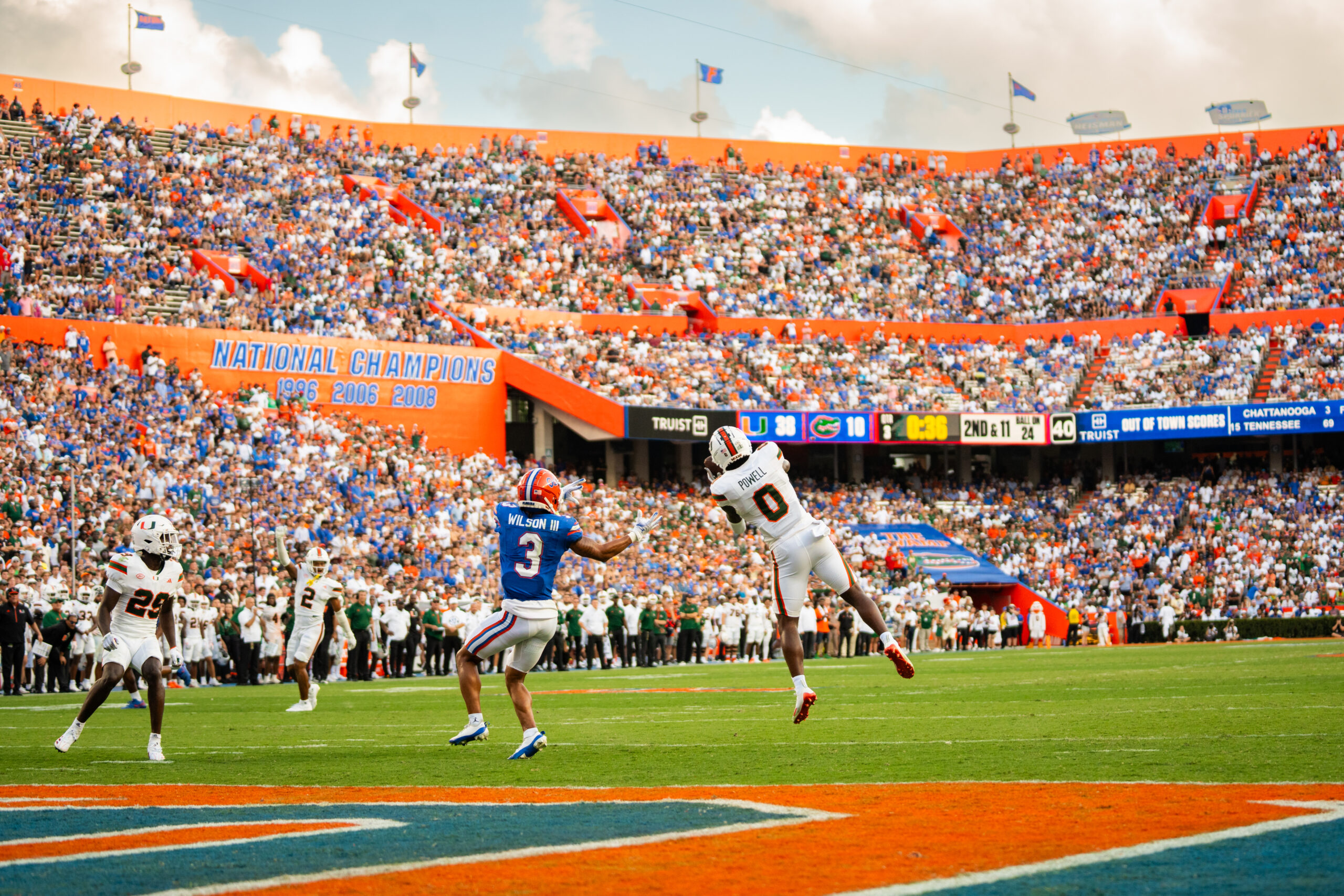
Redshirt senior defensive back, Mishael Powell, intercepts a pass from the University of Florida quarterback at Ben Hill Griffin Stadium on August 31, 2024.

In 1950, the Seminole War Canoe Trophy was introduced – a lightning-struck, 200-year-old cypress canoe carved by Seminole artisans, awarded to the winner each year. The rivalry was as passionate as any – teams hated each other, fans hated each other, and coaches did too. This led to some incredible games and extremely heated moments.

In 1971, one of the most infamous moments of the rivalry happened in a 45-16 Gators thrashing of Miami. With the win in the bag, UF quarterback John Reaves was 10 yards away from breaking the NCAA career passing record. In order to get him the record, the Gators defense performed what would be dubbed the “Gator Flop”, as members of the team intentionally fell to the ground, allowing Miami to score so Reaves could get the ball back and break the record. 

Then-Miami coach Fran Curci was enraged, calling it “the worst thing I have ever seen in football” and refused to shake hands postgame.

In 1979, in what was known as the “Orange Barrage,” Miami players were celebrating a win on their sideline when Gator fans pelted them with orange peels, infuriating both the players and head coach Howard Schnellenberger, as well as prompting the Florida administration to implement fan misconduct rules after the loss. 

Just one year later, the ‘Canes were up 28-7 with a win in hand, but coach Schnellenberger decided to call a timeout just before the clock expired. He trotted out his kicker and sank a “kick in your face” field goal to make it 31-7 as time expired.

University of Miami mascot, Sebasatian the Ibis, performs the C-A-N-E-S chant at Ben Hill Griffin Stadium on August 31, 2024. Photo via Emily Rice

The teams battled it out perennially for the coveted trophy for almost 40 years, until the Gators canceled the yearly series in 1987. That year, the Hurricanes and Gators played their last game for the war canoe, with Miami winning handily, 31-4, and earning the right to keep the trophy forever.

While the Gators claim they were forced to cancel the yearly series because of SEC expansion, the teams attempted to reignite the series in 1990. But, UF wanted to maintain a yearly SEC home game, avoiding the back-and-forth home-and-home arrangement with Miami. This led Miami fans and media voices alike to call out the Gators for allegedly “ducking” the ‘Canes, who were at the height of their power and looked unstoppable. 

With the yearly rivalry canceled, the games came much less frequently, but they still sparked some historic moments.

In 2003, former UF quarterback Brock Berlin had transferred to Miami and was playing for the orange and green. Down by 23, all hope seemed lost until Berlin caught fire, orchestrating a dramatic come-from-behind ‘Canes victory.

In 2008, Florida had a decisive victory of their own, taking down the Hurricanes 26-3. Florida still hadn’t forgotten the 1980 matchup in which the ‘Canes tacked on a late field goal, so they got their revenge 28 years later, opting for a field goal instead of taking a knee. To rub salt in the wound,  Gators wide receiver Louis Murphy proclaimed UF as “The New U”, solidifying the game as “The New U” game.

Their last matchup took place in 2024, with “The U” marching into the Swamp in Week 1, the Hurricane debut of quarterback Cam Ward. Ward kickstarted his historic 2024 campaign with a thrashing of the Gators, winning 41-17. It was the worst season-opening loss in 118 Years of Florida football, and snapped its 33 year home opener win streak. Entering 2025, the Hurricanes hold a 30-27 lead over the Gators all time.

The Miami–Florida rivalry is steeped in history, hostility, and unforgettable moments. With its long-awaited revival, the Gators arrive in Miami not just seeking revenge for their 2024 humiliation, but also aiming to derail the Hurricanes’ undefeated season and national title dreams. Miami may be favorite on Saturday, but in a rivalry this heated, records mean nothing. 

Kickoff is set for 7:30 p.m. at Hard Rock Stadium, airing on ABC — and the nation will be watching as old grudges reignite under the lights.

Leonardo DiCaprio fights ‘One Battle After Another’

Paul Thomas Anderson returns to the big screen with bullets, bombs and Leonardo DiCaprio. In “One Battle After Another,” their first film together, DiCaprio plays an aging revolutionary named Bob. 

DiCaprio suits up in slippers and a beanie to save his kidnapped daughter and reunite with the explosions and car-chases he left behind. 

It’s a film about freedom, fight and, most importantly to DiCaprio, family.

“He’s a disaster of a father, and then all of a sudden he’s put into this wild circumstance to try to save her,” DiCaprio said. “It’s just a beautiful bit of writing.”

You’ve seen The Dude from “The Big Lebowski,” but could you imagine him jumping out of a moving car while “hiding” a sniper rifle in a backpack? Now, you don’t have to. 

DiCaprio read about Bob’s self-deprecation and sabotage in the script and knew the character would take him on a fun ride.

“I think it’s a complete setup for a sort of traditional trope that maybe we’ve seen a multitude of times before,” DiCaprio said. “But the character evolved as the movie went on.”

Bob’s biological and chosen family, and inadvertently the SWAT team that was glued to him, helped him evolve. Someone needed to remind him how military bases are as hard to entering your house drunk. 

Enter Benicio del Toro’s Sergio St. Carlos. The sensei never leaves his nunchucks and words of wisdom at the dojo. He brings calm to Bob’s stoned chaos.

“Leo brings tons of energy, so I just danced with it and stayed,” del Toro said. “I was the anchor in some ways, even though the scenes were packed with movement.”

More of DiCaprio’s notable anchors include Regina King, Teyana Taylor, Sean Penn, and Chase Infiniti. Infiniti’s character, Willa, is an anchor and Bob’s purpose.

He gets off the couch to save her from Penn’s Steven J. Lockjaw’s military brigade. Bob’s ability to remember secret passwords was definitely in question. But his love for Willa was never like Infiniti’s dedication to getting in Willa’s skin.

“More than anything, what I wanted to do was hone in on her feeling of not fully knowing a bit of her story,” Infiniti said. “Regardless of any relationship that she has with a character, any storyline thing, I think that that really helped me drop into her.”

Early critics felt Infiniti, a 25-year-old making her feature debut with DiCaprio, was an outlier in a film with an Oscar-nominated cast and crew. Yet, to her co-stars, they are surprised this is her debut.

Infiniti commands fight scenes with Penn and emotional arguments with DiCaprio. Maybe she even outwits del Toro. There’s only one way to find out.

Head to an early screening of “One Battle After Another” at the Bill Cosford Cinema on Sep. 22 at 7p.m. Click here to reserve your ticket. Get ready for feels, laughs and thrilling action that has a deeper message below the surface.

“He can find humor in the absurdity in things, which he did in this,” King said. “It’s about love. It is about family. Connection, commitment, revolution.”

Afternoon at the Lowe: Interview with the Executive Director

In today’s exclusive interview, Dr. Jill Deupi shares what sets the Lowe Art Museum apart from other university and public museums, her guiding vision as Executive Director & Chief Curator, and how she selects exhibitions and artists. We discuss which works best represent UM’s identity, why students should engage with the museum (even if they’re not art majors), and what exciting projects and exhibitions are coming next.

Sonja Danilovic builds her own legacy, one spike at a time

0

At the U, Freshman outside hitter Sonja Danilovic isn’t just carrying her family’s legacy — she’s creating one of her own. 

As the daughter of former Miami Heat shooting guard Predrag “Saša” Danilovic and sports reporter Svetlana, athletics are in Sonja’s DNA. 

Her siblings felt the calling too. Her sister Olga, 24, plays professional tennis and her brother Vuk, 17, plays for the Serbian national basketball team, both following in their father’s footsteps. 

But while many expected Sonja to take after her father and follow him to the three-point line, the 19-year-old wanted something that belonged entirely to her.

From the moment she first picked up a volleyball and stepped onto the court, the answer was clear. 

Volleyball gave her more than the competition she craved. It offered camaraderie, technical challenge and satiated her constant thirst for improvement.

By age 13, she was representing Serbia in the Balkan, European and World Championships. Each tournament was about more than the medals shining around her neck: playing for her home country brings with it great honor, pride, and above all else, responsibility. 

“When you’re standing under your flag, singing your anthem — it’s a different kind of fight,” she said. 

“It’s personal.” 

But that weight, combined with the expectations that come with her family name, brings enormous pressure. 

Yet, Danilovic insists that pressure fuels her, as she dreams of playing under Serbia’s banner at the Olympics. Until then, each match is a chance to sharpen her skills, honor her roots, and build her own name in the sport she loves. 

Sonja Danilovic representing Serbia at a tournament. Photo Credit: Sonja Danilovic

“When you think of me, you think of volleyball. It’s who I am,” she said. “But when you think of volleyball, you don’t think ‘Sonja Danilovic.’ I want that to change. I want to be the best.” 

Danilovic’s connection to Miami is long standing.

Her parents held a deep admiration for the time they spent with Sonja’s father playing here. Danilovic had visited Miami twice before, and now it’s time for her to stay and leave her own mark on the city. 

Back home in Serbia, her family’s success casts a long shadow. Choosing Miami wasn’t just about volleyball — it was about finding space to grow into herself, as an athlete and as a person.

“I feel so grateful. I wake up every day in Miami because of my hard work. And I’m doing what I love,” she said. “I could be back in Belgrade, but I’d rather be here.”

With it being her first time away from home, over 5,000 miles from her life in Serbia, Danilovic is adjusting to life as an athlete, a freshman and an international student. Everything is new, from the size of the ball to the food that she eats. Embracing such change is a challenge, but she has a formidable support system in her corner. 

She credits her family, coaches, teammates and dear friend Georgia Shayesteh, a sophomore cheerleader at the U.

 “I wouldn’t be able to do this without them,” Danilovic said.

The move was certainly bold. She had to leave her family, friends, and the comfort of familiarity behind. But that was part of the draw. 

“It’s all new, and that’s scary,” Danilovic admitted. “But if I had stayed home and never taken these opportunities, I’d never forgive myself.”

“I could never imagine myself being okay with giving up,” she said. And it’s impossible to not believe her. 

In truth, her story is just beginning. This time, Danilovic won’t just remind us of basketball—it will be synonymous with volleyball too.

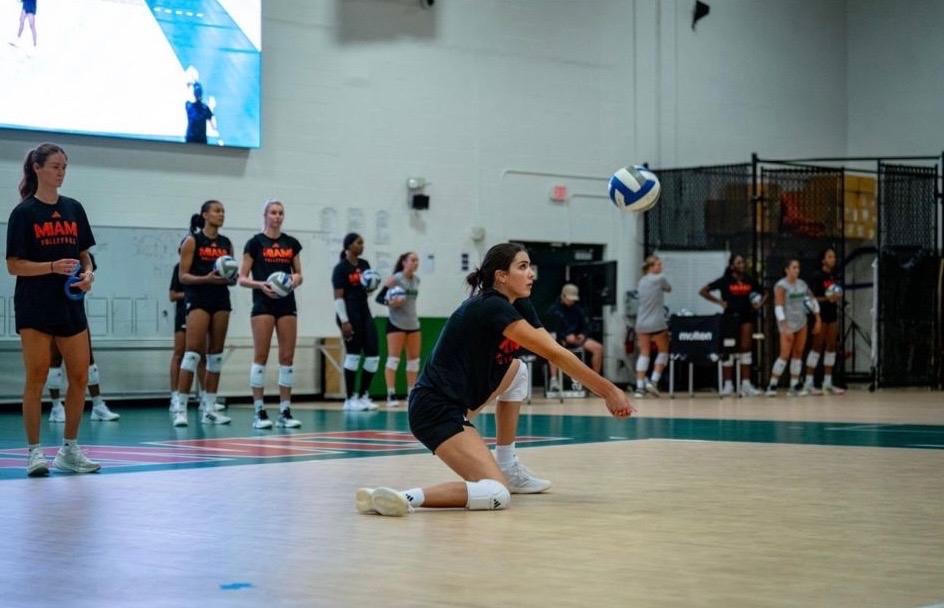
Freshman outside hitter Sonja Danilovic preparing for her first season as a Hurricane. Photo Credit: Sonja Danilovic

Florida’s war on crosswalks is really a war on expression

0

Governor DeSantis issued an ultimatum to communities statewide: erase street art or lose funding. Citing traffic fatalities, he argues that eliminating street murals and crosswalk painting will protect Floridians.

Of course, this order is about more than road safety.  It’s about eliminating freedom of expression from groups he doesn’t want to see.

Safety as a cover 

This logic was also used in the letter from Secretary of Transportation Sean Duffy in which he urged governors nationwide to eliminate street art. The letter promised the government was “using data to guide decision-making and prioritize investments that reduce distraction while improving mobility and safety for all road users.” 

In this same letter, Duffy admits “estimates of traffic fatalities for 2024 continue a downward trend, by decreasing 3.8 percent from 2023.”

From this statistic alone, it is clear that rainbow crosswalks are not posing the threat that politicians are attempting to make them seem. In fact, studies suggest that by improving crosswalk visibility, street art reduces accidents by an average of 17%.

Rainbow crosswalks are not causing accidents 

Even with downward trends in accidents, it’s understandable that the Department of Transportation would want to prevent more accidents. But if their approach is truly data driven, officials would see that removing crosswalks shouldn’t be their number one priority.

Research by BMC Public Health suggests that changing infrastructure isn’t as effective as creating laws that target behavior. If he wanted to improve public safety, DeSantis could implement a ban of cell phone use while driving or improve drunk driving enforcement.

If DeSantis is truly concerned about his constituents, he certainly shouldn’t be withholding funds from the very people charged with keeping roads safe.

Erasing communities and stopping solidarity 

DeSantis did not mention how this order fit into his broader agenda of erasing minorities from public consciousness. On X, the governor posted “We will not allow our state roads to be commandeered for political purposes.”

That calls into question what street art DeSantis considers “political.” Is it political for the street to convey “Black Lives Matter?” Is it political for the LGBTQ+ community to assert their right to exist with colorful art?

One of the first pieces of street art DeSantis targeted was the rainbow crosswalk in front of the Pulse nightclub — the sight of one of the deadliest mass shootings in American history.

The mural was intended to show solidarity with the LGBTQ+ community and reject the hatred that motivated the shooting. By removing that mural, the state of Florida is revoking that solidarity and aligning itself with the hatred of the shooter.

Art as a form of resistance

Some residents are choosing to resist this campaign of intimidation, but this resistance is being met with harsh retaliation from the state. Hundreds participated in protests and recolored the barren sidewalks, but were interrupted by police arguing that coloring amounted to a felony. Four people who recolored the Pulse memorial in chalk were arrested on charges of defacing public property. In St Petersburg, two pastors kneeled in prayer on top of a BLM mural and were arrested for “impeding” officers.

The deadline to remove the art was Sept. 4, but the people of Florida aren’t letting go of this art without a fight. Fort Lauderdale, Delray Beach, Key West and Miami Beach are all appealing the ruling, determined to protect their vulnerable communities. Protests have also emerged throughout the state in support of the art.

It might not feel like street art is the most pressing issue at the moment when there are so many other stories dominating headlines. But, these crosswalks and murals are more than just decorations. They are visible reminders that everyone in our community has a right to be here and that they shouldn’t be afraid to express their identity.

Art has long been a form of resistance and an important avenue of free speech. If we let our art be erased, it won’t be long until entire parts of our communities are erased with it.

Sorry, mom, I probably won’t be allowed to give you any grandkids

0

Last semester on a weekend visit home, my mom and I browsed the toy aisles in my hometown Target. 

We passed a baby doll crib that was nearly identical to the one my sister and I played with growing up. My mom made an innocent comment about how she couldn’t wait to give her grandkids the same kinds of toys that I played with in my childhood. 

Growing up, I spent most of my time playing basketball and volleyball. I fought my mom every time she tried to dress me in a skort. 

The one “feminine” thing I did love was my baby dolls. 

I’d play house where I, a six-year-old mother of 10, would drag all of my dolls from my bedroom to the living room couch to entertain myself for hours every day. 

What my six-year-old self didn’t know was by the time I was 11, I’d realize I was gay — a shock to virtually no one but me. 

Now, eight years later, I know that my parents love both me and my girlfriend of three years dearly. What I don’t know is if I’ll ever have the heart to tell my mom that I will likely never get to start a family like she and my dad did.

The infamous “Don’t Say Gay” legislation flooded national headlines for censoring classroom discussions of LGBTQ+ identity in 2022. Just a few weeks ago, Gov. Ron DeSantis ordered that rainbow street art, including the Pulse nightclub memorial crosswalk in Orlando, be painted over. My state is already actively trying to erase queer history – who’s to say they won’t try to stop my future family?

In 2008, the state of Florida added a definition of marriage to its constitution. Article I, Section 27 of the Florida constitution currently states that marriage is defined as, “the legal union of only one man and one woman as husband and wife.” 

It’s not hard to imagine same-sex marriage being torn away in Florida, as it’s literally already written into our constitution. 

In 2015, a 5-4 Supreme Court decision in the Obergefell v. Hodges case ruled that the 14th amendment’s due process and equal protection clauses should be extended to include same-sex couples. This guaranteed same-sex couples the right to marry, overturning state level bans, including in the state of Florida. 

The Supreme Court was formally asked to overturn the landmark ruling this August. While this does not necessarily mean the case will even be considered, it’s terrifying to think about. To revisit Obergefell, four of the nine justices need to vote to reconsider the case. The ruling requires only five votes to overturn it. 

Of the nine justices in the Supreme Court, six lean conservative. Two of these conservative justices, Clarence Thomas and Samuel Alito, have already expressed interest in reconsidering Obergefell. 

“We should reconsider all of this Court’s substantive due process precedents, including Griswold, Lawrence, and Obergefell,” Thomas wrote in the concurring opinion on Dobbs v. Jackson Women’s Health Organization, the case that overturned Roe v. Wade in 2022. 

With the conservative majority, the risk of Obergefell being overturned isn’t just a hypothetical. If the Court overturns it, marriage rights would ultimately be left up to the individual states. 

If federal protections disappear, my home state could outlaw same-sex marriage. This means that my ability to marry the person I love depends not just on nine justices in Washington, but on politicians in Tallahassee who have already proven they don’t have my rights in mind. 

For straight couples, marriage is a given. It’s a milestone their parents expect, their communities celebrate and their government protects. For queer couples, especially in a conservative state like Florida, the right to marry is seen as a political issue. 

That disconnect is what makes my mom’s comment about her grandkids so bittersweet. I know she meant it lovingly, just like I know she loves me. But it is complicated knowing my conservative parents’ own votes don’t align with my right to have the life they dream for me. 

The truth is, I would love to have a wedding one day and I would love to be a mother. When I was six, playing with my baby dolls, I imagined a future that looked a lot like my parents’ present. I didn’t know then that my young adulthood would be defined by uncertainty about whether my government believes if I deserve that future or not. 

While my mom dreams of passing toys down to her grandkids, I’m stuck in a nightmare wondering if I’ll ever get the opportunity to start my own family.

How do I politely kick my roommate out for a hookup?

0

It’s a Thursday night. The guy who bought your drink at the bar isn’t really that bad after all. Everything is falling into place. Until it hits you: the only thing standing between you and the best hook up of your college career is your beloved roommate. 

There are a few ways to approach kicking your roomie to the curb once you’ve secured your well-deserved weekend play.

First you have to establish where your roommate is at the moment. If they are already back in the dorm, great! Shoot them a “Hey, I might have some company over tonight,” text and pray to the sneaky link gods that they are gone when you get back.

If it’s worth it, consider bribing them with Starbucks or Venmo to secure your spot. Everyone loves a free drink and getting bent over your twin XL might be worth the five dollars. 

If they don’t catch the vibe and welcome both you and your hookup with open arms when you arrive home, your only option is to make it super awkward. It’s only a matter of time before they can’t stand the small-talk and silence in the air and dip.

You’re telling me they are still there after a Starbuck peace offering and a whole lot of awkward? No way. But on the very small occasion that they are, don’t give up.

It’s time for plan B, and no I don’t mean your first purchase when you wake up tomorrow. I mean it’s time to get bold. 

Consider trading in the dorm room for a steamy montage in the communal showers. Worst case scenario, spice it up and find a new hook up spot on campus. Sometimes the hunt for a secret spot can be even hotter than the hook up itself. Especially if your spot happens to be outdoors in Florida.

The bottom line is, whether you decide to bribe them, force them with awkward silence, or say f**k it and go bold, booting your roomie isn’t about cruelty, it’s about creativity. I’m sure your late night escapades will become a story for you both to laugh about later.

With love,

V

News Brief: Vaccines, Canvas and a UM neurologist fired

0

This week on Catch Up Canes:
UM fires a Miller School neurologist after a viral social media post about Charlie Kirk’s assassination sparks national backlash. Florida announces plans to eliminate all vaccine requirements, raising questions about UM’s policies and public health risks. Plus, the University confirms a full switch from Blackboard to Canvas by Fall 2026. And we cover the developing story of Charlie Kirk’s shooting, with reactions from UM student groups and national leaders.

Abortion through a philosophical lens: immoral

0

At its core, abortion is a philosophical conflict where the values of bodily autonomy and the dignity of human life clash. Understanding the moral weight of abortion requires us to examine a harder question: Is it ever right to end the life of an innocent human being?

Most people agree that it is wrong to kill innocent human life. The Declaration of Independence says life is an unalienable right, the United Nations Declaration of Human Rights affirms that “everyone has a right to life” and U.S. criminal laws punish murder as a capital offense.

A fetus is a human, no matter how small

Anti-abortion advocates believe abortion is the killing of an innocent human life. A fetus is a human because it has human DNA and all the characteristics of human life. These characteristics are: cellular organization, response to stimuli, reproduction, development, adaptation, metabolism and homeostasis. A fetus is also innocent because the unborn child did not do anything to justify being killed.

Some abortion rights advocates assert that if an unborn child does not have a heartbeat or cannot maintain a heartbeat on its own, the unborn child is not alive. Five to six weeks into pregnancy, the unborn baby develops a heartbeat, so that argument would not stand after that mark. 

This argument also dehumanizes the 3 million people worldwide who cannot maintain a normal heartbeat on their own. This includes those who rely on pacemakers and those who have received heart transplants. Tying the value of life to the ability to maintain one’s own heartbeat excludes a lot of people who many consider alive.

Thomson’s violinist hypothetical 

One of the most widely cited arguments by abortion rights supporters is the violinist hypothetical from American philosopher Judith Jarvis Thomson. 

In this hypothetical, a person wakes up unwillingly connected by tubes to a famous violinist. If she unplugs herself, the violinist dies. Thomson concludes that it is not immoral for the person to unplug herself from the violinist because the violinist has no rights over another person’s body. Therefore, the argument sustains that abortion is permissible, even if the fetus is a person, because the fetus has no rights over the mother’s body.

The violinist case is a poor analogy to pregnancy. Except in cases of rape, the two people involved in consensual sex know that it could result in pregnancy. The person in the violinist hypothetical did not consent to being hooked up to the violinist.

A mother’s responsibility 

American philosopher Dr. Perry Hendricks challenged Thompson’s reasoning in his essay “My body, not my choice.” Hendricks argued that Thomson’s reasoning fails because there are scenarios where the state can rightfully coerce a person to give their body for another’s survival.

Hendricks offers a scenario where a mother has no food for her newborn except her own breastmilk. If she refuses to feed the baby despite being fully capable, this is viewed as immoral and legally punishable. He further imagines a woman who gives birth alone in a remote cabin with sufficient supplies and the ability to produce breastmilk; if she refuses to feed her child, leading to the baby’s death, society would justly regard this as neglect.

Hendricks concludes, “If the state should coerce mothers into feeding their infants, it should (very likely) also coerce pregnant women into continuing to sustain their fetuses.” 

Mothers have a unique responsibility toward their unborn children because of the special mother-child relationship and because the mother is the only person capable of maintaining the viability of her child until birth.

The anti-abortion rights position is best encapsulated by a line from Dr. Seuss’s “Horton Hears a Who:” “A person’s a person no matter how small.” 

No human’s value should depend on their number of cells or their location inside or outside of the womb. This is a fundamental civil rights issue, and one that our Declaration explicitly names: the right to life.

Lady Gaga’s cancelled Miami concert derails UM concertgoers’ evening

Lady Gaga cancelled her  highly anticipated Sept. 3 evening concert after her doctor and vocal coach both advised her not to perform. 

Wednesday’s performance was set to be Gaga’s third night at the Kaseya Center, following two sold-out shows on Aug. 31 and Sept. 1. Fans received notice that the event was postponed shortly before the concert was scheduled to begin.

“We got out of the parking garage, and all of a sudden we see everyone in Lady Gaga merch walking away,” said Jake Sperling, a third-year architecture student and concert fanatic. “We looked at Instagram to see that Kaseya Center had posted, like, maybe five minutes before that the event was postponed, which was really disappointing.”

The 14-time Grammy Award-winning artist reportedly experienced severe vocal strain during rehearsals the day prior. She was told that performing that night would damage her voice, and with upcoming performances at the Video Music Awards and Madison Square Garden, she elected not to take the risk. 

“I want to be hardcore and just push through this for you, but I don’t want to risk long term or permanent damage on my vocal cords,” Gaga wrote in an Instagram story on the evening of the cancelled performance. “Even though this was a hard and agonizing decision, I would be more afraid of the long term implications on my voice.”

Some fans were particularly distraught considering how difficult tickets were to come by in the first place. As Gaga downgraded from stadiums to arenas this tour, scoring tickets for Lady Gaga’s MAYHEM Ball was particularly challenging. 

“Lady Gaga Mayhem Ball pricing for the Citi Card presale is outrageous,” wrote a user on X.  “Concerts are becoming inaccessible. Ticketmaster sucks. It’s a problem.”

The user detailed entering the Ticketmaster queue for the Madison Square Garden performances only to find $1,100 lower-bowl seats and $600 nosebleed seats.

Adyna Silverberg, a senior music industry major, only got tickets the night before the concert. Her cousin who worked at the venue offered her free tickets. He also told her that the concert was cancelled just moments before the general public found out.

When the announcement was made, Silverberg said the crowd’s reaction resembled “an explosion.”

“[I started] hearing screams … people are screaming, people are crying,” Silverberg said. “I overheard people [saying they] flew all the way here [or] bought expensive tickets to come here and all this stuff, and I just felt so terrible.”

In a Ticketmaster email sent to ticketholders, fans were informed that the event organizer was still trying to reschedule and that purchased tickets would remain good for that date.

“At this time … [the event organizer is] not currently allowing refunds,” the email read. “However, refunds will be made available in the future.”

On Sept. 9, the Kaseya Center announced that the rescheduled performance would take place on March 13, 2026. As the new date takes place during spring break, many UM students said they already have plans to fly home or travel elsewhere. 

“All purchased tickets for the original show date will be honored for the new date,” announced the Kaseya Center. “In the event fans cannot make the new date, refunds will be available at point of purchase.”

Disappointed fans who cannot make the rescheduled Miami date also have the option of attending one of Gaga’s several other dates. In addition to the several scheduled performances, Lady Gaga just announced a second North American leg for 2026. With any luck, Miami’s Little Monsters will have their chance to reign in the “applause” soon enough. 

The ultimate guide to game day as a freshman

Going to game-day events for the first time can be a little intimidating as a freshman. The constant stressors are what to wear, how and where to tailgate and deciding whether or not to actually go to the game. 

Here are a few things to know that will ease your stress and upgrade your game day experience.

Outfits

Whether you’re a girl who ordered your outfits on Shein, or a guy who threw on a polo and khaki shorts, this is the game day guide for you.

Wearing a mini skirt, jean shorts, striped shorts or knitted shorts is always a good option on the bottom. Tops can range from your favorite orange and green bikini to a UM baseball jersey. Hype and Vice tops are also great pieces to add to your closet and are sold in the gift shop.

If you aren’t confident in your outfit, you can always compensate with a cool hairstyle. Rocking braids or a slick-back with orange and green ribbon is always a look to be appreciated. If you want to be bold, a green or orange wig is a classic.

You can’t go wrong with the iconic green and orange striped overalls from the campus book store. 

“My favorite game day outfit to see is the overalls,” said JT Moriarty, a UM freshman studying data science with artificial intelligence.

No matter what outfit and hairstyle you decide to go with, make sure to throw on a pair of shoes you are prepared to get dirty. 

A few good options are any Adidas or Nike shoes in green and orange like the Gazelle Indoor Shoes in orange or the Dunk Low Retro Miami Hurricanes. The New Balance 550s in orange or green are also a great pick.

On-Campus Tailgates

On-campus tailgates at the fraternity houses are arguably the most fun part of game day. The tailgates start early on game day since they’re required to shut down two hours before the game starts. 

After getting ready with your friends, head over to San Amaro Drive to join the party. 

To go or not to go

Everyone’s favorite question: “Are you going to the game?” 

The vast majority of freshmen will be at tailgates wearing orange and green, but traveling to Hard Rock Stadium to see the game is always up in the air.

Most freshmen don’t have a car, so the options for transportation include taking the UBus or splurging on an uber. 

While the UBus is free, you can find yourself waiting in line for up to an hour, either getting to Hard Rock or coming back to campus.Ubering with a group of friends is definitely a good option, but be prepared to spend $10 or more even with a group. 

If you’re a football fan looking to watch the game, but you don’t want to deal with the hassle of commuting to Hard Rock, there are plenty of sports bars nearby. 

Yard House, located in the Shops at Merrick Park, can be a little pricey, but the food is good and the typical “sports bar” atmosphere is unbeatable. Monty’s Raw Bar in Coconut Grove is another cool place to watch the game. It is located right on the water and provides a tropical, beachy feel. It is equipped with endless TVs for sports fans. 

“My favorite part of gameday is seeing everyone come together and supporting the team; seeing that sense of comradery,” said Anna Clark, freshman studying political science.

Whether you decide to show up for the Hurricanes at Hard Rock or support from afar, there are so many places to get your football fix in.