One of ‘Canes football’s biggest fans lives in Japan

Richard Sasaki wakes up as early as 2 a.m. in Tokyo to watch Miami Hurricanes football — a routine that has turned the Japan-based fan with no South Florida ties into one of the team’s most recognizable supporters online.

Sasaki first went viral on TikTok on Dec. 8 after posting his day-in-the-life of being a Miami Dolphins fan in Japan. He later went viral on Instagram, gaining more than 14,000 followers. 

“I enjoy football because the scale and passion of the fans is very different from professional sports in Japan,” Sasaki says. “The energy in the stadium and how deeply fans are involved really stands out to me.”

In his first viral video, Sasaki documented waking up at 2 a.m. Japan Standard Time to watch a Dolphins game.

His Instagram bio states, “No Miami roots,” leading his followers to wonder where his love for South Florida sports began. 

Sasaki discovered his love for football while studying abroad in Hawaii in 2015. The host family of one of his friends was both Seahawks and Patriots fans, who spent the week leading up to the Super Bowl bantering back and forth.

He started to learn about the rules of football while following Washington Commanders quarterback Marcus Mariota, who attended the local high school near where Sasaki stayed in Hawaii.

“I also love the strategic side of the game and the human drama behind it. Every play is planned, but at the same time, players are making split second decisions under huge pressure,” said Sasaki.

In 2017, Sasaki became a Miami Dolphins fan because he loved the logo. He says its  tropical vibe reminded him of Hawaii. 

After receiving advice from a Dolphins fan, Sasaki decided to start watching college football because he heard it offered more energy and excitement. 

“They have a really good history and have been trying to get back a championship win,” he said.

Sasaki is also a Miami Marlins fan as baseball is the most popular sport in Japan. He attended a game here against the Phillies. 

This true fan depicts his schedule on his Instagram reels where he wakes up as early as 2 a.m. to watch the games happening in Miami, due to the 14-hour time difference. When he isn’t watching sports, he balances his full-time sales job during the day. 

To maintain the demanding routine, Sasaki said he relies on consistency — working out, limiting alcohol and going to bed early.

Despite these early mornings, Sasaki stayed up to date with Hurricanes football throughout the season. He said his favorite games to watch were the FSU and Notre Dame games but, like most UM fans, he tries to forget about Louisville and SMU.

“When the Hurricanes lost to SMU, I thought the season was over,” Sasaki said. “To be honest, I didn’t think they would make it to the National Championship.”

He also mentions that Malachi Toney is his favorite player, calling him a “superfreshman.”

When the ’Canes played in the College Football National Championship on Jan.19, Sasaki was hoping to see Toney score two to three touchdowns at the game. 

He was also excited to see Carson Beck possibly win a National Championship with the Hurricanes as he’s only been here for one year. 

Beyond watching games, Sasaki keeps up with Hurricanes football through shows, schedules, podcasts and articles. He notes that his favorite podcasts to watch are Behind the U and Through the Smoke.

He even launched his own podcast called Richard Sasaki’s NFL radio, where he did a Week 11 recap before deciding not to continue it. 

Most importantly, he is excited that the ’Canes were facing off against Fernando Mendoza, who attended high school here in Miami, and to watch the ’Canes first championship game “at home.” 

Sasaki hosted a national championship watch party in Tokyo with 10 to 15 UM study abroad students, decorating the space and watching together despite the 9:30 a.m. local start time.

He said, “Things like tailgating and all the different ways people support their teams make football feel like a full-day experience, not just a game.”

Many fans see Sasaki as a “‘lucky charm,” but he says the real stars are the team. 

“The ’Canes are superstars. Not because of me but because of the players and the fans,” Sasaki said.

Sasaki wants the players to know they are super amazing, and he has a message for the fans.

“You have the greatest energy,” Sasaki said. “Keep up praying with me and keep cheering with me.”

The best music festivals coming to South Florida this semester

South Florida has festival season year-round. For University of Miami students, that means world-class music events are either right in the city or just a short drive away. 

From massive EDM spectacles to intimate waterfront sets, these festivals offer extraordinary experiences without the flights or road trips. 

Here’s a curated guide to five of the best options for all music fans.

Ultra Music Festival 

Dates: March 27 – 29

Location: Bayfront Park

Ultra is the obvious starting point — and for good reason. Few festivals in the world carry its level of global recognition. Taking over Bayfront Park for a full weekend, Ultra turns downtown Miami into the center of the electronic dance music universe. 

The accessibility alone makes it unbeatable for UM students. Public transit, short rides and the energy of a city that already feels like a party.

Ultra’s production is unmatched, with massive stages, cutting-edge visuals and lineups stacked with the biggest names in EDM like John Summit, Afrojack, Alesso and Martin Garrix. 

If you want a festival that feels like a cultural event, not just a show, Ultra sets the bar very high.

We Belong Here 

Dates: Feb. 27 – March 1

Location: Historic Virginia Key Beach Park

We Belong Here Miami offers a complete contrast to Ultra. Instead of chaos and scale, it leans into intimacy and atmosphere. 

Known for sunset sets and scenic backdrops, the festival attracts people who care as much about the vibe as the music itself. Think golden-hour lighting, calm crowds and a more curated feel.

To celebrate its fifth anniversary, the Miami born festival is expanding to three days — as opposed to the normal two — for the first time ever. With headliners Tiësto, Chris Lake, Lane 8 and more, this edition of the festival is looking to put on their biggest spectacle yet. 

It’s shaping up to be the kind of festival where people come to actually listen, hang out with friends and enjoy the setting. If you’re looking for something stylish but low-pressure, this one hits the sweet spot.

Palm Tree Music Festival

Date: Feb. 14 

Location: West Palm Beach

Palm Tree Music Festival feels more like a lifestyle event than a traditional festival, but its lineup rivals that of much larger productions. 

Founded by Kygo, the festival will feature major names like Calvin Harris, Kygo himself, Sofi Tukker and BUNT., blending top-tier DJs with a polished, tropical aesthetic that fits Florida perfectly.

Despite the star power, the crowd will likely remain controlled. The set feels intentional, and the atmosphere is relaxed and social rather than overwhelming.

Palm Tree stands out as a festival that delivers a massive lineup without massive chaos. It’s clean, brand-forward, and highly instagrammable, ideal for a one-day or short-format festival that still feels premium and memorable. 

Okeechobee Music & Arts Festival

Dates: March 19 – 22

Location: Sunshine Grove, Okeechobee

Okeechobee is where South Florida festival culture meets full-on escape. Located a few hours north of Miami, this camping festival feels like a portal into a different reality. 

It’s less about one genre and more about variety. Electronic, hip-hop, indie and experimental sounds all share space across multiple stages.

The lineup includes heavy hitters like Knock2, Cage The Elephant, Fisher, T-Pain, Griz and The Lumineers but also niche artists like Alison Wonderland, Japanese Breakfast and Goth Babe. 

Beyond the lineup, Okeechobee is known for its art installations and immersive environments. It’s a commitment, but it’s a weekend completely removed from campus life, it delivers a sense of community and freedom that city festivals can’t replicate.

GroundUP Music Festival

Dates: March 13 – 15

Location: Miami Beach Bandshell

GroundUP Music Festival returns to Miami Beach this spring for its tenth anniversary, bringing a genre-defying lineup to the oceanfront Miami Beach Bandshell. 

Known for blending jazz, soul, funk, R&B, electronic and hip-hop influences, GroundUP offers a more intimate and curated alternative to larger festival experiences, drawing music fans from around the world.

What sets GroundUP apart is its emphasis on collaboration and musicianship, with performances designed to feel immersive rather than overwhelming. 

For festival goers looking to step outside the typical festival circuit, this is an opportunity to discover world-class artists in a setting that prioritizes creativity, connection and live sound over spectacle.

A former ’Cane baseball player built a business in the dugout

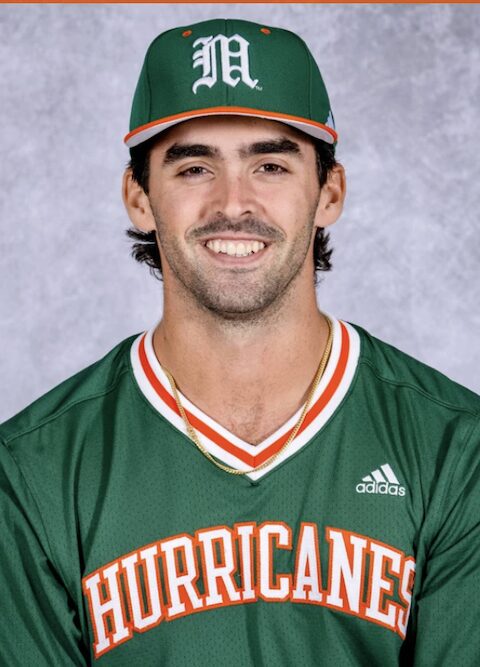
When Lucas Costello transferred to the University of Miami for his senior year, he expected baseball to be his endgame. He saw the move as a chance to finish his college and baseball career at home in Miami. 

He never expected his time as a ’Cane would spark the idea for a company that would take off shortly after he graduated.

Costello is the co‑founder of Celo, a nutrition company that makes bars using whole food ingredients and a commitment to better fuel. The company launched in November 2025 and its first run of bars sold out almost immediately. 

Every sale is driven by the community, word of mouth and a belief that clean nutrition should be accessible and real. 

Celo didn’t start in a boardroom, it started in dugouts, weight rooms and long days on the UM baseball field. 

Before his final season as a ‘Cane, Costello had just come off the high of a College World Series run with Wake Forest. The shift from a winning streak to a year marked by injuries and tough losses hit hard. He learned to keep showing up and how to stay steady when momentum wasn’t on his side. 

Those lessons became the foundation of how he leads today. 

“We still had to show up. We still had to do everything we could,” he said. “ We still had to pull for each other. We still had to find the fun in it.” 

Costello said head coach J.D. Arteaga was one of the most influential figures he worked with at UM and someone who shaped the way he now leads in business. 

 “J.D led that every single day,” he said. “That set the foundation for selling nutrition when things aren’t looking like they’re going your way.”

Costello arrived at UM after three strong seasons at Wake Forest, but his connection to Miami runs much deeper than a transfer portal decision. He had grown up close with Arteaga’s son, a friendship that started in high school and kept him tied to the Arteaga family even while he wasn’t in Miami. 

Arteaga had spent two decades as an associate coach and stepped into the head coach role in 2024.

When Arteaga took over the program, Costello saw the chance to come home and play for someone who had been part of his life long before college baseball.

The move felt like a full‑circle moment and quickly became a crash course in leadership, resilience and discipline that would later shape his approach to entrepreneurship.

Lucas Costello transferred to Miami after playing three seasons on Wake Forest University’s baseball team. Photo Courtesy of Lucas Costello.

That season wasn’t easy. Injuries hit early and the roster lacked the depth Arteaga would build years later. But Costello remembers the tone the coaching staff set every day. There was no room for sulking, no surrender and no room for excuses.

“You still show up. You still find the positive. You still pull for each other,” Costello said. “That year taught me how to lead when things aren’t going your way.”

Those lessons became the backbone of Celo. 

When he and his business partner, former Wake Forest teammate Adam Sisiri, decided on a whim to create a healthy bar during a phone call in October 2024, Costello approached the idea with the same mindset he learned at UM: show up every day, build momentum and keep going.

 “I couldn’t stop thinking about it,” Costello said. “I knew right away that was it. That was the moment.” 

Costello and Sisiri had always shared an interest in health and nutrition. Both had lived the grind of Division 1 baseball, where days started before sunrise and didn’t end until long after practice.

They knew firsthand how much food choices affected performance, energy and recovery. They also knew how few convenient options existed for athletes who wanted real ingredients instead of artificial fillers.

The idea for Celo clicked instantly. Costello describes it as a moment he couldn’t shake.

From that day forward, he poured the same intensity he once reserved for baseball into building a company from scratch.

He called professors, entrepreneurs and anyone he knew who had ever started something of their own. He and Sisiri interviewed manufacturers across the country. 

They worked through more than fifty iterations of their bar with food scientists, adjusting texture, crunch, sweetness and ingredient lists until it matched their vision. 

They refused shortcuts. They refused artificial sweeteners. They refused anything that didn’t align with the values they had carried since their playing days.

“Rome wasn’t built in a day, but it was built every day,” Costello said.

The way he builds Celo today is tied closely to what he learned during his time at UM. Costello credits UM with more than just athletic memories. 

“I think UM has an aura to it,” Costello said. “When you’re there, you feel like you can do anything.”

Being surrounded by students who cared about health, wellness and personal growth helped him see the demand for a product like Celo long before he realized he would be the one to build it.

Conversations with teammates, strength coaches and trainers at UM opened his eyes to the psychology of nutrition. 

Some players cared deeply about what they put in their bodies. Others didn’t. That contrast taught him that a product had to be both healthy and genuinely enjoyable if it was going to make a difference.

“If you’re not fueling yourself right, you feel it,” Costello said. “Those days add up. You start to understand how much nutrition matters.”

His strength coach at UM, H.R. Powell, played a quiet but meaningful role. Powell often pointed out the ingredients in team snacks and questioned why certain products were being used. 

Those comments stuck with Costello. They became part of the foundation for Celo’s ingredient standards.

Celo didn’t take off overnight. It grew the way Costello learned to grow as an athlete — one day at a time. Costello and Sisiri built their team the way they once built a lineup. 

They look for what Costello calls “mental athletes,” people who learn fast, care deeply and show up every day ready to contribute. They’ve shaped a culture where attitude outranks experience and passion carries more weight than ego.

They’ve grown slowly and intentionally. No paid ads. No shortcuts. No attempts to buy a community. Instead, they’ve built one from the inside out, relying on authenticity and the belief that a good product will speak for itself. 

If Costello could go back to his senior year, he said he would network more. Shake more hands. Meet more people. Not because he regrets anything, but because he now understands how powerful the UM community can be.

He encourages current students to try things, even if they feel unprepared. 

“Don’t be afraid to look stupid,” Costello said. “Everyone has ideas. Execution is what matters.”

His advice on nutrition is just as direct. Eat real food. Avoid the artificial stuff. Prepare ahead. Treat your body like it matters, because it does.

Celo may be a young company, but its foundation was built long before its first bar hit the market. It was built in the weight room at 6 a.m. and the dugout after tough losses. 

It was built in conversations with coaches who taught him how to lead and teammates who taught him how to care. It was built at UM, where Costello learned that discipline, resilience and community are not just athletic values. They are entrepreneurial ones.

And now, as Celo continues to grow, those lessons are baked into every bar.

UM Miller School of Medicine professor writes memoir about misdiagnosis

Dr. Shalom Saada Saar — an assistant professor at the University of Miami’s Miller School of Medicine — got misdiagnosed as mentally disabled when he was young. He felt like he never belonged in any room he walked into, and the psychologists that followed him were a constant reminder of that. 

“I was timid, I was shy. I wouldn’t respond to the questions,” Saar said. “Because of their misdiagnosis, they said that this kid didn’t belong in normal school so they pulled me out and they put me in an institution.”

Saar graduated from Harvard two decades later. Last year, he published his memoir, “Out of The Cuckoo’s Nest” to show others how he pushed past the labels people put on him.

“Out of The Cuckoo’s Nest” talks about how his childhood was taken from him. It follows his battles against his insecurities and how he managed to overcome them.

Saar shares how he managed to prove to everyone and to himself that they were wrong about who he was. 

“[The memoir] talks about how challenging life can be at times, how difficult it can be for us, and how to overpower obstacles through resilience and positive thinking,” Saar said. 

Being misdiagnosed followed him for a lot of time in his life, yet it was a great motivator because he had something to prove. It took him a long time to finally feel secure in terms of who he was and helped make him a better teacher. 

“The best gift you can give to people, to students, is the gift of time,” Saar said.  

His memoir is not only a message for people who want to overcome their labels, but also a message for professors and peers to accept students as they are.

Saar wants to tell students that it is okay to be  scared and uncertain at this point in their life. Taking time to reflect and understand who you are brings the change you want to see in your life.

“Take your time to reflect. Reflection creates awakening, awakening creates learning, and learning creates change,” he said.

Saar’s leadership experience in different companies and institutions like Harvard, MIT and Johnson & Johnson helped him understand that people need room to grow to become the best version of themselves.

“If I create a culture of fear, the students will be forced to learn because of fear,” Saar said. “But if I create a culture of openness and the desire to learn, then I’m really acting as a leader.”

UM alumnus Sean Klitzner used Miami grit to produce ‘Beast Games’

When Sean Klitzner landed his first job in Los Angeles after graduating from the University of Miami, his new boss told him his alma mater is why he got the job.

“[The interviewer] told me ‘You went to the University of Miami. I understand the UM mindset,’” Klitzner said. “You can’t teach that.” 

Upon graduating with a degree in film and video production, Klitzner took that expertise with him to California, the epicenter of the American entertainment industry. 

And in entertainment, being a UM alum isn’t just a line on your resume — it’s the kind of currency that can open doors. 

Klitzner has quietly built an eclectic résumé in the world of unscripted television and content creation in the two decades since leaving Coral Gables. Most recently, he landed as a producer and showrunner on “Beast Games,” a competition series that feels less like a game show and more like a cultural experiment. 

Its debut season became one of the most-watched reality releases in 2024. When the show got renewed for season two, the pressure to prove it wasn’t a one-season phenomenon only intensified.

“The question we had was, how far would you go for what amount of money? And it evolved from there,” Klitzner said. 

That philosophy didn’t stay abstract for long. They wanted shock and awe, and soon “Beast Games” became about records, sizing and spectacle.

“We broke 44 Guinness World Records,” Klitzner said. Of these broken records included the largest number of participants in a televised game show and the largest cash prize. 

But for Klitzner and his team, it was missing something that would make the show truly unforgettable. That element was pressure. 

“We were at the roulette table [in Las Vegas], and we wanted to recreate that emotional experience for audiences,” Klitzner said. “That’s where the coin toss came from.”

One of the most talked about moments of “Beast Games” season one was how the show ended with a coin toss. If the finalist won the toss, the prize money would double from $5 million to $10 million, but if they lost, they would walk away with nothing. 

It was a finale that raised the bigger question of whether spectacle alone was enough to sustain a show like this.

So if season one was about grabbing attention, season two is about keeping it. It has the task of proving “Beast Games” isn’t just a viral trend destined to burn out, but a show capable of reshaping how entertainment is produced today.

The second season, which premiered on Jan. 7 on Amazon Prime Video, pits 100 of the strongest competitors against 100 of the smartest. It’s a carefully cast brain vs. brawn showdown with $5 million on the line. 

These 200 competitors are taking part in the biggest, most jaw-dropping game show to date.

But behind the chaos, the spectacle and the record-breaking scale is a team built on effort and instinct rather than pedigree. 

Klitzner describes his collaborators as how they think, how they respond when things fall apart and how serious they are about the responsibility of entertaining millions.

For him, the people around him are the backbone of the entire operation.

“I didn’t care about their resume. I cared about their mindset,” Klitzner said. “Find people that treat that north star the same way that you do.”

For Klitzner, those values are integral to the operation. On a set where chaos is part of the design, trust and clarity about their purpose is what holds the project together.

“You have to understand what the end goal really is,” Klitzner said. “You can’t teach care. Anyone who has care and integrity — that goes a long way.”

He cited the importance of working with one another to grow collectively. His brand is all about that growth, using losses as learning, as he puts it. 

Klitzner believes that the growth achieved in your college years is pivotal to achieving your full potential in the creative space. 

“Don’t sweat the small stuff,” he professed. “And almost everything you do in college is small stuff.”

That mindset, he insists, is momentum, and is exactly what today’s students should be chasing instead of perfection. 

Even after two decades in the industry, Klitzner still speaks about Miami with a kind of reverence. For him, it’s not a stepping stone, but rather the foundation for his success.

Klitzner credits the U with teaching him how to take risks before he ever understood what they might cost. He carries that same belief into every project he touches. 

And today, UM is where the next wave of creators is not-so-quietly shaped to him.

“Hit me up,” Klitzner said. “I’m always looking for UM students to work with.”

It isn’t nostalgia that pulls him back towards Coral Gables. It’s UM students. He sees the same restless ambition in current ’Canes that once sent him chasing a job across the country with no guarantees. 

Because more than Miami being where he started, it’s where the next version of the industry is quietly incubating.

Season two of “Beast Games” promises to show just how far that mindset can take you. It demands your attention and dares you to keep it.

And for Sean Klitzner, who is brimming with an infinite amount of ideas for how he can help evolve the competition space, doing the impossible is more than a hustle for him. It’s his trademark. 

Hurricanes Track & Field indoor season starts in historic fashion at the Jimmy Carnes Invitational

On Friday, the Miami Hurricanes Track & Field team headed to Gainesville to take part in the Jimmy Carnes Invitational and secured two school records.

Graduate distance runner Natalie Varela broke the school’s 1000m with a time of 2:44:90. Gabriella Grissom also had a fantastic time in the 100m, moving into second best all time, clocking in at 2:48:13

In the men’s 1000m, Sophomore Prescott Noll finished with a time 2:29:22 to record the program’s fifth-fastest time.

Junior sprinter Ace Malone made history breaking the 300m school record with a time of 32. 70 while George Franks finished second all-time at 32.88.

On the Women’s side of the 300m, senior Sanaa Hebron ran a 37.69 in the women’s 300m to record the program’s second-fastest time as Janay Moorer set the fifth-fastest time at 38.10. 

Desmond Coleman recorded the fourth-longest men’s weight throw in program history at 20.83 meters, while Heath Vernor improved on his fifth-best mark with a throw of 19.79 meters.

Miami took home all the medals in women’s weight throws as Jocelyn Pringle (20.48m), Tania Da Silva (20.16m) and Calea Jackson (19.60m) finished in the top three.

In the men’s high jump, senior Kennedy Sauder took home first place with a clearance of 2.05m. Dominique Johnson placed third in the women’s triple jump with a distance of 12.85m.

To cap off the meet, the women’s 4×400 relay team finished second with a time of 3:39.17. 

The Hurricanes look to continue its success at the Razorbacks Invitational in Fayetteville Arkansas on Jan. 30-31.

A new standard: Takeaways from Miami’s 27-21 loss to Indiana in National Championship game

It seemed like there would be nothing more poetic than the Miami Hurricanes winning their sixth National Championship at Hard Rock Stadium while celebrating 100 years of the University.

Unfortunately, it just wasn’t meant to be.

The Indiana Hoosiers claimed their first National Title in program history in one of the most remarkable stories in sports, defeating the Hurricanes 27-21 on the evening of Jan. 19.

Still, Miami’s run to the National Championship game was historic–sneaking its way into the CFP, defeating No. 7 Texas A&M, No. 2 Ohio State and No. 6 Ole Miss while being the underdog for the most part.

Here’s what we learned from the Hurricanes as the 2025 season comes to an end.

Indiana beat Miami at its own game

Coming into this matchup, Indiana was flawless — the No.1 team in the nation with a sparkling 15-0 record which included beatdowns of Alabama and Oregon en route to the CFP Final.

Led by head coach Curt Cignetti and Heisman winning quarterback Fernando Mendoza, the Hoosiers prided themselves all season on clinical execution and ruthless aggression in all facets of the game.

And in the Hurricanes’ own backyard at Hard Rock Stadium, Indiana took Miami’s identity and made it its own — a consistent rushing force that just wears down the opponent.

While the stats don’t jump off the page with less than 150 yards on the ground, it was the way the Hoosiers managed the run game that was so demoralizing for Miami.

Whenever there was a key play, whenever there was a chance for Miami to get off the field, IU’s Roman Hemby and Kaelon Black would charge straight through the A-gap to extend the drive.

Even Mendoza got in on the action as he barged through multiple Hurricane defenders as part of a 17-yard QB scramble to extend the Hoosier lead to 10.

Establishing the run early gave Indiana all it needed to outlast the ’Canes despite their best efforts to overcome all night.

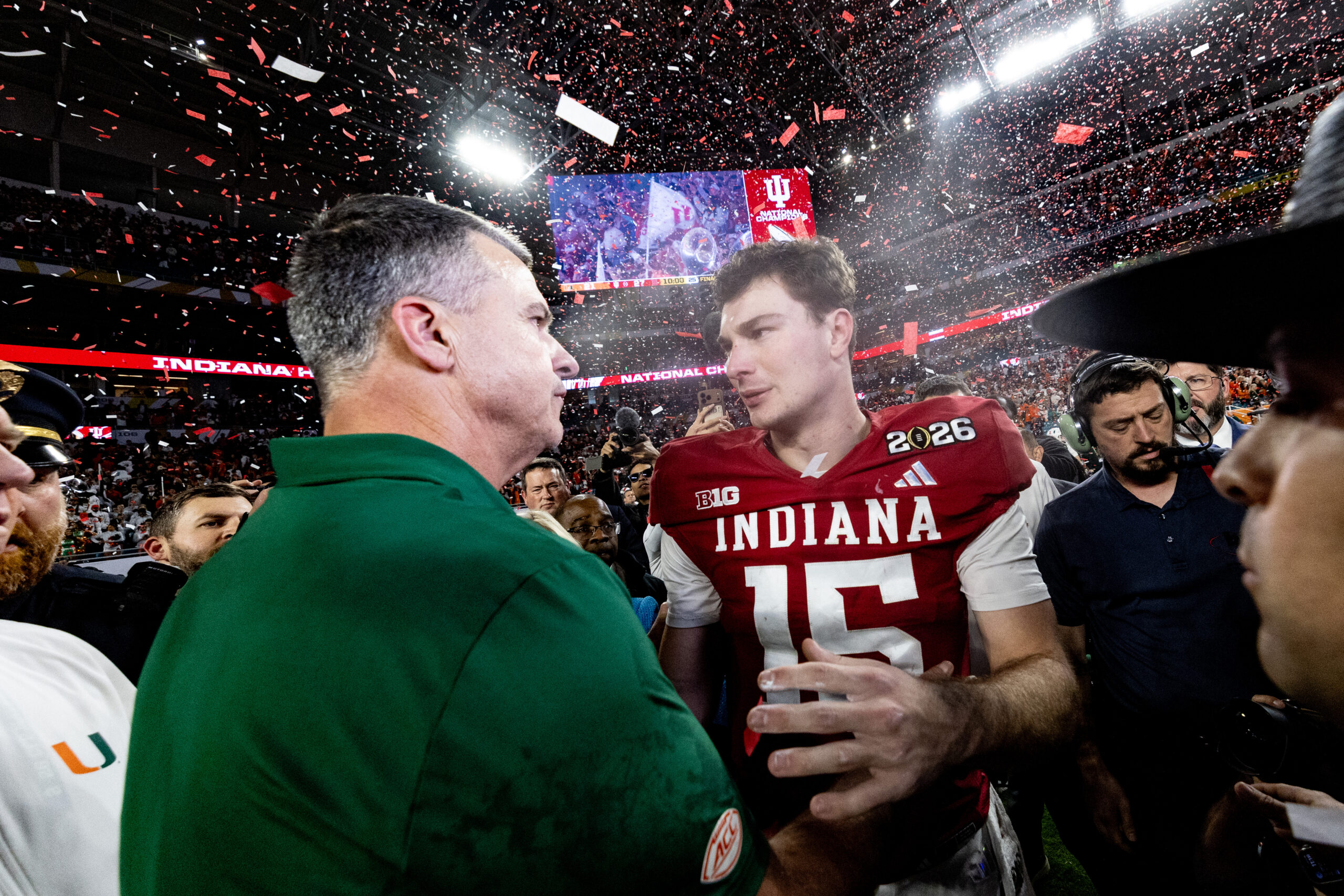
Miami Gardens, FL – 01–19-2026—Photo By Joshua Prezant / University of Miami—CFP National Championship Game at Hard Rock Stadium— University of Miami vs, Indiana University— Second Half. Miami head coach Mario Cristobal congratulates Indiana quarterback Fernando Mendoza

Miami beat itself

Despite all the execution from Cignetti’s bunch, the Hurricanes ultimately beat themselves.

Out of the gate Miami came out scared, unable to get comfortable in the first half which included multiple three-and-outs.

There wasn’t a reliance on the run game early, which forced obvious passing downs where Carson Beck consistently threw into dangerous windows.

Miami only had a 27.3% conversion rate on third down, converting just three times on the night with none of them in the first half.

Simultaneously on the defensive side, the Hurricanes surrendered multiple penalties which extended Hoosier drives.

But there wasn’t a moment more crucial than Miami’s attempted punt late in the third quarter.

After an unsuccessful drive, UM looked to punt and live another day — but tight end Alex Bauman missed his assignment as Indiana’s Mikail Kamara slipped past to swat Dylan Joyce’s punt into the dirt.

IU’s Isaiah Jones fell onto the ball in the end zone, sending the Hoosier crowd into a frenzy as Indiana took a 17-7 lead.

When one considers the ’Canes only lost by six points, the scoop-and-score looms ominously as the moment the National Title slipped away.

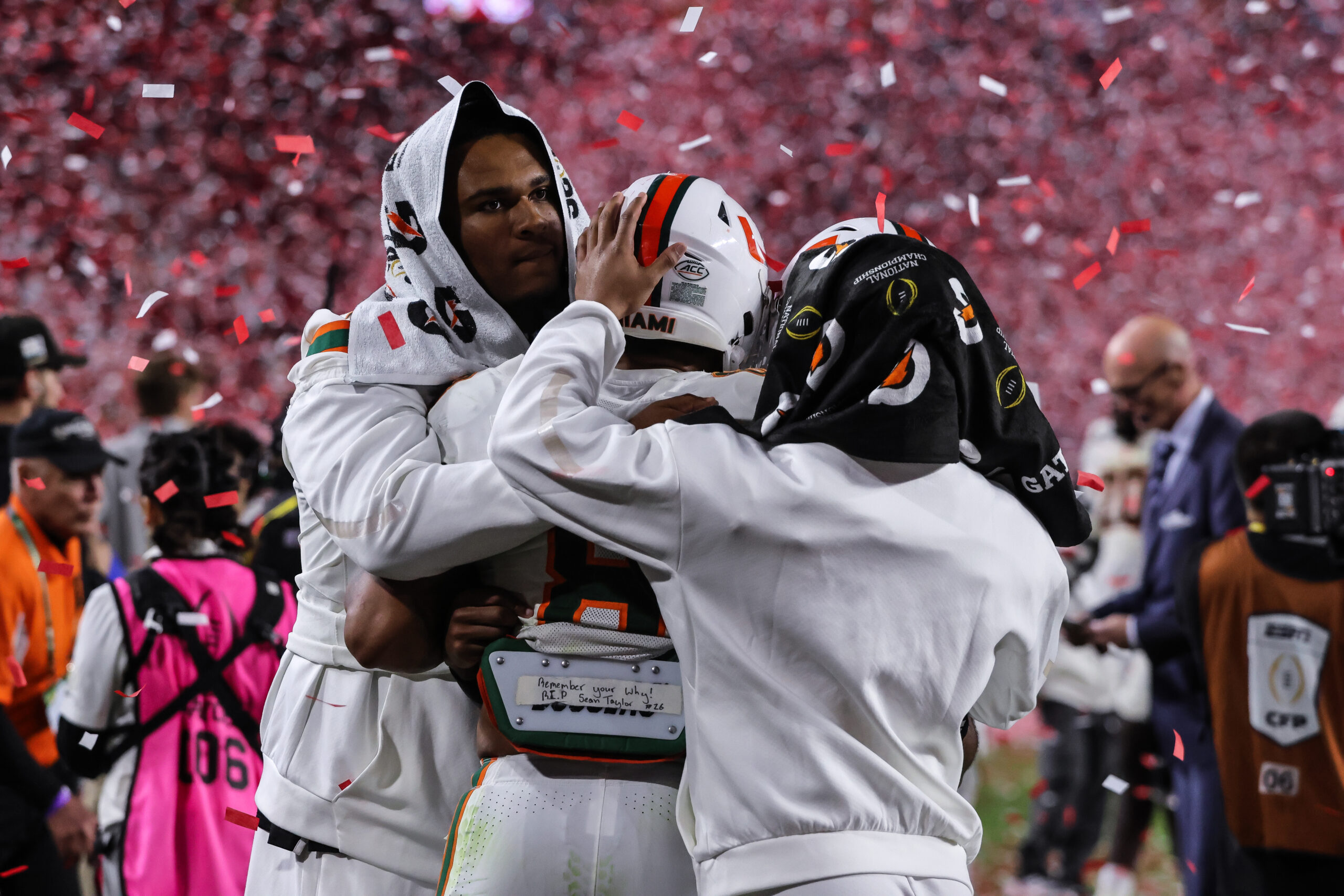
Jakobe Thomas is consoled by two team members at the CFP National Championship game as confetti rains down for Indiana on Monday, Jan. 19. // Photo Credit: Jake Sperling.

The Hurricanes will be back 

Despite losing stud veterans like Beck, Rueben Bain, Francis Mauigoa, and Akheem Mesidor, Miami will be reloading with talent in 2026.

In 2026, the Hurricanes will have returns of Mark Fletcher Jr., Malachi Toney, a majority of the secondary room and will be adding a top-10 ranked recruiting class in 2026.

The culture is still there and it was built from the guys that have been around since Mario Cristobal took over the job in 2022 — a culture that continues to extend day-by-day.

Next season, the Hurricanes have all the reason in the world to get over the final hurdle. Still, Cristobal knows the journey won’t be easy.

“That’s the biggest misconception in sports — ‘well, they almost got there, they’ll be back next year.’ That’s a bunch of bull,” Cristobal said after the game. “You’ve got to improve from a roster standpoint, a regimen standpoint, discipline, everything, and move forward.”

This mentality Cristobal leads with is exactly the reason Miami will be back. Too often over the past few decades, the Hurricanes would feel sorry for themselves after a loss and turn it into more losing.

Now under Cristobal, whenever the ’Canes get knocked down, they bounce right back up, brush themselves off and go to work.

That’s the new standard for Hurricane football, and it will have all the talent and motivation in the world to get the job done next year.

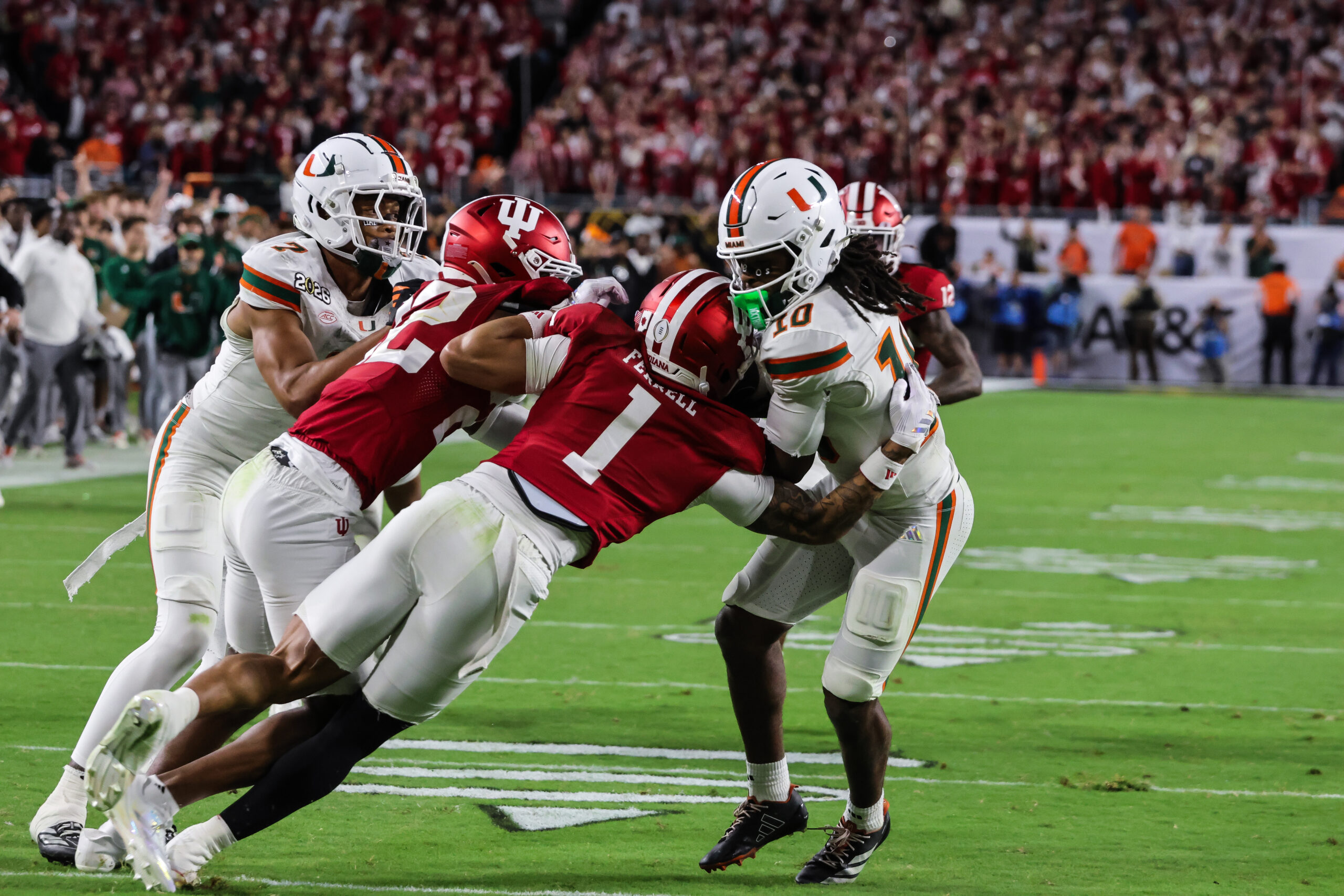
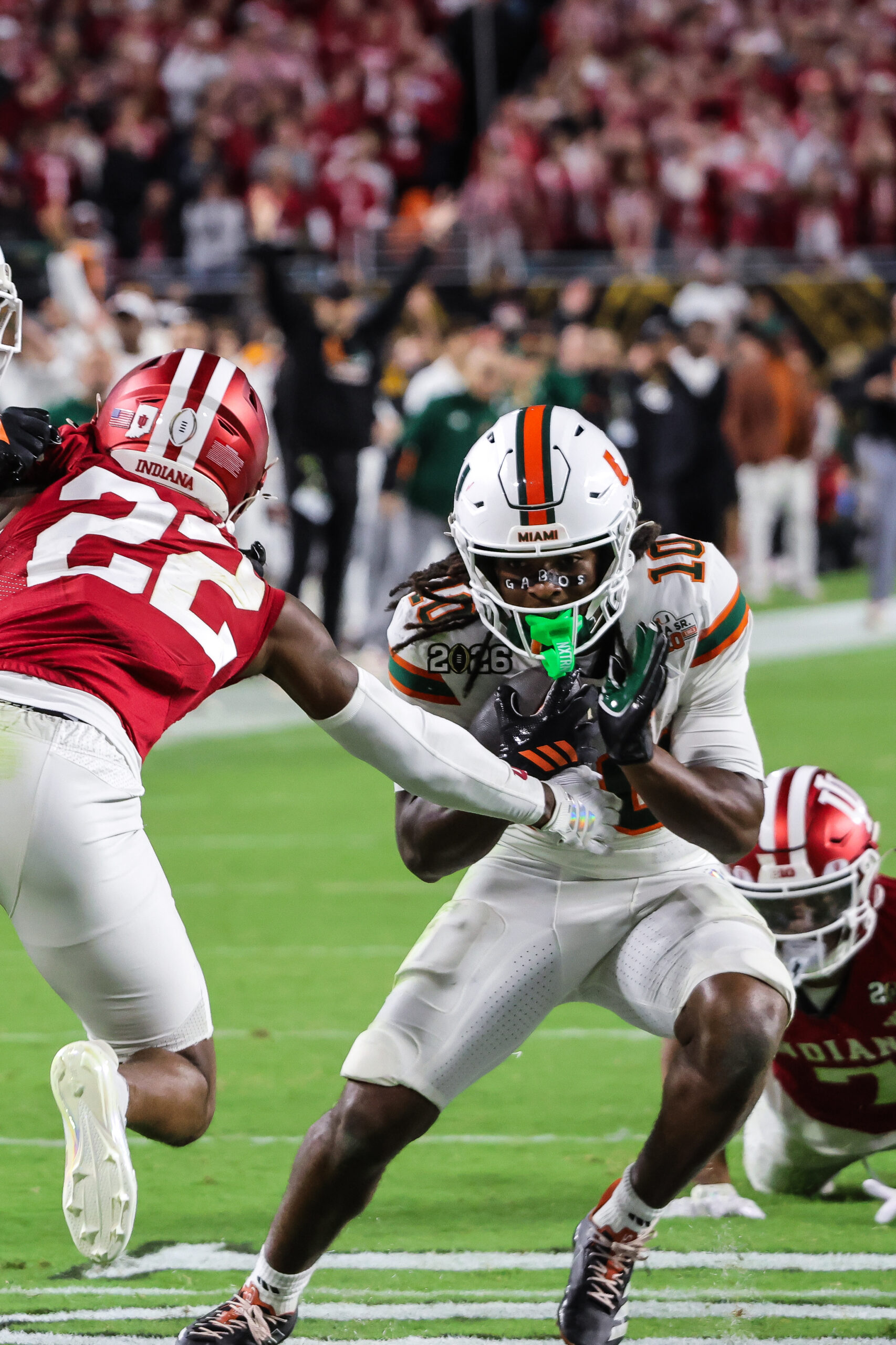
Photo credit: Jake Sperling, Ibis Yearbook // True freshman wide receiver Malachi Toney attempts to break Indiana’s Amare Ferrell in the National Championship game on Jan. 19, 2026.

One drive short: Miami’s title run ends in 27-21 loss to Indiana

The U is almost back.

Despite a historic run into the College Football Playoff, the Miami Hurricanes came up just short in the National Championship, losing to the No. 1 Indiana Hoosiers 27-21 on the evening of Monday, Jan. 19 at Hard Rock Stadium.

Against the best team in the nation, it was going to take clean, no-mistake football from the Hurricanes if they wanted to take down the Hoosiers.

With 1:42 left, Miami needed one final drive to claim its sixth National Championship in program history. Starting at their own 25, the Hurricanes made their way down to Indiana’s 41-yard line.

On first down, Miami quarterback Carson Beck looked left, looking for Keelan Marion.

But Marion kept running and the ball stayed frozen in the air at the 14-yard line as Indiana’s Jamari Sharpe plucked the pass and sent the Hoosier faithful into madness. 

“I’ll take the blame,” Miami head coach Mario Cristobal said after the game. “We’re one drive short of winning a national championship.”

Indiana quarterback Fernando Mendoza took a knee at the three-yard line and crimson and white confetti swirled down as the Hoosiers claimed their first National Title in program history.

Malachi Toney catching the ball at the CFP National Championship game on Monday, Jan. 19. // Photo Credit: Jake Sperling.

“We’re 16-0, national champions at Indiana University, which I know a lot of people thought was never possible,” Indiana coach Curt Cignetti said after the game. “It probably is one of the greatest sports stories of all time.” 

Mendoza, a Miami native, proved in the fourth quarter why he was the 2025 Heisman winner. With nine minutes left up three, Indiana elected to go for it on fourth and four from the Miami 17-yard line. 

Mendoza stepped up in the pocket, ran up the middle, absorbed multiple hits from Miami defenders, regained his balance and dove head first into the end zone. 

“That’s a Heisman moment right there,” Indiana wide receiver Elijah Sarratt said.

The California transfer fell to the ground before being surrounded by his Indiana teammates as the Hoosiers extended the lead to 10.

Despite Mendoza’s touchdown sucking the air out of the Miami crowd, the Hurricanes kept fighting. 

On third and 15 from their own 15-yard line, Beck found tight end Alex Bauman for a 22-yard strike. The next play, Beck hit Malachi Toney in stride, who used his speed to get Miami all the way to the IU 22-yard line.

Two plays later, Beck tossed the ball to Toney, who sprinted to the right, found a hole and scored while also breaking three tackles. The 18-year-old continued to prove that he’s one of the best players in the country.

Toney closed his historic freshman season in the only way he knows how, racking up more than 120 yards on 10 catches — extending both freshman records at the University.

Despite losing in the last drive of the game, Miami’s own faults ended up being the difference in the game.

With five minutes left in the third quarter, Miami was forced to punt on fourth and one from its own 16-yard line. On the ensuing punt attempt, Indiana’s Mikail Kamara broke past Alex Bauman and got to Dylan Joyce’s punt.

Kamara blocked the punt and Isaiah Jones fell onto the ball in the end zone, sending the Hoosier crowd into a frenzy as Indiana took a 17-7 lead.

Inopportune penalties slowed down the Hurricanes all night as Miami racked up multiple drive-extending penalties on third down, which extended Hoosier drives at key points.

Earlier in the first half, the teams were locked in a defensive slugfest as Indiana led 3-0.

Miami was in the midst of consecutive three-and-outs on offense, but the defense continued to pump life as they battled against the Heisman winner in Mendoza.

And on third and six with 10 minutes remaining in the half, Miami felt the momentum swing to its side after OJ Frederique knocked down a pass intended for Sarratt.

But just as he looked to rile up the crowd, a penalty flag rested just on the sideline, extending a drive that ended in a touchdown run for Indiana to jump to a two possession lead at 10-0.

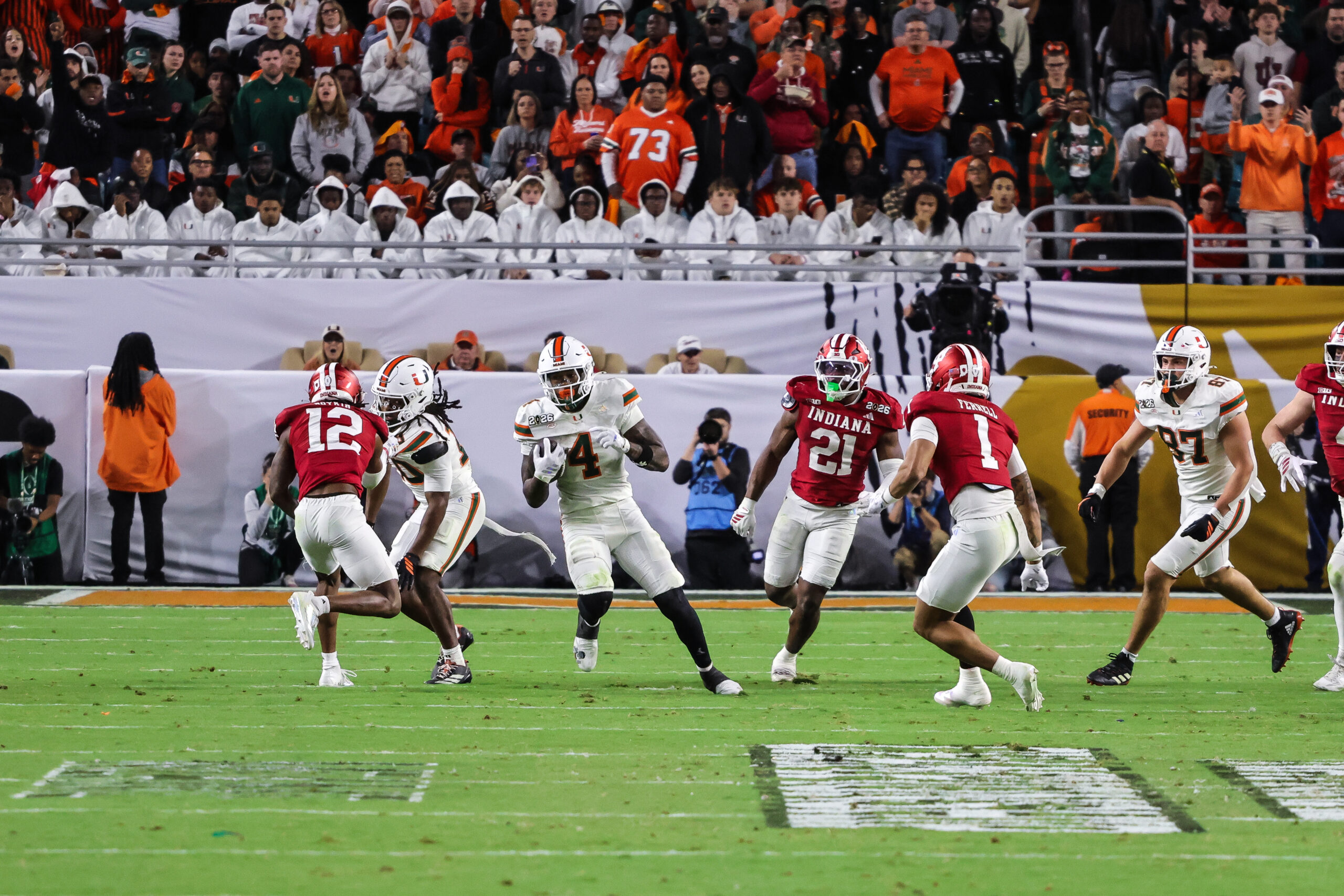
Miami and Indiana battling it out on the Hard Rock field at the CFP National Championship game on Monday, Jan. 19. // Photo Credit: Jake Sperling.

Despite attempting to claw back all game, the Hurricanes ultimately couldn’t overcome that gap.

Miami’s offense finally woke up at the beginning of the third quarter. On the second play of the drive, running back Mark Fletcher Jr. ran to the right and found a hole, breaking free for a 57-yard touchdown, revitalizing the UM crowd as the ’Canes cut the deficit to three.

Even with the aforementioned punt fiasco, the ’Canes continued to work, grinding out a five minute drive that once again culminated in a Fletcher touchdown.

Fletcher, a star for the Hurricanes all season, continued his postseason hot streak as he accompanied those two touchdowns with 122 yards on the ground — good for 6.6 yards a carry.

Although the ’Canes couldn’t overcome their self-made deficit, Miami fared much better than the other teams that faced Indiana throughout the postseason.

Indiana came into the matchup outscoring its CFP opponents 94-25, but Miami stood strong and fought all night.

“They’re the best thing that’s happened to Miami and the University of Miami in over two decades,” Cristobal said.

Despite the loss, the future is bright for the Hurricanes. Key contributors in Monday’s loss are expected to come back, looking to get over the final hurdle of reaching the summit of college football.

Miami’s departing wide receiver CJ Daniels left a message for those returners postgame.

“Don’t forget this feeling, use it as fuel,” Daniels said.

If there is anything certain about this Hurricanes team that has been underdogs for the last six weeks, they will most certainly use it as fuel to put the U back on top.

Where to watch the National Championship if you didn’t score a ticket 

Didn’t get a championship ticket? You aren’t alone. 

With the high demand for one of the biggest National Championships in college football history, many ’Canes fans, including students, were not lucky enough to score a ticket to the big game. 

But don’t worry, ’Canes fans — we’ve got a great plan for you and a big weekend full of activities ahead of game day.

Let’s start off with the Hurricanes watch party happening on Monday at the Watsco Center at 6:30 p.m. This watch party welcomes UM students, alumni, faculty and UM affiliates, but it is not open to the public. A ticket is required for entry, as there will be no walk-ins.

For the rest of Canes fans around the world — we’ve got watch parties all over the United States and worldwide. Click the link to find your nearest watch party.

Ahead of the championship game, there are events happening around the city, starting with the CFB Fan Experience located at the Miami Beach Convention Center. It will be open Friday through Sunday and is a free, family-friendly event with games, prizes and player appearances.

These are just some of the events happening in Miami for the CFP Championship game, but there are plenty of other events and watch parties to be part of this epic night. Bring your family, friends and loved ones to cheer for the Hurricanes and let the noise be heard all around.

Let’s go, Canes!

MIDLINE is one of Miami’s hottest new music venues

Midline Miami, located in Wynwood at the Arlo Hotel, is quickly establishing itself as one of Miami’s most exciting new music venues. The space officially opened on Jan. 16 with a strong first show headlined by Freddie Gibbs and Tia Corine as the opener.

From the moment you walk in, the venue feels intentional. The sound system is excellent—clear, powerful and balanced—allowing the music to remain the focus throughout the night. 

The lighting complements the room well, creating atmosphere without overwhelming the performance. While the design leans minimal, darker and slightly mysterious, it works in the venue’s favor, reinforcing a stripped-down, music-first identity rather than spectacle-driven nightlife.

Midline offers tables toward the back of the room, with an upper deck set to open for future shows. The bar is well run, service moves efficiently, and the overall layout feels comfortable even as the room fills. 

With a capacity of roughly 800 to 1,000 people, the venue strikes a balance between intimacy and scale. This is ideal for touring artists who want real crowd energy without losing connection to the audience.

The vibes during the Freddie Gibbs show were strong from start to finish. Gibbs delivered a sharp, high-energy performance and the crowd fed right back into it, making for an impressive opening night that set the tone for what Midline aims to be.

What truly sets Midline Miami apart is its programming philosophy. The team is clearly focused on filling a gap in Miami’s live music ecosystem. While many local venues lean heavily toward house and electronic music or Latin acts, Midline is committed to a broader range of genres — hip-hop, soul, R&B, rock, and beyond. 

Upcoming shows reflect that vision, including Hawthorne Heights on Jan. 21, Neko Case with Des Demonas on Jan. 31, and an industrial Blood Rave scheduled for Feb. 21.

Rather than flashy spectacle like many Miami music venues, Midline centers the experience on the music itself. The venue feels built for listeners first, not just partygoers. 

That focus, paired with its location in Wynwood, positions Midline as a potential hub not only for concerts, but also for daytime conferences and creative events.

If opening night is any indication, Midline Miami is poised to become a premier destination for both emerging and established touring artists and a venue Miami’s music scene has been needing for a long time.