Attendance follows the scoreboard at the University of Miami

With continued success across the University of Miami’s athletic programs, student attendance has been on the rise. But when teams fall into losing streaks, empty seats can quickly outnumber cheering fans. 

UM is home to 18 National Collegiate Athletic Association (NCAA)  Division I sports and has grown to be known more than its dominant football eras of the late 1980s and early 2000s. This season, the 2026 Miami Hurricanes football team fought its way to the College Football Playoff National Championship for the first time since 2003. Men’s basketball is also on a historic run, ranking third in the ACC after finishing last in the conference last season.

The student sections at Hard Rock Stadium and the Watsco Center have been packed with Hurricanes fans during winning stretches, but that energy is not always consistent when teams begin to lose. 

“When our teams are good, you see that directly translate to attendance,” said Ava Shah, senior creative chair for Category 5. “When we lose, attendance definitely drops.”

Category 5 is a spirit programming board and link between the athletic department and students, whose aim is to preserve and implement sport and spirit-related traditions at UM. 

Hard Rock Stadium can hold up to 80,000 fans, but crowd size fluctuates from game to game. According to UM box score stats, 66,591 fans attended the Hurricanes’ game against USF on Sep. 13, 2025. After losses to Louisville and Southern Methodist University, and following  the homecoming matchup, the next regularly scheduled home game at Hard Rock against NC State drew 59,157 fans.

Basketball attendance has followed a similar pattern. 

“The beginning of the [basketball] season attendance was definitely slower just because we had a completely new team and a new coach,” said Shah. “But as there’s been continued success and we’ve made history with our 21-5 record, the stands have packed.” 

The Watsco Center, which seats 7,972 fans, sees attendance rise and fall based on the matchup, team success and overall interest in the game. 

Men’s basketball drew 4,131 fans when they played Elon early in the season in November 2025. But, as the men’s team continued to win, the crowd grew. When Miami had an upset win against North Carolina on Feb. 10, 2026, the attendance for the game reached 7,355

Women’s basketball experienced the same pattern of wavering support. In December of 2025, women’s basketball played Georgia State at home in front of 1,021 fans. As losses accumulated, their attendance continued to drop. By February, 833 fans attended their game against Stanford. 

Still, athletics compete with the city of Miami itself. Beyond the Coral Gables campus, students have access to the city’s nightlife and cultural scene, often choosing between attending an evening game or going out. 

“The University has a unique challenge,” said Gates Fox, a junior member of Category 5. “While we have amazing sports that are fun to attend, we also have so many cool opportunities in the city of Miami that students can also go [to].” 

Logistical challenges also impact whether students attend sporting events. Since the Miami Orange Bowl closed in 2008, football games have been played at Hard Rock Stadium. Unlike other on-campus venues, the stadium is about 40 minutes from campus depending on traffic, and student tickets and transportation options are limited. The distance, time commitment and required planning can discourage students from attending, especially when the team is struggling and the incentive to make the trip feels lower.  

“I think that when we lose in football, students are discouraged to go because it’s such a hassle to get to the stadium versus basketball or anything other sports that are on campus it’s easier to just pop over to a game,” said Shah. 

To boost turnout during losing streaks, UM has introduced attendance incentives. The athletic department has offered giveaways such as Ultra Music Festival tickets and postgame food promotions with local businesses. Another recent motivator is CanesUnited, an app that allows students to earn points by attending sporting events for a chance to win $42,500 for their student organization. 

“Students love free things,” said Shah. “I’ve noticed every time there are giveaways of some sort there will be an increase in attendance.” 

Access to athletic events is rarely about cost for students. For sports like football, basketball and baseball, students can secure free tickets through the university’s official student ticket portal, typically by logging in with their CaneID and claiming the seats in advance. Other sports, such as volleyball and tennis, admission is generally open, allowing students to walk in without reserving a ticket. 

Simply offering free admission does little to guarantee student turnout. What ultimately fills the stands is the excitement of the game, the stakes of the matchup and the team’s performance – factors that create energy and a sense of community that money can not buy. 

Florida bill targeting public universities may indirectly shift UM applicant pool

0

A proposal advancing in the Florida House could further limit out-of-state and international student enrollment at Florida’s public universities, potentially altering the demographics of future University of Miami admitted classes. 

This bill, HB 1279, would require schools like the University of Florida and Florida State University to ensure that up to 95% of incoming undergraduate students are Florida residents.  

UM’s out-of-state and international students make up more than two thirds of its undergraduate population. Since the University of Miami is a private institution, the same policies would not apply. But, UM could still see indirect effects. 

If Florida’s top public universities reserve more spots for in-state students, fewer Florida students may choose to apply to UM. At the same time, out-of-state and international students who might otherwise attend UF, FSU or other state schools could view UM as an attractive alternative, potentially shifting application trends and the composition of future admitted classes.

“My decision to apply came from where the university was and if it had a major of my interest,” said Georgina Paez, a sophomore media management major. “However, I was worried about being accepted or not considering the low percentage of in-state students accepted.”

Paez also said “I think there should be an equal amount of students accepted, whether it be in state, out of state, or even international. Everyone deserves an equal opportunity to come here.”

However, some non-Florida students say that the higher non-resident population on campus did not have a major impact on their decision to apply. 

“I was aware that admission to U.S. universities is generally highly competitive,” said Miriam Tali, an incoming international student from the class of 2030. “The international acceptance rate did not play a major role in my decision to apply.” 

However, Tali did consider submitting an application to UF, but decided to apply ED to UM.

“I initially considered applying to the University of Florida, but ultimately felt that UM was the better overall fit for me,” Tali said

Currently, Florida’s public universities operate under a statewide average cap that limits out-of-state enrollment to 10%. 

For example, under the current cap, the average out-of-state acceptance rate across all public Florida universities is around 10%, even though some universities, like UF and FSU, have around 20% out-of-state students. Smaller out-of-state enrollment at universities lie the University of North Florida bring the statewide average down. The University of Florida recently decided to pause admissions for out-of-state transfer students. 

UF alumna and Republican Lakeland Representative Jennifer Kincart Jonsson proposed the bill that has passed in the House Budget Committee.  

At public universities, out-of-state students pay more in tuition than in-state students. At UF, the in-state tuition for the 2026-2027 school year is $6,380, while out-of-state tuition is $30,900. 

According to Jonsson, schools will lose a combined $54 million in the first year after the cap is imposed. However, this is only a small portion of the $17.5 billion the schools receive in funding from the state. 

Student government elections record second-highest voter turnout ever

The spring 2026 Student Government elections set the record for the second-highest voter turnout ever. According to the SG election database, 3,099 students voted in the 2026 election, putting it just behind the 2020 election, which drew 3,324 voters. 

Voter turnout in the 2025 election was 1,098 — less than half the number of students who participated this year. The winning ticket, For U, received 1,601 votes — more than double the 701 votes that the 2025 winners, Brand New U, received. 

Incoming SG President Fernando Sepúlveda Sagaseta attributes the high voter turnout to both tickets’ campaign strategies.

“We talked to a lot of [organizations],” Sepúlveda Sagaseta said. “We were trying to hear what everyone needed.”

He estimated that For U visited more than 40 student organizations, from fraternity chapters to religious organizations, as well as activity-centered organizations like Hurricane Productions.

“It definitely incentivized me to vote,” EJ Rambau, a member of Hurricane Productions, said. “I didn’t hear anything about either party before they came to present, and I would’ve been less inclined to cast a vote without hearing from them.”

UNITED candidates also attended the meeting. Both tickets talked about their goals and opened the floor to questions from students, according to Rambau. 

Candidates reached out to classmates individually to encourage voting. Students responded well to these conversations on both sides

“I was not going to vote originally, but then [Alex Barrowclough] came up during class and asked us to vote for him,” Esha Aman, a classmate of the UNITED VP candidate, said.

For U also tabled throughout the week near the Foote Green, Centennial Village and Mahoney Pearson. They tried to catch every passing student’s attention, and many listened, Sepúlveda Sagaseta recalled.

“When it’s stuff they care about, people will stop and listen,” Sepúlveda Sagaseta said. “Everyone is busy, we get that.”

At the same time, UNITED tabled at Merrick Fountain near the Whitten Learning Center. More than 20 student organizations endorsed them and helped push their message. 

“When you go up to people, they are most likely to remember you,” Vanna Smart, a senior, said.

UNITED’s tabling efforts, giveaways and frequent social media posts helped the ticket reach 1,334 Instagram followers — the highest following of any SG campaign in the last six years. Although they did not win, UNITED’s presence on social media was not futile.

“I did think UNITED had a more successful campaign with their social media posts,” Smart said.

While the tickets used new tactics this election, the SG Elections Committee did not. They host the same two events every year before voting starts. 

Candidate debates were held at the Rathskeller four days before the elections, and food incentives were given in the Breezeway to people who stopped to vote.

Students who voted in this election also elected Senate Candidates to represent six student groups: College of Arts & Sciences, Miami Herbert Business School, School of Communication, Commuters, Student Employees and Transfers.

Each category received twice as many votes than in 2025. Most notably, the candidates for transfer student senator, who received fewer than 100 votes in the last two years, reached 227 votes this year.

The UNITED ticket declined The Miami Hurricane’s request for comment on its campaign.

Is UM becoming ‘Influencer U?’

The University of Miami is experiencing a growing social media presence, and according to a survey conducted by The Miami Hurricane, students have started calling UM the “influencer school.”

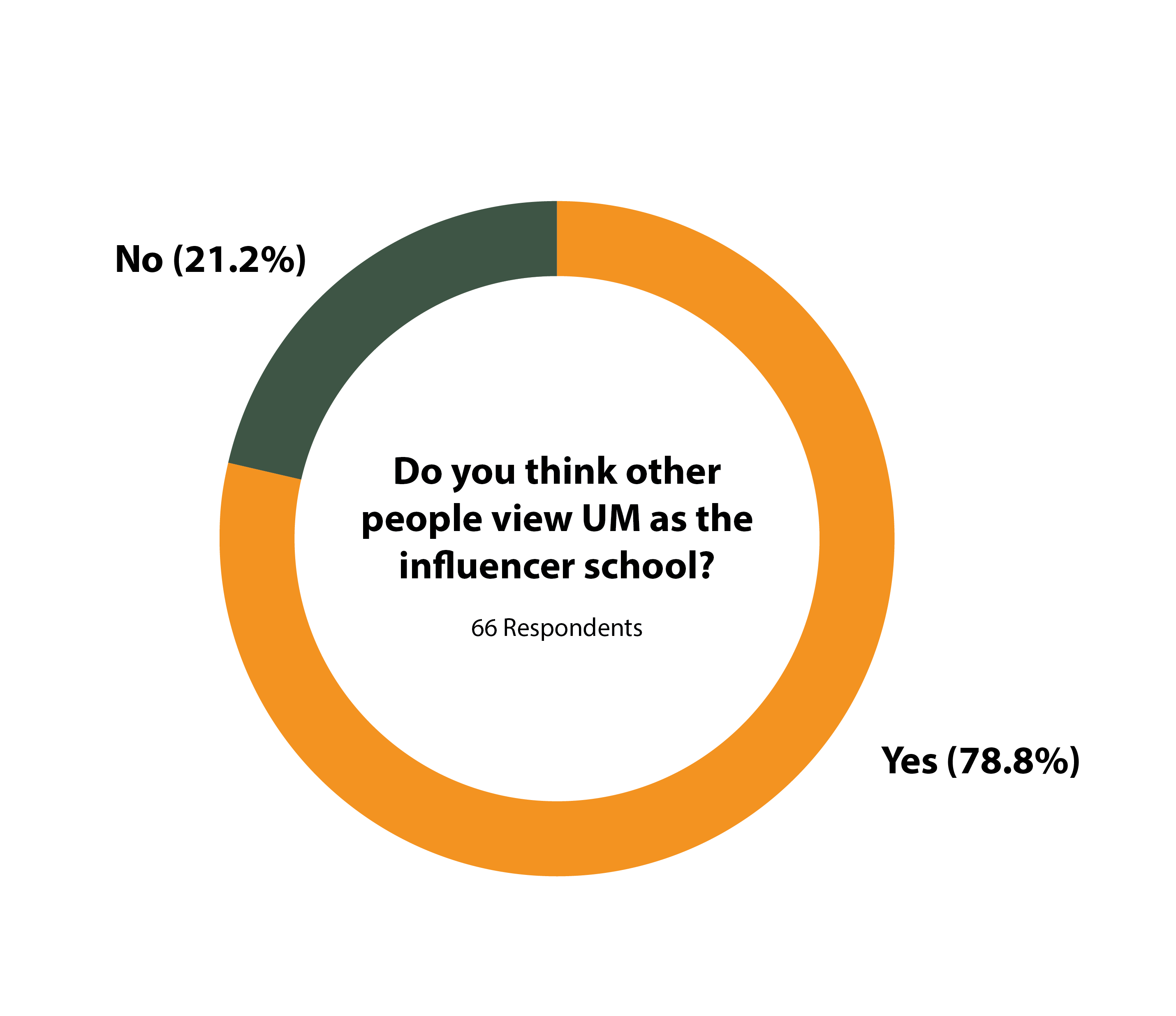
The survey, posted for 48 hours on The Hurricane’s Instagram story, showed that 78.8% of 66 student responders think the public views UM as “Influencer U.” 

Anna Becker, a junior health sciences student, has seen the growing popularity of TikTok around campus during her time at the U.  

“Sometimes by the dorms or walking to classes I’ll see people filming TikToks,” Becker said. “People post everything from Get Ready With Me’s, to day-in-the-life vlogs and dance videos with friends.” 

Alix Earle, who now has 8.3 million followers on TikTok and 5.5 million followers on Instagram, graduated from UM in 2023. According to Parade and Celebrity Net Worth, Earle is now worth $20 million after competing in Dancing With The Stars season 34. She created the “Alix Earle Effect,” catapulting UM into the spotlight when her videos started going viral during her junior year.

Other influencers have grown their following during their time at UM, turning social media into their career. 

Abby Gendell, a creator with 529,400 followers on TikTok, graduated from UM in 2024. She now works in New York City as a content creator thanks to her success on TikTok and Instagram.

“When I moved to New York, I continued growing, and a lot of people who followed me in college stayed,” Gendell said. “I figured if I could build my own brand, I could do that for a company someday, and if I ever applied for a marketing role, I could point to my platform.”

Current students at UM are finding success online, building a following that allows them to secure brand deals and receive PR packages. 

Claire Mellin, a sophomore majoring in advertising management, has worked with brands like Edikted and Princess Polly.

“Most of my opportunities have come through Instagram, usually through brand outreach,” Mellin said. “My audience aligns with the college-aged demographic many brands target, which makes user generated content an effective way for them to connect with that market.”

Hosting brand trips is another way that popular brands connect with their audience. Some students had the opportunity to attend an influencer brand trip with the well-known makeup brand, Tarte, called “Trippin’ With Tarte.” The event was held in Key Largo in April of 2025.

Eva Free, a sophomore majoring in public relations and psychology, went on the trip thanks to her connection with Maureen Kelly’s son. Kelly is the CEO of Tarte Cosmetics and her son attends UM.

“There were a few other UM girls besides my friends and I, maybe three or four,” Free said. “I think that being at UMiami exposes you to these kinds of experiences even if you aren’t directly trying to get them.”

The University’s official social media account also reflects the influencer trend. 

UM’s Instagram account has 318,000 followers as of March 4, 2026. Compared to another medium-sized, private institution like Tulane with 83,900 followers, it is clear that UM reaches a wide audience on social media. 

Some classes even require students to make TikTok or Instagram accounts for projects, imitating real-world experiences where social media is used in everyday business practices. 

Valentina Gomez, a junior studying creative advertising and marketing, created the “Table For Two” TikTok account in September 2025 as her final project for a digital marketing class. Gomez set students up on blind dates in the library to help people form connections. 

The “Table For Two” account has gained about 30,000 likes and 1,232 followers as of March 4, 2026. Her most popular videos currently have tens of thousands of views, with one video reaching 238,200 views.

“I did expect it to do well on TikTok,” Gomez said. “I think it was a unique idea and I knew that I just had to commit to it.”

Commitment is key, but students and influencers also attributed part of their success to UM’s lifestyle and campus. 

“Miami was a stepping stone. If I went to a random small school, people would still enjoy my content, but it wouldn’t be the same,” Gendell said.

Gendell’s content was centered around day-to-day life at UM and part of her success came from the school’s campus and recognizable brand.

“Being on a campus with palm trees and a lake made it so easy to film content. You’re inspired by everything around you all the time,” Gendell said. “I feel like Miami’s aesthetics made content creation really easy.”

Lauren Barnwell, a junior at UM, has accumulated more than 520,000 followers on TikTok by posting about her lifestyle in Miami, inspiring students to post content.

“I feel like all my friends at UM have some sort of following, even if it’s just 10,000 on TikTok, and it’s very normalized,” Gomez said. “Everyone at UM has something special to share and the lifestyle is super interesting.”

Staff members at UM also view the University’s growing social media presence as a positive reflection of the University’s online image. 

Professor Catherine Schenquerman, a lecturer in strategic communication, teaches a course titled “Social Media Influencers.” She understands the advantage that UM students have by going to school here.

“All universities today benefit tremendously from social media visibility,” Schenquerman said. “Univerity of Miami in particular has a stunning campus that translates beautifully to visual platforms.”

But, social media growth has negative aspects too. Students have said that the media attention has created a stereotype that all students are interested in social media.

“I think that people feel UM fits into this one mold, when it has so much more to offer aside from popularity and influencers,” Becker said.

Media attention can also hinder the University’s image among news outlets. The Washington Post published an article on Nov. 12, 2025, describing the “vicious turf war” among influencers at UM. 

The New York Post published an article on Nov. 4, 2025, saying that UM “campus influencers are in tears” and the world of social media “is ruining their college experience.”

This attention has only amplified UM’s reputation as the “influencer school.” 

According to the student survey, 72.7% of students said they do not like or are unsure about the media attention that UM has received.

“I strongly dislike the influencer culture that is growing at UM,” said an anonymous responder.

Other students say that the University is not respected as an academic institution.

“It is strictly viewed as a party school with a side of education, and I really don’t like how this school has turned into that,” said another anonymous responder.

Whether the influencer stereotype is embraced or rejected, students agree that social media has become an unavoidable part of campus life.

Talia Gorelick contributed to the reporting of this article

How do you spice up a relationship?

0

After nearly two years of being with the love of my life, consisting of one year in person and almost a whole school year long distance, I have not once lost the spark.

I’ve quickly learned that love doesn’t stay on autopilot. It takes consistency and effort.

Whether it’s everyday conversations or time in the bedroom (or the countertop, or the car, or the shower), making a few small changes can make the relationship feel new again.

First, do something physical together. Nothing says take me home and take my clothes off like a sweaty hot yoga session. 

Minimal clothing and drenched in sweat, yes please. There’s something about breathing and moving in sync that feels so intimate. We might even leave yoga early. 

Something longer than hot yoga might do the trick too. Plan a three mile hike or walk so that you have to work for it before you get to the light at the end of the tunnel. And you can even get closer emotionally by talking and leaving your phones at home. 

Even with long distance, you can do a quick workout on FaceTime together, or talk on the phone on the treadmill. It turns an ordinary routine into something shared and bonded, sexual or not. 

The next and most important tip: Anticipation is key. Foreplay should not start the second you lay down for bed or after a long day. 

Start the morning with a playful text or compliment. Or even better, tell them what you did together in your dream the night before. 

A good relationship should be stable but not predictable. Predictability is boring. 

Also, communication is key. It sounds basic to tell you to “have deeper, more interesting conversations,” but it’s true. Emotional intimacy strengthens physical connection. 

We like to talk about what’s stressing us out, the goals we are working towards, the latest gossip with our friends and what we may need from one another.

This goes for sex too. If there’s something new you want to try, tell your partner. If you want something done differently, tell your partner. One moment of embarrassment could completely change your sex life. Plus, no one is a mind reader. 

Another thing that’s really stood out to me in my relationship, as a very independent person, is to maintain freedom in the relationship. 

Having different goals, hobbies and friendships helps you grow individually and bring new energy into the relationship. Growth is so hot. 

And, it will give you more to talk about at the end of the day when you are each living your own lives. 

After two years, I’ve realized that love deepens over time, but the spark remains with effort and intention. When you find the right person, whether they are miles apart or in the same city, staying connected means being deliberate, playful and willing to put in the effort for the person you love.

If you’ve found the right one, it will be worth it. 

Love, 

V

Mistrial declared in murder case of UM football player

Jurors failed to reach a verdict in the case for 40-year-old Rashaun Jones in the murder trial of former UM football player Bryan Pata who was killed in 2006. 

According to ESPN, only one juror voted to convict Jones while the rest of the jury believed he could not be found guilty beyond a reasonable doubt. After nearly six hours of deliberation on Thursday, Feb. 26, and additional time on Monday, March 2, Judge Cristina Miranda declared a mistrial which voids the proceedings and resets the case to its pre-trial status. 

Early Monday morning, jurors told the judge they were deadlocked, meaning they were unable to reach a verdict. Miranda urged them to try again, but after an hour of further discussion, the jurors still could not reach a verdict.

The Pata family continues to seek answers amidst a possible new trial.

“I’m disappointed. It’s frustrating, really for all of us,” said Pata’s brother, Edwin Pata, to WPLG 10. Edwin Pata was previously an assistant offensive lineman coach for UM. “…It’s just some kind of closure for us, but we’re going to remain steadfast and it’s clearer now who’s responsible for this.”

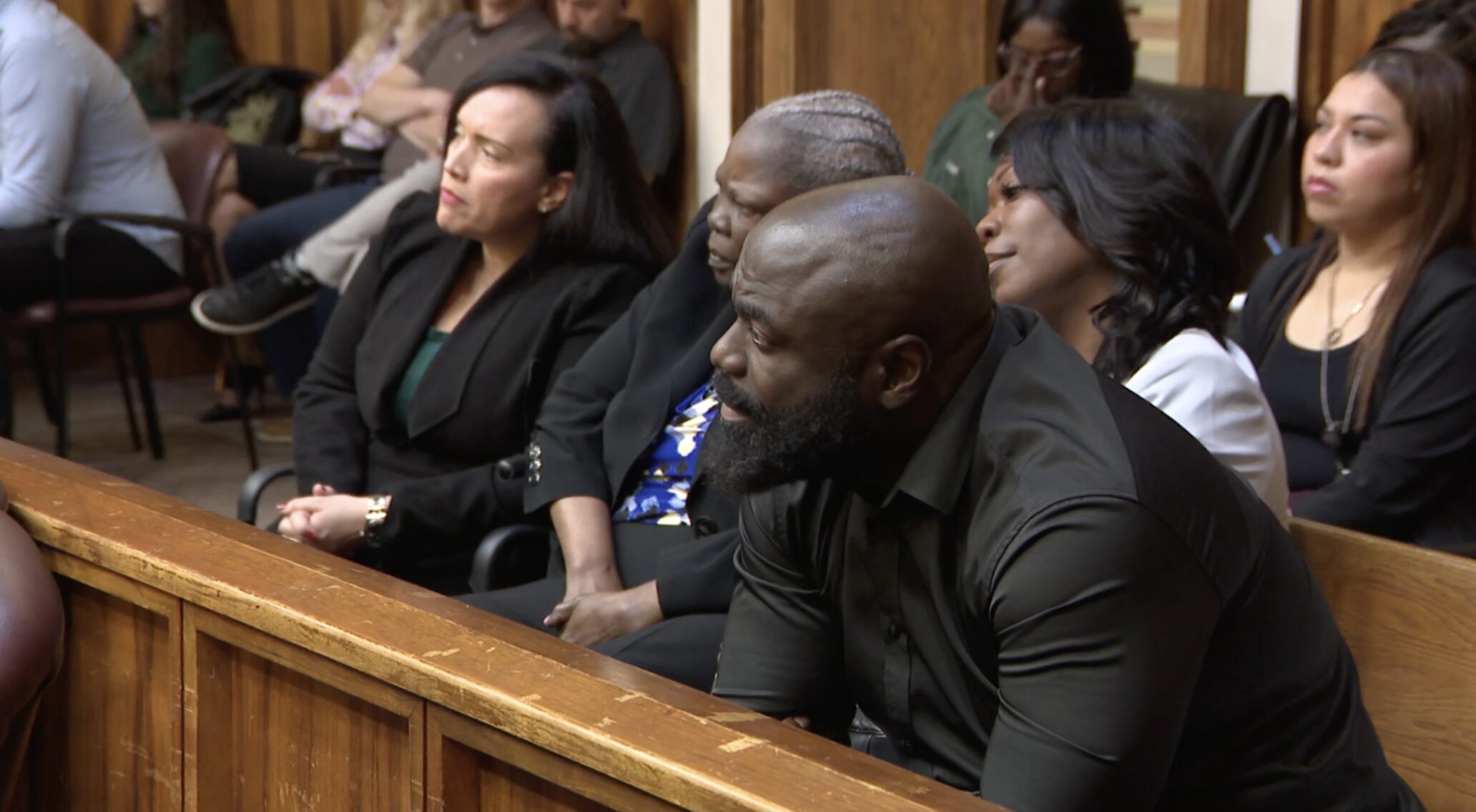
Edwin Pata sits in the front row of court, amongst the Pata family on Monday, March 2, 2026. // Photo Credit: Pool Video Screenshot.

Jones faced a second-degree murder charge and is expected to be tried again. Under Florida law, prosecutors can try the case with a new jury, although the new trial must come within 90 days. According to The Miami Herald, Jones will possibly be tried again, and Miranda has scheduled a hearing for Tuesday morning. 

Pata, 22 at the time, was shot outside of his Kendall apartment following football practice. He was found in a pool of blood next to his apartment in November of 2006. 

No arrests were made until 15 years later when prosecutors arrested Jones on August 19, 2021. 

ESPN had sued the Miami-Dade Police Department in 2020, requesting access to the unredacted case records in the investigation. According to ESPN, the department had said “publicly for years they had no prime suspect and no single person of interest.”

ESPN then published “Death at The U: Who killed Bryan Pata?” on Nov. 6, 2020, that included new information about the case, even naming Jones who had previously dated Pata’s girlfriend at the time, Jada Brody. Jones was arrested about nine months later.

“Brody dated a few football players before Pata, including one of his Miami teammates, Rashaun Jones, who’d found himself on the wrong end of two lopsided fights with Pata,” according to the article.

Jones maintained his innocence throughout the trial proceedings, declining a pre-trial plea deal of 15 years in prison with credit for time served. 

Eyewitness Paul Conner, a former UM professor, appeared via recorded testimony after the state ruled he was no longer mentally capable of testifying in person. 

Connor said he was “90% certain” he saw Jones leaving Pata’s residence after hearing a gunshot. He also picked Jones out of two six-image photo lineups, first in 2007 and again in 2020, the first time being seven months after Conner’s alleged encounter. 

But, defense attorney Christian Maroni pointed out what he believed to be “shortcomings” in the credibility of Conner’s testimony, highlighting that it was dark when Conner passed the alleged killer, and that he had imperfect vision and “didn’t know whether he had his glasses at the time.” 

The case was based heavily on circumstantial evidence presented by the prosecution, relying on inference and logic to connect facts opposed to direct evidence, such as a confession or eyewitness testimony. 

This evidence included Jones’ previous interactions with Pata and phone records from the night of the murder. Prosecutors argued that jealousy drove Jones to kill Pata.

Jurors also heard testimony from a former UM department compliance officer, now-retired Miami-Dade Medical Examiner Emma Lew and several of Pata’s teammates including Dwayne Hendricks, Dave Howell and Eric Moner.

The jury was also asked to review the bullet retrieved from Pata’s body.

In its closing statements, the defense argued that the evidence presented was not strong enough to result in Jones’ conviction.

“There is no way the jury could find that Mr. Jones committed this crime beyond a reasonable doubt,” said defense attorney Sara Alvarez.

The defense expressed to the Judge that the state alongside the Miami-Dade Police Department failed to investigate several other leads, including information from ESPN’s investigation that highlights possible gang involvement. 

The defense shed light on a recent interview they discovered on March 2 with an alleged gang member who provided information related to Pata’s death.

“…no officer sufficiently investigated this and no gang members have been interviewed,” said defense attorney Christian Maroni. “This is the first time a gang member has been interviewed in connection to this case…”

Maroni told the judge the member provided information about Pata calling him and allegedly asking for protection from other gang members. 

The defense engaged in a deposition on March 2, during a short break with a federal agent providing information of the gang involvement, providing sworn out-of-court testimony. 

“We just want to make the record clear that we were in no way insinuating that Bryan Pata was part of a gang…was a gang member,” the defense said.

According to ESPN, Judge Miranda did not allow evidence regarding the “other possible theories and Pata’s other possible interpersonal conflicts” to make it to trial, ruling to keep out any testimony from hearing from the ESPN 2020 lawsuit. 

Alvarez said the defense will “certainly try” to introduce new evidence in a new trial where Miranda will preside. 

Florida-born Olympic skier Nick Page reflects on seventh-place finish in Milan 

Nick Page sat on the edge of his bed in the Olympic Village for an hour without moving.

Moments earlier, the American freestyle skier had finished seventh in the Olympic moguls final — close enough to feel the pressure of the podium, but far enough to replay every turn and every bend. It’s a result that, at this level, exists in the thin space between achievement and frustration.

A couple days later, on the final Friday of the 2026 Winter Olympic Games in Milan-Cortina, Nick Page video calls from a quiet corner of the Olympic Village. A large photograph of a skier decorates the wall behind him. 

“I left some things on the table,” Page said, glancing down. “The things that still jump through my mind are the things that slipped through the cracks.”

Moguls is a freestyle skiing event where athletes race down a steep course covered in closely spaced bumps and perform two aerial tricks. Runs are scored based on speed, technique through the bumps and the difficulty and execution of the jumps. 

When he spoke about making the final eight, Page sounded proud. He smiled as he talked about becoming one with his skis and mastering a mountain. But, he also sounded like an athlete mercilessly replaying the run. 

“I turned too early,” he said. “I was devastated [because] I was in a great position, and I let it slip.”

After staring at a wall that wasn’t his own, in a room caged by deafening silence, Page began processing his disappointment post-event. He mentally rewinded his runs, identifying what he did well and the adjustments he’d have to make going forward. The hurt doesn’t dissipate in a single night — it follows. And then it becomes a pivot-point. 

“Emotions come first, [but] I always try to flip the switch and think logically,” Page said. 

In moguls, emotional control is just another calibration. This wasn’t failure — this was a new jumping off point. 

The average Olympic moguls run lasts less than 30 seconds. In that time, the smallest adjustments and tiniest variables can have the biggest impact on a run — and the skier’s chance at the podium. 

For Page, those margins didn’t start on a course or a pine-covered mountain. 

He was born in Hollywood, Fla., a place far removed from moguls courses and winter training centers. Page’s love for skiing came from his parents,high school sweethearts who were from Utah and loved to ski. 

As a young child, Page and his family moved from the Sunshine State and back west to Utah. Soon, Page was mastering the bunny slopes of Deer Valley. 

Nick Page during the Mens Moguls Finals on February 12, 2026 at 2026 Milano Cortina Olympics in Livigno, Italy. Photo: Chris Randour // U.S. Ski Team

At age seven, he grew restless for advancement and asked for more. His mother enrolled him in the Wasatch Freestyle program, which focused on moguls. 

“I happened into moguls a bit by chance,” Page explained. “I wanted more, and [the program] taught moguls.”

But chance alone doesn’t explain longevity. It’s just a catalyst for opportunity. 

“People always said to me, how much talent I had, [but] they saw the surface level,” he went on. “I really struggled with the sport when I first started.”

But Page loved it — the challenge, the ritual, the artistry. What started as something rooted in chance became something he kept returning to, run after run. 

At 17-years-old, he travelled to Finland and competed in his first World Cup.

Page explained that compared to the rest of the experienced field, he was significantly younger.

Still, he focused on the breadth of his training, which he described as being rooted in consistency and “small tweaks” — a philosophy he carries today.

Moguls is a sport defined by tiny, accumulating factors — balance, big air time, good bent-knee position — all of which are within the athlete’s control. But the other part of the sport is adapting to things outside of their control: bad visibility, wind changes and course variability. 

“The run is constantly changing,” Page explained. “You have to control yourself.”

Since controlling the conditions is impossible, Page explained that skiers have to trust their training and the work they’ve put in over the years. During the descent, the skier needs to adapt. This sport is equal parts precision and volatility, and learning to master that balance is half of the battle. 

For Page, that chaos is part of the appeal.

Moguls rewards precision, but it demands versatility and resilience — a constant negotiation between discipline and unpredictability. 

That tension followed him to 75 World Cup appearances, the 2022 Winter Olympics in Beijing and again this year in Milan. As of 2022, he holds the all-time record for the highest degree of difficulty ever completed in a moguls run.

“I feel like I’m still chasing the top of the podium,” Page said when asked about what’s next. “There’s still a lot ahead of me.”

For a moguls skier, results are only part of the story. What begins as curiosity — the thrill of movement, the satisfaction of accomplishment, the hunger to improve — eventually becomes something bigger. 

“Put all the results and medals aside, and I’ve always been really proud,” Page said. “Even in the face of defeat.”

He’s an Olympian, a decorated World Cup skier, and in 2022 became the first American man to win a moguls World Cup since 2016, ending a six-year drought for the United States. He’s also a 23-year-old who spends his free time with family, golfing and cheering for the Miami Heat and the Florida Panthers.

The contrast of a Florida beginning and a sport defined by snow formed early — and it never really disappeared.

These connections may seem incidental in the grand scheme of his career so far, but they shape Page’s identity. Just like in moguls, the smallest things are rarely insignificant.

LIVIGNO, ITALY – FEBRUARY 12: Nick Page of Team United States competes in Men’s Freestyle Skiing Moguls Final 1 on day six of the Milano Cortina 2026 Winter Olympic games at Livigno Air Park on February 12, 2026 in Livigno, Italy. (Photo by Cameron Spencer/Getty Images)

Financial reports put a spotlight on spiraling cost of college athletics

The current financial state of collegiate sports is being paid with a credit card that has reached its limit.

Recent financial reports from Florida State University peeled back the ugly truth on a sobering reality of college athletics with the school recording nearly half a billion dollars worth of athletics-related debt, according to Athletic Business.

These numbers should have fans across the nation concerned. 

FSU’s athletic department reported that it is projected to have a $437 million deficit for the 2025 fiscal year.  While this does include the cost of a renovated football stadium and athletic facilities, this deficit stems from off the field gambles. 

FSU is considered a powerhouse program that has gone through litigation with the ACC to try and leave the conference, the very same conference the Canes play in, betting its future on a potentially larger media rights deal in the Big Ten or SEC. FSU likely hoped that those other conferences could allow them to operate a more efficient cost than their current nine-figure deficit. 

As part of FSU’s settlement with the ACC in 2025, the conference made key concessions for the Seminoles — a viewership based revenue sharing model and for playoff earnings to solely go to the team which qualified. 

At the time litigation began in December of 2023, this seemed like a smart avenue for FSU, with a football team that just went 13-0 and missed out on a CFP berth. However, in the years to follow the Seminoles have gone 2-10 and 5-7, unable to receive the benefits of their legal efforts. 

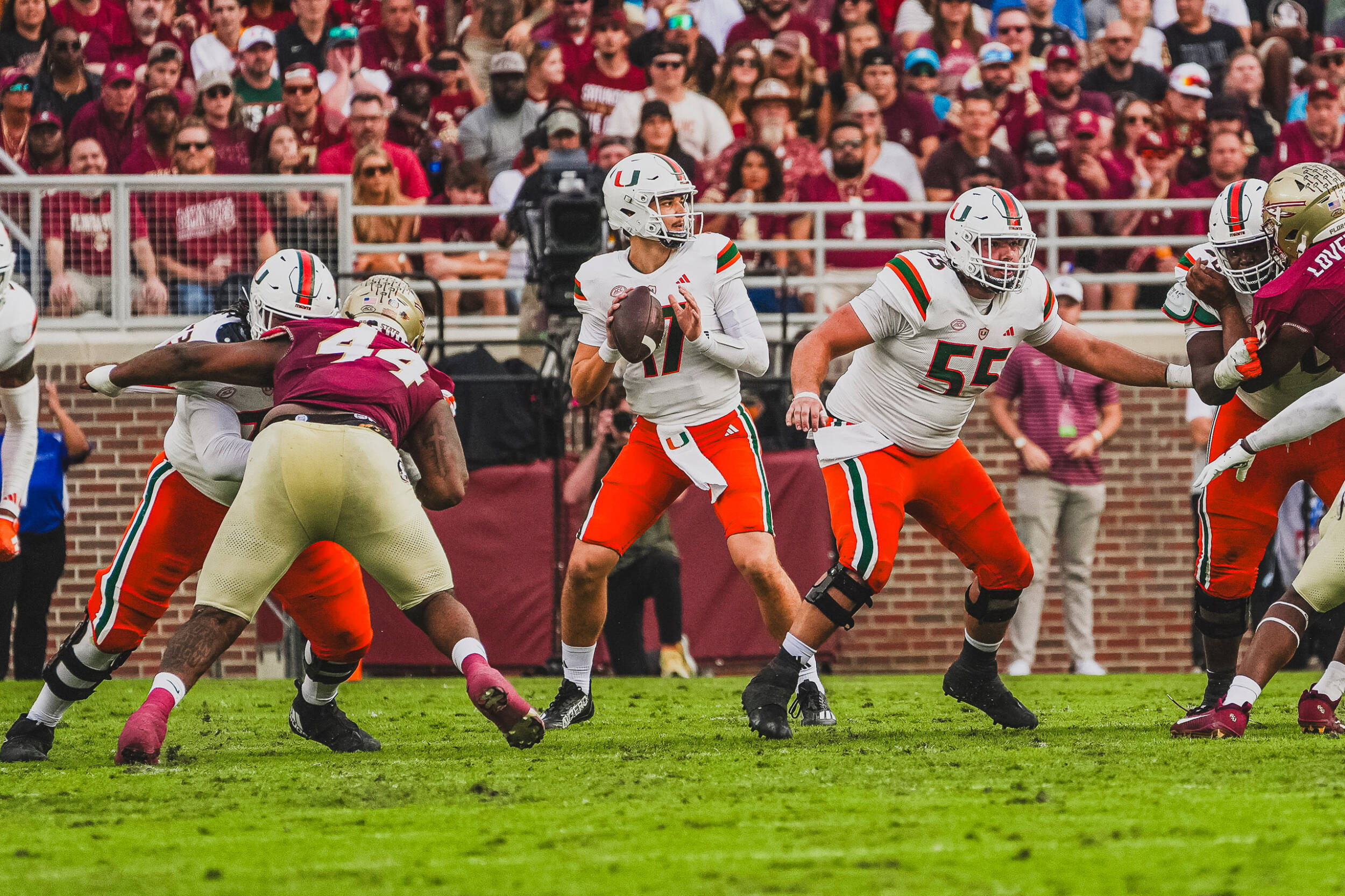
Freshman quarterback Emory WIlliams drops back to pass against Florida State in their 27-20 loss at Doak Campbell Stadium. Photo credit: Miami Athletics

If FSU can’t balance its books in the same conference as Miami, what are the chances for Miami to survive in this environment?

While UM is a private institution and not required to disclose its full ledger, the Hurricanes operate in the same volatile ecosystem and the impact of this national “debt race” could hit home in some unexpected ways.

Last June, the House v. NCAA settlement gave Division I schools the power to give shares of the team revenue to their rosters. This has helped the Canes by being able to pay for immense talent like Cam Ward and Carson Beck out of the transfer portal and lucrative NIL deals while turning players into stars. But, not all that glitters glows. 

The school cannot rely on taxpayer subsidies or public student fees like state schools do in order to pay these athletes without losing sight of its academic mission. This money must come from somewhere — likely through increased ticket prices, donor fatigue or deeper corporate partnerships.

The reports out of Tallahassee suggest that the first casualties of the deficit spending will be the sports that don’t take the coveted Saturday night slots. 

In this scenario, departments like FSU could likely cut olympic sports such as track and field and rowing. Miami on the other hand, has a proud tradition of producing Olympians, but with the cost of football and basketball skyrocketing, perhaps the school could be forced to change the priorities of the athletic department to feed their biggest moneymakers. 

The Hurricanes have always prided themselves on being “The U” against the world. But in the new landscape of collegiate athletics, the toughest opponent isn’t across the line of scrimmage — it’s on the balance sheet.

Keep students safe by keeping campus closed

The University of Miami prides itself in providing a “safe, tranquil and suitable learning environment” for its students, but I’m tired of seeing random men in Meta glasses harass me and my friends with questions for their latest TikTok video. 

UM sits in the center of the bustling city of Coral Gables, leaving students wondering if current security measures are enough to keep them safe.

Several students have reported dangerous encounters with strangers who are able to freely walk around campus whenever they please, because campus gates are often left open or not strictly guarded. The campus’ main gate on Stanford Drive is often left open even during late hours, meaning anyone is able to enter or leave campus without any verification of their identity. 

Enforcing stricter rules at each of the gates would prevent students from being put in dangerous situations. It would also put both parents and students at ease, especially those who may be out-of-state and unfamiliar with the Coral Gables area. 

One of these encounters happened last spring when a man was reported exposing himself to a female student on campus. According to a CBS News article, an unidentified male approached a young woman in Shalala Student Center while undressed and began to touch himself inappropriately.

Another instance occurred this semester when a strange, unidentified man walked onto campus and began making taunting jokes about UM’s football team. A verbal altercation then followed when a student approached the man, leading the man to claim he was being attacked and assaulted. 

Security assistants monitor the lobbies of Residential Colleges from 10 p.m. until 8 a.m. But, there isn’t exactly anything stopping an intruder from entering campus outside of these hours. 

We maintain a safe and welcoming environment through a strong 24/7 police and security presence, rapid emergency response times averaging three minutes or less, and continuous review of our security protocols,” the University of Miami said in a statement to The Hurricane. 

Despite these security protocols, freshman Riley Kai Richards was approached by an unknown person after leaving the Centennial Dining Hall. 

“I was walking out from the dining hall and this much older guy came up to me and was clearly intoxicated,” she said. “He kept trying to get me to go in his car and it wasn’t until another student came up to me that he left me alone.” 

She reported the incident to UMPD.

Richards told The Hurricane that the UMPD remained in contact with her for about three weeks after, but said that she never received a final update on the man. She stated she has not seen the man, or his vehicle, on campus since.

Cane Cards and guest policies are listed on the University’s Housing and Residential Life website, but it is unclear whether these policies are truly keeping students as safe as possible. 

Florida Statute 810.097 states that “any person who does not have legitimate business on the campus” is guilty of a misdemeanor of the second degree and may be asked to leave the premises. 

Many college campuses require students to have a form of  identification, such as UM’s Cane Card. But, regulations differ when it comes to allowing the public access to walk around and enter campus. 

A complete lockdown would be difficult, considering students have mentioned enjoying the community aspect of UM, and it would take more time, money and energy to have constant guards and gates up at all entry points on campus.

However, stricter guidelines could keep future altercations from occurring, or at least lessen how often they occur.

I can’t afford my four-year UM degree

The University of Miami was my dream school. 

I grew up in Broward County, and, like anyone raised in the Miami metropolitan area, I was born a Hurricanes fan.

Attending UM was my dream, what I worked for my whole life. But when I got my acceptance letter from UM, I did not feel the joy I had imagined. Instead, I felt dread: “How am I going to pay for this?” 

The cost of attendance at UM, according to the Office of Undergraduate Financial Assistance and Employment website, is $98,118. $63,456 of that estimate is tuition. The cost may decrease by about $10,000, depending on whether you are an on-campus student or a commuter.

I worked hard throughout high school and was a likely candidate for full-ride scholarships at other Florida universities. At UM, my efforts paid off with three quarters of tuition covered by scholarships, yet the remaining quarter is still hard to pay for.

Now, in my fourth semester at UM, I am preparing to graduate in just two-and-a-half years, much to my mother’s despair — I think. 

I’m not finishing early because I want to. I’m doing it because I can’t afford to stay at UM for the traditional four years.

 And I’m not alone.

In a survey conducted by The Hurricane on Instagram, 59% of student respondents said they are graduating early. We live in an era of education where fast-tracked degrees might be the only way to afford college. 

“My Cane Navigator seemed offended that I even proposed the idea of graduating early,” an anonymous survey responder wrote. “From then on I realized how much of a business this university is. In that meeting I didn’t feel like a student, I felt like a customer.”

I was fortunate. As an in-state student, I am eligible for Florida’s generous grants and scholarships. I also came into college with about 40 high school credits, which made me a sophomore in my first year. 

“I’m technically a sophomore but I don’t feel like a sophomore at all, I’m still figuring out all that UM has to offer,” a survey respondent said. “I’m the youngest in most of my classes and I have to remind myself that everyone else has had more time to find their organizations and community. It feels like playing catch-up even though I’m doing more than the average freshman.”

Throughout the past 20 years, tuition and fees at private national universities have increased by about 32% after adjusting for inflation. These increases have outpaced those at public universities by three percentage points for in-state students and eight points for out-of-state students. 

Rising costs are pushing students who are already struggling to pay for college to graduate early. Of the students who said they were graduating early, 64% cited “financial stress” as a reason.

“I took several APs in high school, so I came in with 30+ credits,” another anonymous survey responder said. “It is a bit stressful having to cram the ‘college experience’ into three years but it saves time and money.”

If tuition hadn’t skyrocketed by the time I came to UM, I would love to stay for three more semesters. It’s my dream school — but the price of being here is turning that dream into a nightmare. 

The need to graduate early also comes with academic and personal costs. Only 20% of students who said they’d graduate early chose “strongly disagree” regarding the prompt, “Has your fast-tracked education caused you any problems?” 

Some of these problems include being forced to switch majors, limited involvement in extracurriculars and leadership, stress about networking and limited time to prepare for the LSAT. All of these school and career-related issues come as early graduates also deal with limited social lives and stress about what to do after graduation. I also deal with many of these issues.

One solution to this problem might be to pursue a graduate degree. Of the students who said they were graduating early, 68% said they were “probably” or “definitely” going to graduate school. Only 24% of those disagreed with the question, “Has your fast-tracked education been a factor in that decision?” 

However, this poses another problem for students who already struggle to afford undergraduate education. Though there are scholarships and employer tuition reimbursement programs, early graduates will be hard-pressed to find time to utilize these resources and form their graduate plans.

The best solution would be to address rising college education costs for students across the country.  Until the 1970s and 80s, many universities across the country charged no tuition. Today, the most expensive university, the University of Southern California, charges $75,162 in tuition, only $11,706 more than UM. The cost of attendance at UM, however, is only $1,021 less than USC’s.

Florida has taken steps to reduce tuition costs for in-state students through scholarships and grants, but it barely makes a dent at private universities. If Florida really wants to attract and retain the best human talent, it should invest more in all its students.