UV residents report longer wait times after changes to shuttle route

0

The Office of Parking and Transportation has announced a new shuttle route between Centennial Village and Ceserano Plaza, which is located in front of the Herbert Business School. 

According to their website, the route is scheduled to run on weekdays from 8 a.m. to 7 p.m. and the wait times are between 18 and 20 minutes.

In addition to the implementation of a new shuttle route, the University of Miami has also changed the Miller Circle route. The original Miller Circle route had a stop at the Hecht Athletic Center which has since been removed. 

“The new pilot route was introduced to improve mobility between underserved areas, including connections between the Metrorail, academic core, and Centennial Village, and to provide an alternative for visitors parking in Red lots,” the University said in a statement to The Hurricane. “Operating Monday to Friday from 8 a.m. to 7 p.m., the route was intentionally designed with an 18 to 20 minute wait time due to its longer travel path. This service operates independently and does not impact other shuttle routes.”

According to an email sent by the Office of Parking and Transportation on Jan. 9, the Hecht Athletic Center stop was removed “to enhance rider safety and improve the overall shuttle experience.”

However, because of these changes students, especially University Village residents, are reporting longer wait times. 

University Village resident Elle Mannion says that the changes to the shuttle routes makes her daily commute longer. 

“I already have to wait for the one bus that runs in the morning to loop all the way around the route before getting back to UV,” she said.

Mannion said that before the new route was added, her commute was short and took her directly to where she needed to go.

Instead of taking the shuttle from the Hecht Athletic stop, which took Mannion directly to her destination, the removal of the stop means that she and other UV residents have to take the shuttle from the UV stop to Brescia Lot which is in the opposite direction of Miller Circle.

“The problem with Brescia is that it’s one block or less away from the UV stop. If you walk from the UV stop to the Brescia stop, it takes less time than riding the bus from the UV stop to the Brescia stop,” she said.

“The University of Miami’s Parking and Transportation team has reviewed recent concerns and confirmed they are not related to the launch of the new pilot shuttle route,” the University continued. “The Miller and Stanford routes continue to meet their 7 to 9 minute service standards, with performance data showing consistent on‑time operation. While large campus events may cause minor fluctuations, overall service remains within expected ranges, and riders may track buses in real time online.”

Despite the longer wait times for UV residents, other students are welcoming the change. 

“I like it because it’s faster. I felt the sports center stop was pointless since it was so close to the UV one,” said UV resident Dis Sorentino. 

“A temporary website categorization error placed the pilot under the Miller/Stanford section; this has been corrected. All routes are currently performing within expectations, and Parking and Transportation continues to actively monitor service and adjust as needed,” the University continued in its statement.

Students can view the route changes on the shuttle tracker.


This article was updated at 9:20 p.m. on Friday, Jan. 23 to include the statement from the University. 

Free concert on Miami Beach draws over-capacity crowd

0

The weekend of Saturday, Jan. 17, Miami Beach hosted the annual AT&T Playoff Playlist Live!,  a free, two-night music festival organized in anticipation of the College Football Playoff National Championship game. 

This year the featured artists were UM alumna XANDRA, Calvin Harris and John Summit who performed on Saturday and Álvaro Díaz, Latin Mafia and Peso Pluma who performed on Sunday. 

The allotted area in Lummus park was created to accommodate around 20,000 guests. By the end of the night the crowd was estimated to be 30,000 people

One University of Miami student who was in attendance Saturday night heard that the crowd had reached more than 200,000 people. 

“The crowd was absolutely massive, and it was easy to get shoved over,” she said. “I heard that a lot of people fainted in the crowd and that several fights broke out.”

The student also noted a lack of security and event officials present at the event, and said that security check points were not effective.

“There was a security checkpoint, but it was small and everyone freely passed through,” she said. “It wasn’t functional when I was there at 7:30 pm, people just passed through.”

However, crowd related issues began long before the artists took the stage. One University of Miami junior arrived at the venue at 1 p.m. in anticipation of the large crowds. The peace of getting there early did not last long. 

Despite Saturday night’s chaos, Sunday was a better experience for some. Sophomore Sebastian Loubet attended Sunday’s Latin medley after having skipped out the night before out of concern for a lack of organization. 

“I didn’t go [Saturday] night because it didn’t feel well organized, especially with the whole free ticket thing plus any age range,” he said. “I would have been more comfortable spending $100 or more on a ticket with the guarantee that it’s more organized.”

While Loubet stands by his decision of not going, he was pleasantly surprised with the event’s organization. He claimed that it was better than he had expected and that is why he decided to go on Sunday. 

He shared that his experience was great and did not find the venue to be overly packed compared to Saturday. 

“It wasn’t too crowded, even up front, and it didn’t get packed too early,” he said. 

Loubet believes that it was more relaxed due to less of a demand from the crowd in addition to more explicit security parameters on social media.  

In a collaborative instagram post between CFB playoff, 2026 Miami Host Committee, Miami Beach Police Department and City of Miami Beach, new safety and entry procedures were clearly outlined. Some of the additions to Sunday’s event were additional entry lanes, “no bag” express lanes, pre-screening for early birds and an increase in security presence. 

Loubet was able to take advantage of the pre-screening security efforts where he was then given a free water voucher and access to the paid concessions while waiting for the main venue area to open. 

Record number of spring admits reshape campus life

0

A record number of more than 750 spring admits arrived at the Coral Gables campus for the new semester, marking the largest spring admit class in the University’s history

These numbers reflect UM’s enrollment growth, alongside record-breaking sorority recruitment numbers and an 8% increase in freshman applications in 2025. 

The spring start undergraduate students arrived as early as Jan. 5 for Cane Kickoff: Spring Orientation. They began classes with the rest of the university on Monday, Jan. 12.

Since housing for spring admits is “neither required nor guaranteed,” these students have the option to commute to campus from nearby housing, reside in overflow housing at Thesis Hotel or Lakeside Village or live in available spaces at the freshman dorm buildings.

Before arriving at the university, spring semester students had the opportunity to start online or study abroad through UM’s Start Abroad program. The program offers semesters abroad in 13 countries like Paris, Barcelona and Rome. 

Spring Starter Korey Cagnolatti participated in the URome program with approximately 150 other students. This not only allowed him to fulfill his arts and humanities cognates, but it eased his transition into college life in a major city.

“I come from the suburbs of Illinois. Going into Rome, an actual city, is a different shift, so it helped me adapt to Miami,” said Cagnolatti. 

Other options for Spring Starters included earning credits at other universities to transfer over for their classes at UM or working during the fall. 

As this spring semester begins, campus walkways and common areas have become noticeably more congested as students adjust to the attendance of hundreds of new peers. Additionally, a new social energy has been brought to campus as fall and spring admit students mingle during the first week of classes. 

UM had been Spring Starter Kailani Cheng’s dream school since her sophomore year of high school. After an initial deferral during the admissions process, she got accepted as a Spring Starter the next round and found a home at the U. 

“I expected it to be more like not knowing anyone, and everyone has their friend groups. But when I came here, everyone’s been really friendly. If you’re just willing to talk to new people, you will be fine,” said Cheng. 

Although she did not anticipate the large number of fellow spring admits, Cheng says the university has provided enough resources to ensure a smooth transition.

“I definitely feel supported by the school, whether it’s from people I already met here or the faculty. Spring Start orientation definitely helped a lot,” said Cheng. 

The Office of Undergraduate Admission will continue to hold spring admit events during the semester to acquaint new students with academic programs and campus life.

UM’s Early Decision acceptance rate drops for fall 2025 admissions cycle

0

The University of Miami accepted 44% of Early Decision applicants for the fall 2025 admissions cycle. The 2025 ED acceptance rate decreased by four percentage points from the 2024 ED acceptance rate, which was 48%. 

According to UM, “The University received 2,395 Early Decision applications; 1,062 applicants were admitted under Early Decision.”

During the 2024 cycle, the University received 2,260 ED applications, and 1,025 students were admitted. 

While the Early Decision acceptance rate declined this year, it remains significantly higher than the University’s overall acceptance rate. UM’s overall acceptance rate for the class of 2029 was 18%, meaning Early Decision applicants were admitted at more than twice the rate of applicants in the regular admissions pool.

“I applied ED because I knew UMiami had everything I was looking for: academics, sports and clubs, and good weather, location and campus,” said Miriam Tali, an ED admit from the class of 2030.

Applying through the binding Early Decision process gives applicants a higher chance of getting into a competitive university. This is because the applicant pool is much smaller and applicants must enroll if they are accepted. 

For example, Tulane University accepted 59.4% of ED applicants into the class of 2028, according to Ivycoach.com. Tulane’s overall acceptance rate is around 14%, with as few as 403 regular decision applicants being admitted for the class of 2026. 

Northeastern accepted 39% of early decision applicants for their class of 2028. Its overall acceptance rate is 5.6%

“If you are confident UM is where you belong, you should 100% apply ED. Applying earlier also reduces a lot of the application process stress,” Tali said. 

The number of students applying via Early Decision and Early Action deadlines is slowly increasing. With a higher volume of applicants, there is more competition for a limited number of spaces, leading to a slight decrease in ED acceptance rates.


Miami falls 65-63 in final seconds to Florida State, suffers first back-to-back loss of season

0

After Miami’s soul-crushing defeat on Monday in the College Football National Championship, Florida State twisted the knife even deeper into the hearts of ‘Canes fans on Tuesday night at the Watsco Center. 

Miami men’s basketball (15-4, 4-2 ACC) fell 65-63 to the 7-11 Florida State Seminoles in a wire-to-wire final-minute thriller, losing for the first time at home all season. 

Entering the contest, the Seminoles were ranked dead last in the ACC, winless through their five clashes in conference play.

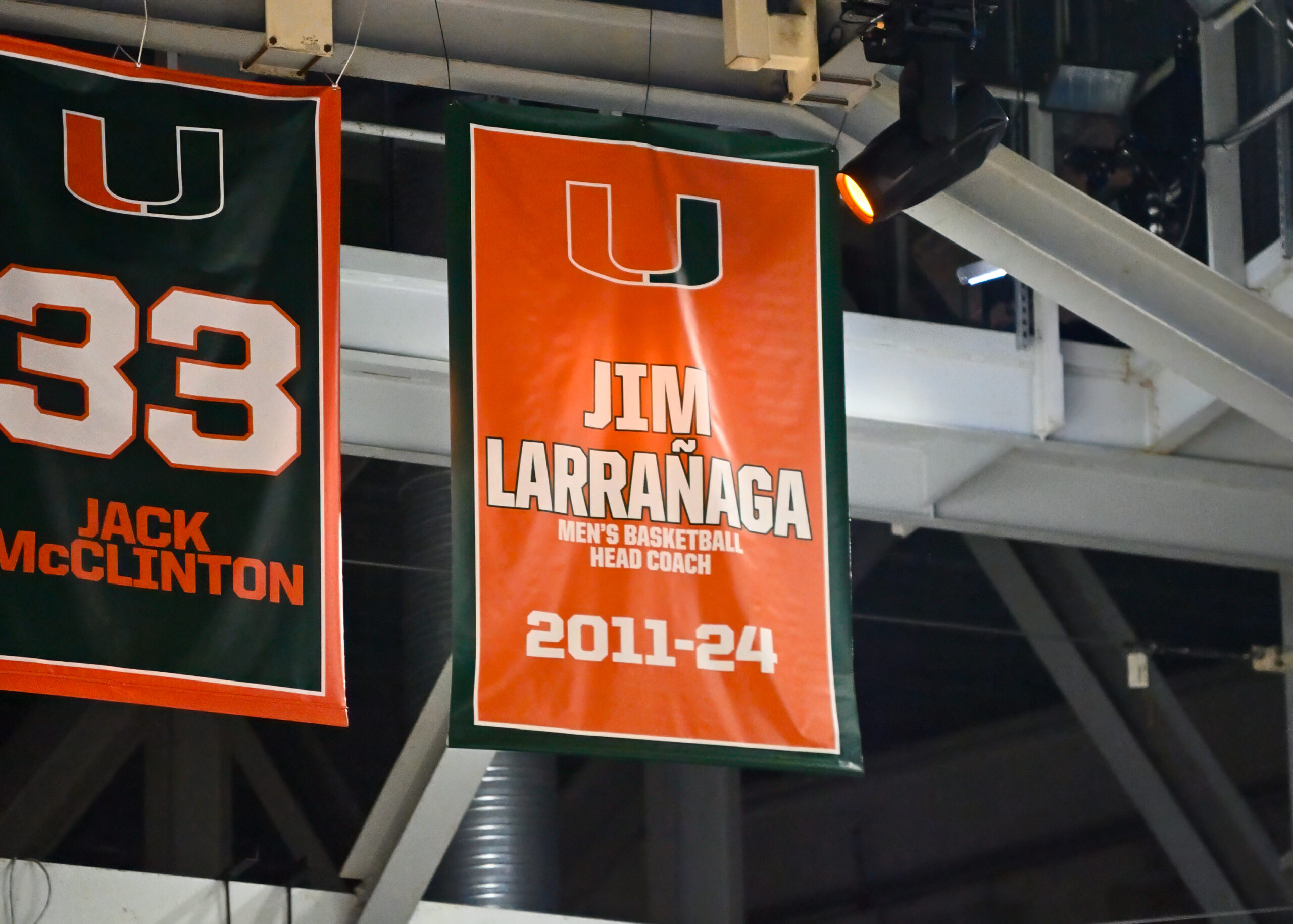
Prior to tip-off, the University of Miami honored former head coach Jim Larrañaga with a ceremony celebrating his career accomplishments with the Hurricanes.

The team paid tribute to the college basketball icon by unfurling his custom banner to hang in the stadium’s rafters, spotlighting his extraordinary legacy with The U that included taking the program to its first-ever Final Four appearance in the 2023 NCAA Men’s Tournament. Unfortunately, Larrañaga’s night was overshadowed by the unexpected loss. 

David Lebowitz, Photo Editor/ Coach Jim Larrañaga speaks at halftime of the Florida State game on January 20, 2026.

The upset comes off the heels of UM’s 10-point stumble against No. 18 Clemson on the road, marking the first time head coach Jai Lucas and his squad have dropped back-to-back games this year. 

The Seminoles are now 15-1 against Miami across all meetings since January 2018, while the ‘Canes have not beaten their in-state rivals since 2023.

Miami played their best in the early stages, launching a 9-0 run when trailing by three to take a 19-13 advantage at the 11:30 mark of the first half. Tallahassee native Tre Donaldson finished with a game-high five assists and was the catalyst of this offensive barrage, drilling three of the team’s four field goals and capping off the scoring frenzy with an emphatic dunk off a fast break.

FSU and UM shared punches back and forth throughout the opening 20 minutes, with no side able to gain significant separation over the other. The largest lead for the Hurricanes came with 4:14 remaining before halftime, when Ernest Udeh Jr.’s slam extended the score to 32-26.

Florida State’s Kobe Magee buried an improbable triple from near center court at the buzzer to give the Seminoles a massive lift heading into the third quarter.

The margins grew even tighter in the second half, and neither team could pull ahead by more than five points.

Despite Miami possessing a lead for only 1:44 in the last frame of action, the Hurricanes kept the Seminoles at bay, forcing the outcome to be determined in the final 60 seconds.

With 59 ticks left, the ‘Canes forced a key stop on defense, causing a Florida State turnover on an uncharacteristic shot clock violation. Malik Reneau cashed in on the next possession, converting from the interior to bring Miami within one, down 62-63.

Another strong defensive effort triggered the visitors to come up empty-handed again, giving the Hurricanes an opportunity to retake the lead with just 20 seconds remaining.

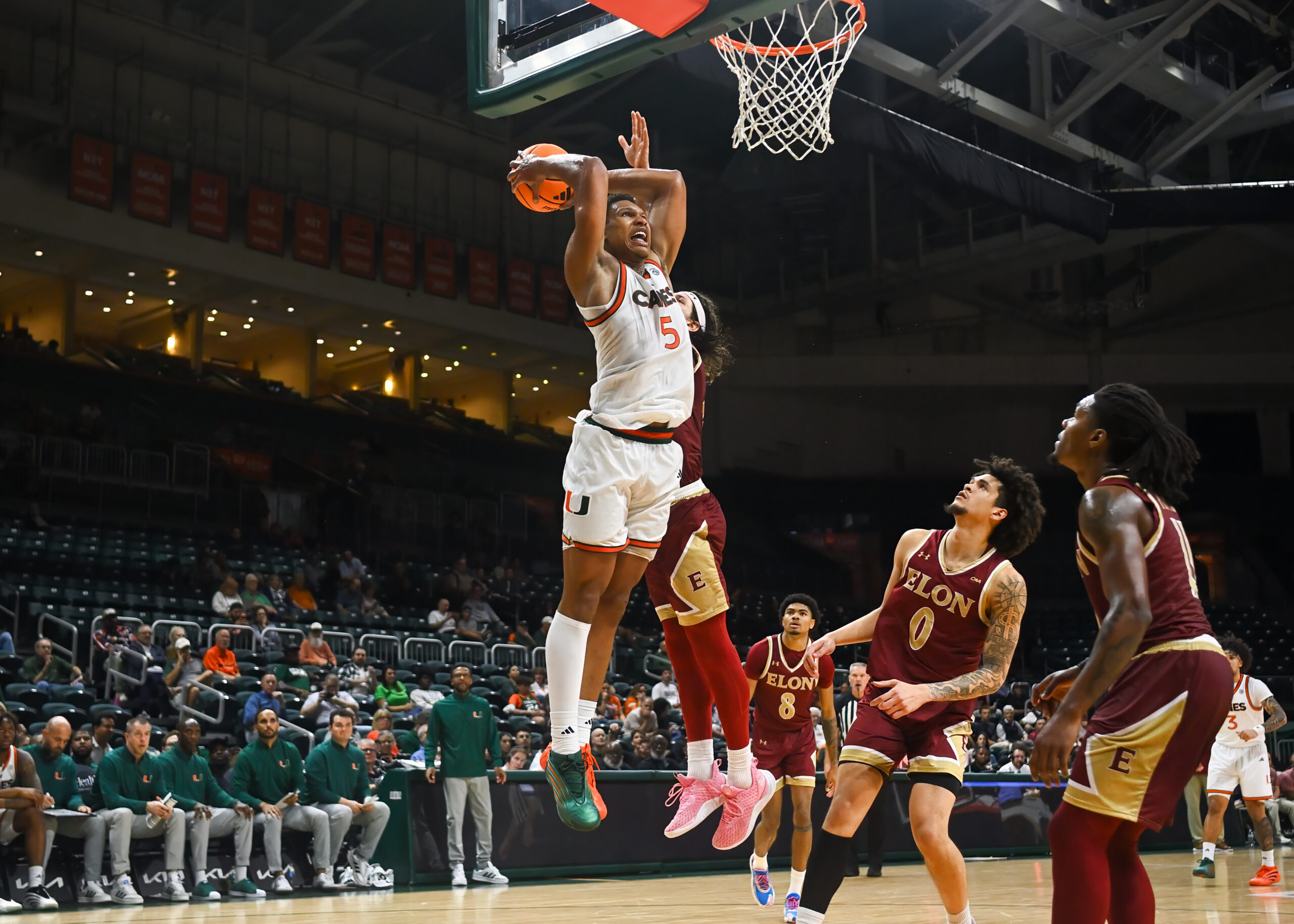
David Lebowitz, Staff Photographer/ Senior Forward Malik Reneau goes up for a dunk against Elon on November 20, 2025.


Surging downhill, Reneau was fouled in the post while going up for a layup, sending him to the foul line to shoot two. The Indiana transfer only connected on one, leveling the score at 63 apiece. 

With an eye on the timer, the Seminoles made one final push to score, draining over 18 seconds of running clock before Robert McCray V drew a foul in the paint while trying for a contested mid-range jumper.

McCray sealed the game by drilling both free throws, handing the ‘Canes their second heartbreaker in 24 hours. 

Miami shot themselves out of the gym, going 25% from beyond the perimeter, the exact same clip they had the week prior in their ranked road loss to Clemson. 

In addition, the Hurricanes struggled with costly giveaways, conceding 14 turnovers and 12 steals against FSU’s defense, ranked top 10 nationally in turnovers forced per game. 

Coach Lucas voiced his frustration with the team’s mentality in the postgame press conference, stressing a need for a more intensified sense of urgency and a desperation to win among his players. 

“Exactly what I talked about, our urgency and our desperation. If we do that, I think everything else will take care of it,” Lucas said after the game. “Right now we’re just kind of sluggishly getting through our stuff. We have to change it.”

Miami will look to course correct this upcoming Saturday at Syracuse. Tip-off is at 2 p.m. ET on the ACC Network with radio coverage on WVUM 90.5 FM. 

David Lebowitz, Photo Editor/ Coach Jim Larrañaga was honored with a banner in the rafters on January 20, 2026.


The SAT/ACT comeback at UM — a step forward or back?

0

For years students build their GPA, stack leadership roles, join extracurriculars and polish essays late at night only to learn that one Saturday morning test could now make or break their chances at attending UM.

With the University of Miami reinstating SAT/ACT requirements for the class of 2026 and beyond, students are once again facing the pressure of high-stakes testing. Though the policy is framed as a step toward fairness, it’s just another barrier for qualified students.

Early Decision statistics show just how competitive admissions have become. For the fall 2025 cycle, the University of Miami accepted 44% of Early Decision applicants, admitting 1,062 students out of 2,395 applicants, according to the University. 

While this rate is higher than regular decisions, it highlights the growing selectivity as the ED rate dropped by 4% since the previous year. 

Standardized tests focus on narrowed skills like timed math equations or memorized vocabulary, predicting short term performance in an academic setting. These tests do not capture curiosity, creativity or collaboration, which are all qualities that drive students’ contributions to their college communities. 

Junior marketing major Marina Boudreau explains her experience.

 “Personally, I’ve never been the strongest test taker, so standardized testing has always felt daunting and almost impossible at times,” she said. “It’s unfortunate that so much of one’s collegiate future can hinge on a single exam, and I don’t think that’s entirely fair or an accurate reflection of one’s skills.”

In early 2025, UM announced that they would reinstate the standardized test requirements for applicants after several years of operating under a test-optional policy. The decision to go test-optional in fall of 2021 followed a  nationwide wave from multiple institutions that began during the COVID-19 pandemic. Students were facing widespread test center closures, unequal access to testing opportunities and quarantine protocols. 

While many schools have decided to keep their test-optional policies permanently, others like the University of South Florida, the University of Texas at Austin, the University of Pennsylvania and the University of Georgia have returned to requiring SAT or ACT scores. This national divide poses a deeper question of what standardized tests actually measure and what role they should play in defining college readiness.

“The University is reinstating the test score policy to provide an additional data point as part of its holistic review process, and it is important to note that the University’s internal data analysis shows that standardized testing is a predictor of academic success,” The University said in a statement to The Hurricane. 

One of the largest criticisms of standardized testing is its close connection to income. Wealthier students have access to test prep courses, private tutoring and the ability to retake exams multiple times. They are also more likely to secure extra-time accommodations through documented disabilities. For some, standardized testing has become yet another area where resources can tilt the playing field

Lower income and first generation students frequently face barriers that make it difficult to perform at the same level as their higher income, continuing generation peers. As The 74 reports, standardized exams often “favor privilege over potential,” turning what should be a measure of academic readiness into a reflection of socioeconomic advantage. Even with test-optional policies, underlying disparities remain. Students with strong scores tend to submit them, while those without remain at a disadvantage. 

Supporters of standardized testing argue that exams like the SAT and ACT restore fairness to the college admission process. Unlike essays or extracurriculars, often influenced by access to mentorship, editing or expensive experiences, test scores offer a consistent metric for evaluating students from different schools and backgrounds. High school GPAs can vary widely depending on the specific schools inflation policies, course rigor and district standards, making it difficult for admissions officers to compare applicants fairly. 

Additionally, research from the College Board and Opportunity Insights showed that test scores combined with GPA can be strong predictors of college performance and retention. Advocates also argue test-optional policies create hidden inequalities that skew the data. Students with high scores tend to submit them, while those with lower scores often choose not to. This distorts the reported average upward, creating a misleading impression of overall performance. 

While these points raise valid concerns, they overlook how standardized testing itself reflects and reinforces structural inequities. Objective measures are only fair if everyone has equal opportunity to prepare for them, which is rarely the case when it comes to any college application requirement. All standardized testing, essays and even GPA can be influenced based on the economic diversity across applicants. 

“University undergraduate admission counselors will continue to use a holistic process to review each applicant, carefully considering a student’s academic record, extracurricular activities, including community involvement and work, personal statement, and test scores,” the University said in a statement to The Hurricane. 

Standardized tests only capture a tiny piece of an individual’s intelligence versus the whole student. The SAT and ACT emphasize speed, memorization and test-taking strategies, in contrast to the qualities many employers value, such as creativity, flexibility, collaboration and leadership. As the University of Chicago found, high school GPA actually outperforms standardized tests in predicting long-term success, since it reflects years of sustained effort and engagement. 

Junior Psychology major Anika Pande agrees that test scores should not define a person’s academic potential. 

“I believe GPA is a stronger indicator of academic ability than standardized tests,” she said. “Although I didn’t submit an SAT score, I’ve maintained a 3.8 GPA at UM, which demonstrates my ability to handle rigorous coursework.” 

Though there will never be a truly equal way to determine college admissions, standardized testing is one of the more inequitable. By reinstating the testing requirement, the University of Miami risks discouraging capable, well-rounded students who might feel defined by a single number rather than their potential to thrive within a diverse academic community.

UM’s return to required testing may provide admissions officers with data, but it risks shrinking opportunity for students without equal resources. Beyond test scores, essays, recommendations and extracurricular achievements offer a richer picture of a student’s potential, highlighting creativity, leadership, resilience and impact which are all qualities that standardized tests cannot measure.

Why I’m ready to be known for more than a TikTok

0

The internet has a way of deciding who you are before you ever get the chance to speak for yourself. One of the worst moments of your life becomes a headline, and suddenly, you’ve become a story so widespread that people around the world assume they know you because of one thing you said online.

I know this because of something that happened during my first semester at the University of Miami.

In the fall semester, The Miami Hurricane ran a print edition that featured freshman creators and influencers on campus. I was interviewed for an article of my own, but when I saw that I didn’t make the front cover, I took the situation to TikTok.

I was in tears and overwhelmed by how much I had invested in the “influencer dream” and how it was a wake up call that I needed to either focus more seriously on my social media or just do it for fun. 

But that vulnerable and unfiltered video went viral. Not because of the lesson I thought I was sharing with my followers, but because of a tone-deaf comment I made.

The real lesson I learned was that, clearly, I had some maturing to do — like many other college freshmen. What I intended to be an honest moment turned into widely circulated content, the reaction was brutal. The comments ranged from dismissal to death threats. 

Mentally, I hit rock bottom, where I didn’t know if I would get through to the next day. Some people online didn’t see me as a human being struggling with self-worth, instead they saw an opportunity to critique, mock and reduce me to a punchline. 

I don’t share this story to gain sympathy or relive the past. I share it because it taught me something invaluable about narratives, identity and the power of platforms like The Hurricane. It revealed how easily context disappears in the digital age, and how quickly a single viral moment can define us instead of our full story.

But here’s the thing: that moment was real. It was raw. And it mattered to me. Yet it was only one piece of who I am, not a complete picture of my thoughts, ambitions or capacity to contribute meaningfully to the University of Miami. 

So, here I am joining The Miami Hurricane, precisely because I don’t want to be known for that moment alone. I want to be known for the ideas I bring, the conversations I spark and the way I engage deeply with issues that matter to students, from digital identity and the effect being online has whether it’s about accountability or about growth.

Writing for the opinion section of a newspaper makes room for honesty — even uncomfortable honesty — and invites readers into thoughtful conversations rather than quick judgment. It values context over going viral and insight over impression. That’s the space I want to inhabit as a writer.

So yes, I cried on social media. Yes, it was real. And yes, I regret it every day. But it’s not the sum of who I am. It’s a chapter. And I’m ready for the next one.

So it’s time for me to stop being known as the “microinfluencer girl.” Instead, it’s time for me to be known as an intelligent human being who has great ideas and conversations to bring to the table. So joining The Miami Hurricane isn’t about erasing the past. It’s about proving that I don’t have to be defined by it, especially when I have something meaningful to say. It’s about personal growth and learning how to share what I feel in a productive way.

The hidden costs of conference expansion

0

College athletic conferences were once designed to bring schools together. They shared similar geographical areas, history and identity. Rivalries spanned decades of hatred between schools, and travel was manageable enough for student athletes to succeed on and off the field. 

College sports felt personal, regional and meaningful.

But today, the old conferences are being replaced by a system driven almost entirely by money and national prestige. As athletic conferences grow larger and more spread out, college athletics are losing their core identity.  

One of the most damaging aspects of conference expansion is the increase in travel distance by athletic programs. College teams now fly thousands of miles across the country to face schools that most times have no cultural or historical ties to the institution that they are playing at.

These long trips are physically and mentally exhausting for the athletes that partake in them. These journeys often take place during scheduled class time, which make the athletes far more likely to fall behind on their coursework. 

Over the course of an extensive season, missed lectures and exams add up which makes it increasingly difficult for student athletes to succeed in the classroom. 

Beyond academics, excessive travel takes a toll on athletes’ mental and physical well being. The sheer amount of long distance flights may contribute to an athlete’s disturbed sleep and limited recovery time, creating higher stress and fatigue.

These student athletes are expected to compete at their highest level while at the same time managing tasks that many non-student athletes will never have to do. This reality contradicts the vision that college athletics are meant to support personal growth and education. 

Conference expansion has also ravaged college sports of their long standing rivalries, many of which have been sacrificed in pursuit of money. A notable example of this is the disappearance of the annual University of Miami and University of Florida game.

Many fans were heartbroken when these two schools stopped playing one another annually. But as a consequence of the SEC’s expansion, it was inevitable that both these programs would stop playing each other. 

These rivalries are not just games, they are traditions that are passed down by generations of students and fans. Their loss weakens the connection between the school and its community. 

With more expansion comes increased television revenue, potentially strengthening athletic departments and allowing schools to invest more in their facilities, coaching and resources. While this may benefit powerhouse programs such as UM and Ohio State, the smaller schools get left behind.

When a larger school leaves a smaller school’s conference, the remaining schools in the conference lose shared revenue, media exposure and recruiting opportunities. For many of these smaller schools, budget cuts happen due to the financial constraints created by losing a source of funding for the schools programs.

These budget cuts lead to many schools cutting programs that they deem unprofitable, which eventually leads to schools like St Francis College of Brooklyn and Sonoma State University closing down their athletic departments entirely. 

The rapid growth of college athletic conferences reveals a growing disparity between the business of college sports and the values of higher education. While conference realignment does generate extra revenue and brand exposure — it does not account for the welfare of student athletes, the value of education or the intense rivalries created by schools. 

If the goal of college athletics is to foster both academics and competition, then conferences must seriously consider whether profit driven expansion truly serves its athletes, schools and fans who give the game its meaning.  

Students should not be charged for being locked out of their rooms

0

It’s 10 p.m. I just got back to my single in Ibis after my three hour lecture. I finally get to shower in our communal showers after an exhausting day of classes and club meetings, until I realize that I left my Cane Card locked inside my room. 

Now, not only do I have to go back downstairs in my towel and embarrassingly ask for a temp card, but I also have to pay for it. 

Unfortunately, this has been a reality for me one too many times, and I hope I’m not the only one. 

With on-campus housing ranging from $10,000 to $18,000, students should not be charged for the use of temp cards. The University should cut students some slack and not charge for every time they accidentally lock themselves out of their room.

Yes, it’s true that having some kind of fee or “punishment” for forgetting your card might prevent students from making the mistake as often, but the school doesn’t benefit from charging $25 every single time. 

“The charge accounts for the administrative work that the process of managing the temporary card process requires,” the University of Miami said in a statement to The Hurricane. 

This policy was just introduced last year, so why now start charging students? Was there no need to do so before? Looking up someone’s name and C number and handing them a temp card isn’t difficult, which leaves the reasoning behind charging students unclear.  

“It happens to everybody, even I have locked myself out,” said Morgan Parodi, a Residential Assistant in Lakeside village. “The main thing that residents complain about is ‘Why are we [getting charged]? I literally know where my Cane Card is, it’s in my room.’”

Cane Cards are tedious to constantly carry around, so it’s easy to leave them behind if you’re exhausted, in a rush or just multitasking. 

At Florida State University, University of Florida and several other colleges, students are able to have their IDs on their Apple Wallet. While a Cane Card is easily forgettable, almost every screen-addicted college student has their phone on them at all times. 

Providing students with a digital ID would make it easier for  students so they don’t get locked out or have to constantly pay fees for a simple mistake, and the desk assistants who are probably tired of their residents walking down to get a temp card — while still in their towels. 

Especially for students who live in a single, it can happen twice as much since they don’t have a roommate who can come to their rescue or suitemates to let them in. 

“It’s really unfair as a student who lives alone, especially coming back from a night out and realizing that my Cane Card was in my dorm the entire time,” a sophomore in Lakeside who wished not to be named said. “Because I have no roommates, I had to walk from Lobby C all the way to Lobby A for a temp card, just to walk all the way back after and be charged a fee. ” 

It’s time we’re forgiven for our mistakes instead of paying. It’s bad enough to make the walk of shame to the lobby, but to be charged an extra fee for an honest mistake is too much. I don’t want to have to watch the money from my savings account drain every time I see the door close with my Cane Card left on the desk. 

What sorority recruitment week could teach you

Panhellenic sorority recruitment at the University of Miami from Jan. 5 to Jan. 11 brought  more than 1,200 students into a fast-paced, highly structured process with high expectations. 

If you wear the right outfit and nail your conversations, you could be welcomed into a sisterhood that supports you throughout college. But even potential new members (PNMs), who follow all every recruitment tip they see on Instagram can still walk away empty-handed.

However, even if someone doesn’t end up with a bid, going through the recruitment process can be a learning experience. Any PNM will learn important lessons that will stick with them throughout life. 

Throughout the week, PNMs are organized into small groups led by recruitment counselors (or RCs). While RCs are affiliated with sororities, they have neutral roles in communicating schedules and results, managing time and providing emotional support time management and supporting PNMs emotionally. 

“You meet so many new people during rush,” a recruitment counselor, who requested to remain unnamed, said. “Even if you decide it’s not for you, it’s still a really valuable social experience.”

Recruitment, much like applying for a job, starts with conversation and first impressions. At scheduled intervals, doors open simultaneously at the Panhellenic building and recruitment counselors call out PNMs’ names. 

The PNMs then line up next to the door of the suite they are set to enter and wait to be called inside for short, timed conversations with  sorority members.  

First impressions can matter during recruitment, as conversations are brief and often set the tone for later rounds. Presentation, confidence and authenticity can all shape how those initial interactions play out.

“Seeing comments and videos online about expensive outfits and bold personalities made it seem like appearances mattered more than they actually did,” said a freshman PNM who requested anonymity. “I realized it was really about showing up as yourself and connecting with people who understand you.”

During those initial conversations, PNMs try to balance wanting to stand out while also searching for genuine connection.

“I was worried about being memorable,” the same PNM said. “But at the same time, I was trying to see if I could actually connect with the girl I was talking to and picture myself being friends with her and the chapter in general.”

Recruitment counselors then knock on the door from the outside to signal to the recruiters that conversations are about to end and the next round will begin.

This synchronized routine defines Panhellenic sorority recruitment at the University of Miami — a process that requires months of preparation, precise logistics and emotional labor for PNMs and RCs.

Recruitment unfolds over several stages: two days of Open House rounds, two days of Philanthropy rounds,  Invitational Day, Preference Day and Bid Day. 

With each round, the number of  PNMs invited back to each chapter decreases, and conversations grow longer and more personal. Multiple rounds take place each day, all starting and ending at the same time, creating a constant rhythm of movement, waiting and interaction.

“Having people around you who understand what you’re going through really matters,” the RC said. “Having supportive girls can make a big difference.”

Using walkie-talkies, lists and minute-by-minute schedules, RCs ensure the process runs efficiently, while also being a consistent point of contact during an emotionally demanding week.

 “A lot of girls worry about not finding a home,” the RC said. “Things like hair, outfits and conversations matter, but it really comes down to wanting to be welcomed into a sisterhood.”

With this year’s recruitment being one of the largest recruitment cycles yet, with approximately 1,250 students registered, there wasn’t a home for everyone. The RC saw time commitments were frequent concerns PNMs had.

“I wanted to ask for a detailed list of activities and events for each month,” a second PNM said. “College already comes with a lot of responsibilities, so understanding what I could manage was important to me as choosing a sorority was becoming something real.”

Inside each sorority suite, conversations followed a consistent structure. PNMs spoke one-on-one with an active member of the sorority they were hoping to join, though some were paired with another PNM and seated side by side. 

“The beginning of the week felt more chaotic,” the RC said. “It’s exciting that so many girls are going through recruitment, but it can get loud and overwhelming at times.”

While there are multiple factors taking in consideration for call backs, the reason for drops is not specified. However, RCs observed that how students responded to those moments often shaped their overall experience inside and outside college life.

“It’s important to enjoy it while it’s happening,” the RC said. “Recruitment can be stressful, but it’s also a way to expand your horizons. The experience is unlike anything else most people ever do.”

Many hopeful PNMs turn to social media for recruitment advice, but the RC cautioned against relying too heavily on online narratives. 

“My biggest advice is not to listen to social media,” the RC said. “Other people’s opinions don’t matter. Recruitment should be based on what feels right for you.”

Another PNM agreed with that perspective, noting that online portrayals of recruitment can be both accurate and incomplete.

“Good and bad opinions that you see online about rush can be valid,” the PNM said. “A strong criticism from someone can easily be a good memory for another; your experience really depends on what you’re looking for and the mindset you have during this time of your life.”

While recruitment can be perceived as superficial or status-driven, observations throughout the week suggested otherwise. 

Active members were seen preparing months in advance — rehearsing sorority chants, coordinating decorations, producing videos and writing letters filled with vulnerability and intention. 

Small gestures of care from RCs, like answering questions and checking in emotionally, helped soften an otherwise rigid system.

Recruitment concludes with Bid Day, when final results are released. Regardless of outcome, the RC emphasized that the value of recruitment extends beyond that final moment. 

While the week moves quickly and emotions run high, recruitment ultimately is an introduction to college life itself: a space to practice resilience, decision-making and communication. 

“Recruitment is a small but important part of being in a sorority,” the RC said. “It can feel like your whole world while you’re in it, but it’s really just one week out of the entire experience.”