There’s only one place at the University of Miami where you can watch live late night comedy sketches. That place is the School of Communication’s Studio C when the University’s comedy show “Off the Wire” takes center stage every other Thursday night.
“Off the Wire” is a late-night comedy TV show on UMTV, featuring skits that mix creativity, pop culture and current events.
The Hurricane went behind the scenes and into the studio, met the casting crew, and got a feel for what it is like to work both on-air and behind the scenes.
Jada Wilson, the social media manager, said that it’s a space where “everybody can bring their own flair.”
In meetings where they plan the show, ideas come to life, no matter how simple or outrageous they are. Audrey Sears, member of the production team, mentioned that the environment is very creative, the team is open to any ideas and there’s no judgment.
The crew also talked about how UMTV provides opportunities for professional growth. Students get to learn and apply new skills in the media world — from camera work to teleprompters, editing, writing, audio and, of course, acting.
Just from watching one show, you get the feeling from the team behind “Of the Wire” that they feel like a family. There is so much going on behind the scenes that people don’t see.
It takes hours of preparation the day before the show to build something up, and the dedication, passion and collaboration among these people really make for an exciting and fresh watch.
Johnny Mustion, the executive producer, said that to prepare for Off The Wire the team has to meet at least three times a week to work on joke writing and rehearsals, among other things.
Mustion says that it’s so worth it because they’re very proud of the end product and always want to improve and listen to the community. “It’s television”.
When it’s time to focus and work, this team will make every trial run and do everything in their power so that the audience has a great show. Some members of the team even come in at around 2 p.m. to get ready for the 8:30 p.m. show.
They have live shows every other Thursday at the School of Communication in Studio C.
Their March 19, show felt like a full-scale late-night production television show, even with a great live music performance by Dreamscape, a band of University of Miami students that plays alternative pop rock music.
It is a very electric, welcoming environment. While speaking with the host of the late-night show, Wrigley Kordt, he shared his excitement with the interaction with the audience, saying you can feed off the energy of the audience, and that comedy can come from anywhere.
“Off the Wire” is a passionate student-led comedy show that delivers nonstop laughs thanks to its nonstop crew.
Make sure to check out past episodes of “Off the Wire” on their YouTube channel and go see them live every other Thursday in Studio C at the School of Communication.
High school backyard matches were just the beginning for one UM student, who turned his love for wrestling into a career while pursuing college classes.
Long before stepping into a professional ring, Angel Santiago’s journey began in high school with a homemade wrestling organization he created with his friends. It was here that he officially created his ring name, “The Puerto Rican Prince.”
“Starting out in the BWO [Backyard Wrestling Organization] helped me to really get my foot in the door, and it is what set me on the path to bigger matches and experiences,” Santiago said.
The BWO started as a passion project but quickly gained traction as they landed on Fox News. It was more than just a hobby, but rather an early step toward the career he ultimately wanted to pursue.
This passion followed him to Miami, as he began formally training under wrestler Doc Holiday during his sophomore year, someone who not only helped shape his technical skills, but also his mindset.
Under Holiday’s guidance, he learned that success in wrestling isn’t just about performance, but about perception, and understanding how others see you in the industry.
“Doc taught me that perception shapes everything. People treat you based on how they see you, not always what’s real,” Angel said.“He pushed me to break those perceptions, understand where people are coming from, and be aware of who doesn’t have my best interests in mind”
At the same time, he was very involved on campus. He served as executive producer for UMTV’S comedy show “Off the Wire” and held multiple leadership positions in the University’s professional film fraternity Delta Kappa Alpha, becoming vice president in his senior year.
Balancing those responsibilities with wrestling required constant effort and sacrifice. Without established connections in Florida, he had to build his name from the ground up.
He traveled for training and relied on friends for rides to shows, staying consistent even when opportunities were limited.
“I just kept showing up and trusting that my work would pay off, even when things felt uncertain,” Angel said.
After about six months of persistence, things began to shift. His first major break came during his junior year at the Space Coast State Fair. Initially scheduled to only open the show, he was unexpectedly given the chance to fight in the main event after another wrestler dropped out. He delivered an impressive performance, giving his career the push in the right direction.
Since then, he has continued to build momentum, even appearing at the same event as well-known wrestlers like Kurt Angle and Kevin Nash.
More recently, in February, he experienced one of the most meaningful moments of his career in Milford, Connecticut, where he defeated a current WWE wrestler, Aaron Rourke, in front of a crowd of over 400 people.
The match was especially significant because it brought together people from every stage of his life, family, friends from high school and even a close friend who served as his manager for the night.
“Winning that match felt surreal, especially knowing how much it meant not just for me, but for everything it represented,” Santiago said.
The event raised money for the Boys and Girls Club of Milford, something he said made the experience even more meaningful, as he is grateful for the opportunity to give back to a community that has always supported him.
Despite these milestones, the path has not been easy. For newcomers without established connections, the wrestling world can be cliquey and elitist. Breaking into those circles required not only talent, but resilience.
Through it all, Holiday’s mentorship remained central. Teaching him how to stay grounded, protect himself in the ring, and maintain a positive outlook regardless of wins or losses.
“He showed me how to stay focused and hold the right mindset, no matter what happens in the ring.”
Equally important was the support system he found at UM. He credits Delta Kappa Alpha in particular for encouraging him to keep going, even when his path didn’t fit the traditional mold. That support made it possible for him to continue pursuing something that many people didn’t initially understand.
Beyond the ring, wrestling has shaped how he approaches life. It has reinforced the idea that persistence leads to progress, that if you commit to something and continue showing up, results will follow.
It has also shown him the importance of community, both in receiving support and giving it back. Looking ahead, he hopes to not only face bigger names in wrestling, but also create opportunities for others who may have the talent but lack the exposure.
“I’ve been in that position before, so now I want to give opportunities to people who have the talent but just need a chance, especially those who are willing to really work for it.”
For students considering unconventional paths, his advice is simple: don’t be afraid to put yourself out there.
“Art only means something if people can see and react to it,” Santiago said. “You can’t be afraid of judgment, people will always have something to say. You just have to push through the uncomfortable.”
From backyard wrestling to main event matches, his journey shows that success isn’t always linear. Persistence and consistency can take you far, and The Puerto Rican Prince is a clear example of that.
V’s Take, formerly Dear V, is The Miami Hurricane’s most controversial and longest-running column. Known for its anonymity and sharp satire, V tackles everything from love and sex to campus gossip.
Over the years, V has taken many forms, with a different secret V shaping the voice of each era.
Not written for the “politically correct or easily offended,” V has spent decades talking about topics that people might be scared or uncomfortable to discuss face-to-face.
Always appearing as the final piece in the newspaper, V’s take on life brings together the news, sports, opinion and arts and entertainment, serving as a closing note for each edition.
“A reader can pick up a paper wondering what the V’s Take article is going to be this time, and hopefully read an article or two as they navigate through the pages to find it,” said Salvatore Puma, a former V writer.
Puma drew inspiration for articles from his own experiences as an openly gay male, as well as stories from friends and email submissions from readers.
“I’d tell myself it gave me an opportunity to have the topic be as timely as possible, but really it’s because my best ideas come under desperation,” said Puma. “The sleep deprivation added a nice flavor to the text.”
One of Puma’s columns was even taken down online. The piece, described by Puma as “basically a beginners guide to Gaydar,” satirized perceptions about masculinity.
“It poked fun at the idea of the performative male and how we sometimes perceive a guy who is up to date on trends and takes care of himself as some sort of queer, because what straight man would do that?”
Despite criticism over language and stereotypes, Puma said he understood why some readers took issue with the column. Still, he believed the backlash missed the larger picture.
“In the path for queer rights and equality I think there is bigger fish to fry than a satirical article about thinking a man in jorts and sambas is a little gay,” Puma said.
V dates back further and is embedded not only with history but also with personal connections between V writers, such as the friendship between Alexandra Vasquez Sarrine and Jamie Ostroff.
Sarrine, a journalism major who graduated in 2008, inherited “Dear V” from her sorority sister.
“Naturally, my personal experience is my primary resource when it comes to giving personal advice,” said Sarrine. “People would submit questions via email and I would pick the question I thought would result in the most interesting column. I would think about it, maybe discuss it with a few close friends or my then-boyfriend (now husband), then draft a response.”
In the February 7-10, 2008, edition of The Hurricane, Sarrine wrote a column that caused a storm on campus. Responding to a sexually explicit and graphic question, she knew the topic was sensitive but did not anticipate the reaction.
“Some people were pretty shocked to see something so graphic printed in our newspaper, and it definitely created a buzz on campus,” Sarrine said.
“Shortly after its publishing, the School of Communication hosted a townhall-type panel to discuss this particular Dear V column in relation to the limits of free speech.”
“What a teaching moment [it was] and at least we all (most of us) had a laugh,” said Sarrine.
As Sarrine’s time at Miami came to an end, she passed the role to her close friend, Jamie Ostroff, in 2009. Though Ostroff only wrote as V for a year, she made the most of the experience.
“I remember sitting in my classes and listening to people giggle behind me over something they had no idea I’d written. It was the literal best,” said Ostroff.
Since its beginning, V has always embraced bold topics and openness. It is a persona that connects with readers without bias or judgement.
“First of all, V goes there,” said Ostroff. “As long as V answers those questions with an open mind, no judgment and maybe a little sense of humor, the column will always have a place.”
From answering questions about “biggest turn offs” to addressing unsafe relationships and body image, Ostroff said she proudly represented V with authenticity.
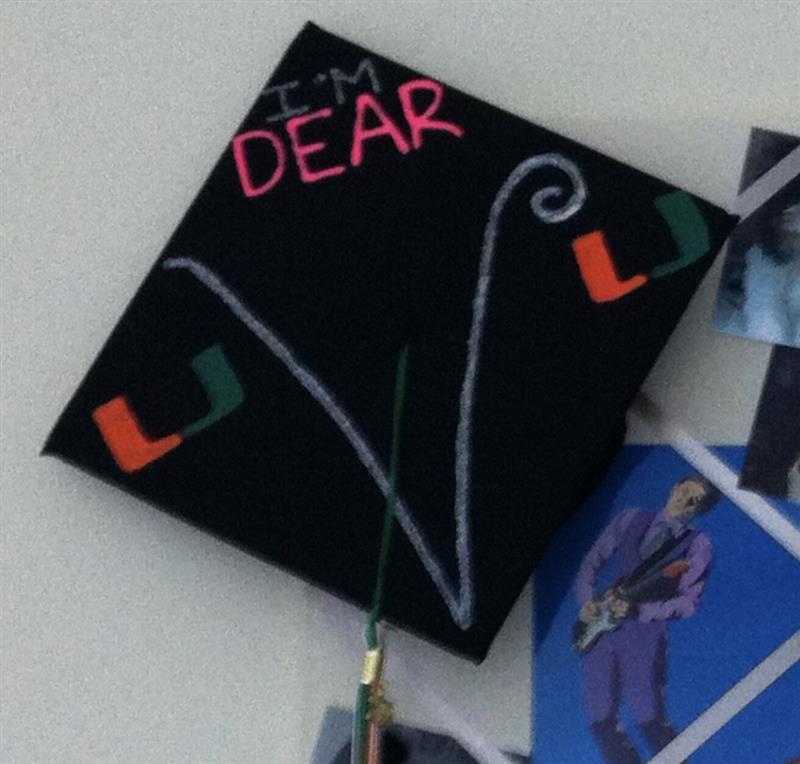
At graduation, she even wrote “I’m Dear V” on her cap and showed it to President Donna Shalala as she walked across the stage to accept her diploma.
The graduation cap Jaime Ostroff showed to President Donna Shalala as she walked across the graduation stage.
The current V, who remains anonymous, draws from both personal and past experiences to shape their version of V’s voice. They emphasize the column’s importance in giving students a platform to express their thoughts.
“My goal this year as V was to be fun, sassy and opinionated,” said the current V. “[V] is saying what everyone else is thinking or what the student body really wants to hear.”
Like past writers, the current V draws information from personal experience, friends’ relationships and readers’ submissions. They said anonymity plays a key role in the column’s success.
“[With] sensitive and controversial topics it’s important to protect the writer’s identity,” said V. “It makes things more fun to read a gossip column when you don’t know who’s writing it.”
Through anonymity, V creates a space where thoughts, questions, and opinions can be expressed without fear of judgement. V is a collective identity shaped by generations of writers and students, each bringing in their own experiences and perspectives.
As Ostroff captures, “V is you! You are V!” — a reminder that V is not just a columnist, but a reflection of the entire UM community.
UM alumni and comedian Gianmarco Soresi built a career on crowd work even though he hates talking to strangers. Now, he has more than 1 million strangers following him on Instagram and watching his viral sets.
The 37‑year‑old comedian, who graduated from the University of Miami in 2011 with a Bachelor of Fine Arts in musical theater, now tours internationally and performs for audiences from Hong Kong to Fort Lauderdale.
“I really thought I was going to be on Broadway. That was the whole dream,” he said.
Soresi didn’t arrive at UM planning to become a comedian. He came in convinced he would end up on Broadway, only to realize by senior year that his singing voice wasn’t going to carry him there.
He shifted toward acting, then toward writing, as he slowly realized the future he imagined might not be the one waiting for him.
By the time he graduated, he had become a quieter, more self‑doubting version of the freshman who once believed he’d be the next Daniel Day‑Lewis.
“I wasn’t confident. I wasn’t quick. I wasn’t the guy anyone thought would do comedy,” he said.
The instinct to listen closely, react instantly and squeeze meaning out of every detail eventually became the backbone of his crowd work.
Soresi credits several UM professors for pushing him in the right direction, especially those who taught him how to write.
“I kind of look at my stand‑up from a scriptwriting perspective, and that came from a great teacher named Bruce Miller,” Soresi said.
His playwriting and script analysis classes — including one taught by Miller, aka Professor Emeritus, a longtime UM professor of theatre arts known for directing, playwriting and teaching acting — shaped the way he builds jokes today.
Miller, now retired, said he “of course” remembers Soresi and was surprised that script‑analysis classes, not the two years of acting training he taught him, were what stuck with him most.
The class taught Soresi to break down structure and analyze why something works, a skill he still relies on every time he sits down to create new material.
His classmates also helped shape him, whether they challenged him, annoyed him or simply tolerated him.
Even the conservatory’s strangest exercises like lip‑sync drills, clowning sessions and the infamous “gun exercise” forced Soresi out of his comfort zone in ways he didn’t appreciate until much later.
However, Miller clarified that he was not the one who ran this “gun exercise” Soresi mentioned, and that it was another professor in the same program who was also named Bruce.
“That exercise consisted of holding the class hostage when one person brought out a realistic looking prop gun to intimidate the others,” Miller said, adding that he “did not approve of [it] and today [it] would have triggered much complaint and protest, and maybe worse.”
Soresi also joked that if UM ever wanted to hire him, he’d be “ready for that gig,” a line delivered with equal parts affection and disbelief.
Since graduating, his career has been shaped by constant travel. International tours have taken him to Asia, Europe and Australia, where he has learned how differently jokes land depending on the country.
Not every crowd‑work moment has been pleasant. His worst gig — a bachelor‑party performance for a man entering his second marriage — still haunts him.
“It was one of those shows where you’re like, ‘Oh, this is going to be bad,’ and then it’s even worse than you imagined,” Soresi said
The groom didn’t want him there, didn’t want jokes about his weight and didn’t want jokes about his life. Soresi spent 30 minutes performing for someone who clearly wanted him to disappear.
The experience now serves as his baseline for discomfort. Nothing on tour ever feels that bad by comparison.
His most wholesome moment came on the opposite end of the spectrum. During a show, he struck up a conversation with a furry in the audience. The interaction was so unexpectedly sweet that it eventually led to him headlining a furry festival.
“I thought it was a joke at first, but they were dead serious,” Soresi said.
Soresi still talks about it fondly, mostly because it proved that trust and tone can turn even the strangest situations into something meaningful.
“If you treat people with respect, even the weirdest moments can turn into something great,” Soresi said.
Through all of this, he remains clear about what he wants audiences to take away from his performances. Laughter comes first, but he also hopes people leave with a sense of skepticism and curiosity.
His comedy, he says, is rooted in the idea that “everyone’s full of sh—t,” including himself. Humor becomes a way to examine that truth without slipping into cynicism.
From a musical theater major who doubted his voice to a comedian who built a career on conversations he never wanted to have, Gianmarco Soresi’s path has been shaped by contradictions, risks and the unexpected benefits of his UM education.
His journey wasn’t the one he planned, but it became one defined by reinvention and a confidence built slowly, sometimes painfully and always with a sense of humor.
TikTok is essentially the new Google. With Gen Z’s love for the 15-second visuals, paired with the hyperspecific algorithms, TikTok’s search results are better than those of Google.
The shift from Google to TikTok is beneficial because it delivers more accessible, visual and user-driven information that better matches how younger generations consume content.
The internet’s growing reliance on AI has led to a decline in Google’s once-trusted reliability. Google recently changed its algorithm to have AI-generated results at the top of the page, instead of its previous method of showing an excerpt of the most relevant source.
The shift toward TikTok reflects a rebellion against this change — a preference for human-driven, experience-based content over AI-generated answers.
“I hate to admit it, but since I am on TikTok so constantly, I find out most of my news from there,” UM freshman Shannon Brickley said. “Whenever I want to know more, I will search it up and doomscroll.”
This is more popular among students than people think. In an interview with Fortune Magazine, Senior Vice President of Google Prabhakar Raghavan emphasized that TikTok is taking over in little ways, such as finding a place to go for lunch. According to their studies, 40% of young people go straight to TikTok or Instagram instead of a regular search engine like Google.
When looking for restaurants on Google, results are largely sponsored or have a massive number of reviews from being around for so long. As a result, these older places are bumped to the top of the search regardless of the quality of the food.
Even the UM student go-to coffee or matcha classic, Honey Veil, is being underserved on Google. While it doesn’t come up on the first page of any search engine for coffee shops around UM, it is one of the first coffee shops when searched on TikTok.
The difference isn’t just in the quality of the suggestion, but also the quality of the way information is communicated. TikToks are short-form videos, allowing for visuals, paired with information that takes little to no work to consume. Attention spans have been vastly shortened by the internet, so TikTok’s entertaining approach to information is more aligned with how information is naturally consumed now.
TikTok’s personable, young and entertaining approach is beginning to give Google competition for the best search bar. Google is not being erased, but as people evolve their habits and Google declines in its content. Its dominance is fading, leaving TikTok to be the future of search.
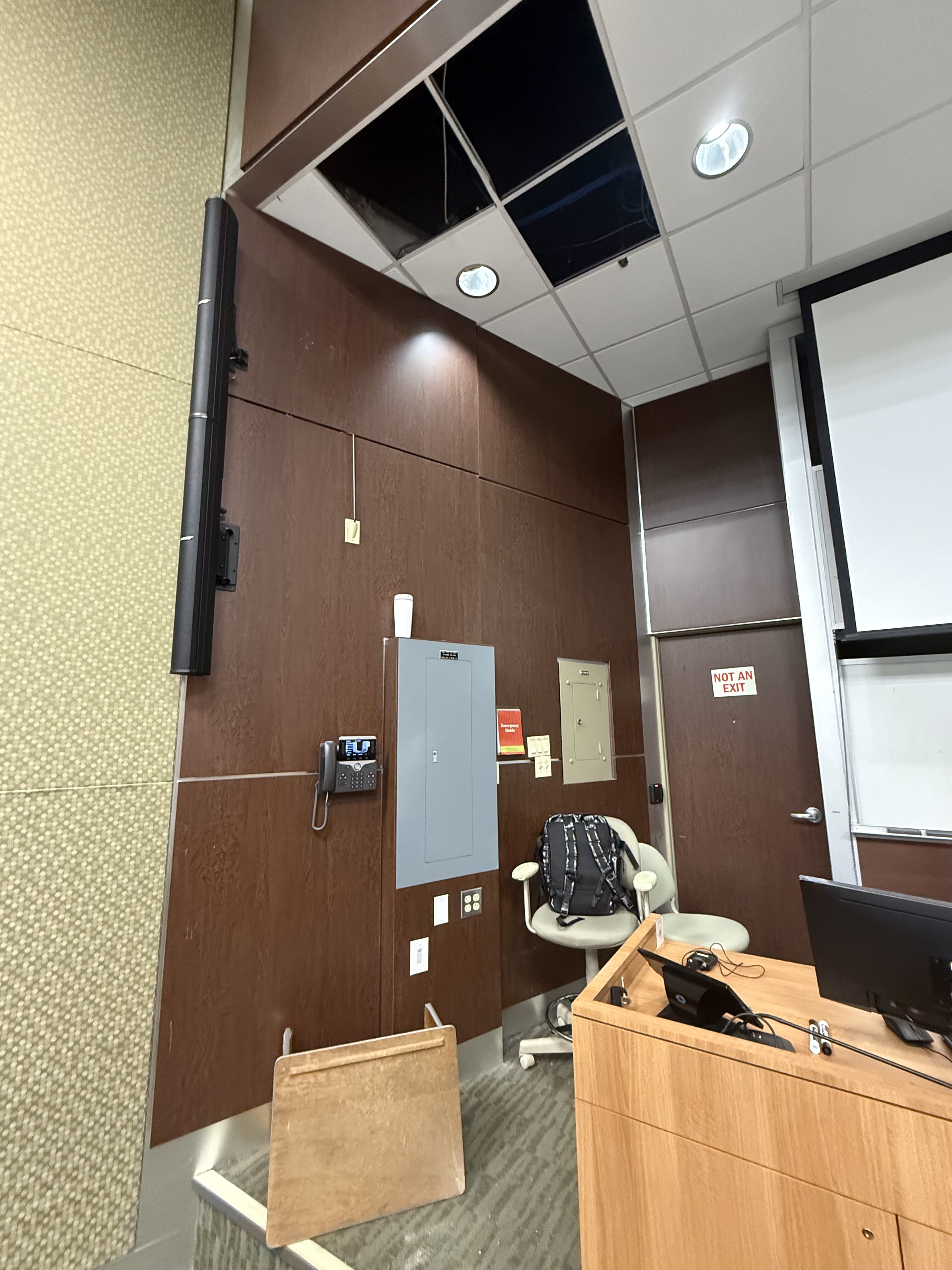
An opossum and its baby fell through the ceiling of Whitten LC 170 during a psychology class around 9 a.m. this morning.
A student who was in the classroom and wishes to remain unnamed said that students had been hearing “sounds of an animal running around in the ceiling” throughout the class.
“A UM facilities employee had been called to the room when the students had first complained about the noise, but [he got] there at 8:58. He did not want to distract the class, [so he] left until our class usually would be over,” she said. “However, the [o]possums fell around two minutes later.”
The opossums fell through the ceiling near the front of the classroom and landed next to the professor, Dr. Melissa Noya, while she was teaching her 8 a.m. PSY110 course.
Video of the opossum in the corner of Whitten LC 170 on the morning of Tuesday, March 31 after it fell through the ceiling. // Video via a student who wishes to remain unnamed.
The unnamed student said that she heard a “series of clanging” right before the opossums fell. Students gasped and some tried to climb onto the desks to avoid the opossums, but Dr. Noya instructed everyone to leave the room. As the student was leaving, she said the larger opossum appeared unconscious.
After a few minutes of standing outside, the student said that everyone returned to the classroom to get their belongings because the older opossum was “staring at everyone in the corner and seemed frightened, while its baby was walking around observing everyone.” She said that neither animal was hissing.
Prior to the opossums falling through the ceiling, the student said it appeared in good condition. Now, three panels are missing from the ceiling and there is debris on the floor.
The three panels and debris on the floor after opossums fell through the ceiling of Whitten LC 170 on the morning of Tuesday, March 31. // Photo credit: Katie Karlson.
“The safety of the campus community is our top priority. University Facilities and Operations staff responded immediately to the Whitten classroom and the two opossums were removed humanely,” said the University of Miami in a statement to The Hurricane. “The animals did not come in contact with those in the classroom and the room and ceiling were secured.”
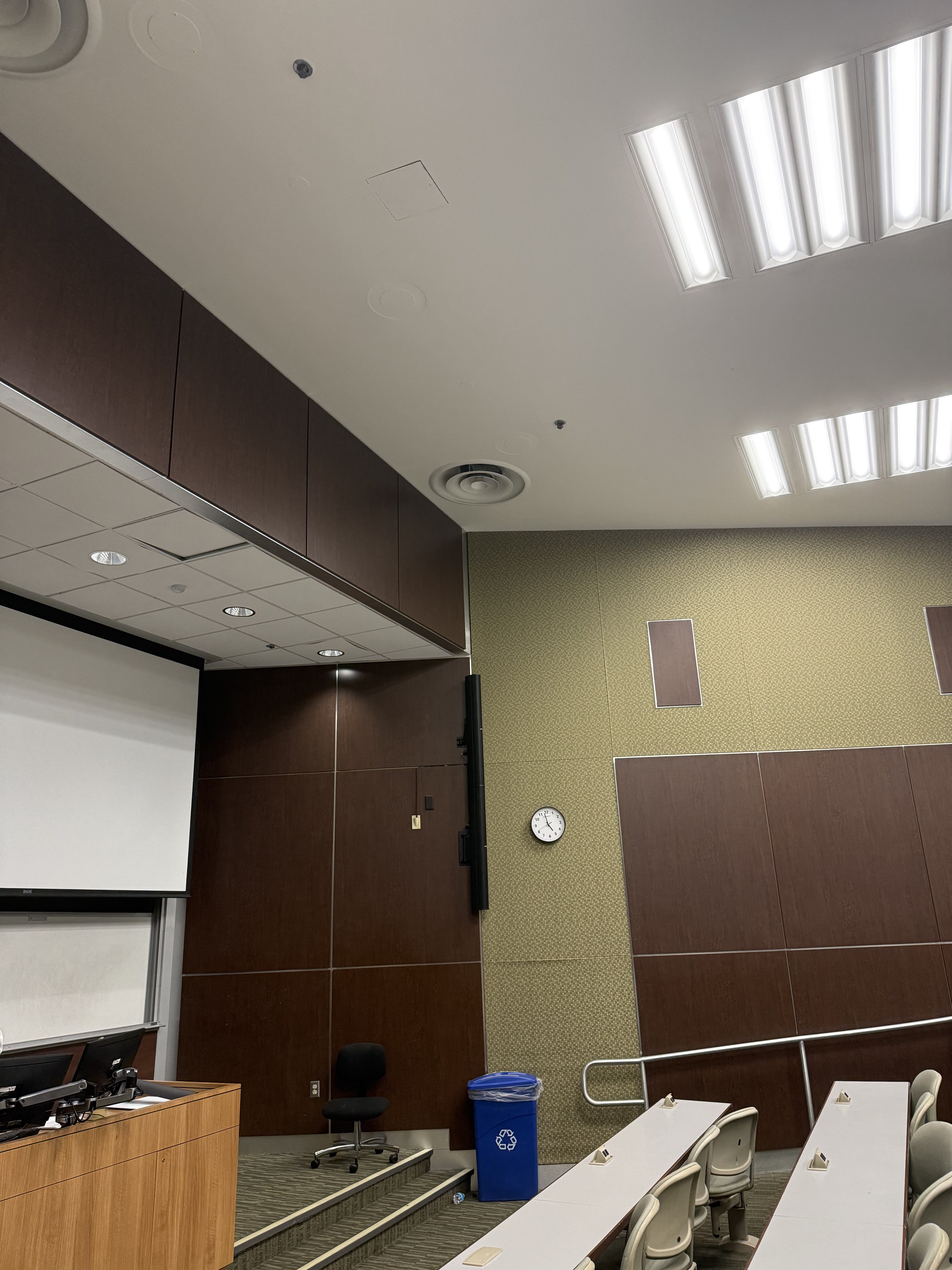
The ceiling in Whitten 170 is designed so that the back of the classroom has paneling, the middle is solid, and the front of the classroom near the professor has a paneled ceiling that is lower than the rest of the classroom. The student suspects that the opossums ran from the back of the classroom to the front and fell onto the panels that are lower, causing them to fall through.
The staggered heights of the ceiling near the front of the Whitten LC 170 classroom on Tuesday, March 31. // Photo credit: Katie Karlson.
“It made me wonder about the state of our infrastructure, especially when it comes to older buildings like Whitten LC,” said the unnamed student. “I had an exam later in the day in Whitten and I think I was more nervous about this [incident] repeating than the exam.”
Although the student originally identified the animals as “possums,” the University confirmed that the animals are actually opossums, marsupials with gray fur that are native to the Americas.
Opossums make their homes in roofs when they are forced out of their normal territory, usually during the mating season. Once they find a safe spot, they are notoriously hard to remove.
The Hurricane reached out to Dr. Noya for a comment and has not yet received a response.
The 98th Oscars dressed for a cultural moment — not just a ceremony.
Every year, the Academy Awards outfits become a mirror to cinema’s biggest night and culture itself. At the 98th Oscars, held on March 15, 2026, at the Dolby Theatre in Hollywood, that reflection had one clear mood: romanticism.
As The Zoe Report noted, “silks and satins, soft color hues, and ladylike accents like lace, delicate floral prints, and bows” had already taken hold of fashion heading into 2026. The Oscars red carpet followed suit.
Emma Stone, in custom Louis Vuitton by stylist Petra Flannery, wore a cascade of pearlescent beads — which, according to WWD, required over 600 hours of handwork to complete. A princess-cut top, cap sleeves and a plunging sexy back that turned the romantic silhouette on its head.
The color, cut, and hair: all of it was exact. The public agreed — her stylist loves her, and it shows.
Odessa A’zion, the Marty Supreme star, stated that she doesn’t have a stylist, she does her own hair and make up. And she still manages to be one of the most relevant looks on the carpet.
A crystal-encrusted couture robe over bootcut pants, a thin black tie, fringe at the hem. Chic, boho rock, completely her own.
Beca Michie arrived in a vintage 2005 Georges Chakra couture gown with embroidered lace, fluid silk skirt, trailing hem. She looked phenomenal.
But her presence sparked a conversation that had nothing to do with her dress. Her appearance on the carpet renewed debate about social media influencers getting access to Hollywood’s most exclusive spaces.
Turns out, there is a growing trend in democratizing Hollywood and fashion worlds, and mixing them both.
Laura Lufesi attracted anything but bad reviews — many comparing her to a pineapple. The culprit: a color palette that worked against her complexion rather than with it.
In a year when colorimeter was the secret weapon of the night’s best looks, getting it wrong was costly.
Renate Reinsve wore a strapless red Louis Vuitton gown with an exaggerated side slit. The construction was strong, but the overall effect was not.
Red already demands full attention, and the high slit reads as excess rather than intention based on public opinions. The absence of jewelry made it worse, stripping the look of the polish of a classic red dress.
Gweyneth Paltrow showed up in a custom ivory Armani Prive gown that was polished from the front and fully transparent from the side. She was sewn into it and said she felt hot.
Although mostly loved, reviews said that the dress was inappropriate and not flattering for her age.
A woman in her fifties declaring herself hot in pronounced dresses — as we saw with Kate Moss in Gucci — still provokes discomfort.
Michael B. Jordan, now a Best Actor winner for “Sinners”, arrived in a custom all-black Louis Vuitton suit with a Mandarin collar, silver waist chain, and a David Yurman diamond brooch — but this wasn’t accidental.
According to Essence, costume designer Ruth E. Carter confirmed that his character Stack’s watch chain was “custom-made by David Yurman using one of their vintage links.” Jordan wore the same jeweler on the carpet.
Timothee Chalament arrived in a white custom suit – clean, tailored, all-white from head to toe. The intention was clear: understated elegance with a modern edge
One has to wonder if the color was strategic — after weeks of online backlash over his comments about ballet and opera being irrelevant, white reads like a blank slate. Innocent, even.
Perhaps that is why romanticism resonates so deeply right now. Feathers, satin, and lace are not escapism — they are a response. When the political moment demands restraint and conformity, fashion reaches for softness, volume, and feeling.
Only RAYE could create a swing jazz song called “I Hate The Way I Look Today” that would make me get up and dance rather than focus on my appearance.
RAYE has graced our ears with her maximalistic sophomore album titled “THIS MUSIC MAY CONTAIN HOPE.”
This South London born singer and songwriter has persevered through many challenging years in the music industry to deliver a standout second album that makes me question why her old record label kept her such a hidden secret.
After being signed to Polydor records as a songwriter for more than five years, she left the label due to them believing she wasn’t “ready enough” to release an album.
“I was at a point where I had nothing left to lose.” RAYE said in an interview.. She broke free from the shackles of her label and was ready to be known for more than just a ghostwriter which led her to her first album and now her second.
It has been three years since her debut album “My 21st Century Blues”and two years since her record-breaking night at the BRIT awards, where she won six awards out of her seven nominations. Ever since her biggest fans have been wondering what was next?
“THIS MUSIC MAY CONTAIN HOPE”follows RAYE through her journey of romantic complications and the strain it took on her mental health.
It is a 73-minute body of work that feels like a movie in album form. She collaborates with composer Hans Zimmer on the 6th track of the album “Click-Clack Symphony”, which is a song about the sound heels make when they touch the floor.
It’s not every day you collaborate with a composer who you may know from his soundtracks in movies like, “Interstellar” and “The Lion King.” She also collaborated with the London Symphonic Orchestra to help bring her vision to life.
This lavish album is filled with beautifully executed orchestrations that are ineffable. She channels her inner Aretha Franklin with her tracks “Nightingale Lane” and “Skin and Bones” and goes back to her EDM roots with the uplifting song “Life Boat.”
I wish I could enter RAYE’s intricate and intense mind. Every aspect of this album feels unique bringing me emotions of hope and “Joy” as told in the 15th song in the album.
Her love for her family is expressed within multiple tracks like “Joy”, which features her two sisters Amma and Absolutely.
This album demands your full attention. It’s RAYE making a statement, she is here and she’s not going anywhere. “I just wanna be free” sings RAYE in the song “Fields”, featuring her grandad.
From soft ballads to neo-soul and gospel, “THIS MUSIC MAY CONTAIN HOPE”smoothly switches genres while making the listener feel as if they are experiencing these emotions with RAYE.
She charms the listeners with a strong and lengthy movement that makes me want more.
A strong contender for album of the year, RAYEhas proven that the music industry needs her.
At the start of this year, President Donald Trump and his administration used military action to remove Venezuelan dictator Nicolas Maduro from power.
Since then, Maduro’s ouster has had a major impact on another Latin American country dominated by communist dictators — Cuba. Since Maduro’s removal, the U.S. has seized control of much of the country’s oil production and has cut that line of profit off from the communist regime. As a result, the island has been plunged into economic turmoil and a blackout lasting 29 hours.
Despite the turmoil abroad, many Cubans — myself included — are hoping that this will have a domino effect and lead to the end of the regime. If the Trump administration were to take over Cuba, as negotiations between the two countries continue, the nation could become a territory.
This would allow for guaranteed rights for people on the island, but also allow for greater defense of the Western Hemisphere and add increased border stability.
Territory Cuba
Cuba was briefly under the watchful eye of the U.S. following the Spanish-American War. However, the island left this relationship in 1902 to become an independent republic, still with U.S. oversight, under the Platt Amendment — which would allow the U.S. to have the right to intervene in the island. They lost that right in 1934, when the two countries signed a Treaty of Relations, a legal agreement establishing a relationship between two nations.
Looking ahead to well over a century later, the totalitarian rule of Miguel Díaz-Canel and the Castros proves that the communist experiment failed its people. If Cuba were to have a territorial status like Guam and Puerto Rico, it could give the country a new life.
Establishing Cuba as a U.S. territory would grant Cubans on the island immediate rights under the U.S. constitution and likely mean citizenship for all. This means the release of all political prisoners, protections of free speech and multi-party, competitive elections — a reversal of more than 60 years of violation of basic human rights by the regime.
Defense of the Western Hemisphere
A cornerstone of the second Trump administration has been the defense of the Western Hemisphere. Following Maduro’s capture, President Donald Trump spoke heavily of what he refers to as the “Don-Roe” doctrine — his take on the famous Monroe Doctrine.
Like the Monroe Doctrine, which spoke of President James Monroe’s desire for the United States to have major influence in the Western Hemisphere, Trump has applied what he calls “Trump Corollary” to expand U.S. influence.
With rumors of China having immense influence in Cuba and the country having been designated a state sponsor of terrorism by the Biden and Trump administrations, putting this piece into the U.S.’s deck of cards would prevent undue influence by China, as they could pose a threat — especially with it being just 90 miles from Florida.
That close proximity could foster any kind of disaster including a migration crisis if the island does not become a territory.
“Any U.S. administration, Republican or Democrat, is not going to want to have an unstable situation, 90 miles from its shores,” Dr. Michael Bustamante, chair of Cuban studies UM said.
Border stability
The systemic economic mismanagement and political repression in Cuba has driven millions into exile from the island. In recent years, over a million people from Cuba arrived in the U.S. and the majority of them arrived here in South Florida. Some people have come through the Temporary Protected Status program for refugees and some have come illegally. This has created unprecedented waves of migration across the Florida straits and the U.S. southern border, straining coast guard resources and overwhelming immigration courts.
By stabilizing Cuba internally and injecting American capital, the U.S. would address a root cause of this crisis. Cubans would no longer need to risk their lives on makeshift rafts and dodging police if they have the opportunity to prosper safely at home.
Critics will say that this idea is radical and would be a violation of international law. While those concerns may be valid and rooted in the complex history of U.S. intervention in Latin America, which is marked by Cold War-era proxy wars and Washington backed coups from Guatemalato Chile. For over a century, the fear of “Yankee Imperialism” has defined the region’s relationship with the United States.
However, past missteps should not blind us to present emergencies, and state sovereignty should not be used as a permanent shield for a regime to starve and oppress its own people in the dark.
If the negotiations between Washington and Havana continue and if it yields a peaceful democratic transition, Cuban exiles who have waited over sixty years to see their homeland freed may get their wish. Becoming a U.S. territory might just be the hard reality that finally brings liberty to the island.
15-year-old Max Uribe has been in search of a stem cell donor since he was just six years old, and now he only has weeks left before his condition becomes cancerous.
The teen was diagnosed with a rare blood disease that, if left untreated, will turn into MDS, a type of blood cancer.
Family and friends of Uribe aim to bring a swab drive to the University in Miami to give Max a better chance at finding a match.
Anyone aged 18 to 35 can help save Uribe’s life through a simple cheek swab, a process that only takes about five minutes.
By registering on this website, potential donors will receive a free swab kit, which will then be mailed back and tested to see if there is a match.
“I can assure that there’s no cost to you, this is safe, and that this is secure and confidential,” Juan Uribe, Max’s father, said in a video he posted on TikTok.
Even with over 42 million donors on the registry, Max has failed to find a match. Patients are more likely to match with someone of similar ancestry and Max, being half-Columbian and part Italian, British and German, has found it difficult to find a donor.
Max is from the Miami area, and receiving swabs from individuals of Colombian origin is imperative because this will give Uribe the highest chance of finding a match.
“As a father, I want to do everything I can to make sure that his survival from this and the minimization of complications through the process is as great as possible,” said Juan in an article from ABC News.
UM’s campus is familiar with these types of swab events. Just last week, the University of Miami’s Alpha Epsilon Pi fraternity raised over $60,000 for the Gift of Life Marrow Registry, a nonprofit aiming to cure blood cancer through cell therapy.
Anyone who would like to request a swab kit can also do so through Max Uribe’s Gift of Life website here.