Why you should care about the layoffs at the Washington Post

0

“Democracy dies in darkness.” Under Jeff Bezos, one newsroom’s light is flickering. 

The Washington Post was acquired by Bezos in 2013 for roughly $250 million. Acclaimed for breaking news like the Watergate Scandal and publishing the Pentagon Papers, the paper is regarded as a pillar of accountability journalism. 

The Post’s recent “financially motivated” decision to lay off roughly one-third of its staff, including entire sections like the International desk — Lizzie Johnson was fired while on the ground, reporting on war in Ukraine — reflects a troubling shift away from journalism that undermines informed civic life.

Change at The Washington Post began with eliminating the editors’ chance to endorse presidential candidates before the 2024 election and moving away from left-leaning opinion pieces. That same year, Bezos sat in the front row of President Trump’s inauguration, alongside Mark Zuckerberg, Elon Musk and Former Prime Minister Boris Johnson. 

More recently, Amazon has acquired the rights to the Melania Trump documentary for $40 million, which was $28 million more than the next highest bidder. Multiple anonymous sources from the company’s entertainment division see this as a bribe. 

The Washington Post’s leadership has framed the layoffs as a necessary business decision, but journalism should not be framed as an optimizable product when it exists to serve the public.

Thirteen years ago, Bezos pledged that he would not view The Post as a source of income. He framed himself as a protector of the institution. This raises an important question: who is responsible for preserving the information systems democracy relies on? Journalists and press advocates warn that treating news purely as a business risks hollowing out its democratic purpose. 

Freedom of the press is an enumerated right, and the free circulation of publications like the Federalist and Anti-federalist papers catalysed the ratification of the U.S. constitution, after circulars and pamphlets rallied the colonies behind the Articles of Confederation.

Much like these historic documents, The Washington Post is a national agenda-setter whose reporting shapes political discourse across the country. When an institution of this scale contracts, the effects ripple outward. This signals to smaller outlets that deep, resource-intensive reporting is increasingly unsustainable. 

This moment reflects a broader crisis in democratic information. More than 50 million Americans live in “news deserts,” or areas with one or less local news sources. Research shows that when news coverage declines, civic participation declines with it. These deserts are disproportionately in rural and low-income areas, creating information gaps and a class divide in the ability to engage with our democracy, starting at the local and municipal levels.

At the annual dinner for reporters covering Congress, former Democratic Speaker of the House Nancy Pelosi spoke out against the layoffs, which she believes infringe on the people’s first amendment rights. 

“A free press cannot fulfill its mission if it is starved of the resources it needs to survive,” Pelosi said. “When newsrooms are weakened, our republic is weakened with them.” 

Choking these institutions financially serves the same purpose as censorship.

So, why does this really matter? As newsroom layoffs accelerate the growth of news deserts, civic participation increasingly becomes a privilege of those with access to quality information, deepening class and geographic divides in democratic engagement. Communities become less informed, civic participation declines, polarization increases and fewer people vote, organize or hold leaders accountable.

Supporting journalism through subscriptions, public pressure and policy conversations is not charity, but a civic act. Use your student accounts and read the local news for your town.

The Washington Post layoffs force readers to confront a difficult truth: Democracy cannot function without strong institutions dedicated to informing the public. 

An engaged and truly representative democracy depends on more than access to information, it depends on institutions capable of producing it.

Student government candidates campaign on the unattainable

0

Student government election season has arrived, and with it a wave of ambitious promises. Candidates are vowing to improve pre-professional advising, expand campus food options and increase security measures, among dozens of other proposals.

These are not small promises. They require funding, administrative approval and coordination with departments that operate independently of student government. The problem is not the ambition behind these proposals, it is the absence of any honest accounting of what student government can realistically deliver.

Yet campaign messaging rarely explains the mechanics.

Instead, initiatives are presented as outcomes rather than advocacy goals. While student government can lobby administrators, allocate portions of student fees and bring attention to student concerns, it cannot independently open national food chains, alter curriculum requirements, extend library hours without administrative approval or install new physical infrastructure – especially off campus.

To better understand how realistic these promises may be, The Hurricane contacted the current executive board of student government. They declined to comment on the feasibility of the current candidates’ proposals.

That leaves students to evaluate campaign platforms without insight into the likelihood of their execution.

Holding candidates to a higher standard is not a rejection of their ambition. It is a recognition of it. Many proposals reflect genuine student concerns, and some build on past accomplishments: further expansion of the campus ride share map and new shuttle stop covers, for instance, are cited as a foundation for this cycle’s larger proposals. But vision alone is not enough. Clarity about how these goals would actually be achieved and what obstacles stand in the way is missing. 

If a candidate proposes expanding food vendors, what existing contracts are in place? If they promise technology upgrades, where would that funding come from? If they guarantee faster reimbursements or clearer budgeting timelines, what structural changes are required?

These questions are not cynical. They are practical.

Student government functions within institutional constraints. Understanding those constraints does not weaken leadership, it strengthens credibility.

The most responsible campaigns are not those with the longest initiative list. They are the ones that distinguish between what they can execute directly, what requires partnership, and what demands long-term advocacy. 

Ambition draws attention. Transparency builds trust. As voters, we should expect both.

Major development postpones opening statements in former Miami Hurricane Byran Pata’s murder trial

Opening statements in the murder trial involving former University of Miami football player Rashaun Jones were scheduled to begin Tuesday morning but were postponed after defense attorneys revealed new information they say could reshape the case.

Jones, now 40, is accused of killing his former teammate Bryan Pata, a defensive lineman for the Miami Hurricanes in November of 2006.

According to defense attorney Christian Maroni, new information that the defense received late on Friday, Feb. 13 includes a Homeland Security Investigation document in which a confidential informant identified a man named Wilner Yacinth as being involved in Pata’s killing. The defense also claims that police did not thoroughly investigate an alleged confession from Yacinth. 

The confession includes the language, “‘I just killed that kid from the University of Miami,’” Maroni said. “So now we have a specific statement linking that confession to the murder of Bryan Pata.”

Maroni also argued that investigators did not fully look into gang involvement and other possible suspects, saying police reports show detectives did not interview individuals allegedly connected to a gang.

Judge Cristina Miranda delayed the start of the trial, saying the court must resolve outstanding questions before opening statements are presented to a jury.

“I do think we want answers to these types of things to be able to put some puzzle pieces together for the ethical obligation that we all have,” Miranda said.

Prosecutors acknowledged receiving the same materials but argued the defense is attempting to introduce unsubstantiated hearsay, characterizing the information is inadmissible.

State attorney Cristina Diamond argued that the court has no supporting records or witnesses who can verify the information referenced in the reports.

Miranda did not immediately rule on whether jurors will be allowed to hear about the alleged confession or the HSI report, noting that similar references to alleged confessions had previously been excluded over validity concerns. After a long hearing Tuesday, the judge gave both sides until Wednesday morning to provide any additional information before making a final determination.

This delay to opening statements came as nearly 17 of Pata’s family members arrived at the courthouse expecting opening statements to begin. Among them was Pata’s mother, Jeanette, who is now wheelchair-bound but attended court.

The opening statements and trial are expected to move forward Wednesday morning, once the court resolves the issues surrounding the newly presented information. 

This article was originally published on Tuesday, Feb. 17 at 8:51 p.m. and was updated on Wednesday, Feb. 18 at 12:35 a.m.

Margo O’Meara captures ACC title as Miami stacks three more medals

The Hurricanes handled business Monday at the ACC Swim & Dive Championships, stacking three more medals at the McAuley Aquatic Center and continuing what has been a dominant showing on the boards.

A day after trading places on the podium in the 3-meter, Margo O’Meara and Chiara Pellacani flipped the script again in the Women’s 1-meter final. In her first season at Miami, O’Meara captured ACC gold with a winning score of 333.45, edging Pellacani by less than two points.

O’Meara’s most electric moment came on her reverse 1½ somersault in pike, which earned 58.80 points. She never dipped below 53 points across six finals dives — the consistency that ultimately secured her the conference title.

Pellacani, this year’s ACC champion on the 3-meter, added another medal to her growing collection with a 332.20 silver-medal finish. Her reverse 1½ somersault with 1½ twists scored 58.50, keeping the duel razor-thin until the final round.

Veteran Emma Gullstrand just missed the podium, placing fourth with 298.15, finishing behind North Carolina’s Sofia Knight (300.25).

On the men’s side, freshman Matteo Santoro continued his breakout championship debut. After earning bronze on the 1-meter Sunday, Santoro claimed silver on the 3-meter with a score of 422.80, finishing behind Georgia Tech’s Max Fowler (459.75). His reverse 3½ somersault tuck scored an impressive 84 points, while his opening forward 2½ with two twists from pike earned 81.60. Although he’s only a freshman, Santoro brings a wealth of experience to the springboard, including winning gold under the Italian banner at the World Aquatics Championship last summer.

Jake Passmore also qualified for finals and finished fourth (373.15), capping another medal-heavy day for Miami.

With six divers feeding off each other’s strengths, the Hurricanes have left much of the conference in the deep end.

Tuesday marks the final day of diving competition — and riding this momentum, Miami looks poised to somersault straight back onto the podium.

RSMAS shuttle driver arrested for DUI while operating shuttle

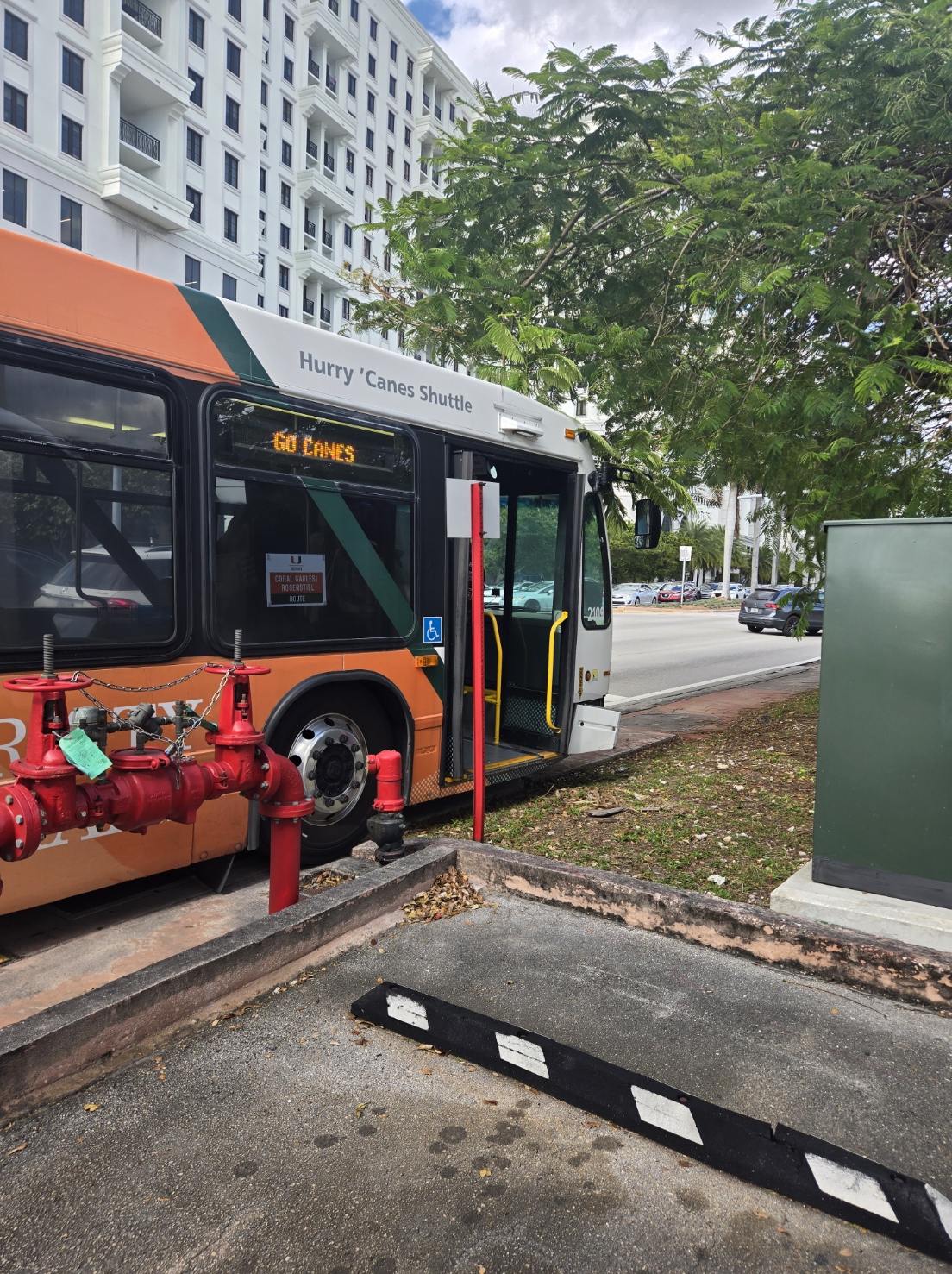
A shuttle driver for Rosenstiel School of Marine, Atmospheric and Earth Science was arrested for driving the UM shuttle with about 15 students on board while allegedly under the influence on Monday, Feb. 16, at approximately 3:27 p.m.

Timothy Kowalewski, the shuttle driver, is facing one charge driving under the influence, two charges of DUI with damage to property or person — one for hitting a tree and one for damage to the vehicle — and one charge of refusal to submit a breath test after license suspension. 

Maya Dejean, a freshman majoring in marine biology and ecology, takes the shuttle to Virginia Key, driven by Kowalewski, every Monday. Dejean said that Kowalewski is normally very punctual, but he was late picking up the students from the Coral Gables campus and picking them back up from the Key, which was the first indication that something was wrong.

“Once he picked us up to drop us back off at the main campus, his driving was very erratic. It wasn’t, you know, it just wasn’t safe,” Dejean said. “I would say he was swerving a lot. He ended up making a U-turn in the middle of [South Dixie Highway], stopping traffic on both sides of the highway, crashing into trees, poles, just very much risking the lives of all of us and everyone around us.”

After Kowalewski made the U-turn, students on the shuttle began asking if he was all right and in the right state to drive. The students talked to him and encouraged him to pull over near the Trader Joe’s on South Dixie Hwy., engaging in a back-and-forth with the driver about putting the shuttle into park. 

“He was trying to first say that he was okay to drive, and at the same time he was driving into the sidewalk,” Dejean said. “So, we kind of just forced him to hit the break and stop. For a good amount of time, he didn’t really put the vehicle in park. He just had his foot on the break.”

Video of the students on the shuttle asking Timothy Kowalewski if he is alright on Monday, Feb. 16. // Video via Maya Dejean.

Dejean also said that the back window of the shuttle was cracked for the ride back to the Coral Gables campus but that it had not been cracked on the trip to Virginia Key. During the drive, the glass from the shattered window blew into the shuttle.  

Students on the shuttle called UMPD and were referred to 911, since the area where the shuttle was stopped was outside of UMPD’s range. Dejean said that police arrived within about 10 minutes and took Kowalewski in an ambulance. 

Coral Gables Police Officer Pena was the first to arrive on the scene and described the defendant as “sweating profusely.” Another officer noted the smell of alcohol on his breath and that he was slurring his words. 

According to the police report, an officer asked the driver if he had had anything to drink, to which he answered “yes.” When asked when his last drink was, he answered, “This morning, since the store opened.” 

Kowalewski declined to participate in any field sobriety exercises and refused to provide a breath sample. 

The RSMAS shuttle parked partially on the sidewalk after students asked the driver to pull over due to his erratic driving on Monday, Feb. 16. // Photo via Sebastian Bernhard.

UM sent another shuttle to retrieve the students and bring them back to the Coral Gables campus. Dejean said that about half of the students had already called their friends or Ubers to take them back, and the other half were “scared and hesitant” to get back on a shuttle. 

“The incident involving a University of Miami campus shuttle is under further investigation by the Coral Gables Police Department. The safety of our students, faculty and staff members, and the greater University community remains our top priority,” the University said in a statement to The Hurricane.

Dejean said that she feels UM dismissed the severity of the situation. She said that nobody from UM was there to talk to the students when they arrived back on campus and they didn’t receive any communication from the University. 

“It felt very dismissed by the school,” she said. “Like, we get alerts on our phone if there’s a car crash or police chase, sometimes not even involving students, and this was very University of Miami involved, like directly involved, and it just felt really pushed to the side.”

The students on the shuttle have been trying to schedule a meeting with the dean of student life since the incident. 


The article was updated at 3:06 p.m. on Tuesday, Feb. 17, to include the statement from the University.

Take your headphones off

0

Your matcha order was made wrong, you’re running late to your nine am and suddenly your headphones die. It’s the recipe for the worst day ever. But it is actually a blessing in disguise. 

This happens to me more often than I’d like to admit but taking my headphones off didn’t ruin my day. It helped me be more balanced, appreciate my surroundings and be present where my feet are.

The typical school day is all accompanied by artificial noise. I’ve grown accustomed to constantly consuming media through podcasts, music and audiobooks. It is honestly exhausting. I rarely make time to look around in silence and take everything in.

Generation Z agrees with this, back in 2023 silent walking became a trend. Essentially you walk with no music or podcasts, only the noise of your surroundings. A trend that has become a habit many people practice purposely. 

Intentionally leaving your headphones in your dorm or not taking the earbuds out of your bag has two major mental health benefits. The silence helps your brain grow by creating new brain cells as your brain needs to be exposed to new auditory environments. 

Leading to you finding yourself around nature more often. Going on a silent walk encourages you to explore places in nature, research published in 2019 in Current Directions in Psychological Science found people who spend more time in nature rather than urban cities have more improvements in cognitive function.

Despite the trends benefits, it has been mocked on social media by older generations claiming it has been done for generations and it is nothing revolutionary. “The ignorance they think they came up with the idea themselves.” 

And it’s true, it’s not new but it’s what some people need. It is a solution to problems of anxiety and tech dependency. Not a concept but a challenge towards self improvement. 

Walking back to your dorm after a long day listening to nature as you walk through the beautiful UM campus helps your mind wind down, catch a breath. 

Hearing the water pouring from the fountain, students having conversations, and my own footsteps. Taking a step back and being where your feet are at that very moment. A step closer to living in the present and observing.

Removing a piece of technology and taking time to breath, think thoughts, and reflect on your day. When it’s late at night this helps improve your quality of sleep by minimizing distractions and focusing on calming your body down. Allowing your body to fully rest in a quiet dark environment. 

This doesn’t mean throw out your headphones or never buy them again. They do hold a lot of benefits that I use all of the time. If you need personal space or want to disassociate after a bad day you can pop them in. And a walk with your favorite podcast or playlist can help improve your mood

Just take them off every now and then. Take advantage of the social interactions on campus, take a walk and hear the birds, and remember you can give your brain a break. It’s about balance.

Are the Grammys Losing Their Groove?

0

Since 1958, the Grammy Awards stood as the pinnacle of musical achievement — an annual event that brought artists, fans,, and industry professionals together in celebration of creativity, craft, and cultural impact. However, in recent years, the Grammys have struggled to stay relevant in the constantly changing entertainment landscape. 

“I just don’t really feel the need to watch the Grammys anymore,” UM freshman Tallulah Steager shared. “I can just look up who won on Google.” 

The 68th Annual Grammy Awards, broadcast live on CBS on February 1, 2026, attracted about 14.4 million viewers, a 6.4% drop from the 2025 live showing. This marks the second straight year of declining television audiences for the Grammys. 

For television networks and advertisers, the most alarming trend has been the Grammy’s collapse in key demographics. In 2026, viewership among adults aged 18-49 fell by nearly 19%. This erosion among young audiences reveals a widening generational disconnect from not only live television but music culture. 

“I do think that the Grammy’s are important to like the music industry,” said UM freshman Elisa Bonaparte-Wyse. “They are just not as they once were in the early 2000s.”  

Award shows are memorable but not always for the right reasons. From Will Smith slapping Chris Rock onstage at the Oscars or Kanye West interrupting Taylor Swift’s speech at the VMAs, there have been numerous mishaps—and the 2026 showing of the Grammys are just another addition to this list. 

 “There were many technical issues that I picked up on throughout the show,” said Bonaparte-Wyse while referencing a clip on her phone. 

One moment that illustrated the several production challenges occurred during Best New Artist nominee Alex Warren’s highly anticipated performance of his Hit 100 song, “Ordinary.” Midway through his debut televised set, Warren encountered a technical malfunction with his earpiece, causing him to fall out of sync with the back track and struggle to hear himself onstage.  

This wasn’t the only mishap that happened during the 2026 Grammys. While presenting Record of the Year, legendary performer Cher, briefly misread the winner’s name after accepting her Lifetime Achievement Award. This mishap was attributed to teleprompter issues that left her slightly frazzled onstage. 

These technical and behind the scenes mishaps—visible to millions watching live—amplified a sense of chaos and disorganization that undermines the ceremony’s prestige.  

“I guess today with all the new technology and AI and such, we pick up on these technical mistakes so much more,” claims Staeger. “But again, maybe that is just me.” 

Another layer of complication for the 2026 Grammys was the political messaging woven throughout the night. Winners like Bad Bunny, Billie Eilish, and Oliva Dean seized their moments onstage to address immigration issues, with Eilish’s uncensored remarks again U.S. Immigration and Customs Enforcement generating significant online buzz. 

 While many people online praised the artists for speaking out, others saw the focus on politics as alienating. 

 “I just wanted to watch the award show, not start up a whole political statement,” claimed an anonymous source. 

 Additionally, during the 2026 telecast, there was a reduced number of awards presented during primetime, with many categories shifted to non-televised segments. 

 “I mainly watch the Grammys to see which artists win,” claimed Bonaparte-Wyse. “Like I don’t really care as much for the live performances.” 

 I would argue that this diminished the recognition of genre diversity and contributed to perceptions that the Grammy’s prioritize spectacle over celebration and achievement of artists’ work. 

 “It’s sad that the Grammys has turned into a clown show,” wrote an anonymous user on a Facebook post 

 The 2026 Grammy Awards were the last under the ceremony’s decades-long contract with CBS. Starting in 2027, the show will transition to ABC and streaming platforms like Hulu and Disney+. This seems to be a smart strategic move—that the future of music celebration must meet audiences where they already are, streaming platforms rather than live TV channels. 

 “Switching to streaming platforms will either break or save the Grammys,” claimed Steager. 

 Whether this evolution restores the Grammys’ cultural prominence or not, one thing is clear: in an era of fractured attention, digital engagement, and diverse musical expression, the Grammy Awards must continually adapt. 

Takeaways from Opening Weekend: Hurricanes baseball starts the season in historic fashion

0

It was a party all weekend long at Mark Light Field during the first three games of the season.

From the explosive pop off the Hurricanes bats, to web-gems from multiple players, and the record-setting Sunday performance, there is a lot to look forward to with this baseball team. 

Here is what we learned from the first three games of the season:

This lineup is loaded

It did not matter who stepped in the batter’s box for the Miami Hurricanes, because one thing is clear — this team can hit the ball. 

The team set an opening weekend record with a program-high 57 runs across the three games, which included a 27-3 demolition of Lehigh during the getaway game on Sunday. 

49 hits through three games is an unbelievable number., with a big help in achieving both tallies being Derek Williams and Alex Sosa who hit back-to-back homers twice on Saturday night. 

Williams led the series with eight hits while Sosa had six hits and three home runs despite a quiet Sunday at the plate. 

But the damage wasn’t limited to the middle of the order. After a slow start to the weekend, Jake Ogden, Max Galvin and Daniel Cuvet broke out in Sunday’s finale, giving the top of the lineup its punch.

And it wasn’t just the veterans setting the tone.

Freshman catcher Alonzo Alvarez made his first career start Sunday and delivered, going 2-for-3 with three RBIs. Miami-Dade transfer Cian Copeland followed suit, finishing 3-for-4 in the finale and 5-for-7 across the series.

The difference from last season is noticeable. Rather than leaning on a top-heavy core, this year’s roster features production throughout the order and even off the bench.

If opening weekend was any indication, Miami’s offense won’t be slowing down anytime soon.

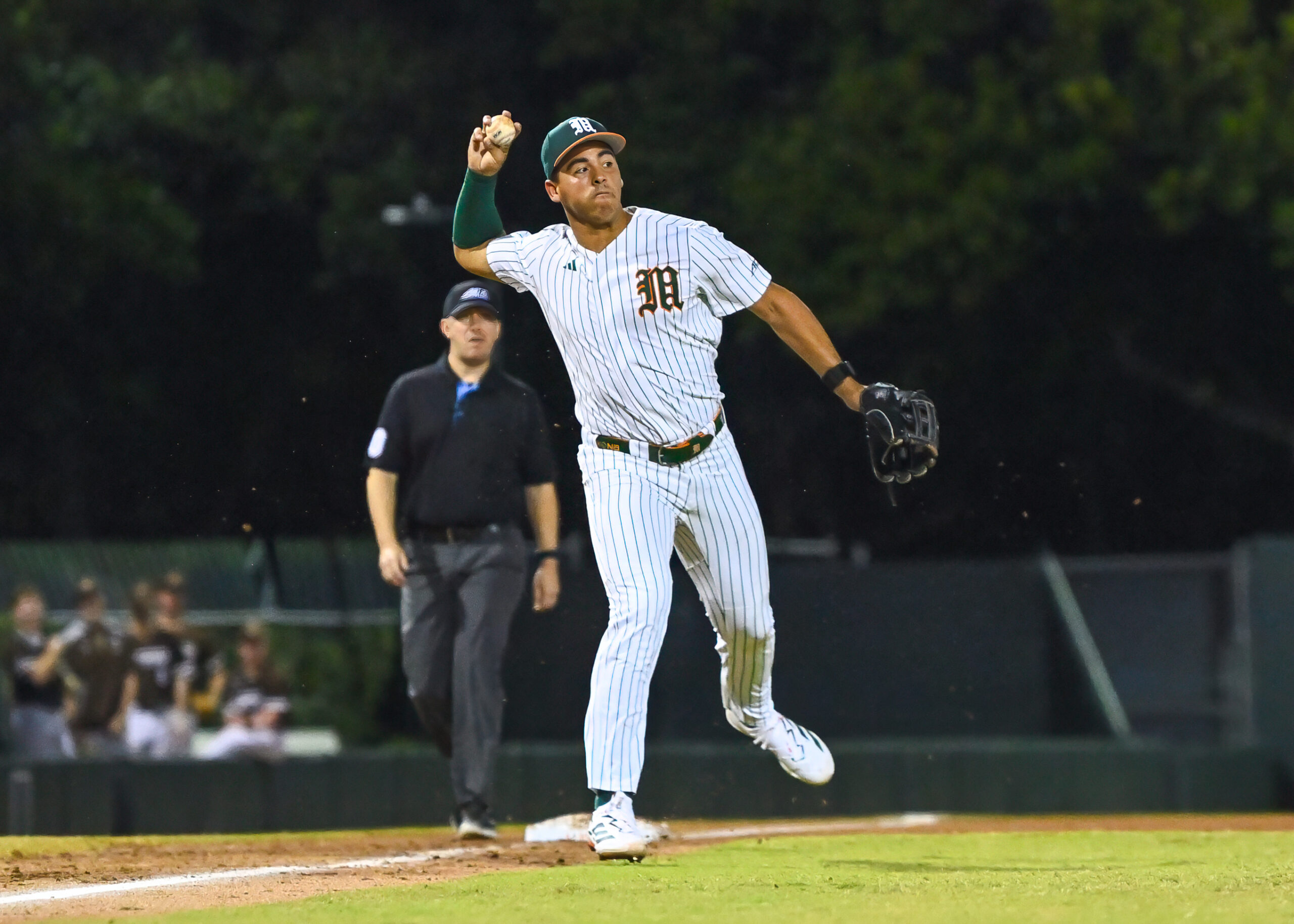
David Lebowitz, Photo Editor/ Junior Third Baseman Daniel Cuvet winds up to throw to first on Friday, February 13, 2026.

Golden Gloves

The fondest Mikey Torres memory from his freshman campaign was his unbelievable home run robbery against Virginia on the road. 

Flash forward to this past Saturday, Torres shined in the outfield making a highlight reel diving grab in left center field.

On Sunday, a Lehigh batter hit a ball sharply to the right side of the infield and second baseman Jake Ogden dove all the way to his left to take away a base hit.

And it wasn’t just the veterans in the field, freshmen such as Gabriel Milano and two-way player Dylan Dubovik made some nice plays as well. 

At the end of the day taking away hits stop runs and when you have guys that can flash the leather it can save a tight ballgame.

How will the pitching hold up?

Friday starter AJ Ciscar and Sunday starter Tate DeRias both dazzled in their sophomore debuts. 

DeRias struck out a single-game program record nine batters over 4.2 innings. The relief pitching on those days were also solid but Saturday was a different story.

Sophomore Lazaro Collera made his first collegiate start, going 3.2 innings, giving up seven hits and five runs. Lehigh went on to have 13 hits on 11 runs, as freshman Jack Durso gave up five of those runs in the final two frames of the contest.

The pitching will be a big factor heading into a six game stretch this week with a doubleheader slated for Saturday against Lafayette. It will be a good test to see how deep the Hurricanes bullpen is before their marquee matchup against a top-15 Florida side the following weekend. 

Miami looks to continue its winning ways at Mark Light Field as they get set to face UCF on Tuesday at 6 p.m.

Rashaun Jones’s trial begins decades after teammate Bryan Pata’s murder

Former University of Miami football player Rashaun Jones is set to appear in court on Tuesday, Feb. 17, for the decades-old murder of his former teammate Bryan Pata. 

Pata, a 22-year-old Hurricanes defensive lineman and Miami Central High School alumni, was expected to be a top NFL draft pick. But, on Nov. 7, 2006, Pata was shot in the back of the head outside his home at the Colony Apartments in Kendall after football practice. 

Pata was pronounced dead at 7:07 p.m. and was buried in the beige suit he had picked out for his draft party.

Fifteen years after Pata’s death, Jones was arrested on a second-degree murder charge. The arrest followed an ESPN investigation that linked Jones to the murder. 

Pretrial hearings began earlier this month on Feb. 2 with jury selection on Feb. 9. During the first pretrial hearing, Circuit Court Judge Cristina Miranda encouraged Jones to accept a 15-year plea deal that included the time he had already served. Jones declined to take the plea deal, maintaining his innocence.

“Deep down in my heart, I know I’m innocent,” ​​Jones said. “Dismissal would be the only thing I am willing to accept.”

During pretrial hearings, Jones’ defense attorneys also argued that the state failed to provide certain case documents that had previously been released to ESPN. Among the documents was a 2007 polygraph report in which inmate Bernard Brinson claimed another prisoner admitted to be the hitman hired to kill Pata.

However, after the prosecutors located the report, Judge Miranda barred the defense from using it as evidence since polygraphs are inadmissible in court.

If convicted of murder, Jones faces a potential life sentence. 

Police records indicate that Jones and Pata had frequent conflicts, including a dispute over a woman who had previously been involved with Jones before later dating and living with Pata. Along with verbal altercations and a locker room fistfight, Pata’s brother also reported that Jones had threatened to shoot Pata.

With no security cameras capturing the killing or forensic evidence linking Jones to the crime, the case relies on circumstantial evidence. 

On the night of the murder, Jones was the only player absent from a mandatory football meeting. He had been suspended after a third failed drug test but was still expected to attend. Jones said he stayed home that night but cellphone records placed him near the murder scene of the Colony Apartments during the shooting. Neighbors also reported hearing loud arguing followed by gun shots. 

Key witness Paul Conner, a former UM professor and Colony Apartments resident, claimed he saw Jones fleeing the scene of the murder. Connor identified Jones in police photo lineups in both 2006 and 2022. In the summer of 2025, prosecutors had mistakenly claimed that Conner was deceased after he did not answer the door for a welfare check, but ESPN reporters found him alive on Sept. 18, 2025. 

Judge Miranda found Conner, now 81 years old, mentally unfit to testify at trial, but she will allow the prosecutors to play his recorded testimony. 

With jury selection and pretrial hearings complete, the trial is scheduled to continue for the next two weeks. The first hearing is set for Tuesday morning at 9:30 a.m. at the Richard E. Gerstein Justice Building. 

Canes torch Lehigh 27-3, opens the season with a sweep

By looking at the score of game three of the opening series between Miami and Lehigh, one might be confused as to why a college football game is being played in February.

However, it was the Canes baseball team, who demolished the Lehigh Mountain Hawks handedly 27-3.

The majority of the onslaught came in the fifth inning, where Miami tallied a school-record 15 runs courtesy of eleven hits, three walks, two players hit by pitches across three different Lehigh pitchers.

13 different Canes hitters reached base during the inning, symbolic of the dominant force UM posed all afternoon.

On the bump for his inaugural start of the season was Tate DeRias, a sophomore righty who pitched 43 2/3 innings last season. He ended the game with a career-best nine strikeouts, allowing three and was also awarded with the win.

The first inning was quiet before the storm.

DeRias struck out the first two, before a walk and a fly-out to right was matched by a quiet bottom half of the inning for Miami.

After another strong half inning from DeRias, Miami started to put players on base. 

Right fielder Derek Williams blasted a double, skimming the left field foul line to put a man on second. First baseman Cian Copeland then lined a single under the first baseman, Trystan Crawford’s diving glove to bring Williams home. 

After an Alonzo Alvarez walk, nine-hole hitter Michael Torres brought two more home, and later recorded a run from a Max Galvin sac-fly, to give the Canes a 4-0 lead.

In the top of the third, third-baseman Raffaele Rogers got the Mountain Hawks on the board as he crushed a two-run shot to left field. Derias rebounded, striking out two to wrap up the inning, holding a 4-2 lead. DeRias then went 1-2-3 in the top of the fourth, striking out the side.

The Canes recorded four hits in the second half of the frame. Ogden started with a double into the left-center gap, followed by a Galvin double which drove in a run. Daniel Cuvet then got his season going by smoking a two-run homer onto the soccer field, his first of the year. After Sosa was hit by a pitch in the head, Williams lined a double down the third-base line, bringing him in, extending the lead to 8-2.

The top of the fifth was the last inning the Mountain Hawks put anything on the board. After Rogers was walked, Designated Hitter Aidan Quinn drilled a double off the right field wall to drive in a run. 

This marked the end of DeRias’s night, but by the time he came back into the dugout after receiving post throwing treatment, Miami was still up at the plate — in the middle of the aforementioned 15 run outburst to boast a 23-2 lead.

For Miami, sophomore lefty Michael Fernandez was brought in relief for the top of the sixth. He walked down the Mountain Hawks 1-2-3 via two strikeouts, and a ground out. 

In the bottom of the inning, freshman and Miami native Gabriel Milano demolished a fastball over the left field fence for his first hit/homer as a Cane. The three-run homer was paired with a Donovan Jeffrey RBI single to extend the lead to 27-3.

Alabama transfer Packy Bradley-Cooney closed the game out against four batters, finishing the game off with a strike-out swinging. The game ended after the top of the seventh through the mercy rule as the Canes led by 10 or more during the seventh. 

Miami will return to the diamond six times over the next week, starting on Tuesday, Feb. 17 at 6:00 p.m. EST in a one-off game against UCF at the Light.