


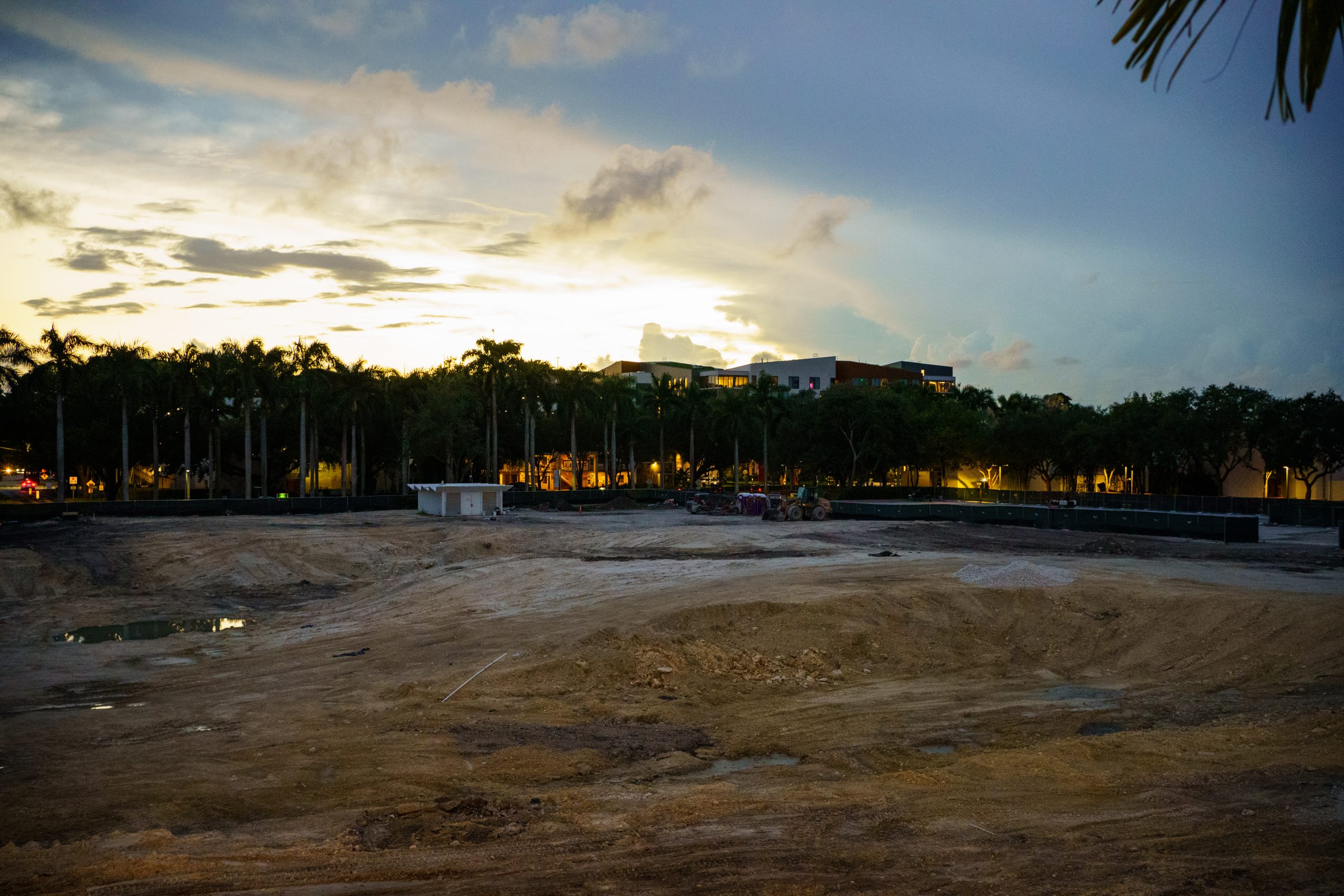
As construction continues at the former Mahoney-Pearson Residential College site, with University of Miami students adjusting to altered walking routes, traffic disruptions and ongoing building activity.
Following the demolition of the nearly 70-year-old buildings this summer, the site will become Gables Village, a residential complex intended for upperclassmen. The project will feature two towers with approximately 1,458 beds, study spaces, recreational areas and a new dining facility. Initial plans projected completion by mid-2029.
Debris concerns
The demolition has prompted questions about the precautions UM took to manage construction debris, dust and potentially hazardous building materials.
With a building as old as Mahoney-Pearson, students expressed concerns about inhaling asbestos — a hazardous material used in building construction largely from the 1900s to 1970s.
According to The Asbestos Institute, asbestos is “mostly dangerous when disturbed or damaged” because “fibers become airborne and inhaled” which can cause inflammation and long-term health issues.
In an emailed statement to The Miami Hurricane, UM said the buildings underwent asbestos inspections before demolition began.
“Before demolition activities commenced, the buildings were inspected for asbestos, and any identified asbestos-containing materials were remediated in accordance with applicable federal and state regulations,” the University said.
UM added that the site met required clearance standards before demolition activities began. The University did not explicitly confirm whether asbestos had been discovered during the inspections, although its statement mentioned remediation.
Students have also reported encounters with debris near the construction site.
“I was walking by the area and the debris got in my eyes once,” said Joseph Sollitto, a sophomore studying public relations, in response to a question posted on The Miami Hurricane’s Instagram story.
When asked about the containment measures surrounding the construction site, UM said procedures were developed and implemented according to industry standards, regulatory requirements and project-specific conditions.
The University did not specify which physical barriers or containment methods were being used.
Pedestrian challenges
The construction has also brought challenges for students navigating the surrounding area, particularly near the Mahoney-Pearson parking garage and Ponce de Leon Boulevard.
In January 2026, UM notified residents that construction would bring temporary pedestrian route changes, increased signage, daytime noise, dust disruptions and occasional access limitations, according to previous reporting by The Miami Hurricane.
For students traveling between the parking garage, dining facilities and academic buildings, these changes have created additional obstacles during their daily commutes.
Jack Orr, a senior and former Mahoney resident, said construction has made accessing certain parts of campus less convenient. He can no longer walk through the parking garage area and instead takes a longer route to reach the dining hall.
“I don’t mind construction. Not too loud,” Orr said.
Despite the inconvenience, Orr expressed support for the redevelopment while reflecting on his former residence.
“I think it’s great they are upgrading,” Orr said, although he also expressed sadness about losing the building where he once lived.
Traffic issues
Construction vehicles entering and exiting the site near Ponce de Leon Boulevard have also affected surrounding traffic.
Orr said students driving to campus may encounter construction vehicles traveling along Ponce and “slowing things down.”
In response to questions about traffic safety, UM said construction vehicle movements are supervised by onsite personnel.
“Construction vehicle movements are coordinated and monitored by onsite personnel to ensure vehicles can safely enter and exit the site,” the University said in its statement to The Miami Hurricane.
UM explained that vehicles may travel at reduced speeds when leaving the construction area to maintain safe operations and visibility.
The University added that it continually monitors construction activities and traffic conditions and will address identified safety concerns.
Concerns about congestion are not new. In February, commuter student Victoria Marciniak told The Miami Hurricane that construction had caused congestion in parking areas and traffic, with restricted access resulting in unexpected delays when traveling to class.
With Gables Village’s projected completion still years away, the construction will remain part of campus life for students navigating the surrounding area. While the redevelopment promises improved residential facilities, its ongoing impact on pedestrian access, debris containment and traffic management continues to draw attention.